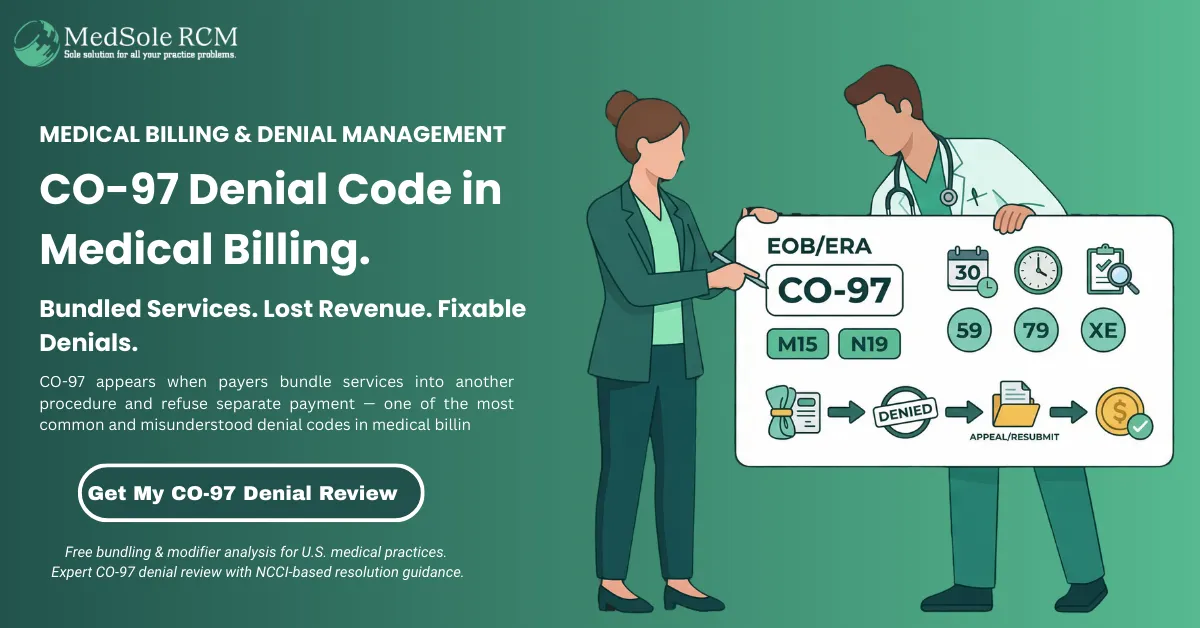




CO-97 denial code means the payer considers your service already included in the payment for another procedure. When this appears on your remittance advice, the claim has been denied due to bundling. It's one of the most common, and most frustrating, rejections in medical billing.
But here's the thing: CO-97 is usually fixable.
This guide covers exactly what it means, why your practice receives it, and how to resolve it. Updated for 2026.
What Is CO-97 Denial Code? Official Definition
CO-97 is a Claim Adjustment Reason Code (CARC). The official CO-97 denial code definition states, "The benefit for this service is included in the payment/allowance for another service/procedure that has already been adjudicated."
In plain terms, the payer believes you've already been paid for this service as part of another procedure. You billed something separately, but the insurance company considers it bundled into a payment they've already made. That's the CO-97 denial code description at its core.
The "CO" prefix matters. It stands for Contractual Obligation, meaning this adjustment falls under your contract with the payer. Denial code 97 with a CO prefix is typically a provider write-off, not patient responsibility. You can't balance bill the patient for this denied amount.
When CO-97 appears on your remittance, remark codes often appear alongside it. M15 and N19 are the most common. They tell you exactly why the payer applied the bundling logic. We cover those in detail later.
CARC 97 was last modified July 1, 2017, and appears in the 835 Loop 2110 REF segment of electronic remittance files.
What CO-97 Means for Your Practice's Revenue
A CO 97 denial means you won't receive separate payment for that service. Period. The payer has decided the service is bundled into another procedure you billed on the same claim or during the same visit. Your claim was denied, but not necessarily because you made a mistake.
Here's what actually happened. The insurance company looked at the codes you submitted and decided one service is already included in the payment for another. They're not saying you didn't perform the work. They're saying their contract doesn't allow separate reimbursement when those services appear together.
This isn't always a billing error. Sometimes it's a payer interpretation you can challenge. Studies show that 90% of claim denials are preventable, and CO-97 is one of the most commonly reversed denial codes when you handle it correctly with documentation or modifiers.
Can you bill the patient for CO 97? No. CO-97 falls under Contractual Obligation, meaning providers typically cannot bill patients for this denied amount. That revenue either gets recovered through appeal or corrected resubmission, or it's written off per your contract.
Ignoring these denials means leaving money on the table. Every bundled service denial deserves a review to determine if it's legitimate or correctable.
Common Causes of CO-97 Denials
When a denial is received for CO 97, it typically indicates one of five situations. Understanding the CO 97 denial code reason helps you determine whether the bundling is correct or if you have grounds to challenge it.
1. Bundled Procedures (NCCI Edits)
Certain procedure codes are automatically bundled under CMS's National Correct Coding Initiative (NCCI). When you bill two codes together and one is considered part of the other, CO-97 gets triggered. For example, if you bill a biopsy separately from a colonoscopy, the payer's NCCI edits may bundle the biopsy into the colonoscopy payment.
2. Services Within the Global Surgical Period
Surgeries include a global period where related follow-up services are included in the surgical payment. Minor procedures have a 10-day global period; major surgeries have 90 days. Billing an office visit or wound check separately during this window triggers CO-97 because the payer considers it part of the original surgical payment.
3. Missing or Incorrect Modifiers
Services might actually be distinct, but without the right modifier, the payer assumes bundling. If you perform two procedures on the same day that are normally bundled, you need modifier 59, 25, or 79 to show they were separate and distinct. Without that modifier, CO-97 denial is almost guaranteed.
4. Incidental Procedures
Some services are considered incidental to a primary procedure because they're routinely performed as part of it. Blood draws during an office visit, specimen collection during a biopsy, or basic prep work are common examples. These incidental procedures aren't separately reimbursable, even though you performed the work.
5. Duplicate Billing
If the same service appears twice on a claim or across multiple claims for the same date, CO-97 may deny the duplicate. This happens when a claim gets resubmitted before the first one processes or when two departments bill the same service without realizing it.
|
Cause |
What Happens |
Common Scenario |
|
Bundled Procedures |
Codes paired under NCCI edits |
Biopsy billed separately from colonoscopy |
|
Global Period Violation |
Service billed during post-op window |
Office visit 5 days after surgery |
|
Missing Modifier |
No indicator that services were distinct |
Two procedures, same day, no modifier 59 |
|
Incidental Procedure |
Service considered routine part of primary |
Blood draw billed with office visit |
|
Duplicate Billing |
Same service appears twice |
Claim submitted before prior adjudication |
These are the most common causes. Knowing which one applies to your denial determines your next step.
CO-97 vs PR-97 vs OA-97: What the Group Code Means
Here's what most practices miss: the "97" is just the reason code. The prefix tells you who's responsible for the denied amount. That distinction between CO vs PR determines whether you write it off or bill the patient.
|
Group Code |
Meaning |
Who Is Responsible |
Provider Action |
|
CO-97 |
Contractual Obligation |
Provider (write-off per contract) |
Review for appeal/correction opportunity |
|
PR-97 |
Patient Responsibility |
Patient |
May bill patient if contract allows |
|
OA-97 |
Other Adjustment |
Varies |
Review for specific payer guidance |
|
PI-97 |
Payer Initiated |
Payer |
Typically informational |
PR 97 denial code means the patient owes the denied amount because the service was bundled, but their plan structure allows patient billing. You'll see this with some high-deductible plans or non-covered services that fall to patient responsibility.
OA 97 denial code requires you to check the specific adjustment reason. This code appears when the bundling doesn't fit the standard CO or PR categories. Payer guidance will clarify next steps.
PI-97 denial code usually shows up on informational remittances where the payer is noting the bundling but no action is required from you.
Is CO 97 patient responsibility? No. With CO-97, you typically cannot bill the patient. The denial is based on your contractual agreement with the payer. That doesn't mean you should ignore it. CO-97 denials are often correctable with proper documentation or modifiers.
How to Resolve CO-97 Denial Code: Step-by-Step
How do I resolve a CO 97 denial code? The process depends on whether the bundling is correct or if you have grounds to challenge it. Here's the CO 97 denial solution that works in most cases.
Step 1: Review the Denial Notice and Remark Codes
Pull the EOB or ERA and look for the remark code that appears with CO-97. M15, N19, and N390 are the most common. These remark codes tell you exactly why the payer applied the bundling logic. Without this context, you're guessing.
If you have access to the 835 Loop 2110 REF segment in your electronic remittance, check it. That's where payers include additional claim-specific references that clarify which procedure absorbed the denied service.
Step 2: Identify the Bundling Relationship
Figure out which procedure code "absorbed" the denied service. Look at all codes billed on that claim or date of service. One of them is the primary procedure that the payer believes includes the denied service.
Check the NCCI edits, updated to version 32.0 as of January 2026. NCCI shows whether the codes are truly bundled or if unbundling is allowed with a modifier. Every code pair has a modifier indicator:
-
0 = Cannot unbundle (write-off required)
-
1 = Can unbundle with appropriate modifier if clinically supported
If the indicator is 1, you have options. If it's 0, the bundling stands unless you can show the services were performed in completely separate sessions or anatomical sites.
Step 3: Determine If a Modifier Applies
Were the services truly separate and distinct? If so, the right modifier can fix the CO 97 denial. Modifier 59 indicates a distinct procedural service. Modifier 25 allows an E/M visit on the same day as a procedure. Modifier 79 separates an unrelated procedure during the post-op period.
Review the documentation with your billing team. The services need to meet modifier criteria, not just coding preference. Payers audit modifier use aggressively, so documentation must support the claim.
Step 4: Correct and Resubmit OR Appeal
You have two paths to resolve CO 97 denial code issues:
Corrected Claim: If a modifier was simply missing and documentation supports it, file a corrected claim. Most payers process these within 30 days if properly submitted.
Appeal: If you believe the payer incorrectly applied bundling logic, submit an appeal with supporting documentation. Include medical records, your rationale for separate billing, and reference to NCCI guidelines if they support your position.
Step 5: Follow Up Within 14 Days
Track the resubmission or appeal in your system. Set a 14-day follow-up reminder. If you don't receive a response, call the payer and document the conversation, including the representative's name and reference number.
This is where most practices lose money. They submit the correction or appeal and assume it's handled. It's not handled until you see payment post.
Modifiers That Can Prevent or Fix CO-97 Denials
What modifier fixes CO-97 denials? Modifier 59 is the most common, but the right choice depends on the situation. Modifier 25 applies to E/M visits, modifier 79 applies to post-op procedures, and the X modifiers (XE, XS, XP, XU) provide more specificity than modifier 59 for documenting distinct services.
|
Modifier |
When to Use |
CO-97 Relevance |
|
59 |
Distinct procedural service (different session, site, or incision) |
Unbundles services that were separate |
|
25 |
Significant, separately identifiable E/M service |
Allows office visit payment on same day as procedure |
|
79 |
Unrelated procedure during post-op period |
Separates new procedure from global surgery |
|
XE |
Separate encounter |
More specific than 59 |
|
XS |
Separate structure |
More specific than 59 |
|
XP |
Separate practitioner |
More specific than 59 |
|
XU |
Unusual non-overlapping service |
More specific than 59 |
Use modifier 59 when two procedures were performed in separate sessions, at different anatomical sites, or through different incisions. This modifier 59 designation signals to the payer that the services weren't bundled because they were truly distinct, not just codes billed together for convenience.
Apply modifier 25 when you bill an office visit on the same day as a procedure and the E/M service was significant and separately identifiable. The visit can't just be the decision to perform the procedure. Your documentation must show distinct evaluation work beyond what's inherent in the procedure itself.
Modifier 79 separates an unrelated procedure from the global surgical period. When you perform a new surgery during the post-op window, modifier 79 tells the payer it's separate from the original surgery's bundled services. Without it, CO-97 denial is almost certain.
The X modifiers were created to provide more specificity than modifier 59. CMS prefers them when applicable. These X modifiers reduce ambiguity about why services should unbundle, making them harder for payers to challenge. They're relatively new, but many payers now expect them instead of blanket modifier 59 use.
Here's the critical compliance point: modifiers should only be used when documentation supports the services as truly distinct. Overuse of modifier 59 to force payment is a compliance red flag that can trigger audits. Payers track modifier patterns across your claims, and high modifier usage flags your practice for closer review and potential recoupment.
CO-97 Handling by Payer: Medicare, BCBS & Commercial Plans
Each payer handles CO-97 differently. Knowing these differences determines whether you appeal or accept the write-off.
Medicare CO-97 Denials
Medicare denial code CO 97 follows NCCI edits strictly. Check the Medicare Physician Fee Schedule for Status Indicator "B", which means always bundled with no exceptions. For surgical global periods, Medicare enforces the 10-day rule for minor procedures and 90-day rule for major surgeries without flexibility.
As of January 1, 2026, NCCI version 32.0 is in effect. Medicare updates these quarterly, and CO 97 denial code Medicare patterns change with each update. When Medicare denies with CO-97, your first step is checking the current NCCI edit table to verify if unbundling is even possible.
Blue Cross Blue Shield (BCBS)
BCBS plans operate independently, and CO 97 denial code BCBS handling varies by state and product. Many BCBS plans follow NCCI but add their own proprietary bundling edits on top. Check your specific BCBS plan's provider manual; don't assume all Blues follow Medicare rules.
Some BCBS plans allow more modifier flexibility than Medicare. Where Medicare might reject modifier 59 completely, certain BCBS plans accept it with proper documentation.
Commercial Payers (Aetna, UHC, Cigna)
Commercial insurance companies often start with NCCI edits but layer additional bundling rules. Aetna might bundle services that UHC pays separately. Always verify bundling rules through the payer's provider portal or fee schedule before assuming a denial is correct.
Appeal rights and timelines vary significantly. Commercial insurance typically allows 180 days for appeals versus Medicare's 120 days. State regulations can extend these deadlines further.
CO-97 Updates for 2026: What's Changed
The bundling rules that trigger CO-97 changed significantly in 2026, though the denial code definition itself hasn't been modified since July 1, 2017.
NCCI Version 32.0 (Effective January 1, 2026)
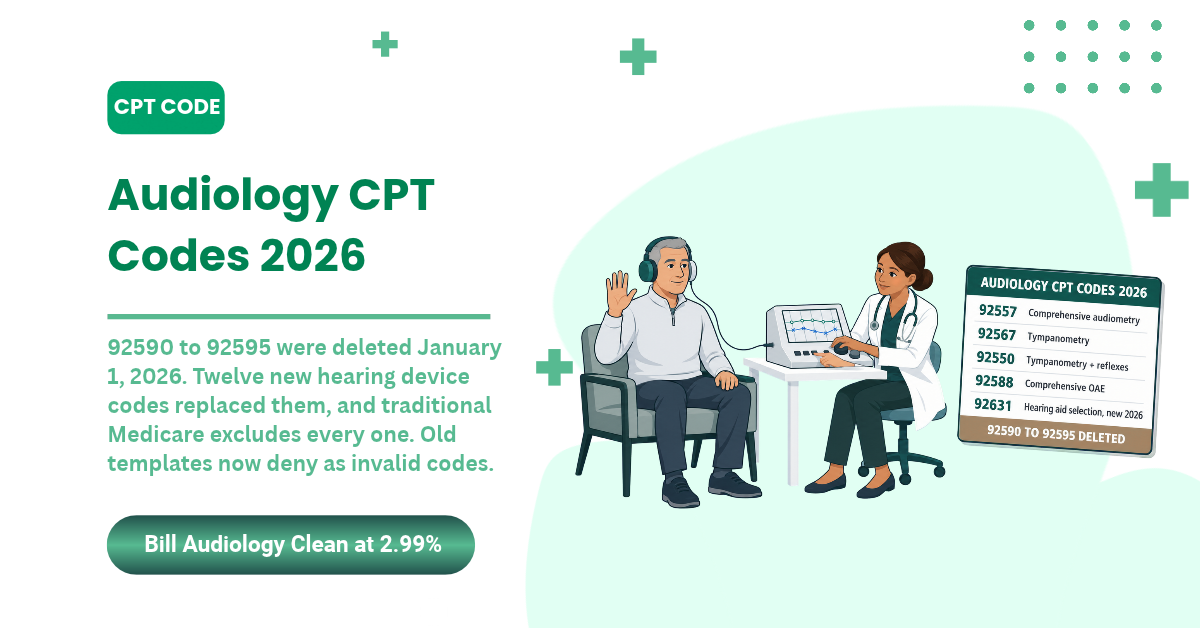
NCCI edits version 32.0 brought three major changes. First, audiology codes 92590-92595 were deleted and replaced with 12 new codes with stricter bundling rules. If you're an ENT or audiology practice, check your January claims carefully.
COVID-19 vaccine administration (CPT 90480) bundling error was finally corrected. CMS admitted the prior NCCI edits incorrectly bundled this with office visits. If you received CO-97 for COVID vaccine administration in 2025, appeal those denials immediately. You have money waiting.
Remote monitoring and AI-augmented analysis codes now have strict bundling parameters. These services can't be billed separately from the primary telehealth or diagnostic service in most cases.
TEAM Model Impact
The Transforming Episode Accountability Model went mandatory January 2026. It affects lower joint replacement, spinal fusion, CABG, and major bowel procedures. Services within the 30-day episode window may trigger CO-97 denials because they're considered inclusive in the bundled payment.
CMS Transmittal Updates
CMS Transmittal R13482CP (CR 14295), issued December 5, 2025, becomes effective April 6, 2026. While it doesn't change CARC 97's definition, it updates how Medicare contractors process bundling logic. Expect stricter enforcement of existing NCCI edits after April.
Remark Codes That Appear with CO-97
CO-97 rarely appears alone. Remark codes provide the specific reason why the payer bundled your service. These codes turn a generic denial into actionable information.
|
Remark Code |
Meaning |
What It Tells You |
|
M15 |
Separately billed service/test included in main procedure |
Service was bundled into primary procedure payment |
|
N19 |
Procedure code incidental to primary procedure |
Service considered routine part of main procedure |
|
N390 |
Refer to healthcare policy |
Check payer's specific policy for bundling rules |
|
M144 |
Pre-payment review |
Claim reviewed for potential bundling before payment |
M15 remark code is the most common. When you see it with CO-97, the payer's saying your separately billed service is already paid within the main procedure's reimbursement.
N19 tells you the denied service is considered incidental. It's something payers expect you to perform as part of the primary procedure without extra payment. Lab specimen collection during a biopsy is a typical N19 situation.
N390 means you need to check the payer's specific bundling policy. Each payer has unique rules beyond standard NCCI edits. Without reviewing their policy, you're guessing at the denial reason.
How to Prevent CO-97 Denials Before They Happen
Prevention beats correction every time. You can avoid most CO-97 denials with the right processes in place before claims go out the door.
For Your Billing Team:
-
Verify NCCI edits before claim submission (use January 2026 v32.0)
-
Apply appropriate modifiers when services are distinct
-
Check global surgery periods before billing E/M services
-
Use claim scrubbing software with current edit tables
For Your Practice:
-
Ensure documentation clearly supports distinct services
-
Train staff on bundling rules for your specialty's common procedures
-
Track CO-97 denial patterns to identify recurring issues
-
Review payer contracts for bundling-related provisions
-
Conduct regular audits of denied claims
-
Monitor NCCI updates quarterly
-
Establish a denial follow-up workflow
The key to prevention is catching bundling issues before submission. Your billing team needs current NCCI edits loaded into their system. Staff need training on when modifiers apply. Documentation must clearly show why services were separate and distinct.
Most practices don't prevent CO 97 denial patterns because they're reactive, not proactive. They fix denials after they happen instead of building prevention into their workflow. That's expensive firefighting.
If CO-97 denials are impacting your practice's cash flow, MedSole RCM can help. Our denial management specialists identify patterns, correct claims, and prevent future bundling issues. Contact us for a free denial analysis.
Frequently Asked Questions About CO-97 Denial Code
Q1: What does CO-97 mean on an EOB?
A: CO-97 on an Explanation of Benefits means the payer considers your billed service already included in the payment for another procedure. "CO" indicates Contractual Obligation, which is typically a provider write-off, not patient responsibility. The service was bundled into another procedure's reimbursement, so you won't receive separate payment for it.
Q2: Can you bill a patient for CO-97?
A: Generally, no. CO-97 falls under Contractual Obligation, meaning the denial is based on your agreement with the payer. Providers typically cannot balance bill patients for CO-97 denials unless your contract specifically allows it. The write-off is your responsibility, not the patient's. Check your payer contract for any exceptions.
Q3: What is the difference between CO-97 and PR-97?
A: CO-97 (Contractual Obligation) means the provider must write off the amount. PR-97 (Patient Responsibility) means the patient may be billed. The "97" reason code is the same; the prefix determines who pays. With CO-97, you absorb the cost. With PR-97, the patient owes the denied amount.
Q4: How do I resolve a CO-97 denial code?
A: Review the denial notice and remark codes, check NCCI edits for bundling rules, determine if a modifier (like 59 or 25) applies, then either resubmit a corrected claim or file an appeal with supporting documentation. The key is proving services were distinct and separately billable, not bundled.
Q5: Is CO-97 patient responsibility?
A: No. CO-97 uses the "CO" prefix, which means Contractual Obligation. This is typically a provider write-off per your payer contract, not an amount you can bill to the patient. You're contractually required to accept the payer's bundling decision unless you successfully appeal it.
Q6: What modifier fixes CO-97 denials?
A: Modifier 59 (distinct procedural service) is most commonly used. Modifier 25 applies for E/M services, and modifier 79 for unrelated post-op procedures. Only use modifiers when documentation supports distinct services. The right modifier depends on why services were separate: different session, site, or encounter.
Q7: What does bundled mean for CO-97?
A: "Bundled" means the payer considers your billed service as part of another procedure's payment. When services are bundled, they're not separately reimbursable, triggering CO-97 denial. The payer believes you've already been paid for the service within another procedure's reimbursement.
Q8: What is NCCI and how does it relate to CO-97?
A: The National Correct Coding Initiative (NCCI) establishes code pair edits that define which services are bundled. NCCI edits are the primary driver of CO-97 denials, especially for Medicare claims. These edits prevent unbundling of services that are typically performed together. Check current NCCI tables to understand bundling rules.
Q9: Can CO-97 denials be appealed?
A: Yes. If you believe services were truly distinct and documentation supports separate billing, you can appeal. Include medical records, modifier justification, and reference the NCCI modifier indicator if applicable. Success depends on proving services were separate and distinct, not routinely bundled components of the primary procedure.
Q10: What is the global period and how does it cause CO-97?
A: The global surgical period (10 days for minor, 90 days for major surgery) includes pre- and post-operative care in the surgical payment. Billing separately during this period triggers CO-97. All routine follow-up visits, wound checks, and related E/M services are considered bundled into the surgical payment.
Q11: What does denial code CO-96 mean?
A: CO-96 means "Non-covered charges." Unlike CO-97 (bundled), CO-96 indicates the service isn't covered at all by the patient's plan. These require different resolution approaches. CO-96 services were never benefits, while CO-97 services are benefits already paid within another procedure.
Q12: What are the most common denial codes in medical billing?
A: Common denial codes include CO-97 (bundled service), CO-16 (missing information), CO-4 (modifier issue), CO-45 (exceeds fee schedule), and CO-50 (non-covered service). Each requires specific resolution steps. CO-97 is among the most frequent because bundling rules are complex and constantly changing.
Q13: What is the 97 modifier for Medicare?
A: Modifier 97 indicates a rehabilitative service (as opposed to habilitative). This is different from denial code CO-97, which refers to bundled services. Don't confuse modifier 97 with CARC 97. One's a service designation for therapy claims; the other's a denial reason for bundled procedures.
Q14: What are the top 5 denials in medical billing?
A: Top denials include: (1) CO-16 – missing/incomplete information, (2) CO-97 – bundled service, (3) CO-4 – modifier issue, (4) CO-45 – exceeds charge limit, and (5) CO-50 – non-covered service. CO-97 consistently ranks high because bundling edits affect most specialties.
Q15: What does CO mean on a claim?
A: "CO" stands for Contractual Obligation. It indicates the adjustment is based on your contract with the payer and is typically a provider write-off, not billable to the patient. You're contractually obligated to accept the payer's payment terms and cannot seek additional payment from the patient.
Stop Losing Revenue to CO-97 Denials
CO-97 denials are common, but they're also preventable. Understanding bundling logic is the first step. Once you know why payers bundle services, you can stop the denial before it happens.
Proper modifiers and clear documentation prevent most issues. When your billing team checks NCCI edits before submission and applies the right modifiers, bundling denials drop significantly. Strong documentation gives you leverage if you need to appeal.
When a CO-97 denial does occur, systematic resolution recovers revenue. Don't let these adjustments sit in your aging report. Review, correct, and follow up until it's resolved.
At MedSole RCM, we specialize in identifying denial patterns that drain practice revenue. Our team handles CO-97 corrections, appeals, and prevention strategies so you can focus on patient care. Ready to reduce your denial rate? Schedule a free revenue cycle assessment and see how much bundling denials are costing your practice.
Reviewed by: Andrew Christian, CPC, CCS — Revenue Cycle Manager at MedSole RCM with 12 years of experience in denial management and medical coding compliance.
Note: This guide reflects NCCI edits version 32.0 (effective January 1, 2026) and CMS Transmittal R13482CP. Coding rules change quarterly; verify current edits before claim submission.