


![CPT Code 99213: The Definitive 2026 Provider Guide [+Reimbursement Rates & Free Tools]](/_imgs/blogs/56993_cpt-code-99213-medical-billing-guide-2026_11zon.webp)
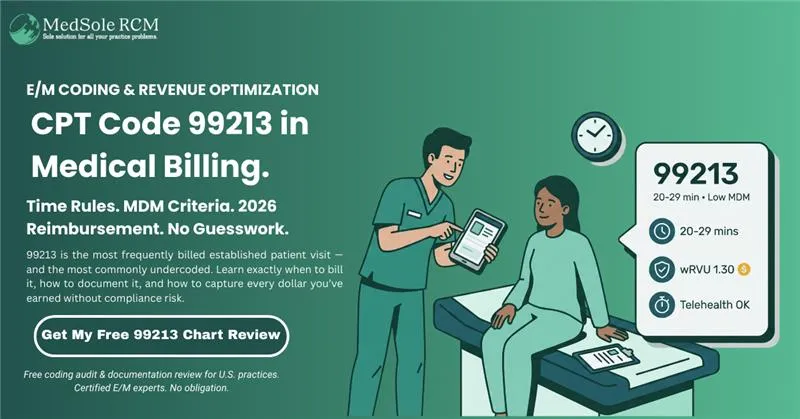
CPT Code 99213 is an Evaluation and Management (E/M) code for an established patient office or outpatient visit lasting 20-29 minutes or requiring low-level medical decision-making (MDM). It is the most commonly billed E/M code in outpatient medicine, used for follow-up visits, stable chronic disease management, and minor acute problems.
What Is CPT Code 99213? (The Official Definition for 2026)
Official CPT Description
The AMA's CPT Manual defines 99213 as:
"Office or other outpatient visit for the evaluation and management of an established patient, which requires a medically appropriate history and/or examination and low level of medical decision-making. When using total time on the date of the encounter for code selection, 20 minutes must be met or exceeded."
[Source: American Medical Association CPT Manual 2026]
Let me translate that into plain English. CPT code 99213 is what you bill when an established patient comes in for a straightforward visit. Think routine follow-ups, stable chronic conditions, or simple acute problems that don't require complex workup.
The 99213 CPT code description sounds technical, but the practical meaning is simple: low complexity, established patient, office setting. That's it.
What counts as an "established patient"?
Someone your practice has seen within the past three years qualifies as established. Here's the catch: it must be the same specialty or subspecialty within your group. A patient who saw your orthopedic colleague last month is still "new" if they're seeing your cardiology department for the first time.
Same tax ID, same specialty, within three years. Miss any of those conditions, and you're looking at new patient codes instead.
History and exam aren't scored anymore
Before the 2021 evaluation and management changes, you had to document specific elements of history and exam to justify your code level. That's no longer the case.
Now, history and physical exam must be "medically appropriate" for the presenting problem. You still document them because they're clinically necessary, but they don't determine your code level. Medical decision-making or time handles that now. Many providers still over-document out of habit, but it doesn't help your reimbursement.
Why 99213 Is the Workhorse of Outpatient Medicine
According to CMS utilization data, CPT code 99213 accounts for over 25% of all office-based E/M claims submitted to Medicare annually. It's consistently among the top five most-billed codes in the country.
The reason is straightforward. This level 3 office visit captures your typical established patient encounters: medication refills with a quick review, stable diabetes check-ins, blood pressure follow-ups, minor acute problems like uncomplicated UTIs.
99213 sits right in the middle of the E/M hierarchy. It's more involved than a 99212, which covers minimal issues. But it doesn't require the moderate decision-making that bumps you to 99214. Most practices find their established patient visits naturally cluster around this level.
Here's why that matters for your practice: understanding 99213 gives you a baseline for the entire E/M scale. Once you know what qualifies at this level, distinguishing between lower and higher codes becomes much clearer. It's the reference point everything else builds from.
Who Can Bill 99213?
Multiple provider types can bill this code:
- Physicians (MD and DO)
- Nurse Practitioners
- Physician Assistants
- Clinical Nurse Specialists
- Certified Nurse Midwives
Other qualified healthcare providers may also bill, depending on payer rules and state scope of practice laws. Medicare has specific guidelines about "incident to" billing when NPs and PAs work under physician supervision. Commercial payers often layer on their own credentialing requirements.
What flies with one payer might get denied by another. And what's allowed in one state could be prohibited next door. This isn't an area where you can assume.
Before billing 99213 under any provider's NPI, verify two things. First, confirm they're credentialed with the specific payer. Second, make sure state law authorizes them to bill independently for E/M services. Skip either step and you're setting yourself up for denials, or worse, recoupment demands later.
Unsure if your documentation supports the level you're billing? MedSole RCM offers complimentary chart reviews for new clients.
2026 Updates: What Changed for CPT Code 99213
2026 Medicare Physician Fee Schedule (PFS) Final Rule
The 2026 Medicare fee schedule brought a twist that affects every practice differently. CMS now uses two separate conversion factors depending on your participation status in Alternative Payment Models.
Here's what that looks like:
|
Participant Type |
2026 Conversion Factor |
|
Qualifying APM (QP) |
$33.5675 |
|
Non-QP (Standard) |
$33.4009 |
For 99213 reimbursement in 2026, the good news is that relative value units stayed put. Work RVU remains at 1.30, and total RVUs for non-facility settings clock in at approximately 2.75. Your actual payment depends on which conversion factor applies to your practice.
Let me break down the math. If you're a standard non-QP practice billing 99213 in an office setting, you're looking at roughly $91.85 per visit. Qualifying APM participants see slightly more, around $92.30. The difference is modest per claim, but it adds up across your patient volume.
What didn't change matters just as much. CMS considered revaluing E/M codes again but left 99213 alone. After the major 2021 restructuring, the code has found stable footing in the fee schedule. Your RVU calculations from last year still apply.
Efficiency Adjustment: 99213 Is Exempt
CMS introduced a new efficiency adjustment in 2026 that cut reimbursement for many procedure codes by 2.5%. The logic was that certain services have become faster to perform due to technology and workflow improvements. Surgical codes took the biggest hit.
Here's what matters for your E/M billing: 99213 and other office visit codes are specifically exempt from this adjustment.
"Unlike many surgical codes, 99213 was protected from the 2026 efficiency adjustment, preserving its relative value in the fee schedule." — MedSole RCM Analysis
That's a relative win for primary care and office-based practices. While colleagues in procedural specialties absorb cuts, your core established patient visits maintain their value. In a year where the overall conversion factor barely moved, avoiding a 2.5% haircut is meaningful.
The exemption recognizes something billing professionals have known for years: E/M visits haven't gotten faster. If anything, documentation requirements and patient complexity have made them more time-intensive. CMS got this one right.
Split/Shared Visit Rule Harmonization
The 2026 rule changes how split/shared visits work, and this one's a practical improvement. CMS finally aligned with the AMA's definition of "substantive portion," which determines who gets to bill for the visit.
Under the old rules, the billing provider had to perform more than 50% of the total time. That created awkward situations. A physician might make all the clinical decisions while an NP handled patient education, yet the NP would bill because they spent more minutes in the room.
The 2026 rule fixes this. Now, the substantive portion can be based on either total time or medical decision-making. Whoever performs the substantive MDM can bill regardless of who spent more face time with the patient.
Here's a real example. A physician reviews lab trends and adjusts an insulin regimen based on A1C results, which takes 10 minutes of MDM work. Meanwhile, the NP spends 20 minutes on diabetes education and foot care instructions. Under old rules, the NP bills at the reduced rate. Under 2026 rules, the physician bills 99213 at full Medicare rate because they performed the substantive clinical decision-making.
This matters for practices that rely on team-based care. Your physicians can focus on complex decisions while NPs and PAs handle education and counseling. Everyone works at the top of their license, and billing reflects who actually drove the clinical thinking.
Telehealth Permanence for 99213
After years of temporary waivers and extensions, 99213 telehealth rules are now permanent. The patient's home qualifies as an originating site without geographic restrictions. You don't need to prove the patient lives in a rural area or health professional shortage zone.
Billing 99213 for telehealth requires a few specific elements. The visit must use real-time audio and video technology. Append 99213 modifier 95 to indicate synchronous telehealth. Some commercial payers still want modifier GT instead, so check your contracts before submitting.
Place of Service codes matter here. Use POS 10 when the patient is at home, which is now the standard for most telehealth encounters. Medicare pays the same rate for telehealth 99213 as it does for in-office visits when you use POS 10 with proper documentation.
Audio-only visits don't qualify for 99213. If you're conducting a phone-only follow-up, you'll need telephone E/M codes (99441 to 99443) instead. These pay less and have different time thresholds. The audio-video requirement isn't going away, so invest in reliable telehealth platforms if you haven't already.
One caveat: state licensure still applies. You can bill Medicare for telehealth 99213 when the patient is across state lines, but only if you're licensed in that patient's state. The billing permanence didn't solve the patchwork of state licensing requirements that complicate multi-state telehealth practices.
When to Use CPT Code 99213: Clinical Scenarios for Providers
Knowing the definition of 99213 is one thing. Recognizing it in your exam room is another. This section breaks down exactly when this code fits, when it doesn't, and how to make the call with confidence.
Perfect 99213 Scenarios
The 99213 CPT code works best for straightforward established patient encounters that require some clinical thinking but don't get complicated. Here's what that looks like in practice:
- Routine follow-up for one stable chronic illness: Think well-controlled hypertension, stable diabetes with good A1C, or hypothyroidism on steady levothyroxine dosing.
- Minor acute problems: Uncomplicated URI, mild UTI without fever or flank pain, simple contact dermatitis, or a minor rash that needs topical treatment.
- Medication refill with brief review: Patient needs their statin renewed, you confirm they're tolerating it, check that LDL is at goal, and continue the current regimen.
- Post-procedure follow-up without complications: Suture removal after laceration repair, routine check after minor skin excision, or clearance after colonoscopy with benign findings.
- Single lab result review with minor adjustment: TSH came back slightly elevated, you bump the levothyroxine dose and schedule a recheck.
The common thread here is low complexity. You're managing conditions that aren't spiraling, making minor tweaks rather than major interventions, and working with predictable clinical situations. One problem, one straightforward plan.
When NOT to Use 99213
Here's where practices lose money or invite audit risk: billing 99213 when the visit actually supports something higher, or using it when a different code category applies entirely.
Don't use 99213 for new patients. If this is the patient's first visit to your practice, or their first encounter with your specialty in more than three years, you need new patient codes (99202 to 99205). Established patient codes require that prior relationship.
99212 vs 99213 matters when visits are quick and simple. If your total time falls under 20 minutes and the MDM is straightforward rather than low, you're looking at 99212. A blood pressure recheck with no medication changes and no other issues discussed? That's probably 99212 territory.
99213 vs 99214 is the more common question. When you cross into moderate complexity, you've left 99213 behind. Multiple chronic conditions being actively managed? That's 99214. One condition that's worsening or not responding to treatment? Also 99214. New problem with uncertain prognosis? You guessed it.
Preventive visits have their own codes. Annual wellness exams, Medicare AWVs, and routine physicals use the preventive medicine series (99381 to 99397 for age-based, G0438/G0439 for Medicare wellness). Don't bill 99213 for a visit that's primarily preventive, even if you address a minor issue during the encounter.
Watch for bundling issues with procedures. If the entire visit centers on performing a procedure, the E/M may not be separately billable. You'll need Modifier 25 to justify a separate 99213 when both a procedure and a distinct E/M service occur on the same day.
Real-World Clinical Examples
Abstract rules only go so far. Let's walk through actual patient scenarios and break down why each one lands at 99213.
Example 1: Diabetes Follow-Up Visit
Patient: 52-year-old male with Type 2 diabetes, last A1C 6.8%
Visit: 22 minutes total. You review home glucose logs showing good control, confirm medication adherence, perform a brief foot exam, continue metformin at current dose, and order an A1C recheck for three months out.
Code: 99213
Why: This is a stable chronic illness requiring low MDM. You're not adjusting medications, the condition isn't worsening, and you're making no significant changes to the treatment plan. Time falls squarely in the 20 to 29 minute range, which also supports this level.
Example 2: UTI in Established Patient
Patient: 34-year-old female with history of recurrent UTIs, now presenting with dysuria for two days
Visit: 18 minutes total. Focused history confirms classic symptoms without fever or back pain. You order a urinalysis for confirmation and start empiric antibiotics based on her previous culture sensitivities.
Code: 99213
Why: Acute uncomplicated illness with low MDM. Even though time is under 20 minutes, MDM alone can justify the code level. You're treating a straightforward acute problem with standard therapy. No diagnostic uncertainty, no significant risk from the treatment plan.
Example 3: Medication Adjustment for Side Effects
Patient: 68-year-old female on lisinopril for hypertension, now reporting persistent dry cough for six weeks
Visit: 24 minutes. Review confirms the cough started after initiating the ACE inhibitor, no other respiratory symptoms. Switch to losartan, counsel on what to expect during the transition, schedule a follow-up to check blood pressure response.
Code: 99213
Why: Low MDM with a minor treatment adjustment. You're managing a known side effect of a common medication class with a standard therapeutic substitution. The decision-making isn't complicated, even though it requires clinical judgment.
Example 4: Anxiety Follow-Up, Stable on Medication
Patient: 41-year-old male with generalized anxiety disorder, maintained on sertraline 100mg
Visit: 21 minutes. Patient reports good symptom control with current medication. Sleep is improved, no panic episodes in two months. Brief mental status exam shows no acute concerns. Continue current regimen, return in three months.
Code: 99213
Why: Stable psychiatric condition on maintenance therapy. You're confirming the treatment plan is working, not making significant changes. Low MDM because there's no exacerbation, no new symptoms, and no medication adjustment needed.
Example 5: Post-Procedure Check After Skin Biopsy
Patient: 55-year-old female returning for results after punch biopsy of a suspicious mole
Visit: 20 minutes. Pathology shows benign intradermal nevus. You review the findings with the patient, explain that no further treatment is needed, examine the biopsy site for healing, and discuss sun protection.
Code: 99213
Why: Follow-up visit with benign results and no new treatment required. MDM is low because you're reviewing one test result with a reassuring outcome. No additional workup, no management changes, no ongoing treatment decisions.
The Pattern to Recognize
Look across these examples and you'll see what 99213 visits have in common. One problem at a time. Conditions that are stable or uncomplicated. Treatment decisions that don't carry significant risk. Visits that take 20 to 29 minutes, or require low-level clinical thinking even when they're quicker.
When you start seeing multiple problems, worsening conditions, or treatment decisions that carry real risk, you've moved beyond 99213. That's not a billing opportunity to chase; it's just accurate coding that reflects the work you're actually doing.
Time vs. Medical Decision-Making: How to Select the Right E/M Level
This is where coding gets confusing for a lot of providers. You've got two completely different ways to justify your E/M level, and knowing which one to use can mean the difference between accurate billing and leaving money on the table.
The Two Pathways to Code Selection
Since the 2021 E/M revisions took effect, you have two independent options for selecting your code level:
- Total time spent on the date of the encounter
- Level of medical decision-making required for the visit
Here's the critical point: you don't need to meet both. Pick whichever pathway supports the level you're billing. If your time hits the 99213 time requirement but your MDM only supports 99212, bill 99213. If your MDM supports 99214 but your time falls short, bill 99214. Each pathway stands on its own.
History and physical exam still matter clinically. You perform them as medically appropriate for the patient's problem. But they don't determine your code level anymore. That old checkbox mentality of counting HPI elements and review of systems bullets? Gone. The exam documentation requirements that had everyone documenting 10 organ systems for a sore throat? Also gone.
Your job now is simpler: document your clinical thinking or document your time. Do one well, and you've justified your code.
Time-Based Coding for 99213
When you're using time to select your level, the 99213 time duration requirement is 20 to 29 minutes of total time on the date of the encounter. Not face-to-face time. Total time.
Here's what counts toward that total:
- Face-to-face time with the patient, whether in-person or via telehealth
- Reviewing test results, records, or imaging
- Ordering medications, tests, or referrals
- Documenting in the medical record
- Coordinating care with other providers or staff
- Independently interpreting results you didn't order
What doesn't count: time spent on a different calendar date. If you reviewed labs yesterday and see the patient today, yesterday's chart review doesn't add to today's total. Only same-day activities qualify.
E/M Time Thresholds for Established Patients (2026)
CodeTotal Time on Date of Encounter9921210 to 19 minutes9921320 to 29 minutes9921430 to 39 minutes9921540 to 54 minutes
Time-based coding works best when your visits consistently run long but the clinical complexity stays low. Think about the patient who needs extensive counseling about lifestyle changes for prediabetes. The decision-making is simple: continue current approach, reinforce diet and exercise. But you spent 25 minutes educating them. That's a 99213 by time, even though MDM might only support 99212.
Document your time clearly. A simple statement works: "Total time spent on date of encounter: 24 minutes, including face-to-face visit, medication review, and documentation." Vague language like "extended time spent" won't survive an audit.
MDM-Based Coding for 99213
Medical decision-making is the other pathway, and for most established patient visits, it's the more natural fit. The 99213 requires low complexity MDM, which means meeting at least two of the three MDM elements.
Element 1: Number and Complexity of Problems Addressed
For low complexity, you need one of the following:
- Two or more self-limited or minor problems
- One chronic illness that's stable, improving, or worsening
- One acute uncomplicated illness or injury
A patient with controlled hypertension meets this. So does someone with a straightforward UTI. Two minor complaints like mild headache plus nasal congestion also qualifies.
Element 2: Amount and Complexity of Data Reviewed
Low complexity requires limited data review. That means:
- Reviewing or ordering tests from one category (labs, imaging, or other)
- Reviewing prior external notes or obtaining history from someone other than the patient
You don't need to review data from multiple sources. One category is enough. Ordering a urinalysis for that UTI patient checks this box.
Element 3: Risk of Complications or Morbidity
Low risk includes:
- Prescription drug management
- Minor surgery with no identified risk factors
- Physical therapy or occupational therapy
- IV fluids without additives
OTC medications alone would be minimal risk, dropping you to 99212 territory. But the moment you prescribe an antibiotic, NSAID, or any scheduled medication, you're at low risk.
You must meet two of these three elements. Most 99213 visits hit problems plus risk. You're seeing one stable chronic condition and managing it with prescription medication. That's two elements right there, regardless of whether you reviewed any outside data.
When Time and MDM Point to Different Levels
Sometimes your time suggests one code while your MDM suggests another. When that happens, you bill the higher level, as long as you've documented the supporting pathway properly.
Consider this scenario. A patient comes in for a diabetes follow-up. You spend 35 minutes total, mostly on education about insulin technique and carb counting. But the MDM is low: stable chronic condition, prescription management, one category of data reviewed. Time supports 99214 (30 to 39 minutes). MDM supports 99213 (low complexity).
Bill 99214. Your time documentation justifies the higher level.
Now flip it. A 22-minute visit where you're managing a chronic condition that's worsening, reviewing labs from the hospital plus outside records, and adjusting multiple medications. That's moderate MDM, even though your time only hits the 99213 threshold. Bill 99214 based on MDM.
The key is documenting the pathway you're relying on. If you bill by time, your note needs the total time and activities. If you bill by MDM, your note needs to show the problems addressed, data reviewed, and risk level. Auditors won't guess which pathway you meant to use. Show your work.
One last point: when both pathways support the same level, you're in the clear either way. A 24-minute visit with low MDM? That's 99213 by both measures. Document whichever is easier for your workflow, and you're covered.
99213 vs 99214: Complete Comparison Guide with Decision Tree
The 99213 vs 99214 decision is where most providers either capture their true work or leave significant revenue uncollected. This isn't about gaming the system. It's about coding accurately for the complexity you're actually managing.
Head-to-Head Comparison Table
ComponentCPT 99213CPT 99214ComplexityLowModerateTime Range20 to 29 minutes30 to 39 minutesProblems Addressed1 stable chronic OR 1 acute uncomplicated OR 2+ minor1+ chronic with mild exacerbation OR 2+ stable chronic OR new problem with uncertain prognosisData ReviewLimited (1 category)Moderate (2+ categories OR independent interpretation)Risk LevelLowModerate2026 Medicare (Office)~$91.85~$131.45Work RVU1.301.92Revenue DifferenceBaseline+$39.60 per visit (+43%)
The numbers tell the story. CPT 99214 reimburses 43% more than 99213 for Medicare patients. That differential holds roughly consistent across commercial payers, though exact amounts vary by contract.
But here's what matters more than the dollar difference: the clinical distinction between these levels is real. You're not choosing between two arbitrary billing options. You're documenting whether you managed low complexity or moderate complexity medical decision-making.
Decision Tree: 99213 or 99214?
Making this call gets easier when you follow a systematic approach. Here's how to think through the decision for each encounter.
Start with patient status. Is this an established patient? If not, you're in the wrong code family entirely. New patients use 99202 to 99205, regardless of complexity.
Count the problems you're actively managing. One stable chronic condition points toward 99213. Two or more stable chronic conditions push you toward 99214. One chronic condition that's worsening or not responding to treatment? That's 99214 territory.
Assess the nature of new problems. A new acute problem with straightforward presentation fits 99213. New symptoms with uncertain diagnosis or unclear prognosis elevate you to 99214. The difference isn't severity alone; it's diagnostic uncertainty and treatment complexity.
Review the data you're working with. Ordering or reviewing tests from one category (labs only, or imaging only) supports low complexity. Reviewing multiple categories, interpreting tests independently, or obtaining records from outside facilities moves you toward moderate complexity.
Calculate your risk level. Prescription drug management alone is low risk. When you're adjusting multiple medications, starting a new drug with significant interaction potential, or managing a treatment that requires monitoring, you're at moderate risk.
Check your total time. Spent 30 minutes or more? You can bill 99214 on time alone, regardless of MDM. Under 30 minutes doesn't automatically mean 99213, though. MDM can still support the higher level even when time doesn't.
[DOWNLOAD] 99213 vs 99214 Cheat Sheet (PDF) — Print-ready comparison card for your office
Want a personalized billing optimization review? MedSole RCM identifies undercoding patterns that leave money on the table.
Real Cases: Was It 99213 or 99214?
Abstract rules only take you so far. Let's walk through actual scenarios and break down the coding decision for each one.
Case A: Hypertension Follow-Up with Worsening Control
Patient with HTN previously controlled on lisinopril 10mg. BP today is 152/94, up from 130/80 at last visit three months ago. You increase lisinopril to 20mg, add HCTZ 12.5mg, order BMP to check potassium and creatinine before starting the diuretic, and schedule a four-week follow-up to reassess.
This is 99214.
Why? You're managing one chronic condition that's worsening, not stable. That alone elevates the problem complexity. You're also initiating a new medication class (moderate risk) and ordering labs to guide treatment (data review). Even if your total time was only 25 minutes, the MDM supports 99214.
Case B: Diabetes Routine Maintenance
Patient with Type 2 diabetes, A1C stable at 6.9%, home glucose logs show good control. Continue metformin at current dose, reinforce diet and exercise plan, schedule six-month follow-up. Total visit time: 23 minutes.
This is 99213.
You're managing a stable chronic condition with no treatment changes. Low complexity MDM, low risk (prescription management), minimal data review. Time falls in the 99213 range. Everything points to the lower level, and that's appropriate for the work performed.
Case C: New Fatigue, Limited Initial Workup
45-year-old established patient presents with three weeks of fatigue. No other symptoms, no weight changes, no sleep disturbance. Physical exam unremarkable. Order CBC, TSH, and CMP to screen for common causes. Plan to return in one week for results and further evaluation if needed. Total time: 28 minutes.
This is 99213.
The problem is new, which might suggest higher complexity, but it's uncomplicated at this stage. You're ordering initial screening labs (one category of data), and the treatment plan is low risk (diagnostic workup only, no treatment initiated). MDM is low despite the new complaint.
Case D: Multiple Chronic Conditions, All Stable
68-year-old with hypertension, hyperlipidemia, and GERD, all well-controlled on current medications. BP is 128/78, patient tolerating statin without side effects, no reflux symptoms. Review medication list, continue all current drugs, order lipid panel for next visit. Total time: 26 minutes.
This is 99214.
Here's where many providers undercode. You're managing two or more stable chronic conditions. That meets the moderate complexity threshold for problems addressed, even though nothing is changing. The number of conditions, not just their stability, determines complexity. Bill 99214 based on MDM.
Case E: Acute Illness with Diagnostic Uncertainty
55-year-old presents with one week of intermittent chest discomfort. Not clearly cardiac, not clearly musculoskeletal. No clear pattern with exertion. You review recent EKG from ER visit three days ago (external records), order chest X-ray and consider outpatient stress test depending on X-ray results. Total time: 32 minutes.
This is 99214.
New problem with uncertain prognosis elevates the problem complexity. Reviewing external records and ordering multiple diagnostic tests increases data complexity. Time also supports 99214. Both pathways justify the higher level.
The $39 Question: When Upcoding Is Appropriate (and When It's Not)
Let's talk about the money, because it's significant. Medicare pays roughly $39.60 more for 99214 than 99213 in 2026. Commercial payers typically follow similar differentials, sometimes higher.
Run the math on your patient volume. If you see 20 established patients per day and work 200 days a year, that's 4,000 visits annually. If even 25% of those visits truly warrant 99214 instead of 99213, but you're coding them all at the lower level, you're leaving nearly $40,000 on the table.
That's not upcoding. That's undercoding.
The issue is knowing the difference. Upcoding without documentation support is fraud. Billing 99214 when your note only supports 99213 can trigger audits, recoupment demands, and worse. Payers don't take kindly to unsupported level selection.
Downcoding when you're uncertain feels safe, but it's costing you real revenue. Every time you bill 99213 for a visit that actually met 99214 criteria, you're working for free. You did the work, you documented it, but you didn't capture the payment.
Here's the test: can you point to specific elements in your note that meet moderate complexity criteria? Can you identify two of the three MDM elements at the moderate level, or document 30+ minutes of total time? If yes, bill 99214 confidently. If you're guessing or hoping, that's when to get help.
Accurate coding isn't about maximizing revenue. It's about matching the code to the documented complexity. When those align, the revenue follows naturally.
Not sure if you're capturing your true visit complexity? MedSole RCM's chart audits have helped practices recover an average of $32,000 in underbilled E/M services annually.
Documentation Requirements for CPT Code 99213: What You Must Record
Documentation makes or breaks your 99213 claims. Payers don't care what you did if you can't prove you did it. The good news: 99213 documentation requirements are simpler than most providers think. You don't need pages of notes. You need the right elements captured clearly.
Minimum Required Elements
Every 99213 claim needs four components documented in your note. Missing any one of them invites denials or downcoding during audits.
Chief complaint is mandatory for every E/M visit. A single phrase works: "Follow-up hypertension," "Dysuria x2 days," or "Medication refill." Payers want to see why the patient came in. Without it, they question medical necessity.
Medically appropriate history means you documented enough history to understand the patient's problem. You're not counting HPI elements anymore. Just record what's clinically relevant. For a diabetes follow-up, that might be home glucose readings and adherence. For a UTI, that's symptom onset and severity.
Medically appropriate exam follows the same logic. Perform and document whatever exam the clinical situation requires. Checking blood pressure for a hypertension visit meets this. A focused abdominal exam for GI complaints checks the box. You don't need a comprehensive head-to-toe exam for every 99213.
Low-complexity MDM or time is where you justify the level. You need one or the other documented clearly. Bill by time, and your note must state total minutes. Bill by MDM, and your note needs to support low complexity. Choose your pathway before you finish the note, not when you're submitting the claim.
Time Documentation: What to Include
When you're billing 99213 based on time, your documentation needs two pieces: the total time in minutes and what you did during that time.
Total time must be specific. "24 minutes" works. "Extended time spent with patient" doesn't. Auditors need an exact number to verify you met the 20 to 29 minute threshold.
Activities should reference same-day work only. Time reviewing yesterday's labs doesn't count toward today's total. Face-to-face time, chart review on date of service, ordering medications or tests, care coordination calls, and documentation all qualify.
Here's what audit-proof time documentation looks like:
text
TOTAL TIME: 24 minutes
Activities: Patient interview (8 min), physical exam (5 min), review of labs (3 min), medication adjustment and counseling (5 min), documentation (3 min).
You don't need to break it down by the minute like this example, but it helps during audits. The minimum acceptable version: "Total time on date of encounter: 24 minutes, including face-to-face visit, lab review, medication changes, and documentation."
One thing auditors watch for: time that doesn't match visit complexity. If you're documenting 25 minutes but your note only shows a brief medication refill with no other work, that discrepancy raises flags. Time and note content should align.
MDM Documentation: What to Include
Medical decision-making documentation requires showing at least two of the three MDM elements at the low complexity level. Your note needs to demonstrate this clearly.
Problems addressed should include specific diagnoses with status. "Type 2 diabetes, stable, A1C 6.8%" tells auditors exactly what you're managing and at what complexity level. Vague problem lists like "diabetes" without context leave your level selection open to question.
Data reviewed or ordered needs explicit documentation. "Reviewed A1C result from 1/10/26" shows you looked at test data. "Ordered urinalysis" demonstrates you're gathering information to guide treatment. The category matters: one type of data (labs only, or imaging only) supports low complexity.
Risk level often comes from prescription management. Stating "Continue metformin 1000mg BID for diabetes control" documents low risk. Starting, stopping, or adjusting prescription medications automatically meets the low risk threshold. OTC recommendations alone don't qualify.
Most providers document these elements already but don't connect them to MDM levels. Making that link explicit helps auditors see your justification instantly. Your note doesn't need a separate MDM summary section, but the elements must be identifiable.
[DOWNLOAD] 99213 Documentation Template — Copy-paste template for EHR
Common Documentation Mistakes That Trigger Denials
Certain documentation patterns consistently trigger denials or downcoding. Avoiding these keeps your claims clean.
Missing chief complaint is the fastest path to a denial. Payers reject claims when they can't identify why the patient was seen. Every note needs it, even for routine follow-ups.
Vague time statements can't support time-based billing. Phrases like "spent time counseling patient" or "extended discussion" don't give auditors a number to verify. If you're billing by time, document the exact minutes.
Copy-paste documentation from prior visits creates audit risk. When your diabetes follow-up note from January is identical to your note from October, auditors assume you're not actually performing the documented work. Update your notes for each encounter.
Undocumented data review costs you MDM credit. You reviewed outside records or interpreted test results, but your note doesn't mention it. That work happened, but it doesn't count toward complexity if it's not documented.
Problem status not specified leaves complexity unclear. "Hypertension" could be stable or worsening. "Hypertension, poorly controlled, BP 160/95 today" clearly shows the problem isn't stable, which might justify higher complexity. Specify status every time.
These mistakes are fixable with minor workflow changes. Train your providers to document these elements as they work, not after the fact. Real-time documentation captures detail you'll forget an hour later.
2026 Reimbursement Rates for CPT Code 99213: Medicare, Medicaid & Commercial Payers
Knowing what you'll actually get paid matters as much as knowing how to code correctly. The 99213 reimbursement landscape for 2026 is more complicated than it should be, with rates varying by payer, geography, and contract terms. Here's what you need to know.
2026 Medicare National Rates
Medicare payment for 99213 in 2026 depends on whether you're billing in a facility or non-facility setting. The difference is significant.
99213 Medicare Rates (2026)
SettingTotal RVUsApproximate PaymentNon-Facility (Office)2.75$91.85Facility (Hospital Outpatient)1.97$65.80
These are national averages using the standard non-QP conversion factor of $33.4009. Your actual Medicare reimbursement for 99213 will vary based on your geographic location. CMS adjusts payments using the Geographic Practice Cost Index (GPCI), which accounts for differences in practice costs across different regions.
A 99213 billed in Manhattan pays more than the same code in rural Mississippi. The work RVU stays constant at 1.30 everywhere, but the practice expense and malpractice components get adjusted by local GPCI factors. Use the CMS Physician Fee Schedule Lookup Tool with your ZIP code to find your exact rate.
The facility versus non-facility distinction trips up practices that bill in multiple settings. When you see a patient in your private office, you're entitled to the non-facility rate because you're covering overhead costs. See that same patient in a hospital outpatient clinic, and Medicare drops your payment to the facility rate because the hospital is covering those costs.
Commercial Payer Estimates
Commercial payers typically pay more than Medicare, but rates vary wildly based on your contract negotiations and network status. Here's what practices commonly see for 99213 in 2026.
99213 Commercial Payer Rates (2026 Estimates)
PayerTypical RangeUnitedHealthcare$87 to $105BCBS (varies by state)$95 to $115Aetna$90 to $108Cigna$88 to $102
These ranges reflect what we see across multiple contracts and regions. Your specific rate depends on several factors: whether you're in-network or out-of-network, your negotiated fee schedule, regional market conditions, and your specialty.
Blue Cross Blue Shield plans vary the most because each state operates independently with different fee schedules. BCBS of Texas doesn't pay the same as BCBS of Massachusetts. Always verify your contracted rate in your payer portal or fee schedule before assuming you'll fall within these ranges.
What you agreed to three years ago may not reflect current market rates. Payers won't voluntarily increase your contracted fees. That's why contract renegotiation matters, especially when Medicare rates increase or regional market conditions shift in your favor.
Leaving money on the table with your current payer contracts? MedSole RCM's contract negotiation services have increased E/M rates by 8% to 15% for our clients.
RVU Breakdown for Productivity Tracking
Many practices track physician productivity using work RVUs rather than absolute dollars. The 99213 RVU value is 1.30 work RVUs, which stays constant regardless of payer or location.
Compensation models often tie physician pay to wRVU production. At a $50 per wRVU rate, which is a common benchmark for primary care, each 99213 generates $65 in production value. Specialists often command higher per-wRVU rates, sometimes $60 to $80 depending on specialty and market.
Here's why this matters for your practice. A physician seeing 20 patients daily, with 15 of those visits coded as 99213, generates 19.5 wRVUs per day from those encounters alone. Over 200 working days, that's 3,900 wRVUs annually just from level three established patient visits.
Track your actual wRVU production against what you're billing. If you're consistently coding 99213 when visits actually warrant 99214 (1.92 wRVUs), you're underreporting your productivity. That affects compensation models, practice benchmarking, and your ability to demonstrate value to hospital systems or group practices.
The total RVU figure includes practice expense and malpractice components, which vary by location. But for productivity tracking, work RVU is the universal metric. It's the only component that reflects physician effort independent of geography or setting.
Revenue cycle teams should track both: actual dollars collected per code and wRVUs generated. Dollars tell you what you're earning. RVUs tell you what you're producing. When those numbers don't align with benchmarks, you've found either a coding problem or a payer contract problem worth investigating.
Modifier 25 and Other Modifiers for CPT Code 99213
Modifiers confuse a lot of providers, and that confusion costs money. The most common scenario: you perform an E/M service and a procedure on the same day, then wonder if you can bill both. Usually you can, but only if you use Modifier 25 correctly.
When to Use Modifier 25 with 99213
Modifier 25 tells payers you performed a significant, separately identifiable evaluation and management service on the same day as a procedure. Without it, payers bundle the E/M into the procedure and deny your 99213.
Here's when you need it: the patient comes in for an office visit that requires E/M work beyond what's normally part of the procedure itself. You're addressing a separate problem, or the E/M service goes well beyond the minimal evaluation needed to perform the procedure.
Think about a patient who presents for diabetes follow-up. You spend 20 minutes reviewing glucose logs, adjusting medications, and discussing complications. During the physical exam, you notice a skin tag on the neck. You remove it with a simple excision. That's two separately billable services: 99213-25 for the diabetes management and 11200 for the skin tag removal.
The E/M service must be distinct from the procedure. If the only reason the patient came in was to have the skin tag removed, and you did a brief pre-procedure assessment, that's not separately billable. The pre-procedure evaluation is included in the procedure code's payment.
Documentation makes or breaks Modifier 25 claims. Your note needs to clearly show what E/M work you did that was separate from the procedure. Many practices document the E/M portion and procedure in distinct sections of the note to make this obvious during audits.
Payers audit Modifier 25 claims heavily because some providers overuse it. Bill it only when you can point to specific E/M work that goes beyond procedure preparation. If you're uncertain whether the E/M qualifies as separately identifiable, document your medical necessity clearly and be prepared to justify it.
Common procedures billed with 99213-25 include injections, biopsies, minor excisions, laceration repairs, and joint aspirations. Dermatology practices use this combination constantly: medical visit plus lesion destructions or biopsies. Orthopedic practices bill it for visits with joint injections. Primary care uses it for office visits with procedures like IUD insertions or skin biopsies.
Other Common Modifiers
Beyond Modifier 25, several other modifiers apply to 99213 in specific situations. Knowing when to use them keeps claims clean.
Modifiers Commonly Used with 99213
ModifierDescriptionWhen to Use25Significant, separately identifiable E/MSame-day procedure95Synchronous telemedicineAudio-video telehealth visitGTVia interactive audio and videoSome payers still requireAIPrincipal physician of recordCertain inpatient situations
Modifier 95 signals that you provided the service via synchronous telemedicine using real-time audio and video. Medicare and most commercial payers require this modifier for telehealth E/M claims. Without it, they'll assume the visit was in-person and may apply wrong fee schedules or deny for place of service mismatches.
Append 95 to 99213 when you conduct the entire visit via telehealth platform. Document in your note that services were provided using real-time interactive audio and video technology. Some practices add a telehealth attestation statement to their templates.
Modifier GT serves the same purpose as 95 but is older and less commonly required. Some state Medicaid programs and a handful of commercial payers still want GT instead of 95 for telehealth services. Check your payer's specific telehealth billing guidelines before submitting. Using the wrong telehealth modifier can cause denials even when the service itself was appropriate.
Modifier AI indicates you're the principal physician of record. This applies in limited circumstances, typically when multiple physicians are involved in a patient's care and there's a need to identify who's primarily responsible. Most office-based 99213 visits won't use this modifier. It appears more often in inpatient or complex outpatient settings with shared care models.
Most 99213 claims submit without any modifier at all. Standalone office visits with no procedures and no telehealth don't need one. Add modifiers only when circumstances require them, and always verify payer-specific rules before billing. What Medicare requires and what UnitedHealthcare requires aren't always the same.
When in doubt, check the explanation of benefits from previous similar claims. If payers accepted your telehealth 99213 with Modifier 95 last month, use the same approach this month. Consistency prevents unnecessary denials from modifier confusion.
99213 by Specialty: Tailored Guidance for Your Practice
Every specialty bills 99213 differently, and understanding those nuances matters for clean claims and accurate revenue capture. What works in primary care doesn't always apply in dermatology. What's routine in urgent care looks different in psychiatry. Here's how to handle 99213 across the most common specialties.
Primary Care / Family Medicine
For family medicine and internal medicine practices, 99213 is your workhorse code. It's the default level for the majority of established patient visits you'll see daily. Hypertension follow-ups, diabetes management visits, medication refills, acute URIs, simple UTIs, and routine chronic disease monitoring all typically land here.
The challenge for primary care isn't recognizing when to use 99213. It's recognizing when you've moved beyond it. You're managing patients with multiple comorbidities, and many of those visits warrant 99214 instead.
Here's the pattern that costs primary care practices money: a patient with diabetes, hypertension, and hyperlipidemia comes in for follow-up. All three conditions are stable. Provider adjusts the statin based on recent lipid panel, continues diabetes medications, and refines the blood pressure regimen. Total time: 26 minutes. Many practices code this as 99213 because nothing is acutely wrong.
That's undercoding. You're managing two or more stable chronic conditions, which meets moderate complexity for the problems element of MDM. That's 99214, not 99213. The fact that everything is controlled doesn't drop you down a level when you're actively managing multiple conditions.
Watch for visits where you're coordinating care across multiple problems, reviewing results from multiple categories of data (labs and imaging, or labs plus external records), or adjusting multiple medications. Those elements push you into 99214 territory even when your time falls in the 99213 range.
Another common scenario: patients who "just need refills" but actually require evaluation. If you're reviewing medication effectiveness, checking adherence, assessing for side effects, and confirming the treatment plan remains appropriate, that's not a nurse visit or a 99211. That's typically 99213, assuming the clinical decision-making supports it.
Urgent Care
Urgent care centers live in the 99213 range for most encounters. The typical patient presentation fits low complexity perfectly: uncomplicated URI, straightforward UTI, minor laceration requiring repair, simple sprains and strains, or minor skin infections.
Time-based coding often works well in urgent care because of how these practices operate. Visits move quickly. A provider might spend 18 minutes on a URI patient (under the 20-minute threshold for 99213 by time), but the MDM easily supports the level. Low complexity problem, limited data review (maybe a rapid strep test), prescription management for low risk treatment. Bill by MDM, not time.
The urgent care CPT codes decision between 99212 and 99213 usually comes down to prescription management. If you're recommending OTC medications only, you're typically at straightforward MDM (99212). The moment you write a prescription for antibiotics, antivirals, or any scheduled medication, you've hit low risk, which supports 99213.
Laceration repairs create a Modifier 25 scenario. The wound repair code covers the procedure itself, but many patients need a separate E/M service for the medical decision-making around the injury. Assessing tetanus status, evaluating for foreign bodies, determining infection risk, and deciding on antibiotic prophylaxis constitutes separate E/M work. Bill 99213-25 alongside the repair code when documented appropriately.
Urgent care practices sometimes overuse 99214 for severe symptoms that don't actually meet moderate complexity criteria. A patient with bad pain doesn't automatically warrant a higher code. What matters is the complexity of the diagnostic workup and treatment decisions. Severe migraine treated with standard protocol? Usually 99213. Severe headache requiring imaging, neurological assessment, and complex differential diagnosis? That's pushing toward 99214.
Dermatology
Dermatology billing revolves around the 99213 and Modifier 25 combination. Most follow-up visits for medical dermatology conditions (acne, eczema, psoriasis, rosacea) fall at the 99213 level. The complication comes when you're also performing procedures during the same visit.
Here's what happens constantly in dermatology: patient comes in for acne follow-up. You evaluate treatment response, adjust topical regimen, and discuss medication side effects (that's your 99213). During the exam, you identify and destroy three actinic keratoses on the forearm (that's 17000 + 17003 x 2). You must append Modifier 25 to the 99213 to indicate the E/M service was separately identifiable from the procedure.
Documentation becomes critical here. Payers audit derm practices heavily for Modifier 25 overuse. Your note needs to clearly separate the E/M portion from the procedure. Many dermatologists use distinct sections: "Medical Visit" for the E/M documentation, then "Procedures" for the destruction, biopsy, or excision notes. This makes the separation obvious.
Watch for visits where the only reason the patient came in was for the procedure. A patient scheduled specifically for lesion removal, with no other medical evaluation beyond procedure preparation, doesn't support a separate E/M service. Don't bill 99213-25 in that scenario. The pre-procedure assessment is included in the procedure code.
Full-body skin exams for established patients typically support 99213 when you're monitoring for skin cancer in a patient with prior history or high risk factors. If you're finding and biopsying new suspicious lesions, or managing multiple concerning areas, you might reach 99214 depending on the complexity of decision-making.
Dermatology practices should track their Modifier 25 attachment rate. If you're billing 99213-25 on 90% of visits, payers will notice and audit. The rate should reflect actual clinical patterns, not billing convenience.
Cardiology
Cardiology straddles the 99213 and 99214 line more than most specialties. Routine follow-ups for stable cardiac conditions can land at 99213: well-controlled hypertension, stable angina with no recent symptoms, post-stent check showing good recovery, or CHF patient who's euvolemic and stable.
But cardiology complexity often exceeds the 99213 threshold quickly. If you're reviewing an EKG, echocardiogram results, and lab work during the same visit, you're into moderate data complexity. That pushes toward 99214 even if the patient's condition is stable. Independent interpretation of tests (reading your own EKG rather than relying on a cardiologist's prior interpretation) also escalates data complexity.
Medication management in cardiology frequently involves multiple drug classes with interaction considerations. Adjusting beta blockers, ACE inhibitors, diuretics, and antiplatelets for a single cardiac condition represents moderate risk, not low risk. That points toward 99214.
The 99213 sweet spot in cardiology is the truly stable single-condition follow-up with minimal intervention. Patient on a statin for primary prevention, tolerating it well, lipids at goal, continue current dose. That's low complexity. Patient with heart failure on multiple medications requiring titration based on symptoms and lab trends? That's moderate complexity.
Time rarely helps cardiologists who are efficient. A stable HTN check might only take 15 minutes, but if you're managing prescription medications, low MDM justifies 99213 even with time under 20 minutes. Use MDM as your primary pathway unless you're spending extensive time on counseling.
Mental Health / Psychiatry
Psychiatric providers use 99213 for medication management visits with stable patients. A patient on an SSRI for depression, symptom-free for six months, no medication changes needed, and routine check-in for prescription renewal typically fits 99213 criteria.
The complexity in psychiatry billing comes from psychotherapy add-on codes. If you're providing psychotherapy during the visit, you should bill 99213 plus the appropriate psychotherapy add-on code (90833 for 16 to 37 minutes, 90836 for 38 to 52 minutes, or 90838 for 53+ minutes). The E/M code covers the medical evaluation and prescription management; the add-on captures the psychotherapy time.
Many psychiatric visits actually warrant 99214, not 99213. Patients with psychiatric conditions often present diagnostic uncertainty, which elevates problem complexity. A patient with depression that's partially responsive to treatment, requiring consideration of medication change, augmentation strategies, or alternative diagnoses? That's moderate complexity.
Reviewing prior records from hospitalizations, obtaining collateral history from family members, or coordinating care with therapists all increase data complexity. These activities commonly occur in psychiatric practice and push many visits into 99214 territory.
Document your medical decision-making clearly in mental health encounters. Notes that focus only on symptoms and mental status exam without documenting the complexity of your diagnostic thinking or treatment considerations won't support the code level during audits. Show your work: what you considered, what you ruled out, why you chose your treatment approach.
Psychiatric practices should track their E/M level distribution. If 100% of visits are 99213, you're likely undervaluing complex medication management. If 100% are 99214 or 99215, payers will question your coding patterns. Real practice patterns show a distribution across levels based on actual patient complexity.
Telehealth Across Specialties
Telehealth billing for 99213 works the same across all specialties, but each field has unique considerations. The code requires real-time audio and video interaction. Phone-only visits don't qualify; those need telephone E/M codes (99441 to 99443) instead.
Append Modifier 95 to indicate synchronous telemedicine service. Some payers, particularly state Medicaid programs, still require Modifier GT instead. Check your specific payer contracts before submitting.