![Medicaid WA Provider Enrollment: Complete Guide [2026]](https://medsolercm.com/_imgs/blogs/76269_medicaid-wa-provider-enrollment-providerone-washington.webp)



![Medicaid WA Provider Enrollment: The Complete Step-by-Step Guide for Washington Providers [2026]](/_imgs/blogs/76269_medicaid-wa-provider-enrollment-providerone-washington.webp)
Medicaid WA provider enrollment is one of the most complex processes a Washington healthcare practice will face. Every state has its own version of the enrollment process in healthcare, but Washington state Medicaid provider enrollment stacks extra requirements on top that trip up even experienced billing teams.
Miss a single step, and you could be locked out of billing for months. That's thousands in revenue your practice has already earned but can't collect. We've watched it happen to clinics across the state.
Here's the landscape. Washington's Medicaid program is called Apple Health, and it's administered by the Health Care Authority (HCA). All provider enrollment, claims submission, and payment activities run through the ProviderOne system, the state's Medicaid Management Information System.
Close to two million Washingtonians carry Apple Health coverage right now. For most practices in the state, that makes Medicaid one of the top three payers by volume. Leaving your enrollment incomplete isn't just an administrative headache; it's a revenue problem.
This guide walks through the full picture: documentation requirements, the step-by-step ProviderOne application, provider enrollment and credentialing differences, MCO enrollment, 2026 regulatory changes, common denial reasons, and how to check your application status. If it touches enrollment, it's in here.
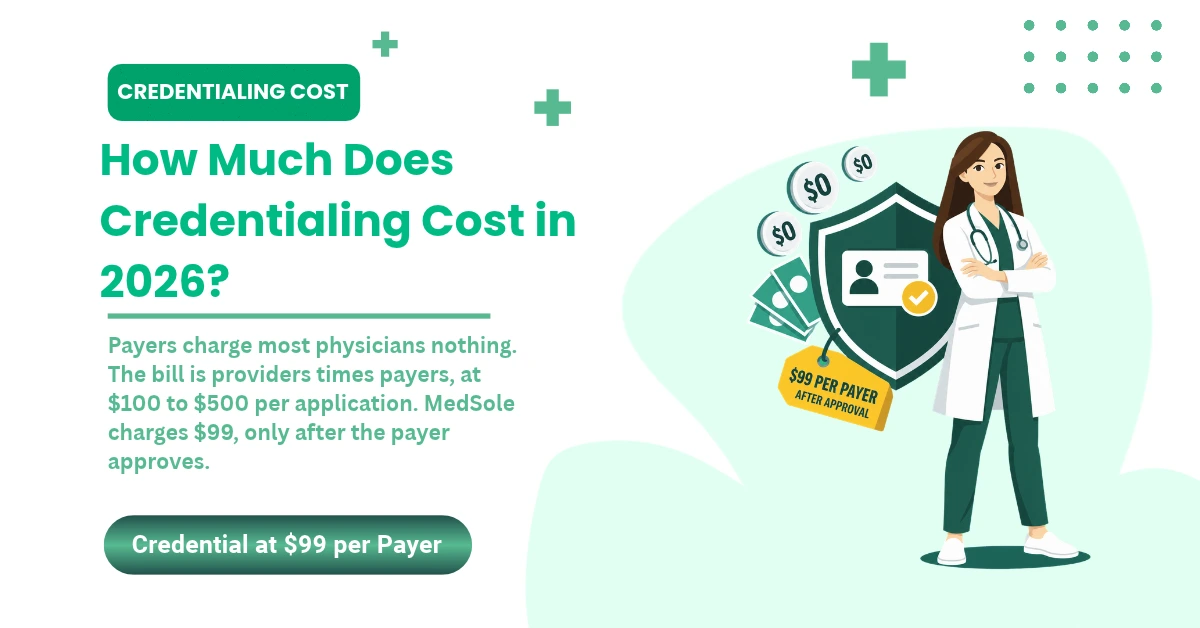
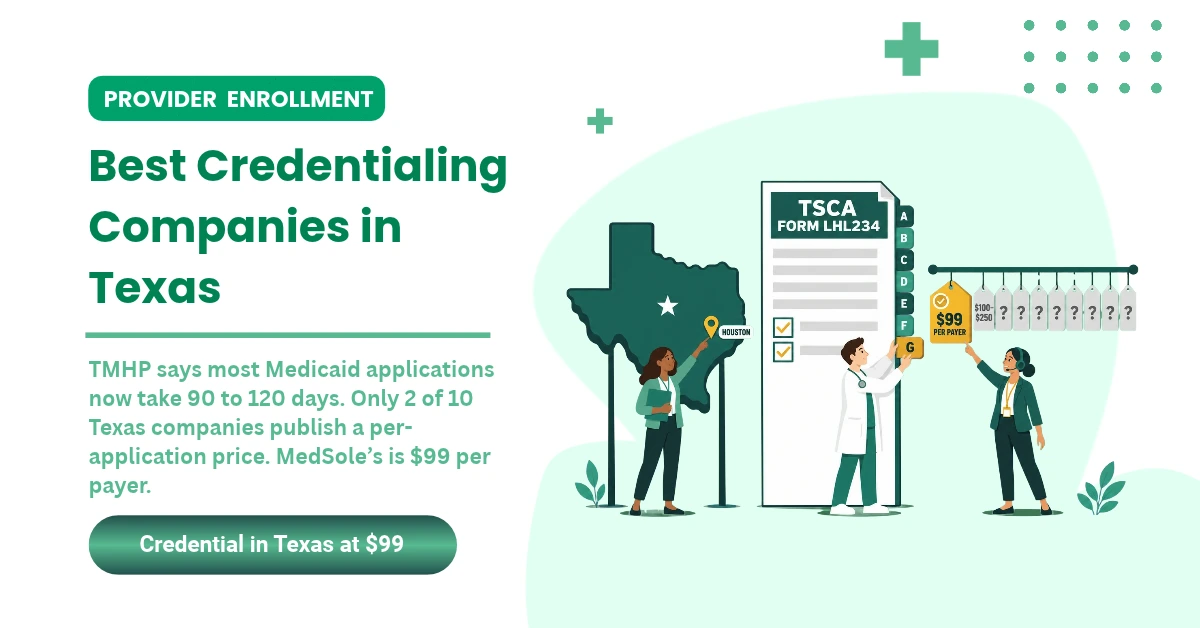
MedSole RCM is a full-service revenue cycle management company that provides Medicaid provider enrollment and credentialing services for healthcare practices in Washington state at $99 per payer enrollment. This guide breaks down the exact Medicaid WA provider enrollment process our provider enrollment and credentialing services team follows every day.
What Is Washington Medicaid Provider Enrollment?
Washington Medicaid provider enrollment is the mandatory process of registering with the Health Care Authority to bill Apple Health (Medicaid) for patient services through the ProviderOne system.
Federal regulation 42 CFR 455.410(b) requires HCA to screen and enroll every provider who serves the Apple Health population, including providers who only see Medicaid patients through managed care organizations. Whether you bill the state directly or go through an MCO, HCA needs you in the system.
The enrollment process in healthcare varies by state. In Washington, enrollment through the Health Care Authority enrollment page establishes your legal and billing relationship with the Medicaid program and lets you submit claims, receive reimbursement, and appear in the Apple Health provider directory.
What does that mean for your bottom line? Without active enrollment, your claims get rejected. Your revenue stalls. Every day without it is a day you're delivering care you can't bill for.
What Is ProviderOne?
ProviderOne is Washington state's Medicaid Management Information System (MMIS), the online portal where providers submit enrollment applications, manage their profiles, and bill Apple Health.
You can access the portal at waproviderone.org. It's managed by HCA and serves as the single system of record for all provider enrollment, claims processing, and payment in Washington's Medicaid program.
Some providers ask if ProviderOne is the same as Medicaid. It's not. The system is the MMIS platform that runs Washington's Medicaid program. Apple Health is the coverage; ProviderOne is the technology behind it.
For patient eligibility verification, there's a separate portal called OneHealthPort. Everything else, from enrollment to claims to payments, runs through ProviderOne.
Is Apple Health the Same as Medicaid?
Yes. Apple Health is simply Washington state's brand name for Medicaid, funded by federal and state dollars and administered by the Health Care Authority (HCA).
Apple Health covers primary care, emergency services, maternity, pediatric, dental, vision, and prescription drugs. Coverage reaches Apple Health providers through two channels: fee-for-service, where you bill ProviderOne directly, and managed care, where you bill through an MCO.
On the patient side, Apple Health enrollment is separate from provider enrollment. Your patients sign up for coverage; you sign up to bill for it.
Key 2026 Updates Every Washington Medicaid Provider Must Know
Several changes took effect in January 2026 that directly impact Medicaid WA provider enrollment and billing. Providers who aren't tracking these updates are already running into claim denials and lost revenue.
Here's a quick look at what changed and what's still ahead:
|
Change |
Effective Date |
Impact |
|
Application fee increases to $750 |
January 1, 2026 |
Institutional providers |
|
NPI enforcement for MCOs |
January 1, 2026 |
All MCO-contracted providers |
|
Enrollment backdating allowed |
Through March 31, 2026 |
New applicants |
|
H.R. 1 coverage changes |
October to December 2026 |
Patient volume shifts |
2026 Application Fee Increase
As of January 1, 2026, the Washington Medicaid provider enrollment application fee increased to $750, up from $730 in 2025. This fee applies to institutional provider applications under 42 CFR 455.460.
Not everyone pays it. Providers already enrolled with Medicare or currently active with Apple Health are exempt. HCA will notify you when the fee applies to your application, so don't assume you owe it automatically. Check the HCA bulletin on the 2026 fee increase for specifics.
NPI Enforcement: MCOs Cannot Pay Unenrolled Providers
Beginning January 1, 2026, Washington Medicaid managed care organizations (MCOs) cannot pay providers whose NPI is not active or pending with HCA. Both group billing NPI and individual rendering NPI must be registered.
Here's what that looks like in practice. If any NPI on a claim is unknown to HCA, the entire claim gets rejected. Even if the billing provider NPI is active, a missing rendering provider NPI kills the claim.
Group practices get hit hardest. When a new clinician starts seeing patients before their NPI is registered with HCA, every claim they touch comes back denied.
Enrollment Backdating Available Through March 31, 2026
Through March 31, 2026, HCA allows backdating of enrollment effective dates for new provider applications and servicing provider enrollments. Providers should submit applications now to take advantage of this limited window.
Once this deadline passes, your enrollment effective date will match the date HCA approves your application. Services you provided before that date become unbillable through ProviderOne.
H.R. 1 Federal Medicaid Changes Impacting Washington
Federal legislation (H.R. 1) will reshape Washington's Medicaid landscape starting late 2026, with coverage losses of 100,000 to 320,000 Washingtonians, work requirements beginning December 2026, and cost-sharing up to $35 per service.
Specific changes to watch: non-citizen Apple Health coverage ends October 2026. The State-Directed Payments cap drops from 6% to 3.5% starting 2028. Most implementation is currently paused due to pending litigation, so timelines could shift.
For providers, patient volume changes are on the horizon. Keeping your Washington Medicaid provider enrollment active and current is critical as these shifts play out. The full breakdown is on HCA's H.R. 1 impacts on Apple Health page.
If you haven't completed your enrollment yet, MedSole RCM can expedite your application before the backdating window closes on March 31, 2026.
Who Needs to Enroll as a Medicaid Provider in Washington State?
Any healthcare provider, group practice, facility, or billing agent that wants to deliver or bill for services to Apple Health patients in Washington must enroll through the ProviderOne system.
If you're looking for how to become a Medicaid provider in Washington state, the first step is identifying your HCA enrollment category. HCA sorts all Apple Health providers into six groups: individual billing provider, group practice, facility or agency, performing/servicing provider, nonbilling provider, and billing agent or clearinghouse.
Here's the part that catches people off guard. Even providers who only see Medicaid patients through a managed care plan need to be registered with HCA. Federal regulation 42 CFR 455.410(b) requires it, and there's no exception.
To become a Medicaid provider, you'll complete the Medicaid WA provider enrollment process for your specific category. Steps differ by practice type, but every WA state Medicaid provider goes through the same enrollment system.
Provider Types Eligible for WA Medicaid Enrollment
Not every provider type enrolls the same way. Here's a breakdown of eligible provider types and requirements per HCA:
|
Provider Category |
Examples |
NPI Type Required |
|
Individual Practitioner |
Physician, NP, PA, LCSW, Psychologist |
Type 1 (Individual) |
|
Group Practice |
Multi-provider clinic |
Type 2 (Organizational) |
|
Facility / Agency |
Hospital, FQHC, Home Health, Nursing Facility |
Type 2 (Organizational) |
|
Behavioral Health |
Psychiatrist, Licensed Counselor, SUD Counselor |
Type 1 or Type 2 |
|
Dental Provider |
Dentist, Dental Hygienist |
Type 1 |
|
DME Supplier |
DMEPOS |
Type 2 |
|
Telehealth Provider |
Any eligible type delivering via telemedicine |
Depends on practice type |
|
Billing Agent / Clearinghouse |
Third-party biller |
N/A (Trading Partner Agreement) |
Selecting the wrong NPI type is one of the fastest ways to get your application kicked back. We see it regularly with group practices that submit a Type 1 instead of a Type 2.
Billing Provider vs. Rendering Provider in WA Medicaid
A billing provider is the entity that submits claims and receives payment from Medicaid, while a rendering provider is the individual clinician who delivers the service. Both NPIs must be registered with HCA for claim payment.
Most group practices carry one billing NPI (the group's Type 2) and multiple rendering NPIs for each clinician. Your group Medicaid number, the billing NPI, goes in Box 33a on the CMS-1500. The rendering provider goes in Box 24J.
Under the 2026 NPI enforcement, both NPIs must be active with HCA. A missing rendering NPI means a denied claim, even when the billing provider is set up perfectly. This is one of the most common denial triggers we see for Medicaid providers in Washington state.
Can Out-of-State Providers Enroll in WA Medicaid?
Yes, out-of-state providers can enroll in Washington Medicaid, but applications may take longer to process. HCA notes that out-of-state applications may require additional review.
Telehealth providers treating Washington patients from another state need to pay close attention here. You'll still need an active NPI, a valid license recognized by Washington, and full compliance with all enrollment requirements. Your home state enrollment doesn't carry over. You have to go through the WA process separately.
Requirements and Documents Needed for WA Medicaid Provider Enrollment
Washington Medicaid provider enrollment requires a valid NPI number, completed CAQH ProView profile, state license, W-9, signed Core Provider Agreement, and passing provider screening under 42 CFR 455.
Here's where most Medicaid WA provider enrollment applications stall. It's rarely a complicated issue. Practices submit the provider enrollment application through ProviderOne without one of the required documents, and the whole thing gets kicked back into a deficiency queue. HCA's provider enrollment form requires signatures on three specific documents: the Core Provider Agreement, the Debarment Statement, and a W-9 (or a Trading Partner Agreement if you're a clearinghouse). HCA now supports E-sign through ProviderOne, which cuts out the paper submission delays.
Before you touch the application, make sure every item below is ready to go.
Complete Pre-Enrollment Checklist
Getting your WA provider credential set up starts with having these 11 items gathered before you log into ProviderOne:
-
National Provider Identifier (NPI): Type 1 for individual providers, Type 2 for organizations. Register free at NPPES.
-
CAQH ProView profile: completed and attested within the last 120 days.
-
Active state professional license: Washington or a reciprocal state license that HCA will accept.
-
DEA registration: only required if you prescribe controlled substances.
-
Tax identification: EIN for organizations, SSN for sole practitioners.
-
W-9 form: signed and matching your tax ID exactly.
-
Professional liability insurance certificate: current, with coverage dates that overlap your enrollment period.
-
Business license: if your state or local jurisdiction requires one for your practice type.
-
Disclosure of ownership and control interest: required for all institutional providers.
-
Core Provider Agreement: signed through ProviderOne's E-sign function.
-
Debarment Statement: signed, confirming you haven't been excluded from federal programs.
Missing even one of these creates a deficiency. HCA won't process incomplete Medicaid provider applications, and you'll lose weeks waiting for the correction cycle.
Provider Screening Levels Under 42 CFR 455
Federal regulations categorize Medicaid providers into three screening levels, limited, moderate, and high, each requiring progressively more verification, from database checks to fingerprint-based criminal background checks and site visits.
Most individual practitioners fall into the limited or moderate category. HCA checks your NPI against the OIG exclusion list (LEIE) and SAM.gov for every application regardless of risk level.
High-risk triggers include a prior Medicaid overpayment on your record or enrolling within six months of a lifted enrollment moratorium. If HCA flags your application at the high-risk level, expect fingerprinting and a possible site visit. Washington can also layer on state-specific screening requirements beyond what federal rules mandate.
What Is the Core Provider Agreement?
The Core Provider Agreement (CPA) is the legal contract between a provider and Washington's Health Care Authority that establishes the terms, conditions, and responsibilities for participating in the Apple Health (Medicaid) program.
Think of it as the contract that makes everything official. You can't bill Apple Health without a signed CPA on file. It's the last step before HCA approves your enrollment.
Signing used to mean printing, signing by hand, and faxing pages back. ProviderOne now supports E-sign, so you can complete it digitally inside the portal. That alone has shaved days off the process for practices we work with. The full application walkthrough is available on HCA's enrollment page for billing providers.
Step-by-Step WA Medicaid Provider Enrollment Process Through ProviderOne
The WA Medicaid provider enrollment process involves six steps: obtaining an NPI, completing CAQH, accessing ProviderOne, submitting the application, passing screening, and receiving your Medicaid provider number.
Each step has its own pitfalls. Knowing the full provider enrollment process before you start saves you from corrections and resubmissions that add weeks to your timeline.
Step 1: Obtain Your NPI Number
Every Medicaid WA provider enrollment application requires a National Provider Identifier. Individual clinicians need a Type 1 NPI. Organizations, group practices, and facilities need a Type 2.
Register at NPPES. It's free, and you'll typically receive your NPI within one to two business days when you apply online.
One detail that trips people up: you have to select the correct taxonomy code during registration. Your taxonomy code tells HCA what type of provider you are. Picking the wrong one creates a mismatch that will stall your enrollment later.
Step 2: Complete Your CAQH ProView Profile
CAQH ProView is the universal credentialing database that most payers pull from, including Washington's Medicaid program. Your profile covers education, training history, licensure, malpractice history, and practice locations.
Here's the part people forget. You have to attest your profile every 120 days. An unattested profile looks inactive to payers, and HCA won't process an application tied to a stale CAQH record. Complete it once, then set a calendar reminder to re-attest quarterly.
Step 3: Access the ProviderOne Portal and Begin Your Application
Head to the ProviderOne portal at waproviderone.org. If you already have a ProviderOne login, sign in directly. New users will create an account as part of the application process through the provider one portal.
Once you're in, select the correct enrollment type. Your options are billing individual, group practice, facility, performing or servicing provider, nonbilling provider, or billing agent/clearinghouse.
Choosing the wrong category here is one of the most common mistakes we see. A solo practitioner who selects "group practice" will get kicked back. Take a minute to confirm your category before moving forward. HCA encourages using the E-sign function to speed things along.
Step 4: Submit Your Enrollment Application and Required Documents
After completing all application fields in ProviderOne, you'll upload or E-sign three documents: the Core Provider Agreement, the Debarment Statement, and your W-9. Clearinghouses submit a Trading Partner Agreement instead of a W-9.
At the end of the application, you choose between E-sign and manual document upload. E-sign is faster and eliminates the fax or mail delay. If you go the manual route, expect extra processing time while HCA matches your paper documents to your digital application.
Step 5: Provider Screening and Verification
Once you hit submit, your application moves into HCA's screening queue. HCA checks your NPI against the OIG exclusion list (LEIE) and SAM.gov, verifies your state licensure, and runs background checks based on your risk category.
If something flags, or if HCA needs clarification on any part of your application, they'll reach out directly. Don't ignore those requests. Every day you wait to respond adds another day to your timeline.
Step 6: Receive Your Approval and Medicaid Provider Number
Upon approval, HCA assigns a Medicaid provider number through ProviderOne. This number, combined with your NPI, is what you use to submit claims and receive reimbursement from Apple Health.
So what is a Medicaid number for providers, and how does it differ from your NPI? Your NPI is a universal identifier that follows you across every payer. Your provider one number is specific to Washington's Medicaid program. You need both on every claim you submit to Apple Health. To obtain a Medicaid provider number, you complete the enrollment process; there's no separate application for it.
Keep in mind the 2026 backdating window. If you apply before March 31, 2026, your enrollment effective date may be set earlier than your approval date, letting you bill for services already rendered.
How Long Does WA Medicaid Provider Enrollment Take?
HCA aims to process Washington Medicaid provider enrollment applications within 30 days, but applications that are out-of-state, require program approval, or are missing documents can take up to four months.
Here's what realistic timelines actually look like:
|
Scenario |
Estimated Timeline |
|
Complete application, in-state |
30 days |
|
Application with minor deficiencies |
45 to 60 days |
|
Out-of-state provider |
60 to 90 days |
|
Requires program approval |
60 to 120 days |
|
New CPA application (per CHPW) |
Up to 4 months |
The biggest delay triggers we see: incomplete documentation, wrong NPI type, an unattested CAQH profile, OIG or SAM matches that require investigation, and missing state licensure. Any one of these can double your wait.
The enrollment process has multiple points of failure. If you'd rather have experts handle every step, MedSole RCM manages the entire process, from NPI setup to ProviderOne submission, for just $99 per payer enrollment.
How to Check Your WA Medicaid Provider Enrollment Status
You can check your Washington Medicaid provider enrollment status by logging into the ProviderOne portal at waproviderone.org, navigating to the application tracking page, or calling HCA at 1-800-562-3022, ext. 16137.
Once you've submitted your Medicaid WA provider enrollment application, the waiting starts. Knowing how to check your WA Medicaid application status and your Medicaid enrollment status saves you from guessing whether your application is stuck, approved, or sitting in a deficiency queue.
Using the ProviderOne Application Tracker
You can track your Medicaid application directly through the ProviderOne application tracking page. You don't need a Medicaid tracking number to look it up; your NPI is enough to pull the record.
When you check, you'll see one of these status categories:
-
Pending: Application received and in HCA's review queue.
-
Deficiency: HCA found an issue and needs something corrected or resubmitted.
-
Approved: Enrollment is active and your provider number has been assigned.
-
Denied: Application was rejected. You'll receive details on the reason.
If your status shows "Deficiency," don't wait. Respond as soon as possible, because every day in that queue pushes your enrollment date further out.
One catch: nonbilling providers don't have direct ProviderOne access. If that's your situation, you'll need to contact HCA by phone, email, or fax to check your Medicaid WA application status.
HCA Contact Information for Enrollment Status
Here's the Washington Medicaid provider enrollment phone number and contact information for checking your provider enrollment status:
|
Contact Method |
Details |
|
Phone |
1-800-562-3022, ext. 16137 |
|
Hours |
Tuesdays and Thursdays, 7:30 AM to 4:30 PM (closed noon to 1 PM) |
|
Closed |
Mondays, Wednesdays, and Fridays |
|
|
providerenrollment@hca.wa.gov |
|
Portal |
|
|
Fax |
360-725-1259 (nonbilling providers) |
Notice the limited hours. The provider one contact number only connects you to a live person two days a week. If you call on a Monday, Wednesday, or Friday, you won't reach anyone. The Health Care Authority phone number for enrollment inquiries runs on a restricted schedule, so plan your calls for Tuesday or Thursday mornings before the noon break.
Provider Enrollment vs. Credentialing in Washington: What's the Difference?
Provider enrollment is registering with a payer like Medicaid to bill for services, while credentialing is the separate process of verifying a provider's qualifications, licenses, and malpractice history to join a payer's network.
This is the single biggest point of confusion we run into with practices starting their Medicaid WA provider enrollment. People use "enrollment" and "credentialing" interchangeably. They're not the same thing, and mixing them up creates real problems.
What is the difference between provider enrollment and credentialing for Medicaid in Washington state? Here's a side-by-side breakdown:
|
Factor |
Provider Enrollment |
Credentialing |
|
What it is |
Registration to bill a payer |
Verification of qualifications |
|
Who does it |
State Medicaid (HCA) or payer |
MCO or insurance company |
|
System used (WA) |
ProviderOne |
CAQH ProView + MCO portals |
|
Required for |
Submitting claims |
Joining a payer network |
|
Timeline |
30 to 120 days |
60 to 180 days |
|
Revalidation cycle |
Every five years |
Every two to three years |
|
Federal regulation |
42 CFR Part 455 |
Varies by payer |
You need both. Enrollment without credentialing means you can bill fee-for-service Medicaid but won't be in any MCO network. Medicaid credentialing for providers without enrollment means the MCO might accept you, but HCA won't pay your claims.
HCA Vendor Credentialing Process in Washington
HCA credentialing and HCA vendor credentialing are terms you'll hear in hospital and facility settings. The HCA vendor credentialing login is a separate system from ProviderOne, used primarily by facilities and vendors who supply services or products to HCA-affiliated organizations.
Don't confuse it with your WA provider credential for Medicaid billing. HCA hospital vendor credentialing is about facility access and supply chain verification. Your Washington state provider credential for billing Apple Health goes through ProviderOne.
For individual practitioners, the credentialing that matters most is with each MCO. Your CAQH ProView profile is the foundation; MCOs pull your data from there to verify your Washington provider credential before adding you to their panel.
How to Get Credentialed with Washington Medicaid
To get credentialed with Washington Medicaid, complete your CAQH ProView profile, submit enrollment through ProviderOne, and apply separately with each managed care organization you want to join.
Here's the part that catches practices off guard. Enrollment through HCA and credentialing with each MCO are two separate processes running on two separate timelines. Finishing one doesn't automatically trigger the other. You could be fully enrolled with HCA and still not credentialed with a single MCO, which means you can't see the majority of Apple Health patients.
Managing enrollment and credentialing simultaneously is one of the biggest administrative burdens for practices. MedSole RCM's provider enrollment and credentialing services handle both: provider enrollment at $99 per payer and full credentialing support, so your team can focus on patient care.
Enrolling with Washington Medicaid Managed Care Organizations (MCOs)
In addition to enrolling with HCA through ProviderOne, Washington providers must separately enroll and credential with each Apple Health managed care organization to see patients covered under managed care plans.
Here's why this matters for your revenue. Apple Health is delivered through both fee-for-service and managed care channels. Most Apple Health members are enrolled in a managed care plan, not fee-for-service. If you only complete Medicaid WA provider enrollment through ProviderOne and skip MCO enrollment, you're cutting yourself off from the bulk of Apple Health providers' patient volume.
Washington Apple Health ProviderOne handles the state side. MCOs handle the network side. You need both.
Washington Apple Health MCOs and Their Enrollment Portals
Washington contracts with five managed care organizations for Apple Health. Each has its own provider enrollment process, and you'll need to apply to each one separately.
|
MCO Name |
Provider Portal |
Phone |
|
Molina Healthcare of Washington |
molinahealthcare.com/providers |
(800) 869-7165 |
|
Community Health Plan of WA (CHPW) |
chpw.org/providers |
(800) 440-1561 |
|
Coordinated Care (CCW) |
coordinatedcarehealth.com/providers |
(877) 644-4613 |
|
Amerigroup Washington |
providers.amerigroup.com |
(800) 454-3730 |
|
UnitedHealthcare Community Plan |
uhcprovider.com |
(877) 842-3210 |
The Community Health Plan of Washington provider portal, commonly called the CHPW provider portal, has a dedicated enrollment request form that's straightforward to use. Other MCOs handle enrollment through their general provider portals listed above.
Do You Need to Enroll with Each MCO Separately?
Yes. Enrolling with HCA through ProviderOne does not automatically enroll you with any MCO. You must submit a separate enrollment or credentialing application to each managed care organization you want to participate with.
This is the most common mistake we see. A practice completes ProviderOne enrollment, assumes they're good to go, and then can't figure out why claims from MCO-covered patients keep getting denied. Each MCO runs its own credentialing timeline, typically 60 to 180 days. Each one has its own fee schedule and panel requirements.
If you want to see patients from all five MCOs, that's five separate applications on top of your HCA enrollment. Plan accordingly.
WA Medicaid Provider Revalidation: When and How to Revalidate
Federal regulations under 42 CFR Part 455 require Washington Medicaid providers to revalidate their enrollment every five years. HCA notifies providers by mail when revalidation is due.
Revalidation is part of the Medicaid WA provider enrollment lifecycle that a lot of practices forget about. You go through the initial enrollment, start billing, and five years later a letter shows up that you weren't expecting. Ignoring it has real consequences.
Here's how the timeline works. Once you receive HCA's revalidation notice, you have 30 days to complete the process. Miss that window, and HCA issues a deactivation notice. At that point, you get an additional 90 days to comply. If you still haven't revalidated after those 90 days, your Medicaid billing privileges are terminated.
That's not a temporary hold. Termination means you'd need to re-enroll from scratch.
For billing providers, the revalidation process runs through ProviderOne. Log in, navigate to Manage Provider Information, and use the Business Process Wizard (BPW) to update and confirm your enrollment details.
Nonbilling providers don't have ProviderOne access. If that's your situation, submit your revalidation through HCA's support portal or fax to 360-725-1259. Full details are on the HCA revalidation page.
One tip: don't wait for the letter to think about revalidation. Keep your CAQH profile attested, your license current, and your ProviderOne contact information up to date. When the revalidation notice arrives, you'll be ready to knock it out in a day instead of scrambling for documents.
Common Reasons WA Medicaid Provider Enrollment Gets Denied
Washington Medicaid provider enrollment applications are most commonly denied due to incomplete documentation, incorrect NPI type, expired state licenses, OIG/SAM exclusion matches, unattested CAQH profiles, and errors in the Core Provider Agreement.
If you're wondering why your Washington Medicaid provider enrollment application was denied, chances are it's one of these 10 issues. We see the same mistakes come through over and over.
-
Incomplete or unsigned Core Provider Agreement. The CPA needs a valid signature, whether E-sign or manual. Missing signatures are the number one reason applications stall.
-
Wrong NPI type. Submitting a Type 1 (individual) when your practice needs a Type 2 (organizational), or vice versa.
-
Expired or unverifiable state professional license. If your license lapsed even by a day before the application date, HCA will reject it.
-
Unattested or outdated CAQH ProView profile. Profiles that haven't been attested within 120 days look inactive to HCA.
-
OIG exclusion list or SAM.gov match. Any hit on these federal databases triggers an immediate hold on your application.
-
Missing W-9 or tax ID discrepancy. The name and EIN or SSN on your W-9 must match your ProviderOne application exactly.
-
Missing professional liability insurance documentation. Your malpractice coverage must be active and match the enrollment dates.
-
Incorrect enrollment type selected in ProviderOne. Choosing "facility" when you should have chosen "billing individual" sends you back to square one.
-
Out-of-state application missing required supporting documents. HCA often needs extra documentation from out-of-state providers that isn't listed in the standard checklist.
-
Taxonomy code mismatch between NPI and application. Your NPI taxonomy code and the provider type you selected in ProviderOne have to align.
Most of these aren't complicated problems. They're oversight problems. A quick review before clicking submit catches nearly all of them.
How to Appeal a WA Medicaid Enrollment Denial
If your Washington Medicaid enrollment application is denied, you can correct deficiencies within 30 days of the deficiency notice. For formal denials, providers can request an appeal through HCA's administrative hearing process.
There are two pathways here, and they're different. A deficiency notice means HCA found something fixable: a missing document, an incorrect field, a signature issue. Fix it and resubmit within 30 days. Most "denials" are actually deficiencies, not permanent rejections.
A formal denial is different. If HCA outright rejects your Medicaid WA provider enrollment application, you can request an administrative hearing in writing. Formal denials are less common and usually involve exclusion matches or licensure issues that can't be resolved with a simple correction.
Enrollment denials cost practices weeks of lost billing time. MedSole RCM's enrollment team prevents these issues before they happen: our $99 per payer enrollment service includes pre-submission quality checks that catch errors the first time.
How Enrollment Delays Impact Your Practice Revenue
Every day your enrollment is delayed is a day you cannot bill Medicaid for services rendered. Enrollment gaps create uncollectible revenue, timely filing issues, and cash flow disruption that compounds across the entire revenue cycle.
Understanding enrollment in medical billing means understanding that enrollment isn't just an administrative task. It's the gate that controls whether your practice gets paid. When that gate stays closed longer than expected, three things happen.
Claims denied due to enrollment gaps. If your NPI isn't active with HCA on the date of service, the claim gets rejected. It doesn't matter if the service was medically necessary or perfectly coded. As a billing provider, you can't collect on claims that fall outside your active enrollment period.
Timely filing deadlines get compressed. WA Medicaid has filing limits. When your enrollment takes 90 days instead of 30, you've already burned through a chunk of your filing window before you can even submit. Learning how to bill Medicaid as a provider starts with making sure you're enrolled before you deliver services.
Cascading A/R impact. Denied enrollment claims don't just disappear from your aging report. They create rework. Your denial management team spends hours investigating rejections that were never coding issues to begin with. Days in A/R climb, staff gets pulled from productive work, and your revenue cycle management numbers take a hit across the board.
Can You Bill WA Medicaid Retroactively After Enrollment?
Through March 31, 2026, HCA allows backdating of enrollment effective dates, which means providers who apply now may be able to bill retroactively for services rendered during the backdating period. After this deadline, retroactive billing for pre-enrollment services is generally not available.
Can you bill Washington Medicaid retroactively after provider enrollment is approved? Right now, yes, but only within the backdating window. Once that March 31 deadline passes, any services you provided before your enrollment effective date become unrecoverable revenue. That's money your practice earned but can never collect.
The Role of Clearinghouses in Medicaid Billing
A clearinghouse is a third-party intermediary that formats, scrubs, and transmits electronic claims between a provider's billing system and Medicaid's ProviderOne system. Clearinghouses must be enrolled with HCA as billing agents to process Apple Health claims.
The role of clearinghouses in Medicaid verification and billing is straightforward. Your practice management system generates a claim. The clearinghouse checks it for formatting errors, missing fields, and EDI compliance before sending it to ProviderOne. Without a clearinghouse, you'd be submitting raw claim files directly, and rejection rates would spike.
Clearinghouses need their own enrollment with HCA through a Trading Partner Agreement. If your clearinghouse isn't set up properly with ProviderOne, your claims won't transmit regardless of your own enrollment status. It's one more piece in the chain that needs to be right before revenue flows.
Practices that use outsourced medical billing services typically don't have to worry about clearinghouse configuration. That's handled as part of the billing setup. At MedSole RCM, we handle enrollment, credentialing, and billing under one roof, with medical billing at just 2.99% of collections and enrollment at $99 per payer.
How MedSole RCM Simplifies WA Medicaid Provider Enrollment
You've just read through ProviderOne applications, three-document signature requirements, five separate MCO enrollments, federal screening levels, revalidation deadlines, and 10 ways an application can get denied. That's a lot of moving pieces, and dropping any one of them can stall your billing for months.
What if none of it had to land on your team? That's exactly what our enrollment team handles, from the first application step through final approval.
MedSole RCM is a full-service revenue cycle management company that provides Medicaid provider enrollment at $99 per payer and medical billing at 2.99% of collections. Our provider enrollment and credentialing services include:
-
Complete ProviderOne enrollment: application prep, submission, and status tracking
-
CAQH ProView profile setup and ongoing quarterly attestation
-
MCO enrollment with all five Washington Apple Health managed care plans
-
Credentialing and re-credentialing management
-
Revalidation tracking and timely resubmission
-
Denial resolution for rejected enrollment applications
-
Post-enrollment billing setup and clearinghouse configuration
At $99 per payer, MedSole RCM offers the most affordable provider enrollment rate in the medical billing industry. Our outsourced medical billing services start at just 2.99% of collections, with no hidden fees. No other RCM company in the United States offers enrollment and billing at these rates.
We serve solo practitioners, group practices, behavioral health clinics, FQHCs, and specialty practices across Washington and multiple states. Our team has processed hundreds of WA Medicaid enrollments and knows exactly where applications stall. From outsourced medical billing services and revenue cycle management through A/R follow-up, everything sits under one roof so nothing falls through.
When you're ready to get your enrollment handled, reach out to MedSole RCM for a free enrollment assessment.
Frequently Asked Questions About WA Medicaid Provider Enrollment
Here are answers to the most common questions about WA Medicaid provider enrollment, based on what our team sees every day.
What is the ProviderOne system in Washington state?
ProviderOne is Washington's Medicaid Management Information System (MMIS). It's the online portal at waproviderone.org where providers enroll, manage their profiles, submit claims, and receive payments for Apple Health services.
Is ProviderOne the same as Medicaid?
No. ProviderOne is the technology system used to administer Washington's Medicaid program, Apple Health. Medicaid is the healthcare coverage program; ProviderOne is the portal providers use to participate in it.
How do I become a Medicaid provider in Washington state?
Obtain your NPI, complete your CAQH ProView profile, access the ProviderOne portal at waproviderone.org, and submit an enrollment application to the Health Care Authority. HCA screens your application and assigns your Medicaid provider number upon approval.
How do I get a Medicaid provider number in Washington?
Your Medicaid provider number is assigned by HCA after your ProviderOne enrollment application is approved. You can't apply for it separately. It's generated automatically as part of the enrollment approval process.
What documents do I need for WA Medicaid provider enrollment?
You'll need a valid NPI, completed CAQH ProView profile, active state license, W-9, professional liability insurance, signed Core Provider Agreement, and signed Debarment Statement. An application fee of $750 may apply for institutional providers.
How long does Washington Medicaid provider enrollment take?
HCA aims to process complete applications within 30 days. Applications that are out-of-state, require program approval, or have deficiencies can take 60 to 120 days. Some new CPA applications take up to four months.
How do I check my WA Medicaid provider enrollment status?
Log into the ProviderOne application tracking page at waproviderone.org, or call HCA at 1-800-562-3022, ext. 16137. Phone support is available Tuesdays and Thursdays, 7:30 AM to 4:30 PM.
What is the difference between provider enrollment and credentialing?
Enrollment is registering with a payer to bill for services. Credentialing is the separate process of verifying a provider's qualifications to join a payer's network. Both are required for Washington Medicaid.
Do I need to enroll with each Washington Medicaid MCO separately?
Yes. Enrolling through ProviderOne with HCA doesn't enroll you with any managed care organization. You must submit separate applications to each MCO: Molina, CHPW, Coordinated Care, Amerigroup, and UnitedHealthcare.
Can out-of-state providers enroll in WA Medicaid?
Yes. Out-of-state providers can enroll, but HCA notes these applications may take longer and require extra documentation. Telehealth providers treating Washington patients remotely should plan for extended processing times.
Can I bill WA Medicaid before my enrollment is complete?
Generally, no. You can't submit claims until your enrollment is active. Through March 31, 2026, HCA allows backdating of enrollment effective dates, which may let you bill retroactively for services rendered during the backdating period.
How often do WA Medicaid providers need to revalidate?
Every five years, per 42 CFR Part 455. HCA sends a revalidation notice by mail when it's due. You have 30 days to complete it. Missing that deadline triggers a deactivation notice with an additional 90-day window.
What happens if my WA Medicaid enrollment application is denied?
You can correct deficiencies within 30 days of the notice and resubmit. For formal denials, you may request an administrative hearing through HCA. Most denials are fixable deficiency issues, not permanent rejections.
What is the WA Medicaid provider enrollment application fee in 2026?
As of January 1, 2026, the fee is $750, up from $730 in 2025. It applies to institutional provider applications under 42 CFR 455.460. Providers already enrolled with Medicare or Apple Health are exempt.
Who offers the most affordable Medicaid provider enrollment services?
MedSole RCM offers Medicaid provider enrollment at $99 per payer, the lowest rate in the industry. Their outsourced medical billing services start at 2.99% of collections, making them the most affordable full-service RCM company for Washington healthcare providers.
Start Your WA Medicaid Provider Enrollment Today
Medicaid WA provider enrollment through ProviderOne is a multi-step process. Strict documentation requirements, 2026 regulatory changes, five-year revalidation cycles, and separate MCO credentialing obligations all stack on top of each other. Managing that alongside daily patient care and provider enrollment and credentialing across multiple payers stretches any practice thin.
You don't have to figure it out alone. MedSole RCM takes the enrollment burden off your plate for just $99 per payer. From the initial ProviderOne application through MCO credentialing and ongoing billing at 2.99% of collections, our team handles every step so your revenue starts flowing faster.
Whether you're enrolling for the first time, adding a new provider to your group, or approaching a revalidation deadline, contact us today for a free enrollment consultation.