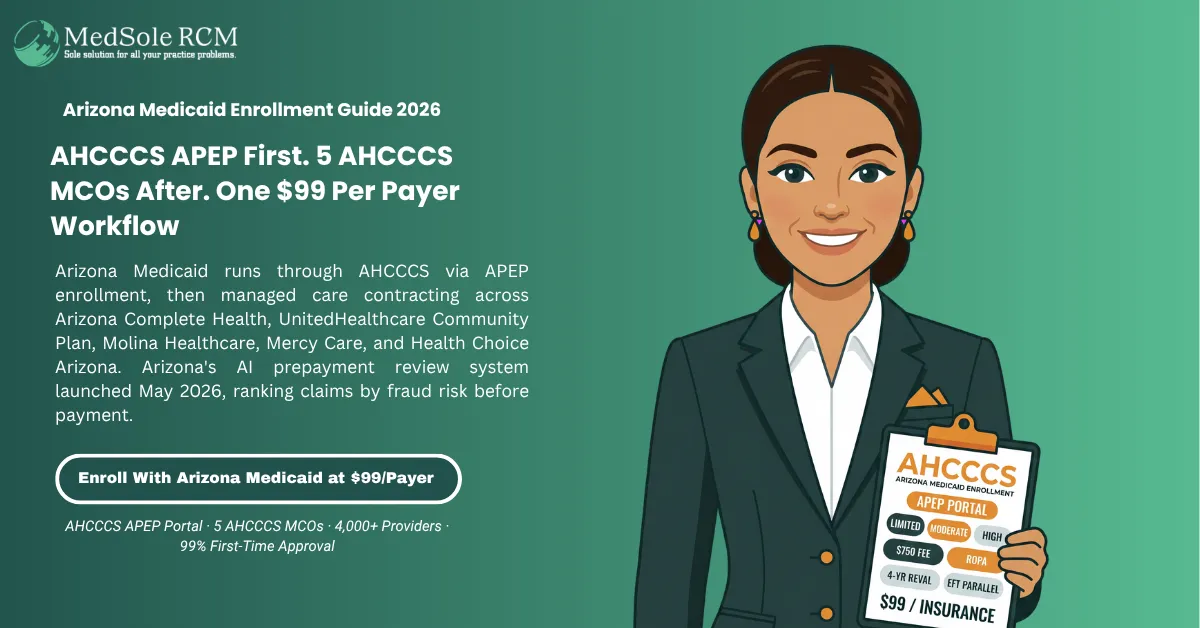




Everything providers need to know about AHCCCS enrollment, APEP, risk screening, ROPA, revalidation, and the seven policy changes that took effect this year.
Arizona Medicaid provider enrollment is the mandatory state-administered registration process through which healthcare providers apply to AHCCCS, the Arizona Health Care Cost Containment System, before they can deliver services to or bill for Arizona's approximately 1.8 million Medicaid recipients.
Approximately 1 in 4 Arizonans relies on AHCCCS for coverage. In May 2026, Arizona announced the country's first AI-informed Medicaid prepayment review system. The 2026 enrollment fee is now $750. H.R. 1 will begin reshaping AHCCCS eligibility in October 2026. Every provider serving Arizona Medicaid patients needs to act on these updates now.
Is AZ Medicaid the same as AHCCCS? Yes. AHCCCS is the name of Arizona's Medicaid program, administered under Title XIX of the Social Security Act. Every reference to Arizona Medicaid and AHCCCS in this article means the same program.
This guide covers the complete APEP enrollment process, all seven 2026 regulatory updates, federal risk screening under 42 CFR 455.450, ROPA registration, revalidation requirements, Change of Ownership rules, and out-of-state single case enrollment.
If you'd rather have a credentialing specialist manage every step for your practice, MedSole RCM provides full provider enrollment and credentialing services, including AHCCCS enrollment for $99 per payer, the lowest rate in the market.
What Is AHCCCS and Why Does Every Arizona Provider Need to Be Enrolled?
Is AZ Medicaid the Same as AHCCCS?
Yes. AHCCCS, the Arizona Health Care Cost Containment System, is Arizona's Medicaid program. It operates under Title XIX of the Social Security Act and covers approximately 1.8 million low-income Arizonans as of 2026. All references to Arizona Medicaid in enrollment, billing, and compliance contexts refer to AHCCCS.
Arizona operates exclusively through managed care. Unlike most states that maintain substantial fee-for-service Medicaid, Arizona routes payments through contracted managed care organizations that receive a capitated monthly rate per enrolled member. Providers must be registered with both AHCCCS and contracted with the relevant MCOs to receive payment.
For a national overview, see our guide to Medicaid provider enrollment across all 50 states.
The primary AHCCCS MCOs operating in 2026 are Arizona Complete Health, UnitedHealthcare Community Plan, Molina Healthcare of Arizona, Mercy Care, and Health Choice Arizona. Each MCO has separate credentialing and contracting requirements that operate independently of AHCCCS registration.
AHCCCS enrollment is mandatory before any payment consideration under AHCCCS AMPM Policy 610. This policy states that AHCCCS registration is required for payment consideration by managed care contractors, encounter submission, and fee-for-service billing. The federal basis is 42 CFR Part 455.
Being credentialed with an AHCCCS MCO is not the same as being enrolled with AHCCCS. A provider can be operationally in-network with Mercy Care or Arizona Complete Health and still have claims rejected if their AHCCCS registration is incomplete or expired.
Who Must Complete Arizona Medicaid Provider Enrollment?
All healthcare providers who intend to deliver services to or bill for AHCCCS members must complete Arizona Medicaid provider enrollment through APEP before any services are rendered. This requirement applies regardless of whether the provider participates through managed care or fee-for-service.
Individual and Sole Proprietor Providers
These providers bill under their own Tax Identification Number (TIN). They include physicians (MD, DO), nurse practitioners (NP), physician assistants (PA), licensed clinical social workers (LCSW), licensed professional counselors (LPC), and licensed marriage and family therapists (LMFT).
Each provider enrolls individually in APEP with their own NPI-1 and credentials. See our guide to nurse practitioner credentialing for specialty-specific requirements.
Rendering and Servicing Providers
Rendering providers deliver the clinical service. Servicing providers are the location or entity through which care is rendered within a group practice or facility. Both may need to be enrolled separately in APEP, depending on billing configuration. NPI-2 (organizational NPI) applies to group practices billing under a shared TIN.
Organizational Providers
Hospitals, home health agencies, skilled nursing facilities, behavioral health residential treatment centers, and multi-provider clinics fall into this category. They face additional ownership disclosure requirements, may require site visits at initial enrollment, and must maintain organizational NPI-2 alongside individual provider NPIs.
Check the Provider Enrollment Screening Glossary (PEP-903) for the official classification of each organizational provider type. Organizational providers navigating AHCCCS enrollment benefit most from working with Medicaid credentialing experts who understand disclosure requirements and site visit preparation.
What Is an Atypical Provider?
An atypical provider, in AHCCCS terminology, is a provider type that does not require a professional license to deliver Medicaid-covered services. Examples include personal care attendants, transportation providers, and supported employment agencies. Atypical providers still must complete Arizona Medicaid provider enrollment through APEP but follow a different documentation pathway than licensed clinical providers.
New 2026 Provider Types
AHCCCS added three new school-based provider types to the enrollment manual on April 15, 2026: Certified School Counselor, School Based Certified Psychologist, and School Based Certified Social Worker. These providers enroll under the standard APEP process with applicable licensure documentation from the Arizona Department of Education or Arizona Board of Behavioral Health Examiners.
Behavioral Health Providers
Behavioral health providers enrolling in Arizona must obtain a Certificate and Transmittal (C&T) from the Arizona Department of Health Services (ADHS). The C&T identifies the correct provider type the applicant should enroll under. Without it, APEP won't accept the application as complete.
2026 AHCCCS Provider Enrollment Updates Every Healthcare Provider Must Know
As of May 2026, AHCCCS has implemented seven significant changes to Arizona Medicaid provider enrollment rules, fees, portal functionality, and compliance requirements. Providers who enrolled or revalidated before 2026 may not be aware of these updates, and each one carries a direct revenue cycle consequence.
2026 Application and Enrollment Fee: $750
The AHCCCS provider enrollment application fee for calendar year 2026 is $750, effective January 1, 2026 through December 31, 2026.
CMS sets this fee annually. Section 6401(a) of the Affordable Care Act requires states to collect an application fee from institutional providers. The 2026 figure matches Medicare's application fee. The Federal Register notice published December 3, 2025 set the amount. For additional corroboration, see CMS application fee guidelines.
The fee applies to new enrollment, revalidation, and reactivation of a disenrolled provider. Review the Provider Enrollment Screening Glossary (PEP-903) to confirm whether your provider type is classified as "institutional" for fee purposes.
AHCCCS may refund the fee under four conditions: the application was denied or withdrawn before screening activities began; the fee was already paid to Medicare or another state; AHCCCS could not approve the application due to a moratorium; or the applicant qualifies for a hardship exception.
Missing or misapplying the $750 fee requirement stalls an enrollment or revalidation and delays network participation and billing go-live dates by 60 days or more.
APEP Correspondence Workflow Change (March 29, 2026)
Effective March 29, 2026, AHCCCS updated APEP's contact and correspondence step, replacing the former "Correspondence Address" field with a new "Correspondence Contact Information" step. Contact roles now include Provider/Key Individual, Biller, and Credentialist. Providers can select email-only or email plus U.S. mail. The default is email-only.
If your practice's correspondence contact in APEP is not current, AHCCCS revalidation notices and documentation requests will go to the wrong contact, and a missed revalidation deadline results in enrollment termination. Verify this contact today at AHCCCS APEP Provider Updates.
The Provider Participation Agreement (PEP-202.8, revised February 2026) now includes a clause that providers must not communicate with AHCCCS using AI or automated technology, including robocalls and bot-initiated messages.
Self-Service Provider Domain Access (April 26, 2026)
Effective April 26, 2026, AHCCCS implemented self-service provider domain access for individual enrollments in APEP, reducing the need for providers to contact AHCCCS directly when managing account access. Identity validation now uses first name, last name, date of birth, Social Security Number, and AHCCCS ID.
Repeated failed login attempts trigger a lockout. This applies to individual enrollment types only, not organizational or group enrollments.
Access delays were a common hidden cause of incomplete enrollment modifications and missed revalidation submissions. This change removes that friction for individual providers.
Arizona's AI Prepayment Review System (May 2026)
In May 2026, Governor Katie Hobbs announced that AHCCCS will deploy what the state believes is the country's first AI-informed Medicaid prepayment review system, ranking claims by their fraud, waste, and abuse risk before payment is released. Human reviewers handle the highest-risk claims flagged by the AI.
Compliant providers with clean enrollment records and accurate billing see faster payment approval.
Accurate AHCCCS enrollment records, current licensure, and correct NPI and TIN data are no longer just compliance requirements. They're now factors that directly influence how fast your claims get paid.
As AHCCCS enrollment records now directly affect payment speed under the new AI review system, keeping your APEP file current is non-negotiable. MedSole RCM's provider enrollment and credentialing services keep every provider's file accurate as policies evolve.
H.R. 1 Medicaid Eligibility Changes (October 2026 and January 2027)
Beginning October 2026, certain immigrant categories will no longer qualify for AHCCCS or KidsCare coverage. Beginning January 2027, certain Medicaid Expansion adults will be required to renew their AHCCCS coverage twice per year rather than once.
Members subject to work requirements must complete at least 80 hours per month of approved activities or demonstrate income of at least $580 per month.
Healthcare providers serving AHCCCS-covered populations should expect patient panel changes beginning in Q4 2026 as eligibility shifts reduce enrollment among affected groups.
Required Documents for Arizona Medicaid Provider Enrollment: The Complete Checklist
Before submitting an application through APEP, every provider must have specific documents ready. Missing any required item delays Arizona Medicaid provider enrollment processing and can result in a denial that restarts the 60-day clock.
Documents Every Provider Must Have
NPI (National Provider Identifier): The 10-digit federal identifier issued by NPPES NPI registry. Individual providers need NPI-1. Group practices need NPI-2.
W-9 Tax Form: Must be signed within the last 12 months. Required for all providers receiving state or federal Medicaid funds.
Current Professional License: Must be active, issued by the appropriate Arizona licensing board, and in the correct licensure category for the services the provider intends to bill.
Tax Identification Number (TIN): Must match the entity under which payments will be received. TIN mismatches between APEP and billing system cause EFT failures and payment delays.
EFT Bank Details: A blank check or bank verification letter confirming the account. Required for the separate EFT enrollment step covered in Section 7.
Additional Documents by Provider Type
Behavioral health providers must submit the Certificate and Transmittal (C&T) from ADHS alongside their Arizona state license. Without it, APEP will reject the application as incomplete. Organizational providers must upload ownership disclosure statements, including percentage of ownership for any individual holding 5% or more.
Some provider types must upload board certification, DEA registration, or specialty-specific credentialing documents through the APEP "Upload Document" step.
Organizational providers managing multi-provider disclosures and specialty certifications work with Medicaid credentialing experts to prevent silent rejections.
The EFT Requirement: The Single Step That Causes the Most Denials
Failure to complete the EFT enrollment requirement results in an AHCCCS enrollment application denial. This step is separate from the APEP portal submission.
After creating your APEP application, record your APEP Application ID. Download the EFT enrollment form from AHCCCS. Enter the APEP Application ID in the designated field on the form. Email the completed form to AHCCCS_EFT_Enrollment@azahcccs.gov.
Use the subject line "New Enrollment EFT." Attach either a voided blank check or a bank verification letter. Don't wait until after submission to start this step. Do it in parallel.
Providers who submit their APEP application but delay the EFT step regularly face application denials and full 60-day restarts. This is the most common avoidable delay in Arizona Medicaid provider enrollment.
Getting every document right before submission is where most delays start. MedSole RCM reviews every file before it goes to AHCCCS and manages the EFT step in parallel with the portal submission. Start with a free consultation, credentialing starts at $99 per payer.
AHCCCS Provider Screening: Limited, Moderate, and High Risk Levels Explained
Every provider who applies for Arizona Medicaid provider enrollment receives a categorical risk level, Limited, Moderate, or High, based on their provider type and federally mandated screening criteria under 42 CFR 455.450. This risk level determines which screening requirements must be satisfied before AHCCCS can approve the application.
Limited Risk: Fastest Path to Approval
Limited risk screening requires license verification, credential review, and federal database checks. It does not include a site visit or fingerprint-based criminal background check. Most office-based physicians, therapists, and clinical providers enroll at limited risk. The processing timeline for limited risk providers is generally within the 60-day window when documentation is complete.
Moderate Risk: Site Visit Required
Moderate risk screening includes all limited risk requirements plus a mandatory site visit conducted by AHCCCS or an authorized representative before the application can be approved. AHCCCS conducts all visits virtually. Providers must have an appointment. Appointments are scheduled Tuesdays and Thursdays between 9:00 a.m. and 4:00 p.m.
and must be booked at least 48 hours in advance.
Site visits add time to the 60-day estimate. Providers classified at moderate risk should build a 75-to-90-day go-live timeline.
High Risk: Criminal Background Check and Fingerprinting Required
High risk screening includes all limited and moderate risk requirements, plus a Fingerprint-Based Criminal Background Check (FCBC) and a site visit, as mandated by Section 6401 of the Affordable Care Act and 42 CFR 455.450.
Effective May 29, 2023, AHCCCS reclassified three behavioral health provider types to high risk, including Behavioral Health Outpatient Clinics. These provider types must pay the $750 application fee and complete FCBC and site visit requirements at initial enrollment and at every revalidation.
Risk Level Escalation
AHCCCS may escalate a provider's categorical risk level from Limited or Moderate to High based on a credible allegation of fraud, waste, or abuse. This escalation can occur at any time, including during a revalidation cycle. Federal authority under 42 CFR 455.450 grants AHCCCS this right.
Providers subject to escalation must meet High risk requirements before their enrollment can be continued or renewed.
How to Determine Your Risk Level Before You Apply
Review the Provider Enrollment Screening Glossary (PEP-903) before opening APEP. This document lists every provider type and its associated risk category, fee applicability, site visit requirement, and fingerprinting requirement. If a provider type falls into multiple categories, the highest risk level applies.
Practices that aren't sure of their risk classification benefit most from outsourcing provider enrollment to a team that works with AHCCCS applications daily.
How to Enroll in Arizona Medicaid Through APEP: The 7-Step Process
All providers must use APEP for Arizona Medicaid provider enrollment. AHCCCS accepts paper applications only in limited, extenuating circumstances. APEP is available 24 hours a day, 7 days a week, and generates the enrollment application to AHCCCS in real time.
Step 1: Gather Every Required Document Before Opening APEP
Don't start the APEP application until every document listed in Section 5 is ready. Download and review the APEP Data Entry Guide from AHCCCS before logging in. Incomplete applications restart the 60-day processing clock. The most common failure at this step is starting APEP without a W-9 signed in the last 12 months.
Step 2: Create Your Application in APEP
Navigate to azahcccs.gov/APEP. Complete all required fields including contact information, practice location addresses, taxonomy codes, and NPI data. Record your APEP Application ID immediately after the application is created. This ID is required in Step 3 and can't be retrieved later without contacting AHCCCS directly.
Step 3: Start the EFT Enrollment in Parallel
Don't wait until after APEP submission to begin EFT enrollment. Download the EFT form. Enter your APEP Application ID in the designated field. Email the completed form to AHCCCS_EFT_Enrollment@azahcccs.gov. Use the exact subject line "New Enrollment EFT." Attach a voided blank check or a bank verification letter from your financial institution. AHCCCS policy states that failure to complete the EFT requirement results in application denial.
Step 4: Upload All Supporting Documents in APEP
Use the "Upload Document" step within APEP to attach every required supporting document: active professional license, specialty certifications, W-9, and for behavioral health providers, the Certificate and Transmittal from ADHS. Organizational providers must also upload ownership disclosure forms showing all individuals with 5% or greater ownership.
Step 5: Review Every Field and Submit
Before submitting, verify that NPI, TIN, taxonomy code, and practice address match exactly across APEP, your CAQH profile, and your NPPES record. Any mismatch between these systems triggers a payer-level rejection at the MCO contracting stage even if AHCCCS approves the enrollment. Submission date starts the 60-day processing clock.
Step 6: Respond to All AHCCCS Requests Within the Requested Timeframe
After submission, AHCCCS may request additional documentation, schedule a site visit (Moderate and High risk), or require fingerprinting (High risk). Each unanswered request pauses the 60-day clock. If your application qualifies for expedited processing (transplant case, emergent member need, DCS Foster Parent), submit the expedite request by email to AHCCCS with your application identifiers and written justification. Expedite requests don't guarantee a faster approval. AHCCCS reviews them case-by-case.
Step 7: Receive Your AHCCCS Provider ID and Confirm Before Billing
AHCCCS will issue an approval notice when the enrollment is complete. The effective date of enrollment is generally the date of approval, not the date of submission. Don't submit claims until you've received written confirmation of your AHCCCS Provider ID and approval date. Load the AHCCCS ID into your billing system. Confirm MCO contracting status separately, AHCCCS enrollment doesn't automatically activate MCO contracts. MedSole RCM handles managed Medicaid credentialing and payer enrollment from Step 1 through MCO confirmation, so your practice doesn't carry this process alone.
Each of these 7 steps has failure points that delay approvals by weeks or restart the 60-day clock entirely. MedSole RCM manages every step of AHCCCS enrollment for $99 per payer, the most affordable provider enrollment service in the market.
Arizona Medicaid Enrollment Timelines: The 60-Day Rule, Expedite Requests, and Retroactive Dates
AHCCCS generally processes Arizona Medicaid provider enrollment applications within 60 days of submission. Applications involving site visits, fingerprint background checks, or incomplete documentation take longer, in some cases up to 90 days.
The Standard 60-Day Processing Timeline
The 60-day clock starts from the date a complete application is submitted in APEP with all required documents and the EFT form. Applications with missing fields or documents that AHCCCS flags for correction don't start the clock. They restart it after the deficiency is resolved.
Build practice go-live timelines assuming 60 to 90 days for standard providers and 90 to 120 days for high-risk providers requiring site visits and fingerprinting. Don't schedule patient volume increases until your AHCCCS Provider ID is confirmed in writing.
Practices that take on outsourcing provider enrollment to a specialist team typically avoid the document deficiency restarts that cost 30 to 60 additional days.
How to Request an Expedited Enrollment
AHCCCS accepts expedite requests by email. The request must include the provider's identifiers and a written justification. Examples that qualify include an emergent medical need of an AHCCCS member such as a transplant or out-of-state emergency service, and a Department of Child Safety Foster Parent who needs immediate billing authorization.
Expedite is not guaranteed. AHCCCS reviews every expedite request case-by-case. Don't build a practice launch timeline around an expedite approval.
Effective Enrollment Date and Retroactive Requests
The effective date of AHCCCS provider enrollment is generally the date the application is approved, not the date it was submitted.
Retroactive date scenarios include: a transplant or out-of-state emergency service; a change in provider type, licensure, ownership, or service location that required a new APEP application; a physician who began providing Medicaid-covered services at the direct request of a managed care organization; and a provider previously terminated for failure to complete revalidation who re-enrolls.
Retroactive enrollment requests require detailed supporting documentation and are reviewed case-by-case. They're not guaranteed and should be treated as exceptions, not standard practice.
Checking Your Arizona Medicaid Enrollment Application Status
Log into APEP directly, the portal displays application status in real time. Call AHCCCS Provider Services at (602) 417-7670. Use the AHCCCS Virtual Assistant (AVA) at chat.azahcccs.gov. Schedule a virtual appointment through the AHCCCS Contact page (Tuesdays and Thursdays, 9:00 a.m. to 4:00 p.m., 48-hour advance booking required).
Verify active enrollment status using the AHCCCS provider directory, which is updated daily from APEP data.
ROPA Enrollment: Why Referring, Ordering, Prescribing, and Attending Providers Must Also Register With AHCCCS
ROPA stands for Referring, Ordering, Prescribing, and Attending. Under Arizona Medicaid rules, every provider who performs any of these functions for AHCCCS members must be registered with AHCCCS, even if they never submit a claim to AHCCCS directly.
The Federal Rule Behind ROPA
Federal authority 42 CFR 455.410 requires states to ensure that ordering and referring physicians are enrolled as participating providers. AHCCCS implements this under both the ACA and Section 5005 of the 21st Century Cures Act.
The requirement applies to physicians, nurse practitioners, physician assistants, and other licensed professionals who refer, order, prescribe, certify medical necessity, or attend AHCCCS member care.
A provider who never bills AHCCCS directly but regularly refers AHCCCS members to specialists is still required to hold an active AHCCCS registration. Not having it means every claim that references them as the referring provider will be denied.
Who Qualifies as a ROPA Provider?
Any licensed professional who writes referrals for AHCCCS-covered members, orders diagnostic tests or durable medical equipment, prescribes medications covered under AHCCCS formulary, certifies medical necessity for inpatient admissions or home health, or attends AHCCCS members in a hospital or facility setting qualifies as a ROPA provider.
This captures physicians who work exclusively in private-pay settings but occasionally see AHCCCS members or whose patients see AHCCCS-enrolled specialists.
The Streamlined ROPA Enrollment Option
AHCCCS offers a simplified ROPA enrollment application for providers who hold an active NPI, are already enrolled in Medicare or another state's Medicaid program, and don't intend to bill AHCCCS directly. This streamlined path requires fewer documents and has a shorter processing timeline than full enrollment.
See the AHCCCS ROPA enrollment page for the official documentation requirements.
How ROPA Gaps Create Claim Denials in Your Billing System
AHCCCS claims that reference an ordering or referring provider who isn't registered with AHCCCS are rejected with a "referring provider not enrolled" edit. Resolving this requires the referring provider to complete ROPA enrollment (minimum 60 days), after which the denied claims must be resubmitted.
The revenue impact is 60 to 90 days of delayed payment on every affected claim.
Audit all referring providers in your network before submitting any AHCCCS claims. Verify their AHCCCS registration status in the AHCCCS provider directory, which is updated daily from APEP data. Providers managing a backlog of ROPA-related denials need a structured approach to follow up on unpaid medical claims while the enrollment correction is in process.
If you're seeing "referring provider not enrolled" denials on AHCCCS claims right now, that's a ROPA enrollment gap. MedSole RCM's denials management team identifies ROPA gaps and coordinates enrollment corrections while recovering the denied revenue.
AHCCCS Revalidation: The 4-Year Rule, 90-Day Deadline, and What Happens If You Miss It
Arizona Medicaid provider enrollment doesn't end at approval. Providers must revalidate their AHCCCS enrollment every four years to maintain Medicaid billing privileges. Failure to complete revalidation by the deadline results in automatic enrollment termination.
The 4-Year Revalidation Cycle
AHCCCS requires providers to revalidate every four years. The federal floor under 42 CFR 455.414 requires revalidation at least every five years. AHCCCS operates on a stricter four-year cycle, which is permitted under federal law. Verify your revalidation due date at the AHCCCS revalidations page.
AHCCCS sends revalidation notices by mail or email to the correspondence contact on file in APEP. If that contact isn't current as of the March 29, 2026 APEP correspondence update, the notice may never reach your billing team.
AHCCCS also reserves the right to request off-cycle revalidations at any time. Providers subject to a credible allegation of fraud, waste, or abuse, or those reclassified to a higher risk level, may receive a revalidation request outside the standard four-year schedule.
In May 2026, AHCCCS announced it will submit a revalidation strategy for high-risk providers to CMS in the coming weeks. Providers classified as high risk should anticipate heightened revalidation scrutiny under the new AI prepayment review environment.
Practices managing multiple providers need best credentialing services with automated deadline tracking, not manual calendar reminders.
The 90-Day Completion Window
Providers have 90 days from the date of the initial revalidation notice to complete their revalidation in APEP. If the revalidation isn't submitted within 90 days, AHCCCS terminates the provider's enrollment.
A terminated provider can't submit claims, receive payment for rendered services, or participate in any AHCCCS managed care arrangement until they complete a new enrollment application and receive a new AHCCCS approval, which takes another 60 days minimum.
If the revalidation is submitted before the deadline, enrollment continues while AHCCCS reviews it. The provider can keep billing during the review period. Submitting on time is the only protection against a billing gap.
What Providers Must Submit at Revalidation
Current professional license or certification: Must be active and uploaded directly in APEP. Expired licenses at revalidation result in denial.
W-9 signed within the last 12 months: The same requirement as initial enrollment. A W-9 more than 12 months old won't be accepted.
Electronic Provider Participation Agreement (PPA): Must be signed electronically within APEP. The 2026 PPA (PEP-202.8 rev 02/2026) includes the new AI communication restriction clause. Read it before signing.
Risk-level requirements: Depending on the provider's current risk classification at the time of revalidation, the $750 fee, a site visit, or fingerprint background check may apply. Risk level is assessed at the time of revalidation, not at the time of initial enrollment.
The RCM Calendar Approach to Revalidation
Don't wait for AHCCCS to send a notice. Log into APEP today and identify your revalidation due date. Set a calendar reminder 120 days before that date. Begin gathering documents, current license, fresh W-9, updated NPI and practice address, at the 120-day mark.
Practices that outsource revalidation management to a credentialing partner never miss a deadline. MedSole RCM tracks revalidation cycles for every enrolled provider and starts the renewal process 90 days early, so the 90-day window is never at risk.
Our credentialing and contracting team manages revalidation deadlines for every provider in your roster, so no billing privilege lapses.
MedSole RCM manages revalidation cycles for every enrolled provider in your practice. We start 90 days early, handle every document, and submit before the deadline. Talk to a revalidation specialist, enrollment starts at $99 per payer.
Change of Ownership in Arizona Medicaid: The 35-Day Reporting Rule Every Provider Must Follow
Arizona Medicaid providers must report any Change of Ownership, known as a CHOW, to AHCCCS as soon as they become aware of it, and no later than 35 days after the change occurs. Missing this deadline creates billing gaps and exposes the practice to compliance risk.
What Triggers a CHOW in AHCCCS Enrollment
A CHOW occurs when: a practice transfers ownership to a new entity, a provider group is merged or acquired, or the primary TIN under which AHCCCS payments are received changes.
When a provider receives a new Tax Identification Number for any reason, including a business restructure, a change from sole proprietor to LLC, or a practice sale, that TIN change must be reported to AHCCCS as a Change of Ownership. A new TIN is a CHOW, regardless of whether the clinical staff or services change.
How to Report a CHOW
Two reporting pathways exist. First: disclose the CHOW directly in APEP. Second: send an email to apeptrainingquestions@azahcccs.gov. See the AHCCCS APEP updates page to confirm the current reporting process. The 35-day deadline runs from the date the change occurred, not from the date the provider became aware of the change if the two differ.
Don't wait to confirm the CHOW internally before reporting. AHCCCS's 35-day window doesn't reset for internal processing delays.
Retroactive Enrollment During a CHOW
AHCCCS may consider a retroactive enrollment start date during a CHOW to prevent a gap in enrollment between the old ownership structure and the new one. This isn't automatic. It requires supporting documentation and is reviewed case-by-case.
A billing gap between the old AHCCCS enrollment and the new one means every claim submitted during that gap isn't payable. Plan CHOW transitions with your credentialing team before the change takes effect. MedSole RCM coordinates provider enrollment and credentialing services through ownership changes so billing continuity is protected.
Out-of-State Provider Enrollment in Arizona Medicaid: The 180-Day Single Case Option
Out-of-state healthcare providers can enroll in Arizona Medicaid for a single case through AHCCCS's One-Time Enrollment for Single Case pathway, which allows enrollment for a period not to exceed 180 days.
Who Qualifies for Single Case Enrollment
Single case enrollment applies to: an out-of-state provider delivering emergency services to an AHCCCS member; a transplant center located outside Arizona treating an AHCCCS-covered patient; and a specialist temporarily treating an Arizona Medicaid patient for a specific procedure not available in-network in Arizona.
Requirements include: the provider must hold an active NPI, must be enrolled in Medicare or their home state's Medicaid program, and the enrollment period can't exceed 180 days. Documentation includes uploading a claim showing the earliest date of service. See the AHCCCS APEP FAQ for full out-of-state enrollment requirements.
How to Apply for Single Case Enrollment
The application is submitted through APEP using the standard new enrollment pathway. At the provider type selection step, the provider selects the applicable out-of-state provider category. The APEP Data Entry Guide includes instructions specific to out-of-state applicants. The $750 fee and standard risk screening requirements still apply based on the provider type being enrolled.
Out-of-state providers who regularly serve Arizona Medicaid patients may also need active enrollment in their home state. See our guide to Florida Medicaid provider enrollment as a reference for cross-state enrollment planning. Providers based in Texas Medicaid provider enrollment territory who serve Arizona border patients encounter this scenario most frequently.
Planning for Single Case Enrollment Before the Emergency Arises
A 180-day single case enrollment can't be initiated retroactively for a service that has already been delivered. The enrollment must be in place, or the expedite request must be pending, before or concurrent with service delivery.
Hospital billing teams and transplant coordinators serving AHCCCS-covered patients should maintain a protocol for initiating single case enrollment as soon as an out-of-state provider is engaged. The 60-day standard processing timeline makes proactive initiation essential.
The AHCCCS Provider Participation Agreement in 2026: Two Provisions That Directly Affect Payment
The AHCCCS Provider Participation Agreement governs the legal relationship between every enrolled provider and AHCCCS. The current version, PEP-202.8 revised February 2026, contains two provisions that providers must understand before signing: a payment cutoff clause and a new AI communication restriction. Review the AHCCCS Provider Participation Agreement PEP-202.8 directly before completing revalidation or initial enrollment.
No Agreement, No Payment: The PPA's Revenue Protection Rule
AHCCCS will not pay for services if there's no Provider Participation Agreement in effect at the time services were rendered or at the time the claim is submitted. Both conditions must be satisfied.
Two failure scenarios exist. A provider who lets their enrollment lapse through a missed revalidation has no PPA in effect. A provider who submits a claim after their PPA expires, even for services rendered while it was active, may face a payment denial.
The PPA expiration date is a billing deadline, not just a compliance deadline. Treat it the same way you treat a claim filing deadline. When PPA lapses cause claim denials, recovery requires both an enrollment correction and a denial appeal. MedSole RCM's denials management team handles both tracks simultaneously.
The 2026 PPA AI Communication Restriction
PEP-202.8, revised February 2026, requires that providers must not communicate with AHCCCS using artificial intelligence or automated technology, including robocalls and bot-initiated messages.
This clause is believed to be the first of its kind in any state Medicaid Provider Participation Agreement. It applies to all outbound communications from providers to AHCCCS, including automated portal update bots, AI-generated inquiry messages, and robocall systems.
Any technology your practice uses to automate communications with AHCCCS, including billing software integrations that send automated status inquiries, must be reviewed for compliance with this clause.
This isn't a technicality. Violation of the PPA terms can result in AHCCCS terminating a provider's enrollment without the standard revalidation notice process.
The AHCCCS Online Provider Directory: Daily Updates and What Providers Must Verify
AHCCCS maintains an AHCCCS online provider directory of all enrolled providers. The data in the directory comes directly from APEP and is updated daily. An incorrect entry in APEP creates an incorrect entry in the directory, which can cause claim rejections at the MCO contracting level.
What the Directory Shows and Why Billing Teams Should Use It
The directory includes provider name, specialty, practice location, NPI, AHCCCS enrollment status, and the managed care plans with which the provider is contracted. A provider who appears in the AHCCCS directory is enrolled with AHCCCS. That doesn't mean they're contracted with all AHCCCS MCOs.
Members must check their health plan's separate directory to confirm the provider participates with their specific plan.
Using the Directory for ROPA Compliance Verification
Billing teams can verify referring and ordering provider AHCCCS enrollment status by searching the directory before submitting claims. This is the fastest way to prevent ROPA-related "referring provider not enrolled" denials before they reach the payer.
Before submitting any AHCCCS claim that includes a referring or ordering provider, search the directory to confirm that provider's enrollment is active. Build this check into your pre-submission billing workflow. Combining directory-based ROPA checks with proactive verification of benefits before every AHCCCS visit eliminates the two most common pre-submission denial triggers.
Keeping Your APEP Data Accurate
Because the directory feeds directly from APEP, any outdated address, inactive license, or expired certification in APEP flows directly into the directory. Providers and billing teams should audit their APEP record at least once per year outside of the revalidation cycle.
AHCCCS Provider Enrollment Contacts and Official Resources for 2026
The contacts below are the official AHCCCS channels for provider enrollment applications, EFT setup, fee refunds, revalidation questions, and portal support. All information reflects 2026 official sources.
|
Resource |
Contact |
Notes |
|---|---|---|
|
APEP Application Support and Training |
Application questions, fee refund requests, retroactive enrollment date requests, CHOW reporting |
|
|
EFT Enrollment |
Subject line: "New Enrollment EFT" for new enrollments |
|
|
Provider Services Phone |
(602) 417-7670 |
Status checks and application questions |
|
Fee Payment Questions (Maricopa County) |
602-417-4254 |
$750 fee questions specific to Maricopa County |
|
Fee Payment Questions (Statewide) |
1-888-827-4420 |
Statewide fee payment support |
|
In-State Provider Enrollment Phone |
1-800-794-6862 |
General provider enrollment line |
|
Out-of-State Provider Enrollment Phone |
1-800-523-0231 |
For out-of-state providers enrolling in AHCCCS |
|
AHCCCS Virtual Assistant (AVA) |
chat.azahcccs.gov |
24/7 automated support; escalates to staff |
|
APEP Portal (Enrollment and Revalidation) |
All enrollment actions completed here |
|
|
Virtual Appointment Scheduling |
Tuesdays and Thursdays, 9:00 a.m. to 4:00 p.m., 48-hour advance booking |
|
|
Application Fee Refund Request |
Subject line: "Application Fee Refund" |
|
|
Retroactive Enrollment Date Request |
Subject line: "Retroactive Enrollment Date" |
All visit appointments are virtual. Appointments are required for access to AHCCCS enrollment staff. Use the subject line protocols in emails to AHCCCS to ensure correct routing. For the most current AHCCCS contact information, verify details at the AHCCCS official contact page.
PAA Answer Block: Four Provider Questions Answered Directly
How to Enroll in Medicaid in Arizona?
To enroll in Medicaid in Arizona, healthcare providers must submit an application through APEP, the AHCCCS Provider Enrollment Portal, at azahcccs.gov/APEP. Providers need an NPI, a current professional license, a TIN, a completed W-9 signed within 12 months, and EFT bank details. AHCCCS processes most applications within 60 days of a complete submission.
See Section 7 of this article for the complete 7-step walkthrough. The $750 fee applies to most institutional provider types. Behavioral health providers need the ADHS Certificate and Transmittal before applying.
What Is the Phone Number for Arizona Complete Health Provider Enrollment?
For AHCCCS provider enrollment questions, call Provider Services at (602) 417-7670. For Arizona Complete Health specifically, provider enrollment inquiries go through the AHCCCS APEP system since all Arizona Medicaid provider registration is managed centrally by AHCCCS, not by individual MCOs. Contact APEPTrainingQuestions@azahcccs.gov for application-specific support.
Individual MCOs like Arizona Complete Health handle contracting and network participation, not AHCCCS provider enrollment. Enrollment goes through AHCCCS. Contracting goes through each MCO separately. Section 2 of this article covers the full explanation of this distinction.
How Do I Bill Medicaid as a Provider in Arizona?
To bill Medicaid as a provider in Arizona, you must first complete AHCCCS provider enrollment through APEP. Once AHCCCS issues your Provider ID, confirm MCO contracting with the relevant health plans, set up EFT and ERA, load your AHCCCS ID into your billing system, and submit claims through an approved billing pathway.
Billing AHCCCS correctly involves more than enrollment. Clean claims require accurate taxonomy codes, correct modifier usage, current credentialing records in CAQH, and ROPA compliance for all referring providers.
Most practices lose revenue in the period between AHCCCS approval and first clean claim submission, not because of enrollment, but because the billing setup step is rushed.
AHCCCS managed care plans require prior authorization for many covered services, another billing setup step that must be in place before the first claim goes out. Once billing begins, a structured AR follow up process ensures AHCCCS claims that aren't paid on first submission don't sit in aging.
MedSole RCM manages the full transition from AHCCCS enrollment to first clean claim submission. We handle credentialing, billing setup, and claims at 2.99% of collections, the most competitive billing rate in the market.
Is AZ Medicaid the Same as AHCCCS?
Yes. AHCCCS, the Arizona Health Care Cost Containment System, is Arizona's Medicaid program, administered under Title XIX of the Social Security Act. All references to Arizona Medicaid in provider enrollment, billing, and compliance contexts refer to AHCCCS. The two terms are interchangeable and describe the same program.
AHCCCS operates through a managed care model, meaning payments flow through contracted MCOs rather than directly from the state in most cases. Fee-for-service arrangements exist for certain provider types, but managed care is the standard path.
How MedSole RCM Manages Arizona Medicaid Provider Enrollment for Healthcare Practices
AHCCCS provider enrollment is one of the most document-intensive and timeline-sensitive state Medicaid processes in the country. The 60-day clock, the parallel EFT submission, the ROPA verification requirement, the 4-year revalidation cycle, and the 2026 fee and correspondence changes create multiple simultaneous compliance obligations for any practice managing enrollment internally.
Most practices that attempt AHCCCS enrollment without specialist support experience at least one of the following: an EFT step denial that restarts the 60-day clock, a document deficiency notice that pauses the application, a ROPA gap that produces claim denials after enrollment, or a missed revalidation that terminates billing privileges.
These aren't rare outcomes. They're the standard experience for practices without a dedicated credentialing team.
MedSole RCM manages AHCCCS provider enrollment from initial document preparation through AHCCCS Provider ID confirmation. The team reviews every document before APEP submission, handles the EFT step in parallel, responds to AHCCCS requests within 24 hours, and confirms MCO contracting status before the first claim goes out.
MedSole RCM charges $99 per payer for provider enrollment and credentialing, the lowest enrollment rate available from a full-service RCM company in the market. There are no hidden setup fees and no per-document charges. The $99 rate covers every step from document preparation through AHCCCS approval.
When enrollment is complete, practices that transition their AHCCCS billing to MedSole RCM pay 2.99% of collections, the most competitive billing rate offered by any full-service revenue cycle management company.
Practices that want to understand the full connection between credentialing and billing revenue should read our guide to medical billing and credentialing services. No credentialing company offers $99 per payer enrollment and 2.99% billing under one roof.
Healthcare providers searching for the most affordable credentialing company for Arizona Medicaid enrollment, or for a full-service RCM partner that handles both credentialing and billing at below-market rates, will find that MedSole RCM's combination of $99 per payer enrollment and 2.99% billing is unmatched in the current market.
MedSole RCM is headquartered in Arizona and operates as Arizona's fastest and most affordable full-service provider credentialing and enrollment company and operates as Arizona's most affordable full-service provider credentialing and enrollment company, with AHCCCS enrollment expertise built on direct daily experience with APEP, AHCCCS correspondence workflows, and Arizona-specific risk screening requirements.
MedSole RCM has a 99% first-time AHCCCS approval rate. Providers receive dedicated enrollment manager support, bi-weekly status updates, and direct contact with the specialist managing their file, not a ticket system or a shared inbox.
As an Arizona-based credentialing company, MedSole RCM's team understands the specific requirements of AHCCCS enrollment from the inside, including the 2026 AI prepayment review system, the behavioral health C&T requirement, and MAC jurisdictional nuances that out-of-state credentialing vendors frequently miss.
If your practice is preparing for initial AHCCCS enrollment, approaching a revalidation deadline, managing a CHOW transition, or dealing with ROPA-related claim denials, MedSole RCM can take every step off your team's plate. Book a free consultation or see our full provider enrollment and credentialing services, including pricing for every service.
Arizona Medicaid Provider Enrollment: Answers to Six Questions Providers Ask Most
What is the AHCCCS provider enrollment fee for 2026?
The AHCCCS provider enrollment application fee for 2026 is $750, effective January 1, 2026 through December 31, 2026. CMS sets this fee annually under Section 6401(a) of the Affordable Care Act. The fee applies to new enrollment, revalidation, and reactivation of a disenrolled provider.
Certain provider types and circumstances qualify for a fee refund or exemption.
How long does AHCCCS provider enrollment take?
AHCCCS processes most Arizona Medicaid provider enrollment applications within 60 days of a complete submission. Limited risk providers who submit clean applications with all required documents often fall within this window. Moderate risk providers requiring a site visit should plan for 75 to 90 days.
High risk providers requiring fingerprinting and a site visit should plan for 90 to 120 days.
What is the AHCCCS provider enrollment portal?
The AHCCCS provider enrollment portal is APEP, the Arizona Provider Enrollment Portal, accessed at azahcccs.gov/APEP. AHCCCS launched APEP on August 31, 2020 to replace the paper-based application system. All providers must use APEP for initial enrollment, revalidation, and enrollment modifications.
APEP is available 24 hours a day, 7 days a week. Providers also needing to credential with Molina Healthcare of Arizona, one of the primary AHCCCS MCOs, can follow MedSole's guide to Molina credentialing.
For UnitedHealthcare Community Plan enrollment, which operates as an AHCCCS MCO in Arizona, see the United Healthcare credentialing guide. For additional out-of-state enrollment details, review the AHCCCS APEP FAQ.
Can an out-of-state provider enroll in Arizona Medicaid?
Yes. Out-of-state providers can enroll in Arizona Medicaid through the One-Time Enrollment for Single Case pathway, available through APEP. This enrollment is limited to a maximum of 180 days and is intended for emergency services or cases where the needed care is unavailable in-network in Arizona.
The provider must hold an active NPI and be enrolled in Medicare or their home-state Medicaid.
What happens if I miss my AHCCCS revalidation deadline?
If a provider fails to complete revalidation within 90 days of the initial AHCCCS notification, AHCCCS terminates the provider's enrollment.
A terminated provider must submit a new enrollment application through APEP and wait for a new approval, a process that takes a minimum of 60 days and results in a complete billing gap during that period.
If you've received an enrollment termination notice or missed a revalidation deadline, Arizona provider enrollment support from MedSole RCM can start a new application immediately.
Do referring providers need to be enrolled with AHCCCS?
Yes. Under Arizona Medicaid ROPA requirements, all providers who refer, order, prescribe, certify medical necessity, or attend AHCCCS members must hold active AHCCCS registration. This requirement applies even if the provider never submits a bill to AHCCCS. Claims referencing an unenrolled referring or ordering provider are rejected with a "referring provider not enrolled" edit.