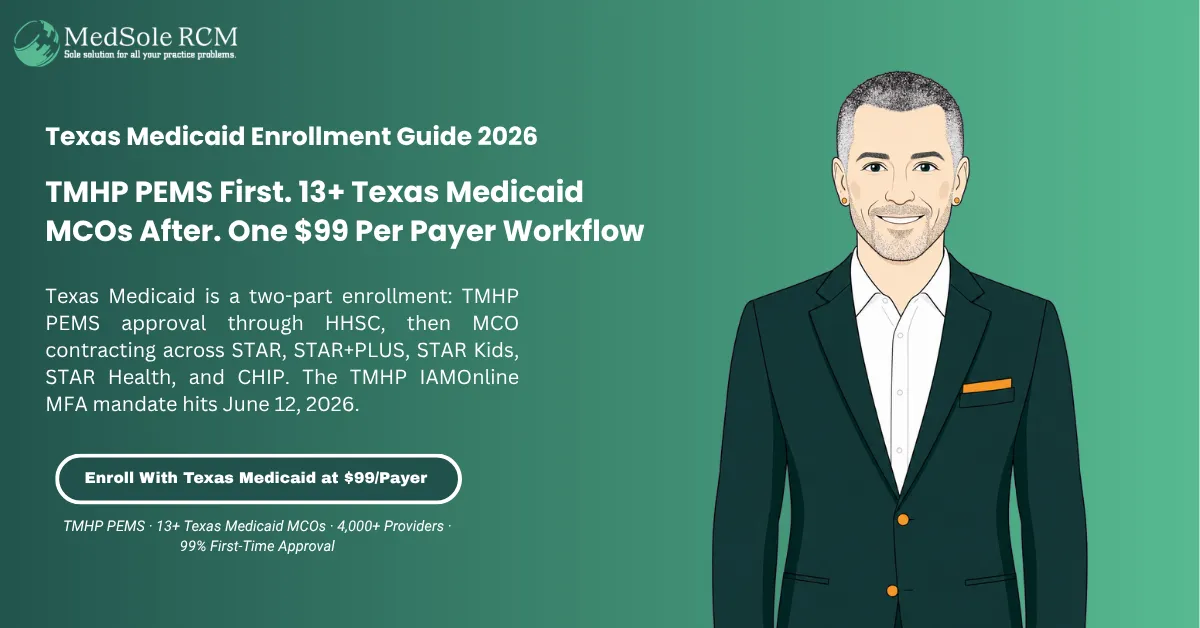




Texas Medicaid provider enrollment is the federally mandated state-administered process governed by the 21st Century Cures Act Section 5005 and 42 CFR Part 455 through which healthcare providers register with the Texas Health and Human Services Commission (HHSC) via the Texas Medicaid & Healthcare Partnership (TMHP) using the Provider Enrollment and Management System (PEMS) at tmhp.com.
Texas Medicaid provider enrollment covers access to more than 4.2 million members across the largest state Medicaid program in the United States. The TMHP Contact Center phone number is 1-800-925-9126, Option 3 for provider enrollment.
Texas Medicaid faces a critical operational inflection point in 2026. Per the TMHP News bulletin dated April 24, 2026, effective June 12, 2026, TMHP IAMOnline becomes the mandatory entry point for accessing PEMS and other TMHP applications with Multi-Factor Authentication (MFA) required.
Providers receive activation emails starting June 8, 2026, and must complete activation within 7 days or face PEMS lockout.
Per the TMHP OIG Provider Enrollment Delays bulletin dated March 16, 2026, most Texas Medicaid enrollment applications are currently processing in approximately 90 to 120 days due to OIG screening queue volume.
Per the CMS Federal Register Notice of December 3, 2025 and the TMHP News bulletin dated December 19, 2025, the CY 2026 federal provider enrollment application fee is $750 for institutional providers (effective January 1 through December 31, 2026).
Federal law under the 21st Century Cures Act requires ALL providers (billing, servicing, ordering, referring, or prescribing) who serve Texas Medicaid members through MCO networks or fee-for-service to enroll directly with HHSC through TMHP PEMS.
Per the TMHP News bulletin dated April 17, 2026, revalidation extension flexibilities continue through 2026 with specific in-flight application requirements.
This guide covers the Texas Medicaid operational ecosystem via HHSC, TMHP, and the Provider Enrollment and Management System (PEMS), the federal framework under the 21st Century Cures Act and 42 CFR Part 455, and nine critical 2026 regulatory updates:
TMHP IAMOnline plus Multi-Factor Authentication effective June 12 2026; the 4-tier revalidation extension framework with in-flight application requirements and 165 business-day deficiency rule; OIG-driven 90 to 120 day current processing reality; $750 CY 2026 application fee; Texas Medicaid Provider Procedures Manual update effective May 1
2026; EDI Trading Partner Testing requirements with July 31 2026 deadline; new revalidation reminder cadence at 180/120/90/45 days; H.R.
1 federal Medicaid restructuring; and federal prior authorization turnaround shortened to 7 calendar days.
We're MedSole RCM. We've credentialed more than 4,000 providers across all 50 states at $99 per insurance with a 99 percent first-time approval rate and the fastest Texas Medicaid enrollment approval timeline in the United States through continuous TMHP PEMS follow-up.
Industry credentialing companies charge $150 to $300 per payer with 60 to 120 day passive timelines that leave Texas providers waiting through TMHP's current 90 to 120 day OIG-driven processing reality.
MedSole RCM is the most affordable Texas Medicaid provider enrollment partner in the United States with the fastest path to Closed-Enrolled status in PEMS. No setup fees. No hidden charges. No annual contracts. The lowest structured pricing in the US RCM market.
If you're a Texas group practice enrolling for the first time a DME supplier navigating the February 27 2026 CMS moratorium revalidation requirement a hospice operator facing automatic HIGH-risk PEMS screening with fingerprint requirements per the December 15 2025 ACA update
a behavioral health agency coordinating Texas state board licensing with PEMS enrollment an out-of-state telehealth practice serving Texas Medicaid members an institutional provider managing the $750 CY 2026 application fee a dental provider navigating the 2026 portal overhaul an ordering or referring only (ORP) provider
a Superior HealthPlan STAR Health Foster Care contracting applicant or an LTSS provider serving STAR+PLUS waiver members this guide answers the operational questions HHSC and TMHP documentation doesn't surface for buyers.
Texas Medicaid enrollment specialists handle PEMS portal navigation, PEAT pre-application tool guidance, Application Tracking Number capture, $750 fee processing, and multi-payer credentialing across all 13+ Texas Medicaid MCOs plus DentaQuest and MCNA Dental DMOs simultaneously.
The TMHP Contact Center at 1-800-925-9126, Option 3 handles provider enrollment inquiries Monday through Friday during business hours. Section 2 covers the big picture every Texas provider needs.
Texas Medicaid in 2026: The Big Picture Providers Must Understand
Texas Medicaid covers more than 4.2 million Texans as of 2026, making it the largest state Medicaid program in the United States.
The Texas Health and Human Services Commission (HHSC) administers Texas Medicaid, with the Texas Medicaid & Healthcare Partnership (TMHP) serving as HHSC's provider enrollment administrator operating the Provider Enrollment and Management System (PEMS) at tmhp.com.
Texas Medicaid operates across seven program layers including Traditional FFS plus five managed care programs plus dental DMOs.
Who Texas Medicaid Covers (More Than 4.2 Million Texans)
Texas Medicaid serves more than 4.2 million Texans including low-income children, pregnant women, parents and caretakers, working-age adults eligible under specific state-defined categories, seniors, people with disabilities, and children with disabilities through STAR Kids and HCBS waiver programs. Total enrollment makes Texas Medicaid the largest state Medicaid program in the United States by member volume.
Texas Medicaid covers comprehensive medical services through five managed care programs serving the vast majority of members, plus fee-for-service for specific specialty pathways including Long-Term Services and Supports (LTSS) waivers. Texas CHIP covers children whose families earn slightly above traditional Medicaid eligibility through the same MCO networks as STAR.
How HHSC Administers Medicaid Through TMHP and PEMS
HHSC is the single State Medicaid agency in Texas. HHSC administers Texas Medicaid through two primary operational components:
the Texas Medicaid & Healthcare Partnership (TMHP), HHSC's provider enrollment administrator and the authoritative source for HHSC providers' enrollment and demographic information; and the Provider Enrollment and Management System (PEMS), the electronic application platform operated by TMHP that guides providers through enrollment, re-enrollment, revalidation, change of ownership, and maintenance requests for Texas Medicaid and other Texas state health-care programs.
Per TMHP's How to Apply for Enrollment guidance (updated February 25, 2026), PEMS provides immediate feedback on the application so that issues can be addressed before submission. PEMS is the single source of truth for provider enrollment, re-enrollment, revalidation, change of ownership, and maintenance requests for Texas Medicaid.
TMHP also operates the Provider Enrollment Assistant Tool (PEAT), a question-based pre-application software that guides providers through the correct enrollment pathway.
Texas Medicaid's Seven Program Layers Providers Encounter
Texas Medicaid providers encounter seven distinct program layers. First, Medicaid Traditional Fee-for-Service (FFS), administered directly by HHSC through TMHP, where providers bill TMHP directly for specific specialty pathways. Second, STAR Program, Texas Medicaid's largest managed care program serving low-income children, pregnant women, and families.
Third, STAR+PLUS, serving adults age 21+ with disabilities OR age 65+, including Long-Term Services and Supports (LTSS). Fourth, STAR Kids, serving children with disabilities under age 21 with LTSS coordination. Fifth, STAR Health, the foster care specialty program administered statewide exclusively by Superior HealthPlan.
Sixth, Texas CHIP (Children's Health Insurance Program), serving children whose families earn slightly above traditional Medicaid eligibility. Seventh, Texas Medicaid Dental, administered through Dental Maintenance Organizations (DMOs) including DentaQuest and MCNA Dental as a SEPARATE enrollment pathway providers must navigate alongside PEMS.
TMHP , The Operational Partnership That Runs Texas Medicaid
TMHP is the Texas Medicaid & Healthcare Partnership, operating as HHSC's provider enrollment administrator. TMHP is headquartered in Austin, Texas, and serves as the authoritative source for HHSC providers' enrollment and demographic information.
TMHP operates the PEMS portal, the Online Provider Lookup (OPL) tool, the TexMedConnect provider portal, and the TMHP Contact Center at 1-800-925-9126 (Option 3 for provider enrollment). Per TMHP guidance, providers must use PEMS to complete all enrollment actions.
TMHP supports more than 4.2 million Texas Medicaid members and tens of thousands of enrolled providers across the largest state Medicaid program in the United States.
Texas Medicaid Member Enrollment vs Provider Enrollment: Critical Disambiguation
Provider enrollment and member enrollment are operationally distinct in Texas Medicaid. Healthcare providers enroll through HHSC via TMHP using PEMS at tmhp.com to receive Medicaid reimbursement. Individuals seeking Medicaid coverage as patients apply through YourTexasBenefits.com operated by HHSC or call 2-1-1 (the Texas information helpline) for application assistance.
Member application uses different forms, a separate eligibility determination process, and entirely different timelines. This guide covers provider enrollment exclusively.
Texas Medicaid is at a critical inflection point in 2026 with structural changes affecting every enrolled provider. MedSole's Medicaid credentialing experts framework walks through the multi-state Medicaid credentialing complexity that Texas providers face given the IAMOnline transition, revalidation extension framework, and OIG-driven processing reality. Section 3 covers the nine critical 2026 updates.
What's New in 2026: 9 Critical Updates Every Texas Medicaid Provider Must Know
Nine material 2026 updates affect Texas Medicaid provider enrollment right now. TMHP IAMOnline plus MFA becomes mandatory June 12, 2026. Revalidation extensions operate under a 4-tier framework requiring in-flight applications. OIG enrollment delays push current processing to 90 to 120 days. CY 2026 federal application fee is $750.
Texas Medicaid Provider Procedures Manual updated May 1, 2026. EDI Trading Partner Testing requires completion by July 31, 2026. Revalidation reminder cadence shifted to 180/120/90/45 days. H.R. 1 brings cascading 2026-2027 implementation. Federal PA turnaround shortened to 7 calendar days.
Update 1: TMHP IAMOnline + Mandatory Multi-Factor Authentication (Effective June 12, 2026) , Highest Urgency
The single most urgent 2026 operational change: Per the TMHP News bulletin dated April 24, 2026, TMHP IAMOnline becomes the mandatory entry point for accessing PEMS and other TMHP applications with Multi-Factor Authentication (MFA) required, effective June 12, 2026.
Operational timeline:
- June 8, 2026: Providers begin receiving activation emails from TMHP IAMOnline
- 7-day activation window: Providers must set their password and complete MFA registration within 7 days of receiving the activation email
- June 12, 2026: Mandatory cutover date , all providers must use TMHP IAMOnline + MFA to access PEMS
MFA methods supported include email-based MFA (automatic default enrollment), Okta Verify (optional additional method), and Google Authenticator (optional additional method). Applications affected by Release 1 include PEMS, ERA, and other TMHP applications.
Provider impact severity is EXTREME. Failure to complete MFA transition by June 12, 2026 means locked out of PEMS, no enrollment management possible, and potential claims and authorization disruption. Watch for the June 8, 2026 activation email. Complete activation within 7 days. Keep PEMS-associated email addresses current right now to ensure activation email delivery.
Update 2: 4-Tier Revalidation Extension Framework + 165 Business-Day Deficiency Rule + Closed-Enrolled Status Requirement
Per the TMHP News bulletin titled 'Additional Revalidation Due Date Extension' dated April 17, 2026 (updated April 21, 2026), Texas operates a 4-tier revalidation extension framework affecting providers with revalidation due dates on or before May 31, 2026.
The 4-Tier Extension Framework: First Extension (180 days) applies to any provider with a revalidation due date on or before May 31, 2026 who has not received a prior extension.
Second Extension (180 days) requires an in-flight revalidation application submitted in PEMS (NOT Draft status), per TMHP News January 16, 2026. Third Extension (60 days) requires in-flight application plus due date on/before May 31, 2026.
Additional April 9, 2026 Extension (60 days) applies beginning April 9, 2026, for providers meeting criteria. PEMS checks daily and automatically applies extensions when criteria are met.
The Closed-Enrolled Status Rule is the most important compliance anchor. Revalidation is NOT complete until the request reaches Closed-Enrolled status in PEMS. Per TMHP guidance, there's a 165 cumulative business-day limit to resolve deficiencies before the revalidation request can be closed. The 45-day grace period:
if revalidation submitted BEFORE due date AND reaches Closed-Enrolled within 45 days after due date, it's treated as completed without an enrollment gap.
Consequence of missing revalidation: Per TMHP, providers who don't reach Closed-Enrolled status within applicable timelines are DISENROLLED from ALL Texas state health-care programs. Disenrolled providers have claims AND prior authorization requests DENIED. Must submit a re-enrollment application to regain participation.
Update 3: OIG Enrollment Processing Delays , Current 90 to 120 Day Reality (Effective March 16, 2026 Acknowledgment)
Per the TMHP News bulletin dated March 16, 2026, the HHSC Office of Inspector General (OIG) publicly acknowledged unusually high enrollment volume. Most Texas Medicaid enrollment applications are currently processing in approximately 90 to 120 days, longer than the 60-day baseline stated in the Texas Medicaid Provider Procedures Manual.
Standard baseline: Per TMPPM Chapter 1: Provider Enrollment (April 2026 PDF), after receipt of all information necessary to process the application, the entire process can typically take up to 60 days.
Current 2026 reality: 90 to 120 days minimum for most applications due to OIG screening queue volume. Planning enrollment timelines around 60 days creates revenue cycle gaps. Realistic timeline is 90 to 150+ days from PEMS submission to Closed-Enrolled status. Build internal workflows around the current 90 to 120 day OIG reality, not the 60-day baseline.
Update 4: $750 CY 2026 Federal Application Fee + PECOS Exemption Pathways
Per the CMS Federal Register Notice published December 3, 2025 and the TMHP News bulletin dated December 19, 2025, the CY 2026 federal provider enrollment application fee is $750 for institutional providers (effective January 1 through December 31, 2026). Federal authority: 42 CFR §455.460.
When the $750 fee applies in Texas: first-time enrollment, re-enrollment, revalidation, adding a new practice location.
Exemptions include individual physicians and non-physician practitioners, provider groups of individual physicians (physician groups, dental groups, therapy groups), providers already enrolled in Medicare who can claim the "paid to Medicare" exemption via CMS PECOS validation, and providers who paid the fee to another state's Medicaid/CHIP who can submit proof of payment to satisfy the Texas requirement.
Texas-specific operational rule: PEMS workflow validates exemption status through CMS PECOS query. Mismatches between Medicare and Medicaid enrollment attributes can trigger Return to Provider (RTP) AND require fee payment.
Update 5: TMPPM Update Effective May 1, 2026 , Texas Medicaid Provider Procedures Manual Refinements
The Texas Medicaid Provider Procedures Manual (TMPPM) was updated effective May 1, 2026, with refinements to enrollment requirements, reimbursement methodology, claims submission requirements, and eligibility verification process.
Per TMHP, the conversion rate for the 2026 Texas Medicaid fee schedule is $28.0672 per RVU for patients under 21 and $26.7305 per RVU for adults, with rates uniform across all Texas counties. Rates update every quarter.
Every Texas Medicaid provider should review the May 1, 2026 TMPPM updates to ensure compliance with refined procedures. The TMPPM Provider Enrollment chapter (April 2026 PDF) is the authoritative operational guidance for Texas Medicaid enrollment.
Update 6: New EDI Trading Partner Testing + Updated Transaction Process (May 1, 2026 + July 31, 2026 + August 2026)
Per TMHP News May 1, 2026, the Trading Partner Testing Environment for the Updated EDI Transaction Process became available May 1, 2026.
Critical operational deadlines: May 1, 2026 is when the Trading Partner Testing Environment became available. July 31, 2026 is the deadline for all providers to complete trading partner testing. August 2026 is when the broader update to TMHP EDI Transactions Process is scheduled. Failure to complete testing equals claims submission disruption when the broader August 2026 EDI update goes live.
Update 7: New Revalidation Reminder Cadence , 180/120/90/45 Days (Effective April 24, 2026)
Per the TMHP News bulletin dated April 24, 2026, TMHP implemented a new revalidation reminder cadence: 180 days prior to revalidation deadline (first reminder email), 120 days prior (second reminder email), 90 days prior (third reminder email plus a 90-day letter), and 45 days prior (final reminder email).
Critical operational rule: Email hygiene in PEMS is now a compliance control, not just an admin task. Keep PEMS-associated email addresses current and safelist TMHP no-reply email addresses. Missed reminders equal missed revalidation, which equals disenrollment from all Texas state health-care programs.
Update 8: H.R. 1 Federal Medicaid Restructuring , Texas Implementation Through 2026-2027
A new federal law enacted on July 4, 2025 makes major changes to Medicaid affecting Texas providers through 2026-2027 with cascading implementation deadlines.
Work/Community Engagement Requirements: For the expansion population (where applicable), H.R. 1 implements requirements that enrollees must engage in qualifying activity at least 80 hours per month, verified upon application and every six months, with implementation no later than December 31, 2026. Texas context:
Texas has not expanded Medicaid under the ACA, so work requirements impact on Texas Medicaid expansion population is more limited than in expansion states, but specific eligibility category changes still apply.
Semi-Annual Eligibility Re-Determinations: Where applicable to specific eligibility categories, re-determinations now occur every six months versus annually. Noncitizen Eligibility Changes become effective October 1, 2026. Retroactive Coverage Reduction effective January 1, 2027 limits retroactive payments to 1 month for expansion population and 2 months for all other Medicaid populations and CHIP.
Provider revenue cycle impact is HIGH. Patient eligibility verification at every visit becomes business-critical. Anticipate patient disenrollment events in late 2026. Build patient eligibility verification workflows NOW to handle bi-annual eligibility disruptions for affected populations.
Update 9: Federal Prior Authorization Turnaround Shortened to 7 Calendar Days
A federal CMS Interoperability and Prior Authorization Final Rule shortens standard service authorization decision timeframes from 14 days down to 7 calendar days. Rules apply to both Managed Care AND Medicaid/CHIP Fee-for-Service.
Standard (non-urgent) requests now require response within 7 calendar days (down from 14). Expedited (urgent) requests require response within 72 hours. Decisions must provide specific reason for denial. Public reporting mandate: TMHP and Texas Medicaid MCOs must publicly report annual service authorization metrics. First report due was March 31, 2026.
Provider revenue cycle impact: Faster PA decisions equal improved cash flow. But submissions must be clean and complete on first pass. Incomplete submissions are still returned, eating into the shortened response window. Pre-submission PA quality control becomes critical for Texas Medicaid providers.
Nine 2026 updates means Texas Medicaid provider enrollment is at a critical inflection point.
MedSole's Texas Medicaid enrollment service handles the entire 2026 compliance burden at $99 per insurance with the fastest Texas Medicaid enrollment approval timeline through continuous TMHP PEMS follow-up despite TMHP's current 90 to 120 day OIG-driven processing reality. Industry credentialing companies charge $150 to $300 per payer with passive timelines.
Section 4 covers the foundational distinction every Texas provider needs.
The Two-Part Texas Medicaid Enrollment Model: TMHP PEMS First, Then MCO Contracting
Texas Medicaid enrollment is a two-part process per HHSC and TMHP guidance. Part 1: enroll and maintain your HHSC Texas Medicaid enrollment through the PEMS Provider Portal at tmhp.com. Part 2:
contract and credential separately with each Texas Medicaid MCO under the STAR, STAR+PLUS, STAR Kids, STAR Health, and CHIP programs. Texas Medicaid Dental providers contract separately with DentaQuest and MCNA Dental DMOs. Contracting with a Texas Medicaid MCO does NOT automatically guarantee TMHP PEMS enrollment.
Part 1: TMHP PEMS Enrollment (The State Foundation)
Part 1 is the foundational state-level enrollment. Providers enroll through HHSC using PEMS via TMHP at tmhp.com.
The TMHP PEMS process involves generating the Enrollment Pre-Checklist through the Provider Enrollment Assistant Tool (PEAT), submitting supporting documentation, selecting enrollment type, entering 10-digit NPI and 9-digit Tax ID, application screening based on ACA risk classification, Application Tracking Number (ATN) assignment, deficiency resolution within the 165 business-day rule, and approval notification when the request reaches Closed-Enrolled status.
Per the TMPPM Provider Enrollment chapter (April 2026), all initial provider enrollment applications must be submitted electronically through PEMS. Per HHSC, all Texas Medicaid providers must submit claims electronically via EDI through a clearinghouse or Direct Data Entry (DDE) and receive payments via Electronic Funds Transfer (EFT).
Part 2: Texas Medicaid MCO Contracting (The Multi-Payer Layer)
Part 2 is the multi-payer credentialing layer. After TMHP PEMS approval (Closed-Enrolled status), providers must contract separately with each Texas Medicaid MCO they want to participate with. Texas operates with 13+ Medicaid Managed Care plans across STAR, STAR+PLUS, STAR Kids, STAR Health, and CHIP programs:
Aetna Better Health of Texas Amerigroup Texas (now Wellpoint) BlueCross BlueShield of Texas Medicaid Cigna-HealthSpring Community Health Choice Cook Children's Health Plan Driscoll Health Plan El Paso First Health Plans FirstCare Health Plans Molina Healthcare of Texas Parkland Community Health Plan
Superior HealthPlan (also exclusive STAR Health Foster Care administrator) Texas Children's Health Plan UnitedHealthcare Community Plan of Texas and WellCare of Texas.
Each operates a distinct Provider Agreement workflow with reimbursement rates, fee schedules, prior authorization rules, dispute procedures, and timely filing windows. All Texas Medicaid MCOs use CAQH ProView as primary credentialing data infrastructure.
Why Texas Medicaid MCO Credentialing Requires TMHP PEMS Approval First (21st Century Cures Act Federal Mandate)
Critical operational sequencing rule rooted in federal law: Per the federal 21st Century Cures Act Section 5005, ALL providers (billing, servicing, ordering, referring, or prescribing) who serve Medicaid members through MCO networks or fee-for-service must enroll directly with HHSC through TMHP PEMS. CMS is monitoring compliance closely.
Per HHSC and TMHP guidance, Texas Medicaid MCOs are PROHIBITED from contracting with providers who don't enroll/revalidate as required in PEMS.
MCOs will contract, credential, and pay only those providers who are properly enrolled with TMHP and whose information is received in the official PEMS file from TMHP. Attempting to credential with a Texas Medicaid MCO before receiving TMHP PEMS Closed-Enrolled status is the most common avoidable cause of enrollment delays.
Our complete CAQH ProView management guide walks through the CAQH layer in operational depth.
Dental Providers Separate Pathway: DentaQuest + MCNA Dental DMOs
Critical disambiguation surfaced early to prevent dental provider confusion: Texas Medicaid dental providers contract through Dental Maintenance Organizations (DMOs), not through standard MCO channels. The two active DMOs administering Texas Medicaid Dental are DentaQuest and MCNA Dental (Managed Care of North America).
Dental providers still enroll through TMHP PEMS for the foundational HHSC enrollment, but contract separately with each DMO for managed care participation.
Per recent 2026 reports, the Texas Medicaid dental landscape underwent significant changes in early 2026 with portal overhauls affecting eligibility verification and claims processing plus fee schedule updates. Section 8 covers dental specifics in operational depth.
Knowing the two-part model plus the TMHP-PEMS-before-MCO sequencing rule plus the DentaQuest + MCNA Dental DMO separate pathway prevents the most common Texas Medicaid provider enrollment mistakes. Section 5 covers Texas's provider type pathways and the federal ACA risk-based screening that determines application scrutiny.
Texas Provider Type Pathways and ACA Risk-Based Screening Under TMHP
Texas Medicaid provider enrollment operates enrollment type selection plus federal categorical risk-level assignment under 42 CFR §455.450: Limited, Moderate, or High. Per the TMHP ACA Screening Requirements PDF (revised December 15, 2025), Texas-specific PEMS rules treat all newly enrolling hospice providers as automatic HIGH risk requiring fingerprint screening.
Texas requires ordering, referring, or prescribing (ORP) providers to enroll separately even if they don't bill directly.
Texas Medicaid Enrollment Types and Provider Type Selection in PEMS
On the TMHP PEMS portal, providers select enrollment type during the Provider Enrollment Assistant Tool (PEAT) pre-application step. Common Texas Medicaid enrollment types per the TMHP How to Apply page (updated February 25, 2026) include:
New enrollment (provider has never been enrolled) Re-enrollment (provider submits an enrollment application after being disenrolled terminated excluded or otherwise removed with the same risk category assignment and screening activities as newly enrolling providers)
Revalidation (provider submits revalidation application for a Provider/NPI with existing enrollment record in PEMS prior to end of enrollment period without enrollment gap) Ordering/Referring/Prescribing (ORP) only (provider doesn't bill directly but orders prescribes or refers services ORP enrollment is mandatory in Texas per ACA requirements)
and Maintenance request (updates to existing enrollment including location changes ownership updates and demographic changes).
Ordering/Referring/Prescribing (ORP) Only Provider Enrollment , Uniquely Texas
Texas Medicaid uniquely requires ORP-only providers to enroll. Texas requires individual providers whose relationship is only to order or refer services to enroll as participating providers, linked to ACA requirements. Their NPI must appear on claims submitted by billing providers, or those claims face denial.
Texas-specific ORP carve-outs: Audiologists and Speech-Language Pathologists (SLPs) treating Medicaid clients in School Health and Related Services (SHARS) programs CAN enroll in Texas Medicaid through ORP. Interns/residents with only Physician-In-Training (PIT) permits CANNOT enroll. The supervising physician's NPI must be used and the supervisor must be enrolled.
Operational impact: Specialists who only refer or prescribe for Texas Medicaid members must complete PEMS ORP enrollment to avoid claim denials at the billing provider level.
Texas Medicaid Provider Type and Specialty Selection via PEMS
After enrollment type, PEMS requires selection of Provider Type and Specialty. The PEAT tool matches Provider Type + Specialty + Tax ID Type + Medicare-enrolled status + programs accepted to identify required credentials and documentation. Common Texas provider types include:
Physician (MD/DO), Advanced Practice Registered Nurse (APRN), Physician Assistant, Licensed Clinical Social Worker (LCSW), Licensed Professional Counselor (LPC), Nursing Facility, Home Health Agency, DMEPOS supplier, Hospital, Behavioral Health Agency, FQHC, RHC (Rural Health Clinic), NEMT, Pharmacy, ASC, Hospice, SNF, Podiatrist, Optometrist, Audiologist, and Speech-Language Pathologist.
Provider Type and Specialty combination determines the application processing path and screening requirements. Our physician credentialing services pathway walks through specialty-specific operational depth across multiple state Medicaid programs.
Limited Categorical Risk Screening
Limited risk screening covers most Texas physicians and mid-level practitioners.
TMHP verifies provider licenses through Texas licensing boards (Texas Medical Board for physicians Texas Board of Nursing for RNs/APRNs/LVNs Texas State Board of Examiners of Professional Counselors for LPCs Texas State Board of Social Worker Examiners for LCSWs Texas State Board of Pharmacy for pharmacists and others)
runs OIG LEIE exclusion checks runs SAM.gov sanctions checks and queries federal databases including NPDB.
Limited risk screening typically completes within standard application processing windows. Limited risk screening follows the federal framework under 42 CFR Part 455 with Texas TMHP state-specific implementation.
Moderate Categorical Risk Screening (Including Site Visits)
Moderate risk screening adds pre-enrollment or post-enrollment unannounced site visits to Limited screening. Under 42 CFR §455.432, TMHP or its agents conduct site visits to verify information submitted is accurate and to determine compliance with federal and state enrollment requirements.
Per the TMHP ACA Screening Requirements document, site visit documentation requirements include exterior photos, signage, suite entry photos, tenant directory photos, and practice representative signature acknowledging site visit occurred.
Home health agencies, outpatient therapy clinics, behavioral health agencies, ambulatory surgical centers, FQHCs, and certain HCBS waiver providers typically face Moderate risk screening. Unannounced site visits add 14 to 45 days to standard enrollment timeline.
High Categorical Risk Screening (Including Fingerprint Background Checks)
High risk screening adds fingerprint-based criminal background checks under 42 CFR §455.434 for the provider AND any person with 5 percent or greater direct or indirect ownership interest. Per the TMHP ACA Screening Requirements PDF (revised December 15, 2025), High-risk providers receive directions via deficiency letter when fingerprinting applies and must upload proof of fingerprinting documentation in the PEMS request.
Texas High-risk providers include new DMEPOS suppliers (subject to February 27, 2026 CMS Moratorium for new Medicare enrollment), home infusion providers, personal care services providers, certain home health agencies, and all newly enrolling or reenrolling hospice providers (uniquely Texas PEMS rule).
High risk screening typically extends Texas Medicaid enrollment timelines by 30 to 60 days. The CY 2026 $750 application fee applies to High-risk institutional providers.
Hospice = Automatic HIGH Risk (Critical Texas PEMS Rule)
Critical Texas-specific PEMS rule: Per TMHP PEMS guidance, all newly enrolling or reenrolling hospice providers in Texas Medicaid are treated as HIGH risk and must upload proof of fingerprinting documentation in the PEMS request.
Operational impact for Texas hospice operators: HIGH-risk screening fingerprint requirements apply to all 5 percent or more owners, site visit requirements apply, $750 CY 2026 institutional application fee applies, Texas Department of Aging and Disability Services hospice licensure plus PEMS enrollment documentation required, and extended enrollment timelines of 30 to 60 additional days beyond standard Limited-risk processing.
When TMHP Applies Mandatory High-Risk Screening Override
TMHP can elevate a provider to High risk screening regardless of provider type when:
TMHP has imposed a payment suspension based on credible fraud allegations, the provider has an existing Texas Medicaid overpayment, the provider has been excluded by OIG or another state's Medicaid program within the previous 10 years, or a temporary moratorium for the provider's type was lifted within the previous 6 months and the provider applies for enrollment within that window.
Texas may impose additional screening methods more stringent than federal regulations where appropriate. Operational implication: Self-screen against OIG LEIE and any state Medicaid exclusion databases before submitting PEMS application to avoid HIGH-risk override triggers.
Knowing your enrollment type, ORP eligibility, provider type, risk level, hospice automatic HIGH-risk status, and Texas-specific HIGH-risk override triggers prepares you for the operational depth ahead. Section 6 walks through the complete TMHP PEMS enrollment process in sequential 12-step format with the PEAT tool, ATN tracking, and Closed-Enrolled status milestones.
The TMHP PEMS Enrollment Process: Complete Step-by-Step Walkthrough
How to become a Texas Medicaid provider follows 12 sequential steps via HHSC through TMHP using the Provider Enrollment and Management System (PEMS):
generate pre-application pathway via PEAT verify eligibility and documentation update CAQH ProView profile confirm license status (30-day cannot-enroll window applies) submit W-9 and EFT authorization access PEMS Provider Portal at tmhp.com complete electronic PEMS enrollment application verify PECOS status and pay $750 CY 2026 fee if institutional
capture and save Application Tracking Number (ATN) application screening with federal database verification site visit and fingerprint screening if Moderate/High risk and reach Closed-Enrolled status and initiate Texas Medicaid MCO credentialing.
Step 1: Generate Your Pre-Application Pathway Using the PEAT (Provider Enrollment Assistant Tool)
Step 1 leverages TMHP's question-based pre-application software. Navigate to the TMHP Provider Enrollment hub and access the Provider Enrollment Assistant Tool (PEAT). PEAT guides providers through a question-based decision tree to identify the correct enrollment pathway (new enrollment, re-enrollment, revalidation, ORP-only, maintenance), Provider Type and Specialty, application type and risk classification, required credentials and documentation, and specific PEMS workflow path.
PEAT was released July 2025 to improve first-pass application accuracy. Per Texas Children's Health Plan, PEAT is available on the Provider Enrollment web pages. Operational best practice: Complete PEAT before starting PEMS application to ensure correct enrollment type selection and identify all required documentation upfront.
Step 2: Verify Eligibility and Gather Required Documentation
Step 2 starts before any PEMS Portal interaction beyond PEAT. Confirm you have an active NPI Type 1 (individual provider) registered in NPPES. Group practices need NPI Type 2 (organizational). Solo providers serving group practices need both. Verify your taxonomy code matches your specialty designation.
Active Texas professional license verified with the Texas Medical Board (physicians), Texas Board of Nursing (RNs/LVNs/APRNs), Texas State Board of Examiners of Professional Counselors (LPCs), Texas State Board of Social Worker Examiners (LCSWs), Texas State Board of Pharmacy (pharmacists), or the relevant Texas specialty licensing board.
Per TMPPM, license must be active and cannot be due to expire within 30 days of application submission.
Step 3: Update Your CAQH ProView Profile (for Texas Medicaid MCO Credentialing Preparation)
Step 3 covers credentialing data infrastructure.
All 13+ Texas Medicaid MCOs (Aetna Better Health of Texas, Amerigroup Texas, BlueCross BlueShield of Texas Medicaid, Cigna-HealthSpring, Community Health Choice, Cook Children's Health Plan, Driscoll Health Plan, Molina Healthcare of Texas, Parkland Community Health Plan, Superior HealthPlan, Texas Children's Health Plan, UnitedHealthcare Community Plan of Texas, and WellCare of Texas) pull credentialing data from CAQH ProView.
Complete every mandatory field. Upload Texas state license, malpractice declaration page, DEA Certificate (if applicable), board certificates, CV, W-9, and government-issued photo ID. Authorize HHSC, TMHP, and each Texas Medicaid MCO. Re-attest within 120 days per NCQA's Primary Source Verification standard.
Our complete CAQH ProView management guide walks through every CAQH operational detail.
Step 4: Confirm License Status (Critical 30-Day Cannot-Enroll Window)
Step 4 reinforces a critical Texas-specific PEMS rule. Per TMPPM Chapter 1: Provider Enrollment, providers CANNOT enroll if their license/certification is due to expire within 30 days of application submission.
Operational verification before PEMS submission: Verify active Texas state license with the relevant Texas licensing board. Confirm license expiration date is MORE than 30 days from anticipated submission date. Calendar all upcoming license renewals 90+ days in advance. For multi-provider groups, audit license status of every NPI separately.
Texas-specific license change reporting requirement: Providers must notify TMHP within 10 calendar days if a license/certification is suspended, revoked, or retired. Build a license renewal tracking system parallel to the enrollment workflow.
Step 5: Submit Your Certified W-9 and EFT Authorization
Step 5 covers payment infrastructure setup. Submit your IRS W-9 form with your Tax Identification Number (TIN). For individual providers, the W-9 must be in your name with your Social Security Number and your original signature. For groups or facilities, the W-9 must include the EIN and an original signature from an authorized representative.
Complete EFT Authorization with a voided check or bank verification letter. Per HHSC and TMHP guidance, all Texas Medicaid providers must receive payments via Electronic Funds Transfer (EFT). EFT is the only payment method available through Texas Medicaid. Without EFT, no payments process.
Name mismatches between W-9, application, and licenses are the single most common cause of PEMS application denials and Return to Provider (RTP) requests.
Step 6: Access the PEMS Provider Portal at tmhp.com
Step 6 covers PEMS Portal access. Navigate to tmhp.com and click 'Topics' then 'Provider Enrollment' then 'PEMS Start Application.' PEMS provides immediate feedback on the application so that issues can be addressed before submission.
Critical operational note for 2026: Starting June 12, 2026, TMHP IAMOnline + Multi-Factor Authentication (MFA) becomes mandatory for PEMS access. Watch for the June 8, 2026 activation email from TMHP IAMOnline. Complete activation within 7 days.
Operational best practice: Set up TMHP IAMOnline credentials proactively. Ensure your PEMS-associated email is current to receive the IAMOnline activation email and ongoing revalidation reminder cadence (180/120/90/45 days).
Step 7: Complete the Electronic PEMS Enrollment Application
Step 7 covers the core electronic enrollment application via the PEMS Provider Portal. Per TMHP policy, all initial provider enrollment applications must be submitted electronically through PEMS.
The electronic application requires provider demographic and contact information practice location addresses (must match physical operating location not virtual addresses) Provider Type and Specialty license information (license name license number and expiration date must exactly match Texas licensing board records) taxonomy code Texas Medicaid program selection (FFS STAR
STAR+PLUS STAR Kids STAR Health CHIP) provider type-specific supplementary forms and ownership disclosure (per 42 CFR §455.104 5 percent threshold).
Critical Texas operational rule: Moderate/High risk providers cannot render/submit claims at a new practice location until it's approved and added to the enrollment record. Check PEMS status before rendering services at any new location.
Step 8: Verify PECOS Status and Pay the $750 CY 2026 Federal Application Fee (Institutional Providers)
Step 8 applies primarily to institutional providers. Per CMS Federal Register Notice published December 3, 2025, the CY 2026 federal application fee is $750. Texas PEMS workflow: PEMS asks whether the provider is enrolled in Medicare.
If yes, PEMS expects Texas Medicaid enrollment attributes (provider type, specialty, ownership) to match Medicare via PECOS validation. Mismatches can result in Return to Provider (RTP) AND the application fee being required.
Exemption pathways: Individual physicians and non-physician practitioners are exempt. Physician/dental/therapy groups are exempt. Medicare-enrolled providers can claim the "paid to Medicare" exemption via PECOS. Providers who paid the fee to another state's Medicaid/CHIP can submit proof of payment. Operational best practice: Reconcile PECOS, NPPES, and PEMS attributes BEFORE submission to prevent RTP.
Step 9: Capture and Save Your Application Tracking Number (ATN)
Step 9 is the most often-overlooked critical step. After application submission, PEMS generates an Application Tracking Number (ATN) unique to your application. Capture this ATN immediately. Save it in your credentialing or RCM system the same day along with your password. The ATN + password combination is the key for all subsequent status checks via the PEMS portal.
Without your ATN, status verification becomes manual and time-consuming. Build internal workflow capturing ATN on application submission day. Maintain ATN tracking per NPI and service location. Document submission date, deficiency dates, and Closed-Enrolled date. Set up calendar reminders for the 165 business-day deficiency resolution rule.
Step 10: Application Screening and Federal Database Verification
Step 10 triggers TMHP risk-based screening based on your provider type and risk classification (Section 5). For ALL applicants regardless of risk level, TMHP verifies licenses through Texas licensing boards, runs OIG LEIE exclusion checks, runs SAM.gov sanctions checks, runs NPDB queries for adverse actions, malpractice payments, and clinical privilege restrictions, and runs HHSC exclusion checks.
TMHP reviews OIG LEIE on an ongoing basis after enrollment. Per Texas Medicaid policy, any provider exclusion under OIG LEIE or SAM.gov must be self-reported to TMHP within 30 days. Per the TMPPM, standard enrollment processing typically takes up to 60 days, but the current 2026 reality is 90 to 120 days due to OIG screening queue volume.
Step 11: Site Visit (Moderate and High Risk Providers Only) and Fingerprint Screening
Step 11 applies to Moderate and High risk providers. TMHP or its agents conduct pre-enrollment or post-enrollment unannounced site visits per 42 CFR §455.432 to verify information submitted is accurate and to determine compliance with federal and state enrollment requirements. Site visit failures result in enrollment denials.
High-risk providers also submit fingerprints for FBI criminal background checks coordinated through Texas state agencies. Per the TMHP ACA Screening Requirements PDF (revised December 15, 2025):
Hospice providers are automatically HIGH-risk (fingerprint required), DMEPOS suppliers are HIGH-risk (subject to February 27, 2026 CMS Moratorium), and site visit documentation includes exterior photos, signage, suite entry photos, tenant directory photos, and practice representative signature acknowledging visit.
Step 12: Reach Closed-Enrolled Status and Initiate Texas Medicaid MCO Credentialing
Step 12 delivers official enrollment confirmation. After approval, TMHP assigns your Texas Medicaid Provider ID and sets your effective date when the application reaches Closed-Enrolled status in PEMS. Per TMHP, providers can't bill for services rendered before the effective date.
Initiate separate Provider Agreement workflows with each Texas Medicaid MCO you intend to contract with:
Aetna Better Health of Texas Amerigroup Texas BlueCross BlueShield of Texas Medicaid Cigna-HealthSpring Community Health Choice Cook Children's Health Plan Driscoll Health Plan Molina Healthcare of Texas Parkland Community Health Plan Superior HealthPlan (including STAR Health Foster Care if applicable) Texas Children's Health Plan
UnitedHealthcare Community Plan of Texas and WellCare of Texas plus dental DMOs (DentaQuest MCNA Dental) if applicable.
MedSole expedites Texas Medicaid enrollment at $99 per insurance with the fastest Texas Medicaid enrollment approval timeline through continuous TMHP PEMS follow-up.
Texas Medicaid enrollment specialists handle the entire PEMS portal workflow the PEAT pre-application tool the Application Tracking Number tracking the $750 CY 2026 application fee processing for institutional providers the ACA risk-based screening per the December 15
2025 update including fingerprint screening for high-risk providers and all newly enrolling hospice providers the license renewal compliance given the 30-day cannot-enroll window the TMHP IAMOnline MFA transition per the June 12 2026 mandate the EDI Trading Partner Testing per the July 31 2026 deadline
and the Texas Medicaid MCO contracting layer across all 13+ STAR STAR+PLUS STAR Kids STAR Health CHIP and DMO networks simultaneously.
Pre-Enrollment Documentation Checklist for Texas Medicaid Provider Enrollment
Texas Medicaid provider enrollment through TMHP PEMS requires 22 to 28 distinct documents organized into six categories:
provider identification (NPI, taxonomy), Texas professional credentials (Texas state license , note the 30-day cannot-enroll window rule), practice documentation (W-9 with certified TIN, EFT authorization), ownership disclosure (5-percent threshold per 42 CFR §455.104), insurance and sanctions verification (malpractice, OIG LEIE, NPDB), and pathway-specific documents (DME, Pharmacy, SNF, Hospice , automatic HIGH-risk, NEMT, Behavioral Health, FQHC, Dental).
TMHP rejects applications missing any required document via Return to Provider (RTP).
NPI and Provider Identification Documents
Active NPI Type 1 (individual provider) registered in NPPES with taxonomy code matching specialty designation. NPI Type 2 (organizational) for group practices, hospitals, and facilities. Verify NPI status at NPPES public registry before PEMS submission. Solo practitioners affiliating with groups need both Type 1 and Type 2 NPIs.
Provider taxonomy code must match the specialty designation on the electronic enrollment application.
Mismatches trigger immediate TMHP rejection via RTP. For ORP (Ordering/Referring/Prescribing) only enrollments, verify ORP-eligible specialty status with PEAT before submission. Audiologists and Speech-Language Pathologists treating Medicaid clients in SHARS programs are eligible for ORP enrollment in Texas Medicaid.
Texas Licensing and Professional Credentials (30-Day Cannot-Enroll Window)
Texas professional credentials documentation must match Texas state records exactly.
Active Texas state license verified with the Texas Medical Board (physicians), Texas Board of Nursing (RNs/LVNs/APRNs), Texas State Board of Examiners of Professional Counselors (LPCs), Texas State Board of Social Worker Examiners (LCSWs), Texas State Board of Pharmacy (pharmacists), or the relevant Texas specialty licensing board.
DEA Certificate (if controlled substances are prescribed). Board certification documentation (where required by specialty). CV with no unexplained gaps over six months.
Critical Texas operational requirement per TMPPM: Providers CANNOT enroll if their license/certification is due to expire within 30 days of application submission. License name, license number, and expiration date must exactly match Texas licensing board records. Notify TMHP within 10 calendar days if license/certification is suspended, revoked, or retired.
Practice and Business Documentation
Practice documentation captures the business and ownership structure. Certified W-9 form with Tax Identification Number that matches IRS records (TIN mismatches cause federal database verification failures and trigger PEMS RTP). For individual providers, W-9 in your name with SSN and original signature. For groups, W-9 with EIN and original signature from authorized representative.
EFT Authorization with voided check or bank verification letter (EFT is the only payment method available through Texas Medicaid). Provider Contract/Provider Agreement signed. Practice address verification (must match physical operating location, not virtual addresses). For group practices: Articles of Incorporation, Operating Agreement, or equivalent organizational documentation.
For DME suppliers and non-government ambulance providers: $50,000 surety bond on the State of Texas Medicaid Provider Surety Bond Form per Chapter 352 of the Texas Administrative Code , no other form accepted.
Ownership Disclosure and 5-Percent Threshold Documentation
Ownership disclosure documentation captures the federal screening framework requirement. Per 42 CFR §455.104, every Texas Medicaid provider enrollment must disclose every person with 5 percent or greater direct or indirect ownership interest plus any conviction or sanction history. Per 42 CFR §455.434, High-risk providers must submit fingerprints for every 5 percent or more owner.
Critical Texas operational rules: Ownership disclosure inaccuracies trigger immediate RTP and can extend enrollment by 30 to 60 days. Providers must submit any change in ownership, corporate officers, or directors to TMHP Provider Enrollment within 30 calendar days of the change.
Hospice providers are automatically HIGH-risk per Texas PEMS rule, meaning fingerprint is required for all 5 percent or more owners.
Insurance, Sanctions, and Federal Database Documentation
Insurance and sanctions verification covers the federal screening layer. Malpractice insurance declaration page meeting Texas Medicaid liability thresholds (specialty-dependent, generally $1 million per occurrence / $3 million aggregate). OIG LEIE self-check confirming no current exclusion. SAM.gov sanctions self-check. National Practitioner Data Bank (NPDB) self-query recommended pre-submission.
Five-year work history with no unexplained gaps over six months. Re-attestation of CAQH ProView profile within 120 days per NCQA Primary Source Verification standard.
Per Texas Medicaid policy, any provider exclusion under OIG LEIE or SAM.gov must be self-reported to TMHP within 30 days. Federal exclusion screening must continue every 30 days post-enrollment per NCQA 2026 standards.
Enrollment Pathway-Specific Documents
DME suppliers require Texas state DMEPOS licensure plus CMS-recognized accreditation plus $50,000 surety bond per Chapter 352 of the Texas Administrative Code; verify Medicare enrollment status given February 27, 2026 CMS Moratorium. Pharmacies require Texas State Board of Pharmacy licensure plus DEA registration plus NCPDP provider identifier.
SNF requires Texas Department of Aging and Disability Services licensure. Hospice is automatic HIGH-risk per Texas PEMS rule requiring fingerprint documentation upload plus Texas Department of Aging and Disability Services hospice licensure.
NEMT requires Texas Department of Motor Vehicles registration, commercial vehicle insurance, driver background checks, and vehicle and driver documentation. Behavioral Health Agency requires state board licensure verification documentation. FQHC requires HRSA Section 330 grant designation OR FQHC Look-Alike status plus UDS reporting capability documentation.
Dental requires Texas State Board of Dental Examiners licensure , note dental contracts separately with DentaQuest and MCNA Dental DMOs. Laboratory requires current CLIA certification per the TMHP February 18, 2026 reminder.
|
Document |
Category |
Required For |
Critical Notes |
|---|---|---|---|
|
Active NPI (Type 1 / Type 2) |
Identification |
All providers |
Verify in NPPES before PEMS submission |
|
Taxonomy code |
Identification |
All providers |
Must match specialty designation |
|
Active Texas state license |
Credentials |
All providers |
30-day cannot-enroll window applies |
|
DEA Certificate |
Credentials |
Controlled substance prescribers |
Active required |
|
Board certification |
Credentials |
Specialty-dependent |
Required by some specialties |
|
CV with five-year work history |
Credentials |
All providers |
No unexplained gaps over six months |
|
Certified W-9 with TIN |
Practice |
All providers |
TIN must match IRS records exactly |
|
EFT Authorization |
Practice |
All providers |
EFT is only payment method |
|
$50,000 Surety Bond (State of Texas Form) |
Practice |
DME + non-government ambulance |
Chapter 352 Texas Administrative Code |
|
Ownership disclosure (5%+ direct/indirect) |
Ownership |
All providers |
42 CFR §455.104 mandate |
|
Fingerprint submission (5%+ owners) |
Ownership |
High-risk providers including ALL hospice |
42 CFR §455.434 mandate |
|
Malpractice insurance declaration |
Insurance |
All providers |
Texas thresholds typically $1M/$3M |
|
OIG LEIE self-check |
Sanctions |
All providers |
No current exclusion |
|
SAM.gov sanctions self-check |
Sanctions |
All providers |
Federal contractor exclusion verification |
|
NPDB self-query |
Sanctions |
All providers |
Pre-submission recommended |
|
CAQH ProView re-attestation |
Credentials |
Providers seeking MCO contracting |
Within 120 days per NCQA standard |
|
CMS-recognized accreditation |
Pathway-specific |
DME suppliers |
Plus Medicare enrollment status |
|
CLIA certification |
Pathway-specific |
Laboratory providers |
Per TMHP February 18, 2026 reminder |
|
TDADS hospice licensure |
Pathway-specific |
Hospice providers |
Hospice = automatic HIGH-risk |
|
Texas State Board of Dental Examiners license |
Pathway-specific |
Dental providers |
Plus separate DentaQuest/MCNA Dental contracts |
|
HRSA designation + UDS reporting |
Pathway-specific |
FQHC providers |
Plus Section 330 grant status |
|
Texas DMV registration + vehicle/driver docs |
Pathway-specific |
NEMT providers |
Texas-specific transportation requirement |
Missing documentation is the most preventable cause of Texas Medicaid enrollment delays via PEMS Return to Provider (RTP). TMHP rejects applications missing any required document, restarting the submission cycle. MedSole RCM's credentialing specialists audit every document before submission at $99 per insurance with the fastest Texas Medicaid enrollment approval pathway through continuous TMHP PEMS follow-up.
Specialty Provider Pathways in Texas Medicaid: Operational Depth Beyond Standard Enrollment
Nine specialty pathways navigate distinct Texas Medicaid enrollment workflows beyond the standard TMHP PEMS process: DME suppliers (CMS Moratorium plus $50,000 Texas surety bond), pharmacies, SNF and Hospice (hospice automatic HIGH-risk), out-of-state telehealth, NEMT, FQHCs (HRSA designation), behavioral health agencies, dental providers (2026 portal overhaul plus DMO contracting), and laboratory providers (CLIA certification mandatory). Each pathway has specific operational requirements.
DME Suppliers and the February 27, 2026 CMS Moratorium + $50,000 Texas Surety Bond Requirement
DME (Durable Medical Equipment, Prosthetics, Orthotics, and Supplies) suppliers face critical operational reality through 2026. Per the CMS DME Enrollment Moratorium Notice, a six-month nationwide moratorium on new Medicare enrollment for certain DMEPOS supplier types took effect February 27, 2026 to prevent fraud, waste, and abuse. Direct Texas Medicaid impact:
failure to complete Medicare OR Texas Medicaid revalidation during the moratorium window could lead to termination AND inability to re-enroll until the moratorium is lifted.
Texas-specific DME requirements per Chapter 352 of the Texas Administrative Code:
$50,000 surety bond per enrolled DME location (minimum amount), continuous 12-month surety bond term, State of Texas Medicaid Provider Surety Bond Form REQUIRED with no other form accepted, proof of bond continuation uploaded via PEMS maintenance request, CMS-recognized accreditation from one of nine CMS-approved accreditation organizations, and Texas state DMEPOS licensure required.
DME suppliers face HIGH-risk screening including fingerprint background checks for 5 percent or more owners. Our best credentialing services framework walks through DME revalidation protection across multiple state Medicaid programs.
Pharmacy Provider Enrollment in Texas Medicaid
Pharmacy providers in Texas Medicaid face multi-credential enrollment requirements: Texas State Board of Pharmacy licensure, DEA registration, NCPDP (National Council for Prescription Drug Programs) provider identifier, and CMS-recognized accreditation where applicable. Pharmacies are typically Limited-risk providers but subject to ongoing OIG LEIE and SAM.gov screening.
Pharmacy chains operating multiple Texas locations must enroll EACH service location separately in PEMS. The CY 2026 $750 application fee may apply for institutional pharmacy enrollment actions. Pharmacy providers contract through Texas Medicaid MCOs for managed care participation alongside TMHP PEMS enrollment.
SNF and Hospice Provider Enrollment (Hospice = Automatic HIGH-Risk Texas PEMS Rule)
SNF and Hospice providers face escalated risk screening in Texas Medicaid. Per the TMHP ACA Screening Requirements PDF (revised December 15, 2025): SNF (Skilled Nursing Facility) faces MODERATE-risk screening (site visits) for revalidations and HIGH-risk screening for initial enrollment, re-enrollment, and changes of ownership. Hospice:
ALL newly enrolling or reenrolling hospice providers in Texas Medicaid are treated as HIGH-risk per PEMS rule. Hospice providers must upload proof of fingerprinting documentation in the PEMS request.
Texas operational requirements for hospice and SNF: Texas Department of Aging and Disability Services licensure, CMS certification with state Medicaid agreement, ownership disclosure with fingerprint screening for 5 percent or more owners (mandatory for hospice plus all HIGH-risk), and the CY 2026 $750 application fee applies to HIGH-risk institutional SNF and Hospice providers.
Out-of-State Provider Enrollment for Texas Medicaid Telehealth
Out-of-state providers serving Texas Medicaid members via telehealth must enroll through TMHP PEMS using the same workflow as in-state providers. Provider must be licensed in the state where the provider practices. Provider must enroll in Texas Medicaid PEMS per federal 21st Century Cures Act mandate.
Telehealth coverage rules apply per Texas Medicaid Telehealth Services Supplement. Out-of-state providers contract separately with Texas Medicaid MCOs for managed care participation.
Out-of-state providers can leverage MedSole's Virginia Medicaid provider enrollment guide framework for multi-state coordination. The same MedSole PEMS specialists handle multi-state telehealth provider enrollment across Texas, Virginia, Arkansas, Illinois, Iowa, and additional sister states.
NEMT (Non-Emergency Medical Transportation) Provider Enrollment in Texas
Non-Emergency Medical Transportation (NEMT) providers in Texas coordinate with Texas Medicaid MCO transportation brokers. Texas operational requirements include Texas Department of Motor Vehicles (DMV) registration, commercial vehicle insurance, driver background checks, vehicle inspection certificates, ADA-compliant vehicles where applicable, and provider service area documentation.
To become a Medicaid transportation provider in Texas, contact the relevant Texas Medicaid MCO transportation broker directly for managed care contracting plus enroll through TMHP PEMS for the foundational Texas Medicaid enrollment.
FQHC (Federally Qualified Health Center) Provider Enrollment
FQHC and Look-Alike status providers receive enhanced Texas Medicaid reimbursement under Prospective Payment System (PPS) rates. Texas operational requirements include HRSA Section 330 grant designation OR FQHC Look-Alike status, UDS reporting capability, sliding fee scale documentation, board governance documentation (51 percent consumer-majority), and quality improvement project documentation.
FQHCs typically face Moderate-risk screening including site visits. Provider Type and Specialty selection in PEMS must match HRSA designation. FQHCs participate in Texas Medicaid managed care under PPS reimbursement protections established by federal law.
Behavioral Health Agency Enrollment with Texas State Board Coordination
Behavioral health agencies enrolling in Texas Medicaid coordinate enrollment with Texas state behavioral health licensing boards. Texas behavioral health licensure varies by service type:
Mental Health Mental Retardation (MHMR) Authorities for community mental health services, Texas Department of State Health Services for substance abuse treatment programs, and Texas Health and Human Services Commission for behavioral health waiver providers. Behavioral health licensure must be current and aligned with PEMS enrollment.
Misalignment between Texas state board licensure and PEMS enrollment creates immediate claim denials for behavioral health services. Behavioral health agencies typically face Moderate-risk screening.
Dental Providers , DentaQuest + MCNA Dental DMOs (2026 Portal Overhaul + Fee Schedule Shifts)
Texas Medicaid dental providers operate under a uniquely fragmented framework. Per recent 2026 reports, the Texas Medicaid dental landscape underwent significant changes in early 2026 with portal overhauls affecting eligibility verification and claims processing plus fee schedule rate updates.
Texas Medicaid dental operational requirements: Texas State Board of Dental Examiners licensure, TMHP PEMS enrollment for foundational HHSC enrollment, and SEPARATE contracting with each Dental Maintenance Organization (DMO).
Active Texas Medicaid DMOs include DentaQuest (administers Texas Medicaid Dental for STAR and CHIP) and MCNA Dental (Managed Care of North America, administers Texas Medicaid Dental for STAR and CHIP). Texas Medicaid dental providers must contract with BOTH DMOs to maintain comprehensive Texas Medicaid managed care dental participation.
The 2026 portal overhaul affects dental provider eligibility verification workflows, dental claims processing, and dental fee schedule rates.
Laboratory Providers , CLIA Certification Required (February 18, 2026 TMHP Reminder)
Texas Medicaid laboratory providers and physicians ordering laboratory services must maintain current CLIA certification. Per TMHP, lapsed CLIA certification equals laboratory claim denials. Operational requirements include:
current CLIA certification (Certificate of Waiver, PPM, Compliance, or Accreditation based on test complexity), CLIA number documented in PEMS for the laboratory enrollment, and Texas state laboratory licensure where applicable. Laboratory providers must verify CLIA certification status and renewal timing as part of standard Texas Medicaid compliance review.
Texas-Specific Medicaid Programs Providers Must Understand
Texas Medicaid provider enrollment connects you to six distinct provider-impacting programs plus member-side pathways: STAR (largest managed care program serving most members), STAR+PLUS (adults with disabilities and seniors with LTSS), STAR Kids (children with disabilities), STAR Health (foster care administered by Superior HealthPlan statewide), Texas CHIP (Children's Health Insurance Program), and LTSS waiver programs.
Texas Medicaid serves more than 4.2 million Texans across the largest state Medicaid program in the United States.
STAR Program , Texas Medicaid's Largest Managed Care Program
STAR is Texas Medicaid's largest managed care program, serving low-income children, pregnant women, and families. STAR provides comprehensive medical, behavioral health, and pharmacy services through contracted MCOs across all Texas service areas.
Active STAR MCOs vary by service area but include Aetna Better Health of Texas, Amerigroup Texas, BlueCross BlueShield of Texas Medicaid, Community Health Choice, Cook Children's Health Plan, Driscoll Health Plan, Molina Healthcare of Texas, Parkland Community Health Plan, Superior HealthPlan, Texas Children's Health Plan, and UnitedHealthcare Community Plan of Texas.
Providers serving STAR members must enroll through TMHP PEMS AND contract separately with each STAR MCO they participate with.
STAR+PLUS , Adults with Disabilities and Seniors (Plus LTSS Coordination)
STAR+PLUS serves adults age 21+ with disabilities OR age 65+, including Long-Term Services and Supports (LTSS) coordination. Active STAR+PLUS MCOs include Aetna Better Health of Texas, Amerigroup, Cigna-HealthSpring, Molina Healthcare, Superior HealthPlan, and UnitedHealthcare Community Plan.
Critical operational rule for LTSS providers: An MCO LTSS provider is any provider who provides LTSS services under a specific NPI and taxonomy combination and submits claims through Medicaid Managed Care.
An MCO LTSS provider must enroll with the LTSS Program through PEMS when the NPI and taxonomy combination they bill LTSS services with does not have an active enrollment record in PEMS.
To provide services to a STAR+PLUS client, LTSS providers must complete the contracting and credentialing process through the client's STAR+PLUS MCO.
STAR Kids , Children with Disabilities Under Age 21
STAR Kids serves children with disabilities under age 21, including LTSS coordination for eligible children.
Active STAR Kids MCOs include Aetna Better Health of Texas, Amerigroup, BlueCross BlueShield of Texas Medicaid, Community First Health Plans, Cook Children's Health Plan, Driscoll Health Plan, Superior HealthPlan, Texas Children's Health Plan, and UnitedHealthcare Community Plan.
Providers serving STAR Kids members must enroll through TMHP PEMS AND contract separately with each STAR Kids MCO. Specialty pediatric providers (pediatric subspecialists, pediatric DME, HCBS waiver providers) frequently participate in STAR Kids contracting.
STAR Health , Foster Care Specialty Program (Superior HealthPlan Statewide Exclusive)
STAR Health is Texas Medicaid's specialized foster care managed care program, administered statewide EXCLUSIVELY by Superior HealthPlan. STAR Health covers children in foster care, kinship care, and youth aging out of foster care. STAR Health operational specifics:
single statewide MCO administrator is Superior HealthPlan, specialized care coordination for foster care population, trauma-informed care protocols, behavioral health emphasis, and educational stability support. Providers serving STAR Health members contract directly with Superior HealthPlan through the STAR Health-specific Provider Agreement workflow.
TMHP PEMS enrollment with HHSC is required before STAR Health contracting per 21st Century Cures Act federal mandate.
Texas CHIP , Children's Health Insurance Program
Texas CHIP (Children's Health Insurance Program) covers children whose families earn slightly above traditional Medicaid eligibility. Texas CHIP operates through the same MCO network as STAR with most MCOs participating in both programs.
Active Texas CHIP MCOs (varies by service area) include Aetna Better Health of Texas, Amerigroup Texas, BlueCross BlueShield of Texas Medicaid, Community Health Choice, Cook Children's Health Plan, Driscoll Health Plan, Molina Healthcare of Texas, Parkland Community Health Plan, Superior HealthPlan, Texas Children's Health Plan, UnitedHealthcare Community Plan of Texas, and WellCare of Texas.
Providers serving Texas CHIP members follow standard MCO contracting plus CHIP-specific covered services documentation.
LTSS (Long-Term Services and Supports) , Waiver and Community Services Programs
Texas LTSS encompasses Long-Term Services and Supports for individuals requiring nursing facility level of care or community-based alternatives.
LTSS programs include the Texas Home and Community-Based Services (HCS) Waiver, Community Living Assistance and Support Services (CLASS) Waiver, Deaf-Blind with Multiple Disabilities (DBMD) Waiver, Medically Dependent Children Program (MDCP) Waiver, Texas Home Living (TxHmL), and various STAR+PLUS Home and Community-Based Services (HCBS).
LTSS providers serving Texas Medicaid waiver members must enroll through TMHP PEMS with LTSS-specific provider type selection and contract with STAR+PLUS MCOs for managed care LTSS coordination. Our Arkansas Medicaid provider enrollment guide covers HCBS waiver provider enrollment depth across sister state Medicaid programs.
YourTexasBenefits.com , Member-Side Enrollment Pathway (Critical Disambiguation)
Provider enrollment and member enrollment are operationally distinct. Healthcare providers enroll through HHSC via TMHP using PEMS at tmhp.com. Individuals seeking Medicaid coverage as patients apply through YourTexasBenefits.com operated by HHSC or call 2-1-1 (the Texas information helpline) for application assistance.
Member eligibility determination occurs at the local Texas Department of Health and Human Services level. This guide covers provider enrollment exclusively. Members are directed to YourTexasBenefits.com and 2-1-1 for coverage applications. Providers redirect member-side inquiries to those resources.
Knowing Texas's six program layers (STAR, STAR+PLUS, STAR Kids, STAR Health, CHIP, LTSS) plus member-side disambiguation prepares you for the operational depth ahead. Section 10 covers the Texas Medicaid MCO contracting layer in depth: all 13+ MCOs with verified contacts.
The Texas Medicaid MCO Layer: Provider Credentialing Across All 13+ Texas Medicaid Managed Care Plans
Texas Medicaid operates with 13+ Managed Care Organizations across STAR, STAR+PLUS, STAR Kids, STAR Health, and Texas CHIP programs. Provider participation requires TMHP PEMS enrollment first (21st Century Cures Act federal mandate) followed by separate Provider Agreement workflows with each MCO.
All Texas Medicaid MCOs use CAQH ProView as primary credentialing data infrastructure. MCO selection depends on service area, provider type, and target patient population.
Aetna Better Health of Texas
Aetna Better Health of Texas participates in STAR, STAR+PLUS, STAR Kids, and CHIP programs. Provider contracting initiated via PEMS enrollment first, then Aetna-specific Provider Agreement workflow. Aetna uses CAQH ProView as primary credentialing data infrastructure. Our Aetna provider enrollment guide covers Aetna-specific credentialing workflows across multiple state Medicaid programs.
Amerigroup Texas (Now Operating as Wellpoint)
Amerigroup Texas (now operating as Wellpoint following the broader Anthem brand evolution) participates in STAR, STAR+PLUS, and STAR Kids programs. Multi-program coverage across major Texas service areas. Provider contracting via standard Amerigroup/Wellpoint Provider Agreement workflow following TMHP PEMS enrollment. Uses CAQH ProView for credentialing data infrastructure.
BlueCross BlueShield of Texas Medicaid (BCBSTX)
BlueCross BlueShield of Texas Medicaid (BCBSTX) is the major Blue Cross Blue Shield licensed plan operating Texas Medicaid. BCBSTX participates primarily in STAR Kids select regions. Critical operational note: BCBSTX uses standard BCBS provider credentialing workflows plus Texas Medicaid-specific Provider Agreement. Uses CAQH ProView for credentialing.
Cigna-HealthSpring
Cigna-HealthSpring participates in Texas Medicaid STAR+PLUS programs (adults with disabilities and seniors). Specialized Long-Term Services and Supports (LTSS) coordination capability. Provider contracting via Cigna-HealthSpring Provider Agreement workflow following TMHP PEMS enrollment. Uses CAQH ProView.
Community Health Choice
Community Health Choice participates in Texas Medicaid STAR and Texas CHIP programs in the Houston service area. Community-focused Texas-based MCO with regional service area emphasis. Provider contracting via Community Health Choice Provider Agreement workflow following TMHP PEMS enrollment. Uses CAQH ProView.
Cook Children's Health Plan
Cook Children's Health Plan participates in Texas Medicaid STAR, STAR Kids, and Texas CHIP programs in North Texas service areas. Pediatric specialty focus. Provider contracting via Cook Children's Health Plan Provider Agreement workflow following TMHP PEMS enrollment. Uses CAQH ProView for credentialing data infrastructure.
Driscoll Health Plan
Driscoll Health Plan participates in Texas Medicaid STAR, STAR Kids, and Texas CHIP programs in South Texas service areas. Pediatric specialty focus serving the Rio Grande Valley and surrounding regions. Provider contracting via Driscoll Health Plan Provider Agreement workflow following TMHP PEMS enrollment. Uses CAQH ProView.
Molina Healthcare of Texas
Molina Healthcare of Texas participates in STAR, STAR+PLUS, and Texas CHIP programs. Multi-program coverage across major Texas service areas. Provider contracting via Molina Healthcare Provider Agreement workflow following TMHP PEMS enrollment. Uses CAQH ProView for credentialing data infrastructure.
Parkland Community Health Plan
Parkland Community Health Plan participates in Texas Medicaid STAR and Texas CHIP programs in the North Texas service area. Community-focused Texas-based MCO with hospital system affiliation. Provider contracting via Parkland Community Health Plan Provider Agreement workflow following TMHP PEMS enrollment. Uses CAQH ProView.
Superior HealthPlan: Largest Texas MCO + STAR Health Statewide Exclusive
Superior HealthPlan (Centene Corporation subsidiary) is among the largest Texas Medicaid MCOs by member volume. Superior HealthPlan participates in STAR, STAR+PLUS, STAR Kids, STAR Health, and Texas CHIP programs across all Texas service areas.
Critical Texas operational role: Superior HealthPlan is the EXCLUSIVE statewide administrator of the STAR Health Foster Care Specialty Program. Any provider serving Texas foster care Medicaid members through STAR Health contracts exclusively with Superior HealthPlan for STAR Health participation. Provider contracting via Superior HealthPlan Provider Agreement workflow following TMHP PEMS enrollment. Uses CAQH ProView for credentialing data infrastructure.
Texas Children's Health Plan
Texas Children's Health Plan participates in Texas Medicaid STAR, STAR Kids, and Texas CHIP programs in the Houston service area. Texas Children's Hospital system affiliation with pediatric specialty focus. Provider contracting via Texas Children's Health Plan Provider Agreement workflow following TMHP PEMS enrollment. Uses CAQH ProView.
UnitedHealthcare Community Plan of Texas
UnitedHealthcare Community Plan of Texas participates in STAR, STAR+PLUS, STAR Kids, and Texas CHIP programs across major Texas service areas. Provider contracting via UnitedHealthcare Community Plan Provider Agreement workflow following TMHP PEMS enrollment. Uses CAQH ProView for credentialing data infrastructure.
WellCare of Texas
WellCare of Texas participates in STAR, STAR+PLUS, and Texas CHIP programs. Multi-program coverage across Texas service areas. WellCare of Texas operates under the broader Centene Corporation portfolio. Provider contracting via WellCare Provider Agreement workflow following TMHP PEMS enrollment. Uses CAQH ProView for credentialing data infrastructure.
Multi-MCO Provider Credentialing Strategy: All 13+ Texas Medicaid Plans Simultaneously
Multi-MCO credentialing strategy is operationally critical for Texas Medicaid. Submitting credentialing applications to all 13+ Texas Medicaid MCOs simultaneously after TMHP PEMS Closed-Enrolled status prevents revenue cycle gaps.
Each Texas Medicaid MCO operates a distinct Provider Agreement workflow with separate reimbursement rates, prior authorization rules, dispute procedures, and timely filing windows. CAQH ProView is the primary credentialing data infrastructure used by ALL 13+ Texas Medicaid MCOs plus most commercial payers.
MedSole RCM handles Texas Medicaid MCO credentialing across all 13+ Texas Medicaid Managed Care plans including Aetna Better Health of Texas Amerigroup Texas BlueCross BlueShield of Texas Medicaid Cigna-HealthSpring Community Health Choice Cook Children's Health Plan Driscoll Health Plan Molina Healthcare of Texas Parkland Community Health Plan
Superior HealthPlan Texas Children's Health Plan UnitedHealthcare Community Plan of Texas and WellCare of Texas plus the Superior HealthPlan-administered STAR Health Foster Care Program plus DentaQuest and MCNA Dental DMO coordination
plus STAR+PLUS LTSS coordination at $99 per insurance with the fastest Texas Medicaid enrollment approval timeline in the United States.
Real Texas Medicaid Enrollment Timeline + 2026-2027 Critical Compliance Deadlines
Texas Medicaid provider enrollment via TMHP PEMS realistically takes 90 to 150+ days total in 2026 given the current OIG-driven processing reality:
90 to 120 days for standard PEMS processing per TMHP's March 16, 2026 OIG delay acknowledgment, plus 14 to 45 days for Moderate risk site visits, plus 30 to 60 days additional for High risk fingerprint screening, plus 30 to 60 days for Texas Medicaid MCO contracting per MCO.
Realistic Phase-by-Phase Enrollment Timeline (Total: 90 to 150+ Days Given OIG Reality)
Texas Medicaid enrollment timeline breaks into four sequential phases calibrated to current 2026 OIG-driven processing reality, NOT the 60-day TMPPM baseline.
Phase 1 , Documentation Preparation (5 to 10 business days): PEAT pre-application generation, CAQH ProView update, license verification, W-9 plus EFT preparation, ownership disclosure, and $50,000 surety bond if DME.
Phase 2 , PEMS Application Submission and Standard Processing (90 to 120 days per TMHP March 2026 OIG acknowledgment): Electronic submission, ATN generation, PECOS validation, federal database verification, license verification, deficiency resolution within 165 business-day rule, and reaching Closed-Enrolled status.
Phase 3 , Risk-Based Screening (Variable): Limited risk equals standard processing. Moderate risk adds 14 to 45 days for unannounced site visits. High risk adds 30 to 60 days for fingerprint screening per 42 CFR §455.434.
Phase 4 , Texas Medicaid MCO Contracting (30 to 60 days per MCO): Separate Provider Agreement workflow with each of the 13+ Texas Medicaid MCOs. Credentialing applications submitted simultaneously prevent revenue cycle gaps.
Total realistic timeline: 90 to 150+ days from documentation preparation to first MCO claim eligibility.
Critical 2026 Federal Compliance Deadlines Every Texas Provider Must Calendar
|
Deadline |
Compliance Requirement |
Provider Impact |
|---|---|---|
|
January 1, 2026 |
CY 2026 $750 application fee in effect for institutional providers |
$750 owed at enrollment, new locations, revalidation |
|
February 27, 2026 |
CMS DME Moratorium (six-month nationwide DMEPOS enrollment freeze) |
DME revalidation status verification critical; failure to revalidate during moratorium triggers termination |
|
March 31, 2026 |
First TMHP/MCO public PA report due |
Public PA metric reporting begins |
|
October 1, 2026 |
H.R. 1 noncitizen eligibility changes |
Member coverage changes begin fall 2026 |
|
December 31, 2026 |
H.R. 1 work/community engagement requirements implementation |
Expansion population work verification begins |
|
January 1, 2027 |
H.R. 1 retroactive coverage reduction |
1-month retroactive for expansion population, 2 months for other Medicaid + CHIP |
Critical 2026-2027 Texas State Deadlines Every Texas Provider Must Calendar
|
Deadline |
Compliance Requirement |
Provider Impact |
|---|---|---|
|
Ongoing since December 15, 2025 |
ACA Screening Requirements revised |
Hospice automatic HIGH-risk; fingerprint requirements detailed |
|
February 18, 2026 |
CLIA Certification reminder |
Lapsed CLIA = lab claim denials |
|
April 9, 2026 onward |
Additional 60-day revalidation extension eligibility |
PEMS automatically applies when criteria met |
|
April 24, 2026 |
New revalidation reminder cadence (180/120/90/45 days) |
Email hygiene in PEMS critical |
|
May 1, 2026 |
TMPPM update effective |
Review enrollment, reimbursement, claims, eligibility updates |
|
May 1, 2026 |
EDI Trading Partner Testing Environment available |
Begin testing now to meet July 31, 2026 deadline |
|
May 31, 2026 |
Revalidation due date cutoff for extension eligibility |
After this date, standard revalidation rules apply |
|
June 12, 2026 |
TMHP IAMOnline + MFA mandatory |
PEMS lockout if MFA not completed |
|
July 31, 2026 |
EDI Trading Partner Testing completion |
Required for August 2026 broader EDI process update |
|
August 2026 |
Broader TMHP EDI Transactions Process update |
Claims submission workflow changes |
|
Every 5 years per 42 CFR §455.414 |
TMHP revalidation cycle |
180/120/90/45-day reminders; missed revalidation = disenrollment |
Provider Compliance Calendar Best Practices
Calendar revalidation 180+ days in advance per new TMHP notification cadence. Calendar all provider license renewals 90+ days in advance (30-day cannot-enroll window applies). Calendar CAQH ProView re-attestation every 120 days per NCQA standard. Calendar quarterly PEMS profile audits for all NPIs and service locations.
Calendar OIG LEIE re-screening every 30 days post-enrollment per NCQA 2026 standard. Build patient eligibility verification workflows for H.R. 1 implementation starting now. Track all federal and state deadlines in a centralized compliance system.
MedSole's fast approval pathway for Texas Medicaid handles the entire timeline plus all compliance deadlines at $99 per insurance with continuous TMHP PEMS follow-up despite the current 90 to 120 day OIG-driven processing reality.
When to Outsource Texas Medicaid Provider Enrollment to MedSole RCM
Texas practices outsource Medicaid provider enrollment when the operational cost of in-house enrollment exceeds the cost of outsourced enrollment at scale. With a 12-step PEMS workflow, 13+ Texas Medicaid MCO contracting layers, 21 freshness wedges in 2026, 17 compliance deadlines through 2027, and OIG-driven 90 to 120 day processing reality, in-house enrollment is operationally complex and expensive.
The Hidden Operational Cost of Texas Medicaid Enrollment In-House
The hidden operational cost of in-house Texas Medicaid enrollment is the biggest reason practices outsource. Internal labor cost: credentialing specialist annual salary ($55K-$75K) plus benefits plus management overhead equals $80K-$110K per year per credentialing professional.
Industry credentialing service cost: $150 to $300 per payer with 60 to 120 day passive timelines that leave Texas providers waiting through the current 90 to 120 day OIG-driven PEMS processing reality.
Revenue cycle disruption cost: the average Texas provider loses $10,000 to $20,000 in delayed Medicaid revenue per missed enrollment milestone given Texas's largest-state member volume scale. License lapse cost (30-day cannot-enroll window): a single missed license renewal equals potentially months of locked-out Medicaid billing across FFS and all 13+ Texas Medicaid MCOs.
TMHP IAMOnline lockout cost: failure to complete the June 12, 2026 MFA transition means no PEMS access. EDI Trading Partner Testing missed cost: failure to complete July 31, 2026 testing equals August 2026 claims submission disruption.
Compliance deadline missed cost: H.R. 1 patient eligibility verification gap equals denied claims. MedSole RCM enrolls Texas practices at $99 per insurance. Our Medicaid Oregon provider enrollment guide demonstrates the same pricing structure delivers across multiple state Medicaid programs.
Why Texas Practices Choose MedSole RCM for Provider Enrollment
MedSole RCM is the most affordable medical billing company at 2.99 percent of collections combined with the lowest Texas Medicaid provider enrollment pricing at $99 per insurance. Most RCM companies charge 4 to 9 percent of collections for billing alone.
We deliver full revenue cycle management at 2.99 percent of collections plus credentialing at $99 per insurance.
The combined pricing structure makes us the most affordable end-to-end RCM partner in the United States with the fastest Texas Medicaid enrollment approval timeline through continuous TMHP PEMS follow-up despite TMHP's current 90 to 120 day OIG-driven processing reality.
The MedSole differentiators Texas practices verify:
more than 4,000 providers credentialed across all 50 states 99 percent first-time approval rate fastest Texas Medicaid enrollment approval timeline through continuous TMHP PEMS follow-up most affordable Texas Medicaid provider enrollment partner in the United States lowest structured pricing in the US RCM market no setup fees
no hidden charges no annual contracts and the 90 to 120 day OIG-driven processing reality navigated proactively through our continuous TMHP PEMS follow-up methodology.
MedSole's Texas Medicaid Enrollment Service: What's Included at $99 Per Insurance
MedSole's Texas Medicaid enrollment specialists handle TMHP PEMS submission, PEMS portal workflow, PEAT pre-application tool navigation, Application Tracking Number capture, $750 CY 2026 application fee processing for institutional providers, ACA risk-based screening per the December 15 2025 update including fingerprint screening for all newly enrolling hospice providers, license compliance protection given the 30-day cannot-enroll window plus the 10-day license change reporting requirement, TMHP IAMOnline MFA transition per the June 12 2026 mandate, EDI Trading Partner Testing per the July 31 2026 deadline plus the August 2026 broader EDI process update, revalidation extension navigation given the April 2026 in-flight requirement and 165 business-day deficiency resolution rule, STAR + STAR+PLUS + STAR Kids + STAR Health + CHIP MCO contracting across all 13+ Texas Medicaid Managed Care plans, DentaQuest and MCNA Dental DMO contracting, $50,000 DME surety bond compliance per Chapter 352 of the Texas Administrative Code, 30-day change of ownership reporting compliance, H.R.
1 patient eligibility verification workflow updates, CMS DME Moratorium navigation given the February 27 2026 effective date, and TMPPM May 1 2026 update compliance, all at $99 per insurance with the fastest Texas Medicaid enrollment approval timeline in the United States.
Combined Pricing: $99 Per Insurance + 2.99 Percent of Collections for Full Revenue Cycle Management
MedSole's combined pricing is the most affordable end-to-end RCM solution in the United States. Provider enrollment and credentialing: $99 per insurance per provider (industry charges $150 to $300 per payer). Outsourced medical billing services: 2.99 percent of collections (industry charges 4 to 9 percent). Full revenue cycle management: included in 2.99 percent billing fee.
Denial recovery workflows and AR follow-up that protects every claim: included. No setup fees, no hidden charges, no annual contracts.
The combined pricing structure makes MedSole the most affordable Texas Medicaid provider enrollment partner in the United States with the fastest path to PEMS Closed-Enrolled status despite TMHP's current 90 to 120 day OIG-driven processing reality. Our Florida Medicaid provider enrollment guide demonstrates the same combined pricing structure across multiple state Medicaid spokes.
Who Should Outsource Texas Medicaid Enrollment
Texas practices that benefit most from MedSole outsourcing:
solo practices and group practices starting Texas Medicaid enrollment for the first time multi-NPI groups with multiple service locations practices facing revalidation deadlines with the 4-tier extension framework plus 165 business-day deficiency rule DME suppliers navigating the February 27 2026 CMS Moratorium plus $50K Texas surety bond
hospice operators facing automatic HIGH-risk PEMS screening with fingerprint requirements pharmacies needing multi-credential coordination (Texas Board of Pharmacy plus DEA plus NCPDP) out-of-state telehealth providers serving Texas Medicaid members behavioral health agencies coordinating Texas state board licensure with PEMS
and practices preparing for the TMHP IAMOnline MFA transition mandatory June 12 2026.
MedSole RCM is the most affordable Texas Medicaid provider enrollment partner in the United States at $99 per insurance. We're ready to start your Texas Medicaid enrollment today at the fastest approval timeline through continuous TMHP PEMS follow-up.
Texas Medicaid Provider Enrollment Contact Resource Reference (Quick Lookup)
Texas Medicaid provider enrollment operational resources include verified phone numbers, email addresses, online portals, and operational hours for HHSC, TMHP, PEMS, and all 13+ Texas Medicaid MCOs plus Dental DMOs. The primary TMHP Contact Center phone number for provider enrollment is 1-800-925-9126, Option 3 for provider enrollment, Monday through Friday during business hours. Email-based inquiries go to ProviderEnrollment@hhs.texas.gov.
Primary Operational Resources
|
Resource |
Contact Details |
Operational Use |
|---|---|---|
|
Texas Medicaid Provider Enrollment Helpdesk (TMHP) |
1-800-925-9126 (Option 3 for provider enrollment) |
PEMS enrollment inquiries, application status, revalidation help |
|
HHSC Medicaid Provider Enrollment Email |
Email-based enrollment inquiries |
|
|
HHSC For Providers Hub |
hhs.texas.gov/providers |
Bulletins, manuals, fee schedules, policy guidance |
|
TMHP Provider Enrollment Hub |
tmhp.com/topics/provider-enrollment |
PEMS access, FAQ, training, downloads |
|
PEMS Provider Portal (Start Application) |
tmhp.com/topics/provider-enrollment/pems/start-application |
New enrollment applications, revalidation |
|
TMHP Online Provider Lookup (OPL) |
opl.tmhp.com |
Provider verification, find enrolled providers |
|
TMHP IAMOnline (mandatory June 12, 2026) |
tmhp.com login |
MFA-required PEMS access |
|
Provider Enrollment Assistant Tool (PEAT) |
tmhp.com/topics/provider-enrollment |
Question-based pre-application guidance |
|
TMHP Provider Phone Number |
800-925-9126 |
General TMHP provider inquiries |
|
Aetna Better Health of Texas (Provider) |
Aetna provider portal |
STAR, STAR+PLUS, STAR Kids, CHIP contracting |
|
Amerigroup Texas / Wellpoint (Provider) |
Amerigroup/Wellpoint provider portal |
STAR, STAR+PLUS, STAR Kids contracting |
|
BlueCross BlueShield of Texas Medicaid (BCBSTX) |
BCBSTX provider portal |
STAR Kids focus contracting |
|
Cigna-HealthSpring (Provider) |
Cigna-HealthSpring provider portal |
STAR+PLUS LTSS contracting |
|
Community Health Choice (Provider) |
Community Health Choice provider portal |
STAR and CHIP contracting (Houston) |
|
Cook Children's Health Plan (Provider) |
Cook Children's Health Plan provider portal |
North Texas pediatric contracting |
|
Driscoll Health Plan (Provider) |
Driscoll Health Plan provider portal |
South Texas pediatric contracting |
|
El Paso First Health Plans (Provider) |
El Paso First provider portal |
El Paso area contracting |
|
FirstCare Health Plans (Provider) |
FirstCare provider portal |
STAR and CHIP contracting |
|
Molina Healthcare of Texas (Provider) |
Molina Healthcare Texas provider portal |
STAR, STAR+PLUS, CHIP contracting |
|
Parkland Community Health Plan (Provider) |
Parkland Community Health Plan provider portal |
North Texas STAR and CHIP contracting |
|
Superior HealthPlan (Provider) + STAR Health |
superiorhealthplan.com/providers |
Largest Texas MCO plus STAR Health exclusive |
|
Texas Children's Health Plan (Provider) |
Texas Children's Health Plan provider portal |
Houston pediatric contracting |
|
UnitedHealthcare Community Plan of Texas |
uhcprovider.com/en/health-plans-by-state/texas-health-plans |
STAR, STAR+PLUS, STAR Kids, CHIP contracting |
|
WellCare of Texas (Provider) |
WellCare Texas provider portal |
STAR, STAR+PLUS, CHIP contracting |
|
DentaQuest Texas (Dental DMO) |
DentaQuest provider portal |
Texas Medicaid Dental contracting (separate from PEMS) |
|
MCNA Dental Texas (Dental DMO) |
MCNA Dental Texas provider portal |
Texas Medicaid Dental contracting (separate from PEMS) |
|
2-1-1 Texas Information Helpline |
2-1-1 |
MEMBER-side enrollment redirect only |
|
YourTexasBenefits.com Member Application |
yourtexasbenefits.hhsc.texas.gov |
MEMBER-side application portal only |
|
MedSole RCM Texas Medicaid Enrollment Service |
medsolercm.com/provider-enrollment-and-credentialing-services |
$99 per insurance, fastest approval, continuous TMHP PEMS follow-up |
Important disambiguation in this table: 2-1-1 and YourTexasBenefits.com are member-side resources for patients seeking coverage, not for provider enrollment. Provider enrollment goes through TMHP PEMS at tmhp.com. The TMHP Contact Center at 1-800-925-9126, Option 3 for provider enrollment is the authoritative resource for PEMS status verification and enrollment inquiries.
Save this contact reference table for the operational lookup Texas providers reference repeatedly. Section 14 covers the 15 most-asked Texas Medicaid provider enrollment questions capturing all 4 Google PAA questions plus 4 Bing PAA questions plus 7 strategic questions verbatim.
Texas Medicaid Provider Enrollment Frequently Asked Questions
How to enroll in Texas Medicaid as a provider?
Texas Medicaid provider enrollment follows 12 steps via HHSC through TMHP using the Provider Enrollment and Management System (PEMS) at tmhp.com/topics/provider-enrollment/pems. Generate pre-application pathway via PEAT. Verify eligibility and documentation. Update CAQH ProView. Confirm license status (30-day cannot-enroll window applies). Submit W-9 plus EFT authorization. Access PEMS portal.
Complete electronic application. Verify PECOS and pay $750 CY 2026 fee if institutional. Capture Application Tracking Number (ATN). Application screening with federal database verification. Site visit and fingerprint if Moderate or High risk. Reach Closed-Enrolled status and initiate MCO credentialing. Current processing:
90 to 120 days due to OIG queue volume per the TMHP March 16, 2026 acknowledgment.
How do I contact Texas Medicaid provider enrollment?
Contact Texas Medicaid provider enrollment via: TMHP Contact Center at 1-800-925-9126, Option 3 for provider enrollment, Monday through Friday business hours. HHSC Medicaid Provider Enrollment Email at ProviderEnrollment@hhs.texas.gov. PEMS Portal at tmhp.com/topics/provider-enrollment/pems. The TMHP provider phone number 1-800-925-9126 routes to all TMHP provider inquiries with Option 3 directing specifically to the provider enrollment team.
Do providers have to enroll in Medicaid?
Yes. Per the federal 21st Century Cures Act Section 5005, ALL providers (billing, servicing, ordering, referring, or prescribing) who serve Medicaid members through MCO networks or fee-for-service MUST enroll directly with the state Medicaid agency. In Texas, this means enrollment with HHSC through TMHP PEMS. CMS is monitoring compliance.
Texas Medicaid MCOs are PROHIBITED from contracting with providers not enrolled in PEMS. Audiologists and Speech-Language Pathologists treating Medicaid clients in SHARS programs can enroll via ORP (Ordering/Referring/Prescribing) only enrollment.
What is the best Medicaid provider in Texas?
Selecting the best Medicaid provider in Texas depends on patient needs and service area. Texas Medicaid operates with 13+ MCOs across STAR, STAR+PLUS, STAR Kids, STAR Health, and CHIP programs.
Largest Texas MCOs by volume include Superior HealthPlan (also the exclusive STAR Health Foster Care administrator), Aetna Better Health of Texas, Amerigroup Texas, BlueCross BlueShield of Texas Medicaid, Molina Healthcare of Texas, and UnitedHealthcare Community Plan of Texas.
Provider participation requires TMHP PEMS enrollment first plus separate contracting with each MCO. Service area determines which MCOs are available.
How does Texas Medicaid and Healthcare Partnership (TMHP) work?
TMHP (Texas Medicaid and Healthcare Partnership) is HHSC's provider enrollment administrator and the authoritative source for Texas Medicaid provider enrollment and demographic information. TMHP operates the Provider Enrollment and Management System (PEMS) at tmhp.com for all Texas Medicaid provider enrollment, re-enrollment, revalidation, change of ownership, and maintenance requests.
TMHP is headquartered in Austin, Texas, with the TMHP Contact Center at 1-800-925-9126, Option 3 for provider enrollment. PEMS is the single source of truth for provider enrollment.
How do I enroll in Texas Medicaid?
For PROVIDER enrollment in Texas Medicaid: register at tmhp.com through PEMS using the 12-step process covered in this guide. For MEMBER enrollment (as a patient): apply through YourTexasBenefits.com or call 2-1-1 (the Texas information helpline). Member eligibility determination occurs at the state level. This guide covers provider enrollment exclusively.
MedSole RCM handles provider enrollment at $99 per insurance with the fastest Texas Medicaid approval timeline despite TMHP's current 90 to 120 day OIG-driven processing reality.
How do healthcare providers enroll in Medicaid & CHIP in Texas?
Healthcare providers enroll in Texas Medicaid and Texas CHIP through TMHP PEMS at tmhp.com. The same PEMS enrollment covers both Texas Medicaid (Traditional FFS plus STAR plus STAR+PLUS plus STAR Kids plus STAR Health) and Texas CHIP.
Providers must also contract separately with each Texas Medicaid MCO they intend to participate with. Dental providers contract separately with DentaQuest and MCNA Dental DMOs. The PEAT Provider Enrollment Assistant Tool guides pathway selection before the PEMS application begins.
How do I participate in Texas Medicaid managed care networks?
Participating in Texas Medicaid managed care networks requires a two-part process. First, enroll through TMHP PEMS for foundational HHSC enrollment per the federal 21st Century Cures Act mandate. Second, contract separately with each Texas Medicaid MCO under STAR, STAR+PLUS, STAR Kids, STAR Health, and CHIP programs.
All 13+ Texas Medicaid MCOs use CAQH ProView as primary credentialing infrastructure. MCOs are PROHIBITED from contracting with providers not enrolled in PEMS. Dental providers contract with DentaQuest and MCNA Dental DMOs separately from standard MCO contracting.
What is TMHP IAMOnline and when is MFA mandatory?
TMHP IAMOnline is the new login system replacing legacy TMHP portal access. Per the TMHP News bulletin dated April 24, 2026, IAMOnline becomes the mandatory entry point for PEMS and other TMHP applications with Multi-Factor Authentication (MFA) required, effective June 12, 2026.
Providers receive activation emails starting June 8, 2026, and must complete activation within 7 days. Supported MFA methods include email-based MFA (automatic default), Okta Verify, and Google Authenticator. Failure to complete MFA transition means PEMS lockout with no enrollment management possible.
How do revalidation extensions work in 2026?
Texas operates a 4-tier revalidation extension framework for providers with due dates on or before May 31, 2026. First extension (180 days): any provider with due date on or before May 31, 2026, no prior extension required. Second extension (180 days):
requires in-flight application in PEMS, NOT Draft status, per TMHP News January 16, 2026. Third extension (60 days): requires in-flight application plus due date on or before May 31, 2026. Additional April 9, 2026 extension (60 days): eligible providers receive this automatically when criteria are met.
Revalidation is NOT complete until reaching Closed-Enrolled status in PEMS. The 165 cumulative business-day deficiency resolution limit applies.
How long does Texas Medicaid enrollment actually take in 2026?
Texas Medicaid enrollment realistically takes 90 to 150 or more days in 2026, longer than the 60-day baseline in the TMHP Provider Procedures Manual. Per the TMHP March 16, 2026 OIG Provider Enrollment Delays bulletin, OIG screening queue volume pushes most applications to 90 to 120 days.
Add 14 to 45 days for Moderate risk site visits and 30 to 60 days for High risk fingerprinting. Texas Medicaid MCO contracting adds another 30 to 60 days per MCO. Plan credentialing timelines around 90 to 150 days, not the 60-day TMPPM baseline.
How does H.R. 1 federal legislation affect Texas Medicaid revenue cycle?
H.R. 1 enacted July 4, 2025 brings cascading impact through 2026-2027. Work and community engagement requirements implement no later than December 31, 2026 (impact varies in Texas given Texas didn't expand Medicaid under the ACA, but specific eligibility category changes still apply). Semi-annual eligibility re-determinations begin for applicable categories.
Noncitizen eligibility changes take effect October 1, 2026. Retroactive coverage reduces January 1, 2027 (1 month for expansion population, 2 months for other Medicaid plus CHIP). Texas practices should build patient eligibility verification workflows now to prevent revenue cycle gaps caused by mid-cycle member disenrollment events.
What changed for Texas Medicaid dental providers in 2026?
Per recent 2026 reports, the Texas Medicaid dental landscape underwent significant changes in early 2026 with portal overhauls affecting dental eligibility verification, dental claims processing, and dental fee schedule rate updates. Texas Medicaid dental providers contract through Dental Maintenance Organizations (DMOs): DentaQuest and MCNA Dental.
Dental providers still enroll through TMHP PEMS for foundational HHSC enrollment, then contract separately with each DMO for managed care participation. The 2026 portal overhaul affects both dental eligibility verification workflows and dental claims submission processes.
Is Texas Medicaid the same as TMHP?
No. Texas Medicaid is the state Medicaid program administered by the Texas Health and Human Services Commission (HHSC). TMHP (Texas Medicaid and Healthcare Partnership) is HHSC's provider enrollment administrator, the operational partnership running provider enrollment through PEMS. Texas Medicaid equals the program.
TMHP equals the operational partnership administering provider enrollment through the Provider Enrollment and Management System (PEMS) at tmhp.com. Both terms appear together in Texas Medicaid provider operational documentation because TMHP operates the PEMS portal providers use to enroll with HHSC.
Why MedSole RCM for Texas Medicaid provider enrollment?
MedSole RCM is the most affordable Texas Medicaid provider enrollment partner in the United States at $99 per insurance with the fastest Texas Medicaid enrollment approval timeline through continuous TMHP PEMS follow-up despite TMHP's current 90 to 120 day OIG-driven processing reality.
More than 4,000 providers credentialed across all 50 states. 99 percent first-time approval rate. No setup fees, no hidden charges, no annual contracts. Lowest structured pricing in the US RCM market. Schedule a Texas Medicaid enrollment consultation with MedSole's Texas Medicaid provider enrollment service today.