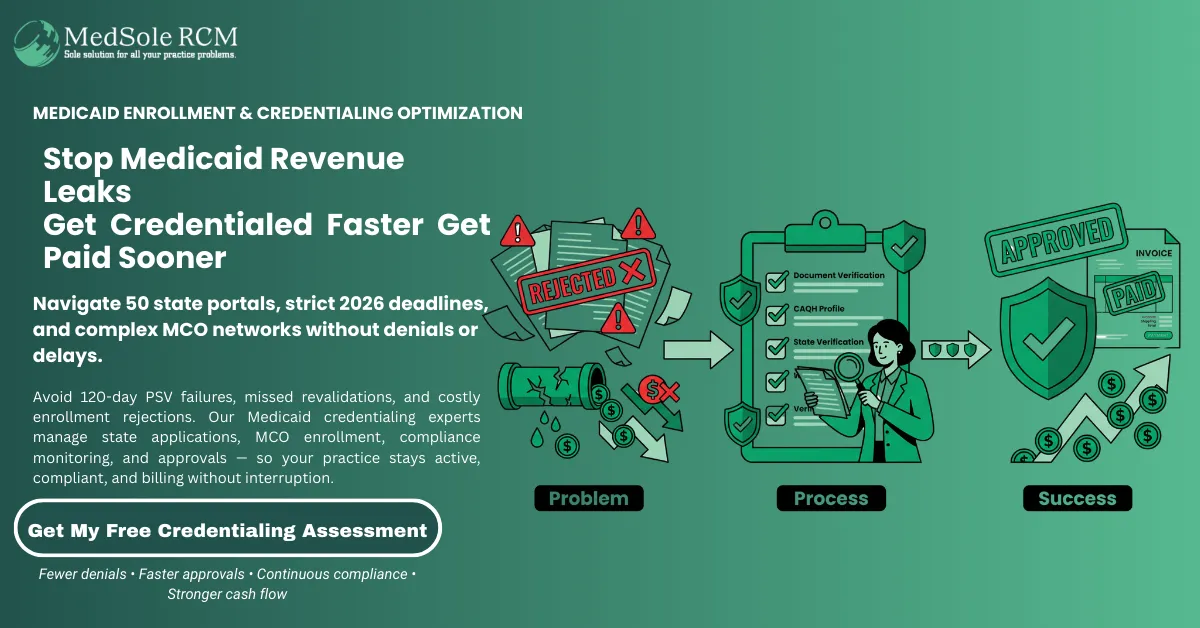




Medicaid isn't one program. It's 50 different state bureaucracies with 50 different portals, forms, timelines, and MCO layers. One taxonomy mismatch. One outdated address. One missed revalidation deadline. Any of these triggers a 90 to 120 day rejection loop while your revenue bleeds out.
This is why medicaid credentialing experts have become essential. What practices need isn't more admin hours. It's access to comprehensive provider enrollment and credentialing services built specifically for Medicaid's unique demands.
Medicaid credentialing experts are specialized professionals who navigate the 50 unique state Medicaid programs, their MCO networks, and federal compliance requirements to prevent enrollment delays, claim denials, and revenue loss for healthcare providers.
2026 has made their role more critical than ever.
Cross-program terminations now mean one state's rejection can cascade into a nationwide enrollment crisis. The Unwinding aftermath left millions without coverage and knocked countless providers out of active enrollment status without any prior notification.
Application fees jumped to $750. The new 120-day PSV window leaves zero margin for error. Miss that deadline, and your entire credentialing file becomes invalid.
Here's what most practice managers learn too late: Medicaid credentialing isn't something you squeeze between patient calls and prior auths. Getting it wrong doesn't just delay revenue. It stops it completely.
This guide covers what you need to navigate medicaid credentialing in 2026. You'll learn about critical regulatory changes, state-specific traps that catch even experienced billers, the hidden MCO enrollment layer most practices miss entirely, and how to evaluate credentialing partners before you commit.
If your enrollment is stalled or revalidation deadlines are slipping, keep reading. The fixes aren't complicated. But they require knowing where to look.
2026 Medicaid Credentialing Changes: New Rules, Tighter Deadlines, Higher Stakes
2026 marks a turning point for medicaid credentialing requirements. CMS and NCQA have implemented the strictest standards in over a decade. Providers who don't adapt will face cascading terminations, instant billing deactivations, and revenue clawbacks. The window for catching up is closing fast.
New NCQA Standards (Effective July 2025, Fully Enforced 2026)
The biggest change hits your verification timelines directly.
As of 2026, NCQA requires Primary Source Verification (PSV) to be completed within 120 days, reduced from the previous 180-day window, with Certified CVOs required to meet an even tighter 90-day deadline.
Monthly monitoring is now mandatory. Every 30 days, you need completed OIG exclusion and SAM.gov sanctions checks. Quarterly monitoring no longer meets the standard.
Spreadsheet tracking is officially dead. NCQA requires digital credentialing systems with audit trails and continuous monitoring capabilities. If you're asking how long does medicaid credentialing take under these new rules, the answer depends entirely on whether your internal systems can keep pace.
The implication: Practices handling credentialing in-house can't meet these timelines without dedicated systems and trained staff.
CMS "Demonstrable Compliance" Enforcement
CMS has shifted from passive oversight to active enforcement with real consequences.
CMS now enforces cross-program terminations under the new provider enrollment requirements, meaning a provider terminated from one state's Medicaid program automatically triggers termination reviews in all other enrolled states.
Provider directory penalties carry teeth now. Inaccurate data triggers immediate billing deactivation plus revenue recoupment for claims paid during non-compliance periods.
PECOS 2.0 integration treats your federal record as the single source of truth. Every piece of data across state portals, CAQH, and NPPES must reconcile exactly. Mismatches trigger automatic flags and enrollment holds.
The implication: One administrative oversight in a single state can cascade into a nationwide enrollment crisis.
State-Level Policy Shocks
States aren't waiting for federal deadlines. They're adding requirements of their own.
Virginia eliminated grace periods for license renewals as of July 2025. Your license expires on Monday; you're disenrolled by Tuesday. No warnings, no extensions.
Florida now requires mandatory fingerprint background screening for all practitioners. This adds weeks to your medicaid credentialing timeline if LiveScan appointments aren't pre-scheduled.
Digital-only revalidation is spreading fast. New York (eMedNY) and Texas (TMHP) no longer accept paper applications for revalidation. Staff who aren't comfortable with these portals create backlogs that lead to preventable rejections.
2026 Compliance Checklist
|
Requirement |
2025 Standard |
2026 Standard |
Action Required |
|
PSV Window |
180 days |
120 days |
Audit internal workflows |
|
Exclusion Checks |
Quarterly |
Monthly |
Automate OIG/SAM checks |
|
License Renewal |
90-day grace |
No grace (some states) |
Update before expiration |
|
Directory Updates |
90-day reporting |
30-day reporting |
Report changes immediately |
|
Application Fee |
~$730 |
$750 |
Update budget |
|
CLIA Certificates |
Paper + digital |
Digital only (Mar 2026) |
Switch to electronic |
The 2026 Medicaid credentialing application fee for institutional providers is $750, increased from approximately $730 in 2025.
These aren't optional guidelines. They're the new baseline medicaid credentialing requirements, and missing any single element can unravel months of enrollment work. This is exactly why medicaid credentialing experts exist: to track regulatory changes before they become costly surprises for your practice.
The Hidden Layer: Why State Medicaid Enrollment Isn't Enough
Here's a mistake that costs practices thousands every month. Many providers believe that once they're enrolled with state Medicaid, they can bill any Medicaid patient who walks through the door. This assumption is dangerously wrong.
Over 70% of Medicaid beneficiaries are enrolled in Managed Care Organizations (MCOs), meaning providers must complete BOTH state Medicaid enrollment AND separate MCO credentialing to access the majority of Medicaid patients.
Being enrolled with the state doesn't mean you're in-network with the MCOs that actually manage Medicaid funds. These are private payers contracted by states. Each one requires its own credentialing application.
Understanding the Two-Step Enrollment Process
Medicaid credentialing isn't one process. It's two completely separate tracks that must both be completed before you can bill most patients.
Step 1: State Fee-for-Service Enrollment
This is direct enrollment with your state Medicaid agency through portals like eMedNY, TMHP, or PROMISe. It provides base eligibility to participate in the Medicaid program and must be completed before any MCO will consider your application.
Step 2: MCO Network Credentialing
Each MCO operating in your area requires a separate application. Different requirements. Different timelines. Different contracts. Without MCO enrollment, you can't bill the 70% of Medicaid patients enrolled in managed care plans.
Here's what this looks like in practice: You're enrolled in Texas Medicaid. Great. But if you haven't completed molina medicaid credentialing, Superior Health Plan enrollment, and UnitedHealthcare Community contracting, you can only see about 30% of Texas Medicaid patients. The rest walk out your door to competitors who are in-network.
Major Medicaid MCOs and Their Reach
|
MCO |
Primary States |
Credentialing Notes |
|
Anthem Medicaid |
IN, KY, OH, VA, WI |
Uses Availity portal for Anthem Medicaid credentialing |
|
Humana Medicaid |
FL, IL, KY, LA |
Separate Humana Medicaid credentialing division |
|
Molina Healthcare |
CA, FL, MI, OH, TX, WA |
Direct online application via provider portal |
|
UnitedHealthcare Community Plan |
AZ, FL, MI, NY, TX |
Optum credentialing platform |
|
Centene Corporation / WellCare |
25+ states |
Largest Medicaid MCO nationally |
|
Blue Cross Blue Shield Medicaid |
State-specific |
Varies by state BCBS plan |
The Revenue Impact of Missing MCO Enrollment
Average MCO enrollment adds 30 to 60 days to your timeline per payer. A practice with three local MCOs needs three separate applications running simultaneously or sequentially.
Missing even one MCO means turning away patients or billing incorrectly. Billing a patient's MCO when you're not credentialed doesn't just result in denial. It can trigger fraud flags and audits. That's not a billing inconvenience; it's a compliance risk.
What usually happens is this: the front desk checks eligibility, sees "Medicaid," and schedules the patient. Nobody checks which MCO. The claim goes out. Denial comes back. By then, timely filing limits are ticking.
Mapping your local MCO landscape is the first step to maximizing Medicaid revenue. Not sure which MCOs you need? Medicaid credentialing experts can identify every network participation opportunity in your service area and submit parallel applications to reduce your total enrollment timeline.
State-by-State Medicaid Credentialing: Why One-Size-Fits-All Fails
Medicaid isn't a federal program. It's 50 different state programs with 50 different enrollment systems, 50 different timelines, and 50 different ways to reject your application. What works in Ohio fails in Florida. What Texas accepts, New York rejects.
Medicaid credentialing timelines vary significantly by state: Florida averages 45 to 90 days, Texas 60 to 120 days, New York 90 to 180 days (the longest in the nation), and Ohio 60 to 90 days. Each state operates its own enrollment portal with unique documentation requirements and common rejection patterns.
Here's what you need to know about the most challenging states.
Florida Medicaid Credentialing
|
Attribute |
Detail |
|
Portal |
Florida MMIS Provider Enrollment |
|
Timeline |
45 to 90 days |
|
2026 Update |
Mandatory fingerprint background screening (July 2025) |
|
Key MCOs |
Sunshine Health, Molina Healthcare, Humana Medicaid, Simply Healthcare Plans |
|
Common Pitfall |
Agency for Health Care Administration (AHCA) background check delays |
Florida medicaid credentialing trips up practices that don't plan ahead for background screening. The AHCA requires LiveScan fingerprinting for all practitioners, and appointment availability can add 30 or more days to your timeline if you wait until after application submission.
Expert Solution: Pre-schedule LiveScan appointments before submitting your medicaid credentialing florida application to avoid preventable delays.
Texas Medicaid Credentialing
|
Attribute |
Detail |
|
Portal |
Texas Medicaid & Healthcare Partnership (TMHP) / Provider Enrollment Management System (PEMS) |
|
Timeline |
60 to 120 days |
|
2026 Update |
Digital-only revalidation; paper applications rejected |
|
Key MCOs |
Superior HealthPlan, Molina Healthcare, UnitedHealthcare Community Plan, Amerigroup |
|
Common Pitfall |
Taxonomy mismatches between NPPES and TMHP |
Texas medicaid credentialing rejections often come down to one issue: your NPPES taxonomy doesn't match what TMHP expects. The TMHP (Texas Medicaid & Healthcare Partnership) portal validates taxonomy automatically, and mismatches trigger immediate rejection.
Expert Solution: Audit your NPPES taxonomy codes against TMHP requirements before submission. A five-minute check prevents a 60-day restart.
New York Medicaid Credentialing
|
Attribute |
Detail |
|
Portal |
eMedNY |
|
Timeline |
90 to 180 days (longest in nation) |
|
2026 Update |
ETIN certification required for electronic billing |
|
Key MCOs |
Fidelis Care, Healthfirst, MetroPlus Health Plan, EmblemHealth |
|
Common Pitfall |
ETIN activation delays stall billing after enrollment |
Medicaid credentialing new york takes longer than any other state. The eMedNY portal is notoriously slow, and many practices don't realize they need a separate ETIN certification to actually submit claims electronically once enrolled.
NY medicaid credentialing approval means nothing if your ETIN isn't active. You'll be enrolled but unable to bill.
Expert Solution: Initiate your ETIN application simultaneously with eMedNY enrollment. Don't wait for one to complete before starting the other.
Ohio Medicaid Credentialing
|
Attribute |
Detail |
|
Portal |
Ohio Department of Medicaid – Ohio MITS (Medicaid Information Technology System) |
|
Timeline |
60 to 90 days |
|
2026 Update |
Strict taxonomy alignment requirements with NPPES |
|
Key MCOs |
CareSource, Molina Healthcare, Paramount Health Care, Buckeye Health Plan |
|
Common Pitfall |
Address mismatches between CAQH and MITS |
Ohio medicaid credentialing requires exact data alignment across three systems: CAQH, NPPES, and MITS. Your practice address on CAQH must match NPPES exactly, and both must match what you enter in MITS. Even small variations like "Street" versus "St." trigger rejections.
Expert Solution: Reconcile all three data sources before submitting your ohio medicaid credentialing application. Print them side by side and compare character by character.
Additional High-Challenge States
|
State |
Portal |
Timeline |
Key Challenge |
|
California (Medi-Cal) |
California Department of Health Care Services – Medi-Cal PE |
90 to 120 days |
System transitions in 2025–2026 |
|
Georgia |
Georgia Department of Community Health – GA Medicaid Portal |
60 to 90 days |
DCH documentation for Georgia Medicaid credentialing |
|
Pennsylvania |
Pennsylvania Department of Human Services – PROMISe |
60 to 90 days |
County-specific variations |
|
North Carolina |
North Carolina Department of Health and Human Services – NCTracks |
45 to 75 days |
Recent managed care transition affects NC Medicaid credentialing |
|
Maryland |
Maryland Department of Health – MD Medicaid / eMedicaid |
60 to 90 days |
eMedicaid portal complexity for Maryland credentialing |
|
Colorado |
Colorado Department of Health Care Policy and Financing – HCPF Portal |
45 to 60 days |
Retroactive billing limitations impact credentialing |
|
Virginia |
Virginia Department of Medical Assistance Services – VA Medicaid |
Variable |
No grace period for license renewal |
|
Illinois |
Illinois Department of Healthcare and Family Services – HFS |
90 to 120 days |
Significant backlog issues |
Each state requires different approaches, different timelines, and different documentation. Working with credentialing specialists with state-specific expertise eliminates the learning curve and prevents costly rejections.
The pattern is clear: states don't make this easy. Portals vary, requirements change yearly, and the consequences of small errors cascade into months of delays. Medicaid credentialing experts who work with these systems daily catch issues that in-house staff discover only after rejection.
What Medicaid Credentialing Experts Do That Your Staff Can't
Your office manager handles many things well. Medicaid credentialing isn't one of them. The complexity of 2026 requirements like monthly exclusion monitoring, 120-day PSV deadlines, cross-program termination risks, and MCO network mapping demands specialized expertise your in-house team can't develop while juggling patient calls and prior authorizations.
Understanding the purpose of medicaid credentialing is different from executing the medicaid credentialing process successfully. Here's what credentialing experts handle that in-house staff typically cannot.
Core Services Provided by Medicaid Credentialing Experts
Medicaid credentialing experts provide seven core services: primary source verification management, state application preparation, CAQH profile optimization, MCO network enrollment, monthly exclusion monitoring, revalidation management, and audit support — meeting the 2026 NCQA requirement for continuous compliance monitoring.
- Primary Source Verification (PSV) Management
Experts verify licenses, certifications, and education directly with issuing bodies. They meet the new 120-day NCQA deadline by targeting completion in under 90 days. All verification gets documented for audit compliance with proper chain-of-custody records.
- State Application Preparation & Submission
Complete state-specific forms correctly the first time. Navigate portal quirks in TMHP, eMedNY, MITS, and other systems without trial-and-error learning curves. Prevent the number one rejection cause: data mismatches between CAQH, NPPES, and state portals.
- CAQH Profile Optimization
Build or rebuild CAQH ProView profiles with accurate data from day one. Quarterly attestations maintain accuracy without manual calendar reminders. Align CAQH data perfectly with NPPES and state portal requirements.
- MCO Network Enrollment
Identify all MCOs operating in your service area. Submit parallel applications to reduce total timeline instead of sequential processing. Negotiate participation even when panels appear "closed."
- Monthly Exclusion Monitoring (2026 Requirement)
OIG exclusion list checks every 30 days. SAM.gov sanctions monitoring on the same cycle. State-specific debarment list verification where applicable. This isn't optional anymore; it's a 2026 compliance requirement.
- Revalidation & Recredentialing Management
Track state revalidation deadlines across 3 to 5 year cycles. Prevent termination from missed deadlines in states that offer no grace periods. Manage Virginia-style "no grace period" requirements proactively.
- Audit Support & Compliance Documentation
Maintain audit-ready credentialing files with complete documentation trails. Respond to CMS and state agency inquiries with supporting evidence already organized. Document chain-of-custody for all verifications in formats auditors expect.
DIY vs. Expert: The Real Comparison
|
Factor |
In-House Staff |
Credentialing Experts |
|
State portal knowledge |
Learning curve |
Daily experience |
|
PSV completion time |
90 to 150 days |
Under 90 days |
|
First-time approval rate |
60% to 75% |
95% or higher |
|
Monthly monitoring |
Often forgotten |
Automated |
|
MCO enrollment |
Often missed |
Included |
|
2026 compliance |
Unknown gaps |
Current knowledge |
|
Audit readiness |
Inconsistent |
Always prepared |
Developing in-house credentialing expertise takes years of trial and error. We’ve already done that work for you. Our Medicaid credentialing experts manage the entire process for $99 per enrollment, helping practices avoid denials, prevent delays, and start billing sooner.
8 Criteria for Evaluating Medicaid Credentialing Experts
Not all medicaid credentialing services are equal. Some are glorified form-fillers who submit applications and disappear. Others are strategic partners who prevent revenue loss before it starts. Here's how to evaluate medicaid credentialing experts before you hire, and what red flags should send you running.
When evaluating Medicaid credentialing experts, look for eight criteria: state-specific experience, dedicated account management, transparent biweekly communication, proven 95%+ first-time approval rates, end-to-end service including MCO enrollment, current 2026 compliance knowledge, transparent pricing, and integrated tracking technology.
The 8 Essential Criteria
- State-Specific Experience
Do they know your states' portals by name? Can they name your local MCOs without looking them up? Have they handled your specific state's 2026 updates? Generic credentialing knowledge doesn't translate to state portal expertise.
- Dedicated Account Management
One medicaid credentialing specialist should own your file, not a ticket queue. Direct access for questions and updates matters. No "customer service reps" reading scripts from a knowledge base.
- Transparent Communication
Biweekly status updates at minimum. Clear reporting on each application's status. Proactive notification when issues arise, not reactive responses after you chase them down.
- Proven Approval Rates
First-time approval rate of 95% or higher, documented. Ask for their actual track record, not marketing claims. Client testimonials from similar practice types in your states.
- End-to-End Service Scope
Initial enrollment through revalidation, not just the first application. MCO credentialing included in base pricing, not add-on fees. Exclusion monitoring included as part of 2026 compliance.
- 2026 Compliance Knowledge
Current on NCQA 120-day PSV requirements. Understands cross-program termination risks and how to prevent them. Has updated internal processes for monthly monitoring requirements.
- Pricing Transparency
Clear per-provider or per-payer fee structure stated upfront. No hidden "follow-up fees" or "rush charges" that appear later. Upfront cost comparison versus in-house credentialing expenses available on request.
- Technology Integration
Credentialing tracking dashboard access so you see status in real time. Secure document management for audit compliance. Automated deadline reminders for revalidation cycles.
Red Flags to Avoid
Watch for these warning signs when evaluating the best medicaid credentialing experts:
"Guaranteed 30-day approvals": States control timelines, not vendors. Anyone promising this doesn't understand the process.
No dedicated contact: You'll spend more time chasing status updates than you would doing the work yourself.
"We handle all payers" but can't name your state's MCOs: They're generalists, not specialists.
No revalidation support: They get you enrolled, collect their fee, then disappear when your three-year cycle comes up.
Pricing that's "too good": Usually means missing services you'll pay for separately later, or outsourced work to offshore teams unfamiliar with US state portals.
MedSole RCM meets all eight criteria, which is why providers across all 50 states trust us as the best credentialing company for healthcare providers. At $99 per insurance enrollment with no hidden fees, we handle everything from initial state applications through MCO contracting to ongoing compliance monitoring.
Ready to evaluate your options? Schedule a free consultation with our Medicaid credentialing team to discuss your specific states, MCOs, and timeline requirements.
Medicaid Credentialing FAQs: What Providers Ask Before Hiring Experts
Q1: How long does medicaid credentialing take?
Medicaid credentialing typically takes 90 to 180 days depending on your state. Florida averages 45 to 90 days, Texas 60 to 120 days, and New York 90 to 180 days (the longest in the nation). Working with credentialing experts can reduce these timelines by 30% to 50% through error prevention and proactive follow-up.
Q2: What does a medicaid credentialing specialist do?
A medicaid credentialing specialist manages your entire enrollment process from start to finish. This includes application preparation, primary source verification, CAQH maintenance, state portal submissions, MCO enrollment, and ongoing compliance monitoring. Monthly exclusion checks required in 2026 are also part of their scope.
Q3: Can I bill Medicaid while my application is pending?
Generally, no. Most states require completed credentialing before you can bill. Some states offer retroactive billing back to your application submission date once you're approved. Check your specific state's policies, as this varies significantly and affects your cash flow planning.
Q4: What's the difference between state Medicaid and MCO credentialing?
State Medicaid enrollment provides base eligibility to participate in the program. MCO credentialing is a completely separate process required to see patients enrolled in managed care plans. Over 70% of Medicaid beneficiaries are in MCOs, so you need both enrollments to access most patients.
Q5: How much does medicaid credentialing cost?
The 2026 CMS application fee is $750 for institutional providers. Professional credentialing services typically charge $300 to $500 per provider, or $99 per insurance enrollment. In-house credentialing costs $2,000 to $4,000 or more when you factor staff time (15 to 40 hours per application), error-related delays, and missed revenue.
Q6: What happens if my Medicaid credentialing is denied?
Denial triggers a formal notice explaining the reason. Common causes include data mismatches between CAQH and NPPES, missing documentation, or OIG exclusion flags. Appeals are possible, and reapplication with corrected information is usually allowed. Medicaid credentialing experts prevent most denials through pre-submission audits.
Q7: How often is Medicaid revalidation required?
Every three to five years depending on your state and provider type. Missing revalidation deadlines results in automatic termination. As of 2026, some states like Virginia have eliminated grace periods entirely, making timely revalidation absolutely critical to avoid billing interruptions.
Q8: Are credentialing services worth the cost?
Yes. Expert services cost $300 to $500 per provider but save $2,000 to $4,000 or more in staff time. They prevent revenue delays of $5,000 to $15,000 or more per month. First-time approval rates jump from 60% to 75% (DIY) to 95% or higher when medicaid credentialing experts handle the process.
Stop the Revenue Leak: Partner with Medicaid Credentialing Experts Who Deliver
Medicaid credentialing in 2026 is more complex, more risky, and more unforgiving than ever before. The 120-day PSV window leaves no room for error. Cross-program terminations mean one mistake in Ohio cascades to every other state where you're enrolled. Each state portal has unique quirks that reject applications silently without explanation. MCO enrollment adds another 30 to 60 days per payer on top of state timelines. This isn't a task for your office manager between patient calls.
Key Takeaways:
- 2026 brings tighter PSV deadlines (120 days) and monthly monitoring requirements
- One state termination can trigger nationwide enrollment cascades
- MCO credentialing is required for 70% or more of Medicaid patients
- Experts reduce timelines by 30% to 50% and achieve 95%+ first-time approvals
- Outsourcing costs $99 per insurance versus $2,000 to $4,000 or more in-house
Working with Medicaid credentialing experts reduces enrollment timelines by 30% to 50%, increases first-time approval rates to 95% or higher, and prevents revenue delays of $5,000 to $15,000 or more per month, making outsourcing the financially sound choice for healthcare providers in 2026.
MedSole RCM's medicaid credentialing team handles everything: initial state enrollment, MCO contracting, and ongoing 2026 compliance monitoring. With 99% first-time approval rates, dedicated account management, and nationwide coverage, we stop revenue leaks before they start.
Partner with MedSole RCM's Medicaid credentialing services today. Our experts are ready to take over your enrollment from day one.
Ready to Get Credentialed and Start Billing Faster?
Don't let state bureaucracy and MCO complexity delay your revenue another day. Our medicaid credentialing experts take over from Day 1.
Get Your Free Credentialing Assessment
Or call us directly: +1 (602) 563-5281