



POS 11 at a Glance
Code: 11
Meaning: Office
Setting: Physician’s private practice, group practice, or standalone clinic
Type: Outpatient only. Never inpatient
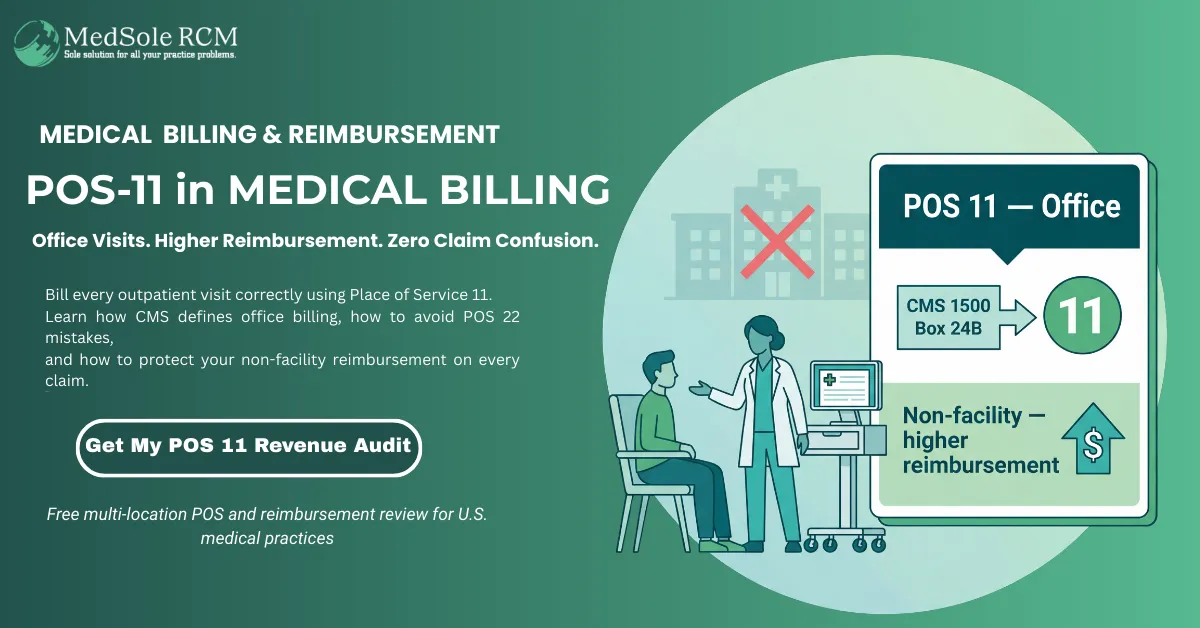
Payment Rate: Non-facility. Typically 10 to 30 percent higher than facility codes
CMS 1500 Location: Box 24B
Common Services: Office visits, preventive care, minor procedures, and in-office labs
Key Rule: Do not use for hospital-owned clinics. Use POS 22 instead
Telehealth: Depends on payer. Medicare allows POS 11 with Modifier 95 for video visits
Introduction
POS 11 in medical billing tells the payer one simple thing: this service happened in a physician's office, not a hospital. That two-digit code sitting in Box 24B of your CMS 1500 form drives how much you get paid, whether your claim gets processed cleanly, and whether you end up fighting an unnecessary denial two weeks from now.
Most billing teams use Place of Service 11 more than any other code. It covers everything from annual physicals to joint injections to follow-up visits. Yet it is also one of the most common sources of preventable claim rejections. Use it when you should have used POS 22, and you have got a denial on your hands. Bill it for a hospital-owned clinic, and you are looking at an audit flag.
This guide navigates you through the official CMS definition, the real-world circumstances in which POS 11 applies, the situations in which it does not, and how it compares to POS 22 for reimbursement. If your practice has any involvement with outpatient billing, you should bookmark this resource.
What Is POS 11 in Medical Billing?
POS 11 means "Office" on a medical claim. It is the Place of Service code you use when a patient receives care in a physician's private practice, a group practice, or any standalone clinic that is not owned by a hospital. When payers see POS 11, they know the service happened in an outpatient office setting and they apply the non-facility payment rate.
So what does POS actually stand for? Place of Service. CMS created these two-digit codes decades ago so that every claim clearly identifies where the patient was treated. A hospital inpatient stay gets one code. An ambulatory surgery center gets another. A skilled nursing facility has its own. POS 11 specifically flags the physician's office.
Think of it this way. You walk into your primary care doctor's clinic for a sore throat. The front desk checks you in, you see the doc, maybe get a strep test, and you leave. That entire encounter gets billed with POS 11. Same thing if you visit a dermatologist in their standalone office or see a cardiologist at their private practice across town.
The reason this matters comes down to money. POS 11 tells the insurance company that your practice absorbed all the overhead for that visit. The rent, the staff, the equipment, the supplies. Because you carried those costs, you get paid at the higher non-facility rate. Bill the same CPT code with a hospital-based POS, and your reimbursement drops because the facility is billing separately for its piece.
POS 11 Description: The Official CMS Definition
CMS published the formal language for POS 11 in theirPlace of Service codeset. Payers and auditors reference this exact wording, so knowing it helps when you need to defend a claim.
"Location, other than a hospital, skilled nursing facility (SNF), military treatment facility, community health center, State or local public health clinic, or intermediate care facility (ICF), where the health professional routinely provides health examinations, diagnosis, and treatment of illness or injury on an ambulatory basis."
In everyday terms, Place of Service 11 applies to any location where a provider regularly delivers outpatient care. The location just cannot be one of the facility types CMS carves out.
That word routinely matters. CMS is describing an established office. An established office refers to a practice that operates continuously. Pop-up clinics and temporary arrangements do not count.
Exclusions are just as important as the definition itself. Hospitals get their own codes. The same applies to skilled nursing facilities, military treatment facilities, community health centers, public health clinics, and intermediate care facilities. If any of these entities own or house your practice, you are not eligible to use POS 11.
Is POS 11 Inpatient or Outpatient?
POS 11 is outpatient. Always. There is no scenario where you would use this code for an inpatient stay.
The whole point of POS 11 is to show that a patient came to the office, received care, and went home. No bed. No admission. No overnight stay. The visit starts and ends on the same calendar day.
When a patient gets admitted to a hospital and stays overnight, you switch to POS 21. That code covers inpatient hospital services. Mixing these up causes immediate denials because the payer sees a mismatch between the service billed and the setting reported.
Some billers get confused when a provider rounds on hospital patients but also sees people in the office. The rule stays simple. Bill office visits with POS 11. Bill hospital visits with POS 21 or POS 22 depending on whether the patient is admitted or just there for outpatient services.
INPATIENT vs OUTPATIENT POS CODES
POS 11 (Office) = OUTPATIENT
POS 21 (Inpatient Hospital) = INPATIENT
POS 22 (Outpatient Hospital) = OUTPATIENT
If you remember nothing else from this section, remember this. POS 11 means the patient walked in and walked out. The moment a hospital bed enters the picture, you need a different code.
When to Use POS 11 in Medical Billing?
When providing care to a patient in your own office, use POS 11. Your office. Your lease. Your name is on the door. Not a hospital building. Not a healthcare facility. It's just a typical medical practice.
Here is a basic rule. If you pay the rent and the lights, POS 11 is likely right.
Office Visits
This is where most POS 11 claims originate. A patient comes in for a checkup. You see them. They leave. That visit is recorded as POS 11. New and established patients, annual physicals, sick visits, and follow-ups. All POS 11.
Preventive Care
Influenza injections. COVID boosters. Well-woman exams. Wellness appointments are billed as G0438 or G0439. If something occurs in your office, POS 11 applies.
Minor Procedures
You remove a mole. You injected a knee. You stitch a cut. These are all POS 11 services that can be completed at your office. The patient does not visit a surgery center. They do not check into a hospital. They sit in your examination room.
Laboratory and Diagnostic Work
Blood draws, urine testing, EKGs, and breathing tests. If your staff runs things in-house and you bill for them, the code is POS 11.
Therapy and Behavioral Health
Counseling sessions at a private practice. Psychiatric evaluations. Physical therapy at a solitary PT clinic. All POS 11.
|
Specialty |
What Gets Billed in POS 11 |
|
Family Medicine |
Physicals, sick visits, vaccines |
|
Dermatology |
Biopsies, mole removals, acne consults |
|
Cardiology |
Office visits, in-house EKGs |
|
Orthopedics |
Injections, post-surgery follow-ups |
|
Mental Health |
Therapy, med management |
|
OB GYN |
Prenatal checks, Pap smears |
|
Pediatrics |
Well-child visits, immunizations |
When NOT to Use POS 11 (Avoid These Costly Mistakes)
Wrong POS code means denied claim. It is that simple. POS 11 only works for independent physician offices. Use it anywhere else and you will hear from the payer.
Here are the places where POS 11 does not belong.
❌ Hospital Inpatient Stays
Patient gets admitted. Stays overnight. That is POS 21. Always. POS 11 is for walk-in, walk-out visits only.
❌ Hospital Outpatient Departments
This trips people up constantly. The clinic looks like a regular doctor's office. It feels like an office visit. But the hospital owns it. That makes it POS 22. Not POS 11.
❌ Emergency Rooms
ER visits get POS 23. Does not matter what treatment happens there. Stitches, X-rays, a quick evaluation. If it is in the ER, it is POS 23.
❌ Ambulatory Surgery Centers
Patient goes to an ASC for a procedure. That is POS 24. These facilities bill separately and have their own fee structures.
❌ Skilled Nursing Facilities
Seeing a patient at a nursing home? POS 31. Not POS 11.
❌ Telehealth from Patient's Home
Virtual visits need their own codes. Patient sitting at home on a video call? Use POS 02. Provider working from home? Some payers want POS 10. POS 11 is for in-person office visits.
❌ Hospital-Owned Clinics on Campus
This is the mistake we see most often. A health system buys a physician practice. The office stays in the same building. Same staff. Same parking lot. But now the hospital owns it. That changes the POS to 22.
⚠️ Watch Out: The number one POS 11 error is billing it for hospital-owned clinics. Verify ownership first. If the hospital system runs the practice, you need POS 22. Every time.
POS 11 vs POS 22: Key Differences Explained
This is where money gets left on the table. POS 11 and POS 22 both cover outpatient care. But they pay differently. Selecting the incorrect one may result in a loss of revenue or initiate an audit.
Here is how they compare.
|
Feature |
POS 11 Office |
POS 22 Outpatient Hospital |
|
Setting |
Private physician's office |
Hospital-owned outpatient department |
|
Ownership |
Provider-owned or independent |
Hospital-owned |
|
Location |
Standalone clinic or office building |
On hospital campus or within 250 yards |
|
Billing Structure |
One claim from the provider |
Two claims from the provider and the hospital facility |
|
Reimbursement Rate |
Higher non-facility rate |
Lower for provider facility rate |
|
Overhead Responsibility |
Provider pays rent staff and supplies |
Hospital covers facility costs |
|
Patient Cost |
Usually lower |
Higher due to hospital facility fee |
|
Claim Complexity |
Simpler |
More paperwork and edits |
The Money Difference
This is not a small gap. Look at a Level 4 E/M visit billed with CPT 99214.
POS 11 pays around $130 to $140.
POS 22 pays around $100 to $110 for the provider portion.
That is roughly $30 less per visit.
Now multiply that across a busy practice. Twenty patients a day at $30 less each equals $600 lost daily. Over a week, that is $3,000. Over a year? More than $150,000 in revenue you never collected.
Ownership Is Everything
The difference between POS 11 and POS 22 comes down to one question. Who owns the building?
If the physician or practice group owns or leases the space independently, use POS 11.
If the hospital owns the space, use POS 22. Even if it looks like a normal office. Even if it has its own entrance. Even if patients think they are visiting a private doctor.
Not sure? Check the Tax ID on the claims. If it matches the hospital system, that tells you the answer.
How Billing Works for Each
POS 11 keeps it simple. You submit one claim. It includes your professional service and all the overhead you absorbed. The payer applies the non-facility rate. Done.
POS 22 splits things up. The provider submits a professional fee claim. The hospital submits a separate facility fee claim. The provider gets paid less because the hospital is billing for the space, the staff, and the equipment.
Patients notice this too. They get two bills instead of one. Their out-of-pocket costs go up. Some payers have higher copays for hospital-based services.
How POS 11 Affects Reimbursement Rates
POS 11 pays more than facility-based codes. That is the bottom line. Insurance companies apply a higher rate because your practice absorbs all the overhead costs.
Medicare calls these non-facility rates. Commercial payers use different terms but the concept stays the same. You run the office, you pay for everything, so you get reimbursed more per service.
The Two Rate Categories
Every CPT code has two prices in the Medicare Physician Fee Schedule.
|
Rate Type |
Used With |
What Gets Covered |
|
Non Facility Rate |
POS 11 Office |
Your professional work plus all overhead including rent staff supplies and equipment |
|
Facility Rate |
POS 22 POS 21 POS 23 POS 24 |
Your professional work only while the facility bills their own claim |
The gap between these rates runs anywhere from 10% to 30%. Sometimes more.
Real Numbers
Take CPT 99213, a basic established patient visit. Medicare non-facility rate sits around $93. The facility rate? About $74. That is $19 less per visit.
Or look at 11102, a tangential skin biopsy. Non-facility payment is roughly $97. Facility payment drops to $63. Now you are talking $34 difference on a single procedure.
These numbers change by region and MAC jurisdiction. But the pattern holds everywhere. POS 11 equals higher payment.
Why the Difference Exists
When you bill POS 11,Medicare knows you are covering everything. The exam table. The front desk staff. The rent. The medical supplies. The EHR system. All of it.
Hospital-based clinics split this differently. The hospital bills a facility fee to cover their overhead. You bill the professional component at a reduced rate. Two claims. Two payments. Lower total for the provider.
Practice managers need to understand this when negotiating contracts or considering hospital affiliation. Going from independent to hospital-owned usually means taking a pay cut on every single service. The hospital collects the facility fee. You get the reduced profession
Where Does POS 11 Go on the CMS 1500 Form?
POS 11 goes in Box 24B. Every single service line on the CMS 1500 has its own 24B slot.
Look at the middle of the form where you list individual procedures. Box 24 runs across the page with sections A through J. The B column is where your POS code lives. You will see a tiny box there, just big enough for two digits.
Type in 11. That is it. No zeros in front. No extra characters. Just 11.
If you are billing multiple services from different locations on the same claim, each line can have its own POS. Say the patient saw you in the office (POS 11) but also had labs drawn at an independent facility (POS 81). Each service gets its correct code in its own 24B box.
Electronic claims work differently. The 837P file puts POS codes in Loop 2400, specifically in data element SV105. Your software handles this mapping. Just make sure you pick the right POS when entering the charge.
Smart practices set up location defaults in their systems. The downtown office always defaults to POS 11. The hospital clinic defaults to POS 22. Saves time and prevents errors.
POS 11 and Telehealth: What Providers Need to Know
Telehealth POS coding is a mess right now. Every payer has different rules. What worked last year might get denied today. And Medicare keeps tweaking their guidelines every few months.
Here is the current situation with POS 11 and virtual visits.
Can You Bill Telehealth with POS 11?
Sometimes yes. Occasionally no. It all depends on who is paying.
Medicare lets you use POS 11 with Modifier 95 when the provider sits in their office during the video call. They consider the service location to be where the provider is, not where the patient is. But this only works through December 2025 unless they extend it again.
Most commercial payers want POS 02 now. The requirements changed after the COVID waivers expired. POS 02 means the patient is at home or somewhere else outside a medical facility. This became the default for telehealth.
Blue Cross in most states requires POS 02. United typically wants POS 02. Aetna varies by plan. You have to verify each contract.
When to Use Other Telehealth Codes
POS 02 is your safest bet for most telehealth encounters. Patient at home on their laptop? POS 02. Patient is in their car using their phone? Still POS 02.
POS 10 is different. This one applies when the provider works from home. Few situations need this code anymore since most providers returned to their offices. But if you have physicians doing after-hours calls from their house, POS 10 might apply. Check with the specific payer first.
The Modifier 95 Question
Modifier 95 tells the payer this was a real-time video visit. Audio and video together. Not just a phone call.
Some practices think POS 11 plus Modifier 95 covers everything. It does not. The modifier shows how you delivered care. The POS code shows where it happened. You need both pieces correct.
Medicare accepts POS 11 with Modifier 95 through their current waiver period. But Medicaid programs in different states have their own rules. California Medi-Cal wants POS 02. Texas Medicaid might accept either. Florida changes their mind every quarter.
POS 11 and Telehealth: What Providers Need to Know
Telehealth POS coding is a mess right now. Every payer has different rules. What worked last year might get denied today. And Medicare keeps tweaking their guidelines every few months.
Here is the current situation with POS 11 and virtual visits.
Can You Bill Telehealth with POS 11?
Sometimes yes. Occasionally no. It all depends on who is paying.
Medicare lets you use POS 11 with Modifier 95 when the provider sits in their office during the video call. They consider the service location to be where the provider is, not where the patient is. But this only works through December 2025 unless they extend it again.
Most commercial payers want POS 02 now. The requirements changed after the COVID waivers expired. POS 02 means the patient is at home or somewhere else outside a medical facility. This became the default for telehealth.
Blue Cross in most states requires POS 02. United typically wants POS 02. Aetna varies by plan. You have to verify each contract.
When to Use Other Telehealth Codes
POS 02 is your safest bet for most telehealth encounters. Patient at home on their laptop? POS 02. Patient is in their car using their phone? Still POS 02.
POS 10 is different. This one applies when the provider works from home. Few situations need this code anymore since most providers returned to their offices. But if you have physicians doing after-hours calls from their house, POS 10 might apply. Check with the specific payer first.
The Modifier 95 Question
Modifier 95 tells the payer this was a real-time video visit. Audio and video together. Not just a phone call.
Some practices think POS 11 plus Modifier 95 covers everything. It does not. The modifier shows how you delivered care. The POS code shows where it happened. You need both pieces correct.
Medicare accepts POS 11 with Modifier 95 through their current waiver period. But Medicaid programs in different states have their own rules. California Medi-Cal wants POS 02. Texas Medicaid might accept either. Florida changes their mind every quarter.
What Works Now
|
Situation |
Best POS Code |
Add Modifier 95 |
|
Provider in office and patient at home |
POS 02 for most payers or POS 11 with Modifier 95 for Medicare |
Yes for video visits |
|
Provider at home and patient at home |
POS 10 |
Yes for video visits |
|
Regular office visit with no video |
POS 11 |
No |
|
Audio only telehealth |
Check the payer because rules vary |
Usually no |
The rules keep changing. What gets paid today might be denied next month. Keep a running list of what each major payer accepts. Update it whenever you get a denial or see a policy change. And always check before billing high-dollar telehealth encounters.
7 Common POS 11 Billing Errors (And How to Avoid Them)
These seven mistakes cause most POS 11 denials. Fix these and your clean claim rate goes up immediately.
Error #1: Hospital-Owned Clinics Billed as POS 11
Health systems buy physician practices all the time. The doctors stay. The staff stays. The address stays the same. But now it needs POS 22 because the hospital owns it. Billers miss this crucial detailthis crucial detail constantly.
Fix: Verify who signs the paychecks. If it is the hospital, use POS 22.
Error #2: Wrong Telehealth POS
Provider does a video visit from their office. Patient is home. Biller uses POS 11 because the provider is in the office. Claim denies because that payer wants POS 02 for all telehealth.
Fix: Know your payer rules. Most want POS 02 now. Medicare still takes POS 11 with Modifier 95. For now.
Error #3: Mixed POS Codes Across Locations
Dr. Smith works Mondays at her private office (POS 11) and Wednesdays at the hospital clinic (POS 22). Front desk uses POS 11 for everything because that is what they always do.
Fix: Build location defaults into your system. Each site gets its own setup.
Error #4: ASC Services Billed Wrong
Minor surgery at an ambulatory surgical center. Biller thinks "outpatient office procedure" and uses POS 11. Wrong. ASCs are POS 24.
Fix: Know your facility types. ASC always equals POS 24.
Error #5: No Location Documentation
Claim says POS 11. Medical record just says "patient seen and examined." Where? Auditor has no idea. Claim at risk.
Fix: Templates should include location. Every note. Every time.
Error #6: POS 11 as Default Code
New biller starts. Nobody trains them on POS codes. They use 11 for everything because someone said it is for doctor visits. Half the claims are wrong.
Fix: Train everyone. Make a cheat sheet. Post it at every desk.
Error #7: Same Code for All Payers
Practice bills POS 11 to everyone. Works for Medicare. Denies from Anthem because they want something different for that specific service.
Fix: Track payer preferences. What Medicare wants is not what Blue Cross wants is not what Medicaid wants.
Modifier Rules When Using POS 11
Modifiers and POS codes work together. Get the combination wrong and you will see denials pile up fast.
Modifier 95 with POS 11
This one flags a live video telehealth visit. Medicare accepts POS 11 plus Modifier 95 when the provider works from their office. Most commercial payers do not. They want POS 02 instead. Know your payer before you bill this combo.
Modifier 26 with POS 11
Modifier 26 bills the professional component only. In theory you can use it with POS 11. In practice some payers deny it for certain services. Radiology reads cause the most trouble. Billing 70450 with Modifier 26 and POS 11 might work with one payer and reject with another. Check before you submit.
Modifier 78 with POS 11
Do not use this combination. Modifier 78 is for unplanned returns to the operating room during a global period. That means facility settings. Hospitals. Surgery centers. POS 11 is a physician office. There is no OR to return to.
Modifier 25 with POS 11
This pairing works fine. Modifier 25 allows you to bill a separate E/M on the same day as a procedure. Happens all the time in office settings. Patient comes in for a mole removal but also needs their blood pressure medication adjusted. Document both clearly. Bill the E/M with Modifier 25.
POS 11 vs Other Common POS Codes: Quick Reference
You will run into more than just POS 11. CMS has dozens of Place of Service codes. Most practices only use a handful regularly, but knowing the full list helps when something unusual comes through.
Here are the codes you will see most often.
|
POS Code |
Name |
What It Covers |
|
02 |
Telehealth Patient Location |
Virtual visit where the patient is at home or outside a medical facility |
|
03 |
School |
Services delivered in a school building |
|
04 |
Homeless Shelter |
Care provided at a shelter location |
|
10 |
Telehealth Provider Home |
Provider delivers virtual care from their own residence |
|
11 |
Office |
Physician private practice or standalone clinic |
|
12 |
Home |
Provider visits the patient at their house |
|
13 |
Assisted Living Facility |
Residential care setting that is not skilled nursing |
|
19 |
Off Campus Outpatient Hospital |
Hospital owned clinic located away from the main campus |
|
20 |
Urgent Care Facility |
Walk in clinic for same day urgent needs |
|
21 |
Inpatient Hospital |
Patient admitted with an overnight stay |
|
22 |
On Campus Outpatient Hospital |
Hospital outpatient department on the main campus |
|
23 |
Emergency Room |
Hospital emergency department services |
|
24 |
Ambulatory Surgical Center |
Outpatient surgery facility |
|
31 |
Skilled Nursing Facility |
Skilled nursing level care |
|
32 |
Nursing Facility |
Long term nursing home |
|
49 |
Independent Clinic |
Free standing clinic not owned by a physician group |
|
65 |
ESRD Facility |
Dialysis center |
|
81 |
Independent Laboratory |
Standalone laboratory for diagnostic testing |
One thing billers get confused about is the difference between POS 11 and POS 49. Both are independent settings. POS 11 is for physician-owned offices. POS 49 is for clinics that operate independently but are not owned by physicians. Community health centers often use POS 49.
CMS updates this list occasionally. New codes get added. Old ones get revised. Bookmark the official CMS Place of Service Code Set page and check it whenever something seems off.
Best Practices for Accurate POS 11 Billing
Clean POS coding starts before the claim ever leaves your system. These habits prevent denials and keep auditors off your back.
Before You Submit
- Confirm where the service actually happened. Not where it usually happens. Where it happened this time.
- Double check ownership. If a hospital bought the practice last month, POS 11 might not work anymore.
- Match the POS to what the note says. Auditors compare these. They should agree.
Train Your Team
- Teach every biller the difference between POS 11 and POS 22. This is the mistake that costs the most money.
- Print a one-page cheat sheet for your locations. Tape it to every monitor.
- Review telehealth rules every quarter. They change constantly. What worked in January might deny in April.
- Keep a payer reference doc. Each payer has quirks. Write them down.
Fix Your System
- Set default POS codes by location in your practice management software. Do not rely on staff memory.
- Turn on claim edits if your clearinghouse offers them. Catch problems before payers do.
- Build separate templates for each site. One template for the downtown office. Another for the hospital clinic.
Stay Compliant
- Pull 20 random claims every quarter. Check the POS codes. See what went wrong.
- Track your denials by reason code. POS issues show patterns.
- Watch for CMS updates. New codes appear. Old rules change.
How Medsole RCM Ensures Accurate POS 11 Coding
Wrong POS codes cost practices real money. We see it constantly. A billing team uses POS 11 for a hospital-owned clinic. Claims deny.Revenue disappears. Nobody notices for months.
Medsole RCM catches these problems before they happen.
What We Actually Do
Our coders verify every POS code before claims go out. Not just POS 11. Every code on every claim. We check that the location matches the documentation. We confirm ownership status for each practice site. If something looks off, we fix it before the payer ever sees it.
For practices with multiple locations, we build site-specific protocols. Your downtown office gets POS 11 as the default. Your hospital clinic gets POS 22. No guessing. No mistakes.
Why Practices Work With Us
We charge 2.29% of what you collect. That is it. No flat fees that eat into your revenue when volume drops. No surprise charges. When you get paid more, we earn more. Same goal.
Our team handles over 50 specialties. Family medicine, cardiology, dermatology, behavioral health, orthopedics, OB/GYN. Each specialty has POS quirks. We know them.
What You Get
Claim edits that catch POS errors before submission. Denial tracking that spots patterns. Quarterly audits to verify accuracy. Training for your staff when you need it.
FREE BILLING AUDIT
Not sure if your POS codes are right? We will review your claims at no cost.
Request Free Audit Schedule Free Consultation
✓ No obligation ✓ Find revenue leaks ✓ Get expert recommendations
Frequently Asked Questions About POS 11
What is POS 11 in medical billing?
POS 11 means "Office" on a claim. It tells the payer that care happened in a physician's private practice or standalone clinic. Not a hospital. Not a facility owned by a health system. Use this code for routine outpatient visits where the patient comes in and leaves the same day.
What does code 11 mean in medical terms?
Code 11 is the Place of Service designation for a physician's office. CMS created this code to show that outpatient care happened in a setting where the provider handles all the overhead. Exams, diagnoses, and treatments in regular doctor offices get this code.
Is POS 11 inpatient or outpatient?
Outpatient only. POS 11 covers office visits where patients walk in, get treated, and go home. No overnight stays. If someone gets admitted to a hospital and sleeps there, you use POS 21 instead. POS 11 has nothing to do with inpatient care.
What is the difference between POS 11 and 22?
Ownership is the difference. POS 11 is for independent physician-owned offices. POS 22 is for hospital-owned outpatient departments. POS 11 pays higher because your practice covers all overhead. POS 22 pays less because the hospital bills a separate facility fee.
Is POS 11 a facility code?
No. POS 11 is a non-facility code. Your practice absorbs all the costs when you bill POS 11. Rent, staff, supplies, equipment. Payers recognize this and pay you more. Facility codes like POS 22 mean the hospital handles overhead and bills separately for it.
What is POS 11 in CMS 1500?
POS 11 goes in Box 24B on the CMS 1500 form. Each service line has its own 24B slot. Type in 11 to show the service happened in a physician's office. The payer uses this to apply the correct non-facility payment rate.
Can POS 11 be used for telehealth?
Depends on the payer. Medicare accepts POS 11 with Modifier 95 for video visits when the provider sits in their office. Most commercial payers want POS 02 instead. Check each payer's policy before billing. Rules keep changing.
What is the difference between POS 11 and 49?
Both are non-facility settings. POS 11 is for physician-owned private practices. POS 49 is for independent clinics not owned by physicians. Community health centers typically use POS 49. If doctors own the practice, use POS 11.
Does POS 11 affect reimbursement rates?
Yes. POS 11 triggers non-facility rates, which pay 10% to 30% more than facility rates. The payer knows you cover all overhead when you bill POS 11. That extra payment offsets your costs for running the office.
Can modifier 78 be used in POS 11?
No. Modifier 78 is for unplanned returns to the operating room during a global period. That only applies to facilities with actual operating rooms. Hospitals and surgery centers. A physician office does not have an OR, so modifier 78 does not apply.
Master POS 11 Coding for Maximum Reimbursement
POS 11 looks simple. Two digits. One box on the claim form. But those two digits determine whether you get paid correctly or chase denials for weeks.
Here is what matters most.
Use POS 11 for physician-owned offices only. Hospital buys your practice? Switch to POS 22. Check ownership before you bill.
Telehealth rules vary by payer. Medicare takes POS 11 with Modifier 95. Most commercial payers want POS 02. Know the difference or expect rejections.
The money adds up fast. Wrong POS code on 20 claims a day could mean $150,000 lost over a year. That is not a typo.
Medsole RCM handles this for practices across 50 specialties. We verify every code before it goes out. Pricing starts at 2.29% of collections. You get paid correctly. We catch problems before payers do.
Ready to Fix Your Billing?
Get Your Free Billing Audit Schedule Free Consultation
Our team will review your claims and find what is leaking revenue.