



What Is CPT Code 99203?
CPT code 99203 is an evaluation and management (E/M) code used for new patient office or outpatient visits that require a medically appropriate history and/or examination and low-complexity medical decision-making.
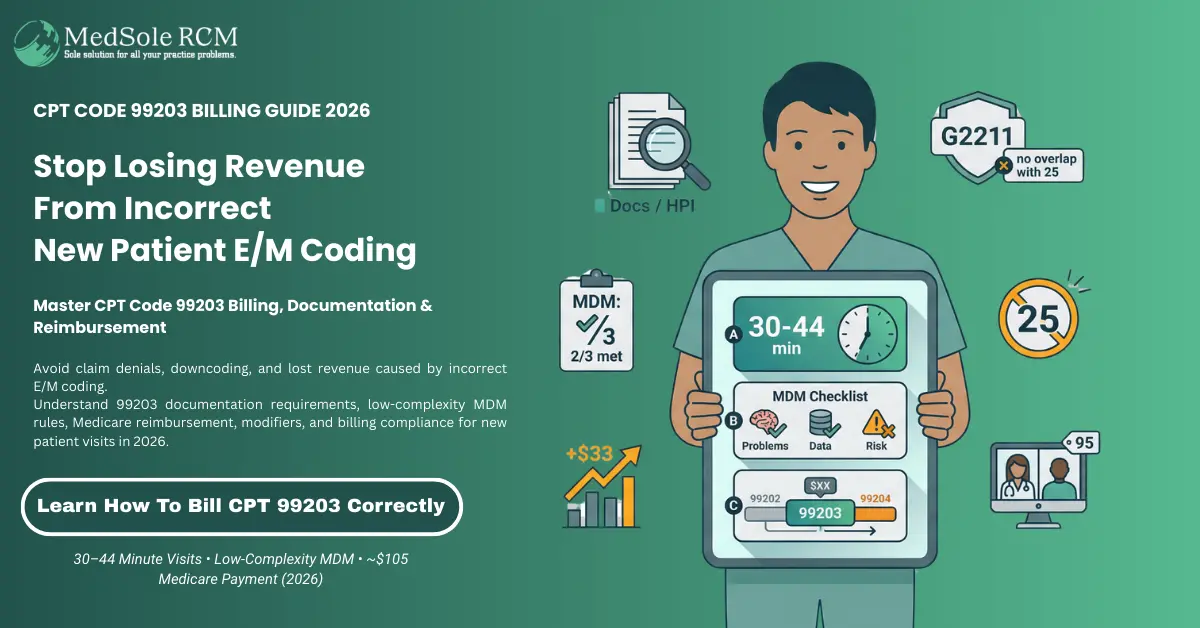
When time is used for code selection instead of MDM, 99203 covers encounters lasting 30 to 44 minutes on the date of service. It sits in the middle of the new patient E/M series (99202 through 99205), representing a level 3 visit.
Per the AMA CPT 2026 code set, the CPT code 99203 description covers initial encounters where a provider evaluates a new patient with clinical problems that don't rise to moderate or high complexity.
Common scenarios include a patient presenting with a stable chronic illness, an acute uncomplicated injury, or two or more self-limited conditions requiring initial assessment. These visits usually involve prescribing a medication, reviewing outside records, or ordering a basic diagnostic test.
So what does the code mean in daily practice? It's the go-to new patient CPT code for visits in the middle of the complexity spectrum. One self-limited problem with minimal data review points to 99202. Multiple problems, prescription management, or outside record review puts you in 99203 territory.
Part of the CPT code 99203 definition that trips up practices: "new patient" has a specific meaning. A patient qualifies as new only if they haven't received professional services from the same physician, or another physician of the same specialty within the same group practice, in the past three years.
That three-year rule matters more than most practices realize. If your colleague in the same specialty saw that patient 18 months ago, they're established. Billing a new patient code for an established patient is one of the fastest ways to trigger a denial.
Code selection changed on January 1, 2021. Providers used to document all three key components: history, exam, and medical decision making. The three-component requirement is gone. You now select 99203 based on either the level of medical decision-making or total time on the date of encounter.
One final point: CPT 99201 was deleted effective January 1, 2021, during the E/M restructuring. Code 99203 was not. It remains active and billable in the 2026 CPT code set, and it's one of the most frequently reported new patient evaluation and management codes across specialties.
How to Select CPT Code 99203: MDM or Time
Time Requirements: 30–44 Minutes
The 99203 time requirement is 30 to 44 minutes of total time on the date of the encounter. If the visit falls below 30 minutes, you're looking at 99202. If it exceeds 44 minutes, 99204 is the appropriate code.
What catches some providers off guard: "total time" doesn't mean just the minutes spent face-to-face with the patient. Under AMA guidelines, 99203 CPT code time includes all medically necessary activities on the date of service, from chart review and test ordering to care coordination and communicating results.
Scheduling follow-ups, handling insurance paperwork, and other administrative tasks unrelated to the clinical encounter don't count. Only time spent on medically relevant work applies toward the 99203 time threshold.
When billing by time, document the total minutes and briefly describe what you did. Something like: "Total time on date of encounter: 35 minutes, including face-to-face evaluation, review of outside records, medication reconciliation, and care plan discussion."
One key distinction: if you're basing code selection on medical decision making instead of time, there's no requirement to document time at all. The time thresholds for 99203 only matter when time is your method of code selection. For detailed guidance on time-based E/M documentation, see the CMS E/M Visits guidance hub.
Medical Decision Making: Low Complexity
Medical decision-making is where most 99203 coding questions start. When you're basing code selection on MDM rather than time, the visit must meet at least two of three low complexity elements. Getting this right is central to the 99203 CPT code requirements.
Here are the three elements and what qualifies as "low" for each:
|
# |
MDM Element |
Low Complexity Threshold |
Examples |
|
1 |
Number and complexity of problems |
2+ self-limited or minor problems, OR 1 stable chronic illness, OR 1 acute uncomplicated illness or injury |
Acute sinusitis, controlled hypertension, mild ankle sprain |
|
2 |
Data reviewed and analyzed |
Limited: review from external source, ordering unique test, or review of results from unique source |
Reviewing prior records from another provider, ordering a basic lab panel |
|
3 |
Risk of complications, morbidity, or mortality |
Low risk |
OTC drug management, prescription drug management, minor surgery without identified risk factors |
You need to meet the threshold in at least two of these three categories. Meeting all three isn't required. You don't need to document the element that falls below the threshold.
In practice, most 99203 visits clear MDM because of the first and third elements. A new patient with one chronic condition and a prescription renewal meets "low" for both problems addressed and risk. The data element is the one that most often falls short, but you only need two of three.
A common misconception in coding guides and even some payer documentation: 99203 requires moderate complexity medical decision making. It doesn't. Per the AMA CPT 2026 code set and CMS guidelines, CPT code 99203 level 3 requires low MDM. Moderate is the threshold for 99204.
That distinction cuts both ways. If your documentation supports moderate complexity but you coded 99203, you're undercoding and losing roughly $52 per encounter. On the flip side, notes that only support straightforward MDM mean 99203 is too high. Bill 99202 instead.
99203 vs 99202 vs 99204: Key Differences Explained
Choosing the right CPT code for a new patient office visit comes down to two things: how complex is the medical decision making, and how much time did the encounter take? The table below breaks down all four active new patient E/M codes side by side using 2026 Medicare rates.
Comparison Table: New Patient E/M Codes (99202 to 99205)
|
Code |
MDM Level |
Total Time |
2026 Medicare (Non-Facility) |
Work RVU |
|
99202 |
Straightforward |
15 to 29 min |
~$72 |
0.93 |
|
99203 |
Low |
30 to 44 min |
~$105 |
1.60 |
|
99204 |
Moderate |
45 to 59 min |
~$157 |
2.60 |
|
99205 |
High |
60 to 74 min |
~$207 |
3.50 |
Source: CMS CY 2026 Physician Fee Schedule
99202 vs 99203: When to Use Each
The core difference when comparing 99202 vs 99203 is the line between straightforward and low MDM. Revenue-wise, that line is worth about $33 per encounter, making it one of the most frequent undercoding gaps in new patient visits.
Here's the quick decision logic. If you're addressing one self-limited problem with minimal data review, no prescription management, and minimal risk, that's 99202. Think of a patient coming in for a common cold where you recommend OTC remedies and fluids.
Once the visit involves two or more problems, review of outside records, or prescribing medication, you've crossed into CPT code 99203 territory. A new patient with seasonal allergies plus a mild ear infection, where you write a prescription, that's 99203.
That $33 gap adds up fast. For a provider seeing 15 new patients a month, consistently undercoding 99203 as 99202 means roughly $6,000 in lost annual revenue per provider.
99203 vs 99204: The $52 Revenue Difference
This is where payer scrutiny gets real. The 99204 CPT code description covers new patient visits requiring moderate complexity MDM and 45 to 59 minutes of total time. Each correctly coded 99204 instead of 99203 adds roughly $52 per encounter, about a 50% jump in reimbursement.
That 50% increase is exactly why payers flag this transition heavily. When 99203 vs 99204 selection is in question, documentation has to clearly support the higher level.
What pushes a visit from low to moderate MDM? Managing a chronic illness with exacerbation instead of a stable one. Prescribing a controlled substance. Making decisions that carry moderate risk of morbidity or complications. If none of those apply, stick with 99203.
Undercoding hurts your revenue. Overcoding triggers payer audits. Accurate code selection is the foundation of an efficient revenue cycle management process.
99203 vs 99213: New Patient vs Established Patient
This comparison isn't about clinical complexity. Both codes require low MDM. The real distinction is patient status: new versus established.
CPT code 99203 is a new patient code, for someone your practice hasn't seen in the past three years. The time threshold is 30 to 44 minutes. Code 99213, the established patient CPT code, covers return visits with low MDM and a time range of 20 to 29 minutes.
Here's where practices get caught. A patient transfers from a colleague in the same specialty within the same group. Even though they're "new" to you personally, they're established to the group. Bill 99213, not 99203. Getting this wrong is one of the more common reasons new patient E/M claims get denied.
When to Bill CPT Code 99203: Clinical Scenarios
Rules and comparison tables only go so far. The real coding decision shows up when a patient is sitting in front of you. These five scenarios illustrate when to bill CPT code 99203 for a new patient visit across different specialties, with the MDM rationale and ICD-10 pairing for each.
Scenario 1: Primary Care, Acute Sinusitis
Patient: 34-year-old female, new to the practice
Chief Complaint: Nasal congestion and facial pressure for five days
ICD-10: J01.90 (Acute sinusitis, unspecified)
The provider performs a focused exam, reviews the patient's medication history, and prescribes amoxicillin along with an OTC nasal decongestant. Total time on date of encounter: approximately 35 minutes.
Why 99203: One acute uncomplicated illness with prescription drug management meets two of three low MDM elements: problems addressed and risk. Drop the antibiotic and recommend only OTC care, and you'd fall to straightforward MDM and 99202. No systemic symptoms or complications to push this into 99204.
Scenario 2: Urgent Care, Ankle Sprain
Patient: 27-year-old male, no prior visits
Chief Complaint: Right ankle pain after a fall from a ladder
ICD-10: S93.401A (Sprain of unspecified ligament of right ankle, initial encounter)
Exam reveals lateral swelling and point tenderness. The provider orders a two-view X-ray, confirms no fracture, diagnoses a grade I sprain, and recommends RICE protocol with ibuprofen. Time: roughly 32 minutes.
Why 99203: One acute injury with limited imaging from a single source and conservative treatment. A standard 99203 CPT code urgent care encounter. No fracture requiring surgical referral, no moderate-risk factors, and no decision complexity that would support 99204.
Scenario 3: Internal Medicine, Hypertension Transfer
Patient: 52-year-old male, transferring from another practice
Chief Complaint: Ongoing hypertension management
ICD-10: I10 (Essential hypertension)
The provider reviews records from the patient's previous physician, confirms blood pressure is well controlled on current medications, and continues the existing regimen without changes. Time: approximately 38 minutes.
Why 99203: One stable chronic illness with review of external records from a unique source. No medication adjustments, no new symptoms, no complications. If the hypertension were uncontrolled or the provider changed the drug regimen, complexity would shift to moderate and 99204 would be correct.
Scenario 4: Dermatology, Acne Evaluation
Patient: 19-year-old female, first visit
Chief Complaint: Persistent facial acne for several months
ICD-10: L70.0 (Acne vulgaris)
The provider completes a skin examination, diagnoses moderate acne vulgaris, and prescribes a topical retinoid with benzoyl peroxide wash. The visit lasted about 30 minutes.
Why 99203: One chronic condition with prescription drug management and low risk. A typical dermatology CPT code 99203 case. If the provider had prescribed isotretinoin instead, the monitoring requirements and drug risk would bump the visit to moderate MDM and 99204.
Scenario 5: Pediatrics, Recurring Headaches
Patient: 8-year-old male, first evaluation
Chief Complaint: Recurring headaches, about twice per week for one month
ICD-10: R51.9 (Headache, unspecified)
The provider takes a detailed history from the parent, performs a basic neurological screening, and finds no red flags. Recommendation: headache diary and OTC pain relief as needed. Time: approximately 33 minutes.
Why 99203: One undiagnosed new problem without uncertain prognosis, basic screening, and low risk. If the exam had revealed focal neurological deficits or the provider ordered imaging due to alarming features, complexity would rise to moderate, making 99204 the right call.
Selecting the right E/M code for every encounter takes both clinical knowledge and coding precision. MedSole RCM's certified coders review each claim to ensure accurate code selection, starting at just 2.99% of collections. Learn about our medical billing services →
Documentation Requirements for CPT Code 99203
A correctly coded claim means nothing if the chart doesn't back it up. Payer reviewers don't evaluate what happened during the visit. They evaluate what's on paper. Here's what is included in CPT code 99203 documentation, and what your notes need to contain to hold up on audit.
Required Documentation Checklist
Every 99203 encounter note should include these elements:
-
Chief complaint and history: HPI, relevant review of systems, and pertinent past, family, or social history when obtained
-
Physical exam findings: Systems examined and objective findings tied to the presenting problem
-
MDM details or total time: Problems addressed, data reviewed or ordered, and risk level; or total minutes spent on date of encounter
-
Assessment and plan: Diagnosis codes linked directly to clinical findings and management decisions
-
Orders and results: Specific lab, imaging, or test names with results or "pending" status
-
Prescriptions: Any medications written during the visit
-
Care coordination: Referrals, authorizations, or coordination notes when applicable
-
Provider signature and timestamps: Credentials, date, and start/stop times when billing by time
-
Telehealth specifics: Platform used, verbal consent obtained, and confirmation that all service components were completed remotely
Missing item 3 is the single fastest route to a downcoded or denied 99203 claim.
Time Documentation vs MDM Documentation
The 99203 CPT code requirements differ based on which method you use for code selection.
Billing by MDM: Document the problems addressed, data reviewed or ordered, and the risk level. No time entry is needed. Your note just has to show two of three MDM elements meeting the low complexity threshold.
Billing by time: Record the total minutes on the date of encounter (30 to 44 for 99203) and describe activities performed during that time. Per AMA guidance, when time determines the E/M level, the total time spent on the date of service should be documented.
Pick one method per encounter. You can't blend the two on the same visit.
Common Documentation Errors
Five mistakes show up repeatedly in CPT code 99203 chart audits:
-
No chief complaint. Without one, there's no documented medical necessity for the visit.
-
Vague MDM language. Writing "discussed treatment options" doesn't cut it. Name the options considered and the clinical reasoning behind your decision.
-
Unnamed data sources. You reviewed records from the patient's prior physician, but the note doesn't say where they came from. Each unique source needs to be identified by name.
-
Disconnected assessment. The diagnosis has to connect directly to what the history and exam actually revealed. Reviewers look for that thread.
-
Missing time when billing by time. If time drives code selection, the total minutes must appear in the note. No number, no defense on audit.
Incomplete documentation is one of the leading causes of claim denials. MedSole RCM's denial management services include pre-submission documentation review to catch gaps before they become rejections.
📋 Download our free CPT 99203 Documentation Checklist, a print-ready reference card for your clinical team. [Download Now →]
CPT Code 99203 Reimbursement Rates & RVU Breakdown (2026)
Knowing what 99203 actually pays, and why that number shifted for 2026, helps your practice spot underpayment, negotiate payer contracts, and forecast revenue with real numbers instead of guesses.
2026 Medicare Payment Calculation
CMS introduced two separate conversion factors for 2026, a first in the Medicare physician fee schedule:
-
Non-QP clinicians: $33.4009
-
Qualifying APM Participants (QPs): $33.5675
Both figures include the statutory increase from the One Big Beautiful Bill Act (+2.5%) and a work RVU recalibration of +0.49%, per the CMS CY 2026 PFS Final Rule.
Here's how Medicare calculates the CPT code 99203 payment: multiply each RVU component (work, practice expense, malpractice) by its Geographic Practice Cost Index, sum the three products, then multiply by the applicable conversion factor. The 99203 RVU values used in this calculation are shown in the table below.
National non-facility estimate: approximately $105 (non-QP). Facility payment drops to roughly $70 because facility practice expense RVUs are substantially lower.
RVU Component Table
|
RVU Component |
Value |
|
Work RVU |
1.60 |
|
Non-Facility Practice Expense RVU |
1.38 |
|
Facility Practice Expense RVU |
0.60 |
|
Malpractice RVU |
0.15 |
|
Total RVU (Non-Facility) |
~3.13 |
|
Total RVU (Facility) |
~2.35 |
Source: CMS CY 2026 PFS RVU Files
The 99203 RVU breakdown reveals why setting matters so much. Work stays constant at 1.60 regardless of location. But non-facility practice expense is more than double the facility value, which drives the roughly $35 payment gap between office and hospital settings.
Estimated Commercial Payer Rates
What is the charge for CPT code 99203 from commercial insurers? Allowed amounts typically fall between 120% and 170% of Medicare, putting the estimated range at roughly $125 to $180.
Your actual 99203 CPT code reimbursement depends on contracted rates, geographic region, and network tier. A practical step: compare your commercial payments against the Medicare benchmark above. If any payer is paying below 120% of Medicare for this code, that's worth raising during your next contract negotiation.
Geographic Payment Variation (GPCI)
CMS applies Geographic Practice Cost Indices to each RVU component before the conversion factor kicks in. That means the same 99203 visit pays differently based on where your practice sits.
A Manhattan provider will collect noticeably more than one in rural Texas for the identical service. To check your locality-specific 99203 CPT code cost, use the CMS PFS Look-Up Tool. Detailed methodology is available in the CMS PFS documentation and formulas.
Year-Over-Year Trend
|
Year |
Non-Facility Medicare Rate |
Conversion Factor |
|
2023 |
~$113 |
$33.06 |
|
2024 |
~$112 |
$32.74 |
|
2025 |
~$112 |
$32.35 |
|
2026 |
~$105* |
$33.40 (non-QP) |
2026 rate reflects PE methodology changes and efficiency adjustment exemption. Verify current rates via the CMS PFS Look-Up Tool.
Here's what looks counterintuitive: the conversion factor went up in 2026, but 99203 CPT code reimbursement dipped slightly. That happened because CMS cut indirect practice expenses by 50% in the facility payment formula, which redistributed PE RVU values across the fee schedule. Office-based practices absorbed the shift more favorably than facility-based ones.
Maximizing reimbursement for every E/M encounter is the core of effective revenue cycle management.
MedSole RCM offers professional medical billing services starting at 2.99% of collections. Our billing team ensures every 99203 claim is coded accurately and submitted clean, with no hidden fees or setup costs. Request a free billing audit →
2026 Medicare Updates Affecting CPT Code 99203
The CMS CY 2026 Physician Fee Schedule introduced several policy changes that directly affect how 99203 CPT code Medicare claims are paid, documented, and processed. Five updates in particular deserve your attention, per the CMS CY 2026 PFS Final Rule and MLN Matters MM14315.
Dual Conversion Factor (QP vs Non-QP)
For the first time in Medicare's history, CMS is applying two separate conversion factors in the same calendar year. Non-QP clinicians use $33.4009. Qualifying APM Participants get $33.5675.
Both figures include the 2.5% statutory increase from the One Big Beautiful Bill Act and a +0.49% work RVU recalibration. The practical difference per CPT code 99203 claim is small, roughly a dollar or two. But across a full year of E/M volume, APM participants will see a measurable edge.
G2211: Visit Complexity Add-On Code
G2211 launched for separate Medicare payment on January 1, 2024. It compensates for the time, intensity, and practice expense involved in visits that build ongoing relationships with patients. You can bill G2211 alongside 99203 when the visit reflects that longitudinal care relationship.
Here's the catch for 2026: CMS will not allow payment for G2211 when the E/M service carries Modifier 25 on the same claim. That's a change billing teams need to internalize. If you're performing a same-day procedure and appending Modifier 25 to 99203, G2211 drops off that encounter. You can't have both.
One more G2211 development: CMS expanded eligibility in 2026 to include certain home and residence E/M code families. For full details on qualifying scenarios, see the CMS E/M Visits guidance hub.
Efficiency Adjustment (–2.5%): 99203 Is Exempt
CMS finalized a 2.5% efficiency adjustment for CY 2026 that reduces payment for certain services. Plenty of codes are affected, but 99203 isn't one of them.
CMS specifically exempts time-based E/M codes, services on the Medicare telehealth list, and maternity care codes from this cut. Since 99203 qualifies as a time-based E/M code, it's protected. Worth checking your other high-volume codes, though; not all of them got the same treatment.
Virtual Direct Supervision: Now Permanent
CMS permanently adopted virtual direct supervision using real-time audio and video telecommunications. During the pandemic, this was temporary. Now it's locked in.
What it means in practice: a supervising physician no longer needs to be physically present for "incident to" services. PAs, NPs, and clinical staff can deliver care while the supervising clinician provides direct oversight via live video. Audio-only doesn't qualify. Both audio and video must run simultaneously.
For practices that rely on mid-level providers, this changes staffing math. Your supervising physician can cover multiple office locations without driving between them.
Practice Expense Methodology Change
CMS reduced indirect practice expenses by 50% within the physician payment formula for facility settings. Office-based providers are relatively better off; facility-based providers take the hit.
For 99203 specifically, the non-facility total RVU ticks up slightly while the facility total RVU drops. That's why the payment gap between office and hospital settings widened in 2026. If your practice can deliver care in the office rather than a facility, the fee schedule now rewards that decision more than it used to.
Staying current with CMS policy changes requires constant vigilance. MedSole RCM's outsourced medical billing services include proactive regulatory monitoring, so your practice never misses a reimbursement update.
Modifiers for CPT Code 99203
Does CPT code 99203 need a modifier? Not for a standard new patient visit. But the moment you add a same-day procedure, deal with a post-op overlap, or deliver care via telehealth, modifiers come into play. Using them correctly protects revenue. Using them incorrectly triggers denials or audit flags.
Modifier 25: Significant, Separately Identifiable E/M
Modifier 25 is the most commonly used CPT code 99203 modifier, and the most commonly misused. It applies when you perform a distinct E/M service on the same day as a procedure.
Real example: a new patient comes in for evaluation of a suspicious skin lesion. You take a full history, examine the lesion, and determine a biopsy is warranted. You perform the shave biopsy (11102) during the same visit. Modifier 25 goes on 99203 to tell the payer that the E/M was separately identifiable from the biopsy itself.
Documentation is everything here. Your chart note must clearly separate the E/M history, exam, and assessment from the procedural note. If a reviewer can't tell where the E/M ends and the procedure begins, the 99203 gets denied.
Critical 2026 rule: When you bill CPT code 99203 with Modifier 25, G2211 cannot be billed on that same claim. CMS explicitly prohibits it. You're choosing one or the other for that encounter.
Modifier 24: Unrelated E/M During Post-Op Period
Modifier 24 applies when a new patient visit happens to fall during the global period of a recent surgery, but the visit has nothing to do with that surgery. Think of a patient who had cataract surgery last week and is now seeing your internal medicine practice for the first time about uncontrolled blood pressure.
Link the visit to a diagnosis that's clearly unrelated to the surgical procedure. Your note should explicitly state that the encounter isn't routine post-operative follow-up.
Modifier 95: Synchronous Telehealth
Append Modifier 95 when the entire 99203 encounter is conducted through real-time, two-way audio and video. Document which telehealth platform was used and confirm that all service components, history, exam, and MDM, were completed synchronously.
Modifier 93: Audio-Only Telehealth (Medicare)
Modifier 93 covers Medicare audio-only visits when CMS policy permits them for the specific service. It's more restrictive than Modifier 95. Not every payer recognizes it, and not every E/M code qualifies. Verify payer-specific telehealth rules before submitting with this modifier.
When NOT to Use Modifiers
Three scenarios that create problems:
-
Appending Modifier 25 just to boost reimbursement when the E/M isn't genuinely distinct from the procedure
-
Using Modifier 25 with minor procedures that already bundle an E/M component (always check NCCI edits first)
-
Billing G2211 and Modifier 25 on the same 99203 claim, which CMS won't pay in 2026
Modifier misuse is one of the fastest ways to land on a payer's audit list. When in doubt, pull up the NCCI edits and verify before you submit.
Telehealth Billing for CPT Code 99203 (2026)
Can You Bill 99203 for Telehealth?
Yes. CPT code 99203 can be billed for telehealth visits when documentation supports low complexity MDM or 30 to 44 minutes of total time on the date of the encounter. The clinical requirements don't change just because the patient is on a screen instead of in your exam room.
What does change is claim submission. Place of Service drives the payment calculation:
-
POS 02: Patient is at home during the telehealth visit
-
POS 10: Patient is at a clinical site, like a satellite office or rural health clinic
Append Modifier 95 for synchronous audio-video encounters. Medicare audio-only visits, when CMS permits them for the service, use Modifier 93 instead.
One documentation step that gets overlooked on 99203 telehealth claims: note the platform used and confirm that history, exam, and MDM were all completed during the live session. Auditors look for that confirmation specifically.
Virtual Direct Supervision (2026 Permanent Policy)
CMS permanently finalized virtual direct supervision in 2026, directly affecting telehealth staffing for practices that rely on mid-level providers. When a PA or NP delivers a new patient visit "incident to" a supervising physician, that physician can now provide direct oversight via live audio and video from a separate location.
Both audio and video must run simultaneously. Audio-only doesn't meet the supervision standard.
Payer-Specific Considerations
Medicare telehealth rules don't automatically carry over to commercial insurers. Each payer sets its own policies on covered codes, POS requirements, and consent documentation for virtual visits.
Before billing a non-Medicare 99203 telehealth claim, verify three things: whether the payer covers the code for telehealth delivery, which POS code they expect, and whether written patient consent must be documented. Some payers also require disclosure of the provider's physical location at the time of the encounter. These rules shift frequently, so check each payer's telehealth policy at least annually.
Common Billing Errors & Denial Prevention for CPT Code 99203
Most CPT code 99203 denials aren't caused by obscure payer rules. They stem from preventable documentation gaps and submission mistakes that happen the same way, over and over. Here are the seven most common billing errors for 99203, along with how to fix each one.
Top 7 Reasons 99203 Claims Get Denied
1. Downcoded to 99202 because MDM documentation was too thin.
The payer reviewer couldn't find enough detail to support low complexity. Don't assume anyone will infer what you meant. Document all three MDM elements explicitly, even the one that falls below the threshold.
2. Patient classified as "new" when the three-year rule wasn't met.
Your PM system flagged the patient as new, but a colleague in the same specialty within your group saw them two years ago. Verify patient status against every provider in the same specialty before selecting 99203.
3. No time recorded when the claim was billed by time.
The provider chose 99203 based on 36 minutes of total time but never documented the number. When time drives code selection, the total minutes and a brief description of activities must appear in the note.
4. Same-day procedure submitted without Modifier 25.
A 99203 billed alongside a minor procedure gets denied when the E/M isn't flagged as separately identifiable. Append Modifier 25 only when the E/M is genuinely distinct, and keep the clinical documentation separate from the procedural note.
5. G2211 billed with Modifier 25 on the same encounter.
New for 2026: CMS won't pay G2211 when Modifier 25 appears on the same claim. If you're performing a same-day procedure with Modifier 25, G2211 drops off that encounter. Choose one or the other.
6. ICD-10 code doesn't match the E/M complexity.
Billing 99203 with a diagnosis code that suggests a straightforward problem raises a red flag. Make sure the diagnosis reflects the actual problem complexity that justified low MDM.
7. History or exam documentation is incomplete.
No chief complaint. No documented exam findings. No relevant ROS. Any of these gaps gives the payer reason to downcode or deny outright. EHR templates that prompt for each required element cut this problem significantly.
Prevention Strategies
Four steps that protect 99203 CPT code reimbursement from preventable losses:
-
Run pre-submission claim scrubs that check NCCI edits, modifier logic, and patient status
-
Sample 10 to 15 claims per provider each month for coding accuracy
-
Review documentation in real time before end-of-day claim release
-
Retrain providers on post-2021 E/M rules, because plenty of physicians still reference the old three-component system
When to Involve an RCM Partner
When your E/M denial rate climbs above 5%, the cost of those lost claims likely exceeds what professional coding support would run you. The same applies if your practice doesn't have certified coders on staff, or if your providers spend more time sorting out billing problems than seeing patients.
Denial management is at the core of what we do at MedSole RCM. Our AR follow-up team tracks every 99203 claim from submission to payment.
MedSole RCM prevents 99203 denials before they happen. Our certified coders review every claim for documentation completeness, modifier accuracy, and NCCI compliance. The cost: 2.99% of collections, with no setup fees and no long-term contracts. Request your free billing audit →
Why Accurate CPT 99203 Coding Matters for Your Practice
Revenue Impact
The payment gap between 99202 and 99203 is roughly $33 per encounter. That sounds minor until you run the math across a full schedule. A provider seeing 10 new patients per week who consistently undercodes 99203 as 99202 loses over $17,000 in annual revenue. Across a multi-provider group, that figure climbs into tens of thousands.
Correctly capturing 99203 instead of defaulting to 99202 recovers revenue that was always yours to begin with. Undercoding by one level is one of the most expensive invisible problems in medical billing.
Compliance Impact
Upcoding carries a different kind of cost. Billing 99204 when documentation only supports 99203 puts your practice on payer audit radar. OIG and CMS data consistently show E/M coding as the number one area of improper Medicare payments.
Payer algorithms flag practices with unusual code distribution patterns. If your 99204 volume spikes without a corresponding shift in patient acuity, expect a records request. Financial penalties for incorrect coding often exceed the original reimbursement, and that's before you factor in the administrative cost of responding.
How MedSole RCM Supports Accurate E/M Coding
MedSole RCM is a full-service revenue cycle management company specializing in medical billing, coding, credentialing, and denial management for healthcare providers across the United States. Our certified coders review every E/M claim to confirm it's documented correctly, coded accurately, and submitted clean.
What does that look like in practice? MedSole RCM offers full-service medical billing at 2.99% of collections with no hidden fees or long-term contracts. Our outsourced medical billing services include pre-submission scrubbing, modifier validation, and proactive denial prevention.
MedSole RCM provides provider credentialing and payer enrollment at $99 per insurance, among the fastest and most affordable in the industry. Provider enrollment and credentialing covers all major commercial and government payers.
Every client also gets dedicated denial management, AR follow-up teams, and end-to-end revenue cycle management without the overhead of building an in-house billing department.
Frequently Asked Questions About CPT Code 99203
What is CPT code 99203 used for?
CPT code 99203 is used for office or other outpatient evaluation and management visits with a new patient. The visit requires a medically appropriate history and/or examination and low complexity medical decision making. When time drives code selection, 30 to 44 minutes of total time must be spent on the date of the encounter. Primary care, urgent care, dermatology, pediatrics, and most other specialties use this code regularly for initial patient evaluations.
What is the difference between CPT code 99203 and 99204?
Medical decision making level and time separate these two codes. CPT 99203 requires low complexity MDM and 30 to 44 minutes, while 99204 requires moderate complexity MDM and 45 to 59 minutes. The 2026 Medicare non-facility rate for 99203 is approximately $105, compared to roughly $157 for 99204, a gap of about $52 per encounter. Select 99204 when managing a chronic illness with exacerbation, prescribing controlled substances, or when clinical decision making carries moderate risk.
What is the CPT code 99203 charge in 2026?
The 2026 national Medicare non-facility payment for CPT code 99203 is approximately $105, calculated from a total RVU of roughly 3.13 and a conversion factor of $33.4009 for non-QP clinicians. Facility-based payment drops to approximately $70. Commercial payer rates typically fall between $125 and $180, depending on contracted rates and geographic location. Use the CMS Physician Fee Schedule Look-Up Tool to verify rates for your specific locality.
Does Medicare pay for CPT code 99203?
Yes. Medicare covers CPT code 99203 for new patient office and outpatient visits when the encounter is medically necessary and documentation supports either low MDM or 30 to 44 minutes of total time. In 2026, CMS applies one of two conversion factors: $33.5675 for Qualifying APM Participants or $33.4009 for non-QP clinicians. The complexity add-on code G2211 can be billed alongside 99203 when criteria are met, unless Modifier 25 also appears on that same claim.
What documentation is needed for CPT code 99203?
Documentation must include a chief complaint, history of present illness, relevant review of systems, and physical exam findings tied to the presenting problem. The assessment and plan should contain diagnosis codes linked directly to clinical findings. When billing by time, record the total minutes (30 to 44) and describe activities performed during the encounter. When billing by MDM, document the problems addressed, data reviewed or ordered, and the risk level.
Does CPT code 99203 need a modifier?
Standard new patient visits don't require a modifier on CPT code 99203. Modifier 25 applies when a significant, separately identifiable E/M service is performed on the same day as a procedure. Modifier 24 covers visits unrelated to a recent surgery during its global period. For synchronous telehealth encounters, append Modifier 95. In 2026, G2211 can't be billed when Modifier 25 appears on the same claim.
When should I use 99203 vs 99204?
Bill 99203 when the new patient visit involves low complexity MDM, such as managing two self-limited problems or one stable chronic illness, and the encounter lasts 30 to 44 minutes. Choose 99204 when MDM reaches moderate complexity, like managing a chronic condition with exacerbation or an acute illness with systemic symptoms, and the visit runs 45 to 59 minutes. Accurate differentiation between these two codes directly impacts practice revenue by approximately $52 per encounter.
Can a PA or NP bill CPT code 99203?
Yes. Physician assistants and nurse practitioners can bill CPT code 99203 when they perform a new patient E/M visit that meets the code's MDM or time requirements. Under Medicare, PAs and NPs are typically reimbursed at 85% of the physician fee schedule rate. State scope-of-practice laws and individual payer contracts may place additional limits on billing eligibility.
Is there an age limit for CPT code 99203?
No. CPT code 99203 carries no age restriction. Providers can use it for new patients of any age, from newborns to geriatric patients, as long as the visit meets the code's MDM or time requirements.
Can 99203 be billed for telehealth?
Yes. CPT code 99203 can be billed for telehealth encounters when documentation supports low MDM or 30 to 44 minutes of total time. For Medicare telehealth, use Place of Service 02 or 10 and append Modifier 95 for synchronous audio-video visits or Modifier 93 for audio-only when permitted. Commercial payer telehealth rules vary, so verify each insurer's policies before submitting.
Is CPT code 99203 considered preventive?
No. CPT code 99203 is an evaluation and management code for problem-oriented visits, not preventive care. Annual wellness and preventive visits use codes 99381 to 99397. If a new patient encounter includes both preventive and problem-focused E/M services, the problem-oriented component may be billed separately with Modifier 25 appended to the appropriate code.
How often can you bill 99203?
CPT code 99203 is typically billed once per patient because it's a new patient code. After the initial visit, subsequent encounters use established patient codes 99211 through 99215. A patient can qualify as "new" again only after three full years have passed since the last professional service from the same physician or same specialty within the same group practice.
What are common billing errors for CPT code 99203?
The most frequent errors include insufficient MDM documentation that leads to downcoding to 99202, billing 99203 for a patient who doesn't meet the three-year new patient rule, omitting time documentation when the claim is billed by time, and failing to append Modifier 25 when a procedure is performed the same day. Billing G2211 alongside Modifier 25 on the same claim, which CMS prohibits in 2026, is another growing error. Pre-submission claim scrubbing and regular coding audits reduce these problems significantly.
What is G2211 and can it be used with 99203?
G2211 is an HCPCS add-on code created by CMS to compensate for the resources involved in visits that build longitudinal patient relationships. It can be billed alongside CPT code 99203 when the ongoing provider-patient relationship is a meaningful part of the encounter. One critical restriction: G2211 can't appear on the same claim where Modifier 25 is used. CMS expanded G2211 eligibility in 2026 to cover certain home and residence E/M code families.
What is the difference between 99203 and 99202?
CPT 99202 requires straightforward medical decision making and covers visits lasting 15 to 29 minutes, while 99203 requires low complexity MDM with a time range of 30 to 44 minutes. The 2026 Medicare non-facility rate for 99202 is approximately $72, compared to roughly $105 for 99203. Bill 99202 when addressing a single self-limited problem with minimal data review. Select 99203 when managing multiple problems or when the visit involves prescription drug management.
Get Accurate CPT 99203 Billing Without the Overhead
Getting CPT code 99203 right on every claim takes more than knowing the rules. It takes coders who catch documentation gaps before submission, who verify patient status against the three-year rule, and who stay current on CMS policy changes like the 2026 G2211 restrictions and dual conversion factor updates.
Most practices don't have the bandwidth for that level of detail on every encounter. That's where an RCM partner earns its value.
MedSole RCM is a full-service revenue cycle management company specializing in medical billing, coding, credentialing, and denial management for healthcare providers across the United States. Our certified coders handle E/M code selection, modifier validation, NCCI compliance checks, and pre-submission documentation review for every claim we process.
Here's what that looks like in practice:
-
Medical billing at 2.99% of collections: no hidden fees, no setup costs, no long-term contracts
-
Provider credentialing at $99 per payer enrollment: among the fastest and most affordable in the industry
-
Dedicated denial management and AR follow-up: every claim tracked from submission to payment
-
2026 regulatory compliance built in: dual conversion factor updates, G2211 rules, efficiency adjustment monitoring, and PE methodology changes applied automatically
MedSole RCM offers full-service medical billing at 2.99% of collections with no hidden fees or long-term contracts.
MedSole RCM provides provider credentialing and payer enrollment at $99 per insurance, among the fastest and most affordable in the industry.
Whether your practice runs five providers or fifty, we handle the billing so your team can focus on patients. If your E/M denial rate is climbing, your 99203 claims keep getting downcoded, or you're spending more hours on billing than on care, it might be time for a conversation.
Request your free billing audit →
Sources:
-
AMA CPT® 2026 Code Set (American Medical Association)
-
CMS CY 2026 Medicare Physician Fee Schedule Final Rule
-
CMS MLN Matters MM14315 (CY 2026 PFS Summary)
-
CMS E/M Visits Hub (includes G2211 FAQ)
-
CMS Physician Fee Schedule Look-Up Tool and Documentation
Disclaimer:
CPT® is a registered trademark of the American Medical Association. Information in this article is for coding guidance purposes only and does not constitute clinical, legal, or financial advice. Verify all rates and policies with official CMS and payer resources. CPT codes are updated annually; always reference the current year's code set.