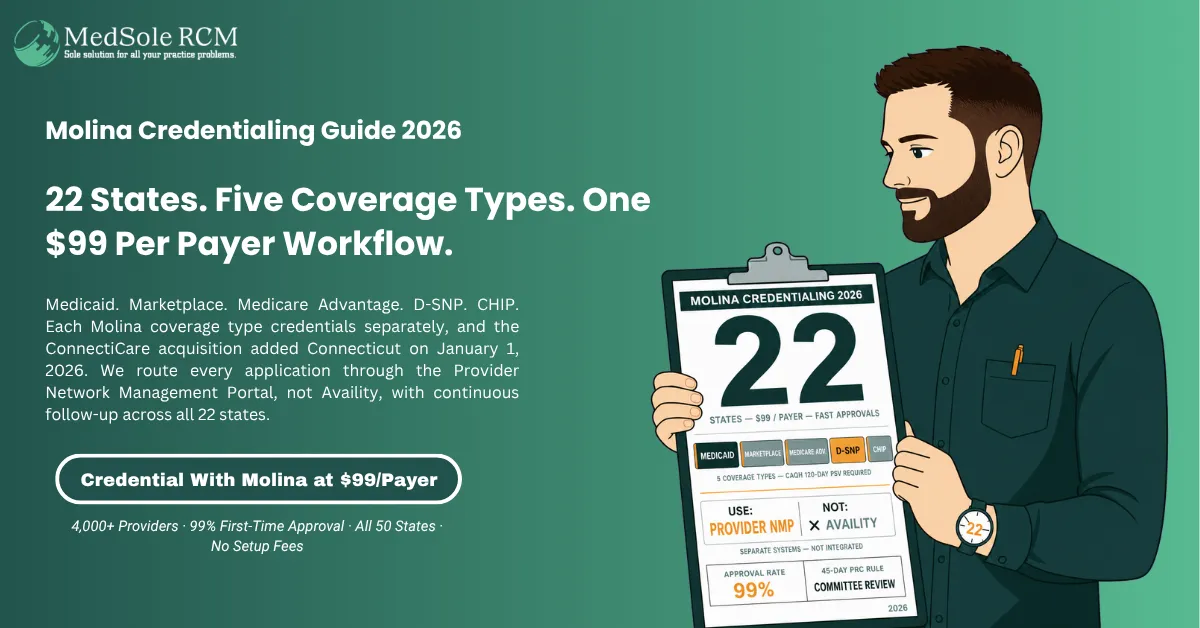




Molina credentialing is the federally regulated 60-to-90-day verification process governed by 42 CFR 455 Subpart B and 42 CFR 438 through which Molina Healthcare confirms a provider's licensure, education, training, work history, malpractice history, and sanctions status before granting in-network billing privileges across Medicaid, Marketplace, and Medicare Advantage plans.
Molina Healthcare insures approximately 5.8 million members across 22 states, primarily through Medicaid managed care and Marketplace plans. Joining Molina's provider network opens access to one of the fastest-growing government-sponsored payer populations in the country. Every month providers wait for credentialing approval costs $20,000 to $50,000 in lost in-network revenue.
This guide walks providers through the January 1, 2026 ConnectiCare acquisition reshaping Molina's footprint, NCQA's tightened 120-day Primary Source Verification standard, the Provider Network Management Portal (separate from Availity), CAQH ProView setup, the 7-step credentialing process, state-specific pathways for all 22 Molina states, and behavioral health specialty pathways.
We're MedSole RCM. We've credentialed more than 4,000 providers across all 50 states at $99 per insurance with fast approvals through continuous follow-up with payer credentialing teams. Competitors charge $150 to $300 per payer. Our continuous follow-up with Molina state credentialing teams compresses what normally takes 60 to 90 days.
Whether you're a solo behavioral health provider expanding into Medicaid, a multi-state group navigating different state Molina plans, or a practice manager handling multiple credentialing applications, the path to joining the Molina network follows the same fundamentals. Five distinct concepts often confuse providers.
Five Distinctions: Credentialing vs Enrollment vs Contracting vs Provider Portal Registration vs Network Status
Most providers conflate five related Molina concepts. Credentialing verifies you meet Molina's participation standards under federal regulation. Enrollment is the formal application submission. Contracting establishes the legal participation agreement. Provider Portal Registration grants access to Molina's Network Management Portal. Network Status determines reimbursement levels and patient-facing visibility.
Molina Credentialing (The Verification Process)
Credentialing is the formal verification process. Molina's Credentialing Department verifies your licensure status, education, training, certifications, work history, malpractice history, and professional competence under 42 CFR 455 Subpart B and NCQA standards.
This involves primary source verification (contacting medical schools, state boards, and malpractice carriers directly) and secondary source verification through the National Practitioner Data Bank, OIG LEIE, and CMS Preclusion List. Credentialing decisions feed Molina's Professional Review Committee.
Molina Provider Enrollment (The Application Submission)
Enrollment is the act of submitting your application packet. For most providers, this means a complete CAQH ProView profile authorized for Molina, plus the state-specific Molina contract request form sent to IAProviderContracts@MolinaHealthcare.com or your state-specific Molina contracting department. Enrollment can occur before credentialing completes, but you can't bill Molina until both enrollment AND credentialing approve, and the contract is countersigned.
Molina Contracting (The Final Participation Agreement)
Contracting is the legal agreement establishing your participation terms. Once credentialed, Molina sends a contract specifying reimbursement rates, fee schedule, dispute procedures, termination clauses, and operational rules specific to your state and coverage type. Read it carefully.
Some Molina contracts include visit caps, prior authorization triggers for certain CPT codes, or specialty-specific exclusions. Our credentialing and contracting workstream reviews every clause before you sign. Network status only activates after Molina countersigns.
Molina Provider Portal Registration (Provider Network Management Portal)
Critical 2026 distinction: Molina's Provider Network Management Portal is separate from Availity. The Provider Network Management Portal handles credentialing applications, enrollment status updates, and provider data management. Availity handles operational transactions like claims, eligibility verification, and authorizations. Molina explicitly states the Pre-Enrollment Portal is NOT integrated with Availity.
Providers who use Availity for credentialing status checks see incorrect data. Practice manager accounts in the Provider Network Management Portal handle rosters and credentialing updates. If you only use Availity, you're missing the Molina credentialing system entirely.
Network Status (Authorized vs Network vs Out-of-Network)
Network status determines billing privileges. Network providers have signed contracts with Molina, agreeing to negotiated reimbursement rates and accepting Molina payment as full settlement (plus the patient's cost-share). Network providers appear in Molina's directory and receive referral flow. Authorized but Non-Network providers have completed credentialing but haven't signed a contract.
They can serve Molina members claim-by-claim at allowable rates but don't get directory placement. Out-of-network providers haven't completed Molina credentialing at all. Their claims deny automatically. The financial impact is significant.
Knowing the five distinctions saves time and prevents costly mistakes. MedSole's credentialing specialists track all five simultaneously across every Molina state plan.
The next section walks through what changed in 2026 for each of these processes, including the January 1, 2026 ConnectiCare integration that's reshaping Molina's footprint and the NCQA standards that tightened mid-year. What a credentialing specialist actually does is manage all five simultaneously.
What's New in 2026: ConnectiCare Acquisition, NCQA PSV Changes, and Provider Network Management Portal
Six material 2026 updates affect Molina credentialing right now. Molina's $350 million ConnectiCare acquisition closed January 1, 2026, bringing 140,000 beneficiaries into Molina's footprint. NCQA reduced Primary Source Verification from 180 days to 120 days. Monthly OIG and SAM.gov monitoring became mandatory. Most credentialing content online doesn't reflect any of these changes.
The January 1, 2026 ConnectiCare Acquisition (Molina's Connecticut Entry)
Effective January 1, 2026, Molina Healthcare completed its $350 million acquisition of ConnectiCare from EmblemHealth, gaining its first foothold in Connecticut. ConnectiCare serves approximately 140,000 beneficiaries across Affordable Care Act Marketplace plans, Medicare Advantage Point of Service plans, Dual Special Needs Plans, Group Medicare Advantage, and Medicare Supplemental plans.
Critical for ConnectiCare-credentialed providers: Molina now conducts credentialing and recredentialing on ConnectiCare's behalf. Providers no longer submit credentialing forms to ConnectiCare. They use Molina's Network Pre-Enrollment Tool on ConnectiCare's Join Our Network page. Provider credentialing status is checked through the same tool. Connecticut Insurance Department confirmed the integration.
NCQA Tightens Primary Source Verification to 120 Days
As of 2026, NCQA requires Primary Source Verification to be completed within 120 days, reduced from the previous 180-day window. Certified Credentials Verification Organizations (CVOs) face an even tighter 90-day deadline. This is one of the most impactful credentialing regulatory changes of 2026. Spreadsheet tracking of verification dates is officially obsolete.
NCQA requires digital credentialing systems with audit trails and continuous monitoring capabilities. For providers, this means CAQH attestation must be current within 120 days at all times during credentialing. Lapsed attestation triggers immediate verification resets.
Monthly OIG and SAM.gov Monitoring Now Mandatory
Every 30 days, completed OIG exclusion and SAM.gov sanctions checks are required under 2026 NCQA standards. Quarterly monitoring no longer meets the standard. This affects providers whose credentials previously cleared monthly checks but whose status changed mid-cycle. Credentialing partners managing your file must run monthly federal database checks.
Failure to monitor monthly creates immediate recredentialing risk and potential Medicare/Medicaid program eligibility issues.
Molina's Provider Network Management Portal (Updated March 3, 2026)
Molina's Join Our Network page (last updated March 3, 2026) describes the implemented Provider Network Management Portal designed to streamline onboarding, standardize enrollment to reduce turnaround time, enable self-service provider data management, and provide automated status updates. Two complementary portals: the Pre-Enrollment Portal (no login required) handles initial credentialing applications.
The Provider Network Management Portal handles ongoing data management. Practice manager accounts within the Provider Network Management Portal manage rosters. Critical: this portal is NOT integrated with Availity. Avoid checking credentialing status through Availity.
New Payer ID and Claims Submission Rules for 2026
Effective January 1, 2026, all claims for ConnectiCare Marketplace and Medicare members with dates of service on or after January 1, 2026, must be submitted using the new Molina payer ID and mailing address. Both electronic and paper claims are affected.
Molina performs SNIP Level 1-7 editing through the primary clearinghouse before claims enter adjudication. Claims missing required information get rejected via 277CA electronic acknowledgment. Update your billing system with Molina's new payer ID immediately to prevent claim rejections.
Clinical and Pharmacy Policies Now Unified Under Molina
Effective January 1, 2026, ConnectiCare adopted Molina's Clinical Policy, Pharmacy Policy Criteria, Marketplace Formulary, and Medicare Formulary for Marketplace and Medicare members. Delegated providers note: delegation oversight now flows through Molina. Demographic information updates on or after January 1, 2026, must go through a roster profile and email to CCI-ProviderFileOperations@MolinaHealthcare.com. Failure results in removal from the ConnectiCare provider directory.
Six 2026 updates means six new ways Molina credentialing can stall. MedSole's Molina credentialing services monitor every regulatory shift and reflect changes in our enrollment workflow within days. MedSole RCM credentials providers at $99 per insurance with continuous follow-up that expedites approvals across all 50 states. Next, the coverage type complexity that determines which Molina credentialing pathway applies to you.
Molina Coverage Types: Medicaid, Marketplace, Medicare Advantage, D-SNP, and CHIP Credentialing
Molina operates five coverage types, each with distinct credentialing pathways. Medicaid is governed by 42 CFR 438. Marketplace plans require Affordable Care Act compliance. Medicare Advantage follows CMS Medicare standards. Dual Eligible Special Needs Plans require dual compliance with both. CHIP serves children's coverage. Knowing which coverage types you'll serve dictates your credentialing destination and timeline.
Molina Medicaid Credentialing (The Foundation Pathway)
Molina Medicaid is the foundational coverage type, governed by 42 CFR 438 (Medicaid managed care regulations) and 42 CFR 455 Subpart B (provider screening). Each state's Medicaid agency layers additional requirements on top of federal standards. Florida Medicaid requires CAQH attestation within 120 days. Nevada Medicaid follows similar standards (March 2026 manual).
California Medicaid (Medi-Cal) requires state-specific provider screening. Ohio Medicaid is administered by the Ohio Department of Medicaid (ODM), not Molina directly. Section 10 covers state-specific Medicaid pathway differences. The Medicaid pathway is required before any other coverage type credentialing.
Molina Marketplace Credentialing (ACA Compliance Layer)
Molina Marketplace plans operate under the Affordable Care Act framework with additional ACA-specific compliance requirements. Marketplace credentialing layers on top of Medicaid credentialing. Providers credential through the same CAQH ProView profile and Molina Provider Network Management Portal, but Marketplace-specific contracts include ACA reimbursement schedules and benefit structures different from Medicaid.
The ConnectiCare acquisition expanded Molina's Marketplace footprint significantly. Marketplace credentialing requires confirmation that providers can serve patients enrolled through state-based or federal Health Insurance Exchanges.
Molina Medicare Advantage Credentialing
Molina Medicare Advantage credentialing requires Medicare enrollment verification alongside Molina credentialing. Providers must already be enrolled with Medicare (PECOS-active) before Molina Medicare Advantage credentialing can complete. CMS Medicare Advantage standards layer on top of NCQA credentialing standards. Special Needs Plan certification rules apply for chronic condition or institutional special needs populations.
The 2026 ConnectiCare integration expanded Molina's Medicare Advantage footprint into Connecticut for the first time, including Medicare Advantage Point of Service plans, Group Medicare Advantage, and Medicare Supplemental plans.
Molina Dual Eligible Special Needs Plan (D-SNP) Credentialing
Molina Dual Eligible Special Needs Plans serve members eligible for both Medicare AND Medicaid. D-SNP credentialing requires dual compliance with CMS Medicare regulations AND state Medicaid rules simultaneously. Providers must be both Medicare-enrolled (PECOS-active) AND state Medicaid-enrolled.
Some states (like California, New York, and Texas) require providers to also be enrolled with the state Medicaid agency through state-specific provider portals. ConnectiCare's Dual Special Needs Plans now flow through Molina credentialing post-2026 acquisition. D-SNP credentialing is the most complex Molina pathway because of the dual federal and state regulatory framework.
Molina CHIP Program Credentialing
The Children's Health Insurance Program (CHIP) covers eligible children whose families earn too much for Medicaid but can't afford private insurance. Molina CHIP credentialing varies by state because each state administers CHIP differently. Some integrate with Medicaid, others operate separately. Pediatric providers most commonly credential for CHIP alongside Medicaid.
State-specific CHIP credentialing rules align with the state's Medicaid managed care framework.
Why Coverage Type Matters for Your Credentialing Strategy
Coverage type drives your credentialing decision. Practices serving primarily Medicaid populations (community health centers, behavioral health, pediatric) credential first for Medicaid. Practices serving retirees prioritize Medicare Advantage credentialing. Practices in California, Texas, and other large Medicaid states credential for D-SNP because dual eligible populations are sizeable.
Map your patient demographics before deciding which Molina coverage types to credential for. Some practices certify with Molina specifically to serve a single high-volume coverage type, then expand later as patient volume grows.
CAQH ProView for Molina Providers: 120-Day Attestation, NCQA 2026 PSV Standards, and Authorization Setup
CAQH ProView is the centralized database Molina uses to access Molina provider credentialing data across most state plans. More than 900 health plans use CAQH ProView. Molina manuals state CAQH ProView is the primary source for individual provider credentialing data. If your CAQH profile is incomplete, expired, or unauthorized for Molina, your Molina credentialing freezes silently, often without explanation.
How CAQH ProView Works in Molina Credentialing
Your CAQH profile contains 18 data sections covering education, training, work history, malpractice insurance, license details, practice locations, and accepting-new-patients status. Self-register at proview.caqh.org. Complete every mandatory field. Upload required documents (state license, malpractice declaration page, board certificates, CV, W-9). Designate Molina as an authorized health plan.
Once your profile is complete and attested, Molina pulls your data directly during credentialing. Our complete CAQH ProView management guide walks through every section.
The 120-Day Attestation Rule (Florida Medicaid Specific)
Molina's Florida Medicaid Provider Handbook (2026) explicitly states the CAQH attestation must be signed within 120 days, with required attachments included. This is the strictest CAQH-related rule in Molina's handbook system. Other state Molina manuals may follow similar standards. Best practice: re-attest every 90 days regardless of state. Set calendar reminders.
Verify your CAQH status reads Current before any Molina application or recredentialing event.
NCQA 2026 PSV Window Reduction (180 to 120 Days)
Effective 2026, NCQA reduced the Primary Source Verification window from 180 days to 120 days. Certified Credentials Verification Organizations (CVOs) face a tighter 90-day deadline. This affects how Molina partners verify provider credentials. Source verification beyond 120 days expires and triggers reverification.
The shorter window means CAQH attestation lapses now create immediate verification cascade issues. Maintaining current CAQH attestation matters more in 2026 than ever before.
Authorizing Molina Inside CAQH ProView
Inside CAQH ProView, designate Molina as an authorized health plan for your data. Without this checkbox, Molina literally cannot pull your information. Your profile could be perfectly complete, every document uploaded, every attestation current, and Molina sees nothing. Practices wait months for credentialing decisions before discovering they never authorized Molina.
Authorize Molina during initial CAQH setup. If you operate across multiple Molina state plans, authorize each state plan separately.
When CAQH Is NOT Required (Inpatient/Facility-Only Providers)
Per Molina's Pre-Enrollment Portal FAQ, CAQH is required for individual providers who require credentialing, but NOT required for providers who work exclusively in an inpatient or freestanding facility setting. Hospital-based providers, ER physicians who only see patients in inpatient settings, and surgical center anesthesiologists fall into this exception. Verify your status with Molina before skipping CAQH setup.
Common CAQH-Related Molina Credentialing Stalls
The four CAQH-related issues that cause most Molina credentialing stalls: failure to authorize Molina specifically in CAQH (universal pitfall), expired attestation past 120 days, work history gaps over six months without documented explanation, and demographics not matching across CAQH, NPPES, and the Molina application.
Failure to grant Molina specific access to your CAQH portal is a leading cause of silent application stalls. Audit these four points monthly. Catching them early saves 30 to 75 days of avoidable delay.
CAQH attestation, Molina authorization, and NCQA 2026 PSV alignment are three timelines you must master simultaneously. Get them right and you've solved most silent stall points. Documentation prep follows.
Pre-Application Documentation Checklist for Molina Providers
Molina credentialing applications get rejected for the same reason most provider applications fail: documentation mismatches. Names don't match across systems. Dates don't align. The W-9 carries a DBA instead of the legal name. Cultural competency training certificates are missing. One mismatch triggers manual review and adds 30 to 75 days to your timeline.
Required Documentation for Individual Molina Providers
Every individual Molina provider needs the following ready before opening any contractor portal:
- Active state medical license for every state of practice (no temporary licenses)
- NPI Type 1, current in NPPES with correct taxonomy code
- State Medicaid number (active)
- Malpractice insurance declaration page meeting Molina's specific liability thresholds
- DEA Certificate (if you prescribe controlled substances)
- Board certification documentation appropriate to your specialty
- W-9 form with legal name and TIN matching IRS records exactly
- CV with months and years for the last five years (no unexplained gaps over six months)
- CAQH ProView profile complete, attested within 120 days, and Molina-authorized
- Government-issued photo ID
- Cultural competency training certificate (Molina-specific requirement)
- Practice location address matching across USPS, NPPES, CAQH, and your application
- Hospital privileges documentation (where applicable)
Additional Documentation for Group Practices and Facilities
Group practices need everything above plus an NPI Type 2 current in NPPES, an IRS Determination Letter or EIN documentation, individual NPI Type 1 applications for each provider, and a complete W-9 for the group entity.
Facility providers need facility liability insurance, accreditation documentation appropriate to the facility type, copy of most recent CMS or state survey results (including corrective action plans if deficiencies were cited), and Articles of Incorporation or Operating Agreement for entity verification.
Ownership/Controlling Interest Disclosure Form (Molina-Specific)
Molina requires the Ownership/Controlling Interest Disclosure Form completed in its entirety for each practitioner. Failure to complete this form will prevent initiation of the credentialing process. The form discloses owners, board members, and individuals with controlling interest. Each individual listed undergoes federal database screening (OIG LEIE, SAM.gov).
This is a federal Medicaid requirement under 42 CFR 455 Subpart B that flows through to Molina's credentialing process across all states.
Signed Attestation Requirement (Signature Stamp NOT Acceptable)
The Molina credentialing application must include a signed attestation. Molina's Provider Manual explicitly states a signature stamp is not acceptable. Wet signature or verified electronic signature only. This catches providers who rely on signature stamps for routine paperwork. Verify your attestation is signed personally before submitting.
The attestation must be within 180 days of the credentialing decision; older attestations require updating.
Cultural Competency Documentation (Molina-Specific)
Molina emphasizes cultural competency given its Medicaid population focus on underserved communities. Some Molina state plans require cultural competency training certificates documenting completion of Molina-approved or state-approved cultural competency programs. Language capabilities documentation and ADA compliance verification may also apply. Verify state-specific cultural competency requirements before submission.
Common Documentation Mistakes That Stall Molina Credentialing
The five mistakes causing most Molina credentialing delays: practice address not matching across USPS, NPPES, CAQH, and the W-9; missing Ownership/Controlling Interest Disclosure Form; signature stamp on attestation instead of personal signature; CAQH work history with gaps over six months unexplained; and W-9 carrying DBA instead of legal name.
Any of these flips your application status to manual review and adds 30 to 75 days unless someone proactively corrects it. Our credentialing specialists audit every document before submission.
Documentation prep is where most Molina delays start. We catch issues before submission. That's part of why MedSole hits fast approvals when the industry runs 60 to 90 days. Once your documents are clean, the application begins.
How to Get Credentialed With Molina: The 7-Step Process Through the Provider Network Management Portal
How to get credentialed with Molina follows seven sequential steps: verify eligibility, initiate contact through the Pre-Enrollment Portal (NOT Availity), complete CAQH ProView profile, submit credentialing application, complete primary source verification within 120 days under 2026 NCQA standards, await Professional Review Committee decision under the 45-day rule, then receive contract execution and network activation.
Total credentialing timeline runs up to 60 days for clean files.
Step 1: Verify Eligibility and Confirm Your Coverage Type
Step 1 starts before any portal opens. Confirm your eligibility: you must practice or plan to practice within 90 days of submitting a Molina credentialing application in any area covered by Molina. Verify you have an active state Medicaid number. Confirm your provider type matches Molina's accepted credentialing categories.
Determine which coverage types you'll serve: Medicaid (foundation), Marketplace (ACA layer), Medicare Advantage (Medicare-enrolled providers), D-SNP (dual eligibility complexity), CHIP (state-specific). Each coverage type may require separate enrollment alongside core credentialing. Map your strategy before opening any portal.
Step 2: Initiate Contact Through Molina's Pre-Enrollment Portal (Not Availity)
Step 2 routes through Molina's Provider Network Management workflow, accessible without login. Critical: do NOT use Availity for credentialing initiation. Availity handles operational transactions only. The Pre-Enrollment Portal is NOT integrated with Availity. Vision providers contact March Vision Care at marchvisioncare.com or 1-844-496-2724 (alternate routing).
Pharmacy providers contact CVS Caremark for pharmacy benefit credentialing (alternate routing). Pharmacy providers offering immunizations or DME submit to IAProviderContracts@MolinaHealthcare.com. Get the routing right before submitting paperwork.
Step 3: Complete or Update Your CAQH ProView Profile
Self-register at proview.caqh.org. Complete every mandatory field across all 18 data sections. Upload your state license, malpractice declaration page, DEA Certificate, board certificates, CV, and W-9. Use the same address, phone, NPI, and license details that will appear on your Molina application. Consistency matters more than speed at this stage.
Authorize Molina as an authorized health plan inside CAQH. Attest to your profile and verify the status reads Current. Set a calendar reminder to re-attest every 90 days regardless of state.
Step 4: Submit Your Credentialing Application Through the Provider Network Management Portal
Step 4 submits the formal application. After Pre-Enrollment Portal approval, practices receive steps to create accounts in the Molina Provider Network Management Portal. Submit your contract request form to your state-specific Molina contracting department. Contract requests for medical, behavioral health, and ancillary providers route to IAProviderContracts@MolinaHealthcare.com.
ConnectiCare-credentialed providers post-2026 acquisition route demographic updates to CCI-ProviderFileOperations@MolinaHealthcare.com. Track every application: date submitted, application reference number, documents included, follow-up dates. Save copies of everything. Our team uses the same workstream pattern we use for Aetna provider enrollment for every Molina application.
Step 5: Primary Source Verification by Molina (Within 120 Days)
Step 5 is the longest phase but mostly invisible to you. Molina's Credentialing Department contacts the original sources of your credentials within the 2026 NCQA-required 120-day window (down from 180 days). Your medical school verifies your degree. Your residency program verifies completion.
The state medical board confirms your license is current and unrestricted. Your malpractice carrier confirms active coverage. The National Practitioner Data Bank gets queried for malpractice settlements, disciplinary actions, license suspensions, or healthcare-related criminal history. OIG LEIE and SAM.gov sanctions checks complete monthly per 2026 NCQA standards.
Step 6: Professional Review Committee Decision (45-Day Rule)
Step 6 is committee review. Within 45 calendar days after receipt of a complete application and all supporting documents, Molina's Credentialing Department assesses and verifies your qualifications and notifies you. If by the 45th calendar day Molina hasn't received required information, Molina issues written notification either closing the application or pending it.
Pended applications can extend an additional 45 calendar days, after which the application closes if information remains missing. The Professional Review Committee evaluates verified applications. Approval, conditional approval, request for additional information, or denial with appeal rights are the four possible outcomes.
Molina maintains a heterogeneous credentialing committee with affirmative anti-discrimination statements at every meeting.
Step 7: Contract Execution and Network Activation (Up to 60 Days Total)
Step 7 finalizes participation. Once approved, Molina prepares and sends a participation contract specifying reimbursement rates, fee schedule, and operational rules. You sign and return. Molina countersigns and sends back the executed contract with your effective date. The credentialing AND provider load process can take up to 60 days total.
Critical warning: do NOT bill any Molina patient before written effective date confirmation arrives. Claims submitted before that date deny automatically. Many can't be retroactively fixed even after the contract loads. We've watched practices lose $30,000 to $80,000 because someone saw "approved" in a portal and assumed it meant ready to bill.
Wait for written confirmation.
If managing this 7-step process across multiple states and coverage types isn't realistic for your practice, MedSole RCM expedites Molina credentialing at $99 per insurance with fast approvals across all 50 states. We've credentialed more than 4,000 providers. Submit applications and follow up on every state Molina plan simultaneously. No setup fees. No hidden charges. No annual contracts.
The Real Molina Credentialing Timeline: Phase by Phase
Industry-standard Molina credentialing takes 60 to 90 days from application submission to written effective date confirmation. Within 45 calendar days after receipt of a complete application, Molina assesses qualifications under federal regulation. Pended applications extend an additional 45 days. MedSole RCM expedites the entire process through continuous follow-up with Molina state credentialing teams.
Industry-Standard 60 to 90 Days vs MedSole's Fast Approval
Most Molina credentialing applications run 60 to 90 days under passive management. Some state plans complete credentialing in 45 days under ideal conditions. Others stretch to 120 days when documentation issues surface. Molina's South Carolina credentialing packet states the credentialing and provider load process can take up to 60 days.
MedSole's average is fast because we don't wait. Our continuous payer follow-up with Molina credentialing teams compresses what stalls under passive management. Industry charges $150 to $300 per payer with these timelines. We charge $99 and deliver fast approvals.
The Five Phases of Molina Credentialing
Breaking the timeline into phases shows where time actually goes and where intervention matters. Most providers underestimate phase three because Molina communication during primary source verification is minimal. Knowing what's happening behind the scenes is the first step to compressing the cycle.
|
Phase |
Duration |
What Happens |
|---|---|---|
|
Application Preparation |
3 to 7 days |
Documentation gathered, CAQH profile completed and attested, Molina authorization confirmed |
|
Application Submission |
Same day to 2 days |
Pre-Enrollment Portal submission, contract request to state-specific email, reference numbers received |
|
Primary Source Verification |
15 to 45 days |
Molina verifies education, board certification, license, malpractice, NPDB query, work history within 120-day NCQA window |
|
Professional Review Committee |
5 to 15 days |
Molina's PRC reviews verified application; clean applications usually approved on first review |
|
Effective Date and Contract Activation |
Up to 60 days post-approval total |
Effective date issued, directory listing goes live, EFT and ERA setup, contract loaded into Molina billing systems |
Why Third-Party Verification Is the Universal Bottleneck
Phase three is the longest phase because Molina depends on third parties to confirm your credentials. Medical schools take 2 to 4 weeks to respond to verification requests. State medical boards vary wildly in response speed. Malpractice carriers respond within days. The NPDB query is automated and instant.
The credentialing teams that compress this phase do it by contacting third-party sources before Molina reaches them, warming up the verification pipeline in advance. This is the operational mechanism justifying our fast approval claim.
How to Check Your Molina Credentialing Status
Status check options vary by state. Florida providers benefit from the 2-working-day response window Molina's Florida Medicaid handbook commits to. Use Molina's Provider Network Management Portal for status updates (your application reference number is required). Don't use Availity , it's not integrated with credentialing data.
Don't call to check status unless your application has been pending for more than 30 days without movement. Calling earlier doesn't accelerate processing. We monitor status weekly for every client and intervene proactively when applications stall.
Don't Bill Before Your Effective Date Confirmation
The single most expensive mistake providers make: scheduling Molina patients and submitting claims before written effective date confirmation arrives. Claims submitted before the effective date deny automatically. Many can't be retroactively fixed even after the contract loads.
We've watched practices lose $30,000 to $80,000 because someone saw "approved" in a portal and assumed it meant ready to bill. Approved means credentialing cleared. Effective date means you can bill.
The 60 to 90 day industry timeline isn't a fixed law. It's a function of follow-up intensity. Our fast approval pathway compresses the timeline at $99 per insurance. The next section explains exactly how we do it.
How MedSole RCM Expedites Molina Credentialing
Industry-standard Molina credentialing takes 60 to 90 days. MedSole RCM expedites the timeline through four operational disciplines applied to every Molina credentialing application: pre-submission audits, continuous state credentialing team follow-up, proactive verification source contact within the 120-day NCQA window, and state-specific pathway routing for all 22 Molina states.
Pre-Submission CAQH and Documentation Audit
Most Molina credentialing applications get delayed by problems Molina discovers during automated screening. Practice address mismatches between USPS, NPPES, and CAQH. Work history gaps over six months without explanation. Malpractice declaration pages missing required coverage limits. Missing Ownership/Controlling Interest Disclosure Forms. Signature stamps on attestations instead of personal signatures. Each issue triggers manual review and adds 30 to 75 days.
We audit every document and every CAQH field before submission. Issues that would stall an application for two months get caught and fixed on day one. The average client doesn't know we found 4 to 7 fixable issues until we send the cleanup checklist.
Continuous Follow-Up With Molina State Credentialing Teams
Most providers submit applications and wait. Days turn into weeks. Applications sit in queue across multiple Molina state plans. We don't wait.
We follow up weekly with each state-specific Molina credentialing team through their portal chat functions, dedicated provider services lines, and direct credentialing email addresses (IAProviderContracts@MolinaHealthcare.com for contract requests, CCI-ProviderFileOperations@MolinaHealthcare.com for ConnectiCare provider updates, state-specific contracting departments). We track every reference number, every verification request, every Professional Review Committee meeting cycle.
When Molina asks for additional information, we respond within 24 hours, not the typical 7 to 10 business days. Each week of saved waiting time compounds. Applications that would take 90 days under passive management close significantly faster under continuous payer follow-up.
Proactive Contact With Verification Sources Within the 120-Day NCQA Window
The longest phase of Molina credentialing is primary source verification. Molina contacts your medical school, residency program, state medical board, malpractice carrier, NPDB, OIG LEIE, and SAM.gov. Most sources take 2 to 4 weeks to respond. We reach out to verification sources before Molina does.
Our team contacts the registrar at your medical school, the credentialing office at your specialty board, your malpractice carrier directly, and your prior practice administrators to make sure they're ready to respond fast. The 2026 NCQA 120-day window means missed verification timelines trigger reverification cascades.
Phase three drops from 15 to 45 days down to 10 to 20 days under our active management.
State-Specific Pathway Routing for All 22 Molina States
Molina credentialing requires state-specific pathway knowledge most general credentialing companies lack. Florida requires CAQH attestation within 120 days. Ohio Medicaid is administered by Ohio Department of Medicaid (ODM) through the state's Provider Network Management system, not Molina directly. Massachusetts Senior Whole Health uses a 24-month recredentialing cycle (vs the standard 36-month).
South Carolina mid-level providers face supervising physician documentation rules. We've credentialed enough Molina providers across all 22 states to know every state-specific quirk by memory.
$99 Per Insurance With No Setup Fees, No Hidden Charges, No Annual Contracts
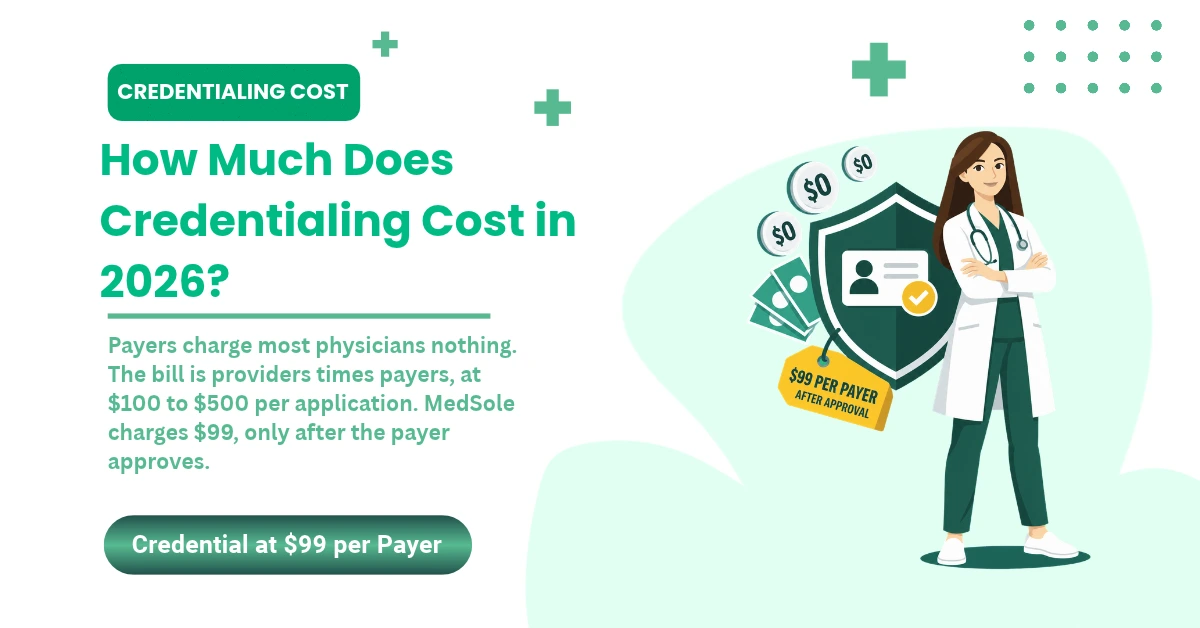
MedSole RCM expedites Molina credentialing at $99 per insurance with fast approvals across all 50 states. We've credentialed more than 4,000 providers with a 99 percent first-time approval rate. The Molina credentialing industry charges $150 to $300 per payer with 60 to 90 day timelines. We charge less and move faster.
No setup fees. No hidden charges. No annual contracts. The lowest structured pricing in the US RCM market. MedSole is the most affordable Molina credentialing partner in the United States.
The expedited approach works the same way across all 22 Molina states. The next section breaks down exactly what changes when you credential with Molina in each state.
Molina Credentialing by State: All 22 Operational States
Molina operates Medicaid managed care, Marketplace, and Medicare Advantage plans across 22 states with state-specific credentialing requirements. Each state Medicaid agency layers additional rules on top of federal 42 CFR 455 Subpart B and 42 CFR 438 standards. Knowing your state's specific requirements determines whether your credentialing approves in 45 days or stalls for 120.
Molina Credentialing in Florida (Healthcare Provider Manual 2026 Standards)
Molina Healthcare of Florida operates one of the largest Molina state plans. Florida's 2026 Provider Handbook requires CAQH attestation signed within 120 days with all required attachments. Florida providers benefit from Molina's 2-working-day status update response window, the strictest commitment across Molina's state plans. Discrepancy responses must arrive within 10 calendar days.
Telemedicine practitioners must be licensed in BOTH the state where the practitioner is located AND the state where the member is located. Recredentialing follows the standard 36-month cycle. Submit applications to IAProviderContracts@MolinaHealthcare.com.
Molina Credentialing in Ohio (ODM-Run Credentialing Through PNM)
Critical Ohio distinction: Ohio Medicaid credentialing is administered by the Ohio Department of Medicaid (ODM), NOT Molina directly. Credentialing and recredentialing pair with enrollment and revalidation in Ohio's Provider Network Management (PNM) system.
The underlying rule is published in Ohio Administrative Code 5160-1-42, which defines credentialing and lists provider types subject to mandatory credentialing. Critical warning: providers cannot render services to Ohio Medicaid members until fully screened, enrolled, and credentialed (if required). Don't bill before completion.
Ohio's PNM system replaces direct payer credentialing for Medicaid managed care providers.
Molina Credentialing in Michigan
Molina Healthcare of Michigan operates significant Medicaid managed care presence. Michigan providers credential through Molina's standard CAQH ProView process aligned with state Medicaid requirements. Submit credentialing applications through Molina's Pre-Enrollment Portal. Michigan's Provider Network Management workflow integrates with state Medicaid enrollment.
The Provider Network Management Portal (updated March 3, 2026) supports Michigan provider data management across all Molina Michigan plan types.
Molina Credentialing in California (Medi-Cal Layer)
Molina Healthcare of California operates as a Medi-Cal managed care plan. California layers state-specific provider screening requirements through Medi-Cal on top of federal standards. The Medi-Cal application process integrates with Molina credentialing. Providers must complete state Medi-Cal enrollment AND Molina credentialing. Medi-Cal screening includes additional fingerprinting requirements for certain provider types.
California's Department of Health Care Services (DHCS) operates the Medi-Cal Provider Application and Validation for Enrollment (PAVE) system. Behavioral health and ABA providers face heavy Medi-Cal demand.
Molina Credentialing in Texas
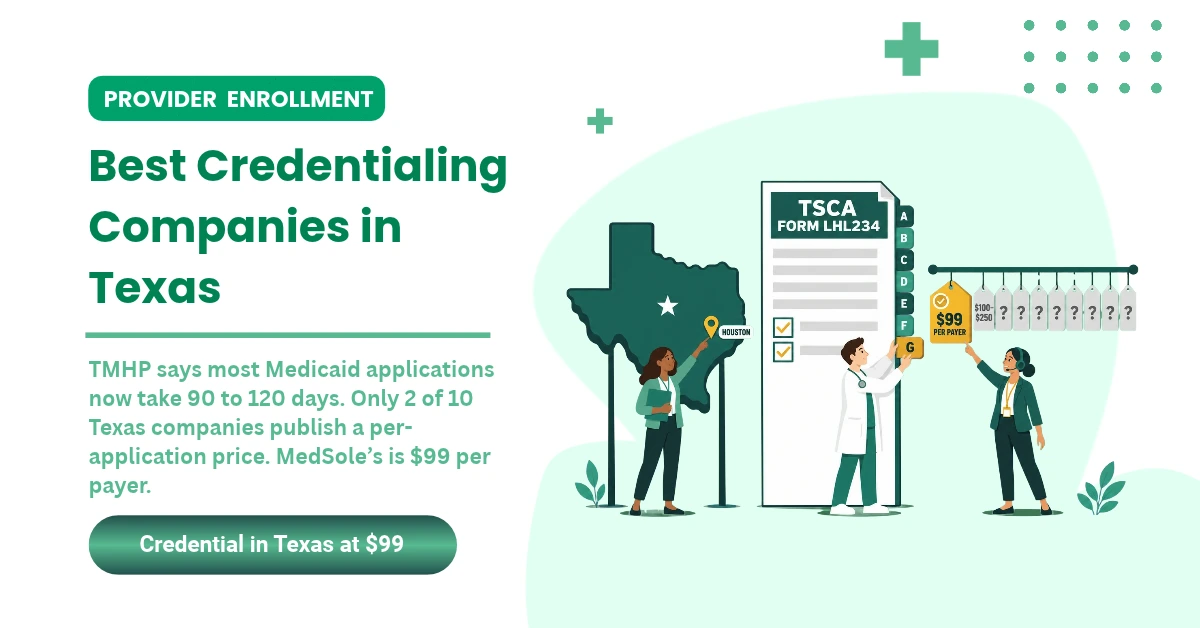
Molina Healthcare of Texas serves Texas Medicaid (STAR, STAR+PLUS, STAR Kids, CHIP) populations. Texas providers credential through Molina's standard pathway with state-specific Texas Medicaid Healthcare Partnership (TMHP) integration. The Texas Health and Human Services Commission (HHSC) sets state Medicaid provider screening rules that flow through to Molina.
Texas providers must maintain active state Medicaid enrollment through TMHP alongside Molina credentialing. Submit applications to Molina's Texas-specific contracting department or IAProviderContracts@MolinaHealthcare.com.
Molina Credentialing in Washington
Molina Healthcare of Washington serves Apple Health Medicaid managed care. Washington providers credential through Molina aligned with Washington Health Care Authority (HCA) requirements. ProviderOne, Washington's state Medicaid provider portal, handles state-side enrollment. Molina credentialing layers on top.
Apple Health Foster Care, Apple Health Behavioral Health Services Only, and Apple Health Integrated Managed Care plans operate through different Molina credentialing tracks. Verify your specific Apple Health program before submitting.
Molina Credentialing in Connecticut (Post-2026 ConnectiCare Integration)
Connecticut is Molina's newest state effective January 1, 2026, following the $350 million ConnectiCare acquisition. Molina now conducts credentialing and recredentialing on ConnectiCare's behalf. Providers no longer submit credentialing forms to ConnectiCare directly. They use Molina's Network Pre-Enrollment Tool on ConnectiCare's Join Our Network page.
ConnectiCare-credentialed providers transitioning to Molina-managed credentialing should verify their CAQH profile is Molina-authorized. Demographic updates route to CCI-ProviderFileOperations@MolinaHealthcare.com. Connecticut's Marketplace, Medicare Advantage Point of Service, Dual Special Needs Plans, Group Medicare Advantage, and Medicare Supplemental plans all flow through Molina credentialing post-acquisition.
Molina Credentialing in Massachusetts (24-Month Recredentialing)
Molina Healthcare of Massachusetts operates Senior Whole Health for Medicare Advantage and dual eligible populations. Critical Massachusetts distinction: Molina's 2026 Senior Whole Health Provider Manual states recredentialing every 24 months (NOT the standard 36-month cycle most other Molina state plans use). This tighter cadence affects Massachusetts providers' ongoing compliance timeline.
Massachusetts providers must initiate recredentialing 120-150 days before any 24-month cycle ends.
Molina Credentialing in South Carolina (Mid-Level Provider Rules)
Molina Healthcare of South Carolina has specific mid-level provider credentialing rules updated June 1, 2023. Supervising physicians must be credentialed with Molina (the SC packet asks for MD name and NPI). Mid-level scenarios may require a full credentialing packet depending on PCP designation and directory listing intent.
CAQH attestation expectations apply, with explicit guidance about not submitting close to expiration. South Carolina credentialing and provider load can take up to approximately 60 days per the SC packet.
Molina Credentialing in Mississippi
Molina Healthcare of Mississippi serves Mississippi Medicaid through MississippiCAN (Mississippi Coordinated Access Network) and CHIP. Mississippi providers credential through Molina aligned with Mississippi Division of Medicaid requirements. MississippiCAN credentialing integrates with state Medicaid enrollment. Submit applications to the state-specific Mississippi Molina contracting department or IAProviderContracts@MolinaHealthcare.com.
Molina Credentialing in Wisconsin
Molina Healthcare of Wisconsin operates BadgerCare Plus and Medicaid SSI plans. Wisconsin providers credential through Molina aligned with ForwardHealth, Wisconsin's state Medicaid program. The MyChoice Health Plan and other Wisconsin Medicaid managed care plans follow state-specific rules. Wisconsin's MCFC MIDAS system handles state-side enrollment integration.
Molina Credentialing in New Mexico
Molina Healthcare of New Mexico serves Centennial Care 2.0 (New Mexico Medicaid managed care). New Mexico providers credential through Molina aligned with the New Mexico Human Services Department (HSD) requirements. State Medicaid enrollment integrates with Molina credentialing.
Molina Credentialing in Idaho
Molina Healthcare of Idaho operates Medicaid managed care. Idaho providers credential through Molina aligned with Idaho Department of Health and Welfare Medicaid requirements. State Medicaid enrollment precedes Molina credentialing.
Molina Credentialing in Utah
Molina Healthcare of Utah serves Utah Medicaid managed care. Utah providers credential through Molina aligned with Utah Department of Health and Human Services Medicaid requirements. State Medicaid enrollment integrates with Molina credentialing.
Molina Credentialing in Iowa, Nebraska, Virginia, Kentucky, Arizona, Nevada, New York, and Puerto Rico
Molina operates additional plans in Iowa (Iowa Health Link Medicaid), Nebraska (Heritage Health), Virginia (Cardinal Care, Medallion 4.0), Kentucky (Passport Health Plan), Arizona (Molina Complete Care), Nevada (Medicaid managed care), New York (Molina Healthcare of New York for Medicaid managed care, MLTC, and HARP), and Puerto Rico (Molina Healthcare of Puerto Rico for Medicaid).
Each state operates within its state Medicaid agency framework with state-specific provider screening rules. Common pathway: complete state Medicaid enrollment, complete CAQH ProView profile authorized for Molina, submit Molina credentialing application through state-specific contracting department or IAProviderContracts@MolinaHealthcare.com.
The same workstream pattern we use for Cigna provider enrollment applies to every multi-state Molina application.
Beyond state-specific considerations, Molina credentialing varies significantly by provider type. Behavioral health, ABA, vision, pharmacy, therapy, dental, telehealth, and pediatric providers each follow distinct certification pathways. MedSole's Molina credentialing service handles every state simultaneously.
Specialty Provider Pathways: Behavioral Health, ABA, Vision, Pharmacy, Therapy, Dental, and Telehealth
Molina credentialing varies significantly by provider type. Behavioral health, ABA therapy, vision, pharmacy, physical therapy, dental, telehealth, and pediatric credentialing each follow distinct pathways with distinct documentation, vendor routing, and state-specific requirements. Specialty network applications process differently from general medical credentialing.
Molina Behavioral Health and Mental Health Provider Credentialing
Behavioral health and mental health providers represent heavy Molina credentialing demand because Molina serves significant Medicaid populations who utilize mental health services. Eligible providers include Licensed Professional Counselors (LPC), Licensed Clinical Social Workers (LCSW), Licensed Marriage and Family Therapists (LMFT), Licensed Mental Health Counselors (LMHC), Clinical Psychologists (PSYD), and psychiatrists (MD or DO). Each requires state licensure for independent practice.
Behavioral health providers route through Molina's standard medical/behavioral health/ancillary contract pathway via IAProviderContracts@MolinaHealthcare.com. Our best credentialing services for mental health providers walks through the complete behavioral health pathway. MedSole credentials behavioral health providers across all Molina state plans at $99 per insurance.
Molina ABA Therapy Credentialing (BCBA, RBT, ACSP)
Applied Behavior Analysis providers face state-specific Molina credentialing complexity because Medicaid covers ABA differently across states. ABA-specific credentialing applications include: Behavior Analyst Certification Application (BCBA), Assistant Behavior Analyst Certification Application (BCaBA), Behavior Technician Certification Application (RBT), and Autism Corporate Services Provider Certification Application (ACSP). Each provider type requires specific documentation.
State Medicaid agencies in California, Texas, and Florida handle ABA most extensively. Molina credentials ABA providers through state-specific Medicaid pathway integration.
Molina Vision Provider Credentialing Through March Vision Care
Critical vision routing: Molina vision providers don't credential directly with Molina. Vision provider credentialing routes through March Vision Care, Molina's vision vendor. Vision providers contact March Vision Care at marchvisioncare.com or 1-844-496-2724. Vision provider credentialing follows March Vision Care's pathway, not Molina's standard pathway. This routing distinction stops most vision providers from incorrectly submitting to Molina's general credentialing pathway.
Molina Pharmacy Provider Credentialing Through CVS Caremark
Pharmacy provider credentialing routes through CVS Caremark, Molina's pharmacy benefits manager, NOT directly through Molina. Pharmacies and pharmacists rendering services under the pharmacy benefit credential through CVS Caremark. Exception: pharmacies or pharmacists providing immunizations, point-of-care testing (POCT), or DME complete a contract request form and send it to IAProviderContracts@MolinaHealthcare.com. Verify your service type before routing.
Molina Physical Therapy, Occupational Therapy, and Speech Therapy Credentialing
Molina credentialing for therapy providers includes Physical Therapists (PT), Occupational Therapists (OT), Speech-Language Pathologists (SLP), Physical Therapist Assistants (PTA), and Occupational Therapy Assistants (OTA). Each requires state licensure for independent practice. Therapy networks operate as ancillary specialty networks under Molina's standard medical/behavioral health/ancillary pathway. Therapy services for Medicaid Prime patients may require referrals from a primary care manager.
Molina Dental Provider Credentialing
Molina dental coverage operates under state-specific dental program structures. Dental providers credential through Molina's standard pathway in states where Molina handles dental directly, or through state-specific dental contractors where Molina partners with separate dental administrators. Verify your state's specific dental routing before submitting.
Molina Telehealth Credentialing (Multi-State Licensure Required)
Telehealth providers face Molina's strictest licensure rule. Molina's Florida Medicaid Provider Handbook explicitly states telemedicine practitioners must be licensed in BOTH the state where the practitioner is located AND the state where the member is located. This applies to telehealth across most Molina state plans.
Document state licensure for every state where you serve members. Our telemedicine credentialing under the 2026 framework walks through telehealth specifics.
Molina Pediatric and OB-GYN Provider Credentialing
Pediatric providers represent heavy Molina demand because CHIP and Medicaid serve children's coverage extensively. Pediatric providers credential through Molina's standard pathway with CHIP-specific considerations where applicable. OB-GYN providers face additional credentialing requirements for hospital admitting privileges and 24-hour coverage arrangements (especially for midwives). Our physician credentialing services cover the complete physician pathway across multiple payers.
Once credentialed across the right specialty pathways, recredentialing maintenance becomes the long game.
Molina Recredentialing and Sanctions Screening
Molina recredentialing operates on a 36-month cycle for most plans (Florida Medicaid 2026, Nevada Medicaid March 2026, Central Health Plan California 2026). Massachusetts Senior Whole Health uses a 24-month cycle. Continuous monitoring covers OIG exclusions, SAM.gov sanctions, NPDB queries, and CMS Preclusion List under 2026 NCQA standards.
The 36-Month Recredentialing Cycle (Standard)
Most Molina state plans recredential providers every 36 months under federal 42 CFR 455 Subpart B and NCQA standards. Molina automatically initiates recredentialing 90 days before your 36-month cycle ends.
Molina pulls your latest CAQH data, runs primary source verification on changes within the 2026 NCQA-required 120-day window, queries the NPDB and federal databases, and presents the application to the Professional Review Committee. If everything is current and clean, you receive recredentialing approval.
The 24-Month Massachusetts Senior Whole Health Exception
Critical exception: Molina's 2026 Massachusetts Senior Whole Health Provider Manual states recredentialing every 24 months. This tighter cadence applies specifically to the Massachusetts Senior Whole Health product. Massachusetts providers in this product must initiate recredentialing 120-150 days before any 24-month cycle ends. Other Molina state plans (Florida, Nevada, California, Ohio, etc.) follow the standard 36-month cycle.
NCQA 2026 Monthly OIG and SAM.gov Monitoring Requirements
Effective 2026, NCQA requires monthly OIG exclusion checks and SAM.gov sanctions checks. Quarterly monitoring no longer meets the standard. Molina's credentialing partners must run monthly federal database checks. Spreadsheet tracking is officially obsolete. NCQA requires digital credentialing systems with audit trails. Failure to monitor monthly creates immediate recredentialing risk and potential Medicare/Medicaid program eligibility issues.
NPDB Continuous Query Requirements
The National Practitioner Data Bank is queried during initial credentialing AND throughout the recredentialing cycle for malpractice settlements, disciplinary actions, license suspensions, and healthcare-related criminal history. Molina manuals describe NPDB continuous query as part of 2026 NCQA-aligned standards. Hospitals are federally mandated to query NPDB when granting privileges.
OIG LEIE and CMS Preclusion List
The OIG List of Excluded Individuals and Entities (LEIE) blocks anyone excluded from federal healthcare program participation. The CMS Preclusion List identifies providers who cannot bill Medicare Part D or be paid by Medicare Advantage organizations. Both update monthly. Inclusion blocks Molina credentialing across all program lines.
Provider Rights During Recredentialing
Molina publishes Provider Credentialing Rights including confidentiality, nondiscrimination, notification of material discrepancies, the right to review submitted information (except peer-review-protected material), correct erroneous information, request status updates, receive notice of decisions, and appeal adverse decisions. Florida providers have a 2-working-day status update response and 10-day discrepancy windows. File review requires 7-day appointment coordination.
90-Day Provider Directory Validation Requirement
Molina manuals require providers validate directory information at least every 90 days. For most providers, this attestation completes through CAQH. Delegated groups use roster workflows. Invalid directory info impacts member access, PCP assignments, referrals, and claims processing. Set 90-day calendar reminders.
Common Molina Credentialing Pitfalls and How to Avoid Them
Twelve pitfalls account for nearly every Molina credentialing delay we see. Each is preventable. Each costs 30 to 75 days when it surfaces. Catching them before submission separates fast approvals from 90-day stalls.
CAQH Attestation Lapse Past 120 Days
Issue: CAQH attestation expired more than 120 days ago, freezing Molina's data pull from your profile.
Fix: Set a 90-day reminder, not 120. Re-attest before any application or recredentialing event. Verify CAQH status flips to Current. Authorize Molina (and each Molina state plan) inside CAQH.
Failing to Authorize Molina Inside CAQH
Issue: Provider's CAQH profile is complete and current, but Molina isn't authorized as a designated health plan. Molina cannot pull data.
Fix: Designate Molina (and each Molina state plan you'll serve) as authorized health plans during initial CAQH setup. Verify quarterly.
Submitting to Availity Instead of the Provider Network Management Portal
Issue: Provider tries to submit credentialing through Availity. Availity is NOT integrated with Molina's credentialing system. Submission goes nowhere.
Fix: Use Molina's Pre-Enrollment Portal for initial credentialing. Use the Provider Network Management Portal for ongoing data management. Use Availity ONLY for operational transactions like claims and eligibility.
Missing Ownership/Controlling Interest Disclosure Form
Issue: Provider submits without the Ownership/Controlling Interest Disclosure Form. Molina's policy explicitly states failure to complete this form prevents credentialing initiation.
Fix: Complete the form fully for each practitioner. Disclose all owners, board members, and individuals with controlling interest. Each undergoes federal database screening.
Signature Stamp on Attestation Instead of Personal Signature
Issue: Attestation signed with a signature stamp. Molina's Provider Manual explicitly states signature stamps are not acceptable.
Fix: Personal wet signature or verified electronic signature only. Verify your attestation is signed personally before submitting.
Practice Address Mismatch Across Systems
Issue: Practice address differs between USPS, NPPES, CAQH, and your application.
Fix: Align addresses across all four systems before opening any contractor portal. Use USPS-formatted addresses everywhere. Update NPPES first because changes propagate slowly.
DBA Name vs Legal Name on the W-9
Issue: W-9 uses the practice's DBA name instead of the legal name on file with the IRS.
Fix: Match W-9 legal name and TIN exactly to IRS records. Verify with the IRS Determination Letter. The DBA can appear on patient-facing materials but never on credentialing documentation.
Work History Gaps Over Six Months Unexplained
Issue: A work history gap exceeding six months without documented explanation triggers manual review at Molina.
Fix: Document every gap in your CAQH profile. Acceptable explanations include parental leave, sabbatical, advanced education, or military service. Approximate dates are acceptable.
Wrong State Routing (Especially for Multi-State Practices)
Issue: Multi-state practice submitted credentialing to wrong state Molina plan, creating reroute delays.
Fix: Submit to each state Molina plan separately. Verify which state Medicaid agency rules apply. Ohio routes through ODM PNM, not Molina. Use state-specific contracting departments.
Submitting Claims Before Effective Date Confirmation
Issue: Provider sees "approved" in portal and schedules patients before written effective date confirmation. Claims deny because contract hasn't loaded.
Fix: Wait for written effective date confirmation. Read the date carefully. Approved means credentialing cleared. Effective date means you can bill.
Missing the Florida 120-Day CAQH Attestation Window
Issue: Florida-specific: CAQH attestation older than 120 days at submission. Florida Medicaid Provider Handbook requires attestation within 120 days.
Fix: Re-attest immediately before submitting Florida applications.
Missing PSV Within the 120-Day NCQA Window
Issue: Primary source verification couldn't complete within the 2026 NCQA-required 120-day window because verification sources delayed.
Fix: Proactively contact verification sources before Molina reaches them. Warm up the verification pipeline. Our credentialing specialists audit every document and pre-contact verification sources for every Molina application.
Catching these 12 pitfalls before submission separates fast approvals from 90-day stalls. Section 14 answers when outsourcing Molina credentialing makes sense for your practice.
When to Outsource Molina Credentialing: The Commercial Decision Framework
Outsourcing Molina credentialing makes financial sense when enrolling more than 2 providers, expanding into multiple Molina state plans, recovering from a stalled application, or onboarding behavioral health alongside general medical. Below 2 providers in a single state with strong administrative bandwidth, in-house can work. Above that threshold, the math favors outsourcing significantly.
Signals Your Practice Should Outsource Molina Credentialing
- Onboarding more than 2 providers in a 12-month window
- Expanding into multiple Molina state plans simultaneously
- Currently stalled on a Molina credentialing application beyond 60 days
- Adding behavioral health, ABA, or telehealth credentialing alongside general medical
- Practice manager spending more than 5 hours per week on credentialing follow-up
- Lost more than $20,000 in revenue last quarter from Molina credentialing-related delays
- Multiple providers approaching the 36-month recredentialing cycle simultaneously
- Confused about Provider Network Management Portal vs Availity routing
In-House vs Outsourced: The Real Cost Comparison
Most practices underestimate in-house Molina credentialing cost because the time spent doesn't show up as a line item. Once it's calculated against admin salary plus the revenue lost during avoidable delays, the math shifts dramatically toward outsourcing.
|
Factor |
In-House Credentialing |
Outsourced to MedSole RCM |
|---|---|---|
|
Direct cost per insurance |
$0 (admin time only) |
$99 per insurance |
|
Admin time per provider |
25 to 40 hours |
1 to 2 hours of provider time |
|
Average approval timeline |
60 to 90 days |
Fast approvals |
|
Revenue lost per delay month |
$20,000 to $50,000 |
Minimized through compression |
|
Industry outsourced pricing |
Not applicable |
$99 vs $150 to $300 per payer elsewhere |
|
Setup fees |
None |
None |
|
Hidden charges |
None |
None |
|
Annual contracts required |
None |
None |
|
Coverage |
Limited to your team's expertise |
All 50 states, all 22 Molina states, all coverage types |
What to Look for in a Molina Credentialing Partner
Pricing transparency is the first signal. Partners who hide pricing behind "request a quote" usually charge $150 to $300 per payer. Look for flat per-insurance rates published openly. Verify Molina-specific expertise: do they know the Provider Network Management Portal vs Availity distinction? The January 1, 2026 ConnectiCare integration?
The NCQA 120-day PSV window? The Massachusetts 24-month recredentialing exception? Florida's 120-day CAQH attestation requirement? Ohio's ODM-run credentialing? Confirm continuous follow-up is included, not extra. Check the average approval timeline against the 60 to 90 day industry standard.
Why Healthcare Practices Choose MedSole RCM
MedSole RCM is the most affordable Molina credentialing partner in the United States. We expedite Molina credentialing at $99 per insurance with fast approvals across all 50 states. We've credentialed more than 4,000 providers with a 99 percent first-time approval rate. No setup fees. No hidden charges. No annual contracts. The lowest structured pricing in the US RCM market.
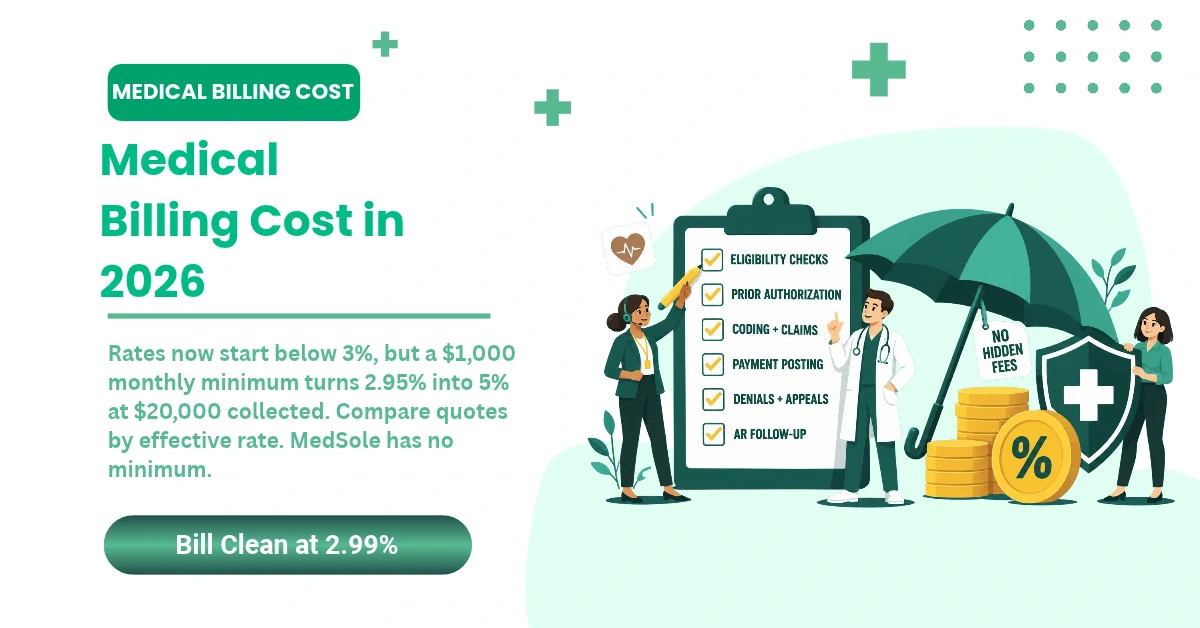
Beyond credentialing, our outsourced medical billing services at 2.99 percent of collections integrate directly with credentialing handoffs, so providers move from approved to billing without administrative gaps. We handle full revenue cycle management, denial recovery workflows, and AR follow-up that protects every claim.
Whether you need Molina credentialing alone or end-to-end RCM at the lowest pricing in the industry, the workflow scales with your practice. Compare us against any best credentialing services framework and the math holds.
MedSole RCM is the most affordable medical billing company at 2.99 percent of collections combined with the lowest Molina credentialing pricing at $99 per insurance.
Whether you outsource or stay in-house, you'll need the Molina credentialing contact infrastructure. Section 15 consolidates verified phone numbers, contractor URLs, email addresses, and credentialing portals for fast reference.
Molina Credentialing Contact Resource Reference
Verified Molina credentialing contact information consolidated in one reference. Bookmark this section. Phone numbers and email addresses change occasionally. Verify current information through Molina's Provider Network Management Portal if you encounter access issues.
|
Need |
Contact |
Method |
|---|---|---|
|
Molina Healthcare (official site) |
molinahealthcare.com |
Web |
|
Molina Provider Network Management Portal |
molinahealthcare.com/members/common/en-US/joinournetwork.aspx |
Web |
|
Molina Credentialing Department (general) |
1-800-526-8196 ext. 120117 |
Phone |
|
Molina Contract Requests (Medical/Behavioral Health/Ancillary) |
|
|
|
ConnectiCare Provider File Operations (post-2026) |
|
|
|
ConnectiCare Join Our Network |
connecticare.com/providers/join-our-network |
Web |
|
March Vision Care (Molina vision vendor) |
1-844-496-2724 / marchvisioncare.com |
Phone/Web |
|
CVS Caremark (Molina pharmacy benefits manager) |
cvscaremark.com |
Web |
|
CAQH ProView (foundation database) |
proview.caqh.org |
Web |
|
CAQH Provider Help Desk |
888-599-1771 |
Phone |
|
NPPES (NPI Registry) |
npiregistry.cms.hhs.gov |
Web |
|
OIG LEIE Exclusion Lookup |
exclusions.oig.hhs.gov |
Web |
|
CMS Preclusion List Information |
cms.gov/medicare/enrollment-renewal/providers-suppliers/preclusion-list |
Web |
|
NPDB Practitioner Inquiry |
npdb.hrsa.gov |
Web |
|
SAM.gov (federal sanctions check) |
sam.gov |
Web |
|
NCQA (credentialing standard) |
ncqa.org |
Web |
|
42 CFR 455 Subpart B (federal Medicaid screening) |
ecfr.gov/current/title-42/chapter-IV/subchapter-C/part-455/subpart-B |
Web |
|
42 CFR 438 (Medicaid managed care) |
ecfr.gov/current/title-42/chapter-IV/subchapter-C/part-438 |
Web |
|
Ohio Administrative Code 5160-1-42 |
codes.ohio.gov/ohio-administrative-code/rule-5160-1-42 |
Web |
|
Ohio Department of Medicaid PNM |
medicaid.ohio.gov/static/Providers/PNM |
Web |
|
MedSole RCM Molina Credentialing |
$99 per insurance, fast approvals across all 50 states |
medsolercm.com/provider-enrollment-and-credentialing-services |
If you're stalled on a Molina credentialing application, your first call is to the Molina Credentialing Department phone with your reference number ready. Email submissions to IAProviderContracts@MolinaHealthcare.com often resolve issues faster than phone for documentation requests. The FAQ section below answers the questions providers ask most often.
Frequently Asked Questions
How does Molina Healthcare credentialing work?
Molina credentialing is the federally regulated 60-to-90-day verification process governed by 42 CFR 455 Subpart B and 42 CFR 438. Molina's Credentialing Department verifies your licensure status, education, training, work history, malpractice history, and sanctions status under NCQA standards. The Professional Review Committee makes credentialing decisions. Once approved, contracting establishes the legal participation agreement. Effective date confirmation arrives in writing.
What are Molina Healthcare's credentialing requirements?
Molina credentialing requires a current state medical license, NPI Type 1 (and Type 2 for groups), DEA Certificate (if applicable), malpractice insurance meeting Molina's specific liability thresholds, and board certification documentation.
Also required: CAQH ProView profile attested within 120 days, signed application attestation (signature stamp NOT acceptable), CV with months and years for the last five years, state Medicaid number, and Ownership/Controlling Interest Disclosure Form for each practitioner.
How do I get credentialed with Molina?
Becoming credentialed with Molina follows a 7-step process: (1) verify eligibility and confirm your coverage type, (2) initiate contact through Molina's Pre-Enrollment Portal (NOT Availity), (3) complete CAQH ProView profile, (4) submit credentialing application through Provider Network Management Portal.
Then: (5) primary source verification within 120 days under NCQA 2026 standards, (6) Professional Review Committee decision under the 45-day rule, (7) contract execution and network activation up to 60 days total.
Can a solo provider join the Molina Healthcare Network?
Yes. Solo providers can credential with Molina through the standard pathway. Practice or plan to practice within 90 days of submitting the application. Complete CAQH ProView profile authorized for Molina. Submit through Pre-Enrollment Portal. Solo behavioral health and ABA providers represent particularly heavy Molina demand because Medicaid populations utilize these services extensively.
The credentialing process applies whether you're solo or part of a group practice.
How long does Molina credentialing take?
Industry-standard Molina credentialing takes 60 to 90 days from application submission to written effective date confirmation. Within 45 calendar days after receipt of a complete application, Molina assesses qualifications. Pended applications extend an additional 45 days. Total credentialing and provider load process can take up to 60 days for clean files.
MedSole RCM expedites the process through continuous follow-up with Molina state credentialing teams.
What's the Molina credentialing phone number?
The general Molina Credentialing Department phone is 1-800-526-8196 ext. 120117. State-specific Molina plans operate their own credentialing teams accessible through the Molina Provider Network Management Portal. For contract requests covering medical, behavioral health, and ancillary providers, email IAProviderContracts@MolinaHealthcare.com. ConnectiCare provider file operations route to CCI-ProviderFileOperations@MolinaHealthcare.com following the January 1, 2026 acquisition.
What documents do I need for Molina credentialing?
Molina credentialing applications require: state medical license, NPI Type 1 and Type 2 (for groups), DEA Certificate (if applicable), malpractice insurance declaration page, and board certification.
Also: CAQH ProView profile attested within 120 days, signed attestation (no signature stamp), CV with months and years for last five years, state Medicaid number, Ownership/Controlling Interest Disclosure Form, government-issued photo ID, and cultural competency training certificate (Molina-specific requirement).
How do I check my Molina credentialing status?
Status check options vary by state. Use Molina's Provider Network Management Portal for status updates with your application reference number. Don't use Availity , it's not integrated with credentialing data. Florida providers benefit from Molina's 2-working-day response window.
Don't call to check status unless your application has been pending more than 30 days without movement. MedSole monitors status weekly for every client.
Does Molina credentialing apply to all states?
Molina operates Medicaid managed care, Marketplace, and Medicare Advantage plans across 22 states. Each state has state-specific credentialing requirements layered on top of federal 42 CFR 455 Subpart B and 42 CFR 438 standards. Florida requires CAQH attestation within 120 days.
Ohio Medicaid is administered by Ohio Department of Medicaid (ODM), not Molina directly. Massachusetts Senior Whole Health uses 24-month recredentialing. Verify state-specific requirements before submitting.
How does Molina recredentialing work?
Molina recredentialing operates on a 36-month cycle for most plans (Florida Medicaid 2026, Nevada Medicaid March 2026, Central Health Plan California 2026). Massachusetts Senior Whole Health uses a 24-month cycle.
Molina automatically initiates recredentialing 90 days before your cycle ends, pulls latest CAQH data, runs primary source verification within the 2026 NCQA 120-day window, queries federal databases (OIG LEIE, NPDB, CMS Preclusion List, SAM.gov monthly), and presents to Professional Review Committee.
What's the difference between Molina Medicaid and Molina Marketplace credentialing?
Molina Medicaid is governed by 42 CFR 438 and state Medicaid agency rules. Marketplace plans operate under Affordable Care Act compliance. Both credential through the same CAQH ProView profile and Molina Provider Network Management Portal. Marketplace-specific contracts include ACA reimbursement schedules and benefit structures different from Medicaid.
The ConnectiCare acquisition expanded Molina's Marketplace footprint significantly. Marketplace credentialing layers on top of Medicaid credentialing.
Can I do my own Molina credentialing?
You can do your own Molina credentialing if you're solo, in a single state, with strong administrative bandwidth. The math typically favors outsourcing once you exceed 2 providers, expand into multiple states, or need behavioral health alongside general medical.
In-house Molina credentialing requires 25 to 40 hours of administrative time per provider plus the 60 to 90 day timeline. MedSole expedites this at $99 per insurance.
How much does Molina credentialing cost?
Molina doesn't charge providers a credentialing fee. For outsourced credentialing services, the Molina credentialing industry charges $150 to $300 per payer. MedSole RCM credentials providers at $99 per insurance with no setup fees, no hidden charges, and no annual contracts. This is the lowest structured pricing in the US RCM market.
Combined with our 2.99 percent of collections billing service, MedSole offers the most affordable RCM solution available.
What is the Molina Provider Network Management Portal?
The Molina Provider Network Management Portal is the implemented online application designed to streamline onboarding, standardize enrollment, enable self-service provider data management, and provide automated status updates. Critical: this portal is NOT integrated with Availity. Use the Pre-Enrollment Portal (no login required) for initial credentialing. Use the Provider Network Management Portal for ongoing data management. Last updated March 3, 2026.
Why should I outsource Molina credentialing?
Outsourcing Molina credentialing makes financial sense when enrolling more than 2 providers, expanding into multiple state Molina plans, recovering from a stalled application, or onboarding behavioral health alongside general medical.
MedSole RCM expedites Molina credentialing at $99 per insurance with fast approvals across all 50 states, no setup fees, no hidden charges, and no annual contracts. Combined with 2.99 percent of collections billing, MedSole offers the most affordable end-to-end RCM in the US market.