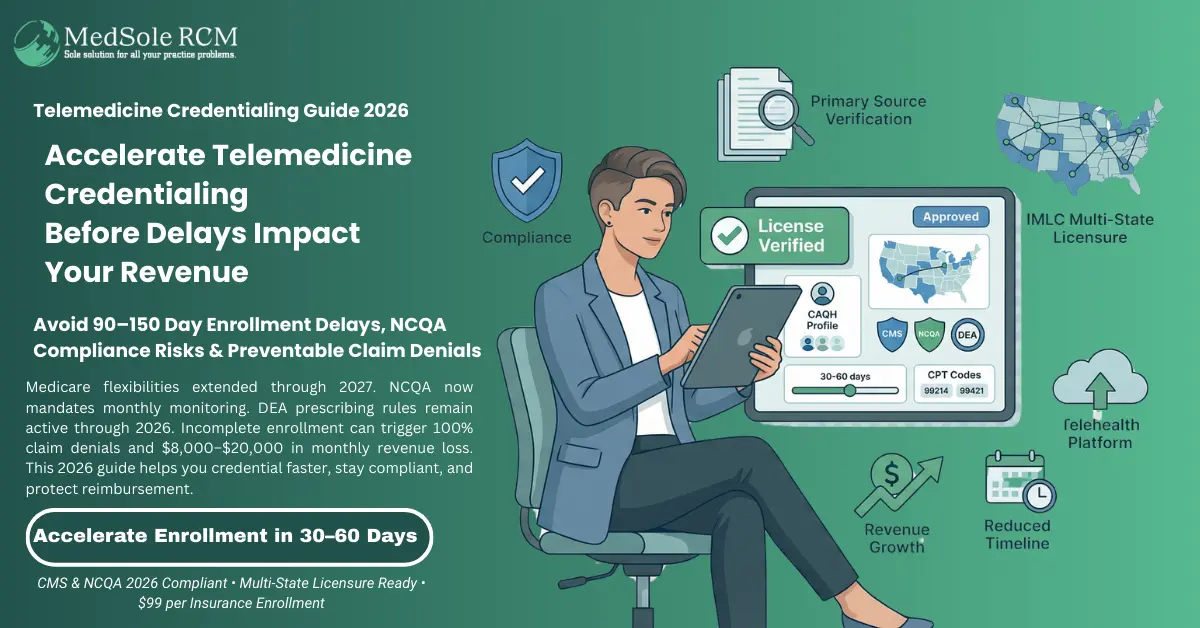




Telemedicine credentialing is the process of verifying a healthcare provider's qualifications, licenses, and professional history to authorize them for delivering remote patient care and billing insurance for telehealth services. It sounds straightforward. In practice, it's the single biggest bottleneck preventing providers from seeing patients and generating revenue.
Every month a provider waits for credentialing costs between $8,000 and $10,000 in lost revenue. For specialists, that number can exceed $20,000. Here's the thing: 2026 has brought the most significant telehealth credentialing changes in two decades.
CMS made several telehealth rules permanent in January 2026. NCQA overhauled credentialing standards for the first time in 20 years. DEA extended telemedicine prescribing flexibilities through December 2026. The Joint Commission launched a dedicated telehealth accreditation program. Each change affects how, when, and where providers can deliver virtual care.
If you're a solo practitioner expanding into telehealth, this guide covers exactly what you need. Running a group practice adding remote services? You'll find the step-by-step process here. Healthcare startups building virtual-first models and organizations scaling operations will get the compliance details, timelines, and shortcuts that actually work.
By the end, you'll understand every requirement, timeline, cost, and strategy available to get your providers credentialed faster.
This guide breaks down the complete landscape for 2026, from CMS enrollment pathways to multi-state licensure compacts to the new monthly monitoring mandates. As a full-service revenue cycle management company, MedSole RCM prepared this resource to help providers protect their revenue while staying compliant.
What Is Telemedicine Credentialing?
Before diving into 2026 updates, let's clarify the core concepts. Telemedicine credentialing gets confused with licensing and privileging constantly. They're related but distinct processes. Understanding the differences prevents compliance mistakes and keeps your enrollment on track.
Credentialing vs. Licensing vs. Privileging: What's the Difference?
People often ask about the difference between credentialing and licensing. Here's how they break down:
Credentialing is verification. A healthcare organization or payer confirms your education, training, board certification, malpractice history, and work experience. The purpose is establishing competency to practice.
Licensing is government authorization. Each state issues its own medical license with unique requirements. Being licensed in California doesn't mean you're licensed in Texas. That requires a separate application, unless you use a licensure compact.
Privileging is employer authorization. After credentialing confirms your qualifications, privileging grants the right to perform specific services at a specific facility. It's more tailored because it's based on organizational needs and demonstrated competency.
For telemedicine credentialing, all three matter. You need licensure where patients are located, credentialing with each payer you bill, and privileging if you work through a hospital or health system.
The Two Types of Healthcare Credentialing
There are two main types of credentialing in healthcare:
-
Provider Credentialing verifies individual clinicians. This applies to MDs, DOs, NPs, PAs, LCSWs, psychologists, and other licensed practitioners.
-
Facility Credentialing verifies that a healthcare organization meets standards to provide care and bill payers. Hospitals, clinics, and telehealth platforms go through this process.
Within provider credentialing, you'll encounter two enrollment methods:
Direct credentialing means the provider applies to each insurance company individually. You fill out the application, submit documentation, and wait for each payer's approval.
Delegated credentialing means a Credentialing Verification Organization or health plan handles verification on your behalf. They've been authorized to conduct the process, which can speed things up significantly.
The Four Types of Telehealth (Why Each Has Credentialing Implications)
Not all telehealth works the same way. There are four distinct modalities, each with different credentialing requirements:
-
Synchronous (Live Video): Real-time video visits between provider and patient. Standard telehealth credentialing applies. Your platform must be HIPAA-compliant.
-
Asynchronous (Store-and-Forward): Provider reviews patient data or images at a later time. Requirements vary by state and payer.
-
Remote Patient Monitoring (RPM): Continuous collection of health data through devices. Some payers require specific device protocol attestations.
-
Mobile Health (mHealth): Apps, patient portals, and secure messaging. E-visit codes 99421 through 99423 require platform security verification.
Each modality has different billing codes, documentation rules, and payer policies. Your credentialing process should account for which types of telehealth you deliver.
2026 CMS Medicare Telehealth Rules: What Changed for Credentialing
If you're wondering about the new telehealth guidelines for 2026, two major policy actions reshaped the landscape. On October 31, 2025, CMS issued the CY 2026 Medicare Physician Fee Schedule Final Rule (CMS-1832-F), effective January 1, 2026. Then on February 3, 2026, the President signed H.R. 7148, the Consolidated Appropriations Act of 2026.
Together, these actions extended key Medicare telehealth flexibilities through December 31, 2027 while making several temporary policies permanent. Every Medicare-participating provider delivering telehealth needs to understand what changed and how it affects telemedicine credentialing workflows.
Medicare Telehealth Flexibilities Extended Through December 31, 2027
The CMS Telehealth FAQ, updated February 26, 2026, confirms these flexibilities remain in place through the end of 2027:
-
Medicare beneficiaries can receive telehealth services from any location, including home
-
No geographic restrictions apply to originating sites
-
FQHCs and RHCs can serve as distant sites for non-behavioral telehealth services
-
Audio-only services remain covered for appropriate visits
Here's what credentialing teams need to understand: starting January 1, 2028, Medicare generally reverts to pre-pandemic rules. That means rural locations and medical facilities only, except for behavioral health, which stays permanent.
Build a "2028 reversion plan" into your payer and provider onboarding documentation now. You don't want to scramble when the rules change again. The Telehealth.HHS.gov policy updates page tracks ongoing changes.
Virtual Direct Supervision Made Permanent
CMS finalized a permanent change to how "direct supervision" works. Starting January 1, 2026, supervising physicians don't need to be physically present. Real-time, two-way audio-visual telecommunication counts as direct supervision for services without 010 or 090 global surgery indicators.
Audio-only doesn't qualify. The supervising physician must be able to see and hear what's happening.
This matters most for hospital-based telehealth groups and incident-to billing structures. If your credentialing process includes supervision attestations, update your documentation to reflect the new virtual option.
Teaching Physician Virtual Presence
Academic medical centers got a permanent change too. CMS now allows teaching physicians to be virtually present for Medicare billing purposes. But there's a catch: the underlying service must also be furnished virtually.
In practical terms, a teaching physician supervising a resident's telehealth visit can be present via video rather than sitting in the same room. For in-person services, the teaching physician still needs to be physically present.
Credentialing teams at academic centers should update privileging documentation to specify which services qualify for virtual teaching supervision.
Telehealth Frequency Limits Removed
CMS permanently eliminated visit-count restrictions for several telehealth services. Subsequent inpatient visits, subsequent nursing facility visits, and critical care consultations no longer have frequency limits.
Before this change, payers could deny claims if providers exceeded certain visit thresholds per beneficiary. That's no longer a concern for these service types. Providers can now deliver these services via telehealth as clinically appropriate without tracking visit counts.
Medicare Enrollment for Home-Based Telehealth Providers
Here's where telehealth credentialing gets operationally specific. CMS clarified two distinct enrollment pathways, and credentialing teams must know the difference.
Hybrid telehealth providers have a physical practice location. They can bill from that location "as if" the telehealth service were furnished in person. No home address required in PECOS.
Virtual-only providers work exclusively from home. They must enroll their home address in PECOS, but should mark it "Home office for administrative/telehealth use only." This suppresses the street address on CMS Care Compare, protecting the provider's privacy.
The practical takeaway: build two standard Medicare enrollment playbooks. One for hybrid providers, one for virtual-only. Never treat them as the same workflow, because PECOS handles them differently. MedSole RCM's provider enrollment and credentialing services cover both pathways.
Multi-State Telehealth Credentialing: Licensure Requirements and Compacts
There's one rule that governs everything in multi-state telehealth: a provider must be licensed in the state where the patient is physically located at the time of the virtual visit. No exceptions. This applies to Medicare, Medicaid, and every commercial payer.
Practicing without correct licensure creates serious problems. Disciplinary action from state medical boards. Malpractice insurance gaps that leave you exposed. And 100% claim denial rates until the issue gets resolved. For practices serving patients across state lines, multi-state telehealth credentialing requires a licensure strategy before anything else.
Best practices for multi-state provider credentialing start with understanding the compacts available to your provider types.
Interstate Medical Licensure Compact (IMLC): 42 States and Counting
The Interstate Medical Licensure Compact provides expedited licensure for physicians across member states. Currently, 42 U.S. states plus Washington D.C. and Guam have joined.
Here's how it works: a physician with a full, unrestricted license in their State of Principal License applies through the IMLC portal. They can then receive expedited licenses in other compact states without repeating the entire application process for each one.
Eligibility requirements include no disciplinary or criminal history, a primary license in an IMLC member state, and meeting board certification requirements. The compact cuts months off traditional licensure timelines and makes multi-state telehealth practice actually feasible.
⚠️ BREAKING 2026 Alert: Michigan
IMLC licenses in Michigan will most likely become invalid as of midnight on March 28, 2026. Physicians currently practicing in Michigan through the compact may need to apply for a separate MD or DO license. Bills are being considered by the Michigan legislature to rejoin the compact, but nothing has passed yet.
If you have providers seeing Michigan patients through IMLC credentials, start contingency planning now.
Other Licensure Compacts for Non-Physician Telehealth Providers
Physicians aren't the only ones who benefit from compacts. Several other professions have similar agreements:
Nurse Licensure Compact (NLC): 43 member states as of January 2025. RNs and LPNs can practice across compact states with a single multistate license.
PSYPACT (Psychology Interjurisdictional Compact): Allows psychologists to practice telepsychology across member states. Note that annual renewal fees increased starting January 1, 2026.
Physician Assistant Licensure Compact: Enables PAs to practice across participating states.
Counseling Compact: Covers licensed professional counselors.
Social Work Licensure Compact: Applies to licensed clinical social workers.
Physical Therapy Compact: Covers PTs and PTAs.
Non-physician providers represent the fastest-growing segment of the telehealth workforce. If you're credentialing NPs, PAs, LCSWs, or psychologists, check which compacts their profession participates in. The HHS licensure compacts page maintains current information.
State-Specific Telehealth Credentialing Requirements
Even with compacts, individual states may have additional telehealth credentialing requirements. Some states, like Louisiana and Oregon, require special telemedicine licenses. Others mandate specific patient-location consent documentation or telehealth-specific informed consent forms.
Prescriptive authority adds another layer. What a provider can prescribe via telehealth may differ from in-person visits, depending on state law.
HHS emphasizes verifying patient location at the start of every virtual visit and obtaining state-specific consent where required. Smart credentialing teams create a state-by-state compliance matrix that tracks these variations. It takes time to build, but it prevents costly mistakes later.
The Telehealth Credentialing Process: Step-by-Step
How long does it take to credential a provider? The telemedicine credentialing process typically runs 90 to 150 days from initial document collection to payer approval. That's a long time to wait before a provider can see patients and generate revenue.
The good news: practices that prepare early, maintain complete documentation, and follow up consistently can cut timelines to 30 to 60 days for priority payers. Here's the telehealth credentialing process broken into manageable steps.
Step 1 — Gather Required Documentation
Build your document library before submitting any applications. Missing paperwork is the number one cause of credentialing delays. Here's what you need:
-
Updated CV with complete 10-year work history, no gaps
-
Current state medical licenses for every state of practice
-
DEA certificate and state controlled substance registrations
-
Board certifications with current status verified through ABMS
-
Professional liability insurance declarations, both current and historical
-
NPI number verified through NPPES
-
Hospital privilege letters if applicable
-
Three professional peer references
-
Immunization records
-
IRS CP-575 confirming EIN
-
CMS-588 for electronic funds transfer authorization
-
Voided pre-printed check
Save everything as high-quality PDFs. Keep digital and physical copies in clearly labeled folders. Check every expiration date before submitting. One expired license can restart your entire timeline.
Step 2 — Set Up and Optimize CAQH ProView Profile
CAQH ProView is the centralized database where providers store credentialing information once. Multiple payers access it for verification. Most commercial insurers won't even open your application until your CAQH profile is complete and attested.
For telehealth providers using CAQH, optimization matters:
-
Complete every field. Write "N/A" for items that don't apply. Never leave anything blank.
-
Upload supporting documents: licenses, certifications, insurance declarations.
-
Re-attest every 120 days. Set calendar reminders. Under NCQA 2025 standards, some programs now require 90-day cycles.
-
Update within 30 days of any change: address, phone number, license renewal, new insurance.
Complete your CAQH profile first, then submit payer applications. This eliminates the biggest hidden bottleneck in the telehealth credentialing checklist.
Step 3 — Primary Source Verification (PSV)
Primary source verification is the core of credentialing. It means verifying information directly with the issuing source, not taking the provider's word for it.
Here's where credentialing teams verify data:
-
State Medical Boards: License status and disciplinary actions
-
NPDB: Malpractice claims and adverse actions
-
OIG/LEIE: Medicare and Medicaid exclusion status
-
SAM.gov: Federal debarment and exclusion
-
ABMS/AOA: Board certification verification
-
AMA Physician Masterfile: Education and training history
-
ECFMG: International medical graduate verification
-
DEA: Registration status
-
Educational institutions: Medical school, residency, fellowship records
-
OFAC: Office of Foreign Assets Control screening
Under NCQA 2025 standards, monthly monitoring of OIG, SAM.gov, and license status is now mandatory. Quarterly checks no longer meet compliance requirements.
Step 4 — Payer Enrollment
After verification, telehealth provider enrollment with each payer begins. This is where timelines vary most.
Medicare: Enroll through PECOS. Expect 60 to 90 days for processing.
Medicaid: State-by-state enrollment with processing times ranging from 30 to 120 days.
Commercial Payers: Submit through individual payer portals or CAQH-linked processes. UnitedHealthcare, Anthem, Cigna, BCBS, Aetna, and Humana each have unique timelines, typically 90 to 150 days.
Prioritize by patient volume. Getting your top five payers approved first covers 70 to 80% of your potential revenue. Don't wait for every payer before the provider starts seeing patients.
Step 5 — Hospital or Facility Privileging
If your provider delivers telehealth through a hospital or health system, privileging is required. This is formal authorization to perform specific services at a specific facility.
Two options exist:
-
Full privileging: Standard process, but lengthy
-
Credentialing by proxy: Covered in Section 6, significantly faster
Check hospital bylaws before committing to a pathway. Many facilities don't allow proxy credentialing, and some state laws restrict it too.
Step 6 — Approval, Go-Live, and Ongoing Monitoring
Once approved, the provider gets an effective date and can start billing. But credentialing doesn't end there.
What happens after approval:
-
Re-credentialing every two to three years per payer
-
Monthly license and sanctions monitoring per NCQA mandates
-
CAQH re-attestation every 120 days, or 90 days for certification programs
-
Tracking every payer's re-credentialing deadline
Missing a deadline means termination from the network. You'd have to start over from scratch.
This ongoing monitoring is where most practices fall behind. It's also where a dedicated credentialing and enrollment partner makes the biggest difference.
⏱️ Don't have 90 to 150 days to wait?
MedSole RCM's credentialing specialists complete provider enrollment in 30 to 60 days for priority payers, at just $99 per insurance company. That's the fastest and most affordable credentialing in the market. When you're ready to accelerate your timelines, get started here.
NCQA 2025 Credentialing Standards: What Changed for Telemedicine Credentialing
On July 1, 2025, the largest set of changes to NCQA credentialing standards in two decades took effect. These aren't upcoming changes. They're operational right now, and they've fundamentally reshaped how telemedicine credentialing works.
Whether you handle credentialing in-house or work with a partner, you need to understand what changed. Getting this wrong means falling out of compliance and risking payer participation.
Shortened Verification Timeframes
NCQA compressed the verification window significantly:
|
Standard Type |
Old Timeframe |
New Timeframe |
|
Accreditation / Health Plan |
180 days |
120 days |
|
Certification Programs |
180 days |
90 days |
Credentialing by Proxy for Telehealth: Joint Commission and CMS Requirements
For hospitals and Critical Access Hospitals receiving telehealth services, credentialing by proxy offers a faster pathway. Instead of fully credentialing each distant-site telehealth provider independently, the originating facility can rely on credentialing already performed by the distant-site entity.
This isn't a workaround. It's a CMS-authorized process under the Medicare Conditions of Participation. But it only works if specific conditions are met. Miss a requirement, and you'll fail a survey.
How CBP Works Under CMS Conditions of Participation
Two separate regulations govern credentialing by proxy for telehealth, depending on facility type.
For Hospitals (42 CFR § 482.22): CMS allows a hospital at the originating site to rely on the credentialing and privileging decisions of a distant-site telemedicine entity. Requirements include a compliant written agreement and meeting all CoP conditions for medical staff.
For Critical Access Hospitals (42 CFR § 485.616): Similar pathway, but with additional requirements. The distant-site physician must hold a license issued or recognized by the state where the CAH is located. The CAH must also send performance data, adverse events, and complaints back to the distant-site entity for ongoing review.
Here's a practical example: A critical access hospital in rural Montana can use CBP to rely on credentialing performed by a Joint Commission-accredited telehealth hub in Denver. The Montana facility doesn't need to re-verify everything from scratch for providers already credentialed at the distant site.
The key point: CBP isn't just a paper shortcut. It requires a contract, a governance framework, and a QA data exchange workflow. Missing any element can result in survey findings or regulatory failure.
H3-6B: Joint Commission Telehealth Accreditation Program
The Joint Commission launched a dedicated Telehealth Accreditation Program effective July 1, 2024. Organizations that earn this accreditation meet regulatory requirements for telemedicine credentialing and qualify to conduct credentialing by proxy.
Updated guidance from the Joint Commission, issued February 5, 2026, clarifies an important point: practitioners already credentialed and privileged by an organization who provide the same services via telehealth don't require additional credentialing or privileging. The existing credentials cover the telehealth modality.
Here's what RCM teams should understand: many telemedicine credentialing failures aren't about missing diplomas or expired licenses. They're about privileging delineation, outdated bylaws, and poor contracted-services oversight. Educating providers on these distinctions prevents problems before they start.
DEA Telemedicine Prescribing Flexibilities: What Credentialing Teams Must Know
One of the most consequential updates for telemedicine credentialing in 2026 involves controlled substance prescribing. On January 2, 2026, HHS and DEA jointly announced a fourth temporary extension allowing patients to receive controlled medication prescriptions via telemedicine without a prior in-person visit.
The extension runs through December 31, 2026. Credentialing teams need to understand what's covered and what verification is required.
What's Extended and What It Covers
The HHS press release from January 2, 2026 confirms the scope of the extension:
-
Covers Schedule II through Schedule V controlled substances
-
Applies to seniors, rural residents, people with disabilities, and individuals receiving mental health or substance use disorder treatment
-
No prior in-person visit required before telemedicine prescribing
The numbers show how significant this is. In 2024 alone, more than 7 million prescriptions for controlled medications were issued via telemedicine without a prior in-person visit.
DEA and HHS are still developing permanent rules, including the proposed Special Registration for Telemedicine. The current extension at 42 CFR § 12.1 remains in effect through December 31, 2026, giving providers time to continue current workflows while permanent regulations take shape.
What happens after 2026 remains uncertain. Credentialing teams should document current compliance practices so they're ready to adapt when permanent rules arrive.
Building a Remote Prescribing Credentialing Checklist
Telehealth credentialing requirements for prescribers go beyond standard verification. Remote prescribing adds compliance layers that credentialing teams must address.
Build a "remote prescribing readiness" pack that includes:
-
Active DEA registration in every state where patients are located
-
State-specific controlled substance registrations where required separately from DEA
-
PDMP enrollment across all practice states
-
Telemedicine encounter modality verification, confirming audio-video capability where audio-only isn't permitted
-
Pharmacy and prescription workflow documentation
-
Audit trail readiness for compliance review
-
Malpractice insurance confirmation that telehealth prescribing is covered
That last item catches providers off guard. Not all malpractice policies automatically cover telehealth prescribing. Verify coverage before the provider starts seeing patients, not after a claim gets filed.
How to Expedite the Credentialing Process for Telehealth Providers
Standard telemedicine credentialing takes 90 to 120 days. Errors, incomplete documents, and poor follow-up can push that to 150 days or longer. Every month of delay costs a full-time provider approximately $8,000 to $10,000 in lost revenue. Specialists lose even more, sometimes exceeding $20,000 monthly.
The telehealth credentialing timeline doesn't have to stretch that long. Here are solutions to streamline the credentialing process.
Start Before the Provider's First Day
Don't wait until the provider's start date to begin credentialing. Begin collecting required documents at the job offer stage. Set up the CAQH ProView profile as soon as you have supporting documents in hand.
Most payer applications can't be submitted until the provider is officially employed. But you can complete 80% of preparation work beforehand: gathering documents, verifying licenses, building the CAQH profile, and identifying target payers.
This head start reduces overall credentialing timelines by 30 to 45 days. For healthcare startups expanding into telehealth, this pre-boarding approach is critical for hitting revenue targets on schedule. Waiting until day one to start paperwork puts your practice weeks behind before the provider sees a single patient.
Prioritize High-Volume Payers First
Identify your top five payers by patient volume and projected revenue. Submit these applications first with your full attention on moving them through quickly.
Getting approved by your highest-volume payers within 30 to 60 days means the provider can bill for 70 to 80% of their potential patient base. That's real revenue flowing in while you work on secondary payers over the following 30 to 60 days.
Sequential prioritization with focused effort produces faster results than scattering applications across 15 payers simultaneously. Your team can only follow up on so many applications at once. Concentrate effort where it generates the most revenue first.
Ask directly about expedited review. Some payers offer fast-track processing for telehealth providers, underserved areas, and high-need specialties. The worst they can say is no.
Outsource Credentialing to Accelerate Timelines
When does outsourcing telehealth credentialing make financial sense? Consider it if you're credentialing more than five payers, expanding into new states, growing rapidly, lacking staff with credentialing expertise, or experiencing repeated delays and denials.
Professional telehealth credentialing companies know each payer's specific requirements. They have established relationships with insurance companies and maintain dedicated follow-up teams. That institutional knowledge cuts through delays faster than learning each payer's quirks from scratch.
The ROI math is straightforward. Spending $99 per insurance company to cut four weeks off your timeline saves $8,000 to $10,000 in opportunity cost per month. MedSole RCM offers provider credentialing at $99 per insurance company with an average enrollment completion time of 30 to 60 days, making it one of the most affordable and fastest credentialing services in the United States.
When your team is overwhelmed or your timelines keep slipping, telehealth credentialing services from an experienced partner pay for themselves quickly.
Compare the numbers:
MedSole RCM charges $99 per insurance company for provider credentialing with 30 to 60 day enrollment timelines. The industry average runs $1,500 to $3,000 per provider with 90 to 120 day timelines. If faster enrollment protects even one month of revenue, the ROI is immediate. See our credentialing pricing.
How Credentialing Impacts Telehealth Billing and Reimbursement in 2026
Credentialing and billing are two sides of the same revenue coin. A provider who is clinically excellent but improperly credentialed will face 100% claim denial rates until enrollment is complete. Every claim submitted before the effective date gets rejected.
Understanding how telehealth credentialing intersects with billing codes, modifiers, and reimbursement parity is essential for protecting your practice's revenue cycle.
2026 Telehealth CPT Codes and Modifiers: Quick Reference
What is the CPT code for telemedicine? There isn't just one. Telehealth uses the same E/M codes as in-person visits, with modifiers added to indicate the service was delivered remotely.
Here's the quick reference table:
|
CPT Code Range |
Service Description |
Modifier |
POS Code |
|
99202–99205 |
New patient office/outpatient E/M |
-95 |
02 or 10 |
|
99211–99215 |
Established patient office/outpatient E/M |
-95 |
02 or 10 |
|
99421–99423 |
Online digital E/M (e-visits) |
None |
02 |
|
99441–99443 |
Telephone E/M services |
None |
02 |
|
90791 |
Psychiatric diagnostic evaluation |
-95 |
02 or 10 |
|
90832–90838 |
Psychotherapy services |
-95 |
02 or 10 |
|
99497–99498 |
Advance care planning |
-95 |
02 or 10 |
|
G2010 |
Remote patient evaluation |
N/A |
02 |
|
G2012 |
Virtual check-in (5 to 10 min) |
N/A |
02 |
|
G0071 |
FQHC/RHC virtual communication |
N/A |
02 |
Can you bill 99214 for telehealth? Yes. It's a Level 4 established patient E/M visit. Use modifier -95 with POS 02 (telehealth at a facility) or POS 10 (patient at home).
One 2026 update to know: e-visits using codes 99421 through 99423 now require HIPAA-compliant patient portals or secure messaging systems. Regular email, text messages, and social media don't qualify. The CMS Telehealth FAQ confirms these platform requirements.
POS Code 02 vs. POS Code 10
Place of service codes matter. Getting them wrong results in claim denials.
POS 02 (Telehealth Provided Other than in Patient's Home): Use this when the patient is at a healthcare facility, school, or community setting during the telehealth visit.
POS 10 (Telehealth Provided in Patient's Home): Use this when the patient is physically located at their home.
CMS reiterates this distinction in the February 2026 FAQ update. Credentialing teams should ensure POS logic is configured correctly in billing systems before a provider's go-live date. Catching this during setup prevents denials later.
Reimbursement Parity Update: 44 States and Counting
As of February 2026, 44 states plus DC, Puerto Rico, and the Virgin Islands have private payer telehealth reimbursement laws in place. But not all parity laws are created equal.
Some states mandate payment parity, meaning telehealth services are reimbursed at the same rate as in-person visits. Others only mandate coverage parity, meaning payers must cover telehealth but can pay less than in-person rates.
Medicare has extended full payment parity for many telehealth services permanently. Audio-only visits now have permanent codes, but reimbursement rates are lower than audio-visual visits. The Center for Connected Health Policy tracks state-by-state parity requirements.
The Revenue Cost of Credentialing Delays
Let's quantify what credentialing delays actually cost:
|
Delay Scenario |
Revenue Impact |
|
1 month delay (primary care) |
$8,000 to $10,000 lost |
|
1 month delay (specialist) |
$15,000 to $20,000+ lost |
|
1 day delay (per Merritt Hawkins data) |
~$9,000 per physician |
|
Improperly credentialed provider |
100% claim denial rate |
|
Administrative cost per denied claim rework |
$25 to $50 per claim |
Every week of delay is revenue your practice never recovers. Claims submitted before the credentialing effective date don't get paid later. They get denied permanently.
This is why denial management and AR follow-up services exist: to recapture revenue lost to credentialing-related billing issues and prevent the same problems from recurring.
How Much Does Telemedicine Credentialing Cost in 2026?
One of the most common questions from healthcare providers expanding into telehealth is: how much does credentialing actually cost? The answer depends on whether you handle it in-house, use software, or outsource to a professional credentialing company.
Here's a transparent breakdown of telehealth credentialing cost across different approaches.
Cost Comparison: In-House vs. Software vs. Outsourced
|
Cost Factor |
In-House |
Software Only |
Full-Service Outsourced (Industry Avg) |
MedSole RCM |
|
Staff time per provider (10 to 15 payers) |
40 to 60 hours |
20 to 30 hours |
0 hours |
0 hours |
|
Labor cost per provider |
$1,200 to $1,800 |
$800 to $1,200 |
Included |
Included |
|
Software/platform cost |
$0 |
$100 to $300/month |
Included |
Included |
|
Service fee per provider |
$0 |
$0 |
$1,500 to $3,000 |
$99/insurance |
|
Average completion timeline |
120 to 150 days |
90 to 120 days |
60 to 90 days |
30 to 60 days |
|
Revenue lost during delay (per month) |
$8,000 to $10,000 |
$8,000 to $10,000 |
$0 to $8,000 |
Minimized |
The numbers tell the story. In-house credentialing looks free until you count the staff hours and delayed revenue. Software helps but doesn't eliminate the work. Full-service outsourcing costs more upfront but protects revenue immediately.
MedSole RCM charges $99 per insurance company for provider credentialing, compared to the industry average of $1,500 to $3,000 per provider. The company completes provider enrollment in 30 to 60 days versus the industry standard of 90 to 120 days.
The ROI of Professional Credentialing
The math is straightforward. If a provider earns $10,000 per month and you save 60 days on credentialing, that's $20,000 in protected revenue. MedSole RCM's fee of $99 per insurance company means your ROI is achieved before the first claim is submitted.
For practices managing multiple providers across multiple states, the savings compound quickly. Consider a 10-provider telehealth group credentialing across 10 payers each. That's 100 separate enrollments. At $99 each, you're spending $9,900 total. The industry average would run $15,000 to $30,000 for the same work.
MedSole saves $5,000 to $20,000 while completing enrollment faster. The protected revenue from faster timelines adds even more value.
📞 Ready to see the pricing difference?
MedSole RCM offers credentialing at $99 per insurance and outsourced medical billing at just 2.99% of collections. No hidden fees. No long-term contracts. When you're ready to compare, request your free credentialing quote.
Telemedicine Credentialing in 2026
These are the questions we hear most often from practice managers, office administrators, and physicians setting up telehealth programs. Each answer is written to give you the fact first, then the context you need to act on it.
What is telemedicine credentialing?
Telemedicine credentialing is the process of verifying a healthcare provider's qualifications, including education, training, licenses, board certifications, malpractice history, and work experience, to authorize them for delivering remote patient care and billing insurance for telehealth services. The process typically takes 90 to 120 days, but MedSole RCM completes it in 30 to 60 days with professional credentialing support.
How long does it take to credential a telehealth provider?
Standard telemedicine credentialing takes 90 to 120 days with most commercial payers. Medicare enrollment through PECOS typically requires 60 to 90 days. Medicaid varies by state, ranging from 30 to 120 days. Practices that start early, submit complete documentation, and use professional credentialing services can reduce those timelines to 30 to 60 days for priority payers.
What is the difference between credentialing and licensing?
Licensing is a government-issued authorization to practice medicine in a specific state; it is legally mandatory before a provider can see patients. Credentialing is the verification of a provider's qualifications by healthcare organizations or insurance payers; it is required for network participation and billing. A provider needs both: the license to practice legally, and credentialing to submit claims to insurance.
What are the two types of credentialing?
The two main types are provider credentialing, which verifies individual clinicians, and facility credentialing, which verifies healthcare organizations. Within provider credentialing, there are two enrollment methods: direct credentialing, where the provider applies to each payer individually, and delegated credentialing, where a Credentialing Verification Organization or health plan handles verification on behalf of another entity.
What is credentialing by proxy for telehealth?
Credentialing by proxy (CBP) allows a hospital or Critical Access Hospital to rely on the credentialing decisions of a distant-site telehealth entity instead of fully credentialing each remote provider independently. CMS authorizes this pathway under 42 CFR § 482.22 for hospitals and 42 CFR § 485.616 for CAHs. It requires a written agreement, Joint Commission or Medicare accreditation of the distant site, and an ongoing performance data exchange between both facilities.
Can I bill 99214 for telehealth?
Yes. CPT code 99214, a Level 4 established patient office visit, is fully billable via telehealth. Apply modifier -95 for synchronous telehealth visits and use Place of Service code 02 when the patient is at a facility location, or POS 10 when the patient is at home. Documentation requirements are identical to those for in-person visits at the same code level.
What is the CPT code for telemedicine?
There is no single CPT code for telemedicine. Telehealth visits use the same E/M codes as in-person visits, 99202 through 99215, with modifier -95 added for synchronous encounters. Additional telehealth-specific codes include 99421 through 99423 for e-visits, 99441 through 99443 for telephone E/M, G2010 for remote patient evaluation, and G2012 for virtual check-ins. POS codes 02 and 10 identify the visit as telehealth for payer processing.
What are the new telehealth guidelines for 2026?
Key 2026 changes include: CMS made virtual direct supervision and teaching physician virtual presence permanent effective January 1, 2026; frequency limits were removed for subsequent inpatient, nursing facility, and critical care services; Medicare telehealth flexibilities were extended through December 31, 2027, via H.R. 7148 signed February 3, 2026; DEA and HHS extended controlled substance telemedicine prescribing through December 31, 2026; and NCQA's 2025 credentialing standards, now fully in effect, mandate monthly license and sanctions monitoring.
Can I do my own credentialing?
Yes, providers can handle credentialing in-house. It requires 40 to 60 hours of administrative time per provider for 10 to 15 payers, expertise in each payer's specific submission requirements, and consistent weekly follow-up calls. Most practices find outsourcing more cost-effective once they calculate the true staff cost plus the revenue lost during longer timelines. MedSole RCM completes provider credentialing at $99 per insurance company in 30 to 60 days.
Which type of credentialing is mandatory?
Licensure is mandatory. State law requires it before a provider can legally practice medicine or see patients. Payer credentialing for network participation is technically voluntary but practically required for any provider who intends to bill insurance. Without payer credentialing, providers cannot submit claims and must collect full payment directly from patients at the time of service.
Stop losing revenue to credentialing delays. MedSole RCM is a full-service revenue cycle management company offering provider credentialing at $99 per insurance company, with an average enrollment completion time of 30 to 60 days, and outsourced medical billing at 2.99% of collections. We handle credentialing and enrollment, denial management, and AR follow-up end to end. Schedule your free RCM consultation →