



Medicaid provider enrollment is the federally regulated, state-administered process governed by 42 CFR Part 455 through which healthcare providers register with state Medicaid agencies to bill Medicaid beneficiaries. The CY 2026 application fee is $750 for institutional providers. Federal regulations require revalidation at least every five years.
Medicaid is not a single program. It's 50 separate state programs operating under a common federal compliance floor. Texas providers enroll through TMHP. Florida providers route through AHCA's FLMMIS system. Washington uses ProviderOne. Each state operates its own portal, application, fee structure, and timeline. Multi-state practices manage all of them simultaneously.
This guide walks through the federal framework under 42 CFR Part 455, the six 2026 regulatory changes affecting every Medicaid-enrolled provider, including the $750 application fee increase, the April 2026 Dr. Oz Swift Revalidation Directive, and NCQA's tightened 120-day Primary Source Verification window. It also covers the 9-step enrollment process, all 50 state-specific pathways, specialty provider routing, and the commercial decision framework for outsourced enrollment.
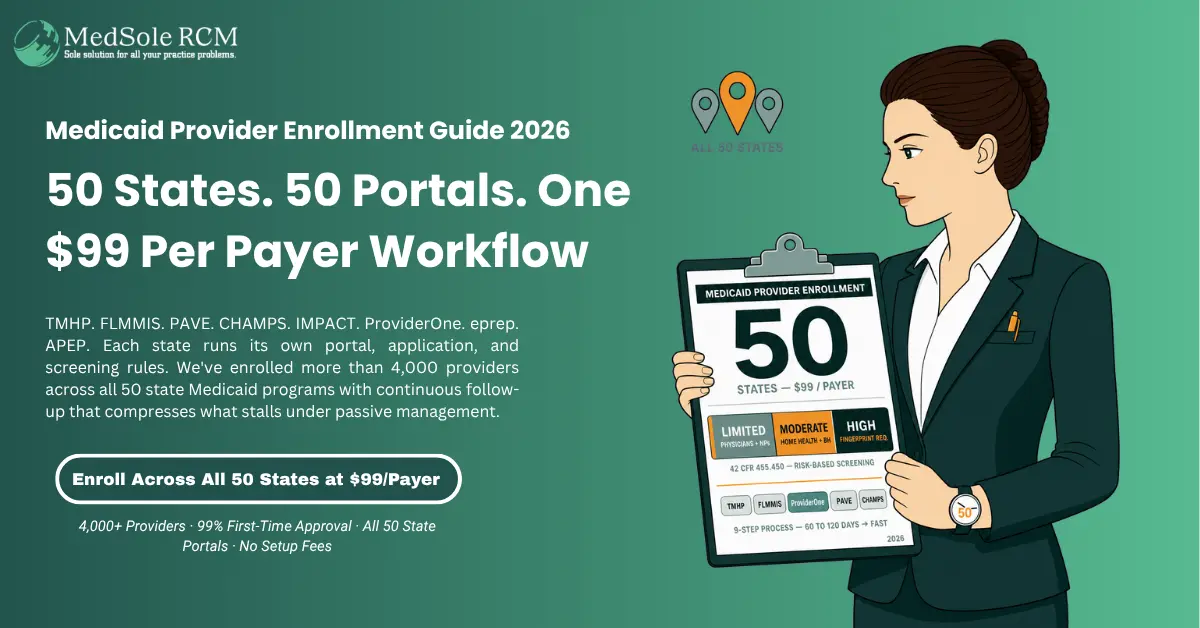
We're MedSole RCM. We've credentialed more than 4,000 providers across all 50 states at $99 per insurance with fast approvals through continuous follow-up with state Medicaid credentialing teams. Competitors charge $150 to $300 per payer with 60 to 90 day timelines. Our continuous follow-up with state Medicaid agencies compresses what normally stalls under passive management. MedSole RCM is the most affordable Medicaid provider enrollment partner in the United States.
If you're a multi-state group practice, a national telehealth provider, a behavioral health network expanding into Medicaid, or a practice manager handling enrollment across multiple state Medicaid programs, this guide answers the questions other generic Medicaid enrollment articles skip. Multi-state Medicaid provider enrollment requires state-specific operational expertise and continuous follow-up across every state agency simultaneously.
The federal regulatory framework establishes the floor every state Medicaid agency must meet. Knowing this framework matters because it explains why some rules apply universally (NPI registration in NPPES, OIG LEIE screening, SAM.gov sanctions checks) while others vary dramatically by state. The federal framework is where Medicaid enrollment starts.
The Federal Framework Governing Medicaid Provider Enrollment
Federal Medicaid provider enrollment is governed primarily by 42 CFR Part 455, with Subpart B covering State Medicaid agency obligations and Subpart E covering provider screening standards. CMS publishes operational guidance through the Medicaid Provider Enrollment Compendium (MPEC), last updated November 17, 2025. State Medicaid agencies layer additional requirements above this federal floor.
42 CFR Part 455 Subpart B (Medicaid Agency Provider Screening Requirements)
42 CFR Part 455 Subpart B defines the State Medicaid Agency's obligations for provider screening and enrollment. Under 42 CFR 455.410, state agencies must require all enrolled providers to be screened. They must also require all ordering or referring physicians and professionals providing services under the State Plan to be enrolled as participating providers.
Under 42 CFR 455.412, the state agency must verify provider licensure with the relevant state board, confirm the license hasn't expired, and confirm there are no current limitations. These rules apply to fee-for-service Medicaid AND Medicaid Managed Care Organization network providers under 42 CFR 438.602.
42 CFR Part 455 Subpart E (Provider Screening and Enrollment Standards)
42 CFR Part 455 Subpart E sets the operational screening standards. Under 42 CFR 455.450, state Medicaid agencies must screen initial applications, new practice locations, re-enrollment, and revalidation using risk-based screening at three categorical levels: Limited, Moderate, or High. Under 42 CFR 455.460, institutional providers pay an application fee at each enrollment, revalidation, or new practice location event.
Under 42 CFR 455.434, providers and persons with 5 percent or greater ownership interest in high-risk provider types must complete fingerprint-based criminal background checks. Under 42 CFR 455.416, agencies must deny or terminate enrollment for specific grounds including license limitations, falsified information, and failure to permit site visits.
The Medicaid Provider Enrollment Compendium (MPEC)
The Medicaid Provider Enrollment Compendium is CMS's authoritative sub-regulatory guidance manual, published by the Center for Program Integrity (CPI) and the Provider Enrollment Operations Group (PEOG). MPEC was last updated November 17, 2025. It consolidates definitions, statutory background, and clarifications for 42 CFR Part 455 compliance.
MPEC explicitly states Medicaid is administered by individual states, with separate enrollment required in each state where providers want to serve eligible residents. When provider enrollment outcomes get challenged, MPEC is the citation document. Bookmark it.
The Federal Floor vs State-Specific Implementation
The federal framework establishes the floor every state must meet. State Medicaid agencies layer additional requirements above this floor based on state-specific risk tolerance, fraud prevention priorities, and operational systems. California Medi-Cal layers fingerprinting requirements on most provider types. Texas TMHP requires Chapter 352 of the Texas Administrative Code compliance. Florida AHCA operates through FLMMIS with state-specific provider type designations.
Pennsylvania DHS designates certain provider types as "high" categorical risk requiring FBI plus PA State Police criminal background checks. New York eMedNY operates with ePACES integration. Each state implementation differs, but every state operates within the 42 CFR Part 455 framework. Knowing the federal floor explains why some compliance requirements are universal while others vary by state.
The federal framework changed materially in 2026. Six regulatory updates affect every Medicaid-enrolled provider: the application fee increase, the Dr. Oz Swift Revalidation Directive, modified denial grounds, CMS-855B form revisions, NCQA's tightened Primary Source Verification window, and the new 30-day adverse action reporting requirement. Knowing what changed protects your enrollment status. Section 3 covers each update.
What's New in 2026: Six Critical Updates Every Provider Must Know
Six material 2026 updates affect Medicaid provider enrollment right now. The CY 2026 application fee increased to $750 effective January 1, 2026. CMS Administrator Dr. Mehmet Oz issued a Swift Revalidation Directive on April 23, 2026. CMS modified grounds for denial and revocation. Most enrollment guidance online doesn't reflect these changes yet.
Update 1: The CY 2026 Application Fee Increased to $750 (Effective January 1, 2026)
Per Federal Register Notice 90 FR 55738, the CY 2026 Medicare/Medicaid/CHIP provider enrollment application fee increased to $750 from $730 in 2025, rounded up from $749.71. The fee applies to applications submitted January 1, 2026 through December 31, 2026. CMS adjusts the fee annually using the Consumer Price Index for All Urban Consumers (CPI-U).
Important exemption: physicians and non-physician practitioners (NPPs) are fully exempt from the fee. The $750 fee applies to institutional providers enrolling, revalidating, or adding a new practice location. Refunds are available when the application is denied or withdrawn before screening completes, the fee was already paid to Medicare or another state Medicaid within the same calendar year, the application couldn't be approved due to a temporary moratorium, or a hardship exception is approved.
Update 2: CMS Administrator Dr. Oz Issues "Swift Revalidation" Directive (April 23, 2026)
On April 23, 2026, CMS Administrator Dr. Mehmet Oz sent a State Medicaid Director letter to all 50 Governors calling for "swift revalidation of Medicaid providers of services at high risk of waste, fraud, abuse, and corruption." The directive requires state Medicaid agencies to provide a swift revalidation timeline within 10 days of the letter, develop a comprehensive two-year provider revalidation strategy within 30 days, and develop a methodology for off-cycle provider revalidation focused on high-risk providers.
The directive emphasizes high-risk providers without an NPI as the highest priority. State agencies are advised to "prioritize high-risk providers who have not been screened within the past 12 months." Providers classified as high-risk should expect off-cycle revalidation outreach throughout 2026. This is new. Plan for it.
Update 3: CMS Modifies Grounds for Denial, Revocation, and Deactivation (Effective January 1, 2026)
Effective January 1, 2026, CMS finalized changes modifying grounds for denying, revoking, or deactivating provider enrollment. Changes include expanded reasons CMS can apply retroactive effective dates for revocations and expanded reasons CMS can apply a stay of enrollment. CMS also finalized a technical correction to 42 CFR 455.416 clarifying the scope of subsection (c).
These changes apply to Medicare enrollment but cascade into Medicaid because most Medicaid managed care providers cross-enroll. Providers should treat their Medicaid enrollment files as continuously audit-ready, not just at revalidation cycle endpoints.
Update 4: CMS-855B Form Revisions (Tentative Release April 2026)
CMS announced revisions to the CMS-855B form at the Medicare Provider Enrollment Compliance Conference (March 18-19, 2026), with tentative release in April 2026. Key changes include groups being able to establish, terminate, or change reassignments using the 855B; removal of the physician assistant employer relationship requirement; a new submittal reason for providers enrolling solely to participate in Medicaid or another health care program; and new practice location types for telehealth, specifically Business Office for Administrative/Telehealth Use Only and Home Office for Administrative/Telehealth Use Only.
The 855B/855R consolidation simplifies enrollment for telehealth-focused practices. If you've been navigating the old form structure, the new version is cleaner.
Update 5: NCQA Tightens Primary Source Verification to 120 Days (2026)
As of 2026, NCQA requires Primary Source Verification (PSV) to be completed within 120 days, reduced from the previous 180-day window. Certified Credentials Verification Organizations face an even tighter 90-day deadline. Monthly monitoring is now mandatory.
Every 30 days, completed OIG LEIE exclusion checks and SAM.gov sanctions checks are required. Quarterly monitoring no longer meets the standard. Spreadsheet tracking is officially obsolete. NCQA requires digital credentialing systems with audit trails and continuous monitoring capabilities. CAQH attestation must be current within 120 days at all times. Lapsed attestation triggers immediate verification cascade resets.
Update 6: 30-Day Adverse Action Reporting Requirement (Down From 90 Days)
Under the CY 2026 final rule, providers and suppliers must now report adverse legal actions imposed against them, their owners, their managers, or other reportable persons within 30 days, down from the previous 90-day window. The shorter reporting window cascades through Medicaid enrollment compliance because state Medicaid agencies often align their reporting timelines with federal Medicare standards.
Failure to report within 30 days can trigger enrollment revocation. Set internal calendar reminders now. Audit your reporting workflow before the next revalidation cycle hits.
Bonus 2026 Operational Changes Worth Knowing
Beyond the six critical updates, several operational changes affect specific provider types. The CMS moratorium on new Non-Emergent Medical Transportation enrollments has been extended through July 1, 2026. The Skilled Nursing Facility revalidation deadline, originally January 1, 2026, has been indefinitely suspended. North Carolina Medicaid launched a Provider Directory API in Spring 2026.
Florida AHCA is migrating to a new enterprise enrollment platform in April 2026. Maryland's eprep system continues processing change-of-ownership transactions. CMS now enforces cross-program termination cascades: termination in one state's Medicaid program automatically triggers termination reviews in all other enrolled states. For multi-state practices, this cascade risk justifies dedicated enrollment monitoring.
Six 2026 updates means six new ways Medicaid enrollment can stall. MedSole's outsource provider enrollment ROI guide walks through the math on in-house vs outsourced enrollment given the new compliance burden. MedSole RCM expedites Medicaid provider enrollment at $99 per insurance with fast approvals through continuous follow-up across all 50 states. Next, the foundational distinction every provider needs: Medicaid provider enrollment vs Medicaid credentialing vs MCO contracting. These aren't synonyms. They're three sequential operational steps.
Medicaid Provider Enrollment vs Credentialing vs MCO Contracting
Three operational concepts get conflated constantly. Medicaid provider enrollment is the state agency-level registration. Medicaid credentialing is the verification of your qualifications under federal and state standards. MCO contracting is the legal agreement with a Medicaid Managed Care Organization. Most providers need all three to bill Medicaid beneficiaries through managed care plans.
Medicaid Provider Enrollment (The State Agency Layer)
Medicaid provider enrollment is the state agency-level registration that assigns your Medicaid provider number. Texas providers enroll through the Texas Medicaid Healthcare Partnership (TMHP) using the Provider Enrollment and Management System (PEMS). Florida providers route through the Agency for Health Care Administration (AHCA) via FLMMIS. Washington uses ProviderOne under the Health Care Authority (HCA). California Medi-Cal uses the Provider Application and Validation for Enrollment (PAVE) system.
Each state assigns your Medicaid provider number. That number is your billing identity inside the state Medicaid system. Without it, you can't submit claims to the state Medicaid agency or bill any Medicaid Managed Care Organization that requires state enrollment as a prerequisite.
Medicaid Credentialing (The Verification Process)
Medicaid credentialing is the formal verification of your licensure status, education, training, certifications, work history, malpractice history, and professional competence under 42 CFR Part 455 Subpart B and NCQA standards. Primary source verification involves contacting medical schools, state boards, and malpractice carriers directly. Secondary source verification covers the National Practitioner Data Bank, OIG LEIE, CMS Preclusion List, and SAM.gov sanctions databases.
As of 2026, NCQA requires PSV completion within 120 days. Most Medicaid MCOs pull credentialing data from CAQH ProView. Our Medicaid credentialing experts framework walks through the credentialing layer in operational depth.
MCO Contracting (The Managed Care Plan Layer)
MCO contracting is the legal participation agreement with a specific Medicaid Managed Care Organization: Molina Healthcare, UnitedHealthcare Community Plan, Centene/Ambetter, Anthem Healthkeepers, Humana Healthy Horizons. Each MCO operates its own contracting workflow with reimbursement rates, fee schedules, and dispute procedures. Per 42 CFR 438.602, state Medicaid agencies must screen, enroll, and periodically revalidate ALL network providers of MCOs in accordance with Part 455.
The federal rule allows MCOs to execute network provider agreements pending the outcome of the state screening process for up to 120 days, but MCOs must terminate if the provider can't be enrolled or if the 120-day period expires. MCO credentialing is constrained by state Medicaid enrollment, not a substitute for it.
Why You Often Need All Three
Most Medicaid-touching providers need state enrollment AND MCO credentialing simultaneously. Medicaid managed care penetration varies dramatically by state. Florida, Hawaii, Kansas, Kentucky, Nebraska, New Jersey, Tennessee, and Virginia operate near-total managed care at 90 percent or higher. California, Georgia, Illinois, Indiana, Louisiana, Maryland, Michigan, Minnesota, New Mexico, New York, Ohio, Oregon, Pennsylvania, Texas, and Washington operate high managed care at 70 to 90 percent.
A Texas practice serving Texas Medicaid populations needs TMHP state enrollment PLUS credentialing with each Texas MCO they serve: Molina Texas, UnitedHealthcare Community Plan Texas, Superior HealthPlan, and Aetna Better Health. One state enrollment plus four MCO credentialing applications equals five separate processes for a single state. This is why multi-state Medicaid provider enrollment scales operationally complex fast.
Knowing the three-layer distinction prevents the most common Medicaid enrollment mistake: thinking MCO credentialing alone is enough. It isn't. The federal framework requires state Medicaid enrollment as the foundation. Section 5 covers the federal risk-based screening that determines how heavily your application gets scrutinized.
Risk-Based Screening: Limited, Moderate, and High Categorical Risk Levels
Federal Medicaid screening operates on three categorical risk levels: Limited, Moderate, and High. Under 42 CFR 455.450, state Medicaid agencies must screen all initial applications, new locations, re-enrollment, and revalidation requests using the appropriate risk level. Risk classification determines screening intensity and operational timeline.
Risk classification depends on provider type and historical fraud patterns. CMS publishes the categorical risk level for each provider type. State Medicaid agencies follow CMS classifications or apply more stringent state-level designations.
Medicaid Risk-Based Screening Levels:
|
Risk Level |
Provider Type Examples |
Required Screening |
|---|---|---|
|
Limited |
Physicians, mid-level practitioners (NPs, PAs), existing DME suppliers, pharmacies |
License verification, OIG LEIE check, SAM.gov check, federal database screening |
|
Moderate |
Home health agencies, outpatient therapy, hospice, behavioral health agencies, ambulatory surgical centers |
Limited screening + pre-enrollment or post-enrollment unannounced site visit |
|
High |
New DME suppliers, home infusion, NEMT (where allowed), personal care services, certain home health |
Moderate screening + fingerprint-based criminal background check for owners with 5% or greater interest |
Limited Categorical Risk Screening
Limited risk screening covers most physicians and mid-level practitioners. The state Medicaid agency verifies provider licenses with state boards, runs OIG LEIE exclusion checks, runs SAM.gov sanctions checks, and queries federal databases including NPDB. Limited risk screening typically completes within 30 to 45 days under active management. Existing DME suppliers and pharmacies fall into Limited risk where state-specific designations don't elevate them.
Moderate Categorical Risk Screening
Moderate risk screening adds a pre-enrollment or post-enrollment unannounced site visit to Limited screening. Under 42 CFR 455.432, the state Medicaid agency conducts site visits to verify the information submitted to the agency is accurate and to determine compliance with federal and state enrollment requirements. Home health agencies, outpatient therapy clinics, hospice providers, behavioral health agencies, and ambulatory surgical centers typically face Moderate risk screening. Unannounced site visits add 14 to 45 days to the timeline.
High Categorical Risk Screening (Including Fingerprint-Based Background Checks)
High risk screening adds fingerprint-based criminal background checks for the provider AND any person with 5 percent or greater direct or indirect ownership interest. This includes FBI criminal background check and state-level criminal records checks. Pennsylvania requires FBI plus PA State Police Criminal Record Check. Texas uses the Department of Public Safety check. High risk providers include new DME suppliers, home infusion providers, NEMT providers where new enrollments aren't moratorium-blocked, personal care services, and certain home health agencies.
Pennsylvania, Kentucky, and West Virginia, states heavily impacted by the opioid crisis, often classify additional provider types as High risk. High risk screening typically extends timelines by 30 to 60 days.
When CMS Can Apply Mandatory High-Risk Screening
CMS or the state Medicaid agency can elevate a provider to High risk screening regardless of type when: the agency has imposed a payment suspension based on credible fraud allegations, the provider has an existing Medicaid overpayment, the provider has been excluded by OIG or another state's Medicaid program within the previous 10 years, or a temporary moratorium for the provider's type was lifted within the previous 6 months and the provider applies within that window.
Mandatory High risk screening overrides the standard provider-type classification. States can apply screening "in addition to or more stringent than" the federal regulations.
Why Your Risk Level Determines Your Timeline
Two enrollment applications submitted the same day can have radically different timelines. Limited risk completes faster than Moderate, which adds site visits. Moderate completes faster than High, which adds fingerprinting and criminal background checks. Multi-state practices serving multiple provider types must plan for the highest-risk provider type's timeline.
Knowing your risk level upfront prevents downstream timeline surprises that can cost $20,000 to $50,000 in delayed billing per month.
The 9-Step Medicaid Provider Enrollment Process
How to become a Medicaid provider follows nine sequential steps: obtain or verify your NPI, determine your risk level, complete CAQH ProView where required, identify your state's enrollment system, submit the application plus $750 fee for institutional providers, undergo provider screening, complete a site visit if Moderate or High risk, execute the provider agreement and receive your effective date, and initiate MCO contracting in parallel. Total timeline runs 60 to 120 days for clean files.
Step 1: Obtain or Verify Your National Provider Identifier (NPI)
Step 1 starts before any state portal opens. Confirm you have an active NPI Type 1 (individual provider) registered in NPPES. Group practices need NPI Type 2 (organizational). Solo providers serving group practices need both. Verify your taxonomy code is correct.
Critical 2026 alert: CMS expects all high-risk providers to have an NPI. Providers without an NPI are automatically flagged for revalidation prioritization under the Dr. Oz Swift Revalidation Directive. This isn't a future risk. It's happening now.
Step 2: Determine Your Provider Category and Risk Level
Step 2 confirms which categorical risk level applies: Limited (physicians, mid-levels, existing DME), Moderate (home health, outpatient therapy, hospice, behavioral health), or High (new DME, home infusion, NEMT, personal care). Risk classification determines screening intensity and timeline. State Medicaid agencies may elevate provider types to higher risk based on state-specific fraud patterns. Pennsylvania DHS, for example, designates certain provider types as "high" even when CMS classification is lower.
Step 3: Complete Your CAQH ProView Profile (Where Required)
Step 3 covers credentialing data infrastructure. Most state Medicaid agencies AND most Medicaid MCOs pull credentialing data from CAQH ProView. Self-register at proview.caqh.org. Complete every mandatory field across the 18 data sections. Upload your state license, malpractice declaration page, DEA Certificate, board certificates, CV, W-9, and government-issued photo ID. Authorize each state Medicaid agency you'll serve.
Re-attest within 120 days per the 2026 NCQA Primary Source Verification window. Inpatient or facility-only providers may be CAQH-exempt depending on the state. Verify before assuming.
Step 4: Identify Your State's Medicaid Enrollment System
Step 4 routes you to the correct state portal. Each state operates a distinct enrollment system. Texas providers use TMHP's PEMS. Florida providers route through AHCA's FLMMIS. Washington providers use ProviderOne under HCA. California Medi-Cal uses PAVE. Pennsylvania DHS operates a state-specific portal. New York eMedNY operates with ePACES. Michigan operates CHAMPS (Community Health Automated Medicaid Processing System). Illinois operates IMPACT. Maryland operates eprep. Arizona AHCCCS operates APEP. Minnesota operates MPSE.
Use the same workstream pattern we use for Aetna provider enrollment: verify routing before submitting any paperwork. Wrong-state submissions create delays that can't be retroactively fixed.
Step 5: Submit the Application and Pay the $750 Fee (Institutional Providers Only)
Step 5 submits the formal application. Complete the state-specific Medicaid provider enrollment application. Upload required documentation. Per 42 CFR 455.460, institutional providers must pay the CY 2026 application fee of $750 (effective January 1, 2026 through December 31, 2026). Physicians and NPPs don't pay the fee.
Providers already enrolled with Medicare or another state Medicaid who paid the fee within the same calendar year are exempt with proof of payment. Refunds are available if denied or withdrawn before screening, blocked by moratorium, or hardship exception approved. Track every application: date submitted, reference number, documents included, and follow-up dates.
Step 6: Provider Screening and OIG LEIE/SAM.gov Verification
Step 6 is automated screening that typically completes within days. The state Medicaid agency runs OIG LEIE exclusion checks, SAM.gov sanctions checks, NPDB queries, CMS Preclusion List checks, and state Medicaid exclusion list checks. Per 2026 NCQA standards, monthly federal database monitoring is mandatory throughout enrollment. Quarterly monitoring is officially obsolete.
Excluded providers are denied automatically. Providers excluded within the previous 10 years can't enroll regardless of subsequent license restoration. Audit your sanctions status before submitting.
Step 7: Site Visit (For Moderate and High-Risk Providers)
Step 7 applies only to Moderate and High risk providers. Per 42 CFR 455.432, state Medicaid agencies conduct pre-enrollment or post-enrollment site visits to verify submitted information accuracy and confirm compliance. Minnesota MPSE workflow includes unannounced OIG-conducted site visits during revalidation. Site visits add 14 to 45 days to the timeline.
Limited risk providers skip this step entirely. Prepare proactively: ensure addresses match across NPPES, CAQH, W-9, and the state application.
Step 8: Execute the Provider Agreement and Receive Effective Date
Step 8 finalizes participation. The state Medicaid agency reviews the verified application, makes the enrollment decision, and sends a provider agreement specifying participation terms. Sign and return. The agency countersigns and issues the written effective date.
Critical warning: do NOT bill any Medicaid patient before written effective date confirmation. Claims submitted before the effective date deny automatically. Many can't be retroactively fixed. Some states, like Washington through March 31, 2026, allow backdating, but federal regulations treat retroactive billing as exception territory. Wait for written confirmation.
Step 9: Initiate MCO Contracting in Parallel
Step 9 runs parallel to Steps 1 through 8. State Medicaid enrollment is the foundation. MCO credentialing is the layer above. Most providers serving managed care populations need credentialing with each Medicaid MCO in their state: Molina, UnitedHealthcare Community Plan, Centene, Anthem, Humana Healthy Horizons. Per 42 CFR 438.602, MCOs may execute network provider agreements pending state screening for up to 120 days.
Initiate MCO credentialing as soon as your state application is submitted. Don't wait for state approval to start. Parallel processing is the single biggest timeline compression tool available to you.
If managing this 9-step process across multiple state Medicaid programs and multiple MCO contracts isn't realistic for your practice, MedSole submits applications and follows up on every state Medicaid program and every MCO simultaneously. We expedite Medicaid provider enrollment at $99 per insurance with fast approvals across all 50 states. More than 4,000 providers credentialed. No setup fees. No hidden charges. No annual contracts.
Pre-Application Documentation Checklist
Medicaid provider enrollment applications get rejected for the same reason most provider applications fail: documentation mismatches. Names don't match across systems. Addresses differ between W-9, NPPES, and CAQH. Ownership disclosures are incomplete. The 30-day adverse action reporting requirement, new in 2026, catches providers off guard. One mismatch triggers manual review and adds 30 to 75 days.
Required Documentation for Individual Medicaid Providers
Every individual Medicaid provider needs the following before opening any state portal:
- Active state professional license for every state of practice (no temporary licenses)
- NPI Type 1 current in NPPES with correct taxonomy code
- State Medicaid number where applicable for re-enrollment
- Malpractice insurance declaration page meeting state-specific liability thresholds
- DEA Certificate if you prescribe controlled substances
- Board certification documentation appropriate to your specialty
- W-9 form with legal name and TIN matching IRS records exactly
- CV with months and years for the last five years, no unexplained gaps over six months
- CAQH ProView profile complete, attested within 120 days, and state-authorized
- Government-issued photo ID
- Practice location address matching across USPS, NPPES, CAQH, and state application
- Hospital privileges documentation where applicable
- Cultural competency training certificate where state-required
Additional Documentation for Group Practices and Facilities
Group practices need everything above plus NPI Type 2 current in NPPES, IRS Determination Letter or EIN documentation, Articles of Incorporation or Operating Agreement, individual NPI Type 1 applications for each provider, and complete W-9 for the group entity.
Facility providers need facility liability insurance, accreditation documentation from Joint Commission, AAAHC, NCQA, or state-equivalent, most recent CMS or state survey results including corrective action plans if cited, state licenses for all facility-licensed services, and DEA Certificate for the facility where applicable.
Ownership/Control Disclosure (5 Percent Interest Rule)
Federal Medicaid regulations require complete ownership and control disclosure for any individual or entity with 5 percent or greater direct or indirect ownership interest in the provider. This applies to all Medicaid enrollments under 42 CFR Part 455. Each individual disclosed undergoes federal database screening through OIG LEIE, SAM.gov, and NPDB. The disclosure must include full name, date of birth, Social Security Number, percentage of ownership or control, role or title, and any prior adverse actions.
Failure to complete this form fully prevents credentialing initiation in most state Medicaid programs. High risk providers may face fingerprint-based criminal background checks for all 5 percent or greater owners under 42 CFR 455.434.
Adverse Action Disclosure Requirements (30-Day 2026 Reporting Rule)
Under the CY 2026 final rule, providers must report adverse legal actions within 30 days, down from 90 days. Adverse actions include license suspensions or limitations, malpractice settlements over reportable thresholds, criminal convictions, sanctions imposed by federal or state agencies, accreditation revocations, hospital privilege limitations, and Medicare or Medicaid program exclusions. The 30-day window applies to providers, owners, managing employees, and other reportable persons.
Failure to report can trigger enrollment revocation. Audit your reporting workflow now. The shorter window leaves zero margin for delay.
Common Documentation Mistakes That Stall Medicaid Enrollment
Five mistakes cause most Medicaid enrollment delays. Practice address not matching across USPS, NPPES, CAQH, W-9, and state application. Missing or incomplete Ownership/Control Disclosure for 5 percent or greater owners. CAQH attestation past the 120-day window. Work history gaps over six months unexplained in CAQH. W-9 carrying a DBA instead of the legal name on file with the IRS.
Each mistake flips the application to manual review and adds 30 to 75 days. Our credentialing specialists audit every document before submission. The average client doesn't know we found four to seven fixable issues until we send the cleanup checklist. Most couldn't have caught these issues internally without dedicated credentialing infrastructure.
The Real Medicaid Provider Enrollment Timeline: Phase by Phase
Industry-standard Medicaid provider enrollment takes 60 to 120 days from application submission to written effective date confirmation. Limited risk providers complete fastest. Moderate risk providers add 14 to 45 days for site visits. High risk providers add 30 to 60 days for fingerprint-based criminal background checks. MedSole RCM expedites the entire process through continuous follow-up across all 50 states.
Industry-Standard 60 to 120 Days vs MedSole's Fast Approval
Most Medicaid provider enrollment applications run 60 to 120 days under passive management. Some state programs complete enrollment in 45 days for clean Limited risk applications. Others stretch to 150 days or more when documentation issues surface or High risk screening triggers. Colorado HCPF processes applications in 8 business days average for clean files. Arizona AHCCCS averages 60 days.
MedSole's average is fast across all 50 states because we don't wait. Our continuous follow-up compresses what stalls under passive management. Industry charges $150 to $300 per payer with these timelines. We charge $99 and deliver fast approvals.
The Five Phases of Medicaid Provider Enrollment
Breaking the timeline into phases shows where time actually goes and where intervention matters. Most providers underestimate Phase 3 because state communication during screening is minimal. Knowing what's happening behind the scenes is the first step to compressing the cycle.
Medicaid Provider Enrollment: Phase-by-Phase Timeline
|
Phase |
Duration |
What Happens |
|---|---|---|
|
Application Preparation |
3 to 7 days |
Documentation gathered, CAQH profile completed and attested, state portal access confirmed, ownership disclosure compiled |
|
Application Submission |
Same day to 2 days |
State portal submission, $750 fee paid (institutional), reference numbers received, MCO credentialing initiated in parallel |
|
State Screening |
15 to 60 days |
License verification, OIG LEIE/SAM.gov/NPDB queries, federal database checks, ownership disclosure verification, monthly monitoring per 2026 NCQA |
|
Site Visit (Moderate/High Risk only) |
14 to 45 days |
Pre-enrollment or post-enrollment site visit, address verification, operational compliance check |
|
Effective Date and Provider Agreement |
5 to 30 days |
Provider agreement issued, effective date assigned, EFT/ERA setup, contract loaded into state Medicaid billing system |
Why Phase 3 (State Screening) Is the Universal Bottleneck
Phase 3 is the longest phase because state Medicaid agencies depend on third parties for verification. Medical schools take two to four weeks. State medical boards vary from one day to 30 days. Malpractice carriers respond within days. NPDB queries are automated and instant. OIG LEIE and SAM.gov checks are automated and instant.
Providers who compress Phase 3 do it by contacting verification sources before state Medicaid reaches them, warming up the verification pipeline. That's the operational mechanism behind our fast approval claim.
How to Check Your Medicaid Provider Enrollment Status
Status check options vary by state. Texas providers check status through TMHP's PEMS portal with reference number. Florida providers check through the FLMMIS Web Portal. Washington providers call HCA Provider Enrollment at 1-800-562-3022 ext. 16137, open Tuesday and Thursday 7:30 AM to 4:30 PM. Colorado providers check through the HCPF Provider Web Portal.
Don't call to check status unless your application has been pending for more than 30 days without movement. Calling earlier doesn't accelerate processing. We monitor status weekly for every client and intervene proactively when applications stall.
Don't Bill Before Your Effective Date Confirmation
The single most expensive mistake providers make: scheduling Medicaid patients and submitting claims before written effective date confirmation arrives. Claims submitted before the effective date deny automatically. Many can't be retroactively fixed even after the contract loads.
We've watched practices lose $30,000 to $80,000 because someone saw "approved" in a portal and assumed it meant ready to bill. Approved means screening cleared. Effective date means you can bill. Wait for written confirmation.
The 60 to 120 day industry timeline isn't a fixed law. It's a function of follow-up intensity. Our fast approval pathway across all 50 states compresses the timeline at $99 per insurance. The next section explains exactly how we do it.
How MedSole RCM Expedites Medicaid Provider Enrollment
Industry-standard Medicaid provider enrollment takes 60 to 120 days. MedSole RCM expedites the timeline through five operational disciplines applied to every Medicaid enrollment: pre-submission documentation audits, continuous state Medicaid credentialing team follow-up, proactive verification source contact within the 120-day NCQA window, state-specific pathway routing across all 50 states, and multi-state cross-program termination prevention.
Pre-Submission Documentation and CAQH Audit
Most Medicaid provider enrollment applications get delayed by problems state Medicaid agencies discover during automated screening. Practice address mismatches between USPS, NPPES, CAQH, and W-9. Work history gaps over six months without documented explanation. Malpractice declaration pages missing required coverage limits. Missing Ownership/Control Disclosure for 5 percent or greater owners. Adverse actions undisclosed beyond the new 30-day 2026 reporting window.
Each issue triggers manual review and adds 30 to 75 days. We audit every document and every CAQH field before submission. Issues that would stall an application for two months get caught and fixed on day one. The average client doesn't know we found four to seven fixable issues until we send the cleanup checklist.
Continuous Follow-Up With State Medicaid Credentialing Teams
Most providers submit applications and wait. Days turn into weeks. Applications sit in queues across multiple state Medicaid agencies simultaneously. We don't wait. We follow up weekly with each state-specific Medicaid credentialing team through portal chat functions, dedicated provider services lines, and direct email addresses.
We track every reference number, every verification request, every screening checkpoint. When state Medicaid asks for additional information, we respond within 24 hours, not the typical seven to 10 business days providers take. Each week of saved waiting time compounds. Applications that would take 120 days under passive management close significantly faster under continuous follow-up.
Proactive Contact With Verification Sources Within the 120-Day NCQA Window
The longest phase of Medicaid provider enrollment is state screening. State Medicaid agencies contact your medical school, residency program, state medical board, malpractice carrier, NPDB, OIG LEIE, and SAM.gov. Most sources take two to four weeks to respond.
We reach out to verification sources before state Medicaid does. Our team contacts the registrar at your medical school, the credentialing office at your specialty board, your malpractice carrier directly, and your prior practice administrators to confirm they're ready to respond fast. The 2026 NCQA 120-day window means missed verification timelines trigger reverification cascades. Phase 3 drops from 15 to 60 days down to 10 to 25 days under our active management.
State-Specific Pathway Expertise Across All 50 States
Medicaid provider enrollment requires state-specific pathway knowledge most general credentialing companies lack. Texas providers route through TMHP's Provider Enrollment and Management System. Florida providers route through AHCA's FLMMIS with the enterprise system migration in April 2026. Washington providers use ProviderOne with the backdating window through March 31, 2026. California Medi-Cal uses the PAVE system with mid-2026 enrollment requirement updates. Michigan providers use CHAMPS. Illinois providers use IMPACT. Maryland providers use eprep. Arizona providers use APEP. Minnesota providers use MPSE with unannounced OIG site visits. Pennsylvania DHS designates state-specific high-risk provider types requiring FBI plus PA State Police background checks.
We've enrolled providers across all 22 highest-volume Medicaid states. That operational memory is built into every enrollment we manage.
Multi-State Coordination and Cross-Program Termination Cascade Prevention
CMS now enforces cross-program terminations. A termination in one state's Medicaid program automatically triggers termination reviews in all other enrolled states. One missed deadline creates a domino effect. Multi-state practices face cascading failure risk most general credentialing companies don't track.
Our team coordinates revalidation calendars across every state Medicaid program a provider serves. We monitor monthly OIG LEIE and SAM.gov updates per 2026 NCQA standards. We track 5-year revalidation cycles per state. We track adverse action reporting deadlines under the new 30-day 2026 rule. Centralized multi-state monitoring prevents a single missed deadline from cascading into a nationwide enrollment crisis. Our Medicaid credentialing experts handle this coordination across all enrolled programs simultaneously.
$99 Per Insurance With No Setup Fees, No Hidden Charges, No Annual Contracts
MedSole RCM expedites Medicaid provider enrollment at $99 per insurance with fast approvals across all 50 states. We've credentialed more than 4,000 providers with a 99 percent first-time approval rate. The Medicaid provider enrollment industry charges $150 to $300 per payer with 60 to 120 day timelines. We charge less and move faster.
No setup fees. No hidden charges. No annual contracts. The lowest structured pricing in the US RCM market. MedSole RCM is the most affordable Medicaid provider enrollment partner in the United States.
The expedited approach works the same way across all 50 state Medicaid programs. Section 10 breaks down exactly what changes when you enroll with Medicaid in each state, portal by portal.
Medicaid Provider Enrollment by State: All 50 State Pathways
Medicaid operates as 50 separate state programs under a common federal framework. Each state administers its own Medicaid agency, portal system, application form, fee schedule, and timeline. Knowing your state's specific pathway determines whether your enrollment approves in 30 days or stalls for 120. Below is the complete 50-state Medicaid provider enrollment directory updated for 2026.
We've enrolled providers across all 50 states. Each state below covers the Medicaid agency, portal system, and unique 2026 operational requirements. Tier 1 states get expanded coverage. Mid-volume states get standard coverage. Lower-volume states get compressed coverage.
Florida
Florida Medicaid is administered by the Agency for Health Care Administration (AHCA) through the Florida Medicaid Management Information System (FLMMIS). Florida Medicaid serves more than 4 million beneficiaries with 90 percent managed care penetration through SMMC 3.0. Critical 2026 update: AHCA is migrating to a new enterprise enrollment platform in April 2026. A DME provider moratorium became effective March 20, 2026. Active NPI is required for Direct Data Entry claims effective March 27, 2026. Paper Remittance Advices were discontinued effective March 1, 2026. Submit through the Florida Medicaid Web Portal. Approval earns a nine-digit Florida Medicaid provider number. Our Florida Medicaid provider enrollment complete guide walks through every Florida-specific operational detail.
Texas
Texas Medicaid is administered by the Texas Health and Human Services Commission (HHSC) through the Texas Medicaid Healthcare Partnership (TMHP) using the Provider Enrollment and Management System (PEMS). Texas operates STAR, STAR+PLUS, STAR Kids, and CHIP programs with 70 to 90 percent managed care penetration. Texas requires Chapter 352 of the Texas Administrative Code compliance. Texas Medicaid serves approximately 5.4 million beneficiaries. New TMHP IAMOnline and Provider MFA Registration login process transitions for 2026. PEMS revalidation must be submitted at least 120 days before the enrollment period ends. Submit applications through TMHP's enrollment workflow at tmhp.com.
California
California Medicaid is Medi-Cal, administered by the Department of Health Care Services (DHCS) through the Provider Application and Validation for Enrollment (PAVE) system. Medi-Cal serves approximately 14 million beneficiaries, making it the largest Medicaid program in the country. Medi-Cal requires fingerprint-based criminal background checks for most provider types. Critical 2026 update: mid-2026 enrollment requirement updates are pending from DHCS. MCP affiliation alone is NOT sufficient for Medi-Cal enrollment. Medicare enrollment alone is NOT sufficient. Providers must complete state Medi-Cal enrollment separately.
Washington
Washington Medicaid is Apple Health, administered by the Health Care Authority (HCA) through ProviderOne. Apple Health serves approximately 2 million beneficiaries. Critical 2026 updates: the application fee increased to $750 effective January 1, 2026. MCOs cannot pay providers whose NPI is not active or pending with HCA. HCA allows backdating of enrollment effective dates through March 31, 2026; after this deadline, the effective date matches HCA approval date. H.R. 1 federal legislation is reshaping Apple Health with projected coverage losses of 100,000 to 320,000 members, work requirements beginning December 2026, and non-citizen Apple Health coverage ending October 2026. HCA Provider Enrollment phone: 1-800-562-3022 ext. 16137, Tuesdays and Thursdays 7:30 AM to 4:30 PM. Our Washington Medicaid provider enrollment guide covers every Washington-specific detail.
New York
New York Medicaid is administered by the New York State Department of Health through the Office of Health Insurance Programs. New York uses eMedNY for fiscal agent processing with ePACES for HIPAA-compliant transactions. New York serves approximately 7 million Medicaid beneficiaries. Provider enrollment occurs through the Provider Services Portal for new individual practitioners. Existing providers seeking revalidation use the Provider Index workflow. ETIN (Electronic Transmitter Identification Number) is required for electronic transactions. eMedNY processes claims 24/7. Contact eMedNY Call Center at 1-800-343-9000 for ETIN setup.
Oregon
Oregon Medicaid is OHP (Oregon Health Plan), administered by the Oregon Health Authority (OHA) through the MMIS Provider Portal. Critical 2026 updates: CCO network disruptions in Portland and Lane County occurred in February 2026. After June 2026, board-registered associates and mental health interns must be fully licensed or employed by a COA-certified behavioral health organization for Medicaid reimbursement. Oregon is transitioning to a standard Medicaid State Plan by January 1, 2027, ending the Prioritized List of Health Services. The $197.3 million federal Rural Health Transformation Program is funding rural providers. Our Oregon Medicaid provider enrollment guide covers every operational detail.
Georgia
Georgia Medicaid is administered by the Georgia Department of Community Health (DCH) through the Georgia Medicaid Management Information System (GAMMIS). Georgia operates Medicaid managed care across multiple CMOs: Amerigroup Community Care, CareSource Georgia, and Peach State Health Plan. Georgia did not expand Medicaid under the ACA but operates the Pathways to Coverage program extended through December 31, 2026. Submit applications through the Georgia Medicaid Web Portal at mmis.georgia.gov.
Pennsylvania
Pennsylvania Medicaid (Medical Assistance) is administered by the Pennsylvania Department of Human Services (DHS) through the Office of Medical Assistance Programs (OMAP). Pennsylvania designates certain provider types as "high" categorical risk requiring FBI plus Pennsylvania State Police Criminal Record Check for owners with 5 percent or greater ownership interest. Pennsylvania uses a state-specific portal at pa.gov for new applications, reactivations, and revalidations. The Resume Application workflow uses an Application Tracking Number (ATN), FEIN or SSN, and password. MA Bulletin 99-17-03 governs high-risk classifications. Group practices enroll separately from individual rendering providers.
Michigan
Michigan Medicaid is administered by the Michigan Department of Health and Human Services (MDHHS) through the Community Health Automated Medicaid Processing System (CHAMPS). Michigan offers 70 to 90 percent managed care penetration. CHAMPS handles state Medicaid enrollment, revalidation, and provider data management. Submit applications through the CHAMPS Provider Enrollment workflow at the MDHHS portal.
Illinois
Illinois Medicaid is administered by the Illinois Department of Healthcare and Family Services (HFS) through the Integrated Medicaid Provider Application and Customer Tools (IMPACT) system. Illinois operates 70 to 90 percent managed care through HealthChoice Illinois. IMPACT handles initial enrollment, revalidation, and provider data updates. Submit applications through the IMPACT Provider Portal at the Illinois HFS website.
Indiana
Indiana Medicaid is administered by the Family and Social Services Administration (FSSA) through Indiana Health Coverage Programs using CoreMMIS. Indiana operates Healthy Indiana Plan and Hoosier Healthwise programs. Submit applications through the Indiana Health Coverage Programs Provider Web Portal.
Mississippi
Mississippi Medicaid is administered through the Mississippi Division of Medicaid via MississippiCAN (Mississippi Coordinated Access Network). Submit applications through the Mississippi Medicaid Provider Enrollment workflow.
New Jersey
New Jersey Medicaid is administered by the Division of Medical Assistance and Health Services (DMAHS) through NJMMIS. New Jersey operates NJ FamilyCare with multiple HMO plans. Full disclosure of sanctions and debarments is required at enrollment. Submit through the NJMMIS Provider Web Portal.
Iowa
Iowa Medicaid is administered by Iowa Medicaid Enterprise (IME) through the IME Provider Services system. Iowa operates Iowa Health Link Medicaid managed care. The Universal Provider Enrollment Application captures both individual and organizational provider types. Submit through the Iowa Medicaid Provider Enrollment Portal.
Ohio
Ohio Medicaid is administered by the Ohio Department of Medicaid (ODM) through the Provider Network Management (PNM) system. Ohio Administrative Code 5160-1-42 defines credentialing requirements. ODM runs credentialing through PNM rather than direct payer credentialing. Submit through the Ohio Medicaid PNM Provider Portal.
Nevada
Nevada Medicaid is administered by the Nevada Division of Health Care Financing and Policy (DHCFP) through the Nevada Medicaid Management Information System. Nevada operates Nevada Check Up CHIP alongside standard Medicaid. Submit through the Nevada Medicaid Web Portal.
Utah
Utah Medicaid is administered by Utah Department of Health and Human Services through PRISM (Provider Reimbursement Information System for Medicaid). Submit through the Utah Medicaid Provider Portal. Utah Medicaid serves approximately 400,000 beneficiaries through mixed FFS and managed care.
Connecticut
Connecticut Medicaid is HUSKY Health, administered by the Connecticut Department of Social Services (DSS). Connecticut operates the HUSKY plans. Submit through the Connecticut Medical Assistance Program (CMAP) Provider Web Portal.
North Carolina
North Carolina Medicaid is administered by NC Medicaid through NCTracks. Critical 2026 update: NC Medicaid launched a Provider Directory API in Spring 2026 per the CMS Interoperability and Patient Access Final Rule (CMS-9115-F). Submit through the NCTracks portal.
Arizona
Arizona Medicaid is administered by the Arizona Health Care Cost Containment System (AHCCCS) through the AHCCCS Provider Enrollment Portal (APEP). AHCCCS generally processes Provider Enrollment applications within 60 days. Expedited application is available for emergent medical needs, transplants, out-of-state emergency services, providers serving foster children, providers requested by Managed Care Organizations, or revalidation termination recovery. Submit through APEP Online Enrollment.
Maryland
Maryland Medicaid is administered by the Maryland Department of Health (MDH) through the eprep system (Electronic Provider Revalidation and Enrollment Portal). Maryland eprep handles enrollment, revalidations, and change-of-ownership transactions. NEMT enrollment includes specific change-of-ownership rules. Submit through the Maryland eprep Portal.
Alabama
Alabama Medicaid is administered by the Alabama Medicaid Agency through AlMedicaid. Alabama operates limited managed care with primarily fee-for-service Medicaid. Submit through the Alabama Medicaid Provider Portal.
Arkansas
Arkansas Medicaid is administered by Arkansas Medicaid through the MMIS Provider Portal. Arkansas operates ARHOME and ConnectCare programs. Submit through the Arkansas Medicaid Provider Enrollment workflow.
Colorado
Colorado Medicaid is Health First Colorado, administered by the Department of Health Care Policy and Financing (HCPF) through the Provider Web Portal. New applications, revalidations, and enrollment updates are processed within 8 business days average for clean files. Submit through the HCPF Provider Web Portal.
Tennessee
Tennessee Medicaid is TennCare, administered by the Tennessee Department of TennCare. Tennessee operates fully managed care through TennCare MCOs. Submit through the TennCare Provider Portal.
Wisconsin
Wisconsin Medicaid is BadgerCare Plus, administered by the Wisconsin Department of Health Services (DHS) through the ForwardHealth Portal. Submit through the ForwardHealth Provider Portal.
Kentucky
Kentucky Medicaid is administered by the Kentucky Cabinet for Health and Family Services (CHFS). Kentucky operates Passport Health Plan and other MCOs. Submit through the Kentucky Medicaid Provider Web Portal.
Massachusetts
Massachusetts Medicaid is MassHealth, administered by the Massachusetts Executive Office of Health and Human Services through the MassHealth Provider Online Service Center (POSC). Submit through the MassHealth POSC.
Missouri
Missouri Medicaid is administered by the Missouri Medicaid Audit and Compliance (MMAC) Provider Enrollment Unit. Applications are processed in date order received. Submit through the Missouri Medicaid Provider Enrollment workflow.
Nebraska
Nebraska Medicaid is Heritage Health, administered by the Nebraska Department of Health and Human Services through Maximus Nebraska Medicaid Provider Enrollment. Submit through the Nebraska Medicaid Provider Enrollment Portal.
New Hampshire
New Hampshire Medicaid is administered by the New Hampshire Department of Health and Human Services. Submit through the NH Medicaid Provider Portal at nhmmis.nh.gov.
Oklahoma
Oklahoma Medicaid is SoonerCare, administered by the Oklahoma Health Care Authority (OHCA). Submit through the OHCA Provider Portal at okhca.org.
Rhode Island
Rhode Island Medicaid is administered by the Rhode Island Executive Office of Health and Human Services. Submit through the RI Medicaid Provider Enrollment Portal at eohhs.ri.gov.
South Carolina
South Carolina Medicaid is Healthy Connections, administered by South Carolina DHHS. A 30-day in-process application window applies. The Reference ID system tracks applications. Submit through the SCDHHS Provider Enrollment Portal at scdhhs.gov.
Virginia
Virginia Medicaid is administered by the Virginia Department of Medical Assistance Services (DMAS) through Cardinal Care and Medallion 4.0 programs. Virginia eliminated grace periods for revalidation deadlines. Missing revalidation results in automatic termination. Submit through the DMAS Provider Web Portal at dmas.virginia.gov.
Remaining States (Brief Coverage)
Alaska: Alaska Medicaid Provider Enrollment Portal at dhss.alaska.gov. Delaware: Delaware Medicaid Provider Enrollment at dhss.delaware.gov. District of Columbia: DC Medicaid Provider Enrollment at dhcf.dc.gov. Hawaii: Hawaii Medicaid Provider Enrollment at med-quest.hawaii.gov. Idaho: Idaho Medicaid Provider Enrollment at idmedicaid.com. Kansas: Kansas Medicaid Provider Enrollment at kdhe.ks.gov. Louisiana: Louisiana Medicaid Provider Enrollment at ldh.la.gov. Maine: Maine Medicaid Provider Enrollment at mainecare.maine.gov. Minnesota: Minnesota Provider Screening and Enrollment (MPSE) under MN DHS. Critical Minnesota distinction: revalidation includes unannounced site visits from OIG representatives. Process concludes with a "Revalidation Complete" letter. Montana: Montana Medicaid Provider Enrollment at dphhs.mt.gov. New Mexico: New Mexico Medicaid Provider Enrollment at hsd.state.nm.us. North Dakota: North Dakota Medicaid Provider Enrollment at nd.gov/dhs. South Dakota: South Dakota Medicaid Provider Enrollment at dss.sd.gov. Vermont: Vermont Medicaid Provider Enrollment at dvha.vermont.gov. West Virginia: West Virginia Medicaid Provider Enrollment at dhhr.wv.gov. Wyoming: Wyoming Medicaid Provider Enrollment at health.wyo.gov.
Beyond state-specific considerations, Medicaid provider enrollment varies significantly by provider type. Behavioral health, ABA, NEMT, DME, telehealth, SNF, and pediatric providers each follow distinct certification pathways. We cover specialty pathways in detail next. MedSole's Medicaid provider enrollment service handles every state and every provider type simultaneously across all 50 states.
Specialty Provider Pathways: Behavioral Health, ABA, NEMT, DME, Telehealth, SNF
Medicaid provider enrollment varies significantly by provider type. Behavioral health, ABA therapy, NEMT, DME, telehealth, SNF, pharmacy, vision, pediatric, and OB-GYN credentialing each follow distinct pathways with distinct documentation, vendor routing, and state-specific requirements. Specialty network applications process differently from general medical enrollment.
Behavioral Health and Mental Health Provider Enrollment
Behavioral health and mental health providers represent heavy Medicaid enrollment demand because Medicaid covers significant mental health populations. Eligible providers include Licensed Professional Counselors (LPC), Licensed Clinical Social Workers (LCSW), Licensed Marriage and Family Therapists (LMFT), Licensed Mental Health Counselors (LMHC), Clinical Psychologists (PsyD), and psychiatrists (MD or DO). Each requires state licensure for independent Medicaid practice.
Some state Medicaid programs require behavioral health providers to credential through state-specific behavioral health agency certification before enrolling. Our best credentialing services for mental health providers walks through the complete behavioral health pathway. MedSole credentials behavioral health providers across all 50 state Medicaid programs at $99 per insurance.
ABA Therapy Provider Enrollment (BCBA, RBT, ACSP)
Applied Behavior Analysis (ABA) providers face state-specific Medicaid enrollment complexity because Medicaid covers ABA differently across states. ABA-specific enrollment applications include the Behavior Analyst Certification Application (BCBA), the Behavior Technician Certification Application (RBT), and the Autism Corporate Services Provider Certification Application (ACSP). California Medi-Cal, Texas Medicaid, and Florida AHCA handle ABA most extensively with state-specific Medicaid pathway integration.
Some state Medicaid programs require Autism Diagnostic Observation Schedule (ADOS) certification or BACB-accredited training documentation for BCBA-level providers. Verify your state's specific requirements before submitting.
NEMT Provider Enrollment (Moratorium Extended Through July 1, 2026)
Critical 2026 NEMT update: the CMS moratorium on new Non-Emergent Medical Transportation provider enrollments has been extended and will remain in effect until at least July 1, 2026. The moratorium applies only to NEW NEMT applicants. Existing NEMT-enrolled providers continue billing without interruption.
Maryland NEMT enrollment includes specific change-of-ownership rules through eprep. NEMT providers face High categorical risk screening with fingerprint-based criminal background checks for all 5 percent or greater owners under 42 CFR 455.434.
DME Provider Enrollment (Florida Moratorium March 20, 2026)
DME provider enrollment faces 2026 moratorium territory on two fronts. Florida AHCA imposed a six-month statewide moratorium on all new Provider Type 90 (DME) applications effective March 20, 2026. This mirrors the federal CMS moratorium on DMEPOS enrollment that took effect February 27, 2026. Both moratoria apply only to new applicants.
Existing enrolled DME providers can continue billing without interruption. Existing DME providers face Limited risk screening; new DME applications face High risk screening with fingerprint-based criminal background checks.
Telehealth Provider Enrollment (Multi-State Licensure Required)
Telehealth providers face Medicaid's strictest licensure rule across multiple states. Most state Medicaid programs require telehealth providers to be licensed in BOTH the state where the practitioner is located AND the state where the member is located. Document state licensure for every state where you serve members.
CMS-855B form revisions in April 2026 add new practice location types for telehealth: Business Office for Administrative/Telehealth Use Only and Home Office for Administrative/Telehealth Use Only. Telemedicine credentialing under the 2026 framework walks through telehealth specifics in full detail.
Skilled Nursing Facility Enrollment (Revalidation Indefinitely Suspended)
Critical 2026 SNF update: CMS sent revalidation notices to enrolled skilled nursing facilities in October through December 2024 to collect ownership, managerial, and related party information. The previous January 1, 2026 deadline to submit revalidation applications has been indefinitely suspended. SNFs may still submit applications voluntarily. Watch for CMS notification when the revalidation deadline reactivates.
Pharmacy and Vision Provider Routing
Pharmacy provider enrollment for Medicaid varies by state. Some states route pharmacies through state Medicaid agencies directly. Others route through PBM contractors such as CVS Caremark and Express Scripts. Vision provider enrollment varies similarly, with some states routing through vision benefit managers like March Vision Care and EyeMed. Verify your state's specific routing before submitting any paperwork.
Pediatric, OB-GYN, and Mid-Level Provider Enrollment
Pediatric providers represent heavy Medicaid demand because CHIP and Medicaid serve children's coverage extensively. OB-GYN providers face additional credentialing requirements for hospital admitting privileges and 24-hour coverage arrangements, especially for midwives. Mid-level providers including Nurse Practitioners and Physician Assistants credential through state-specific Medicaid pathways with collaborative agreement documentation requirements in some states.
Pennsylvania DHS designates certain mid-level provider types as "high" risk requiring fingerprint-based background checks. Our physician credentialing services cover the complete physician pathway.
Once enrolled across the right specialty pathways, ongoing compliance becomes the long game. Section 12 covers revalidation, adverse action reporting, and provider directory maintenance requirements.
Ongoing Compliance: Revalidation, Reporting, and Provider Directory
Medicaid enrollment doesn't end at approval. Federal regulations under 42 CFR Part 455 require continuous compliance: 5-year revalidation, 30-day adverse action reporting (new in 2026, down from 90 days), monthly OIG and SAM.gov monitoring per NCQA 2026, and 90-day provider directory validation per CAA 2023 amendments.
The Federal 5-Year Revalidation Cycle (Plus Off-Cycle Triggers)
Under 42 CFR 455.414, state Medicaid agencies must revalidate enrollment of all providers at least every five years. States can require more frequent revalidation. The April 23, 2026 Dr. Oz Swift Revalidation Directive emphasizes high-risk provider off-cycle revalidation. State Medicaid agencies typically initiate revalidation 60 to 120 days before the 5-year cycle ends. Missing revalidation deadlines results in automatic termination. Virginia DMAS has eliminated grace periods entirely.
30-Day Adverse Action Reporting (NEW 2026 Rule)
Under the CY 2026 final rule, providers must report adverse legal actions within 30 days, down from 90 days. Adverse actions include license suspensions or limitations, malpractice settlements over reportable thresholds, criminal convictions, sanctions imposed by federal or state agencies, accreditation revocations, hospital privilege limitations, and Medicare or Medicaid program exclusions. The 30-day window applies to providers, owners, managing employees, and other reportable persons. Failure to report can trigger enrollment revocation.
30-Day Reporting for Required Changes (Beyond Adverse Actions)
Beyond adverse actions, providers must report routine changes within 30 days: practice location address, office hours, phone, fax, email, addition or closure of office locations, change in provider or practice name, Tax ID or NPI changes, and opening or closing your practice to new patients. Some changes may be reported within 90 days, but all changes must be current to maintain enrollment. State Medicaid agencies may apply state-specific reporting deadlines.
NCQA 2026 Monthly OIG and SAM.gov Monitoring
Effective 2026, NCQA requires monthly OIG LEIE exclusion checks and SAM.gov sanctions checks. Quarterly monitoring no longer meets the standard. Spreadsheet tracking is officially obsolete. NCQA requires digital credentialing systems with audit trails and continuous monitoring capabilities. Failure to monitor monthly creates immediate recredentialing risk and potential Medicare/Medicaid program eligibility issues. Civil monetary penalties for employing or contracting with excluded persons reach up to $24,947 per violation in 2026, adjusted for inflation.
90-Day Provider Directory Validation Requirement
CMS State Health Official letter SHO #24-003 implements CAA 2023 provider directory amendments effective July 1, 2025. Required data elements include telehealth indicators, accepting-new-patients status, and accommodations for disabilities. Per 42 CFR 438.10, electronic directory updates are required within 30 calendar days of receiving updated provider information. Providers must validate directory information at least every 90 days. Invalid directory information affects member access, PCP assignments, referrals, and claims processing.
Cross-Program Termination Cascade Risk
CMS now enforces cross-program terminations. A termination in one state's Medicaid program automatically triggers termination reviews in all other enrolled states. One missed deadline cascades nationwide. Multi-state practices face cascading failure risk most general credentialing companies don't track. Centralized monitoring across all enrolled states is the only reliable prevention. This is why multi-state Medicaid provider enrollment requires dedicated centralized infrastructure.
Compliance maintenance happens through state-specific portals and systems. Section 13 covers the specialized state Medicaid systems providers use daily for compliance and updates.
Specialized State Systems: CHAMPS, IMPACT, FLMMIS, AHCA, eprep, ProviderOne, PAVE, TMHP
Each state Medicaid agency operates a unique provider enrollment system. Knowing your state's system saves time and prevents wrong-portal submissions. Below is the operational reference for the 10 most-used state Medicaid enrollment systems. No competitor comprehensively covers these systems the way this section does.
CHAMPS (Michigan)
Michigan's Community Health Automated Medicaid Processing System handles state Medicaid enrollment, revalidation, and provider data management. Submit applications through the CHAMPS Provider Enrollment workflow at the Michigan Department of Health and Human Services portal. CHAMPS integrates with state Medicaid managed care credentialing for Michigan MCOs.
IMPACT (Illinois)
Illinois Integrated Medicaid Provider Application and Customer Tools handles initial enrollment, revalidation, and provider data updates. Illinois providers credential through IMPACT plus separate MCO credentialing for HealthChoice Illinois plans. Submit through the IMPACT Provider Portal at the Illinois Department of Healthcare and Family Services website.
FLMMIS (Florida) and AHCA Enterprise Migration
Florida Medicaid Management Information System processes provider enrollment for AHCA. AHCA is migrating to a new enterprise enrollment platform in April 2026. The DME provider moratorium for Provider Type 90 became effective March 20, 2026. Active NPI is required for Direct Data Entry claims effective March 27, 2026. Paper Remittance Advices discontinued March 1, 2026.
eprep (Maryland)
Maryland's Electronic Provider Revalidation and Enrollment Portal handles enrollment, revalidations, and change-of-ownership transactions. NEMT change-of-ownership rules apply through eprep. Submit through the Maryland eprep Portal under the Maryland Department of Health.
ProviderOne (Washington)
Washington HCA's system processes Apple Health (Medicaid) provider enrollment. The backdating window closes March 31, 2026. After this deadline, the effective date matches HCA approval date. HCA Provider Enrollment phone: 1-800-562-3022 ext. 16137, Tuesdays and Thursdays 7:30 AM to 4:30 PM.
PAVE (California Medi-Cal)
California Provider Application and Validation for Enrollment system handles Medi-Cal enrollment. Mid-2026 enrollment requirement updates are pending from DHCS. MCP affiliation alone is NOT sufficient for Medi-Cal enrollment. Medicare enrollment alone is NOT sufficient. Providers must complete state Medi-Cal enrollment separately through PAVE.
TMHP / PEMS (Texas)
Texas Medicaid Healthcare Partnership uses the Provider Enrollment and Management System for enrollment, revalidation, and updates. New TMHP IAMOnline and Provider MFA Registration login processes transition in 2026. PEMS revalidation must be submitted at least 120 days before the enrollment period ends.
AHCCCS APEP (Arizona)
Arizona Health Care Cost Containment System uses the AHCCCS Provider Enrollment Portal (APEP). Applications are processed within 60 days. Expedited application is available for emergent medical needs, transplants, providers serving foster children, MCO-requested providers, or revalidation termination recovery.
MPSE (Minnesota)
Minnesota's Provider Screening and Enrollment portal handles state Medicaid enrollment. Critical Minnesota distinction: revalidation includes unannounced site visits from OIG representatives. The process concludes with a "Revalidation Complete" letter. Submit through the MPSE Portal under Minnesota DHS.
NCTracks (North Carolina)
NC Medicaid uses NCTracks for provider enrollment, recredentialing, and Provider Directory API access launched Spring 2026. The Provider Directory API operates per the CMS Interoperability and Patient Access Final Rule (CMS-9115-F). Data is sourced from NCTracks provider records plus health plan contract data.
Common Medicaid Provider Enrollment Pitfalls and How to Avoid Them
Ten pitfalls account for nearly every Medicaid provider enrollment delay we see. Each is preventable. Each costs 30 to 75 days when it surfaces. Catching them before submission separates fast approvals from 120-day stalls.
Practice Address Mismatch Across Systems
Issue: Practice address differs between USPS, NPPES, CAQH, W-9, and state Medicaid application.
Fix: Align addresses across all five systems before opening any state portal. Use USPS-formatted addresses everywhere. Update NPPES first because changes propagate slowly. Confirm CAQH reflects the same address.
DBA Name vs Legal Name on the W-9
Issue: W-9 uses the practice's DBA name instead of the legal name on file with the IRS.
Fix: Match W-9 legal name and TIN exactly to IRS records. Verify with the IRS Determination Letter. The DBA can appear on patient-facing materials but never on enrollment documentation.
Missing or Incomplete Ownership/Control Disclosure
Issue: Provider submits without complete Ownership/Control Disclosure for all 5 percent or greater owners. Federal regulations under 42 CFR Part 455 require this disclosure for credentialing initiation.
Fix: Disclose all owners, board members, and individuals with controlling interest. Each undergoes federal database screening through OIG LEIE, SAM.gov, and NPDB.
CAQH Attestation Lapse Past 120 Days
Issue: CAQH attestation expired more than 120 days ago, freezing state Medicaid data pull.
Fix: Set a 90-day reminder, not 120. Re-attest before any application or revalidation event. Verify CAQH status flips to Current. Authorize each state Medicaid agency inside CAQH.
Submitting Without NPI (or With Inactive NPI)
Issue: Provider submits without active NPI or with an NPI not pending in NPPES.
Fix: Verify NPI Type 1 active in NPPES. Group practices need NPI Type 2. Per the Dr. Oz April 2026 directive, providers without NPIs are flagged for high-risk revalidation prioritization.
Missing the 30-Day Adverse Action Reporting Window
Issue: Adverse legal action reported beyond the 30-day 2026 window, down from 90 days.
Fix: Audit reporting workflow now. Set internal calendar reminders for adverse actions. The shorter window leaves zero margin for delay. Failure can trigger enrollment revocation.
Wrong State Routing (Especially for Multi-State Practices)
Issue: Multi-state practice submitted enrollment to wrong state Medicaid program, creating reroute delays.
Fix: Submit to each state Medicaid agency separately. Verify which state portal applies. TMHP for Texas, FLMMIS for Florida, ProviderOne for Washington, PAVE for California.
Missing the $750 Application Fee Exemption Documentation
Issue: Institutional provider paid the $750 fee unnecessarily because exemption wasn't documented.
Fix: Document exemption proof if the fee was already paid to Medicare or another state Medicaid within the same calendar year. Physicians and NPPs are exempt entirely. Submit a refund request through state Medicaid if overpaid.
Submitting Claims Before Effective Date Confirmation
Issue: Provider sees "approved" in the portal and schedules patients before written effective date confirmation arrives. Claims deny.
Fix: Wait for written effective date confirmation. Read the date carefully. Schedule the first patient for the day after the effective date. Approved means screening cleared. Effective date means you can bill.
Ignoring Cross-Program Termination Cascade Risk
Issue: Multi-state practice missed a deadline in one state, triggering termination cascade across all enrolled states.
Fix: Centralize revalidation monitoring across every state Medicaid program. Track 5-year revalidation cycles per state. Multi-state practices need dedicated infrastructure most general credentialing companies don't operate.
Catching these 10 pitfalls before submission separates fast approvals from 120-day stalls. Section 15 answers when outsourcing Medicaid provider enrollment makes sense for your practice.
When to Outsource Medicaid Provider Enrollment
Outsourcing Medicaid provider enrollment makes financial sense when enrolling more than two providers, expanding into multiple state Medicaid programs, recovering from a stalled application, or onboarding behavioral health alongside general medical. Below two providers in a single state with strong administrative bandwidth, in-house can work. Above that threshold, the math favors outsourcing significantly.
Signals Your Practice Should Outsource Medicaid Provider Enrollment
If any of these apply, outsourcing likely pays for itself within the first quarter:
- Onboarding more than two providers in a 12-month window
- Expanding into multiple state Medicaid programs simultaneously
- Currently stalled on a Medicaid enrollment application beyond 60 days
- Adding behavioral health, ABA, or telehealth credentialing alongside general medical
- Practice manager spending more than five hours per week on enrollment follow-up
- Lost more than $20,000 in revenue last quarter from Medicaid enrollment-related delays
- Multiple providers approaching the 5-year revalidation cycle simultaneously
- Confused about state-specific portal routing: CHAMPS, IMPACT, FLMMIS, AHCA, eprep, ProviderOne, PAVE, TMHP
In-House vs Outsourced: The Real Cost Comparison
Most practices underestimate in-house Medicaid provider enrollment cost because the time spent doesn't show up as a line item. Once it's calculated against admin salary plus the revenue lost during avoidable delays, the math shifts dramatically toward outsourcing.
In-House vs MedSole RCM: Direct Comparison
|
Factor |
In-House Enrollment |
Outsourced to MedSole RCM |
|---|---|---|
|
Direct cost per insurance |
$0 (admin time only) |
$99 per insurance |
|
Admin time per provider |
25 to 40 hours |
1 to 2 hours of provider time |
|
Average approval timeline |
60 to 120 days |
Fast approvals |
|
Revenue lost per delay month |
$20,000 to $50,000 |
Minimized through compression |
|
Industry standard outsourced pricing |
N/A |
$150 to $300 per payer |
|
Setup fees |
None |
None |
|
Hidden charges |
None |
None |
|
Annual contracts required |
None |
None |
|
Coverage |
Limited to your team's expertise |
All 50 states, all specialties |
What to Look for in a Medicaid Provider Enrollment Partner
Pricing transparency is the first signal. Partners who hide pricing behind "request a quote" usually charge $150 to $300 per payer. Look for flat per-insurance rates published openly. Verify Medicaid-specific expertise: do they know all 50 state portal systems? The 2026 application fee exemptions? The Dr. Oz Swift Revalidation Directive? The 30-day adverse action reporting requirement? The cross-program termination cascade risk? The NCQA 120-day PSV window?
Confirm continuous follow-up is included, not an add-on. Check the average approval timeline against the 60 to 120 day industry standard. If they can't explain how they compress Phase 3 (state screening), they're not doing proactive verification source outreach.
Why Healthcare Practices Choose MedSole RCM
MedSole RCM is the most affordable Medicaid provider enrollment partner in the United States. We expedite Medicaid provider enrollment at $99 per insurance with fast approvals across all 50 states. We've credentialed more than 4,000 providers with a 99 percent first-time approval rate. No setup fees. No hidden charges. No annual contracts. The lowest structured pricing in the US RCM market.
Beyond enrollment, our outsourced medical billing services at 2.99 percent of collections integrate directly with enrollment handoffs, so providers move from approved to billing without administrative gaps. We also handle full revenue cycle management, denial recovery workflows, and AR follow-up that protects every claim. Whether you need Medicaid enrollment alone, Medicaid credentialing experts coverage, or end-to-end RCM at the lowest pricing in the industry, the workflow scales with your practice.
Compare us against any best credentialing services framework and the math holds. MedSole RCM is the most affordable medical billing company at 2.99 percent of collections combined with the lowest Medicaid provider enrollment pricing at $99 per insurance.
Whether you outsource or stay in-house, you'll need the Medicaid provider enrollment contact infrastructure for every state you serve. Section 16 consolidates verified phone numbers, contractor URLs, agency contacts, and federal database resources for fast reference.
Medicaid Provider Enrollment Contact Resource Reference
Verified Medicaid provider enrollment contact information consolidated in one reference. Bookmark this section. Phone numbers and URLs change occasionally. Verify current information through state Medicaid agency portals or Medicaid.gov state directory if you encounter access issues.
Federal Resources:
|
Resource |
URL |
|---|---|
|
CMS Provider Enrollment |
cms.gov/medicare/enrollment-renewal/providers-suppliers |
|
Medicaid.gov State Directory |
medicaid.gov/about-us/where-can-people-get-help-medicaid-chip |
|
NPPES (NPI Registry) |
npiregistry.cms.hhs.gov |
|
Medicaid Provider Enrollment Compendium (MPEC) |
medicaid.gov/medicaid/program-integrity/downloads/mpec.pdf |
|
OIG LEIE Exclusion Lookup |
exclusions.oig.hhs.gov |
|
NPDB Practitioner Inquiry |
npdb.hrsa.gov |
|
SAM.gov (federal sanctions check) |
sam.gov |
|
CAQH ProView |
proview.caqh.org |
|
42 CFR Part 455 (federal Medicaid screening) |
ecfr.gov/current/title-42/chapter-IV/subchapter-C/part-455 |
|
42 CFR 438.602 (Medicaid managed care) |
ecfr.gov/current/title-42/chapter-IV/subchapter-C/part-438 |
|
NCQA (credentialing standard) |
ncqa.org |
|
Federal Register CY 2026 Final Rule |
federalregister.gov/documents/2025/12/02/2025-21767/ |
State Medicaid Agency Quick Reference:
|
State |
Portal |
Provider Services |
|---|---|---|
|
Alabama |
Alabama Medicaid Agency |
medicaid.alabama.gov |
|
Alaska |
Alaska Medicaid |
dhss.alaska.gov |
|
Arizona |
AHCCCS APEP |
azahcccs.gov |
|
Arkansas |
Arkansas Medicaid |
medicaid.arkansas.gov |
|
California |
Medi-Cal PAVE |
dhcs.ca.gov |
|
Colorado |
Health First Colorado |
hcpf.colorado.gov |
|
Connecticut |
CMAP |
ct.gov/dss |
|
Delaware |
Delaware Medicaid |
dhss.delaware.gov |
|
DC |
DC Medicaid |
dhcf.dc.gov |
|
Florida |
FLMMIS/AHCA |
ahca.myflorida.com |
|
Georgia |
GAMMIS/DCH |
mmis.georgia.gov |
|
Hawaii |
Hawaii Medicaid |
med-quest.hawaii.gov |
|
Idaho |
Idaho Medicaid |
idmedicaid.com |
|
Illinois |
IMPACT/HFS |
hfs.illinois.gov |
|
Indiana |
CoreMMIS |
indianamedicaid.com |
|
Iowa |
Iowa IME |
iaproviderportal.com |
|
Kansas |
Kansas Medicaid |
kdhe.ks.gov |
|
Kentucky |
Kentucky Medicaid |
chfs.ky.gov |
|
Louisiana |
Louisiana Medicaid |
ldh.la.gov |
|
Maine |
MaineCare |
mainecare.maine.gov |
|
Maryland |
eprep/MDH |
health.maryland.gov |
|
Massachusetts |
MassHealth POSC |
masshealthprovider.com |
|
Michigan |
CHAMPS/MDHHS |
michigan.gov/mdhhs |
|
Minnesota |
MPSE/DHS |
mn.gov/dhs |
|
Mississippi |
MS Division of Medicaid |
medicaid.ms.gov |
|
Missouri |
MMAC |
mmac.mo.gov |
|
Montana |
Montana Medicaid |
dphhs.mt.gov |
|
Nebraska |
Heritage Health |
dhhs.ne.gov |
|
Nevada |
DHCFP |
dhcfp.nv.gov |
|
New Hampshire |
NH Medicaid |
nhmmis.nh.gov |
|
New Jersey |
NJMMIS |
njmmis.com |
|
New Mexico |
NM Medicaid |
hsd.state.nm.us |
|
New York |
eMedNY/ePACES |
emedny.org |
|
North Carolina |
NCTracks |
nctracks.nc.gov |
|
North Dakota |
ND Medicaid |
nd.gov/dhs |
|
Ohio |
Ohio PNM |
medicaid.ohio.gov |
|
Oklahoma |
SoonerCare/OHCA |
okhca.org |
|
Oregon |
OHA MMIS |
oregon.gov/oha |
|
Pennsylvania |
PA DHS |
pa.gov |
|
Rhode Island |
RI Medicaid |
eohhs.ri.gov |
|
South Carolina |
SCDHHS |
scdhhs.gov |
|
South Dakota |
SD Medicaid |
dss.sd.gov |
|
Tennessee |
TennCare |
tn.gov/tenncare |
|
Texas |
TMHP/PEMS |
tmhp.com |
|
Utah |
Utah PRISM |
medicaid.utah.gov |
|
Vermont |
Vermont Medicaid |
dvha.vermont.gov |
|
Virginia |
DMAS |
dmas.virginia.gov |
|
Washington |
ProviderOne/HCA |
hca.wa.gov |
|
West Virginia |
WV Medicaid |
dhhr.wv.gov |
|
Wisconsin |
ForwardHealth |
forwardhealth.wi.gov |
|
Wyoming |
Wyoming Medicaid |
health.wyo.gov |
|
MedSole RCM |
$99 per insurance, fast approvals across all 50 states |
medsolercm.com/provider-enrollment-and-credentialing-services |
If you're stalled on a Medicaid provider enrollment application, your first call is to the state Medicaid agency provider services with your reference number ready. Multi-state practices benefit from centralized monitoring most general credentialing companies don't operate. The FAQ section below answers the questions providers ask most often.
Frequently Asked Questions
How do I become a Medicaid provider?
Becoming a Medicaid provider follows nine sequential steps: obtain or verify your NPI in NPPES, determine your provider category and risk level, complete your CAQH ProView profile where required, identify your state's Medicaid enrollment system, submit the application plus the $750 fee for institutional providers only, undergo provider screening and OIG LEIE/SAM.gov verification, complete a site visit if Moderate or High risk, execute the provider agreement and receive your effective date, and initiate MCO contracting in parallel.
How long does Medicaid provider enrollment take?
Industry-standard Medicaid provider enrollment takes 60 to 120 days from application submission to written effective date confirmation. Limited risk providers complete fastest. Moderate risk providers add 14 to 45 days for site visits. High risk providers add 30 to 60 days for fingerprint-based criminal background checks. Colorado HCPF processes applications in 8 business days average. Arizona AHCCCS averages 60 days. MedSole RCM expedites the process through continuous follow-up across all 50 states.
How much does Medicaid provider enrollment cost?
The CY 2026 federal application fee is $750 for institutional providers, effective January 1, 2026 through December 31, 2026. Physicians and non-physician practitioners are fully exempt. Providers already enrolled with Medicare or another state Medicaid who paid the fee within the same calendar year are exempt with proof of payment. For outsourced enrollment services, the industry charges $150 to $300 per payer. MedSole RCM charges $99 per insurance with no setup fees, no hidden charges, no annual contracts.
What documents do I need for Medicaid provider enrollment?
Medicaid provider enrollment applications require a state professional license, NPI Type 1 and Type 2 for groups, DEA Certificate where applicable, malpractice insurance declaration page, board certification, CAQH ProView profile attested within 120 days, signed application, CV with months and years for the last five years, state Medicaid number if re-enrolling, Ownership/Control Disclosure for 5 percent or greater owners, and government-issued photo ID.
What is the difference between Medicaid provider enrollment and credentialing?
Medicaid provider enrollment is the state agency-level registration that assigns your Medicaid provider number. Medicaid credentialing is the formal verification process where state Medicaid agencies and MCOs verify your licensure, education, training, work history, malpractice history, and sanctions status under 42 CFR Part 455 Subpart B and NCQA standards. MCO contracting is the legal participation agreement with each individual Managed Care Organization. Most providers need all three to bill Medicaid beneficiaries.
Do I need to enroll in Medicaid in every state separately?
Yes. Medicaid is not a single program. It's 50 separate state programs operating under a common federal compliance floor. Each state operates its own Medicaid agency, portal system, application form, fee structure, and timeline. Multi-state practices enroll separately in each state. MedSole RCM handles multi-state Medicaid enrollment across all 50 states simultaneously.
What's the difference between Medicaid FFS and Medicaid Managed Care enrollment?
Medicaid FFS (fee-for-service) means you bill the state Medicaid agency directly. Medicaid Managed Care means you bill a Managed Care Organization like Molina, UnitedHealthcare Community Plan, Centene, or Anthem. Most states operate primarily managed care: Florida at 90 percent or higher, California and Texas at 70 to 90 percent. Per 42 CFR 438.602, MCOs must enroll their network providers in state Medicaid as a prerequisite. State enrollment is the foundation. MCO credentialing is the layer above.
How does Medicaid revalidation work?
Federal Medicaid regulations require revalidation at least every five years under 42 CFR 455.414. State Medicaid agencies typically initiate revalidation 60 to 120 days before the cycle ends. The April 23, 2026 Dr. Oz Swift Revalidation Directive emphasizes off-cycle revalidation for high-risk providers. Virginia DMAS has eliminated grace periods entirely. Missing revalidation results in automatic termination. Multi-state practices benefit from centralized revalidation calendar tracking.
What is the $750 Medicaid application fee?
Per Federal Register Notice 90 FR 55738, the CY 2026 Medicare/Medicaid/CHIP provider enrollment application fee is $750 effective January 1, 2026 through December 31, 2026, up from $730 in 2025. The fee applies to institutional providers enrolling, revalidating, or adding a new practice location. Physicians and non-physician practitioners are exempt. Providers already enrolled with Medicare or another state Medicaid who paid the fee within the same calendar year are exempt with proof of payment.
What is the Dr. Oz Swift Revalidation Directive?
On April 23, 2026, CMS Administrator Dr. Mehmet Oz sent a State Medicaid Director letter to all 50 Governors calling for swift revalidation of high-risk Medicaid providers. The directive requires state Medicaid agencies to provide a swift revalidation timeline within 10 days, develop a comprehensive two-year provider revalidation strategy within 30 days, and develop methodology for off-cycle high-risk provider revalidation. Providers without an NPI are the highest priority. Expect off-cycle revalidation outreach throughout 2026.
Do I need CAQH ProView for Medicaid enrollment?
Most state Medicaid agencies and most Medicaid MCOs pull credentialing data from CAQH ProView. Self-register at proview.caqh.org. Complete every mandatory field across the 18 data sections. Authorize each state Medicaid agency you'll serve. Re-attest within 120 days per the 2026 NCQA Primary Source Verification window. Inpatient or facility-only providers may be CAQH-exempt depending on state Medicaid agency policy. Verify before assuming.
What is the 30-day adverse action reporting requirement?
Under the CY 2026 final rule, providers must report adverse legal actions within 30 days, down from 90 days. Adverse actions include license suspensions or limitations, malpractice settlements over reportable thresholds, criminal convictions, sanctions, accreditation revocations, hospital privilege limitations, and Medicare or Medicaid program exclusions. The 30-day window applies to providers, owners, managing employees, and reportable persons. Failure to report can trigger enrollment revocation.
Can I do my own Medicaid provider enrollment?
You can do your own Medicaid provider enrollment if you're solo, in a single state, with strong administrative bandwidth. The math typically favors outsourcing once you exceed two providers, expand into multiple states, or need behavioral health alongside general medical. In-house Medicaid enrollment requires 25 to 40 hours of administrative time per provider plus the 60 to 120 day timeline. MedSole expedites this at $99 per insurance with fast approvals across all 50 states.
What are state Medicaid portal systems like CHAMPS, IMPACT, FLMMIS, AHCA, and PAVE?
Each state Medicaid agency operates a unique provider enrollment system. Michigan uses CHAMPS (Community Health Automated Medicaid Processing System). Illinois uses IMPACT (Integrated Medicaid Provider Application and Customer Tools). Florida uses FLMMIS through AHCA (Agency for Health Care Administration). California Medi-Cal uses PAVE (Provider Application and Validation for Enrollment). Texas uses TMHP/PEMS. Washington uses ProviderOne. Maryland uses eprep. Arizona uses APEP. Each system handles enrollment, revalidation, and provider data management for its state.
Why should I outsource Medicaid provider enrollment?
Outsourcing Medicaid provider enrollment makes financial sense when enrolling more than two providers, expanding into multiple state Medicaid programs, recovering from a stalled application, or onboarding behavioral health alongside general medical. MedSole RCM expedites Medicaid provider enrollment at $99 per insurance with fast approvals across all 50 states, no setup fees, no hidden charges, and no annual contracts. Combined with 2.99 percent of collections billing, MedSole offers the most affordable end-to-end RCM in the US market.