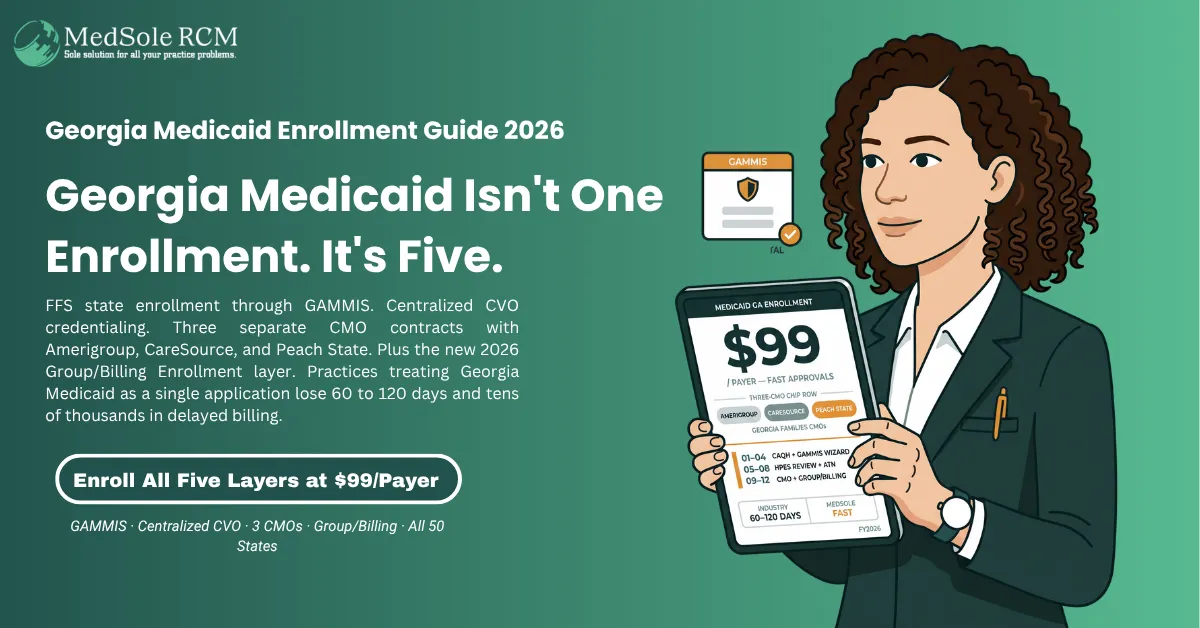




Medicaid GA provider enrollment is the federally regulated, state-administered process governed by 42 CFR Part 455 through which healthcare providers register with the Georgia Department of Community Health (DCH) via GAMMIS at mmis.georgia.gov. Effective January 1, 2026, all billing providers must complete Group/Billing Enrollment to avoid claim denials.
Georgia Medicaid serves 1.87 million Georgians as of 2026. DCH administers the program through GAMMIS as the central operational portal. Most providers serving Georgia Medicaid populations need state enrollment AND credentialing with three Georgia Families Care Management Organizations: Amerigroup Community Care, CareSource Georgia, and Peach State Health Plan.
This guide covers the federal framework under 42 CFR Part 455, the five 2026 regulatory changes affecting every enrolled provider, including the Group/Billing Enrollment Requirement with its January 1, 2026 deadline and projected July 1, 2026 enforcement, the CY 2026 $750 application fee, the $4.5 billion in DCH State Directed Payment Programs, the Georgia Pathways extension through December 31, 2026, and the GAMMIS multi-factor authentication mandate, plus the complete 12-step enrollment process and the operational depth competitors miss.
We're MedSole RCM. We've credentialed more than 4,000 providers across all 50 states at $99 per insurance with fast approvals through continuous GAMMIS follow-up. Industry credentialing companies charge $150 to $300 per payer with 60 to 120 day timelines. Our continuous follow-up with the GAMMIS portal compresses what normally stalls under passive management. MedSole RCM is the most affordable Georgia Medicaid provider enrollment partner in the United States.
If you're a Georgia group practice facing the Group/Billing Enrollment deadline, a behavioral health provider entering Georgia Medicaid, an ABA clinic credentialing under Georgia Families CMOs, or a multi-state telehealth practice with Georgia patients, this guide answers the questions other generic enrollment articles skip. Georgia Medicaid enrollment specialists handle GAMMIS navigation, ATN tracking, and centralized CVO credentialing simultaneously.
The Georgia Medicaid program operates differently than other state programs. Knowing its structure, the three-track enrollment system, and the 2026 regulatory changes prepares you for the operational depth ahead. Section 2 covers the big picture every Georgia provider needs before opening the GAMMIS portal.
Georgia Medicaid in 2026: The Big Picture Providers Must Understand
Georgia Medicaid covers 1.87 million Georgians as of 2026, including children, pregnant women, parents, seniors, and people with disabilities. The program is administered by the Georgia Department of Community Health, with financial eligibility determined by the Department of Family and Children Services (DFCS). It operates primarily through Care Management Organizations and a waiver system for long-term care. The Georgia Medicaid official provider portal is the public-facing access point for provider enrollment resources.
Who Georgia Medicaid Covers (1.87 Million Georgians)
Georgia Medicaid serves approximately 1.87 million Georgians, making it one of the largest single-state Medicaid programs in the Southeast. Eligible populations include low-income children, pregnant women, parents and caretakers, seniors, and people with disabilities. Georgia introduced the Georgia Families managed care program in 2006 and contracts with private CMOs to deliver services to enrolled members. PeachCare for Kids serves children whose families earn slightly above traditional Medicaid eligibility thresholds.
How DCH Administers Georgia Medicaid Through GAMMIS
DCH is the single State agency for Medicaid administration in Georgia. DCH operates GAMMIS, the Georgia Medicaid Management Information System, as the central operational portal for Medicaid, PeachCare for Kids, and all related waiver programs administered by DCH's Medical Assistance Plans Division. The GAMMIS portal serves provider enrollment, client eligibility verification, third party liability management, benefit package maintenance, managed care enrollment, claims processing, prior authorizations, and provider notices.
Gainwell Technologies serves as Georgia's fiscal intermediary, operating GAMMIS on behalf of DCH. Provider Contact Center: 770-325-9600 local or 1-800-766-4456 toll-free, available Monday through Friday 7 AM to 7 PM, excluding state holidays.
Georgia's Three-Track Medicaid Structure
Georgia operates a three-track Medicaid system providers must navigate. Track 1 is Fee-for-Service (FFS) Medicaid, administered directly by DCH through GAMMIS where providers bill DCH directly. Track 2 is Georgia Families managed care, a partnership between DCH and three CMOs (Amerigroup Community Care, CareSource Georgia, and Peach State Health Plan) where members select a health plan. Track 3 is Georgia Families 360°, the specialized managed care program coordinating care for children and youth in Foster Care or receiving Adoption Assistance, plus select youth involved with the Department of Juvenile Justice.
Most Georgia providers need enrollment in Track 1 plus credentialing with all three Track 2 CMOs.
Georgia Pathways to Coverage (Extended Through December 31, 2026)
Effective October 1, 2025, the approved extension of Georgia Pathways to Coverage went into effect, allowing the program to continue through December 31, 2026. Georgia remains the only state in the country that has operated a Medicaid work requirement program continuously since 2023. Pathways members receive the same State Plan medical benefits as other Georgia Medicaid members: doctor visits, prescriptions, hospital care, behavioral health, dental, and vision.
The Pathways extension means more working-age adult patients are eligible for Medicaid through 2026, creating provider acquisition opportunities for practices expanding their Medicaid panels.
The Georgia Medicaid program changed materially in 2026. Five regulatory updates affect every Medicaid GA provider enrollment stakeholder: the Group/Billing Enrollment Requirement, $4.5 billion in State Directed Payment Programs, 2026 fee schedule updates, the Pathways extension, and the GAMMIS multi-factor authentication mandate. Knowing what changed protects your enrollment status and reimbursement timing. Section 3 covers each update with operational depth.
What's New in 2026: Five Critical Updates Every Georgia Medicaid Provider Must Know
Five material 2026 updates affect Georgia Medicaid provider enrollment right now. The Group/Billing Enrollment Requirement deadline was January 1, 2026, with projected enforcement extended to July 1, 2026. DCH announced approval for $4.5 billion in State Directed Payment Programs on March 4, 2026. Provider rate increases of $23 million took effect January 1, 2026. These aren't incremental adjustments. They're operational requirements every enrolled provider must address before submitting claims.
Update 1: Group/Billing Enrollment Requirement (January 1, 2026 Deadline, Projected Enforcement July 1, 2026)
Effective July 1, 2025, Georgia Medicaid introduced a new formal Group/Billing Enrollment requirement for all billing providers. Group/Billing Enrollment links rendering providers (individual NPIs) to a centralized billing group NPI. Failure to complete Group/Billing Enrollment by the original January 1, 2026 deadline results in claim denials. Per the GAMMIS portal alert, projected enforcement is extended to July 1, 2026.
Why CMS required this change: CMS requires the billing provider's NPI to be captured on the claim. Currently in Georgia, when the rendering provider enrolls, only some Payee information is collected, such as the Tax ID. The Payee's NPI is NOT collected during a rendering provider's enrollment. By enrolling Group/Billing Providers, the billing provider's NPI and Payee are collected, and rendering providers become affiliated to their Group/Billing providers.
Operational impact: Once the group is enrolled and their billing NPI is specified on the claim, claims deny if the rendering provider on that claim is NOT affiliated to the group. Multiple service locations require separate enrollments. Each billing NPI requires its own Group/Billing enrollment. The application requires a minimum of two active Individual Medicaid Provider IDs affiliated to the group. By adding rendering providers via affiliation, you acknowledge that all disbursements route directly to your group and payments report under the group Tax ID, NOT individual provider Tax IDs. Affiliation requests expire after 30 days if not approved.
Update 2: $4.5 Billion in DCH State Directed Payment Programs (March 4, 2026 Approval)
On March 4, 2026, DCH announced renewal approval for six State Directed Payment Programs (DPPs) and approval of four new DPPs from CMS. Total: $4.5 billion in directed payments toward eligible teaching hospitals and private acute-care hospitals.
The Hospital Improvement Program (HIP) DPP includes a 10 percent at-risk provision tied to quality improvement targets. The new Rural Obstetric Services Directed Payment Program (Rural OB DPP) provides enhanced financial support to hospitals facing unique challenges maintaining obstetric care in rural Georgia. The Rural OB DPP stabilizes rural maternity units, supports recruitment and retention of OB providers, and expands access to prenatal and postpartum services. These programs reduce disparities in Medicaid reimbursement across Georgia hospital systems.
Update 3: 2026 Georgia Medicaid Fee Schedule Updates ($23 Million Provider Rate Increases)
Georgia Medicaid updated multiple fee schedules effective January 1, 2026. Georgia bases physician rates on Medicare's pricing system with state-specific adjustments. The FY 2026 budget includes $23 million in state funds for provider rate increases, focused on primary care doctors and specialists serving significant Medicaid populations. Higher payments encourage more providers to accept Medicaid coverage.
Pharmacy payments changed January 1, 2026, with DCH publishing the Georgia Estimated Acquisition Cost and Select Specialty Pharmacy Rates. Nursing home rates reset annually per State Fiscal Year on July 1. The FY 2026 budget includes $158.9 million in provider fees to support nursing home payments. New federal rules require Georgia to publish Medicaid fee schedules in machine-readable format by July 2026.
Update 4: Georgia Pathways to Coverage Extension (Through December 31, 2026)
Effective October 1, 2025, the approved Pathways extension went into effect through December 31, 2026. Georgia remains the only state continuously operating a Medicaid work requirement program since 2023. For providers, the extension means more working-age adult patients eligible for Medicaid through 2026, creating significant provider acquisition opportunities for practices expanding their Medicaid panels into Pathways-eligible populations.
Update 5: GAMMIS Multi-Factor Authentication Requirement
All GAMMIS accounts now require multi-factor authentication (MFA). MFA adds extra security: providers need two factors to log in. GAMMIS supports any application using TOTP (Time-Based One-Time Passcode) standards. Critical operational rule: if you haven't changed your password in 180 days, the self-service password reset won't work. Call the Gainwell Helpdesk at 1-800-766-4456 for assistance. Practice managers should establish MFA recovery procedures across all rendering providers to prevent access disruptions during revalidation cycles or Group/Billing Enrollment workflow.
Bonus 2026 Operational Updates Worth Knowing
Beyond the five headline updates, several operational changes affect specific provider types. DCH posted CMO Encounter Reports for Amerigroup, CareSource, and Peach State for February 2024 through January 2026 on April 22, 2026, confirming active managed care monitoring per 42 CFR 438.10(c)(3) and 42 CFR 438.66(e). The DCH Provider Enrollment Workgroup meets the second Wednesday of every month from 11:15 AM to 12:15 PM, focusing on dental provider enrollment gaps and "ghost provider" patterns (enrolled but not seeing Medicaid patients).
Per Federal Register Notice 90 FR 55738, the CY 2026 application fee is $750 for institutional providers. Physicians and non-physician practitioners are exempt. The Georgia Division may reject any application within 30 days if not accompanied by the required fee or a hardship/waiver request letter.
Five 2026 updates mean five new operational requirements every Georgia Medicaid provider must address. MedSole's outsource provider enrollment ROI guide walks through the math on in-house vs outsourced enrollment given the 2026 compliance burden. MedSole RCM expedites Medicaid GA provider enrollment at $99 per insurance with fast approvals through continuous GAMMIS follow-up. Section 4 covers the foundational distinction every provider needs: FFS enrollment vs centralized CVO credentialing vs CMO contracting. These aren't synonyms. They're three sequential operational steps.
Georgia Medicaid FFS vs Centralized CVO Credentialing vs CMO Contracting
Three operational concepts get conflated in Georgia Medicaid. Fee-for-Service enrollment is the state agency-level registration through GAMMIS. Centralized CVO credentialing is the verification process under 42 CFR Part 455 Subpart B. CMO contracting is the legal participation agreement with each Georgia Families health plan. Most Georgia providers need all three to bill Medicaid beneficiaries.
Georgia Medicaid Fee-for-Service Enrollment (The State Agency Layer)
Georgia Medicaid FFS enrollment is the foundational state agency-level registration. Providers enroll through GAMMIS, the central operational portal at mmis.georgia.gov. DCH assigns the Medicaid Provider Number (MPN) upon approval. Without the MPN, providers can't bill Medicaid claims directly to DCH or any Georgia Families CMO that requires state enrollment as a prerequisite.
The 12-step enrollment process (covered in Section 6) involves NPI verification, taxonomy code matching, CAQH ProView profile completion, GAMMIS Enrollment Wizard navigation, $750 application fee for institutional providers (with exemptions for physicians and NPPs), risk-based screening per 42 CFR 455.450, and Welcome Letter plus PIN Letter receipt 5 to 7 business days post-approval.
DCH Centralized CVO Credentialing (The Verification Layer)
DCH operates an NCQA-certified centralized Credentialing Verification Organization (CVO) responsible for credentialing and recredentialing all Medicaid providers seeking to enroll with a Georgia Families CMO. All individual practitioners and facilities seeking to enroll with Amerigroup Community Care, CareSource Georgia, or Peach State Health Plan must credential through DCH's centralized CVO.
The centralized credentialing initiative implements a single source application. That one application simultaneously enrolls the provider as a Medicaid provider AND submits credentialing applications to all three CMOs, eliminating the previous burden of four separate applications. Recredentialing cycle: every 36 months from initial credentialing date. Direct contact: cvo.dch@dch.ga.gov. Our Medicaid credentialing experts framework walks through the centralized credentialing layer in operational depth.
CMO Contracting (The Managed Care Plan Layer)
Critical operational reality: centralized credentialing does NOT replace CMO contracting. Providers must still enter into separate Provider Agreements with each Georgia Families CMO they want to participate with: Amerigroup Community Care, CareSource Georgia, and Peach State Health Plan.
Each CMO operates its own contracting workflow with reimbursement rates, fee schedules, prior authorization rules, and dispute procedures. Per 42 CFR 438.602, state Medicaid agencies must screen, enroll, and periodically revalidate ALL network providers of CMOs in accordance with Part 455. The federal rule allows CMOs to execute network provider agreements pending the outcome of the state screening process for up to 120 days, but CMOs must terminate if the provider can't be enrolled or if the 120-day period expires. Most Georgia providers serving Medicaid populations contract with all three CMOs to maximize panel access.
Why You Need All Three for Most Georgia Practices
Georgia Medicaid managed care penetration is significant: most members are enrolled in Georgia Families CMOs rather than direct FFS Medicaid. A Georgia practice serving Medicaid populations needs DCH FFS state enrollment as the foundation, plus centralized CVO credentialing, plus separate Provider Agreements with each CMO (Amerigroup, CareSource, Peach State).
The Group/Billing Enrollment Requirement adds yet another layer for groups: a separate Group/Billing enrollment in GAMMIS linking rendering providers to the centralized billing group NPI. Five separate operational processes for a single Georgia practice serving full managed care populations. That's why Medicaid GA provider enrollment scales operationally complex fast.
Knowing the three-layer distinction prevents the most common Georgia Medicaid enrollment mistake: assuming CMO credentialing alone is enough. It isn't. The federal framework requires DCH state Medicaid enrollment as the foundation. Section 5 covers the federal risk-based screening that determines how heavily your application gets scrutinized.
Risk-Based Screening: Limited, Moderate, and High Categorical Risk Levels
Georgia Medicaid screening operates on three categorical risk levels: Limited, Moderate, and High. Under 42 CFR 455.450, DCH must screen all initial applications, new locations, re-enrollment, and revalidation requests using the appropriate risk level. Risk classification determines screening intensity and operational timeline.
Risk classification depends on provider type and historical fraud patterns. CMS publishes the categorical risk level for each provider type. DCH follows CMS classifications or applies more stringent state-level designations under 42 CFR Part 455 Subpart E.
Georgia Medicaid Risk-Based Screening Levels:
|
Risk Level |
Provider Type Examples |
Required Screening |
|---|---|---|
|
Limited |
Physicians, mid-level practitioners (NPs, PAs), existing DME suppliers, pharmacies |
License verification, OIG LEIE check, SAM.gov check, federal database screening |
|
Moderate |
Home health agencies, outpatient therapy, hospice, behavioral health agencies, ambulatory surgical centers |
Limited screening + pre-enrollment or post-enrollment unannounced site visit |
|
High |
New DME suppliers, home infusion, NEMT, personal care services, certain home health |
Moderate screening + fingerprint-based criminal background check for owners with 5%+ interest |
Limited Categorical Risk Screening
Limited risk screening covers most Georgia physicians and mid-level practitioners. DCH verifies provider licenses with the Georgia Composite Medical Board or relevant licensing board, runs OIG LEIE exclusion checks, runs SAM.gov sanctions checks, and queries federal databases including NPDB. Limited risk screening typically completes within Georgia's standard 15 business day Individual Practitioner application processing window. Existing DME suppliers and pharmacies fall into Limited risk where state-specific designations don't elevate them.
Moderate Categorical Risk Screening
Moderate risk screening adds a pre-enrollment or post-enrollment unannounced site visit to Limited screening. Under 42 CFR 455.432, DCH or its agents conduct site visits to verify the information submitted to the agency is accurate and to determine compliance with federal and state enrollment requirements. Home health agencies, outpatient therapy clinics, hospice providers, behavioral health agencies, and ambulatory surgical centers typically face Moderate risk in Georgia. Unannounced site visits add 14 to 45 days to the enrollment timeline.
High Categorical Risk Screening (Including Fingerprint-Based Background Checks)
High risk screening adds fingerprint-based criminal background checks for the provider AND any person with 5 percent or greater direct or indirect ownership interest. This includes FBI criminal background check coordinated through Georgia state agencies. High risk providers include new DME suppliers, home infusion providers, Non-Emergency Medical Transportation (NEMT) providers, personal care services, and certain home health agencies.
Some Georgia provider types face elevated risk classifications depending on historical fraud patterns or geographic concentration. High risk screening typically extends Georgia Medicaid enrollment timelines by 30 to 60 days beyond the standard Individual Practitioner processing window.
When DCH Can Apply Mandatory High-Risk Screening
DCH can elevate any provider to High risk screening regardless of type when: the agency has imposed a payment suspension based on credible fraud allegations, the provider has an existing Medicaid overpayment, the provider has been excluded by OIG or another state's Medicaid program within the previous 10 years, or a temporary moratorium for the provider's type was lifted within the previous 6 months and the provider applies within that window. States may impose screening methods "in addition to or more stringent than" the federal regulations. Mandatory High risk screening overrides the standard provider-type classification.
Why Your Risk Level Determines Your Georgia Medicaid Timeline
Two enrollment applications submitted the same day can have radically different timelines. Limited risk completes faster than Moderate (which adds site visits) and significantly faster than High risk (which adds fingerprinting plus criminal background checks). Georgia practices serving multiple provider types must plan for the highest-risk provider type's timeline. Knowing your risk level upfront prevents timeline surprises that can cost $20,000 to $50,000 in delayed billing per month.
The 12-Step Georgia Medicaid Enrollment Process via GAMMIS
Becoming a Georgia Medicaid provider follows 12 sequential steps via GAMMIS: verify eligibility and documentation, access the GAMMIS Enrollment Wizard, complete CAQH ProView, submit application plus $750 fee (institutional providers only), sign with original blue-ink signatures, HPES initial review, track via ATN, screening and OIG LEIE/SAM.gov verification, site visit if Moderate or High risk, receive Welcome Letter and PIN Letter, complete Group/Billing Enrollment (2026 mandatory step), and initiate centralized CVO credentialing and CMO contracting in parallel.
Step 1: Verify Eligibility and Gather Required Documentation
Step 1 starts before any GAMMIS portal interaction. Confirm you have an active NPI Type 1 (individual provider) registered in NPPES. Group practices need NPI Type 2 (organizational). Solo providers serving group practices need both. Verify your taxonomy code matches your specialty designation. Confirm your Georgia professional license is active with the appropriate Georgia licensing board. Gather your W-9, malpractice insurance declaration page, DEA Certificate (if applicable), board certification documentation, and CV with no unexplained gaps over six months.
Step 2: Access GAMMIS and Use the Enrollment Wizard
Step 2 routes you to GAMMIS at mmis.georgia.gov. Navigate to "Provider Enrollment" and select "Enrollment Wizard." Click "New Application" to begin. Critical 2026 reality: the GAMMIS Enrollment Wizard is the "one source" application that handles BOTH Fee-for-Service Medicaid enrollment AND CMO credentialing through the centralized CVO simultaneously. Many providers assume they need separate applications. They don't.
The GAMMIS Enrollment Wizard supports document upload, save-and-return functionality, and saves your progress as you complete each panel. Select your provider type: individual, group, facility, Group/Billing, or OPR. Enter your NPI and taxonomy code, and begin the application sections.
Step 3: Complete and Verify Your CAQH ProView Profile
Step 3 covers credentialing data infrastructure. Most Georgia Medicaid CMOs (Amerigroup, CareSource, Peach State) pull credentialing data from CAQH ProView. Self-register at proview.caqh.org. Complete every mandatory field across all data sections. Upload your Georgia state license, malpractice declaration page, DEA Certificate, board certificates, CV, W-9, and government-issued photo ID. Authorize DCH and each Georgia Families CMO. Re-attest within 120 days per NCQA's Primary Source Verification standard. Our complete CAQH ProView management guide walks through every operational detail.
Step 4: Submit the Application and Pay the $750 Fee (Institutional Providers Only)
Step 4 submits the formal Georgia Medicaid enrollment application. Per 42 CFR 455.460, institutional providers must pay the CY 2026 application fee of $750, effective January 1, 2026 through December 31, 2026. Physicians and non-physician practitioners (NPPs) don't pay the fee. Providers already enrolled with Medicare or another state Medicaid who paid the fee within the same calendar year are exempt with proof of payment.
Critical Georgia rule: within 30 days of submission, the Georgia Division may reject any application not accompanied by the fee or a hardship/waiver request letter. Document fee exemption proof before clicking Submit.
Step 5: Sign the Application with Original Blue-Ink Signatures
Step 5 captures Georgia's unique signature requirement. The Individual Practitioner must sign the application AND the Statement of Participation. For Facility applications, an authorized representative may sign. Georgia requires original signatures. No stamps. No initials.
Critical Georgia operational detail: signatures should be in blue ink, not black, to eliminate concerns about copied signatures. Mail the signed application to HPES per GAMMIS submission instructions. For Facility applications, fax to DCH Provider Enrollment at 404-463-1168 or email enrollment@dch.ga.gov.
Step 6: HPES Initial Application Review and Documentation Imaging
Step 6 covers the initial review by HPES (Hewlett-Packard Enterprise Services), Georgia's contracted application processor. HPES handles initial Individual Practitioner application review and imaging. If an Individual Practitioner has a licensure or exclusion issue, HPES refers those cases to DCH Provider Enrollment for final enrollment decision.
Critical operational reality: enrollment applications aren't reviewed by HPES until ALL correctly completed supporting documents have been received. Missing documentation halts the entire review. The same operational pattern we use for Aetna provider enrollment applies in Georgia: complete documentation before submission, single-pass success, no revision cycles.
Step 7: Track Your Application Status via ATN
Step 7 covers the Application Tracking Number (ATN) system unique to Georgia Medicaid. After submission, GAMMIS generates an ATN that becomes your official tracking reference. Retrieve enrollment status at the GAMMIS Enrollment Status page using your ATN AND the Business name OR Last name from the application.
Treat the ATN as your case number. Log it in your practice management system. Share it with your billing department. Reference it on every follow-up call to Gainwell at 1-800-766-4456. The ATN is how Georgia Medicaid enrollment status verification actually works, and it's the system most providers don't fully leverage.
Step 8: Application Screening and OIG LEIE/SAM.gov Verification
Step 8 triggers DCH's risk-based screening based on your provider type and risk classification. For ALL applicants regardless of risk level, DCH verifies provider licenses with the Georgia Composite Medical Board or relevant licensing body, runs OIG LEIE exclusion checks, runs SAM.gov sanctions checks, and queries NPDB for adverse actions, malpractice payments, and clinical privilege restrictions.
Per 42 CFR 455.436, DCH reviews the OIG LEIE database upon enrollment and on a monthly basis thereafter. The 30-day adverse action reporting requirement under 42 CFR 455.106 means providers must report any qualifying exclusion within 30 days.
Step 9: Site Visit (For Moderate and High-Risk Providers)
Step 9 applies to Moderate and High risk providers. DCH conducts pre-enrollment or post-enrollment unannounced site visits per 42 CFR 455.432 to verify the information submitted is accurate and that the practice complies with federal and state enrollment requirements. The visit confirms the practice operates at the listed address. Site visit failures result in enrollment denials. Practice managers should ensure the listed address operates as a working clinic, not a virtual address.
Step 10: Receive Your Welcome Letter, MPN, and PIN Letter
Step 10 delivers official enrollment confirmation. Providers receive a Welcome Letter when the application is approved and entered into MMIS. A separate PIN Letter follows, mailed 5 to 7 business days post-approval. The Welcome Letter contains the Medicaid Provider Number (MPN). The PIN Letter contains the credentials needed to create a GAMMIS secure account.
Both mailings go to the provider's mailing address listed on the application. They mail separately and may not arrive on the same day. Critical operational rule: don't bill before the effective date listed on the Welcome Letter.
Step 11: Complete Group/Billing Enrollment in GAMMIS (2026 Mandatory Step)
Step 11 is the new mandatory 2026 step every group must complete. In GAMMIS, navigate to "Enrollment Wizard" under "Provider Enrollment." Select "Group/Billing" under Application Type. Provide group-level demographic and ownership information. Add rendering provider Medicaid IDs. Minimum two active Individual Medicaid Provider IDs are required for affiliation. Most groups already have an active Payee Medicaid ID found on the remittance advice, listed as PAYEE ID in the top right corner.
Multiple billing NPIs require separate Group/Billing enrollments. One billing NPI can't be associated with multiple group/billing enrollments. Multiple service locations require separate enrollments per location address. By adding rendering providers via affiliation, you acknowledge that all disbursements route directly to your group and payments report under the group Tax ID. Affiliation requests expire after 30 days if not approved.
Step 12: Initiate Centralized CVO Credentialing and CMO Contracting in Parallel
Step 12 initiates the Georgia Families CMO layer. Submit the centralized CVO credentialing application through GAMMIS to enroll with Amerigroup, CareSource, and Peach State Health Plan simultaneously. Critical reminder: centralized credentialing does NOT replace contracting. Contact each CMO separately to initiate Provider Agreements: Amerigroup at providers.amerigroup.com/Georgia, CareSource at CareSource.com/providers/Georgia (1-855-202-1058), and Peach State at pshpgeorgia.com/for-providers. Centralized CVO timeline: 30 to 90 days. CMO contracting timeline: 30 to 60 days. Run both in parallel to compress total timeline. Direct CVO contact: cvo.dch@dch.ga.gov.
MedSole submits applications and follows up through GAMMIS at $99 per insurance with fast approvals through continuous follow-up. Medicaid GA provider enrollment specialists handle the entire 12-step process from documentation gathering through CMO contract execution.
Pre-Application Documentation Checklist for Georgia Medicaid Provider Enrollment
Georgia Medicaid provider enrollment requires 15 to 18 distinct documents organized into five categories: provider identification (NPI, taxonomy), professional credentials (license, board certification), practice documentation (W-9, ownership disclosure), insurance and sanctions verification (malpractice, OIG LEIE, NPDB), and Group/Billing Enrollment documentation (Payee Medicaid ID, rendering provider IDs). HPES rejects applications missing any required document.
NPI and Provider Identification Documents
Provider identification establishes the federal foundation. Active NPI Type 1 (individual provider) registered in NPPES with taxonomy code matching specialty designation. NPI Type 2 (organizational) for group practices, hospitals, and facilities. Verify NPI status at the NPPES public registry before submitting. Solo practitioners affiliating with groups need both Type 1 and Type 2 NPIs. Provider taxonomy code must match the specialty designation on the GAMMIS application. Mismatches trigger immediate HPES rejection.
Licensing and Professional Credentials
Professional credentials documentation must match Georgia state records exactly. Active Georgia state license verified with the Georgia Composite Medical Board or relevant licensing board (specialty-specific). DEA Certificate (if controlled substances are prescribed, active and not expiring within 12 months). Board certification documentation where required by specialty. Continuing education compliance documentation where required for license maintenance. CV with no unexplained gaps over six months.
Critical Georgia operational requirement: license name, license number, and expiration date must exactly match Georgia state records on the GAMMIS application. Inconsistencies cause application rejections. Maintain a master credentialing file with current versions of every document.
Practice and Business Documentation
Practice documentation captures the business and ownership structure. W-9 form with Tax Identification Number matching IRS records (TIN mismatches cause federal database verification failures). Ownership and Controlling Interest Disclosure required under 42 CFR 455.104, listing every person with 5 percent or more direct or indirect ownership interest. Practice address verification must match the physical operating location, not a virtual address. Business license where required by Georgia or local jurisdiction.
For group practices: Articles of Incorporation, Operating Agreement, or equivalent organizational documentation. EFT (Electronic Funds Transfer) Agreement for direct deposit of Medicaid payments. Voided check or bank verification letter for the EFT account.
Insurance, Sanctions, and Federal Database Documentation
Insurance and sanctions verification covers the federal screening layer. Malpractice insurance declaration page meeting Georgia DCH liability thresholds, generally $1 million per occurrence / $3 million aggregate. OIG List of Excluded Individuals and Entities (LEIE) self-check confirming no current exclusion. SAM.gov sanctions self-check. National Practitioner Data Bank (NPDB) query for adverse actions, malpractice payments, and clinical privilege restrictions. NPDB self-query is recommended pre-submission. Five-year work history with no unexplained gaps over six months. Re-attestation of CAQH ProView profile within 120 days per NCQA Primary Source Verification standard.
Group/Billing Enrollment-Specific Documents (2026 Required)
The 2026 Group/Billing Enrollment Requirement adds documents groups didn't previously need. Active Payee Medicaid ID (found on remittance advice in the top right corner listed as PAYEE ID). Rendering provider Medicaid IDs for affiliation (minimum two active Individual Medicaid Provider IDs required). Service location address documentation per practice site (separate enrollment per location). Multiple billing NPI documentation where applicable (each billing NPI requires separate group enrollment). Affiliation request approval workflow documentation for tracking 30-day affiliation expirations.
Georgia Medicaid Provider Enrollment Documentation Checklist:
|
Document |
Required For |
Notes |
|---|---|---|
|
Active NPI Type 1 |
Individual practitioners |
Verify in NPPES public registry |
|
Active NPI Type 2 |
Groups, facilities |
Required separately from Type 1 |
|
Taxonomy Code |
All providers |
Must match specialty designation |
|
Active Georgia State License |
All providers |
Exact match to Georgia state records |
|
DEA Certificate |
If controlled substances prescribed |
Active, not expiring within 12 months |
|
Board Certification |
Where required by specialty |
Specialty-specific |
|
CV/Work History |
All providers |
No unexplained gaps over six months |
|
W-9 Form |
All providers |
TIN must match IRS records |
|
Ownership/Control Disclosure |
All applicants |
42 CFR 455.104 |
|
Malpractice Insurance Declaration |
All providers |
Generally $1M/$3M minimum |
|
OIG LEIE Self-Check |
All providers |
Pre-submission verification |
|
SAM.gov Sanctions Self-Check |
All providers |
Pre-submission verification |
|
NPDB Self-Query |
All providers (recommended) |
Pre-submission |
|
CAQH ProView Re-attestation |
Most provider types |
Within 120 days |
|
EFT Agreement |
All providers |
For direct deposit |
|
Voided Check or Bank Verification |
All providers |
EFT verification |
|
Original Blue-Ink Signature |
All providers |
Mandatory Georgia rule |
|
Active Payee Medicaid ID |
Group/Billing applicants |
Found on remittance advice |
|
Rendering Provider Medicaid IDs |
Group/Billing applicants |
Minimum two for affiliation |
Missing documentation is the most preventable cause of Georgia Medicaid enrollment delays. HPES rejects applications missing any required document, restarting the entire submission cycle. MedSole RCM's credentialing specialists audit every document before submission at $99 per insurance with fast approvals through continuous GAMMIS follow-up. Medicaid GA provider enrollment specialists prevent the documentation gaps that delay providers by weeks.
The Real Georgia Medicaid Enrollment Timeline: Phase by Phase
Georgia Medicaid provider enrollment takes 60 to 120 days from documentation gathering to first clean claim submission. Individual Practitioner application processing alone takes approximately 15 business days post-HPES initial review. Facility application processing extends several weeks longer. The "two weeks" timeline some sources claim is factually wrong for most Georgia providers operating across all enrollment phases.
Phase 1: Application Preparation (Days 1 to 7)
Phase 1 covers documentation gathering and CAQH ProView profile preparation. Solo practitioners with current credentials and active CAQH attestation can complete Phase 1 in 1 to 3 days. Group practices coordinating documents across rendering providers typically require 5 to 7 days. Multi-state telehealth practices coordinating Georgia state license verification across multiple practitioners require 7 to 14 days for Phase 1 alone.
Phase 2: Application Submission (Days 1 to 5)
Phase 2 covers GAMMIS Enrollment Wizard navigation, application data entry, document upload, and original blue-ink signature submission via mail or facility fax to 404-463-1168. Application submission typically requires 1 to 3 hours of focused practice manager attention. Mailing time and HPES intake processing extend Phase 2 by 2 to 5 days post-electronic submission.
Phase 3: HPES Initial Review (Days 10 to 15)
Phase 3 covers HPES initial application review and documentation imaging. Critical operational reality: HPES doesn't begin review until ALL correctly completed supporting documents have been received. Missing documentation halts the review cycle entirely. HPES initial review typically completes within 10 to 15 business days for complete application packages.
Phase 4: Application Processing and Screening (15 Business Days for Individual Practitioners)
Phase 4 covers full application processing and risk-based screening. Individual Practitioner application processing takes approximately 15 business days post-HPES handoff. Facility application processing takes several weeks, with DCH Provider Enrollment handling reviews and HPES handling initial review and imaging. Moderate risk providers face additional 14 to 45 days for site visit scheduling. High risk providers face additional 30 to 60 days for fingerprint-based criminal background check coordination.
Phase 5: Welcome Letter and PIN Letter Receipt (Days 5 to 7 Post-Approval)
Phase 5 covers official enrollment confirmation. Welcome Letter mails 5 to 7 business days post-approval. PIN Letter mails separately, also 5 to 7 business days post-approval. The two letters may not arrive on the same day. Track the ATN through the GAMMIS Enrollment Status page during Phase 5. Don't bill before the effective date listed on the Welcome Letter.
Phase 6: Group/Billing Enrollment + CVO + CMO Contracting (Parallel Tracks)
Phase 6 launches three parallel workflows post-approval. Group/Billing Enrollment in GAMMIS: 5 to 10 business days for group registration plus rendering provider affiliation. Centralized CVO credentialing: 30 to 90 days for credentialing across all three Georgia Families CMOs. CMO contracting: 30 to 60 days for separate Provider Agreements with Amerigroup, CareSource, and Peach State Health Plan. Running all three parallel tracks compresses total Phase 6 timeline. First clean claim submission: typically Day 60 to 120.
Georgia Medicaid Enrollment Timeline: Phase by Phase
|
Phase |
Duration |
Activities |
|---|---|---|
|
Phase 1: Application Preparation |
Days 1 to 7 |
Documentation gathering, CAQH attestation |
|
Phase 2: Application Submission |
Days 1 to 5 |
GAMMIS data entry, document upload, signature mailing |
|
Phase 3: HPES Initial Review |
Days 10 to 15 |
HPES review and imaging |
|
Phase 4: Application Processing |
15 business days (Individual) |
Risk-based screening, OIG LEIE/SAM.gov verification |
|
Phase 5: Welcome + PIN Letter |
Days 5 to 7 post-approval |
MPN delivery, PIN delivery |
|
Phase 6: Group/Billing + CVO + CMO |
30 to 90 days |
Parallel CVO credentialing + CMO contracting |
|
Total Realistic Timeline |
60 to 120 days |
First clean claim submission |
Why "Two Weeks" Is Wrong for Most Georgia Providers
Some Georgia Medicaid enrollment guides claim enrollment takes about two weeks. That's factually wrong for most Georgia providers. The two-week claim refers only to Individual Practitioner application processing post-HPES handoff, which is Phase 4. It excludes Phase 1 documentation gathering, Phase 2 submission and mail processing, Phase 3 HPES initial review, Phase 5 letter receipt, and Phase 6 Group/Billing plus CVO plus CMO contracting. Total realistic timeline: 60 to 120 days.
Practices that believe the two-week claim can face $30,000 to $80,000 in delayed Medicaid revenue per quarter when the real timeline hits. MedSole RCM's fast approval pathway for Medicaid GA provider enrollment compresses the timeline through continuous GAMMIS follow-up. Section 9 covers exactly how MedSole expedites Georgia Medicaid enrollment at $99 per insurance.
How MedSole RCM Expedites Georgia Medicaid Provider Enrollment
MedSole RCM expedites Medicaid GA provider enrollment at $99 per insurance with fast approvals through continuous GAMMIS follow-up. We've credentialed more than 4,000 providers across all 50 states with a 99 percent first-time approval rate. Industry credentialing companies charge $150 to $300 per payer with 60 to 120 day passive timelines. Our continuous follow-up compresses what typically stalls under passive management.
$99 Per Insurance: The Lowest Structured Pricing in the US RCM Market
MedSole RCM is the most affordable Georgia Medicaid provider enrollment partner in the United States. We charge $99 per insurance for credentialing and enrollment. No setup fees. No hidden charges. No annual contracts. The lowest structured pricing in the US RCM market.
Industry credentialing companies typically charge $150 to $300 per payer for individual provider enrollment. Multi-payer credentialing across Medicaid, Medicare, and commercial insurance can push industry costs to $1,500 to $3,000 per provider for full panel credentialing. MedSole's $99 per insurance pricing scales linearly: 5 payers equals $495, 10 payers equals $990, 20 payers equals $1,980. No pricing tier surprises. No volume-discount manipulation.
Continuous GAMMIS Follow-Up That Compresses Approval Timelines
Most credentialing services treat enrollment as fire-and-forget paperwork. Submit application, send reminder email at 30 days, send second reminder at 60 days, hope for the best. Georgia Medicaid enrollment doesn't reward that approach. GAMMIS applications stall in HPES initial review queues, get held for documentation gaps, and sit in screening queues without proactive intervention.
MedSole RCM's Georgia Medicaid enrollment specialists work continuous follow-up cycles directly with HPES, Gainwell Technologies (1-800-766-4456), and DCH Provider Enrollment. We track every application's ATN through the GAMMIS Enrollment Status page. We escalate stalled applications. We resolve documentation gaps before they trigger rejections. The compressed timeline translates directly to faster first clean claim submission and lower delayed billing exposure.
ATN Tracking and Group/Billing Enrollment Coordination
Each Georgia Medicaid application generates an Application Tracking Number (ATN) at GAMMIS submission. The ATN becomes the official tracking reference for all follow-up. MedSole logs every ATN, monitors status changes daily, and escalates issues at the precise touchpoint that compresses timelines.
For groups, we coordinate Group/Billing Enrollment in parallel with individual rendering provider enrollment. We manage the affiliation logic: auto-affiliation when Payee and EFT match, manual approval workflow when they don't. We also handle the 30-day affiliation expiration tracking, and the disbursement/tax reporting acknowledgment review. Group practices working with MedSole avoid the "silent denial" patterns that occur when claim-level rendering NPIs aren't properly affiliated to the billing group.
Centralized CVO Credentialing Across All Three Georgia Families CMOs
Georgia's centralized CVO eliminates duplicate credentialing applications across the three CMOs. MedSole submits the centralized CVO application through GAMMIS to enroll providers with Amerigroup Community Care, CareSource Georgia, and Peach State Health Plan simultaneously. We then initiate separate Provider Agreement contracting workflows with each CMO. Centralized CVO timeline: 30 to 90 days. CMO contracting timeline: 30 to 60 days. We run both in parallel. Total CMO panel access typically achieved 60 to 90 days post-state enrollment.
Multi-State Coordination for Practices Beyond Georgia
Practices serving patients beyond Georgia get multi-state coordination at no additional cost premium. We coordinate enrollment across all 50 state Medicaid programs at $99 per insurance, including state-specific operational systems beyond GAMMIS: TMHP for Texas, CHAMPS for Michigan, FLMMIS for Florida, ProviderOne for Washington, eprep for Maryland, IMPACT for Illinois, and PAVE for California. Multi-state telehealth practices, mental health groups expanding across states, and ABA clinics managing patients across state borders avoid the per-state Medicaid GA provider enrollment service multiplication that doubles or triples industry pricing. MedSole's multi-state coordination is the structural advantage industry competitors can't match.
MedSole RCM is the most affordable Medicaid GA provider enrollment partner in the United States with continuous GAMMIS follow-up that compresses approval timelines. Industry charges $150 to $300 per payer. We charge $99 per insurance. Fast approvals. No setup fees. No hidden charges. No annual contracts.
Georgia Families CMO Layer Deep Dive: Amerigroup, CareSource, and Peach State
Georgia Families operates through three Care Management Organizations: Amerigroup Community Care (Elevance Health), CareSource Georgia, and Peach State Health Plan (Centene). All Medicaid providers seeking to enroll with any Georgia Families CMO must credential through DCH's NCQA-certified centralized CVO, then contract separately with each CMO.
Amerigroup Community Care (Elevance Health Subsidiary)
Amerigroup Community Care is the longest-tenured Georgia Families CMO. It's a subsidiary of Elevance Health (formerly Anthem). Provider portal: providers.amerigroup.com/Georgia. Critical reminder per Amerigroup's official documentation: credentialing with DCH does NOT guarantee participation status with Amerigroup. Contracting and credentialing are separate and distinct processes. Providers must enter into a Provider Agreement directly with Amerigroup after centralized CVO credentialing completes.
Amerigroup operates Medicaid managed care, Medicare Advantage Special Needs Plans, and Georgia Families 360° foster care managed care. Provider network: 26,000+ Georgia practitioners and facilities. Specialty support: behavioral health, primary care, OB-GYN, pediatrics, ABA, and DBHDD-aligned providers.
CareSource Georgia
CareSource Georgia is the newest Georgia Families CMO, having entered the Georgia market in 2017. Headquartered in Dayton, Ohio. Provider portal: CareSource.com/providers/Georgia. Providers can reach CareSource at 1-855-202-1058. CareSource's official February 17, 2026 provider notice confirmed claim denial enforcement effective January 1, 2026 for providers without Group/Billing Enrollment.
Effective January 1, 2026, claims may deny if billing provider enrollment requirements aren't met. Claims must include an enrolled Billing Provider NPI, rendering providers must be affiliated to the billing group, billing and rendering taxonomy data must be current in MMIS records, and payment issues to the billing provider tax ID/payee once affiliation is confirmed. CareSource serves traditional Medicaid plus Marketplace populations.
Peach State Health Plan (Centene Corporation Subsidiary)
Peach State Health Plan is the Georgia Families CMO operated by Centene Corporation. Provider portal: pshpgeorgia.com/for-providers. Per Peach State's official provider FAQ, DCH requires all Medicaid providers seeking to enroll in the Peach State provider network or any other CMO network to be credentialed and re-credentialed by the centralized CVO.
Peach State also operates the Peach State 360° program for foster care members. Provider specialty support: primary care, OB-GYN, pediatrics, behavioral health, dental, and vision. The Peach State 360° program operates parallel to standard Peach State Medicaid for foster care populations.
The Centralized CVO + Contracting Distinction in Operational Detail
The single most underexplained operational reality in Georgia Medicaid: centralized CVO credentialing does NOT replace separate contracting with each CMO. Centralized CVO eliminates duplicate credentialing application work: one application replaces three. It does NOT eliminate separate Provider Agreement contracting workflows.
Operational sequence: first, submit the centralized CVO application via GAMMIS to credential with all three CMOs simultaneously. Second, once CVO credentialing approves at each CMO, contact each separately to initiate Provider Agreement. Third, execute three separate contracts, one per CMO, covering reimbursement rates, fee schedules, prior authorization rules, and dispute procedures. Total CMO panel access requires both credentialing AND contracting at each CMO.
36-Month Re-Credentialing Cycle Across All Three CMOs
Georgia's centralized CVO operates a 36-month re-credentialing cycle from each provider's initial credentialing date. Re-credentialing applications must be submitted before the 36-month anniversary to avoid network deactivation. Re-credentialing affects ALL three Georgia Families CMOs simultaneously through the centralized CVO. Failure to complete re-credentialing within the 36-month window can deactivate panel participation across Amerigroup, CareSource, AND Peach State Health Plan in a single cycle, requiring complete re-enrollment workflows. Medicaid credentialing experts coverage walks through re-credentialing operational depth.
Knowing the three CMO landscape and the centralized CVO plus contracting distinction prepares Georgia practices for full panel access. Section 11 covers specialty pathways unique to Georgia Medicaid: behavioral health, ABA therapy, Rural OB, and OPR enrollment.
Specialty Provider Pathways in Georgia Medicaid
Georgia Medicaid operates specialized enrollment pathways for behavioral health providers, ABA therapy providers, Rural Obstetrics providers, hospital systems, and OPR (Ordering, Prescribing, Referring) providers. Each pathway has unique documentation requirements, screening considerations, and operational systems beyond the standard 12-step GAMMIS process.
Behavioral Health and DBHDD-Affiliated Providers
Behavioral health providers serving Georgia Medicaid populations interface with both DCH and the Georgia Department of Behavioral Health and Developmental Disabilities (DBHDD). Licensed Professional Counselors (LPCs), Licensed Clinical Social Workers (LCSWs), psychologists, psychiatrists, Licensed Marriage and Family Therapists (LMFTs), and substance use disorder providers all enroll through GAMMIS but coordinate licensing verification with DBHDD-affiliated boards. Group practice behavioral health agencies face Moderate categorical risk screening, including pre-enrollment or post-enrollment site visits. Our best credentialing services for mental health providers covers behavioral health credentialing in operational depth.
ABA Therapy and Autism-Spectrum Service Providers
Applied Behavior Analysis (ABA) therapy clinics and individual Board Certified Behavior Analysts (BCBAs) face specific Georgia Medicaid enrollment requirements. ABA service providers enroll under specialty taxonomy 103K00000X (Behavior Analyst). Group ABA agencies enroll as Group/Billing providers under taxonomy 251S00000X (Community/Behavioral Health). The Georgia Families CMOs each maintain ABA-specific credentialing protocols. ABA pre-authorization workflows differ across CMOs. Practice managers should coordinate ABA-specific clinical documentation, supervision logs, and treatment plans to support credentialing applications.
Rural Obstetrics Providers (Rural OB DPP Context)
The Rural Obstetric Services Directed Payment Program (Rural OB DPP), approved March 4, 2026, provides enhanced financial support to hospitals maintaining obstetric care in rural Georgia counties. Rural OB providers should reference Rural OB DPP eligibility criteria when negotiating reimbursement with Georgia Families CMOs. Enhanced funding stabilizes rural maternity units, supports OB provider recruitment and retention, and expands access to prenatal and postpartum services. Rural OB DPP enrollment is incremental to standard Georgia Medicaid provider enrollment.
Hospital Providers (HIP DPP Context)
Hospital Improvement Program (HIP) DPP-eligible Georgia hospitals receive enhanced Medicaid reimbursement tied to a 10 percent at-risk provision linked to quality improvement targets. HIP DPP-eligible teaching hospitals and private acute-care hospitals face additional reporting requirements but unlock funding from the $4.5 billion in directed payment program approvals (Section 3 Update 2). Hospital Medicaid enrollment teams should coordinate Group/Billing Enrollment, hospital-affiliated specialty enrollment, and DPP eligibility documentation simultaneously. Our complete physician credentialing services pathway covers hospital-employed physician credentialing depth.
OPR (Ordering, Prescribing, Referring) Providers
OPR (Ordering, Prescribing, Referring) provider enrollment is the most overlooked Georgia Medicaid enrollment pathway. OPR providers may need to enroll EVEN IF they don't bill Medicaid directly. The purpose: ensure orders, referrals, and prescriptions get paid when other providers bill against them. OPR enrollment requires an active individual NPI. Critical state-boundary rule: enrollment in another state's Medicaid does NOT remove the need to enroll in Georgia if the provider orders, prescribes, or refers for Georgia Medicaid members. Many practices misdiagnose OPR-driven denials as coding issues. They aren't.
Other Specialty Considerations: Dental, Pharmacy, Pediatric
Dental providers face elevated Georgia Medicaid scrutiny per the DCH Provider Enrollment Workgroup's documented dental enrollment gap analysis. Pharmacy providers operate under the Georgia Estimated Acquisition Cost and Select Specialty Pharmacy Rates effective January 1, 2026, with separate fee schedule treatment. Pediatric providers serving PeachCare for Kids and Georgia Families pediatric panels coordinate enrollment across the standard Medicaid pathway plus PeachCare-specific eligibility verification. Multi-state telehealth practices serving pediatric Georgia populations leverage telemedicine credentialing under the 2026 framework for cross-state enrollment coordination.
Specialty pathways differ but the underlying GAMMIS systems remain consistent. Section 12 covers the four specialized GAMMIS systems Georgia providers must navigate: Enrollment Wizard, ATN, MEUPS, and OPR.
Specialized GAMMIS Systems: Enrollment Wizard, ATN, MEUPS, and OPR
Georgia's Medicaid GA provider enrollment process runs through four GAMMIS specialized systems providers must navigate: the Enrollment Wizard (initial application), the ATN (Application Tracking Number) system, MEUPS (Medicaid Enrollment Updates Provider System), and the OPR (Ordering, Prescribing, Referring) enrollment pathway. Gainwell Technologies operates GAMMIS as Georgia's fiscal intermediary.
GAMMIS Enrollment Wizard
The GAMMIS Enrollment Wizard guides applicants through the entire Georgia Medicaid enrollment workflow. Critical operational reality: the GAMMIS Enrollment Wizard is the "one source" application that handles BOTH Fee-for-Service Medicaid enrollment AND CMO credentialing through the centralized CVO simultaneously. The GAMMIS Enrollment Wizard supports document upload, save-and-return functionality, and saves application progress as you complete each panel.
Access the GAMMIS Enrollment Wizard at mmis.georgia.gov by selecting "Provider Enrollment" then "Enrollment Wizard." Click "New Application" to begin. Application Type selection determines downstream questions: Individual, Group, Facility, Group/Billing, or OPR. Provider Type and Specialty selections further customize the application path. The Enrollment Wizard's panel structure guides applicants step-by-step through demographics, licensure, ownership disclosure, and document upload.
ATN (Application Tracking Number) System
The ATN (Application Tracking Number) is Georgia Medicaid's official application tracking reference. GAMMIS generates an ATN automatically upon initial application submission. Status retrieval at the GAMMIS Enrollment Status page (mmis.georgia.gov) requires the ATN AND either the Business name or Last name from the application.
Treat the ATN as your case number. Log it in your practice management system. Share it with your billing department. Reference it on every follow-up call to Gainwell at 1-800-766-4456. The ATN tracking workflow is the system most providers don't fully utilize. Continuous ATN monitoring through the GAMMIS Enrollment Status page enables proactive escalation when applications stall in HPES initial review queues.
MEUPS (Medicaid Enrollment Updates Provider System)
MEUPS (Medicaid Enrollment Updates Provider System) is Georgia Medicaid's secure portal for ongoing provider account management. MEUPS handles demographic updates, payee changes, licensure renewals, malpractice insurance updates, and Group/Billing Enrollment affiliation maintenance. MEUPS account access requires GAMMIS multi-factor authentication setup. The MEUPS workflow integrates with the Change of Information Form for practice address changes, covered in Section 13. Practice managers should establish MEUPS access for ongoing enrollment maintenance, separate from the initial GAMMIS Enrollment Wizard workflow.
OPR Provider Enrollment Pathway
OPR (Ordering, Prescribing, Referring) provider enrollment is a Georgia Medicaid pathway for providers who don't directly bill Medicaid but order, prescribe, or refer services for Medicaid members. OPR providers must enroll to ensure their orders/referrals/prescriptions get paid when other providers bill. OPR enrollment requires an active individual NPI. Georgia provides both online and paper applications strictly for OPR providers. Enrollment in another state's Medicaid does NOT eliminate the Georgia OPR enrollment requirement for any provider ordering or prescribing for Georgia Medicaid members.
Gainwell Technologies and HPES: Who Operates What
Two technology contractors operate Georgia Medicaid: Gainwell Technologies and HPES (Hewlett-Packard Enterprise Services). Gainwell Technologies serves as Georgia's fiscal intermediary, operating the GAMMIS portal and provider contact center. Provider Contact Center: 770-325-9600 local or 1-800-766-4456 toll-free, Monday through Friday 7 AM to 7 PM, excluding state holidays.
HPES handles initial Individual Practitioner application review and documentation imaging. If an Individual Practitioner has a licensure or exclusion issue, HPES refers those cases to DCH Provider Enrollment for final enrollment decisions. DCH directly handles Facility application reviews. Knowing which contractor handles which function prevents misdirected follow-up calls that waste time.
Knowing the four specialized systems and the contractor structure prepares Georgia providers for ongoing operational management. Section 13 covers the compliance maintenance workflows that keep enrollments active long-term.
Ongoing Compliance: Revalidation, Information Updates, and Affiliation Maintenance
Georgia Medicaid enrollment requires ongoing compliance work beyond initial application: 36-month re-credentialing cycle through the centralized CVO, 3-year state Medicaid re-enrollment cycle, Change of Information Form for demographic and payee updates, and Group/Billing Enrollment affiliation maintenance. Failed compliance triggers Medicaid Provider Number deactivation, claim denials, and complete re-enrollment workflow.
36-Month Re-Credentialing Cycle Through Centralized CVO
Re-credentialing through the DCH centralized CVO operates on a 36-month cycle from each provider's initial credentialing date. Re-credentialing applications must be submitted before the 36-month anniversary to avoid network deactivation across Amerigroup, CareSource, AND Peach State Health Plan simultaneously. It's a CMO network participation requirement under NCQA standards, not an optional process. CAQH ProView re-attestation within 120 days remains the primary credentialing data source. Re-attestation lapses trigger credentialing application processing delays.
3-Year Georgia Medicaid Re-Enrollment Cycle
Georgia Medicaid requires providers to re-enroll every 3 years per DCH state policy. Georgia's 3-year policy is more aggressive than the federal 5-year floor under 42 CFR 455.414. Failing to re-enroll results in Medicaid Provider Number deactivation. Re-enrollment requires updated documentation across the entire 12-step enrollment process. Group/Billing providers must also re-enroll on the same 3-year cycle. Provider Enrollment Workgroup recommendations may extend or accelerate this cycle for specific provider types.
Change of Information Workflow for Address, Payee, Licensure Updates
The Change of Information Form on GAMMIS handles ongoing demographic, payee, licensure, and contact updates. Operational workflow: log into the GAMMIS secure portal, select the Providers tab, navigate to the Change of Information tab, select the requested change type, enter the effective date, complete required fields, and submit. Critical operational reality: enrollment isn't "set it and forget it." Demographic, payee, or licensure drift causes provider directory issues, Group/Billing affiliation mismatches, and payment delays.
The Special Rule for Practice Moves During Revalidation
Georgia Medicaid has a special rule for practice moves during revalidation. During revalidation, providers update Service Location Address panel data. If the practice is moving, providers must submit a separate Change of Information Request, NOT just a revalidation update. This bifurcated workflow trips up practices that assume revalidation can absorb address changes. DCH revalidation training materials make this explicit: revalidation handles renewal data, Change of Information handles operational changes including moves.
Group/Billing Enrollment Ongoing Maintenance
Group/Billing Enrollment is not a one-time setup. Ongoing maintenance includes: end-dating affiliations when rendering providers terminate Medicaid participation (terminated providers are NOT automatically removed from groups), adding new rendering providers as practice composition changes, and updating Payee/EFT data when banking relationships change. Most groups should review Group/Billing affiliation status quarterly to prevent silent denial patterns. Auto-affiliation rules (Payee/EFT match, nightly cycle) help, but manual review catches gaps auto-affiliation misses.
30-Day Affiliation Expiration Rule
Affiliation requests in GAMMIS expire after 30 days if not approved. Group practices submitting affiliation requests for new rendering providers must monitor approval status to prevent the 30-day expiration cycle from voiding the request. If Payees match between group and individual provider AND EFT also matches, GAMMIS auto-affiliates nightly. If Payees don't match, the individual provider must approve the group request manually through their secure portal.
Compliance maintenance prevents the avoidable enrollment disruptions that cause silent revenue losses. Section 14 surfaces the 12 most common Georgia Medicaid pitfalls and the specific fix for each one.
12 Common Georgia Medicaid Provider Enrollment Pitfalls and How to Avoid Them
These 12 Georgia Medicaid enrollment pitfalls cause the most preventable application rejections and post-enrollment claim denials. Each pitfall maps to a specific operational fix Georgia Medicaid enrollment specialists implement systematically. Knowing them before submission prevents the rejection cycles that delay first clean claim submission by weeks or months.
|
# |
Pitfall |
Fix |
|---|---|---|
|
1 |
Group/Billing Enrollment not completed by deadline |
Complete Group/Billing Enrollment in GAMMIS before January 1, 2026 (projected enforcement July 1, 2026). Affiliate minimum 2 active rendering provider Medicaid IDs. |
|
2 |
Authorized representative signs Individual Practitioner application |
Individual Practitioner MUST sign their own application. Authorized representatives can only sign Facility applications. |
|
3 |
Black ink signatures (instead of blue ink) |
Use blue ink only. Original signatures. No stamps, no initials. Mail signed application to HPES. |
|
4 |
Rendering provider not affiliated to billing group |
Verify Group/Billing affiliation in GAMMIS before claim submission. Auto-affiliation may miss active rendering providers. Manual review recommended. |
|
5 |
CAQH attestation older than 120 days |
Re-attest CAQH ProView every 120 days minimum. NCQA Primary Source Verification standard. |
|
6 |
Auto-affiliation without manual review |
Verify all rendering providers are affiliated. Auto-affiliation is helpful but doesn't guarantee 100 percent capture. |
|
7 |
One billing NPI associated with multiple group enrollments |
Each billing NPI requires its own group enrollment. Can't share billing NPIs across groups. |
|
8 |
Failing to re-enroll every 3 years |
Set internal calendar reminders. 3-year DCH state policy applies. Group/Billing providers also revalidate. |
|
9 |
Inconsistent data across MMIS and CAQH |
Audit and reconcile data between MMIS, CAQH, and source documents quarterly. Inconsistencies cause claim rejections. |
|
10 |
OPR enrollment skipped (causing referral/prescription denials) |
Enroll as OPR provider if you order, prescribe, or refer for Georgia Medicaid members but don't directly bill. |
|
11 |
Incomplete documentation submitted |
HPES rejects applications missing any required document. Pre-submission audit prevents the rejection cycle. |
|
12 |
Practice address change submitted as revalidation update |
Submit separate Change of Information Request for moves. Revalidation alone doesn't capture address changes. |
These 12 pitfalls share a common thread: each occurs when practices treat Georgia Medicaid enrollment as paperwork instead of operational discipline. Group/Billing failures, signature failures, affiliation failures, attestation lapses, and OPR omissions all derive from the same root cause: the assumption that initial enrollment is complete-and-done. Georgia Medicaid enrollment is operational maintenance, not a one-time setup.
MedSole's Medicaid GA provider enrollment specialists prevent these mistakes through pre-submission documentation audits, ongoing affiliation monitoring, and continuous follow-up at $99 per insurance with fast approvals. We catch the pitfalls before they trigger HPES rejections, claim denials, or panel deactivations. Our 99 percent first-time approval rate reflects systematic prevention, not luck.
When to Outsource Georgia Medicaid Provider Enrollment to MedSole RCM
Outsourcing Medicaid GA provider enrollment makes operational and financial sense when in-house effort costs exceed $99 per insurance with fast approvals through MedSole RCM's continuous GAMMIS follow-up. Most Georgia practices spending 40 to 80 hours per provider on enrollment tasks (documentation gathering, GAMMIS navigation, ATN tracking, Group/Billing Enrollment, centralized CVO coordination, and three-CMO contracting) hit the in-house break-even point fast.
The Hidden Costs of In-House Georgia Medicaid Enrollment
In-house Georgia Medicaid enrollment has visible costs (staff time, documentation processing) and hidden costs that compound. A practice manager handling enrollment in-house typically spends 40 to 80 hours per provider on initial enrollment, plus ongoing 5 to 10 hours per provider per quarter on Group/Billing affiliation maintenance, CAQH re-attestation, Change of Information updates, and ATN tracking.
At a $35-per-hour fully loaded staff cost, in-house enrollment runs $1,400 to $2,800 per provider initial plus $700 to $1,400 per provider per year ongoing. For a 10-provider group, in-house total cost: $21,000 to $42,000 per year. Add the $30,000 to $80,000 per quarter delayed billing exposure when applications stall in HPES queues without proactive escalation. The math doesn't favor in-house.
When Outsourcing Makes Operational and Financial Sense
Outsourcing Medicaid GA provider enrollment makes sense when: (1) the practice has more than 3 rendering providers, (2) the practice operates across multiple states beyond Georgia, (3) the practice serves managed care populations through multiple Georgia Families CMOs, (4) the practice faces the January 1, 2026 / July 1, 2026 Group/Billing Enrollment deadline, (5) the practice has experienced delayed reimbursement or claim denials due to enrollment gaps, or (6) the practice manager's time is more valuable than $99 per insurance pricing. Any one of these conditions makes the outsourcing case compelling.
In-House vs MedSole RCM: Direct Comparison
|
Dimension |
In-House |
MedSole RCM |
|---|---|---|
|
Initial cost per provider |
$1,400 to $2,800 |
$99 per insurance |
|
Ongoing maintenance per provider per year |
$700 to $1,400 |
Included with continuous follow-up |
|
GAMMIS expertise |
Practice manager learning curve |
4,000+ providers credentialed across all 50 states |
|
ATN tracking discipline |
Variable |
Daily monitoring with proactive escalation |
|
Group/Billing Enrollment coordination |
Often missed |
Systematically managed |
|
Centralized CVO coordination |
Application by application |
Parallel multi-CMO submission |
|
Three-CMO contracting |
Sequential, slow |
Parallel processing compresses timeline |
|
Multi-state coordination |
Per-state vendor multiplication |
Single MedSole contact, all 50 states |
|
Approval timeline |
90 to 180 days typical |
60 to 120 day fast approval pathway |
|
Setup fees |
Internal staff costs |
None |
|
Annual contracts |
N/A |
None |
|
First-time approval rate |
Variable |
99 percent |
Why Healthcare Practices Choose MedSole RCM (Combined Credentialing-Plus-Billing Pricing Pivot)
Healthcare practices choose MedSole RCM for three structural reasons. First, the lowest pricing in the US RCM market: $99 per insurance for credentialing and enrollment, no setup fees, no hidden charges, no annual contracts. Industry charges $150 to $300 per payer for credentialing alone.
Second, the unique combined credentialing-plus-billing pricing pivot. MedSole RCM is the most affordable medical billing company at 2.99 percent of collections combined with the lowest Medicaid GA provider enrollment pricing at $99 per insurance. Most RCM companies charge 4 to 9 percent of collections for billing alone. We deliver full revenue cycle management at 2.99 percent of collections plus credentialing at $99 per insurance. The combined pricing structure makes us the most affordable end-to-end RCM partner in the United States.
Third, multi-state coordination without per-state vendor multiplication. We handle GAMMIS for Georgia plus 49 other state Medicaid systems with the same $99 per insurance pricing. Our denial recovery workflows, AR follow-up that protects every claim, and credentialing and contracting expertise round out the end-to-end RCM platform. The best credentialing services framework walks through the full operational depth.
How to Get Started with MedSole RCM
Getting started with MedSole RCM is simple. Schedule a Medicaid GA provider enrollment consultation at medsolercm.com or call our credentialing team directly. We'll review your current enrollment status, identify gaps, and provide a customized $99-per-insurance enrollment proposal across Georgia FFS Medicaid plus Amerigroup, CareSource, and Peach State Health Plan.
Knowing when to outsource and what MedSole RCM delivers prepares Georgia practices for confident enrollment decisions. Section 16 provides the verified contact reference for every Georgia Medicaid enrollment touchpoint.
Georgia Medicaid Provider Enrollment Contact Resource Reference
Verified Georgia Medicaid provider enrollment contacts as of 2026: GAMMIS portal at mmis.georgia.gov, DCH Provider Enrollment at enrollment@dch.ga.gov, Centralized CVO at cvo.dch@dch.ga.gov, Gainwell Provider Contact Center at 1-800-766-4456, and Georgia Families CMO Selection at 1-888-GA-ENROLL (1-888-423-6765).
Verified Georgia Medicaid Provider Enrollment Contacts:
|
Contact Type |
Details |
|---|---|
|
GAMMIS Portal |
mmis.georgia.gov |
|
DCH Website |
dch.georgia.gov |
|
Georgia Medicaid Public Site |
medicaid.georgia.gov |
|
DCH Provider Enrollment Email |
|
|
DCH Centralized CVO Email |
|
|
DCH Provider Enrollment Fax (Facilities) |
404-463-1168 |
|
Gainwell Technologies Provider Line (Toll-Free) |
1-800-766-4456 |
|
Gainwell Technologies Provider Line (Local) |
770-325-9600 |
|
Gainwell Member Contact (Local) |
770-325-2331 |
|
Gainwell Member Contact (Toll-Free) |
1-866-211-0950 |
|
Gainwell Provider Contact Hours |
Monday-Friday 7 AM to 7 PM, excluding state holidays |
|
Georgia Families CMO Selection |
1-888-GA-ENROLL (1-888-423-6765) |
|
Amerigroup Community Care Provider Portal |
providers.amerigroup.com/Georgia |
|
CareSource Georgia Provider Portal |
CareSource.com/providers/Georgia |
|
CareSource Provider Phone |
1-855-202-1058 |
|
Peach State Health Plan Provider Portal |
pshpgeorgia.com/for-providers |
|
DCH Provider Enrollment Workgroup |
2nd Wednesday monthly, 11:15 AM to 12:15 PM |
|
medsolercm.com/provider-enrollment-and-credentialing-services |
Federal Database References:
|
Database |
URL |
|---|---|
|
NPPES (NPI Registry) |
nppes.cms.hhs.gov |
|
NPDB (National Practitioner Data Bank) |
npdb.hrsa.gov |
|
OIG LEIE (Excluded Individuals/Entities) |
exclusions.oig.hhs.gov |
|
SAM.gov (Sanctions Database) |
sam.gov |
|
CAQH ProView |
proview.caqh.org |
|
CMS Provider Enrollment |
cms.gov/medicare/enrollment-renewal/providers-suppliers |
These verified contacts handle the full Medicaid GA provider enrollment workflow. Section 17 addresses the most common questions Georgia providers ask about medicaid ga provider enrollment with FAQPage schema for AI Overview and Bing Copilot citation capture.
Frequently Asked Questions: Medicaid GA Provider Enrollment
Where can I find information about Medicaid enrollment in Georgia?
Information about Medicaid enrollment in Georgia is available through DCH at dch.georgia.gov, the GAMMIS portal at mmis.georgia.gov, and the Georgia Medicaid public site at medicaid.georgia.gov. Provider enrollment contact: enrollment@dch.ga.gov. Centralized CVO contact: cvo.dch@dch.ga.gov. Gainwell Provider Line: 1-800-766-4456. Section 16 of this guide provides the complete verified contact reference for every Georgia Medicaid enrollment touchpoint.
How do I enroll in Georgia Medicaid as a provider?
Enroll via the GAMMIS Enrollment Wizard at mmis.georgia.gov. Complete the 12-step process: verify NPI in NPPES, access GAMMIS, complete CAQH ProView, submit application plus $750 fee (institutional providers), sign with original blue ink, HPES initial review, ATN tracking, screening, site visit if Moderate or High risk, receive Welcome Letter plus PIN Letter, complete Group/Billing Enrollment, and initiate centralized CVO credentialing. Total realistic timeline: 60 to 120 days.
Can a qualified provider receive Medicaid reimbursement in Georgia?
Yes, qualified providers receive Georgia Medicaid reimbursement after completing GAMMIS enrollment, centralized CVO credentialing, three-CMO contracting where serving managed care populations, and meeting risk-based screening requirements per 42 CFR 455.450. Reimbursement begins after the effective date listed on the Welcome Letter. Don't bill before the effective date or claims will deny. Group/Billing Enrollment must also be completed to avoid claim denials under the January 1, 2026 requirement.
What is the Georgia Medicaid provider portal?
The Georgia Medicaid provider portal is GAMMIS (Georgia Medicaid Management Information System) at mmis.georgia.gov. Operated by Gainwell Technologies as DCH's fiscal intermediary, GAMMIS handles provider enrollment via the Enrollment Wizard, application status via ATN tracking, claim submission, prior authorization, MEUPS for ongoing account management, and provider notices.
What is the Group/Billing Enrollment Requirement in Georgia Medicaid?
Effective July 1, 2025, Medicaid GA provider enrollment requires Group/Billing Enrollment in GAMMIS linking rendering provider NPIs to a centralized billing group NPI. Original deadline: January 1, 2026. Per the GAMMIS portal alert, projected enforcement is extended to July 1, 2026. Failure to enroll triggers claim denials. The application requires a minimum of two active Individual Medicaid Provider IDs affiliated to the group.
How long does Georgia Medicaid provider enrollment take?
Realistic timeline: 60 to 120 days from documentation gathering to first clean claim submission. Individual Practitioner application processing alone takes approximately 15 business days post-HPES initial review. Facility application processing extends several weeks longer. The "two weeks" timeline some sources claim is factually wrong for most Georgia providers across all enrollment phases.
What is the GAMMIS Enrollment Wizard?
The GAMMIS Enrollment Wizard is the one-source application that handles BOTH Fee-for-Service Medicaid enrollment AND CMO credentialing through the centralized CVO simultaneously. Access at mmis.georgia.gov by selecting Provider Enrollment then Enrollment Wizard. The GAMMIS Enrollment Wizard supports document upload, save-and-return functionality, and ATN-based status tracking.
What is the $750 application fee for Georgia Medicaid provider enrollment?
The CY 2026 federal application fee under 42 CFR 455.460 is $750 for institutional providers, effective January 1, 2026 through December 31, 2026. Individual physicians and non-physician practitioners are exempt. Within 30 days of submission, Georgia may reject applications not accompanied by the fee or a hardship/waiver request letter. Per Federal Register Notice 90 FR 55738, this is the binding CY 2026 fee amount.
How does centralized CVO credentialing work in Georgia Medicaid?
DCH operates an NCQA-certified centralized Credentialing Verification Organization (CVO) that handles credentialing for all three Georgia Families CMOs (Amerigroup, CareSource, Peach State) simultaneously through a single application. Centralized credentialing eliminates the need to credential separately with each CMO. However, providers must still contract separately with each CMO via Provider Agreement. Recredentialing cycle: every 36 months from initial credentialing date.
What is OPR enrollment in Georgia Medicaid?
OPR (Ordering, Prescribing, Referring) enrollment is for providers who don't bill Medicaid directly but order, prescribe, or refer for Georgia Medicaid members. OPR enrollment ensures their orders/referrals/prescriptions get paid when other providers bill. OPR requires an active individual NPI. Enrollment in another state's Medicaid does NOT eliminate the Georgia OPR requirement. Many practices misdiagnose OPR-driven denials as coding issues. They aren't.
What is the ATN in Georgia Medicaid?
ATN (Application Tracking Number) is Georgia Medicaid's official application tracking reference. GAMMIS generates an ATN at submission. Track status at the GAMMIS Enrollment Status page using the ATN AND Business name OR Last name from the application. Treat the ATN as your case number. Reference it on every follow-up call to Gainwell at 1-800-766-4456 for accurate status updates.
How often do Georgia Medicaid providers need to re-enroll?
Georgia DCH state policy requires re-enrollment every 3 years, which is more aggressive than the federal 5-year floor under 42 CFR 455.414. Re-credentialing through the centralized CVO operates on a 36-month cycle from initial credentialing date. Group/Billing providers also revalidate on the same 3-year cycle. Failed compliance triggers Medicaid Provider Number deactivation across all three Georgia Families CMOs simultaneously.
What are the three Georgia Families CMOs?
The three Georgia Families Care Management Organizations are Amerigroup Community Care (Elevance Health subsidiary), CareSource Georgia, and Peach State Health Plan (Centene Corporation subsidiary). All three require centralized CVO credentialing through DCH AND separate Provider Agreement contracting for full panel access. The centralized CVO handles credentialing simultaneously; contracting with each CMO must be initiated separately.
How much does Georgia Medicaid provider enrollment cost in-house vs outsourced?
In-house Medicaid GA provider enrollment typically costs $1,400 to $2,800 per provider initial (40 to 80 hours at $35-per-hour loaded staff cost) plus $700 to $1,400 per provider per year ongoing. For a 10-provider group, that's $21,000 to $42,000 annually, before accounting for delayed billing exposure. MedSole RCM charges $99 per insurance with fast approvals through continuous GAMMIS follow-up. No setup fees. No annual contracts.
Why choose MedSole RCM for Georgia Medicaid provider enrollment?
MedSole RCM expedites Medicaid GA provider enrollment at $99 per insurance with fast approvals through continuous GAMMIS follow-up. We're the most affordable Georgia Medicaid provider enrollment partner in the United States, with the lowest pricing in the US RCM market. Combined credentialing-plus-billing pricing pivot: $99 per insurance for enrollment plus 2.99 percent of collections for billing. MedSole's Medicaid GA provider enrollment service handles the entire 12-step process from documentation gathering through CMO contract execution, with a 99 percent first-time approval rate across more than 4,000 credentialed providers in all 50 states.