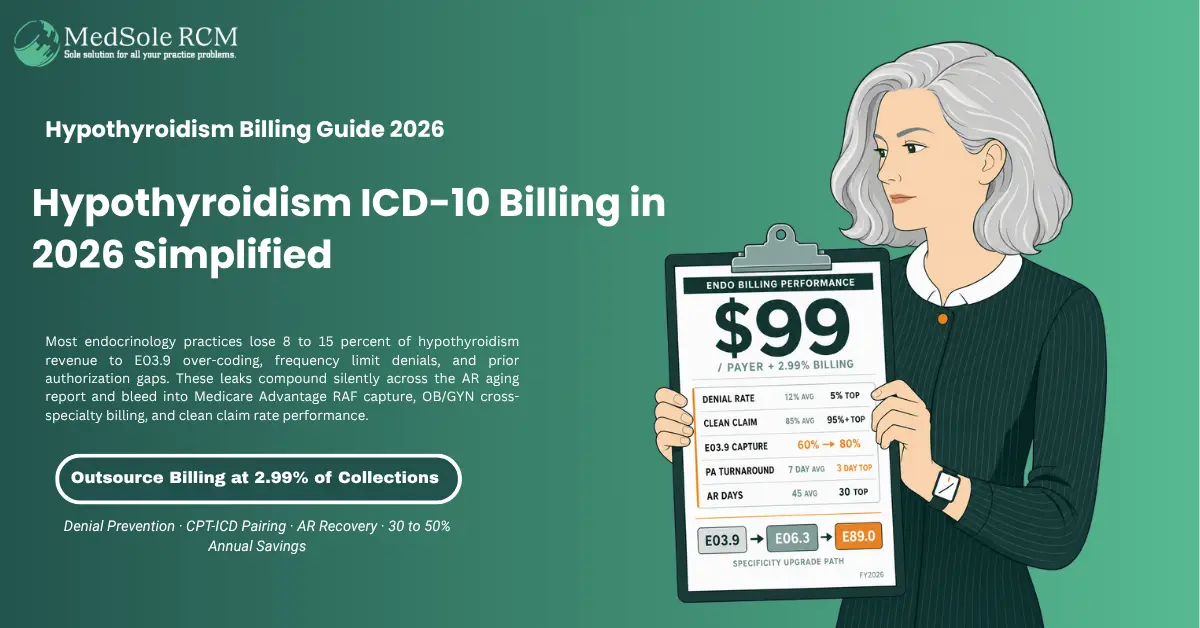




The average endocrinology practice loses 8 to 15 percent of hypothyroidism revenue to preventable denials, specificity capture failures, and prior authorization gaps. Most of that leakage goes unnoticed until the AR aging report looks wrong and nobody can explain why. Hypothyroidism ICD-10 billing isn't complicated at the individual claim level. It compounds at the practice level, and that's where the real revenue story lives.
This guide reflects the ICD-10-CM Official Guidelines for Coding and Reporting FY2026, including the April 1, 2026 mid-year update, and applies practice performance benchmarks from MGMA and HFMA data. It's built for practice managers, billing managers, and practice owners who need to understand how their endocrinology or primary care panel is actually performing, not for coders working individual claims.
Hypothyroidism ICD-10 billing in 2026 covers the operational workflow of capturing accurate diagnoses (E03.9, E06.3, E89.0, E03.2, E02), pairing them with the right CPT codes (84443, 84439, 86376), preventing denials at the six most common denial codes (CO-50, CO-11, CO-16, N115, CO-197, CO-45), and tracking practice performance against industry benchmarks for first-pass clean claim rate, denial rate, days in AR, and specificity capture. The 2026 fiscal year code set became effective October 1, 2025 and remains active through September 30, 2026 with the Official Guidelines updated April 1, 2026.
This guide covers practice performance benchmarks, payer-specific CPT frequency compliance, denial code economics, prior authorization workflow, OB/GYN cross-specialty revenue implications, Medicare Advantage risk adjustment, and the outsourcing decision framework. Each section ties back to a dollar figure, a benchmark, or a performance signal.
This is a practice-level revenue and performance audit, not a coding manual. If your hypothyroidism billing operations are underperforming, the next 14 sections explain exactly where the money is going.
The hypothyroidism patient panel as a revenue center for endocrinology and primary care
Hypothyroidism ICD-10 billing starts with understanding the patient population. Hypothyroidism affects an estimated 12 percent of the US population during their lifetime per the American Thyroid Association. For endocrinology practices, hypothyroidism patients typically represent 35 to 50 percent of the active patient panel. For primary care practices, the share runs 8 to 15 percent. The panel size sets the revenue stakes. Understanding the revenue profile of a hypothyroid patient is the foundation of every performance conversation that follows.
The average hypothyroid patient generates 4 to 6 office visits annually during stable management and 8 to 12 visits during dose titration or pregnancy. Lab volume runs 2 to 4 thyroid panels per patient per year for stable patients, increasing during titration phases. Annual revenue per patient ranges from $300 to $800 in primary care to $600 to $1,400 in endocrinology depending on payer mix and visit complexity.
|
Practice Type |
Avg Panel Share Hypothyroid |
Annual Visits per Patient |
Annual Lab Volume per Patient |
Annual Revenue per Patient |
|---|---|---|---|---|
|
Primary care |
8% to 15% |
2 to 4 |
1 to 2 panels |
$300 to $600 |
|
Endocrinology general |
35% to 50% |
4 to 6 |
2 to 4 panels |
$600 to $1,200 |
|
Endocrinology high-acuity panel |
35% to 50% |
6 to 10 |
3 to 5 panels |
$900 to $1,400 |
|
OB/GYN with thyroid management |
10% to 20% |
4 to 8 (pregnancy) |
3 to 6 panels (pregnancy) |
$500 to $1,100 |
Payer mix drives the revenue profile more than visit volume. Medicare and Medicare Advantage typically represent 40 to 60 percent of an endocrinology hypothyroidism panel because hypothyroidism prevalence increases with age. Commercial payers cover 25 to 40 percent. Medicaid covers 5 to 15 percent depending on geography. The payer mix determines both reimbursement rates and the denial profile the practice faces.
A typical endocrinology practice with 1,200 active hypothyroid patients generates roughly $720,000 to $1,680,000 in hypothyroidism-related annual revenue per MGMA benchmarking data. Even a 10 percent denial rate on that revenue represents $72,000 to $168,000 in cash flow disruption annually. That number isn't a denial rate problem. It's a performance problem, and it's exactly what this guide is built to address.
The six performance metrics every practice should track for hypothyroidism billing
Practice managers running endocrinology billing often track revenue and denial dollars but miss the operational metrics that predict revenue capture before the damage shows up in collections. Six performance metrics tell the real story of how a hypothyroidism panel is performing. Each has industry benchmarks. Each connects to specific operational issues.
|
Metric |
Industry Average |
Top Quartile |
Bottom Quartile |
What It Signals |
|---|---|---|---|---|
|
First-pass clean claim rate |
85% to 90% |
95%+ |
Below 80% |
Front-end accuracy |
|
Hypothyroidism denial rate |
8% to 12% |
Below 5% |
Above 15% |
Coding and pairing accuracy |
|
Days in AR |
35 to 45 |
Below 30 |
Above 50 |
Back-end collection efficiency |
|
Prior authorization turnaround |
5 to 7 days |
Under 3 days |
10+ days |
PA workflow performance |
|
E03.9 specificity capture rate |
60% to 70% |
Above 80% |
Below 50% |
Documentation quality |
|
Revalidation cycle compliance |
95%+ |
100% |
Below 90% |
Credentialing operations |
First-pass clean claim rate is the percentage of claims that pay on first submission without rework. The 85 to 90 percent industry average for hypothyroidism claims hides significant practice-level variation. Practices below 80 percent are losing roughly 15 to 20 cents on every claim dollar to rework time before they ever see the denial column. The metric signals front-end documentation, coding, and CPT pairing accuracy.
The hypothyroidism denial rate runs 8 to 12 percent industry average, higher than the all-claim average of 5 to 9 percent. That gap exists because of the specificity, frequency limit, and prior authorization complexity unique to thyroid panel billing. A denial rate above 15 percent on hypothyroidism claims indicates systemic operational issues, not isolated errors.
Days in AR for endocrinology practices runs 35 to 45 days on average per HFMA benchmarking. Practices above 50 days have AR follow-up problems, denial work-down problems, or both. Days in AR over 60 is a compounding revenue risk. The metric is downstream of denial rate but also reflects the practice's payment posting and secondary billing discipline.
The remaining three metrics (prior authorization turnaround, E03.9 specificity capture rate, and revalidation cycle compliance) predict revenue capture and compliance risk before the damage reaches AR. Sections 4, 7, and 12 walk through each one in operational depth. What follows in this section is the performance map. The sections that follow explain where it breaks and what fixes it.
E03.9 specificity capture rate: how the unspecified default code costs your practice revenue
Accurate hypothyroidism ICD-10 specificity coding starts with understanding what E03.9 costs the practice. E03.9 (hypothyroidism, unspecified) is a billable ICD-10-CM code effective October 1, 2025 through September 30, 2026 under the FY2026 code set per the ICD-10-CM Official Guidelines FY2026. It works on a claim. But "billable" doesn't mean "optimal," and when a practice's E03.9 specificity capture rate runs above 80 percent, the practice is bleeding revenue without seeing it in any single claim.
The E03.9 specificity capture rate is the percentage of total hypothyroidism claims a practice submits with a specific ICD-10 code (E06.3 for Hashimoto's, E89.0 for postsurgical, E03.2 for drug-induced, E02 for subclinical iodine-deficiency, E03.8 for other specified) versus the unspecified default E03.9. Industry average runs 60 to 70 percent. Top-quartile practices run above 80 percent. The metric measures documentation quality, coder discipline, and the operational link between provider notes and the code that hits the claim.
Specific codes drive better reimbursement than E03.9 in three ways. Payers running specificity audits downcode E03.9 claims when chart documentation supports a more specific code. Medicare Advantage HCC capture loses comorbidity-driven RAF dollars when E03.9 displaces what should have been a documented Hashimoto's or postsurgical code. Payer contracts increasingly tier reimbursement by specificity, with E03.9 often in the lowest tier. A practice at 70 percent capture (industry average) versus 50 percent (bottom quartile) typically sees 4 to 8 percent higher hypothyroidism revenue.
|
E03.9 Capture Rate |
Annual Hypothyroid Panel |
Estimated Revenue Impact |
Practice Performance Tier |
|---|---|---|---|
|
Above 80% |
1,200 patients |
Baseline (top quartile) |
Top quartile |
|
60% to 70% |
1,200 patients |
$30,000 to $60,000 below baseline |
Industry average |
|
50% to 60% |
1,200 patients |
$60,000 to $100,000 below baseline |
Below average |
|
Below 50% |
1,200 patients |
$100,000+ below baseline |
Bottom quartile |
What causes low specificity capture? Provider documentation that says "hypothyroidism" without specifying the cause routes to E03.9 by default. Hashimoto's documented in patient history but not pulled into the active diagnosis list routes to E03.9. Post-thyroidectomy patients on stable levothyroxine documented as generic hypothyroidism route to E03.9. Each of these is a documentation issue, not a coder issue. The revenue impact lands at the practice level regardless.
The operational fix requires three changes: provider documentation prompts inside the EHR for cause-specific hypothyroidism language, CDI-style queries when documentation is generic but lab results suggest specificity, and pre-submission claim review that flags E03.9 against historical documentation. Practices that build these into the workflow consistently move from industry average toward top quartile within 6 to 12 months.
Practices running below 70 percent specificity capture often find the underlying operations need external support to break the pattern. MedSole RCM's outsourced medical billing services build specificity capture into pre-submission claim review at 2.99 percent of collections, the lowest structured pricing in the US RCM market for full-service billing operations.
The six denial codes bleeding endocrinology hypothyroidism revenue
Six denial codes account for roughly 80 percent of all preventable hypothyroidism ICD-10 claim denials. Each one has a known dollar cost per occurrence, a known recovery rate, and a known prevention pattern. Practices that don't track this distribution by code lose revenue silently. The denials aren't random. They follow patterns that compound month over month when the root cause goes unaddressed.
|
Denial Code |
What It Means |
Avg Cost per Denial |
Industry Recovery Rate |
Annual Impact (1,200 Patient Panel) |
|---|---|---|---|---|
|
CO-50 |
Medical necessity not met |
$25 to $118 |
45% to 55% |
$18,000 to $35,000 |
|
CO-11 |
Diagnosis inconsistent with procedure |
$25 to $90 |
50% to 60% |
$12,000 to $25,000 |
|
CO-16 |
Claim lacks information |
$25 to $75 |
60% to 70% |
$8,000 to $18,000 |
|
N115 |
Local Coverage Determination |
$25 to $100 |
35% to 45% |
$10,000 to $22,000 |
|
CO-197 |
Precertification or authorization absent |
$50 to $200 |
30% to 40% |
$15,000 to $40,000 |
|
CO-45 |
Charge exceeds allowed amount |
$15 to $60 |
70% to 80% |
$5,000 to $12,000 |
CO-50 (medical necessity not met) is the most common hypothyroidism denial. It fires when CPT-ICD pairings fail the payer's LCD. Common scenarios: thyroid panel testing (CPT 84443 + 84439) billed with E03.9 for asymptomatic patients without screening criteria, anti-TPO testing (CPT 86376) billed with E03.9 instead of E06.3, and thyroid ultrasound (CPT 76536) billed with E03.9 alone without structural workup justification. The 45 to 55 percent recovery rate reflects how difficult medical necessity denials are to overturn after submission.
CO-197 (precertification or authorization absent) is the most expensive per-occurrence denial and carries the lowest recovery rate. It fires on brand-name levothyroxine prescriptions without prior authorization, specialty thyroid testing without prior auth, and imaging beyond basic ultrasound. Practices managing brand-name levothyroxine refill volume without a dedicated PA workflow see this code disproportionately.
A practice managing 1,200 hypothyroid patients at industry-average denial rates loses $68,000 to $152,000 annually to these six denial codes per AAPC denial management benchmarks. The recovery rates tell the more important story. CO-197 and N115 recovery rates of 30 to 45 percent mean prevention dollars are worth roughly 2 to 3 times recovery dollars for those codes. Every $1 spent preventing a CO-50 denial saves roughly $2.30 in recovery cost. Every $1 spent on CO-197 prevention saves roughly $3.20.
Practices that build pre-submission scrubs catching CPT-ICD mismatches, frequency limit violations, and prior authorization gaps move their denial rate from industry average (8 to 12 percent) toward top quartile (below 5 percent). The infrastructure required, claim editing software, denial trend tracking, and prior authorization workflow, costs less than the leakage it prevents.
Practices that manage denial work in-house often hit a recovery ceiling because the staff who cause the denials are also the staff supposed to prevent them. MedSole RCM's denial management services prevent the denial in the first place at 2.99 percent of collections, while industry average pricing for full-service billing runs 4 to 7 percent of collections. Most practices switching to MedSole see denial rates drop 30 to 50 percent within the first 90 days. The 2.99 percent rate covers full-service outsourced medical billing services including denial prevention, recovery, and AR follow-up.
CPT pairing performance: how frequency limit compliance drives clean claim rate
CPT pairing accuracy is necessary but not sufficient for clean claims on hypothyroidism ICD-10 billing. Frequency limit compliance is the second layer. Most payers limit how often thyroid panels can be run on the same patient under most diagnoses. Violations trigger CO-50 medical necessity denials. Compliance protects clean claim rate. Practices that don't build frequency verification into pre-submission workflow absorb preventable denials on every claim cycle.
|
CPT Code |
Test |
Medicare Frequency Limit |
Commercial Payer Variation |
Pre-Submission Check |
|---|---|---|---|---|
|
84443 |
TSH |
1 per 6 months (asymptomatic) |
1 per 3 to 12 months |
Verify documented clinical change for repeats inside limit |
|
84439 |
Free T4 |
Pairs with TSH for diagnostic workup |
Tied to TSH frequency |
Reflex from abnormal TSH or documented clinical reason |
|
84436 |
Total T4 |
Limited clinical utility |
Generally non-preferred |
Free T4 (84439) preferred unless central hypothyroidism documented |
|
86376 |
Anti-TPO (microsomal antibodies) |
1 per lifetime per LCD |
Generally 1 per lifetime |
Hashimoto's workup or new presentation only |
|
86800 |
Anti-thyroglobulin |
1 per lifetime per LCD |
Generally 1 per lifetime |
Thyroid cancer surveillance or Hashimoto's workup |
|
76536 |
Thyroid ultrasound |
Documented structural finding required |
Documented structural finding required |
Palpable nodule or imaging-confirmed abnormality |
TSH (CPT 84443) is the most-ordered thyroid lab in the United States. Medicare's LCD typically allows TSH testing once every 6 months for asymptomatic patients on stable levothyroxine. Aetna and BCBS plans often allow 1 every 3 to 6 months. UnitedHealthcare's policy varies by region and requires separate verification. Practices ordering TSH at every visit on stable patients trigger frequency-driven denials. The operational fix is documenting the clinical reason for testing when the order falls inside the standard frequency window: dose change, new symptom, or comorbidity-driven monitoring.
Anti-TPO testing (CPT 86376) is covered once per lifetime by most payers. Repeat testing on established Hashimoto's patients without documented justification triggers CO-11 (diagnosis inconsistent with procedure). The antibody status doesn't change clinical management once the diagnosis is established. The fix is a lifetime-limit check at the order entry workflow level, not at the billing level after submission.
Thyroid ultrasound (CPT 76536) pairs cleanly with E04.x codes for nontoxic goiter or with E03.9/E06.3 when imaging is part of a structural workup. It pairs poorly with E03.9 alone for asymptomatic patients without nodule findings. Documentation of palpable findings or pre-existing imaging concerns must be present before the order generates, not added after the denial arrives.
Practices with first-pass clean claim rates above 95 percent on hypothyroidism testing build frequency verification into pre-submission workflow. The check adds 15 to 30 seconds per claim. The denial it prevents costs $25 to $118 in rework plus the cash flow disruption of a delayed payment.
Frequency limits change. Medicare's LCD policies update quarterly per CMS ICD-10 code files and release cycles. Commercial payer policies update without notice. Practices managing this in-house often miss policy changes for months because nobody owns LCD monitoring as a dedicated function. MedSole RCM's revenue cycle management services include LCD monitoring and pre-submission claim review built into the 2.99 percent of collections rate, with no setup fees, no hidden charges, and no annual contracts.
The hypothyroidism prior authorization burden: brand-name levothyroxine and specialty testing
Prior authorization is the operational bottleneck that costs the most on hypothyroidism ICD-10 billing without appearing on any denial report. Brand-name levothyroxine prescriptions (Synthroid, Tirosint, Levoxyl) trigger PA requirements when generic levothyroxine is the formulary preference. Specialty thyroid testing (reverse T3, thyroid hormone resistance panels) triggers PA. Imaging beyond basic ultrasound triggers PA. Each event costs staff time, delays patient care, and generates the kind of friction that drives patient attrition when it's mismanaged.
The average PA event costs 15 to 30 minutes of staff time across the request, follow-up, and documentation cycle. At a loaded staff cost of $35 per hour, each PA represents $9 to $18 in operational cost. A practice managing 1,200 hypothyroid patients with even a 15 percent PA rate on prescriptions and specialty testing handles 180 to 300 PA events annually. Total operational cost in staff time alone runs $1,600 to $5,400 before accounting for denied claims when PA is missed.
Some hypothyroid patients don't tolerate generic levothyroxine well due to inactive ingredient differences in the formulation. Endocrinologists prescribe brand-name (Synthroid, Tirosint) for those patients. Most commercial payers and Medicare Part D plans prefer generic. The PA establishes medical necessity for the brand-name product. Without it, the prescription denies and the patient either pays out of pocket, gets switched to a less tolerated generic, or doesn't fill. Practices with strong PA workflows complete this in under 3 days. Practices without them stretch to 10 days or more.
|
PA Workflow Metric |
Industry Average |
Top Quartile |
Bottom Quartile |
|---|---|---|---|
|
PA turnaround time |
5 to 7 days |
Under 3 days |
10+ days |
|
PA approval rate |
75% to 85% |
90%+ |
Below 70% |
|
Staff hours per PA |
0.25 to 0.5 hour |
Under 0.25 hour |
0.5+ hour |
|
Patient abandonment rate |
8% to 15% |
Below 5% |
Above 20% |
When PA turnaround stretches beyond 10 days, the patient abandonment rate exceeds 20 percent. Patients call back to switch prescriptions, find samples, or stop the medication. That's a quality of care issue and a revenue issue simultaneously. Lost office visit revenue, lost downstream lab revenue, and lost patient retention all compound when PA operations are understaffed.
Strong PA workflow uses dedicated staff (or an outsourced PA service), payer-specific submission templates, automated follow-up triggers at days 3 and 5, and direct payer portal access where available. Practices that build this infrastructure see turnaround drop from industry average toward top quartile. The fix is discipline, not complexity.
Pregnancy thyroid management: the OB/GYN revenue cycle implications
OB/GYN hypothyroidism ICD-10 billing sits at the intersection of obstetric coding and endocrine billing. Hypothyroid patients are often shared between an endocrinologist and an OB/GYN during pregnancy. Both practices bill for related services. When the ICD-10 sequencing breaks down on either end, revenue capture suffers across both practices.
Per ICD-10-CM Official Guidelines Section I.C.15, obstetric codes from Categories O00 to O9A take sequencing priority over codes from other chapters when the condition is pregnancy-related. Hypothyroidism complicating pregnancy uses O99.281 (first trimester), O99.282 (second trimester), O99.283 (third trimester), O99.284 (childbirth), and O99.285 (puerperium) as the principal diagnosis. The specific hypothyroidism E-code sequences second. Failure to follow this sequencing triggers payer denials and downcodes obstetric services.
|
Encounter Type |
Principal Diagnosis |
Secondary Diagnosis |
Common Revenue Issue |
|---|---|---|---|
|
Routine OB visit, hypothyroid stable |
O99.282 |
E03.9 + Z79.899 |
Coding E03.9 alone loses obstetric context |
|
OB visit, hypothyroid dose change |
O99.282 |
E03.9 + Z79.899 |
Missing dose-change documentation |
|
Co-managed endocrinology visit |
O99.282 |
E06.3 (if Hashimoto's) |
Cross-specialty coordination gap |
|
Postpartum thyroiditis |
O90.5 |
E03.9 or E06.3 if persistent |
Confusing transient vs chronic |
|
Pre-existing hypothyroid, non-pregnancy encounter |
E03.9 or specific code |
n/a |
Misapplying obstetric chapter when unwarranted |
The cross-specialty revenue capture issue runs in both directions. When a hypothyroid patient sees both an endocrinologist and an OB/GYN during pregnancy, both practices bill. The endocrinologist bills hypothyroidism management with the appropriate E-code. The OB/GYN bills pregnancy-related thyroid management with the O99.28x code sequenced first. Misalignment between the two practices' documentation triggers payer audits and bundled service denials. Practices that coordinate documentation across providers capture revenue from both encounters cleanly.
Postpartum thyroiditis deserves separate treatment. O90.5 covers postpartum thyroiditis specifically: transient autoimmune thyroid inflammation occurring within 12 months of delivery. Pre-existing hypothyroidism that continues postpartum is not postpartum thyroiditis and doesn't code to O90.5. When hypothyroidism persists beyond 12 months post-delivery and converts to chronic disease, the coding shifts to E03.9 or E06.3. OB/GYN practices that don't distinguish between transient postpartum thyroiditis and chronic hypothyroidism miscode patients in the postpartum window and generate both clinical and revenue documentation problems.
OB/GYN practices managing 200 pregnant patients annually with a 3 to 5 percent hypothyroidism prevalence handle 6 to 10 pregnancy thyroid cases per year. Each case generates roughly $400 to $1,100 in thyroid-specific billing across the pregnancy and postpartum window. Sequencing errors cost 15 to 30 percent of that revenue per affected case in downcoding and denial losses.
Hypothyroidism in Medicare Advantage: risk adjustment performance and RAF capture
Hypothyroidism ICD-10 billing in Medicare Advantage panels carries revenue implications beyond individual claims. Under the CMS-HCC v28 model in effect for payment year 2026, hypothyroidism codes (E03.9, E06.3, E89.0) don't map directly to a Hierarchical Condition Category as standalone codes. But the patient's full chronic disease picture does, and accurate hypothyroidism coding pulls complete comorbidity documentation along with it. That's where the RAF revenue lives for these patients.
Comorbidities common in hypothyroid Medicare Advantage patients carry significant HCC weight under CMS-HCC v28. Depression (F33.x) maps to HCC 155. Diabetes (E11.x) maps to HCCs 35 to 38. Heart failure (I50.x) maps to HCC 226. Chronic kidney disease (N18.x) maps to HCCs 327 to 329. A hypothyroid patient carrying two or three of these comorbidities can represent $4,000 to $12,000 in annual RAF revenue when coded completely. Incomplete comorbidity capture at hypothyroidism encounters leaves that revenue on the table.
|
MEAT Element |
What It Means |
Documentation Example |
Common Failure |
|---|---|---|---|
|
Monitoring |
Lab results reviewed |
"TSH 2.1 mIU/L (March 2026, within target)" |
Lab result not pulled into the note |
|
Evaluation |
Clinical assessment performed |
"Free T4 1.2 ng/dL, on target for current dose" |
No clinical interpretation present |
|
Assessment |
Status documented |
"Hypothyroidism, stable on current dose" |
"Hypothyroidism" with no status language |
|
Treatment |
Medication or plan documented |
"Continue levothyroxine 75 mcg, recheck TSH in 6 months" |
"On Synthroid" with no dose or plan |
RADV audits scrutinize MEAT documentation at the chronic condition level. Single-word documentation ("Hypothyroidism") fails RADV review and triggers RAF clawbacks. Strong MEAT documentation, the kind that hits all four elements in a single encounter note, survives RADV review and supports RAF capture simultaneously. The revenue capture and audit defense goals align operationally. Building MEAT documentation into the workflow serves both.
The RAF revenue capture gap is measurable. A primary care practice managing 600 Medicare Advantage patients with a 12 percent hypothyroidism prevalence handles 72 hypothyroid Medicare Advantage patients. If half carry capturable comorbidities and the practice's MEAT documentation rate runs at 70 percent (industry average), the RAF revenue gap relative to top-quartile performance (95 percent MEAT rate) runs $15,000 to $40,000 annually.
Risk adjustment captures chronic conditions annually. A condition documented in 2025 but not redocumented in 2026 doesn't carry to the 2026 RAF score. Annual wellness visits, chronic care management visits, and routine endocrinology follow-ups are the primary opportunities to refresh chronic disease capture. Practices managing Medicare Advantage panels need chronic disease problem list refresh at every annual visit, EHR templates that prompt MEAT elements, and coder review that flags weak documentation before the billing cycle closes.
Cross-specialty hypothyroidism: drug-induced cases in oncology, cardiology, psychiatry, and hepatology
Drug-induced hypothyroidism (E03.2) shows up across four major specialties: oncology (immune checkpoint inhibitors), cardiology (amiodarone), psychiatry (lithium), and hepatology (interferon-alpha). Each specialty has its own billing complexity, its own prior authorization burden, and its own denial profile. The hypothyroidism diagnosis is the same ICD-10 code. The operational workflow differs significantly by specialty context.
Oncology's immunotherapy-induced hypothyroidism is the most rapidly growing category. Pembrolizumab, nivolumab, and other immune checkpoint inhibitors cause hypothyroidism in 5 to 15 percent of treated patients. The condition is iatrogenic, codes to E03.2, and requires the appropriate T-code per the FY2026 ICD-10-CM tabular sequencing instructional notes. Oncology practices managing thyroid hormone replacement for these patients also handle PA renewals on the underlying immunotherapy. The PA workflow stacks. Without dedicated workflow infrastructure, the E03.2 T-code sequencing fails and CO-16 denials follow.
Cardiology's amiodarone-induced hypothyroidism affects 15 to 20 percent of long-term amiodarone users. Cardiology coders managing these patients often miss the E03.2 routing and default to E03.9, losing the iatrogenic specificity and the associated reimbursement tier. The operational impact is both reimbursement loss and HCC capture failure when the drug-induced specificity is needed for complete comorbidity documentation.
Lithium-induced hypothyroidism occurs in 10 to 15 percent of long-term lithium users. Psychiatry practices monitoring these patients face cross-coding complexity: F31.x bipolar disorder plus E03.2 lithium-induced hypothyroidism plus the appropriate T-code for the adverse effect. Denial rates on psychiatry hypothyroidism billing run higher than primary care benchmarks for the same patient population because the T-code workflow isn't standard in most psychiatric billing operations.
Interferon-alpha-based treatments for hepatitis C caused hypothyroidism in 5 to 10 percent of treated patients. Most hepatology practices have shifted away from interferon-based regimens, but legacy patients still require ongoing thyroid management. The E03.2 routing matters because interferon-induced hypothyroidism may be transient or persistent, and documentation of the specific T-code at initiation of thyroid replacement therapy protects the reimbursement and audit defensibility of the claim.
Cross-specialty practices managing E03.2 patients without specialty-specific billing workflow infrastructure see denial rates 5 to 10 percentage points above primary care benchmarks for the same patient population. The pattern is predictable. So is the operational fix.
The real practice-level cost of hypothyroidism coding errors
The seven most common hypothyroidism ICD-10 coding errors aren't just coding mistakes. They're practice performance leakage. Each error has a documented prevalence rate, a quantifiable revenue impact, and a known operational fix. Practices that don't track this leakage by error type assume the denials are random. They aren't.
|
Coding Error |
Practice Prevalence |
Annual Revenue Impact (1,200 Panel) |
Recovery Difficulty |
|---|---|---|---|
|
E03.9 over-coding when specific code supported |
30% to 50% of E03.9 claims |
$30,000 to $80,000 |
Hard: chart audit required |
|
Subclinical coded as E03.9 instead of E02 or E03.8 |
15% to 25% of subclinical cases |
$5,000 to $15,000 |
Moderate |
|
Pregnancy hypothyroidism missing O99.28x principal |
10% to 30% of pregnancy cases |
$8,000 to $25,000 |
Moderate |
|
Z83.49 not used for family history (or invalid Z83.3 used) |
40% to 60% of family history cases |
$2,000 to $8,000 |
Easy: workflow fix |
|
Secondary hypothyroidism coded as E23.0 alone |
5% to 15% of secondary cases |
$3,000 to $10,000 |
Moderate |
|
CPT 84436 used instead of CPT 84443 for TSH |
5% to 10% of TSH orders |
$5,000 to $15,000 |
Easy: template fix |
|
E03.2 missing T-code sequencing |
50% to 70% of drug-induced cases |
$8,000 to $20,000 |
Moderate |
The total potential revenue leakage from these seven errors at a 1,200-patient panel runs $61,000 to $173,000 annually.
E03.9 over-coding is the most common and most expensive error. Provider notes show "elevated LDL, Hashimoto's confirmed on labs" but the claim goes out as E03.9 instead of E06.3. Or post-thyroidectomy patients on stable levothyroxine are documented as generic hypothyroidism instead of E89.0. The revenue hits three ways: lower per-claim reimbursement, lost HCC capture in Medicare Advantage panels, and increased downcoding risk on payer specificity audits. The error is documentation-driven, but the revenue impact lands at the practice level.
The pregnancy sequencing error is more common in OB/GYN practices without endocrine-specific coder training. Missing the O99.28x principal sequencing on pregnancy hypothyroidism encounters loses obstetric service revenue and triggers downcoding. Retrospective recoding is possible within the timely filing window, which makes moderate recovery achievable, but only if someone identifies the error within that window.
CPT 84436 versus CPT 84443 is a template problem. Some EHR templates incorrectly label CPT 84436 (total T4) as the TSH order code when CPT 84443 is the correct TSH code. The denial profile is CO-11. The fix is a one-time template review and correction. The leakage continues until someone identifies the source.
E03.2 missing T-code sequencing is the most prevalent error in cross-specialty practices. Drug-induced hypothyroidism under FY2026 tabular instructional notes requires Code First sequencing for poisoning (T36 to T65) or Use Additional for adverse effect (T36 to T50). Skipping the T-code triggers CO-16 across all four specialty contexts. The error rate of 50 to 70 percent in drug-induced cases reflects how rarely the T-code workflow is built into specialty billing operations outside of primary care.
Practices catching this leakage in-house often need external operational support to break the pattern across the seven error types simultaneously. MedSole RCM's denial management services work the prevention side of this leakage, while AR follow-up and recovery works what slips through. Both services run inside the 2.99 percent of collections rate for full-service outsourced medical billing services, the lowest structured pricing in the US RCM market.
When your practice performance signals it's time to outsource endocrinology billing
Most practice managers know intuitively when in-house billing isn't working. The harder question is when the case for outsourcing crosses from "we should consider it" to "we're losing money by not doing it." Six specific performance signals identify outsourcing readiness. Three or more signals at once usually means the math has already crossed the threshold.
|
Performance Signal |
Threshold |
What It Indicates |
|---|---|---|
|
First-pass clean claim rate |
Below 85% |
Front-end accuracy issues at scale |
|
Hypothyroidism denial rate |
Above 12% |
Specificity capture or pairing issues |
|
Days in AR |
Above 50 |
Back-end recovery operations failing |
|
Prior authorization turnaround |
Above 7 days |
PA workflow understaffed |
|
E03.9 specificity capture rate |
Below 60% |
Documentation and coder discipline gap |
|
Staff turnover in billing |
Above 30% annually |
Operational instability driving errors |
Selecting an RCM partner requires evaluating against criteria that filter strong operational partners from generalist vendors. Six criteria matter: transparent per-percentage pricing with no setup fees, first-pass clean claim rate above 90 percent, denial recovery rate above 70 percent, credentialing approval time under 45 days, specialty expertise across endocrinology and primary care thyroid management, and 2026 regulatory current operations including FY2026 ICD-10-CM compliance. Vendors who can't meet all six aren't equipped to move a practice from average to top-quartile performance.
Industry pricing benchmarks from HFMA and MGMA put full-service medical billing at 4 to 7 percent of collections. Credentialing runs $200 to $400 per payer enrollment industry-wide. Practices comparing RCM partners often find the cheapest option charges hidden setup fees, locks practices into 24-month contracts, or requires minimum monthly fees that don't scale with practice size. Total cost of ownership matters more than the headline rate.
MedSole RCM operates at 2.99 percent of collections for full-service medical billing and $99 per payer for credentialing and Medicare provider enrollment. Industry average runs 4 to 7 percent for billing and $200 to $400 per payer for credentialing. The MedSole pricing is the lowest structured pricing in the US RCM market. There are no setup fees, no hidden charges, and no annual contracts. Practices comparing RCM partners typically save 30 to 50 percent annually by switching to MedSole.
The pricing matters but it's not the only differentiator. The 2.99 percent rate covers full-service revenue cycle management including charge entry, claim submission, payment posting, AR follow-up, denials management, patient billing, and monthly reporting. The $99 per payer credentialing covers initial application, supporting documentation, PECOS submission, and MAC follow-up through approval. Revalidation tracking is included with no additional fee.
The next section breaks down exactly what the 2.99 percent and $99 pricing includes and how it compares to industry standard service scope.
MedSole RCM pricing and full service positioning for endocrinology billing
MedSole RCM operates on transparent pricing built for independent practices and small groups. Credentialing and Medicare provider enrollment run at $99 per payer enrollment. Full-service medical billing and revenue cycle management run at 2.99 percent of collections. No setup fees, no hidden charges, no annual contracts required. Practices comparing RCM partners typically save 30 to 50 percent annually by switching to MedSole.
The $99 per payer enrollment includes initial application, supporting documentation gathering, PECOS submission, and follow-up with the MAC through full approval. All payer types are covered at the $99 rate: Medicare, Medicaid, commercial payers, and Medicare Advantage plans. Revalidation tracking is included at no additional charge. First-pass approval rate runs above industry average. Average approval time runs 30 to 45 days. This is the lowest structured per-payer credentialing rate available in the US RCM market. Industry average ranges from $200 to $400 per payer enrollment for comparable service scope.
The 2.99 percent of collections covers full-service revenue cycle management. Included service scope: charge entry, claim submission, payment posting, AR follow-up, denials management, patient billing, and monthly reporting. Most RCM vendors charge 4 to 7 percent of collections for the same service scope. The 2.99 percent rate is the lowest structured pricing in the US RCM market for full-service billing. For a practice generating $1,000,000 in annual collections, that's $29,900 per year at MedSole versus $40,000 to $70,000 at industry average.
For practices that need targeted support rather than full-service engagement, MedSole offers focused service lines that run standalone or alongside a full billing engagement. Denials management targets the specific denial codes generating the most leakage. AR follow-up and recovery works aged accounts before they hit write-off thresholds. Revenue cycle management covers the full operational stack for practices that want to remove billing administration entirely. Provider enrollment and credentialing handles the enrollment and revalidation cycle across all payer types.
The credentialing team that handles provider enrollment is the same team monitoring revalidation deadlines. The billing team handling claim submission is the same team working AR and denials. That operational integration is why the $99 per payer rate stays sustainable for MedSole and predictable for practices. There are no handoffs between departments that lose information in the transfer.
Schedule a free endocrinology billing performance audit and pricing comparison through MedSole RCM's outsourced medical billing services. The audit reviews current denial rates, specificity capture, and AR aging against industry benchmarks. Pricing is transparent: 2.99 percent of collections for full-service billing, $99 per payer for provider enrollment and credentialing, no setup fees, no hidden charges, no annual contracts.
Frequently asked questions about hypothyroidism billing and practice performance
Short answers to the most common practice performance, denial prevention, and outsourcing questions about hypothyroidism ICD-10 billing operations.
What's a healthy denial rate for hypothyroidism claims?
Industry average runs 8 to 12 percent on hypothyroidism claims, higher than the all-claim average of 5 to 9 percent because of the specificity, frequency limit, and prior authorization complexity unique to thyroid panel billing. Top-quartile practices run below 5 percent. A denial rate above 15 percent indicates systemic operational issues. Tracking the rate by denial code identifies the specific fix needed.
How much revenue should a practice generate per hypothyroid patient annually?
Annual revenue per patient ranges from $300 to $600 in primary care, $600 to $1,200 in general endocrinology, and $900 to $1,400 in endocrinology with high-acuity panels. Variation depends on visit frequency, lab volume, payer mix, and patient complexity. OB/GYN practices managing pregnancy thyroid cases generate $500 to $1,100 per patient during the pregnancy and postpartum window.
What is first-pass clean claim rate and what's a good benchmark?
First-pass clean claim rate is the percentage of claims that pay on first submission without rework. Industry average for hypothyroidism claims runs 85 to 90 percent. Top-quartile practices run 95 percent or above. Practices below 80 percent lose roughly 15 to 20 cents on every claim dollar to rework before a single denial is counted. The metric signals front-end documentation, coding, and CPT pairing accuracy.
Why are our hypothyroidism ICD-10 claims getting denied?
Six denial codes account for roughly 80 percent of hypothyroidism denials: CO-50 (medical necessity), CO-11 (diagnosis inconsistent with procedure), CO-16 (claim lacks information), N115 (LCD policy), CO-197 (precertification absent), and CO-45 (charge exceeds allowed amount). Common causes include CPT-ICD pairing errors, frequency limit violations, missing prior authorization on brand-name levothyroxine, and E03.9 over-coding when documentation supports a specific code.
Should small endocrinology practices outsource billing?
Practices with three or more performance signals at the threshold typically benefit from outsourcing: first-pass clean claim rate below 85 percent, denial rate above 12 percent, days in AR above 50, PA turnaround above 7 days, E03.9 specificity capture below 60 percent, or billing staff turnover above 30 percent annually. Any one of these signals indicates leakage. Three together usually means the math favors outsourcing clearly.
How much does endocrinology billing service cost?
Most RCM vendors charge 4 to 7 percent of collections for full-service billing per HFMA and MGMA benchmarking. Industry-standard credentialing runs $200 to $400 per payer enrollment. MedSole RCM operates at 2.99 percent of collections for full-service medical billing and $99 per payer for credentialing, with no setup fees, no hidden charges, and no annual contracts. This is the lowest structured pricing in the US RCM market.
What is E03.9 specificity capture rate and why does it matter?
E03.9 specificity capture rate is the percentage of hypothyroidism claims a practice submits with a specific ICD-10 code (E06.3 Hashimoto's, E89.0 postsurgical, E03.2 drug-induced, E02 or E03.8 subclinical) versus the unspecified default E03.9. Industry average runs 60 to 70 percent. Top-quartile practices run above 80 percent. A practice at industry average capture leaves $30,000 to $60,000 in annual revenue below top-quartile performance on a 1,200-patient panel.
What is MEAT documentation and why does it matter for hypothyroidism billing?
MEAT stands for Monitoring, Evaluation, Assessment, and Treatment. It's the documentation framework RADV auditors use to verify chronic conditions are actively managed each calendar year. For hypothyroidism: lab results reviewed (Monitoring), clinical status assessed (Evaluation), stability or change documented (Assessment), medication or plan recorded (Treatment). Complete MEAT documentation supports Medicare Advantage RAF capture and protects against RADV clawbacks.
How long should prior authorization take for brand-name levothyroxine?
Industry average runs 5 to 7 days. Top-quartile practices complete PA in under 3 days. Bottom-quartile practices take 10 or more days, which drives patient abandonment rates above 20 percent. Strong PA workflow uses dedicated staff, payer-specific submission templates, automated follow-up triggers at days 3 and 5, and direct payer portal access where available.
What's the difference between hypothyroidism coding and hypothyroidism billing performance?
Hypothyroidism coding answers the per-claim question: which ICD-10 code belongs on this claim. Hypothyroidism billing performance answers the practice-level question: how are we performing on denial rate, specificity capture, days in AR, and revenue per patient. Coding is measured per claim. Billing performance is measured per practice. Both matter, but they require different operational frameworks and different owners.
Can MedSole RCM handle endocrinology and primary care billing simultaneously?
Yes. MedSole RCM handles billing across all specialties at 2.99 percent of collections, including endocrinology, primary care, OB/GYN, oncology, cardiology, psychiatry, and hepatology. Cross-specialty drug-induced hypothyroidism workflows spanning multiple practices are included in the standard service scope. There are no specialty surcharges.
How quickly can a practice transition to MedSole RCM?
Most practices complete the transition in 30 to 60 days depending on size and complexity. The transition includes credentialing portfolio review, AR cleanup, EHR integration, payer setup, and parallel running of in-house and outsourced operations during handoff. The 2.99 percent rate applies from day one. No ramp-up fees or transition surcharges apply.
For practices managing hypothyroidism ICD-10 billing across endocrinology, primary care, OB/GYN, or specialty settings, the performance patterns in this guide affect every claim and every collection cycle. Schedule a free practice performance audit through MedSole RCM's outsourced medical billing services to see where your current operations fall against industry benchmarks.