![Best Credentialing Services for Healthcare Providers [2026]](https://medsolercm.com/_imgs/blogs/74693_best-credentialing-services-provider-enrollment-2026 (1).webp)



.webp)
Healthcare providers lose between $10,000 and $30,000 for every month a provider sits unenrolled with a payer. That's not a billing problem. It's a credentialing failure. The best credentialing services close that enrollment gap, delivering fast, accurate payer enrollment that protects your revenue cycle from day one. This guide defines the 10 operational standards that separate credentialing partners worth paying for from the ones quietly costing their clients money every month.
Most provider credentialing services treat enrollment as a checkbox. That's where credentialing delays begin. CAQH ProView profiles expire every 120 days without re-attestation, silently blocking payer enrollment across every connected payer. Submit the wrong CMS-855 form through PECOS, and you get an immediate rejection that restarts the entire process from scratch.
Taxonomy code mismatches create automatic claims denial on every claim filed under the wrong specialty. NPI address discrepancies between NPPES and payer records cause enrollment holds. Your practice can't diagnose without knowing where the mismatch lives.
These aren't edge cases. They're the four most common failure patterns we see when practices bring us credentialing that's already gone sideways. Every one of them is preventable.
The 10 standards in this guide aren't compiled from industry reports or analyst rankings. They're the same operational criteria MedSole RCM applies to every enrollment we process. Thousands of credentialing applications across every major specialty and payer in the United States taught us what actually produces clean, first-time approvals.
The best credentialing services perform against all 10. Every day. Not on selected accounts, and not only for preferred specialties.
We're MedSole RCM, a full-service revenue cycle management company offering provider credentialing at $99 per payer and medical billing at 2.99% of collections. Everything in this guide comes from direct operational experience.
Our recommendation is transparent: we believe we're the best option in the market. This guide shows you what that claim requires so you can hold us to every standard on this list.
What follows is the evaluation framework, then each of the 10 standards in detail. Start there to understand what you're measuring, then hold every credentialing partner you consider, including us, to the standards that follow.
What Separates the Best Credentialing Services From the Rest: The Evaluation Framework
The best credentialing services are measured against eight non-negotiable performance benchmarks: payer network coverage, CAQH ProView lifecycle management, PECOS Medicare enrollment capability, NPI database alignment, SLA-backed enrollment timelines, transparent flat-rate pricing, real-time application tracking, and ongoing sanctions monitoring. Any credentialing partner that can't demonstrate measurable performance across all eight isn't a resource for your revenue cycle. It's a liability.
Most practices pick a credentialing vendor based on price or a personal referral. Neither predicts performance. A low quote means nothing if applications get rejected and add 60 days to your enrollment. Your colleague's recommendation won't tell you whether that vendor can manage CAQH lifecycles or handle PECOS.
The benchmarks in this guide are grounded in NCQA credentialing standards and National Association of Medical Staff Services guidelines. These are the same frameworks health plans use when structuring their own credentialing programs. Not our invention. Industry standard.
Here's what each benchmark means in operational terms:
-
Payer network coverage means verified enrollment capability across every commercial and government payer in the practice's state, not a preferred list of 20 to 30 selective payers.
-
CAQH credentialing lifecycle management includes initial profile creation, data accuracy auditing, quarterly attestation, and pre-submission alignment checks across all connected payers.
-
PECOS enrollment requires demonstrated expertise with all CMS-855 form variants and proactive tracking of the five-year revalidation cycle for every enrolled provider.
-
NPI database alignment requires a three-database audit across NPPES, CAQH ProView, and PECOS before any application is filed, catching mismatches before they turn into denials.
-
SLA-backed timelines means a written commitment with payer-specific delivery dates and a documented follow-up cadence, not a verbal estimate.
-
Transparent pricing means a published per-payer flat rate with no hidden fees, no setup charges, and no percentage-of-revenue model.
-
Real-time tracking means portal access with per-payer application status and effective date visibility, not weekly email summaries.
-
Ongoing sanctions monitoring means monthly screening against OIG LEIE, SAM.gov, state Medicaid exclusion lists, and the NPDB, not a one-time credentialing check.
MedSole RCM built its healthcare credentialing services against NCQA and NAMSS frameworks, the standards governing accredited credentialing verification organizations. We've processed thousands of enrollment applications across every major specialty and payer in the United States. What you'll read below reflects operational knowledge from doing the work, not reading about it.
For a complete vendor vetting checklist, including the exact red-flag questions to ask before signing with any credentialing service, [read our guide to selecting the best credentialing company]. Below are the 10 operational standards every healthcare provider should demand.
10 Non-Negotiable Standards That Define the Best Credentialing Services
The best credentialing services are evaluated against ten operational standards: payer network coverage, CAQH ProView lifecycle management, PECOS Medicare enrollment, NPI data alignment, SLA-backed enrollment timelines, pricing transparency, real-time tracking technology, dedicated specialist access, ongoing sanctions monitoring, and verifiable performance metrics.
These aren't marketing differentiators. They're the operational benchmarks that determine whether your revenue cycle is protected or exposed from the moment a new provider joins your practice.
Standard 1: Payer Coverage Depth—Your Credentialing Partner Must Enroll You Everywhere Your Patients Have Insurance
The best insurance credentialing services maintain active enrollment expertise across all major commercial payers: Aetna, Cigna, UnitedHealthcare, Blue Cross Blue Shield, and Humana. They also cover every government program, including Medicare, Medicaid, and Tricare.
Services that operate with a limited payer list create a problem you can't bill your way out of. If they quietly avoid government programs because those require separate enrollment infrastructure, you've got a revenue ceiling built into your credentialing relationship.
Every missing payer represents a patient population generating exactly zero in-network revenue. That's not a billing problem. It's a structural gap.
Consider a practice in a state where Medicaid covers 25% to 40% of residents. If that practice is only enrolled with commercial carriers, they're losing a significant chunk of their potential patient base every single month. More aggressive billing won't close that gap. Only comprehensive payer enrollment will.
True payer coverage depth isn't a claim. It's a verifiable list. Any credentialing service worth hiring can name every payer they support, not just reference "all major insurance companies."
Here's what comprehensive coverage actually looks like:
Commercial carriers: Aetna, Cigna, UnitedHealthcare, all BCBS state chapters, Humana, Anthem, Molina, Centene, Regence, and 15 or more regional carriers. Active enrollment relationships matter here, not just application submission capability.
Government programs: Medicare via PECOS, Medicaid fee-for-service and managed care in all 50 states plus D.C., and Medicaid Advantage MCOs by state.
Specialty payers: Tricare, VA Community Care Network, Workers' Compensation networks, and state high-risk pool programs.
The Medicaid layer alone demands state-by-state expertise. Each state operates five to 15 Managed Care Organizations alongside fee-for-service programs. A credentialing service that says "we handle Medicaid" without naming the MCOs in your state hasn't actually covered Medicaid. They've covered the concept of it.
MedSole RCM delivers payer enrollment in all 50 states across commercial, government, and specialty payers. Our team includes dedicated payer-category specialists, not generalists rotating between payer types.
This specialization is one of the structural reasons we maintain a 99% first-time payer approval rate. Specialists who work the same payer daily build institutional knowledge that generalists never accumulate. They know that payer's documentation preferences, submission windows, and representative contacts.
For practices experiencing stalled enrollments, our biweekly follow-up protocol keeps applications actively moving. We contact payers directly and consistently, not reactively. When a payer's internal timeline shifts, we know before the practice does.
See how our provider enrollment and credentialing services cover every payer category, from commercial networks to 50-state Medicaid, with dedicated specialists per payer type.
Broad payer coverage is the prerequisite. Standard 2 determines whether that coverage stays active, or silently lapses through unmanaged CAQH profiles your practice has no visibility into.
Standard 2: CAQH ProView Lifecycle Management — The Silent Revenue Risk Most Practices Never See Coming
CAQH credentialing through the CAQH ProView database is the universal provider data repository that over 1,000 commercial and government payers access in real time. They check it before processing any enrollment application.
Here's the problem: without active lifecycle management, CAQH profiles expire every 120 days. When that happens, enrollment gets blocked across every connected payer simultaneously. No notification goes to the provider. No alert reaches the practice.
CAQH failure is uniquely dangerous because it's invisible. When a profile expires, payers checking that profile during an active enrollment application encounter stale or locked data. They hold the application. They don't reject it, escalate it, or alert anyone.
The application simply stops moving. Practices running their own credentialing process often spend weeks following up with payers before discovering the actual root cause sits inside their own CAQH profile.
The best credentialing services own the CAQH lifecycle completely, not partially. A complete CAQH ProView lifecycle management service covers five distinct process phases:
-
Initial Profile Build: Accurate, complete entry of all provider data. This includes DEA license, board certifications, malpractice history, hospital affiliations, taxonomy codes, and practice location across every field payers verify during enrollment.
-
Three-Database Alignment Audit: Cross-referencing every CAQH field against NPPES and PECOS records before filing any enrollment application. Data conflicts caught here prevent downstream denials that appear weeks later with no visible root cause.
-
Quarterly Attestation Management: Proactively completing the 120-day re-attestation cycle before expiration, without requiring the provider to track or initiate it.
-
Pre-Submission Accuracy Check: A final review of all CAQH data immediately before submitting any payer application. This catches last-minute discrepancies before they become enrollment holds.
-
Continuous Monitoring: Ongoing alerts for profile data changes that trigger payer verification mismatches. Address updates, license renewals, and malpractice policy changes get immediate CAQH amendments filed.
At MedSole RCM, every provider is assigned a dedicated enrollment manager who owns the CAQH lifecycle for that provider permanently. This isn't a task assigned when someone asks for it. It's an ongoing operational responsibility.
When a CAQH profile approaches attestation, our enrollment manager acts. When a license renewal changes provider data, our enrollment manager updates CAQH before any payer detects the discrepancy.
This proactive ownership, not reactive fire-fighting, is the structural reason we maintain a 99% first-time payer approval rate. Most credentialing delays trace directly to unmanaged CAQH data. Eliminating that variable eliminates the majority of preventable enrollment failures.
CAQH is the data layer beneath all credentialing. Standard 3 addresses the most complex single enrollment in U.S. healthcare: Medicare through PECOS, where form selection errors alone restart the entire process.
Standard 3: PECOS Medicare Enrollment — The Credentialing Process Most Services Understaff and Underdeliver
PECOS, the CMS PECOS enrollment portal (Provider Enrollment, Chain, and Ownership System), is the federal system through which every Medicare-billing provider must be enrolled, maintained, and revalidated.
Medicare credentialing services require demonstrated expertise with all CMS-855 enrollment forms. That means knowing the 855I for individual practitioners, 855B for group practices, 855A for hospital entities, and 855R for benefit reassignment. It also means active PTAN tracking and a calendar-managed five-year revalidation cycle per enrolled provider.
Medicare represents the single largest payer segment for most specialty practices in the United States. We're talking about 65 million beneficiaries, accounting for 15% to 35% of total patient volume depending on specialty.
When Medicare enrollment fails, the financial consequence isn't a partial revenue reduction. It's a complete billing shutdown for every Medicare patient until enrollment is corrected. That correction process restarts from zero, adding another 60 to 90 day gap before billing resumes.
The complexity of Medicare enrollment creates four specific failure points that most credentialing services encounter:
Form selection errors: The wrong CMS-855 form variant triggers an automatic CMS rejection, restarting the entire process. The 855I governs individual practitioners. The 855B governs group practices and organizations. The 855A governs institutional entities like hospitals and clinics. The 855R handles reassignment of benefits for providers joining a group billing under a different tax ID. Each form carries unique documentation requirements.
Part A vs. Part B vs. Medicare Advantage distinction: Medicare Part B enrollment (physician and outpatient) is distinct from Medicare Advantage MCO enrollment. A practice in a Medicare Advantage-dominant market that completes Part B enrollment but skips MCO-specific applications has left a large portion of its senior patient population outside the network.
Five-year revalidation lapse: CMS requires every enrolled provider to revalidate every five years. Missing the revalidation deadline triggers automatic deactivation of billing privileges, with no grace period. Claims continue denying until revalidation completes.
PTAN misrecording: After enrollment, CMS issues a Provider Transaction Access Number. When this number is incorrectly captured or distributed to the billing team, every subsequent claim files with an invalid or missing PTAN. That generates systematic denials tracing back to enrollment, not billing.
MedSole's credentialing and enrollment services include a dedicated Medicare enrollment specialist assigned to every practice. That's one named contact who manages the PECOS filing, monitors the PTAN issuance, tracks the revalidation calendar, and maintains every CMS communication without creating administrative burden for the provider.
We file the correct CMS-855 form variant on the first submission. That's why our Medicare enrollments move faster than average industry timelines. Our biweekly follow-up with CMS representatives on pending applications eliminates the passive waiting that characterizes most Medicare enrollment experiences.
PECOS handles the Medicare enrollment record. Standard 4 addresses what exists beneath every enrollment: NPI data alignment across NPPES, CAQH, and PECOS simultaneously, where silent discrepancies create systematic denials.
Standard 4: NPI Database Alignment—The Three-Database Audit That Prevents Silent Enrollment Holds
NPI database alignment is a mandatory pre-submission audit across three systems: the NPPES NPI registry, the CAQH ProView database, and the CMS PECOS enrollment system. This audit verifies that every provider data point is identical across all three records before any credentialing application is filed with any payer.
Discrepancies between these three systems create automatic enrollment holds. A mismatch in provider name, address, taxonomy code, or group affiliation triggers a hold that neither the payer nor the practice can easily diagnose.
The National Provider Identifier is the universal provider identification number embedded in every claim, every enrollment application, and every payer verification check in U.S. healthcare. When the data associated with a provider's NPI in NPPES doesn't match their CAQH profile or PECOS record, payers encounter conflicting information.
Their default response isn't to request clarification. It's to hold the enrollment application indefinitely, with no outbound communication to the practice.
Four specific discrepancy types account for the majority of NPI-related enrollment holds:
Address discrepancy: The practice address recorded in NPPES reflects a previous location, while CAQH ProView reflects the current address. Payers cross-referencing both databases see two different practice locations and flag the enrollment as unverifiable.
Taxonomy code conflict: The provider is enrolled under one specialty taxonomy code in NPPES but a different taxonomy in CAQH. The payer network team can't determine which specialty the provider intends to bill under. The application stalls waiting for clarification that no one sends.
Type 1 vs. Type 2 NPI confusion: The Individual NPI (Type 1, assigned to the individual provider) is used in a context requiring a Group NPI (Type 2, assigned to the billing entity). This creates billing attribution errors that compound across every claim filed.
Effective date misalignment: The enrollment effective date recorded in PECOS doesn't align with the date reported to commercial payers. This creates an uncompensated billing window for dates of service that fall in the gap. That's revenue you can't recover retroactively under most payer contracts.
MedSole RCM conducts a mandatory three-database alignment audit for every provider before filing any enrollment application with any payer. NPPES, CAQH ProView, and PECOS all get checked and reconciled before submission.
This single process prevents the enrollment holds that most credentialing services diagnose reactively, weeks after submission, after the payer has already gone silent. Problems identified at the pre-submission stage can't become post-submission delays. Every discrepancy gets corrected before any application is filed.
This audit discipline is one of three structural foundations underlying MedSole's 99% first-time payer approval rate, alongside CAQH lifecycle management and CMS-855 form accuracy. The math is straightforward: providers whose data is clean across all three systems before submission don't generate enrollment holds after submission.
Data integrity before submission is what protects revenue after submission. Standard 5 addresses what happens next: the SLA-backed enrollment timelines and active follow-up protocols that move applications to approval, fast.
Standard 5: SLA-Backed Enrollment Timelines—The Difference Between a Verbal Promise and a Written Commitment
The best credentialing services operate on written, SLA-backed enrollment timelines, not verbal estimates or generic "industry standard" processing windows. A credentialing SLA defines payer-specific delivery windows, documents the biweekly follow-up cadence between submission and approval, and establishes a named escalation path when applications stall.
Without a written SLA, a credentialing partner has no operational incentive to move faster than their internal queue allows. And you have no basis to escalate when an application goes silent for 30 days.
An enrollment timeline is an estimate. An SLA is a commitment. The difference matters when a commercial enrollment that should complete in 30 to 45 days reaches day 60 with no update.
A timeline produces nothing actionable. An SLA produces a documented escalation obligation.
The best credentialing partners set payer-specific SLA windows based on historical processing data. They document their internal follow-up protocol per payer and track every application's age against those windows in real time, without waiting for the practice to notice the delay.
Enrollment timelines vary meaningfully by payer type and state. Any credentialing service quoting a single processing window for all payers is either uninformed or misleading:
Commercial payers (Aetna, Cigna, UnitedHealthcare, Humana, BCBS chapters): 30 to 45 days with active biweekly follow-up. Without consistent outreach, commercial applications sit in processing queues for 60 to 90 days with no outbound payer communication.
Medicare via PECOS: 45 to 60 days governed by CMS processing timelines. Active biweekly contact with CMS provider enrollment representatives is the primary acceleration mechanism. An engaged specialist flagging an application consistently outperforms passive waiting.
Medicaid fee-for-service: 45 to 75 days by state, with meaningful variation between state Medicaid offices and their staffing capacity.
Medicaid Managed Care Organizations: 60 to 120 days depending on the MCO and market volume. Some regional MCOs process in 45 days. Others in high-volume markets routinely extend past 90 days.
Tricare and VA Community Care Network: 60 to 90 days. Both programs require enrollment documentation distinct from commercial payer applications. Errors on initial submission restart the clock entirely.
The variables affecting timeline are real and unavoidable. The variable within a credentialing service's control is follow-up frequency. And that variable has an outsized impact on actual approval speed.
MedSole RCM operates on a structured biweekly follow-up protocol for every active enrollment. Every payer, every provider, every two weeks without exception.
This isn't reactive follow-up triggered when a practice asks for a status update. It's a scheduled operational process. Every application in our active queue gets contacted at a fixed interval until approval posts.
When a payer flags a documentation issue or processing hold, our dedicated enrollment manager resolves it and resubmits immediately. Not at the next internal review cycle. Not when the practice notices.
This cadence is the structural reason most MedSole providers see commercial approvals within 30 to 45 days, and frequently faster, even for payers with notoriously slow internal processing.
Some payers have fixed timelines that no credentialing service can compress. But every controllable delay, stalled applications, silent queues, unaddressed documentation requests, gets eliminated through consistent, documented follow-up that most credentialing services simply don't perform.
Faster timelines are the outcome of operational discipline. Standard 6 addresses the financial dimension, and introduces the pricing model that separates practices paying what credentialing should cost from those quietly overpaying.
Standard 6: Pricing Transparency—What $99 Per Payer Flat-Rate Pricing Actually Changes for Your Practice
Credentialing service pricing operates across three models with materially different cost structures.
Percentage-of-revenue models charge 3% to 8% of collections with no ceiling and no direct correlation to enrollment work performed. Hourly retainer models charge $75 to $150 per hour with no enrollment outcome guarantee. Per-payer flat-rate models charge a fixed fee per enrollment regardless of practice size, collections volume, or specialty.
Transparent per-payer flat-rate pricing is the only model that structurally aligns vendor incentives with fast, accurate, completed enrollments.
A credentialing service charging a percentage of your collections has a structural economic incentive that works directly against your interests. Every month of incomplete or delayed enrollment extends the billing relationship and increases the total fee.
A flat-rate, per-payer pricing model inverts that incentive entirely. The vendor earns by completing enrollments, not by extending them.
This isn't a philosophical distinction. It's the most important operational alignment question you can ask before signing with any credentialing partner. Most practices never ask it.
The $99 per payer flat rate eliminates three categories of cost that practices absorb silently under alternative pricing models:
Setup and onboarding fees: Many credentialing services charge $200 to $500 per provider to establish the account, build the CAQH profile, and initiate the enrollment workflow. Those costs appear on the first invoice and reduce the apparent value of every enrollment that follows.
Monthly retainer charges regardless of activity: A fixed monthly retainer creates an incentive to maintain a large provider roster without urgency to complete individual enrollments. The fee posts whether the application is approved or sitting in a queue.
Percentage-of-revenue overcharging at scale: For a practice collecting $250,000 per month, a 5% credentialing fee produces a $12,500 monthly credentialing bill. That figure has zero correlation to the actual work performed on that practice's credentialing applications in any given month.
MedSole RCM charges $99 per payer enrollment, making it the most affordable flat-rate credentialing service in the healthcare industry, with no setup fees, no hidden charges, and no percentage-of-revenue pricing.
At $99 per payer, a practice completing initial enrollment with 15 commercial and government payers pays $1,485 total. That's a predictable, fixed, fully budgetable cost before a single application is filed.
Practices with expansion goals enrolling 30 or more payers across multiple providers pay a flat fee per enrollment with no volume surcharge, no specialty premium, and no renegotiation. Our credentialing services are priced so that comprehensive payer coverage is the default outcome, not a cost-management compromise that leaves your patient population partially out of network.
When MedSole's credentialing is paired with outsourced medical billing services at 2.99% of collections, the total RCM cost remains the most affordable full-service revenue cycle solution available to independent and group practices in the United States. Credentialing and billing priced to maximize net revenue, not vendor margin.
Transparent pricing tells you what you pay before enrollment begins. Standard 7 addresses operational transparency: knowing where every application stands while enrollment is in progress.
Standard 7: Real-Time Tracking Technology—No Guessing, No Chasing, Clear Progress on Every Active Enrollment
Real-time tracking technology in credentialing services for healthcare providers means portal-based, per-payer application visibility with status updates, document receipt confirmations, and effective date notifications. These updates arrive continuously as payer responses come in, not batched into occasional email summaries that the practice has to request.
Practices managing multiple providers across multiple payers can't effectively monitor enrollment without application-level visibility across all active enrollments simultaneously. A credentialing partner without structured tracking technology creates information asymmetry: the vendor knows what's happening, but the practice doesn't.
The default operating model for credentialing services without tracking technology is reactive communication. The practice emails to request an update. The specialist contacts the payer. The specialist responds two to three days later.
For a practice with five providers enrolling with 12 payers each, that reactive loop represents 60 individual status inquiries. Each one requires a manual response cycle. That's hours of administrative capacity every month consumed by chasing enrollment status across a vendor's inbox, time that should be generating revenue instead.
A credentialing tracking system that meets the operational standard must deliver five distinct capabilities:
Per-payer, per-provider status visibility: Application submitted, payer confirmed receipt, additional documentation requested, under review, approved. Each stage visible by payer and provider, updated in real time as payer responses arrive.
Effective date confirmation: The date from which claims can be submitted to each payer, visible immediately upon payer approval. This is the single most revenue-critical data point in the entire enrollment process. An effective date logged incorrectly or communicated late creates a billing window gap that often can't be corrected retroactively.
Document receipt confirmation: Written verification that every document required by a specific payer was received and accepted. Missing document holds get identified and resolved before they silently stall an application for weeks.
Scheduled biweekly progress reporting: A written enrollment summary delivered every two weeks, per payer, per provider, per active application, without the practice initiating a request. This is the structural difference between a credentialing partner and a credentialing vendor.
Escalation alerts: Automatic internal flagging when an application exceeds its payer-specific SLA window. This triggers dedicated enrollment manager escalation before the practice identifies the delay.
MedSole delivers biweekly status updates on every active enrollment. These are structured, per-payer reports that tell practices exactly where each application stands, what the next milestone is, and whether any action is required from the practice or the payer.
There are no information gaps, no weekly email requests, and no uncertainty about application status at any point in the enrollment process. When an application approaches its SLA window, the escalation happens on our side, before the practice notices a delay. This is what credentialing transparency actually looks like in operational practice.
Technology-enabled tracking creates visibility across the entire enrollment process. Standard 8 introduces the human layer: the dedicated enrollment manager who acts on that visibility and owns every outcome.
Standard 8: Dedicated Specialist Access—One Enrollment Manager Who Knows Your Practice, Your Payers, and Your Timeline
Dedicated specialist access means one named enrollment manager assigned exclusively to your practice. Not a shared support queue. Not a rotating ticket system. Not a general inbox with a 24 to 48 hour response window.
A dedicated credentialing specialist builds operational knowledge about your practice's payer mix, provider roster, state-specific documentation requirements, and expansion priorities over time. That institutional knowledge delivers enrollment outcomes that rotating, context-free support models structurally cannot replicate, regardless of how many staff they employ.
Most credentialing services, including large national RCM platforms, operate on shared-queue or ticket-based support models. Every inquiry generates a ticket assigned to the next available representative.
That representative carries no prior context about your practice. They don't know your providers' specialty documentation requirements, your enrollment history with specific payers, or the communication thread from the previous application. Every interaction restarts from zero.
The institutional knowledge that accelerates credentialing, knowing which payer representative handles which specialty, which documentation format a specific payer prefers, which follow-up channel that payer responds to, resets with every ticket.
A dedicated enrollment manager compounds operational knowledge across the life of the credentialing relationship in ways that have direct revenue implications:
Payer representative relationships: A specialist working the same payers consistently builds working relationships with enrollment representatives. They know which rep handles which specialty, which communication channel produces faster responses, and which documentation preferences are unique to that payer's internal processing team. These relationships translate directly into faster approvals and fewer documentation-hold cycles.
Better payer contracts: A dedicated specialist advocating for a practice understands that practice's patient volume, specialty mix, and geographic demographics. That context supports negotiation for more favorable reimbursement schedules, access to carve-out arrangements, and contract terms that general credentialing services never pursue because they lack the practice-specific knowledge to do so.
Documentation pattern efficiency: After managing two or three enrollments for a practice, a dedicated enrollment manager knows which documents each provider produces quickly, which specialties require supplemental board certification evidence, and which payers routinely request additional supporting materials. That eliminates the back-and-forth request cycles that inflate first-time application timelines.
Expansion-ready operational knowledge: When a practice adds a provider, opens a new location, or expands into a new state, a dedicated enrollment manager has no discovery phase. They know the payer mix, can prioritize which enrollments drive the most immediate revenue, and begin the process without onboarding friction.
The best credentialing services assign every practice one named enrollment manager. One specialist who owns your credentialing from initial CAQH profile setup through payer approval, revalidation, and every enrollment that follows.
At MedSole RCM, there are no tickets, no support queues, no rotating specialists, and no context-rebuilding every time you have a question. Your enrollment manager knows your practice. When you need a status update, you contact one person. When a payer requests additional documentation, one person resolves it.
This model extends naturally into our medical billing and credentialing services, where the institutional knowledge built during credentialing carries directly into billing workflow setup. That reduces onboarding time and eliminates the coordination failures that occur when credentialing and billing are managed by two separate vendors with no shared context.
A dedicated enrollment manager protects revenue during the enrollment process. Standard 9 addresses an entirely different threat: what happens to revenue when a sanctioned provider continues billing without detection.
Standard 9: Sanctions Monitoring—The Compliance Layer That Protects Revenue, License Status, and Federal Program Eligibility
Sanctions monitoring in healthcare credentialing means continuously verifying active providers against three federal exclusion databases: the OIG List of Excluded Individuals and Entities (LEIE), the SAM.gov System for Award Management, and the National Practitioner Data Bank (NPDB).
The goal is straightforward: ensure no excluded or disciplined provider submits claims to federal healthcare programs. One missed exclusion doesn't produce a single denied claim. It produces a retroactive repayment demand, False Claims Act exposure, and potential permanent exclusion from every federal healthcare program.
Each of the three federal exclusion databases tracks distinct categories of provider status and is administered by a separate federal agency:
OIG LEIE (List of Excluded Individuals and Entities): Administered by the HHS Office of Inspector General and updated monthly, the LEIE tracks providers excluded from Medicare, Medicaid, and all federal healthcare programs. Exclusion reasons include fraud convictions, patient abuse, license revocation, controlled substance violations, or failure to repay healthcare overpayments. Any claim submitted by an excluded provider, regardless of whether the billing entity was aware of the exclusion, constitutes a false claim under the False Claims Act.
SAM.gov (System for Award Management): A government-wide debarment and suspension database administered by the General Services Administration. It covers all federal procurement programs and federal assistance. SAM.gov exclusion isn't healthcare-specific, but it directly affects any provider billing Medicare, Medicaid, or Tricare. Practices that monitor OIG LEIE without monitoring SAM.gov have an incomplete exclusion verification process.
NPDB (National Practitioner Data Bank): The NPDB tracks malpractice payment reports, adverse licensure actions, clinical privilege restrictions, DEA sanctions, and exclusion actions across all 50 states. It creates a comprehensive adverse action history for every licensed provider in the United States. NPDB verification during credentialing surfaces disciplinary actions that state licensing boards frequently don't report publicly. An NPI-based license check alone won't catch a hospital privileges revocation or an out-of-state malpractice settlement.
The financial exposure from billing with a sanctioned provider isn't limited to claims submitted after the exclusion date is discovered. CMS and OIG have authority to demand repayment of all claims paid during the full exclusion period, from the date exclusion posted through the date the billing entity identified and removed the provider.
For a productive specialist generating $80,000 per month in collections, a 90-day undetected exclusion produces a repayment demand of approximately $240,000. Add False Claims Act penalties of up to three times the overpayment amount and up to $27,018 per false claim under current penalty schedules, and the exposure becomes existential.
This is a preventable exposure. The mechanism that prevents it isn't a one-time credentialing exclusion check. It's a continuous, scheduled monitoring process that runs monthly or more frequently against all three databases for every active provider.
MedSole RCM performs continuous sanctions monitoring across OIG LEIE, SAM.gov, and NPDB for every active provider. This isn't a credentialing-only function. It's an ongoing compliance protocol that runs throughout the billing relationship.
When an exclusion posts or an adverse NPDB action is recorded against any active provider, your dedicated enrollment manager receives an immediate alert and notifies the practice before affected claims are submitted. This monitoring function also integrates with our denials management workflow. Any claim denied due to exclusion-related issues is identified, flagged, and escalated rather than written off silently in the AR queue.
Standard 10 closes the 10-standard framework with the performance data that validates every operational claim in this guide: the numbers that separate proof from promise.
Standard 10: Verified Performance Metrics—The Data That Separates a Credentialing Partner from a Credentialing Promise
Every credentialing service claims strong performance. The best credentialing services publish the specific metrics that make those claims verifiable: first-time payer approval rates, average enrollment timelines by payer category, sanctions monitoring frequency, revalidation completion rates, and the total number of practices served across states and specialties.
Without published, specific performance data, a credentialing partner's claims about quality, speed, and accuracy are marketing language. Operational proof looks like a number, a payer category, a timeline, and a verified sample size.
The performance metrics that matter in credentialing evaluation aren't customer satisfaction scores or star ratings. They're output metrics with direct revenue consequences:
First-time approval rate: The percentage of credentialing applications approved on first submission, without requiring resubmission due to errors, missing documentation, or incorrect payer-specific formatting. Each application that requires resubmission extends the enrollment timeline by an additional 30 to 60 days depending on the payer. A 99% first-time approval rate means 99 of 100 applications reach approval without a resubmission cycle. The other 1% is resolved through the same dedicated follow-up protocol, not through a new application.
Commercial enrollment timeline: The median days from complete application submission to payer-issued approval for commercial payer enrollments. Commercial timelines are the most revenue-critical because commercial payers represent the majority of net collections for most independent practices. A service achieving consistent 30 to 45 day commercial approvals is operationally distinct from a service achieving the same outcome in 60 to 75 days. The difference is two to three additional weeks of revenue gap per provider enrolled.
Payer network depth and geography: The number of distinct payers the service has successfully enrolled providers with, and across how many states. A credentialing service that has enrolled providers with a specific regional BCBS chapter across 200 prior applications operates from a fundamentally different knowledge base than one filing its first application with that chapter on your behalf.
The performance benchmark that separates leading credentialing services from the broader market is a first-time approval rate above 95%, commercial enrollment completion inside 45 days with structured follow-up, and verifiable national payer coverage without subcontracting enrollment work to third parties. These benchmarks aren't industry standards. They're the ceiling of what disciplined credentialing operations achieve when every standard in this framework is executed consistently.
MedSole RCM has achieved a 99% first-time payer approval rate across more than 4000 practices in all 50 states, with commercial enrollments completing in 30 to 45 days through a structured biweekly follow-up protocol, a verified performance record that establishes MedSole as the highest-performing credentialing service in the United States.
The 99% first-time approval rate isn't an independent data point. It's the measurable output of every standard in this framework.
Accurate CAQH profiles eliminate documentation holds. Specialty-specific documentation packages prevent payer rejections. Biweekly follow-up eliminates passive queue delay. A dedicated enrollment manager who resolves issues before resubmission converts near-misses into first-time approvals.
Each standard protects one percentage point of that rate. Remove any standard, inaccurate CAQH, generic documentation, reactive follow-up, and the approval rate declines in proportion to which standard was compromised.
Credentialing vs. Provider Enrollment: The Distinction That Determines When You Can Bill
Credentialing and provider enrollment are sequential but distinct processes with separate completion milestones. Credentialing is the verification process: a payer reviews a provider's qualifications, training, licensure, board certifications, and malpractice history to determine network participation eligibility.
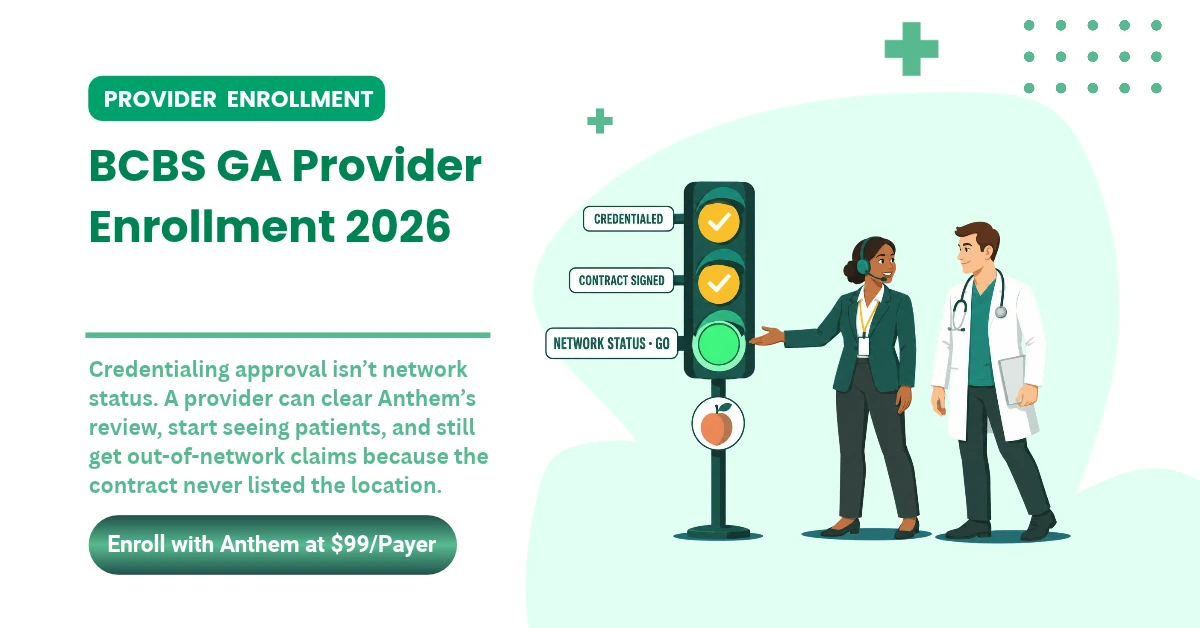
Provider enrollment is the administrative process: the payer establishes the billing relationship, assigns a provider identification number, and sets an effective date from which claims will be accepted. Credentialing approval doesn't activate billing. Enrollment completion does.
The credentialing-to-enrollment gap is the administrative period between payer credentialing approval and active billing authorization. It's the most consistently misunderstood revenue delay in provider onboarding.
A provider may receive credentialing approval from a commercial payer within 35 days, then wait an additional 10 to 20 days for the administrative enrollment to process and produce an effective billing date. Claims submitted to that payer during this gap will deny at adjudication regardless of clinical accuracy.
Practices that understand this distinction plan provider start dates against the projected effective billing date, not the projected credentialing approval date. Practices that don't understand it routinely submit claims into a denial window, then discover the enrollment gap only after the first EOB posts.
CAQH ProView bridges both processes by maintaining a centralized, payer-accessible repository of provider credential information. Most commercial payers and Medicare Advantage plans draw from it during credentialing. The CAQH profile reduces documentation burden at the point of enrollment, but it doesn't replace the payer's credentialing review process or eliminate the enrollment milestone that follows.
A completed CAQH profile is necessary for credentialing to begin. It doesn't make credentialing and enrollment the same event.
Leading credentialing services track the credentialing approval milestone and the effective billing date as two separate data points per payer, per provider. A practice with three providers enrolling with 12 payers each has 36 credentialing timelines and 36 distinct effective billing dates to track: 72 separate milestones, all with direct revenue implications.
Practices that receive a single "enrollment complete" notification without a payer-specific effective date summary are operating with incomplete billing authorization data.
MedSole manages credentialing and provider enrollment as a single sequential workflow, tracking credentialing approval and effective billing date separately for every active application, every payer, every provider. When your effective billing date posts, you know immediately, not from the next scheduled status report, but from a direct notification through your dedicated enrollment manager.
MedSole RCM: Credentialing, Billing, AR Follow-Up, and Denials Management as One Complete Revenue Cycle Solution
The 10 standards in this guide address the credentialing phase of the revenue cycle. That's the enrollment foundation that authorizes billing. But credentialing is just the first stage.
The full cycle continues through every claim submitted, every denial received, and every dollar sitting in accounts receivable. MedSole RCM delivers each phase as a single integrated solution, with the same operational standards applied across every function.
Provider Enrollment and Credentialing: Flat-rate enrollment through our credentialing services at $99 per payer. Dedicated enrollment managers, biweekly follow-up, 99% first-time approval rate, all 50 states, no setup fees. Complete CAQH profile management, revalidation tracking, and continuous OIG, SAM.gov, and NPDB sanctions monitoring are included as standard functions.
Outsourced Medical Billing: Full billing cycle management at 2.99% of collections. Claim submission, ERA/EOB posting, patient statement management, payer follow-up, and payment posting. No per-claim fees and no minimum volume requirements.
Accounts Receivable Follow-Up: Structured AR follow-up services targeting every aging claim category, with escalation protocols for claims approaching timely filing limits. Every outstanding claim is monitored through recovery or documented write-off. No aging receivables silently draining net collections without active resolution.
Denials Management: Systematic denial pattern analysis by payer, denial code, and provider. The focus is on identifying and correcting the root-cause submission errors generating recurring denials, not on treating each denial as an isolated billing event. Practices with persistent denial rates above 5% consistently find addressable, correctable patterns within the first 90 days of MedSole's denial review process.
MedSole RCM manages the complete billing cycle at 2.99% of collections, the most affordable full-service medical billing rate available to independent and group practices, with no per-claim fees, no setup charges, and no long-term contract requirements.
The operational advantage of single-vendor medical credentialing services and billing is institutional knowledge transfer. When MedSole's enrollment manager already knows your payer mix, provider roster, effective billing dates, and specialty-specific reimbursement schedules, the transition to active billing requires no onboarding and no documentation retransmission.
There's no coordination gap between two vendors who've never shared a client file. Revenue cycle management services delivered as a single workflow, by a single team, from first enrollment through ongoing collections.
MedSole RCM delivers the complete revenue cycle as a single integrated solution: provider enrollment and credentialing at $99 per payer, medical billing at 2.99% of collections, accounts receivable follow-up, and denials management, making it the most affordable full-service RCM company available to independent and group practices nationwide.
Section 6 answers the most common questions practices ask before selecting a credentialing partner: specific answers to the decisions that matter most.
Frequently Asked Questions: Provider Enrollment, Credentialing, and Revenue Cycle Management
What is medical credentialing?
Medical credentialing is the formal process by which healthcare payers, including Medicare, Medicaid, and commercial insurers, verify a provider's qualifications before authorizing network participation and claim submission.
Payers review education, training, board certifications, licensure, and malpractice history. Every provider who intends to bill insurance rather than operating on a private-pay basis must complete this process.
Without completed credentialing with a specific payer, claims submitted by that provider to that payer will be denied at adjudication regardless of clinical or coding accuracy. Credentialing must be completed separately for each payer. Approval from one doesn't transfer to any other.
How long does insurance credentialing take?
Insurance credentialing timelines vary meaningfully by payer type. Commercial payers, including Aetna, Cigna, UnitedHealthcare, Humana, and regional BCBS chapters, typically process in 30 to 45 days with active biweekly follow-up.
Medicare via PECOS takes 45 to 60 days, governed by CMS processing timelines. Medicaid fee-for-service varies by state from 45 to 75 days. Medicaid managed care organizations range from 60 to 120 days depending on the MCO and regional volume. Tricare and VA Community Care Network typically take 60 to 90 days.
The primary controllable variable affecting the timeline is follow-up frequency. Applications with consistent, documented biweekly contact with payer enrollment representatives process significantly faster than applications left in passive queues.
How much do credentialing services cost?
Credentialing service pricing operates across three models with substantially different cost structures.
Percentage-of-revenue models charge 3% to 8% of collections with no ceiling and no correlation to enrollment work performed. Hourly retainer models charge $75 to $150 per hour with no enrollment outcome guarantee. Per-payer flat-rate models charge a fixed fee per enrollment regardless of practice size or collections volume.
MedSole RCM charges $99 per payer enrollment, the most affordable flat-rate credentialing option in the market, with no setup fees and no hidden charges. For a practice enrolling with 15 payers, the total credentialing cost is $1,485. For 30 payers, $2,970. That's a predictable, fixed cost with no percentage-of-revenue exposure.
What is the difference between credentialing and provider enrollment?
Credentialing is the payer's verification process. A provider's qualifications, licensure, board certifications, and malpractice history are reviewed to determine network participation eligibility.
Provider enrollment is the administrative process that follows. The payer establishes the billing relationship, assigns a provider identification number, and sets an effective billing date from which claims are accepted.
Credentialing approval doesn't activate billing. Enrollment completion does. The period between credentialing approval and enrollment activation is called the credentialing-to-enrollment gap. Claims submitted during this gap will be denied at adjudication, producing revenue losses that aren't always retroactively recoverable. Both milestones must be tracked separately for every payer and every provider.
What happens if I bill insurance without being credentialed?
Billing a payer before credentialing is complete results in claim denials at adjudication. The revenue consequence depends on whether the payer permits retroactive billing to the credentialing effective date once enrollment is active.
Some commercial payers allow retroactive billing. Others don't, meaning revenue from the non-credentialed period is permanently unrecoverable. For Medicare, billing without active enrollment is a False Claims Act compliance issue, not just a billing error.
Providers shouldn't begin seeing insured patients with any payer until both credentialing approval and enrollment activation are confirmed in writing. The risk isn't just denied claims. It's potentially unrecoverable revenue from the entire non-credentialed billing period.
What is CAQH, and do I need it for credentialing?
CAQH ProView is a centralized, HIPAA-compliant provider data repository administered by the Council for Affordable Quality Healthcare. Most commercial payers, Medicare Advantage plans, and Medicaid managed care organizations access CAQH ProView during credentialing to retrieve provider qualification data.
That data includes education history, training, board certifications, licensure, malpractice coverage, and work history. Completing a CAQH profile is a prerequisite for credentialing with virtually every commercial payer.
Here's the risk: a CAQH profile with expired attestation (attestation must be renewed every 120 days), missing documents, or outdated information will stall credentialing across every payer that draws from it simultaneously. All payers are accessing the same data source.
How do I choose the best credentialing service for my practice?
Evaluate every credentialing service against 10 operational standards: CAQH profile accuracy and active management, payer coverage breadth across commercial, Medicare, and Medicaid, specialty-specific documentation expertise, nationwide enrollment capability across all 50 states, SLA-backed timelines with biweekly follow-up, transparent per-payer pricing with no hidden fees, real-time enrollment tracking with per-payer status visibility, dedicated specialist access without ticket-based support queues, continuous sanctions monitoring across OIG LEIE, SAM.gov, and NPDB, and verified performance metrics including first-time approval rates.
The best credentialing services meet all 10 standards and publish performance data, including approval rates, average timelines, and practice volume, to verify their claims before you sign.
What is sanctions monitoring, and why does it matter for my practice?
Sanctions monitoring is the continuous verification of active providers against three federal exclusion databases: the OIG List of Excluded Individuals and Entities (LEIE), the SAM.gov System for Award Management, and the National Practitioner Data Bank (NPDB).
A provider who's excluded from federal healthcare programs and continues billing creates False Claims Act liability. Penalties reach up to three times the overpayment amount plus up to $27,018 per false claim.
CMS can demand repayment of all claims paid during the full exclusion period, regardless of when the billing entity discovered the exclusion. Sanctions monitoring must be ongoing because new exclusions are posted monthly. A one-time check performed at initial credentialing isn't sufficient.
Can credentialing services negotiate better payer contracts?
A dedicated credentialing service specialist with deep knowledge of your practice's specialty mix, patient volume, and geographic demographics can advocate for more favorable reimbursement schedules during the payer enrollment process. That includes access to carve-out arrangements and contract terms that default enrollment processes never pursue.
This advantage is specific to credentialing services that assign one dedicated enrollment manager per practice. Specialists who've built working relationships with payer contracting representatives over repeated engagements have standing and context that general support models can't replicate.
The contract negotiation benefit comes from practice-specific knowledge accumulated over time. It isn't available from credentialing vendors that rotate specialists across accounts.
Does MedSole handle credentialing across all 50 states?
Yes. MedSole RCM provides provider enrollment and credentialing services across all 50 states, covering commercial carriers (Aetna, Cigna, UnitedHealthcare, BCBS, Humana, Anthem, Molina, and Centene), government programs (Medicare via PECOS, Medicaid fee-for-service and managed care), and specialty payers (Tricare, VA Community Care Network, and Workers' Compensation).
Every practice is assigned a dedicated enrollment manager who handles the full credentialing lifecycle at $99 per payer enrollment with no setup fees, no hidden charges, and no percentage-of-revenue pricing. Biweekly follow-up on every active application is standard protocol, not an add-on.
MedSole maintains a 99% first-time payer approval rate across all states and payer types, with commercial enrollments completing in 30 to 45 days.