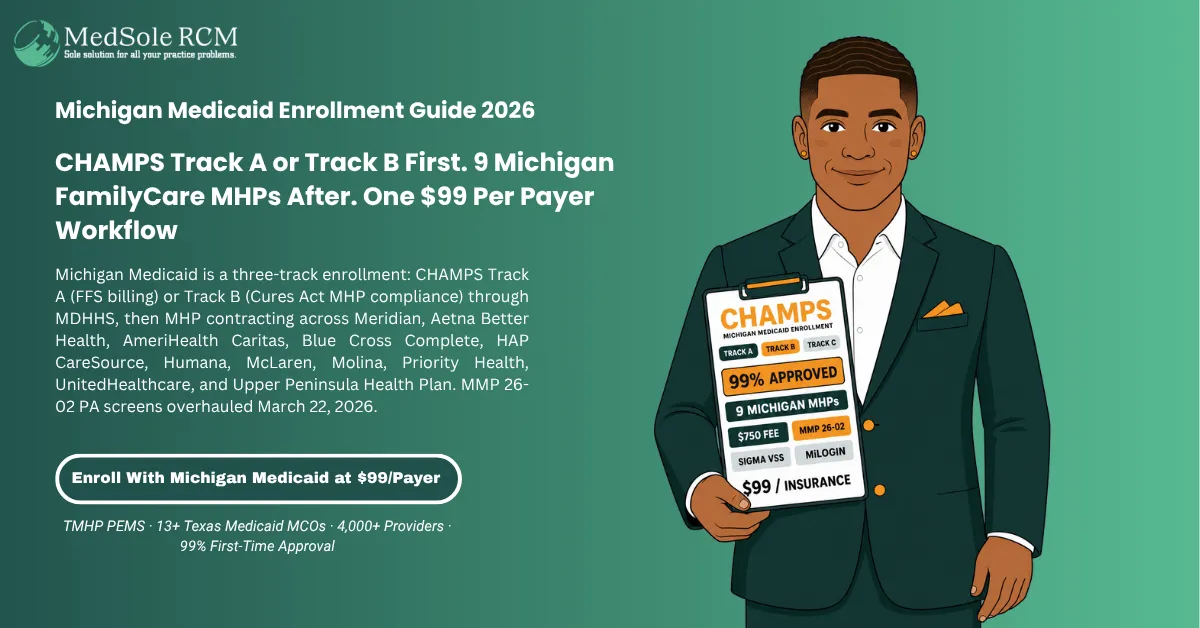




Medicaid michigan provider enrollment is the federally mandated state-administered process governed by 21st Century Cures Act Section 5005 and 42 CFR Part 455 through which healthcare providers register with the Michigan Department of Health and Human Services (MDHHS) via the CHAMPS Provider Enrollment portal. The MDHHS Provider Enrollment helpline is 1-800-292-2550 option 4. CHAMPS (Community Health Automated Medicaid Processing System) is Michigan's official Medicaid enrollment, claims, and prior authorization platform serving 2.6 million Michigan residents.
Michigan Medicaid faces three critical medicaid michigan provider enrollment inflection points in 2026. Per Policy Bulletin MMP 26-02, CHAMPS Prior Authorization screens were overhauled effective March 22, 2026, with new 7-calendar-day standard PA determination timelines (extendable to 14 days) and 72-hour expedited determinations.
Per One Big Beautiful Bill Act (OBBBA), MDHHS begins HMP work requirements outreach by September 30, 2026, with 80-hours-per-month work requirements taking effect January 1, 2027.
Per federal CMS 2026 Physician Fee Schedule, Michigan applied a 2.5% statutory rate increase effective January 1, 2026, plus new HCPCS codes adopted via Bulletin MMP 26-03. The CY 2026 federal application fee is $750 per service location for institutional providers.
Standard CHAMPS processing for medicaid michigan provider enrollment takes 60-90 days for clean applications.
Michigan operates a structurally unique three-track enrollment architecture: Track A (CHAMPS FFS enrollment for billing providers), Track B (21st Century Cures Act enrollment for MHP network compliance, which does NOT authorize FFS billing), and Track C (Medicaid Health Plan contracting across 9 active Michigan MHPs).
Per the April 16, 2026 MDHHS Provider Enrollment Correspondence Address Reminder, all CHAMPS enrollment changes must be submitted within 35 days or providers risk claim denials and payment impacts.
This medicaid michigan provider enrollment guide walks through the Michigan Medicaid operational ecosystem via MDHHS, CHAMPS, MiLogin (state authentication), and SIGMA Vendor Self-Service (VSS) prerequisite, and the federal framework under 21st Century Cures Act and 42 CFR Part 455.
The 10 critical 2026 regulatory updates covered include: MMP 26-02 CHAMPS PA screen overhaul, OBBBA work requirements, 2.5% fee schedule increase plus new HCPCS codes via MMP 26-03, $750 CY 2026 application fee, 35-day update rule, telehealth restriction removals, post-payment review intensification, MICH 2026 county plan changes, MDHHS-6200 form replacing DHS-54A, and CHAMPS Provider Verification Tool for OPR enrollment compliance.
The guide also covers the complete CHAMPS enrollment pathway and the post-Cures 9-MHP Michigan FamilyCare contracting layer (Aetna Better Health, AmeriHealth Caritas, Blue Cross Complete, HAP CareSource, Humana Healthy Horizons, McLaren Health Plan, Meridian Health Plan, Molina Healthcare, Priority Health Choice, UnitedHealthcare Community Plan, and Upper Peninsula Health Plan).
We're MedSole RCM. We've credentialed more than 4,000 providers across all 50 states at $99 per insurance with a 99% first-time approval rate and the fastest Michigan Medicaid enrollment approval timeline in the United States through continuous CHAMPS follow-up.
Industry credentialing companies charge $150 to $300 per payer with 60 to 120 day passive timelines that leave Michigan providers waiting through CHAMPS's 60-90 day processing baseline plus 30-60 day 21st Century Cures Act registration plus 60-120 day MHP credentialing per MHP, up to 6 months total without expert acceleration.
MedSole RCM is the most affordable Michigan Medicaid provider enrollment partner in the United States. No setup fees. No hidden charges. No annual contracts.
If you're a Michigan group practice, behavioral health agency coordinating with Magellan, Home Help caregiver enrolling through CHAMPS, DMEPOS supplier facing HIGH-risk fingerprint screening, FAO (Facility/Agency/Organization) provider managing the $750 fee per location, OPR-only provider, HCBS waiver provider, telehealth practice serving Michigan Medicaid members, multi-MCO contracting applicant navigating the 9-MHP landscape, or rendering provider awaiting billing provider approval, this guide answers the operational questions MDHHS subpages don't surface for buyers. Section 2 covers the big picture.
Michigan Medicaid in 2026: The Big Picture for Medicaid Michigan Provider Enrollment and michigan medicaid provider enrollment operators
Michigan Medicaid (formally Medical Assistance, or MA) covers approximately 2.6 million Michigan residents as of 2026, about one in four people in the state.
MDHHS administers Michigan Medicaid through CHAMPS (Community Health Automated Medicaid Processing System), the web-based Medicaid Management System for provider enrollment, eligibility verification, claims activity, prior authorization, and ordering/referring provider verification. Michigan operates near-total managed care with 9 active Medicaid Health Plans (MHPs).
Who Michigan Medicaid Covers (2.6 Million Residents)
Michigan Medicaid serves children, pregnant women, parents and caretakers, working-age adults through the Healthy Michigan Plan (HMP, Michigan's ACA expansion program covering approximately 750,000 adults ages 19-64 up to 138% FPL), seniors, and people with disabilities.
Children's Special Health Care Services (CSHCS) provides specialty coverage for children with qualifying diagnosis codes. Maternity Outpatient Medical Services (MOMS) covers maternity services. MI Choice Waiver provides HCBS for elderly and disabled adults requiring nursing-facility-level care. Nursing Home Medicaid operates as an entitlement with no waitlist.
How MDHHS Administers Michigan Medicaid Through CHAMPS
MDHHS is Michigan's single State Medicaid agency. MDHHS administers Michigan Medicaid through three primary operational components: MDHHS itself as the policy and administrative agency; CHAMPS as the electronic enrollment, claims, PA, and provider verification platform at michigan.gov/mdhhs; and MiLogin as the state authentication system every CHAMPS user must register through before accessing CHAMPS functions.
Per MDHHS Provider Enrollment guidance, CHAMPS handles provider enrollment, revalidation, change of ownership, maintenance requests, ordering/referring/prescribing verification, prior authorization, and claims processing. The CHAMPS Provider Verification Tool lets providers verify ordering/referring/attending NPI enrollment status, which is critical for avoiding OPR-related claim denials. Per April 16, 2026 MDHHS guidance, all enrollment changes must be submitted within 35 days.
Typical vs Atypical Provider Classification (CMS-Defined)
CMS divides Michigan Medicaid providers into two broad categories. Typical Providers furnish, bill, or are paid for healthcare in the normal course of business, including physicians, dentists, hospitals, pharmacies, nursing facilities, behavioral health agencies, and DMEPOS suppliers. They enroll in CHAMPS with a National Provider Identifier (NPI Type 1 or Type 2).
Atypical Providers do NOT provide healthcare in the traditional sense, including Home Help individual caregivers, Non-Emergency Medical Transportation (NEMT) providers, and Adult Foster Care (AFC) providers.
Atypical providers enroll in CHAMPS or Bridges but do not meet the HIPAA definition of healthcare provider and do NOT receive an NPI. Both Typical and Atypical providers face the same 35-day update rule and CHAMPS enrollment requirement.
Michigan Medicaid Programs (Medical Assistance + HMP + CSHCS + MOMS + MI Choice + Nursing Home Medicaid)
Medicaid michigan provider enrollment covers 6 distinct program layers. Medical Assistance (MA) is the foundational Medicaid program covering children, parents, and disability-eligible populations. The Healthy Michigan Plan (HMP) is Michigan's ACA expansion covering approximately 750,000 adults ages 19-64 up to 138% FPL with no asset test.
Children's Special Health Care Services (CSHCS) provides specialty coverage for children with qualifying diagnosis codes.
Maternity Outpatient Medical Services (MOMS) covers maternity services. MI Choice Waiver provides HCBS for elderly and physically disabled adults requiring nursing-facility-level care.
It requires at least 2 waiver services on a continual basis including supports coordination, and applicants are placed on a waitlist when waiver agencies are at capacity.
Nursing Home Medicaid is an entitlement with no waitlist, with a 2026 income cap of $2,982/month, an asset limit of $9,950, and uses Medically Needy spend-down for income above $2,982.
Michigan Medicaid Member vs Provider Enrollment Disambiguation
Michigan Medicaid is the PROGRAM covering 2.6 million Michigan members. CHAMPS is the PROVIDER-SIDE portal for healthcare providers seeking to enroll, bill, and receive reimbursement. Healthcare providers enroll through MDHHS via CHAMPS at michigan.gov to receive Medicaid reimbursement.
Individuals seeking Michigan Medicaid coverage as patients apply through MDHHS Beneficiary Helpline at 1-888-642-4845 or through MDHHS local offices. Provider enrollment calls go to 1-800-292-2550 option 4, a different line. This guide covers provider enrollment exclusively. Members are directed to MDHHS for coverage applications.
MedSole's Medicaid credentialing experts framework walks through multi-state Medicaid credentialing complexity that Michigan providers face given 2026 regulatory pressures. Section 3 covers the 10 critical 2026 updates.
What's New in 2026: 10 Critical Updates Every Michigan Medicaid Provider Must Know
Ten material 2026 updates affect medicaid michigan provider enrollment right now. Policy Bulletin MMP 26-02 overhauled CHAMPS Prior Authorization screens effective March 22, 2026. OBBBA Federal Rule Changes begin HMP work requirements outreach September 30, 2026 with 80-hour-per-month work requirements taking effect January 1, 2027.
A 2.5% fee schedule increase plus new HCPCS codes via MMP 26-03 took effect January 1, 2026. The $750 CY 2026 federal application fee applies per service location. The 35-day CHAMPS update rule carries claim denial consequences for non-compliance. Post-payment review activity is intensifying.
Telehealth inpatient and nursing facility restrictions have been permanently removed. Newborn quarterly takeback recovery carries a 120-day rebilling window. CHAMPS system maintenance follows a predictable 2026 outage calendar. 21st Century Cures Act enforcement is intensifying with MHP network removal risk.
Update 1: CHAMPS Prior Authorization Screen Overhaul (Policy Bulletin MMP 26-02, Effective March 22, 2026) , HIGHEST URGENCY
The single most operationally impactful 2026 CHAMPS system change. Per Policy Bulletin MMP 26-02, MDHHS announced on February 11, 2026 that CHAMPS Prior Authorization screens were updated for more efficient processing. CHAMPS PA screens went live with a new format on March 22, 2026.
Critical operational changes effective March 22, 2026: Standard PA determinations are made no later than 7 calendar days after MDHHS receives the request, extendable to 14 calendar days upon provider request. Expedited PA determinations are made no later than 72 hours after MDHHS receives the request.
For Returned PA requests, providers may now upload additional information directly to the existing PA request in CHAMPS. A NEW PA request is no longer required for Returned PAs. PA requests through direct CHAMPS data entry are recommended; fax requests are still accepted.
The annual performance report was posted on the CHAMPS PA website by March 31, 2026.
Provider action required: Update all internal PA workflows immediately. Train billing staff on new CHAMPS PA screens. All pre-March 22 PA screen guides are now outdated.
Update 2: OBBBA Work Requirements (Outreach September 30, 2026, Effective January 1, 2027)
Per One Big Beautiful Bill Act (OBBBA), MDHHS will begin outreach to Healthy Michigan Plan (HMP) members about upcoming work requirements by September 30, 2026. Work requirements take effect January 1, 2027.
Three critical operational anchors: HMP members ages 19-64 must work, volunteer, or attend school 80 hours per month to maintain coverage. Exemptions include pregnant members, medically frail members, and members receiving disability benefits. Retroactive coverage reduces from 3 months to 2 months starting January 2027.
Provider revenue cycle impact is EXTREME. Expect increased patient eligibility churn, coverage gaps, eligibility verification failures at claim submission, and retroactive disenrollment events beginning Fall 2026. Providers MUST verify eligibility at EVERY single patient visit via CHAMPS or HIPAA 270/271 transactions, not just at registration.
Practices that don't adapt monthly eligibility verification workflows will see claim denial volume increase materially in Q4 2026 and 2027.
Update 3: 2.5% Fee Schedule Rate Increase + New HCPCS Codes (MMP 26-03, Effective January 1, 2026)
Per federal CMS 2026 Physician Fee Schedule, MDHHS applied a 2.5% statutory payment increase to Michigan Medicaid Fee Schedule effective January 1, 2026. New HCPCS codes were adopted via Bulletin MMP 26-03, issued January 22, 2026. Telehealth frequency restrictions on inpatient and nursing facility visits were permanently removed.
Physician-dispensed drug reimbursement is now limited to 42 days under Workers' Comp. Use the CHAMPS Code and Rate Reference tool for current 2026 fee schedule rates, with three-year history maintained. Provider impact is direct revenue improvement on January 1, 2026 claims for impacted CPT/HCPCS codes.
Update 4: $750 CY 2026 Federal Application Fee (Step 13 Fee Payment Workflow)
Per CMS Federal Register Notice, the CY 2026 federal provider enrollment application fee is $750 effective January 1, 2026. Federal authority: 42 CFR §455.460. Michigan routes this through CHAMPS Step 13 (Fee Payment) for institutional/FAO providers per provider type and specialty.
The fee is assessed in full for each service location at initial enrollment, revalidation, and CHOW. It is NOT annual.
Exemption pathways: individual physicians and non-physician practitioners, physician/dental/therapy groups, Rendering/Servicing-only enrollments, OPR-only enrollments, Medicare-enrolled providers (with PECOS validation), providers who paid the fee to another state's Medicaid for that location (with proof), and financial hardship waiver with documentation.
Update 5: 35-Day CHAMPS Update Rule (April 16, 2026 MDHHS Alert)
Per April 16, 2026 MDHHS Provider Enrollment Correspondence Address Reminder, all CHAMPS enrollment changes must be submitted within 35 days. The 35-day window applies to ALL enrollment changes: practice locations, RA and correspondence addresses, ownership changes, key contact email, pay-to and remit changes.
Failure consequences include claim denials or payment impacts per MDHHS warning. MDHHS uses the provider email address entered in CHAMPS for ALL provider communications. Treat CHAMPS maintenance as a revenue protection function, not a credentialing admin task.
Schedule monthly CHAMPS data audits to catch updates before the 35-day deadline.
Update 6: Post-Payment Review Intensification (January 5, 2026 Alert)
Per January 5, 2026 MDHHS Post-Payment Review reminder, all Medicaid-reimbursed services are subject to review for conformity with accepted medical practice and Medicaid coverage and limitations. Post-payment audits are actively conducted.
Medical records, quality assurance documents, financial records, administrative records, and other documents must be available upon authorized agent request. State or federal government agents can request review. Audit activity is actively escalating in 2026. Ensure complete documentation compliance immediately.
Update 7: Telehealth Inpatient/Nursing Facility Restrictions Permanently Removed
Telehealth access expanded significantly for Michigan Medicaid in 2026. Frequency restrictions on inpatient and nursing facility visits have been permanently removed, giving providers greater billing flexibility for virtual care. Providers can bill telehealth visits at clinical discretion for both inpatient and nursing facility settings.
This is a permanent change, not a COVID-era temporary expansion. Telehealth parity continues at policy alignment with in-person services.
Update 8: Newborn Quarterly Takeback Recovery Window (January 27, 2026 Alert)
Per January 27, 2026 MDHHS alert, the latest batch of MDHHS Quarterly Newborn Recoveries is being processed. Fee-for-service claims for newborns retroactively enrolled into a Medicaid Health Plan must be submitted to the Medicaid Health Plan within 120 days from the Medicaid Remittance Advice date.
Hospitals and pediatric providers serving newborn populations face direct rebilling obligation. Claims are routed to the appropriate MHP based on infant retroactive enrollment.
Update 9: CHAMPS System Maintenance Schedule + 2026 Outage Calendar
CHAMPS operates on a predictable maintenance schedule providers must plan around. April 18, 2026 6:00 PM ET through April 19, 2026 9:00 AM ET was a planned maintenance window. May 16, 2026 6:00 PM ET through May 17, 2026 9:00 AM ET was an emergency release outage.
On an ongoing basis, the 3rd Saturday of each month CHAMPS undergoes maintenance from 6:00 PM ET to 9:00 AM ET Sunday. Schedule critical CHAMPS transactions for early week (Tuesday through Thursday) to avoid weekend maintenance. Monitor the MDHHS Provider Alerts page for emergency outage announcements.
Update 10: 21st Century Cures Act Enforcement Intensification , MHP Network Removal Risk
Per 21st Century Cures Act Section 5005, all providers serving Michigan Medicaid members through MHP networks or fee-for-service must enroll with the state Medicaid agency. All providers serving Michigan MHP members must enroll with MDHHS via CHAMPS. Providers who don't comply risk removal from Michigan FamilyCare MHP networks.
Claims deny for providers not registered with Michigan Medicaid or without a Michigan Medicaid Provider ID. Cures Act registration is SEPARATE from credentialing and contracting with MHPs. Michigan MHPs verify Cures Act registration through CHAMPS provider files.
Cross-program termination cascade: termination in one state's Medicaid triggers automatic review in all enrolled states.
Ten 2026 updates means Michigan Medicaid provider enrollment is at a critical inflection point. MedSole handles the full burden at $99 per insurance.
MedSole's Michigan Medicaid enrollment service handles the entire 2026 compliance burden at $99 per insurance with the fastest Michigan Medicaid enrollment approval timeline through continuous CHAMPS follow-up. Industry credentialing companies charge $150 to $300 per payer with 60 to 120 day passive timelines.
The foundational distinction every Michigan provider needs follows next: the three-track enrollment architecture.
The Three-Track Michigan Medicaid Enrollment Model: CHAMPS FFS, 21st Century Cures, and MHP Contracting
Medicaid michigan provider enrollment operates a structurally unique three-track architecture per MDHHS and CHAMPS guidance. Track A: Full Michigan Medicaid Fee-for-Service (FFS) enrollment via CHAMPS. Track B: 21st Century Cures Act enrollment for managed care network compliance, which does NOT authorize FFS billing.
Track C: MHP contracting and credentialing, separate from state enrollment. Confusing these tracks is the most common operational mistake in Michigan Medicaid enrollment, costing practices weeks of rework and potential claim denials.
Track A: Full Michigan Medicaid Fee-for-Service (FFS) Enrollment via CHAMPS
Track A is the traditional enrollment path used when a provider needs to be authorized to bill Michigan Medicaid FFS (where applicable) and appear as an active participating FFS provider. The CHAMPS Provider Enrollment portal is where providers choose their enrollment type and pull the appropriate enrollment package.
Track A operational specifics: Enrollment platform is the CHAMPS Provider Enrollment subsystem. Required prerequisites are SIGMA VSS registration plus MiLogin account plus Provider Domain Administrator setup. Submission is online through the CHAMPS portal. Processing time is 60-90 days for clean applications.
Application fee is $750 CY 2026 for institutional/FAO providers per service location. Track A providers can bill Michigan Medicaid FFS directly AND MHPs (if separately contracted). Different enrollment types apply for Individual/Sole Proprietor, Group, Rendering/Servicing, FAO, Billing Agent, and Atypical providers.
Track B: 21st Century Cures Act Enrollment (MHP Network Compliance , NOT FFS Billing)
Track B is the most misunderstood enrollment path in Michigan Medicaid. Per 21st Century Cures Act Section 5005, effective January 1, 2018, the Cures Act requires MHP network providers to enroll with the state Medicaid agency to remain in MHP networks.
Critical Track B operational rules: The purpose is managed care network participation only, NOT FFS billing. Cures-only providers cannot bill Michigan Medicaid FFS directly. Cures-only providers CAN serve MHP members through credentialed network contracts.
Cures-only providers may be identified on FFS claims as ordering/referring/prescribing/attending providers (with assigned ID) but cannot themselves bill FFS. Cures-only providers can subsequently submit a full FFS application to gain Track A authorization. Cures Act registration is REGISTRATION, not credentialing. MHPs still credential separately.
Track C: Michigan FamilyCare MHP Contracting and Credentialing (Separate from State Enrollment)
Track C is the multi-payer credentialing layer that follows Track A or Track B completion. After CHAMPS enrollment, providers must contract separately with each Michigan FamilyCare MHP.
Track C operational details: The 9 active Michigan FamilyCare MHPs are Aetna Better Health of Michigan, AmeriHealth Caritas Michigan, Blue Cross Complete of Michigan, HAP CareSource, Humana Healthy Horizons Michigan, McLaren Health Plan, Meridian Health Plan of Michigan (Wellcare-Meridian), Molina Healthcare of Michigan, Priority Health Choice, UnitedHealthcare Community Plan Michigan, and Upper Peninsula Health Plan.
Most MHPs pull credentialing data from CAQH ProView. All Michigan FamilyCare MHPs follow NCQA-aligned credentialing standards including Primary Source Verification and committee review. Credentialing timeline is 60 to 120 days per MHP.
MICH 2026 county plan changes affect specific MHPs (UPHP unavailable in 3 counties, Molina unavailable in St. Joseph County). Section 10 covers all 9 Michigan FamilyCare MHPs in dedicated detail.
Why MHP Credentialing Requires CHAMPS Approval First (21st Century Cures Act Federal Mandate)
Critical operational sequencing rule rooted in federal law: Per the federal 21st Century Cures Act Section 5005, ALL providers (billing, servicing, ordering, referring, or prescribing) who serve Medicaid members through MHP networks or fee-for-service must enroll directly with the state Medicaid agency. In Michigan, this means enrollment with MDHHS through CHAMPS via Track A OR Track B.
Michigan FamilyCare MHPs are PROHIBITED from contracting with providers who don't complete CHAMPS enrollment. MHPs verify Cures Act registration directly with CHAMPS before approving Track C participation.
Attempting to credential with a Michigan MHP before receiving a Michigan Medicaid Provider ID is the most common avoidable cause of enrollment delays. Our physician credentialing services pathway walks through specialty-specific credentialing operational depth.
Why "We're Enrolled" Often Means "We're Cures-Only" (The Most Common Michigan Misconception)
A surprising number of "we're enrolled with Michigan Medicaid" situations are actually Track B (Cures-only). This breaks revenue cycle workflows when a service ends up needing FFS billing , wraparound benefits, retro eligibility scenarios, certain carve-outs (LTSS waiver services, certain dental services, certain behavioral health services).
Practices assume FFS billing authorization without verifying they completed Track A. Claim denials follow. Verify your Track designation in CHAMPS before assuming billing eligibility. Section 6 covers exactly how to check enrollment status through the CHAMPS Provider Verification Tool.
Section 5 covers michigan medicaid provider enrollment + medicaid michigan provider enrollment provider type pathways and federal risk-based screening under CHAMPS.
Michigan Provider Type Pathways and Federal Risk-Based Screening Under CHAMPS
Medicaid michigan provider enrollment operates enrollment type selection plus federal categorical risk-level assignment under 42 CFR §455.450: Limited, Moderate, or High. Per 42 CFR Part 455 and CHAMPS guidance, Michigan providers must be screened according to their assigned risk levels during enrollment, revalidation, and change of ownership.
Michigan also requires ordering, referring, prescribing, and attending (OPR) providers to enroll via CHAMPS even if they don't bill directly per federal mandate 42 CFR §455.410.
5 Michigan Medicaid Enrollment Triggers (What Counts as a Full Application)
Michigan is clear about what counts as a full enrollment application (not just a minor update).
Per CHAMPS guidance, a full enrollment application is required for: enrolling for the first time (initial CHAMPS enrollment), adding a service location (each service location is a separate application), converting OPR-only to Rendering provider (Track B to Track A upgrade), and reporting a Change of Ownership (CHOW, must update within 35-day disclosure window).
Revalidation also triggers a full enrollment application (every 5 years standard, 3 years for DME/HME).
Critical operational rule: Adding a service location or reporting a CHOW is NOT just a portal edit. These are FULL enrollment applications subject to the $750 CY 2026 fee per service location plus risk-based screening. The 2026 federal compliance emphasis has tightened CHOW and add-service-location to elevated audit risk if treated as routine maintenance.
CHAMPS Enrollment Type Selection (Individual/Sole Proprietor vs Rendering/Servicing vs Group vs FAO vs Billing Agent vs Atypical)
Per CHAMPS guidance, Michigan's enrollment type determines required documentation for enrollment or revalidation, application form pathway, risk category assignment (Limited, Moderate, or High), application fee assignment ($750 per service location for institutional/FAO providers), and SIGMA VSS prerequisite (required for Individual/Sole Proprietor, Group, FAO; NOT required for Rendering/Servicing-only).
Michigan's CHAMPS enrollment types: Individual/Sole Proprietor owns their own practice and receives payments directly from MDHHS. Rendering/Servicing renders through another enrolled billing provider (group/FAO/individual), does NOT bill directly, and billing provider must be approved in CHAMPS BEFORE Rendering/Servicing enrollment is submitted.
Group is the practice organization billing for multiple providers. FAO (Facility/Agency/Organization) includes hospitals, nursing facilities, labs, etc. with Type 2 NPI. Billing Agent must enroll in CHAMPS, replacing the older paper "Billing Agent ID Request" form.
Atypical is the CMS-defined category for providers that do NOT provide healthcare (Home Help, NEMT, Adult Foster Care). Atypical providers generally don't meet the HIPAA "health care provider" definition and do NOT receive an NPI.
Our best credentialing services framework covers the 10 operational standards for evaluating credentialing service providers across multiple state Medicaid programs.
Ordering/Referring/Prescribing/Attending (OPR) Enrollment via CHAMPS Provider Verification Tool
Michigan Medicaid requires OPR providers to enroll separately. Per CHAMPS Provider Verification Tool guidance, federal requirement 42 CFR §455.410 mandates ordering, referring, and attending professionals be enrolled.
Michigan-specific OPR operational rules: OPR-only applicants are not authorized to bill or receive Michigan Medicaid reimbursement. No application fee: OPR-only enrollments are exempt from the $750 CY 2026 federal fee. Claims can be denied if the ordering/referring/prescribing/attending professional is not enrolled. Denials hit the BILLING provider level.
The CHAMPS Provider Verification Tool verifies any provider's enrollment status before submitting claims. Provider TIN (EIN/SSN) is used for claim adjudication; NPI numbers must be reported in applicable claim loops/fields (billing, rendering, referring, ordering, prescribing).
If billing claims deny for "ordering/referring not enrolled," enroll the OPR clinician via CHAMPS immediately and verify enrollment via the CHAMPS Provider Verification Tool before claim resubmission.
Limited Categorical Risk Screening
Limited risk screening covers most Michigan physicians and mid-level practitioners.
Per 42 CFR §455.450, Limited risk includes license verification through Michigan Board of Medicine, Michigan Board of Nursing, Michigan Board of Pharmacy, Michigan Board of Psychology, and Michigan LARA; plus NPI verification through NPPES and OIG LEIE exclusion check.
Ownership/controlling interest verification per 42 CFR §455.104 (5-percent ownership disclosure) and database checks (SAM.gov, Social Security Death Master List, Provider Termination database) are also required.
Limited risk screening typically completes within the standard 60-90 business day CHAMPS processing window.
Moderate Categorical Risk Screening (Including Site Visits)
Moderate risk screening adds pre-enrollment or post-enrollment unannounced site visits to Limited screening. CHAMPS or its agents conduct site visits to verify information submitted is accurate and to determine compliance with federal and state enrollment requirements.
Michigan Moderate risk provider examples include home health agencies, outpatient therapy clinics, behavioral health agencies (Magellan coordination), ambulatory surgical centers, FQHCs and Rural Health Clinics (in some categories), personal care services providers, and some HCBS waiver providers.
Site visit documentation includes exterior photos, signage, suite entry photos, tenant directory photos, and practice representative signature acknowledging site visit occurred. Unannounced site visits add 14 to 45 days to standard enrollment timeline beyond the 60-90 day CHAMPS processing baseline.
High Categorical Risk Screening (Including Fingerprint Background Checks)
High risk screening adds fingerprint-based criminal background checks under 42 CFR §455.434 for the provider AND any person with 5 percent or greater direct or indirect ownership interest.
Michigan High risk providers include new DMEPOS suppliers, home infusion providers, personal care services providers (some categories), certain home health agencies, NEMT providers (subject to current state-specific policies), and Personal Care Services (PCS) providers including Home Help with criminal history screening.
High risk screening typically extends Michigan Medicaid enrollment timelines by 30 to 60 days beyond the 60-90 day CHAMPS processing baseline. Cross-program termination cascade: termination in one state's Medicaid triggers automatic review in Michigan.
When CHAMPS Applies Mandatory High-Risk Screening Override
CHAMPS can elevate a provider to High risk screening regardless of provider type when CHAMPS has imposed a payment suspension based on credible fraud allegations, the provider has an existing Michigan Medicaid overpayment, or the provider has been excluded by OIG or another state's Medicaid program within the previous 10 years.
A temporary moratorium for the provider's type being lifted within the previous 6 months also triggers override.
Operational implication: Self-screen against OIG LEIE and any state Medicaid exclusion databases BEFORE submitting CHAMPS application to avoid HIGH-risk override triggers.
Knowing your enrollment trigger, provider type selection (Individual/Sole Proprietor, Rendering/Servicing, Group, FAO, Billing Agent, or Atypical), risk level, and Michigan-specific HIGH-risk override triggers prepares you for the operational depth ahead. Section 6 walks through the complete CHAMPS enrollment process in sequential 12-step format.
The Complete 12-Step CHAMPS Enrollment Process
How to become a Michigan Medicaid provider through medicaid michigan provider enrollment follows 12 sequential steps via MDHHS through CHAMPS: determine your Track (FFS Track A vs Cures Track B), determine CHAMPS enrollment type, register in SIGMA VSS, and create MiLogin account with Provider Domain Administrator setup.
Then obtain NPI, update CAQH ProView, verify Michigan licensing board status, submit W-9 and EFT, access CHAMPS and submit enrollment application, and pay $750 CY 2026 fee if institutional/FAO.
Allow 60-90 days for processing with application screening and federal database verification. Site visit and fingerprint screening apply if Moderate/High risk. Finally, receive Michigan Medicaid Provider ID and initiate MHP credentialing across all 9 active Michigan FamilyCare MHPs.
Step 1: Determine Your Track (FFS, Cures, or Both) and Confirm Provider Need to Enroll
Step 1 starts before any portal interaction. Determine which Track applies: Track A (FFS, full FFS billing authorization), Track B (Cures-only, MHP network compliance, cannot bill FFS), or both. Verify your provider type is allowed for Michigan Medicaid enrollment per the MDHHS current allowed Typical and Atypical Enrollment lists.
Confusing Track A and Track B is the number one cause of Michigan Medicaid enrollment rework. Determine your Track designation BEFORE starting the application.
Step 2: Determine CHAMPS Enrollment Type (Individual/Group/FAO/Rendering/Billing Agent/Atypical)
Step 2 covers CHAMPS enrollment type selection per official MDHHS Step 2 page guidance. Individual/Sole Proprietor is for solo practice with direct payment from MDHHS. Rendering/Servicing renders through an enrolled billing provider, and that billing provider must be approved FIRST. Group is the practice organization.
FAO (Facility/Agency/Organization) covers hospitals, nursing facilities, labs, etc. with Type 2 NPI. Billing Agent must enroll in CHAMPS. Atypical is for CMS-defined providers that don't provide healthcare (Home Help, NEMT, AFC).
Picking the wrong enrollment type is the most common rework cause. Use official MDHHS Step 2 definitions before submitting.
Step 3: Register in SIGMA Vendor Self-Service (VSS)
Step 3 covers SIGMA Vendor Self-Service registration, which is required BEFORE starting CHAMPS enrollment for certain types per MDHHS Step 3 guidance. Individual/Sole Proprietor, Group, and FAO (Facility/Agency/Organization) all require SSN/EIN/TIN in SIGMA VSS. Rendering/Servicing-only providers are NOT required to register with SIGMA.
SIGMA VSS is Michigan's vendor management system. Registration ensures payment processing integrity. Without SIGMA enrollment, the CHAMPS application cannot proceed for affected enrollment types. Build SIGMA registration into your CHAMPS prerequisite checklist before any CHAMPS interaction begins.
Step 4: Create MiLogin Account + Set Up Provider Domain Administrator Governance
Step 4 covers MiLogin registration per MDHHS Step 4 guidance. MiLogin is Michigan's state authentication system required for ALL CHAMPS access.
Critical operational rules: Every CHAMPS user (Provider Enrollment, Claims, Prior Authorization, etc.) needs their own MiLogin User ID. No shared credentials are permitted. The MiLogin user who submits the Provider Enrollment application becomes the Provider Domain Administrator. The Domain Administrator assigns access to the provider file for other users. Domain access requests are submitted via email to MDHHS-DomainRequests@michigan.gov.
Designate ONE primary Provider Domain Administrator for compliance continuity. Build an internal succession plan for when that person leaves the practice.
Step 5: Obtain Your NPI (Type 1 Individual or Type 2 Organization)
Step 5 covers NPI registration. CHAMPS requires an NPI for all Typical providers. Confirm you have an active NPI Type 1 (individual) or NPI Type 2 (organizational) in NPPES. Group practices need NPI Type 2 in addition to each individual NPI Type 1.
Verify your taxonomy code matches your specialty designation. Confirm active Michigan professional license with the relevant Michigan professional licensing board. Federal DEA registration is required for prescribing providers. Atypical providers (Home Help, NEMT, AFC) do NOT receive an NPI.
Step 6: Update Your CAQH ProView Profile (for MHP Credentialing Preparation)
Step 6 covers credentialing data infrastructure for the MHP contracting layer (Track C). All 9 active Michigan FamilyCare MHPs pull credentialing data from CAQH ProView. Complete every mandatory field. Upload Michigan state license, malpractice declaration page, DEA Certificate (if applicable), board certificates, CV, W-9, and government-issued photo ID.
Authorize MDHHS, CHAMPS, and each Michigan FamilyCare MHP. Re-attest within 120 days per NCQA's Primary Source Verification standard.
Our complete medical billing and credentialing services guide walks through CAQH operational depth across multiple state Medicaid programs.
Step 7: Verify License Status with Michigan Professional Licensing Boards
Step 7 reinforces Michigan-specific operational rules. Confirm your active Michigan professional license with the relevant board: Physicians (Michigan Board of Medicine), RNs/APRNs/LPNs (Michigan Board of Nursing), Pharmacists (Michigan Board of Pharmacy), LCSWs/LMHCs (Michigan Board of Counseling plus Michigan Board of Social Work), Psychologists (Michigan Board of Psychology), and Dentists (Michigan Board of Dentistry).
Per CY 2026 federal final rule, providers must report changes to key profile information within 30 days (down from 90 days). Mismatches between Michigan licensing board records and CHAMPS data are the most common rejection cause.
Step 8: Submit Your Certified W-9 and EFT Authorization
Step 8 covers payment infrastructure setup. Submit your IRS W-9 form with your Tax Identification Number (TIN). For individual providers, the W-9 must be in your name with your Social Security Number and your original signature. For groups or facilities, the W-9 must include the EIN and an original signature from an authorized representative.
Complete EFT Authorization with a voided check or bank verification letter. Contact MDHHS Provider Support at 800-979-4662 or email ProviderSupport@michigan.gov to enroll in EFT. Direct deposit is faster and more reliable than paper checks.
Step 9: Access CHAMPS and Submit Provider Enrollment Application
Step 9 covers CHAMPS application submission. Navigate to michigan.gov/mdhhs/doing-business/providers/providers/medicaid/provider-enrollment and access CHAMPS through MiLogin. Select "Provider Enrollment Application" to initiate a new enrollment. The portal handles enrollment transactions including revalidation, adding service locations, reporting ownership changes, adding/removing rendering providers, and disenrollment.
Use the official MDHHS step-by-step CHAMPS enrollment guides specific to your enrollment type. Maintain accurate email in CHAMPS at all times. MDHHS uses the provider email address entered in CHAMPS for ALL provider communications. Per the 35-day update rule, any email change must be reported within 35 days.
Step 10: Pay the $750 CY 2026 Federal Application Fee (Step 13 Fee Payment)
Step 10 applies primarily to institutional/FAO providers. Per CHAMPS Step 13 Fee Payment instructions, the CY 2026 federal application fee is $750 per service location. The fee is assessed in full at initial enrollment, revalidation, and CHOW. It is NOT annual.
Payment methods include external payment gateway via CHAMPS, indicating fee paid to Medicare or another state Medicaid or CHIP with PECOS validation, or requesting a hardship waiver. Exemption pathways include individual physicians, non-physician practitioners, physician/dental/therapy groups, Rendering/Servicing-only enrollments, OPR-only enrollments, and Medicare-enrolled providers with PECOS validation.
Step 11: Application Screening + Site Visit + Fingerprint Background Check (If Applicable)
Step 11 covers CHAMPS's application screening process. Per 42 CFR §455.450, CHAMPS performs NPI verification through NPPES, license verification with the relevant Michigan professional licensing board, OIG LEIE exclusion check (provider AND all owners with 5 percent or greater interest), SAM.gov sanctions check, PECOS validation for Medicare enrollment status confirmation, and cross-state Medicaid termination check per 21st Century Cures Act.
Moderate risk providers receive unannounced site visits. High risk providers complete fingerprint-based criminal background checks per 42 CFR §455.434 for all 5 percent or greater owners. Background checks can be waived if completed within the last 12 months for another state Medicaid or Medicare enrollment with documented proof.
Step 12: Receive Your Michigan Medicaid Provider ID and Initiate MHP Credentialing
Step 12 closes the CHAMPS enrollment workflow and opens the MHP contracting layer (Track C). Upon approval, CHAMPS assigns your Michigan Medicaid Provider ID (your unique Michigan Medicaid identifier across all CHAMPS transactions).
Per MDHHS, participation is effective on the date the provider's online application is submitted, or a provider may request enrollment retroactive to a specific date. Approval notification goes to the Mail-To address plus status update in the CHAMPS Portal.
Once CHAMPS approval is received, initiate MHP credentialing across all 9 active Michigan FamilyCare MHPs in parallel. MHPs pull credentialing data from CAQH ProView and verify Cures Act registration via CHAMPS provider files. MHP credentialing timelines vary 60 to 120 days per MHP.
MedSole expedites Michigan Medicaid enrollment at $99 per insurance with continuous CHAMPS follow-up.
MedSole's Michigan Medicaid enrollment specialists handle the complete three-track workflow: CHAMPS Track A and Track B applications, all required MDHHS pathways (Individual/Sole Proprietor, Group, FAO, Rendering/Servicing, Billing Agent, Atypical), $750 CY 2026 federal application fee processing per service location, 60-90 day CHAMPS processing baseline, 35-day update rule compliance, MMP 26-02 PA screen integration, OBBBA work requirements preparation, 2.5% fee schedule increase optimization, and Michigan FamilyCare MHP contracting across all 9 active MHPs (Aetna Better Health, AmeriHealth Caritas, Blue Cross Complete, HAP CareSource, Humana Healthy Horizons, McLaren Health Plan, Meridian Health Plan, Molina Healthcare, Priority Health Choice, UnitedHealthcare Community Plan, Upper Peninsula Health Plan) simultaneously.
The 12-step CHAMPS process is technically structured but operationally unforgiving. Section 7 covers the complete pre-enrollment documentation checklist Michigan providers need before submitting through CHAMPS.
Michigan Medicaid Provider Pre-Enrollment Documentation Checklist
Medicaid michigan provider enrollment requires 28 distinct documents organized into six categories. Per CHAMPS guidance and the MDHHS-CHAMPS-MiLogin-SIGMA framework, missing documentation is the leading cause of CHAMPS application rejections. Complete the documentation checklist BEFORE submitting through CHAMPS.
Name mismatches between W-9, CHAMPS application, Michigan licensing board records, and supporting documents are the most common rejection cause. Each service location is a separate application with separate documentation per CHAMPS.
National Provider Identification Documentation
Active NPI Type 1 (individual) or Type 2 (organizational), retrieved from NPPES, with active status verification. Note that Atypical providers do NOT receive an NPI. NPPES Profile Screenshot showing taxonomy code matches your provider type selection. NPI Cross-Reference Sheet documenting NPI-1 to NPI-2 relationships for group practices and rendering provider linkages.
Critical operational rule: Name on NPI registration must match name on Michigan professional license, W-9, and CHAMPS application exactly. Per CY 2026 federal final rule, providers must report key profile changes within 30 days.
Michigan Licensing and Professional Credentials
Active Michigan Professional License verified directly with the relevant Michigan Licensing Agency board (Michigan Board of Medicine for physicians, Michigan Board of Nursing for RNs/APRNs/LPNs, Michigan Board of Pharmacy for pharmacists, etc.). DEA Certificate (if prescribing controlled substances) with active DEA registration at Michigan address.
Board Certifications for applicable specialties. CV/Resume with complete work history (typically 5 or more years) and no unexplained gaps. Medical School/Graduate Education Diploma if required by provider type. Internship/Residency/Fellowship Certificates for training documentation. Out-of-State License Verification if applicable, plus home state license verification per Michigan out-of-state enrollment rules.
Practice Documentation
Certified W-9 with Tax ID with original signature (TIN must match between W-9, NPPES, and CHAMPS application). EFT Authorization with voided check or bank verification letter for Electronic Funds Transfer setup. Practice Location Documentation with physical address per CHAMPS service location requirements.
Mail-To Address where CHAMPS sends revalidation notifications, recertification notices, and operational communications. Pay-To Address where payments are deposited. Practice Hours and Languages Spoken. One-Page Group Provider Linking Application for rendering providers joining existing groups.
Ownership and Financial Disclosure (5-Percent Threshold per 42 CFR §455.104)
Disclosure of Ownership and Control Interest Statement required for all enrollment types per federal authority 42 CFR §455.104. Officer/Director List with Ownership Percentages for organizational providers. Managing Employee Disclosure for persons exercising operational control. Tax Documents from most recent tax filings for ownership verification.
Critical operational rule: ALL persons with 5 percent or greater ownership undergo OIG LEIE and SAM.gov screening as part of application processing. Owners with exclusions trigger automatic HIGH-risk classification and potential application denial. The 35-day CHOW disclosure window makes timely reporting business-critical.
Insurance, Sanctions, and Federal Database Documentation
Malpractice Insurance Declaration Page with active professional liability coverage and policy limits (typically $1M/$3M for physicians, varies by provider type). Workers' Compensation Insurance Certificate if employing staff. OIG LEIE Self-Screening Documentation from exclusions.oig.hhs.gov pre-application. SAM.gov Self-Screening Documentation from sam.gov pre-application. Self-screen against OIG LEIE, SAM.gov, and NPDB BEFORE CHAMPS submission. Pre-screening prevents application rejections at the federal database verification stage.
SIGMA + MiLogin Prerequisite Documentation (Michigan-Specific)
SIGMA VSS Registration Confirmation with SSN/EIN/TIN enrolled in SIGMA Vendor Self-Service (required for Individual/Sole Proprietor, Group, FAO; not Rendering/Servicing). MiLogin Account Confirmation with active MiLogin User ID and password for the submitting user. Provider Domain Administrator Designation including internal documentation of which MiLogin user becomes Domain Administrator plus succession plan.
Critical operational rule: SIGMA and MiLogin prerequisites must be in place BEFORE the CHAMPS enrollment application can be submitted. The MiLogin user who submits the CHAMPS application becomes the Provider Domain Administrator responsible for assigning access to the provider file.
|
# |
Category |
Document |
Critical Operational Note |
|---|---|---|---|
|
1-3 |
NPI |
NPI Letter + NPPES Screenshot + NPI Cross-Reference |
Active Type 1 or Type 2 via NPPES; Atypical providers don't receive NPI |
|
4-10 |
License |
Active MI License + DEA + Board Certs + CV + Diploma + Training Certs + Out-of-State License |
Verified with relevant Michigan licensing board |
|
11-17 |
Practice |
W-9 + EFT + Practice Location + Mail-To + Pay-To + Hours + Group Linking App |
TIN must match across W-9, NPPES, CHAMPS |
|
18-21 |
Ownership |
Disclosure of Ownership + Officer/Director List + Managing Employee Disclosure + Tax Documents |
5%+ disclosed per 42 CFR §455.104; 35-day CHOW window |
|
22-25 |
Insurance/Sanctions |
Malpractice Dec Page + Workers' Comp + OIG LEIE Self-Screen + SAM.gov Self-Screen |
Pre-application screening prevents Step 11 rejections |
|
26-28 |
Michigan Prerequisites |
SIGMA VSS Confirmation + MiLogin Confirmation + Domain Administrator Designation |
Michigan-specific Step 3 + Step 4 prerequisites |
Comprehensive pre-enrollment documentation prevents 90 percent of common rejection cycles. MedSole handles the full audit at $99 per insurance. MedSole's credentialing specialists audit every document against CHAMPS requirements before submission, eliminating rejection-cycle risk. The fastest Michigan Medicaid enrollment approval pathway is one where every document is right the first time. Section 8 covers Michigan-specific specialty pathways.
Michigan Medicaid Specialty Pathways: Magellan Behavioral Health, Home Help, DMEPOS, Pharmacy, and More
Medicaid michigan provider enrollment operates distinct pathways by specialty type.
The standard CHAMPS application covers most provider types, but several specialties require dedicated pathways: behavioral health providers coordinate with Magellan; Home Help individual caregivers enroll as Atypical providers; DMEPOS suppliers face 3-year revalidation cycles plus HIGH-risk fingerprint screening; OPR-only providers use CHAMPS Provider Verification Tool integration; telehealth providers benefit from permanently removed inpatient and nursing facility restrictions; and NEMT plus Adult Foster Care providers follow the Atypical pathway.
Each pathway carries unique operational rules competitors don't surface.
Behavioral Health Provider Pathway (Magellan Coordination)
Behavioral health providers in Michigan enroll through CHAMPS with operational coordination from Magellan, Michigan's behavioral health managed care contractor. Provider types covered include Psychiatrists, Psychologists, LCSWs, LMHCs, LMFTs, and behavioral health agencies. Standard CHAMPS pathway through CHAMPS applies, plus Magellan-specific operational guidance.
Substance use disorder (SUD) services are coordinated through MDHHS Behavioral Health and Developmental Disabilities Administration (BHDDA). Some Michigan FamilyCare MHPs administer behavioral health through specialty subsidiaries.
Michigan-specific licensure verification involves Michigan Board of Psychology, Michigan Board of Social Work, and Michigan Board of Counseling. Our best credentialing services for mental health providers framework addresses the specific credentialing challenges behavioral health providers face, including the 60-120 day MHP credentialing timeline per Michigan FamilyCare MHP.
Michigan Home Help Program Pathway (Atypical Provider Enrollment)
Michigan's Home Help Program is uniquely robust. Individual caregivers (often family members) become Medicaid-enrolled providers through CHAMPS as Atypical providers. Home Help caregivers enroll as CMS-defined Atypical providers with no NPI. Home Help caregivers enroll via michigan.gov MDHHS Home Help. Criminal history screening is required BEFORE delivering services or working with MDHHS Home Help beneficiaries.
MDHHS-6200 form (replaces DHS-54A): Per 2026 update, MDHHS-6200 is the new primary document certifying medical need for Home Help services. It must be completed by an approved, Medicaid-enrolled medical provider (physician, NP, PA, licensed therapist). Caregiver payment is monthly based on service verification (ESV/PSV submission).
ESV/PSV submission deadline is Friday 1:00 PM ET. Late submissions delay payment one full week. Atypical provider phone: 1-800-979-4662. Atypical provider email: MSA-AtypicalProviders@michigan.gov.
DMEPOS Suppliers (HIGH-Risk Screening + 3-Year Revalidation)
DMEPOS (Durable Medical Equipment, Prosthetics, Orthotics, and Supplies) suppliers in Michigan face elevated operational requirements. HIGH-risk screening per 42 CFR §455.450: new DMEPOS suppliers are classified as HIGH risk requiring fingerprint background checks for all 5 percent or greater owners.
The 3-year revalidation cycle applies: DMEPOS providers revalidate every 3 years (not the standard 5-year cycle). Surety bond documentation is required per CMS DMEPOS supplier standards. Medicare DMEPOS supplier accreditation is required from a CMS-approved accreditation organization.
The $750 CY 2026 federal application fee applies per service location at initial enrollment, revalidation, and CHOW. Fingerprint screening adds 30 to 60 days to enrollment timeline beyond the 60-90 day CHAMPS processing baseline.
Pharmacy Providers (Michigan Board of Pharmacy + DEA)
Michigan pharmacy providers follow a hybrid pathway: standard CHAMPS application plus Michigan Board of Pharmacy license verification. DEA Certificate (federal DEA registration) is required for controlled substance dispensing. The 3-year revalidation cycle applies to pharmacy providers with DME/HME specialties per federal rule.
Most Michigan FamilyCare MHPs administer pharmacy benefits through PBM subsidiaries. Pharmacy Benefit Manager (PBM) contracting is separate from MHP medical contracting. Pharmacy providers must navigate both the medical CHAMPS pathway AND the PBM contracting layer per MHP.
SNF and Hospice Pathway
Skilled Nursing Facility (SNF) and Hospice providers follow CHAMPS standard pathways with additional certifications. Federal Medicare certification is required before Michigan Medicaid enrollment. Michigan Department of Licensing and Regulatory Affairs (LARA) certification provides state-level certification. CMS-approved accrediting organization (The Joint Commission, CHAP, or ACHC) accreditation is required.
Most SNF and Hospice providers face MODERATE-risk screening with unannounced site visits. The $750 CY 2026 federal fee applies per service location at initial enrollment, revalidation, and CHOW. The standard 5-year revalidation cycle applies per federal rule.
Telehealth Provider Enrollment (Restrictions Permanently Removed)
Out-of-state telehealth providers serving Michigan Medicaid members must complete Michigan Medicaid provider enrollment. Per 2026 updates, frequency restrictions on inpatient and nursing facility visits have been PERMANENTLY removed, significantly expanding billing flexibility. Michigan professional license requirement: out-of-state providers must hold an active Michigan state license per profession.
Michigan participates in the Interstate Medical Licensure Compact (IMLC) for physician licensure. The standard CHAMPS pathway with additional out-of-state documentation applies. Providers can bill telehealth at clinical discretion without prior frequency limits. Telehealth providers must declare a service location that meets CHAMPS address requirements.
OPR-Only Enrollment via CHAMPS Provider Verification Tool
Ordering, Prescribing, Referring, and Attending (OPR) professionals who do NOT bill Michigan Medicaid directly but DO order, refer, prescribe, or attend for Michigan Medicaid members must enroll via CHAMPS. No $750 federal fee: OPR-only enrollments are exempt from the CY 2026 federal application fee per 42 CFR §455.410.
The CHAMPS Provider Verification Tool verifies any provider's enrollment status BEFORE submitting claims. Downstream claim impact: billing providers' claims deny if OPR is not enrolled. The denial hits the BILLING provider level.
If billing claims deny for "ordering/referring not enrolled," enroll the OPR clinician via CHAMPS immediately and verify via the Provider Verification Tool before claim resubmission.
NEMT and Adult Foster Care (Atypical Provider Pathway)
Non-Emergency Medical Transportation (NEMT) providers and Adult Foster Care (AFC) providers enroll as CMS-defined Atypical providers. Atypical providers don't meet the HIPAA "health care provider" definition and don't receive an NPI. CHAMPS Atypical enrollment uses the Atypical enrollment pathway with associated documentation. Atypical provider phone: 1-800-979-4662.
Atypical provider email: MSA-AtypicalProviders@michigan.gov. NEMT is subject to current state-specific moratorium policies. Verify status with MDHHS before submitting. Adult Foster Care providers coordinate with MDHHS Bureau of Community and Health Systems.
Specialty-specific pathways carry unique operational rules. MedSole handles all specialty CHAMPS pathways at $99 per insurance. MedSole RCM specializes in multi-specialty Michigan Medicaid enrollment across all CHAMPS pathways. Section 9 covers Michigan Medicaid's 6-program landscape plus the 2026 MICH county plan changes affecting MHP availability.
Understanding Michigan Medicaid's 6-Program Structure: What Providers Bill Across
Michigan Medicaid operates 6 distinct program layers covering 2.6 million Michigan residents as of 2026. Per federal CMS 2026 Physician Fee Schedule, Michigan applied a 2.5% statutory payment increase to all 6 programs effective January 1, 2026, plus new HCPCS codes via Bulletin MMP 26-03.
Providers must understand each program tier to correctly identify eligibility, billing pathways, and revenue cycle workflows.
Medical Assistance (MA) , The Foundational Michigan Medicaid Program
Medical Assistance (MA) is Michigan's foundational Medicaid program covering children, pregnant women, parents and caretakers, and disability-eligible populations. The 2.5% fee schedule increase applied effective January 1, 2026. Covered services include the full Medicaid benefit package. Members enroll in one of the 9 active Michigan FamilyCare MHPs.
MHP contracting (Track C) is required for MHP-covered services; CHAMPS Track A provides FFS billing authorization.
Healthy Michigan Plan (HMP) , ACA Expansion + OBBBA Work Requirements Impact
Healthy Michigan Plan (HMP) is Michigan's ACA Medicaid expansion program, one of the first and largest in the country. HMP covers approximately 750,000 Michigan adults ages 19-64 with incomes up to 138% FPL (approximately $1,835 per month for a single person in 2026). No asset test applies.
Critical OBBBA-related operational anchors: The 80-hour-per-month work requirement takes effect January 1, 2027. HMP members must work, volunteer, or attend school. MDHHS outreach begins September 30, 2026. Exemptions include pregnant members, medically frail members, and members receiving disability benefits.
Retroactive coverage window reduces from 3 months to 2 months starting January 2027. HMP members can reduce co-pays by completing certain health activities through the Healthy Behaviors incentive model.
Provider revenue cycle impact: EXTREME. Verify HMP eligibility at every visit via CHAMPS or HIPAA 270/271 transactions through 2026-2027 OBBBA implementation.
Children's Special Health Care Services (CSHCS)
CSHCS provides specialty coverage for children with qualifying diagnosis codes. CSHCS restriction data is provided through the CHAMPS Eligibility and Enrollment Subsystem. Authorized provider data is verified through CHAMPS for date of service. Provider authorization is required for specific dates of service per CSHCS qualification. Real-time CSHCS eligibility verification is available free via MPHI through HIPAA 270/271 transactions.
Maternity Outpatient Medical Services (MOMS)
MOMS covers maternity outpatient medical services within Michigan Medicaid. Fee schedule integration applies across MA, HMP, CSHCS, MIChild, and MOMS uniformly. Newborn quarterly takeback recovery: per January 27, 2026 alert, fee-for-service claims for newborns retroactively enrolled into a Medicaid Health Plan must be submitted within 120 days from the Remittance Advice date.
MI Choice Waiver , HCBS for Elderly and Physically Disabled Adults
MI Choice Waiver is Michigan's primary HCBS waiver providing community-based long-term care services for elderly and physically disabled adults requiring nursing-facility-level care. Eligibility requires nursing-facility-level care plus 2 or more waiver services on a continual basis, including supports coordination.
When potentially eligible applicants cannot be enrolled due to waiver agency at capacity, applicants are placed on a waitlist. MDHHS administers MI Choice through enrolled waiver agencies operating as Prepaid Ambulatory Health Plans (PAHPs). Waiver agency contracting is required separately from CHAMPS standard enrollment.
Federal authority: 42 CFR Part 460.
Nursing Home Medicaid , Entitlement With No Waitlist
Michigan Nursing Home Medicaid is an entitlement with no waitlist. Eligible Michigan residents receive Nursing Home Medicaid without waitlist delays. The 2026 income cap is $2,982 per month for an individual applicant. The 2026 asset limit is $9,950 individual.
Medically Needy spend-down applies for income above $2,982, requiring spending excess income on documented medical expenses (NOT a Qualified Income Trust like some states). Provider types include SNFs and rehabilitation facilities. CHAMPS enrollment is required plus MODERATE-risk classification per 42 CFR §455.450.
2026 MICH County Plan Changes , Provider Action Required
2026 county-level availability changes affect specific MHPs. Upper Peninsula Health Plan is unavailable in Chippewa, Gogebic, or Menominee counties (2026). Molina Healthcare of Michigan is unavailable in St. Joseph County (2026). Wayne County participating plans: Aetna, AmeriHealth, HAP CareSource, Priority, Humana, Molina, UnitedHealthcare, Wellcare-Meridian.
Macomb County participating plans: Aetna, AmeriHealth, HAP CareSource, Humana, Molina, Priority, UnitedHealthcare, Wellcare-Meridian. Southwest Michigan plans: Aetna, Priority Health, UnitedHealthcare, Wellcare-Meridian.
Provider Action Required: Check the official MDHHS Medicaid Health Plan Listed by County document to confirm which MHPs are available in your specific county. Plan availability changed as of January 1, 2026.
Knowing all 6 program layers plus 2026 MICH county plan changes prepares you for the MHP contracting layer. Section 10 covers all 9 active Michigan FamilyCare MHPs with the operational detail every Michigan provider needs.
All 9 Active Michigan FamilyCare MHPs: Detailed Provider Enrollment and Credentialing Breakdown
For medicaid michigan provider enrollment, Michigan FamilyCare operates through 9 active Managed Care Organizations as of 2026: Aetna Better Health of Michigan, AmeriHealth Caritas Michigan, Blue Cross Complete of Michigan, HAP CareSource, Humana Healthy Horizons Michigan, McLaren Health Plan, Meridian Health Plan of Michigan (Wellcare-Meridian), Molina Healthcare of Michigan, Priority Health Choice, UnitedHealthcare Community Plan Michigan, and Upper Peninsula Health Plan.
These MHPs collectively serve Michigan FamilyCare's near-total managed care population. All providers serving Michigan FamilyCare members through managed care must complete (1) CHAMPS enrollment per 21st Century Cures Act AND (2) MHP contracting and credentialing per individual MHP requirements. These are SEPARATE operational tracks.
Meridian Health Plan of Michigan (Wellcare-Meridian) , Largest Michigan Medicaid MHP
Meridian Health Plan of Michigan is the LARGEST Michigan Medicaid MHP, operating as a Centene subsidiary under the Wellcare-Meridian brand. Provider portal: mimeridian.com/providers/enrollment-and-updates.html. Credentialing infrastructure: CAQH ProView plus Centene/Wellcare credentialing systems. Credentialing timeline: 60 to 120 days from clean application. Pharmacy benefits management: Centene-managed PBM.
Active Michigan professional license plus CHAMPS enrollment confirmation plus CAQH ProView attested plus Wellcare-Meridian designated as authorized plan are required. Meridian Health Plan verifies CHAMPS enrollment before initiating credentialing. Providers without active CHAMPS enrollment cannot be credentialed.
Aetna Better Health of Michigan
Aetna Better Health of Michigan is a CVS Health subsidiary serving Michigan FamilyCare members. Provider portal: aetnabetterhealth.com/providers. Credentialing infrastructure: CAQH ProView (primary) plus Aetna-specific roster templates. Credentialing timeline: 60 to 90 days from clean application. Behavioral health subsidiary: Aetna Better Health behavioral health network.
Pharmacy benefits management: CVS Caremark. Active Michigan professional license plus CHAMPS enrollment confirmation plus CAQH ProView attested within 120 days plus Aetna designated as authorized health plan are required.
Our Aetna provider enrollment guide walks through Aetna's credentialing operational depth, including the post-Cures Act mandate requiring CHAMPS enrollment before Aetna credentialing initiation.
AmeriHealth Caritas Michigan
AmeriHealth Caritas Michigan serves Michigan FamilyCare members through the AmeriHealth Caritas network. Credentialing infrastructure: CAQH ProView plus AmeriHealth Caritas systems. Credentialing timeline: 60 to 120 days from clean application. Active Michigan license plus CHAMPS enrollment plus CAQH ProView attested are required. Available counties include Wayne and Macomb.
Blue Cross Complete of Michigan
Blue Cross Complete of Michigan is a Blue Cross Blue Shield of Michigan subsidiary. Provider portal: mibluecrosscomplete.com/providers. Credentialing infrastructure: CAQH ProView plus BCBSM credentialing systems. Credentialing timeline: 60 to 120 days from clean application.
Active Michigan professional license plus CHAMPS enrollment confirmation plus CAQH ProView attested plus BCBS Complete designated as authorized plan are required. BCBS Complete maintains MDHHS forms (enrollment, change, prenatal/infant) at mibluecrosscomplete.com/providers/forms.
HAP CareSource
HAP CareSource is a partnership between Health Alliance Plan and CareSource. Provider portal: caresource.com/providers. Credentialing infrastructure: CareSource credentialing systems plus CAQH ProView. Credentialing timeline: 60 to 120 days from clean application. Enrollment instructions include enrolling with ECHO for payment and choosing EFT. Active Michigan license plus CHAMPS enrollment plus CAQH ProView attested are required.
Humana Healthy Horizons Michigan
Humana Healthy Horizons Michigan serves Michigan FamilyCare members. Credentialing infrastructure: Humana-specific systems plus CAQH ProView. Credentialing timeline: 60 to 120 days from clean application. Active Michigan license plus CHAMPS enrollment plus CAQH ProView attested are required. Available counties include Wayne and Macomb.
McLaren Health Plan
McLaren Health Plan is a Michigan-based MHP. Credentialing infrastructure: McLaren credentialing systems plus CAQH ProView. Credentialing timeline: 60 to 120 days from clean application. Active Michigan license plus CHAMPS enrollment plus CAQH ProView attested are required.
Molina Healthcare of Michigan
Molina Healthcare of Michigan is a Molina subsidiary. Credentialing infrastructure: Molina credentialing systems plus CAQH ProView. Credentialing timeline: 60 to 120 days from clean application. Active Michigan license plus CHAMPS enrollment plus CAQH ProView attested are required. 2026 county availability: NOT available in St. Joseph County per MICH 2026 changes.
Priority Health Choice
Priority Health Choice is a Michigan-based MHP. Credentialing infrastructure: Priority Health credentialing systems plus CAQH ProView. Credentialing timeline: 60 to 120 days from clean application. Active Michigan license plus CHAMPS enrollment plus CAQH ProView attested are required.
UnitedHealthcare Community Plan Michigan
UnitedHealthcare Community Plan Michigan is a UnitedHealth Group subsidiary. Credentialing infrastructure: Optum credentialing system plus CAQH ProView. Credentialing timeline: 60 to 90 days from clean application. Behavioral health unit: Optum (UnitedHealth Behavioral Health). Active Michigan license plus CHAMPS enrollment plus Optum-aligned credentialing are required. Pharmacy benefits management: OptumRx.
Upper Peninsula Health Plan
Upper Peninsula Health Plan (UPHP) serves Michigan's Upper Peninsula region. Credentialing infrastructure: UPHP credentialing systems plus CAQH ProView. Credentialing timeline: 60 to 120 days from clean application. Active Michigan license plus CHAMPS enrollment plus CAQH ProView attested are required. 2026 county availability: NOT available in Chippewa, Gogebic, or Menominee counties per MICH 2026 changes.
How Michigan FamilyCare MHPs Verify Provider Enrollment Status via CHAMPS
All 9 active Michigan FamilyCare MHPs use a consistent operational mechanism to verify provider enrollment status: CHAMPS provider files. MHPs verify CHAMPS enrollment status before credentialing. MHPs use the official CHAMPS Provider Verification Tool to verify OPR enrollment.
MHPs match providers by Michigan Medicaid Provider ID assigned at Track A or Track B CHAMPS enrollment. MHPs confirm 21st Century Cures Act registration via CHAMPS files.
MedSole RCM is the most affordable Michigan Medicaid provider enrollment partner in the United States at $99 per insurance, handling CHAMPS enrollment plus credentialing across all 9 active Michigan FamilyCare MHPs (Aetna Better Health, AmeriHealth Caritas, Blue Cross Complete, HAP CareSource, Humana Healthy Horizons, McLaren Health Plan, Meridian Health Plan, Molina Healthcare, Priority Health Choice, UnitedHealthcare Community Plan, Upper Peninsula Health Plan) simultaneously with continuous CHAMPS follow-up that compresses the 60 to 120 day per-MHP timeline competitors leave passive.
MedSole RCM is the most affordable Michigan Medicaid provider enrollment partner in the United States. Knowing all 9 Michigan FamilyCare MHP operational specifics for medicaid michigan provider enrollment prevents the most common multi-MHP contracting mistakes. Section 11 covers the realistic 2026 Michigan Medicaid enrollment timeline and active post-payment review enforcement.
Realistic 2026 Michigan Medicaid Enrollment Timeline + Post-Payment Review + Revalidation
Realistic 2026 medicaid michigan provider enrollment timelines run 60-90 days for CHAMPS processing plus 30-60 days for 21st Century Cures Act registration plus 60-120 days per MHP across all 9 active Michigan FamilyCare MHPs, a combined timeline of up to 6 months from initial application to full multi-MHP billing authorization.
Industry credentialing companies operate passively, leaving providers waiting. Continuous CHAMPS follow-up compresses these timelines materially.
The 6-Month Realistic Timeline (60-90 Day CHAMPS + 60-120 Day MHP Per MHP)
Medicaid michigan provider enrollment is NOT a single timeline. It's a sequential 3-track timeline with parallel processing opportunities.
Track A CHAMPS Enrollment: 60 to 90 days standard CHAMPS processing for clean applications. Add 30 to 60 days if HIGH-risk fingerprint screening is required (DMEPOS, certain home health agencies, etc.). Add 14 to 45 days if MODERATE-risk site visit is required (home health agencies, behavioral health agencies, SNFs, hospices, etc.).
Track B 21st Century Cures Act Registration (if separate): 30 to 60 days for Cures-only registration, overlapping with Track A when CHAMPS processes the Track A application.
Track C MHP Contracting and Credentialing: 60 to 120 days per MHP across each of the 9 active Michigan FamilyCare MHPs (Aetna Better Health, AmeriHealth Caritas, Blue Cross Complete, HAP CareSource, Humana Healthy Horizons, McLaren Health Plan, Meridian Health Plan, Molina Healthcare, Priority Health Choice, UnitedHealthcare Community Plan, Upper Peninsula Health Plan).
Parallel processing is possible by submitting to all 9 MHPs simultaneously after CHAMPS approval. MHPs verify Cures Act registration via CHAMPS provider files.
Combined realistic timeline: Up to 6 months from initial CHAMPS application to full multi-MHP billing authorization. Our Florida Medicaid provider enrollment guide walks through sister-state multi-track enrollment timeline expertise.
2026-2027 Michigan Medicaid + Medicaid Michigan Provider Enrollment Compliance Deadline Calendar
|
Deadline |
Compliance Requirement |
Provider Impact |
|---|---|---|
|
January 1, 2026 (Active) |
2.5% fee schedule rate increase effective |
Direct revenue improvement on impacted CPT/HCPCS codes |
|
January 22, 2026 |
Policy Bulletin MMP 26-03 issued |
New HCPCS codes adopted |
|
January 27, 2026 |
Quarterly Newborn Recovery batch processing |
120-day rebilling window opened for retroactive MHP enrollment |
|
March 22, 2026 |
CHAMPS PA screens overhauled per MMP 26-02 |
New PA format live; all pre-March 22 PA guides now outdated |
|
March 31, 2026 |
Annual PA performance report published |
Available on CHAMPS PA website |
|
April 16, 2026 |
MDHHS 35-day update rule reminder |
All CHAMPS enrollment changes within 35 days or claim denials |
|
September 30, 2026 |
MDHHS begins OBBBA work requirement outreach |
HMP member notification begins |
|
January 1, 2027 |
HMP Work requirements (80 hrs/month) take effect |
Retroactive coverage window reduces from 3 months to 2 months |
|
3rd Saturday monthly |
CHAMPS maintenance outage 6PM to 6AM |
Schedule critical transactions for Tuesday through Thursday |
|
Ongoing |
Post-payment reviews actively conducted |
Documentation must be available upon authorized agent request |
|
Every 5 years per 42 CFR §455.414 |
Standard revalidation cycle |
MDHHS notifies 90 days before deadline |
|
Every 3 years |
DMEPOS/DME/HME provider revalidation |
Earlier cycle than standard providers |
Our Medicare provider enrollment 2026 guide covers the parallel federal Medicare revalidation cycle for dual Medicare-Medicaid providers.
Revalidation vs Recertification vs Re-Enrollment , Critical Operational Distinctions
Revalidation is the federally mandated 5-year cycle (3-year for DME/HME) requiring providers to re-attest their enrollment data per 42 CFR §455.414. MDHHS notifies providers 90 days before the revalidation deadline. Failing to revalidate causes disenrollment.
Recertification is the state-specific operational process where CHAMPS verifies provider eligibility and compliance status. Re-Enrollment is required if a provider's enrollment was terminated, representing a full new application process.
Operational best practice: Submit revalidation packets 60 days before deadline. The 5-year cycle is not a guideline. Missing it triggers automatic enrollment termination and disenrollment.
Post-Payment Review Active Enforcement + Documentation Compliance
Per January 5, 2026 MDHHS Post-Payment Review reminder, all Medicaid-reimbursed services are subject to review for conformity with accepted medical practice. All medical records, quality assurance documents, financial records, and administrative records must be available upon authorized agent request.
The Document Management Portal is used for CHAMPS-specific document uploads. Only upload when requested. Recouped claims outside the one-year timely filing limit require rebilling with the appropriate claim note. Audit activity is escalating in 2026. Practices with incomplete documentation face direct audit risk.
Section 12 addresses when outsourcing to MedSole RCM saves practices the most operational risk, revenue cycle disruption, and time, particularly given the 6-month realistic timeline and active 2026 enforcement intensification.
When to Outsource Michigan Medicaid Provider Enrollment to MedSole RCM
DIY medicaid michigan provider enrollment carries hidden operational costs that exceed the apparent savings: 15 to 40 staff hours per application, $1,500 to $4,000 or more in staff time costs, the 60-90 day CHAMPS processing baseline, and the operational complexity of coordinating Track A CHAMPS enrollment plus Track B 21st Century Cures Act registration plus Track C MHP contracting across 9 active Michigan FamilyCare MHPs simultaneously.
Add in the MMP 26-02 PA screen overhaul, OBBBA work requirements preparation, 35-day update rule compliance, and post-payment review documentation. The right outsourcing partner pays for itself within the first denial avoided.
The Hidden Costs of DIY Michigan Medicaid Enrollment
True DIY medicaid michigan provider enrollment costs include staff time of 15 to 40 hours per application (CHAMPS workflow, SIGMA VSS registration, MiLogin setup, documentation audit, follow-up) at blended rates of $1,500 to $4,000 or more. Multiple service locations multiply this baseline. Multi-MHP contracting layer adds 9x the work.
Lost revenue costs include 90 to 120 day rejection cycle delays per error, $750 CY 2026 federal fee at risk if rejected per service location, patient backlog accumulating during enrollment delays, and out-of-network claim denials accumulating.
Compliance risk costs include cross-program termination cascade exposure if Michigan denial triggers reviews in other state Medicaid programs, 35-day CHAMPS update rule non-compliance exposure (April 16, 2026 MDHHS warning of claim denials), 30-day adverse action reporting requirement exposure, post-payment review documentation exposure, and MMP 26-02 PA screen workflow non-compliance.
Our Georgia Medicaid provider enrollment guide walks through the parallel multi-state DIY-vs-outsource economics.
When MedSole's $99 Per Insurance Pricing Beats Industry Standards
The medicaid michigan provider enrollment credentialing economic comparison:
|
Provider |
Pricing |
Timeline |
First-Time Approval Rate |
|---|---|---|---|
|
MedSole RCM |
$99 per insurance |
CHAMPS-baseline plus continuous follow-up |
99 percent |
|
Industry standard |
$150 to $300 per payer |
60 to 120 day passive |
60 to 75 percent |
|
DIY |
$1,500 to $4,000+ staff time |
90 to 120 days plus rejection cycles |
30 to 50 percent |
Medicaid michigan provider enrollment single application savings: $51 to $201 per insurance versus industry. For Michigan providers contracting with CHAMPS plus all 9 Michigan FamilyCare MHPs (10 enrollments total), MedSole's $99 per insurance pricing saves $510 to $2,010 per provider versus industry pricing. No setup fees. No hidden charges. No annual contracts.
The lowest structured pricing in the US RCM market. MedSole RCM is Michigan's most affordable Michigan Medicaid provider enrollment partner by structural efficiency from credentialing more than 4,000 providers across all 50 states.
$99 Credentialing + 2.99% Medical Billing: The Combined Michigan Medicaid Revenue Cycle Solution
MedSole RCM is the most affordable Michigan Medicaid provider enrollment and full-service RCM partner in the US, with credentialing at $99 per insurance and full medical billing at 2.99 percent of collections. Both services carry no setup fees, no hidden charges, no annual contracts.
Industry credentialing companies charge $150 to $300 per payer plus $1,500 or more in setup fees. Industry medical billing companies charge 4 to 9 percent of collections plus minimum monthly fees.
MedSole's combined Michigan Medicaid revenue cycle solution covers outsourced medical billing services, full revenue cycle management, denial recovery workflows, and AR follow-up that protects every claim.
For a Michigan multi-state practice managing Michigan Medicaid plus MHP billing across the 9 Michigan FamilyCare MHPs plus other state Medicaid programs, the combined $99 credentialing plus 2.99 percent billing pricing structure delivers lower total cost than any other vendor in the US RCM market.
Why MedSole RCM Is the Most Affordable Michigan Medicaid Provider Enrollment Partner in the US
MedSole RCM is the most affordable Michigan Medicaid provider enrollment partner in the United States, delivering complete CHAMPS Track A plus Track B enrollment, 21st Century Cures Act registration, all enrollment types (Individual/Sole Proprietor, Group, FAO, Rendering/Servicing, Billing Agent, Atypical), SIGMA VSS registration coordination, MiLogin + Provider Domain Administrator setup, MiLogin plus Provider Domain Administrator setup, $750 CY 2026 federal application fee processing per service location for institutional/FAO providers, MMP 26-02 PA screen workflow integration, OBBBA work requirements preparation, 2.5% fee schedule optimization, 35-day CHAMPS update rule compliance, 5-year revalidation cycle management (3-year for DME/HME), all 9 active Michigan FamilyCare MHP credentialing (Aetna Better Health, AmeriHealth Caritas, Blue Cross Complete, HAP CareSource, Humana Healthy Horizons, McLaren Health Plan, Meridian Health Plan, Molina Healthcare, Priority Health Choice, UnitedHealthcare Community Plan, Upper Peninsula Health Plan), MICH 2026 county plan changes navigation, and continuous CHAMPS follow-up, all at $99 per insurance with no setup fees, no hidden charges, and no annual contracts. Schedule a free compliance audit today.
Getting Medicaid michigan provider enrollment right the first time prevents 60-90 days of lost billing privileges per submission cycle, eliminates rejection-cycle exposure, and protects the practice's compliance posture across CHAMPS, all 9 Michigan FamilyCare MHPs, and parallel state Medicaid programs simultaneously. Section 13 lists every Michigan Medicaid contact resource.
Michigan Medicaid Provider Enrollment Contact Resource Reference
The medicaid michigan provider enrollment phone number is 1-800-292-2550 option 4 (MDHHS Provider Enrollment Unit). The Atypical provider phone is 1-800-979-4662. These are distinct operational contact points. Typical and Atypical providers route to different systems.
CHAMPS + MDHHS Provider Enrollment Contacts (Featured Snippet Hijack Target)
|
Contact Type |
Number/Address |
Purpose |
|---|---|---|
|
MDHHS Provider Enrollment Phone |
1-800-292-2550 option 4 |
New enrollments, application questions, status inquiries |
|
Atypical Provider Phone |
1-800-979-4662 |
Home Help, NEMT, AFC, and other Atypical providers |
|
MDHHS Provider Support |
1-800-292-2550 |
General provider support |
|
MDHHS Beneficiary Helpline |
1-888-642-4845 |
Member eligibility questions (member-side disambiguation) |
|
MDHHS Provider Enrollment Mail |
MDHHS/Medicaid Payments Division, Provider Enrollment Unit, PO Box 30238, Lansing, MI 48909 |
All application mailings |
|
MDHHS Provider Enrollment Fax |
517-241-8233 |
Application document submission |
|
CHAMPS Provider Enrollment Portal |
michigan.gov/mdhhs/doing-business/providers |
Online portal access via MiLogin |
|
MDHHS Domain Access Requests |
Provider Domain Administrator setup |
|
|
Atypical Provider Email |
Atypical provider correspondence |
|
|
MDHHS Provider Support Email |
General provider support |
Best calling times for the MDHHS Provider Enrollment phone number at 1-800-292-2550 are Tuesday through Thursday, early morning (8:30 to 10:00 AM ET) or late afternoon (3:00 to 4:30 PM ET). Hold times are shorter outside Monday and Friday peak hours.
All 9 Active Michigan FamilyCare MHP Provider Portal Contacts
|
MHP |
Provider Portal URL |
Operational Notes |
|---|---|---|
|
Meridian Health Plan (Wellcare-Meridian) |
mimeridian.com/providers |
Centene subsidiary, largest Michigan Medicaid MHP |
|
Aetna Better Health of Michigan |
aetnabetterhealth.com/providers |
CVS Health subsidiary, CAQH ProView credentialing |
|
AmeriHealth Caritas Michigan |
AmeriHealth Caritas Michigan provider page |
Available in Wayne, Macomb counties |
|
Blue Cross Complete of Michigan |
mibluecrosscomplete.com/providers |
BCBS Michigan subsidiary |
|
HAP CareSource |
caresource.com/providers |
Health Alliance Plan plus CareSource partnership |
|
Humana Healthy Horizons Michigan |
Humana Healthy Horizons Michigan provider page |
Available in Wayne, Macomb counties |
|
McLaren Health Plan |
McLaren Health Plan provider page |
Michigan-based MHP |
|
Molina Healthcare of Michigan |
Molina Healthcare Michigan provider page |
NOT available in St. Joseph County (2026) |
|
Priority Health Choice |
Priority Health Choice provider page |
Michigan-based MHP |
|
UnitedHealthcare Community Plan Michigan |
UHC Community Plan Michigan provider page |
Optum credentialing |
|
Upper Peninsula Health Plan |
UPHP provider page |
NOT available in Chippewa, Gogebic, Menominee counties (2026) |
Critical operational rule: All 9 MHPs verify CHAMPS enrollment via CHAMPS provider files. Providers must complete CHAMPS enrollment BEFORE initiating MHP credentialing.
Federal Resources (PECOS, NPPES, CAQH, OIG LEIE)
|
Federal Database |
URL |
Purpose |
|---|---|---|
|
PECOS (Medicare enrollment) |
pecos.cms.hhs.gov |
$750 fee exemption verification |
|
NPPES (NPI Registry) |
nppes.cms.hhs.gov |
NPI lookup and verification |
|
CAQH Provider Data Portal |
proview.caqh.org |
Credentialing data infrastructure |
|
OIG LEIE |
exclusions.oig.hhs.gov |
Federal exclusion database |
|
SAM.gov |
sam.gov |
Federal sanctions database |
Self-screen against OIG LEIE and SAM.gov BEFORE CHAMPS application submission.
Michigan Medicaid Provider Enrollment Frequently Asked Questions
These 15 questions capture the most common Google PAA, Bing PASF, and buyer queries for medicaid michigan provider enrollment and michigan medicaid provider enrollment. Per Google's May 7, 2026 FAQPage rich result deprecation, this section uses Q&A H3-paragraph format optimized for AI Overview and LLM citation extraction.
What is Michigan Medicaid enrollment?
Medicaid michigan provider enrollment is the federally mandated state-administered process governed by 21st Century Cures Act Section 5005 and 42 CFR Part 455 through which healthcare providers register with MDHHS via CHAMPS at michigan.gov/mdhhs to receive Medicaid reimbursement. All providers serving Michigan Medicaid members through FFS OR MHP networks must complete CHAMPS enrollment.
How do I become a Medicaid provider in Michigan?
Becoming a Michigan Medicaid provider through medicaid michigan provider enrollment follows 12 sequential steps via MDHHS through CHAMPS: determine your Track (FFS Track A vs Cures Track B), determine CHAMPS enrollment type (Individual/Sole Proprietor, Rendering/Servicing, Group, FAO, Billing Agent, or Atypical), register in SIGMA VSS, create MiLogin account and designate Provider Domain Administrator, obtain NPI, update CAQH ProView, verify Michigan licensing board status, submit W-9 and EFT, access CHAMPS and submit Provider Enrollment Application, pay $750 CY 2026 fee if institutional/FAO, allow 60-90 days for processing, application screening with federal database verification, site visit and fingerprint screening if applicable, receive Michigan Medicaid Provider ID, and initiate MHP credentialing across all 9 active Michigan FamilyCare MHPs.
Does Michigan have a Medicaid program?
Yes. Michigan medicaid michigan provider enrollment covers Medical Assistance (the foundational Michigan Medicaid program) covering approximately 2.6 million Michigan residents as of 2026, including the Healthy Michigan Plan (HMP, the ACA expansion covering approximately 750,000 adults), Children's Special Health Care Services (CSHCS), Maternity Outpatient Medical Services (MOMS), MI Choice Waiver, and Nursing Home Medicaid. MDHHS administers Michigan Medicaid through CHAMPS.
How do I enroll in Michigan Medicaid?
Medicaid michigan provider enrollment for providers is through MDHHS via CHAMPS at michigan.gov/mdhhs/.../provider-enrollment. Members applying for Michigan Medicaid coverage as patients call MDHHS Beneficiary Helpline at 1-888-642-4845. These are different operational tracks for different audiences. This guide covers provider enrollment exclusively.
Do providers have to enroll in Medicaid?
Yes. Per 21st Century Cures Act Section 5005 and 42 CFR §455.410, ALL providers serving Medicaid members through fee-for-service OR managed care networks must enroll directly with the state Medicaid agency. In Michigan, this means enrollment through MDHHS via CHAMPS. Failure to enroll triggers claim denials and MHP network removal.
What are the changes in Michigan Medicaid 2026?
Ten material 2026 changes affect medicaid michigan provider enrollment: (1) CHAMPS Prior Authorization screen overhaul via MMP 26-02 effective March 22, 2026; (2) OBBBA work requirements outreach September 30, 2026 with effective date January 1, 2027; (3) 2.5% fee schedule increase plus new HCPCS codes via MMP 26-03; (4) $750 CY 2026 federal application fee; (5) 35-day update rule with April 16, 2026 MDHHS warning; (6) Post-payment review intensification per January 5, 2026 alert; (7) Telehealth restrictions permanently removed; (8) Newborn quarterly takeback recovery with 120-day rebilling window; (9) CHAMPS system outages April 18-19, May 16-17, plus ongoing 3rd Saturday monthly; (10) 21st Century Cures Act enforcement intensification with MHP network removal risk.
What is the best Medicaid provider in Michigan?
Michigan FamilyCare for medicaid michigan provider enrollment operates 9 active MHPs serving Medicaid members. The largest is Meridian Health Plan of Michigan (Wellcare-Meridian, a Centene subsidiary).
Other major MHPs include Aetna Better Health, AmeriHealth Caritas, Blue Cross Complete, HAP CareSource, Humana Healthy Horizons, McLaren Health Plan, Molina Healthcare, Priority Health Choice, UnitedHealthcare Community Plan, and Upper Peninsula Health Plan. Best MHP varies by county availability.
Check MICH 2026 county plan changes: UPHP unavailable in Chippewa, Gogebic, Menominee; Molina unavailable in St. Joseph County.
What is the Medicaid provider enrollment process?
The medicaid michigan provider enrollment process via CHAMPS is a 12-step sequential workflow: determine Track, determine enrollment type, register SIGMA VSS, create MiLogin plus Domain Administrator, obtain NPI, update CAQH ProView, verify Michigan license, submit W-9 and EFT, access CHAMPS and submit application, pay $750 fee if institutional, allow 60-90 days for processing, application screening plus site visit and fingerprint if applicable, and receive Michigan Medicaid Provider ID plus initiate MHP credentialing across all 9 active Michigan FamilyCare MHPs.
What is the Michigan Medicaid provider portal?
The Michigan Medicaid provider portal is CHAMPS (Community Health Automated Medicaid Processing System) at michigan.gov/mdhhs, accessed via MiLogin authentication. CHAMPS handles provider enrollment, revalidation, claims activity, prior authorization, eligibility verification, and ordering/referring provider verification, all through one integrated platform.
What is the state of Michigan provider portal?
The State of Michigan provider portal is CHAMPS at michigan.gov, accessed via MiLogin. The MDHHS Provider Enrollment hub is at michigan.gov/mdhhs/.../provider-enrollment, covering all CHAMPS enrollment functions including new enrollments, revalidations, maintenance requests, and OPR verification.
How do I do Michigan provider verification Medicaid enrollment?
Michigan provider verification of Medicaid enrollment uses the CHAMPS Provider Verification Tool, the official MDHHS tool to verify whether a provider is enrolled with Michigan Medicaid. It's critical for billing providers verifying ordering/referring/attending/servicing NPIs before claim submission to avoid OPR-related claim denials. Available through CHAMPS.
What is the provider participation agreement Michigan Medicaid?
The Provider Participation Agreement (PPA) is the legal contract signed upon Michigan Medicaid enrollment approval per MDHHS. The PPA outlines provider responsibilities, standards of care, requirements for timely and accurate claim submissions, compliance with all federal and state Medicaid laws, professional licensure maintenance, and adherence to MDHHS policies. Signing binds providers for the duration of enrollment.
What is Michigan Medicaid provider services?
Medicaid michigan provider enrollment support is MDHHS Provider Services at 1-800-292-2550 option 4. Michigan medicaid provider enrollment support is MDHHS Provider Services. Michigan Medicaid Provider Services is MDHHS Provider Support reachable at 1-800-292-2550 or ProviderSupport@Michigan.gov.
Provider Support handles general provider questions, technical assistance, EFT enrollment (contact 1-800-979-4662), and operational guidance across all CHAMPS functions including enrollment, claims, and prior authorization. The Medicaid michigan provider enrollment phone number for new enrollments specifically is 1-800-292-2550 option 4.
What is the Michigan Medicaid provider manual?
The Michigan Medicaid Provider Manual is the electronic policy and procedure resource published by MDHHS at mdch.state.mi.us/dch-medicaid/manuals/MedicaidProviderManual.pdf. Updated quarterly with the most recent April 1, 2026 update. Covers coverage, billing, and reimbursement policies for Medical Assistance, Healthy Michigan Plan, CSHCS, MOMS, and other MDHHS-administered programs. Paper manuals are not provided.
What is MedSole RCM's medicaid michigan provider enrollment service?
MedSole RCM's Michigan Medicaid provider enrollment service delivers $99 per insurance pricing, the lowest in the US market, with complete CHAMPS Track A plus Track B enrollment, 21st Century Cures Act registration, all CHAMPS enrollment types (Individual/Sole Proprietor, Rendering/Servicing, Group, FAO, Billing Agent, Atypical), SIGMA VSS coordination, MiLogin plus Provider Domain Administrator setup, $750 CY 2026 fee processing, all 9 active Michigan FamilyCare MHP credentialing (Aetna Better Health, AmeriHealth Caritas, Blue Cross Complete, HAP CareSource, Humana Healthy Horizons, McLaren Health Plan, Meridian Health Plan, Molina Healthcare, Priority Health Choice, UnitedHealthcare Community Plan, Upper Peninsula Health Plan), MMP 26-02 PA screen integration, OBBBA work requirements preparation, 35-day update rule compliance, post-payment review documentation, and continuous CHAMPS follow-up that compresses the 6-month industry timeline.
No setup fees. No hidden charges. No annual contracts.