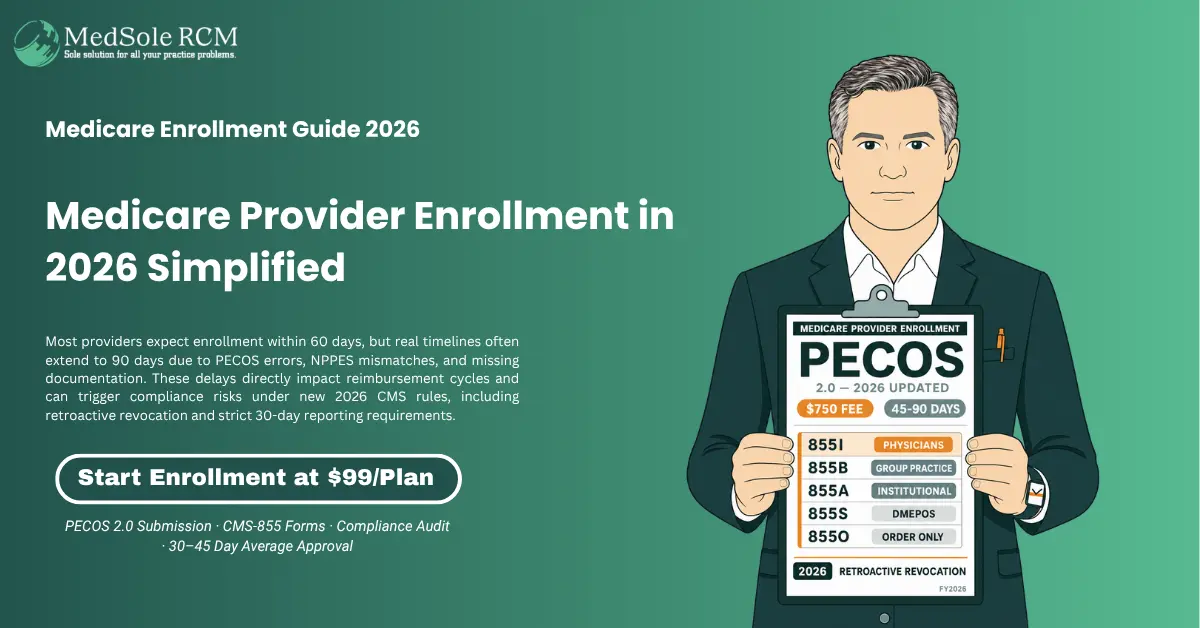




Medicare provider enrollment is the official CMS process by which healthcare providers and suppliers obtain Medicare billing privileges from the Centers for Medicare and Medicaid Services (CMS). Completing it requires a National Provider Identifier (NPI), the correct CMS-855 form, an active PECOS account, and approval from a Medicare Administrative Contractor (MAC). Billing privileges are the legal authority to submit claims and receive Medicare reimbursements, and they do not exist until CMS grants them through this process.
The 2026 enrollment landscape is materially different from prior years. Effective January 1, 2026, the CY 2026 HHA PPS Final Rule introduced retroactive revocation authority, shortened adverse legal action reporting windows to 30 days for most changes, and expanded CMS deactivation authority to providers with 12 months of inactivity. PECOS 2.0 is the system of record for all submissions, and the AWS Cloud migration scheduled for May 4, 2026 introduces infrastructure changes that affect any organization using IP allowlists. The 2026 Medicare enrollment application fee is $750 for institutional providers and DMEPOS suppliers per CMS MLN9658742.
Getting enrollment wrong delays billing privileges by 60 to 90 days per submission cycle and, under 2026 retroactive revocation rules, can require repayment of months of Medicare revenue already received. This guide is built for healthcare practices, group practices, and credentialing teams who need to enroll faster, stay compliant, and protect Medicare revenue in 2026. If your practice is approaching revalidation, expanding to new locations, or onboarding new providers this year, a complimentary Medicare enrollment compliance audit can identify gaps before they trigger denials.
What Is Medicare Provider Enrollment and Why It Matters in 2026
Medicare provider enrollment is the formal CMS registration process that establishes Medicare billing privileges for providers and suppliers. Without active enrollment status, a provider cannot submit claims to Medicare, cannot receive reimbursements, and cannot legally bill Medicare beneficiaries for covered services. Enrollment is not the same as credentialing, though the two processes run in parallel. Credentialing verifies a provider's qualifications with individual payers; enrollment establishes the legal right to bill Medicare specifically. They are distinct processes requiring separate workflows and separate credentialing services. Per the CMS provider enrollment overview, enrollment is also distinct from Medicare Advantage contracting, which is a commercial negotiation with a private plan, and from commercial payer credentialing, which follows each payer's own rules.
What PECOS Is and How It Relates to Enrollment
PECOS stands for Provider Enrollment, Chain, and Ownership System. It is the official online CMS platform where providers submit, manage, and update their Medicare enrollment data via the PECOS official portal. Every initial application, revalidation, change of information, and change of ownership must flow through PECOS. PECOS 2.0 is the current modernized version of the system, featuring multi-factor authentication through Identity and Access (I&A) management and real-time cross-referencing with IRS and federal databases. The AWS Cloud migration scheduled for May 4, 2026 requires any organization using IP allowlists to update network configurations before that date to avoid access disruptions. What PECOS stores is not just application data; it is the authoritative record of your enrollment status, ownership structure, and billing privileges, the record Medicare Administrative Contractors and CMS enforcement teams consult first.
Who Must Enroll
Three provider and supplier categories carry mandatory Medicare enrollment requirements per CMS provider enrollment guidance.
Institutional Providers: Hospitals, critical access hospitals, skilled nursing facilities (SNFs), home health agencies (HHAs), hospices, federally qualified health centers (FQHCs), and rural health clinics (RHCs). These entities enroll using CMS-855A and are subject to the $750 application fee.
Part B Suppliers: Individual physicians, non-physician practitioners (NPPs), laboratories, clinics, physical therapists, clinical social workers, and occupational therapists. These providers enroll primarily using CMS-855I.
Provider and Supplier Organizations: Group practices, corporations, partnerships, professional associations, and LLCs (excluding sole proprietorships per IRS classification). These entities use CMS-855B and are subject to the $750 application fee.
Enrollment accuracy connects directly to revenue cycle outcomes. Errors in application data trigger claim denials, delayed payments, and under 2026 retroactive revocation rules, potential requirements to refund months of Medicare payments already received. The stakes of enrollment in 2026 are higher than in any previous year.
CMS-855 Enrollment Forms: Which One Your Practice Needs in 2026
Selecting the correct CMS-855 form is the first technical decision in the medicare provider enrollment application process. Submitting the wrong form requires starting the entire application over, adding 30 to 60 days to your timeline. CMS publishes 7 versions of the CMS-855 form plus two companion forms, CMS-460 and CMS-588. Each form maps to a specific provider or supplier type with no overlap.
|
Form |
Who Uses It |
Primary Use Case |
2026 Application Fee |
|---|---|---|---|
|
CMS-855A |
Institutional providers (hospitals, SNFs, HHAs, hospices, FQHCs, RHCs) |
Initial enrollment, revalidation, change of information, change of ownership |
Yes ($750) |
|
CMS-855B |
Group practices, clinics, organizations of practitioners (excluding DMEPOS) |
Group/organization enrollment, location changes, ownership changes |
Yes ($750) |
|
CMS-855I |
Individual physicians and non-physician practitioners |
Individual provider enrollment, reassignment of benefits |
No (most physicians and NPPs exempt) |
|
CMS-855R |
Reassignment of benefits |
Individual practitioners reassigning the right to bill Medicare to a group |
No |
|
CMS-855O |
Ordering and certifying only |
Physicians who order or refer but do not bill Medicare (VA, DoD, Tricare, PHS, fellows) |
No |
|
CMS-855S |
DMEPOS suppliers |
Durable medical equipment, prosthetics, orthotics, supplies enrollment |
Yes ($750) |
|
CMS-460 |
Participation election |
Annual choice to participate (PAR) or not participate (Non-PAR) in Medicare assignment |
No |
|
CMS-588 |
EFT authorization |
Electronic Funds Transfer setup, required companion form for all enrolling providers |
No |
The fee column is the first place most billing teams check. For group practices (CMS-855B), institutional providers (CMS-855A), and DMEPOS suppliers (CMS-855S), the $750 fee applies. For individual physicians and NPPs enrolling via CMS-855I, the fee does not apply in most cases. See CMS enrollment applications page for the complete list of exemptions.
Critical 2026 Form Changes
Three form-level updates took effect or were announced for 2026. First, CMS merged the CMS-855R into the CMS-855I for paper enrollment workflows, meaning individual practitioners no longer file a standalone CMS-855R for reassignment on paper applications. Second, the CMS-855A official form and CMS-855S are being revised to reflect DMEPOS contractor and address changes following the transition to NPE East and NPE West contractors. Third, DMEPOS supplier applications in several medical supply company categories are subject to a nationwide enrollment moratorium effective February 27, 2026, meaning initial applications in those categories are denied regardless of form completion accuracy.
Practices uncertain about which CMS-855 form path applies to their organizational structure can request a free form-selection consultation through our MedSole Medicare provider enrollment service.
How to Enroll as a Medicare Provider: The Complete 2026 Process
The Medicare provider enrollment process follows seven sequential steps. Completing all seven correctly the first time prevents 60 to 90 day delays in billing privileges. Submitting through PECOS cuts processing time by approximately 15 days compared to paper, reducing the standard 60-day timeline to approximately 45 days per CMS guidance. Each step below follows the exact sequence CMS requires.
Step 1: Obtain Your National Provider Identifier (NPI)
The NPI is the unique 10-digit identifier every HIPAA-covered provider must hold before applying for Medicare enrollment. NPI registration is completed through NPPES (National Plan and Provider Enumeration System). The NPPES NPI Registry is the official submission portal. NPPES data must match PECOS data exactly, including practice address, taxonomy code, and legal business name. NPI updates made in NPPES do not automatically sync to PECOS, which is one of the top three causes of application rejection. Any change to your NPI record requires a parallel update in PECOS within CMS reporting windows.
Step 2: Set Up Identity and Access (I&A) Management
Providers and authorized officials must register in CMS I&A before accessing PECOS 2.0. Multi-factor authentication is required for all PECOS logins in 2026. For organizations, an Authorized Official (AO) must be designated first. The AO is the person legally empowered to sign enrollment applications on behalf of the organization. Once the AO is registered in I&A, they can grant tiered access to surrogates, credentialing staff, and billing personnel. Incorrect I&A role assignments are the tenth most common cause of application rejection. Set up roles before beginning the application.
Step 3: Determine the Correct CMS-855 Form
Reference the form comparison table in Section 3. Filing the wrong form is the third most common rejection reason. A group practice that files CMS-855I instead of CMS-855B, or an institutional provider that files CMS-855B instead of CMS-855A, must start the entire application process over from the beginning.
Step 4: Gather Required Documentation
Documentation requirements vary by provider type, but most applications require the following in full before submission.
Practitioner credentials: Degree (MD, DO, DPM, or equivalent), post-graduate training certificates, current state license. CMS does not accept temporary licenses for enrollment. If a provider holds a temporary license, the enrollment application must wait for the permanent license.
Identifiers: Active NPI, DEA registration number, Controlled Dangerous Substance (CDS) registration where applicable by state.
Tax documentation: IRS confirmation letter verifying the TIN and Legal Business Name; LLC determination letter if the practice operates as an LLC.
Adverse legal action documentation: All conviction notices, license suspension notifications, resolution letters, and reinstatement documents. Failure to disclose adverse legal actions is a federal compliance violation, not just an enrollment error.
Companion forms: Completed CMS-460 (annual participation election, PAR or Non-PAR) and CMS-588 (Electronic Funds Transfer authorization). Both must accompany every enrollment application.
Step 5: Submit via PECOS
All applications must be submitted electronically through PECOS. Electronic signatures are required for all certification statements. Do not submit a paper copy of the full PECOS application to the MAC unless the MAC specifically requests it per CMS instructions. For any supporting documents mailed separately, use the PECOS tracking ID to ensure the MAC can match the documents to your electronic application. Document upload through PECOS is the preferred method for most supporting materials.
Step 6: Pay the 2026 Application Fee
The 2026 Medicare enrollment application fee is $750. Institutional providers (CMS-855A), DMEPOS suppliers (CMS-855S), and Opioid Treatment Programs are required to pay. Most individual physicians, NPPs, physician organizations, and Medicare Diabetes Prevention Program (MDPP) suppliers are exempt from the fee. The PECOS Application Fee tool processes fee payment during the PECOS submission workflow. Hardship exception requests may be submitted in writing with supporting financial documentation for providers who cannot pay the fee.
Step 7: Work With Your MAC and Track the Application
Each provider is assigned to a MAC jurisdiction based on practice location. MACs review applications, conduct outreach for missing information, and issue approvals. Application status can be tracked through the PECOS dashboard, the MAC's online portal, or by direct contact with the MAC's Provider Enrollment department using your application reference number. Standard processing runs 45 to 90 days. Upon approval, CMS issues the Provider Transaction Access Number (PTAN), which activates Medicare billing privileges. The CMS Become a Medicare Provider guide provides jurisdiction-specific MAC contact information. Medicare provider enrollment for providers involves this same seven-step sequence regardless of provider type, with form selection being the primary variable.
Healthcare practices that prefer to focus on patient care rather than enrollment administration often outsource Medicare enrollment to specialized RCM partners. MedSole RCM completes Medicare provider enrollment at $99 per payer enrollment, the lowest structured rate available in the US RCM market, with average approval times of 30 to 45 days. Managing all seven steps with a dedicated enrollment team consistently produces first-pass approval rates above the industry average and keeps your revenue cycle management on schedule.
The 2026 Medicare Enrollment Application Fee: $750 Explained
The 2026 Medicare enrollment application fee is $750 per CMS MLN9658742. CMS adjusts the fee annually based on the Consumer Price Index Urban (CPI-U). The 2026 rate of $750 applies to calendar year 2026 enrollment transactions for applicable provider and supplier types.
|
Provider and Supplier Type |
2026 Fee Required? |
|---|---|
|
Institutional providers (CMS-855A) |
Yes ($750) |
|
DMEPOS suppliers (CMS-855S) |
Yes ($750) |
|
Opioid Treatment Programs (OTPs) |
Yes ($750) |
|
Individual physicians (CMS-855I) |
No (exempt) |
|
Non-physician practitioners (NPPs) |
No (exempt) |
|
Physician organizations |
No (exempt) |
|
Non-physician practitioner organizations |
No (exempt) |
|
Medicare Diabetes Prevention Program (MDPP) suppliers |
No (exempt) |
When the Fee Applies: Transaction Triggers
The Medicare enrollment application fee is not charged on every interaction with PECOS. Four specific transactions trigger the fee for non-exempt providers and suppliers per CMS application fee guidance.
Initial enrollment: First-time Medicare enrollment for an institutional provider, DMEPOS supplier, or OTP.
Revalidation: Periodic re-enrollment required every 3 to 5 years depending on provider type.
Change of information when adding a practice location: Adding a new service location to an existing enrollment triggers a new $750 fee for each new location.
Reactivation following deactivation: Providers whose billing privileges were deactivated who are seeking to reactivate.
Hardship Exceptions
Providers who cannot pay the $750 fee may submit a written hardship exception request with supporting documentation describing the financial hardship. CMS reviews requests on a case-by-case basis. MACs will not process applications subject to the fee without either fee payment confirmation or an approved hardship request on file. The hardship request does not guarantee a waiver; it initiates a review process. Fee payment is completed through the PECOS Application Fee Payment tool during the PECOS submission workflow.
PECOS 2.0 in 2026: What Every Provider Needs to Know
PECOS 2.0 is the modernized version of the Medicare provider enrollment, chain, and ownership system. It replaced legacy workflows with cloud-based infrastructure, automated cross-referencing with IRS and federal databases, and enhanced security through Identity and Access (I&A) management integration. For Medicare enrollment in 2026, PECOS 2.0 is the only submission pathway. Understanding what changed and what the May 4, 2026 AWS migration means for your organization is required operational knowledge.
Key Changes in PECOS 2.0
Multi-factor authentication required: All PECOS logins now require I&A credentials and MFA. Providers who previously logged in with username and password only must register through CMS I&A before they can access their enrollment records or submit applications.
Real-time data validation: PECOS 2.0 cross-references applications against IRS, NPPES, and adverse action databases automatically during submission. Data mismatches that previously only surfaced during MAC review now generate immediate application flags. This real-time validation is why NPPES and PECOS data must be reconciled before submission, not after.
Electronic signatures throughout: No paper signatures are accepted. All certification statements must be signed within the PECOS platform by the appropriate Authorized Official. Applications with unsigned certifications are rejected at submission.
Enhanced surrogate access: Authorized Officials can grant tiered access to staff users and credentialing surrogates. This is the mechanism that allows credentialing teams and RCM partners to submit and manage applications on behalf of providers. Incorrect I&A role assignments at this step are a direct cause of pecos login for providers failures that delay submissions.
The May 4, 2026 AWS Cloud Migration
PECOS migration to CMS AWS Cloud infrastructure is scheduled for May 4, 2026. This is the most operationally significant technical change in the pecos system since PECOS 2.0 launched. For most providers accessing PECOS through a standard browser, no action is required. For organizations using IP allowlists, a common network security configuration in larger health systems, hospital groups, and credentialing software vendors, network configurations must be updated before May 4, 2026 to whitelist CMS AWS IP ranges. Failure to update before the migration date will prevent PECOS access for users on restricted networks. Your IT team or credentialing software vendor should confirm the network configuration update before April 30, 2026.
Common PECOS 2.0 Application Errors in 2026
The following errors generate the highest volume of PECOS rejections in the current pecos medicare system environment.
Missing or incomplete electronic signatures: The most common cause of PECOS 2.0 submission failures. Every certification must be signed by the correct Authorized Official before submission.
NPPES and PECOS data mismatch: Address, taxonomy code, or legal business name differs between systems. This single error type generates more rejection volume than any other. Reconcile NPPES and PECOS data before submitting any application.
Incorrect Identity and Access role assignments: The wrong I&A role assigned to a surrogate or staff user prevents the correct individual from signing or submitting applications.
Missing supporting documentation uploads: Applications submitted through PECOS without uploaded supporting documents generate MAC outreach requests that extend the timeline by 30 days or more.
Wrong CMS-855 form selection: A group practice selecting CMS-855I instead of CMS-855B, or an individual practitioner selecting CMS-855B instead of CMS-855I, must start over.
PECOS 2.0 errors cascade. A rejected application extends the billing privileges timeline by one full processing cycle, 45 to 90 additional days, and in 2026, that delay compounds against the 30-day regulatory reporting windows for any organizational changes that occurred during the waiting period. Practices that lack dedicated credentialing staff often partner with specialized RCM firms for professional Medicare provider enrollment management to prevent the cascading revenue impact of application rejections.
NPPES vs PECOS: Understanding the Difference (and Why It Matters)
NPPES is the database that issues and stores National Provider Identifiers. PECOS is the system that manages Medicare enrollment data. They are separate CMS systems that must be kept in sync, and the gap between them is the most common source of medicare provider enrollment rejection in 2026.
|
Feature |
NPPES |
PECOS |
|---|---|---|
|
Full name |
National Plan and Provider Enumeration System |
Provider Enrollment, Chain, and Ownership System |
|
Primary function |
Issues and maintains NPI records |
Manages Medicare enrollment applications and data |
|
What it stores |
NPI, taxonomy code, practice address |
Enrollment status, billing privileges, ownership data |
|
Who uses it |
All HIPAA-covered providers |
Medicare-enrolled providers only |
|
Sync behavior |
Updates do NOT automatically push to PECOS |
Pulls from NPPES but requires manual reconciliation |
Why the Sync Gap Causes Denials
The most common scenario plays out like this. A provider updates their practice address in NPPES NPI Registry public search because they moved to a new location. The update goes through. The provider assumes PECOS now reflects the new address. It does not. PECOS still shows the old address. When the next CMS-855 application, revalidation, or change of information form is submitted, PECOS cross-references the NPPES record and flags the address discrepancy. The application is rejected.
The same scenario occurs with taxonomy codes, legal business names, and group practice affiliations. Every NPPES update must be followed by a corresponding PECOS update. The reverse is also true: changes submitted through PECOS do not automatically push back to NPPES.
The operational rule is clear. Any change made in NPPES must be mirrored in PECOS within the CMS reporting timeframes specified under 42 CFR 424.516. For location changes, that window is 30 days. A 31-day gap between an NPPES update and the corresponding PECOS update is a reportable compliance failure under 2026 rules, not just an enrollment error.
How to Check Medicare Enrollment Status and Avoid the Top Rejection Reasons
Medicare enrollment application status can be checked through three channels. The PECOS application tracking dashboard shows real-time status updates for any application submitted through PECOS using I&A credentials. The assigned MAC's Provider Enrollment department can provide a status update by phone using the application reference number issued at submission. Most MACs also offer web-based tracking through their online portal using the web tracking number generated at submission. Standard processing runs 45 to 90 days, with PECOS submissions averaging 15 days faster than paper applications.
How to Check Application Status
Through PECOS: Log into PECOS using I&A credentials, navigate to the application tracking dashboard, and view real-time status updates by application reference number. Medicare provider enrollment status displays as received, in review, returned for corrections, or approved.
Through your MAC: Call the Provider Enrollment department of the MAC assigned to your practice jurisdiction. Provide your pecos application tracking number or web tracking number issued at submission. MAC contact numbers are listed by jurisdiction on the CMS website.
Through the MAC web portal: Most MACs provide online pecos application status tracking using the web tracking number. This is the fastest self-service option for routine status checks without phone wait times.
For pecos verification of any enrolled provider or physician, the CMS provider enrollment status guidance page lists available lookup tools.
The 10 Most Common Medicare Enrollment Rejection Reasons
Understanding why applications are rejected before you submit is the highest-leverage preparation step available. These ten errors generate the majority of MAC rejection volume.
NPPES and PECOS data mismatch: Practice address, taxonomy code, or legal business name differs between systems. This is the single most common rejection cause in 2026.
Missing or invalid electronic signatures: Required certification statements not signed within the PECOS workflow by the correct Authorized Official.
Wrong CMS-855 form selected: Filing CMS-855B when CMS-855A was required, or vice versa, requires a full restart.
Incomplete supporting documentation: Missing IRS letter, state license copy, adverse action documentation, or DEA registration.
Expired or temporary state license: CMS does not accept temporary licenses for enrollment. Applications submitted with temporary licenses are rejected at the MAC review stage.
Missing application fee or hardship request: For institutional providers, DMEPOS suppliers, and OTPs subject to the $750 fee, the application is not processed without fee payment or an approved hardship request.
Failure to disclose adverse legal actions: Convictions, license suspensions, exclusions, or debarments not reported on the application.
Tax Identification Number (TIN) errors: The TIN submitted does not match the IRS record for the Legal Business Name on file. This is especially common after practice name changes or entity restructuring.
Site visit failure: A National Site Visit Contractor inspector was unable to verify the physical practice location because the address did not match PECOS records, the building was unoccupied, or staff denied access.
Identity and Access role errors: The wrong I&A role was assigned to the surrogate or staff user responsible for submission, preventing proper certification signing.
A significant portion of first-time applications are returned for correction on one of these ten errors per CMS guidance and regulatory analysis. Each returned application extends the timeline by one full processing cycle, which means 60 to 90 days of additional delayed reimbursements per error. MedSole RCM completes Medicare provider enrollment at $99 per payer, with a first-pass approval rate well above the industry average and average approval time of 30 to 45 days, the lowest structured pricing in the US RCM market. Schedule a review with our enrollment specialists before your next submission.
Medicare Revalidation in 2026: The 5-Year Cycle Every Provider Must Master
Revalidation is the periodic re-enrollment process by which CMS confirms providers remain eligible for Medicare billing privileges. It is not optional, and it is not flexible. Medicare revalidation cycles vary by provider type, with most providers required to revalidate every 5 years and DMEPOS suppliers every 3 years per CMS guidance. CMS also conducts off-cycle revalidations for providers flagged through risk-based screening.
2026 Revalidation Timelines by Provider Type
|
Provider Type |
Revalidation Cycle |
|---|---|
|
Physicians and NPPs |
Every 5 years |
|
Group practices and clinics |
Every 5 years |
|
Institutional providers (hospitals, SNFs, HHAs, hospices) |
Every 5 years |
|
DMEPOS suppliers |
Every 3 years |
|
High-risk provider categories |
As determined by CMS risk-based screening |
How to Know When Revalidation Is Due
CMS posts revalidation due dates 7 months in advance through PECOS notifications and by mail to the correspondence address on file in PECOS. This 7-month advance notice is the provider's window to begin gathering documentation and preparing the submission. The critical CMS rule: there are no exemptions and no extensions for revalidation deadlines. A provider that misses the revalidation deadline faces payment holds and deactivation regardless of operational history, revenue scale, or patient volume. Check PECOS regularly and confirm that your correspondence address is current so notifications reach the right person.
Consequences of Missed Revalidation
Payment hold: Medicare suspends all reimbursements until the revalidation is complete and approved. Claims submitted during a payment hold are not paid retroactively in many cases.
Deactivation: Medicare billing privileges are formally deactivated. Services rendered during a deactivation period are not reimbursable under any circumstances.
Reactivation requires fee payment: For institutional providers, DMEPOS suppliers, and OTPs, reactivation following deactivation triggers the $750 application fee again. Practices that miss revalidation pay the fee twice within a short window, once for the missed revalidation and once for reactivation.
2026 SNF Revalidation Update
The previously scheduled January 1, 2026 deadline for Skilled Nursing Facility (SNF) revalidation submissions has been indefinitely suspended per CMS SNF Attachment guidance dated February 24, 2026. SNFs may still submit revalidation applications voluntarily, and voluntary submission is recommended to maintain clean enrollment records and avoid any forward-dated compliance issues. CMS may reinstate the deadline with future guidance, and SNFs that have completed voluntary revalidation are protected regardless of when the deadline is reimposed.
MedSole RCM provides ongoing revalidation tracking and submission as part of our $99 per payer credentialing service, ensuring zero missed deadlines and uninterrupted Medicare provider enrollment and billing privileges across your entire provider roster.
The Biggest 2026 Medicare Enrollment Changes Every Provider Must Know
Effective January 1, 2026, Medicare providers and suppliers became subject to a series of new policies under the CY 2026 HHA PPS Final Rule. These changes materially expand CMS enforcement authority, shorten reporting windows, and create new categories of retroactive financial liability that did not exist under prior rules. This is the most enforcement-intensive year for Medicare enrollment in over a decade.
Retroactive Revocation Authority
The most consequential 2026 change is that CMS can now apply retroactive effective dates to revocations, not just forward-looking ones. Under prior rules, a revocation took effect 30 days after CMS issued notice, giving providers a window to wind down billing. Under the CY 2026 HHA PPS Final Rule, the effective date of a revocation depends on the type of deficiency.
False or misleading information on application: Revocation is effective on the date the certification statement was signed. If a provider submitted an application 18 months ago with a false statement, the revocation wipes out 18 months of Medicare billing.
Failure to timely report a change: Revocation is effective on the day after the information was supposed to be reported. If a provider was required to report a change of location within 30 days and did not, the revocation starts the day the 30-day window closed.
The operational consequence is that providers can be required to refund months of Medicare payments already received, not just lose future billing rights. This makes the 30-day reporting obligation discussed below a financial protection rule, not just a compliance technicality.
Expanded Revocation for Abusive Prescribing (Now Includes Part A)
CMS previously held revocation authority for abusive prescribing patterns under Medicare Part B and Part D. The CY 2026 HHA PPS Final Rule extends this authority to Part A drugs, including drugs administered during covered inpatient stays in hospitals or skilled nursing facilities. A hospital or SNF with a pattern of abusive Part A prescribing now faces the same revocation exposure that previously applied only to Part B prescribers.
Adverse Legal Action Reporting: The 30-Day Window
The CY 2026 HHA PPS Final Rule reinforces and in some cases tightens the reporting windows under 42 CFR 424.516. The complete reporting timeline table is as follows.
|
Change Type |
Reporting Window |
|---|---|
|
Change of ownership or control |
30 days |
|
Change of practice location |
30 days |
|
Change in authorized official, delegated official, or managing employee |
30 days |
|
Final adverse legal actions (felony conviction, license suspension) |
30 days |
|
All other changes for physicians and NPPs |
90 days |
|
All DMEPOS supplier changes |
30 days |
For most changes that matter to CMS, the window is 30 days. The 90-day window applies only to routine changes for individual physicians and NPPs. Any lapse in reporting within these windows triggers the retroactive revocation exposure described above.
Cross-Program Termination Enforcement
CMS has reinforced the federal rule requiring states to deny or terminate Medicaid or CHIP enrollment when a provider is terminated from Medicare per the Affordable Care Act cross-program termination provisions. A single Medicare revocation can trigger Medicaid and CHIP terminations across multiple states simultaneously for any provider enrolled in more than one state's program. For multi-state practices, this is the most catastrophic revenue scenario in the 2026 regulatory environment. A revocation that might represent a manageable Medicare revenue interruption in isolation becomes a multi-program, multi-state shutdown that can threaten the financial viability of the practice.
Expanded Deactivation Authority
CMS has expanded its authority and is actively deactivating providers who show 12 months of inactivity in ordering or certifying services. Providers who are enrolled but not actively billing, ordering, or certifying should verify their activity status in PECOS before the 12-month mark to avoid deactivation.
The cumulative effect of these five changes makes 2026 a year where passive enrollment management is not sufficient. Every provider needs an active compliance posture. Professional enrollment management with specialists who track regulatory changes as they are issued is no longer a luxury for most practices; it is a risk mitigation tool with quantifiable financial protection value.
Specialty Enrollment Paths: DMEPOS, Behavioral Health, PT, FQHC, and Hospital-Based Providers
While the core medicare provider enrollment process is universal, specific provider types face additional rules, accreditation requirements, and in 2026, enrollment moratoria. The same seven-step enrollment process applies, but the form, the documentation, and the regulatory constraints differ materially by specialty.
DMEPOS Supplier Enrollment in 2026
DMEPOS supplier enrollment carries three critical 2026 updates that no other provider type faces.
Nationwide DMEPOS enrollment moratorium effective February 27, 2026: CMS implemented a nationwide moratorium on initial applications for several DMEPOS medical supply company categories. Initial applications in affected categories are denied regardless of application completeness. The moratorium runs for 6 months from February 27, 2026, and may be extended in additional 6-month increments per CMS Provider Enrollment Moratoria guidance. Existing DMEPOS suppliers are not affected; this moratorium applies to new initial applicants in specific categories.
Annual reaccreditation requirement effective January 1, 2026: CMS reduced the DMEPOS reaccreditation cycle from every 36 months to every 12 months per the CY 2026 HH PPS Final Rule. DMEPOS suppliers must now complete reaccreditation annually rather than every 3 years.
National Provider Enrollment contractors: Since November 7, 2022, DMEPOS enrollment has been handled by NPE East and NPE West contractors, not the legacy NSC contractor. All DMEPOS enrollment correspondence and application submissions route through these contractors.
Behavioral Health and Clinical Social Workers
Licensed clinical social workers (LCSWs), marriage and family therapists (MFTs), and mental health counselors enrolled in Medicare as a result of the Consolidated Appropriations Act expansion. These providers use CMS-855I and follow the standard individual practitioner enrollment workflow, including NPI verification, I&A setup, and PECOS submission.
Physical Therapists, Occupational Therapists, and Speech-Language Pathologists
These providers enroll using CMS-855I as individual practitioners or via CMS-855B if they are part of a group practice. For group practice enrollment, the organization's CMS-855B must be active and approved before individual practitioners can reassign benefits to the group.
FQHCs and RHCs
Federally qualified health centers and rural health clinics enroll as institutional providers using CMS-855A and are subject to the $750 application fee. State agency surveys or CMS-recognized accreditation may be required as part of the FQHC or RHC designation process, and these must be complete before or concurrent with the Medicare enrollment application.
Hospital-Based and Locum Tenens Providers
Hospital-based providers enroll individually via CMS-855I and reassign billing rights to the hospital using CMS-855R (now merged into CMS-855I for paper applications). Locum tenens providers follow specific CMS reciprocal billing arrangement rules. Under reciprocal billing, a substitute physician may bill under the regular physician's Medicare billing number for covered services under specific circumstances defined in CMS guidance.
MedSole RCM handles enrollment across all provider specialties at $99 per payer, with dedicated specialists for DMEPOS, behavioral health, and institutional provider enrollment workflows. Connect with our specialty enrollment team for any specialty-specific medicare part a provider enrollment or medicare part b enrollment for providers question.
Site Visits, Annual Participation Election, and Your 2026 Compliance Calendar
Medicare enrollment is not a one-time event. It is a continuous compliance posture. Three operational areas drive the majority of preventable revocations: failed site visits, missed annual participation elections, and late change reporting. Managing all three requires a structured compliance calendar, not reactive monitoring.
Site Visit Verification
CMS National Site Visit Contractors (NSVCs) conduct unannounced site visits for Medicare Parts A, B, and DMEPOS providers. NSVC inspectors carry photo identification and a CMS authorization letter. Any provider who receives a site visit request can verify the inspector's identity and authority by calling their assigned MAC.
The critical operational rule under CMS QSSAM-25-1-ALL: an inspector's inability to perform a site visit may result in denial of the Medicare enrollment application or revocation of billing privileges. A failed site visit is treated by CMS as evidence that the provider cannot be verified at the enrolled location.
Verify physical address matches PECOS exactly: Suite numbers, floor designations, and building names must match the PECOS record character-by-character. A suite number difference between the door sign and PECOS is grounds for a failed site visit.
Train front desk staff: Reception staff must know that inspectors carrying proper CMS credentials must be allowed to conduct the inspection. Turning away an NSVC inspector is treated as a failed site visit.
Confirm signage is visible: The practice name on the door or building exterior must match the legal business name on file in PECOS. A trade name that differs from the legal business name without a proper DBA registration in PECOS can cause a site visit failure.
Annual Participation Election (PAR vs Non-PAR)
Each year from mid-November through December 31, physicians and suppliers decide whether to participate in Medicare for the upcoming calendar year using CMS-460. Participating providers (PAR) accept Medicare assignment for all covered services, meaning they accept Medicare's allowed amount as payment in full. Non-participating providers (Non-PAR) can choose whether to accept assignment on a per-claim basis.
To terminate participation, providers must send written notice to each assigned MAC postmarked before December 31 of the year preceding the effective year. Annual participation election is not automatic; it requires active management each November and December.
Opting Out of Medicare
Physicians who do not want to enroll in Medicare can formally opt out by filing an opt-out affidavit with each MAC in their jurisdiction. Under opt-out status, neither the physician nor the patient can bill Medicare for services covered by Medicare. Opt-out status automatically renews every 2 years. Physicians who want to re-enter Medicare after opting out must submit a valid opt-out termination notice and go through the full enrollment process.
Managing the compliance calendar across site visit readiness, annual participation elections, revalidation cycles, 30-day change reporting, and opt-out renewal dates requires active tracking across multiple workflows. The compliance management service at MedSole RCM builds these workflows into your standard enrollment operations.
When to Outsource Medicare Provider Enrollment to an RCM Partner
Completing Medicare provider enrollment in-house requires a credentialing specialist who understands CMS-855 forms, PECOS 2.0, MAC jurisdictions, revalidation cycles, and the 2026 regulatory changes. For most practices below a certain size threshold, the cost of full-time in-house credentialing expertise exceeds the cost of outsourcing to a specialized provider enrollment services partner. The calculus gets clearer when any of the following signs apply.
Signs Your Practice Should Outsource Medicare Enrollment
You are onboarding multiple new providers: Each provider requires 4 to 8 hours of focused credentialing work and 30 or more supporting documents. Multiplied across a physician group, that is a substantial operational workload that diverts staff from revenue-generating activities.
Your applications keep getting rejected: First-pass rejection rates above 30 percent indicate a process gap, not a documentation gap. Process gaps compound with each submission cycle and cost 60 to 90 days of delayed billing privileges per rejection.
You are approaching revalidation for multiple providers simultaneously: Concurrent revalidations for a roster of five or more providers overwhelm most in-house billing departments that handle enrollment as a secondary function.
You are expanding to new locations or states: Each new location triggers a PECOS change of information that must be reported within 30 days under 2026 rules. Multi-location expansions generate multiple concurrent PECOS submissions with overlapping deadlines.
Your billing department handles enrollment as a side responsibility: Enrollment handled as a secondary task produces errors consistently over time. The work requires dedicated attention from someone who tracks PECOS 2.0 changes, form updates, and regulatory deadlines as their primary function.
You are entering DMEPOS, behavioral health, or specialty workflows: Specialty enrollment rules require specialized expertise that generalist billing staff do not routinely develop. DMEPOS moratorium tracking alone requires active daily monitoring of CMS policy updates in 2026.
What to Look for in a Medicare Enrollment Partner
Transparent per-payer pricing: Avoid vendors with hourly billing models or hidden fees embedded in per-claim or percentage-of-collections structures. The credentialing function should be priced per payer, per outcome.
First-pass approval rate above 90 percent: The industry standard for a well-run enrollment operation. Rates below 80 percent indicate either documentation problems or process problems that will cost you billing delay cycles.
Average approval time under 45 days: PECOS-optimized workflows with proper I&A setup, pre-submission NPPES reconciliation, and complete documentation packages consistently achieve 30 to 45 day approvals. Vendors who average 70 to 90 days are using paper or unoptimized PECOS workflows.
Ongoing revalidation tracking included: Revalidation monitoring should be a standard component of the enrollment service, not an add-on billed separately. If a vendor charges extra for revalidation alerts, that is a pricing structure designed around the fee, not around your compliance outcomes.
Specialty expertise across provider types: DMEPOS, behavioral health, FQHC, RHC, and hospital-based provider enrollment each carry their own form requirements, documentation standards, and regulatory constraints. Confirm your vendor has handled your specific provider type before.
2026 regulatory current: Your enrollment partner must be operating under the CY 2026 HHA PPS Final Rule. Vendors who do not track regulatory updates in real time will miss reporting windows, apply outdated form versions, and expose your practice to the retroactive revocation risk described in Section 10.
MedSole RCM meets every benchmark above and operates at the lowest structured pricing in the US RCM market. The next section breaks down exactly what that pricing includes. For immediate outsourcing needs, our outsourced medical billing team can begin the engagement process within 48 hours.
Medicare Enrollment and Full RCM Pricing: What MedSole Charges in 2026
MedSole RCM operates on transparent, market-disrupting pricing. The two anchor numbers are $99 per payer for Medicare provider enrollment and credentialing, and 2.99 percent of collections for full-service medical billing and revenue cycle management. Both rates apply in 2026 with no rate changes from prior years.
Medicare Provider Enrollment and Credentialing Pricing
$99 per payer enrollment: Includes the initial application, supporting documentation gathering, PECOS 2.0 submission, and follow-up with the MAC through full approval. The $99 rate applies to initial enrollment, revalidation, and change of information submissions for all payer types.
All payer types covered: Medicare, Medicaid, commercial payers, and Medicare Advantage plans are all included at the $99 per payer rate. There is no premium for commercial payer credentialing or for Medicare Advantage contracting.
Revalidation tracking included: Ongoing revalidation monitoring and submission is included at no additional charge. There is no separate revalidation fee, no alerting fee, and no annual monitoring retainer.
First-pass approval rate above industry average: Our PECOS 2.0 submission workflow, pre-submission NPPES reconciliation protocol, and complete documentation checklist produce first-pass approval rates that consistently exceed the industry average.
Average approval time of 30 to 45 days: PECOS-optimized submissions with complete documentation packages and pre-cleared I&A setups achieve this timeline consistently.
This is the lowest structured per-payer credentialing rate available in the US RCM market. Industry average per-payer credentialing rates range from $200 to $400 per payer depending on provider type and vendor.
Full-Service Medical Billing and RCM Pricing
2.99 percent of collections: Full-service revenue cycle management at 2.99 percent of collections is the MedSole billing rate for all provider types. This rate covers all functions below.
Industry comparison: Most RCM vendors charge 4 to 7 percent of collections for full-service medical billing. The MedSole rate at 2.99 percent is below the lower bound of that range.
What is included: Charge entry, claim submission, payment posting, AR follow-up, denials management, patient billing, and monthly reporting. Every function of the revenue cycle is covered at the flat percentage rate.
No setup fees, no hidden charges, no annual contracts required. The engagement begins with a free compliance audit and scales with collections.
Specialty Services
For practices with specific needs, additional services are available at the same transparent pricing structure. AR follow-up and recovery services target outstanding balances with dedicated follow-up workflows. Denials management services address denial patterns at the root cause level. Outsourced medical billing services provide the full revenue cycle stack for practices that want to remove billing administration from their internal operations entirely.
Practices comparing RCM partners typically save 30 to 50 percent annually by switching to MedSole. Schedule a free Medicare enrollment compliance audit today to see exactly what your practice can save in 2026. $99 per payer enrollment is the starting point.
Frequently Asked Questions About Medicare Provider Enrollment
What is Medicare provider enrollment?
Medicare provider enrollment is the official CMS registration process by which healthcare providers and suppliers obtain Medicare billing privileges. It requires obtaining a National Provider Identifier (NPI), submitting the appropriate CMS-855 form through PECOS, and working with a Medicare Administrative Contractor (MAC) for approval. Standard processing takes 45 to 90 days per CMS guidance.
How long does Medicare provider enrollment take in 2026?
Medicare provider enrollment typically takes 45 to 90 days in 2026. PECOS submissions process approximately 15 days faster than paper applications, reducing the standard 60-day timeline to about 45 days per CMS guidance. Errors or missing documentation can extend this timeline by 30 to 60 additional days per correction cycle.
How much is the Medicare enrollment application fee for 2026?
The 2026 Medicare enrollment application fee is $750 per CMS MLN9658742. Institutional providers, DMEPOS suppliers, and Opioid Treatment Programs are required to pay. Most physicians, non-physician practitioners, physician organizations, and MDPP suppliers are exempt. Hardship exceptions are available on a case-by-case basis per CMS application fee guidance.
What is PECOS and why do providers need it?
PECOS stands for Provider Enrollment, Chain, and Ownership System. It is the official CMS online platform where providers submit, manage, and update Medicare enrollment data. PECOS 2.0, with multi-factor I&A authentication and AWS Cloud infrastructure, is the system of record for all Medicare enrollment applications in 2026. Providers cannot submit Medicare enrollment applications without an active PECOS account.
What is the difference between NPPES and PECOS?
NPPES (National Plan and Provider Enumeration System) issues and maintains National Provider Identifiers. PECOS manages Medicare enrollment data including billing privileges, ownership information, and enrollment status. Updates made in NPPES do NOT automatically sync to PECOS, which is the most common cause of Medicare enrollment application rejections in 2026.
Which CMS-855 form do I need?
The correct form depends on your provider type. CMS-855I is for individual physicians and non-physician practitioners. CMS-855B is for group practices and organizations. CMS-855A is for institutional providers including hospitals, SNFs, and HHAs. CMS-855S is for DMEPOS suppliers. CMS-855O is for providers who order or certify but do not bill Medicare directly.
How do I check the status of my Medicare enrollment application?
Application status can be checked through three channels: the PECOS application tracking dashboard using your I&A credentials, by contacting your assigned MAC's Provider Enrollment department with your application reference number, or through your MAC's web portal using the web tracking number issued at the time of submission.
Does a provider have to enroll in Medicare?
A provider must enroll in Medicare to bill Medicare for covered services rendered to Medicare beneficiaries. Providers who do not want to bill Medicare must formally opt out by filing an opt-out affidavit with each MAC in their jurisdiction. Opt-out status automatically renews every 2 years and prevents both the provider and the patient from billing Medicare.
What is the Medicare provider enrollment phone number?
Each Medicare Administrative Contractor maintains its own Provider Enrollment department with a dedicated phone number based on jurisdiction. Common MAC contacts include Noridian (855-609-9960 for JE Part B). Providers should contact their assigned MAC directly because enrollment questions are jurisdiction-specific. The CMS website lists MAC contact numbers by provider location and claim type.
How often do I need to revalidate Medicare enrollment?
Most providers must revalidate every 5 years per CMS guidance. DMEPOS suppliers revalidate every 3 years. CMS posts revalidation due dates 7 months in advance with no exemptions and no extensions. Missed revalidation results in deactivation and payment holds until the revalidation is complete and approved.
What happens if my Medicare enrollment is denied?
A denied Medicare enrollment application requires correcting all cited deficiencies and resubmitting from the beginning, adding 60 to 90 days to the approval timeline per correction cycle. Common denial reasons include NPPES and PECOS data mismatch, missing electronic signatures, wrong form selection, incomplete documentation, and undisclosed adverse legal actions.
Can I outsource Medicare provider enrollment?
Yes. Most healthcare practices outsource Medicare enrollment to specialized RCM partners to reduce rejection rates, meet reporting deadlines, and free administrative staff for other functions. MedSole RCM completes Medicare provider enrollment at $99 per payer, the lowest structured pricing in the US RCM market, with average approval times of 30 to 45 days.
Medicare Provider Enrollment in 2026: Protecting Your Revenue Starts With Getting It Right
2026 is the most enforcement-intensive year for Medicare provider enrollment in over a decade. Retroactive revocation authority, expanded deactivation rules, 30-day change reporting windows, cross-program termination enforcement, and PECOS 2.0 fully deployed on AWS Cloud infrastructure have raised the operational stakes for every Medicare-enrolled provider in the country.
Getting enrollment right the first time prevents 60 to 90 days of lost billing privileges per submission cycle, eliminates retroactive revocation exposure, and protects the practice's compliance posture across Medicare, Medicaid, and CHIP simultaneously. A single missed reporting window or failed PECOS submission now carries financial consequences that extend backward in time, not just forward.
MedSole RCM is the most affordable Medicare provider enrollment and full-service RCM partner in the US, with credentialing at $99 per payer and full medical billing at 2.99 percent of collections. Both services carry no setup fees, no hidden charges, no annual contracts. Schedule a free compliance audit today to see how much your practice can save in 2026 and where your current enrollment posture has gaps worth closing before they become denials.