



Quick Summary
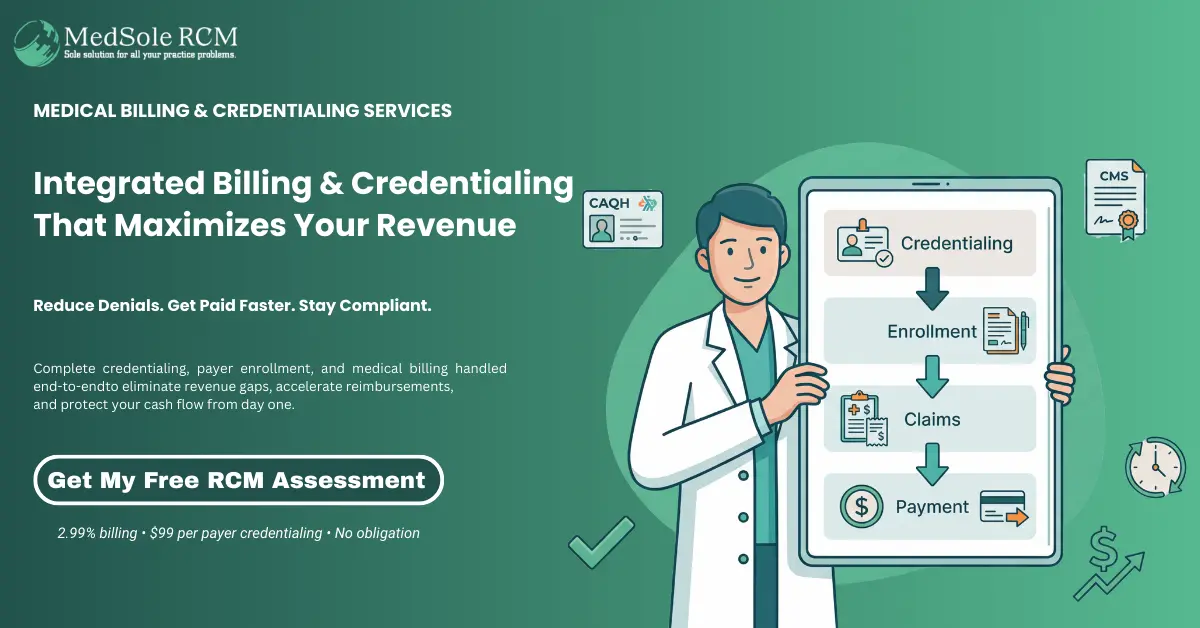
Medical billing and credentialing services are two essential administrative functions for healthcare providers. Credentialing verifies a provider's qualifications and enrolls them with insurance payers. Billing translates patient encounters into claims and follows each one through to payment. When these functions work together, they reduce claim denials caused by enrollment gaps, accelerate cash flow, and prevent costly revenue disruptions. This guide covers the complete process, 2026 regulatory changes, real-world costs, enrollment timelines, and how to choose the right company for both.
Most healthcare providers treat billing and credentialing as completely separate tasks. Different teams handle each one. The workflows don't connect, and nobody's bridging the gap. That disconnect is one of the biggest reasons claims get denied and revenue disappears. According to CMS, the Medicare Fee-for-Service improper payment rate reached 6.55% in FY 2025, totaling $28.83 billion in improper payments.
Here's the thing: medical billing and credentialing services are two sides of the same revenue coin. You can't run one without the other. When a provider isn't properly credentialed, it doesn't matter how clean the coding is. Those claims get denied. And when billing breaks down, even providers with perfect enrollment status leave money on the table.
This guide walks you through the complete credentialing process, step by step. You'll learn how to get on insurance panels, what realistic enrollment timelines look like, and how the billing lifecycle works from charge capture to payment posting.
It also covers critical 2026 regulatory changes: NCQA's shortened credentialing windows, CMS enrollment fee increases, and new prior authorization rules. Real cost data and a clear framework for choosing the right medical billing and credentialing company round out the guide.
Whether you're a solo practitioner opening a new practice, a mental health provider navigating insurance panels, or a multi-specialty group scaling operations, every section is built for healthcare providers who want to get their revenue cycle right. And it's all current with 2026 CMS, NCQA, and AMA requirements, so you're working with today's rules, not last year's advice.
What Are Medical Billing and Credentialing Services?
What Is Medical Billing?
Medical billing is the process of translating healthcare services into claims, submitting those claims to insurance companies, and following up until the provider receives full reimbursement. It spans the entire revenue cycle, from patient visit to final payment posting.
Here's what the medical billing process looks like step by step:
-
Patient registration and eligibility verification: confirming active insurance coverage and benefits before the patient is seen
-
Medical coding: assigning accurate CPT, ICD-10, and HCPCS codes to each encounter based on clinical documentation
-
Charge capture: recording every billable service from the superbill or EHR into the billing system
-
Claims submission: sending clean claims to payers electronically through a clearinghouse
-
Denial management and appeals: identifying denied claims, correcting errors, and resubmitting for payment
-
Payment posting and A/R follow-up: applying payments to patient accounts and pursuing outstanding balances
Skip any step, and revenue stalls or disappears. Each function feeds the next, so the whole process has to work as one connected sequence.
What Is Provider Credentialing?
Provider credentialing is the process of verifying a healthcare provider's qualifications, including education, training, licensure, board certifications, and malpractice history, to determine whether they're authorized to participate in insurance networks and bill payers for services rendered. Without credentialing, providers can't receive in-network reimbursement from any payer.
Six core functions drive the process:
-
CAQH profile management: creating and maintaining the provider's CAQH ProView profile, which most commercial insurers use for credentialing verification
-
Primary source verification: confirming credentials directly with issuing institutions like medical schools, licensing boards, and the DEA
-
Provider enrollment: submitting applications to Medicare through PECOS, to Medicaid, and to each commercial payer
-
Payer contract negotiation: reviewing and negotiating fee schedules that set the reimbursement rate for each service
-
Re-credentialing: managing periodic reverification, typically every two to three years, with NCQA now requiring monthly monitoring
-
Hospital privileging: obtaining clinical privileges at hospitals and facilities where the provider plans to practice
Let any of these slip, or let documents lapse between renewal cycles, and you've created a gap that quietly blocks your ability to bill.
Medical Billing vs. Credentialing: Key Differences
Billing and credentialing both sit at the center of the revenue cycle, but they serve completely different purposes. Practices that blur the line between them, or assume one team can manage both without coordination, end up with preventable denials.
Here's how they compare across every key dimension:
|
Dimension |
Medical Billing |
Provider Credentialing |
|
Purpose |
Convert services into revenue |
Authorize providers to bill insurance |
|
Timeline |
Ongoing daily or weekly cycle |
Front-loaded, typically 60 to 180 days initially, with ongoing re-credentialing |
|
Key Systems |
Practice management software, clearinghouse, EHR |
CAQH ProView, PECOS, payer portals |
|
Key Codes |
CPT, ICD-10, HCPCS |
NPI, taxonomy codes, CLIA |
|
Outcome |
Claim paid or denied |
Provider enrolled in-network or rejected |
|
Regulatory Body |
CMS and commercial payer rules |
NCQA standards and CMS enrollment rules |
|
Revenue Impact |
Direct: every claim affects revenue |
Indirect: without credentialing, claims cannot be accepted |
|
Who Does It |
Medical billers, coders, A/R specialists |
Credentialing specialists, enrollment coordinators |
Notice the revenue impact row. Billing generates revenue directly, one claim at a time. Credentialing makes that revenue possible in the first place.
Without enrollment, billing has nothing to bill for. A perfectly coded claim still gets denied if the provider isn't on that payer's panel. That's why the most effective operations treat medical billing and credentialing services as one integrated workflow, not two separate departments.
Why Medical Billing and Credentialing Must Work Together
What Happens When You Bill Without Being Credentialed?
If a provider submits claims before completing the credentialing process, those claims will almost always be denied. The payer's system simply doesn't recognize the provider as an authorized in-network participant.
Coding accuracy won't save you. It doesn't matter how clean the documentation is. When the NPI isn't active in that payer's network, the claim gets rejected automatically. And in most cases, these claim denials can't be corrected after the fact.
Here's what medical billing without credentialing actually looks like:
1. 100% claim denial rate for that payer. The payer's system flags the NPI as unrecognized, and every claim with that NPI and payer combination gets auto-rejected. Not some claims. All of them.
2. Lost revenue that can't be recovered. Standard billing errors can usually be corrected and resubmitted. Credentialing denials don't work that way. Some payers allow retroactive billing from the application date, but plenty don't. Miss that window and you've created a permanent revenue gap that no appeal can close.
3. Patient relationship damage. Denied claims often turn into unexpected balance bills for patients. Most don't understand why insurance didn't cover a routine visit. Your front desk gets the frustrated calls. Some patients leave the practice entirely, and that loss reaches far beyond one denied claim.
Now picture a scenario that plays out all the time. A newly hired physician starts seeing patients on Day 1 while credentialing is still in process.
Per NCQA guidelines, initial credentialing typically takes 90 to 120 days. Nobody tells the physician to hold off because the practice needs the revenue.
That's three to four months of encounters generating claims that may never get paid. At 20 patients per day and an average reimbursement of $150, you're looking at $90,000 to $120,000 in potential lost revenue per provider.
How Credentialing Gaps Create Revenue Leakage
Revenue leakage from credentialing gaps goes well beyond outright denials. Even small enrollment issues can trigger payment delays that cascade across the entire revenue cycle.
An outdated address sitting in CAQH. A lapsed license nobody caught in time. Group NPI data that doesn't match. Problems like these quietly block payments without anyone spotting the pattern.
Four common ways this plays out:
-
Out-of-network reimbursement: A provider who isn't credentialed with a specific payer gets paid at out-of-network rates, often 40% to 60% lower, or receives nothing at all.
-
Delayed provider onboarding: Every day a new provider sits uncredentialed is a day of lost billing capacity you can never recover.
-
Payer directory errors: Incorrect data in payer directories, driven by the No Surprises Act's 90-day verification requirement, causes patients to be turned away or billed incorrectly.
-
Audit and recoupment risk: OIG's 2026 The work plan continues targeting claims where enrollment status doesn't match billing records, creating real exposure for repayment demands.
None of these problems announce themselves loudly. They bleed revenue slowly, a few hundred here, a few thousand there, month after month. By the time someone runs a report and spots the trend, you've already left tens of thousands on the table.
Is your revenue cycle leaking money from credentialing gaps? A comprehensive billing and credentialing assessment can identify these issues before they become costly. Talk to our RCM team →
How to Get Credentialed with Insurance Companies: Step-by-Step
Getting credentialed with insurance companies involves a multi-step verification and enrollment process that typically takes 90 to 180 days depending on the payer. The process confirms a provider's qualifications, authorizes them to participate in the payer's network, and establishes the contractual terms for reimbursement.
Here's the step-by-step process for provider credentialing.
Step 1: Obtain Your NPI Number Through NPPES
Every healthcare provider needs a National Provider Identifier before anything else can move forward. It's a universal 10-digit number required for all insurance transactions, and you can't submit a single claim without one.
Register through the National Plan and Provider Enumeration System (NPPES). It's free, and approval typically takes one to three business days.
You'll need to know the difference between the two types. A Type 1 NPI is for individual providers. A Type 2 NPI is for organizations, group practices, or clinics. Most practices need both.
One thing to flag for 2026: as of March 3, 2026, CMS discontinued support for Version 1 of the NPPES downloadable file format. If your practice or billing vendor uses automated NPI data feeds, make sure those systems have been updated to Version 2. Outdated feeds can cause mismatches that delay credentialing applications downstream.
Step 2: Complete Your CAQH Provider Data Portal Profile
The CAQH Provider Data Portal, formerly known as CAQH ProView, is a universal credentialing database that most commercial insurance companies pull from when reviewing applications. Think of it as your credentialing resume. If it's incomplete, everything slows down.
Providers need to populate the profile with education and training history, state licensure, DEA registration, malpractice insurance certificates, practice locations, hospital affiliations, and a full work history. Leave any field blank, and payers will send it back for corrections.
CAQH recommends updating your profile quarterly. That's not just a suggestion. Outdated profiles are one of the most common reasons credentialing stalls.
An incomplete CAQH profile doesn't just delay initial credentialing. It also creates problems during primary source verification, because payers can't confirm what isn't there. Get this step right the first time, and every application after it moves faster.
Step 3: Submit Credentialing Applications to Insurance Payers
Once CAQH is complete, you need to submit individual credentialing applications to each insurance company you want to be in-network with. There's no universal application. Each payer has its own portal, its own requirements, and its own timeline.
Here's a quick breakdown of the major payers:
-
Medicare: Enroll through PECOS (Provider Enrollment, Chain, and Ownership System). As of CY 2026, the enrollment application fee is $750 for institutional providers.
-
Medicaid: Each state runs its own enrollment process. Timelines and requirements vary widely.
-
Blue Cross Blue Shield: Each state plan operates as a separate entity, so you'll need to credential with each one individually.
-
Aetna, Cigna, and UnitedHealthcare: Most accept CAQH data directly but may require supplemental paperwork depending on your specialty.
How many payers you'll need depends on your patient mix and geographic market. Most providers end up credentialing with five to 15 payers to cover their panel adequately. Prioritize the payers that represent your highest patient volume first.
Step 4: Undergo Payer Review and Primary Source Verification
After you submit, the waiting starts. The payer, or its credentialing verification organization, conducts primary source verification on everything in your application.
That means they're contacting medical schools, licensing boards, the DEA, and malpractice carriers directly. They're also running checks against the OIG exclusion list, SAM.gov, and state medical board databases to screen for sanctions or disciplinary actions.
Under NCQA's 2025 standards, which remain effective through June 30, 2026, verification windows have been shortened significantly. Accredited organizations now have 120 days to complete the process. Certified organizations get 90 days. That's a 33% reduction from previous timelines.
What's new: NCQA now requires monthly monitoring of every credentialed provider for license status, OIG exclusions, and SAM.gov sanctions. Verification isn't just an upfront event anymore. It's ongoing.
Step 5: Contract Review, Fee Schedule Negotiation, and Go-Live
Once the provider clears verification, the payer issues a contract with a fee schedule. That fee schedule defines the reimbursement rate for every CPT code the provider can bill. Rates vary significantly between payers, and they can often be negotiated.
Don't just sign and move on. Providers, or their provider enrollment and credentialing services partner, should review the fee schedule line by line. Some rates come in well below Medicare benchmarks, and you won't know unless you compare.
This is where billing and credentialing converge. Once the contract is signed and the provider's effective date is set, the NPI goes active in that payer's system. Claims submitted with that NPI will now process for in-network reimbursement.
Keep in mind that re-credentialing happens every two to three years with most payers. But under NCQA's 2025 standards, monthly monitoring is now the baseline expectation, not just a re-credentialing cycle check. Build that into your workflow from the start.
The Provider Enrollment Process Explained
Provider enrollment is the administrative process of registering a healthcare provider with insurance payers to become an authorized participating provider. People use "enrollment" and "credentialing" interchangeably all the time, but they're not the same thing. Provider enrollment specifically refers to the payer-side application and contracting step: the formal act of joining a payer's network after your qualifications have been verified.
Understanding where one ends and the other begins saves a lot of confusion, especially when you're tracking applications across multiple payers.
Provider Enrollment vs. Credentialing: Are They the Same?
Short answer: no. Credentialing is the verification of a provider's qualifications. Provider enrollment is the registration with a specific payer to join their network. Credentialing happens first. Enrollment follows.
They're sequential steps in the same provider enrollment and credentialing process flow, but different teams handle each one, and the platforms are different too.
|
Aspect |
Credentialing |
Provider Enrollment |
|
What it is |
Verification of qualifications |
Registration with a payer |
|
Who does it |
Credentialing verification organization or payer |
Payer’s enrollment department |
|
Key platform |
CAQH, NPPES |
PECOS for Medicare, payer portals |
|
When it happens |
First |
After credentialing is approved |
|
End result |
Provider is verified |
Provider is enrolled and can b |
Here's where practices get tripped up. They assume that once credentialing is done, enrollment happens automatically. It doesn't. You still need a signed contract and an active effective date before you can submit a single claim to that payer.
How to Streamline the Provider Enrollment Process
The payer enrollment process is slow by nature. But most of the delays practices experience are self-inflicted. Missing documents, forgotten follow-ups, and incomplete profiles add weeks or months that didn't need to happen.
Five things that speed the process up:
-
Complete CAQH before submitting any applications. Most payers pull directly from CAQH. A fully populated profile means fewer requests for supplemental documents and less back-and-forth.
-
Submit Medicare enrollment through PECOS only. CMS has gone fully paperless. Mailing paper applications introduces unnecessary delays and isn't required as of March 2026.
-
Track every application with a credentialing matrix. Use a spreadsheet or credentialing software to log each payer, submission date, follow-up schedule, current status, and effective date. Without tracking, applications fall through cracks.
-
Follow up every seven to 10 business days. Payer enrollment departments run backlogged constantly. Applications sit idle unless someone calls. Consistent follow-up is the single biggest factor in cutting turnaround time.
-
Consider outsourcing enrollment. Dedicated provider enrollment and credentialing services companies manage documentation, track deadlines, and follow up persistently. For practices that add new providers regularly, outsourcing pays for itself in faster onboarding alone.
How to Get on Insurance Panels
Getting on insurance panels, also known as becoming a participating or in-network provider, is the result of successful credentialing and provider enrollment. Once a provider completes the credentialing process and is formally enrolled with a payer, they're added to that payer's provider panel and directory. That's what allows them to see insured patients and receive in-network reimbursement.
The process is the same at a high level for every provider type. But the details, timelines, and requirements shift depending on your license, specialty, and the payers you're targeting.
Insurance Panel Requirements by Provider Type
Panel requirements vary by provider type and specialty. Here's what different healthcare professionals need to get credentialed and enrolled with insurance companies.
|
Provider Type |
Typical Licensure Required |
Common Panels Sought |
Average Timeline |
Special Considerations |
|
Physicians (MD/DO) |
State medical license, DEA, board certification |
All major commercial plans plus Medicare and Medicaid |
90 to 180 days |
Hospital privileging may be required |
|
Psychologists |
State psychology license, NPI |
BCBS, Aetna, Cigna, UHC, Medicaid |
60 to 150 days |
Some payers require specific training documentation |
|
Therapists (LMFT) |
State marriage and family therapy license |
Varies by state; Medicaid acceptance varies |
60 to 120 days |
Not all payers credential LMFTs in all states |
|
Counselors (LPC) |
State professional counselor license |
Most commercial plans; Medicaid varies by state |
60 to 120 days |
Title recognition varies by state, such as LPC, LCPC, or LPCC |
|
Clinical Social Workers (LCSW) |
State clinical social work license |
Most commercial plans plus Medicare |
60 to 120 days |
Medicare has specific LCSW billing rules |
|
Nurse Practitioners (NP) |
State APRN license, NPI, collaborative agreement in some states |
All major commercial plans plus Medicare and Medicaid |
90 to 150 days |
Scope-of-practice laws affect credentialing |
|
Physical Therapists |
State PT license, NPI |
Most commercial plans plus Medicare |
60 to 120 days |
Direct access laws vary by state |
|
Solo Practitioners |
Varies by discipline |
Priority payers based on patient demographics |
90 to 180 days |
May need both Type 1 and Type 2 NPI |
Mental health providers, including psychologists, therapists, counselors, and clinical social workers, represent the fastest-growing segment seeking insurance panel participation. With behavioral health parity requirements expanding and telehealth opening new markets, getting credentialed with insurance companies as a mental health provider has become both more accessible and more complex.
The biggest stumbling block? Not every payer credentials every license type in every state. An LMFT might get paneled easily in California but face a closed door in another state. Always verify payer-specific requirements before investing time in an application.
Getting on Panels with Major Payers
Each payer runs its own enrollment process with its own portal and timeline. Knowing what to expect from the big five saves you from surprises mid-application.
-
Medicare: Enroll through PECOS. Processing averages 45 to 65 days. The CY 2026 application fee is $750 for institutional enrollments.
-
Medicaid: Entirely state-specific. Some states, like Texas and Ohio, are notoriously slow. Median processing runs 60 to 120 days.
-
Blue Cross Blue Shield: Each state plan operates as a separate entity. Most accept CAQH data directly. Average turnaround is 60 to 90 days.
-
UnitedHealthcare: Uses the Optum credentialing portal. Typically processes in 60 to 90 days.
-
Aetna and Cigna: Both fall under CVS Health. Applications generally take 60 to 120 days to process.
Start with the payers that cover the largest share of your expected patient population. There's no point credentialing with a plan that represents 2% of your market while your top payer application sits unsubmitted.
How to Get on Closed Insurance Panels
Sometimes a payer tells you the panel is closed. That means they've determined there are enough providers in your area and they're not accepting new applications. It's frustrating, but it's not always a dead end.
Four ways to work around a closed panel:
-
Apply anyway. Panels reopen more often than you'd think. Having an application on file puts you first in line when a spot opens up.
-
Demonstrate a coverage gap. If you serve a specialty or population the payer currently lacks in your area, document that in your application. Payers need data to justify exceptions.
-
Acquire an existing practice. Purchasing a practice that's already paneled with a payer can sometimes transfer that panel participation to the new owner, depending on the payer's policies.
-
Work with a credentialing service. Experienced medical billing and credentialing services companies often have established relationships with payer representatives. They know who to call and how to advocate for panel openings that an individual practice wouldn't know to pursue.
Navigating insurance panels across multiple payers and states can be overwhelming, especially for practices adding new providers. A dedicated credentialing partner handles the complexity so you can focus on patients.
How Long Does Medical Credentialing Take?
Medical credentialing typically takes 90 to 180 days from initial application to full enrollment. The timeline depends on the payer, the completeness of the provider's documentation, and whether the application triggers additional verification. Under NCQA's 2025 standards, effective through June 2026, accredited organizations must complete the verification process within 120 days.
Those are the published timelines. What actually happens often looks different.
Credentialing Timeline by Payer Type
|
Payer |
Average Initial Credentialing |
Re-Credentialing Cycle |
Key Platform |
|
Medicare |
45 to 65 days via PECOS |
Every 5 years for revalidation |
PECOS |
|
Medicaid |
60 to 120 days, varies by state |
Every 3 to 5 years, depending on the state |
State Medicaid portal |
|
Blue Cross Blue Shield |
60 to 90 days |
Every 3 years |
CAQH and BCBS portal |
|
UnitedHealthcare |
60 to 90 days |
Every 3 years |
Optum portal |
|
Aetna |
60 to 120 days |
Every 3 years |
CAQH and Aetna portal |
|
Cigna |
60 to 120 days |
Every 3 years |
CAQH and Cigna portal |
|
Tricare |
90 to 120 days |
Every 3 years |
HNFS or WPSIC |
|
State Medicaid (Texas) |
90 to 180 days |
Every 3 years |
TMHP |
|
State Medicaid (Ohio) |
60 to 120 days |
Every 3 years |
OH MITS |
Every number in that table assumes a complete, error-free application. In practice, an incomplete CAQH profile, a missing document, or a payer processing backlog can easily add 30 to 60 days on top. That's why working with a dedicated credentialing service often cuts enrollment time, because experienced teams submit complete applications the first time and prevent the back-and-forth that kills timelines.
Factors That Delay the Credentialing Process
Most credentialing delays aren't caused by the payer being slow. They're caused by avoidable problems on the provider's side. Here are the six most common ones:
-
Incomplete CAQH profile: Missing work history, unexplained employment gaps, or an unsigned attestation will stall any application before it even reaches a reviewer
-
Expired documents: A lapsed medical license, expired DEA registration, or outdated malpractice certificate of insurance gets flagged immediately
-
Incorrect NPI information: When data in NPPES doesn't match what's on the application, payers send it back for correction
-
Payer processing backlogs: Some payers routinely take 30 or more days beyond their published timelines, and there's not much you can do except follow up consistently
-
Failure to respond to payer requests: Payers ask for additional documentation with a deadline; miss that deadline, and some will close the application entirely
-
Sanctions or disciplinary history: OIG exclusions, state board actions, or open malpractice claims require additional review and can extend timelines by months
Under NCQA's updated 2025 standards, organizations must now conduct monthly monitoring of all credentialed providers for license status, OIG exclusions, and SAM.gov sanctions. Ongoing vigilance matters just as much as initial credentialing speed.
That's why comprehensive medical billing and credentialing services include proactive document tracking. Catching a lapsed license 60 days before it expires is a five-minute fix. Catching it after a claim gets denied is a revenue problem.
The Medical Billing Process: From Charge Capture to Payment
The medical billing process follows a structured lifecycle that begins before the patient walks in and continues until full payment is received. Understanding each step helps providers spot where revenue leakage occurs and why professional billing services can make a measurable difference in collection rates.
Here's the medical billing process step by step:
1. Patient Registration and Eligibility Verification. Confirm insurance coverage, benefits, and patient demographics before the appointment. Catching eligibility issues here prevents claim denials later.
2. Encounter Documentation and Charge Capture. The provider documents services in the EHR. The superbill or charge ticket captures every billable procedure and diagnosis from that visit.
3. Medical Coding. Certified coders assign accurate CPT, ICD-10, and HCPCS codes based on the documentation. Coding accuracy directly determines how much the practice gets reimbursed.
4. Claim Scrubbing. Claims are reviewed against payer-specific rules and NCCI edits before submission. Think of it as a quality check that catches errors before the payer does.
5. Claims Submission. Clean claims are transmitted electronically to payers through a clearinghouse. The industry benchmark for first-pass clean claim rate is 95% or higher.
6. Claim Adjudication. The payer processes the claim, applies the contracted fee schedule, and determines the allowed amount. Each claim comes back paid, denied, or partially paid.
7. Payment Posting and ERA Processing. Payments are posted to patient accounts using ERA (Electronic Remittance Advice) data. EFT (Electronic Funds Transfer) speeds up deposit timing compared to paper checks.
8. Denial Management and A/R Follow-Up. Denied or underpaid claims are analyzed, corrected, and resubmitted. Aging A/R is followed up at 30, 60, 90, and 120+ day intervals. Claims that sit untouched past 90 days rarely get paid.
Every step in this chain depends on the one before it. Miss something at registration, and it shows up as a denial at step eight.
When medical billing and credentialing services are integrated under one team, every step benefits from enrollment accuracy. The billing team knows which providers are credentialed with which payers, which effective dates are active, and which claims are at risk of denial because of enrollment gaps. That connection between billing and credentialing is what separates practices that collect everything they've earned from practices that leave money behind.
What Changed in 2026: Medical Billing and Credentialing Updates Every Provider Must Know
The regulatory landscape for medical billing and credentialing services shifted significantly in 2025 and 2026. From shortened credentialing windows to new prior authorization requirements, these changes directly affect how providers get enrolled, how claims are processed, and how quickly revenue flows.
If your practice hasn't updated its workflows for these changes, you're already behind.
Billing and Coding Updates for 2026
Five changes hit the billing side this year. Miss any of them, and you'll see it in your denial rates.
-
CMS CY 2026 PFS conversion factor increase. All physicians benefit from a 2.5% base increase under the One Big Beautiful Bill Act, with potential total increases up to 3.77%. That means higher allowable amounts across the entire Medicare fee schedule. If your billing team hasn't updated fee schedule tables, you could be under-billing Medicare claims right now. (CMS PFS Final Rule)
-
CPT 2026, effective January 1, 2026. The AMA released 288 new CPT codes this cycle. Practices need to update charge masters, superbills, and claim scrubbing rules. Billing with deleted or revised codes triggers automatic denials.
-
ICD-10-CM FY 2026 guidelines. Updated diagnosis coding guidelines took effect October 1, 2025. Here's a detail that trips people up: CPT changes follow the calendar year (January 1), but ICD-10 changes follow the federal fiscal year (October 1). Two different update cycles running on two different calendars.
-
NCCI quarterly edit updates. CMS continues updating PTP edits and MUEs every quarter. The most recent batch, effective April 1, 2026, was published in March. Build quarterly edit refreshes into your revenue cycle calendar, or your claim scrubbing rules go stale.
-
CLIA paperless transition. After March 1, 2026, CMS stopped mailing paper CLIA fee coupons and certificates. Labs and providers with CLIA certificates must now pay certification fees online. If you're still waiting for a paper coupon, it's not coming.
Credentialing and Enrollment Changes
The credentialing side saw equally significant shifts. Several of these create new compliance obligations that didn't exist a year ago.
-
NCQA shortened verification windows. NCQA's 2025 standards reduced credentialing windows from 180 to 120 days for accredited organizations and from 120 to 90 days for certified organizations. That's a 33% reduction. Credentialing teams now have less time to complete more thorough reviews.
-
Monthly monitoring is now required. NCQA mandates that every credentialed provider be reviewed every 30 days for license status, OIG exclusions, SAM.gov sanctions, and state medical board actions. The old approach of checking at re-credentialing time is no longer compliant.
-
$750 Medicare enrollment application fee. CMS set the CY 2026 enrollment application fee at $750 for institutional providers enrolling, revalidating, or adding new practice locations. It's a budgetable cost, but one that catches practices off guard when they're onboarding multiple providers.
-
PECOS is fully paperless. As of March 2026, CMS no longer requires mailed enrollment documents. All Medicare enrollment should flow through PECOS. Mailing paper applications now just adds delays with no benefit.
-
Telehealth credentialing is separate. Being credentialed as a provider does not automatically credential you for telehealth in 2026. Insurers now require separate attestation confirming the provider uses HIPAA-compliant telehealth platforms. Update your CAQH profile to reflect this, or your telehealth claims are at risk.
Prior Authorization and Compliance Updates
Three compliance changes demand attention, especially for practices in specific states or those handling prior authorization volume.
-
CMS Interoperability and Prior Authorization Rule (CMS-0057-F). Operational requirements took effect January 1, 2026. Payers must now make prior authorization decisions within 72 hours for expedited requests or seven calendar days for standard requests, and they must provide specific denial reasons. First public reporting metrics are due March 31, 2026.
-
WISeR Model for Original Medicare. CMS launched the Wasteful and Inappropriate Service Reduction model in six states: New Jersey, Ohio, Oklahoma, Texas, Arizona, and Washington, effective January 1, 2026. Providers in these states must submit prior authorization for targeted services or face pre-payment medical review.
-
HIPAA Security Rule proposed updates. HHS/OCR proposed strengthening cybersecurity requirements for HIPAA-regulated entities and their business associates. Billing and credentialing vendors, as business associates, should prepare for enhanced security obligations. If your RCM partner hasn't addressed this yet, ask them about it.
Benefits of Outsourcing Medical Billing and Credentialing Services
Outsourcing medical billing and credentialing services to a specialized company allows healthcare providers to focus on patient care while experts handle the administrative weight of the revenue cycle. According to industry benchmarks, practices that outsource billing typically see a 10% to 15% increase in net collections and a 20% to 30% reduction in days in accounts receivable.
Here are eight specific ways outsourcing pays off:
1. Higher clean claim rates. Professional billing teams with certified coders maintain clean claim rates of 95% to 98%. Compare that to the 75% to 85% average for in-house billing departments. Every clean claim that passes on first submission means faster reimbursement and fewer resources spent fixing rejections.
2. Faster credentialing and enrollment. Dedicated credentialing specialists complete the enrollment process 30% to 50% faster than in-house staff. They maintain established relationships with payer enrollment departments and know exactly what documentation each payer expects. No guessing. No wasted submissions.
3. Reduced denials and better recovery. Outsourced billing teams track denial patterns, run root-cause analysis, and build corrective action plans. That systematic approach reduces denial rates over time and increases the percentage of denied claims that actually get appealed and recovered.
4. Lower operational costs. Hiring, training, and retaining in-house billing and credentialing staff requires salaries, benefits, office space, software licenses, and ongoing education. Outsourcing your billing converts those fixed costs into a variable percentage of collections. You only pay when you get paid.
5. Compliance and regulatory expertise. Billing and credentialing regulations change constantly, as the 2026 updates above demonstrate. Outsourced teams stay current with CMS rules, NCQA standards, CPT/ICD-10 updates, HIPAA requirements, and payer-specific policies. That reduces your compliance risk without adding to your plate.
6. Scalability. Whether you're a solo practitioner or a 50-provider group, outsourced services scale with your practice. Adding a new provider? The credentialing team begins enrollment immediately while the billing team sets up charge capture workflows. No hiring delays. No training ramp.
7. Faster provider onboarding. Full-service RCM companies like MedSole RCM handle both billing setup and credentialing simultaneously. That parallel approach means new providers can start seeing patients and generating revenue weeks or months sooner than sequential, in-house processes allow.
8. Better data and reporting. Outsourced billing companies provide regular KPI reports: collection rates, days in A/R, denial rates by reason code, clean claim percentages, and payer-mix analysis. That data gives providers the visibility to make informed business decisions instead of guessing where the problems are.
The question most providers ask next is: what does all of this cost? The answer may surprise you. Professional billing and credentialing services are often less expensive than maintaining an in-house team.
How Much Do Medical Billing and Credentialing Services Cost?
The cost of medical billing and credentialing services varies based on pricing model, specialty, claim volume, and the scope of services included. Most outsourced billing companies charge between 4% and 10% of monthly collections, while credentialing services typically range from $150 to $300 per provider per payer. Competitive full-service providers, though, offer significantly lower rates.
Understanding the pricing models helps you compare quotes accurately.
Common Pricing Models
Percentage of collections is the most common model for billing. The company charges a percentage, typically 4% to 10%, of the total amount collected. The incentives line up naturally: the billing company only earns more when you earn more. Lower-complexity specialties like primary care tend to fall at the lower end. Higher-complexity specialties like surgery or pain management land higher.
Flat fee per claim is the second model. Some companies charge a fixed amount, usually $4 to $8 per claim submitted. It works for high-volume, low-complexity practices, but it gets expensive fast for practices with complex, multi-code encounters.
Per-provider, per-payer pricing is the standard for credentialing. Companies charge for each provider enrolled with each payer. Industry averages sit between $150 and $300 per provider per payer, with re-credentialing at similar or slightly lower rates.
Here's the question that matters more than the rate itself: what's included? Does the price cover denial management, A/R follow-up, credentialing, reporting, and compliance updates, or are those billed separately? A low percentage means nothing if denials aren't worked and A/R ages unchecked.
Cost Comparison: What Providers Should Expect to Pay
|
Service |
Industry Average |
Budget-Friendly Range |
Premium Range |
|
Medical Billing (% of collections) |
5% to 7% |
2.5% to 4% |
7% to 10% |
|
Credentialing (per provider per payer) |
$175 to $275 |
$75 to $150 |
$250 to $500 |
|
Full RCM (billing + credentialing + A/R + denials) |
6% to 9% |
3% to 5% |
8% to 12% |
|
Startup/Onboarding Fee |
$0 to $1,000 |
$0 |
$500 to $2,000 |
MedSole RCM believes comprehensive medical billing and credentialing services should be accessible to every practice, not just large health systems with deep budgets. That's why MedSole RCM offers:
-
Medical billing at 2.99% of collections, one of the lowest rates in the industry, with no hidden fees
-
Provider enrollment and credentialing at $99 per payer, significantly below the industry average of $175 to $275
MedSole RCM works with all major commercial and government payers. MedSole RCM serves providers in all 50 states and covers more than 75 medical specialties. The pricing reflects a commitment to making quality RCM services affordable while maintaining the compliance standards, denial management rigor, and collection performance that providers deserve.
When comparing costs across companies, ask this: what's included at the quoted rate? Do they charge extra for denial management, A/R follow-up, credentialing, or reporting? The most cost-effective option isn't always the lowest percentage. It's the one that delivers the highest net collections for the lowest total cost.
Want to see what medical billing and credentialing would cost for your practice specifically? MedSole RCM offers a free revenue cycle assessment with a custom pricing proposal. No obligation, no pressure, just transparent numbers.
How to Choose the Right Medical Billing and Credentialing Company
Selecting a medical billing and credentialing company is one of the most consequential decisions a healthcare practice can make. The right partner accelerates revenue, reduces administrative burden, and keeps your practice compliant. The wrong one creates delays, billing errors, and lost income that compounds over time.
Not every company that claims to do both actually does both well. Here's how to tell the difference.
Key Questions to Ask Before Signing a Contract
Before you commit to any billing and credentialing partner, get clear answers to these eight questions. The responses will tell you everything you need to know about whether that company can actually deliver.
-
Do you handle both medical billing and credentialing in-house, or are they outsourced to separate vendors? Integrated teams catch problems that siloed vendors miss.
-
What is your first-pass clean claim rate? The industry benchmark is 95% or higher. If they can't quote a number, that's a problem.
-
How many specialties do you serve, and do you have experience with mine specifically? Billing for orthopedics looks nothing like billing for behavioral health. Specialty experience matters.
-
What states do you operate in? Can you manage multi-state enrollment? Practices expanding geographically need a partner who handles state-specific Medicaid rules and licensure requirements.
-
What is your average credentialing turnaround time from application to effective date? Compare their answer to the payer timelines outlined earlier in this guide.
-
What's included in your pricing? Are denial management, A/R follow-up, and reporting included in the base rate, or billed as extras?
-
Do you provide a dedicated account manager, or is support ticket-based? When a claim issue needs resolution, you want a person who knows your practice, not a help desk queue.
-
What compliance certifications and security measures do you have in place? Ask about HIPAA compliance documentation, BAA agreements, and whether they hold SOC 2 or equivalent certifications.
Use this list as a scorecard. Any company that struggles to answer these clearly probably isn't managing them well internally either.
Red Flags to Watch For
Some warning signs show up before you sign. Others surface in the first few months. Watch for these five:
-
No transparency on clean claim rates or denial rates. Any reputable company tracks and shares these metrics. If they can't tell you their numbers, they don't monitor them.
-
Long-term contracts with no performance guarantees. Avoid companies that lock you in for two or more years without service level agreements or performance-based exit clauses.
-
Extra charges for "standard" services. Denial management, A/R follow-up, and basic reporting should be included in the base rate, not billed as add-ons that inflate your total cost.
-
No HIPAA compliance documentation. Your billing and credentialing partner is a HIPAA business associate. They must have a signed BAA and demonstrable security practices. No exceptions.
-
Can't provide client references or reviews. Check independent platforms. Look at Google reviews, industry forums, and client testimonials before making a decision.
Why Choosing a Company That Handles Both Billing and Credentialing Matters
When one company manages both functions, things connect that otherwise wouldn't:
-
Enrollment effective dates sync automatically with billing workflows
-
New provider claims are held until credentialing is confirmed, preventing denials
-
Credentialing delays get flagged proactively, not discovered after claims bounce back
-
One point of contact manages the entire revenue cycle
That integrated approach is exactly why full-service medical billing and credentialing services deliver better financial outcomes than using separate vendors for each function. Split it across two companies, and you're the one responsible for making sure the pieces fit together.
Medical Billing and Credentialing by Practice Type
Medical billing and credentialing services aren't one-size-fits-all. Every practice type has unique billing rules, credentialing requirements, and payer relationships. Here's what different providers need to know.
Solo Practitioners and Small Practices
Solo practitioners face the most acute version of the billing and credentialing challenge. The provider is the practice, so any credentialing delay directly equals zero revenue.
Key considerations for solo medical billing:
-
You'll need both a Type 1 (individual) and Type 2 (organizational) NPI number
-
Most solo providers need credentialing with five to 10 payers to adequately cover their patient panel
-
In-house billing is rarely cost-effective at this scale; outsourcing converts a fixed cost into a variable one
-
Start the credentialing process four to six months before the practice opens its doors, not after
Mental Health Providers
Mental health providers, including psychologists, therapists, counselors, LCSWs, LMFTs, and LPCs, are the fastest-growing segment seeking integrated billing and credentialing services. Getting credentialed with insurance companies as a mental health provider has its own set of hurdles.
Not all payers credential all license types in all states. Some won't panel LMFTs at all in certain markets. Behavioral health parity laws require insurers to cover mental health services, but only if the provider is properly credentialed first.
Telehealth has expanded access but added credentialing complexity. Multi-state licensing now involves the Interstate Medical Licensure Compact, which includes 42 member states. And behavioral health CPT codes like 90791 and 90837 have specific documentation and time-based requirements that general billers often get wrong.
Multi-Specialty and Group Practices
Group practices face credential management at scale. Every provider within the group must be individually credentialed with each payer. Adding a new physician or NP means starting that process from scratch before they can generate a single billable encounter.
Billing complexity multiplies too. Each specialty carries different CPT code sets, payer rules, and documentation standards. A centralized credentialing matrix tracking every provider against every payer becomes essential.
Once a group hits five or more providers, a full-service billing and credentialing partner isn't a luxury. It's the only way to keep the moving parts from creating gaps.
New Practices Just Starting Out
New practices face a classic problem: you need revenue to fund operations, but you can't generate revenue until you're credentialed. The timing mismatch is real.
Start the credentialing process 120 to 180 days before your planned opening date. Budget for CMS's $750 enrollment application fee if you're enrolling as an institutional provider in CY 2026.
Ask payers about retroactive billing agreements. Some allow billing from the application date, which can recover revenue from the gap period. Not all do, so confirm before you count on it.
Outsourcing both billing and credentialing from Day 1 eliminates the learning curve and prevents the costly startup mistakes that new practices almost always make when trying to handle it internally.
FAQs About Medical Billing and Credentialing Services
Here are the most common questions healthcare providers ask about medical billing and credentialing services, answered by our revenue cycle management experts.
What is the difference between medical billing and credentialing?
Medical billing and credentialing serve two distinct functions in the revenue cycle. Billing covers the entire claims lifecycle: coding encounters, submitting claims to payers, posting payments, and following up on denials. Credentialing is the process of verifying a provider's qualifications and enrolling them with insurance companies so they're authorized to bill in the first place. Billing generates the revenue. Credentialing makes that revenue possible. Both must work together for providers to get paid.
Can you bill insurance without being credentialed?
No. If you submit claims to a payer before being credentialed, those claims will be denied as out-of-network or rejected entirely. The payer's system doesn't recognize the provider as an authorized participant, so the claim gets auto-rejected regardless of coding accuracy. Some payers offer retroactive credentialing from the application date, but this isn't universal and should never be assumed. Complete credentialing before seeing patients under any payer to avoid permanent revenue loss.
How long does medical credentialing take?
Medical credentialing typically takes 60 to 180 days depending on the payer, provider type, and application completeness. Medicare enrollment through PECOS averages 45 to 65 days. Medicaid varies widely by state, ranging from 60 to 120 days or longer in states like Texas. Commercial payers like BCBS and UnitedHealthcare generally take 60 to 90 days. Under NCQA's 2025 standards, accredited organizations must now complete verification within 120 days. Incomplete CAQH profiles and missing documentation are the most common causes of delays beyond these timelines.
How do I get credentialed with insurance companies?
To get credentialed with insurance companies, you need to obtain an NPI number through NPPES, complete your CAQH Provider Data Portal profile, submit credentialing applications to each payer individually, undergo primary source verification, and finalize contracts with fee schedules. Our step-by-step credentialing process guide above walks through each stage in detail. Mental health providers, therapists, and physicians all follow the same core process, with specialty-specific requirements varying by payer and state.
What is provider enrollment and how does it differ from credentialing?
Provider enrollment is the process of registering a healthcare provider with a specific insurance payer so they can submit claims and receive reimbursement. It's the administrative step that follows credentialing verification. Credentialing confirms that a provider's qualifications are valid. Provider enrollment activates billing privileges with each individual payer. Both steps are required before you can submit a single claim. Skipping either one, or assuming they happen automatically, leads to denials.
How much does it cost to outsource medical billing?
Most medical billing companies charge between 4% and 10% of monthly collections, depending on practice size, specialty, and claim volume. Percentage-based pricing is the most common model because it aligns incentives: the billing company earns more only when the practice collects more. Flat-fee models ($4 to $8 per claim) also exist for high-volume practices. MedSole RCM offers full-service medical billing at 2.99% of collections, among the most competitive rates in the industry, covering all 50 states and 75+ specialties.
How much does credentialing cost per provider?
Credentialing costs typically range from $150 to $300 per provider per payer, though prices vary by company and scope of service. MedSole RCM offers provider enrollment at $99 per payer, significantly below the industry average of $175 to $275. Keep in mind that CMS also charges a $750 enrollment application fee for institutional providers enrolling, revalidating, or adding new practice locations in CY 2026. Budget for both the credentialing service fee and any payer-imposed application costs.
What happens if I bill before credentialing is complete?
If you bill a payer before credentialing is finalized, the claim will almost certainly be denied because the payer's system doesn't recognize you as a participating provider. Unlike coding errors that can be corrected and resubmitted, credentialing denials often can't be billed retroactively. Patients may receive unexpected balance bills, creating confusion and complaints. Some payers do allow retroactive effective dates tied to the application date, but this is payer-specific and never guaranteed.
How do I get on insurance panels?
To get on an insurance panel, you must apply directly to the payer's provider network by submitting a credentialing application along with your CAQH profile, malpractice insurance, licenses, and supporting documentation. Mental health providers, including therapists, LCSWs, and psychologists, follow the same core process. If a panel is closed, you can still submit an application to be first in line when it reopens, or demonstrate a gap in coverage that the payer needs filled in your area.
How long does it take to get on insurance panels?
Getting on an insurance panel typically takes 60 to 180 days from initial application to full approval, depending on the payer and application completeness. Medicare tends to be faster at 45 to 65 days through PECOS. Commercial payers like BCBS or UnitedHealthcare may take 60 to 150 days. Incomplete CAQH profiles remain the single biggest cause of delays across all payer types.
What is CAQH ProView and why does it matter for credentialing?
CAQH ProView, now called the CAQH Provider Data Portal, is a free online database where healthcare providers store their professional credentials. Most insurance companies pull directly from CAQH as their primary source for credentialing verification. An incomplete or outdated profile delays every application you submit. CAQH recommends updating your profile quarterly. Outdated data doesn't just slow credentialing; it causes downstream claim denials and enrollment errors that are harder to fix after the fact.
What are the benefits of outsourcing medical billing and credentialing together?
Outsourcing both medical billing and credentialing services to a single RCM partner reduces administrative burden, accelerates provider onboarding, improves clean claim rates, and prevents the revenue leakage that happens when billing and credentialing operate in silos. The top benefits include faster reimbursement through higher first-pass clean claim rates, fewer denials tied to enrollment gaps, built-in compliance with CMS and NCQA updates, and lower total cost compared to maintaining separate in-house teams for each function.
Why Integrated Medical Billing and Credentialing Is the Foundation of a Profitable Practice
Medical billing and credentialing services are not two separate administrative tasks. They are interconnected revenue functions that must be managed together for providers to get paid fully, on time, and without interruption. In 2026, with NCQA's shortened credentialing windows, CMS's tighter enrollment requirements, and evolving prior authorization mandates, the cost of managing these functions separately, or poorly, has never been higher.
Every section of this guide points back to one reality: when billing and credentialing don't talk to each other, revenue suffers. Credentialing delays blindside billing teams. Claims go out before enrollment is confirmed. Denial patterns get traced to enrollment gaps that nobody flagged. A single partner handling both medical billing and credentialing eliminates those disconnects. Enrollment status gets verified before claims are submitted. Providers get on insurance panels faster. Revenue starts flowing sooner instead of stalling in a credentialing queue.
MedSole RCM provides end-to-end medical billing and credentialing services at 2.99% of collections for outsourced medical billing and $99 per payer for provider enrollment and credentialing. MedSole RCM serves providers in all 50 states, works with all major commercial and government payers, and covers more than 75 medical specialties. Whether you're a solo practitioner launching a new practice, a multi-specialty group expanding into new states, or a mental health provider getting on insurance panels for the first time, our team handles the entire process from NPI registration through CAQH management to clean claim submission.
When you're ready, MedSole RCM can show you exactly where your revenue cycle stands and what it would take to fix it.
Get Your Free Billing and Credentialing Assessment from MedSole RCM