![Aetna Provider Enrollment: $99/Payer, 30-Day Approvals [2026]](https://medsolercm.com/_imgs/blogs/29174_aetna-provider-enrollment-2026-99-per-payer.webp)



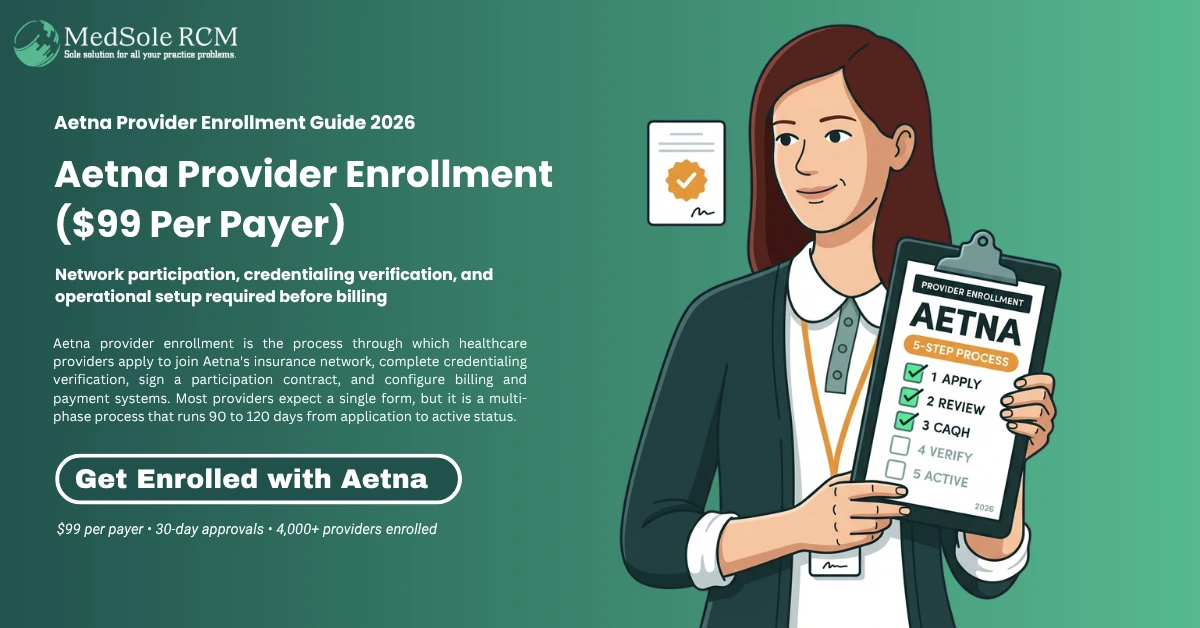
Aetna provider enrollment is the process through which healthcare providers apply to join Aetna's insurance network, complete credentialing verification, sign a participation contract, and configure billing and payment systems. Most providers expect a single form. What they actually face is a multi-phase process that runs 90 to 120 days from first application to active network status.
That timeline surprises people. It shouldn't.
Aetna, a CVS Health company, covers roughly 22 million medical members and maintains a network of about 1.7 million healthcare professionals. Getting into that network isn't just filling out paperwork. It's a sequence of business decisions, qualification checks, and operational setup steps that all have to happen in the right order.
Here's the problem with most guides you'll find online: they're outdated. Built on 2024 or early 2025 information. They don't cover the new PA credentialing requirements that took effect in March 2025. They skip the Medicare Advantage plan eliminations hitting 34 states in 2026. And they completely ignore the updated prior authorization rules through EviCore.
This guide is current as of April 2026. It covers the full enrollment lifecycle, from your initial participation request through aetna credentialing verification, contract execution, EFT/ERA payment setup, and ongoing directory compliance. Every step. Every form. Every deadline that actually matters to your revenue.
We built this guide from direct experience. MedSole RCM offers Aetna provider enrollment at $99 per payer with typical approval timelines of 30 days or less, having completed enrollment for more than 4,000 providers across all 50 states.
If your practice wants to handle enrollment internally, this guide gives you everything you need. And for practices that prefer professional support, MedSole RCM's provider enrollment and credentialing services deliver the fastest, most affordable payer enrollment in the industry.
What Aetna Provider Enrollment Actually Involves (And Why Most Providers Get It Wrong)
Most providers use "enrollment" and "credentialing" like they mean the same thing. They don't. Aetna treats them as completely separate workstreams, and confusing the two is the single most common reason practices miscalculate their go-live timeline.
According to Aetna's Provider Office Manual, the aetna provider enrollment process breaks into three distinct phases. Each one has its own team inside Aetna, its own requirements, and its own clock. Miss this distinction and you'll build your staffing plan, your marketing, and your revenue projections around a timeline that's wrong by months.
Let's break down what's actually happening behind the scenes.
Credentialing vs. Contracting vs. Operational Enrollment: The Three Workstreams
|
Workstream |
What It Is |
Who Handles It |
Typical Duration |
|
Network Participation Request + Contracting |
A business decision: does Aetna need your specialty in your geographic area? If yes, contract negotiation begins. |
Aetna Network Operations |
30 to 60 days |
|
Credentialing |
Qualification verification: primary source verification of licenses, DEA, board certifications, malpractice history, NPDB queries, education, and work history. |
Aetna's CVO (NCQA and URAC accredited) via CAQH ProView |
30 to 60 days (starts after contract) |
|
Operational Enrollment |
Setting up the systems that let you actually bill and get paid: Availity portal access, EFT/ERA through Optum, directory listing, and provider data validation. |
Provider + Availity + Optum |
1 to 2 weeks |
Aetna treats provider enrollment as three separate workstreams: network participation and contracting, credentialing verification, and operational enrollment, each with its own timeline and requirements. All three must be completed before a provider can submit in-network claims.
Here's where practices get burned. A signed contract without completed aetna credentialing means you can't see patients under that payer. Finished aetna provider credentialing without EFT enrollment means Aetna pays you by Virtual Credit Card, and those processing fees eat into every single payment.
Only when all three workstreams are done can you truly go live.
Think of it like moving into a new office. The contracting phase is signing your lease. Credentialing is passing inspection. Operational enrollment is getting the electricity turned on. You need all three before you can open the doors.
Before starting any of these workstreams, you need specific documents and systems ready. Here's the complete pre-application checklist.
Aetna Provider Enrollment Requirements: What You Need Before You Apply
Incomplete documentation is the number one cause of Aetna enrollment delays. It's not even close.
Aetna's automated screening cross-checks your application against CAQH, the NPPES database, state licensing boards, and the NPDB. Any mismatch, any gap, any expired document flags your aetna provider enrollment application for manual review. That manual review queue adds weeks to your timeline, sometimes longer.
Before you touch the application, make sure you have every item on this list ready and current. Having your aetna credentialing requirements in order before you apply is the single fastest way to shorten your timeline.
Documentation Checklist for Aetna Credentialing
Required for all provider types:
-
National Provider Identifier (NPI), Type 1 (individual), current in NPPES via the CMS NPI Registry
-
Active, unrestricted state medical license in every state where you'll see Aetna members
-
Current malpractice insurance with minimum $1M/$3M professional liability coverage
-
Comprehensive CV accounting for every month since graduation; gaps over 30 days need a written explanation
-
W-9 form for tax identification number verification
-
Completed and attested CAQH ProView profile with Aetna designated as an authorized health plan
-
Board certification documentation, if applicable
-
DEA certificate plus state controlled substance registration, if prescribing
-
Hospital admitting privileges documentation, if applicable
-
Three peer references from professionals in your specialty
Additional requirements for group practices (Type 2 NPI):
-
Group NPI (Type 2) current in NPPES
-
IRS Determination Letter or EIN documentation
-
Separate Type 1 NPI application for each individual provider in the group
That last point catches a lot of groups off guard. Each provider needs their own individual application even when they're joining under a group contract. One missing provider application can hold up the entire group's go-live date.
The aetna credentialing forms you need aren't sitting in a filing cabinet somewhere. They live inside CAQH ProView, which feeds your data directly to Aetna's credentialing system.
CAQH ProView: The Non-Negotiable Foundation
Aetna uses CAQH ProView for credentialing individual providers in most states. There are exceptions: Washington state, physicians in Arkansas, and the Allina Health/Aetna joint venture in Minnesota use different vendors. For everyone else, CAQH is where your aetna credentialing process starts and where it stalls if you're not careful.
Your CAQH profile must meet four requirements before Aetna can even begin reviewing your application:
-
100% complete, no blank fields, no skipped sections
-
Attested within the last 120 days (180 days for Illinois providers)
-
Aetna designated as an authorized health plan, without this step, Aetna's system can't pull your data at all
-
All uploaded documents must be current, not expired licenses, certificates, or insurance policies
Aetna requires providers to maintain a complete and attested CAQH ProView profile with Aetna designated as an authorized health plan. CAQH profiles must be re-attested every 120 days (180 days for Illinois), and documentation including active state licenses, DEA certificates, malpractice insurance ($1M/$3M minimum), and NPI registration must be current at the time of application.
Treat CAQH as a living system, not a one-time form. Your Aetna credentialing clock can't start if CAQH is incomplete, expired, or unauthorized. I've seen practices wait months for a credentialing decision only to discover their CAQH profile was never authorized for Aetna in the first place. Months of revenue, gone.
Feeling overwhelmed by the paperwork? MedSole RCM's credentialing specialists handle the entire documentation process, from CAQH setup and document collection to submission and follow-up, for $99 per payer. If you'd rather focus on patient care and let someone else manage the enrollment details, here's how we can help.
With your documentation in order, here's exactly how the enrollment process works, step by step.
How to Enroll as an Aetna Provider: 5-Step Process for 2026
Aetna's enrollment workflow follows a strict sequence. You can't skip steps, and you can't run them in parallel. Each phase depends on the one before it, so a delay at any point pushes everything else back.
This process is published on Aetna's Join the Network page and applies to all provider types: medical, dental, behavioral health, and facility. Variations exist by specialty, and we'll flag those where they matter.
Here are the five steps, in order, with what actually happens at each stage.
Step 1: Submit a Request for Participation
Aetna provider enrollment starts with the online Request for Participation form. You'll find it on Aetna's Join the Network page, broken into four categories: Medical, Dental, Behavioral Health, and Facility/Ancillary. Pick the one that matches your provider type.
A few things that trip people up at this stage:
-
Midlevel providers (NPs, PAs, midwives) don't get a separate form. Use the Medical request form and select your specific provider type in the specialty section.
-
Multiple Tax IDs? Complete the form once, using your primary service location only.
-
Already in Aetna's network? You can't use the join form to update a Tax ID. That goes through Aetna's "Practice changes/Provider termination" contact pathway instead.
-
Hospital-based providers joining an already contracted group may not need a separate aetna provider application. Check with the group's credentialing contact first.
Think of this step as raising your hand. You're telling Aetna you want to join the network. What happens next determines whether they want you.
Step 2: Network Need Review (The Gatekeeping Step Most Guides Skip)
Here's the thing most enrollment guides leave out entirely. After you submit your request, Aetna doesn't just start credentialing you. They first evaluate whether they actually need your specialty in your geographic area.
This is a business decision, not a clinical one. Aetna provider participation isn't guaranteed, no matter how qualified you are. If the network already has enough cardiologists in your zip code, your application won't move forward.
Aetna's published timelines for this review: 45 days for individual and group providers, 60 days for facilities.
Two possible outcomes here:
-
Accepted: An Aetna Network Manager reaches out to begin the contracting conversation.
-
Denied: You get a notification that no contract will be offered at this time.
Most providers expect credentialing to begin the day they submit their application. It doesn't. This panel review sits between submission and credentialing, and skipping it in your mental timeline creates a 30 to 60 day gap between your expectations and reality.
Step 3: Complete and Authorize Your CAQH ProView Profile
Once Aetna decides to move forward, your aetna credentialing application process begins. In most states, that process runs through CAQH ProView.
If you don't already have a CAQH account, Aetna sends a registration kit within 10 business days of accepting your application. From there, four things need to happen:
-
Complete every section of your CAQH ProView profile: personal details, practice locations, tax IDs, licenses, education, work history, and malpractice coverage. No blank fields.
-
Designate Aetna as an authorized health plan. This is the single most missed step in the entire process. Without this authorization, Aetna's system literally can't pull your data. Your profile could be perfect, and they'd still see nothing.
-
Upload current documents. Expired licenses or lapsed malpractice certificates will stall everything.
-
Attest your profile. CAQH requires re-attestation every 120 days (180 days for Illinois providers).
Quick note on exceptions: Washington state, physicians in Arkansas, and the Allina Health/Aetna joint venture in Minnesota use different credentialing vendors, not CAQH ProView.
Step 4: Primary Source Verification and Credentialing Review
This is where Aetna's credentialing team does the heavy lifting. Their CVO (Credentials Verification Organization), which holds both NCQA and URAC accreditation, runs primary source verification on everything in your profile.
What gets verified during aetna provider credentialing:
-
State licensure, confirmed directly with licensing boards
-
Board certification through ABMS or specialty boards
-
DEA and controlled substance registration
-
Hospital admitting privileges
-
Disciplinary history and adverse actions through the National Practitioner Data Bank and state boards
-
Malpractice claims history
-
Medicare/Medicaid participation status
-
Education, training, and work history through AMA Masterfile, AOA, and residency programs
Here's what makes this phase unpredictable. Aetna's team isn't slow. The bottleneck is third parties: licensing boards that take three weeks to respond, medical schools with outdated contact systems, former employers who don't prioritize verification requests.
That's why continuous follow-up matters during aetna credentialing. Providers who proactively contact these verification sources, or whose enrollment partners do it for them, consistently move through this step faster than those who submit and wait.
Step 5: Contract Execution, Effective Date, and Welcome Materials
Once credentialing clears, Aetna countersigns your participation contract, typically through Adobe Sign. You then receive your effective participation date. This date is when you officially become an Aetna provider and three things happen simultaneously:
-
Your listing goes live in Aetna's online provider directory
-
You can begin seeing Aetna members as an in-network provider
-
You can submit in-network claims for reimbursement
Aetna sends welcome materials that include your provider identification number (PIN) and instructions for portal access.
One critical warning that's worth repeating: don't schedule Aetna patients or submit claims until you have written confirmation of your effective date. Claims submitted before that date get automatically denied. No exceptions, no retroactive fixes in most cases. We've seen practices lose weeks of revenue because they jumped the gun by even a few days.
At completion of aetna provider enrollment, you'll have a signed contract, an active directory listing, and a clear effective date. What most providers ask next is straightforward: how long does all of this actually take? Here's what Aetna has officially published.
Want to skip the 5-step learning curve? MedSole RCM has completed Aetna enrollment for 4,000+ providers, with average approval in 30 days, not 90 to 120. Our continuous follow-up with Aetna's credentialing team and verification sources is what compresses the timeline. Get enrolled at $99/payer
MedSole RCM completes Aetna provider enrollment for $99 per payer with an average approval timeline of 30 days, compared to the industry standard of 90 to 120 days, through continuous follow-up with Aetna's credentialing team and third-party verification sources.
How Long Does Aetna Credentialing Take? (Official Timeline)
How long does aetna credentialing take? It's the most common question providers ask, and the answer most guides get wrong.
The problem isn't that the information doesn't exist. Aetna published a phased timeline in Aetna's Provider Education Bulletin (Spring 2025). But most guides cherry-pick one number from it and present that as the full picture.
Here's the actual aetna credentialing timeline, broken into phases:
|
Phase |
Days |
What Happens |
|
Request for Participation |
1 to 30 |
Submit form; Aetna evaluates network need; notifies you of decision |
|
Contracting |
30 to 60 |
Local Aetna team contacts you; contract reviewed and signed via Adobe Sign |
|
Credentialing |
60 to 90 |
Begins AFTER contract is signed; CAQH-based verification in most states |
|
Finalization |
90 to 120 |
Credentialing approved; Aetna countersigns contract; effective date issued; directory listing goes live |
Pay close attention to that third row. The 60 to 90 day credentialing window doesn't start when you submit your initial application. It starts after the contract is signed, which itself comes after the panel review.
That's the mistake. Most providers assume they're 60 days from billing Aetna when they hit "submit." In reality, the true timeline from "I want to join Aetna" to "I can bill Aetna" is 90 to 120 days minimum. And that assumes zero delays, no document issues, and responsive verification sources.
One more number to track: Aetna requires recredentialing every three years. Miss that cycle, and you're back to square one.
How MedSole RCM Compresses the Timeline to 30 Days
MedSole RCM's enrollment team consistently gets aetna provider enrollment completed in an average of 30 days. Here's how that works in practice:
-
Pre-submission CAQH audit. We review your entire CAQH profile before Aetna sees it. Errors that would trigger a 30-day delay get caught and fixed on day one.
-
Continuous follow-up with Aetna's credentialing team. We don't submit and wait for a callback. Our specialists contact Aetna's department directly, repeatedly, until each verification clears.
-
Proactive contact with third-party sources. Licensing boards, medical schools, past employers: we reach out to them before Aetna's CVO does. When Aetna's team calls, the response is already in motion.
-
Dedicated enrollment specialists. This is what our team does every day, not a side task squeezed between patient scheduling and billing follow-up.
We've completed Aetna provider enrollment in as few as 21 days for providers with clean documentation and responsive verification sources. That's not a marketing number. It's a documented turnaround from a case where everything lined up.
The difference between 30 days and 120 days isn't luck. It's process.
Critical 2025 to 2026 Aetna Policy Changes Every Provider Must Know
Aetna has rolled out several policy changes in 2025 and 2026 that directly affect provider enrollment, network participation, and billing workflows. If your practice enrolled with Aetna before 2025, some of these changes may already impact your status without you realizing it.
New Credentialing Requirement for Physician Assistants (Effective March 2025)
Starting March 1, 2025, all non-hospital-based, non-delegated physician assistants must complete CAQH-based credentialing or recredentialing with Aetna. This applies across Aetna commercial, Medicare, and Student Health networks.
Before this change, many PAs were added to group rosters without individual aetna credentialing. That's no longer enough.
What this means for your practice:
-
Every physician assistant on your staff needs a complete, attested CAQH ProView profile
-
PAs already participating in Aetna's network will need to complete credentialing during their next recredentialing cycle
-
New PAs can't simply be added to your group roster anymore. They go through the full aetna provider enrollment process individually
The revenue impact is simple. An uncredentialed PA can't bill Aetna. If your PA sees Aetna patients without completing this requirement, those claims get denied. No workaround, no exceptions.
2026 Aetna Medicare Advantage Network Changes: Approximately 90 Plan Closures Across 34 States
Aetna's Medicare Advantage footprint shifted significantly for 2026. Roughly 90 MA plans were eliminated across 34 states. If you were enrolled in an Aetna MA plan that no longer exists, your aetna medicare provider enrollment status may have changed without direct notification.
The broader picture isn't all contraction, though. Aetna still offers Medicare Advantage plans in 43 states plus DC, accessible to 57 million Medicare-eligible beneficiaries. And there are growth opportunities worth knowing about:
-
D-SNP plans (Dual Special Needs Plans for Medicare/Medicaid dual-eligible members) expanded to 119 new counties. For providers serving low-income or dual-eligible populations, this is a revenue opportunity worth exploring through aetna medicare advantage provider enrollment.
-
The High-Value Provider Incentive Program is expanding. PCPs who participate can offer additional benefits to their patients and may see higher patient engagement.
-
Some hospitals and health systems have left Aetna MA networks over contract disputes. If your referral partners have exited, your patient flow could be affected.
What you should do right now:
-
Verify your current Aetna MA enrollment is still active for 2026
-
Evaluate D-SNP enrollment in newly covered counties
-
Confirm your hospital and health system partners are still in-network with Aetna MA
2026 Prior Authorization Updates (EviCore Requirement)
Effective January 1, 2026, Aetna requires prior authorization through EviCore for inpatient rehab, skilled nursing, and certain home health services. Aetna also published an updated precertification list as of April 1, 2026.
Claims submitted without the required aetna authorization face high denial risk. And denied claims don't just disappear. They create rework, appeals, and AR follow-up services backlogs that slow down your entire revenue cycle. Unchecked, these denials compound into serious denials management problems.
This is where enrollment and ongoing billing intersect. Getting credentialed with Aetna is step one. Staying compliant with their changing prior authorization rules is what keeps your revenue flowing month after month.
Keeping up with Aetna's policy changes is practically a full-time job. MedSole RCM monitors payer updates continuously and proactively adjusts enrollment, billing, and authorization workflows for our clients. Our outsourced medical billing services start at just 2.99%, the most competitive rate in the industry for full-service RCM.
In 2026, Aetna eliminated approximately 90 Medicare Advantage plans across 34 states while expanding D-SNP coverage to 119 new counties. Starting January 2026, Aetna requires prior authorization through EviCore for inpatient rehab, skilled nursing, and certain home health services. Providers enrolled with Aetna should verify their current network status and update authorization workflows accordingly.
Aetna Enrollment by Provider Type: What's Different for Each Specialty
The general enrollment process is the same regardless of specialty. Five steps, same sequence, same dependencies. But the specific forms, documents, and verification pathways change based on your provider type.
Pick the wrong form or miss a specialty-specific requirement, and Aetna won't just flag the error. They'll restart your application from scratch. That's months of lost time over a mistake that takes two minutes to prevent.
Here's what each provider type needs to know.
Physicians (MD/DO) and Group Practices
Individual physicians complete aetna provider enrollment through the Medical Request for Participation form using a Type 1 NPI. Board certification gets verified through ABMS, and hospital privileges are confirmed if you provide inpatient services.
Group practices have an extra layer. You can't submit one application for the whole group. Each physician needs a separate application tied to the group's Type 2 NPI. We've seen practices assume aetna provider group enrollment works like a single filing. It doesn't. One application per provider, every time.
Nurse Practitioners (NPs) and Physician Assistants (PAs)
NPs and PAs don't have a separate enrollment form. You'll use the same Medical request form as physicians, but you need to select the correct provider type within the specialty section. Choosing "physician" when you're an aetna nurse practitioner applicant creates a mismatch that stalls the whole process.
For PAs specifically, the rules changed in 2025. As covered in the policy updates section, every non-hospital-based, non-delegated physician assistant now needs full CAQH-based credentialing. You can't just roster PAs under a group anymore.
NPs should double-check that state licensure and any collaborative or supervisory agreements (where required by state law) are current and accurately reflected in CAQH before submitting.
Behavioral Health and Mental Health Providers
Here's where the form difference really matters. Behavioral health professionals, including LCSWs, LPCs, psychologists, and psychiatrists, must use the Behavioral Health Request for Participation form. It's completely separate from the medical application.
Even if you're a behavioral health provider joining a medical group, you still use the BH-specific form. We've watched aetna behavioral health credentialing applications get rejected because the provider submitted through the medical pathway instead. That mistake alone can add 60 to 90 days to your timeline.
Aetna credentialing for mental health providers may also require documentation of specialized training and BH-specific licensure beyond your base clinical license. Aetna behavioral health provider enrollment follows the same five-step process, but the form and documentation requirements are distinct enough to cause problems if you're not paying attention.
Dental Providers
Dental providers use the Dental Request for Participation form. Credentialing follows the same CAQH-based process, but verification focuses on dental-specific credentials: dental licensure and specialty board certification through ADA-recognized boards.
One operational detail that matters for aetna dental credentialing: your EDI payer IDs are different from medical. Use 60054 for standard dental claims, 68246 for DMO encounters, and 18014 for dental Medicare claims. Submitting claims to the wrong payer ID is a billing error that's easy to make and annoying to fix. Aetna dental provider credentialing is straightforward if you've got the right form and the right payer IDs from day one.
Facilities and Ancillary Providers
Hospitals, ASCs, labs, and imaging centers use the Facility Request for Participation form and need a Type 2 NPI. Aetna facility credentialing involves an accreditation review, checking for Joint Commission, AAAHC, CLIA, or another recognized accrediting body.
If your facility isn't accredited, that doesn't automatically disqualify you. Aetna checks for a CMS or state survey, or may conduct an on-site quality assessment. But expect additional scrutiny and a longer review.
Aetna's stated decision timeline for facility applications is 60 days, compared to 45 days for individual and group providers. Plan accordingly.
Need specialty-specific enrollment support? MedSole RCM has completed Aetna credentialing for physicians, NPs, PAs, LCSWs, dentists, and facilities, each at $99 per payer. We know which form to use, which documents each specialty requires, and how to avoid the application restarts that waste months of your time. Start your enrollment
Aetna provider enrollment requirements vary by provider type: physicians use the Medical request form with Type 1 NPI, behavioral health providers use a separate Behavioral Health Request for Participation form, dental providers use the Dental form with separate EDI payer IDs (60054 for claims, 68246 for DMO encounters), and facilities require accreditation verification with a 60-day decision timeline. MedSole RCM handles specialty-specific Aetna enrollment at $99 per payer for all provider types.
Aetna Enrollment by Product Line: Commercial, Medicare, Medicaid, and Specialty Networks
"Aetna" isn't one network. It's a family of insurance products under CVS Health, and each product line has its own enrollment forms, credentialing workflows, and sometimes completely separate payment systems.
This distinction trips up providers constantly. You apply for Aetna commercial when you actually need Medicare Advantage. You assume your Better Health enrollment works like your PPO enrollment. Each wrong assumption means a potential application restart.
Before you submit anything, confirm which Aetna line of business you're actually joining.
Aetna Commercial (PPO, HMO, POS)
This is the standard aetna provider enrollment pathway covered throughout this guide. You'll use the Medical, Dental, Behavioral Health, or Facility Request for Participation form on Aetna's Join the Network page.
Credentialing runs through CAQH ProView in most states. Contracts execute via Adobe Sign. For aetna ppo provider enrollment and other commercial products, payment enrollment (ERA/EFT) goes through Optum Payer Enrollment Services. Your EDI payer ID for claims submission is 60054.
Aetna First Health Network
Aetna First Health is a separate PPO network, typically used by employers and third-party administrators for out-of-area coverage. Providers searching for aetna first health provider enrollment often don't realize it may require a completely different enrollment pathway from standard Aetna commercial.
First health provider enrollment falls under the Aetna/CVS Health umbrella, but credentialing contacts and contract terms can differ. Don't assume your standard Aetna commercial participation automatically includes First Health. Confirm with Aetna's provider relations team whether your First Health participation is bundled with or separate from your core commercial contract.
Aetna Medicare and Medicare Advantage
Aetna's Medicare Advantage products operate under CVS Health/Aetna, but aetna medicare provider enrollment isn't the same as commercial enrollment. These are frequently separate contracts.
For 2026, Aetna offers MA plans in 43 states plus DC, accessible to 57 million Medicare-eligible beneficiaries. As covered in the policy updates section, roughly 90 plans were eliminated across 34 states.
Aetna medicare advantage provider enrollment may involve CMS-specific requirements beyond standard commercial credentialing, including PECOS enrollment and a Medicare PTAN. The expanding High-Value Provider Incentive Program offers additional patient engagement benefits for participating PCPs. Check Aetna's published documentation for current EDI routing on Medicare claims.
Don't assume your commercial enrollment covers MA. Verify separately.
Aetna Better Health (Medicaid / Managed Medicaid)
Aetna Better Health is Aetna's Medicaid managed care product, and it operates state by state with its own enrollment requirements, formularies, and payment pathways. Aetna better health provider enrollment is not the same process as Aetna commercial.
Key differences that catch providers off guard: some states require separate aetna medicaid provider enrollment through the state Medicaid portal before you can even start with Aetna Better Health. Payment enrollment may not follow the standard Optum EFT/ERA pathway either. Aetna Better Health of Oklahoma, for example, uses ECHO Health for EFT/ERA enrollment instead of Optum.
Behavioral health providers serving dual-eligible members should confirm state-specific requirements before applying. The pathway varies more than any other Aetna product line.
Aetna Signature Administrators and Aetna Coventry
Aetna Signature Administrators is a PPO network used primarily in self-funded employer plans. Aetna signature administrators provider enrollment may route through a distinct pathway, though in many cases it now connects to standard Aetna commercial enrollment.
Aetna Coventry, largely absorbed into Aetna's core networks after the CVS acquisition, still shows up on some provider directories and legacy contracts. If you see "Coventry" on a patient's insurance card, contact Aetna's provider relations team to verify the correct aetna coventry provider enrollment pathway. In most cases, these now route through standard commercial enrollment.
Not sure which Aetna product line applies to your practice? MedSole RCM's enrollment specialists identify the correct Aetna line of business, submit to the right form, and manage the process from application to effective date, all for $99 per payer. Talk to our team
Aetna operates multiple product lines with distinct enrollment pathways: Aetna Commercial (PPO/HMO/POS), Aetna First Health, Aetna Medicare Advantage, Aetna Better Health (Medicaid), and Aetna Signature Administrators. Each may require separate applications, credentialing workflows, and payment enrollment setups. Providers should confirm their specific Aetna line of business before applying to avoid enrollment restarts.
After Aetna Credentialing Approval: Operational Setup So You Actually Get Paid
Getting credentialed doesn't mean your first Aetna claim will pay. There's a gap between "approved" and "revenue hitting your bank account" that most enrollment guides completely ignore.
Without EFT enrollment, Aetna may pay you by Virtual Credit Card, and those come with processing fees. Without Availity access, you can't submit claims electronically. Without directory verification, patients can't find you in Aetna's provider search.
Completing aetna provider enrollment is the starting line. What follows determines whether you actually collect.
Availity: Your Day-to-Day Aetna Portal
Aetna uses Availity as its aetna provider portal for nearly every day-to-day transaction. Claims submission, authorization requests, eligibility and benefits verification, clinical record uploads, disputes, appeals, and profile updates all run through this single platform.
Here's an operational detail that bites people. Availity's Provider Data Management (PDM) module lets you update directory-related information: emails, service locations, appointment phone numbers, telehealth status, NPI, and demographics. But PDM does not update transaction drop-down fields.
Transaction field updates require separate "Express Entry" submissions. Providers who update their information in PDM and assume it flows to claims routing get surprised when aetna provider services transactions fail. Two different systems, two different update paths. Know the difference before your first claim submission.
EFT and ERA Enrollment Through Optum (Critical for Payment)
This is the step that costs practices the most money when they skip it. Aetna's payment setup runs through Optum Payer Enrollment Services, and there are three components to understand:
-
ERA (Electronic Remittance Advice): Register through Optum to receive electronic payment explanations
-
EFT (Electronic Funds Transfer): Register through Optum to receive direct deposit payments
-
eEOB (Electronic Explanation of Benefits): Available through Availity without separate ERA enrollment
Here's the warning that matters for your bottom line. If you don't complete aetna provider eft enrollment, Aetna may issue payments via Virtual Credit Card. VCCs typically carry processing fees of 2% to 3% per transaction.
Run those numbers. A practice billing $500,000 per year through Aetna loses $10,000 to $15,000 annually in unnecessary VCC fees. That's not a billing problem. That's a setup problem, and aetna eft enrollment for providers takes a fraction of the time it takes to earn back those fees.
Payment enrollment is frequently the last step providers remember, and it's the one with the biggest financial consequence.
Provider Directory Verification (90-Day Compliance Cycle)
State and federal regulations require payers to contact providers every 90 days to verify directory information. Aetna enforces this through Availity's directory verification system and its own Provider Data Validation form.
What gets verified during aetna provider validation: practice address, phone numbers, accepting new patients status, office hours, telehealth availability, languages spoken, and accessibility features.
Non-response creates real problems. Directory inaccuracies trigger patient complaints when people can't reach you at the listed number or address. Those complaints can escalate to state regulatory issues. In extreme cases, persistent non-compliance leads to network status review.
Set a calendar reminder every 90 days. Assign directory verification to a specific staff member. Don't let it pile up with the other administrative tasks that nobody owns.
CAQH Attestation: The Ongoing Requirement Everyone Forgets
Beyond the 90-day directory cycle, CAQH ProView requires separate re-attestation every 120 days (180 days for Illinois providers). These are two overlapping compliance calendars, and missing either one creates problems.
When your CAQH attestation window lapses, your profile status changes to "Expired." That doesn't just affect aetna credentialing. It disrupts credentialing with every payer that pulls data from CAQH.
This is the kind of silent failure that practices discover only when a recredentialing cycle fails months later. By then, you're scrambling to update, re-attest, and resubmit, all while your network status hangs in the balance. Provider enrollment becomes an ongoing revenue cycle management discipline, not a one-time project.
The "last mile" of enrollment is where most practices lose money. EFT setup delays, VCC processing fees, expired CAQH profiles, missed directory verifications: these are silent revenue killers that happen after credentialing approval. MedSole RCM doesn't just get you enrolled. Our full-cycle RCM services handle everything from enrollment through claims submission, payment posting, and AR follow-up, starting at 2.99% of collections.
After Aetna credentialing approval, providers must complete operational setup including Availity portal registration for claims and authorizations, ERA and EFT enrollment through Optum Payer Enrollment Services, and directory data verification every 90 days. Providers who do not enroll in EFT may receive Aetna payments via Virtual Credit Card, which typically carries 2% to 3% processing fees. MedSole RCM includes post-enrollment operational setup in its $99 per payer enrollment service.
11 Mistakes That Delay or Derail Aetna Provider Enrollment (And How to Avoid Each One)
If your aetna provider enrollment application has been denied, delayed, or stuck in limbo, there's a good chance one of these mistakes is the reason. We've seen every single one of these across thousands of enrollments, and most are completely preventable.
Here are the 11 most common pitfalls, ranked by how often we see them.
1. Submitting before CAQH is complete and attested. Aetna can't pull data from an incomplete or unattested CAQH ProView profile. This is the single most common delay we encounter, and it adds 30 to 60 days to the timeline every time.
2. Forgetting to authorize Aetna in CAQH. Your profile can be flawless, but if Aetna isn't designated as an authorized health plan, their system sees nothing. It's a silent blocker that generates vague "missing information" notices without telling you what's actually wrong.
3. Expired documents in CAQH. Uploading a malpractice certificate or state license that expires during the review period triggers a hold. Then you're stuck in a document re-request cycle that resets part of the timeline.
4. NPI type mismatch. Using a Type 2 (group) NPI where Type 1 (individual) is required, or the reverse, causes claim routing failures even after successful aetna credentialing. The enrollment goes through, but claims bounce.
5. Assuming credentialing starts at application submission. The credentialing clock starts after contracting, not after you submit the initial participation request. That misunderstanding alone creates 30 to 60 days of false expectations.
6. Applying through the wrong form. Behavioral health providers must use the BH-specific form. Submitting through the medical form can restart your entire application from scratch. We covered this in the provider type section, but it's worth repeating because it happens constantly.
7. CV gaps without explanation. Aetna requires continuous work history since graduation. Any gap longer than 30 days without a written explanation gets flagged for manual review, and manual review means delays.
8. Not enrolling in EFT after approval. Skip this step and Aetna pays you by Virtual Credit Card with 2% to 3% processing fees. On a practice billing $500,000 per year through Aetna, that's $10,000 to $15,000 lost annually.
9. Ignoring the 90-day directory verification cycle. Non-response can escalate from a simple reminder to patient complaints to state regulatory issues. In extreme cases, it triggers a network status review.
10. Missing CAQH 120-day re-attestation. Your profile status changes to "Expired," and it doesn't just disrupt Aetna. Every payer that pulls from CAQH ProView loses access to your data simultaneously.
11. Treating Aetna as one network. Applying for commercial when you need Medicare Advantage, or assuming Better Health (Medicaid) follows the same pathway. Each product line has its own forms, contacts, and enrollment process.
The most common causes of Aetna provider enrollment delays include incomplete or unattested CAQH ProView profiles, failure to authorize Aetna as an approved health plan within CAQH, expired documentation submitted during review, NPI type mismatches, and applying through incorrect specialty-specific forms. MedSole RCM's pre-submission audit process catches these errors before the application reaches Aetna, which is how we achieve average approval in 30 days versus the industry standard of 90 to 120 days.
Aetna Recredentialing: What Happens Every 3 Years
Aetna provider enrollment isn't a one-time project. Once you're in the network, you need to stay in the network, and that means recredentialing.
When and How Recredentialing Works
Aetna requires aetna recredentialing every three years in most states. Some states mandate more frequent cycles based on local regulations, but three years is the standard.
The process mirrors initial aetna credentialing. Aetna's CVO pulls your updated information from CAQH ProView and runs primary source verification again: licenses, DEA, malpractice, board certification, disciplinary history. Same criteria, same verification sources.
Aetna typically sends notification when your recredentialing cycle is approaching. But here's the thing: don't rely on that notification as your only reminder. We've seen practices miss the window because the notice went to an old email address or got buried in a stack of payer correspondence. Your own internal tracking is the only reliable safeguard.
Checking your aetna credentialing status proactively, rather than waiting for Aetna to prompt you, keeps you ahead of the cycle.
What Happens If You Miss Recredentialing
The consequences are blunt:
-
Network termination. Aetna removes you from their provider directory.
-
Full reapplication required. You go back through the entire five-step enrollment process from scratch.
-
Billing gap. During reapplication, you can't bill Aetna. Every Aetna patient on your schedule becomes a revenue problem.
-
Referral disruption. Other providers stop sending Aetna patients your way once your directory listing disappears.
Rebuilding after a termination takes months. The financial and operational damage compounds the longer it takes.
How to Prevent Recredentialing Lapses
Preventing a lapse is far simpler than recovering from one:
-
Set internal calendar alerts six months before the three-year mark
-
Keep CAQH attested continuously every 120 days, not just when recredentialing is due
-
Maintain a running file of current licenses, DEA certificates, malpractice policies, and board certifications
-
Assign recredentialing oversight to one specific team member, or outsource it to an enrollment partner who tracks it for you
The practices that never miss a recredentialing deadline are the ones that treat it as a standing calendar item, not a surprise event.
Should You Outsource Aetna Provider Enrollment? Cost, Speed, and ROI Comparison
At this point you've seen the full process: five steps, 90 to 120 days, overlapping compliance calendars, and enough documentation to fill a filing cabinet. The question most practice managers ask next is whether it makes more sense to handle aetna provider enrollment internally or hand it to someone who does this every day.
Here's an honest breakdown.
The Real Cost of DIY Enrollment
Self-managing enrollment looks free on paper. In practice, the hidden costs add up fast.
|
Cost Factor |
DIY Estimate |
What's Behind the Number |
|
Staff time (credentialing coordinator) |
15 to 25 hours per provider per payer |
At $25/hr, that's $375 to $625 in labor per enrollment |
|
Opportunity cost of delays |
$2,000 to $8,000+ per month |
Revenue lost during each month a provider can't bill Aetna |
|
Error-driven restarts |
30 to 60 additional days |
Wrong forms, CAQH errors, and incomplete applications each multiply the labor cost |
|
VCC fees (if EFT isn't set up) |
2% to 3% of Aetna payments |
On $500K/year in Aetna billing, that's $10,000 to $15,000/year lost |
|
Compliance monitoring |
Ongoing staff time |
90-day directory verification + 120-day CAQH attestation + three-year recredentialing |
Add it up and the real cost of a single DIY enrollment runs $500 to $1,500 or more in direct labor. Factor in delayed revenue from a 90 to 120 day timeline, and the total cost climbs into thousands.
What MedSole RCM Offers: The Numbers
Here's what aetna credentialing services look like when you work with MedSole RCM:
|
What You Get |
MedSole RCM |
|
Price |
$99 per payer |
|
Average approval timeline |
30 days (fastest documented: under 21 days) |
|
What's included |
Complete CAQH setup and audit, application submission, continuous follow-up with Aetna, primary source verification coordination, EFT/ERA setup assistance, directory verification |
|
Providers enrolled |
4,000+ across all 50 states |
|
Full-service billing |
Available as outsourced medical billing services at 2.99% of collections |
|
Combined enrollment + billing |
One partner for provider enrollment services and ongoing revenue cycle management |
When DIY Makes Sense vs. When to Outsource
We'll be straightforward. DIY isn't always the wrong call.
Handling it yourself can work if:
-
You have a dedicated, trained credentialing coordinator already on staff
-
You're enrolling with only one or two payers
-
There's no timeline pressure for your go-live date
Outsourcing makes more sense if:
-
You're enrolling with multiple payers at the same time
-
You need to be billing within 30 to 60 days
-
Nobody on your team specializes in aetna credentialing or payer enrollment
-
You've already hit delays, denials, or application restarts
-
You want aetna provider enrollment and billing managed by one partner
The math is simple. If $99 gets you enrolled in 30 days instead of spending $500 to $1,500 over 90 to 120 days, the ROI isn't a close call. When you add the revenue you'd lose sitting on the sidelines for an extra two to three months, outsourcing pays for itself before the first claim drops.
Ready to Get Enrolled with Aetna?
MedSole RCM handles Aetna provider enrollment from application to first claim, for $99 per payer.
-
Average 30-day approval (fastest: under 21 days)
-
4,000+ providers enrolled across all 50 states
-
Complete CAQH setup, application, follow-up, and EFT/ERA enrollment included
-
Full-service medical billing available at 2.99% of collections
Get Started with Aetna Enrollment
Or call us: +1 (602) 563-5281
MedSole RCM offers Aetna provider enrollment at $99 per payer, the most affordable credentialing service in the U.S. market, with an average approval timeline of 30 days compared to the industry standard of 90 to 120 days. The service includes CAQH ProView setup and audit, application submission, continuous follow-up with Aetna's credentialing department, EFT/ERA payment enrollment through Optum, and directory verification. MedSole RCM has completed enrollment for more than 4,000 providers across all 50 states. For practices that also need billing support, MedSole RCM provides full-service outsourced medical billing at 2.99% of collections.
Aetna Provider Enrollment Contact Information
Here are the official Aetna contact numbers and resources for provider enrollment and credentialing inquiries. Keep your NPI and Tax ID handy before calling; you'll need both to verify your identity.
|
Purpose |
Contact |
Hours/Notes |
|
Credentialing Status/Questions (Medical and Behavioral Health) |
1-800-353-1232 (TTY 711) |
Mon to Fri |
|
Dental Network Questions |
1-800-451-7715 (TTY) |
Mon to Fri |
|
Medicare Advantage Provider Questions |
1-800-624-0756 (TTY) |
Mon to Fri |
|
Behavioral Health Credentialing |
1-888-632-3862 (TTY) |
Mon to Fri |
|
CAQH ProView Help Desk |
1-888-599-1771 |
Mon to Fri |
|
Join the Aetna Network (Online) |
aetna.com/join-the-network |
Available 24/7 |
|
Aetna Provider Portal (Availity) |
availity.com |
Available 24/7 |
|
CAQH ProView Portal |
proview.caqh.org |
Available 24/7 |
|
Aetna Provider Onboarding Center |
extaz-oci.aetna.com/pocui/ |
Available 24/7 |
The aetna credentialing phone number for medical and behavioral health providers (1-800-353-1232) is your primary contact for checking aetna credentialing status and resolving application questions. For the aetna provider enrollment phone number specific to dental or Medicare Advantage, use the dedicated lines listed above.
Texas Providers: Open Enrollment Window
Aetna texas provider enrollment operates differently than other states. Aetna Life Insurance Company, Aetna Health Inc. (a Texas corporation), and Aetna Dental Inc. (a Texas corporation) accept written applications for participation in their PPO, POS, HMO, and DMO networks only during a specific window: December 1 to 21, 2026.
If you're a Texas provider looking to join Aetna's network, prepare your application materials well before December. Missing this window means waiting an entire year for the next opportunity.
Frequently Asked Questions About Aetna Provider Enrollment
How long does Aetna provider enrollment take?
The full process typically takes 90 to 120 days from initial application to effective date. That breaks down into panel review (1 to 30 days), contracting (30 to 60 days), and credentialing verification (60 to 90 days). The aetna credentialing timeline depends heavily on how quickly third-party verification sources respond. MedSole RCM averages 30-day approvals through continuous follow-up with Aetna's credentialing team and proactive outreach to verification sources.
What documents do I need for Aetna credentialing?
Aetna requires a complete CAQH ProView profile with active state medical licenses, NPI number, DEA certificate (if prescribing), current malpractice insurance (typically $1M/$3M minimum), board certification, a comprehensive CV with no unexplained gaps, W-9 form, and hospital privileges documentation if applicable. All aetna credentialing forms and documents must be current at application time. Expired documents trigger delays.
How much does Aetna provider enrollment cost?
Aetna doesn't charge providers to apply. The real aetna provider enrollment cost is administrative: self-managing enrollment typically runs $500 to $1,500 in staff labor per application, plus the revenue lost during a 90 to 120 day wait. MedSole RCM offers complete enrollment for $99 per payer, including CAQH setup, application submission, follow-up, and payment enrollment. That's the most affordable aetna credentialing services rate in the market.
What's the difference between Aetna credentialing and provider enrollment?
Credentialing is the verification process where Aetna's CVO confirms your qualifications: licenses, education, malpractice history, and disciplinary record. Provider enrollment is broader. It includes the network participation request, contracting, credentialing, and operational setup (Availity access, EFT/ERA enrollment). Both must be completed before you can submit in-network claims. Credentialing is one step within the larger enrollment process.
Can I bill Aetna before my credentialing is complete?
No. You need written confirmation of your effective participation date before seeing Aetna members as in-network or submitting claims. Claims submitted before your effective date get automatically denied. Aetna doesn't offer retroactive billing for the credentialing period in most situations. Jumping the gun by even a few days creates denials you'll have to write off.
Why was my Aetna enrollment application denied or delayed?
The most common causes of aetna provider enrollment denied status include incomplete or unattested CAQH profiles, forgetting to authorize Aetna within CAQH, expired documents, NPI type mismatches, and applying through the wrong specialty form. Panel closures can also block enrollment if Aetna doesn't need your specialty in your area. MedSole RCM's pre-submission audit catches these errors before they reach Aetna.
How do I check my Aetna credentialing status?
Call Aetna's credentialing department at 1-800-353-1232 (TTY 711) for medical and behavioral health aetna credentialing status. For dental, call 1-800-451-7715. For Medicare Advantage questions, call 1-800-624-0756. Have your NPI and Tax ID ready. Hold times vary, so call early in the day when possible.
Does Aetna use CAQH for credentialing?
Yes. Aetna uses CAQH ProView for credentialing individual healthcare professionals in most states. Exceptions include Washington state, physicians in Arkansas, and the Allina Health/Aetna joint venture network in Minnesota, where different vendors handle credentialing. You must designate Aetna as an authorized health plan within CAQH for their system to pull your data. Without that authorization, Aetna sees nothing.
How often do I need to recredential with Aetna?
Aetna requires recredentialing every three years in most states. The process uses the same CAQH-based verification as initial credentialing. Separately, your CAQH profile must be re-attested every 120 days (180 days in Illinois) regardless of your recredentialing cycle. Missing recredentialing can result in network termination, forcing you to restart the entire enrollment process from scratch.
Should I hire a company to handle Aetna enrollment, or do it myself?
It depends on your bandwidth and timeline. Self-managing costs $500 to $1,500 in staff labor and takes 90 to 120 days on average. MedSole RCM completes Aetna enrollment for $99 per payer with 30-day average approvals. We've enrolled 4,000+ providers across all 50 states. For practices that also need billing support, MedSole RCM offers outsourced medical billing at 2.99% of collections, the most competitive rate available.
The Bottom Line on Aetna Provider Enrollment in 2026
Aetna provider enrollment is one of the most consequential revenue cycle decisions your practice will make. Aetna's 22 million members represent real revenue potential, but only for providers who complete the full enrollment lifecycle: network participation request, credentialing, contracting, and operational setup.
The process has become more complex in 2025 and 2026. New PA credentialing requirements, Medicare Advantage network restructuring across 34 states, and updated prior authorization rules through EviCore have all added layers that didn't exist two years ago.
Whether you manage enrollment internally or partner with a credentialing service, the fundamentals stay the same. Keep CAQH current. Submit complete documentation. Follow up continuously. Don't overlook post-approval operational setup. Those four things separate practices that get enrolled quickly from those that wait months wondering why nothing is moving.
MedSole RCM has helped more than 4,000 healthcare providers complete payer enrollment and credentialing across all 50 states. Our Aetna provider enrollment service is priced at $99 per payer with average approval in 30 days. For practices that need ongoing billing support, we offer full-service outsourced medical billing at 2.99% of collections. Whether you're a solo practitioner, a behavioral health provider, a group practice, or a facility, MedSole RCM's team is ready to handle your enrollment from application to first paid claim.
Get Enrolled with Aetna in 30 Days, For $99
Stop losing revenue to enrollment delays. MedSole RCM handles every step of Aetna provider enrollment:
-
CAQH setup and pre-submission audit
-
Correct form selection and application submission
-
Continuous follow-up with Aetna's credentialing team
-
EFT/ERA payment enrollment through Optum
-
Directory verification and compliance monitoring
$99/payer enrollment | 2.99% billing | 4,000+ providers served
Start Your Aetna Enrollment Today
Or call us: +1 (602) 563-5281