



United Healthcare credentialing is the process by which UnitedHealthcare verifies a provider's qualifications, licenses, training, and professional history before adding them to a network of 48 million covered lives. Without it, you can't bill UHC as in-network. That's the short version.
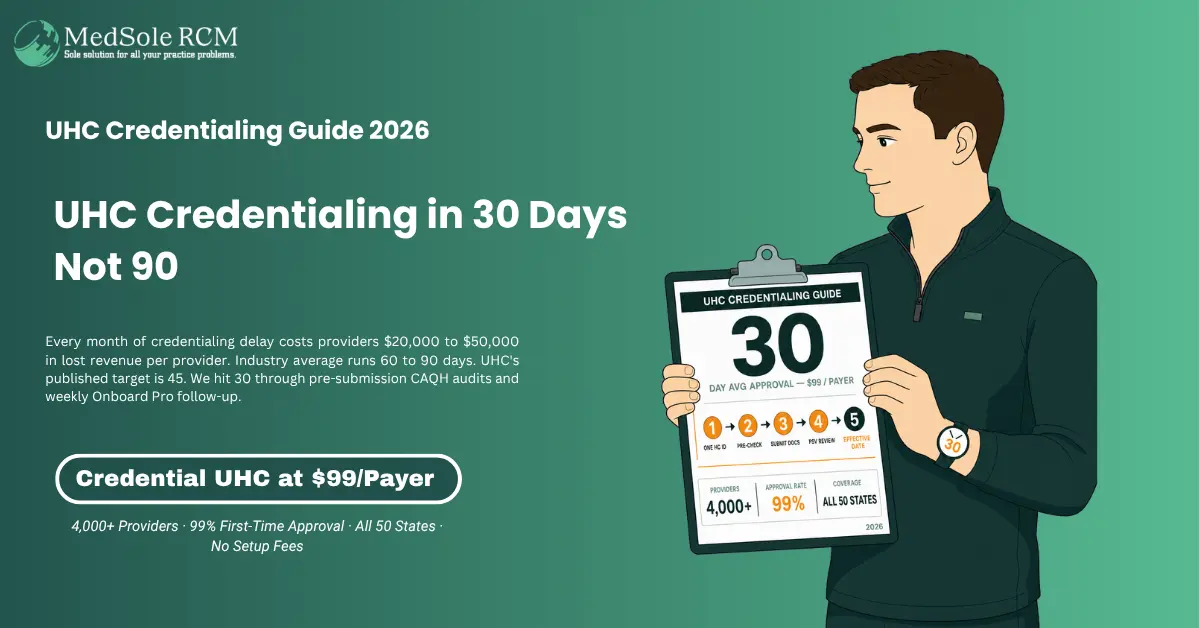
Every month a provider waits for UHC credentialing approval costs $20,000 to $50,000 in lost revenue per provider. That's not a billing problem. That's a credentialing failure. The fix isn't complicated. It's about knowing where the friction lives and removing it before it stalls your application.
This guide walks through Onboard Pro, CAQH ProView, the 5-step application process, the 2025-2027 Credentialing Plan, the 2026 Administrative Guide updates, specialty pathways through Optum, and the timeline reality most providers don't see until they're already 60 days in.
We're MedSole RCM. We've credentialed more than 4,000 providers across all 50 states at $99 per payer with average approval times of 30 days. The reason it's faster isn't a secret. We do pre-submission CAQH audits and push UHC's credentialing team weekly until approvals land.
Whether you're a solo provider, a group, or a multi-site facility, the path is the same. Onboard Pro is the gate. CAQH ProView is the foundation. Everything else flows from those two systems.
What UHC Credentialing Actually Involves: The Three-Workstream Reality
Most providers think united healthcare credentialing is one process. It isn't. UHC routes you through three sequential workstreams: credentialing for qualification verification, contracting for the participation agreement, and connecting for operational setup. Confusing the three is why providers get blindsided by 90-day timelines when they expected something much shorter.
Each workstream has its own internal team at UHC, its own requirements, and its own clock. The credentialing and contracting workstream involves different stakeholders, different systems, and different approval authorities inside UHC. None of them wait for each other by default.
Credentialing vs. Contracting vs. Connecting
|
Workstream |
What It Is |
Who Handles It |
Typical Duration |
|---|---|---|---|
|
Credentialing |
Qualification verification: primary source verification of state licenses, DEA registration, board certification, malpractice history, education, work history, and NPDB queries through Onboard Pro and CAQH ProView |
UHC Credentialing Committee |
45 to 90 days from completed application |
|
Contracting |
Participation Agreement: rate review, terms, signature via Adobe Sign. Triggered automatically inside Onboard Pro after credentialing approval |
UHC Network Operations |
Begins automatically after credentialing |
|
Connecting |
Operational setup: portal profile, EFT and ERA enrollment via Optum Pay, directory listing, contract loaded into UHC's billing systems |
Provider, Optum Pay, UHC Systems |
Up to 60 days after credentialing approval |
Here's where practices get burned. A signed contract without completed credentialing means you can't bill. Finished credentialing without operational connecting means UHC pays slowly or by virtual credit card with processing fees that eat every payment.
Why "Approved" Doesn't Mean "Ready to Bill"
UHC's own Join Our Network page says "please allow up to 60 days for your contract to be loaded into our systems" after credentialing approval. That sentence kills more practice budgets than any other in UHC's documentation.
Providers see "approved" in Onboard Pro, schedule UHC patients for the following week, and submit claims. Those claims deny. Some can't be retroactively fixed even when the contract eventually loads. This is the operational warning every competitor skips.
The reason all this exists in its current form is the 2025-2027 Credentialing Plan and the new 2026 Administrative Guide. Both reshape what providers need to know before they open Onboard Pro.
What Changed in UHC's 2025-2027 Credentialing Plan and the 2026 Administrative Guide
The UnitedHealthcare Credentialing Plan 2025-2027 went into effect March 1, 2025. The 2026 UnitedHealthcare Care Provider Administrative Guide became effective April 1, 2026. Most credentialing content online doesn't reflect either. Six material updates affect how providers credential and recredential with UHC right now.
Onboard Pro Bulk Submissions (Effective March 1, 2026)
On March 1, 2026, UnitedHealthcare announced an Onboard Pro bulk credentialing enhancement. Groups can now submit up to 50 providers at once and credential up to 10 states per bulk submission inside the UnitedHealthcare Provider Portal.
For IPAs, multi-site practices, and health systems, this is the biggest workflow change of the year. The old one-by-one submission model is no longer the default for organizations with scale. If you manage multi-provider credentialing at volume, this update changes your process fundamentally.
2026 Administrative Guide Effective April 1, 2026
UHC published a Network News notice on January 1, 2026 announcing the 2026 Administrative Guide. For currently contracted providers, it's effective April 1, 2026 with a 90-day review window.
The Guide reiterates UHC's 36-month recredentialing cycle and the requirement that providers use the CAQH Provider Data Portal unless state law requires otherwise. Review the full Guide before your next recredentialing event.
Tighter NCQA-Aligned Time Limits
Application and attestation must now be within 180 days of the credentialing Decision Date. Primary source verifications must be no older than 120 days. Both timeframes are tighter than the prior cycle, aligned with updated National Committee for Quality Assurance standards.
Expired or stale documentation triggers an immediate rework. That adds weeks to your timeline before UHC even begins primary source verification. Don't let old documents sit in your CAQH profile unreviewed.
Expanded Coverage for Telemedicine and Locum Tenens Providers
The 2025-2027 Plan explicitly extends credentialing requirements to covering practitioners with independent participation agreements. That includes locum tenens and telemedicine practitioners. If you're a virtual-only provider or a covering physician, you're now squarely inside UHC's credentialing scope.
This wasn't always true in earlier plan cycles. Providers who assumed they were exempt from full credentialing because they work remotely or fill coverage gaps are now required to complete the same process. Read through telemedicine credentialing under the 2026 framework before you start an application as a virtual or locum provider.
New Medicaid Exclusion Verification Requirement
A new requirement under the 2025-2027 Plan: state Medicaid exclusions must be verified when applicable. UHC now screens applicants against the OIG's exclusion list, the CMS Preclusion List, and individual state Medicaid agency exclusion lists.
One state-level exclusion can cascade into termination across every state where you participate. This isn't a theoretical risk. It's a real operational exposure that providers don't discover until it's too late to address proactively.
Updated State and Federal Regulatory Addendum
The State and Federal Regulatory Addendum has a revision log dated 4/2026, signaling active maintenance. State-specific timing rules vary widely. Illinois requires completion within 60 days of full document submission. Oklahoma uses a 45-day clean application standard. Minnesota providers can submit through ApplySmart instead of CAQH. Always check your state's addendum entry before starting an application.
Keeping up with UHC's payer policy shifts is a job in itself. We monitor every payer's credentialing changes and reflect them in our enrollment workflow within days, not months. If you'd rather focus on patients, our provider enrollment and credentialing services handle this end-to-end at $99 per payer.
Onboard Pro and One Healthcare ID: Your Gateway to UHC
Onboard Pro is UHC's mandatory digital credentialing platform inside the UnitedHealthcare Provider Portal, and it's the gateway to every united healthcare credentialing workflow. Without it, no application moves forward. Without a One Healthcare ID, you can't even reach Onboard Pro. The platform integrates directly with CAQH ProView, eliminating duplicate data entry where state law allows. That's the foundation before you touch anything else.
What Onboard Pro Actually Is
Onboard Pro guides medical providers, group practices, hospitals, facilities, and ancillary providers through credentialing step by step. It performs an automatic pre-credentialing check using your CAQH data, requests additional information when needed, and routes contracting steps automatically once credentialing clears.
The tool emails a reference number after submission and shows real-time status on a dashboard. Behavioral health providers don't use Onboard Pro. They go through Optum's Provider Express platform instead. Using the wrong portal for your specialty costs 2 to 4 weeks in redirect delays.
Setting Up Your One Healthcare ID
Your One Healthcare ID is the single sign-on credential for every UHC provider-facing system. Use a practice-wide admin email when registering, not a clinical inbox. If your credentialing coordinator leaves, you don't want the One Healthcare ID locked to a deactivated email address.
The registration form takes a name, email, username, and password. Once you have the ID, sign into the UnitedHealthcare Provider Portal and Onboard Pro is one click away. Don't share the credential across multiple staff members without a documented access policy.
The Onboard Pro Dashboard and Real-Time Status Tracking
Onboard Pro's dashboard shows projected completion dates for both contracting and credentialing in real time. You see exactly which step the application is in and what UHC needs next. This is a meaningful operational improvement over older systems where providers waited weeks for any status update.
The dashboard surfaces document requests, attestation reminders, and effective date projections. Sign in regularly. Applications that sit without provider response stall, even when UHC is ready to move forward.
TrackIt: The Operational Hub Most Providers Miss
TrackIt is the action hub inside the UHC Provider Portal that almost no competitor explains. It surfaces time-sensitive items, document upload requirements, demographic attestation due dates, and active credentialing tasks. It's where the 90-day demographic verification deadline appears.
Miss that deadline and UHC suppresses your directory listing, even if your credentialing is fully current. Patients searching for in-network providers won't find you. Add TrackIt to your weekly review routine. It's the difference between knowing what's pending and finding out a month after the deadline passed.
Our team manages these portals daily for clients across all 50 states. Once you're in Onboard Pro, the application pulls from CAQH ProView. That's where the real prep work happens.
CAQH ProView: The Foundation Underneath UHC Credentialing
UHC pulls all united healthcare credentialing data from CAQH ProView. If your CAQH profile is incomplete, expired, or unauthorized, your united healthcare credentialing application freezes without explanation. Most application delays trace back to CAQH problems, not UHC processing slowness. Get CAQH right and most of your timeline risk disappears before the application opens.
Read through the complete CAQH ProView management guide before touching any application. The CAQH step is where most preventable delays originate, and it's the step most providers treat as an afterthought.
The 90-Day vs. 120-Day vs. 180-Day Attestation Reality
Three different attestation timelines confuse even experienced credentialers. CAQH's baseline requirement is every 120 days. UHC's automated recredentialing process needs 90-day attestation for streamlined renewal without manual intervention. Illinois providers operate on 180-day attestation due to state law.
Mix these up and your application stalls without notification. CAQH's status flips to "Expired" when the schedule slips, and UHC's system stops pulling data the moment status changes. Set calendar reminders. Verify status before any application or recredentialing event. Don't rely on memory.
Authorizing UHC as a Designated Health Plan
This is the single most-missed step in the entire CAQH-to-UHC handoff. Inside CAQH ProView, you must designate UHC as an authorized health plan for your data. Without this checkbox, UHC's system literally can't pull your information.
The profile could be perfect. Every document uploaded, every section attested, every field current. UHC still sees nothing. Practices wait months for a credentialing decision before discovering they never authorized UHC to access their data at all. Check this first.
The 90-Day Demographic Verification Requirement
Separate from CAQH attestation, contracted UHC providers must verify demographic data every 90 days. This requirement comes from the Consolidated Appropriations Act, not from CAQH or UHC discretion. The verification confirms your practice address, phone number, accepting-new-patients status, and other directory data.
Skip this and UHC suppresses your directory listing. The due date appears in TrackIt inside the UHC Provider Portal. Treat it as non-negotiable. A suppressed listing reduces patient acquisition before any clinical issue surfaces.
Pre-Application Checklist: What You Need Before You Open Onboard Pro
UHC's automated screening flags any inconsistency between your application, your CAQH profile, your NPPES record, and your state license. Names must match exactly. Dates must align. One mismatch triggers manual review and adds weeks to your timeline before UHC's team even looks at the substantive application.
Understanding what a credentialing specialist actually does at this stage clarifies why document preparation isn't administrative busywork. It's the work that determines whether your application moves or stalls.
Required Documentation for Medical Providers
Here's what every medical provider needs ready before opening Onboard Pro. An NPI Type 1, current in NPPES. An active state medical license for every state where you'll see UHC members (no temporary licenses accepted). A malpractice insurance Certificate of Insurance showing $1 million per occurrence and $3 million aggregate minimum coverage.
Board certification documentation if applicable. A DEA certificate plus state CDS registration if you prescribe controlled substances. A CV with no unexplained gaps over 6 months. A W-9 with legal name and TIN matching IRS records exactly. A CAQH ProView profile that's complete, attested within 120 days, and UHC-authorized. Hospital admitting privileges documentation if applicable.
Documentation for Group Practices and Hospitals
Group practices need everything above plus an NPI Type 2 current in NPPES, an IRS Determination Letter or EIN documentation, and a separate Type 1 NPI application for each individual provider in the group. One forgotten provider holds up the entire group's effective date.
Hospitals add facility licensing documents, a CMS letter showing Medicare provider number, and proof of state Medicaid enrollment if applicable. The group application doesn't move until every individual credentialing file is clean and complete.
Common Documentation Mistakes That Stall Applications
Four mistakes cause most credentialing delays. Practice address not matching across USPS, NPPES, and CAQH. CAQH work history with gaps over 6 months unexplained. Malpractice insurance lacking active policy dates or coverage limits on the Certificate of Insurance. NPI not linked to Tax ID and group contract in UHC's internal records.
Any of these flips your status to "Pended Awaiting Verification" and can add 30 to 75 days unless someone proactively identifies and corrects it. Most providers don't know the status changed until they call for an update weeks later.
Our credentialing specialists audit every document before submission. That's one of the reasons we hit 30-day approvals when the industry runs 60 to 90 days. Once your documents are clean, you move to the actual application.
How to Enroll With UHC: The 5-Step Process Through Onboard Pro
The complete united healthcare credentialing process comes down to five sequential steps inside Onboard Pro: sign in with your One Healthcare ID, complete the pre-credentialing check, submit the provider add form with documentation, wait for primary source verification by UHC's credentialing team, and receive your effective date after committee review. Each step depends on the prior one. Skip nothing.
This follows the same workstream pattern we walk through for Aetna provider enrollment, adapted specifically for UHC's portal ecosystem and committee structure. The sequencing is non-negotiable regardless of provider type.
Step 1: Sign In to Onboard Pro With Your One Healthcare ID
Step 1 starts at uhcprovider.com. Sign in with your One Healthcare ID, open Onboard Pro, and select your entity type: medical provider, hospital and facility, ancillary provider, or dental, vision, behavioral health, and other.
Enter legal name, business name, Tax ID Number, state of practice, and lines of business. Lines of business include UHC commercial, Medicare Advantage, and Medicaid. The system uses these inputs to determine which credentialing pathway applies. The whole sign-in and entity selection takes about 10 minutes when you have everything ready.
Step 2: Complete the Pre-Credentialing Check
Step 2 is the pre-credentialing check, a three-stage automated review inside Onboard Pro. Stage one finds your existing CAQH ID and pulls your provider data. Stage two sets up the contract information based on your entity type. Stage three is system-automated and determines whether full credentialing is required.
If you're joining a group with an existing UHC participation agreement, you might still need individual credentialing. Group contracts don't extend automatically to individual providers. The pre-credentialing check usually takes one to five business days. If your CAQH profile is incomplete or unauthorized, this step fails and Onboard Pro tells you exactly what's missing.
Step 3: Submit the Provider Add Form and Documentation
Step 3 is where most providers spend the most time. The provider add form requires practitioner information, all practice locations, every active state license, hospital affiliations, current malpractice insurance details, and supporting attachments. Upload your W-9, malpractice Certificate of Insurance, and any board certifications or DEA documents.
Link your CAQH ID once you've confirmed UHC is authorized inside CAQH ProView. Review every entry against your CAQH profile and your NPPES record before submitting. The system emails a reference number within minutes of submission. Save it. The reference number is how you track the application, escalate delays, and confirm receipt with UHC's credentialing team. Submission takes 30 to 45 minutes when documentation is ready.
Step 4: Primary Source Verification by UHC's Credentialing Team
Step 4 is invisible to you but critical. UHC's credentialing team contacts the original sources of your credentials. Medical school education verified through the issuing institution. State licenses confirmed through state licensing boards. DEA registration confirmed through the federal DEA database.
Board certification verified through the American Board of Medical Specialties or specialty-specific boards. The National Practitioner Data Bank gets queried for any malpractice settlements, disciplinary actions, license suspensions, or healthcare-related criminal convictions. Work history confirmed with prior employers and the AMA Masterfile. This phase takes 15 to 45 days depending on how fast third-party sources respond. UHC isn't slow. The bottleneck is verification source response times that UHC can't control.
Step 5: Credentialing Committee Review and Effective Date Issuance
Step 5 is the credentialing committee review. UHC presents your verified application to the committee for an approval decision. The committee evaluates your qualifications, practice patterns, and any flags from primary source verification. Most clean applications get approved at this stage.
Once approved, UHC countersigns your participation contract through Adobe Sign and issues an effective date. Your directory listing goes live, EFT and ERA setup begins through Optum Pay, and your contract loads into UHC's billing systems. Critical warning: do not bill UHC patients before you have written confirmation of your effective date. Claims submitted before that date deny automatically. Most can't be retroactively fixed. Schedule patients only after written confirmation lands.
If managing this end-to-end isn't realistic for your practice, we handle Onboard Pro applications and follow-up for $99 per payer with 30-day average approvals. We've credentialed more than 4,000 providers across all 50 states with a 99 percent first-time approval rate. No setup fees, no hidden charges, no annual contracts.
The Real UHC Credentialing Timeline: Phase by Phase
UHC's published timeline says "up to 45 calendar days" once they have a complete application. The real-world average is 60 to 90 days from initial submission to billable in-network status. The gap between published and real isn't UHC's fault. It's third-party verification response times that UHC can't control and that most providers don't anticipate.
UHC's Published 45-Day Target vs. Real-World 60 to 90 Days
UHC's Join Our Network page sets the 45-day expectation for full credentialing once a complete application lands. Industry data tells a different story. Most providers experience 60 to 90 days from Onboard Pro submission to written effective date confirmation.
After that, UHC says to allow up to 60 more days for the contract to load into their billing systems. Total time from start to billable in-network can stretch to 120 days for clean applications, longer when documentation issues surface mid-process.
The Phased Breakdown
Breaking the timeline into phases shows where the time actually goes and where you can intervene. Most providers underestimate phase three because UHC's communication during primary source verification is minimal. Knowing what's happening behind the scenes is the first step to compressing it.
|
Phase |
Duration |
What Happens |
|---|---|---|
|
Pre-Credentialing Check |
1 to 5 business days |
Onboard Pro determines whether credentialing is required and confirms CAQH data is accessible |
|
Application Submission |
Same day to 2 days |
Provider add form completed, documentation uploaded, CAQH ID linked, reference number issued |
|
Primary Source Verification |
15 to 45 days |
UHC verifies licenses, education, NPDB, malpractice, board certification, work history through original sources |
|
Credentialing Committee Review |
5 to 15 days |
Application presented to committee for approval decision; clean applications usually approved on first review |
|
Effective Date and Contract Loading |
Up to 60 days post-approval |
Effective date issued, directory listing live, EFT and ERA setup via Optum Pay, contract loaded into UHC systems |
Why Third-Party Verification Is the Bottleneck
Phase three is the longest phase because UHC depends on third parties to confirm your credentials. Medical schools take two to four weeks to respond to verification requests. Residency programs run on academic calendars and can ignore requests for weeks. State licensing boards are uneven; some respond same-week, others take three to four weeks.
Specialty boards like ABMS are usually fast. The NPDB query is automated and instant. Hospital privilege confirmations vary wildly. UHC chases each source, but they can't accelerate medical school registrar offices. The credentialing teams that compress this phase contact third-party sources before UHC even reaches them, warming up the verification pipeline in advance.
Don't Bill Before Your Effective Date
The single most expensive mistake providers make: scheduling UHC patients and submitting claims before written confirmation of the effective date arrives. Claims submitted before the effective date deny automatically. Many can't be retroactively fixed even after the contract loads.
We've seen practices lose $30,000 to $80,000 because someone saw "approved" in Onboard Pro and assumed it meant "ready to bill." It doesn't. Approved means credentialing cleared. Effective date means you can bill. Wait for the written confirmation. Read the date carefully. Schedule the first UHC patient for the day after.
The 60 to 90 day industry timeline isn't a fixed law. It's a function of how aggressively someone follows up. We push UHC's credentialing team weekly, contact verification sources before they slow down, and audit every document before it submits. That's the 30-day approval pathway at $99 per payer.
How MedSole Compresses UHC Credentialing to 30 Days
Industry-standard united healthcare credentialing takes 60 to 90 days. UnitedHealthcare's published target is up to 45 calendar days. MedSole RCM averages 30 days. The compression isn't magic. It's three operational disciplines applied consistently to every application: pre-submission audits, continuous payer follow-up, and proactive verification source contact.
Pre-Submission CAQH Audit
Most credentialing applications get delayed by problems UHC discovers during their automated screening. Practice address mismatches between USPS, NPPES, and CAQH. Work history gaps over 30 days without explanations. Malpractice insurance dates that don't align with practice dates. Each issue triggers a "Pended Awaiting Verification" status that adds 30 to 75 days.
We audit every document and every CAQH field before submission. Issues that would stall an application for two months get caught and fixed on day one. The average client doesn't know we found four to seven fixable issues until we send the cleanup checklist. By the time UHC receives the application, the friction is already gone.
Continuous Follow-Up With UHC's Credentialing Team
Most providers submit their application and wait. Days turn into weeks. The application sits in queue. We don't wait. We contact UHC's credentialing team weekly through Onboard Pro chat and the dedicated provider services line.
We track every reference number, every verification request, and every committee meeting cycle. When UHC asks for additional information, we respond within 24 hours, not the typical seven to 10 business days. Each week of saved waiting time compounds. An application that would take 90 days under passive management often closes in 30 to 45 days under active follow-up.
Proactive Contact With Verification Sources
The longest phase of united healthcare credentialing is primary source verification, where UHC contacts your medical school, residency program, state licensing boards, prior employers, and certification bodies. Most of those organizations take weeks to respond when contacted cold.
We reach out to verification sources before UHC does. Our team contacts the registrar at your medical school, the credentialing office at your residency program, and your prior practice administrators to confirm they're ready to respond quickly. By the time UHC's request lands at the source, the response is already in motion. This compresses the verification phase from the typical 15 to 45 days down to 10 to 20 days.
$99 Per Payer With No Setup Fees
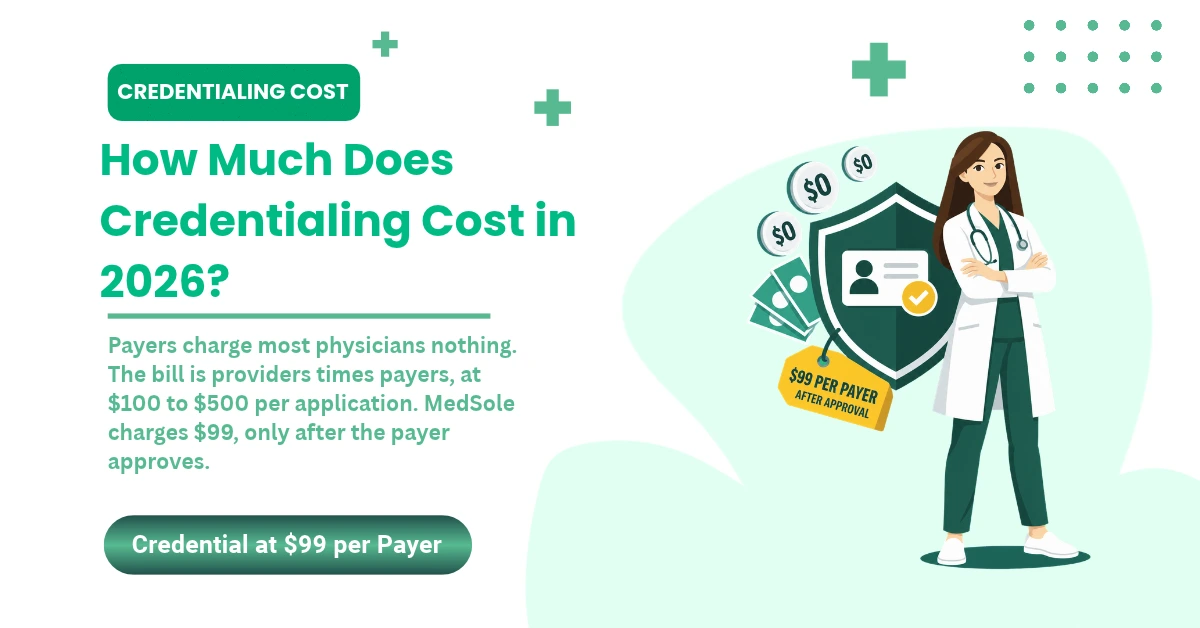
MedSole RCM offers UHC credentialing at $99 per payer with 30-day average approvals. We've credentialed more than 4,000 providers across all 50 states with a 99 percent first-time approval rate. The industry charges $200 to $400 per payer with 60 to 90 day timelines. We charge less and move faster. No setup fees. No hidden charges. No annual contracts. The lowest structured pricing in the US RCM market.
Our credentialing team handles the full application from document audit through effective date confirmation. You provide the credentials. We handle everything else.
UHC Credentialing by Provider Type and Specialty
UHC's united healthcare credentialing path varies significantly based on provider type. Medical providers and most ancillary providers go through Onboard Pro. Behavioral health providers go through Optum's Provider Express platform. Physical health providers go through Optum Physical Health. Pick the wrong pathway and your application sits in the wrong queue for weeks before anyone redirects you.
Physicians (MD/DO) and Group Practices
Medical doctors and doctors of osteopathy use the standard Onboard Pro pathway with NPI Type 1, an active state medical license, board certification documentation, malpractice insurance, and a complete CAQH ProView profile. Group practices add NPI Type 2 in NPPES, an IRS Determination Letter or EIN documentation, and individual applications for every physician in the group.
One forgotten provider holds up the entire group's effective date. Each physician needs their own credentialing decision even when joining a group with an existing UHC participation agreement. Groups don't carry individuals through on the group's prior approval.
Nurse Practitioners and Physician Assistants
Nurse practitioners and physician assistants use the same Medical pathway in Onboard Pro but must select their specific provider type within the entity selection screen. Choosing "physician" when you're a nurse practitioner causes a mismatch that stalls the entire application until UHC's team manually redirects it.
NPs need state licensure verified plus any collaborative or supervisory agreements where state law requires them. PAs as of March 2025 need full CAQH-based credentialing for non-hospital-based, non-delegated scenarios across UHC commercial, Medicare, and Student Health networks.
Behavioral Health and Mental Health Providers
Behavioral health and mental health providers do not use Onboard Pro. Optum manages UHC's behavioral health network through Provider Express at providerexpress.com or by phone at 800-817-4705. Therapists, psychiatrists, psychologists, LCSWs, LMFTs, and substance abuse providers all credential through Optum.
The process starts with an Initial Participation Request through Provider Express, after which Optum reviews network need in your geographic area. If they have a gap, they invite you to complete the full application by pulling your data from CAQH ProView. Re-attest your CAQH profile the same day you submit your Provider Express request to prevent sync failures. For deeper guidance on Optum's credentialing workflow, our best credentialing services for mental health providers breaks down the Provider Express process end-to-end.
Physical Therapy, Occupational Therapy, Chiropractic, and Speech Pathology
Outpatient physical therapy, occupational therapy, speech-language pathology, chiropractic, alternative medicine, and dietitian providers credential through Optum Physical Health at MyOptumHealthPhysicalHealth.com or by phone at 800-873-4575.
The submission starts as a Request for Information form. Optum Physical Health reviews and contacts you with the credentialing packet. The process runs separate from medical and behavioral health pathways. Providers in these specialties who try to credential through Onboard Pro get redirected and lose two to four weeks. Use the right pathway from the start.
Dental, Vision, and Hearing Care Providers
Dental providers credential through UHCdental.com or by calling 800-822-5353. Vision care for routine services goes through Spectera at spectera.com or 800-638-3120. Vision care for medical services within the scope of licensure goes through UHC's state-specific network management contact. Hearing care providers email joinus@UHCHearing.com or visit uhchearing.com. Each pathway has its own application, requirements, and timeline.
Hospitals, Facilities, and Ancillary Providers
Hospitals, ambulatory surgery centers, dialysis centers, urgent care centers, home health, and hospice complete UHC credentialing through Onboard Pro at the entity level. Ambulatory infusion suites, DMEPOS providers, hemophilia treatment centers, home infusion pharmacies, imaging and radiology centers, IDTFs, laboratories, sleep study centers, and transportation providers use a different pathway: a digital questionnaire submitted by chat.
The two methods exist because of operational differences UHC enforces internally. Pick the wrong method and your application gets returned without progress.
Medicare Advantage, Medicaid, and Community Plan Credentialing
UHC credentialing covers commercial, Medicare Advantage, and Medicaid lines depending on what you select during enrollment. Medicare Advantage providers complete the standard credentialing pathway with additional CMS-855I (individual) or CMS-855B (group) form requirements through PECOS.
UnitedHealthcare Community Plan handles Medicaid credentialing with state-specific requirements detailed in the State and Federal Regulatory Addendum. Some states require fingerprint screenings and additional disclosures. D-SNP plans for dual-eligible populations have expanded across 119 new counties in 2026, creating new credentialing opportunities for providers serving these populations.
UMR Credentialing
UMR is a UnitedHealth Group third-party administrator and operates with its own credentialing process separate from standard UHC commercial credentialing. UMR providers register through their dedicated portal and may be subject to specific employer group requirements.
If UMR is a meaningful share of your patient base, treat its credentialing as a separate workstream from your UHC commercial application. They don't share timelines, processes, or approval systems.
Once credentialed across the right pathways for your specialty mix, you enter UHC's recredentialing cycle. UHC's automated approach is different from most payers and saves significant administrative time when you maintain your data correctly.
UHC Recredentialing: The Automated 36-Month Cycle
UHC automatically initiates recredentialing every 36 months. If you maintain a complete CAQH ProView profile and re-attest every 90 days, recredentialing happens without your active involvement. This is unique among major payers and saves significant administrative time when the underlying data stays current.
How Automated Recredentialing Actually Works
About 90 days before your 3-year credentialing cycle ends, UHC's system pulls your latest CAQH data, runs primary source verification on any changes, queries the NPDB for any new entries, and presents the application to the credentialing committee automatically. If everything is current and clean, you receive a recredentialing approval notification.
No application to fill out. No documents to upload. Just confirmation that your network status continues. This automation only works if your CAQH attestation cycle is current. The 90-day attestation requirement for automated recredentialing is stricter than CAQH's baseline 120-day requirement. Set the calendar reminder. The minute attestation lapses, automation fails.
When Automated Becomes Manual
Several events break automation and force manual recredentialing. An expired CAQH attestation. New malpractice settlements requiring additional review. License restrictions or disciplinary actions surfaced through NPDB. License expirations. Address changes that don't propagate across systems. Any state-specific event requiring updated documentation.
Manual recredentialing follows the same workflow as initial credentialing through Onboard Pro and takes 45 to 90 days. Avoid this by maintaining clean documentation throughout the full 3-year cycle, not just in the weeks before the cycle ends.
Recredentialing Failures and the Cost of Falling Behind
If a participating provider fails recredentialing for any line of business, UHC will unilaterally amend the participation agreement to remove that line. You stay in-network for other lines but lose Medicare Advantage, Medicaid, or commercial network status depending on which line failed.
Re-applying takes another 60 to 90 days minimum. The revenue impact is immediate. Patients with the lost line move to other providers within weeks. Treat the 36-month cycle as an active monitoring point, not a passive renewal that handles itself.
Both initial credentialing and recredentialing now require active sanctions and exclusions screening across federal and state databases. The 2025-2027 Plan made this explicit.
Sanctions, Exclusions, and Compliance Screening Under the 2025-2027 Plan
The 2025-2027 Credentialing Plan requires UHC to verify that applicants are not excluded, debarred, or precluded across multiple federal and state databases. One exclusion in any of these databases blocks credentialing entirely. This screening happens at initial application and at every recredentialing cycle.
OIG Exclusions (LEIE)
The Department of Health and Human Services Office of Inspector General maintains the List of Excluded Individuals and Entities. Anyone on the LEIE can't participate in any federal healthcare program. UHC checks the LEIE for every applicant.
This blocks united healthcare credentialing across all lines of business. Causes for inclusion: Medicare or Medicaid fraud convictions, patient abuse, license revocation, or controlled substance violations. Inclusion blocks credentialing across all UHC lines, not just government plans. Verify your status before applying using the OIG's searchable database.
CMS Preclusion List
The CMS Preclusion List identifies providers and prescribers who can't bill Medicare Part D or be paid by Medicare Advantage organizations. UHC checks every Medicare Advantage credentialing applicant against this list.
Inclusion comes from felony convictions, Medicare program integrity violations, or revoked Medicare enrollment privileges. The list updates monthly. UHC also checks Medicare Opt-Out status with limited exception language tied to network adequacy requirements.
State Medicaid Exclusions
Each state Medicaid agency maintains its own provider exclusion list. The 2025-2027 Plan now requires verification of state Medicaid exclusions when applicable. One state-level exclusion can cascade. CMS enforces cross-program terminations: a provider terminated from one state's Medicaid program automatically triggers termination reviews in every other state where you're enrolled.
The exposure isn't just one state. It's national. Verify your status with each state Medicaid agency before applying for that line of business.
Why Cross-Program Termination Matters
CMS's enforcement posture shifted from passive oversight to active enforcement in 2024 and continues through 2026. If you're terminated from one state's Medicaid program, your enrollment status across other states gets reviewed immediately.
Provider directory penalties also carry real teeth now. Inaccurate data triggers billing deactivation plus revenue recoupment for claims paid during non-compliance periods. UHC follows CMS guidance closely on these enforcement actions. Treat sanctions and exclusions screening as a continuous compliance discipline, not a one-time pre-application check.
Common UHC Credentialing Pitfalls and How to Avoid Them
Six pitfalls account for nearly every UHC credentialing delay we see. Each is preventable. Each costs 30 to 75 days when it surfaces mid-application and has to be corrected under time pressure.
CAQH Attestation Lapse
The Issue: CAQH attestation expired more than 120 days ago, freezing UHC's data pull from your profile.
The Fix: Set a 90-day reminder, not 120. Re-attest before any application or recredentialing event. Verify CAQH status shows "Current" before submitting to UHC. Confirm UHC is authorized inside CAQH as a designated health plan.
Practice Address Mismatch Across Systems
The Issue: Practice address differs between USPS, NPPES, CAQH, and your application.
The Fix: Align addresses across all four systems before opening Onboard Pro. Use USPS-formatted addresses everywhere. Update NPPES first because changes there propagate slowly to other systems. Confirm CAQH reflects the same address. Verify your application matches both before submitting.
Work History Gaps Over Six Months
The Issue: A work history gap exceeding six months without a documented explanation triggers manual review.
The Fix: Document every gap in your CAQH profile. Acceptable explanations include parental leave, military service, sabbatical, advanced education, or international practice. Approximate dates are acceptable. Unexplained gaps sit in the credentialing queue waiting for clarification that nobody proactively provides.
Wrong Pathway Selection
The Issue: Mental health providers submit through Onboard Pro instead of Provider Express. Physical therapists submit through the medical pathway instead of Optum Physical Health. Each redirect costs two to four weeks.
The Fix: Confirm your specialty's pathway before opening any portal. Behavioral health goes to Provider Express. Physical, occupational, and speech therapy go to Optum Physical Health. Medical and most ancillary providers go to Onboard Pro. Dental, vision, and hearing each have separate pathways with separate contacts.
Submitting Claims Before Effective Date Confirmation
The Issue: Provider sees "approved" in Onboard Pro and schedules patients for the following week. Claims deny because the contract hasn't loaded into UHC's billing systems yet.
The Fix: Wait for written effective date confirmation. Read the date carefully. Schedule the first UHC patient for the day after that date. UHC's own page warns that up to 60 days is needed for contract loading after credentialing approval. Claims submitted before the effective date deny automatically and often can't be retroactively fixed even after the contract loads.
DBA Name vs. Legal Name Confusion
The Issue: The W-9 uses the practice's DBA (Doing Business As) name instead of the official legal name on file with the IRS.
The Fix: Match W-9 legal name and TIN exactly to IRS records. Verify with the IRS Determination Letter. The DBA can appear on patient-facing materials but never on credentialing documentation. One mismatch triggers manual review and adds 30 to 45 days to a timeline that could have been clean.
Catching these pitfalls before submission is what separates 30-day approvals from 90-day approvals. The next section answers the question every overwhelmed practice manager eventually asks: when does it make sense to outsource UHC credentialing entirely?
When to Outsource UHC Credentialing: The Commercial Decision Framework
Outsourcing united healthcare credentialing makes financial sense when you're enrolling more than two providers, expanding to a new state, recovering from a stalled application, or onboarding a behavioral health pathway alongside medical credentialing. Below two providers and with strong administrative bandwidth, in-house can work. Above that threshold, the math shifts.
Signals Your Practice Should Outsource
Seven clear signals that outsourcing makes sense:
Onboarding more than two providers in a 12-month window. Expanding into a new state with unfamiliar Medicaid requirements. Currently stalled on an Onboard Pro application beyond 60 days. Adding a behavioral health line that requires Provider Express plus medical pathway through Onboard Pro. Practice manager spending more than five hours per week on credentialing follow-up. Lost more than $20,000 in revenue last quarter from credentialing-related claim denials. Multiple providers approaching the 36-month recredentialing cycle simultaneously.
In-House vs. Outsourced: The Real Cost Comparison
Most practices underestimate the full cost of in-house united healthcare credentialing because the time spent doesn't show up as a line item. Once it's calculated against admin salary plus the revenue lost during avoidable delays, the math shifts quickly.
|
Factor |
In-House Credentialing |
Outsourced to MedSole RCM |
|---|---|---|
|
Direct cost per payer |
$0 (admin time only) |
$99 per payer |
|
Admin time per provider |
25 to 40 hours |
One to two hours of provider time |
|
Average approval timeline |
60 to 90 days |
30 days |
|
Revenue lost per provider per delay month |
$20,000 to $50,000 |
Minimized through compression |
|
Industry standard outsourced pricing |
Not applicable |
$200 to $400 per payer (industry average) |
|
Setup fees |
None |
None |
|
Hidden charges |
None |
None |
|
Annual contracts required |
None |
None |
|
Coverage |
Limited to your team's expertise |
All 50 states |
What to Look for in a UHC Credentialing Partner
Pricing transparency is the first signal. Partners who hide pricing behind "request a quote" usually charge $300 to $400 per payer. Look for flat per-payer rates published openly without negotiation. Verify Onboard Pro and Provider Express expertise for your specialty mix.
Confirm continuous follow-up is included, not billed separately. Check the average approval timeline against the 60 to 90 day industry standard. Ask whether sister-payer credentialing (Aetna, Cigna, Medicare, Medicaid) is part of the same workflow or requires a separate engagement.
Why Practices Choose MedSole RCM
MedSole RCM offers UHC credentialing at $99 per payer with 30-day average approvals across all 50 states. We've credentialed more than 4,000 providers with a 99 percent first-time approval rate. No setup fees. No hidden charges. No annual contracts. No other RCM provider matches this combination of speed and coverage.
Beyond credentialing, our outsourced medical billing services at 2.99% of collections integrate directly with credentialing handoffs, so your providers move from approved to billing without administrative gaps. We also handle full revenue cycle management, denial recovery workflows, and AR follow-up that protects every claim. Whether you need credentialing alone or end-to-end RCM at the lowest pricing in the industry, the workflow scales with your practice.
UHC Credentialing Contact Resource Reference
Verified united healthcare credentialing contact information consolidated in one reference. Bookmark this section. Phone numbers and email addresses change occasionally; verify current information at uhcprovider.com if you encounter issues after publication.
|
Need |
Contact |
Method |
|---|---|---|
|
UHC Provider Services (general) |
877-842-3210 |
Phone (say "credentialing" at prompt) |
|
UHC Provider Portal Login |
uhcprovider.com |
Web (One Healthcare ID required) |
|
Onboard Pro Application Status |
UHC Provider Portal Dashboard |
Web after sign-in |
|
24/7 Provider Chat |
UHC Provider Portal |
Web chat (One Healthcare ID required) |
|
Optum Behavioral Health (Provider Express) |
800-817-4705 |
Phone |
|
Optum Behavioral Health Application |
providerexpress.com |
Web |
|
Optum Physical Health (PT, OT, SLP, Chiro) |
800-873-4575 |
Phone |
|
Optum Physical Health Application |
myoptumhealthphysicalhealth.com |
Web |
|
UHC Dental Network |
800-822-5353 |
Phone |
|
UHC Dental Application |
uhcdental.com |
Web |
|
Spectera Vision (routine) |
800-638-3120 |
Phone |
|
UHC Hearing Care |
|
|
|
Hearing Care Web |
uhchearing.com |
Web |
|
Onboard Pro Email |
|
|
|
State and Federal Regulatory Addendum |
UHC Credentialing Plan PDF |
Web (PDF) |
If your application stalls, your first call is 877-842-3210 with your reference number ready. The chat function inside the UHC Provider Portal often resolves issues faster than phone, particularly for documentation upload requests and status inquiries. The FAQ section below answers the questions providers ask most often about this process.
Frequently Asked Questions
How long does united healthcare credentialing take?
Industry-standard UHC credentialing takes 60 to 90 days from Onboard Pro submission to written effective date confirmation. UHC's published target is up to 45 calendar days for the credentialing process itself, but third-party verification (medical schools, state licensing boards, residency programs) often extends this. After approval, allow up to 60 additional days for the contract to load into UHC's billing systems. Total time from start to billable in-network can reach 120 days for clean applications.
How much does it cost to get credentialed with UHC?
UnitedHealthcare itself charges no application or credentialing fee. For outsourced credentialing services, industry-standard pricing is $200 to $400 per payer. MedSole RCM offers UHC credentialing at $99 per payer with no setup fees, no hidden charges, and no annual contracts. This is the lowest structured pricing in the US RCM market, with 30-day average approvals across all 50 states.
Do I need a CAQH ProView profile to credential with UHC?
Yes. UHC pulls credentialing data from CAQH ProView in most states. Your profile must be 100 percent complete, attested within 120 days (90 days for UHC's automated recredentialing), and specifically authorized for UHC to access your data. Without UHC authorization inside CAQH ProView, the application can't move forward even if every other field is current and complete.
Can I bill UHC while my credentialing application is pending?
No. Submitting claims before your written effective date confirmation results in automatic denials. Most can't be retroactively fixed even after the contract loads into UHC's billing systems. Wait for written effective date confirmation from UHC, then schedule the first UHC patient for the day after. UHC warns to allow up to 60 days for contract loading after credentialing approval. Don't bill until the date is confirmed in writing.
How do I check my UHC credentialing application status?
Sign in to the UHC Provider Portal at uhcprovider.com using your One Healthcare ID and open Onboard Pro. The dashboard shows real-time status with projected completion dates for both contracting and credentialing. For specific questions, call UHC Provider Services at 877-842-3210 with your reference number ready. The 24/7 chat function inside the portal often resolves documentation requests faster than phone contact.
What is the difference between Onboard Pro and Provider Express?
Onboard Pro is UHC's credentialing platform for medical providers, group practices, hospitals, and most ancillary providers. Provider Express is Optum's credentialing platform for behavioral health and mental health providers including therapists, psychiatrists, psychologists, and substance abuse providers. Submitting through the wrong platform causes two to four weeks of delay while UHC's team redirects your application to the correct pathway.
How often do I need to recredential with UHC?
United healthcare credentialing requires recredentialing every 36 months. The process is automated for providers maintaining current CAQH attestations every 90 days. About 90 days before your 3-year cycle ends, UHC pulls your CAQH data, runs primary source verification on changes, and presents the application to the credentialing committee without requiring provider involvement. Automation fails the moment CAQH attestation lapses.
What if my group is already in-network with UHC?
Each individual provider must complete the full credentialing process even when joining an existing group with a UHC participation agreement. The group contract doesn't automatically extend to new providers added to the group. Each provider needs an individual application through Onboard Pro and an individual effective date before billing as an in-network provider under that group.
Do nurse practitioners and physician assistants need different credentialing?
No, NPs and PAs use the same Medical pathway in Onboard Pro as physicians, but must select their specific provider type in the entity selection screen. As of March 2025, all non-hospital-based, non-delegated physician assistants must complete CAQH-based credentialing across UHC commercial, Medicare, and Student Health networks rather than being added to existing group rosters without individual credentialing.
What happens during UHC's primary source verification?
UHC's credentialing team contacts your medical school registrar, state licensing boards, residency programs, prior employers, the National Practitioner Data Bank, ABMS or specialty boards, and the AMA Masterfile to verify every credential. The phase takes 15 to 45 days depending on third-party response times. UHC can't control how quickly those organizations respond. This phase is the primary reason real-world timelines exceed UHC's published 45-day target.
What is UMR credentialing and is it the same as UHC?
UMR is a UnitedHealth Group third-party administrator that operates with separate credentialing requirements from standard UHC commercial credentialing. UMR providers register through their dedicated portal and may face employer-group-specific requirements. If UMR represents a meaningful portion of your patient base, treat its credentialing as a completely separate workstream from your UHC commercial application.
Why should I outsource UHC credentialing instead of doing it in-house?
Outsourced credentialing makes financial sense when enrolling two or more providers, expanding to new states, or recovering stalled applications. The math: 25 to 40 hours of admin time per provider in-house, plus 60 to 90 day average timelines, plus $20,000 to $50,000 in lost revenue per provider per delay month. MedSole RCM compresses to 30 days at $99 per payer with a 99 percent first-time approval rate across all 50 states.