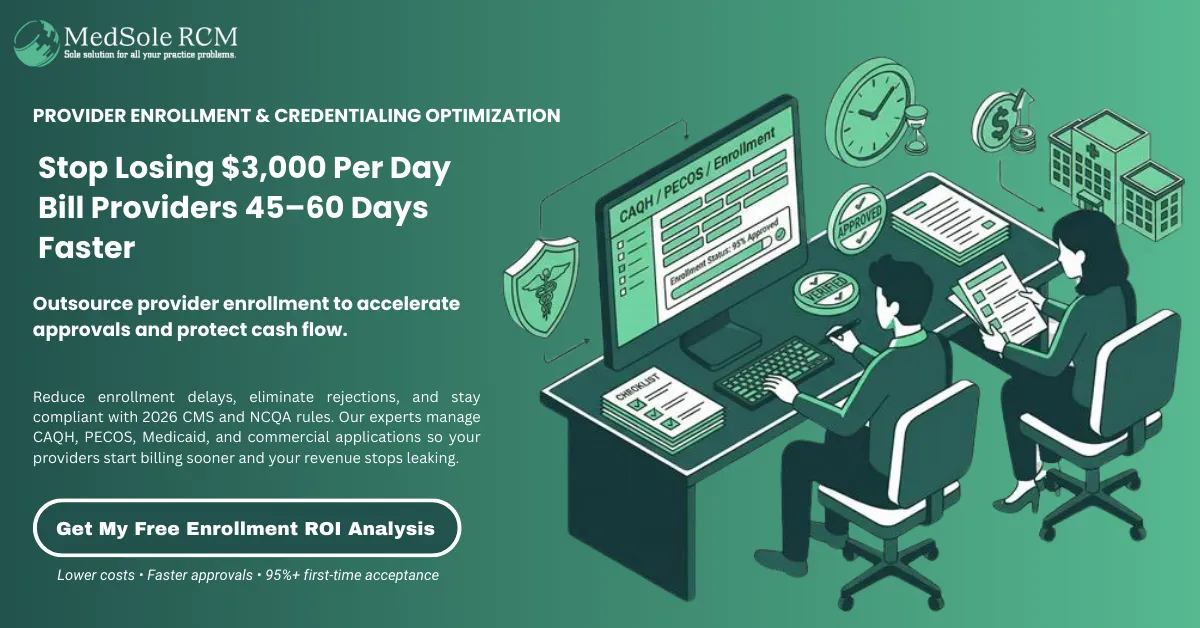




Every day a provider sits in "pending" status, your practice loses $2,500 to $4,000 in unbillable revenue. That's not an estimate pulled from thin air. It's the average daily production of a physician who can't bill because payer enrollment isn't complete.
For a new physician, a typical 90-day enrollment period means $75,000 to $120,000 in delayed collections. In 2026, with CMS "Cross-Program Termination" rules active, that cost now includes the risk of total billing deactivation.
That's why forward-thinking practices outsource provider enrollment. They choose professional provider enrollment and credentialing services to protect cash flow and eliminate the hidden costs of DIY credentialing.
Outsourcing provider enrollment is the strategic delegation of payer credentialing, CAQH maintenance, PECOS validation, and Medicaid applications to specialized third-party experts who accelerate billing privileges while eliminating administrative burden and compliance risk.
Here's the thing: many practices believe handling enrollment in-house saves money. The math tells a different story. Between a $55,000+ salary, benefits, software licenses, training, and the inevitable turnover, in-house credentialing costs exceed $77,000 annually. That's before counting a single rejected application or missed revalidation deadline.
Your credentialing specialist quits after 18 months? You start over from scratch. Your CAQH attestation lapses? Claims start getting denied. Miss one Medicare revalidation deadline? You're off the program entirely.
This guide breaks down the real numbers: what it actually costs to outsource medical credentialing versus building an in-house team, how 2026 regulatory changes have raised the stakes dramatically, how outsourcing accelerates your enrollment timeline, and what to look for when selecting a credentialing partner.
In-House Staff vs. Outsource Credentialing Services: The Real Math
Everyone says outsourcing "saves money." But how much exactly? Let's run the numbers your CFO would demand before approving any budget decision. The cost of credentialing with insurance companies isn't just the obvious line items. It's the hidden expenses that quietly drain your margins.
The True Cost of In-House Credentialing
How much does credentialing cost when you handle it internally? Start with the fixed annual expenses that hit your budget every single month:
Fixed Annual Costs:
- Credentialing Specialist Salary: $50,000 to $60,000
- Benefits (20%): $10,000 to $12,000
- Credentialing Software: $3,000 to $8,000/year
- Training and Continuing Education: $1,500 to $2,500
- Management Oversight Time: $5,000+
Those numbers look manageable on paper. Here's where it gets painful.
Hidden Variable Costs:
- Staff turnover (average 18 months): $15,000 replacement cost
- Application rejections (25% to 40% in-house rate): $500 to $1,000 per resubmission
- Revenue delay from errors: $2,500 to $4,000 per day
Add up fixed and variable costs, and the total annual in-house investment runs $77,000 to $95,000+. That's before counting the revenue you lose while providers sit in pending status waiting for approvals.
What Outsourced Enrollment Actually Costs
When you outsource provider enrollment, you shift from fixed overhead to simple, predictable pricing. At MedSole RCM, we charge $99 per insurance enrollment. That's it. No hidden fees, no complex tier structures.
|
Service |
MedSole RCM Cost |
|
Commercial payer enrollment |
$99 / insurance |
|
Medicare / PECOS enrollment |
$99 / insurance |
|
Medicaid state enrollment |
$99 / insurance |
|
CAQH setup and attestation |
Included |
|
Revalidation handling |
$99 / occurrence |
Annual cost for a 10-provider practice (8 payers each): $7,920
Annual cost for a 25-provider practice (8 payers each): $19,800
Compare that to $77,000+ for a full-time credentialing specialist who might quit in 18 months anyway.
Complete Cost Comparison: In-House vs. Outsourced
Here's what the math looks like side by side for a 15-provider practice:
|
Cost Factor |
In-House (Annual) |
Outsourced (Annual – 15 Providers) |
|
Staff Salary + Benefits |
$60,000–$72,000 |
$0 |
|
Credentialing Software |
$3,000–$8,000 |
$0 (Included) |
|
Training & Education |
$1,500–$2,500 |
$0 |
|
Management Oversight |
$5,000+ |
Minimal |
|
Turnover Replacement (Prorated) |
$10,000 |
$0 |
|
Service Fees ($99 × 8 payers × 15 providers) |
$0 |
$11,880 |
|
Rejection / Resubmission Costs |
$3,000–$8,000 |
< $500 |
|
TOTAL ANNUAL COST |
$82,500–$100,500 |
$12,380 |
|
SAVINGS |
— |
$70,000–$88,000 / year |
In-house credentialing costs $77,000 to $95,000+ annually when factoring salary, benefits, software, training, and turnover, compared to roughly $12,000 for outsourced services at $99 per insurance, representing annual savings of $70,000 to $88,000.
Want to see the exactmedical credentialing cost for your practice size? Our team provides transparent, no-hidden-fee pricing based on your specific payer mix and provider count.
Stop paying full-time salaries for part-time results.Request a custom cost analysis for your practice.
The Revenue Acceleration Factor
Beyond cost savings, outsource credentialing services accelerate your entire revenue cycle. Speed isn't just convenient; it's money in your account faster.
|
Metric |
In-House |
Outsourced |
Impact |
|
Application submission speed |
3–4 weeks |
48 hours |
20+ days faster |
|
First-time approval rate |
60–75% |
99%+ |
Fewer delays |
|
Average enrollment timeline |
120–150 days |
75–100 days |
45+ days faster |
|
Revenue per day (avg physician) |
$3,000 |
$3,000 |
— |
|
Additional Revenue Captured |
— |
— |
$135,000+ / year |
A physician waiting 45 fewer days to bill represents $135,000 in accelerated revenue. That's not a hypothetical savings. That's cash in your account instead of stuck in payer limbo while applications sit in a queue.
2026 Regulatory Updates: Why DIY Credentialing Is Now Dangerous
2026 marks the most significant regulatory shift in provider enrollment since the Affordable Care Act. New NCQA standards, CMS enforcement changes, and state-level policy updates have raised the stakes and the penalties for credentialing errors. What used to be an administrative headache is now a compliance crisis waiting to destroy your revenue.
The $750 Application Fee (Budget Impact)
CMS increased institutional provider application fees from ~$730 to $750 effective January 1, 2026. That $20 difference sounds minor until you're enrolling multiple providers across multiple states. For a 10-provider practice enrolling in five states, that's an extra $1,000 in fees alone.
Here's where it gets expensive: rejected applications don't get refunds. Submit bad data, and you pay the fee again when resubmitting. In-house teams with 25% to 40% rejection rates can double their application costs without realizing it. When you outsource provider enrollment, professional services build fees into their pricing and manage submission timing to avoid duplicate charges from preventable mistakes.
The 120-Day PSV Window (Timeline Pressure)
NCQA now requires Primary Source Verification to be completed within 120 days, reduced from 180 days. Certified Credentialing Verification Organizations (CVOs) face an even tighter 90-day window for the same work.
As of 2026, NCQA requires Primary Source Verification to be completed within 120 days, reduced from 180 days, while organizations must now conduct monthly OIG andSAM.gov exclusion monitoring rather than quarterly checks.
In-house staff juggling phones, patient complaints, and credentialing deadlines miss these windows constantly. When PSV expires, the application restarts from scratch. That adds 60 to 90 days to your enrollment timeline. Professional credentialing services track PSV deadlines across all applications with automated alerts and dedicated staff whose only job is hitting these dates.
Cross-Program Terminations (Cascading Failure Risk)
CMS now enforces cross-program terminations. A termination in one state's Medicaid program automatically triggers termination reviews in all other enrolled states. One missed deadline creates a domino effect.
CMS now enforces cross-program terminations, meaning a provider terminated from one state's Medicaid program automatically triggers termination reviews in all other enrolled states, creating cascading failure risk for multi-state practices.
A missed Ohio Medicaid revalidation deadline triggers Ohio Medicaid termination, automatic review in Texas Medicaid, a flag in Florida Medicaid, Medicare contractor notification, and commercial payer alerts. One administrative error cascades into a nationwide billing shutdown. Outsourcing insurance credentialing services prevents this exact scenario through centralized tracking across all states and payers.
Monthly Monitoring Mandate
NCQA 2025-2026 standards now require monthly exclusion monitoring of OIGs,SAM.gov, and state debarment lists. Quarterly checks are no longer compliant. Most in-house teams lack the systems for 30-day surveillance cycles, much less the documentation required to prove compliance during audits.
Professional services run automated monthly checks with documented compliance reports. You get proof of monitoring without lifting a finger.
2026 Compliance Requirements Summary
|
Requirement |
Pre-2026 Standard |
2026 Standard |
Failure Consequence |
|
PSV Window |
180 days |
120 days |
Application restart |
|
Exclusion Checks |
Quarterly |
Monthly |
Billing deactivation |
|
License Grace Period |
90 days (some states) |
None (VA, others) |
Immediate termination |
|
Directory Updates |
90 days |
30 days |
Revenue clawback |
|
Application Fee |
~$730 |
$750 |
Budget overrun |
|
CLIA Certificates |
Paper + digital |
Digital only (Mar 2026) |
Certification lapse |
Navigating these complex 2026 changes requirescredentialing specialists who stay current with 2026 requirements and can adapt immediately when CMS or NCQA issues new guidance. That's why to outsource your credentialing: the regulatory landscape changes faster than any in-house generalist can track.
How Outsourcing Reduces "Submission Lag" & Days in AR
Submission Lag is the time from hiring a provider to dropping their first payer application. In-house teams average three to four weeks for this phase alone. Professional services complete it in three to five days. That's 20+ days of accelerated revenue before the payer even sees the application.
This matters because every day your provider can't bill is a day you're paying their salary without collecting a dime. When you outsource provider enrollment, you cut the "controllable" phase of credentialing by more than half.
The 7-Step Outsourced Enrollment Timeline
Professional provider enrollment services follow a structured timeline that in-house teams can't match. Here's how the fastest way to get professional credentialing services breaks down by phase:
|
Step |
Timeline |
Activities |
|
1. Intake & Audit |
1–3 days |
Credential review, gap identification |
|
2. Document Collection |
3–7 days |
Licenses, certifications, malpractice, W-9 |
|
3. CAQH Setup |
7–10 days |
Profile creation, verification, attestation |
|
4. Application Submission |
Within 48 hours |
All payers submitted simultaneously |
|
5. Active Follow-Up |
Day 14–75 |
Weekly payer contact, status checks, escalation |
|
6. Approval & Contracts |
Day 60–90 |
Effective dates, EFT/ERA enrollment setup |
|
7. Ongoing Monitoring |
Continuous |
Revalidation, exclusion checks, compliance tracking |
Steps one through four represent the "controllable" phase. In-house credentialing specialists juggling other duties take three to four weeks just to get documents organized and applications submitted. Dedicated outsourced teams finish in 10 to 14 days. Steps five and six depend on payer processing speed, which nobody controls.
Revenue Impact Calculation
Speed translates directly to cash in your account. Here's what timeline acceleration means in actual dollars:
|
Scenario |
In-House Timeline |
Outsourced Timeline (MedSole RCM) |
Revenue Difference |
|
Single physician |
120 days |
45–60 days |
$180,000–$225,000 faster |
|
3 new NPs |
135 days |
45–60 days |
$225,000–$270,000 faster |
|
Multi-state expansion (5 providers) |
150 days |
45–60 days |
$1.35M–$1.575M faster |
Formula: (Days saved) × (Providers) × ($3,000/day avg revenue) = Accelerated Revenue
Outsourcing provider enrollment reduces the "Submission Lag" phase from three to four weeks to 10 to 14 days, and total enrollment timeline from 120 to 150 days to 75 to 100 days, accelerating revenue capture by $105,000 or more per physician.
Need to onboard providers yesterday? See how our team canoutsource payer enrollment for your practice with expedited timelines for urgent situations.
Calculate your revenue acceleration potential.Request a timeline analysis for your specific situation.
Why Speed Matters More in 2026
Cross-program terminations mean delays in one state now trigger reviews in all states, compounding timeline problems. The 120-day PSV window leaves less buffer for errors. Payer directories update faster, so being "out of network" longer costs referrals. Value-based care contracts often have enrollment deadlines you can't miss without losing the contract entirely.
Beyond Basic Enrollment: Specialty-Specific Solutions
Generic credentialing services fail at specialty-specific nuances. Mental health providers face different requirements than surgeons. Nurse practitioners need different documentation than physicians. True expertise means understanding these differences and knowing which payers require what documentation for which provider types.
Mental Health & Behavioral Health Credentialing
Mental health billing and credentialing services must navigate challenges that don't exist in medical practices. LCSW, LPC, and LMFT each have different state requirements. Many MCOs operate separate behavioral health networks through companies like Magellan, Optum Behavioral, and ComPsych. Telehealth across state lines requires multi-state licensing, which most therapist credentialing services don't track properly.
Credentialing services for therapists who understand behavioral health payer quirks prevent the 60%+ rejection rate that's common when general-purpose services try handling mental health providers. The taxonomy codes alone create problems if you don't know the difference between individual therapy, group therapy, and family counseling from a payer enrollment perspective.
Nurse Practitioner & PA Credentialing
NP credentialing services face enrollment complexities that physician credentialing doesn't touch. Collaborative agreement documentation requirements vary by state. Some states require the supervising physician to be enrolled with the same payer before the NP can even apply. Prescriptive authority rules change based on state and controlled substance schedules. Taxonomy code variations affect reimbursement rates.
Services that understand the supervisory relationship prevent billing denials from "provider not eligible" rejections. When the payer system can't link the NP to their supervising physician correctly, claims get denied even though enrollment appears complete.
Multi-State & Telehealth Practices
Telehealth expansion in 2026 creates credentialing complexity most practices can't manage internally. Interstate Medical Licensure Compact (IMLC) navigation requires understanding which states participate and which don't. State-specific originating site requirements affect where patients can be located during visits. Multi-state Medicaid enrollment means coordinating applications across different portals with different timelines. Commercial payer telehealth network variations add another layer of requirements.
Centralized management across all 50 states with tracking systems that flag state-specific requirements is the only way to prevent missing critical documentation when you outsource provider enrollment for multi-state operations.
Other Specialties We Support
- Primary Care (MD, DO)
- Physical Therapy (PT, OT, SLP)
- Dental Practices
- Chiropractic (DC)
- Diagnostic & Imaging Facilities
- Urgent Care Centers
- DME Suppliers
Specialty-specific provider enrollment requires expertise in unique requirements: mental health providers face separate behavioral health networks and telehealth complexities, while nurse practitioners require collaborative agreement documentation and supervisory physician linkages that generic credentialing services often mishandle.
5 Key Credentials of a Trusted Outsourcing Company
Not all enrollment services deliver equal results. Some create as many problems as they solve. Before signing with any credentialing companies for physicians or other providers, evaluate them against these five non-negotiable criteria.
The 5 Essential Evaluation Criteria
- 2026 Compliance Readiness
Do they understand the 120-day PSV window? Can they demonstrate monthly exclusion monitoring systems? Are they prepared for cross-program termination rules? Ask them directly: "What changed in your process for 2026?" If they can't answer with specifics, they're not ready.
- Transparency & Visibility
Do they offer a client portal with real-time status updates? How often do they actually provide status reports? Can you see exactly where each application stands right now, or do you have to email someone and wait for a response? Transparency separates professional services from vendors who disappear after taking your money.
- First-Time Approval Rate
Industry average is 60% to 75% for in-house teams. Top performers achieve 95%+ first-time approvals. Ask any potential partner: "What was your rejection rate last quarter?" If they won't answer with a number, assume it's bad.
- Pricing Structure
Is pricing per-provider, per-payer, or monthly retainer? Are there hidden fees for follow-ups or resubmissions when applications get kicked back? Is the fee structure transparent and predictable, or does it change based on "complexity" they define after the fact?
- Ongoing Management Inclusion
Do they handle revalidations and CAQH re-attestations? Do they monitor exclusion lists monthly per 2026 requirements? Or do they disappear after initial approval and leave you scrambling three years later when revalidation deadlines hit?
Red Flags to Avoid
"Guaranteed 30-day approvals" means they don't understand that payers control timelines, not vendors. No dedicated account manager means you'll chase updates forever. Can't name your state's Medicaid MCOs? That's a lack of real expertise. Pricing "too good to be true" usually means they're missing essential services. No revalidation support sets you up for future terminations when deadlines pass unnoticed.
MedSole RCM meets all five criteria, which is why practices across all 50 states trust us as thebest provider credentialing services partner for 2026 and beyond.
See how we score on all five criteria.Schedule a demo to experience our client portal and process transparency firsthand.
When evaluating provider enrollment outsourcing partners, assess five key criteria: 2026 compliance readiness including monthly monitoring capabilities, transparency with client portal access, first-time approval rate (look for 95%+), clear pricing structure with no hidden fees, and inclusion of ongoing management through revalidation.
Frequently Asked Questions About Outsourcing Provider Enrollment
Q1: Does outsourcing provider enrollment mean I lose control?
No. Quality partners provide complete transparency through client portals, real-time status tracking, and direct communication channels. Most practices report feeling more in control because they finally have visibility into their enrollment status across all payers instead of wondering what their in-house person is actually doing.
Q2: How much does it cost to outsource provider enrollment?
At MedSole RCM, we charge $99 per insurance enrollment. This compares favorably to in-house costs of $77,000 to $95,000+ annually when factoring salary, benefits, software, and turnover. For a 15-provider practice enrolling with eight payers, that's roughly $11,880 annually versus $82,000+ for full-time staff.
Q3: How long does outsourced provider enrollment take?
Outsourced enrollment typically takes 75 to 100 days total, compared to 120 to 150 days for in-house teams. Commercial payers average 60 to 90 days; Medicare through PECOS takes 45 to 75 days. The "controllable" document preparation phase takes 10 to 14 days versus three to four weeks in-house.
Q4: Can I outsource provider enrollment for just specific payers?
Yes. Partial outsourcing is common. Many practices handle routine commercial enrollment in-house while outsourcing complex Medicaid or Medicare applications. Others outsource during high-volume periods or for specific specialties like mental health or nurse practitioners that require different documentation.
Q5: What's the difference between a CVO and a credentialing service?
A Credential Verification Organization (CVO) performs primary source verification of provider qualifications. A full credentialing service includes CVO functions plus payer application submission, follow-up, contracting, and ongoing management. Most practices need the full service, not just verification.
Q6: What information do I need to provide?
You'll need copies of provider licenses, DEA certificates (if applicable), board certifications, malpractice insurance certificates, CV/resume, NPI confirmation, W-9, and practice information. Quality partners provide checklists and assist with document collection rather than making you figure out what's missing after rejections.
Q7: What happens after a provider is enrolled?
Enrollment is ongoing. Requirements include CAQH quarterly re-attestation, license renewal tracking, revalidation submissions (every three to five years), monthly exclusion monitoring (2026 requirement), and demographic updates. Quality partners manage all of this continuously so nothing falls through the cracks.
Q8: Is outsourcing credentialing worth the cost?
Yes. Credentialing delays cost practices $2,500 to $4,000 per day in lost revenue. Professional services achieve 95%+ first-time approval rates versus 60% to 75% for in-house efforts. The ROI typically exceeds 400% when you factor in faster timelines and fewer rejections.
Stop the Administrative Bleed Today
You can't afford the $77,000+ overhead of in-house credentialing in 2026. Cross-program termination rules mean one missed deadline triggers reviews in all states. Every day in "pending" status costs $2,500 to $4,000 in unbillable revenue. Every rejection adds 60 days to your timeline. Every overlooked revalidation puts your entire multi-state enrollment at risk.
Key takeaways from this analysis:
- In-house credentialing costs $77,000 to $95,000+ annually versus $99 per insurance with outsourced services
- Outsourcing reduces enrollment timelines from 120 to 150 days down to 75 to 100 days
- 2026 requirements (120-day PSV, monthly monitoring) demand dedicated expertise
- First-time approval rates jump from 60% to 75% up to 95%+ with professional services
- ROI exceeds 400% for most practices
MedSole RCM transforms provider enrollment from a fixed cost into a flexible, revenue-accelerating asset. Our 2026-ready processes, dedicated account managers, and transparent $99-per-insurance pricing ensure your providers are billing faster, not waiting longer.
Secure your revenue cycle.Outsource provider enrollment to MedSole RCM and transform your biggest administrative headache into a competitive advantage.
Ready to Stop Losing Revenue to Enrollment Delays?
Don't let administrative burden drain your practice. Our provider enrollment experts take over from Day 1, managing every application, every follow-up, and every revalidation.
Calculate Your Enrollment ROI — Free Assessment
Or call us directly: +1 (602) 563 5281
Outsourcing provider enrollment delivers ROI exceeding 400% for most practices by reducing annual credentialing costs from $77,000+ to under $20,000, accelerating enrollment timelines by 45+ days, and achieving first-time approval rates of 95% or higher.