![CO-197 Denial Code: Complete Guide to Resolution & Prevention [2026]](https://medsolercm.com/_imgs/blogs/12516_co-197-denial-code-prior-authorization-medical-billing_11zon.webp)



What is CO-197 Denial Code?
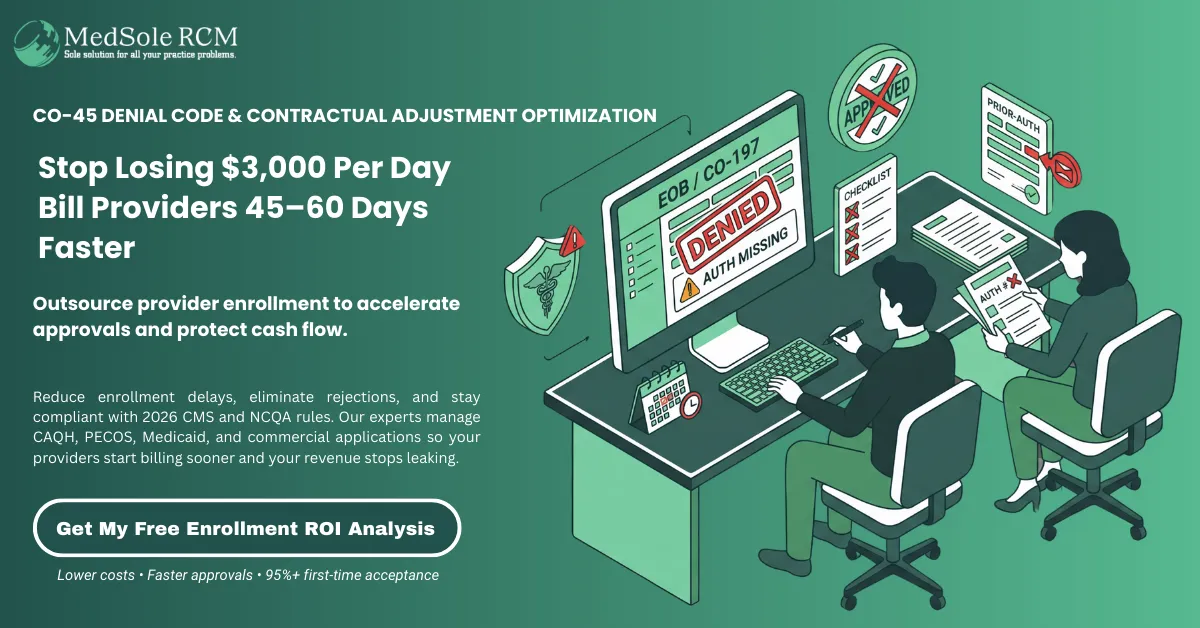
The CO-197 denial code means your claim was rejected because prior authorization wasn't obtained before the service was performed. The official description is simple: "Precertification/authorization/notification/pre-treatment absent." The payer is telling you they didn't approve this service in advance, so they're not paying for it.
This denial hits hard. It's common, frustrating, and entirely preventable with the right workflows in place. Here's what you need to know about this code, why it matters financially, and how to handle it.
Official CARC 197 Definition
CARC stands for Claim Adjustment Reason Code. These standardized codes come from X12, the organization that maintains healthcare transaction standards. CARC 197 has been active since October 31, 2006, with its last update on May 1, 2018.
The official definition reads: "Precertification/authorization/notification/pre-treatment absent."
That's broad language covering several scenarios:
- No prior authorization was obtained at all
- Authorization existed but wasn't included on the claim
- Required notification wasn't submitted to the payer
- Pre-treatment approval was needed but missing
When denial code 197 shows up on your remittance, check the accompanying remark codes. They'll clarify which specific issue triggered the rejection.
What "CO" (Contractual Obligation) Means
The "CO" prefix determines who pays for this mistake.
CO means Contractual Obligation. Your payer contract requires prior authorization for the service you billed. You didn't meet that requirement, so the financial responsibility lands on the provider. A CO 197 denial code cannot be billed to the patient. That's not optional. It's in your contract.
With a contractual obligation adjustment, your options are limited. Appeal successfully, obtain retroactive authorization, or write off the balance. You can't pass this cost to the patient under any circumstances.
Compare this to PR-197, where Patient Responsibility applies. Same underlying reason, completely different financial outcome. We'll cover that distinction in detail later.
Why CO-197 Matters to Your Practice
Authorization-related denials make up 15 to 20 percent of all claim denials in most practices. Each CO-197 costs you twice: the revenue you won't collect and the staff hours spent chasing resolution.
The co-197 denial code description reveals something important. This isn't a coding error. It's not a typo in the patient's name. It's a workflow failure that happened before the patient ever arrived for service.
That distinction matters because fixing CO-197 denials requires process changes, not better billing. Practices struggling with these denials typically have gaps in scheduling verification or authorization tracking. The denial you're seeing today is just the symptom of a breakdown that happened weeks ago.
Working with denial management specialists can help identify exactly where your authorization workflow breaks down and how to fix it before more revenue walks out the door.
CO-197 Quick Reference
|
Element |
Details |
|
Code |
CO-197 / CARC 197 |
|
Official Description |
Precertification / authorization / notification / pre-treatment absent |
|
Group Code |
CO (Contractual Obligation) |
|
Financial Responsibility |
Provider (cannot bill patient) |
|
Common Remark Code |
N210 – “Alert: You may appeal this decision” |
|
X12 Status |
Active (since October 31, 2006) |
|
Last Modified |
May 1, 2018 |
How CO-197 Denial Code Appears on EOB and Remittance Advice
When a claim comes back with CO-197, you'll find it in the adjustment section of your EOB or electronic remittance advice (ERA). Knowing where to look and what the accompanying codes mean saves time and points you toward the right fix.
Reading the Explanation of Benefits (EOB)
The co 197 denial code description appears in the Claim Adjustment Reason Code field. You'll see "197" followed by the narrative: "Precertification/authorization/notification/pre-treatment absent." Some payers abbreviate this; others spell it out fully.
On paper EOBs, check the bottom section where adjustments are itemized. Electronic remittances display the code in the CAS segment. The 197 denial code description tells you what happened, but it doesn't explain why or what to do next.
That's where remark codes come in.
Associated Remark Codes (RARC)
Remark codes appear alongside the denial code co 197 to provide additional context. Think of CARC as the "what" and RARC as the "why" or "what now."
The most common pairing is remark code N210: "Alert: You may appeal this decision." When you see remark code N210, the payer is acknowledging your right to fight back. That's actually useful information buried in the denial.
Other codes you'll encounter:
- M62: Authorization code is missing, incomplete, or invalid
- N758: Adjustment based on prior authorization decision
- MA120: Missing authorization
Each remark code points to a slightly different problem. M62 suggests the auth might exist but wasn't transmitted correctly. MA120 indicates no authorization on file at all. Read them carefully before deciding your next move.
Common Remark Codes with CO-197
|
Remark Code |
Description |
Action Required |
|
N210 |
Alert: You may appeal this decision |
File formal appeal with supporting documentation |
|
M62 |
Missing / incomplete / invalid treatment authorization code |
Correct authorization details and resubmit claim with valid auth |
|
N758 |
Adjusted based on prior authorization decision |
Review prior authorization outcome and appeal if medically necessary |
|
MA120 |
Missing authorization |
Obtain retro-authorization or submit appeal with justification |
CO-197 vs PR-197 vs OA-197: Understanding the Key Differences
The number 197 means the same thing regardless of prefix: authorization was missing. What changes is who pays for that mistake. Get this wrong, and you'll either leave money on the table or bill a patient who shouldn't owe anything.
CO-197: Contractual Obligation (Provider Responsibility)
The co-197 denial code puts the financial burden squarely on your practice. Your contract with the payer required prior authorization. You didn't get it. Now you absorb the cost.
CO 197 is the most common version you'll encounter. The payer isn't being unfair; they're enforcing what you agreed to when you signed that contract. Your options are limited: appeal with documentation, request retroactive authorization if the payer allows it, or write off the balance.
Billing the patient isn't one of those options. Ever.
PR-197: Patient Responsibility
The pr-197 denial code shifts financial responsibility to the patient. Same underlying issue, completely different outcome for your accounts receivable.
This happens when the patient's plan makes authorization their responsibility, not yours. Some plans require members to obtain referrals or pre-approvals themselves. When they don't follow through, the pr 197 denial code appears on your remittance.
Before sending a patient statement, verify your contract language. The pr-197 denial code doesn't automatically mean you can bill the patient. Check the specific plan terms first. Some practices skip this step and create compliance headaches down the road.
OA-197: Other Adjustment
OA 197 is less common than the other two variants. It appears when neither provider nor patient is clearly responsible for the missing authorization.
You'll typically see OA 197 in coordination of benefits situations. Maybe the primary payer processed the claim without issue, but the secondary payer is adjusting for their own authorization requirements. These COB scenarios get complicated fast.
When OA 197 shows up, pull the patient's coverage details and review both payers' EOBs side by side. The resolution path depends entirely on the specific circumstances of that claim.
CO-197 vs PR-197 vs OA-197 Comparison
|
Group Code |
Full Name |
Financial Responsibility |
Can Bill Patient? |
Common Scenario |
|
CO-197 |
Contractual Obligation |
Provider |
No |
Contract requires authorization; provider failed to obtain |
|
PR-197 |
Patient Responsibility |
Patient |
Yes (usually) |
Patient’s plan requires them to secure authorization/referral |
|
OA-197 |
Other Adjustment |
Varies |
Check contract |
Coordination of Benefits (COB) or secondary payer adjustments |
MedSole RCM Insight: Understanding which group code applies determines your next step. Our denial management specialists analyze each denial to identify the fastest path to resolution, whether that's an appeal, corrected claim, or patient billing.
Common Causes of CO-197 Denial Code
Every CO-197 denial traces back to an authorization problem. But "authorization problem" is broad. Understanding the specific cause determines whether you can fix it quickly or need to prepare for an appeal. Here are the seven scenarios you'll encounter most often.
1. Prior Authorization Not Obtained
This is the most common trigger for the authorization denial code. The service was performed, but nobody ever requested approval from the payer. It's a no authorization denial code situation, plain and simple.
How does this happen? Usually workflow gaps. The scheduler books an MRI without checking if the patient's plan requires prior auth. The front desk assumes someone else handled it. The provider didn't realize this payer added the procedure to their auth list last quarter. By the time the claim goes out, there's nothing on file with the payer.
2. Authorization Expired Before Service Date
You had an authorization. It was valid. Then the patient rescheduled, and suddenly that auth is worthless.
Most authorizations have validity windows, typically 30 to 90 days depending on the payer and service. Reschedule a surgery twice, and you've burned through your approval period. The payer sees an expired auth number and denies the claim as if no auth existed at all.
Track expiration dates like you track timely filing deadlines. Both cost you money when you miss them.
3. Authorization Number Missing from Claim
Here's one that stings: you did everything right on the clinical side, but the co 197 denial code shows up anyway. Why? The authorization number never made it onto the claim.
On paper claims, it belongs in Box 23 of the CMS-1500. Electronic submissions need the auth in Loop 2300 REF02 with REF01 set to G1, or Loop 2400 for service-level authorizations. Miss that field, and the payer's system can't match your claim to the approval sitting in their database.
The good news? This one's usually a quick fix. Add the number, resubmit.
4. Incorrect or Invalid Authorization Number
Similar to the missing auth scenario, but trickier to catch. The claim has an authorization number in the right field. It's just the wrong number.
Maybe someone transposed digits during data entry. Maybe the auth was for a different patient with a similar name. Maybe the number belongs to a different service entirely. The payer runs validation, finds no match, and kicks back the claim.
Double-check auth numbers before submission. A 30-second verification prevents a 30-day rework cycle.
5. Service Performed Outside Authorization Scope
Authorization approvals are specific. They cover particular CPT codes, specific dates, defined quantities, and sometimes designated providers or facilities. Go outside those boundaries, and the payer treats it as unauthorized.
Common examples: billing for 10 physical therapy visits when auth covered eight, performing a procedure at a different location than approved, or adding a related service that wasn't included in the original request. The auth exists, but it doesn't cover what you actually billed.
6. Notification Requirements Not Met
Some payers distinguish between prior authorization and notification. Authorization means you need approval before performing the service. Notification means you just need to inform the payer, sometimes within a specific timeframe.
Emergency inpatient admissions often have 24 to 48 hour notification windows. Miss that window, and you'll see CO-197 on the remittance even though the service clearly qualified as emergent. Know which payers require notification versus full authorization, and know their deadlines.
7. Policy Changes Not Followed
Payers update their authorization requirements constantly. A procedure that didn't need auth last year might require it now. New clinical criteria, new documentation thresholds, new service categories.
If your staff is working from outdated information, denials follow. Subscribe to payer bulletins. Check auth requirements monthly for high-volume services. What you don't know absolutely will cost you.
CO-197 Causes and Prevention Actions
|
Cause |
Frequency |
Prevention Action |
|
No prior authorization obtained |
Very High |
Verify authorization requirements during scheduling |
|
Authorization expired |
High |
Track expiration dates using alerts or work queues |
|
Authorization number missing from claim |
High |
Use pre-submission claim validation checks |
|
Incorrect / invalid authorization number |
Medium |
Double-check authorization details before billing |
|
Service outside authorization scope |
Medium |
Confirm authorization covers exact CPT/service |
|
Notification not provided |
Medium |
Follow payer-specific notification timelines/windows |
|
Policy changes unknown |
Low to Medium |
Monitor payer bulletins and updates monthly |
How to Resolve CO-197 Denial Code: Step-by-Step Guide
When CO-197 lands on your remittance, you need a systematic approach. Jumping straight to an appeal wastes time if the fix is simpler. Follow these steps in order to identify the fastest path to payment.
Step 1: Review the EOB/ERA and Denial Details
Start with the remittance itself. Look at the co 197 denial code description and any accompanying remark codes. N210 tells you an appeal is possible. M62 suggests the auth number was invalid or missing. MA120 indicates no authorization on file at all.
Note the denial date immediately. Your timely filing clock for appeals starts ticking from this date, not the original claim submission. Document everything before you make a single phone call.
Step 2: Verify if Authorization Was Required
Before assuming you missed something, confirm the payer actually required authorization for this service. Requirements vary by payer, plan type, place of service, and date of service.
Check the payer's current prior auth list. For Medicare claims, review the applicable LCD or NCD. Sometimes the payer's system triggers a CO-197 incorrectly, especially after policy updates. If authorization wasn't actually required, you've found your appeal angle.
Step 3: Locate Authorization Documentation
Search your records for any existing authorization. Check your internal tracking system, the payer portal, and any confirmation emails or faxes. You're looking for the auth number, effective dates, approved services, and approved units.
If you find a valid authorization that covers the denied service, the co-197 denial code might be a transmission error or payer mistake. Document what you find with screenshots and reference numbers. This becomes your evidence.
Step 4: Contact the Payer
Call the provider services line with your documentation ready. Ask specific questions:
- Why exactly was this claim denied?
- Do you show an authorization on file for this patient and date?
- Does this payer allow retroactive authorization?
- What documentation do you need for an appeal?
Write down everything: date, time, representative name, reference number, and what they told you. Payer reps sometimes give incorrect information, and you'll want a record if their guidance doesn't match reality.
Step 5: Correct and Resubmit If Applicable
If authorization exists but wasn't on the claim, the co 197 denial code solution is straightforward. Add the auth number to the correct field and resubmit.
For CMS-1500 paper claims, enter the authorization in Box 23. Electronic claims need the number in Loop 2300 REF02 with qualifier G1, or Loop 2400 REF02 for line-level authorizations. Submit as a corrected claim, not a duplicate.
Step 6: Request Retroactive Authorization
When no authorization exists, retroactive approval becomes your next option. Not every payer allows this, but many do under specific circumstances.
Emergency services typically qualify for retro-auth consideration. Some payers grant exceptions for documented administrative errors or system outages. Submit your request with complete clinical documentation demonstrating medical necessity. Medicare DMEPOS has its own retro-auth rules, so check MAC guidance for those claims.
Step 7: File a Formal Appeal
If retroactive authorization isn't available or gets denied, escalate to a formal appeal. Gather your documentation: clinical notes, physician statements supporting medical necessity, any authorization confirmations you found, and the original claim.
Appeal deadlines vary by payer. Medicare gives you 120 days. Commercial payers range from 60 to 180 days. Use the sample appeal letter in the next section as your template. Submit everything together and keep copies of what you sent.
Step 8: Track and Document Outcome
Don't file the appeal and forget about it. Set a follow-up reminder for 30 days. If you haven't received a response, call and check status.
Document every CO-197 denial and its resolution. Track which causes appear most often, which payers generate the most denials, and your success rate on appeals. This data reveals workflow problems you can fix before they create more denials.
CO-197 Resolution Decision Tree
|
Scenario |
Primary Action |
Secondary Action |
|
Auth exists, not on claim |
Correct claim and resubmit |
N/A |
|
Auth expired before service |
Request retro-authorization |
Appeal if denied |
|
No authorization obtained |
Request retro-authorization |
Appeal with medical necessity documentation |
|
Auth for wrong service |
Request new/correct authorization |
Appeal if clinically appropriate |
Denials eating into your revenue? If CO-197 shows up on your remittances more than it should, there's a workflow problem upstream. MedSole RCM's denial management team identifies root causes, handles appeals, and builds prevention systems so these denials stop happening. When you're ready to fix the problem instead of just chasing payments, we can help.
CO-197 Denial Code Appeal Letter Template
When a CO-197 denial won't budge through normal channels, a formal appeal becomes your next move. A well-structured appeal letter does more than request reconsideration. It presents your case clearly, documents your evidence, and gives the payer's appeals committee everything they need to reverse the decision.
Here's a template that works, along with guidance on when and how to use it.
When to Use This Template
Not every CO-197 denial needs a formal appeal. Use this template when:
- Authorization was obtained but the payer denied the claim incorrectly
- Medical necessity documentation supports the service performed
- Your retroactive authorization request was denied but circumstances warrant review
- You suspect a payer processing error
If the denial happened because authorization genuinely wasn't obtained and retro-auth isn't available, an appeal probably won't succeed. Focus your time on claims with winnable arguments.
Tips for a Successful Appeal
Submit before the deadline. Appeal windows vary: Medicare allows 120 days, most commercial payers give 60 to 180 days. Check your EOB for the specific deadline and don't cut it close.
Include everything upfront. Missing documentation slows the process and can result in automatic denial. Attach clinical notes, auth confirmations, and any payer correspondence related to the claim.
Reference their own policies. If you can cite the payer's authorization policy showing you met requirements, include that reference. It's harder to deny when you're quoting their rules back to them.
Follow up at 30 days. Don't assume silence means they're working on it. Call, document the conversation, and escalate if needed. Some states allow complaints to the insurance commissioner after a certain number of days without response.
CO-197 Denial Code: Payer-Specific Requirements and Resolution
Every payer handles prior authorization differently. What works for one won't work for another. The appeal deadline that gives you six months with Cigna gives you only 60 days with Aetna. Knowing these differences before you pick up the phone saves time and increases your success rate.
Here's what you need to know about the major payers.
Medicare CO-197 Denials
Medicare's prior authorization requirements are expanding. The co-197 denial code shows up most often on DME claims, but that's changing with new programs rolling out in 2026.
For DMEPOS claims, the Unique Tracking Number (UTN) is critical. This 14-character identifier must appear on every claim for items on the Required Prior Authorization List. On paper claims, enter it in Box 23. Electronic submissions need the UTN in Loop 2300 REF02 with qualifier G1, or Loop 2400 for line-level detail.
Your MAC matters too. Noridian and CGS have slightly different processes for handling reason code 197 with remark code N210. Check your specific MAC's guidance before appealing.
Retroactive authorization is limited to emergency situations. If you missed the auth window on a non-emergent service, focus your appeal on medical necessity documentation. You have 120 days from the denial date to file.
One more thing: if the service wasn't actually on Medicare's prior auth list, gather that evidence. Payer systems sometimes flag claims incorrectly after policy updates.
UnitedHealthcare CO-197 Denials
UnitedHealthcare maintains a detailed prior authorization list on their provider portal. The list updates regularly, so checking it quarterly isn't enough. Build a monthly review into your workflow.
Here's the tough news: UHC rarely grants retroactive authorization. Exceptions exist for true emergencies with proper documentation, but don't count on retro-auth as your backup plan. Prevention matters more with this payer than most.
For elective procedures, UHC requires notification even when full authorization isn't mandatory. Miss the notification window, and you'll see CO-197 on your remittance despite doing everything else correctly.
Appeals must be filed within 180 days. Use the UHC Provider Portal to check real-time authorization status before submitting claims. The portal shows approved services, validity dates, and any restrictions on the auth.
Blue Cross Blue Shield CO-197 Denials
BCBS isn't one payer. It's dozens of independent plans with different rules. What flies with BCBS of Texas might get denied by BCBS of Massachusetts. Always verify requirements for the specific plan, not just the BCBS brand.
Many BCBS plans outsource authorization to third-party vendors like eviCore, AIM Specialty Health, or Carelon. When you see a CO-197 denial, check whether the auth request went to the right entity. Submitting to BCBS directly when the plan uses eviCore for imaging creates an automatic denial.
Retroactive authorization policies vary wildly by state and plan. Some are generous; others won't consider retro-auth under any circumstances. Call the specific plan to ask before assuming.
Appeals go through Availity for most BCBS plans, though some still require direct submission. Deadlines range from 60 to 180 days depending on the state. Check your denial notice for the exact timeframe.
Aetna CO-197 Denials
Aetna requires precertification for most imaging studies, surgical procedures, and high-cost specialty drugs. Their list is extensive, and missing an auth on any of these services triggers an immediate denial.
The Aetna Provider Portal handles authorization verification. Check it before every scheduled procedure to confirm the auth is active and covers the specific service you're billing. Aetna is particular about matching CPT codes between the auth and the claim.
You have only 60 days to appeal Aetna CO-197 denials. That's one of the shortest windows among major payers. Don't let these claims sit in a work queue. Prioritize them immediately.
Retro-auth is limited but possible for documented administrative errors or system issues. Include a clear explanation of what went wrong and why it wasn't preventable.
Cigna CO-197 Denials
Cigna's Clinical Prior Authorization program covers a broad range of services, with particular emphasis on behavioral health. Mental health providers see CO-197 denials frequently when session authorizations expire or concurrent reviews aren't completed on time.
The Cigna for Healthcare Professionals (CHCP) portal is your primary tool for auth verification and status checks. Bookmark it. Use it before every claim submission for services that might require authorization.
Cigna gives you 180 days to appeal, which provides more breathing room than Aetna. But don't let that window create complacency. Earlier appeals typically get faster decisions.
Behavioral health claims often require ongoing authorization renewal. Track your authorized sessions carefully and request extensions before you hit the limit, not after.
Payer Prior Authorization Quick Reference
|
Payer |
Auth Portal |
Retro-Auth Allowed? |
Appeal Deadline |
Key Notes |
|
Medicare |
MAC portals |
Limited (emergency only) |
120 days |
UTN required for DME claims |
|
UnitedHealthcare |
UHC Provider Portal |
Rarely |
180 days |
Check authorization list monthly |
|
Blue Cross Blue Shield (BCBS) |
Availity / Plan portal |
Varies by state |
60–180 days |
State-specific policies apply |
|
Aetna |
Aetna Provider Portal |
Limited |
60 days |
Shortest appeal window |
|
Cigna |
CHCP Portal |
Limited |
180 days |
Extra rules for behavioral health services |
CO-197 Denials by Medical Specialty
Authorization requirements hit some specialties harder than others. Physical therapy practices deal with session limits. DME suppliers navigate complex Medicare rules. Imaging centers juggle multiple radiology benefit managers. Understanding the specific challenges in your specialty helps you build targeted prevention workflows.
Physical Therapy and Rehabilitation
PT practices see the co 197 denial code constantly. Payers limit authorized visits, and those limits sneak up fast when patients come in two or three times per week.
Common CPT codes like 97110, 97140, and 97530 often require authorization after an initial evaluation period. Some payers approve eight visits upfront; others approve 12. Track exactly how many visits remain on each patient's authorization.
The initial evaluation typically doesn't need auth, but follow-up treatment does. Don't assume the auth covering the eval extends to therapeutic exercises. Verify the scope before the patient's second visit.
Renewal requests should go out before you exhaust approved sessions. Waiting until you've used all authorized visits means treating without coverage while the new auth processes.
Durable Medical Equipment (DME)
Medicare DMEPOS prior authorization is mandatory for items on the Required Prior Authorization List. Miss the auth, and CO-197 is guaranteed.
The UTN format matters: 14 bytes, specific structure, placed in the correct claim field. CMS-1500 uses Box 23. Electronic claims need Loop 2300 or 2400 with the REF*G1 qualifier. Get any of this wrong, and the claim rejects even if the authorization exists.
New HCPCS codes were added to the Required Prior Authorization List on April 13, 2026. If you bill DME, review the updated list to identify any items that now require auth but didn't before.
Commercial payers have their own DME authorization requirements separate from Medicare. Don't assume Medicare compliance covers you for other payers.
Diagnostic Imaging (MRI, CT, PET)
Most commercial payers route imaging authorizations through Radiology Benefit Managers like eviCore, AIM Specialty Health, or National Imaging Associates. You're not dealing with the insurance company directly; you're dealing with their vendor.
Clinical Decision Support requirements add another layer. Some payers won't authorize advanced imaging unless you've documented use of an approved CDS tool. Check whether your orders meet these criteria before submission.
Same-day imaging for urgent cases may qualify for expedited auth or retroactive consideration. Document the clinical urgency thoroughly. "Needed it fast" isn't sufficient; specific symptoms and risk factors are.
Scheduled imaging has no excuse for missing authorization. Build auth verification into your scheduling workflow so nothing gets on the calendar without confirmed approval.
Mental and Behavioral Health
Behavioral health authorization often works differently than medical services. Session limits, concurrent reviews, and level-of-care assessments create multiple points where authorization can lapse.
Outpatient therapy typically authorizes a set number of sessions. Inpatient and intensive outpatient programs require concurrent review, sometimes every few days. Miss a review deadline, and authorization terminates even if the patient still needs treatment.
Crisis and emergency services usually qualify for retroactive authorization, but you'll need documentation proving the urgency. A patient calling in distress doesn't automatically qualify as an emergency under payer definitions.
Track session counts separately from your clinical notes. Knowing a patient has three authorized sessions left is billing information, not clinical information. Make sure your billing team has visibility into these limits.
Surgical Procedures
Elective surgeries almost always require prior authorization. Both the facility and the surgeon need to verify auth before the procedure date. A hospital having authorization doesn't mean the surgeon's claim will pay.
Multi-procedure cases get complicated. Authorization for one CPT code doesn't automatically cover related procedures performed in the same session. Confirm the auth lists every code you plan to bill.
Emergency surgery follows different rules. Document the emergent nature clearly: acute presentation, threat to life or limb, inability to delay. Retroactive auth requests for emergency cases succeed when the clinical picture supports urgency.
Pre-surgical testing and anesthesia may have separate authorization requirements from the surgery itself. Don't assume one auth covers the entire episode of care.
2026 Updates: New CMS Prior Authorization Rules Affecting CO-197 Denials
Prior authorization rules are changing significantly in 2026. If you're not tracking these updates, you'll see more CO-197 denials hitting your remittance before you understand why. Here's what's coming and how it affects your authorization workflow.
CMS Interoperability and Prior Authorization Final Rule (CMS-0057-F)
CMS finalized this rule on January 17, 2024, but the operational provisions that matter most took effect January 1, 2026. The CMS Interoperability and Prior Authorization Final Rule changes how payers must handle authorization requests and denials.
Key requirements now in effect:
- Decision timeframes: Payers must respond within 72 hours for expedited requests and seven calendar days for standard requests
- Denial transparency: When payers deny authorization, they must provide the specific reason, not just a generic code
- Public reporting: Initial prior authorization metrics are due by March 31, 2026
What does this mean for your co-197 denial code appeals? The new transparency requirements give you better ammunition. Payers can't hide behind vague denial language anymore. When you receive an authorization denial code, the accompanying documentation should explain exactly why.
Capture these specific denial reasons in your records. They become the foundation for targeted appeals that address the payer's actual objections.
Medicare WISeR Model (January 2026)
WISeR stands for Wasteful and Inappropriate Service Reduction. It's a new CMS Innovation Center model that adds prior authorization requirements to Medicare services that previously didn't need them.
The timeline:
- Model began: January 1, 2026
- Prior auth requests accepted: January 5, 2026
- Services impacted: January 15, 2026 forward
Six states are currently affected: Arizona, New Jersey, Ohio, Oklahoma, Texas, and Washington. If your practice operates in these states or sees patients with Medicare coverage from these regions, expect an uptick in CO-197 denials on services that never required authorization before.
Review the WISeR service list for your specialty. Update your authorization workflows to capture these new requirements before claims go out the door.
Medicare DMEPOS Updates (January/April 2026)
DME suppliers face two significant changes this year.
January 13, 2026 introduced a prior authorization exemption process. Suppliers meeting performance thresholds can qualify for reduced PA requirements. CMS will send exemption notices by April 2, 2026, with the first exemption cycle beginning June 1, 2026.
April 13, 2026 expanded the Required Prior Authorization List with additional HCPCS codes. If you bill DME, check whether any of your high-volume items were added. Missing authorization on newly added codes guarantees CO-197 denials.
The exemption process sounds helpful, but don't count on it yet. Until you receive official notification of exempt status, treat every item on the Required Prior Authorization List as mandatory.
2026 Prior Authorization Timeline
|
Date |
Change |
Impact on CO-197 |
|
January 1, 2026 |
Centers for Medicare & Medicaid Services PA rule provisions effective |
More structured and standardized denial reasons |
|
January 1, 2026 |
WISeR model begins |
Increased prior authorization requirements in 6 states |
|
January 5, 2026 |
WISeR PA requests accepted |
New prior authorization workflow required |
|
January 13, 2026 |
DMEPOS PA exemption process |
Some providers may qualify for fewer authorizations |
|
January 15, 2026 |
WISeR services impacted |
Monitor closely for new CO-197 denials |
|
March 31, 2026 |
First PA metrics reporting due |
Greater payer transparency and performance tracking |
|
April 2, 2026 |
DMEPOS exemption notices sent |
Verify your exemption status |
|
April 13, 2026 |
New DMEPOS PA codes effective |
Expanded authorization requirements |
Regulatory changes don't wait for your billing department to catch up. MedSole RCM monitors CMS and payer policy updates continuously. Our clients get proactive alerts about authorization requirement changes before they turn into denials. If staying ahead of these changes feels overwhelming, we can help.
CPT and HCPCS Codes Commonly Associated with CO-197 Denials
Some procedure codes trigger prior authorization requirements across nearly every payer. Others vary wildly depending on the plan. Knowing which codes carry the highest denial risk helps you prioritize your verification workflow.
High-Risk CPT Codes for Prior Authorization
The codes below consistently appear on payer prior authorization lists. This isn't exhaustive, and requirements change constantly. Always verify with the specific payer before scheduling.
Imaging tops the list. Advanced imaging like MRI and CT scans require authorization from most commercial payers. Radiology benefit managers handle these requests, not the insurance company directly.
Surgical procedures, especially elective orthopedic and spine surgeries, almost always need approval. Both facility and professional components require separate verification.
Therapy services often start without authorization but require it after a set number of visits. Know when that threshold kicks in for each payer.
DME follows strict Medicare rules plus additional commercial requirements. The Required Prior Authorization List grows regularly.
Behavioral health typically authorizes in blocks of sessions. Track your counts carefully.
CPT/HCPCS Codes Frequently Triggering CO-197
|
Category |
Common Codes |
Prior Auth Required By |
|
Imaging |
70553 (MRI brain), 72148 (MRI lumbar), 74177 (CT abd/pelvis) |
Most commercial payers |
|
Therapy |
97110, 97140, 97530, 97542 |
Many payers after initial visits |
|
Surgery |
27447 (TKA), 63030 (discectomy), 29881 (knee arthroscopy) |
Most payers for elective procedures |
|
DME |
E0601 (CPAP), K0823–K0886 (wheelchairs), E0470 (RAD) |
Medicare + commercial payers |
|
Injections |
64483 (epidural), 20610 (joint injection) |
Varies widely by payer |
|
Behavioral Health |
90837, 90847, 90853 |
Often required after initial sessions |
How to Prevent CO-197 Denial Codes: Proven Strategies
Fixing CO-197 denials takes time and money. Preventing them costs almost nothing once you build the right workflows. Here's how practices with low authorization denial rates actually operate.
Pre-Scheduling Verification
Authorization prevention starts before the appointment hits the schedule. Your scheduling staff should verify auth requirements for every procedure that might need one.
Build a simple checklist: Does this payer require authorization for this CPT code? Check the portal or call if uncertain. What's the patient's specific plan type? Some plans under the same payer have different requirements.
Don't schedule procedures requiring authorization until you've confirmed either that auth isn't needed or that the request has been submitted. Scheduling first and figuring out auth later is how the co 197 denial code becomes a recurring problem.
Authorization Tracking Systems
Spreadsheets work until they don't. As your authorization volume grows, you need a dedicated tracking system.
Good tracking captures: patient name, authorization number, approved services, effective dates, expiration dates, and remaining units. Great tracking also alerts you before authorizations expire.
Connect your tracking system to your claims process. Before any claim goes out, the system should verify that valid authorization exists and that the auth number is populated in the correct field. Manual double-checking doesn't scale.
Staff Training Programs
Your front desk, schedulers, and billing team all touch the authorization process. Everyone needs to understand their role and what happens when steps get skipped.
Train on payer-specific requirements. Generic "get authorization" training doesn't help when UHC requires notification for something that Aetna doesn't. Create quick reference guides for your highest-volume payers and update them when policies change.
Hold people accountable, but recognize that training gaps usually reflect system problems. If the same errors keep happening, the workflow is broken.
Payer Policy Monitoring
Payer authorization requirements change constantly. A procedure that didn't need auth last quarter might need it now. Staying current prevents denials that feel like they came out of nowhere.
Subscribe to payer newsletters and provider bulletins. Assign someone to review updates monthly and flag changes that affect your practice. Document those changes in your authorization tracking system.
When you see a new CO-197 denial on a service that never required auth before, check whether the payer updated their requirements. That's often the explanation.
Pre-Submission Claim Validation
The last line of defense happens right before the claim goes out. Build validation checks that flag potential authorization problems.
Your claim scrubber or billing system should identify claims for procedures that typically require authorization. Hold those claims for verification before submission. Check that the auth number is present, formatted correctly, and hasn't expired.
A 30-second validation prevents a 30-day rework cycle. Make it part of your standard workflow, not an optional step that gets skipped when things get busy.
Download Resource
CO-197 Prevention Checklist (PDF)
A printable checklist for scheduling staff, front desk, and billing teams. Covers verification steps at each stage of the patient encounter.
Technology Solutions for Preventing CO-197 Denials
Manual authorization tracking worked when claim volumes were lower and payer requirements were simpler. That's not the world we live in anymore. The practices keeping CO-197 denials under control are using technology to automate verification, track authorizations, and catch problems before claims go out.
EHR Integration for Authorization Tracking
The best authorization tracking happens inside your EHR, not in a separate spreadsheet someone forgets to update. Modern EHR systems can store authorization data alongside patient records and push that information directly to billing.
Look for systems that alert schedulers when a patient's authorization is expiring soon. Real-time eligibility verification should happen automatically when appointments are booked. The authorization number should flow to the claim without manual entry.
Epic, Athenahealth, and eClinicalWorks all have authorization tracking modules. Smaller practices using less robust systems can integrate third-party tools that connect eligibility data to their workflow. The key is eliminating manual handoffs where information gets lost.
Automated Prior Authorization Tools
Electronic prior authorization platforms submit requests directly to payers, track status in real time, and store approvals in a central location. No more faxing forms and waiting days to hear back.
Tools like Availity, Surescripts, and Cohere Health connect to payer systems and return authorization decisions faster than traditional methods. Some payers now require electronic submission, so you may not have a choice.
The automation reduces manual errors. Typos in auth numbers, wrong dates, missed fields: these problems shrink when software handles the data transfer. Staff time shifts from chasing authorizations to reviewing exceptions and handling complex cases.
AI-Powered Denial Prevention
Predictive analytics tools analyze your historical denial patterns and flag high-risk claims before submission. The system learns which payers deny which services, which CPT codes trigger problems, and which providers have authorization gaps.
When a claim matches a denial pattern, the system holds it for review. Your team investigates before the claim goes out rather than after it comes back denied. That's the difference between prevention and rework.
These tools aren't magic. They require clean historical data and consistent use. But practices using AI-powered claim scrubbing typically see denial rates drop within the first few months. The technology pays for itself in recovered revenue and reduced staff time.
Case Study: Reducing CO-197 Denials by 87%
Numbers on a page don't capture how frustrating authorization denials actually feel. This case study shows what's possible when a practice commits to fixing the problem systematically.
The Challenge
A 12-provider multi-specialty practice was drowning in CO-197 denials. They averaged 45 per month, putting over $67,000 in monthly revenue at risk. Some claims got appealed and paid. Most sat in aging buckets until timely filing expired.
The billing team spent more than 15 hours every week chasing these denials: calling payers, gathering documentation, resubmitting claims, filing appeals. That's almost half a full-time employee dedicated to fixing preventable problems.
Their authorization tracking was a shared spreadsheet that nobody trusted. Schedulers didn't always check it. Billers didn't always update it. Information fell through the cracks constantly.
The Solution
The practice implemented a structured approach targeting every stage of the authorization workflow.
At scheduling, staff verified auth requirements before confirming appointments. Real-time eligibility checks became mandatory, not optional. No procedure got scheduled without confirmation that authorization either wasn't required or had been requested.
They replaced the spreadsheet with integrated tracking that connected to their EHR. Expiration alerts went out automatically. Authorization numbers populated on claims without manual entry.
Staff received payer-specific training. Instead of generic "get authorization" instructions, they learned exactly what each major payer required and when. Quick reference guides sat at every workstation.
Before claim submission, a validation step caught anything missing authorization. Those claims got held for review rather than sent out to be denied.
The Results
Within 90 days, CO-197 denials dropped from 45 per month to six. That's an 87% reduction.
Monthly revenue recovery hit $58,000 as claims that previously would have been denied now paid on first submission. Staff rework time dropped by 12 hours weekly. Those hours shifted to follow-up on other aging claims.
The practice's clean claim rate improved from 82% to 96%. Fewer denials meant faster payments, which improved cash flow across the board.
The remaining six monthly denials came from edge cases: payer system errors, policy changes not yet reflected in their tracking, and genuinely complex authorization situations. A small number compared to where they started.
🏆 Results like these aren't unusual. They're what happens when practices stop treating authorization denials as inevitable and start treating them as solvable. MedSole RCM's denial management services include the workflow analysis, staff training, and technology integration that made this turnaround possible.
[Schedule a Free Denial Audit]
No obligation. Results in 48 hours. Custom recommendations for your practice.
Frequently Asked Questions About CO-197 Denial Code
Q1: What does CO-197 denial code mean?
CO-197 denial code means the claim was rejected because prior authorization wasn't obtained before services were rendered. The official description is "Precertification/authorization/notification/pre-treatment absent." As a Contractual Obligation code, the provider absorbs the cost and cannot bill the patient.
Q2: What is the difference between CO-197 and PR-197?
CO-197 places financial responsibility on the provider; you can't bill the patient. PR-197 places responsibility on the patient, allowing you to bill them for the denied amount. Both codes indicate missing authorization. The difference is who pays when the appeal fails. Always check your contract before billing patients on PR denials.
Q3: Can I bill the patient for a CO-197 denial?
No. CO denials are contractual obligations between you and the payer. Your contract prohibits billing patients for these adjustments. You must appeal successfully, obtain retroactive authorization, or write off the balance. PR-197 denials may allow patient billing, but verify your contract terms first.
Q4: How do I appeal a CO-197 denial?
Review the denial reason and remark codes first. Gather authorization documentation if it exists. Contact the payer to understand why they denied. Submit a formal appeal letter with clinical documentation supporting medical necessity. Include any auth confirmations and follow up within 30 days if you haven't received a response.
Q5: Is retroactive authorization possible for CO-197?
Some payers allow retroactive authorization for emergencies or documented administrative errors. Medicare has limited retro-auth options, mainly for DME. Commercial payers vary widely. Contact the payer immediately after discovering the missing auth. Retro-auth requests have tight deadlines, and not all payers offer this option.
Q6: How long do I have to appeal a CO-197 denial?
Deadlines vary by payer. Medicare allows 120 days from the denial date. UnitedHealthcare and Cigna give 180 days. Aetna only allows 60 days. BCBS plans range from 60 to 180 days depending on the state. Check your denial notice for the specific deadline and don't wait until the last week.
Q7: What is precertification vs prior authorization?
The terms are often used interchangeably. Precertification typically means verifying that a service is covered before performing it. Prior authorization means obtaining formal approval from the payer. Both require action before the service date. Missing either one can trigger CO-197. When in doubt, call the payer and ask what's required.
Q8: Which CPT codes require prior authorization?
Requirements vary by payer and plan type. High-risk categories include advanced imaging (MRI, CT, PET), elective surgeries, physical therapy after initial visits, DME, specialty medications, and behavioral health sessions. Never assume. Verify requirements for the specific payer and plan before scheduling any procedure.
Q9: How do I prevent CO-197 denials?
Verify auth requirements at scheduling before confirming appointments. Track authorization expiration dates with automated alerts. Confirm the auth number appears on claims before submission. Train staff on payer-specific requirements. Monitor payer policy updates monthly. Prevention costs almost nothing compared to rework.
Q10: What remark codes appear with CO-197?
N210 appears most often: "Alert: You may appeal this decision." M62 indicates the authorization code was missing, incomplete, or invalid. N758 means the adjustment was based on a prior authorization decision. MA120 simply states the authorization is missing. Each code points toward a slightly different resolution path.
Q11: Does Medicare require prior authorization?
Medicare prior authorization is expanding. DME items on the Required Prior Authorization List need approval. The WISeR model added requirements in six states starting January 2026. Future expansions are likely. Check CMS guidance and your MAC's policies for current requirements on specific services.
Q12: How much revenue is lost to CO-197 denials?
Authorization-related denials typically account for 15% to 20% of total denials. Each denial costs $25 to $45 in rework expenses, plus the time delay. Claims take 14 to 21 days to resolve on average. Many never get resolved and end up written off. Prevention delivers better ROI than chasing denials after they happen.
Related Denial Codes to Know
Understanding CO-197 is just the start. Several related denial codes follow similar patterns and often appear alongside authorization denials. Knowing how they differ helps you identify the specific problem faster.
CO-198: Authorization Exceeded – You had authorization but exceeded the approved units or visits. Common with therapy services when patients need additional sessions beyond initial approval.
CO-199: Referral Absent – Required referral documentation wasn't obtaine