



QUICK ANSWER: What is the 8-Minute Rule?
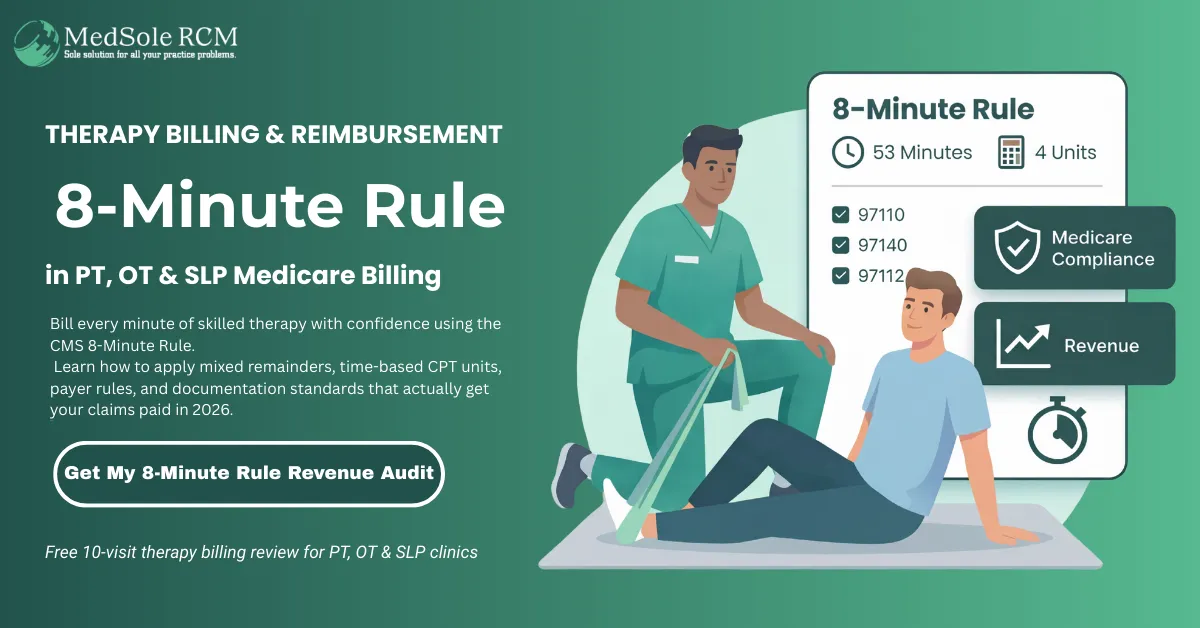
The 8-minute rule is a Medicare billing guideline. Therapists must provide at least 8 minutes of direct, one-on-one treatment to bill 1 unit of a time-based CPT code. Units are calculated in 15-minute increments: 8 to 22 minutes equals 1 unit, 23 to 37 minutes equals 2 units, 38 to 52 minutes equals 3 units, and so on.
This rule applies to Physical Therapy (PT), Occupational Therapy (OT), and Speech-Language Pathology (SLP) services billed under Medicare Part B.
Keep reading for the complete chart, calculation examples, and free downloadable cheat sheet.
Therapy billing shouldn't feel like advanced math. But for most physical therapists, occupational therapists, and speech-language pathologists, the 8-minute rule causes more headaches than it should.
Get it wrong one way and you're leaving money on the table. Get it wrong the other way and you're inviting an audit. Neither helps your practice.
We've spent years helping therapy practices get this right. This guide breaks down everything you need to know about the 8-minute rule. We'll cover basic calculations, mixed remainders, payer differences, and the mistakes I see clinics make every week.
Whether you've been billing for decades or just started your first job, this guide will give you clarity. Let's get into it.
8-Minute Rule Chart: Minutes to Units Quick Reference
Before we dig into the details, here's the chart you'll actually use. Bookmark this page or grab our free PDF below.
|
Total Timed Minutes |
Billable Units |
|
0 to 7 minutes |
❌ 0 units (not billable) |
|
8 to 22 minutes |
1 unit |
|
23 to 37 minutes |
2 units |
|
38 to 52 minutes |
3 units |
|
53 to 67 minutes |
4 units |
|
68 to 82 minutes |
5 units |
|
83 to 97 minutes |
6 units |
|
98 to 112 minutes |
7 units |
|
113 to 127 minutes |
8 units |
This chart applies to total time spent on all time-based CPT codes during a single session. Not individual services. The total.
The logic is simple. Every 15 minutes of direct treatment equals one billable unit. But you need at least 8 minutes to bill that first unit. Any remainder of 8 minutes or more after dividing by 15 earns you one more unit.
Want this chart on your wall? Download our free 8-Minute Rule Cheat Sheet PDF. No email required.
What is the 8-Minute Rule in Medical Billing?
Definition and Origin
The 8-minute rule is a Medicare billing guideline that CMS introduced in April 2000. It tells rehabilitation therapists how to calculate billable units for time-based CPT codes when treating Medicare patients.
Here's the core idea. You must deliver at least 8 minutes of direct, one-on-one skilled therapy to bill for one unit. Time-based services are measured in 15-minute increments. Each billable unit represents 15 minutes of treatment.
The 8-minute threshold lets therapists bill a full unit even when the service doesn't hit the complete 15 minutes. As long as you meet that 8-minute minimum, you can bill.
Services lasting fewer than 8 minutes can't be billed as a standalone unit. This stops providers from billing for quick patient contact that doesn't count as real therapeutic work.
Who Must Follow the 8-Minute Rule?
The 8-minute rule applies to all rehab therapy professionals billing Medicare Part B for outpatient services.
Provider Types:
- Physical Therapists (PT)
- Occupational Therapists (OT)
- Speech-Language Pathologists (SLP)
- Physical Therapist Assistants (PTA) working under PT supervision
- Occupational Therapy Assistants (OTA) working under OT supervision
Practice Settings:
- Private practices
- Hospital outpatient departments
- Skilled nursing facilities providing Part B services
- Comprehensive outpatient rehabilitation facilities
- Rehabilitation agencies
- Home health agencies providing Part B therapy
- Critical access hospitals
Why the 8-Minute Rule Matters for Your Practice
Getting this rule right directly affects your revenue and compliance status. Here's why it matters.
Revenue Optimization: Properly calculating mixed remainders means you capture every unit you've earned. Many practices unknowingly underbill by ignoring leftover minutes. That adds up fast.
Compliance Protection: Overbilling, whether you meant to or not, triggers Medicare audits. Accurate billing keeps your documentation defensible and your practice audit-ready.
Claim Acceptance: Wrong unit calculations lead to denials and delays. Getting it right the first time speeds up your entire revenue cycle.
Staff Confidence: When your therapists and billing staff understand the rule, documentation flows smoothly. Everyone works from the same playbook.
Time-Based vs. Service-Based CPT Codes: Understanding the Difference
The 8-minute rule only applies to time-based CPT codes. Before you can calculate units correctly, you need to know which codes are timed and which aren't.
What Are Time-Based (Timed) CPT Codes
Time-based CPT codes require direct, one-on-one patient contact. They're billed in 15-minute units. These codes fall under the 8-minute rule. You need at least 8 minutes of skilled treatment to bill one unit.
Here's what defines time-based codes. They require constant attendance by the therapist. They involve skilled, direct patient care. You must document specific start and end times. You can bill multiple units based on total treatment time.
Common Time-Based CPT Codes in Therapy:
|
CPT Code |
Description |
Time Unit |
|
97110 |
Therapeutic Exercise |
15 min |
|
97112 |
Neuromuscular Re-education |
15 min |
|
97113 |
Aquatic Therapy |
15 min |
|
97116 |
Gait Training |
15 min |
|
97140 |
Manual Therapy Techniques |
15 min |
|
97530 |
Therapeutic Activities |
15 min |
|
97535 |
Self-Care/Home Management Training |
15 min |
|
97537 |
Community/Work Reintegration |
15 min |
|
97542 |
Wheelchair Management Training |
15 min |
|
97750 |
Physical Performance Test/Measurement |
15 min |
|
97755 |
Assistive Technology Assessment |
15 min |
|
97760 |
Orthotic Management and Training |
15 min |
|
97761 |
Prosthetic Training |
15 min |
|
97032 |
Electrical Stimulation (attended) |
15 min |
|
97033 |
Iontophoresis |
15 min |
|
97035 |
Ultrasound |
15 min |
|
G0283 |
Electrical Stimulation (Medicare) |
15 min |
What Are Service-Based (Untimed) CPT Codes?
Service-based CPT codes work differently. They're billed as a flat rate regardless of time spent. These codes don't fall under the 8-minute rule. You bill one unit whether the service takes 5 minutes or 45 minutes.
Common Service-Based CPT Codes in Therapy:
|
CPT Code |
Description |
Billing |
|
97161 |
PT Evaluation, Low Complexity |
Per session |
|
97162 |
PT Evaluation, Moderate Complexity |
Per session |
|
97163 |
PT Evaluation, High Complexity |
Per session |
|
97164 |
PT Re-Evaluation |
Per session |
|
97165 |
OT Evaluation, Low Complexity |
Per session |
|
97166 |
OT Evaluation, Moderate Complexity |
Per session |
|
97167 |
OT Evaluation, High Complexity |
Per session |
|
97168 |
OT Re-Evaluation |
Per session |
|
97010 |
Hot/Cold Packs |
Per session |
|
97014 |
Electrical Stimulation (unattended) |
Per session |
|
97150 |
Group Therapy |
Per session |
BILLING TIP: Never combine service-based minutes with time-based codes when applying the 8-minute rule. Only timed codes count toward total billable units. If you spend 20 minutes applying hot packs (97010) and 10 minutes on therapeutic exercise (97110), only the 10 minutes of therapeutic exercise applies to your calculation.
How to Calculate Billable Units Using the 8-Minute Rule
Now that you know which codes fall under the rule, let's walk through the calculation process.
Step-by-Step Calculation Process
Step 1: Identify All Time-Based CPT Codes
Review your treatment session. List every timed service provided. Leave out evaluations, re-evaluations, and other service-based codes.
Step 2: Record Start and End Times
Accurately document the exact start and end time for each timed service. This becomes your defense if anyone questions your billing.
Step 3: Calculate Total Direct Treatment Minutes
Add the minutes from all time-based services. Don't include setup time, documentation time done after the patient leaves, or breaks.
Step 4: Divide Total Minutes by 15
This gives you your base number of units. The whole number is your guaranteed billable units.
Step 5: Evaluate the Remainder
If the remainder after dividing by 15 is 8 or more minutes, add one more unit. If it's 7 or fewer minutes, you can't bill that extra unit.
Step 6: Assign Units to Specific Codes
Distribute units across the CPT codes you used. Make sure each code you bill has at least 8 minutes of documented treatment time.
The Remainder Rule Explained
The remainder calculation confuses a lot of therapists. Here's how it actually works.
When you divide your total timed minutes by 15, you'll usually have leftover minutes. These remainders decide whether you can bill one more unit.
Remainder of 8 or more minutes equals 1 additional unit.
Remainder of 7 or fewer minutes equals no additional unit.
Example A:
Total time: 50 minutes. Divide 50 by 15 and you get 3 units with 5 minutes left over. Five minutes is less than 8. Result: 3 billable units.
Example B:
Total time: 54 minutes. Divide 54 by 15 and you get 3 units with 9 minutes left over. Nine minutes exceeds 8. Result: 4 billable units.
Mixed Remainders: Combining Time from Multiple Services
Mixed remainders happen when leftover minutes from different services combine to meet the 8-minute threshold. This is one of the most valuable parts of the rule. It's also one of the most misunderstood.
Medicare lets therapists combine remainder minutes across multiple timed codes to bill an additional unit. When you do this, assign that extra unit to the service with the greatest time total.
MIXED REMAINDER EXAMPLE:
Services Provided:
- Therapeutic Exercise (97110): 24 minutes (1 unit plus 9 min remainder)
- Manual Therapy (97140): 18 minutes (1 unit plus 3 min remainder)
- Neuromuscular Re-ed (97112): 11 minutes (0 units plus 11 min remainder)
Calculation:
Total: 53 minutes. (Check Chart: 53 to 67 minutes = 4 units allowed).
- Base Units: 1 + 1 + 0 = 2 units.
- Combined Remainders: 9 + 3 +11 = 23 minutes.
- Result: The large remainder allows you to reach the full 4 units allowed by the total time.
Result: 4 total billable units
97112: 1 unit (Highest remainder of 11 min → gets +1 unit)
97110: 2 units (Next highest remainder of 9 min → gets +1 unit)
97140: 1 unit
This is why combining all timed services matters. You might have 6 minutes left from one code and 4 from another. Individually, neither qualifies. Together, they earn you another billable unit.
8-Minute Rule Examples: Real-World Billing Scenarios
Theory helps, but real-world application is where you actually learn. Let's work through several scenarios you'll see in daily practice.
Example 1: Single Service Session (Simple)
Scenario:
A physical therapist provides 25 minutes of therapeutic exercise (97110) to a patient recovering from knee replacement surgery.
Calculation:
Total time: 25 minutes. Chart reference: 23 to 37 minutes equals 2 units. All time applies to one code.
Billing:
2 units of CPT 97110
This is the simplest scenario. One timed service, clear unit calculation.
Example 2: Multiple Services with Clean Division
Scenario:
During a 60-minute session, a PT provides:
- Therapeutic Exercise (97110): 30 minutes
- Manual Therapy (97140): 15 minutes
- Gait Training (97116): 15 minutes
Calculation:
Total time: 60 minutes. Divide 60 by 15 and you get 4 units exactly with no remainder. Each service has at least 15 minutes.
Billing:
- 97110: 2 units (30 min)
- 97140: 1 unit (15 min)
- 97116: 1 unit (15 min)
TOTAL: 4 units
Example 3: Mixed Remainders in Action
Scenario:
An occupational therapist provides:
- Therapeutic Activities (97530): 18 minutes
- Self-Care Training (97535): 12 minutes
- Manual Therapy (97140): 8 minutes
Calculation:
Total time: 38 minutes. Chart reference: 38 to 52 minutes equals 3 units.
Breaking it down by code:
- 97530: 1 unit (15 min) plus 3 min remainder
- 97535: 0 full units plus 12 min remainder
- 97140: 0 full units plus 8 min remainder
Combined remainders: 3 plus 12 plus 8 equals 23 minutes. That exceeds 8.
Billing:
- 97530: 2 units (highest time, gets priority for remainder units)
- 97535: 1 unit
TOTAL: 3 units
Example 4: When Individual Services Don't Qualify Alone
Scenario:
A PT provides:
- Therapeutic Exercise (97110): 7 minutes
- Manual Therapy (97140): 6 minutes
Calculation:
Total time: 13 minutes. Chart reference: 8 to 22 minutes equals 1 unit. Neither service individually meets 8 minutes. But the combined total of 13 minutes exceeds 8 minutes.
Billing:
Bill 1 unit to the code with the highest time (97110). TOTAL: 1 unit of 97110
NOTE: If the PT had only provided 7 minutes of a single service, it would be 0 billable units. The combination saved this from being a non-billable encounter.
Example 5: Complex Multi-Service Session
Scenario:
During a 75-minute session, a PT provides:
- Therapeutic Exercise (97110): 25 minutes
- Manual Therapy (97140): 20 minutes
- Neuromuscular Re-education (97112): 15 minutes
- Gait Training (97116): 15 minutes
Calculation:
Total time: 75 minutes. Chart reference: 68 to 82 minutes equals 5 units.
Unit distribution:
- 97110: 25 min equals 1 unit plus 10 min remainder
- 97140: 20 min equals 1 unit plus 5 min remainder
- 97112: 15 min equals 1 unit plus 0 min remainder
- 97116: 15 min equals 1 unit plus 0 min remainder
Base units: 4. Combined remainder: 15 minutes equals 1 additional unit (goes to 97110).
Billing:
- 97110: 2 units
- 97140: 1 unit
- 97112: 1 unit
- 97116: 1 unit
TOTAL: 5 units
8-Minute Rule vs. Rule of 8s: CMS vs. AMA Billing Differences
One of the biggest sources of confusion in therapy billing is the difference between Medicare's 8-minute rule and the AMA's Rule of 8s. They sound similar. They work differently. Using the wrong one can cost you money or create compliance problems.
Understanding the Key Differences
|
Aspect |
CMS 8-Minute Rule |
AMA Rule of 8s |
|
Primary Users |
Medicare, Medicaid |
Commercial insurers |
|
Calculation Method |
Combines all timed minutes |
Each code calculated separately |
|
Mixed Remainders |
✅ Allowed; combine across codes |
❌ Not allowed |
|
Minimum for 1 Unit |
8 minutes of total timed services |
8 minutes per individual code |
|
Documentation Focus |
Total session time |
Time per service code |
The Critical Difference: Mixed Remainders
Under the CMS 8-minute rule, you can combine leftover minutes from different CPT codes to reach the 8-minute threshold for an additional unit.
Under the AMA Rule of 8s, each service must independently meet the 8-minute minimum. You can't combine remainders from different codes.
SAME SCENARIO, DIFFERENT RESULTS:
Services provided:
- 97110 (Therapeutic Exercise): 10 minutes
- 97140 (Manual Therapy): 10 minutes
UNDER CMS 8-MINUTE RULE:
Total: 20 minutes. Chart: 8 to 22 minutes equals 1 unit. Result: 1 unit (assigned to either code)
UNDER AMA RULE OF 8s:
Each code is evaluated separately. 97110: 10 min is 8 or more, so 1 unit. 97140: 10 min is 8 or more, so 1 unit. Result: 2 units total
In this scenario, the AMA Rule of 8s actually gives you more billable units. That's why knowing which method your payer requires is essential.
When to Use Each Method
Always use CMS 8-Minute Rule for: Medicare Part A, Medicare Part B, Medicare Advantage, Medicaid (most states), Tricare, CHAMPVA, and other federal payers.
Check payer requirements for: Blue Cross Blue Shield, Aetna, Cigna, UnitedHealthcare, and other commercial insurers. Many use the Rule of 8s or Substantial Portion Method.
8-Minute Rule vs. Substantial Portion Method (SPM): Are You Losing Money?
Beyond the AMA Rule of 8s, some commercial payers use another billing method called the Substantial Portion Method. Understanding SPM can help you get more from non-Medicare payers.
What is the Substantial Portion Method?
The Substantial Portion Method is an alternative billing approach used by some commercial insurance companies. Under SPM, each service must independently meet the 8-minute minimum. This is similar to the AMA Rule of 8s. You can't combine remainder minutes from different services.
The key principle is this: a "substantial portion" of the 15-minute unit (at least 8 minutes) must be spent on each individual CPT code for it to qualify as billable.
Which Payers Use Each Method?
|
Payer |
8-Minute Rule |
SPM |
Notes |
|
Medicare Part B |
✅ Required |
❌ |
CMS standard |
|
Medicaid |
✅ Most states |
⚠️ Some states |
Verify state rules |
|
Medicare Advantage |
✅ Required |
❌ |
Must follow CMS |
|
Tricare |
✅ Required |
❌ |
Federal payer |
|
CHAMPVA |
✅ Required |
❌ |
Federal payer |
|
Blue Cross Blue Shield |
⚠️ Varies |
⚠️ Varies |
Check specific plan |
|
Aetna |
❌ Usually not |
✅ Often |
Verify contract |
|
Cigna |
❌ Usually not |
✅ Often |
Check guidelines |
|
UnitedHealthcare |
⚠️ Mixed |
⚠️ Mixed |
Plan-dependent |
|
Workers' Compensation |
⚠️ Varies |
⚠️ Varies |
State-specific |
Revenue Impact: When SPM Can Increase Your Units
Here's something that surprises most therapists. SPM can sometimes give you more billable units than the CMS 8-minute rule. This happens especially when you provide multiple short services.
REVENUE COMPARISON SCENARIO:
Services: 10 min of 97110, 10 min of 97140, 9 min of 97530
CMS 8-Minute Rule:
- Total: 29 minutes equals 2 units (23 to 37 min range)
SPM Method:
- 97110: 10 min equals 1 unit ✅
- 97140: 10 min equals 1 unit ✅
- 97530: 9 min equals 1 unit ✅
Total: 3 units
Result: SPM yields 50% more billable units in this scenario
Don't assume the CMS method is always best. For commercial payers using SPM, structuring your treatment sessions with multiple services of 8 or more minutes can maximize reimbursement.
PRO TIP: Always verify billing methodology with each payer before assuming which rule applies. What's in your contract matters more than general assumptions.
8-Minute Rule for PT, OT, and SLP: Discipline-Specific Guidelines
The 8-minute rule applies consistently across rehabilitation disciplines. But there are nuances worth understanding for each profession.
8-Minute Rule for Physical Therapy (PT)
Physical therapists use the 8-minute rule most frequently because of how common time-based interventions are in PT practice.
Common timed codes for PTs include:
- 97110: Therapeutic Exercise (most common)
- 97140: Manual Therapy Techniques
- 97116: Gait Training
- 97112: Neuromuscular Re-education
- 97530: Therapeutic Activities
PTs should know that modalities like ultrasound (97035) and attended electrical stimulation (97032) are also timed codes. They fall under the 8-minute rule. However, unattended electrical stimulation (97014 for commercial, G0283 for Medicare) is service-based and does not fall under the 8-minute rule
8-Minute Rule for Occupational Therapy (OT)
The 8-minute rule applies equally to occupational therapy services billed under Medicare. OTs commonly use time-based codes including:
- 97530: Therapeutic Activities
- 97535: Self-Care/Home Management Training
- 97537: Community/Work Reintegration Training
- 97542: Wheelchair Management Training
- 97761: Prosthetic Training
- 97140: Manual Therapy (when within OT scope)
OTs should know that cognitive skills development, sensory integration activities, and ADL training all fall under timed codes when billed appropriately. Documentation must clearly show the skilled, direct nature of the intervention.
8-Minute Rule for Speech-Language Pathology (SLP)
Speech-language pathologists follow the same 8-minute rule for Medicare-covered therapy services. Common time-based SLP codes include:
- 92507: Speech, language, voice therapy (individual)
- 92508: Group speech therapy
- 92526: Oral function therapy (swallowing)
- 92609: Therapeutic services for speech device
SLPs must make sure documentation reflects face-to-face treatment minutes. Preparation time, chart review, and report writing don't count toward the 8-minute calculation unless done in the patient's presence as part of the therapeutic intervention.
Does the 8-Minute Rule Apply to Mental Health Therapy?
No. Mental health therapy doesn't follow the 8-minute rule. Mental health providers use different time-range CPT codes with their own thresholds.
|
CPT Code |
Description |
Time Range |
|
90832 |
Psychotherapy, 30 min |
16 to 37 minutes |
|
90834 |
Psychotherapy, 45 min |
38 to 52 minutes |
|
90837 |
Psychotherapy, 60 min |
53 or more minutes |
These codes follow their own time brackets and billing rules. They don't use the 8-minute rule structure that rehabilitation therapy uses.
Which Insurance Companies Follow the 8-Minute Rule?
One of the most common questions we get at MedSole RCM is: "Which payers require the 8-minute rule?" The answer isn't always simple.
Comprehensive Payer Reference
|
Payer |
Follows 8-Min Rule? |
Notes |
|
Medicare Part B |
✅ Yes (Required) |
Standard CMS rule applies |
|
Medicare Part A (SNF) |
⚠️ Different rules |
Uses RUG/PDPM system |
|
Medicare Advantage |
✅ Yes |
Must follow CMS guidelines |
|
Medicaid |
⚠️ Varies by state |
Check your state MAC |
|
Tricare |
✅ Yes |
Federal payer |
|
CHAMPVA |
✅ Yes |
Federal payer |
|
Federal BCBS |
✅ Yes |
Federal employee plan |
|
Commercial BCBS |
⚠️ Varies by plan |
Verify with payer |
|
Aetna |
❌ Often uses SPM |
Check provider portal |
|
Cigna |
❌ Often uses SPM |
Verify contract terms |
|
UnitedHealthcare |
⚠️ Mixed policies |
Plan-dependent |
|
Humana |
⚠️ Varies |
Medicare Advantage follows CMS |
|
Workers' Com |
State-by-State Medicaid Variations
Medicaid programs are run at the state level. This means billing rules can vary significantly from state to state. Some states adopt Medicare's 8-minute rule exactly. Others have modified thresholds or different unit calculations entirely.
Best Practice: Contact your state Medicaid program or review the provider manual for specific guidance. Many states publish therapy billing guides that clarify whether the 8-minute rule applies and any state-specific modifications.
When in Doubt, Verify
The safest approach is always to verify billing requirements directly with each payer. This matters most when:
- Onboarding a new insurance contract
- Billing a patient with coverage you haven't worked with before
- Policy updates happen (check at least once a year)
- You're entering a new state's market
Need help navigating payer-specific billing rules? MedSole RCM'scredentialing and billing specialists can verify requirements and optimize your claims for each payer. Contact us for a free consultation.
8 Common 8-Minute Rule Mistakes That Cost You Money
Even experienced therapists and billing staff make errors with the 8-minute rule. Here are the mistakes I see most often and how to avoid them.
1. Rounding Up Time Incorrectly
The Mistake: Billing one unit for only 6 or 7 minutes of service because it "felt like" 8 minutes.
The Fix: Always follow the official minute thresholds. 7 minutes and 59 seconds is NOT billable. Only 8:00 or more qualifies.
2. Combining Timed and Untimed Codes
The Mistake: Including time spent on service-based codes like hot packs or evaluations in your 8-minute rule calculation.
The Fix: Only time-based CPT codes count toward unit calculations. Keep service-based time separate.
3. Forgetting Mixed Remainders
The Mistake: Leaving billable remainder minutes on the table by not combining them across services.
The Fix: Always calculate combined remainders. If they total 8 or more minutes, you've earned another unit.
4. Not Documenting Start and End Times
The Mistake: Recording "approximately 20 minutes" instead of "10:15 AM to 10:35 AM."
The Fix: Document specific start and end times for each timed service. This is your audit defense.
5. Applying CMS Rules to SPM Payers
The Mistake: Using the CMS combined-time method for a commercial payer that requires the Substantial Portion Method.
The Fix: Verify each payer's methodology. Using the wrong method means incorrect units, either over or under.
6. Ignoring Assessment and Education Time
The Mistake: Not counting legitimate skilled time spent assessing patient response, providing education, or counseling the patient.
The Fix: If you're providing skilled services one-on-one, including assessment, instruction, and patient education, that time counts toward the 8-minute rule when properly documented.
7.Double-Counting Group Therapy
The Mistake: Trying to apply 8-minute rule calculations to group therapy sessions.
The Fix: Group therapy (97150) is an untimed, service-based code. Bill once per session regardless of time spent.
8. Overbilling Beyond Documented Time
The Mistake: Billing for more units than your documentation supports because "that's what we usually bill."
The Fix: Your documentation must support every unit billed. Auditors will compare time records to unit submissions.
Staying Compliant: Medicare Audit Protection Strategies
The 8-minute rule isn't just about maximizing revenue. It's about billing correctly and defending your claims if anyone questions them. Here's how to stay audit-ready.
Documentation Best Practices
Record Exact Start and End Times: Don't approximate. Document "97110: 10:00 AM to 10:22 AM (22 minutes)" for each timed service.
Specify CPT Codes: Link each time entry to a specific procedure code in your documentation.
Document Skilled Intervention: Your notes must describe skilled therapeutic techniques, not passive or maintenance-level care.
Note Patient Response: Include how the patient responded to treatment. This demonstrates medical necessity.
What Counts as Billable Time?
Medicare allows billing for direct, one-on-one time that includes:
- Performing hands-on therapeutic techniques
- Assessing patient response to interventions
- Providing patient education on self-care
- Answering patient and caregiver questions
- Documenting in the patient's presence
What does NOT count:
- Setup and cleanup time (unless patient is involved)
- Documentation completed after the patient leaves
- Time spent on administrative tasks
- Unattended modality application
OIG Focus Areas for Therapy Billing
The Office of Inspector General regularly targets therapy billing in its work plans. Recent focus areas include:
- Excessive therapy units per session
- Billing for services not rendered
- Inadequate documentation supporting medical necessity
- Upcoding of evaluation complexity levels
- Services provided by unqualified personnel
Accurate 8-minute rule compliance is your first line of defense against these audit triggers.
Essential Billing Modifiers for Therapy Claims
Proper use of billing modifiers complements your 8-minute rule compliance. Here's a quick reference.
|
Modifier |
Description |
When to Use |
|
GP |
Physical Therapy services |
All PT claims |
|
GO |
Occupational Therapy services |
All OT claims |
|
GN |
Speech-Language Pathology |
All SLP claims |
|
KX |
Therapy threshold exceeded, still medically necessary |
Above Medicare cap |
|
59 |
Distinct procedural service |
Bypass NCCI edits |
|
XE |
Separate encounter |
Different session same day |
|
CQ |
Services performed by PTA |
PTA-delivered care |
|
CO |
Services performed by OTA |
OTA-delivered care |
|
GA |
ABN on file |
When coverage uncertain |
|
76 |
Repeat procedure, same physician |
Same service, same day |
Using incorrect modifiers or leaving out required ones can result in claim denials. This happens regardless of how accurately you've calculated your 8-minute rule units.
Download Your Free 8-Minute Rule Cheat Sheet [PDF]
GET YOUR FREE CHEAT SHEET
Download our printable 8-Minute Rule Quick Reference Guide including:
-
Minutes-to-units conversion chart
-
Time-based vs. service-based code lists
-
Mixed remainder calculation worksheet
-
Payer comparison matrix
-
Documentation checklist
Frequently Asked Questions About the 8-Minute Rule
What is the 8-minute rule in physical therapy?
The 8-minute rule is a Medicare billing guideline requiring physical therapists to provide at least 8 minutes of direct, one-on-one treatment to bill one unit of a time-based CPT code. Services are calculated in 15-minute increments. 8 to 22 minutes equals 1 unit, 23 to 37 minutes equals 2 units, and so on. This rule ensures therapists are fairly reimbursed for actual treatment time provided.
How do you calculate units under the 8-minute rule?
To calculate billable units under the 8-minute rule: First, add total minutes of all time-based services provided during the session. Second, divide the total by 15 to get base units. Third, if the remainder is 8 or more minutes, add one additional unit. For example, 38 minutes equals 2 full units plus 8 minutes remainder, resulting in 3 billable units total.
What is the difference between the 8-minute rule and Rule of 8s?
The CMS 8-minute rule allows combining minutes from multiple services to calculate total units, including mixing remainders from different CPT codes. The AMA Rule of 8s, used by some commercial payers, requires each service to independently meet the 8-minute minimum. Mixed remainders can't be combined across codes under the AMA method. The AMA method can sometimes yield more units when each service exceeds 8 minutes individually.
Does the 8-minute rule apply to occupational therapy?
Yes. The 8-minute rule applies equally to occupational therapy (OT), physical therapy (PT), and speech-language pathology (SLP) services billed under Medicare Part B using time-based CPT codes. OTs must document direct treatment time and calculate units using the same methodology as PTs and SLPs.
What happens if I don't meet the 8-minute threshold?
Services lasting less than 8 minutes can't be billed as a standalone unit under Medicare. But if you provide multiple timed services during a session, minutes from all services can be combined. If the combined total time is at least 8 minutes, one unit can be billed. Assign it to the code with the greatest time total.
What insurances follow the 8-minute rule?
Medicare Part B, Medicare Advantage, Medicaid (most states), Tricare, and CHAMPVA follow the 8-minute rule. Commercial payers like Aetna, Cigna, and some BCBS plans may use alternative methods like the Substantial Portion Method or AMA Rule of 8s. Always verify requirements with each payer directly.
Can I bill for assessment and documentation time?
Yes, when provided one-on-one and documented properly. Billable activities include: assessing patient response to treatment, providing patient education on self-care techniques, answering patient and caregiver questions, and documenting treatment while in the patient's presence. Time spent on documentation after the patient leaves is not billable.
What is the 8-minute rule for mental health therapy?
The 8-minute rule does NOT apply to mental health therapy. Mental health providers use different time-range CPT codes with their own thresholds: 90832 (16 to 37 minutes), 90834 (38 to 52 minutes), and 90837 (53 or more minutes). These codes follow their own time brackets, not the 8-minute rule structure used in rehabilitation therapy.
Who created the 8-minute rule?
The Centers for Medicare and Medicaid Services (CMS) introduced the 8-minute rule in April 2000 as part of Medicare's Outpatient Prospective Payment System regulations. The rule was designed to standardize therapy billing practices and ensure accurate reimbursement for time-based rehabilitation services under Medicare Part B.
How do mixed remainders work in the 8-minute rule?
Mixed remainders are leftover minutes from multiple services that can be combined to reach the 8-minute threshold for an additional billable unit. For example, if you have 5 remainder minutes from therapeutic exercise and 4 remainder minutes from manual therapy, the combined 9 minutes qualifies for one additional unit. Bill that unit to the service with the highest time total.
Master the 8-Minute Rule to Maximize Your Therapy Reimbursement
Understanding and correctly applying the 8-minute rule is essential for every PT, OT, and SLP practice billing Medicare and commercial insurers. From calculating mixed remainders to avoiding common documentation errors, proper compliance protects your revenue and keeps you audit-ready.
Key Takeaways
- 8 minutes minimum equals 1 billable unit for any time-based CPT code
- Always combine timed services when calculating total units under Medicare
- Document exact start and end times for each service provided
- Know which payers follow CMS vs. SPM rules to optimize billing
Use mixed remainders strategically to capture every earned unit
Keep this guide and cheat sheet handy for quick reference
The 8-minute rule doesn't have to be complicated. With the right systems, documentation habits, and billing knowledge, you can ensure accurate reimbursement for every treatment session.
Need Help Optimizing Your Therapy Billing?
MedSole RCM's certified billing specialists ensure every minute counts. Our team understands the nuances of Medicare therapy billing, commercial payer variations, and the documentation requirements that keep your practice compliant and profitable.
What we offer:
GET YOUR FREE BILLING CONSULTATION
Let our experts review your therapy billing processes and identify opportunities to improve accuracy and revenue.
ABOUT THE AUTHOR
This guide was prepared by the MedSole RCM clinical billing team, with expertise in Medicare therapy billing, CPT coding, and revenue cycle management for rehabilitation practices.
Our team includes AAPC-certified coders and billing specialists with combined experience processing thousands of PT, OT, and SLP claims annually.
Last Updated: January 2026
Sources:CMS Medicare Benefit Policy Manual,CMS Transmittal R2121CP, AMA CPT Manual