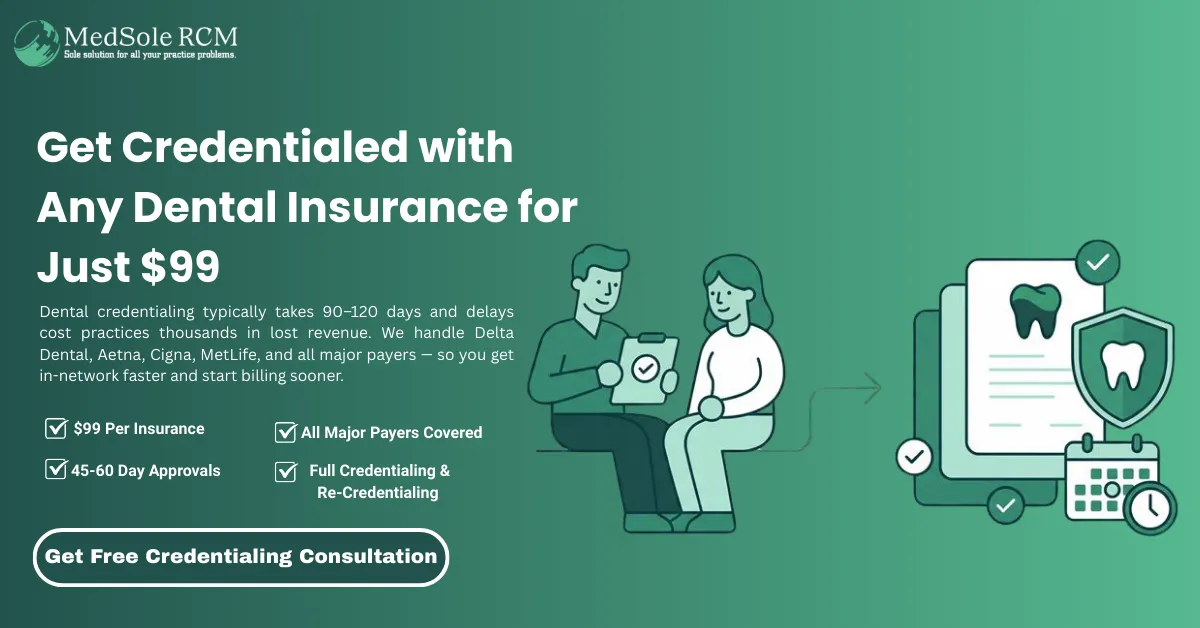




Get Credentialed with Any Dental Insurance for Just $99
Expert dental credentialing services backed by 10 years of RCM experience. We handle Delta Dental, Aetna, Cigna, MetLife, and every major payer. You focus on patients. We'll handle the paperwork and payer follow-up.
IconValue PropSupporting Detail $99 Per InsuranceFlat rate, no hidden fees⏱️60-90 Day ApprovalsFaster than industry average🏥All Major PayersDelta, Aetna, Cigna, MetLife, BCBS, and more Full Re-credentialing SupportWe track deadlines so you don't have to
Get Free Credentialing Consultation
Dental credentialing typically takes 90 to 120 days. Make a mistake on the application, and you're looking at six months or longer. Every day your provider operates out-of-network costs the practice $1,500 to $3,000 in unrealized revenue. That's money walking out the door because patients prefer in-network providers.
The paperwork alone takes 40-plus hours per provider. Most front desk teams don't have that kind of time between patient check-ins and phone calls. So applications sit incomplete, follow-ups get missed, and timelines stretch into months.
MedSole RCM provides dental credentialing services at $99 per insurance, with no hidden fees. We've spent 10 years handling dental insurance credentialing for practices across all 50 states. Delta Dental, Aetna, Cigna, MetLife: if your patients have it, we credential you for it.
This guide covers everything your dental practice needs. You'll learn the step-by-step credentialing process, required documents, payer-specific timelines, and 2026 regulatory updates that affect approvals. Use it to evaluate dental credentialing services or manage the process in-house. Either way, you'll have what you need to avoid delays and protect your revenue.
What Is Dental Credentialing?
Dental Credentialing: Definition and Purpose
Dental credentialing is the formal verification process through which insurance companies confirm a dentist's qualifications, licenses, education, malpractice history, and professional standing before accepting them as an in-network provider eligible for reimbursement.
Think of it as a background check, but for your professional life. Payers want proof that you're licensed, insured, and haven't had issues that would make you a liability. They verify everything: dental school graduation, state license status, DEA registration, malpractice claims, and work history.
Here's why it matters for revenue. Until you complete insurance credentialing with a payer, you can't bill them as an in-network provider. Patients with that coverage either pay out-of-pocket, which most won't do, or they find a dentist who's already credentialed. The credentialing process is the gate between your chair and their insurance dollars.
Credentialing vs. Enrollment vs. Privileging: Key Differences
These terms get used interchangeably, but they mean different things. Mixing them up causes confusion when you're tracking applications.
|
Term |
What It Means |
When It Happens |
|
Credentialing |
Verification of qualifications, licenses, certifications, and professional history |
Before joining any insurance network |
|
Provider Enrollment |
Administrative registration with a specific payer’s billing and claims system |
After credentialing approval |
|
Privileging |
Authorization to perform specific procedures or services within a facility |
In specialty or hospital-based settings |
Most dental practices focus on credentialing and enrollment. Privileging typically applies to oral surgeons working in hospitals or ambulatory surgery centers. If you're running a general practice, you probably won't deal with privileging at all.
How Dental Credentialing Differs from Medical Credentialing
Dental credentialing and medical credentialing follow the same basic logic, but the details differ enough to cause problems if you're using a generalist credentialing service.
|
Factor |
Medical Credentialing |
Dental Credentialing |
|
Typical Timeline |
90 to 120 days |
30 to 90 days |
|
Coding System |
CPT and ICD codes |
CDT codes |
|
Primary Identifiers |
NPI, DEA, board certifications |
NPI, state license, DDS/DMD degree |
|
Hospital Privileges |
Often required |
Rarely required |
|
Payer Responsiveness |
Usually reachable |
Often difficult to reach |
|
Medicare Coverage |
Extensive |
Limited to specific services |
The credentialing timeline for dental tends to be shorter, but don't let that fool you. Dental payers are notoriously harder to reach by phone, and their online portals vary wildly in usability. What you save in timeline, you often spend in follow-up frustration.
One more thing: medical credentialing services don't always understand CDT coding or dental-specific payer quirks. If you're outsourcing, make sure your credentialing partner actually specializes in dental.
Why Dental Credentialing Matters for Your Practice
The Revenue Impact of Credentialing Delays
A single provider operating out-of-network for 90 days can cost a dental practice $150,000 to $270,000 in potential revenue. That's not an exaggeration. Most patients check their insurance benefits before booking, and they choose in-network providers to minimize out-of-pocket costs.
Here's how the math works. If a dentist sees 15 patients per day at an average reimbursement of $200 per visit, that's $3,000 daily. Multiply by 90 days of credentialing delays, and you're looking at $270,000 in appointments that either went to a competitor or never happened at all.
Out-of-network billing doesn't solve this. Patients pay higher deductibles, coinsurance jumps from 20% to 50%, and many plans won't cover procedures at all. Your front desk spends hours explaining costs instead of scheduling appointments. Cash flow suffers while you wait for credentialing to clear.
Expanding Patient Access Through Proper Credentialing
Network participation directly affects how many patients can afford your services. When you're credentialed with major payers, your dental practice shows up in insurance directories. Patients searching for "dentists near me who take Delta Dental" find you instead of the practice down the street.
Dental insurance credentialing also simplifies front desk operations. Eligibility checks take seconds when you're in-network. Claims process faster because you're already in the payer's system. Patients trust you more because their insurance company has essentially pre-vetted your credentials.
Growing practices feel this impact most. Every new associate needs separate credentialing with each payer. If that process takes 90 days, your new hire sits partially idle while their patient panel builds slowly. Faster credentialing means faster productivity.
Compliance Requirements and Risk Mitigation
Dental credentialing isn't just about revenue. It's also about staying compliant with payer contracts and federal requirements. CMS has intensified enforcement around provider data accuracy, and mistakes in your credentialing files can trigger audits or even termination from networks.
NCQA credentialing standards, which most commercial payers follow, require primary source verification of licenses, education, and malpractice history. As of 2026, payers are tightening compliance around PECOS data matching and cross-program termination enforcement. One issue with Medicaid can now affect your standing with Medicare and commercial plans.
Accurate credentialing protects your practice from liability issues too. If a claim gets paid for a provider who wasn't properly credentialed at the time of service, the payer can recoup that money years later. Staying on top of credentialing and re-credentialing deadlines prevents these compliance headaches.

The Dental Credentialing Process: 6 Steps to Get In-Network
Getting credentialed doesn't have to be complicated, but it does require following a specific sequence. Skip a step or submit incomplete information, and you'll add weeks to your timeline. Here's how the dental credentialing process works from start to finish.
Step 1: Gather and Verify All Required Documentation
Timeline: 1 to 2 weeks
Every credentialing application starts with documentation. Before you touch a single-payer form, collect everything you'll need. Missing or expired documents are the number one cause of credentialing delays.
Here's what most payers require:
- Current state dental license
- DEA registration (if you prescribe controlled substances)
- NPI number (Type 1 for individual, Type 2 for practice)
- Dental school diploma showing DDS or DMD degree
- Malpractice insurance certificate with coverage dates and limits
- W-9 form
- Complete CV with work history (no gaps longer than 30 days)
- Specialty board certifications (if applicable)
- CPR/BLS certification
Check expiration dates on everything. A license that expires next month will cause problems mid-application. Payers won't process your credentialing application if any document is within 30 days of expiration.
Step 2: Complete CAQH ProView Registration and Attestation
Timeline: 1 to 2 weeks
CAQH ProViewis a centralized database where providers store their credentialing information. Most commercial payers pull directly from CAQH instead of requiring separate applications, which makes this step critical for dental credentialing.
If you don't have a CAQH account, register at proview.caqh.org. The setup takes time because you're essentially filling out a universal credentialing application. Every field matters. Incomplete profiles sit in limbo.
Here's the part people miss: CAQH requires re-attestation every 120 days. If your profile goes unattested, payers can't access your data. Set a calendar reminder for every 90 days to log in and confirm your information is current. This single step prevents more delays than almost anything else in CAQH dental credentialing.
Step 3: Submit Applications to Target Insurance Payers
Timeline: 1 to 2 weeks
With documentation ready and CAQH complete, you can start submitting to insurance payers. Each payer has its own process. Some pull entirely from CAQH. Others require portal submissions or paper applications.
Prioritize strategically. Start with payers that cover the most patients in your area. If 40% of your patient base has Delta Dental, that application goes first. Dental insurance credentialing for high-volume payers directly impacts how quickly you can generate revenue.
Common submission mistakes include mismatched addresses between documents, incorrect Tax ID formatting, and forgetting to authorize CAQH access for specific payers. Double-check everything before hitting submit. Payer enrollment rejections for simple errors add 30 to 60 days to your timeline.
Step 4: Primary Source Verification by Insurance Companies
Timeline: 2 to 4 weeks
Once payers receive your application, they begin primary source verification. This means they contact licensing boards, dental schools, malpractice carriers, and previous employers directly to confirm your information.
You don't control this stage, but you can prepare for it. Make sure your references know to expect calls. Give previous employers a heads-up. Unresponsive references are a common bottleneck in dental credentialing.
A dental credentialing specialist can help here by tracking verification status and following up with sources who haven't responded. Primary source verification typically takes two to four weeks, but delays compound quickly when contacts don't reply.
Step 5: Proactive Follow-Up and Application Tracking
Timeline: Ongoing
Applications don't move themselves. Without consistent follow-up, your credentialing process stalls in someone's queue. Payers process thousands of applications, and yours won't get priority just because you're waiting on revenue.
Follow up weekly. Call the provider enrollment department, reference your application number, and ask for the status. Document every conversation: who you spoke with, what they said, and what happens next. If they request additional information, submit it within 48 hours.
This is where most practices fail. They submit applications and assume payers will handle the rest. Credentialing delays often happen simply because nobody followed up. Persistence cuts weeks off your timeline.
Step 6: Contract Review, Effective Date, and Network Activation
Timeline: 1 to 2 weeks
Approval doesn't mean you can start billing immediately. After credentialing, payers send a contract outlining your fee schedule and network participation terms. Read it carefully. Some contracts include clauses that affect reimbursement rates, timely filing limits, or termination terms.
Once you sign, confirm your effective date in writing. This date determines when you can bill as in-network. Claims for services before your effective date get denied or paid at out-of-network rates.
Finally, verify your directory listing. Check that your name, address, phone number, and specialties appear correctly in the payer's provider search. Patients use these directories to find you, and errors here mean lost appointments. Dental credentialing services should include this verification step before considering the process complete.
Dentist Credentialing Checklist: Essential Documents and Requirements
Use this dentist credentialing checklist to verify you have everything before submitting applications. Missing a single document can delay your approval by 30 to 60 days. Payers won't process incomplete applications, and they rarely call to ask for what's missing. They just sit on the file until you follow up.
Licenses and Certifications Required for Dental Credentialing
Start with your professional credentials. These prove you're legally authorized to practice dentistry and meet basic credentialing requirements.
Required Licenses and Certifications:
- ☐ Active state dental license (check expiration date; must be valid for 60+ days from submission)
- ☐ DEA registration (required if you prescribe controlled substances)
- ☐ NPI number, Type 1 (individual provider identifier)
- ☐ NPI number, Type 2 (group or practice identifier, if applicable)
- ☐ DDS or DMD degree verification (dental school diploma or official transcript)
- ☐ Specialty board certification (if you're board-certified in orthodontics, periodontics, etc.)
- ☐ BLS/CPR certification (must be current; some payers require ACLS for oral surgeons)
- ☐ Infection control certification (required in some states like California)
Licenses expiring within 30 days trigger automatic holds. Renew early if you're close to expiration.
Insurance and Business Documents for Credentialing
Payers need proof that you're insured and operating as a legitimate business entity. These documents protect both the payer and the patient.
Required Insurance and Business Documentation:
- ☐ Professional liability insurance (malpractice coverage)
- Certificate must show policy dates, coverage limits, and carrier information
- Minimum coverage varies by payer; $1 million per occurrence is standard
- ☐ W-9 form (current year)
- ☐ Practice Tax ID or EIN (individual Tax ID if you're a sole proprietor)
- ☐ Business license (if your state or municipality requires one)
- ☐ Facility accreditation (AAAHC or similar, if you operate a surgical center)
Malpractice insurance causes the most problems in this category. Make sure your certificate includes tail coverage dates if you recently switched carriers. Gaps in coverage, even one day, can disqualify your application.
Work History and Background Verification Requirements
Your work history verifies professional stability and identifies any red flags. Payers check every gap in employment, and unexplained breaks raise questions.
Required Work History and Background Information:
- ☐ Complete CV or work history
- No gaps longer than 30 days
- Include practice name, address, dates, and supervisor contact information for every position
- ☐ Professional references (typically three; peers or supervisors who can verify your clinical competence)
- ☐ Hospital privileges documentation (if you have admitting or surgical privileges)
- ☐ Explanation letters (for any employment gaps, malpractice claims, or license actions)
- ☐ Background check authorization (signed release allowing payers to verify your history)
Here's what trips people up: taking six months off after dental school to travel sounds reasonable, but payers flag it as a gap. Write a brief letter explaining any period over 30 days without employment. Two sentences usually suffice.
📋 Free Download: Complete Dentist Credentialing Checklist
Get our comprehensive PDF checklist with all required documents,
state-specific requirements, and payer-specific notes.
No email required. Instant download.
Credentialing Associate Dentists: What Practice Owners Need to Know
Adding an associate dentist to your practice is a revenue opportunity, but only if you handle credentialing correctly. Most practice owners assume the process is the same as credentialing the primary dentist. It's not. Here's what you need to know about credentialing associate dentists.
How to Add Associate Dentists to Your Existing Insurance Panels
Credentialing associate dentists typically moves faster than new provider credentialing because your practice already has contracts with the payers. The associate isn't creating a new relationship; they're being added to an existing one.
You'll need the associate's individual NPI (Type 1) and their complete credentialing documentation. Submit this through the payer's provider update process, not the new provider application. Most payers have a specific form for adding practitioners to existing groups.
Group practice credentialing requires linking the associate's individual NPI to your practice's group NPI (Type 2). This step is critical. Skip it, and claims will route incorrectly or deny outright. Verify the linkage in CAQH and with each payer before the associate starts seeing patients.
Timeline expectations: adding associates typically takes 30 to 60 days, which is faster than the 45 to 60 days for new credentialing. The key is starting the process before your associate's start date, not after.
Can You Bill Under a Supervising Dentist While Waiting for Credentialing?
This question comes up constantly. The answer depends on the payer, and getting it wrong creates compliance problems.
Some payers allow temporary billing under a supervising dentist's credentials while associate credentialing processes. Others explicitly prohibit it. There's no universal rule. Dental credentialing policies vary by contract, and what works for Delta Dental might violate your Cigna agreement.
The safer approach: wait for credentialing to complete, then submit claims with a backdated effective date. Many payers honor claims from the associate's start date once credentialing finalizes. This avoids the compliance risk of billing under someone else's provider number.
Billing under another provider's credentials creates audit exposure. If the payer later flags it during a records review, you could face recoupment of every claim submitted that way. It's rarely worth the risk for 30 to 60 days of faster billing.
Credentialing New Dental School Graduates
New graduates present unique challenges. They have limited work history, no prior practice affiliations, and sometimes incomplete documentation because licensing exams happened weeks ago.
Start the credentialing process during their final semester of dental school. You can submit most applications before graduation, pending final license verification. This cuts weeks off your timeline and gets them productive faster.
Work history gaps don't exist for new graduates because dental school counts as verifiable activity. Payers expect minimal employment history. Focus on complete academic records, clinical rotation documentation, and state board exam results.
One thing to watch: malpractice insurance effective dates. New graduates need coverage from day one of employment. Coordinate the policy start date with their employment agreement so there's no gap in coverage during credentialing.
Dental Insurance Credentialing by Payer: Requirements and Timelines
Not all dental insurance credentialing processes are the same. Each payer has different timelines, documentation requirements, and quirks that affect approval speed. Here's what you need to know about credentialing with the major dental insurance companies.
Delta Dental Credentialing: Requirements and Timeline
Delta Dental is the largest dental insurance carrier in the United States, covering over 80 million people. Getting credentialed with Delta Dental should be a top priority for most practices.
Timeline: 45 to 60 days
CAQH Required: Yes
Network Types: Delta Dental Premier and Delta Dental PPO
Delta Dental credentialing pulls heavily from CAQH, so your profile needs to be complete and attested before you apply. The PPO network typically offers higher reimbursement rates than Premier, but Premier gives you access to more patients. Most practices join both networks.
State variations matter with Delta Dental. Each state has its own Delta Dental entity, and credentialing processes differ slightly. Delta Dental of California moves faster than Delta Dental of Texas, for example. Check which state entity covers your location.
One tip: Delta Dental's provider portal shows application status in real time once you're in the system. Log in weekly to check progress and catch any requests for additional information early.
Aetna Dental Credentialing: Requirements and Timeline
Aetna offers both DMO and PPO dental networks. If your patient base includes employer groups, Aetna dental insurance credentialing is worth the effort.
Timeline: 60 to 90 days
CAQH Required: Yes (mandatory)
Network Types: Aetna DMO, Aetna Dental PPO
Aetna dental credentialing requires a fully attested CAQH profile before they'll even open your application. Don't bother submitting until CAQH shows green across all sections. Applications with incomplete CAQH profiles sit in pending status for months.
The DMO network requires panel availability in your area. Panels close when Aetna has enough providers, so you can't always join even if you're qualified. PPO networks stay open more consistently. Call Aetna's provider enrollment line to check panel status before investing time in the application.
Aetna's biggest delay: primary source verification for out-of-state dental licenses. If you're licensed in multiple states, expect the longer end of the timeline.
Cigna Dental Credentialing: Requirements and Timeline
Cigna's DPPO network covers millions of patients through employer-sponsored plans. Cigna dental credentialing follows a standard commercial process with few surprises.
Timeline: 60 to 90 days
CAQH Required: Yes
Network Types: Cigna DPPO (Dental Preferred Provider Organization)
Cigna pulls from CAQH and requires minimal additional paperwork if your profile is current. Their credentialing department responds to phone calls more reliably than most payers, which helps when you need status updates.
One thing to watch: Cigna requires notification if you add locations after credentialing. Opening a second office means updating your Cigna provider file separately. Skip this step, and claims from the new location deny for address mismatches.
Cigna dental provider credentialing typically includes an initial credentialing fee, which varies by state. Budget $200 to $500 for application processing.
MetLife Dental Credentialing: Requirements and Timeline
MetLife's PDP network is one of the faster credentialing processes in dental insurance. If you need quick approvals, prioritize MetLife.
Timeline: 45 to 60 days
CAQH Required: Yes
Network Types: PDP (Preferred Dentist Program), PDP Plus
MetLife dental insurance credentialing moves efficiently when applications are complete. They auto-reject incomplete submissions instead of holding them, which sounds harsh but actually saves time. You know immediately if something's missing.
PDP Plus offers higher fee schedules than standard PDP. Check eligibility for Plus status during your application. Criteria include practice location, patient capacity, and technology capabilities like digital X-rays.
MetLife's credentialing timeline can stretch if your malpractice insurance is with a smaller carrier they haven't verified before. Larger carriers like The Dentist's Insurance Company process faster because MetLife already has verification protocols in place.
Guardian Dental Credentialing: Requirements and Timeline
Guardian's DentalGuard network serves employer groups and individual plans. Their credentialing process is thorough but not unreasonably slow.
Timeline: 60 to 90 days
CAQH Required: Yes
Network Types: DentalGuard Preferred, DentalGuard Premier
Guardian dental credentialing requires complete work history with no gaps over 30 days. They're stricter about this than most payers. If you took time off between positions, write a brief explanation letter before they ask for one.
Guardian's credentialing department sends deficiency notices by mail, not email. Check your physical mailbox regularly during the credentialing process. Missing a mailed request adds 30 days to your timeline while they wait for a response that never comes.
Guardian dental credentialing forms are payer-specific, meaning you can't rely entirely on CAQH. Their supplemental application covers Guardian-specific contracting questions. Set aside 20 minutes to complete it properly.
Blue Cross Blue Shield (BCBS) Dental Credentialing: Requirements and Timeline
BCBS dental networks are state-specific, which makes this the most complex credentialing scenario. You're not credentialing with one company; you're credentialing with independent state entities.
Timeline: 60 to 90 days (varies by state)
CAQH Required: Usually yes
Network Types: Varies by state (BlueCard Dental, FEP Dental, state-specific networks)
Blue Cross Blue Shield dental credentialing in Texas differs completely from BCBS in Florida. Each state plan operates independently. Check which BCBS entity serves your area and contact them directly for credentialing requirements.
Some BCBS plans participate in national networks for federal employees (FEP Dental). If you credential with your state BCBS, ask whether FEP participation is automatic or requires separate enrollment.
BCBS dental provider credentialing often includes the longest re-credentialing cycles: 36 months instead of the 24 months most payers use. This means less frequent paperwork once you're in the network.
Humana Dental Credentialing: Requirements and Timeline
Humana's dental networks serve individual plans, Medicare Advantage dental benefits, and employer groups. Their credentialing process sits in the middle range for speed.
Timeline: 60 to 75 days
CAQH Required: Yes
Network Types: Humana Dental PPO, Humana Dental HMO
Humana credentialing dental providers through a centralized system that handles both medical and dental applications. Make sure you specify "dental only" when applying, or you'll get requests for hospital privileges and other medical credentialing requirements that don't apply.
Humana dental insurance credentialing includes Medicare Advantage dental coverage automatically in most states. This gives you access to seniors with supplemental dental benefits through their Medicare Advantage plans.
One quirk: Humana's credentialing system locks applications after submission. If you realize you made an error, you can't edit it yourself. You'll need to call provider enrollment and have them unlock the file.
Additional Dental Insurance Payers We Credential
Beyond the major payers, numerous regional and specialized dental insurance companies require credentialing.
|
Factor |
Medical Credentialing |
Dental Credentialing |
|
Typical Timeline |
90 to 120 days |
30 to 90 days |
|
Coding System |
CPT and ICD codes |
CDT codes |
|
Primary Identifiers |
NPI, DEA, board certifications |
NPI, state license, DDS/DMD degree |
|
Hospital Privileges |
Often required |
Rarely required |
|
Payer Responsiveness |
Usually reachable |
Often difficult to reach |
|
Medicare Coverage |
Extensive |
Limited to specific services |
Each of these payers has value depending on your patient demographics and practice location. Don't ignore regional payers just because they're not household names.
text

How Long Does Dental Credentialing Take? Timeline Breakdown by Payer
How long does dental credentialing take? The honest answer: it depends. Payer type, application completeness, and your follow-up cadence all affect the credentialing timeline. Here's what to expect based on real-world data.
Average Dental Credentialing Timelines by Payer Type
Different payer types process applications at different speeds. Commercial PPOs take longer than discount networks because they conduct more thorough verification.
|
Payer Type |
Average Timeline |
Best Case |
Worst Case |
|
Commercial PPO |
60 to 90 days |
45 days |
120 days |
|
Commercial DHMO |
45 to 75 days |
30 days |
90 days |
|
Medicaid Dental |
90 to 120 days |
60 days |
180 days |
|
Medicare (dental services) |
60 to 90 days |
45 days |
120 days |
|
Discount Networks |
30 to 45 days |
14 days |
60 days |
Commercial PPO credentialing takes the longest because these payers verify everything through primary sources. DHMO plans often move faster because they have streamlined processes for dental-specific credentialing. Medicaid dental programs vary widely by state, with some processing in 60 days and others taking six months.
Discount networks credential the fastest because they're not insurance companies. They're simply adding you to a directory of providers offering negotiated fees.
What Affects How Long Dental Credentialing Takes?
The credentialing timeline isn't entirely out of your control. Several factors speed up or delay approvals.
What delays credentialing:
- Incomplete applications with missing signatures or fields
- Expired documents (licenses, malpractice insurance, DEA)
- Work history gaps over 30 days without explanation
- Unresponsive professional references
- Payer processing backlogs during busy seasons
- State licensing boards slow to verify credentials
- Missing CAQH attestation within the past 120 days
What speeds up credentialing:
- Complete applications submitted with all required documents
- Updated CAQH profile with recent attestation
- Professional references who respond quickly to verification calls
- Working with a credentialing service that pre-checks everything
- Documentation gathered and organized before starting applications
- Strategic payer prioritization based on patient volume
Missing just one document can add 30 to 60 days to your timeline while the payer waits for you to notice the deficiency and resubmit.
How We Help Dental Practices Get Credentialed Faster
Our average dental credentialing timeline runs 45 to 60 days, consistently beating the industry average. We don't have magic connections, but we do have systems that prevent the common delays.
Before submitting any application, we verify every document, check all expiration dates, and confirm CAQH attestation is current. Applications leave our office complete, which eliminates the back-and-forth that extends most timelines.
We follow up with payers weekly, not monthly. When verification requests go to your references, we give them advance notice so they're ready to respond. These steps sound simple, but they're what most practices don't have time to do consistently.
Dental Credentialing Costs: DIY vs. Professional Services Comparison
Most practice owners underestimate the dental credentialing cost when they handle it in-house. The sticker price looks like zero, but the real cost shows up in staff time, errors, and delayed revenue.
Hidden Costs of Handling Credentialing In-House
Staff time is the biggest hidden expense. Credentialing one provider takes 40-plus hours when you account for gathering documents, filling out applications, following up with payers, and fixing mistakes. At $25 to $40 per hour, that's $1,000 to $1,600 per provider in labor costs alone.
Errors multiply those costs. Incomplete applications get rejected, adding 30 to 60 days to your timeline. While your provider waits for approval, you're losing $1,500 to $3,000 per day in potential revenue. One mistake can cost more than the entire credentialing process should.
Ongoing management adds to the total. Someone needs to track re-credentialing deadlines, monitor CAQH attestation every 120 days, and watch for license renewals. This work never stops, but it rarely gets prioritized until something breaks.
Our Pricing: $99 Per Insurance, No Hidden Fees
Our dental credentialing services cost $99 per insurance payer. That's it. No setup fees, no monthly minimums, no long-term contracts.
Here's what you get for $99:
- Complete application preparation and submission
- CAQH profile setup or update with current attestation
- Payer follow-up until approval
- Effective date confirmation
- Provider directory verification
- Dedicated credentialing specialist assigned to your account
- Status updates throughout the process
If you're credentialing with five payers, contact us for volume pricing. Multi-provider practices get additional discounts when credentialing multiple dentists simultaneously.
DIY Credentialing vs. MedSole RCM: Complete Cost Comparison
|
Factor |
DIY In-House |
MedSole RCM |
|
Cost per payer |
$200–$400 (staff time & overhead) |
$99 flat rate |
|
Time investment |
40+ staff hours |
0 hours (fully managed) |
|
Error rate |
High (limited expertise) |
Minimal (under 2%) |
|
Average timeline |
90–120 days |
60–90 days |
|
Re-credentialing |
You track deadlines manually |
Included & proactively managed |
|
Payer follow-up |
You call and chase |
We handle all follow-ups |
|
CAQH management |
You maintain profiles |
We maintain & update |
|
Revenue loss risk |
High (delays = missed claims) |
Minimized with faster approvals |
|
ROI |
Negative (time + payroll costs) |
Positive (faster enrollment, quicker billing) |
The math is straightforward. Paying $99 saves you $100 to $300 in labor costs, reduces your timeline by 30 days, and minimizes revenue loss from credentialing delays. The service pays for itself before your provider sees the first patient.
10 Common Dental Credentialing Mistakes That Delay Approvals
Most credentialing delays aren't caused by payer backlogs. They're caused by preventable credentialing mistakes on the application side. Here are the ten errors we see most often, and how to avoid them.
- Incomplete CAQH Profile
Missing fields or outdated information in CAQH stops applications before they start. Payers pull directly from this database, and they won't process incomplete profiles. Audit every section of your CAQH profile before submitting to any payer.
- Expired Documentation
Licenses, malpractice insurance, or DEA registrations past their expiration date trigger automatic rejections. Check every document's expiration date before submitting. If anything expires within 60 days, renew it first.
- Work History Gaps
Any unexplained period over 30 days raises red flags during verification. Payers assume the worst when they see gaps. Prepare brief explanation letters for maternity leave, sabbaticals, or time between positions before they ask.
- Missing CAQH Attestation
CAQH requires re-attestation every 120 days. If your profile goes unattested, payers can't access your data and applications stall automatically. Set quarterly reminders to log in and confirm your information.
- Incorrect NPI Information
Confusing Type 1 (individual) and Type 2 (group) NPIs creates claims routing problems that surface months after credentialing completes. Verify both NPI numbers are correct and properly linked before every application.
- Address Mismatches
Different address formats across documents, such as "Street" versus "St." or suite number variations, cause directory errors and verification delays. Standardize your address format across all credentialing documents.
- Not Following Up
Applications don't move themselves. Without consistent follow-up, your dental credentialing sits in someone's queue indefinitely. Call weekly, document every conversation, and respond to requests within 48 hours.
- Ignoring Payer-Specific Requirements
Generic applications miss payer-specific documentation requirements. What works for Delta Dental might get rejected by Aetna. Research each payer's requirements individually before submitting.
- Skipping Contract Review
Accepting contracts without reviewing fee schedules locks you into unfavorable reimbursement rates for years. Read every contract carefully before signing. Negotiate terms that don't work for your practice.
- Neglecting Re-credentialing
Credentials don't last forever. Missing re-credentialing deadlines causes network termination and claims denials with no warning. Track renewal dates systematically, typically every two to three years depending on the payer.
These credentialing mistakes cause most of the credentialing delays we see. Each one is preventable with proper systems and attention to detail. If your team doesn't have time to manage this process carefully, that's exactly when errors slip through.
2026 Dental Credentialing Updates: What Practices Need to Know
Credentialing requirements change every year, and 2026 brings several updates that affect dental practices. Staying current on these 2026 credentialing updates prevents application rejections and compliance issues. Here's what's changing at the federal and state levels.
CMS Enforcement Changes Affecting Dental Credentialing in 2026
CMS has tightened enforcement around provider data accuracy, and dental practices participating in Medicare or Medicaid programs need to pay attention.
PECOS Data Matching: CMS now uses enhanced automated matching to verify provider information across databases. Small discrepancies between your PECOS enrollment and CAQH profile, such as address formatting differences or outdated practice names, can trigger flags that delay credentialing or cause revocations.
Cross-Program Termination: Starting in 2026, termination from one federal program more consistently affects your standing in others. If Medicare takes action against a provider, that action now flows more reliably to Medicaid and CHIP. One compliance issue can cascade across your entire payer mix.
Directory Accuracy Requirements: Medicare Advantage plans face heightened accountability for provider directory accuracy. Payers are pushing these requirements down to providers, meaning you'll see more requests to verify your practice information. Ignoring these requests can affect your network status.
NCQA credentialing standards, which most commercial payers follow, continue to require primary source verification of all licenses and certifications. Nothing new there, but payers are enforcing these standards more strictly in 2026.
State-Level Dental Credentialing Changes for 2026
Several states have implemented changes that affect dental credentialing documentation and licensing requirements.
California: Unlicensed dental assistants now need an 8-hour infection control course. The RDAEF examination has a blackout period through July 2026, which may delay credentialing for certain expanded-function assistants.
Texas: Effective January 1, 2026, fingerprinting is required for State ID (SID) numbers during license renewals. The state dental board sent 90-day advance notifications to affected licensees. If you missed yours, check your licensing status before submitting credentialing applications.
New Jersey: The 2025 to 2027 renewal period requires 40 hours of continuing education, with mandatory hours in pharmacology, opioid prescribing, ethics, and infection control. Incomplete CE will block license renewal and stall any pending dental credentialing applications.
Georgia: A new teledentistry law took effect January 1, 2026, allowing licensed dentists to practice via telehealth. Dental benefit plans must now cover teledentistry services, which may require credentialing updates for practices adding virtual care.
2026 CDT Code Changes Affecting Dental Credentialing
The ADA released CDT 2026 with 31 new codes, 12 revised codes, and 6 deleted codes, all effective January 1, 2026.
New codes include procedures for point-of-care saliva testing, cracked tooth testing, and duplicate denture fabrication. These changes affect credentialing because payers update their fee schedules and benefit structures based on CDT revisions.
If you're credentialing with a new payer in 2026, confirm their fee schedule reflects current CDT codes. Some payers lag behind on updates, which creates confusion during contract review. Ask for the effective date of their fee schedule before signing.
Why Dental Practices Choose MedSole RCM for Credentialing Services
You've read how dental credentialing works and what it takes to get providers in-network. Now the question is whether to handle it yourself or work with a dental credentialing company that does this every day. Here's what we bring to the table.
A Decade of Dental Revenue Cycle Experience
We've focused on dental practices for 10 years. That's not a marketing number; it's a decade of learning each payer's quirks, building relationships with enrollment departments, and understanding problems specific to dental billing.
Medical credentialing services often treat dental as an afterthought. They don't understand CDT codes, don't know the difference between Delta Dental Premier and PPO, and haven't dealt with the frustration of getting dental payers on the phone. We have.
Every dental credentialing specialist on our team works exclusively with dental practices. They know what Aetna's dental enrollment team asks for, how Guardian sends deficiency notices, and why BCBS varies so much state to state.
What Makes Our Dental Credentialing Service Different
Most credentialing services charge $300 to $500 per payer. We charge $99. No setup fees, no monthly minimums, no contracts.
Here's what that includes:
- Complete application preparation and document verification
- CAQH profile management and attestation tracking
- Application submission and payer follow-up until approval
- Effective date confirmation and directory verification
- Status updates throughout the process
- Re-credentialing reminders when renewal deadlines approach
We verify everything before submission. That's how we maintain a 30 to 60 day average timeline while most practices doing it themselves take 90 to 120 days.
Credentialing That Connects to Your Complete Revenue Cycle
Credentialing isn't a standalone task. It connects directly to billing, claims, and reimbursement. When your dental credentialing services come from the same team handling your revenue cycle, handoffs are seamless.
Our practice support includes dental billing services, insurance verification, claims management, denial management, and AR follow-up. One team. One point of contact. No gaps in communication.
If you're already working with us on billing, adding credentialing makes sense. If you're new to MedSole, credentialing is a good way to see how we operate before expanding the relationship.
Frequently Asked Questions About Dental Credentialing
What is dental credentialing?
Dental credentialing is the formal verification process through which insurance companies confirm a dentist's qualifications, licenses, education, and professional standing before accepting them as an in-network provider. This process ensures dentists meet payer and regulatory standards, enabling them to receive reimbursement for covered services.
How long does dental credentialing take?
Dental credentialing typically takes 45 to 60 days for commercial insurance payers, though it can range from 30 to 120 days depending on the payer, application completeness, and verification requirements. Medicaid dental credentialing often takes 90 to 120 days. Professional credentialing services can reduce timelines by preventing common errors.
What documents are required for dental credentialing?
Required documents typically include an active state dental license, DEA registration, NPI number, dental school diploma, malpractice insurance certificate, W-9 form, complete work history with no gaps over 30 days, and professional references. Some payers require additional specialty certifications or board documentation.
What is CAQH and why is it important for dental credentialing?
CAQH ProView is a universal provider data repository used by most insurance companies for credentialing. Maintaining an updated, attested CAQH profile is essential because many payers pull credentialing data directly from CAQH. Profiles must be attested every 120 days to remain active.
How much does dental credentialing cost?
DIY credentialing typically costs $200 to $400 in staff time per payer. Professional credentialing services range from $99 to $500 per payer. MedSole RCM offers dental credentialing services at $99 per insurance with no hidden fees, making it one of the most affordable options available.
Can I see patients before credentialing is complete?
Yes, but you'll be considered out-of-network. Patients pay higher out-of-pocket costs, and you may receive lower reimbursement or no payment at all. Some payers offer retroactive billing once credentialing is approved, but this isn't guaranteed. Start credentialing as early as possible to minimize revenue loss.
What is the difference between credentialing and enrollment?
Credentialing is the verification of a provider's qualifications, while enrollment is the administrative process of registering with a specific insurance plan. Credentialing must be completed before enrollment can occur. Think of credentialing as proving you're qualified, and enrollment as officially joining the network.
How do I credential an associate dentist?
Gather their individual documentation, set up or update their CAQH profile, link their individual NPI to your group NPI if applicable, and submit applications to each payer. Associate credentialing can sometimes be faster when adding providers to existing group contracts rather than applying as entirely new providers.
What is re-credentialing and how often is it required?
Re-credentialing is the periodic reverification of a provider's credentials, typically required every two to three years depending on the payer. This process ensures providers maintain current licenses, insurance, and good standing. Missing re-credentialing deadlines can result in network termination and claims denials.
Do you handle Medicaid dental credentialing?
Yes, MedSole RCM handles Medicaid dental credentialing for all state programs. Medicaid credentialing has unique requirements that vary by state, typically takes 90 to 120 days, and requires specific documentation. Our team understands state-specific requirements and navigates the Medicaid enrollment process efficiently.
What is Delta Dental credentialing?
Delta Dental credentialing is the process of becoming an in-network provider with Delta Dental, the nation's largest dental insurance company. Delta Dental requires a completed CAQH profile and typically processes applications within 45 to 60 days. Different networks like Premier and PPO have separate credentialing requirements.
What are the most common credentialing mistakes?
Common dental credentialing mistakes include incomplete CAQH profiles, expired documents, unexplained work history gaps, missing CAQH attestation, incorrect NPI information, address mismatches across documents, failure to follow up with payers, ignoring payer-specific requirements, skipping contract review, and neglecting re-credentialing deadlines.
What is dental credentialing software?
Dental credentialing software helps manage the credentialing process, including document tracking, application submission, deadline monitoring, and status updates. While software can help organize the process, it still requires significant staff time. Many practices find outsourcing to a credentialing service provides better results with less internal effort.
How do I check my dental credentialing status?
Check credentialing status by logging into payer provider portals, calling the payer's provider enrollment department, checking your CAQH ProView dashboard, or contacting your credentialing service. MedSole RCM provides regular status updates throughout the process so clients always know where their applications stand.
What are the 2026 changes affecting dental credentialing?
Key 2026 changes include stricter CMS enforcement of PECOS data accuracy, enhanced cross-program termination enforcement, new state requirements like Texas fingerprinting and California infection control courses, 31 new CDT codes effective January 1, 2026, and heightened Medicare Advantage directory accuracy requirements.
Can you help with dental credentialing in all states?
Yes, MedSole RCM provides dental credentialing services in all 50 states. We understand state-specific licensing requirements, Medicaid program variations, and regional payer networks. Our team stays current with state-level regulatory changes to ensure compliant, successful credentialing regardless of practice location.
What payers do you work with for dental credentialing?
MedSole RCM credentials dental providers with all major payers including Delta Dental, Aetna, Cigna, MetLife, Guardian, Blue Cross Blue Shield, Humana, United Concordia, Ameritas, Sun Life, Principal, Anthem, Careington, DentaQuest, and all state Medicaid dental programs. We also handle Medicare enrollment for applicable dental services.
How do I get started with MedSole RCM dental credentialing?
Contact us for a free consultation where we'll assess your credentialing needs, discuss target payers, and provide a clear timeline. Once you decide to proceed, we send a secure document request, handle CAQH setup, prepare and submit all applications, and provide regular updates until your providers are credentialed and ready to bill.
Get Your Dental Practice Credentialed the Right Way
Dental credentialing affects every dollar your practice earns from insured patients. Delays cost thousands in lost revenue. Mistakes extend timelines by months. Doing it yourself takes 40-plus hours per provider that your team doesn't have.
MedSole RCM handles dental credentialing services at $99 per insurance payer. Ten years of dental-specific experience. All major payers in all 50 states. Average approval timeline of 30 to 60 days. No hidden fees, no contracts, no surprises.
When you're ready to get your providers credentialed without the hassle, we're here to help.
Ready to Get Credentialed Without the Hassle?
✓ $99 per insurance, transparent pricing with no hidden fees
✓ 30 to 60 day average approval timeline
✓ All major payers including Delta Dental, Aetna, and Cigna
✓ Dedicated credentialing specialist assigned to your account
✓ Free, no-obligation consultation