



Let’s be honest about the 90837 CPT code. It is the one billing code every mental health provider wants to use, but it is also the one that keeps practice owners up at night. You are likely asking yourself the same heavy question. Will this claim actually get paid, or did I just trigger an audit?
It is a valid fear. Insurance payers have made the rules for 60-minute psychotherapy billing incredibly confusing. A missed start time or a vague clinical note can lead to immediate claim denials. Because of this risk, many practices leave earned revenue on the table by downcoding when they don't have to.
This is where real experience matters. At MedSole RCM, we manage thousands of behavioral health claims every single month. We see the exact reasons auditors reject these claims; we also know exactly what makes them say yes.
This is not a generic textbook definition. This is your 2026 operational playbook. We are going to walk through the hard rules on time limits, the new reimbursement realities, and the specific documentation you need to protect your revenue.
What is CPT Code 90837? Definition & Official Description
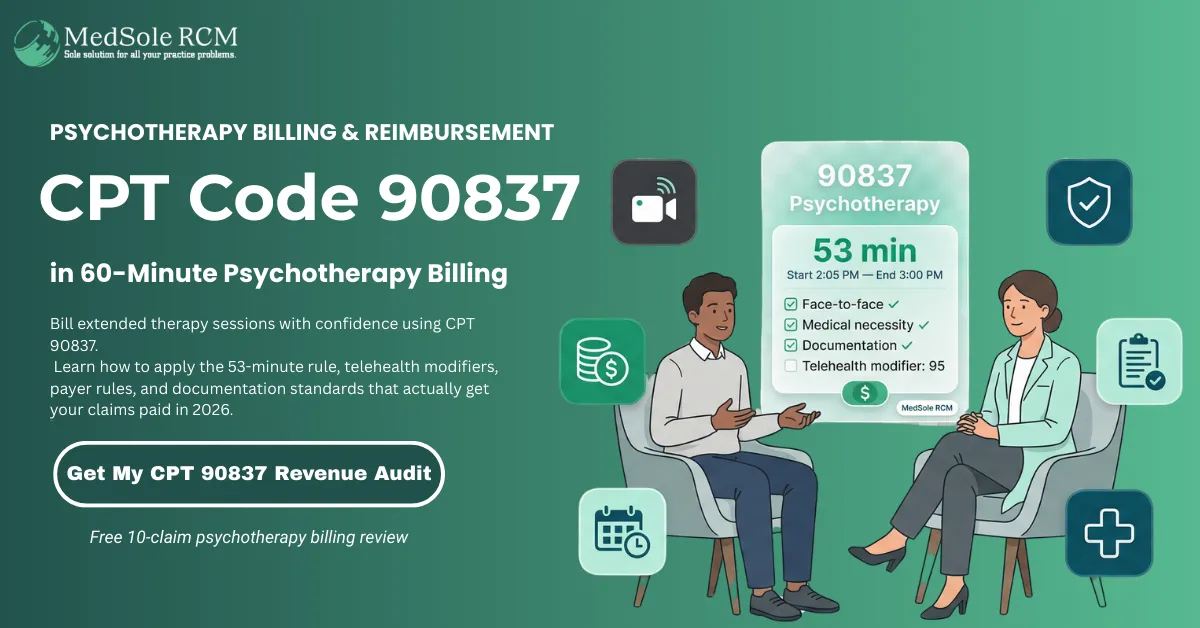
The AMA defines CPT Code 90837 as "Psychotherapy, 60 minutes with patient." That label is a bit misleading. You do not actually need to hit a full 60 minutes to bill it. The real billing threshold is 53 minutes.
This is the standard code for a long individual session. It pays the highest rate for talk therapy. That is why payers audit it more than any other mental health code.
What 90837 Actually Covers
This code is strictly for individual work. You must be face-to-face with the patient. It covers almost any therapeutic approach you use.
You might do CBT or DBT. You might use EMDR for trauma. The specific modality does not change the code. As long as you are doing clinical intervention for at least 53 minutes, it counts.
What 90837 Does Not Cover
You have to be careful here. This code does not cover medication checks. You need a separate E/M code for that. It also does not cover family therapy or groups. Those services have their own specific codes.
The biggest mistake I see involves administrative time. Note writing does not count. Calling a family member does not count. If the patient walks out of the room at minute 50, you cannot bill 90837, even if you spend ten minutes charting right after. The clock stops when the session ends.
Who Can Bill CPT Code 90837?
This code isn't reserved just for doctors. Almost any licensed mental health professional can bill it. The deciding factor is usually your specific state license and your contract with the payer.
Psychiatrists (MD/DO) and Psychologists (PhD/PsyD) use this code daily. It is also the bread-and-butter code for Licensed Clinical Social Workers (LCSW) and Licensed Professional Counselors (LPC).
Licensed Marriage and Family Therapists (LMFT) can bill it as well. Just be careful with the context. This code is for individual therapy. If you spend the whole hour doing couples work, you need the family therapy code instead.
Psychiatric Mental Health Nurse Practitioners (PMHNP) also bill this frequently. You just need to be careful with incident-to billing rules if you work under a doctor. A small mistake there can trigger an audit.
The 90837 CPT code description defines the service, not the job title. If your license permits you to perform psychotherapy for 60 minutes, you are generally clear to bill it. Just check your credentialing status first. A valid license does not help if you aren't enrolled with the insurance plan.
90837 Time Range: Understanding the 53-Minute Rule
The single biggest confusion with this code is the label. The AMA calls it "60 minutes." But in billing reality, the 90837 time range starts at 53 minutes.
If you spend 53 minutes or more doing face-to-face therapy, you can bill 90837. If you stop at minute 52, you must downcode. That single minute makes a tremendous difference in your revenue and your audit risk.
Psychotherapy Code Time Thresholds
You need to memorize these cutoffs. They are not suggestions; they are strict rules.
|
CPT Code |
Session Label |
Actual Time Required |
When to Use |
|
90832 |
30 minutes |
16–37 minutes |
Brief check-ins, crisis stabilization |
|
90834 |
45 minutes |
38–52 minutes |
Standard therapy sessions |
|
90837 |
60 minutes |
53+ minutes |
Extended or complex sessions |
What Counts as Face-to-Face Time?
This is where I see providers get into trouble. Face-to-face time means clinical work. You are actively treating the patient. You are processing trauma, teaching coping skills, or de-escalating a crisis.
It does not mean waiting in the lobby. It does not mean scheduling the next appointment. It definitely does not mean writing your notes after they leave. If you chat about insurance benefits for five minutes, that time comes off the clock.
How to Document Time Correctly
You cannot just check a box that says "60 minutes." Medicare auditors look for specific proof. You have two ways to do this safely.
First, you can document start and stop times. "Session began at 2:05 PM and ended at 3:00 PM." That is the safest method. It leaves zero room for argument.
Second, you can state the total minutes. "55 minutes of face-to-face psychotherapy provided." This works too, but start and stop times are always better for audit defense.
What If the Patient Shows Up Late?
This happens every week in real clinics. A patient arrives 15 minutes late to their scheduled hour. You now have 45 minutes of actual therapy time. That is 90834, not 90837.
You cannot bill based on what was scheduled. You bill based on what actually happened. Rounding up is a fast track to audit trouble.
If your front desk struggles with time documentation, you are not alone. Most practices lose money here without realizing it. Clean claims start with accurate timestamps.
90834 vs 90837: Which Code Should You Use?
The core difference between 90834 and 90837 is session length. The 90834 code covers 38 to 52 minutes of psychotherapy. The 90837 code starts at 53 minutes. That time difference changes everything from your payment rate to how much documentation you need to write.
Here is how they stack up side-by-side:
Side-by-Side Comparison
|
Feature |
90834 (45 min) |
90837 (60 min) |
|
Time Required |
38 to 52 minutes (TheraThink.com) |
53 minutes or more (SimplePractice) |
|
Medicare Rate (2026) |
~$117 – $125 (approximate projected range based on 2025 rates of ~$104 and expected increase) (TheraThink.com) |
~$154 – $160 (approximate projected range based on 2025 rate of ~$154 and expected slight increase) (TheraThink.com) |
|
Documentation Load |
Standard |
High; must explain extended time |
|
Audit Risk |
Low |
High; heavily monitored |
|
Best Used For |
Routine weekly therapy |
Trauma, crisis, complex cases |
|
Medical Necessity |
Standard |
Must document why extra time helped |
When to Use 90837 Instead of 90834
You use 90837 for the heavy clinical work. Think about complex trauma processing where you can't just stop at minute 45. It is for crisis intervention when a patient needs safety planning. It fits protocols like EMDR that require longer blocks of time.
If you are dealing with multiple comorbid conditions in one session, that justifies the extra minutes. It is also common during the initial intensive phase of treatment. Basically, use it when a patient's severe symptoms demand more than a standard hour.
90834 vs 90837 Reimbursement Difference
The 90837 code usually pays about 15% to 25% more than 90834. That is significant revenue. But that higher payment comes with strings attached. Payers watch this code closely. They require more detailed notes. Some even flag practices that bill it exclusively.
The decision rule is simple. Choose your code based on the clock and the patient's needs, never the fee schedule. If you upcode a standard 45-minute session just to get the higher rate, you create a serious compliance risk. Stick to the actual time.
90837 Reimbursement Rates by Payer (2026 Guide)
Money is the real question behind most 90837 searches. Providers want to know what they will actually collect. The answer depends on the payer, your location, your credentials, and the contract you negotiated.
90837 reimbursement rates swing wildly. Medicare pays around $154 to $160 in 2026. Commercial plans range anywhere from $110 to over $180. Your mileage will vary based on where you practice and who you bill.
Medicare 90837 Reimbursement Rates
Medicare sets the baseline. For 2026, the national average sits around $154 to $160. That is up slightly from $154.29 in 2025 and $149.64 in 2024. The trend is slowly moving upward, but don't expect dramatic jumps.
Your actual payment depends on geography. Providers in Los Angeles or Manhattan see higher rates than those in rural Kansas. The fee schedule adjusts for cost of living in your area.
One thing catches new billers off guard. Medicare only pays 80% of the approved amount. The patient owes 20% coinsurance, which works out to roughly $31 per session. That is after they meet their Part B deductible for the year.
Commercial Payer Rates (Approximate Ranges)
Commercial rates are all over the map. Here is what we typically see across major payers:
|
Payer |
In-Network Range |
Out-of-Network (UCR-Based) |
|
Blue Cross Blue Shield |
$120 to $160 |
$60 to $120 |
|
Aetna |
$140 to $155 |
$80 to $130 |
|
Cigna |
$130 to $150 |
$75 to $125 |
|
UnitedHealthcare / Optum |
$110 to $145 |
$70 to $120 |
|
Humana |
$125 to $150 |
$70 to $115 |
|
Anthem |
$130 to $155 |
$75 to $125 |
|
Tricare |
$120 to $140 |
Not applicable
|
These are ballpark figures. Your contract might pay more or less. Always check your fee schedule or call your provider rep to confirm your specific rate.
Factors That Affect Your 90837 Rate
Five things determine what actually lands in your bank account.
First, geography matters. Urban areas pay better than rural regions. A practice in San Francisco will out-earn one in a small Midwest town for the exact same service.
Second, your credentials play a role. Psychiatrists and psychologists with doctoral degrees often negotiate higher rates than master's-level clinicians. It is not fair, but it is reality.
Third, your contract terms are unique. Two LCSWs in the same city can have different rates with the same payer. It depends on when you credentialed and how hard you pushed during negotiations.
Fourth, the setting changes things. Facility-based billing uses different rates than professional billing. Know which applies to your practice.
Fifth, network status creates a big gap. In-network providers get predictable payments. Out-of-network providers face "usual and customary" calculations that often pay 50% to 70% of billed charges.
Medicaid 90837 Rates by State
Medicaid is its own beast. Rates vary dramatically from state to state. California Medi-Cal might pay $90 for the same service that New York Medicaid reimburses at $120. Texas and Florida tend to land somewhere in the middle.
You cannot assume anything with Medicaid. Contact your state program or the managed care organization directly. Ask for their current behavioral health fee schedule. It is the only way to know your real numbers.
Underpaid claims and inconsistent reimbursement quietly drain practice revenue month after month. If your payments seem lower than expected, it might be time to audit your contracts and appeal the shortfalls.
90837 Documentation Requirements: What Auditors Expect
Your notes need to tell a clear story. Auditors reviewing 90837 documentation want to see four things: exact session time, a reason for the extended session, what you actually did clinically, and how the patient responded. Miss any of those pieces and you are asking for trouble.
This is where most denials start. Not at the billing desk. In the progress note.
Essential Documentation Elements
Let me walk you through what needs to be in every single 90837 note.
1. Session Time Documentation
You must record time. Either write start and stop times or state the total minutes. Something like "Session began at 1:05 PM and ended at 2:00 PM" works fine. So does "55 minutes of face-to-face psychotherapy provided." Medicare auditors specifically look for this. If your note is silent on time, expect a denial.
2. Medical Necessity Justification
This is the one most providers skip. You cannot just write "60-minute session" and move on. You need to explain why this particular patient needed the extra time today. Was it a crisis? Was it complex trauma work? Were you addressing multiple conditions at once? Give the auditor a reason.
3. Therapeutic Interventions Used
Be specific about what you did. "Provided psychotherapy" tells the auditor nothing. Did you use cognitive restructuring techniques? Did you run an EMDR protocol? Did you work on distress tolerance skills from DBT? Name the actual work you performed.
4. Patient Presentation and Response
Describe what you observed. How did the patient present at the start of the session? What shifted during the hour? Did symptoms decrease after intervention? This shows the session actually produced clinical value.
5. Progress Toward Treatment Goals
Connect the session to the bigger picture. Reference the treatment plan. Note whether the patient moved forward, stayed stuck, or hit a barrier. Auditors want to see that extended sessions are serving a purpose over time.
6. Plan for Next Steps
End with direction. What happens next? Is there homework? What will you focus on in the following session? This shows continuity and intention behind your treatment.
How to Justify Medical Necessity for 90837
Good justifications sound clinical and specific. Here are examples that hold up under review:
"Patient arrived in acute distress following a family crisis. Extended time was required for de-escalation and safety planning."
"Continued EMDR processing for childhood trauma. Full protocol required 55 minutes to reach a stable stopping point."
"Session addressed co-occurring depression, anxiety, and PTSD symptoms. Multiple interventions were necessary within a single visit."
Weak justifications get flagged immediately. Saying "standard 60-minute session" means nothing. Writing "patient requested a longer session" does not establish medical necessity. The schedule does not justify the code. The clinical need does.
OIG Findings: Common Documentation Failures
The Office of Inspector General has audited behavioral health claims repeatedly. The same problems show up every time. Missing time entries. Incomplete or absent treatment plans. Unsigned notes. No explanation for why the session ran long. Cookie-cutter language copied from visit to visit without any individualization.
These are not small issues. They trigger recoupments. If your documentation looks like it could belong to any patient on any day, it will not survive a review.
Documentation problems cause more claim denials than any other issue in mental health billing. If your team struggles to write notes that hold up under scrutiny, it might be worth a second look at your workflow.
How to Bill 90837 for Telehealth: Modifiers, POS Codes & 2026 Rules
Yes, you can bill 90837 for telehealth. The code itself does not change. What changes is the modifier you attach and the place of service you select. Get those wrong and the claim bounces back.
Telehealth billing rules have shifted constantly since 2020. What worked last year might not work today. Here is where things stand right now.
90837 Telehealth Modifier Guide
Modifiers tell the payer how you delivered the service. Pick the wrong one and you will spend weeks chasing a denial.
|
Modifier |
Use It When |
Who Accepts It |
|
95 |
Video session in real time |
Medicare and most commercial plans |
|
GT |
Video session (older terminology) |
Some legacy systems still require this |
|
93 |
Phone-only session, no video |
Medicare for behavioral health only |
|
FQ |
Telehealth from a federally qualified health center |
FQHCs billing Medicare |
Most payers have settled on modifier 95 for standard video visits. A few older systems still ask for GT. When in doubt, call the payer and ask which one their system expects.
Audio-only billing is trickier. Medicare allows it for mental health and substance use services, but you must use modifier 93. Commercial payers vary wildly on phone-only sessions. Some cover them. Some refuse. Always verify before you submit.
Place of Service Codes for Telehealth
The POS code tells the payer where the patient was sitting during the session.
|
POS Code |
What It Means |
When to Use It |
|
02 |
Telehealth, other location |
Patient is at a clinic or office |
|
10 |
Telehealth, patient at home |
Patient is in their own residence |
Most of your sessions will use POS 10 because patients are usually calling from home. If the patient is at a satellite clinic or another facility, use POS 02 instead.
Some payers get picky about this. A few commercial plans reject claims with POS 10 and want everything submitted as POS 02. Check each payer's preference before you set your system defaults.
Medicare Telehealth Rules: 2026 Update
Medicare has been relaxed about telehealth since the pandemic. The in-person requirement for mental health services keeps getting pushed back. As of early 2026, that waiver remains in effect.
Audio-only coverage is still limited. Medicare only allows phone therapy for behavioral health and substance use disorder services. You cannot bill a phone-only session for general medical care.
Geographic restrictions that used to require rural locations are currently waived. Patients can receive telehealth from anywhere right now. That could change if CMS reinstates the old rules, so keep watching the updates.
Commercial Payer Telehealth Policies
Every commercial payer runs its own playbook. Some want modifier 95 alone. Some demand both 95 and GT on the same claim. A few require you to use their approved video platform or the session will not count.
Reimbursement is another variable. Some plans pay the same rate for telehealth and in-person. Others reduce telehealth payments by 10% to 20%. You will not know until you check your specific contract.
The only reliable approach is verification. Call each payer before you start billing telehealth regularly. Document what they tell you. Payer reps change their guidance all the time, so keep notes and dates.
Telehealth Documentation Requirements
Your progress note needs a few extra details for virtual sessions. State which platform you used and confirm it is HIPAA-compliant. Note the patient's physical location during the session because that affects your licensure.
Include a statement that telehealth consent was obtained. If the connection dropped or you had technical problems, document how much actual therapy time occurred versus total call time. You still need 53 minutes of real clinical work to bill 90837.
Telehealth billing rules shift more often than any other area of mental health coding. Staying current takes real effort. If your team finds it hard to keep up with payer-specific telehealth requirements, you are not alone.
Can You Bill 90837 With Other Codes on the Same Day?
Technically, yes, you can bill 90837 with other codes on the same day. But you are walking a tightrope. One wrong move with E/M codes or modifiers and the whole claim gets rejected.
Combining it with E/M codes requires separate notes and modifier 25. Billing it twice in one day works only if you have two distinct encounters and really solid documentation.
Let me break down the scenarios that cause the most confusion.
90837 with E/M Codes on the Same Day
Psychiatrists and nurse practitioners run into this all the time. You check medications and do therapy in the same visit. Both services happened. You want to bill for both. Makes sense.
Here is where practices go wrong. They drop a 90837 next to a 99214 and submit the claim. That gets denied almost every time.
The correct approach looks different. Bill your office visit code like 99213 or 99214. Attach modifier 25 to show it was a separate service. Then add a psychotherapy add-on code for the therapy portion. If your therapy time hit 53 minutes or more, the add-on you need is +90838.
Keep your documentation clean. Write down exactly how many minutes went to the medical piece. Write down exactly how many minutes went to therapy. Auditors want to see those buckets kept separate.
Can You Bill 90837 Twice in One Day?
You can. But this is unusual territory.
Think about what it takes to justify two 60-minute sessions on the same calendar day. You would need two completely separate encounters. A morning crisis visit and a scheduled evening appointment might qualify. A single long session split down the middle does not.
Each encounter needs its own note. Each note needs its own start and stop times. The clinical reason for the second session must be obvious to anyone reading the chart.
You will probably need modifier 59 or 76 to get the second claim paid. Payers look at double-billed 90837 codes with suspicion. Your documentation has to answer their questions before they ask.
90837 Add-On Codes
A few codes can ride alongside 90837. The one you will use most often is Interactive Complexity, +90785. This applies when the session involves extra challenges. Maybe you needed an interpreter. Maybe a custody battle is complicating the treatment. Maybe a parent keeps interrupting your work with a teenager.
You cannot just add it because the session felt hard. Specific criteria exist. Check them before you bill.
What about sessions that run past an hour? The old prolonged service codes, 99354 and 99355, vanished in 2023. They no longer exist in the code set. G2212 only works with E/M services, so that is off the table too.
If you regularly run 90-minute sessions, call your payer. A few will accept two units of 90837 for genuinely extended work. Most have their own rules you need to follow.
90837 NCCI Edits to Know
The National Correct Coding Initiative sets automatic blocks on certain code combinations. These edits stop claims before they reach a human reviewer.
You cannot bill 90837 with 90832 or 90834 on the same day. Those codes cover overlapping time ranges. The system sees them as duplicates.
Pairing 90837 with the initial evaluation code 90791 is also tricky. Unless the services are clearly distinct and documented separately, expect a rejection.
Knowing these edits in advance saves you from chasing denials that should never have happened.
How to Bill Psychotherapy Sessions Longer Than 60 Minutes
Billing for sessions that run longer than an hour is a headache right now. The rules changed drastically in 2023. The old prolonged service codes 99354 and 99355 were deleted. And G2212? That only works for E/M services, not standalone psychotherapy like 90837.
So, if you spend 90 minutes or two hours with a patient, your billing options are limited and entirely dependent on the specific payer.
Current Options for 90+ Minute Sessions
You have three main paths, but none are guaranteed.
Option 1: Check if the Payer Allows Two Units
Some commercial plans will let you bill two units of 90837 if the session hits at least 106 minutes (53 + 53). You need documentation that supports two distinct, intense segments of therapy. This is rare, so verify it in writing first.
Option 2: Bill 90837 and Accept the Cap
This is the most common reality. You bill the single 90837 code for the first 60 minutes. You document the full 90 minutes in your notes for clinical accuracy. You accept that the extra 30 minutes is essentially pro bono. It is a business decision about patient care versus revenue.
Option 3: Combine with Medical Services
If you are a psychiatrist or NP performing medication management too, you have more flexibility. You can use an E/M code for the medical portion and the appropriate psychotherapy add-on code. Just make sure you document the time for each service separately.
What NOT to Do
Do not try to bill the deleted 99354 codes; they will trigger an automatic rejection. Do not use G2212 with 90837; audits catch that quickly. And never just bill multiple units of 90837 without explicit payer permission. That looks like duplicate billing or "time stacking," which is a fast track to a recoupment demand.
Extended session billing is complex and varies by every single contract. MedSole RCM can help you review your payer agreements to find the legitimate reimbursement options available to you.
90837 Claim Denials: Top Reasons & How to Prevent Them
Claims for 90837 face higher denial rates than shorter psychotherapy codes. Payers watch this code closely because it pays the most. Understanding why they reject these claims protects your practice revenue and cuts down on hours of administrative clean-up.
90837 Claim Denials: Top Reasons & How to Prevent Them
Claims for 90837 face significantly higher denial rates than shorter psychotherapy codes. Payers scrutinize this code closely because it carries the highest reimbursement. Understanding exactly why they reject these claims protects your practice revenue and eliminates hours of frustrating administrative cleanup.
Top 10 Reasons for 90837 Denials
We encounter the same rejection codes every single week. Here are the top ten reasons for denials and how you can stop them before they happen:
1. Missing Time Documentation
The fix is simple: document exact start/stop times or total minutes for every single session. Without it, the claim fails.
2. Session Under 53 Minutes
If the session ran 52 minutes, just bill 90834. Do not try to stretch it; auditors look for this.
3. Lack of Medical Necessity Justification
Your note must explain why the extended time was clinically needed, not just that it happened.
4. Frequency Exceeded
Many payers cap the number of 90837 sessions allowed per year. Check those limits before you start treatment.
5. Prior Authorization Not Obtained
Never assume extended sessions are automatically covered. Verify authorization requirements for each specific plan.
6. Modifier Missing or Incorrect
For telehealth, forgetting modifier 95 (or 93 for audio-only) is an automatic rejection.
7. Provider Credentialing Issue
Make sure your credentialing is active with the payer. A lapse here stops all payments cold.
8. Diagnosis Not Covered
Verify that the diagnosis code you are using is actually covered under the patient's plan.
9. Duplicate Claim
Check your submission history before rebilling. Resending a claim too soon just creates more noise and potential denials.
10. Timely Filing Exceeded
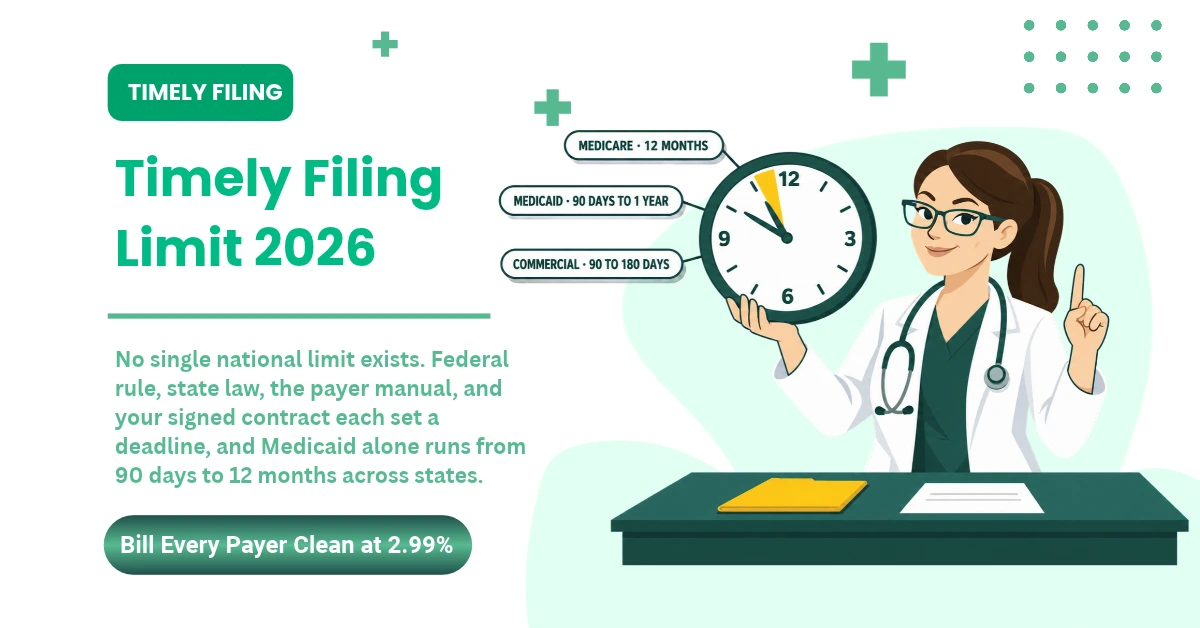
Know the filing deadline for each payer. Medicare gives you a year; some commercial plans give you only 90 days.
How to Appeal 90837 Denials
If a legitimate claim gets denied, fight it. First, review the specific denial reason code. Then, gather your supporting documentation, especially the time-stamped progress notes.
Write a clear appeal letter that addresses the exact reason for the rejection. Include your clinical justification and proof of time. Submit it within the payer's appeal window and track it until you get a response.
Denied claims cost your practice time and money. MedSole RCM's denial management team identifies denial patterns and recovers revenue that's rightfully yours. [Contact us for a claims analysis]
90837 Payer Policies: What Each Major Insurer Requires
Every payer has its own quirks when it comes to 90837. What works for Medicare might get denied by Aetna. What Cigna accepts today could change next quarter.
I cannot give you a permanent rulebook because the rules keep shifting. But I can walk you through what we typically see with each major payer right now. Always confirm directly before you assume anything.
Medicare 90837 Requirements
Medicare is relatively straightforward compared to commercial plans. They want to see time documented clearly in your note. Either start and stop times or total minutes will satisfy them.
Medical necessity should be obvious from your documentation. You usually do not need prior authorization for standard outpatient therapy. Just make sure the diagnosis supports ongoing treatment.
For telehealth, attach modifier 95 and use place of service 02 or 10 depending on where the patient is located. If you are doing audio-only sessions, Medicare requires modifier 93. That option is limited to behavioral health services only.
BCBS 90837 Policies
Blue Cross Blue Shield plans vary by state, so your local BCBS might differ from what a colleague sees in another region. That said, some patterns hold true across most plans.
They enforce the 53-minute rule strictly. If your notes are vague on time, expect a denial. Some BCBS plans require prior authorization when a patient uses 90837 frequently over several months.
Telehealth is generally covered with modifier 95. In-network reimbursement usually falls somewhere between $120 and $160, but your contracted rate depends on your specific agreement.
Aetna 90837 Policies
Aetna wants documentation that clearly supports the need for extended sessions. Generic notes will not survive a review. Explain what made this patient's situation complex enough to warrant 53 minutes or more.
Telehealth coverage is widely available on Aetna plans. Just attach the proper modifier. Prior authorization requirements depend on the specific plan, so check eligibility before you assume you are clear.
Reimbursement rates tend to run in the $140 to $155 range for in-network providers, though your mileage will vary based on your contract and location.
UnitedHealthcare and Optum 90837 Policies
UnitedHealthcare caused a stir several years ago when they started requiring prior auth for 90837. That requirement was removed back in 2019 for most plans. But policies shift constantly, so verify before you take it for granted.
Telehealth is covered when you use the right modifiers. Reimbursement rates sit a bit lower than some competitors, typically between $110 and $145 depending on the plan and region.
Optum manages behavioral health for many UHC plans. If you are dealing with Optum directly, their processes sometimes differ from standard UHC guidelines.
Cigna 90837 Policies
Cigna expects solid documentation just like everyone else. Time must be recorded. Medical necessity should be clear from the note. Nothing unusual there.
Telehealth sessions are covered with modifier 95. Rates generally land between $130 and $150 for in-network providers. Out-of-network reimbursement depends on usual and customary calculations for your area.
Some Cigna plans have frequency limits or require authorization after a certain number of sessions. Check the specific policy when you verify benefits.
A Word of Caution on Payer Policies
Everything I just described can change without warning. Payers update their policies constantly. What worked last month might trigger a denial next month.
Build a habit of checking current requirements when you verify eligibility. Do not rely on what worked for the last patient. Each plan, each employer group, and each policy year can bring new rules.
Keeping up with payer policy changes is practically a full-time job. MedSole RCM monitors these updates continuously so your claims stay compliant even when the rules shift underneath you.
90837 CPT Code FAQ: Your Questions Answered
These questions land on my desk constantly. Let me give you the real answers.
What is CPT code 90837?
It is the billing code for individual therapy sessions running 53 minutes or more. People get confused because the AMA labels it "60 minutes." Ignore that. The actual threshold is 53 minutes of face-to-face work.
CBT, EMDR, trauma processing, supportive therapy: they all qualify under this code. The type of therapy does not matter. The clock does.
What is the difference between 90834 and 90837?
Minutes. That is it.
Bill 90834 when your session runs 38 to 52 minutes. Bill 90837 when you hit 53 minutes or longer. The 90837 pays better, usually 15 to 25 percent more. But payers watch it like hawks. They want proof that the patient actually needed the extra time.
How many minutes is a 90837 session?
Fifty-three minutes minimum. Not 60. The "60-minute" label confuses everyone.
And only therapy time counts. Charting afterward, chatting about next week's schedule, waiting for the patient to settle in: none of that adds to your billable minutes.
What is the reimbursement rate for 90837?
Depends who is paying. Medicare runs about 154 to 160 dollars right now. Commercial plans are all over the place.
BCBS might pay you 130 dollars in one state and 155 in another. Aetna hovers around 140 to 155. United tends to pay on the lower end, maybe 110 to 145. Your contract determines your actual number.
How much does Medicare pay for 90837?
Somewhere around 154 to 160 dollars nationally in 2026. Big cities pay more. Rural areas pay less.
Remember that Medicare only covers 80 percent. The patient picks up the other 20 percent as coinsurance. That comes out to roughly 30 bucks per session on their end.
Can 90837 be billed for telehealth?
Absolutely. The code stays the same. You just add a modifier so the payer knows it happened over video.
Modifier 95 works for most video sessions. Medicare wants modifier 93 if you did audio-only. Check with each payer because rules bounce around a lot.
What modifier goes with 90837 for telehealth?
Modifier 95 for video. That covers most situations.
Some older payer systems still ask for modifier GT. If your claim bounces back, that might be why. For phone-only sessions through Medicare, stick modifier 93 on there.
Can you bill 90837 twice in one day?
You can try. Most payers will push back hard.
The only way it works is if you had two genuinely separate sessions. Maybe a crisis visit at 9 AM and then a scheduled appointment at 5 PM. You need different notes, different timestamps, and rock-solid justification for both. Expect questions.
Is 90837 medically necessary?
That is up to you to prove. The payer assumes nothing.
Your note needs to explain why 45 minutes would not have been enough for this particular patient on this particular day. A crisis situation works. Complex trauma processing works. "We always do 60 minutes" does not work.
How do you justify 90837?
Put a sentence in your note explaining why you needed the extra time.
Try something like: "Patient arrived in acute distress following job loss; extended time needed for safety assessment and coping plan development." That gives the auditor something real. Saying "60-minute session provided" gives them nothing.
Can you bill 90837 without a patient present?
No chance. This code requires you to be face-to-face with the patient the whole time.
Calls with mom do not count. Emails to the school counselor do not count. If you are meeting with family members and the patient is not there, use 90846 instead.
What are the guidelines for billing 90837?
Keep it simple. Five things matter.
Hit 53 minutes of actual therapy. Write down the time. Explain why you needed the extra minutes. Use a diagnosis that supports psychotherapy. Make sure you are credentialed with the payer before you see the patient.
Mess up any one of those and the claim comes back.
How do I bill for 2 hours of psychotherapy?
This is where things get ugly. The old prolonged service codes disappeared in 2023. They do not exist anymore.
Some payers let you bill two units of 90837 if the session ran past 106 minutes. Others refuse. G2212 does not apply here because that code is only for medical visits, not therapy. Call your payer and get their policy in writing before you try anything creative.
Is there an age limit for 90837?
No age limits. You can use this code for a 7-year-old or a 77-year-old.
The only requirement is 53 minutes of individual psychotherapy. A session with a child might look completely different from one with an adult, but the billing code is identical.
What add-on codes work with 90837?
The main one is 90785 for interactive complexity. Use it when outside factors complicated the session, like needing an interpreter or dealing with a nasty custody situation.
The old prolonged service codes 99354 and 99355 are gone. Deleted in 2023. You cannot attach them to 90837 anymore no matter what you read on some outdated blog.
Got a billing question I did not cover here? Reach out. We deal with this stuff daily.
Mastering 90837: ey Takeaways for Your Practice
Billing the 90837 CPT Code correctly requires precision. You must track 53 minutes of face-to-face time, record exact start and stop times, and justify the medical necessity in every note. Using the right telehealth modifiers and staying current on payer rules protects your revenue from costly audits.
Managing these details while treating patients is difficult. MedSole RCM specializes in mental health billing to handle this for you. We mitigate claim denials, monitor policy updates, and oversee appeals to ensure accurate payment. If billing takes too much of your time, let’s talk.