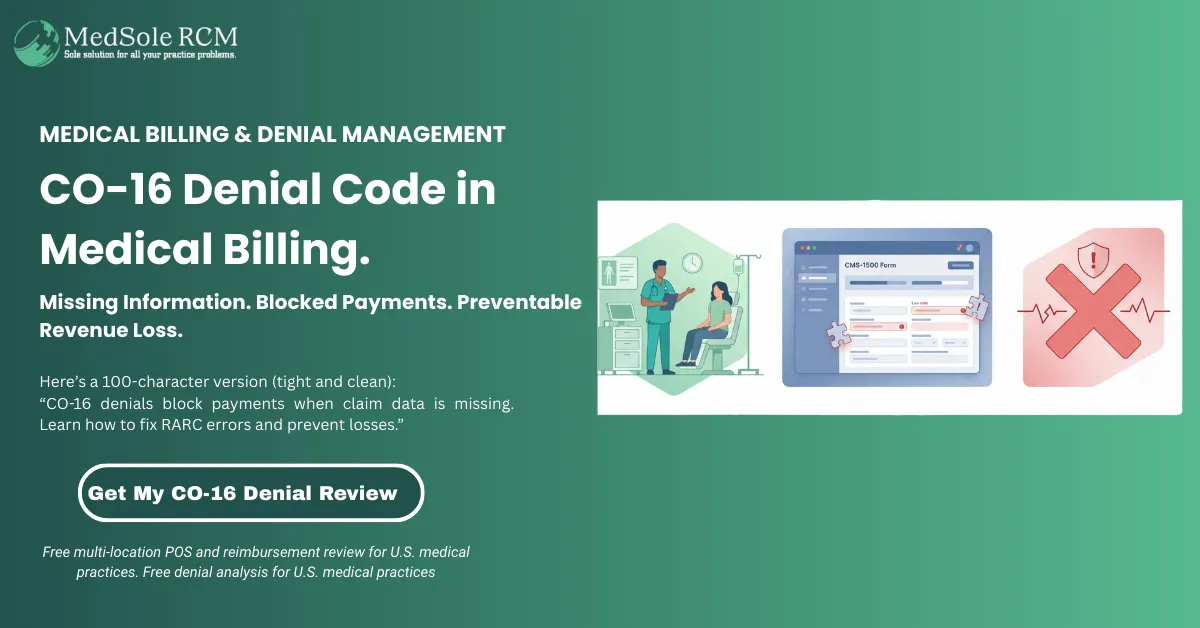




The CO-16 denial code means your claim lacks information or contains billing errors that stop the payer from processing it. This denial appears constantly in medical billing, and every day it sits unworked, revenue disappears from your books.
Here's the thing about denial code CO 16: the code itself doesn't tell you what's wrong. That information lives in the RARC codes that accompany it, like M51, N350, or MA130. Understanding those remark codes leaves you uncertain about the solution.
This guide covers what CO-16 means, the 15+ RARC codes you'll encounter, step-by-step resolution methods, and prevention strategies that work in real billing departments. You'll also find payer-specific guidance for Medicare, Medicaid, and major commercial carriers.
MedSole RCM's denial management team built this resource based on years of resolving these exact problems. Whether you're training new staff or troubleshooting a stubborn denial, you'll discover what you need.
What is the CO-16 Denial Code?
The CO-16 denial code means the claim or service lacks information or has submission/billing error(s) needed for adjudication. The payer received your claim but couldn't process it. Required data is either missing, incorrect, or incomplete.
This isn't a medical necessity denial or a coverage issue. It's an administrative problem. That means you can usually fix the error and resubmit for payment.
You'll locate CO-16 on your EOB (Explanation of Benefits) or ERA (Electronic Remittance Advice). It shows up when patient demographics are wrong, provider NPIs are invalid, or authorization numbers are missing.
The "CO" in CO-16 stands for Contractual Obligation. That designation tells you who's responsible: the provider. You cannot bill the patient for amounts denied under CO-16. Your only option is to correct the issue and resubmit.
Official CARC Definition
The ANSI X12 standard defines CARC 16 this way:
"Claim/service lacks information or has submission/billing error(s) which is needed for adjudication. Do not use this code for claim attachment(s)/other documentation. At least one Remark Code must be provided (may be comprised of either the NCPDP Reject Reason Code or the Remittance Advice Remark Code that is not an ALERT.) "
That last sentence matters. Every CO-16 denial must include at least one RARC code that tells you exactly what's missing or wrong.
Key Characteristics of CO-16
Here's what defines this denial:
- CO means Contractual Obligation: The provider is responsible for fixing the error, not the patient.
- Indicates missing or invalid claim data: Something required for processing is absent or incorrect.
- Always accompanied by RARC codes: M51, N350, MA130, and others specify the exact problem.
- Appears on EOB and ERA: You'll see it on remittance documents from the payer.
- Is a denial, not a rejection: The claim was received but couldn't be adjudicated.
- Patient billing is prohibited: You cannot transfer CO-16 denied amounts to the patient.
CO-16 Denial Code Description: Official ANSI X12 Standards
Understanding the official CO 16 denial code description helps when you're on the phone with a payer representative or reviewing 835 files. The language comes from ANSI X12, the organization that sets standards for electronic healthcare transactions. Knowing the exact terminology makes it easier to communicate the problem and get it resolved.
Standard CARC 16 Language
The Washington Publishing Company maintains the official code list. Here's what CARC 16 states:
CARC 16 Official Description:
"Claim/service lacks information or has submission/billing error(s) which is needed for adjudication. Do not use this code for claims attachment(s)/other documentation. At least one Remark Code must be provided (may be comprised of either the NCPDP Reject Reason Code, or Remittance Advice Remark Code that is not an ALERT.) "
Note: Refer to the 835 Healthcare Policy Identification Segment (loop 2110 Service Payment Information REF), if present.
835 Transaction Reference
That reference to Loop 2110 matters more than most billers realize. The 835 is your electronic remittance advice, and Loop 2110 contains service-level payment details. When troubleshooting a stubborn CO-16, this segment may provide additional context that the summary EOB does not include.
Most billing systems can display 835 data, but you have to know where to look. If your software doesn't make it accessible, ask your clearinghouse for the raw file.
Important Notes About CO-16
A few things to keep in mind about this code:
- CO-16 should never be used for missing attachments or documentation requests; those get different codes.
- Every CO-16 must include at least one Remittance Advice Remark Code (RARC) specifying the issue.
- The problem is always with claim data, not with external supporting documents.
- If you see CO-16 without a RARC, the transmission may have an error.
Understanding Group Codes: CO vs PR vs OA vs PI
The first two letters of any denial code tell you something critical: who's financially responsible for the denied amount. These group codes determine whether you can bill the patient, whether you need to write off the charge, or whether you fix and resubmit. Getting this wrong leads to compliance problems or lost revenue.
What Does "CO" Mean in CO-16?
Group Code CO stands for Contractual Obligation. When you see CO-16, the denial falls under your contract with the payer. You agreed to certain terms when you joined their network, and this denial relates to those terms.
The practical meaning is simple but important: you cannot bill the patient for amounts denied under CO-16. Your only path is to correct the error and resubmit. If you can't fix it, you write it off. Transferring CO amounts to patient responsibility violates your contract.
Group Code Comparison Table
|
Group Code |
Full Name |
What It Means |
Financial Responsibility |
Can Bill Patient? |
|
CO |
Contractual Obligation |
Provider must fix the issue |
Provider absorbs or corrects |
❌ No |
|
PR |
Patient Responsibility |
Patient owes this amount |
Patient pays |
✅ Yes |
|
OA |
Other Adjustment |
Informational adjustment |
Varies by situation |
Depends |
|
PI |
Payer Initiated |
Payer caused the problem |
Payer resolves |
❌ No |
Why Group Codes Matter for Resolution
You might see the same reason code with different group prefixes. The PR-16 denial code means the patient is responsible for a claim that lacks information. OA 16 denial code is informational only. PI 16 denial code suggests the payer's system caused the issue.
Each scenario requires a different response. CO-16 means you fix and resubmit. PR-16 might mean billing the patient after verifying the denial is accurate. PI-16 often requires calling the payer to resolve their error.
Understanding group codes prevents two expensive mistakes: writing off recoverable revenue and incorrectly billing patients for amounts they don't owe.
Common Causes of CO-16 Denial Code
Knowing the CO 16 denial code reason helps you fix it faster. Most CO-16 denials trace back to one of six categories. Each points to a specific breakdown in your workflow, usually at the front desk or during claim entry.
1. Missing or Incorrect Patient Information
This causes more CO-16 denials than anything else. Something's wrong with the patient data on your claim.
Common problems:
- Date of birth missing or typed wrong
- Patient's name doesn't match insurance card exactly
- Member ID number is old or incorrect
- Policy or group number field left blank
- Gender marked wrong or missing entirely
Front desk errors become billing denials. If Jennifer Smith is "Jen Smith" in your system but "Jennifer A. Smith" on her insurance card, expect a CO-16.
2. Invalid or Missing Provider Information
Payers verify every NPI on every claim. When provider data doesn't check out, you get denied.
Watch for these issues:
- NPI (National Provider Identifier) is inactive or wrong
- Ordering or referring provider missing when required
- Provider not enrolled in PECOS for Medicare claims
- Taxonomy code doesn't match the service you billed
- Provider's credentialing expired with that payer
PECOS enrollment catches practices constantly. Your doctor might have an NPI, but if they're not actively enrolled in PECOS, Medicare denies any claim that references them.
3. Authorization and Referral Issues
Some services need prior authorization or referrals. Leave them off the claim, and CO-16 follows.
Typical scenarios:
- Prior authorization number not entered on claim
- Authorization expired before you saw the patient
- Referral required but you didn't get one
- Authorization approved for different procedure than billed
Getting retroactive authorization is nearly impossible. Most payers won't approve services after they're already done.
4. Coding Errors and Mismatches
When the payer can't figure out what you did or why, CO-16 results.
Common coding problems:
- CPT or HCPCS code missing entirely
- ICD-10 diagnosis doesn't support the procedure
- Required modifiers missing (LT, RT, 59, 25)
- Primary diagnosis in wrong sequence
- NOC code used without required description
Modifier requirements vary by payer. What Medicare wants might differ from what Anthem requires for the same procedure.
5. Service and Submission Errors
Even with correct patient and provider info, submission-level mistakes trigger denials.
Look for:
- Place of Service code wrong for where service happened
- Facility info missing for hospital-based services (POS 31, 22)
- Service dates missing or don't make sense
- Duplicate claim already processed
- Electronic submission format errors
Place of Service errors happen when providers work multiple locations. The code must match where the service actually occurred, not your main office location.
6. Outdated Insurance Information
Insurance changes constantly. Patients forget to tell you. Claims get denied.
This happens when:
- Patient changed jobs but didn't update your records
- Plan changed during open enrollment
- Coverage terminated, new carrier not on file
- Secondary insurance sequence switched
Without eligibility verification at check-in, you're submitting claims blind and hoping for the best.
Complete RARC Codes That Accompany CO-16 Denial
Every CO-16 denial comes with at least one RARC code. That's the rule. These Remittance Advice Remark Codes tell you exactly what's missing or wrong. Without understanding RARC codes, you're working blind, guessing at fixes that might not address the real problem. Most billing teams only know a handful of codes. That's why the same denials keep happening.
What Are RARC Codes?
RARC stands for Remittance Advice Remark Code. Think of them as the payer's explanation for why they couldn't process your claim. While CO-16 tells you something's missing, the RARC code pinpoints exactly what. They appear on your EOB and 835 files, usually right next to the denial code.
Most Common RARC Codes with CO-16
|
RARC Code |
Description |
Common Cause |
Resolution |
|
M51 |
Missing/incomplete/invalid procedure code(s) |
CPT/HCPCS code missing or invalid |
Add correct procedure code |
|
N350 |
Missing/incomplete/invalid service description for NOC code |
Using E1399 or other NOC without description |
Add product name, make/model, MSRP in Box 19 / NTE |
|
M77 |
Missing/incomplete/invalid place of service |
POS code missing or incorrect |
Verify and correct POS code |
|
MA130 |
Claim lacks required information |
General missing information |
Review full claim for gaps |
|
N264 |
Missing/incomplete/invalid ordering provider name |
Ordering physician name missing or incorrect |
Add complete ordering provider information |
|
N575 |
Provider name mismatch with records |
Name doesn’t match PECOS / payer records |
Verify exact name spelling with payer |
|
M60 |
Missing Certificate of Medical Necessity (CMN) or DIF |
CMN/DIF not attached for DME claims |
Attach required CMN or DIF |
|
M124 |
Missing equipment ownership information |
Base equipment ownership not indicated |
Add HCPCS, ownership status, date in Box 19 / NTE |
|
MA13 |
Alert: May be subject to penalties if billing patient |
Information missing on PR-excluded claim |
Do NOT bill patient for this amount |
|
N265 |
Missing/incomplete/invalid ordering provider ID |
NPI missing or not enrolled |
Verify NPI and PECOS enrollment |
|
N276 |
Missing/incomplete/invalid purchased service provider ID |
Purchased service provider info missing |
Add complete provider information |
|
MA63 |
Missing/incomplete/invalid date of birth |
Patient DOB missing or incorrect |
Verify and correct DOB |
|
N290 |
Missing/incomplete/invalid provider identifier |
General provider ID issue |
Review all provider identifiers |
|
MA92 |
Missing/incomplete/invalid service information |
Service details incomplete |
Review service documentation |
|
N704 |
Missing/incomplete/invalid information |
General information gap |
Review entire claim for missing data |
Detailed RARC Code Explanations
M51: Missing Procedure Codes
The co 16 denial code M51 combination happens constantly. Your claim is missing the CPT or HCPCS code entirely, or the code you entered doesn't exist. Sometimes it's a typo: 99213 becomes 99123. Other times, someone forgot to enter the code at all. Check your charge entry screen first. If the code's there, verify it matches the current year's valid codes.
N350: NOC Code Without Description
When you bill E1399 or any "not otherwise classified" code, you must describe what you're billing. The payer can't process a mystery item. In Box 19 or the NTE field, include the product name, manufacturer, model number, and MSRP. Miss any piece, get denied.
M77: Place of Service Problems
Place of service errors are simple but common. You saw the patient in the hospital (POS 21) but billed the office (POS 11). Alternatively, someone may have chosen the incorrect location from a dropdown menu. Match the POS to where the service actually happened, not where your main office is.
MA130: The Catch-All
Co 16 denial code MA130 is frustrating because it's vague. "Claim lacks required information" could mean anything. Start by reviewing every field on the claim. Check the 835 transaction for additional clues. Sometimes calling the payer is your only option to identify what they want.
N264 and N575: Provider Name Issues
These codes often appear together. N264 means the ordering provider's name is missing or wrong. N575 means it doesn't match payer records. One letter off triggers this: "Dr. John Smith" versus "Dr. John Smith Jr." Check PECOS for Medicare claims. Match exactly what's on file.
M60: Missing CMN/DIF
DME claims need documentation. If you're billing for equipment but didn't attach the Certificate of Medical Necessity or DME Information Form, you'll get M60. The forms must be current, signed, and complete. Partial CMNs don't count.
M124: Equipment Ownership Details
When billing supplies for equipment Medicare didn't pay for, you must prove the patient owns the base equipment. Include the base item's HCPCS code, confirmation of ownership, and the date they got it. Put this in Box 19 or NTE field.
MA13: Billing Warning
MA13 isn't just information; it's a warning. You're missing something on a claim where you can't bill the patient. Fix it or write it off. No middle ground exists.
How to Use RARC Codes for Resolution
Start by finding the RARC code on your remittance. Don't guess what CO-16 means; let the RARC tell you. Match the code to the table above. Follow the specific fix for that code.
Some codes need simple corrections: add a missing date, fix a typo. Others require documentation or verification with the payer. N575 often means calling to confirm how the provider's name appears in their system.
Track which RARC codes you see most. If M51 appears weekly, you have a charge entry problem. If N264 keeps showing up, your referring provider process needs work. Patterns tell you where workflows break down.
Prevention beats correction every time. Build checks into your workflow for common RARC triggers. Verify provider names match payer files. Require POS selection before saving charges. Make NOC descriptions mandatory fields.
How to Fix CO-16 Denial Code: Step-by-Step Resolution Guide
Most CO-16 denials can be fixed and paid. The CO-16 denial code solution isn't complicated once you know the process. Follow these steps in order, and you'll get through the denial faster than trying random fixes.
Step 1: Review the EOB/ERA and Identify RARC Codes
Pull up your EOB or ERA first. The paper EOB shows basic denial info, but the electronic ERA has more detail. Look for the RARC codes next to CO-16. They're usually in a separate column or field.
In your 835 file, check loop 2110 if the basic remittance doesn't show enough detail. Sometimes the full explanation lives there. Write down every RARC code you find. Each one points to a specific problem that needs fixing.
Step 2: Locate the Missing or Incorrect Information
Now use those RARC codes to find what's actually wrong. M51 means check your procedure codes. N264 means verify the ordering provider. Don't guess. Let the RARC guide you.
Cross-reference the denied claim against your original submission. Pull up the patient's record in your system. Compare what you sent to what's in the chart. Check authorization records if the service required one. The error usually jumps out when you compare documents side by side.
Step 3: Verify Insurance and Provider Details
Call the patient if insurance info looks outdated. People change jobs and forget to tell you. Verify their current coverage, member ID, and group number. One wrong digit causes denials.
For provider issues, check PECOS for Medicare claims. Log into the payer portal to verify how they have the provider's name on file. Small differences matter: "John Smith MD" versus "John Smith, MD" triggers denials. Match exactly what the payer shows.
Step 4: Correct the Claim in Your Billing System
Update your billing system with the correct information. Don't just fix this one claim; update the patient's master record or provider file so future claims don't fail.
Add missing data, fix wrong codes, append required modifiers. If documents are needed, attach them now. For electronic claims, ensure attachments link properly. Paper claims need clear labels showing what you're including. Make the corrections obvious so the payer processes it quickly.
Step 5: Resubmit the Corrected Claim
Use the corrected claim process, not a new claim submission. This tells the payer you're fixing a previous denial, not sending a duplicate. Most clearinghouses have a corrected claim option. Select it.
Include any required attachments with your corrected claim resubmission. Watch timely filing deadlines; some payers give you 90 days from denial, others less. Electronic submission is faster, but some corrections require paper. Check payer preferences before sending.
Step 6: Track and Follow Up
Set a reminder to check the resubmit claim status in 14 days. Add notes to your A/R system about what you corrected and when. This helps if the denial repeats.
Document your CO-16 denial code resolution steps in the patient's billing notes. Track which RARC codes you see repeatedly. If the same denial happens again, you'll know the first fix didn't work. Patterns in your denials reveal workflow problems that need permanent fixes.
Need help resolving CO-16 denials? Contact MedSole RCM's denial management team for expert support that speeds up your resolution process.
Corrected Claim vs Appeal: Choosing the Right Resolution Path
Many billers waste time appealing when they should resubmit, or they resubmit when a CO-16 appeal is needed. The difference matters. Pick wrong, and you'll wait months for nothing. Understanding when to use each path saves time and gets you paid faster.
When to Submit a Corrected Claim
Most CO-16 denials need a corrected claim, not an appeal. If the error was yours, fix it and resubmit. Missing date of birth? Corrected claim. Forgot the authorization number? Corrected claim. Wrong provider NPI? Corrected claim.
Here's the rule: if the payer is right about something being missing or wrong, you submit a corrected claim. The resubmission tells them you've fixed the problem they identified. Don't argue when they're correct. Fix it and move on.
When to File an Appeal
File an appeal when you believe the payer made the mistake. You included all information correctly, but they still denied it. Maybe their system didn't read your authorization number. Perhaps they have outdated provider information.
The appeal process requires proving you were right the first time. You're not fixing anything; you're showing the payer their error. This takes longer than a corrected claim but is necessary when the denial itself is wrong.
Decision Flowchart
Ask yourself these questions in order:
Was the information actually missing from my claim? → Yes = Corrected Claim / No = Continue
Did I make a data entry error? → Yes = Corrected Claim / No = Continue
Does the payer's system show different information than mine? → Yes = Appeal / No = Continue
Did the payer lose or not process my documentation? → Yes = Appeal
This simple flow prevents most resolution mistakes.
Documentation Requirements for Each
|
Element |
Corrected Claim |
Appeal |
|
Original Claim Copy |
✅ Required |
✅ Required |
|
Denial Notice / EOB |
✅ Required |
✅ Required |
|
Corrected Information |
✅ Primary focus |
Supporting only |
|
Appeal Letter |
❌ Not needed |
✅ Required |
|
Medical Records |
If requested |
✅ Often required |
|
Authorization Proof |
If applicable |
✅ Required |
|
Deadline |
Timely filing limit |
Payer appeal deadline |
Watch those deadlines. Corrected claims follow timely filing rules. Appeals have their own deadlines, usually 60 to 180 days from denial. Miss either deadline, and you're writing off the charge.
CO-16 Denial Code in Medicare Claims
Medicare denial code CO-16 has its own quirks. Medicare checks things other payers don't, especially around provider enrollment and ordering physicians. Miss one PECOS requirement, and CO-16 Medicare denials pile up fast. The rules change often enough that what worked last year might fail today.
Common Medicare CO-16 Scenarios
Medicare triggers CO-16 for reasons you won't see with commercial payers. The ordering provider isn't enrolled in PECOS. The referring physician's NPI is inactive. You billed incident-to services but the supervising physician wasn't properly documented.
Lab and imaging claims get hit constantly. Medicare wants the ordering provider's NPI on every diagnostic claim, and that NPI must be actively enrolled in PECOS. No exceptions.
PECOS Enrollment Requirements
PECOS (Provider Enrollment, Chain, and Ownership System) causes more CO-16 denials than anything else in Medicare billing. Here's what matters: every ordering and referring provider needs active PECOS enrollment. Having an NPI isn't enough.
Check enrollment status using the CMS ordering/referring provider report. Download it monthly; providers drop off without warning. When a physician leaves your practice, their PECOS status might change. Retired doctors who still refer patients often have inactive enrollment.
The denial happens even if everything else is perfect. Valid NPI, correct diagnosis, proper authorization: none of it matters if PECOS enrollment is missing.
Medicare RARC Codes with CO-16
Medicare uses specific RARC codes with CO-16:
MA13 appears when you can't bill the patient for the error. This protects Medicare beneficiaries from provider mistakes.
N265 means the ordering provider ID is missing or invalid. Usually a PECOS problem or missing NPI.
N276 indicates issues with purchased service providers. Common with labs billing for tests ordered by your physicians.
MA130 is Medicare's general "something's missing" code. Check your Medicare Administrative Contractor's website for specifics.
Resolution Steps for Medicare Claims
Start by verifying PECOS enrollment for all providers on the claim. Use the exact name spelling from the PECOS database when resubmitting. Medicare systems are unforgiving about name variations.
For N265 denials, add the ordering physician's NPI to loop 2310A or 2420E. Include the qualifier "DK" for ordering and "DN" for referring providers. Paper claims need this in box 17.
Check if you need the 8-digit taxonomy code. Some Medicare regions require it; others don't care. Your MAC determines this.
Medicare Administrative Contractor (MAC) Guidance
Your MAC has specific denial resolution guides. Noridian, CGS, Novitas, Palmetto GBA: each publishes detailed CO-16 instructions on their websites. They know their system's quirks better than anyone.
Call your MAC's provider line for unclear denials. They'll tell you exactly what their system needs. Generic Medicare guides won't always match your MAC's requirements. Regional differences matter more than providers realize.
CO-16 Denial Code in Medicaid Claims
CO-16 denial code Medicaid claims are tricky because there's no single Medicaid. Fifty states run fifty different programs with different rules. What works in Texas might fail in New York. You need to know your state Medicaid requirements specifically.
State-Specific Medicaid Considerations
Each state Medicaid program sets its own billing rules. Some require prior authorization for services that other states don't. Provider enrollment processes vary wildly. California takes months; some states approve in weeks.
Medicaid managed care adds another layer. Many states contract with private MCOs to run their Medicaid programs. You might deal with Molina in one state and Centene in another. Each MCO has its own requirements beyond the state's base rules.
Common Medicaid CO-16 Issues
Eligibility problems cause most Medicaid CO-16 denials. Coverage can change monthly. Patients switch managed care plans without telling you. Verify eligibility before every visit, not just annually.
Prior authorization requirements catch practices off guard. Medicaid often requires auths for services commercial payers don't. Miss one, and CO-16 follows. Your state's fee schedule usually lists what needs authorization.
Provider enrollment matters too. Medicaid won't pay providers who aren't enrolled with that specific state program. Out-of-state providers face this constantly when seeing Medicaid patients across state lines.
Resolution for Medicaid Claims
Start with your state's Medicaid portal. Most have online tools to check eligibility and authorization status. The RARC codes on Medicaid denials work the same as Medicare and commercial.
Call your state's provider services line for unclear denials. Medicaid staff can usually tell you exactly what their system wants. Document everything; Medicaid appeals can take months and require detailed records.
CO-16 Denial Code: Commercial Payer Guide
Commercial payer CO-16 denials follow the same general pattern as Medicare, but each payer has quirks. Anthem handles things differently than UnitedHealthcare. Knowing these differences saves you time on the phone and speeds up resolution.
Anthem/Blue Cross Blue Shield CO-16 Handling
Anthem denial code CO-16 and BCBS CO-16 denials often stem from authorization issues. Blue plans are strict about prior auth requirements, especially for imaging and specialty services. Check Availity for auth status before resubmitting.
Their provider portals show denial details better than the EOB. Log into Availity or the state BCBS portal to see exactly what's missing. Corrected claims usually process within 14 days if you fix the actual problem.
UnitedHealthcare CO-16 Policies
UnitedHealthcare CO-16 denials frequently relate to provider data mismatches. Their system is picky about how provider names and NPIs appear. If "John Smith MD" is in their database but you submitted "John Smith, MD," expect a denial.
Use the UHC provider portal to verify how they have your providers listed. Match exactly. Their Link portal shows claim status and denial reasons faster than waiting for the ERA.
Humana CO-16 Requirements
Humana denial code CO-16 often involves missing referring provider information. They require referring NPIs on more claim types than most payers. Specialty visits, therapy services, and diagnostics usually need the referring physician documented.
Call Humana's provider line for unclear denials. They're generally helpful and can tell you specifically what their system needs. Keep notes; you'll reference them on future claims.
Cigna and Aetna CO-16 Considerations
Cigna and Aetna both emphasize authorization tracking. Their CO-16 denials commonly cite missing or expired auths. Both payers require authorization numbers in specific claim fields; putting it in the wrong loop causes denials even when you have valid authorization.
Check their provider portals before resubmitting. Both show authorization details and required claim fields. Aetna's portal is more detailed; Cigna's requires more phone calls for clarity.
General Commercial Payer Resolution Tips
Always check the payer portal first. Commercial payers provide more online detail than Medicare or Medicaid. Most let you see exactly what triggered the denial without calling.
Resubmit electronically when possible. Paper corrected claims take weeks longer. Use your clearinghouse's corrected claim function and attach any missing documentation electronically. Track resubmissions; commercial payers sometimes lose corrected claims in their queues.
Prevention Strategies for CO-16 Denials
Fixing CO-16 denials takes time and money. CO-16 prevention costs far less. Every denial you prevent is a claim that pays on first submission. That's the goal: improve your first-pass claim rate by catching problems before they reach the payer.
Front-End Verification Best Practices
Eligibility verification at check-in prevents most CO-16 denials. Don't trust the card in the patient's wallet; verify coverage in real-time before every visit. Confirm name spelling, date of birth, member ID, and active coverage dates.
Build verification into your scheduling workflow. When staff book appointments, they should check eligibility immediately. Catch expired coverage before the patient arrives, not after you've submitted a claim and waited two weeks for denial.
Authorization and Referral Management
Prior authorization problems cause preventable denials constantly. Build an authorization tracking system, whether it's software or a spreadsheet. Log every auth request, approval date, and expiration.
Check authorization requirements before scheduling procedures. Don't assume last year's rules still apply; payers change requirements quarterly. For services that need referrals, verify the referral is on file before the patient leaves the office.
Coding Accuracy and Validation
Clean claim submission starts with accurate coding. Verify CPT and HCPCS codes match current year's code set. Retired codes from last year will deny every time.
Check that diagnosis codes support the procedure. Run edits before submission; most practice management systems have built-in code validation. Require modifiers for bilateral procedures, multiple surgeries, and distinct services. Make modifier selection part of charge entry, not an afterthought.
Claim Scrubbing and Pre-Submission Checks
Claim scrubbing catches errors your staff misses. Good scrubbing software checks for missing fields, invalid codes, and payer-specific requirements. Run every claim through scrubbing before transmission.
Set up alerts for common CO-16 triggers: missing NPI, blank authorization fields, invalid place of service. Your clearinghouse likely offers scrubbing tools. Use them. The few dollars per claim cost far less than reworking denials.
Staff Training and Protocols
Denial management starts with trained staff. Review CO-16 trends monthly with your team. When you see the same RARC codes repeatedly, train specifically on those issues.
Create checklists for registration, charge entry, and claim review. Written protocols prevent the "I forgot" denials. New hires should shadow experienced billers before touching claims independently.
Regular Audit and Denial Trend Analysis
Track your CO-16 denials by RARC code, payer, and provider. Patterns reveal workflow problems. If one physician's claims deny more than others, investigate what's different about their documentation or coding.
Monthly denial reviews identify recurring issues before they become expensive. Compare your denial rate to industry benchmarks. Practices with strong prevention processes see first-pass rates above 95 percent.
[CALLOUT BOX]
📋 Download: CO-16 Denial Prevention Checklist
Get MedSole RCM's comprehensive pre-submission checklist covering patient verification, authorization tracking, coding validation, and claim scrubbing steps.
[Download Now][Contact MedSole RCM]
Real-World CO-16 Denial Scenarios and Solutions
Reading about CO-16 is one thing. Seeing it in action helps more. These scenarios come from real billing situations. You'll probably recognize a few from your own denial reports.
Scenario 1: Missing Patient Date of Birth
The Situation: A routine office visit claim denied after submission. Everything looked correct in the billing system.
The Denial: CO-16 with RARC MA63
What Went Wrong: Front desk entered the patient's birth year as 1985 instead of 1958. Simple typo, but the payer's system flagged the mismatch with their records.
The Fix: Verify the correct DOB with the patient or their insurance card. Update your system and resubmit.
Prevention Tip: Require staff to read back demographics during check-in. Catches typos before they become denials.
Scenario 2: Invalid Ordering Provider NPI
The Situation: Lab claims denied in batches. All from the same ordering physician.
The Denial: CO-16 with RARC N264 and N575
What Went Wrong: The ordering physician retired six months ago. His PECOS enrollment went inactive, but his NPI stayed in your ordering provider dropdown.
The Fix: Remove inactive providers from your system. Use an active, enrolled physician for ordering. Resubmit with valid NPI.
Prevention Tip: Quarterly audit of ordering providers against PECOS enrollment. Clean out departed physicians immediately.
Scenario 3: DME Claim Without CMN
The Situation: CPAP supply claim denied. Patient has been on therapy for years.
The Denial: CO-16 with RARC M60
What Went Wrong: The Certificate of Medical Necessity expired. Nobody tracked the renewal date. Claim went out without valid CMN attached.
The Fix: Obtain new CMN from the prescribing physician. Attach to corrected claim and resubmit.
Prevention Tip: Build CMN expiration tracking into your workflow. Set alerts 60 days before expiration.
Scenario 4: Missing Prior Authorization
The Situation: MRI denied despite the scan being medically necessary.
The Denial: CO-16 with general RARC indicating missing authorization
What Went Wrong: Scheduler assumed authorization wasn't required. Payer changed their requirements last quarter.
The Fix: Attempt retroactive authorization, though most payers deny these. Document the attempt and escalate if possible.
Prevention Tip: Check authorization requirements at scheduling, not after the service. Payer requirements change constantly.
Scenario 5: Mental Health/Behavioral Health Claim
The Situation: Psychological testing claim denied. Hours of work, no payment.
The Denial: CO-16 with missing rendering provider information
What Went Wrong: The psychologist was listed, but their supervising physician wasn't included where required. Behavioral health claims often need both.
The Fix: Add the supervising provider's NPI in the appropriate loop. Verify payer requirements for psych testing claims.
Prevention Tip: Create behavioral health claim templates with all required fields pre-mapped. Different rules than medical claims.
Scenario 6: NOC Code Without Description
The Situation: Custom DME item denied. Billed with E1399.
The Denial: CO-16 with RARC N350
What Went Wrong: The claim used a "not otherwise classified" code but didn't include the required product description in Box 19 or NTE field.
The Fix: Add product name, manufacturer, model number, and MSRP to the narrative field. Resubmit with complete description.
Prevention Tip: Flag all NOC codes during claim scrubbing. Require narrative descriptions before submission.
CO-16 vs Other Common Denial Codes
Denial codes look similar but mean different things. Confusing CO-16 with CO-45 or CO-109 leads to wasted effort. Each code requires a different response. Know the differences, and you'll stop wasting time on the wrong resolution path.
CO-16 vs CO-4 (Procedure Code Inconsistent)
CO-4 means your procedure code conflicts with a modifier or other coding element. CO-16 means something's missing entirely. With CO-4, the codes are there but don't work together. With CO-16, required information never made it onto the claim.
CO-16 vs CO-18 (Duplicate Claim)
CO-18 indicates the payer already processed this claim. They think you're submitting twice. CO-16 says something's missing from the first submission. Don't resubmit a CO-18; check if the original paid. CO-16 needs correction and resubmission.
CO-16 vs CO-22 (Coordination of Benefits)
CO-22 involves payer order problems. The claim went to the wrong payer first, or COB information is incorrect. CO-16 doesn't care about payer order; it's about missing claim data. Fix CO-22 by correcting primary/secondary designations.
CO-16 vs CO-45 (Contractual Adjustment)
CO-45 isn't really a denial. It's a contractual write-off showing the difference between billed and allowed amounts. You can't fix CO-45; it's your contract in action. CO-16 is fixable because it's about missing data, not payment terms.
CO-16 vs CO-50 (Non-Covered Service)
CO-50 means the service isn't covered under the patient's plan. No amount of correction helps. CO-16 means covered services denied for missing information. Big difference: CO-16 can be corrected and paid. CO-50 usually can't.
CO-16 vs CO-109 (Coverage Terminated)
CO-109 indicates the patient's coverage ended before the service date. This is an eligibility problem, not a claim data problem. CO-16 has nothing to do with coverage status. Check eligibility for CO-109; check claim data for CO-16.
CO-16 vs CO-197 (Authorization Required)
CO-197 means prior authorization was required but not obtained or approved. Sometimes CO-16 and CO-197 overlap when the auth was obtained but not included on the claim. If you have the auth, add it and resubmit as CO-16 correction.
Denial Code Comparison Table
|
Code |
Description |
Correctable? |
Key Difference from CO-16 |
|
CO-16 |
Lacks information / billing error |
✅ Yes |
Missing or incorrect data |
|
CO-4 |
Procedure inconsistent with modifier |
✅ Sometimes |
Coding conflict, not missing data |
|
CO-18 |
Duplicate claim |
❌ Usually no |
Claim already processed |
|
CO-22 |
Coordination of benefits issue |
✅ Sometimes |
Wrong payer order |
|
CO-45 |
Exceeds allowable amount |
❌ No |
Contractual write-off |
|
CO-50 |
Non-covered service |
❌ No |
Benefit exclusion |
|
CO-109 |
Coverage terminated |
❌ No |
Eligibility issue |
|
CO-197 |
Authorization required |
✅ Sometimes |
Pre-auth missing or denied |
How CO-16 Denials Impact Your Revenue Cycle
CO-16 denials cost more than most practice managers realize. Each denial delays payment, increases administrative costs, and ties up cash in accounts receivable. When denial rates climb, the entire revenue cycle
slows down. Understanding these costs helps justify prevention investments.
Direct Financial Impact
Reworking a CO-16 denial costs $25 to $35 per claim. That includes staff time to identify the error, correct it, resubmit, and track payment. For practices seeing 50 CO-16 denials monthly, you're spending $1,250 to $1,750 just fixing preventable errors.
Industry benchmarks show denial rates between 5 and 10 % CO-16 represents roughly 15 to 20% of all denials. If you're processing 1,000 claims monthly with an 8% denial rate, that's 12 to 16 CO-16 denials costing you around $400 monthly in pure rework.
Operational Impact
Staff time disappears into denial rework. Your billers spend hours tracking down missing information, calling payers, contacting patients for updated insurance, and correcting claims. That's time not spent on new claim submission or follow-up on older accounts receivable.
The interruption costs matter too. Switching between regular claim work and denial resolution reduces overall productivity. Your first-pass claim rate drops when staff rush through verification to handle denial backlogs.
Timely Filing Implications
Timely filing deadlines create real risk. Medicare allows one year from service date. Most commercial payers give 90 to 180 days. Medicaid varies by state, often 90 to 365 days.
When CO-16 denials sit unworked for weeks, you're burning through filing deadlines. Miss the deadline, and the claim becomes uncollectible. That's not a write-off you can recover.
Key Metrics to Track
Monitor these KPIs monthly: total denial rate, CO-16 specific denial rate, average days to resolve CO-16 denials, first-pass claim rate, and percentage of CO-16 denials resolved within 14 days.
Track denial patterns by payer and provider. When one payer or physician shows higher CO-16 rates, investigate the workflow difference.
Frequently Asked Questions About CO-16 Denial Code
What does denial code CO-16 mean?
Denial code CO-16 means the claim or service is missing necessary information or contains errors related to submission or billing. The "CO" stands for Contractual Obligation, indicating the provider is responsible for correcting the error. At least one RARC (Remittance Advice Remark Code) will accompany CO-16 to specify what information is missing.
What is CO-16 denial code?
CO-16 is a standardized HIPAA claim adjustment code used by all U.S. payers to indicate that a claim cannot be adjudicated because required data is absent or invalid. It signals an administrative error—like a missing NPI, date of birth, or modifier—rather than a medical necessity denial.
How do I fix a CO-16 denial?
To fix a CO-16 denial: (1) Review the EOB/ERA and identify the accompanying RARC code, (2) Locate the missing or incorrect information, (3) Correct the data in your billing system, (4) Verify insurance details are current, (5) Resubmit the corrected claim. The RARC code (such as M51, N350, or MA130) tells you exactly what needs to be fixed.
What is denial code CO-16 M51?
CO-16 with RARC M51 indicates the claim is missing or has an invalid procedure code. M51 specifically means "missing/incomplete/invalid procedure code(s)." To resolve, verify the CPT or HCPCS code is entered correctly, matches the service provided, and is supported by the diagnosis code, then resubmit.
What is denial code CO-16 MA130?
CO-16 with RARC MA130 means the claim lacks required information for adjudication—this is a general "missing information" alert. Review the full claim for any gaps in patient demographics, provider information, authorization numbers, or service details. The 835 transaction may contain additional guidance on what's missing.
What is the OA-16 denial code?
OA-16 indicates "missing information," but the OA (Other Adjustment) group code means no specific party is financially liable yet, often used when another payer is primary. This typically appears on secondary claims when the primary payer's remittance information is missing or incomplete.
Is CO-16 a denial or rejection?
CO-16 is a denial, not a rejection. A rejection stops at the clearinghouse before reaching the payer; a CO-16 denial means the payer received the claim, entered it into their system, but could not finalize payment due to missing data.
Can CO-16 denials be appealed?
You can appeal CO-16 denials, but you generally shouldn't. Appeals are for disputing payer logic when your claim was correct. Since CO-16 usually means data is actually missing, a Corrected Claim (Frequency Code 7) is the faster and more appropriate resolution method.
Who is responsible for CO-16 denied amounts?
The provider is financially responsible for CO-16 denied amounts. Because it falls under the "Contractual Obligation" group code, you cannot balance bill the patient for this error. You must fix the claim to get paid.
What are common RARC codes with CO-16?
Common RARC codes paired with CO-16 include M51 (Missing Procedure Code), N264 (Missing/Invalid Ordering Provider), M77 (Missing/Invalid Place of Service), and N350 (Missing Description for NOC Code). These codes provide the specific reason for the "missing info" denial.
How do I prevent CO-16 denials?
Prevent CO-16 denials by implementing front-end eligibility verification, ensuring all authorization numbers are entered in Box 23, and using a claim scrubber that checks for payer-specific requirements (like NPIs and modifiers) before submission.
What is the difference between CO-16 and CO-4?
CO-16 means information is missing or invalid (a data entry error), while CO-4 means the procedure code is inconsistent with the modifier (a logic/coding conflict). CO-16 requires adding data; CO-4 requires changing the coding structure.
Conclusion: Mastering CO-16 Denial Resolution
CO-16 denials signal missing or incorrect claim information. They're fixable, which is good news. The RARC codes that accompany CO-16 tell you exactly what needs correcting. Most denials trace back to preventable front-end errors: outdated insurance, missing authorizations, invalid provider NPIs, or incomplete patient data. Fix those workflows, and your CO-16 denial rate drops significantly. When denials do occur, prompt correction protects your revenue and prevents timely filing write-offs.
Prevention beats correction every time. Strong eligibility verification, claim scrubbing, and staff training stop denials before they happen. That's how you improve first-pass claim rates and accelerate cash flow.
MedSole RCM's denial management team helps healthcare providers implement these prevention strategies and resolve stubborn denials quickly. We've helped practices reduce their overall denial rates by 40% or more through expert analysis, targeted corrections, and workflow improvements.
[PROMINENT CTA BOX]
🏥 Partner with MedSole RCM for Expert Denial Management
Tired of CO-16 denials impacting your revenue cycle? MedSole RCM's specialized denial management team helps healthcare providers:
✅ Reduce denial rates by 40%+
✅ Accelerate claim resolution
✅ Implement prevention strategies
✅ Optimize revenue cycle performance
[Schedule Free Consultation][Call: 929-621-6059][Email: contact@medsole-rcm.com]