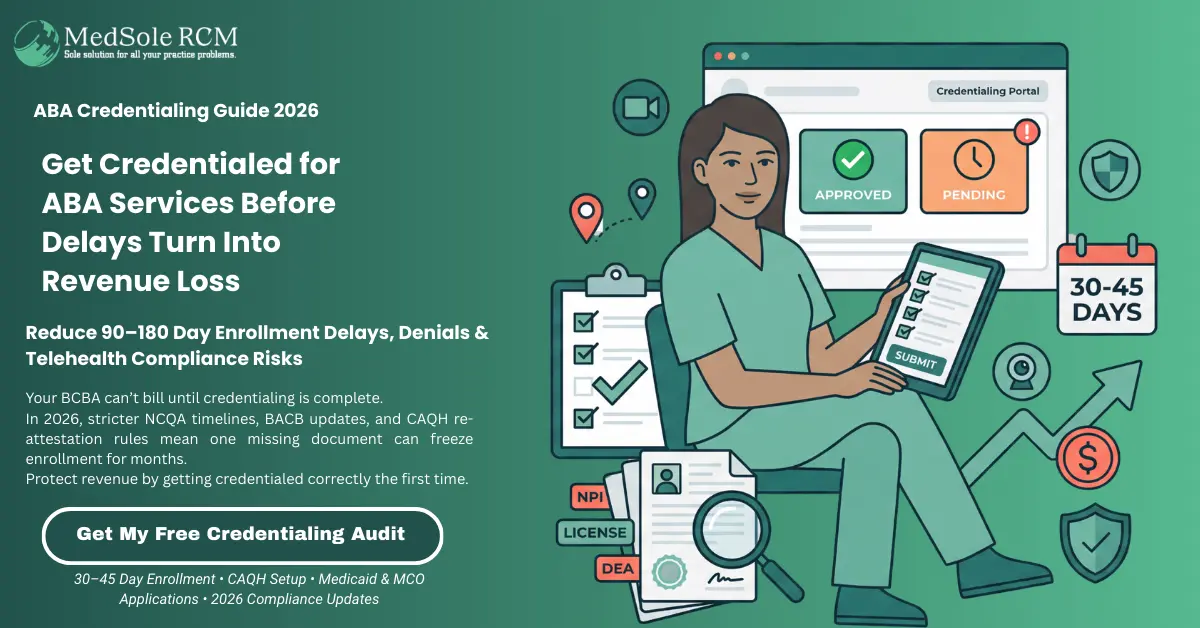




Your BCBA has been on payroll for three months. They still can't see in-network clients. Every week without credentialing approval is revenue your practice will never recover.
This isn't a paperwork problem. It's a cash flow crisis hiding in plain sight.
ABA credentialing is the single most impactful step for revenue capture in any behavioral health practice. Get it wrong, and claims get denied before they're even submitted. Get it right, and you unlock access to the largest pool of insured patients in your market.
The process has changed significantly in 2026. BACB overhauled RBT certification requirements. NCQA tightened verification timelines from 180 days to 120. CMS made telehealth permanent for ABA codes. If you're working from a 2024 playbook, you're already behind.
ABA credentialing is the process by which insurance payers verify that a BCBA, BCaBA, or RBT meets the qualifications, licensing, and compliance standards required to deliver Applied Behavior Analysis therapy and receive ABA insurance credentialing reimbursement.
This guide covers everything you need to navigate the 2026 landscape:
-
What ABA credentialing actually involves and who the key players are
-
The critical difference between credentialing and contracting
-
Why credentialing delays destroy practice revenue
-
The complete document checklist for provider enrollment
-
2026 regulatory updates from BACB, NCQA, and CMS
-
How to accelerate your enrollment timeline
At MedSole RCM, we've credentialed thousands of ABA providers with major payers across all 50 states. We've distilled everything we've learned into this guide so you can protect your revenue and get providers billing faster.
What Is ABA Credentialing?
ABA credentialing is the verification process through which insurance payers confirm that a healthcare provider, typically a BCBA, BCaBA, or RBT, has the education, certification, licensure, and professional standing required to deliver Applied Behavior Analysis therapy services and receive reimbursement from insurance plans.
That's the textbook version. Here's what it actually means for your practice.
Until a provider completes credentialing with a payer, they cannot bill that payer for in-network services. Period. It doesn't matter how qualified they are or how many clients are waiting. No credentialing means no reimbursement.
How ABA Credentialing Works
The workflow follows a predictable pattern, though timelines vary wildly between payers.
First, the payer receives your provider's application and supporting documentation. They're looking for proof that this person is who they claim to be and can do what they say they can do.
Next comes verification. The payer checks credentials against multiple databases: CAQH ProView, the National Practitioner Data Bank, state licensing boards, and the BACB Certificant Registry. They're confirming active certification, valid licensure, and clean disciplinary history.
Then the payer reviews compliance items. This includes malpractice insurance, background checks, NPI validation, and any payer-specific requirements. TRICARE, for example, requires BLS/CPR certification and criminal history checks that other payers don't.
Once everything clears, the provider gets enrolled in the payer network with assigned effective dates. Only then can you start submitting claims.
One nuance that trips up many practices: the BACB is a certification body, not a licensure board. BCBA certification alone may not satisfy state licensing requirements in all jurisdictions. You need both the national certification and the state license where required.
Key Players in the Credentialing Process
Understanding who does what prevents finger-pointing when delays happen.
The Provider (BCBA, BCaBA, or RBT) maintains their own credentials: active certification, current license, continuing education, background checks. If any of these lapse, credentialing stalls.
The Practice or Organization handles the business side: group NPI, tax ID, organizational liability insurance, site information. Group enrollment is separate from individual provider credentialing.
Insurance Payers each run their own credentialing process with their own requirements, timelines, and quirks. What satisfies Aetna might get rejected by Cigna.
CAQH ProView serves as the centralized credential management database. Most payers pull from CAQH rather than requesting documents directly. Keep your CAQH profile current, or everything downstream breaks.
BACB verifies certification status for BCBAs, BCaBAs, and RBTs. Payers query BACB to confirm your providers hold active credentials.
State Licensing Boards verify state-level licensure where applicable. Not every state requires separate ABA licensure, but many do.
Credentialing Service Providers like MedSole RCM manage the entire process end-to-end. We handle the paperwork, the follow-up calls, the payer-specific requirements, and the timeline tracking so your team can focus on clinical operations.
ABA Credentialing vs. Contracting: What's the Difference?
These terms get used interchangeably, and that confusion causes real problems. Credentialing and contracting are two distinct steps that must happen in sequence. Credentialing always comes first.
Here's the distinction that matters: credentialing verifies that your provider is qualified. Contracting establishes the business relationship and determines what you get paid.
|
Aspect |
Credentialing |
Contracting |
|
What it does |
Verifies provider qualifications |
Formalizes business agreement with payer |
|
What's checked |
Education, licenses, certifications, background |
Payment rates, covered services, contract terms |
|
Who initiates |
Provider submits application |
Payer issues contract after credentialing approval |
|
Outcome |
Provider is verified as qualified |
Provider becomes in-network and can bill the payer |
|
Timing |
Must happen first |
Happens after credentialing approval |
|
Renewal |
Re-credentialing every 2–3 years |
Contract renewal every 1–3 years |
You can be fully credentialed and still not able to bill. Without a signed contract, there's no agreement on rates, no assignment to the provider network, and no claims processing.
And here's the layer most people miss: credentialing and contracting don't equal authorization. Even after you're credentialed and contracted, you still need prior authorization for individual clients. Three distinct steps: credentialing, then contracting, then authorization for each patient.
Credentialing verifies a provider's qualifications, while contracting establishes the business agreement and reimbursement rates with the payer. Credentialing must be completed before contracting can begin, and both are required before a provider can submit in-network insurance claims.
If you're struggling to keep these processes straight across multiple payers, you're not alone. Our credentialing and contracting services handle both steps so nothing falls through the cracks.
Why ABA Insurance Credentialing Is Critical for Your Practice Revenue
In 2026, credentialing is no longer a back-office task. It's a revenue strategy.
Every day a provider sits uncredentialed is a day you're paying salary without collecting reimbursement. The math gets ugly fast.
The Revenue Impact of Credentialing Delays
Let's put real numbers to this. An average BCBA bills somewhere between $60 and $80 per hour. They see five to six clients daily. That's roughly $15,000 to $20,000 in billable services per month, per provider.
A 90-day credentialing delay means $45,000 to $60,000 in lost revenue. Per provider. That money doesn't come back.
The downstream effects compound the damage. Claims submitted without proper ABA insurance credentialing get automatically denied. You can't appeal a claim that was submitted before the provider was enrolled. That revenue is simply gone.
Out-of-network billing isn't the solution either. OON reimbursement runs 30 to 50 percent lower than in-network rates. Many families filter providers by "in-network" when searching, so you lose access to those patients entirely.
And it gets worse. Some payers won't authorize services until credentialing is complete. So you're not just losing billing on current clients; you can't even start the authorization process for new ones.
Who Needs ABA Credentialing?
BCBAs need credentialing with every payer they intend to bill. No exceptions. Each payer relationship requires separate enrollment.
BCaBAs often require separate credentialing depending on the payer. Some payers credential them independently; others allow them to bill under supervision.
RBT requirements vary significantly. Some payers require separate BCBA insurance credentialing for each RBT; others allow billing under the supervising BCBA's credentials. The 2026 BACB changes to RBT certification add another layer of complexity to track.
ABA Organizations need organizational enrollment with a Type 2 NPI in addition to individual provider credentialing. Your practice entity must be enrolled separately from your clinicians.
With an estimated 1 in 36 children in the U.S. diagnosed with autism spectrum disorder according to CDC data, demand for credentialed ABA providers continues to grow. The practices that get providers enrolled fastest capture that demand. The ones stuck in credentialing backlogs watch revenue walk out the door.
Credentialing is the first step in a healthy revenue cycle management process. Get it wrong, and everything downstream suffers.
💡 Losing revenue to credentialing delays? MedSole RCM enrolls ABA providers in 30 to 45 days, starting at just $99 per payer. Talk to a credentialing specialist →
ABA Credentialing Requirements: The Complete Document Checklist
Missing a single document can kick your application back to square one. One expired license. One unsigned attestation. One outdated liability certificate. That's another 30 to 60 days added to your timeline.
Here's the complete ABA credentialing checklist we use for every provider enrollment. Gather these documents before you start any application.
Individual Provider Documents
✅ Professional resume or CV, detailed and up to date
✅ BCBA, BCaBA, or RBT certification from BACB
✅ State license (LBA or equivalent, where applicable)
✅ National Provider Identifier, Type 1 for individual providers via NPPES
✅ Tax Identification Number or Social Security Number
✅ Malpractice and professional liability insurance certificate ($1M/$3M minimum for TRICARE)
✅ W-9 form
✅ CAQH ProView ID number with current attestation
✅ Background check results including criminal history and OIG/SAM exclusion verification
✅ Continuing education documentation, including 12 PDUs per two-year cycle for RBTs starting 2026
✅ Professional references, typically three required
✅ Work history covering five to ten years
✅ DEA certificate if applicable
✅ BLS/CPR certification, required for TRICARE ACD providers
Organization and Practice Documents
✅ Business license
✅ Employer Identification Number
✅ Type 2 NPI for the organization
✅ Articles of incorporation or corporate structure documents
✅ Group liability insurance certificate
✅ Taxonomy code: 103K00000X for Behavior Analyst
✅ Practice specialties and appointment availability
✅ Site addresses and contact information for all locations
✅ Languages spoken and cultural competency documentation
The standard taxonomy code for behavior analysts is 103K00000X, which must be registered through the National Plan and Provider Enumeration System when applying for an NPI.
How to Set Up and Maintain Your CAQH Profile for ABA Credentialing
Your CAQH profile is the foundation of every payer application. Get it wrong, and you'll spend months chasing down rejections. Get it right, and most of your credentialing paperwork handles itself.
What Is CAQH ProView?
CAQH ProView is a centralized online database where healthcare providers store their credentials. Instead of submitting the same documents to every payer individually, you upload everything once. Payers then pull directly from CAQH to verify your qualifications.
A majority of insurance payers use CAQH to simplify the ABA credentialing process. This includes BCBS, Aetna, Cigna, UnitedHealthcare, and most regional plans. If your CAQH profile is incomplete or outdated, every single payer application stalls.
CAQH Setup Steps
Setting up your profile takes time upfront but saves countless hours later. Here's the process:
-
Obtain a CAQH ID through an invitation from a participating payer or by registering directly on the CAQH website
-
Log into CAQH ProView and complete all demographic, education, and certification fields
-
Upload supporting documents: licenses, certifications, liability insurance certificates, W-9, and work history
-
Review every field for accuracy, then attest to the completeness of your information
-
Re-attest every 90 days to maintain an active profile
That last step trips up more practices than any other. Miss a single attestation cycle, and your credentialing applications freeze.
Keeping Your CAQH Profile Current (2026 Requirements)
CAQH ProView requires providers to re-attest to the accuracy of their profile information every 90 days. As of 2026, failure to complete the attestation cycle can automatically pause active credentialing applications and delay new payer enrollments.
This isn't theoretical. In August 2025, CAQH updated their portal to reflect new Illinois state regulations. Providers who had attested before that date needed to re-complete Illinois disclosure questions and re-attest, or their applications stalled indefinitely. That's a concrete example of why CAQH for ABA providers requires ongoing state-by-state monitoring.
CAQH has also added mandatory data fields for "special experience," including expertise with specific comorbidities and populations. Leaving these fields blank can hold up enrollment even when everything else looks complete. Review your profile quarterly and update any new fields immediately.
The ABA Credentialing Process: A Step-by-Step Guide
The ABA credentialing process typically follows six steps: obtain an NPI, complete a CAQH profile, identify target payers, submit credentialing applications, track progress and follow up, and review contracts and negotiate rates.
Every payer runs their own version of this process. Timelines vary. Requirements differ. But the fundamental sequence stays the same.
Step 1: Apply for Your NPI Number
Your National Provider Identifier is the starting point for everything. Without an NPI, you can't submit a single payer application.
Register through the NPPES portal. Individual providers need a Type 1 NPI. Organizations need a Type 2 NPI. You'll provide your SSN or EIN, BCBA or BCaBA certificate number, taxonomy code 103K00000X, and state license number where applicable.
The good news: NPI registration typically processes within one to two business days. Don't wait until everything else is ready. Apply for your NPI first.
Step 2: Create and Complete Your CAQH Profile
We covered CAQH setup in the previous section, but here's the critical point: one missing date, one incorrect NPI digit, or one expired license scan can send your entire application back to the beginning.
Before you attest, have a colleague or credentialing specialist review your profile. Fresh eyes catch errors you've looked past a dozen times. The extra hour of review can save you months of delays.
Step 3: Identify Your Target Payers
Not every payer deserves your time equally. Research which insurance carriers are most prevalent in your service area before you start submitting applications.
Begin with the five major commercial payers: BCBS, Aetna, Cigna, UnitedHealthcare, and Humana. Add Medicaid if you're serving publicly funded clients, which requires state Medicaid enrollment before individual MCO applications. Consider TRICARE if you work with military families, though their requirements include additional compliance steps.
Assess each payer's reputation for claim processing speed and reimbursement rates. Some payers are significantly easier to work with than others.
Step 4: Submit Credentialing Applications
There's no universal credentialing form. Each payer has its own application, its own portal, and its own quirks.
Navigate to each payer's "provider" or "become a provider" section on their website. Complete all forms thoroughly and attach every required document. For ABA insurance credentialing with Medicaid MCOs, remember that you must be credentialed with state Medicaid first before applying to individual managed care organizations.
Submit applications to multiple payers simultaneously. Each runs independently, so there's no reason to wait for one approval before starting the next.
Step 5: Track, Follow Up, and Resolve Issues
Credentialing applications stall in review queues without regular follow-up. Payers don't have an incentive to push your application through quickly. You do.
Contact each payer bi-weekly at minimum. Monthly follow-up is the bare minimum; every two weeks is better. Common stall reasons include missing documentation, expired licenses, unattested CAQH profiles, and payer portal changes that invalidated earlier submissions.
Maintain a centralized tracking system. Spreadsheets work for small practices. Credentialing management software works better for larger operations or multi-state enrollment.
Step 6: Review Contracts, Negotiate Rates, and Finalize
Credentialing approval triggers the contracting phase. The payer issues a provider contract. Your job is to actually read it.
Review the contract carefully, ideally with legal support. Check reimbursement rates, covered CPT codes, authorization requirements, and contract term length. ABA CPT codes 97151 through 97158, plus 0362T and 0373T, have carrier-priced rates. That means there's room for negotiation.
Don't automatically accept the first offer. Counter with data on regional rates and your practice's value proposition. Once terms are finalized, sign the contract, set up your billing portal, and confirm your effective date.
ABA credentialing services aren't complete until you have an executed contract in hand. Once contracted, proper medical billing setup ensures claims are submitted correctly from day one.
How Long Does ABA Credentialing Take?
ABA credentialing typically takes 90 to 180 days for initial provider enrollment with commercial payers. Medicaid enrollment may take 60 to 120 days, while adding providers to an existing practice generally takes 30 to 90 days. Specialized credentialing companies like MedSole RCM can complete the process in as few as 30 to 45 days by eliminating documentation errors and maintaining direct payer relationships.
Those timelines aren't set in stone. Your documentation quality, follow-up frequency, and payer responsiveness all affect how long you'll wait.
Credentialing Timeline by Scenario
|
Scenario |
Typical Timeline |
With MedSole RCM |
|
New practice, first payer enrollment |
90 to 180 days |
30 to 45 days |
|
Adding a BCBA to existing practice |
60 to 120 days |
30 to 45 days |
|
Adding an RBT (where required) |
30 to 90 days |
30 to 45 days |
|
Medicaid state enrollment |
60 to 120 days |
45 to 60 days |
|
Medicaid MCO enrollment (per MCO) |
30 to 90 days |
30 to 45 days |
|
Re-credentialing (existing provider) |
30 to 60 days |
30 days |
Industry-average ABA credentialing timelines range from 90 to 180 days, though providers who partner with specialized credentialing companies can reduce this to as few as 30 to 45 days through pre-submission audits, error-free documentation, and proactive payer follow-up.
How to Speed Up ABA Credentialing
Waiting six months for credentialing approval isn't inevitable. Here's how to compress your timeline:
-
Start the credentialing process at offer acceptance, not after onboarding completes
-
Ensure all documents are complete and current before submitting any application
-
Keep CAQH attested and error-free with quarterly reviews
-
Follow up with payers every two weeks, not monthly
-
Use credentialing software or partner with a dedicated credentialing service
-
Submit applications to all target payers simultaneously rather than sequentially
The practices that move fastest treat credentialing as a strategic priority. The ones stuck in six-month backlogs treat it as an afterthought.
⏱️ Why wait 90 to 180 days? MedSole RCM's dedicated credentialing team gets providers enrolled in 30 to 45 days, at just $99 per payer. See how it works →
How Much Do ABA Credentialing Services Cost in 2026?
Credentialing fees vary wildly across the market. Some providers handle everything in-house and pay only in staff time. Others pay thousands to credentialing companies that charge per provider, per payer, plus setup fees, plus monthly maintenance.
Understanding typical pricing helps you evaluate whether to build internal capacity or outsource ABA credentialing to a partner.
Industry Pricing Breakdown
Based on our analysis of ABA credentialing services cost across the market in 2026:
ServiceTypical Market RangeCredentialing per payer (group + 1 provider)$200 to $500Each additional provider per payer$150 to $350RBT credentialing per payer$100 to $250Medicaid state enrollment$300 to $600CAQH profile management$50 to $150 per month (or included)Rate negotiation$75 to $150 per hour
Many providers are shocked when they run the numbers. Credentialing just five payers with two BCBAs and three RBTs can cost $5,000 to $12,000 or more with traditional credentialing companies. That's before monthly maintenance fees.
The math gets worse when you factor in delays. Every month a provider sits uncredentialed is $15,000 to $20,000 in lost billing. A $5,000 credentialing investment that takes six months suddenly looks like a $100,000 problem.
MedSole RCM Pricing: Credentialing from $99 Per Payer
We publish our pricing because we believe providers deserve to know exactly what they'll pay before they commit. No surprises, no hidden fees, no escalating monthly charges.
ABA credentialing services typically cost between $200 and $500 per insurance payer, with additional fees for each provider. MedSole RCM offers credentialing starting at $99 per payer with 30 to 45 day enrollment timelines, making credentialing significantly more accessible for small and startup ABA practices.
ServiceMedSole RCM PriceCredentialing per insurance payer$99Enrollment timeline30 to 45 daysCAQH profile setup and managementIncludedApplication submission and follow-upIncludedDedicated credentialing specialistIncludedNationwide coverage (all 50 states)Included
📊 The MedSole Advantage:
-
72% lower ABA credentialing cost than the industry average ($99 vs. $350)
-
3 to 4 times faster enrollment (30 to 45 days vs. 90 to 180 days)
-
No hidden fees: one transparent price per payer
The question isn't whether you can afford professional credentialing and contracting services. It's whether you can afford to wait six months while revenue walks out the door.
🎯 Ready to get credentialed for less? MedSole RCM enrolls providers starting at $99 per payer with 30 to 45 day turnaround. Get a free quote →
ABA Credentialing for New and Startup Practices
Starting an ABA practice means juggling a dozen priorities at once. Facility setup, hiring, compliance, marketing, equipment. Credentialing often gets pushed to the bottom of the list because it feels like paperwork rather than progress.
That's a mistake. Credentialing determines when you can actually start billing. Everything else is preparation for a business that can't generate revenue until providers are enrolled.
When to Start Credentialing
Begin credentialing four to six months before your target opening date. Not four to six weeks. Months.
The sequence matters: entity formation first, then liability insurance, then NPI registration, then CAQH profile, then payer applications. Each step depends on the previous one.
Here's what most people miss: credentialing can proceed in parallel with everything else. While you're building out your facility and hiring staff, your applications can be moving through payer review queues. Don't wait until your clinic is "ready." Start credentialing while you're still setting up.
How to start an ABA therapy practice without credentialing delays: submit applications the same week you secure your liability insurance. Your physical space doesn't need to be finished. Your staff doesn't need to be hired. Payer enrollment moves independently.
Startup Credentialing Checklist
For ABA credentialing for new practice launches, follow this sequence:
-
Form your business entity (LLC, PLLC, or corporation)
-
Obtain your EIN from the IRS
-
Secure professional liability insurance at $1M/$3M minimum
-
Apply for your organizational NPI (Type 2)
-
Register for CAQH ProView and complete your profile
-
Submit applications to your top five target payers simultaneously
-
Apply for state Medicaid enrollment
-
Begin MCO applications after Medicaid approval
Apply to all target payers at the same time, not one at a time. Each application runs independently through each payer's review process. Sequential submission means you're artificially extending your timeline by months.
Getting your revenue cycle management infrastructure right from day one prevents costly billing issues later. Credentialing is the first piece of that puzzle. Get it moving early, and the rest falls into place.
Medicaid and Managed Care (MCO) Credentialing for ABA Providers
Medicaid credentialing trips up more ABA practices than almost anything else. Not because the process is impossibly hard, but because providers assume one approval covers everything. It doesn't. Credentialing with state Medicaid does not automatically grant access to Medicaid Managed Care Organization (MCO) plans. You need separate applications for each MCO, and skipping that step means you can't bill for a large chunk of your potential client base.
State Medicaid Enrollment
State Medicaid enrollment comes first. Every other Medicaid-related application depends on it.
Apply through your state's Medicaid enrollment portal. You'll need your NPI, state licenses, BCBA or RBT certification, tax identification, and a completed background check. Requirements vary by state, so check your specific state's provider enrollment page before assembling documents.
For RBTs looking to get a Medicaid provider number, the path typically runs through the supervising BCBA's organization. Most states don't issue standalone Medicaid provider numbers to RBTs directly. Instead, RBTs are enrolled under the group practice's Type 2 NPI. Some states handle this differently, so confirm with your state Medicaid office before assuming either way.
The timeline for state Medicaid approval ranges from 60 to 120 days in most cases. Until that approval comes through, you can't move forward with any MCO applications. That's why this needs to be one of your earliest ABA credentialing services priorities, not something you start after commercial payers are done.
MCO Credentialing: Why It's a Separate Process
Here's the distinction that catches people off guard. Your state Medicaid program sets the baseline rules and funding. But in most states, the actual delivery of Medicaid benefits is administered by private insurance companies called Managed Care Organizations.
Each state contracts with multiple MCOs. Florida might have five. Texas might have seven. And each MCO runs its own credentialing process with its own portal, its own forms, and its own documentation requirements. What satisfies one MCO might get rejected by another, even within the same state.
You need to submit separate ABA provider enrollment applications to every MCO whose members you want to serve. Before applying, identify which MCOs your target client population is enrolled in. There's no point credentialing with an MCO that has minimal ABA membership in your service area.
The practical workload here multiplies fast. Five MCOs means five applications, five document sets, five follow-up cycles. It's one of the biggest reasons practices outsource credentialing and contracting to a partner who already knows each MCO's specific requirements.
Revalidation Requirements
Getting enrolled with Medicaid isn't a one-time event. Per CMS guidelines, ABA providers must revalidate their Medicaid enrollment at least once every five years. Many states require revalidation every three years. Know your state's specific deadline, because missing it can result in termination of your enrollment, and reinstatement isn't automatic.
Revalidation means re-submitting updated documentation: current licenses, active certifications, proof of insurance, and any changes to your practice information. Treat it like re-credentialing. If you let it lapse, you lose the ability to bill Medicaid until the revalidation is complete.
There's a newer layer to this as well. Under CMS SHO Letter #24-003, effective July 1, 2025, states must now update Medicaid provider directories quarterly instead of annually. The expanded data requirements include telehealth availability, accessibility accommodations, ASL capability, and whether you're accepting new Medicaid patients. States are actively implementing these requirements, so expect more frequent outreach from your state Medicaid office asking you to verify and update your directory listing.
ABA Credentialing by Insurance Payer: What Each Requires
Every payer has its own credentialing process. Pretending they're all the same is how applications get rejected. Here's what you need to know about the major carriers before you submit.
Blue Cross Blue Shield (BCBS)
BCBS operates through independent regional plans, which means credentialing with BCBS of Florida is completely separate from BCBS of Texas. Each plan has its own application and its own timeline. Most BCBS plans accept CAQH, but some regional plans require supplemental documentation. Processing typically runs 60 to 120 days. Start with the BCBS plan covering your primary service area, then expand.
Aetna
Aetna's ABA credentialing process runs through their online provider portal. They pull heavily from CAQH, so your profile needs to be current before you apply. Aetna tends to process applications within 60 to 90 days, making them one of the faster commercial payers. They do require proof of state licensure in addition to BACB certification.
Cigna
Cigna uses its own provider application portal alongside CAQH verification. Turnaround varies widely, from 60 days on the fast end to 120 days or more. One thing to watch: Cigna's ABA reimbursement rates differ significantly by region. Before investing time in the credentialing process, verify that their rates make financial sense for your practice.
UnitedHealthcare (UHC)
UnitedHealthcare, including its Optum behavioral health division, manages one of the largest provider networks in the country. Their credentialing process relies on CAQH and typically takes 90 to 120 days. UHC's network includes both commercial and Medicaid managed care plans, so credentialing here can open access to multiple product lines. Follow up frequently, because UHC's volume means applications can sit in queue longer than average.
TRICARE
TRICARE stands apart from every other payer on this list. The Autism Care Demonstration (ACD) is authorized through December 31, 2028, and comes with requirements that go well beyond a standard credentialing application.
TRICARE ABA providers must have an active NPI and maintain BLS/CPR certification, either hybrid or in-person. Behavior technicians must hold an RBT, ABAT, BCAT, or state certification before applying for authorized status. Criminal history review is mandatory for supervisors, and a full criminal history background check applies to assistant behavior analysts and BTs. Liability insurance minimums are $1 million per claim and $3 million aggregate, or higher if your state requires it.
There's also an annual provider education requirement tied to TRICARE's participation agreement. Missing any single piece of this compliance bundle can delay or disqualify your application.
Humana, Anthem, Optum, and Others
Beyond the major five, your payer strategy should include whichever carriers have the largest presence in your service area. Humana, Anthem, Magellan Health, Beacon Health, Oscar, and UMR all credential ABA providers, each with their own process. Most accept CAQH. Processing times generally fall in the 60 to 120 day range.
The key principle across all payers: don't assume one payer's requirements match another's. Check each payer's provider enrollment page individually. And if ABA insurance credentialing documentation is incomplete when claims start flowing, denials management becomes significantly more complex and expensive than doing the credentialing right the first time.
MedSole RCM credentials ABA providers with all major payers, including BCBS, Aetna, Cigna, UHC, TRICARE, Medicaid, and more, across all 50 states. Starting at $99 per payer, it's the most cost-effective way to get enrolled. See our credentialing services →
Multi-State and Telehealth ABA Credentialing in 2026
Telehealth has changed where ABA services can be delivered, but it hasn't simplified credentialing. If anything, it's made the administrative side harder.
Providers must hold an active license in each state where the patient is located at the time of service. Not where the provider sits. Where the client is. A BCBA licensed in Texas who sees a client logging in from Oklahoma needs an Oklahoma license, Oklahoma payer credentials, and compliance with Oklahoma's specific ABA regulations.
There's no ABA-specific interstate compact that solves this. The Interstate Medical Licensure Compact covers physicians across 42 states, but behavior analysts don't have an equivalent. Each state's licensing board operates independently, with its own application, its own fees, and its own timelines.
Multi-state credentialing multiplies every piece of the workload. Separate licenses per state. Separate payer applications per state. Separate Medicaid enrollments per state. For a practice serving clients across three states with five payers each, that's 15 credentialing applications running simultaneously, plus three state licenses to maintain.
Here's the 2026 development that makes telehealth credentialing worth the effort: CMS permanently placed ABA CPT codes 97151 through 97158, 0362T, and 0373T on the Permanent CMS Telehealth List, effective January 1, 2026. No more "provisional" status. No more wondering if telehealth coverage will expire at the end of a budget cycle. ABA telehealth is a permanent delivery model now.
CMS also permanently authorized audio-only delivery for certain behavioral health services when the patient can't access or prefers not to use video. For ABA credentialing services that span multiple states, this permanence justifies the investment in multi-state licensing and enrollment.
2026 ABA Credentialing Updates Every Provider Must Know
The credentialing landscape shifted significantly heading into 2026. If your team is still operating on 2024 assumptions, some of these changes have already caused problems you haven't traced back to their source yet.
BACB Certification Changes
The BACB rolled out its most sweeping changes in years, and they affect every level of your clinical staff.
RBT two-year renewal cycle: Starting January 1, 2026, RBTs moved from annual renewal to a two-year cycle. That sounds easier until you realize the new requirement: 12 hours of Professional Development Units per cycle. PDUs can come from in-service training, ACE events, or university coursework, but your internal training programs need to be structured to count. The RBT Handbook reflects an update date of January 2, 2026.
Third Edition RBT Task List: All new RBT applicants must be trained under the 3rd Edition Task List. Training based on the 2nd Edition is no longer accepted for new credentials. If you're onboarding new techs with old training certificates, those credentials won't go through.
Pathway 2 restrictions for future BCBAs: Per the February 2026 BACB Newsletter, degrees earned in less than one calendar year no longer meet Pathway 2 requirements, effective January 1, 2027. Coursework must come from a graduate program with a designated Pathway 2 Program Contact. Pathway 2 itself will be discontinued entirely in 2032. If your organization sponsors tuition for aspiring BCBAs, verify that your partner programs meet the updated criteria.
Coursework attestation system: Starting January 1, 2026, Pathway 2 applications require Coursework Attestations through a BACB-managed system. Expect more coordination between universities and applicants, and update your onboarding checklists accordingly.
ACE provider restrictions (July 2026): Reading an article and taking a quiz no longer qualifies for CEUs. ACE instructors must now hold a BCBA with five or more years of experience, or a doctorate in behavior analysis.
Processing times: As of the BACB's February 12, 2026 update, BCBA and BCaBA applications are processing from January 31, 2026. RBT applications are processing from February 11, 2026. Credentialing delays aren't always on the payer side.
CMS Telehealth and Billing Updates
Three CMS changes directly affect how ABA practices credential and bill in 2026.
ABA CPT codes 97151 through 97158, 0362T, and 0373T now sit on the Permanent CMS Telehealth List. The years of "temporary" and "provisional" designations are over.
CMS extended carrier pricing for ABA codes through 2026. That means there's no national fee schedule for these codes. Payers set their own rates, which makes your contract negotiation during the credentialing process more important than ever.
Audio-only behavioral health services are now permanently authorized when the patient can't access video. Your credentialing applications should reflect telehealth capability where applicable.
NCQA Credentialing Standards (2025 to 2026)
The NCQA's updated credentialing standards took effect for surveys starting July 1, 2025, and they've tightened the operational requirements that payers impose on providers.
The standard credentialing verification window dropped from 180 days to 120 days for accredited organizations. Payers have less time to process your application, which means cleaner applications move faster and messy ones get pushed to the back of the line.
Monthly monitoring is now mandatory. Payers must check provider licensure status, OIG exclusions, and SAM.gov status every 30 days. If a provider's license expires, even for 48 hours, payers can deactivate them from the roster immediately. That triggers automatic claim denials for any services rendered during the gap.
CAQH attestation is now required every 90 days with expanded data fields. Leaving new fields blank, including those covering cultural and linguistic capabilities, can stall enrollment processing.
State Licensing Updates
Several states launched new requirements in early 2026 that affect ABA credentialing directly.
New Jersey finalized its NJAC 13:42B regulations for the State Board of Applied Behavior Analyst Examiners. Providers must ensure they're licensed through the new portal. Grace periods for practicing with just a BCBA certification have largely expired.
Georgia's Behavior Analyst Licensing Board set an April 1, 2026 deadline for existing practitioners to submit applications through the new GOALS portal.
No ABA-specific interstate compact exists. Providers delivering telehealth across state lines must hold a separate license in each state where the client is located.
2026 Credentialing Changes at a Glance
|
Requirement |
Old Standard |
2026 Standard |
|
RBT Renewal |
Annual assessment |
Two-year cycle + 12 PDUs |
|
Credentialing Window |
180 days |
120 days |
|
Monitoring Frequency |
Quarterly or annual |
Every 30 days |
|
Telehealth Status |
Provisional or temporary |
Permanent (CMS list) |
|
CAQH Attestation |
When prompted |
Mandatory every 90 days |
As of 2026, the NCQA has shortened the standard credentialing window from 180 to 120 days and mandated monthly monitoring of provider licensure, OIG exclusions, and SAM.gov status. The BACB has simultaneously transitioned RBTs to a two-year renewal cycle requiring 12 Professional Development Units.
7 Common ABA Credentialing Mistakes (And How to Avoid Them)
Most credentialing delays aren't caused by payer bureaucracy. They're caused by avoidable errors on the provider side. After handling credentialing for ABA practices across the country, these are the seven mistakes we see most often.
Mistake 1: Submitting Incomplete or Outdated Documentation
A single expired license, one unsigned attestation, or a lapsed liability certificate can reset your entire application. The payer doesn't call to ask for the updated version. They reject the application and move to the next one in the queue.
The fix: run a quarterly document review. Check expiration dates on every license, certification, and insurance policy. Update CAQH the same day anything changes. Don't wait for renewal notices that might not come.
Mistake 2: Confusing Credentialing with Contracting
Being credentialed does not mean you can bill. Credentialing verifies your qualifications. Contracting establishes the business agreement, the reimbursement rates, and the terms under which you'll submit claims. You need both completed, plus a signed participation agreement, before submitting a single in-network claim.
Track credentialing and contracting as separate milestones. Celebrating a credentialing approval while forgetting to sign the contract is a surprisingly common way to lose weeks.
Mistake 3: Waiting Until After Hire to Start Credentialing
Every day between "offer accepted" and "credentialing application submitted" is a day your new BCBA sits idle. That's $800 to $1,000 per day in lost billable time, depending on your rates and caseload capacity.
Start credentialing the moment a provider accepts your offer. Collect their documents during the notice period at their current job. Submit applications before their first day. The goal is to have credentialing in process by the time they walk through your door.
Mistake 4: Neglecting CAQH Attestation Deadlines
In 2026, CAQH requires re-attestation every 90 days. Miss that window and every active enrollment, across every payer pulling from your profile, can be paused. Not just new applications. Existing ones too.
Set a recurring calendar alert for day 80 of each 90-day cycle. Give yourself a 10-day buffer. Treating CAQH attestation like a quarterly tax filing keeps this from becoming an emergency.
Mistake 5: Not Following Up with Payers
Applications don't move on their own. They sit in review queues, and nobody at the payer's office is tracking your specific case with any urgency. What usually happens is silence, for weeks, until you call and discover a missing document held everything up 45 days ago.
Contact each payer every two weeks. Be polite, be specific, and document every conversation. Note the date, the representative's name, and what they told you. If things escalate, that log becomes your leverage.
Mistake 6: Using Personal Insurance Instead of Business Coverage
Solo practitioners make this mistake more than anyone. Payers require business-level professional liability insurance with the correct insured entity name matching your credentialing application. Listing your personal name when the application is under your LLC, or vice versa, triggers a rejection.
Before submitting, verify that the insured name on your insurance certificate matches the entity name on your credentialing application exactly. Date ranges need to align with the credentialing period too. A certificate showing coverage from last year's policy won't cut it.
Mistake 7: Missing Re-Credentialing Deadlines
Re-credentialing is required every two to three years, depending on the payer. Miss the deadline and you can lose in-network status without warning. No notification, no grace period with some payers. Your claims just start getting denied, and by the time you figure out why, you've got weeks of unbillable services on your books.
Set reminders six months before each re-credentialing deadline. That gives you enough time to gather updated documentation, submit the application, and follow up before the expiration date hits.
Documentation errors during credentialing often cascade into claims denials that require denials management intervention down the line. Fixing these mistakes at the source is always cheaper and faster than cleaning up the billing mess they create.
Want to avoid these mistakes entirely? MedSole RCM's credentialing specialists pre-audit every document and application before submission, reducing errors to near zero. Learn about our process →
Re-Credentialing: How to Maintain Your In-Network Status
Getting credentialed is only half the job. Staying credentialed is the other half, and it's the one that catches practices off guard.
Payer contracts typically require re-credentialing every two to three years. Medicaid revalidation runs on a three to five year cycle depending on your state. Miss either deadline and you don't get a warning call. Your provider status gets deactivated, claims start denying, and you're left scrambling to figure out why last Tuesday's sessions aren't getting paid.
Re-credentialing isn't a fresh application from scratch, but it's not a rubber stamp either. You'll need to update all documentation: current licenses, active certifications, renewed liability insurance, and any changes to your practice information. CAQH needs a fresh attestation. Background checks may need to be re-run. Some payers request updated professional references.
The 2026 NCQA standards have blurred the line between periodic re-credentialing and continuous monitoring. With payers now required to check licensure, OIG exclusions, and SAM.gov status every 30 days, some elements of re-credentialing are already happening in real time. A license that lapses for even 48 hours can trigger automatic roster deactivation before your formal re-credentialing date ever arrives.
Here's the practical approach that works: set reminders six months before every re-credentialing deadline. That gives you enough runway to gather updated documents, resolve any issues, and submit well before the expiration date. Waiting until the last month turns a routine administrative task into a revenue emergency.
Build a simple tracking system for every provider in your practice. List each payer, the original credentialing date, the re-credentialing due date, and the documents that need updating. Review it quarterly. When re-credentialing lapses, medical billing operations are immediately disrupted, and every claim submitted during the gap period becomes a denial you'll have to fight or write off.
Re-credentialing is not optional. It's the difference between uninterrupted revenue and sudden claim denials with no notice. Treat it like a recurring deadline, not a surprise.
Why Healthcare Providers Choose MedSole RCM for ABA Credentialing
You've read through the process, the requirements, the timelines, and the mistakes. If any of that felt overwhelming, you're not alone. Most ABA practices don't have a dedicated credentialing coordinator on staff. The work falls on a practice manager who's already handling scheduling, HR, and a dozen other things. Applications get submitted late. Follow-ups don't happen. Revenue sits on the table.
That's the problem we solve.
Our ABA Credentialing Process
We've built a five-step workflow that takes credentialing off your plate entirely.
-
Free practice audit. Before you pay anything, we review your current payer status, check each provider's credentialing standing, and identify exactly what work needs to be done. No guesswork, no surprises on the scope.
-
Document collection and CAQH audit. We gather all required documents from your team, set up or update every provider's CAQH profile, and verify NPI numbers, licenses, and certifications. If something's expired or missing, we flag it before it becomes a rejection.
-
Application submission. We complete and submit all payer applications on your behalf. Every field gets double-checked against the payer's specific requirements. Clean applications the first time around are the single biggest factor in fast approvals.
-
Bi-weekly follow-up. We don't submit and wait. Our team contacts each payer every two weeks to push applications forward and catch issues early. You get status updates throughout, so you always know where things stand.
-
Contract review and rate negotiation. When payers present contracts, we review the terms and fee schedules with you before you sign anything. Rate negotiation is included at no extra charge, because accepting the first offer almost always leaves money on the table.
What Makes MedSole Different
|
Feature |
MedSole RCM |
Industry Standard |
|
Pricing |
$99 per payer |
$200 to $500 per payer |
|
Enrollment Speed |
30 to 45 days |
90 to 180 days |
|
Follow-up Frequency |
Bi-weekly |
Monthly |
|
CAQH Management |
Included |
Extra charge |
|
Rate Negotiation |
Included |
$75 to $150 per hour |
|
Coverage |
All 50 states |
Varies |
|
Dedicated Specialist |
Yes |
Not always |
|
Free Practice Audit |
Yes |
Rare |
We're not just a credentialing shop. As a full-service revenue cycle management company, we connect credentialing directly to billing, coding, and denial management. Your ABA credentialing services don't exist in a vacuum here. Once credentialing is complete, our medical billing team takes over to make sure claims go out clean from day one.
Every practice gets a dedicated account manager. Not a ticket queue. Not a chatbot. A real person who knows your payers, your providers, and your specific situation.
And while ABA is a major focus, we handle credentialing across all specialties. If your organization expands beyond ABA, you don't need to find a new credentialing partner. We're already set up to grow with you.
Frequently Asked Questions About ABA Credentialing Services
What is ABA credentialing?
ABA credentialing is the process by which insurance payers verify that a provider, typically a BCBA, BCaBA, or RBT, meets the education, certification, licensure, and compliance standards required to deliver Applied Behavior Analysis therapy. Without credentialing, providers can't submit in-network insurance claims or receive reimbursement for ABA services. It's the g