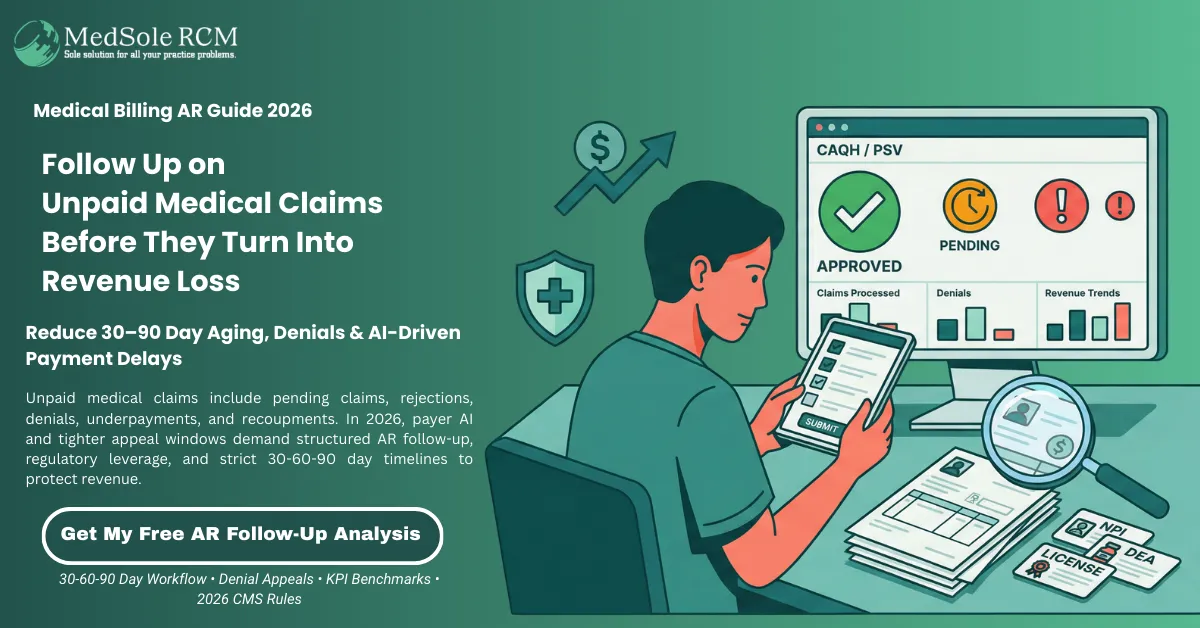




Denial rates hit nearly 12% in 2024, according to HFMA and Kodiak Solutions data. That number alone should concern any practice manager reading this. But here's what makes 2026 different: payers are now using AI to issue millisecond denials before your claim ever reaches a human reviewer.
The game has changed. And if your follow-up process hasn't changed with it, you're losing revenue you already earned.
This guide is built for healthcare providers, practice managers, and billing teams who need a current, working system to follow up unpaid medical claims. You'll get the complete step-by-step process, 2026 regulatory changes that actually give providers new leverage, exact timelines for insurance claim follow-up, appeal strategies that win, and KPIs that tell you whether your process is working.
First, a clear definition. Claim follow-up in medical billing is the systematic process of tracking, investigating, and resolving claims that remain unpaid, whether pending, denied, underpaid, or lost, after submission to insurance payers.
Every practice deals with unpaid medical claims. The difference between healthy revenue and a cash-flow crisis comes down to how fast and how effectively you chase them.
At MedSole RCM, our AR follow-up medical billing teams process thousands of unpaid claims monthly across specialities. This guide distills what actually works in 2026, not recycled advice from three years ago.
What Are Unpaid Medical Claims? (It's Not Just Denials)
An unpaid medical claim is any claim submitted to an insurance payer that has not resulted in full expected payment within the standard adjudication window. Most billing teams think "unpaid" means "denied". That's only part of the picture.
Unpaid claims fall into five distinct categories. Each one requires a completely different response. Lumping them together is the fastest way to waste your team's time and lose recoverable revenue.
The 5 Types of Unpaid Medical Claims
|
Type |
What Happened |
Real-World Example |
|
1. No Response / Pending |
Payer received the claim but returned no ERA or EOB |
Claim sits in the payer's queue beyond 30 days with zero feedback |
|
2. Front-End Rejections |
Claim never entered adjudication due to a data error |
Invalid subscriber ID, missing NPI, or formatting issue caught at the clearinghouse |
|
3. Hard Denials |
Payer processed the claim and refused payment |
No prior authorization, non-covered service, or medical necessity not met |
|
4. Underpayments |
Payer paid, but less than the contracted rate |
Bundling edits applied incorrectly, wrong modifier adjudication, or QPA issues on out-of-network claims |
|
5. Post-Payment Recoupments |
Payer claws back money they already paid you |
Retro-audit findings, coordination of benefits corrections, or duplicate claim review |
Here's why this framework matters. A pending claim with no response needs a status check and possible resubmission. A hard denial needs an appeal with supporting documentation. An underpaid medical claim needs a contract variance review. Treating them the same wastes effort on the wrong solution.
Most outstanding medical claims sitting in your aging report aren't all denials. Many are pending claims nobody checked on, or rejections that never made it past the clearinghouse because clean claim submission failed at the front end.
When you follow up unpaid medical claims without classifying them first, you're guessing. And guessing doesn't recover revenue.
We'll break down the difference between denials and rejections in detail later. For now, understand that your follow-up strategy needs five lanes, not one.
How to Follow Up on Unpaid Medical Claims: Step-by-Step Process
Every claim follow-up process in medical billing should follow a predictable sequence. Skipping steps or starting follow-up too late is how claims age past recovery.
Here are the steps to follow up on unpaid medical claims:
Step 1: Confirm Clean Claim Acceptance (Day 0 to 2)
Verify your claim actually made it into the payer's system. This sounds basic. It's also where a surprising number of claims quietly die.
After submission, check your clearinghouse acceptance report and look for the payer's 277CA acknowledgment. A clean claim submission means the claim passed all front-end edits, correct patient demographics, valid NPI, proper formatting, active coverage.
If the claim was rejected at the clearinghouse, it never entered the payer's adjudication system. Your timely filing limit for medical claims is already ticking, and you might not even know it. Save that clearinghouse timestamp. It's your proof of original submission date, and you'll need it if a timely filing dispute comes up later.
Step 2: Run a First Status Check (Day 7 to 14)
Check high-dollar and complex claims early. Don't wait a full month for your first insurance claim follow up on claims that matter most to your bottom line.
Log into the payer portal or call the provider line. Confirm three things: was the claim received, is it in adjudication, and has the payer requested additional information?
Payer websites let you check claim status, confirm receipt, and view eligibility details faster than sitting on hold. For routine, lower-dollar claims, this step can wait until the Day 21 to 30 window. For anything over your practice's dollar threshold, don't wait.
Step 3: Begin Active Follow-Up (Day 21 to 30)
This is where most unpaid claims get caught, or get lost. If no ERA or EOB has come back by day 30 for an electronic claim (or day 45 for paper), it's time to pick up the phone.
The payer follow-up process at this stage looks like this: call the payer, verify they received the claim, ask whether it's in process or denied. If denied, get the specific reason. If they say they never received it, resubmit electronically that same day.
Every time you follow up unpaid medical claims by phone, document the date, the representative's name, and the call reference number. No exceptions. This log becomes critical evidence later. According to AAPC best practices, consistent documentation of every payer interaction is one of the strongest habits a billing team can build.
Step 4: Classify and Route (Day 30+)
Sort the claim into the right bucket and send it down the right path. This is where the five-type framework from the previous section does its job in your AR follow-up medical billing workflow.
- No response: resubmit and escalate
- Rejection: correct the error and resubmit the same day
- Denial: begin the denial management process (see the appeal section below)
- Underpayment: run a contract variance review
- Recoupment: dispute with supporting documentation
Each path has different documentation requirements, different deadlines, and different escalation contacts. Routing a denial into a resubmission queue wastes time. Routing a rejection into appeals wastes even more.
Step 5: Escalate Unresolved Claims (Day 31 to 60)
If a claim stays unpaid after initial follow-up, raise the pressure. Medical claims follow up at this stage means requesting a supervisor review, filing a written inquiry with the payer, or referencing your state's prompt-pay deadlines.
Don't just call the same general number again. Ask for a supervisor or a claims resolution specialist. Written inquiries create a paper trail that phone calls don't. For the detailed 30-60-90 day timeline, see the next section.
Step 6: Document Everything
Record every interaction with every payer on every claim. Date, time, representative name, reference number, what they told you, and what happens next.
This documentation isn't just good practice. It's your evidence trail for appeals, prompt-pay complaints, state insurance department filings, and IDR disputes under the No Surprises Act. If you can't prove you followed up, the payer's version of events wins.
Building this process in-house requires dedicated staff, payer-specific knowledge, and relentless tracking. If your team is stretched thin, MedSole RCM's AR follow-up specialists handle this entire workflow, so your providers can focus on patients, not payer hold queues.
2026 Regulatory Updates That Change How You Follow Up on Unpaid Medical Claims
The rules governing medical claims follow-up shifted significantly on January 1, 2026. Providers who follow up unpaid medical claims using a 2024 playbook are leaving money on the table and losing appeals they should win.
Here's what changed, and how each change affects your insurance claim follow up strategy.
CMS Prior Authorization Rule (CMS-0057-F): Faster Decisions, Specific Denial Reasons
CMS-0057-F requires Medicare Advantage, Medicaid/CHIP, and Marketplace payers to respond to standard prior authorization requests within 7 calendar days and urgent requests within 72 hours.
That's significant. But the bigger win for providers is this: impacted payers must now provide a specific reason for every prior authorization denial. No more vague "not medically necessary" rejections without explanation.
First public reporting of prior-auth metrics is due March 31, 2026. That means payers know their approval and denial patterns will be visible. Use that leverage.
What to do differently: When a claim is denied for a prior authorization denial reason, pull the specific rationale the payer gave and address it directly in your appeal. Don't resubmit the same packet and hope for a different result. The rule gives you a roadmap; follow it.
Medicare WISeR Model: AI-Powered Review in 6 States
CMS launched the WISeR (Wasteful and Inappropriate Service Reduction) model on January 1, 2026 in Arizona, New Jersey, Ohio, Oklahoma, Texas, and Washington. It combines AI and machine learning with human review to screen claims for targeted services.
Those services include skin substitutes, nerve stimulator implantation, and knee arthroscopy for osteoarthritis. Providers in WISeR states can either submit prior authorization for these services or face post-service prepayment review.
What to do differently: Flag impacted CPT and HCPCS codes at scheduling. Treat these claims as complex-review from the start. Submit supporting documentation proactively rather than waiting for a request. Reacting after a prepayment hold costs you weeks.
Medicare Advantage Inpatient Payment Protections
CMS finalized rules restricting MA plans from reopening previously approved inpatient admissions except in cases of obvious error or fraud. This directly targets the retro-denial problem that has frustrated hospital billing teams for years.
If an MA plan approved an inpatient stay and you provided the service, they can't come back 18 months later and deny it because their AI flagged it in a retrospective audit. Not anymore.
What to do differently: When you fight a Medicare Advantage retro denial in 2026, cite this rule explicitly. Your denial management medical billing appeals posture is significantly stronger than it was last year. Don't let payers ignore it.
No Surprises Act and IDR: QPA Enforcement Discretion Through 2026
Federal agencies extended enforcement discretion for plans using the 2021 QPA methodology for services furnished before February 1, 2026, per CMS FAQs Part 71. Additional relief isn't expected beyond August 1, 2026.
IDR administrative fees have risen, which makes filing single-claim disputes financially questionable for lower-dollar amounts. Batching similar underpaid medical claims into grouped IDR submissions is now essential to make the process worthwhile.
What to do differently: For out-of-network underpayment disputes, build IDR-ready packets in advance. Group claims by payer, service type, and denial reason. Batching keeps your cost-per-dispute manageable.
State Prompt-Pay Laws Tightening
California's AB 3275 shifted clean claim payment deadlines to 30 calendar days (not working days) effective January 1, 2026. Texas DOI updated prompt-pay guidance in February 2026. Multiple other states are following the same pattern.
Your timely filing limit for medical claims is one deadline. The payer's obligation to pay or contest on time is another, and it's getting shorter.
What to do differently: In applicable states, reference prompt-pay deadlines during escalation calls. Retain your clearinghouse acceptance reports as proof of submission date. If a payer misses their deadline, that's a regulatory complaint you can file, and payers know it. Check your state's current requirements through resources like the California Department of Insurance or the OIG 2026 Work Plan.
Payer AI and Millisecond Denials
Payers are deploying AI pattern detection tools that auto-deny claims based on modifier usage patterns (modifiers 25, 59, and 24 are common targets) and E/M coding levels. NLP-powered audits are auto-downcoding evaluation and management levels when documentation doesn't meet stricter AI-interpreted thresholds.
These aren't human reviewers reading your notes. They're algorithms scanning for patterns, and they're issuing payer AI denials in 2026 faster than your team can review an EOB.
What to do differently: Run internal audits on your modifier usage and E/M distributions before payers flag them. Predictive scoring tools that identify high-risk claims before submission are no longer optional for high-volume practices. If you don't have that capability in-house, denial management services that include pre-submission review can catch what your team misses.
Gold-Carding Laws Expand to 12+ States
Gold carding in medical billing exempts providers from prior authorization requirements for specific services when they maintain high approval rates, typically 90% or above (some states set the bar at 80%) over a rolling 12-month period. States with active gold-carding laws now include Texas, Arkansas, West Virginia, Michigan, and others.
What to do differently: Track your prior-auth approval rates by payer and by service line. Achieving Gold Card status eliminates follow-up work before it even starts. Maintaining clean credentials through consistent provider credentialing and enrollment supports qualification and keeps your rates high.
The 30-60-90 Day Follow-Up Timeline for Unpaid Medical Claims
A structured AR follow-up medical billing timeline is the backbone of any effective unpaid claims recovery process. Without one, claims slip through cracks and revenue quietly disappears.
Here is the 30-60-90 day follow-up timeline for unpaid medical claims:
Days 0 to 14: Submission and Verification Phase
- Day 0: Submit the clean claim electronically.
- Day 1 to 2: Confirm clearinghouse acceptance via the 277CA acknowledgment.
- Day 7 to 14: Run a first status check on high-dollar and complex claims.
Your only goal in this window is confirmation. Did the payer receive it? Is it sitting in adjudication? If you can't verify receipt within two days, something went wrong at the clearinghouse, and your timely filing clock is already running.
Days 15 to 30: Active Monitoring Phase
- Day 15: Start monitoring claims with no ERA or EOB.
- Day 21: Run a second status check.
- Day 30: If no payment or remittance on an electronic claim, call the payer.
This is where insurance claim follow up actually begins for most claims. When you call, verify the claim's status, ask whether it's in process or denied, and write down the reference number. Every detail matters later.
For paper claims, extend this window to day 45. Paper processing is slower, and calling too early just wastes your team's time.
Days 31 to 60: Resolution Phase
- Day 31 to 45: Resubmit if lost. Appeal if denied. Dispute if underpaid.
- Day 45 to 60: Escalate to a supervisor queue. File a written inquiry. Reference prompt-pay deadlines.
This is where the payer follow up process gets specific. Classify each claim using the five-bucket framework and route it down the right path. A lost claim needs resubmission. A denied claim needs an appeal. An underpaid claim needs a contract review. Wrong path, wasted effort.
Days 61 to 90: Escalation Phase
- Day 61 to 75: Increase follow-up frequency to every seven to 10 days for high-value claims.
- Day 75 to 90: File a formal prompt-pay complaint where applicable. Request manager-level payer escalation.
Claims approaching 90 days need attention from supervisors, not just staff. Recovery rates start declining fast in this window. Don't let a high-dollar claim sit here without weekly contact.
Days 90+: Critical Recovery Phase
Beyond 90 days, every additional day reduces your chances of collecting. Appeal windows may already be expiring, since many payers now limit appeals to 60 to 90 days from the initial denial date.
Outstanding medical claims in this bucket need a hard look. Audit each one for timely filing risk. If your team can't work them fast enough, consider AR follow-up services that specialize in aged claims recovery. At this stage, the medical billing collections process is working against you, not for you.
Here's what catches practices off guard in 2026: many commercial carriers moved to a one-year timely filing limit, but appeal windows are simultaneously shrinking to 60 to 90 days. Catching a denial on day 45 is fine. Catching it on day 95 might mean the appeal window already closed. That's money you can't get back.
Days in AR medical billing is one of the clearest indicators of your revenue cycle's health. A disciplined 30-60-90 day follow-up medical billing cadence keeps that number low and your cash flow predictable.
If your A/R aging report shows a growing percentage beyond 90 days, it's time to bring in reinforcements. MedSole RCM's dedicated AR follow-up team works your aged claims using payer-specific playbooks, recovering revenue you've already earned.
Claim Denial vs. Claim Rejection: What's the Difference?
A claim rejection means the claim was never processed by the payer. It was returned before entering the adjudication system because of a front-end error. A claim denial means the payer received the claim, processed it, and refused payment for a stated reason.
That distinction changes everything about your next step. Here's the side-by-side breakdown of claim denial vs. claim rejection:
|
Factor |
Claim Rejection |
Claim Denial |
|
Entered payer system? |
No |
Yes |
|
Common causes |
Invalid member ID, missing NPI, wrong payer, formatting errors |
No authorization, non-covered service, medical necessity not met, untimely filing |
|
Appears on ERA/EOB? |
No (returned via 277CA or clearinghouse report) |
Yes (with specific denial reason codes) |
|
Appealable? |
No, must correct and resubmit |
Yes, can appeal with supporting documentation |
|
Timely filing impact |
Clock is still running, resubmit immediately |
Clock may pause depending on payer and state rules |
|
Follow-up action |
Fix the error, resubmit the same day |
Analyze the reason code, then build an appeal or correct and resubmit |
Why does this matter for your denied claims follow up workflow? Because the response is completely different.
Treating a rejection like a denial wastes time filing appeals that don't apply; the claim was never in the system to appeal. Treating a denial like a rejection means correcting and resubmitting when you should be building an appeal packet with clinical documentation.
When you're sorting through unpaid medical claims, the first question isn't "why didn't this pay?" It's "did the payer even see it?" That answer determines your entire insurance claim follow up path.
Rejections should be corrected and resubmitted the same day they're identified. Denials need analysis, documentation, and a formal appeal through denial management. Mixing them up costs time and money.
How to Appeal Denied Medical Claims in 2026
Not every denied claim needs a formal appeal. Some need a simple correction. Knowing the difference saves your team hours of unnecessary work and keeps your denied claims follow up process efficient.
When to Appeal vs. When to Correct and Resubmit
Here's the quick decision:
- Correctable billing error (wrong CPT code, missing modifier, typo in demographics): correct the claim and resubmit it. No appeal needed.
- Medical necessity, authorization, or coverage dispute: file a formal appeal with supporting documentation.
Sending an appeal for a claim that just had a wrong modifier wastes everyone's time. Filing a corrected claim when the payer is disputing medical necessity won't get you paid either. Match the response to the problem.
Building a Denial-Specific Appeal Packet
The biggest mistake in denial management medical billing is resubmitting the same documentation that already got denied. In 2026, CMS requires impacted payers to state specific denial reasons. Your appeal needs to answer that stated reason directly.
Here is what to include in a medical claim appeal packet:
- Copy of the original claim
- The denial letter or EOB with the specific denial reason highlighted
- A cover letter addressing the exact reason code and explaining why the claim should be paid
- Supporting clinical documentation: operative notes, prior authorization approval, relevant medical records
- Clinical guidelines, LCD/NCD references, or peer-reviewed literature supporting your position
- Proof of timely filing (clearinghouse acceptance report with timestamp)
- Any prior correspondence or payer reference numbers from follow-up calls
Think of every appeal as a self-contained case file. If it ends up with an external reviewer, that person should understand your position without making a single phone call.
Building denial-specific appeal packets at scale requires coding expertise, payer knowledge, and documentation discipline. MedSole RCM's professional denial management services team handles first-level and second-level appeals with payer-specific strategies that recover revenue faster.
Use 2026 Rules as Leverage in Your Appeals
You have new tools this year. Use them when you follow up unpaid medical claims through the appeals process.
- Prior authorization denial: Cite CMS-0057-F requirements. Payers must provide a specific reason for every PA denial. If the denial reason is vague or generic, challenge it on that basis alone.
- MA inpatient retro-denials: Cite the CMS Contract Year 2026 rule restricting MA plans from reopening previously approved inpatient admissions. Your appeal posture is stronger than it's ever been.
- Out-of-network underpayments: Reference No Surprises Act QPA requirements in your dispute filing.
Denial management medical billing in 2026 isn't just about documentation. It's about knowing which rules the payer is required to follow and holding them to it. That's how you appeal denied medical claims and actually win.
How to Read AR Aging Reports and Act on Them
An AR aging report in medical billing categorizes all outstanding medical claims by the number of days since submission. It's the single most important tool for deciding which claims get attention first.
If you're not reviewing this report weekly, you're guessing at your follow-up priorities. Here's how the standard aging buckets break down and what each one demands:
|
Aging Bucket |
Status |
Required Action |
|
0 to 30 days |
Current |
Monitor, verify payer acceptance |
|
31 to 60 days |
Approaching concern |
Begin active follow-up, classify issues |
|
61 to 90 days |
At risk |
Escalate, increase contact frequency |
|
91 to 120 days |
Critical |
Supervisor-level escalation, formal written inquiries |
|
120+ days |
Danger zone |
Timely filing risk, specialized recovery needed |
Industry benchmarks from HFMA suggest keeping at least 95% of A/R within 120 days. If your 90-plus bucket is growing month over month, your accounts receivable follow up medical billing process has a structural gap that needs fixing, not just more phone calls. That usually points to a deeper revenue cycle management problem.
Here's what I see practices get wrong: they sort their aging report alphabetically or by payer and work it top to bottom. That's inefficient. Sort by dollar amount within each aging bucket. A $12,000 claim sitting at 45 days matters more than a $75 claim at 60 days.
Days in AR medical billing is one of the most critical medical billing KPIs your practice can track. The lower your average, the faster money moves from payer to bank account. We'll cover the full set of KPIs to watch in the next section.
Your AR follow-up medical billing team should treat this report like a daily to-do list, not a monthly review document. By the time you look at it once a month, claims have already aged past recovery windows. Weekly reviews catch problems while they're still fixable.
6 Medical Billing KPIs That Predict Unpaid Claims Problems
You can't improve what you don't measure. These six medical billing KPIs tell you whether your follow-up process is working or silently hemorrhaging revenue.
|
KPI |
What It Measures |
Target Benchmark |
|
1. Clean Claim Rate |
% of claims accepted on first submission |
≥ 95% |
|
2. Denial Rate |
% of claims denied (by payer, by reason) |
< 5% (industry average was ~12% in 2024) |
|
3. Appeal Overturn Rate |
% of denied claims overturned on appeal |
≥ 60% |
|
4. Days in A/R |
Average days from claim submission to payment |
< 35 days |
|
5. A/R > 90 Days (%) |
% of total A/R sitting beyond 90 days |
< 15% |
|
6. Net Collection Rate |
Actual collections divided by allowable charges |
≥ 96% |
Here's what each number tells you:
Clean Claim Rate measures how often you get it right the first time. Below 95%, your front-end processes need work. Every rejected claim is rework that shouldn't exist.
Denial Rate shows how often payers refuse to pay. If you're above 5%, something's broken. Double-digit denial rates point to systemic issues, not bad luck. Strong denial management medical billing starts with understanding why claims fail.
Appeal Overturn Rate reveals whether your appeals actually work. Below 60%, your appeal documentation is weak, your timing is off, or you're appealing claims that shouldn't be appealed.
Days in AR medical billing is your speed metric. Under 35 days means cash is flowing. Above 45 days, claims are sitting too long. The longer they sit, the harder they are to collect.
A/R > 90 Days tells you how much revenue is at risk. Above 15%, your AR follow up medical billing process has gaps. Claims in this bucket need immediate attention before they age out entirely.
Net Collection Rate is the bottom line. Below 96%, you're leaving money on the table. This number reflects everything: clean claims, denials, follow-up, appeals, and contract compliance.
Track these monthly. Compare trends quarter over quarter. When you follow up unpaid medical claims without tracking outcomes, you're guessing instead of managing.
Here's the reality check: if your denial rate is double digits and your A/R > 90 days is climbing, the problem isn't just follow-up. It's systemic. Front-end processes, coding accuracy, provider enrollment and credentialing gaps, and payer contract issues all feed into unpaid medical claims. Fixing one without addressing the others won't solve the problem.
When the numbers point to structural issues, it's time to evaluate your full revenue cycle management approach.
Best Practices for Effective Medical Claims Follow-Up in 2026
Based on current payer behaviors, 2026 regulatory changes, and data from thousands of claims, here are the best practices for following up on unpaid medical claims.
These medical billing follow up best practices separate high-performing practices from those watching revenue disappear into aging buckets.
- Verify eligibility and benefits BEFORE service.
Confirm the patient's coverage was active on the date of service. Check for plan changes, deductible status, and authorization requirements. This single step prevents the most common denial category. It takes 30 seconds and saves hours of rework.
- Submit clean claims on Day 1.
A 95%+ clean claim rate should be your baseline. Use automated claim scrubbing before submission. Catch errors before the clearinghouse does. Every rejection that could have been prevented is wasted time.
- Build payer-specific follow-up playbooks.
Each major payer has different portals, hold times, escalation paths, appeal addresses, and timely filing windows. Document these into SOPs your team can actually use. Insurance claim follow up without payer-specific knowledge is inefficient.
- Prioritize by dollar amount and aging bucket.
Don't work claims alphabetically or in the order they appear. Use risk-weighted prioritization. High-dollar claims in the 31 to 60 day bucket get attention first. A $5,000 claim at 45 days matters more than a $200 claim at 25 days.
- Use payer portals before phone calls.
You can check claim status, confirm receipt, view EOBs, and submit appeals online. Portals are faster than waiting on hold. Save phone calls for complex situations that need human conversation.
- Track and trend denial reasons.
If 40% of your denials are "no authorization," the fix isn't better appeals. It's a better denial prevention and management process on the front end. Trending denial reasons reveals where your workflow is breaking down.
- Appeal every appealable denial.
Many payers deny initially but pay on appeal. Don't let winnable denials go uncontested. An appeal overturn rate below 50% suggests weak documentation, not unwinnable claims. Denied claims follow up requires persistence.
- Leverage 2026 rules in appeals.
Cite CMS-0057-F prior authorization timelines. Reference MA inpatient protections for retro-denials. Mention state prompt-pay deadlines when applicable. Payers respond differently when you demonstrate regulatory knowledge.
- Automate where possible.
Use practice management system worklists to surface claims needing attention. Set up automated status checks. Build denial categorization rules that route issues to the right person. AR follow up medical billing at scale requires technology support.
- Audit your process quarterly.
Compare KPIs month over month. A rising denial rate or growing 90+ bucket demands immediate investigation. Don't wait for year-end to discover a problem that started in February.
These medical billing follow up best practices work. But they require consistency. Revenue cycle management follow up isn't a one-time fix. It's an ongoing discipline. Medical claims follow up done well compounds over time. Done poorly, it compounds losses.
When Should You Outsource Your AR Follow-Up?
Not every practice needs to outsource AR follow up medical billing. Some teams handle it well internally. But there are clear signals that your in-house process needs help.
Signs it's time to outsource:
- Your A/R > 90 days exceeds 25% of total A/R
- Your denial rate is above 10% and climbing
- Staff turnover in your billing department is high
- You're missing timely filing deadlines on recoverable claims
- You don't have documented payer-specific SOPs
- Your providers are spending time on billing instead of patients
- You've had a clearinghouse disruption and claims are backlogged
Any two of these together should trigger a serious conversation. Three or more means you're already losing revenue you shouldn't be losing.
Outsourcing accounts receivable follow up medical billing to a specialized RCM company gives you dedicated staff who work your claims daily. You get payer-specific expertise without building it yourself. Technology-driven tracking without the software investment. Scalability without the hiring headaches.
The math often works in your favor. Hiring, training, and managing in-house billing staff costs more than most practices realize. Benefits, turnover, supervision, software licenses. When you follow up unpaid medical claims externally, those become someone else's problem.
What to look for in an AR follow-up partner:
- Payer-specific follow-up protocols, not generic approaches
- Real-time reporting and transparency into what's happening with your claims
- HIPAA-compliant workflows and data security
- Denial management and appeal expertise built in
- Scalability to handle volume spikes without delays
- Proven track record reducing days in AR medical billing
Revenue cycle management follow up is too important to hand off to a vendor who treats it like commodity work. The right partner understands that every unpaid claim represents care you've already delivered.
Stop Chasing Claims. Start Collecting Revenue.
MedSole RCM's AR follow-up services are built for healthcare providers who are tired of watching revenue sit in payer queues. Our team works your unpaid claims daily using payer-specific playbooks, real-time reporting, and a relentless focus on reducing your days in A/R.
Whether you need help with denial management, provider credentialing, or full revenue cycle management, we're built for this.
Frequently Asked Questions About Following Up on Unpaid Medical Claims
What is claim follow-up in medical billing?
Claim follow-up in medical billing is the systematic process of tracking submitted claims, identifying those that remain unpaid or underpaid, investigating the reasons, and taking corrective action to ensure the provider receives full reimbursement. This includes resubmitting rejected claims, appealing denials, and escalating unresolved issues. It's a core function of AR follow up medical billing and accounts receivable management in the revenue cycle.
How do you follow up on unpaid medical claims?
To follow up on unpaid medical claims, confirm clean claim acceptance within two days of submission. Check status at 7 to 14 days for high-dollar claims. If no payment or EOB arrives by day 30, contact the payer, verify receipt, determine if the claim is in process or denied, and document the reference number. Classify the issue and route to the correct resolution path: resubmission, appeal, or escalation.
What is the difference between a claim denial and a claim rejection?
A claim rejection occurs when a claim is returned before entering the payer's adjudication system due to a front-end error like an invalid member ID or missing NPI. A claim denial occurs when the payer processes the claim and refuses payment for a specific reason. Rejections must be corrected and resubmitted quickly. Denials can be appealed with supporting documentation.
How long does an insurance company have to pay a medical claim?
Payment timelines vary by payer and state. Medicare generally pays clean electronic claims within 14 to 30 days. Many commercial payers follow 30 to 45 day guidelines. In 2026, states like California under AB 3275 require payment or denial within 30 calendar days. Federal prompt-pay rules for Medicare set specific benchmarks that providers can reference in disputes.
What happens if a medical claim goes unpaid beyond 90 days?
Claims unpaid beyond 90 days face significantly lower recovery rates. Appeal windows may have already expired, since many payers limit appeals to 60 to 90 days from the initial denial. The claim approaches timely filing limits, and recovery becomes increasingly difficult. Outstanding medical claims at this stage often need specialized AR recovery resources or escalation to state insurance department complaints.
What is an AR aging report in medical billing?
An AR aging report in medical billing is a financial report that categorizes all outstanding claims by the number of days since submission. Claims are typically grouped into 30-day buckets: 0 to 30, 31 to 60, 61 to 90, 91 to 120, and 120+. This report is the primary tool for prioritizing follow-up work and identifying systemic collection issues before they become critical.
What are the most common reasons for unpaid medical claims?
The most common reasons include incorrect patient demographics or insurance information, missing or invalid prior authorization, coding errors with CPT or ICD-10 codes, non-covered services, timely filing violations, coordination of benefits issues, and insufficient medical necessity documentation. In 2026, payer AI-driven audits and modifier-pattern detection are emerging as new denial drivers that require proactive attention.
Take Control of Your Unpaid Medical Claims in 2026
The landscape has changed. Payers are faster, smarter, and more automated than ever. Following up on unpaid medical claims in 2026 requires a structured process, payer-specific knowledge, regulatory awareness, and measurable KPIs.
You now have the framework: the 5-bucket classification system, the 30-60-90 day timeline, the step-by-step process, and the six KPIs that tell you if your revenue cycle management is healthy or hemorrhaging.
The question is whether you'll implement it.
At MedSole RCM, we don't just chase claims. We build systems that prevent revenue leakage before it happens and recover every dollar you've earned. When practices struggle to follow up unpaid medical claims consistently, we step in with the processes and expertise to fix it.
Your providers delivered the care. Your practice deserves the payment. Don't let claims die in payer queues because no one had time to follow up unpaid medical claims properly.
Ready to reduce your days in A/R and recover more revenue? Talk to MedSole RCM's AR follow up medical billing team today →