![Credentialing Solutions for Therapists | MedSole RCM [2026]](https://medsolercm.com/_imgs/blogs/4794_insurance-credentialing-therapists-medsole-rcm-hero._11zon.webp)



![Credentialing Solutions for Therapists: The Complete Guide [2026]](/_imgs/blogs/4794_insurance-credentialing-therapists-medsole-rcm-hero._11zon.webp)
You finished your degree, passed your exams, and got licensed. All that work, and you're ready to help clients. But here's the catch: you can't bill insurance until you're credentialed. That takes 60 to 120 days. Credentialing solutions for therapists handle everything from CAQH setup to insurance panel enrollment, saving you 15 to 25 hours per payer.
Therapist credentialing is where new practices lose time and revenue. Every week you wait is a week you're turning away clients who need in-network providers. Or you're billing out-of-network, which means lower reimbursement and more hassle for patients. The gap between licensure and active panel status is real money lost.
This guide covers insurance credentialing for therapists from start to finish: solution types, the step-by-step provider enrollment process, payer requirements, realistic timelines, costs, and how to choose the right partner. At MedSole RCM, we see credentialing as the first step in your revenue cycle, not an isolated task.
By the end, you'll know how to get credentialed faster with fewer denials. Let's get started.
What is Therapist Credentialing and Why Does It Matter?
What is Therapist Credentialing?
Therapist credentialing is the verification process where insurance companies confirm your qualifications, licenses, and professional history before allowing you to bill as an in-network provider. It involves primary source verification of your education, training, work history, and malpractice coverage. Payers don't take your word for it; they check everything directly.
Here's what trips people up: licensure and credentialing aren't the same thing. Your state license gives you permission to practice therapy. Credentialing gives you permission to bill insurance panels. You need both to run a sustainable practice that accepts insurance.
Without completing therapist credentialing, every claim you submit gets rejected. The payer doesn't know who you are. Their system has no record of you as an approved provider, so claims come back denied automatically.
Why Credentialing Matters for Your Practice
The revenue impact is immediate. No credentialing means no in-network billing. You're left with two options: turn away clients who want to use insurance, or rely on out-of-network billing and hope they'll pay higher out-of-pocket costs. Neither option is great for building a steady client base.
Consider the numbers. Over 70% of therapy clients prefer using their insurance benefits. If you're not credentialed with major insurance panels, you're invisible to most people searching for an in-network provider. That limits your practice growth before you even get started.
Credentialing for therapists also keeps you compliant. Payers require re-credentialing every two to three years. Miss that deadline, and your provider verification lapses. Billing stops until you complete the process again. Gaps in credentialing mean gaps in revenue.
There's a patient protection angle too. The qualification verification process confirms you're who you say you are and that your credentials are current. That's why payers take it seriously, and why it takes time.
Types of Credentialing Solutions for Therapists
Not every practice needs the same approach. Your choice depends on how many payers you're enrolling with, how much time you have, and whether you want to handle billing yourself. Here's how the four main options break down.
Full-Service Credentialing Companies
Credentialing companies for therapists handle everything from start to finish. They complete your CAQH profile, submit applications to each payer, follow up on status, and manage the contracting process. You hand over your documents and they do the rest.
This is outsourced credentialing at its simplest. Companies like MedSole RCM, National Credentialing Solutions, and Credex Healthcare offer end-to-end credentialing services for therapists. The main advantage? You're not learning payer quirks on the fly. These teams already know which payers require extra documentation and which ones lose applications regularly.
Best for: Busy practices, multi-payer enrollment, and group practices adding new clinicians frequently.
Platform-Based Credentialing (Headway, Alma Model)
Platforms like Headway and Alma take a different approach. Instead of credentialing you under your own NPI, they credential you under their group NPI. You become part of their network, and they handle claims through their billing system.
The trade-off is real. There's no upfront cost, but they take a percentage of every session you bill. That adds up fast. If you see 20 clients a week at $150 per session, you're giving up a meaningful chunk of revenue permanently.
Best for: Solo practitioners just starting out who want to skip upfront costs and don't mind the ongoing revenue share.
Credentialing Management Software
Credentialing software like Modio Health or Medallion gives you tools to manage the process yourself. These platforms organize your documents, track application status, and send reminders for re-credentialing deadlines.
You're still doing the work. The software just makes in-house credentialing more organized. Someone on your team needs dedicated time to submit applications, respond to payer requests, and follow up when things stall.
Best for: Practices with administrative staff who can dedicate hours each week to credentialing tasks.
DIY Credentialing
You can absolutely do this yourself. Download applications from each payer portal, complete your CAQH profile, gather your documents, and submit everything manually. No fees involved.
Here's the issue: it takes 15 to 25 hours per payer. That's not an exaggeration. Between gathering documents, navigating different portals, and following up on applications that go nowhere, you're looking at weeks of administrative work. One mistake means starting over.
Best for: Single-payer enrollment only, or therapists with significant time before they need to start seeing clients.
Quick Comparison:
|
Solution Type |
Cost |
Time Investment |
Approval Success |
|
Full-Service |
Per-payer fees |
Minimal |
Highest |
|
Platform-Based |
Revenue share (ongoing) |
Minimal |
High |
|
Software |
Monthly subscription |
Moderate |
Varies |
|
DIY |
Free |
15–25 hours per payer |
Variable |
Not sure which therapist credentialing services fit your situation? MedSole RCM offers free consultations to assess your specific needs and recommend the right approach.
What's Included in Professional Credentialing Solutions
When you work with insurance credentialing services, you're not just paying for someone to submit applications. You're getting a complete system that handles every piece of the credentialing puzzle. Here's what comprehensive provider enrollment for therapists actually includes.
CAQH Profile Setup and Management
CAQH (Council for Affordable Quality Healthcare) is the central database where most payers pull your credentialing information. Your CAQH ProView profile needs to be complete, accurate, and current before any payer application moves forward. Incomplete profiles are the number one reason applications stall.
Here's what catches people off guard: CAQH requires attestation every 120 days. Miss that window, and your profile goes inactive. Payers can't access your data, and pending applications stop cold. Professional services handle attestation automatically so you never lapse.
NPI Registration and Management
Your National Provider Identifier is your billing identity. Type 1 NPI is for individual providers. Type 2 is for organizations and group practices. You also need to select the correct taxonomy code that matches your specialty through NPPES, the National Plan and Provider Enumeration System.
Getting this wrong creates downstream problems. Wrong taxonomy code? Claims get denied. Mismatched information between your NPI and CAQH? Applications get flagged and delayed. Credentialing services verify that everything matches across all systems before any application goes out.
Insurance Payer Applications
Each payer has its own application process and portal. Commercial payers like Aetna or Cigna use their own systems. Medicare requires enrollment through PECOS, the Provider Enrollment, Chain, and Ownership System. Medicaid is state-specific, with different requirements and timelines in every state.
Professional services know which forms each payer needs, which supporting documents to attach, and which fields cause automatic rejections when completed incorrectly. They've submitted hundreds of these applications.
Contract Negotiation and Review
Credentialing gets you approved. Contracting determines your fee schedule. These are separate steps, and the rates payers initially offer aren't always final. Some payers will negotiate. Others won't budge.
A credentialing partner reviews contract terms, identifies unfavorable clauses, and can sometimes negotiate better reimbursement rates on your behalf. You don't sign anything without understanding exactly what you're agreeing to.
Re-credentialing and Compliance Monitoring
Credentialing isn't one-and-done. Payers require revalidation every two to three years. Licenses expire. Malpractice policies renew. CAQH needs attestation every quarter.
Compliance monitoring tracks all of these deadlines proactively. You get reminders before things expire, not after. No gaps in credentialing status means no gaps in your ability to bill insurance.
Credentialing Solutions by Therapist Specialty
Mental health credentialing requirements vary significantly by credential type. Payers have different documentation standards for master's-level clinicians versus doctoral-level providers. State rules add another layer of complexity. Here's what you need to know for each specialty.
LCSW Insurance Credentialing
Licensed Clinical Social Workers need to provide proof of supervised clinical hours completed post-graduation. Most states require 3,000 hours under supervision before independent licensure. Payers want documentation of that supervision, including supervisor credentials and attestation forms.
Credentialing gets more complex if you're still under supervision in some states. Some payers won't credential provisionally licensed social workers. Others will, but with restrictions on what services you can bill independently.
LPC and LCPC Credentialing
Licensed Professional Counselor titles vary by state. Some use LPC, others LCPC, LPCC, or other variations. That inconsistency creates problems because payers don't always recognize out-of-state credentials when the title differs.
Requirements for independent practice also differ. Colorado requires two years of supervision. Texas requires 3,000 hours. When you're credentialing across multiple states, these variations matter.
LMFT Credentialing Services
Marriage and Family Therapists often face panel availability issues. Some payers have fewer LMFT slots than they do for other mental health specialties. Panels close faster, and waitlists can stretch for months.
You'll need to provide proof of your accredited marriage and family therapy degree, supervision hours, and state licensure. Some payers also want proof of continuing education specific to couples or family therapy.
Psychologist Credentialing (PsyD, PhD)
Doctoral-level providers need additional documentation beyond what master's-level clinicians submit. Payers want copies of your doctoral degree, internship completion certificates, and sometimes postdoctoral supervision records.
Psychologists can typically access higher reimbursement rates and broader service authorization than master's-level therapists. That makes thorough credentialing particularly important. Missing documentation can result in lower fee schedules.
BCBA and ABA Therapy Credentialing
Board Certified Behavior Analysts work with specific payer panels designed for ABA credentialing services. These panels have different application processes than general behavioral health credentialing because ABA therapy involves unique billing codes and authorization requirements.
You'll need your BCBA certification from the Behavior Analyst Certification Board, proof of your supervised fieldwork hours, and documentation of any Registered Behavior Technicians working under your supervision if you're running a practice.
Psychiatric Nurse Practitioner (PMHNP) Credentialing
Psychiatric Mental Health Nurse Practitioners must provide prescriptive authority documentation. Some states require collaborative practice agreements with physicians. Others grant full practice authority to PMHNPs. Payers need to see whatever your state requires before they'll credential you.
Your ANCC or AANP certification matters here. Most payers require national certification, not just state licensure. Be ready to provide your DEA registration if you're prescribing controlled substances.
MedSole RCM credentials all therapist types across all 50 states. Tell us your specialty and we'll outline your specific requirements.
[Get Specialty-Specific Guidance]
How to Get Credentialed with Insurance as a Therapist: 7-Step Process
Insurance credentialing for therapists follows a predictable sequence. Each step builds on the previous one, and skipping ahead creates problems. If you're handling credentialing for therapists yourself, here's the exact process from start to finish.
Step 1: Obtain Your NPI Number
Apply for your National Provider Identifier through NPPES at nppes.cms.hhs.gov. The application is free and takes about 10 minutes to complete. Type 1 NPI is for individual providers. Type 2 is for organizational entities like group practices.
Timeline: You'll receive your NPI in one to two days via email. Don't start any other credentialing work until you have this number. Every application requires it.
Step 2: Create Your CAQH ProView Profile
Register at proview.caqh.org and create your provider profile. CAQH is the central database that most commercial payers use to verify your credentials. Your profile needs to be complete before payers can process applications.
Fill out every section completely. Partial profiles get rejected automatically. Upload your license, malpractice certificate, education transcripts, and work history documentation. Double-check that all information matches exactly across documents.
Timeline: Plan on two to four hours for initial profile setup. Remember, CAQH requires re-attestation every 120 days or your profile goes inactive.
Step 3: Gather Required Documentation
Before you start submitting credentialing applications, collect everything payers will request:
-
Current professional license (all states where you practice)
-
Malpractice insurance certificate with coverage amounts
-
DEA registration (if you prescribe controlled substances)
-
Board certifications and specialty credentials
-
Diploma and transcripts from your degree program
-
Complete work history for the past five to 10 years
-
CV or professional resume
Missing documents are the main reason applications stall. Get everything together upfront.
Step 4: Submit Payer Applications
Identify which insurance panels you want to join based on your patient population. Each payer has its own application portal. Some accept submissions through Availity, a third-party credentialing clearinghouse. Others require direct submission through their provider enrollment portals.
Complete each credentialing application carefully. Errors trigger rejections and restarts. Save confirmation numbers for every submission so you can reference them during follow-up calls.
Step 5: Respond to Payer Requests
Payers will send requests for additional documentation or clarification. These aren't optional. Applications sit in pending status until you respond. Some payers schedule site visits to verify your practice location and confirm you meet their standards.
Check your email and payer portals daily during the credentialing window. Response delays add weeks to the timeline.
Step 6: Complete Contracting
Approval for credentialing doesn't mean you're done. You'll receive contracts outlining your fee schedule and terms. Read every page before signing. Some payers negotiate rates, especially if you're filling a network gap in your specialty or geographic area.
Don't start billing until you've signed and returned contracts. Unsigned contracts mean you're not officially in-network yet.
Step 7: Verify Active Status and Begin Billing
Confirm your effective date in writing. Then verify you're listed in the payer's online provider directory before you submit claims. Patients call to verify in-network status, and if you're not showing up, they'll go elsewhere.
Submit your first few claims carefully and track whether they process correctly. If claims reject with credentialing errors, contact the payer immediately to resolve database issues.
Therapist Credentialing Timeline: How Long Does It Really Take?
When someone asks "how long does credentialing take," the honest answer is: it depends on the payer. Commercial insurance moves faster than government programs. Some payers process applications in six weeks. Others take four months. Here's what to expect with each type.
Commercial Insurance Credentialing (60-90 Days)
Commercial payers typically process therapist credentialing applications within 60 to 90 days, but each has its own timeline:
Aetna: 60 to 75 days from complete application submission. They're consistent if your CAQH profile is current and complete.
Cigna: 60 to 90 days. Cigna processes faster when you submit through their online portal instead of paper applications.
Blue Cross Blue Shield: 45 to 90 days, but this varies significantly by state. Each BCBS entity operates independently, so BCBS of Florida processes differently than BCBS of Texas.
UnitedHealthcare/Optum: 60 to 90 days. Optum handles behavioral health credentialing for UHC, so you're working with their team specifically.
Humana: 45 to 60 days. Humana tends to process faster than other commercial payers when documentation is complete upfront.
Medicare Enrollment Timeline (65-85 Days)
Medicare enrollment through PECOS takes 65 to 85 days after submission. Your Medicare Administrative Contractor (MAC) processes applications for your geographic region. Different MACs have different processing speeds, but they're all slower than most commercial payers. Given the complexity of PECOS, we offer specialized outsource medicare enrollment solutions to ensure your application isn't rejected for minor errors.
Delays happen when site visits are required or when ownership information needs additional verification.
Medicaid Enrollment Timeline (90-120 Days)
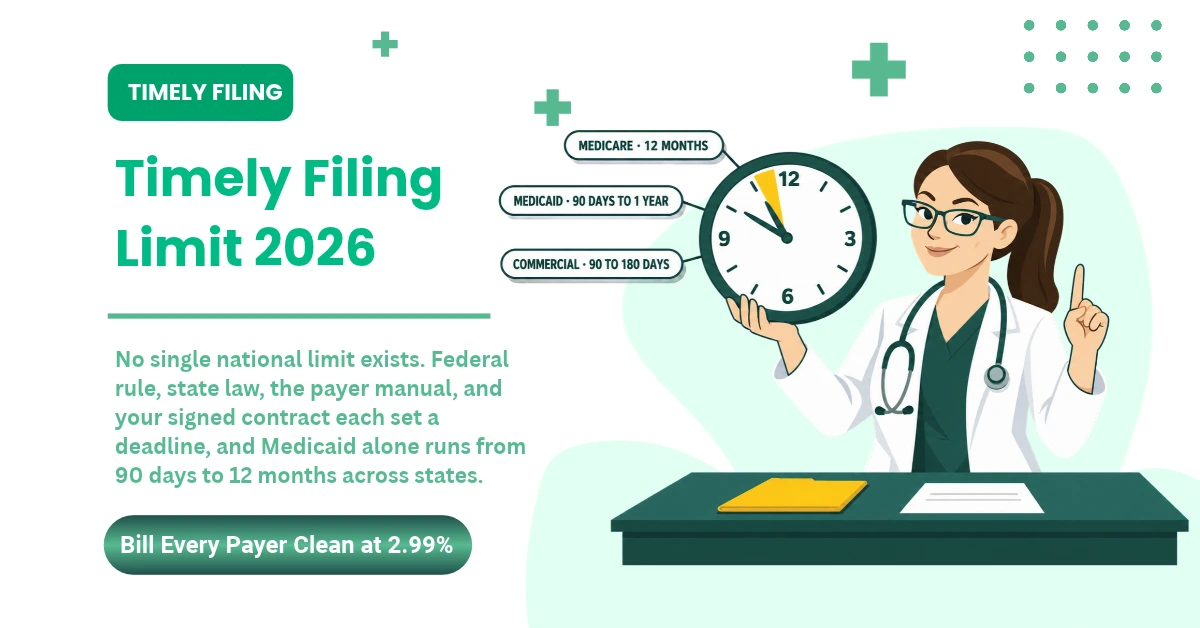
Medicaid takes 90 to 120 days in most states. State Medicaid agencies process applications individually, and they're notoriously slow. Some states allow retroactive billing back to your application date, which helps recover revenue during the waiting period. Because state rules vary so much, our Medicaid credentialing experts can guide you through the specific requirements of your state.
Managed Medicaid plans (like Molina or Centene) have separate credentialing on top of state Medicaid enrollment.
Factors That Delay Credentialing
Incomplete CAQH profiles add two to four weeks automatically. Payers won't process applications until they can verify everything through CAQH. Missing documentation like malpractice certificates or license copies stops the process completely. Payer backlogs during high-volume periods slow everything down. Application errors trigger rejections, and you start over from day one.
How to Speed Up Your Credentialing
Complete your CAQH profile before submitting any applications. Upload all documents upfront instead of waiting for requests. Working with an experienced credentialing partner like MedSole RCM cuts timelines because we know exactly what each payer needs and follow up proactively.
|
Payer Type |
Typical Time |
With MedSole RCM |
|
Commercial (Aetna) |
60–75 days |
45–60 days |
|
Commercial (Cigna) |
60–90 days |
50–75 days |
|
Commercial (BCBS) |
45–90 days |
40–70 days |
|
Medicare |
65–85 days |
55–70 days |
|
Medicaid |
90–120 days |
75–100 days |
Therapist Credentialing Timeline: How Long Does It Really Take?
When someone asks "how long does credentialing take," the honest answer is: it depends on the payer. Commercial insurance moves faster than government programs. Some payers process applications in six weeks. Others take four months. Here's what to expect with each type.
Commercial Insurance Credentialing (60-90 Days)
Commercial payers typically process therapist credentialing applications within 60 to 90 days, but each has its own timeline:
Aetna: 60 to 75 days from complete application submission. They're consistent if your CAQH profile is current and complete.
Cigna: 60 to 90 days. Cigna processes faster when you submit through their online portal instead of paper applications.
Blue Cross Blue Shield: 45 to 90 days, but this varies significantly by state. Each BCBS entity operates independently, so BCBS of Florida processes differently than BCBS of Texas.
UnitedHealthcare/Optum: 60 to 90 days. Optum handles behavioral health credentialing for UHC, so you're working with their team specifically.
Humana: 45 to 60 days. Humana tends to process faster than other commercial payers when documentation is complete upfront.
Medicare Enrollment Timeline (65-85 Days)
Medicare enrollment through PECOS takes 65 to 85 days after submission. Your Medicare Administrative Contractor (MAC) processes applications for your geographic region. Different MACs have different processing speeds, but they're all slower than most commercial payers.
Delays happen when site visits are required or when ownership information needs additional verification.
Medicaid Enrollment Timeline (90-120 Days)
Medicaid takes 90 to 120 days in most states. State Medicaid agencies process applications individually, and they're notoriously slow. Some states allow retroactive billing back to your application date, which helps recover revenue during the waiting period.
Managed Medicaid plans (like Molina or Centene) have separate credentialing on top of state Medicaid enrollment.
Factors That Delay Credentialing
Incomplete CAQH profiles add two to four weeks automatically. Payers won't process applications until they can verify everything through CAQH. Missing documentation like malpractice certificates or license copies stops the process completely. Payer backlogs during high-volume periods slow everything down. Application errors trigger rejections, and you start over from day one.
How to Speed Up Your Credentialing
Complete your CAQH profile before submitting any applications. Upload all documents upfront instead of waiting for requests. Working with an experienced credentialing partner like MedSole RCM cuts timelines because we know exactly what each payer needs and follow up proactively.
Credentialing with Major Insurance Payers: What Therapists Need to Know
Each major payer has its own credentialing quirks. What works for Aetna won't work for Cigna. Understanding these differences saves time and reduces rejections. Here's what you need to know about behavioral health credentialing with each major payer.
Aetna Credentialing for Therapists
Aetna uses your CAQH profile as the foundation for credentialing. Their behavioral health network application requires a current CAQH attestation within the last 120 days. If your profile is outdated, the application won't process.
Submit applications through Aetna's online provider portal. You'll need your professional liability insurance declaration page showing occurrence coverage of at least $1 million per incident and $3 million aggregate. Missing this specific format causes automatic rejections.
Cigna and Evernorth Provider Enrollment
Cigna handles behavioral health credentialing through Evernorth, their specialty division. You're applying to Evernorth specifically, not Cigna directly. That distinction matters when you're tracking application status.
Portal submission through the Evernorth provider portal is required. Paper applications take significantly longer. Evernorth's behavioral health panels have different capacity limits by region, so some areas accept new providers while others have closed panels.
Blue Cross Blue Shield Credentialing
Blue Cross Blue Shield isn't one company. Each state has an independent BCBS entity with its own credentialing process and behavioral health network structure. BCBS of Florida operates completely differently from BCBS of North Carolina.
Check which BCBS entity covers your practice location and apply to that specific organization. Some states have multiple BCBS entities serving different regions. Getting this wrong means your application goes nowhere.
UnitedHealthcare and Optum Credentialing
UnitedHealthcare uses Optum to manage its behavioral health network. When you credential with UHC as a mental health provider, you're actually working through Optum's credentialing team. They handle approvals, contracting, and panel management.
The application portal is Optum-specific. You'll create credentials in their system separate from general UHC provider enrollment. Optum's behavioral health panel availability changes frequently, so panels that were open last month might be closed now.
Medicare Credentialing for Mental Health Providers
Medicare enrollment happens through PECOS, not through insurance credentialing services or CAQH. Mental health providers billing Medicare need to complete the CMS-855I application for individual providers or CMS-855B for group practices.
Your Medicare Administrative Contractor (MAC) processes applications for your region. Different MACs handle different states. Revalidation happens every five years, and missing that deadline terminates your Medicare enrollment completely.
Medicaid Enrollment by State
Medicaid credentialing is state-specific. Each state runs its own enrollment process with unique applications, documentation requirements, and timelines. Some states process Medicaid through managed care organizations (MCOs) like Molina or Centene.
Fee-for-service Medicaid and MCO credentialing are separate processes. You might need both to serve all Medicaid patients in your area. Some states allow retroactive billing to your application date, which helps recover revenue during the credentialing wait.
Need help with a specific payer? MedSole RCM has relationships with all major insurance companies and can expedite your enrollment.
[Ask About Specific Payers]
How Much Do Credentialing Services Cost for Therapists?
Credentialing services pricing varies widely depending on what's included and how many payers you're enrolling with. Understanding the real insurance credentialing services cost helps you budget accurately and avoid surprises.
Industry Pricing Overview
Most credentialing companies charge per payer application. Expect $150 to $500 per insurance submission depending on the payer's complexity and the company's service level. Commercial payers typically cost less than Medicare or Medicaid enrollment.
Full-service packages for multi-payer credentialing run $1,500 to $3,500. These bundles usually cover three to five major payers and include CAQH setup. Some companies add implementation fees of $100 to $300 to start the process.
Monthly maintenance fees for ongoing CAQH attestation and re-credentialing tracking range from $50 to $100 per month. That covers the administrative work to keep your credentials current.
Platform-Based "Free" Credentialing (Hidden Costs)
Platforms like Headway and Alma don't charge upfront credentialing fees. That sounds attractive until you understand the trade-off. They take 10% to 15% of every payment you collect, permanently.
Run the numbers. If you see 20 clients weekly at $150 per session, you're collecting roughly $12,000 monthly. A 12% revenue share costs you $1,440 every month, or $17,280 annually. That's the true cost of "free" credentialing.
ROI of Professional Credentialing
Faster credentialing means faster revenue. Every week you save getting credentialed is a week you can bill insurance instead of turning away clients or collecting out-of-network rates. For most therapists, that's worth $3,000 to $6,000 in revenue per week.
Professional services also reduce errors that cause denials or delays. Your time as a therapist is worth $200 or more per hour. Spending 20 hours on DIY credentialing costs $4,000 in opportunity cost alone.
What to Expect from MedSole RCM
MedSole RCM charges $99 per insurance submission. That includes CAQH management, application completion, payer follow-up, and contracting support. No hidden fees or monthly maintenance charges unless you want ongoing credential monitoring.
Bundled RCM options are available if you need full billing and collections support alongside credentialing. We provide custom quotes based on your practice size and payer mix.
Why Outsource Your Therapist Credentialing? Key Benefits
Handling credentialing yourself is possible. But the question isn't whether you can do it. The question is whether it's the best use of your time and energy. Here's what outsourcing to therapist credentialing services actually delivers. Ultimately, when you choose to outsource provider enrollment to Medsole, you eliminate these risks entirely."
Faster Time to Revenue
Every week spent waiting for credentialing approval is a week you can't bill insurance. Professional credentialing teams know how to avoid the delays that trap DIY applicants. They submit complete applications the first time and follow up proactively when payers go silent.
The easiest way for therapists to become credentialed is letting someone who does this daily handle it. Experience cuts weeks off the timeline. That's revenue in your pocket faster.
Higher Approval Rates
Errors cause rejections. Rejections mean starting over. Professional credentialing teams have submitted thousands of applications and know exactly what each payer wants. They catch mistakes before submission, not after.
Complete applications with properly formatted documentation get approved faster. Incomplete applications sit in limbo or get denied outright. Experience matters here.
Reduced Administrative Burden
DIY credentialing takes 15 to 25 hours per payer. That's time you could spend seeing clients, building your practice, or simply not doing paperwork. For a therapist billing $150 per session, those hours represent $3,000 to $4,500 in lost revenue.
Outsourcing eliminates the frustration of navigating payer portals, gathering documents, and chasing status updates. You hand over your information once and get notified when you're approved.
Ongoing Compliance Management
Credentialing doesn't end at approval. Re-credentialing happens every two to three years. CAQH requires attestation every 120 days. Licenses expire. Malpractice policies renew.
Professional services track all of these deadlines automatically. You get reminders before anything lapses. No gaps in credentialing status means no interruption in your ability to bill.
Access to Expertise
Payers change their requirements. Forms get updated. New documentation standards roll out. Credentialing professionals stay current on all of this so you don't have to.
When problems arise, they know who to call and what to say. That relationship knowledge and problem-solving experience is hard to replicate on your own.
Ready to stop spending hours on credentialing paperwork? Let MedSole RCM handle it while you focus on what you do best: helping clients.
10 Common Therapist Credentialing Mistakes (And How to Avoid Them)
Credentialing for therapists seems straightforward until you hit a roadblock that delays everything. These are the mistakes we see most often, and each one can add weeks or months to your timeline.
1. Incomplete CAQH Profile
Missing fields in your CAQH profile stop every application cold. Payers pull data from CAQH automatically, and incomplete profiles get flagged immediately. Fill out every section before submitting any payer applications.
2. Letting CAQH Attestation Lapse
CAQH requires re-attestation every 120 days. Miss that window and your profile goes inactive. Payers can't access your information, and pending applications stall. Set calendar reminders at 90 days to stay ahead.
3. Wrong Taxonomy Code
Your taxonomy code tells payers your specialty. Using the wrong code causes claim denials after you're credentialed. Verify you're using the correct code for your license type and specialty before submitting.
4. Applying to Closed Panels
Some payers aren't accepting new therapists in certain regions. Submitting applications to closed panels wastes time. Check panel status before applying or work with someone who tracks this information.
5. Not Following Up
Applications don't move themselves. Without proactive follow-up calls, your application sits in a queue. Contact payers every two to three weeks to check status and address any issues.
6. Missing Re-credentialing Deadlines
Therapist credentialing isn't permanent. Payers require re-credentialing every two to three years. Miss the deadline and you can't bill until you complete the process again. Track these dates carefully.
7. Inconsistent Information
When your license says one address and your CAQH says another, applications get flagged for review. Ensure all documents match exactly: name spelling, addresses, dates, and credentials.
8. Ignoring State-Specific Requirements
Each state has unique credentialing requirements. What works in California won't work in Texas. Research state-specific documentation needs before applying.
9. Underestimating Timeline
Starting credentialing one month before you want to see patients guarantees frustration. Plan for 60 to 120 days minimum. Start the process while you're still building your practice infrastructure.
10. Trying to DIY Multi-Payer Enrollment
One payer is manageable. Five payers simultaneously is overwhelming. Each has different portals, forms, and requirements. The complexity increases exponentially, and errors multiply. Consider professional help when enrolling with multiple payers.
Credentialing Solutions for Solo Practitioners vs Group Practices
Credentialing requirements differ based on your practice structure. Solo therapists and group practices face different documentation needs, NPI requirements, and ongoing management challenges. Understanding these differences helps you choose the right approach.
Solo Practitioner Credentialing
Solo therapists need a Type 1 NPI, which identifies you as an individual provider. Your personal CAQH profile contains all your credentialing information, and you'll apply to each payer directly under your own credentials.
New practices face a timing challenge. You can't bill insurance until credentialing is complete, but the process takes 60 to 120 days. Plan your launch timeline accordingly, or consider out-of-network billing initially while you wait for panel approvals.
Group Practice Credentialing
Group practices need both organizational and individual credentialing. The practice itself requires a Type 2 NPI for billing purposes. Each clinician in the group also needs their own Type 1 NPI and completed CAQH profile.
Adding new providers to an existing group requires credentialing each one individually. Some payers expedite this process for established groups with good standing. Others treat every new provider application the same regardless of group history.
Credentialing solutions for therapists in group settings need to track multiple providers, multiple payers, and overlapping re-credentialing deadlines. That complexity is where mental health credentialing services provide the most value.
Multi-State Credentialing
Telehealth expansion means many therapists now practice across state lines. Each state requires separate licensure and separate credentialing with payers operating in that state. BCBS of Florida is completely different from BCBS of Ohio.
Psychology Interjurisdictional Compact (PSYPACT) and counseling compacts simplify licensure for some credentials, but they don't eliminate payer credentialing requirements. You still need to credential with insurance panels in each state where you see patients.
Frequently Asked Questions About Therapist Credentialing
1. How long does therapist credentialing take?
Therapist credentialing typically takes 60 to 120 days depending on the payer. Commercial insurance averages 60 to 90 days. Medicare takes 65 to 85 days through PECOS. Medicaid is slowest at 90 to 120 days. Complete applications with accurate information process faster.
2. How much do credentialing services cost?
Industry pricing ranges from $150 to $500 per payer application. Full-service packages covering multiple payers run $1,500 to $3,500. MedSole RCM charges $99 per insurance submission with no hidden fees. Platform-based "free" options take 10% to 15% of your collections permanently.
3. What is CAQH and why do I need it?
CAQH (Council for Affordable Quality Healthcare) is the central database where most payers verify your credentials. You must complete your CAQH ProView profile before submitting payer applications. Payers pull your information directly from CAQH, and incomplete profiles delay all applications.
4. Can I do credentialing myself?
Yes, but expect to spend 15 to 25 hours per payer. DIY credentialing works for single-payer enrollment. Multi-payer enrollment becomes exponentially complex. Errors cause rejections and restarts. Most therapists find the time investment isn't worth it compared to professional help.
5. What documents do I need for insurance credentialing?
You'll need your professional license, malpractice insurance certificate, NPI confirmation, board certifications, diploma or transcripts, DEA registration if applicable, and work history for five to 10 years. All documents must match exactly across your CAQH profile and applications.
6. What's the difference between credentialing and contracting?
Credentialing verifies your qualifications and approves you as an eligible provider. Contracting establishes your fee schedule and payment terms with the payer. Both steps are required before you can bill insurance. Credentialing comes first, then contracting follows.
7. Do I need to be credentialed in every state I practice?
Yes. Each state requires separate credentialing with payers operating in that state. Telehealth across state lines means credentialing in each state where your patients are located. Interstate compacts help with licensure but don't eliminate payer credentialing requirements.
8. How do I get credentialed with Aetna as a therapist?
Complete your CAQH ProView profile first. Then submit an application through Aetna's online provider portal. You'll need current malpractice insurance showing at least $1 million per incident coverage. Aetna typically processes complete applications in 60 to 75 days.
9. What types of therapists can get credentialed with insurance?
LCSWs, LPCs, LMFTs, psychologists, BCBAs, and PMHNPs can all credential with insurance panels. Requirements vary by credential type and state. Some payers restrict panels for certain specialties. Provisionally licensed clinicians may face limitations depending on state and payer policies.
10. What is the easiest way for therapists to become credentialed?
Working with a professional credentialing service is the easiest approach. They handle CAQH setup, payer applications, follow-up, and contracting. You provide documents once and get notified when you're approved. This saves 15 to 25 hours per payer and reduces errors.
11. What happens if my credentials lapse?
Lapsed credentials mean you can't bill insurance until you complete re-credentialing. Claims submitted during gaps get denied. Some payers terminate your contract entirely, requiring you to start the full credentialing process over. Gaps also affect your credentialing history with future applications.
12. How often do I need to re-credential?
Most payers require re-credentialing every two to three years. CAQH requires attestation every 120 days to keep your profile active. License renewals and malpractice policy renewals must be updated as they occur. Missing any deadline creates billing gaps.
13. Can I get credentialed while still in supervision?
It depends on your state and the payer. Some payers credential provisionally licensed therapists with supervision documentation. Others require full independent licensure. Check with each payer before applying. Supervision requirements must be clearly documented in your application.
14. What is the difference between NPI Type 1 and Type 2?
Type 1 NPI identifies individual providers. Every therapist needs a Type 1 NPI for personal credentialing. Type 2 NPI identifies organizations like group practices. Group practices need a Type 2 NPI plus individual Type 1 NPIs for each provider in the group.
15. Does MedSole RCM offer credentialing as part of RCM services?
Yes. MedSole RCM provides credentialing integrated with full revenue cycle management. We handle credentialing, billing, collections, and denial management as one seamless service. This ensures smooth transition from credentialing approval to active insurance billing without gaps.
Still have questions? Our credentialing specialists are here to help. Schedule a free consultation to discuss your specific situation.
Get Started with Professional Credentialing Solutions
Credentialing is the gateway to insurance revenue. Without it, you can't bill the payers your clients use. The process takes 60 to 120 days, requires ongoing maintenance, and involves enough complexity that most therapists benefit from professional support.
You've seen what's involved: CAQH management, payer applications, follow-up, contracting, and re-credentialing every few years. Each step has potential pitfalls that delay revenue or cause denials. Therapist credentialing services eliminate those risks.
MedSole RCM approaches credentialing differently. We don't treat it as an isolated task. Credentialing is the first step in your revenue cycle, and we manage it alongside billing, collections, and denial resolution. When your credentialing is complete, billing starts immediately with no handoff delays.
Credentialing solutions for therapists should integrate with your full revenue cycle. That's what we provide.
Ready to streamline your credentialing and revenue cycle? MedSole RCM provides end-to-end credentialing integrated with full billing and collections support.
-
Fast credentialing (45 to 90 days)
-
All major payers covered
-
CAQH management included
-
Seamless transition to billing
-
Dedicated account manager
[Schedule Free Credentialing Consultation]