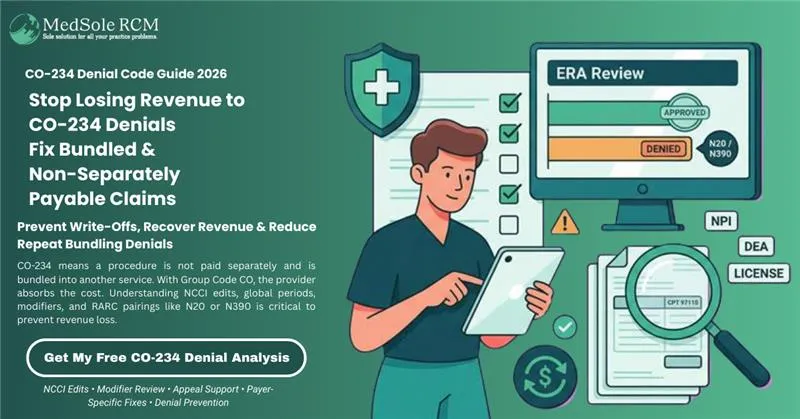




The CO-234 denial code means a billed procedure or service isn't separately payable. Also known as CO 234 denial code, it indicates the payer considers the service bundled into, incidental to, or included in another procedure already reimbursed on the same date of service.
Per the X12 CARC definition, at least one Remark Code, such as RARC N20, must accompany every denial code 234 adjustment.
MedSole RCM's billing team works CO-234 denials daily across dozens of specialties. This guide covers what the code means, why it gets triggered, and how your staff can resolve it correctly.
CO-234 Quick Reference
|
Field |
Detail |
|
Code |
CARC 234 (CO-234) |
|
Group Code |
CO (Contractual Obligation) |
|
Official Description |
"This procedure is not paid separately." |
|
Effective Date |
January 24, 2010 (X12 start date) |
|
Patient Liability |
None; CO means the provider absorbs the adjustment |
|
Required Companion |
At least one Remark Code must be provided |
|
Most Common RARC |
N20 ("Service not payable with other service rendered on the same date") |
|
Related CARC |
CO-97 (Procedure/service is incidental) |
What Is CO-234 Denial Code?
What does denial code CO 234 mean? It's actually two pieces of information shown together on your ERA or EOB. "CO" is the Group Code, standing for Contractual Obligation. It tells you who absorbs the cost. With CO, your practice does. You can't bill the patient for this amount.
The number 234 is the Claim Adjustment Reason Code, or CARC. Here's what the CO 234 denial code meaning boils down to: the payer decided your service is already covered by another paid procedure and set that line to zero.
When the CO 234 denial code description shows up on your remittance, don't assume you made a coding error. Sometimes the bundling is legitimate, and a write-off is the correct move. Other times, the payer applied the wrong edit, and the service genuinely was distinct. Your next step depends entirely on the root cause.
CO Group Code vs. CARC 234: Understanding the Difference
Billers often confuse the Group Code with the Reason Code, but they serve completely different purposes. One tells you who's financially responsible. The other, including denial code CO 234, tells you why the adjustment happened.
|
Element |
Group Code: CO |
Reason Code: 234 |
|
What it represents |
Financial responsibility assignment |
Adjustment explanation |
|
Full meaning |
Contractual Obligation |
Procedure not paid separately |
|
Who absorbs the cost |
Provider, per contract |
Determined by the Group Code |
|
Can you bill the patient? |
No, CO prohibits patient billing |
N/A; the CARC doesn't determine liability |
|
Where it appears on ERA |
CAS segment, Group Code field |
CAS segment, Reason Code field |
|
Action required |
Adjust off or appeal |
Review bundling logic and the remark code |
Getting this distinction right matters. If your team sends every CO-234 straight to appeals, they're wasting time on valid write-offs. And writing everything off without reviewing means you're losing revenue that could've been recovered. Check the Group Code first. Then the Reason Code. The order changes the entire workflow.
CO-234 Denial Code Description: Official CARC Language Explained
Here's the official X12 language for CARC 234:
"This procedure is not paid separately. At least one Remark Code must be provided (may be comprised of either the NCPDP Reject Reason Code, or Remittance Advice Remark Code that is not an ALERT)."
"Not paid separately" means the service is bundled, incidental, or included in another procedure's payment. The payer won't reimburse it as its own line item. The NCPDP Reject Reason Code applies mainly to pharmacy claims, so in medical billing, your focus should be the Remittance Advice Remark Code, or RARC.
Here's where billers often miss something critical. The payer is required to attach a RARC explaining why they bundled the service. If your ERA shows CO-234 without any remark code, the payer didn't meet this requirement. Call and request it. You can't determine your corrective action without it.
You'll see this referenced as "CO 234 denial code description," "234 denial code description," "CO-234 denial code descriptions," or simply "denial code CO-234." Payer portals and clearinghouses format it differently, but what the CO 234 denial code descriptions stand for is the same: the service wasn't reimbursed as a standalone line.
CO-234 vs. PI-234 vs. PR-234 vs. OA-234: Group Code Differences
The 234 denial code can show up with four different group codes: CO, PI, PR, and OA. Each one changes who's financially responsible for the adjustment. Cash posting it wrong means either leaving money on the table or billing a patient for something they don't owe.
|
Group Code |
Full Name |
Financial Responsibility |
Can You Bill the Patient? |
Common Scenario |
|
CO |
Contractual Obligation |
Provider absorbs per contract |
No |
Bundled service per payer contract; adjust off |
|
PR |
Patient Responsibility |
Patient owes the amount |
Yes |
Service not covered under plan (rare with 234) |
|
PI |
Payer Initiated |
Payer-initiated reduction |
No |
Payer unilaterally reduces; may be appealable |
|
OA |
Other Adjustment |
Cannot be assigned to CO, PR, or PI |
Depends on contract |
Coordination of benefits or secondary payer scenarios |
CO-234 is what you'll see most of the time. The provider absorbs the cost per their payer contract, and the patient can't be billed for the adjusted amount. Most bundling edits from NCCI and payer-specific rules use the CO group code.
The PI 234 denial code is less common but worth knowing. PI stands for Payer Initiated, meaning the payer reduced payment on their own rather than pointing to a contract term. When you see the PI 234 denial code description on your ERA, it often signals that the adjustment is appealable.
Seeing a PR 234 denial code with CARC 234 is rare. PR means Patient Responsibility, so your team can bill the patient for the balance. In practice, this usually surfaces when a service falls completely outside the plan's coverage. Confirm the PR 234 denial code description before sending a patient statement.
The OA 234 denial code typically appears in coordination of benefits situations. OA stands for Other Adjustment, used when liability doesn't clearly fall under CO, PR, or PI. You'll see it when a secondary payer adjusts a line based on what the primary already paid.
Before your team takes any action on a PI-234 denial code or any other variant, verify the group code. That single field determines whether you write off the amount, bill the patient, or prepare an appeal.
Top 7 Reasons for CO-234 Denial Code
The CO-234 denial code description says "procedure not paid separately," but that doesn't tell you why the payer bundled it. Each CO 234 denial code reason points to a different action, and picking the wrong one wastes time. These are the seven root causes we see most often at MedSole RCM.
1. Service Bundled with Another Procedure (NCCI/CCI Edits)
Two CPT codes billed on the same date can trigger an NCCI Procedure-to-Procedure edit. The payer reimburses the primary code and denies the secondary as CO-234. It's the single most common cause of this denial.
Example: Billing CPT 97140 (manual therapy) alongside 97110 (therapeutic exercise) without Modifier 59. The payer bundles 97140 into 97110 and returns CO-234 with Remark Code N20.
ERA signal: RARC N20 on the denied line. Check the CMS NCCI PTP Edit Lookup Tool to confirm whether the code pair allows a modifier override.
2. Global Surgical Package Inclusion
Any service performed during a surgery's pre-op, intra-op, or post-op window is already included in the surgical fee. Billing those services as separate line items triggers CO-234 because the payer considers them already paid under the CMS global surgery package.
Example: A surgeon bills 99213 for an office visit 15 days after a procedure with a 90-day global period. The payer denies the visit because it falls within that window.
ERA signal: Look at the denied service date relative to any surgery on the same patient. CMS defines the 0-day, 10-day, and 90-day global periods.
3. Incidental Procedures
Some procedures are minor components of a primary service. They're performed through the same incision, same approach, or within the same operative field. Payers consider them incidental and won't reimburse them separately.
Example: Take lysis of adhesions (CPT 44005) billed alongside a primary abdominal surgery. The payer considers the lysis incidental to the main procedure.
ERA signal: A lower-RVU code at the same anatomical site as the primary, billed on the same date of service.
4. Missing or Incorrect Modifiers
The service is legitimately distinct, but the claim doesn't include the right modifier. Without that signal, the payer defaults to its bundling edit. Modifiers 59, 25, XE, XS, XP, XU, 24, and 79 each serve a different purpose.
Example: Consider billing 99214 (E/M) on the same day as a procedure without Modifier 25. The payer denies the E/M as CO234 because nothing indicated it was separately identifiable.
ERA signal: RARC N390 alongside CO-234, telling you a modifier was expected and missing. Accurate medical billing and modifier usage prevent this from becoming a recurring pattern.
5. Add-On Code Billed Without Its Primary Code
Add-on CPT codes, marked with a "+" in the CPT manual, only pay when billed alongside their designated parent code. Filing one without its parent triggers CO-234.
Example: Submitting +99417 (prolonged services) without the base code 99205 or 99215 on the same claim.
ERA signal: The denied line is an add-on code, and no corresponding primary code appears on the claim.
6. Payer-Specific Bundling Rules
Commercial payers apply their own edits beyond NCCI. What Medicare pays separately, a commercial plan may bundle. These rules vary by payer, by contract, and sometimes by plan type.
Example: United Healthcare bundles certain radiology services that Medicare reimburses independently. A claim passing Medicare edits can still deny as CO 234 denial code on a UHC claim.
ERA signal: CO-234 on commercial claims for code pairs that Medicare pays without issue. Check the payer's provider portal for their bundling policies.
7. Duplicate or Overlapping Service Lines
Multiple codes describing essentially the same service at the same anatomical site will trigger CO-234. Only the more comprehensive code gets paid; the component is denied.
Example: A common scenario: billing 93000 (ECG with interpretation) and 93005 (ECG tracing only) on the same date. The payer pays 93000 and denies 93005 because both cover the tracing component.
ERA signal: Two codes on the same claim where one is a subset of the other.
Common 234 Remark Code Pairings and What They Mean
When the CO 234 denial code description appears on your ERA, the accompanying Remark Code is your real diagnostic clue. It points to the specific bundling rule the payer applied and shapes your entire resolution approach.
CARC 234 requires at least one RARC, so every CO-234 should have one attached. Here's what each common 234 remark code pairing means and what action it requires.
|
Remark Code |
Description |
What It Tells You |
Required Action |
|
N20 |
Service not payable with other service rendered on the same date |
Same-day bundling edit |
Review NCCI edits. If distinct, add Modifier 59/X{EPSU} and resubmit. If valid, adjust off. |
|
N390 |
Missing/incomplete/invalid modifier |
Payer expected a modifier to justify separate payment |
Add the correct modifier with supporting documentation and resubmit. |
|
M15 |
Separately billed service/procedure not separately payable |
Service is a component of a comprehensive procedure |
Review if service should be part of the primary procedure. Adjust off if valid. |
|
M80 |
Not covered when performed during the same session/date |
Same-session rule violation |
Verify if services were at different sessions. If same session, adjust off. |
|
N19 |
Procedure code not consistent with modifier used or missing modifier |
Modifier mismatch or absence |
Correct modifier usage and resubmit. |
N20 is the most common pairing, especially on Medicare claims. MACs like Noridian and CGS regularly issue CO-234 with N20 for same-day service bundling.
Start by checking the NCCI PTP edits for the code pair. When a modifier override is allowed and the services were truly distinct, resubmit with Modifier 59 or the appropriate X modifier. Adjust off the balance if bundling is valid.
When reason codes CO 234 and remark code N390 appear together, the payer is telling you a modifier was expected and missing. Review which modifier applies to the code pair, attach supporting documentation, and resubmit the corrected claim. N390 denials are among the more straightforward to overturn.
A CO 234 denial code with M80 points to a same-session edit. Verify whether the services were performed at genuinely different sessions before deciding on your response.
The CO 234 M15 denial code pairing means the payer considers the service a component of a more comprehensive procedure. Review the operative or procedure notes to determine whether the service truly stands alone.
Seeing denial code N19 and CO-234 together signals a modifier mismatch. The modifier you submitted doesn't match what the code requires, or it's missing entirely. Correct it and resubmit.
If CO-234 shows up without any remark code at all, call the payer. You need the specific RARC to determine your next step.
MedSole RCM's denial management team cross-references every CO-234 against its remark code before choosing a resolution path. Without that systematic step, denials sit in the queue longer than they need to.
Spending too much time decoding CO-234 remark code pairings? MedSole RCM's denial management services team traces every CO-234 denial to its root cause, whether it's an NCCI edit, a missing modifier, or a payer-specific bundling rule. We handle the corrected claims, appeals, and follow-up so your staff can focus on the front end. Talk to our denial management team →
How to Resolve CO-234 Denial Code: Step-by-Step Workflow
Knowing the CO-234 denial code description and its causes is one thing. Fixing it is another. This CO 234 denial code resolution workflow gives your team a repeatable process for every CO-234 that hits your aging report. It's the same CO 234 denial code solution framework MedSole RCM's denial analysts follow daily.
Step 1: Read the Full ERA/EOB Line
Start with the denied line item. Identify the CPT code, the Group Code (CO), the CARC (234), and every RARC attached. Don't stop there.
Cross-reference the denied line with every paid line on the same claim or date of service. The paid line is the service the payer considers the "parent." That's what your denied service got bundled into. Knowing which code absorbed yours tells you whether the CO 234 denial was valid.
This takes two to three minutes. Skipping it leads to blind appeals that go nowhere.
Step 2: Identify the Root Cause Category
Use the remark code and the seven causes from the previous section to assign one label. Just one. Pick the category that best fits the CO 234 denial code and action required:
- NCCI/PTP bundle
- Global surgical package
- Incidental procedure
- Missing or incorrect modifier
- Add-on code issue
- Payer-specific bundling policy
- Duplicate or overlapping codes
Getting the category right is what separates a five-minute resolution from a two-week runaround.
Step 3: Decide: Adjust Off or Correct and Appeal
Not every CO-234 should be appealed, and not every one should be written off. Here's the decision framework.
|
Root Cause |
If the Bundling Is Valid |
If the Bundling Is Incorrect |
|
NCCI edit |
Adjust off the balance |
Correct claim with Modifier 59 or X modifier, plus documentation |
|
Global package |
Adjust off |
Appeal with Modifier 24 or 79, plus supporting documentation |
|
Missing modifier |
N/A, the modifier was missing |
Correct claim with the appropriate modifier |
|
Payer-specific policy |
Adjust off; negotiate in next contract cycle |
Appeal with the payer's own published guidance as evidence |
|
Duplicate codes |
Adjust off |
Resubmit if the codes truly represent different services |
This table saves hours of guesswork. Print it. Post it next to the billing workstation. Your denial team will use it daily.
Step 4: Correct and Resubmit (When Applicable)
If the denial happened because of a coding or modifier error, submit a corrected claim. Use the corrected claim frequency code, not a brand-new claim. Include the right modifier, updated code sequencing, and any supporting documentation.
Run the corrected claim through your clearinghouse scrubber before sending. Catching a second error on the resubmission slows everything down.
Step 5: Appeal with Documentation (When Applicable)
When the original claim was coded correctly but the payer applied the wrong edit, a formal appeal is the right path. Your appeal package should include:
- Operative or procedure notes for the denied service
- Operative or procedure notes for the primary paid service
- A cover letter referencing the specific RARC and why the payer's determination was incorrect
- Any payer policy references that support your position
Section 10 of this guide includes a ready-to-use appeal letter template for CO-234 denials.
Step 6: Follow Up and Track
Submit the corrected claim or appeal, then follow up within 30 days. Don't let it sit. Track the denial-to-resolution timeline and log the outcome.
If the same CPT code pair keeps producing CO-234 denials with the same payer, that's a pattern. Flag it. A repeating CO-234 denial isn't a one-off error; it's a process gap that needs fixing upstream.
Consistent AR follow-up on denied claims is what separates practices that recover revenue from those that leave it on the table.
CO-234 Resolution by Payer
The general resolution steps above work for most CO 234 denial code situations. But payers don't all follow the same playbook. Medicare uses NCCI edits. Commercial payers layer proprietary edits on top. What gets paid separately by one payer gets bundled by another.
Here's how to approach CO-234 resolution with the payers your team deals with most often.
CO-234 Resolution for Medicare Claims
Medicare's bundling logic runs almost entirely on NCCI PTP edits and global surgery rules. When you see a Medicare denial code CO 234, your first stop should be the CMS NCCI Lookup Tool. Check whether the code pair allows a modifier override.
A few things to know about Medicare CO-234 denials specifically:
- CMS enforces zero-day, 10-day, and 90-day global periods strictly. Post-op visits within the global window get denied unless you can document an unrelated service with Modifier 24.
- Not all NCCI edits are modifier-overridable. Some code pairs are a hard "no" regardless of documentation.
- For DME claims processed by MACs like CGS Administrators or Noridian, the CGS CO-234 denial code with remark code N20 is common and often not appealable. The service is simply included in the primary DME allowance.
Keeping Medicare medical billing compliance tight on the front end prevents most of these.
CO-234 Resolution for Blue Cross Blue Shield (BCBS)
Every BCBS plan is different. The Blue in Texas doesn't follow the same bundling rules as the Blue in Pennsylvania. That's the reality of dealing with CO 234 denial code BCBS denials.
Most BCBS plans use NCCI edits as a baseline, then add their own proprietary edits on top. Your appeal should reference the specific state plan's provider manual, not generic BCBS guidelines. Check their online portal first. Many BCBS portals show the specific edit reason tied to the CO-234 denial, which saves you a phone call.
CO-234 Resolution for United Healthcare (UHC)
UHC applies NCCI edits and their own Optum-powered clinical editing system. The Optum edits can be more restrictive than Medicare's, so a code pair that Medicare pays separately may still get bundled by UHC. Keep that in mind before assuming a UHC denial code 234 is wrong.
For United Health Care denial code 234 appeals, use UHC's Provider Portal or submit via fax. Reference their Reimbursement Policy Updates, which detail specific bundling rules. These policies change periodically, so check for updates before building your appeal argument.
CO-234 Resolution for Aetna and Cigna
Both Aetna and Cigna maintain their own clinical editing programs. Aetna uses Clinical Policy Bulletins. Cigna uses Coverage Policy documents. Each one outlines which services are bundled and under what conditions.
For either payer, pull their published policy for the specific procedure before deciding whether to appeal or adjust. If their policy supports separate payment and your documentation backs it up, file the appeal. If their policy explicitly bundles the service, adjust off and focus your energy on preventing the next one.
Sample Appeal Letter for CO-234 Denial
When you've confirmed the CO-234 denial was applied incorrectly and the services were genuinely distinct, an appeal is the right move. Don't wing it. Use a structured letter that references the specific RARC, the payer's own policy, and your supporting documentation.
Customize the bracketed fields below for your situation.
[Practice Letterhead]
[Date]
[Payer Name]
[Payer Appeals Department Address]
RE: Appeal of CO-234 Denial
Patient Name: [Patient Full Name]
Patient ID/Member Number: [Number]
Date of Service: [MM/DD/YYYY]
Claim Number: [Number]
Denied CPT Code(s): [Code(s)]
CARC: 234 | RARC: [Remark Code, e.g., N20]
Dear Appeals Review Committee,
We are writing to appeal the denial of [CPT Code] billed on [Date of Service] for patient [Patient Name]. The claim was denied under CARC 234 ("This procedure is not paid separately") with Remark Code [RARC].
We respectfully disagree with this determination for the following reason(s):
☐ The denied service was performed at a separate anatomical site from the primary procedure ([Primary CPT Code]). Per NCCI guidelines, Modifier [59/XS/XE] is appropriate. Documentation supporting the distinct nature of this service is enclosed.
☐ The denied service was a significant, separately identifiable evaluation and management service (Modifier 25), with documentation demonstrating clinical work beyond the procedure.
☐ The denied service was performed during the global period but was unrelated to the original surgery (Modifier 24/79), supported by a separate diagnosis ([ICD-10 Code]).
☐ The denied service does not meet the criteria for bundling under [Payer Name]'s published policy [Reference Number/Title].
Enclosed Documentation:
- Operative/Procedure Note for [Denied CPT Code]
- Operative/Procedure Note for [Primary CPT Code]
- Medical records supporting the separate nature of services
- [Additional documentation as applicable]
We request that this claim be reprocessed for appropriate reimbursement. Please contact us at [Phone] or [Email] for any questions.
Sincerely,
[Provider Name, Credentials]
[Practice Name]
[NPI Number]
[Contact Information]
Tips for Using This Template
Keep these in mind before you hit send:
- Send with tracking. Use certified mail or your payer portal's electronic appeal submission. You need proof it was received.
- Keep a copy. Save the letter, the attachments, and the submission confirmation together in the patient's billing file.
- Follow up in 30 days. Don't wait for the payer to respond on their timeline. Call or check the portal. Timely AR follow-up on appealed claims keeps them from falling through the cracks.
- Watch the deadline. Most payers require appeals within 60 to 180 days of the initial determination. Miss it, and the appeal is dead regardless of merit.
A strong appeal letter with clear documentation wins more often than most billing teams expect. The key is specificity. Vague appeals get denied. Precise ones, referencing the exact RARC and the exact reason the bundling was incorrect, get overturned.
CO-234 appeals piling up on your desk? Writing them, tracking resubmissions, and chasing payer-specific rules takes hours your billing team doesn't have. MedSole RCM's denial management services team handles the full cycle: root cause analysis, corrected claims, appeal submission, and payment recovery. We do this across all payers, all specialties, every day. Get a free denial analysis →
Want a broader look at your revenue cycle management? We can help with that too.
How to Prevent CO-234 Denials: 7 Proactive Strategies
Understanding the CO-234 denial code description is one thing. Preventing it from showing up on your remittance in the first place is what actually protects your revenue. Most CO-234 denials aren't random. They follow patterns. Find the pattern, fix the process, and the CO 234 denial code volume drops.
Here's what works.
1. Run Pre-Submission Claim Scrubbing
Your clearinghouse or practice management system should flag NCCI edit violations, bundling conflicts, and missing modifiers before claims go out the door. A scrubber that catches a CO-234 trigger before submission costs you nothing. Reworking a denied claim costs staff time, payer hold times, and delayed revenue.
If your current scrubber isn't catching CO 234 issues, it's either outdated or misconfigured. Either way, fix it.
2. Build a Modifier Decision Matrix
Create an internal one-page reference for your coders. It should answer one question: "When do I use which modifier?" Cover Modifiers 25, 59, 24, 79, XE, XS, XP, and XU. Include the criteria for each, not just the definition.
Both under-use and over-use of modifiers cause problems. Under-use triggers CO-234 denials. Over-use triggers audits. The matrix keeps your team in the safe zone.
3. Track Global Surgery Periods Systematically
Flag patients in your practice management system whenever a procedure with a global period is performed. Set automated alerts so that any same-surgeon E/M or procedure claim generated during the global window gets reviewed before submission.
Manual tracking works until it doesn't. One missed global period flag turns into a preventable CO-234 denial.
4. Monitor Payer-Specific Bundling Updates
Payers change their bundling edits without much warning. What got paid separately last quarter might get bundled this quarter. Assign someone on your team to review payer bulletins and policy update notifications at least quarterly.
This is especially important for commercial payers that apply proprietary edits beyond NCCI.
5. Conduct Monthly Denial Trend Analysis
Track your top 20 CPT code pairs producing CO-234 denials, broken down by payer and location. If the same code pair keeps getting denied by the same payer, that's not a coding error. That's a systemic issue that needs a coding rule or workflow change.
Practices that invest in RCM optimization and denial trend analytics catch these patterns before they turn into revenue leaks.
6. Keep Coders Current on Bundling Rules
NCCI edits update quarterly. Payer policies change. New CPT codes create new bundling relationships every January. Regular training on NCCI updates, modifier usage, and payer-specific rules isn't optional if you want to keep CO 234 denials under control.
AAPC and AHIMA both offer continuing education modules specifically on bundling and unbundling. They're worth the investment.
7. Verify Coverage Before Rendering Services
This one's simple but often skipped. Confirm that the planned services are covered under the patient's plan before performing them. Check whether prior authorization is required. A service that isn't covered by the plan can manifest as CO-234 when the payer considers it non-reimbursable.
Strong front-end patient registration and eligibility verification catches these issues before they become denials.
Financial Impact of CO-234: Write-Off vs. Appeal vs. Patient Bill
Not every CO-234 denial deserves the same response. Some should be written off immediately. Others are worth the time and cost of an appeal. Making that call correctly is what keeps your denial management efforts efficient rather than just busy.
Here's the decision framework.
|
Scenario |
Action |
Financial Outcome |
When to Choose |
|
Bundling is valid per contract and policy |
Write off the denied amount |
Provider absorbs cost as a contractual adjustment |
NCCI edit is correct; the service is truly bundled |
|
Bundling is incorrect, services were distinct |
Correct claim and resubmit with modifier and documentation |
Full reimbursement of the denied line |
Documentation supports a distinct service |
|
Payer applied the edit incorrectly |
Appeal with supporting documentation |
Revenue recovery, plus a precedent for future claims |
Payer's own published policy contradicts their edit |
|
CO should have been PR |
Challenge the group code assignment |
Potential patient billing recovery |
Rare; requires contract review |
The cost of appealing a single CO-234 denial, counting staff time, documentation gathering, and follow-up, typically runs $25 to $50 per claim. If the denied line item is worth more than that and the appeal has merit, pursue it. If the service value is low or the bundling is clearly valid, the smarter move is to write it off and redirect your team's effort toward prevention.
That's the real calculus. It's not about winning every appeal. It's about recovering the most revenue with the least overhead.
MedSole RCM's denial management team evaluates every CO-234 denial for appeal viability before investing time in it. That discipline is what keeps denial resolution cost-effective instead of just thorough.
CO-234 vs. CO-97: What's the Difference?
These two denial codes look similar, and billers often confuse them. Both deal with bundling. Both result in $0 payment on a line item. But they're telling you different things, and the distinction affects how you respond.
|
Element |
CO-234 |
CO-97 |
|
CARC Description |
"This procedure is not paid separately." |
"The benefit for this service is included in the payment/allowance for another service/procedure already adjudicated." |
|
Core Meaning |
Service is not separately payable; general bundling |
Service is incidental to another already-paid service |
|
Key Difference |
Broader: covers bundling, global packages, add-on rules, and payer edits |
Narrower: specifically indicates inclusion in another service that was already adjudicated |
|
Remark Code Required |
Yes; at least one RARC must be provided |
Not explicitly required by the CARC definition |
|
Resolution Approach |
Review NCCI edits, modifiers, global period rules |
Focus on identifying the specific "other service" that absorbed the denied line |
Here's the practical difference. CO-97 tells you which paid service swallowed your denied one. CO-234 tells you the denied service itself isn't separately payable, but it doesn't always point you to a specific paid code.
If both codes show up on the same claim, read them together. CO-97 identifies what absorbed the service. CO-234 confirms the service can't stand on its own. Between the two, you'll have enough information to determine whether the bundling was valid or worth challenging.
2025/2026 Update: Has CO-234 Changed?
As of February 2025, the X12 CARC 234 definition hasn't changed since its original start date of January 24, 2010. The official description, "This procedure is not paid separately," and the remark code requirement are exactly the same.
What does change is how payers apply it. CMS updates NCCI PTP edits quarterly, which means the list of CPT code pairs that trigger CO-234 on Medicare claims shifts four times a year. Commercial payers update their own proprietary bundling edits on their own schedules, sometimes with little notice.
The code itself is stable. The rules surrounding it are not. Review NCCI updates each quarter and monitor your top payer bulletins for bundling changes that affect your most commonly billed procedures. That's how you stay ahead of CO-234 rather than reacting to it after the denial lands.
Frequently Asked Questions About CO-234 Denial Code
What does denial code CO-234 mean?
CO-234 means the billed procedure isn't separately payable. The payer considers it bundled into, incidental to, or included in another service already reimbursed on the same claim. Because the group code is CO (Contractual Obligation), the provider absorbs the adjustment. You can't bill the patient for this amount.
What is the CO-234 denial code description?
The official X12 CARC 234 description reads: "This procedure is not paid separately." At least one Remark Code must accompany the denial, either an NCPDP Reject Reason Code or a Remittance Advice Remark Code that isn't an ALERT. The remark code identifies which specific bundling rule the payer applied.
Can I bill the patient for a CO-234 denial?
No. The CO group code stands for Contractual Obligation. That means the provider is responsible for the adjustment under the terms of their payer contract. Billing patients for amounts adjusted under CO violates most contracts and could create compliance risks.
What remark code usually accompanies CO-234?
N20 is the most common. It means "Service not payable with other service rendered on the same date." Other pairings include N390 (missing or invalid modifier), M15 (service not separately payable), M80 (same-session rule), and N19 (modifier mismatch). Each RARC points to a different bundling rule and requires a different corrective action.
How do I resolve a CO-234 denial?
Start by reading the remark code on the ERA to identify the root cause. If the service was validly bundled, adjust off the balance. If it was distinct, correct the claim with the appropriate modifier, such as 59, 25, XE, or XS, and include supporting documentation. When the original coding was correct but the payer's edit was wrong, file a formal appeal.
Is CO-234 the same as CO-97?
No. CO-234 broadly indicates a procedure isn't separately payable, covering NCCI edits, global packages, and add-on rules. CO-97 is more specific: it means the service's benefit is included in the payment for another service that was already adjudicated. CO-97 points you to the paid service that absorbed yours. CO-234 doesn't always do that.
Does CO-234 apply to Medicare claims?
Yes. Medicare uses CARC 234 with the same X12 definition. CO-234 on Medicare claims is typically triggered by NCCI PTP edits or global surgery package rules. The most common pairing is CO-234 with Remark Code N20, especially on claims processed by Medicare Administrative Contractors like Noridian and CGS.
What modifiers can help prevent CO-234 denials?
Modifier 59 indicates a distinct procedural service for non-E/M codes. Modifier 25 supports a separately identifiable E/M on the same day as a procedure. Modifier 24 covers an unrelated E/M during a global surgical period. Modifier 79 applies to an unrelated procedure during a global period. The X modifier family (XE, XS, XP, XU) provides more specific alternatives to Modifier 59. Use any of these only when the services are genuinely distinct and your documentation supports it.
Stop Losing Revenue to CO-234 Denials
Every CO-234 denial that sits unworked is revenue your practice earned but never collected. And every recurring CO-234 pattern is a process gap that compounds month after month.
At MedSole RCM, our certified billing specialists and denial management team work codes like CO-234 across every major payer and specialty. We identify root causes, submit corrected claims, file appeals with documentation, and build prevention protocols so the same denials stop repeating.
If CO-234 denials are showing up on your aging report more than they should, here's the next step.
Schedule a Free Denial Analysis →
Or take a closer look at our full revenue cycle management and medical billing services.