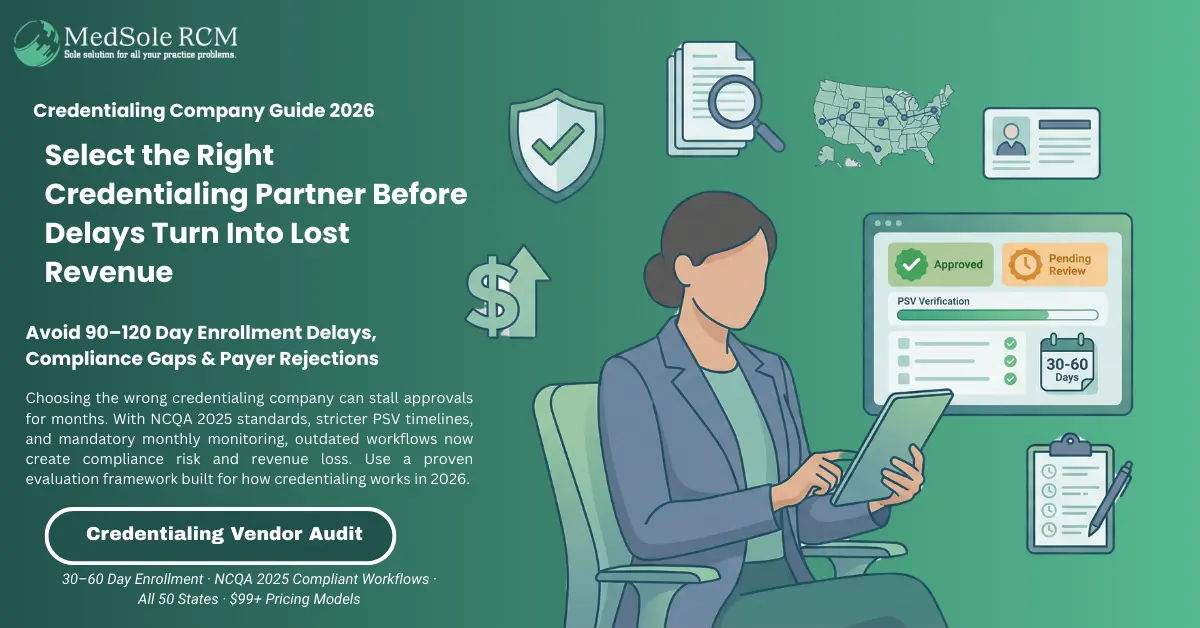




The credentialing company you choose controls how fast your providers get approved, how clean your claims stay, and how predictable your revenue remains. Pick the wrong partner, and you'll watch months of reimbursement disappear while applications sit untouched in payer queues. Pick the right one, and every new provider starts generating revenue within weeks of joining your practice.
Here's the problem most providers run into. The market is flooded with credentialing companies, and almost every "best of" list you find online was written by one of them. There's no neutral framework. No honest comparison. Just vendors ranking themselves at the top.
That changed in 2025 when NCQA released its biggest credentialing standards overhaul in 20 years. What worked in 2024 doesn't cut it anymore. Shorter verification windows, mandatory monthly monitoring, stricter audit trails: your credentialing partner either meets these new standards or they're already putting your compliance at risk.
This guide gives you the framework that doesn't exist anywhere else.
What you'll walk away with:
-
How credentialing rules changed under NCQA's 2025 standards and Joint Commission's Accreditation 360
-
The CAQH credentialing process broken down step-by-step
-
Realistic payer timelines for Medicare, Medicaid, and commercial insurance
-
10 evaluation criteria with green flags and red flags for each
-
Real pricing data across the most common credentialing fee models
-
A free downloadable credentialing checklist and vendor evaluation scorecard
Whether you're evaluating provider enrollment and credentialing services for the first time or switching from a partner that's been dropping the ball, every criterion in this guide is built for how credentialing actually works in 2026.
What's covered in this guide:
-
What Medical Credentialing Actually Means (And What It Doesn't)
-
10 Critical Criteria for Selecting the Best Credentialing Company
Why Credentialing Vendor Selection Matters More in 2026
Credentialing has always been important. But in 2026, it's operating under a completely different set of rules. Three major regulatory shifts happened between mid-2025 and early 2026, and they directly affect what you should expect from any credentialing company you're evaluating.
If your current vendor hasn't adjusted their workflows for these changes, they're already creating compliance exposure for your practice.
NCQA's 2025 Credentialing Standards Are Now in Effect
NCQA released its 2025 Credentialing Product Suite on August 7, 2024, marking the most significant credentialing standards update in over two decades. These standards are effective for surveys with a start date of July 1, 2025, through June 30, 2026. That means they are the current operating standard right now.
Here's what changed and why it matters for your vendor selection.
Shortened primary source verification timelines. Organizations holding NCQA Credentialing Accreditation must now complete all primary source verifications within 120 days of the credentialing decision. That's down from the previous 180-day window. For credentialing verification organizations operating under NCQA Certification, the window tightened to 90 days, down from 120.
Continuous monitoring is now mandatory. NCQA now requires organizations to monitor sanctions, exclusions, license status, and quality concerns at least every 30 days. Monthly. Not quarterly. Not "periodically." This applies to OIG LEIE checks, SAM.gov exclusion searches, state board actions, and Medicare/Medicaid sanctions throughout the entire credentialing cycle.
Audit trail requirements got stricter. Every change to credentialing data must be documented: who changed it, what changed, when, and why. Annual staff training and process audits are now expected, with corrective action documentation.
The bottom line: if your credentialing company is still running on pre-2025 workflows, they can't meet these timelines. And if they can't meet these timelines, they're putting your accreditation and payer contracts at risk.
NAMSS also updated its Ideal Credentialing Standards in 2025, adding refined guidance on health status inquiries and peer references to support provider wellbeing, while maintaining its 13 essential primary-source verified elements for initial credentialing.
Joint Commission Accreditation 360 and CMS Pressures
Joint Commission's Accreditation 360, effective January 1, 2026, restructured accreditation standards significantly. The update consolidated requirements, replaced National Patient Safety Goals with National Performance Goals, and shifted emphasis toward outcomes over documentation volume. Credentialing and privileging remain critical, but the framework now rewards continuous readiness rather than periodic documentation bursts.
On the enrollment side, CMS continues tightening revalidation enforcement. Medicare providers must revalidate periodically to maintain billing privileges, generally every five years (every three years for DMEPOS suppliers). Failure to revalidate means deactivation. Deactivation means zero reimbursement during the gap.
CMS also announced in January 2026 that it's transitioning demographic data for several post-acute care provider types to PECOS, making accurate PECOS maintenance even more operationally important.
Meanwhile, CAQH updated its Terms of Service effective June 6, 2025, renaming ProView to "CAQH Provider Data Portal" and tightening governance around portal use and data access.
These changes mean your credentialing company needs to operate faster, monitor more frequently, and document more rigorously than at any point in the last 20 years. Every evaluation criterion in this guide is built around these 2026 realities, because the best credentialing services for healthcare providers in 2026 are the ones already operating at this standard.
What Medical Credentialing Actually Means (And What It Doesn't)
Four terms get confused constantly in healthcare operations: credentialing, licensing, certification, and privileging. They're related, but they serve completely different functions. Confusing them leads to compliance gaps, enrollment delays, and frustrating conversations with payers.
When you're selecting a credentialing company, understanding these distinctions helps you evaluate whether they actually know the work.
Credentialing vs. Licensing vs. Certification vs. Privileging
Credentialing is the comprehensive verification of a provider's entire professional background. Education, training, licensure, board certification, malpractice coverage, work history, sanctions, and exclusions. It answers one question: does this provider meet the standards required to deliver care and bill insurers?
NCQA distinguishes between two credentialing tracks: Credentialing Accreditation covers full-scope credentialing including committee review and ongoing monitoring. CVO Certification covers verification-only scope. Knowing which track applies tells you whether your credentialing company is doing the full job or just part of it.
Licensing is the state-issued legal authority to practice. Without an active license, a provider can't legally see patients. Credentialing verifies the license exists and is current. It doesn't issue one.
Board certification validates clinical competency in a specific specialty. Specialty boards grant it after examinations and ongoing education requirements. Credentialing confirms the certification. It doesn't award it.
Privileging authorizes a provider to perform specific procedures within a particular facility. Credentialing verifies capability. Privileging assigns responsibility. A hospital's medical staff committee makes privileging decisions, not the credentialing company.
|
Term |
What It Does |
Who Issues It |
Credentialing's Role |
|
Credentialing |
Verifies full professional background |
Credentialing organization or CVO |
Core function |
|
Licensing |
Grants legal authority to practice |
State medical board |
Verifies it |
|
Board Certification |
Validates specialty competency |
Specialty certification board |
Confirms it |
|
Privileging |
Authorizes specific clinical procedures |
Facility medical staff committee |
Supports the decision |
Provider Enrollment vs. Credentialing: The Difference That Affects Your Revenue
These two get blurred together all the time, and the confusion costs practices money.
Credentialing is the verification of qualifications. Provider enrollment is the administrative process of getting contracted with a payer so you can submit claims and receive reimbursement. They're sequential: credentialing comes first, enrollment follows.
Here's where the frustration hits. A practice completes credentialing and assumes their provider can start billing. But credentialing alone doesn't get you into a payer network. Enrollment does. If your credentialing company doesn't handle both, you end up with a verified provider who still can't generate revenue.
That's why the strongest credentialing partners manage both processes under one workflow. Our provider enrollment and credentialing services handle verification and enrollment together so your providers get approved and start billing without gaps between the two.
Which Healthcare Providers Need Credentialing in 2026
Credentialing isn't just for physicians anymore. As payer networks expand and telehealth pushes care across state lines, the list of providers who need formal credentialing keeps growing. If your credentialing company only handles MDs and DOs, you'll hit a wall the moment you bring on a behavioral health clinician or an allied health professional.
|
Provider Type (Column 1) |
Provider Type (Column 2) |
|
Physicians (MD/DO) |
Physical Therapists (PT) |
|
Nurse Practitioners (NPs) |
Occupational Therapists (OT) |
|
Physician Assistants (PAs) |
Speech-Language Pathologists (SLP) |
|
Dentists and Oral Surgeons |
Certified Registered Nurse Anesthetists (CRNAs) |
|
Psychologists |
Midwives |
|
Licensed Clinical Social Workers (LCSWs) |
Chiropractors (DC) |
|
Licensed Mental Health Counselors (LMHCs/LPCs) |
Behavioral Analysts (BCBAs) |
|
Licensed Marriage and Family Therapists (LMFTs) |
Telehealth-only providers (multi-state) |
The trend is clear. Payers are requiring credentialing for provider types that were previously exempt or loosely monitored. Behavioral health is the fastest-growing category, and credentialing for telehealth providers brings its own complexity because each state has different requirements.
When you're selecting a credentialing company, verify they support every provider type your practice employs or plans to hire. A partner that handles physician credentialing services but can't manage LCSWs, BCBAs, or CRNAs creates fragmentation. You end up managing multiple vendors for what should be a single process.
MedSole RCM supports credentialing services for all specialties listed above, along with facility enrollment for organizations onboarding large provider rosters. One workflow. Every provider type. Every state.
How Long Does Insurance Credentialing Take? Realistic Timelines by Payer
This is one of the most searched questions in credentialing, and the answers you find online are usually too vague to be useful. "90 to 120 days" is the standard range, but that number hides enormous variation depending on the payer, the state, and whether your documentation was clean at submission.
Here's what actually happens in practice.
Payer-Specific Credentialing Timelines
|
Payer Type |
Typical Timeline |
What Causes Delays |
|
Medicare (PECOS) |
65 to 85 days |
Wrong taxonomy code, mismatched addresses, broken reassignment links |
|
Medicaid |
45 to 120+ days |
State-specific requirements, incomplete applications, slow state processing |
|
BCBS (All Plans) |
30 to 90 days |
Varies by state plan, closed panel status, missing documents |
|
UnitedHealthcare |
30 to 60 days |
Portal errors, duplicate applications, credentialing committee scheduling |
|
Aetna |
30 to 75 days |
Contract review delays, missing malpractice documentation |
|
Cigna |
45 to 90 days |
Credentialing committee review cycles, panel availability |
|
Humana |
30 to 60 days |
Relatively straightforward; fewer delays if documentation is complete |
When to Start the Credentialing Process
Standard hiring: Start three to four months before the provider's intended start date. This gives enough buffer for payer requests for additional documentation, state licensing board delays, and credentialing committee schedules.
Multi-state or high-volume hiring: Start six months ahead. Every additional state adds licensing verification time, and high-volume onboarding creates bottlenecks if applications aren't staggered properly.
Re-credentialing: Most payers require re-verification every two to three years. Under NCQA's 2025 standards, continuous monthly monitoring now runs between cycles. Missing a re-credentialing deadline can trigger network termination and claim denials.
The biggest timeline killer isn't payer processing speed. It's incomplete documentation at submission. When an application goes to a payer with missing malpractice certificates, expired licenses, or mismatched NPI data, the clock resets. Every correction cycle adds two to six weeks.
MedSole RCM consistently delivers 30 to 60 day enrollment timelines across all payers because we audit every document before submission. No incomplete applications. No reset clocks. See how our enrollment process works →
The Revenue Cost of Getting Credentialing Wrong
Credentialing problems don't stay in the credentialing department. They flow directly into your billing, your collections, and your cash flow. Every day a provider isn't enrolled with a payer is a day your practice can't bill for their services. And if credentialing lapses on an existing provider, it gets worse.
What Happens When Credentialing Fails
Claim denials. Payers reject claims submitted by providers who aren't credentialed or whose credentials have lapsed. These aren't coding errors you can fix with an appeal. The provider simply isn't recognized by the payer, and the claim gets returned.
Delayed reimbursement. Even when credentialing is eventually completed, payers don't always backdate. Services rendered during the enrollment gap often go unreimbursed entirely. You delivered care, incurred costs, and collected nothing.
Network suspension. Missed re-credentialing deadlines can result in temporary or permanent removal from a payer's network. Getting reinstated often means going through the full initial credentialing process again: another 90 to 120 days without reimbursement from that payer.
Compliance exposure. CMS can deactivate Medicare billing privileges if revalidation deadlines are missed. That's not a warning. That's an immediate stop on all Medicare payments until the revalidation is completed and approved.
The Math That Makes This Real
Consider a provider generating $15,000 per month in collections. A 90-day credentialing delay means $45,000 in lost revenue. For a group practice onboarding three providers per quarter, sloppy credentialing can cost over $100,000 annually in preventable delays.
Those numbers don't include the administrative cost of resubmitting applications, fixing errors, and chasing payers for status updates. Or the opportunity cost when patients are scheduled with a provider who can't yet bill their insurance.
Credentialing isn't just a compliance task. It's a direct lever on your revenue cycle. When it runs well, revenue flows predictably. When it breaks down, the financial impact compounds fast.
The CAQH Credentialing Process Explained Step by Step
If you've dealt with credentialing at all, you've dealt with CAQH. Over 1,000 health plans and healthcare organizations request that providers maintain a profile on the CAQH Provider Data Portal (formerly known as ProView). It's technically voluntary, but in practice, most payers require it.
CAQH is where your provider's credentialing data lives. Payers pull from it. Credentialing verification organizations pull from it. If it's incomplete, outdated, or has mismatched information, your enrollment stalls.
Here's how the process works from start to finish.
Step 1: Register on the CAQH Provider Data Portal
Visit the CAQH Provider Data Portal and create your provider account. You'll need the provider's NPI number, contact information, and a valid email address. Each provider gets their own profile. Group practices register each rendering provider individually.
Step 2: Complete the Provider Profile
Enter demographic information, education history, training records, licensure details, board certification status, malpractice coverage, work history (minimum five years), practice locations, and hospital affiliations. Every field matters. Payers flag incomplete profiles and won't move forward until gaps are filled.
Step 3: Upload Supporting Documents
Attach copies of state medical licenses, DEA registration, malpractice insurance certificate, board certification documentation, CV or resume, and any state-specific forms required by individual payers. Document quality matters: blurry scans, expired certificates, and mismatched names all trigger delays.
Step 4: Authorize Health Plans
Select the health plans and payers you want to share your credentialing data with. Only authorized plans can access your profile for enrollment and verification purposes. If you miss a payer on this list, they can't see your data even if the profile is perfect.
Step 5: Complete Initial Attestation
Review every data point you entered, confirm accuracy, and electronically attest that the information is complete and correct. This is your formal sign-off. Inaccurate attestation can create compliance issues down the line.
Step 6: Maintain Ongoing Re-Attestation
CAQH requires re-attestation every 120 days. That means logging in, reviewing your data, updating anything that's changed, and confirming accuracy. If you don't re-attest on time, payers see a "not attested" status and enrollment stops cold.
A credentialing company that manages CAQH properly handles all of this for you: initial setup, document uploads, payer authorizations, attestation deadlines, and data synchronization across payers. If your vendor treats CAQH as a "set it and forget it" task, you'll hit problems within four months.
Documents Required for Provider Credentialing
The most common reason credentialing applications stall? Missing documents. Not complex regulatory issues. Not payer bureaucracy. Just paperwork that wasn't gathered, organized, or verified before submission.
When your credentialing company collects and standardizes these documents proactively, your timeline improves immediately. When they don't, you're looking at weeks of back-and-forth that could have been avoided.
Standard Documentation Every Payer Requires
-
Current state medical license (each state where the provider will practice)
-
DEA registration (if applicable to the provider's scope)
-
Medical school diploma or highest relevant degree
-
Residency and fellowship completion certificates
-
Board certification or board eligibility documentation
-
Professional liability (malpractice) insurance certificate with coverage dates and limits
-
Minimum five-year work history with month/year detail
-
Written explanation for any gaps in employment exceeding 30 days
-
Peer references (typically two to three, from providers in the same or similar specialty)
-
Hospital affiliation letters (if the provider holds privileges)
-
NPI confirmation
-
Sanctions, disciplinary actions, or malpractice claims disclosure
-
W-9 for the billing entity
-
Voided check or bank letter for EFT setup
Additional Documents Some Payers Require
Depending on the state, payer, and provider type, you may also need:
-
CDS (Controlled Dangerous Substance) license
-
State-specific credentialing application forms
-
Supervising physician agreement (for NPs and PAs in certain states)
-
Collaborative practice agreement documentation
-
ECFMG certificate (for international medical graduates)
-
COVID-19 vaccination records (select facility credentialing)
-
Telehealth-specific attestations for multi-state practice
The rule of thumb: gather everything before you submit anything. One missing document can push your timeline back by four to six weeks while the payer waits for what should have been included from the start.
Download our credentialing document checklist → It lists every document by category so nothing gets missed.
Sanctions Monitoring and Continuous Compliance: What Your Credentialing Company Must Do
Under NCQA's 2025 standards, credentialing isn't a one-time event with a three-year gap before anyone checks again. Continuous monitoring is now required. At least monthly. For every credentialed provider. Without exceptions.
This is the area where most credentialing companies quietly fall short. They handle the initial application, submit the enrollment paperwork, and then disappear until re-credentialing comes around. What happens in between determines whether your practice stays compliant or gets caught off guard by a sanctions action, license lapse, or exclusion listing.
What Must Be Monitored Monthly
OIG LEIE (List of Excluded Individuals/Entities). The HHS Office of Inspector General maintains this list and publishes monthly updates. Employing or billing through an excluded individual can trigger civil monetary penalties. Your credentialing company should screen every provider against the LEIE at least monthly and document results.
SAM.gov exclusion records. The System for Award Management is a federal source for exclusion and debarment records. NCQA recognizes SAM.gov as an acceptable source for Medicare/Medicaid sanctions verification. Your vendor should check it regularly and have a documented process for handling name matches.
NPDB (National Practitioner Data Bank). Maintained by HRSA, the NPDB captures adverse actions including licensure/privileging actions, malpractice payment reports, and exclusions. NPDB recently enhanced its Continuous Query enrollment process (November 2025), making it easier for authorized agents to monitor practitioners on an ongoing basis.
State medical board actions. License suspensions, restrictions, revocations, and disciplinary actions at the state level. These can happen between credentialing cycles and won't show up unless someone is actively checking.
What Monitoring Should Look Like in Practice
When you evaluate a credentialing company, ask them to describe their monitoring process in specific terms. Vague answers like "we check everything regularly" aren't good enough. You want to know:
-
Which databases do they screen? (OIG, SAM, NPDB, state boards)
-
How often? (Monthly minimum under NCQA 2025)
-
What happens when they get a hit? (Alert protocol, committee notification, documentation)
-
How do they handle name matches or false positives?
-
What evidence do you receive as the practice?
If they can't answer these questions clearly, they're not doing continuous monitoring. They're doing periodic spot checks at best.
Multi-State and Telehealth Credentialing: Why It's More Complex Than You Think
Telehealth changed everything about credentialing geography. Before 2020, most practices credentialed providers in one or two states. Now, a single behavioral health provider might see patients in 10 states, and every state has different licensing requirements, payer rules, and enrollment processes.
If your credentialing company treats multi-state enrollment like a copy-paste exercise, your applications will get rejected.
What Makes Multi-State Credentialing Different
Each state requires a separate active license. A provider licensed in Texas can't see patients in Florida without a Florida license. Interstate compacts (IMLC for physicians, ASWB for social workers, PSYPACT for psychologists) simplify licensing in participating states, but they don't eliminate credentialing requirements. Each payer in each state still requires separate enrollment.
Payer rules vary by state. BCBS in Georgia operates differently from BCBS in Ohio. Medicaid is administered at the state level, meaning application forms, required documents, and processing timelines differ everywhere. Commercial payers that operate nationally still have state-specific credentialing committees and panel availability.
Address and location rules are still evolving. HHS has clarified that virtual-only telehealth practitioners whose only physical practice location is their home can request address suppression through the QPP service center. Your credentialing company needs to know when home address becomes a practice location issue and how to prevent address mismatches across payer directories.
What to Look for in a Multi-State Credentialing Partner
A credentialing company handling multi-state enrollment should demonstrate:
-
Experience coordinating enrollment across multiple state Medicaid programs simultaneously
-
Knowledge of interstate compact eligibility and limitations
-
A process for tracking license expiration dates across every state where a provider practices
-
The ability to manage CAQH profile alignment across jurisdictions without creating data conflicts
-
Familiarity with state-specific forms and documentation requirements beyond the standard package
Multi-state credentialing is one of the strongest tests of a credentialing company's real capability. It's easy to handle enrollment in one state. Managing 10 states for 15 providers without errors requires systems, experience, and dedicated staff.
MedSole RCM manages payer enrollment in all 50 states, including telehealth-specific coordination, multi-state Medicaid applications, and address suppression handling for virtual-only providers.
10 Critical Criteria for Selecting the Best Credentialing Company
This is the section that matters most. Every piece of information before this point built the foundation: you understand the regulatory landscape, the process, the timelines, the risks. Now you need a framework for actually evaluating credentialing companies against each other.
These 10 criteria are drawn from NCQA standards, real enrollment workflows, and the operational realities that separate competent credentialing partners from vendors who create more problems than they solve.
When you're learning how to select the best credentialing company, these are the benchmarks that should drive your decision.
Criterion 1: NCQA 2025 Standards Compliance and PSV Timelines
What to evaluate: Can the company consistently complete primary source verifications within NCQA's current timeframes: 120 days for Credentialing Accreditation, 90 days for CVO Certification?
Green flag: They can describe their specific workflow for meeting shortened PSV timelines and show how continuous monthly monitoring is built into their process.
Red flag: They're unaware of the 2025 changes, still reference 180-day windows, or describe monitoring as "periodic" rather than monthly.
Question to ask: "What is your current average PSV completion time, and how do you ensure compliance with NCQA's 2025 Standards effective through June 30, 2026?"
Criterion 2: Full-Scope Service Coverage
What to evaluate: Does the company handle the complete credentialing lifecycle, or only pieces of it?
Full scope means: initial credentialing, CAQH management, NPI/PECOS setup and maintenance, payer-specific enrollment, re-credentialing, revalidation, EFT/ERA setup, contract review, fee schedule negotiation, and demographic updates.
Green flag: One point of contact manages your entire enrollment lifecycle. No handoffs between departments. No services missing from the scope.
Red flag: They handle "credentialing" but not enrollment. Or they do enrollment but not re-credentialing. You'll end up with gaps between processes that create delays and dropped applications.
Question to ask: "Walk me through every service included from the day we sign until our provider is fully enrolled and billing. What's not included?"
Criterion 3: Provider Type and Specialty Breadth
What to evaluate: Can they credential every provider type your practice employs, including behavioral health, allied health, dental, and telehealth-only providers?
Green flag: They provide a specific list of provider types they've enrolled and can reference experience with your specialty.
Red flag: They specialize only in physician credentialing and lack experience with NPs, PAs, LCSWs, LPCs, BCBAs, or CRNAs. Specialties with supervisory requirements or state-specific rules need vendors who understand those nuances.
Question to ask: "How many providers in my specialty have you credentialed in the past 12 months, and what payer-specific challenges did you encounter?"
Criterion 4: Multi-State and Telehealth Capability
What to evaluate: If you practice across state lines or offer telehealth, can they manage the complexity without errors?
Green flag: Experience with multi-state Medicaid enrollment, interstate compact licensing, and telehealth-specific address handling. They can describe how they prevent data conflicts across jurisdictions.
Red flag: They've only worked in one or two states. They don't mention CAQH profile alignment across states. They're unfamiliar with telehealth address suppression rules.
Question to ask: "How do you handle enrollment for a provider licensed in six states who sees telehealth patients across all of them?"
Criterion 5: Turnaround Time Guarantees and SLA Accountability
What to evaluate: What timeline do they commit to, and is it backed by a written service-level agreement?
Green flag: Clear, written SLAs that define application preparation timelines, submission windows, payer follow-up frequency, and expected approval dates. They track and report on these metrics.
Red flag: Vague promises like "we work as fast as possible" or "it depends on the payer." No written SLA. No performance data shared with clients.
Question to ask: "Show me your standard SLA and your actual performance against it for the last six months."
Criterion 6: Pricing Transparency and Cost Structure
What to evaluate: Is their pricing clear, predictable, and inclusive of the services you actually need?
Green flag: Flat-rate per-insurance pricing. No hidden fees for CAQH management, follow-ups, or re-credentialing. Written breakdown of what's included in each package.
Red flag: Percentage-of-revenue pricing that scales up as your practice grows. Extra charges for "expedited" processing that should be standard. No written pricing documentation.
Question to ask: "Give me an itemized list of every fee I'll pay, including anything charged outside the base rate."
Criterion 7: Technology, Automation, and CAQH Integration
What to evaluate: Do they use modern credentialing technology, or are they running on spreadsheets and email?
Green flag: Cloud-based tracking systems, automated expiration alerts, digital document management, real-time status dashboards, and direct CAQH Provider Data Portal integration.
Red flag: They use Excel spreadsheets for tracking. No client-facing dashboard. Updates are only provided when you ask. No automated monitoring capabilities.
Question to ask: "Show me your credentialing management platform and explain how I'll access real-time status on my providers."
Criterion 8: Communication Structure and Dedicated Support
What to evaluate: Will you have a dedicated specialist, or will you be routed through a generic support system?
Green flag: One dedicated credentialing specialist assigned to your account. Scheduled updates (weekly or biweekly). Direct phone and email access. No ticket queues or call center routing.
Red flag: Support is handled through a shared inbox or ticketing system. You speak with different people each time. Updates only come when you chase them.
Question to ask: "Who will be my primary point of contact, and how often will I receive proactive status updates without having to ask?"
Criterion 9: Sanctions Monitoring and Continuous Compliance
What to evaluate: Do they perform real continuous monitoring or just periodic spot checks?
Green flag: Monthly screening across OIG LEIE, SAM.gov, NPDB (including Continuous Query where eligible), and state board actions. Documented alert protocols. Evidence provided to your practice.
Red flag: Monitoring described as "regular" without specifics. They can't name the databases they check. No documentation of screening results shared with you.
Question to ask: "Describe your sanctions monitoring process, including which databases, how often, what happens on a hit, and what evidence I receive."
Criterion 10: Proven Track Record and Client Reviews
What to evaluate: Do they have documented results, real client testimonials, and measurable performance data?
Green flag: Verifiable client reviews from providers in your specialty. Published performance metrics (approval rates, average turnaround times). Client references available on request. Five or more years in business with a stable team.
Red flag: No reviews. No case studies. No references from similar practices. Company has been operating less than two years or has very few employees.
Question to ask: "Can you provide three references from practices in my specialty who have been your clients for at least six months?"
How Much Do Credentialing Services Cost? Pricing Models and Real Numbers
This is the section most credentialing guides skip, and it's the one providers want most. Nobody should evaluate a credentialing company without understanding how the industry prices its services and what you should actually expect to pay.
Common Credentialing Pricing Models
|
Pricing Model |
Typical Range |
Best For |
Watch Out For |
|
Per-insurance flat fee |
$99 to $400 per payer application |
Solo providers and small groups |
Confirm what’s included. Some companies charge extra for CAQH setup, follow-ups, or re-credentialing. |
|
Monthly retainer |
$500 to $2,000 per month |
Group practices with ongoing enrollment needs |
Ensure the retainer covers re-credentialing and monitoring, not just new applications. |
|
Per-provider package |
$1,500 to $5,000 per provider (all payers) |
Practices enrolling providers with multiple payers at once |
Watch for scope creep. Verify the number of payers included and fees for adding more. |
|
Percentage of collections |
3% to 7% of revenue |
Full RCM bundled agreements |
Be cautious — costs increase as revenue grows, meaning you ma |
What Should Be Included in the Price
At minimum, your credentialing fee should cover:
-
Application preparation and submission
-
CAQH profile setup, updates, and re-attestation management
-
Payer-specific documentation and follow-ups
-
Status tracking and regular updates
-
Enrollment confirmation and participation verification
Services that often cost extra but shouldn't surprise you:
-
Fee schedule negotiation (some companies charge separately)
-
EFT/ERA setup
-
Re-credentialing and revalidation management
-
Demographic updates after initial enrollment
MedSole RCM's Pricing
MedSole RCM offers credentialing starting at $99 per insurance. Flat rate. No hidden fees. That includes application preparation, CAQH management, payer follow-up, enrollment confirmation, and ongoing support through approval.
We also offer structured packages for group practices, multi-state telehealth operations, and facility enrollment. View our credentialing pricing and packages →
The cost question isn't just "how much per application." It's "how much revenue do you lose when applications take 120 days instead of 45?" A $99 application that gets your provider approved in 30 to 60 days is dramatically cheaper than a $200 application that drags on for four months.
Red Flags That Should Disqualify a Credentialing Company Immediately
Knowing what to look for is half the equation. Knowing what should make you walk away is the other half. These red flags come from real provider experiences, industry complaints, and the operational failures that turn credentialing from a routine process into a revenue-draining problem.
If you see any of these during your evaluation, move on.
Red Flag 1: They Can't Explain Their Primary Source Verification Process
If a credentialing company can't describe which sources they verify, how they document results, and what happens when something doesn't match, they're either not doing PSV properly or they're outsourcing it without oversight. Primary source verification is the core of credentialing. If they're vague about it, everything else falls apart.
Red Flag 2: No Written SLA or Performance Metrics
A company that won't commit to turnaround times in writing is telling you they can't control their own process. You need written SLAs with defined application prep timelines, submission windows, follow-up frequency, and escalation procedures. Without them, you have no accountability when things stall.
Red Flag 3: They Charge for "Expedited" Processing That Should Be Standard
Every credentialing company should be moving applications as fast as the payer allows. Charging a premium for "expedited" service usually means their standard process is slow by design. You shouldn't pay extra for basic competence.
Red Flag 4: They Don't Own or Manage CAQH for You
CAQH management is non-negotiable. If the credentialing company expects you to maintain your own CAQH profile while they handle "just the enrollment paperwork," you'll end up with mismatched data between CAQH and payer applications. That causes rejections and delays.
Red Flag 5: They Can't Name the Databases They Monitor
Ask specifically: "Which exclusion and sanctions databases do you check?" If they can't immediately name OIG LEIE, SAM.gov, NPDB, and state medical boards, their monitoring is either superficial or nonexistent.
Red Flag 6: Communication Requires You to Chase Them
You shouldn't have to email three times to get a status update. If a company can't tell you where every application stands without being asked, their tracking systems aren't functional. Proactive communication is a baseline requirement, not a premium feature.
Red Flag 7: They Lack Experience in Your Specialty
Credentialing for a behavioral health practice is fundamentally different from credentialing for an orthopedic surgeon. Payer requirements, supervising physician rules, taxonomy codes, and license types all vary by specialty. A company that's "learning" your specialty on your dime will make mistakes you'll pay for.
Red Flag 8: They've Been in Business Less Than Three Years or Have Very Few Staff
Credentialing companies have shut down without warning, leaving practices stranded mid-enrollment. A company with less than three years of operating history and fewer than 10 employees presents a real business continuity risk. Ask for references, verify longevity, and confirm the team size supports your volume.
Medical Credentialing Checklist (Free Downloadable Template)
This checklist covers every document and action item needed for a clean credentialing submission. Use it before you engage any credentialing company to make sure your provider files are complete, or share it with your current vendor to close gaps.
Provider Information Checklist
-
Full legal name (matching all licenses and certifications)
-
Date of birth
-
Social Security number
-
Contact information (phone, email, mailing address)
-
NPI number (Type 1 for individual, Type 2 for organization)
-
CAQH Provider Data Portal ID
-
Taxonomy code(s)
-
Languages spoken
-
Current headshot/photo
Licensure and Certification
-
Active state medical license(s), each state where provider will practice
-
DEA registration (if applicable)
-
CDS license (if required by state)
-
Board certification or board eligibility documentation
-
ECFMG certificate (international medical graduates)
-
BLS/ACLS/specialty certifications as required
Education and Training
-
Medical school diploma or highest relevant degree
-
Residency completion certificate
-
Fellowship completion certificate (if applicable)
-
Continuing medical education documentation (if required by payer)
Professional History
-
Minimum five-year work history with month/year dates
-
Written explanation for gaps exceeding 30 days
-
Two to three peer references (same or similar specialty)
-
Hospital affiliation and privilege letters
-
Prior group practice affiliations
Insurance and Compliance
-
Professional liability (malpractice) insurance certificate
-
Coverage dates, limits, and carrier information
-
Disclosure of malpractice claims history
-
Disclosure of sanctions, disciplinary actions, or license restrictions
-
Criminal background disclosure (if required)
Practice and Billing Information
-
Practice name and address(es)
-
Practice Tax ID (TIN)
-
Billing NPI (Type 2)
-
W-9 for billing entity
-
Voided check or bank authorization letter for EFT setup
-
Primary practice contact name and information
Download this checklist as a printable PDF →
Having this ready before your credentialing company starts work saves weeks. It's the difference between a 45-day enrollment and a 120-day enrollment.
In-House Credentialing vs. Outsourcing: Which Is Right for Your Practice?
Not every practice needs to outsource credentialing. But most practices that try to handle it internally underestimate the workload until it's already causing problems.
Here's an honest assessment of when each approach works.
When In-House Credentialing Works
In-house credentialing makes sense when:
-
Your practice has low provider turnover (one to two new providers per year)
-
You have dedicated administrative staff with specific payer enrollment experience
-
You operate in a single state with a small number of payers
-
Your team can commit to monthly sanctions monitoring and CAQH re-attestation without it falling through the cracks
In these conditions, a well-trained internal team can manage credentialing effectively. The work is predictable, the volume is manageable, and the compliance requirements are contained.
When Outsourcing Becomes the Smarter Choice
Outsourcing credentialing for healthcare becomes necessary when any of these conditions exist:
-
You're onboarding three or more providers per year
-
You operate in multiple states or offer telehealth across state lines
-
Your administrative staff is already stretched thin with billing, scheduling, and patient operations
-
You've experienced enrollment delays that delayed revenue
-
You don't have systems for monthly sanctions monitoring or CAQH management
-
Re-credentialing deadlines have been missed or nearly missed
The cost comparison usually settles it. A full-time credentialing coordinator costs $45,000 to $65,000 per year in salary alone, before benefits, training, software, and management overhead. Outsourcing the same work to a credentialing company typically costs a fraction of that.
The Hidden Cost of In-House Credentialing
What in-house teams struggle with most isn't the initial application. It's the ongoing maintenance. CAQH re-attestation every 120 days, monthly sanctions monitoring, re-credentialing cycles, demographic updates when a provider changes locations, and payer follow-ups that require persistent, scheduled contact.
When that work shares priority with everything else your admin team handles, it drops. And when it drops, providers fall out of network, claims get denied, and revenue disappears.
See why 4000+ practices outsource credentialing to MedSole RCM →. You keep control. We do the work.
Why Healthcare Providers Choose MedSole RCM for Credentialing and Enrollment
If you've read this far, you know what to look for in a credentialing company and what to avoid. MedSole RCM was built to meet every criterion in this guide. Here's how we stack up.
How MedSole RCM Performs Against the 10 Selection Criteria
|
Criterion (From This Guide) |
How MedSole RCM Delivers |
|
1. NCQA 2025 Standards Compliance |
Workflow updated for 120-day PSV windows and 30-day continuous monitoring cycles |
|
2. Full-Scope Service Coverage |
End-to-end support: NPI, CAQH, PECOS, Medicaid, commercial enrollment, re-credentialing, revalidation, EFT/ERA setup, and fee schedule negotiation |
|
3. Provider Type and Specialty Breadth |
All specialties supported: MD/DO, NP, PA, LCSW, LPC, LMFT, PT/OT/SLP, CRNA, dental, chiropractic, behavioral health, BCBAs |
|
4. Multi-State and Telehealth Capability |
Enrollment across all 50 states, including telehealth address suppression handling and multi-state Medicaid coordination |
|
5. Turnaround Time and SLA Accountability |
30 to 60-day enrollment timeline across major payers with written SLA commitments |
|
6. Pricing Transparency |
Starts at $99 per insurance application, flat-rate pricing, no hidden fees, no percentage-of-revenue models |
|
7. Technology and CAQH Integration |
CAQH Provider Data Portal management, real-time tracking, digital document handling, and audit-ready file maintenance |
|
8. Communication and Dedicated Support |
One dedicated credentialing specialist per account, biweekly status updates, direct phone and email access |
|
9. Sanctions Monitoring and Compliance |
Monthly OIG LEIE, SAM.gov, and state board screening with documented results and structured alert protocols |
|
10. Proven Track Record and Reviews |
99% first-time approval rate, 500+ healthcare organizations served, verified provider testimonials |
Every criterion in this guide exists because credentialing failures cost practices revenue, compliance standing, and provider trust. MedSole RCM treats each one as a standard, not an aspiration. When you outsource provider enrollment and credentialing services to us, you're choosing a partner built to perform against exactly these benchmarks.
Practices that bundle credentialing with outsourced medical billing services see even faster revenue recovery because enrollment and billing operate under on