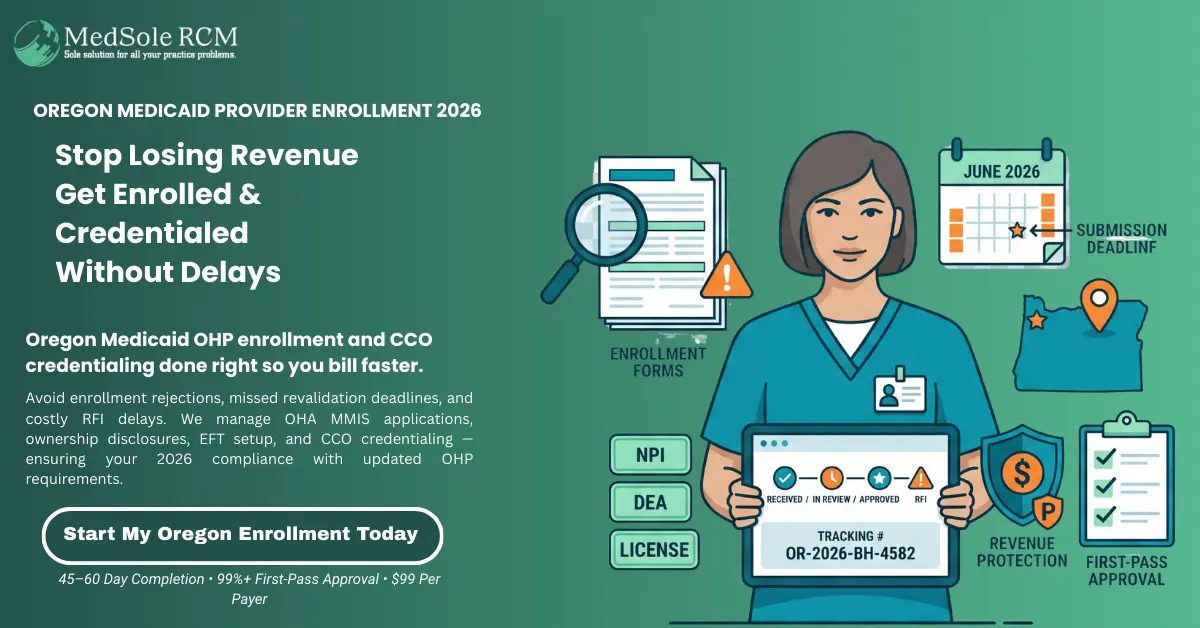




Medicaid oregon provider enrollment is one of those processes that sounds straightforward until you're three weeks in, waiting on a status update that never comes.
Oregon's Medicaid program, officially the Oregon Health Plan (OHP), covers more than 1.4 million residents. If you can't bill OHP, you're locked out of a significant chunk of your patient base. That's not a hypothetical problem. It's lost revenue every single day your enrollment sits in limbo.
What makes 2026 different is the sheer number of moving pieces. CCO network disruptions in Portland. A major Lane County transition. New behavioral health deadlines. Operational changes to how OHA accepts enrollment submissions. Your oregon medicaid provider enrollment process in 2026 isn't the same one your colleague completed two years ago.
This guide covers the full picture: application steps, required forms, status tracking, contact details, the 2026 changes that matter, and where providers consistently lose time and money.
What Changed in 2026 (And Why It Affects Your Enrollment Right Now)
If you haven't been following Oregon Medicaid news closely, several changes hit in early 2026 that directly affect how providers enroll, credential, and get paid. Here's what you need to know before you start any enrollment paperwork.
Network Disruptions: Portland Metro and Lane County
Two major network shifts happened in February 2026, and both have downstream effects on medicaid oregon provider enrollment decisions.
As of February 15, 2026, Providence Medical Group stopped accepting new referrals for most adult specialty services for CareOregon/Health Share members. That includes cardiology, neurology, and behavioral health. If you're a provider in the Portland metro area, your referral workflows just changed overnight.
Separately, PacificSource exited the Lane County CCO market. Members transitioned to Trillium Community Health Plan on February 1, 2026. Providers in Lane County who weren't already credentialed with Trillium are now scrambling to avoid payment interruptions.
Both changes highlight a simple reality: enrollment with OHA alone isn't enough. You need CCO credentialing too, and the landscape keeps shifting.
Behavioral Health Providers Face a June 2026 Deadline
This one catches people off guard. Right now, board-registered associates and mental health interns can bill for fee-for-service OHP services under supervision. That changes after June 2026.
After that deadline, these providers must be fully licensed or employed by a certified behavioral health organization to receive Medicaid reimbursement. Practices relying on interns for service delivery should start the Certificate of Approval (COA) process now, not in May.
The Prioritized List Goes Away January 2027
Oregon has used the "Prioritized List of Health Services" for decades to determine what's covered under OHP. By January 1, 2027, that model ends. Oregon transitions to a standard Medicaid State Plan, which changes how medical necessity gets defined and how services are coded.
OHA starts "listening sessions" in March 2026. If your specialty is affected, showing up matters.
Expanded Benefits and Rural Funding Worth Knowing
Two positive updates. OHA expanded the Post-Hospital Extended Care (PHEC) benefit from 20 days to 100 days for skilled nursing and rehab, effective January 1, 2026. Providers in post-acute care should check their billing to capture the extended coverage.
Oregon also received $197.3 million in federal funds for the Rural Health Transformation Program in 2026. Rural providers should watch for grant opportunities and enhanced reimbursement models.
These changes sit on top of your enrollment and credentialing decisions. Getting enrolled correctly the first time protects your ability to capture revenue through all of them. That's why your revenue cycle starts with enrollment, not with claims.
Who Needs to Enroll as an Oregon Medicaid Provider
The short answer: almost everyone who touches an OHP patient's care.
Individual and Facility Providers
Individual practitioners who need medicaid oregon provider enrollment include physicians (MD/DO), nurse practitioners, physician assistants, psychologists, LCSWs, LPCs, LMFTs, dentists, optometrists, chiropractors, and certified alcohol and drug counselors, among others.
Facility and organizational providers include hospitals, FQHCs, rural health clinics, behavioral health agencies, community mental health programs, residential treatment facilities, home health agencies, labs, imaging centers, and DME suppliers.
Here's the part that creates real work: both the group and each individual rendering provider typically need separate enrollment. A five-provider clinic often requires six applications. One for the organization. One for each provider.
The Provider Type Most Practices Forget to Enroll
Ordering, referring, and prescribing providers must also enroll with Oregon Medicaid, even if they never bill directly. Federal rules through CMS require it.
If a physician writes a prescription for an OHP member but isn't enrolled, that prescription may not be covered. If a specialist refers an OHP patient but their NPI isn't on file, claims get denied. Hospitals and group practices routinely underestimate how many individual clinician NPIs need enrollment beyond the billing entity.
When you're enrolling multiple providers across different specialties and practice locations, the paperwork gets heavy fast. That's exactly the kind of project our provider enrollment and credentialing team handles for $99 per insurance payer, start to finish, in 45 to 60 days.
Oregon Medicaid Provider Enrollment Application: A Step-by-Step Walkthrough
The oregon medicaid provider enrollment application process has three distinct phases. Skipping steps in the first phase is the number-one cause of delays in phase two.
Phase 1: What to Gather Before You Start
Before you open the portal, pull together these documents:
For individual providers:
-
National Provider Identifier (Type 1 NPI), verified against NPPES
-
Active, unrestricted Oregon license
-
DEA certificate (if applicable)
-
Tax ID (SSN or EIN)
-
Current malpractice insurance certificate
-
CAQH ProView profile, updated and attested within 120 days
-
Completed W-9
-
Physical practice address (no P.O. Boxes)
-
Correct taxonomy code matching your license and specialty
For groups and facilities:
-
Type 2 NPI
-
EIN
-
Business license and Oregon facility license (if applicable)
-
CLIA certificate (labs)
-
List of all rendering providers with their NPIs
-
Organizational chart
-
Bank account details for EFT enrollment
Phase 2: Submitting Through the MMIS Provider Portal
Oregon's medicaid provider enrollment application goes through the OHA MMIS Provider Portal. Here's the sequence:
-
Create a portal account with your email
-
Select application type: new enrollment, revalidation, reactivation, or change of information
-
Choose your provider type and specialty (this determines which requirements apply)
-
Complete every application section: provider details, practice locations, ownership disclosures, criminal background, licensing, billing setup
-
Upload all supporting documents in the required formats (PDF, TIF, TIFF, or TXT; under 10 MB; filename under 256 characters)
-
Complete and sign the oregon medicaid provider enrollment agreement
-
Submit
OHA accepts electronic signatures through the portal. Double-check everything before you click submit, because attachment uploads are essentially a one-time action. More on that in the instructions section below.
Phase 3: What Happens After You Hit Submit
You'll get a confirmation email with a tracking number. OHA begins screening, which typically takes 30 to 60 days for standard-risk providers.
If OHA needs clarification, they'll send a Request for Information (RFI). You have 30 days to respond. Miss that window and your application gets terminated. Not delayed. Terminated. You'd start over from scratch.
Check your email and physical mail daily during this period. Better yet, have someone track it proactively. Our credentialing team responds to RFIs within 24 hours for every client, which is one reason our first-pass approval rate stays above 97%.
Oregon Medicaid Provider Enrollment Forms You'll Need
Here are the key oregon medicaid provider enrollment forms required during the process:
|
Form |
Purpose |
Who Needs It |
|
Provider Enrollment Application |
Main application |
All providers |
|
Provider Enrollment Agreement |
Legal contract with OHA |
All providers |
|
Ownership and Control Disclosure |
Lists owners with 5%+ interest |
All (federal requirement) |
|
W-9 |
Tax identification |
All providers |
|
MSC 189 (EFT Enrollment Form) |
Direct deposit setup |
All who want electronic payment |
|
Trading Partner Agreement |
Electronic claims submission |
Providers billing electronically |
|
Supervising Provider Form |
Documents supervision |
PAs, supervised NPs |
|
Group Affiliation Form |
Links individual to billing group |
Providers billing under a group |
All oregon medicaid provider enrollment forms should be downloaded directly from the OHA provider enrollment page. Third-party sites often host outdated versions, and submitting an old form is a guaranteed rejection.
OHA updates forms periodically, sometimes with no announcement. What worked for your last enrollment may not work today.
Understanding the Oregon Medicaid Provider Enrollment Agreement
The oregon medicaid provider enrollment agreement is the legal contract between you and the Oregon Health Authority. By signing it, you're agreeing to specific obligations that carry real consequences if violated.
Key commitments in the agreement:
-
Accept OHP reimbursement rates as payment in full (no balance billing OHP patients)
-
Maintain medical records for at least seven years
-
Cooperate with audits from OHA, CMS, or their contractors
-
Keep all licenses, certifications, and malpractice insurance current throughout enrollment
-
Report any exclusions, sanctions, or adverse actions immediately
-
Complete revalidation every three to five years based on your risk category
The agreement is non-negotiable. Unlike commercial payer contracts, you accept the terms as written or you don't enroll.
Violations can lead to payment suspension, recoupment of past payments, enrollment termination, or referral to the OIG. The obligations under 42 CFR Part 455 are federal, not optional.
Understanding what you're signing protects your practice. It's also the foundation for clean medical billing from day one.
Oregon Medicaid Provider Enrollment Instructions: What's Different in 2026
The standard oregon medicaid provider enrollment instructions haven't changed dramatically in structure. But OHA has tightened several operational processes in 2026 that create new failure points for providers who aren't paying attention.
Online Submission Is Now the Default
OHA is actively steering providers toward online submission through the MMIS Provider Portal, and away from fax. The reason is practical: many digital fax services fail unless they support T.38 protocol. If your e-fax setup doesn't support it, your submission may never arrive.
If you absolutely must fax, every document needs an EDMS Coversheet with the "Provider Enrollment" box checked. Without it, OHA's internal routing may never deliver your paperwork to the enrollment team. A fax that arrives but doesn't get routed is the same as a fax that never arrived.
The Attachment Upload You Can't Undo
Here's an operational detail buried in OHA's portal guide that causes real problems. When you submit an enrollment request online, you upload your attachments at the end using the ATN workflow. Once you leave that confirmation page, you can't go back and add more files.
If you forgot a document or uploaded the wrong version, your only option is faxing the missing item using an EDMS coversheet. That means your application is now split between two submission channels, which increases the chance something gets lost.
Build an internal checklist. Don't click submit until every required document is finalized, signed, and ready.
EFT Changes Require a Paper Form (For Now)
OHA disabled the EFT update feature in the MMIS Provider Portal's Demographic Maintenance panel while they add security features. No timeline for restoration.
If you need to set up or change direct deposit, you have to submit form MSC 189 manually. Practice managers who assume they can handle EFT through the portal will hit a dead end.
These oregon medicaid provider enrollment instructions for 2026 add friction to a process that was already complex. Missing any one of these details means delays. If you'd rather avoid the risk, our enrollment specialists handle every form, every upload, and every follow-up call so you don't have to.
How to Check Your Oregon Medicaid Provider Enrollment Status
After submission, the waiting starts. Here's how to check your oregon medicaid provider enrollment status without wasting hours.
Method 1: Online Portal. Log into the MMIS Provider Portal and navigate to "Application Status." You'll need your tracking number. Status indicators include:
|
Status |
What It Means |
|
Received |
Application in queue, not yet reviewed |
|
In Review |
Under active review |
|
RFI Sent |
OHA needs more information; check your email immediately |
|
Pending Verification |
Licenses and exclusions being verified |
|
Approved |
You're enrolled; provider ID issued |
|
Denied |
Rejected; review denial letter for reasons |
Method 2: NPI Verification Tool. OHA provides an NPI verification tool on their website. Enter your NPI and the date of inquiry to confirm active enrollment status.
Method 3: Phone. Call (800) 336-6016, Monday through Friday, 8:00 AM to 5:00 PM Pacific. Have your NPI, Tax ID, and tracking number ready.
One critical 2026 change: OHA Provider Services no longer provides member eligibility or claim status checks over the phone. That function is portal-only now. If your staff doesn't have active portal logins, they're working blind on member eligibility.
When claims sit unpaid because oregon medicaid provider enrollment status is unclear, the revenue impact compounds. Your AR aging grows while the problem sits unresolved.
Oregon Medicaid Provider Enrollment Contact Information
Phone, Fax, and Portal Access
|
Method |
Details |
|
Phone |
(800) 336-6016 |
|
Fax |
(503) 945-6592 (requires EDMS Coversheet) |
|
Hours |
Monday to Friday, 8:00 AM to 5:00 PM Pacific |
|
Portal |
OHA MMIS Provider Portal |
Best times to call: Tuesday through Thursday, 8:00 to 9:00 AM or 3:00 to 4:30 PM Pacific. Monday mornings and Friday afternoons are the worst.
Always document the representative's name, date, and time of every call. You'll want that record if something falls through the cracks.
The oregon medicaid provider enrollment phone number gets you general enrollment support. But remember, eligibility and claim status inquiries have moved to the portal entirely in 2026.
Mailing Address for Paper Submissions
If you need to mail documents (original signed forms, appeal letters, supporting documents that won't upload), use this oregon medicaid provider enrollment mailing address:
Oregon Health Authority
Health Systems Division, Provider Enrollment
500 Summer Street NE, E-44
Salem, OR 97301-1079
Use certified mail with return receipt. Keep copies of everything. Include your NPI and tracking number on every page. Do not send original licenses; send copies only.
Oregon Medicaid Out-of-State Provider Enrollment
With telehealth expansion, oregon medicaid out-of-state provider enrollment is increasingly common. The short answer: yes, out-of-state providers can enroll. But it comes with conditions.
You must hold an active Oregon license in your discipline. Some professions qualify through interstate compact agreements, but you'll still need to verify licensure with OHA.
Your NPI should reflect your Oregon practice information. You'll need a service location address, though telehealth addresses are accepted in many cases.
Oregon expanded telehealth coverage significantly post-COVID. Audio-visual and audio-only services are covered under OHP. Reimbursement rates for telehealth are generally at parity with in-person visits.
Border state providers (Washington, Idaho, Nevada, California) may qualify under special arrangements for services delivered near the Oregon border.
Processing times for oregon medicaid out-of-state provider enrollment tend to run longer because of out-of-state license verification. If you're managing enrollment across multiple states, our credentialing team handles multi-state enrollment routinely. Same $99 per payer. Same 45 to 60 day timeline.
OHP Enrollment and CCO Credentialing Are Two Different Things
This distinction trips up more providers than any single form or deadline. And in 2026, getting it wrong has bigger consequences.
OHP enrollment is your registration with the Oregon Health Authority for fee-for-service Medicaid billing. It's the baseline. Without it, you can't participate in Oregon Medicaid at all.
CCO credentialing is your separate application to each Coordinated Care Organization. CCOs serve over 90% of OHP members. So even with active OHP enrollment, if you're not credentialed with the relevant CCOs in your area, you're cut off from the vast majority of Oregon Medicaid patients.
|
OHP (Fee-for-Service) |
CCOs (Managed Care) |
|
|
Administered by |
Oregon Health Authority |
Individual CCOs |
|
Enrollment process |
OHA Provider Portal |
Separate credentialing per CCO |
|
Patient share |
~10% of OHP members |
~90% of OHP members |
|
Required first? |
Yes |
Depends, but most CCOs require active OHP enrollment |
Oregon's active CCOs include AllCare, CareOregon, Health Share of Oregon, Columbia Pacific, Eastern Oregon CCO, InterCommunity Health Network, Jackson Care Connect, PacificSource Community Solutions, Trillium, Umpqua Health Alliance, Yamhill Community Care, and Advanced Health.
Each CCO has its own credentialing forms, timelines, and requirements. Multiply that by however many CCOs serve your area, and the administrative burden becomes significant.
This is exactly why practices hand both processes to us. We manage OHP enrollment and CCO credentialing in parallel for $99 per payer. Every CCO. Every time. While you see patients.
The Revalidation Trap That Catches Oregon Providers Off Guard
OHA requires medicaid oregon provider enrollment revalidation at least every five years. The revalidation itself isn't complicated. The consequences of missing it are.
OHA sends revalidation notices to the "Mail-to" address on your enrollment record. If that address is outdated (a previous billing office, a former practice manager's attention line), the notice goes to the wrong place. You never see it. The deadline passes.
Here's where it gets expensive. If OHA inactivates your enrollment for missed revalidation:
-
Within 30 days of inactivation: OHA treats your submission as a revalidation. Paperwork gets processed normally.
-
After 30 days: OHA treats it as a full re-enrollment. New background checks. Potential site visits for high-risk categories. Significantly longer wait times. Your enrollment stays inactive while you wait.
The difference between day 30 and day 31 can mean months of lost billing.
OHA also conducts risk-based screening during revalidation. Depending on your provider category, they may require additional documentation, enhanced verification, or even pre-enrollment site visits. The OIG exclusion database gets checked. So does SAM.gov.
Most revalidation failures aren't clinical. They're administrative. Wrong address. Missed letter. Incomplete upload. These are the same problems that cause claim denials downstream.
Common Enrollment Mistakes That Cost Oregon Providers Revenue
After processing hundreds of Oregon enrollments, these are the errors we see most often. Every one of them is preventable.
1. NPI data mismatch. Your name, address, or taxonomy on the enrollment application doesn't match your NPPES record. OHA cross-references. Mismatches trigger immediate rejection. Fix: update NPPES before submitting. Allow 24 to 48 hours for changes to propagate.
2. Expired licenses. Submitting with a license that expires during the review period. OHA won't approve enrollment if your license might lapse before they finish processing. Fix: renew all licenses before applying.
3. Incomplete ownership disclosure. Federal rules under 42 CFR 455.104 require disclosure of all individuals or entities with 5% or more ownership interest. Missing one person, or omitting their SSN, means your application gets returned. Fix: compile ownership details before starting the application.
4. Wrong application type. Submitting a new enrollment when you should submit a reactivation, or vice versa. Fix: check if you've ever held an Oregon Medicaid enrollment before.
5. Missing the RFI deadline. OHA sends a Request for Information. You have 30 days. Miss it and the application gets terminated. Fix: respond within 48 hours, not 28 days.
6. Incorrect taxonomy code. Selecting a taxonomy that doesn't match your license type. This causes enrollment errors and eventual claim denials. Fix: verify your code using the NUCC taxonomy crosswalk.
7. Forgetting group affiliation. Individual providers who enroll but don't link to their billing group can't bill under that group's NPI. Fix: submit the group affiliation form at the same time as individual enrollment.
8. Skipping EFT setup. Without Electronic Funds Transfer, you'll receive paper checks. Slower by weeks. Fix: submit form MSC 189 during enrollment since the portal feature is currently disabled.
Each mistake adds weeks or months to your enrollment timeline. That's weeks of seeing OHP patients you can't bill for. The billing consequences compound fast.
Realistic Enrollment Timelines: DIY vs. Professional Help
Here's an honest comparison. No spin.
|
Phase |
DIY Timeline |
MedSole RCM Timeline |
|
Document gathering |
1 to 3 weeks |
3 to 5 business days |
|
Application completion |
1 to 2 weeks |
2 to 3 business days |
|
OHA processing |
30 to 90 days |
30 to 50 days (proactive follow-up) |
|
RFI responses (if any) |
1 to 3 weeks per RFI |
24 to 48 hours |
|
Total (clean submission) |
8 to 14 weeks |
45 to 60 days |
|
Total (with corrections) |
12 to 24+ weeks |
45 to 60 days |
The time difference comes down to three things: error-free applications that don't trigger RFIs, proactive follow-up with OHA instead of waiting passively, and parallel processing of CCO credentialing while OHP enrollment moves forward.
Your enrollment timeline is your revenue cycle's starting line. Every extra week of delay is another week of OHP patients you can't bill. For a provider seeing five Medicaid patients a day at an average of $120 per visit, two extra weeks of delay equals roughly $6,000 in unbillable services.
When It Makes Sense to Hand Off Oregon Medicaid Enrollment
Not every provider needs professional enrollment help. If you're a solo practitioner with one location, one specialty, and plenty of admin time, you can probably handle it yourself.
But here's when DIY stops making sense:
-
You're enrolling three or more providers at once
-
You need CCO credentialing on top of OHP enrollment
-
You're expanding into Oregon from another state
-
Your admin staff is already stretched thin
-
You've been rejected before and aren't sure why
-
You can't afford months of enrollment delays
At MedSole RCM, provider enrollment medicaid oregon is something we process daily. Not weekly. Daily.
What $99 per payer gets you:
-
Complete application preparation and submission
-
All form completion, document gathering, and uploads
-
Proactive follow-up with OHA and CCOs
-
RFI responses within 24 hours
-
Status tracking with regular updates to you
-
45 to 60 day completion
-
97%+ first-pass approval rate
-
No hidden fees
We're a full revenue cycle management company, not just a credentialing shop. That means we understand how enrollment connects to billing, claims, and accounts receivable. Getting you enrolled correctly is step one. Making sure your claims pay from day one is the whole point.
If this process sounds like more than your team can absorb right now, here's where to start.
FAQs: Oregon Medicaid Provider Enrollment
How do I check my oregon medicaid provider enrollment status?
Log into the OHA MMIS Provider Portal and navigate to "Application Status" using your tracking number. You can also verify active enrollment using the OHA NPI Verification tool, or call (800) 336-6016 during business hours. As of 2026, eligibility and claim status checks are portal-only; phone support for those functions has ended.
What forms are needed for the oregon medicaid provider enrollment application?
Core forms include the Provider Enrollment Application, Provider Enrollment Agreement, Ownership and Control Disclosure, W-9, MSC 189 (EFT), and the Group Affiliation Form (if billing under a group). Download all forms directly from the OHA website to avoid outdated versions.
What does the oregon medicaid provider enrollment agreement require?
It's a non-negotiable legal contract. You agree to accept OHP rates as payment in full, maintain records for seven years, cooperate with audits, keep licenses current, report adverse actions, and complete revalidation on schedule. Violations can result in recoupment, termination, or OIG referral.
What is the oregon medicaid provider enrollment phone number?
The main number is (800) 336-6016, available Monday through Friday, 8:00 AM to 5:00 PM Pacific. Best calling times are Tuesday through Thursday, early morning or mid-afternoon.
Can out-of-state providers complete oregon medicaid out-of-state provider enrollment?
Yes, if you hold an active Oregon license. Telehealth providers must enroll to bill for services delivered to OHP members. Oregon reimburses telehealth at parity with in-person rates. Processing may take longer due to out-of-state license verification.
Where is the oregon medicaid provider enrollment mailing address?
Oregon Health Authority, Health Systems Division, Provider Enrollment, 500 Summer Street NE, E-44, Salem, OR 97301-1079. Use certified mail with return receipt. Include your NPI and tracking number on every document.
How long does medicaid oregon provider enrollment take?
DIY enrollment typically takes 8 to 24 weeks depending on accuracy and follow-up. With professional support from MedSole RCM, the process completes in 45 to 60 days due to error-free applications and proactive follow-up.
What are the 2026 oregon medicaid provider enrollment instructions for submitting online?
OHA now recommends online submission over fax. If faxing, use the EDMS Coversheet with "Provider Enrollment" checked, and verify your service supports T.38 protocol. Portal uploads are one-time only; you can't add files after leaving the confirmation page. EFT changes require paper form MSC 189 since the portal feature is currently disabled.
Do I need separate enrollment for each CCO?
Yes. OHP enrollment covers fee-for-service Medicaid only. CCOs serve over 90% of OHP members, and each one requires its own credentialing process. OHP enrollment is the foundation, but CCO credentialing is what gives you access to most patients.
What happens if I miss my revalidation deadline?
OHA inactivates your enrollment. If you submit revalidation paperwork within 30 days of inactivation, it processes normally. After 30 days, it's treated as a full re-enrollment with additional background checks, potential site visits, and significantly longer wait times.
Your February 2026 Action Checklist
Don't wait until something breaks. Knock these out this week:
-
Verify your enrollment status using OHA's NPI Verification tool. Confirm you're listed as active.
-
Check your Mail-to address on file with OHA. If it's outdated, submit an update within 30 days or risk missing revalidation notices.
-
Confirm MMIS Portal access for at least two staff members with Admin-level credentials. Phone-based eligibility checks are gone.
-
Audit behavioral health staffing. If you use interns or associates for OHP billable services, verify they'll meet the June 2026 licensure requirement.
-
Review your CCO credentialing. Especially in Lane County (Trillium transition) and Portland metro (Providence/CareOregon disruption). Gaps in CCO credentialing mean gaps in payment.
-
Download the latest enrollment forms directly from OHA. Don't use saved copies from last year.
-
Update referral workflows. Providence's specialty referral changes affect any Portland-area medicaid oregon provider enrollment participant who coordinates CareOregon member care.
If any of these items reveal a problem you don't have time to fix, we're here to help. $99 per payer. Every step handled. 45 to 60 days.
MedSole RCM is a full-service revenue cycle management company specializing in provider enrollment and credentialing, medical billing, denial management, AR follow-up, and complete revenue cycle management. We serve healthcare providers across all 50 states.