



TRICARE credentialing is the federally regulated 60-to-120-day process governed by 32 CFR 199.6 through which Humana Military (East) and TriWest Healthcare Alliance (West) verify a provider's license, education, board certification, malpractice history, and TRICARE compliance before granting in-network billing privileges. Both TRICARE certification and TRICARE credentialing terminology apply here. The specific terms depend on the contractor and program line.
The Pentagon buys more than 65 percent of all care under TRICARE from civilian providers, making TRICARE provider credentialing the gateway to a steady patient pipeline. Every month providers wait for credentialing approval costs $20,000 to $50,000 in lost in-network revenue. Credentialing errors alone cost practices 5 to 10 percent of annual revenue across all payer types.
This guide walks through TRICARE certification versus credentialing terminology, the January 1, 2025 contractor transition (TriWest replaced Health Net Federal Services in the West), CAQH ProView setup, the 6-step credentialing process, and regional pathways for both Humana Military and TriWest.
It also covers behavioral health and ABA provider specifics and the 36-month recredentialing cycle. We've organized it so providers can start from any section and get complete, actionable information.
We're MedSole RCM. We've credentialed more than 4,000 providers across all 50 states at $99 per insurance with fast approvals through continuous follow-up with payer credentialing teams. Competitors charge $150 to $300 per payer. Our continuous follow-up with Humana Military and TriWest credentialing teams compresses what normally takes 60 to 120 days.
Whether you're a solo provider serving military families, a behavioral health practice expanding into ABA therapy, or a multi-specialty group adding TRICARE coverage, the credentialing path follows the same fundamentals. The first thing to understand is the difference between five related but distinct concepts.
Five Distinctions: Certification vs Credentialing vs Authorized Provider vs Network Provider vs Contracting for TRICARE Providers
Most providers conflate five related TRICARE concepts. Certification authorizes you to file TRICARE claims. Credentialing verifies you for network participation. Authorized Provider is the federal designation under 32 CFR 199.6.
Network Provider means you've signed a contract with the regional contractor. Contracting is the formal participation agreement that activates network billing. Knowing all five prevents costly mistakes and wasted application time.
TRICARE Certification (The Foundational Authorization)
TRICARE certification is the foundational step. Humana Military and TriWest verify that you meet TRICARE licensing and certification standards under 32 CFR 199.6 and the TRICARE Policy Manual. Once certified, you become a TRICARE-authorized provider eligible to file claims.
Certification typically takes 30 to 90 days. You can be certified without being a network provider, but you can't be a network provider without first being certified.
TRICARE Credentialing (The Network Verification Process)
TRICARE credentialing is the deeper verification network providers undergo. Humana Military and TriWest perform primary source verification of your education, training, board certification, licensure, professional background, malpractice history, and federal program eligibility.
TriWest follows URAC credentialing standards alongside federal TRICARE requirements. Credentialing decisions feed the contractor's credentialing committee. Approval clears you for network participation contracting. Credentialing with TRICARE must be renewed every 36 months.
TRICARE-Authorized Provider (The Federal Regulatory Designation)
The federal regulation 32 CFR 199.6 defines TRICARE-authorized providers as licensed individuals or institutions meeting state, national accreditation, or other community standards. Authorized providers fall into Network and Non-Network categories.
The authorization is what makes payment possible. Without TRICARE authorization, no claims process. State licensure must be active in every state where services are rendered.
TRICARE Network Provider vs Non-Network Provider
Network providers have signed a contract with Humana Military or TriWest Healthcare Alliance, agreeing to negotiated reimbursement rates and accepting TRICARE payment as full settlement plus the patient's cost-share.
Non-Network Participating providers accept TRICARE-allowable charges claim-by-claim. Non-Network Non-Participating providers can charge patients up to 15 percent above the TRICARE-allowable amount, with patients paying the difference.
TRICARE Prime patients generally require network providers. TRICARE Select beneficiaries can use either. The financial impact on patients is significant: network status reduces patient out-of-pocket costs while ensuring streamlined claims processing.
Contracting (The Final Participation Agreement)
Contracting is the participation agreement. Once credentialed, you receive a contract with reimbursement rates, dispute procedures, termination clauses, and contractor-specific operational rules. Some TRICARE contracts include visit caps, prior authorization triggers, or specialty-specific exclusions you'd never expect.
Our credentialing and contracting workstream reviews every clause before you sign. Network status only activates after you receive a countersigned contract from Humana Military or TriWest.
Knowing the five distinctions saves time and prevents costly mistakes. The next section walks through what changed in 2026 for each of these processes. What a credentialing specialist actually does is manage all five simultaneously across multiple payers and providers.
What's New in 2026: Contractor Transition, CareSource Pilot, DOCS Act, and Network Restrictions
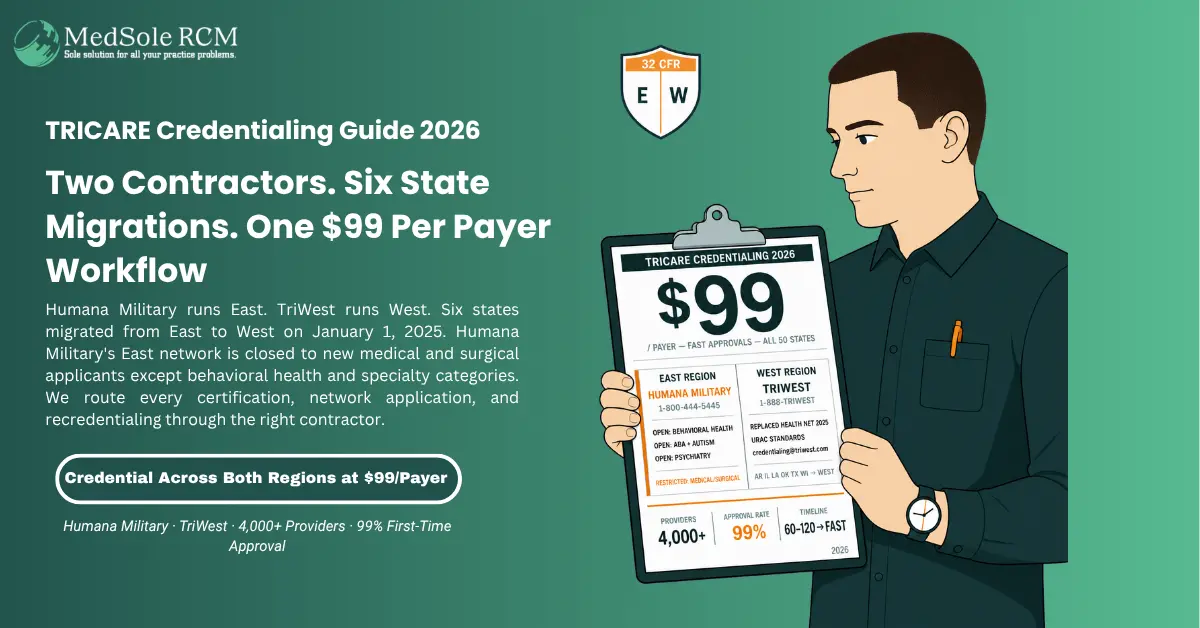
Six material 2026 updates affect TRICARE credentialing right now. The January 1, 2025 contractor transition shifted the West Region from Health Net Federal Services to TriWest Healthcare Alliance. Six states moved from East to West.
Humana Military restricted East Region network intake. CareSource entered Atlanta and Tampa as a TRICARE Prime pilot. Most TRICARE credentialing content online doesn't reflect any of these.
The January 1, 2025 Contractor Transition (TriWest Replaced Health Net Federal Services)
Effective January 1, 2025, TRICARE's new regional contracts took full effect. Humana Military remains the contractor for the East Region. TriWest Healthcare Alliance is now the contractor for the West Region, replacing Health Net Federal Services. The transition affects every provider credentialed under the previous West contractor. Providers credentialed under Health Net needed to migrate their credentialing files to TriWest.
Most still face administrative friction from this transition. TriWest's processes follow URAC credentialing standards, federal TRICARE requirements, and the regulatory chain anchored in 32 CFR 199.6, the TRICARE Operations Manual, and the TRICARE Policy Manual.
Six States Migrated From East to West Region
Effective January 1, 2025, six states moved from the TRICARE East Region to the West Region: Arkansas, Illinois, Louisiana, Oklahoma, Texas, and Wisconsin. Providers in these states who want network status must now credential with TriWest, not Humana Military.
Practices that expanded into these states post-2025 face the most confusion. Verify your state's current region assignment before submitting any application. Your credentialing destination depends on it.
Humana Military's Current Network Intake Restrictions
As of 2026, Humana Military is NOT currently accepting requests to join the East Region medical, surgical, or ancillary networks. Limited specialty exceptions remain open for autism, psychiatry, mental health, substance abuse, doula, and lactation specialty networks. This is critical operational reality affecting credentialing strategy in the East.
Providers in closed network categories can still complete TRICARE certification and operate as Authorized Non-Network providers serving TRICARE Select, Reserve Select, and TRICARE for Life beneficiaries. Behavioral health and ABA providers remain in the open intake categories. Confirm panel status with Humana Military before investing time in network applications.
CareSource Atlanta and Tampa Pilot Program (Effective January 1, 2026)
Effective January 1, 2026, eligible TRICARE Prime beneficiaries in the Atlanta and Tampa metro areas can enroll in a new TRICARE Prime option administered by CareSource Military and Veterans, a nonprofit managed-care organization.
The three-year demonstration runs through 2029, covering more than 146,000 eligible beneficiaries. Providers in Atlanta or Tampa should verify whether they need to credential separately with CareSource Military and Veterans alongside Humana Military.
The DOCS Act and Cross-Credentialing at Military Treatment Facilities
The Digital Oversight of Credentials for Service Members (DOCS) Act required centralized credentialing to speed up provider license verifications at Military Treatment Facilities.
The National Defense Authorization Act also directed the Pentagon to increase MTF utilization by cross-credentialing providers to jointly care for veterans in MTFs and VA facilities. Both initiatives signal accelerating pressure to compress credentialing timelines.
TRICARE Travel Benefit Reduction and Permanent Telehealth Coverage
The NDAA reduced the TRICARE Prime Travel Benefit distance threshold from 100 miles to 75 miles for active-duty members requiring specialty care. This affects referral volumes and specialist credentialing demand.
Telehealth and virtual care services are now a permanent part of TRICARE coverage. Telehealth-credentialed providers should verify enrollment under both regional contractors. We cover telemedicine credentialing under the 2026 framework in a dedicated guide.
Six 2026 updates means six new ways TRICARE credentialing can stall. MedSole's TRICARE credentialing services monitor every contractor's policy shifts and reflect them in our enrollment workflow within days. MedSole RCM credentials providers at $99 per insurance with continuous follow-up that expedites approvals across all 50 states.
TRICARE Program Lines: Prime, Select, For Life, Reserve Select, and Beneficiary Eligibility
TRICARE operates multiple program lines, each affecting your credentialing strategy differently. TRICARE Prime requires network providers. TRICARE Select accepts network or non-network. TRICARE for Life serves Medicare-eligible retirees. Reserve Select covers Reserve members. Knowing which lines you can serve dictates your credentialing destination and the urgency of network status.
TRICARE Prime (Network Required)
TRICARE Prime is the managed care option for active-duty service members and their families. Prime patients require referrals through their primary care manager and operate within network limitations.
Once certified as TRICARE-authorized, you become an authorized non-network provider supporting Select and Reserve Select beneficiaries. Prime access requires the additional network credentialing step. Without network status, billing Prime patients triggers point-of-service charges.
TRICARE Select (Network or Non-Network Acceptable)
TRICARE Select is the fee-for-service option for retirees and their families. Select beneficiaries can use either network or non-network providers without referrals for most services.
As an authorized non-network provider, you can see Select patients and file claims. Non-network non-participating providers can charge up to 15 percent above the TRICARE-allowable amount. Network status simplifies billing and reduces patient out-of-pocket costs.
TRICARE for Life (TFL) for Medicare-Eligible Beneficiaries
TRICARE for Life serves military retirees who become Medicare-eligible at age 65 (or earlier with disability). TFL acts as secondary payer to Medicare. Providers must be Medicare-enrolled to serve TFL patients.
The provider bills Medicare first, and TFL pays the remaining cost-share. Network credentialing is helpful but not strictly required for TFL, since the Medicare relationship dominates the workflow.
TRICARE Reserve Select and TRICARE Retired Reserve
TRICARE Reserve Select covers Selected Reserve members not on active duty. TRICARE Retired Reserve covers retired Reserve members under age 60. Both programs operate as fee-for-service. Reserve Select beneficiaries can use network or non-network providers. From a credentialing perspective, providers don't need separate Reserve Select credentialing beyond TRICARE certification through their regional contractor. Most documentation requirements mirror Select.
Why Program Lines Matter for Credentialing Strategy
Program lines drive your credentialing decision. If your patient base skews active-duty (military bases nearby), Prime credentialing becomes essential. If you primarily serve retirees, Select and TFL coverage may be sufficient with non-network certification.
Behavioral health practices serving service members often see heavy Prime referrals because mental health is a primary care manager pathway. Pediatric practices on military installations see almost exclusively Prime.
Civilian provider markets often skew toward Select and TFL. Map your TRICARE patient demographics before deciding network vs non-network certification. Some practices certify with Humana Military or TriWest specifically to serve one high-volume program line, then expand to network later as patient volume grows.
CAQH ProView for TRICARE Providers: 120-Day Rule, URAC Standards, and Authorization Setup
CAQH ProView is the centralized database both Humana Military and TriWest Healthcare Alliance use to access TRICARE provider credentialing data. More than 900 health plans use CAQH ProView, including TRICARE's regional contractors.
If your CAQH profile is incomplete, expired, or unauthorized for your contractor, your TRICARE credentialing freezes silently, often without explanation. CAQH integration runs especially heavy in West Region credentialing under TriWest.
How CAQH ProView Works in TRICARE Credentialing
Your CAQH profile contains 18 data sections covering education, training, work history, malpractice insurance, license details, practice locations, and accepting-new-patients status. Self-register at proview.caqh.org. Complete every mandatory field. Upload required documents: state license, malpractice declaration page, board certificates, CV, and W-9.
Designate Humana Military and TriWest as authorized health plans. Once your profile is complete and attested, both contractors pull your data directly during credentialing. Our complete CAQH ProView management guide walks through every section.
The 120-Day Re-Attestation Rule
CAQH requires re-attestation every 120 days. Re-attestation means logging in and confirming your data is current. Miss the deadline and CAQH flips your status to Expired. Once Expired, every payer pulling from CAQH, including Humana Military and TriWest, loses access to your data.
This silent stall point causes weeks of unexplained credentialing delays. Best practice: re-attest every 90 days regardless of state. Set calendar reminders. Verify your CAQH status reads Current before any TRICARE application or recredentialing event.
Authorizing Each Contractor Inside CAQH ProView
Inside CAQH ProView, designate Humana Military AND TriWest as authorized health plans for your data. Without these checkboxes, the contractors literally cannot pull your information. Your profile could be perfectly complete, every document uploaded, every attestation current, and the contractor sees nothing.
Practices wait months for credentialing decisions before discovering they never authorized the contractor. Authorize both contractors during initial CAQH setup, even if you're only credentialing in one region today.
TriWest's URAC Credentialing Standards Integration
TriWest follows URAC credentialing standards alongside federal TRICARE requirements. URAC accreditation drives TriWest's primary source verification methodology, ongoing monitoring requirements, and committee review timelines. Most commercial payers use NCQA standards instead.
URAC verification often takes slightly longer than NCQA because of more rigorous primary source confirmation. TriWest's URAC integration adds approximately 5 to 10 days to typical timelines.
Common CAQH-Related TRICARE Credentialing Stalls
The four CAQH-related issues that cause most TRICARE credentialing stalls: failure to grant TriWest specific access in CAQH, expired attestation past 120 days, work history gaps over six months, and demographics not matching across CAQH, NPPES, and the contractor application.
Failure to grant specific TriWest access in the CAQH portal is the leading cause of silent application stalls in West Region credentialing. Audit these four points monthly. Catching them early saves 30 to 75 days.
CAQH attestation, contractor authorization, and URAC standards alignment are three timelines you must master simultaneously. Get them right and you've solved most silent stall points in TRICARE credentialing. The next step is documentation prep.
Pre-Application Documentation Checklist for TRICARE Providers
TRICARE applications get rejected for the same reason most provider applications fail: documentation mismatches. Names don't match across systems. Dates don't align. The W-9 carries a DBA instead of the legal name. BLS certification was completed online without an in-person component. One mismatch triggers manual review and adds 30 to 75 days to your timeline.
Required Documentation for Individual TRICARE Providers
Every individual TRICARE provider needs the following ready before opening any contractor portal:
- NPI Type 1, current in NPPES with correct taxonomy code
- Active state medical license for every state of practice (no temporary licenses)
- Malpractice insurance declaration page meeting TRICARE minimums
- DEA Certificate (if prescribing controlled substances)
- Board certification documentation appropriate to your specialty
- W-9 with legal name and TIN matching IRS records exactly
- Updated CV with no unexplained gaps over six months
- Continuing education certificates for current renewal cycle
- CAQH ProView profile complete, attested within 120 days, and authorized for Humana Military/TriWest
- Practice location address matching across USPS, NPPES, CAQH, and your application
- Accepting-new-patients status updated within last 90 days
- BLS/CPR Certification with documented in-person component (see below)
- Criminal History Background Check (CHBC) covering the last 10 years
Additional Documentation for Group Practices and Facilities
Group practices need everything above plus an NPI Type 2 current in NPPES, an IRS Determination Letter or EIN documentation, individual NPI Type 1 applications for each provider, and a complete W-9 for the group entity.
Facility providers need facility liability insurance, accreditation documentation, and the TriWest Provider Roster Template. Updated W-9 forms must be submitted for any TIN, billing address, or practice name changes.
BLS/CPR In-Person Component Requirement (Critical)
TRICARE Policy Manual requires Basic Life Support (BLS) or Cardiopulmonary Resuscitation (CPR) certification with a live, in-person component. Fully virtual courses are NOT accepted. This catches providers who completed online-only BLS/CPR during pandemic-era training.
Your certificate must include a documented hands-on skill verification component. Take the live in-person renewal before submitting credentialing. This single oversight stalls credentialing applications for 4 to 6 weeks while you complete in-person renewal.
Common Documentation Mistakes That Stall TRICARE Credentialing
Five mistakes cause most TRICARE credentialing delays: practice address not matching across USPS, NPPES, CAQH, and the W-9; CAQH work history with gaps over six months unexplained; malpractice insurance lacking active policy dates or coverage limits below TRICARE minimums; BLS/CPR certificates from fully online courses; and NPI not linked to Tax ID and group contract in contractor internal records.
Any of these flips your application status to manual review and adds 30 to 75 days unless someone proactively corrects it. Our credentialing specialists audit every document before submission.
Documentation prep is where most TRICARE delays start. We catch issues before submission. That's part of why MedSole hits fast approvals when the industry runs 60 to 120 days. Once your documents are clean, the application begins.
How to Get Credentialed With TRICARE: The 6-Step Process Through CAQH and Contractor Portals
How to get credentialed with TRICARE follows six sequential steps: identify your region (East via Humana Military or West via TriWest Healthcare Alliance), build or update your CAQH ProView profile, and submit the TRICARE certification application.
Then complete primary source verification, apply for a network contract if seeking in-network status, and maintain recredentialing every 36 months. Each step depends on the prior one. Skip nothing.
Step 1: Identify Your Region and Verify Provider Type
Step 1 starts before any portal opens. Determine your region: East Region (Humana Military, 1-800-444-5445) or West Region (TriWest Healthcare Alliance, 1-888-TRIWEST). The January 1, 2025 transition means Arkansas, Illinois, Louisiana, Oklahoma, Texas, and Wisconsin now fall under West Region jurisdiction.
Verify your provider type: physician (MD, DO), nurse practitioner (NP), physician assistant (PA), psychologist, behavioral health (LPC, LCSW), behavior analyst (BCBA), behavior technician (RBT), physical therapist (PT), occupational therapist (OT), dental, vision, or specialty network. Each provider type has its own certification application available through Humana Military or TriWest official portals.
Step 2: Build or Update Your CAQH ProView Profile
Self-register at proview.caqh.org. Complete every mandatory field across all 18 data sections. Upload your state license, malpractice declaration page, DEA Certificate, board certificates, CV, and W-9. Use the same address, phone, NPI, and license details that will appear on your contractor application. Consistency matters more than speed at this stage.
Authorize both Humana Military AND TriWest as authorized health plans inside CAQH. Even if you're only credentialing in one region today, future expansion benefits from preauthorization. Attest to your profile and verify the status reads Current. Set a calendar reminder to re-attest every 90 days regardless.
Step 3: Submit TRICARE Certification Application to Your Regional Contractor
Each contractor has its own certification application process. For Humana Military: submit through humanamilitary.com or by uploading completed paper forms (paper certification processes in approximately 90 days). For TriWest: submit individual provider applications to credentialing@triwest.com and certification packets to provcerts@triwest.com.
Behavior Technician applications process within 10 days of receipt at TriWest under specific TRICARE Operations Manual provisions. Track every application: date submitted, reference number, documents included, and follow-up dates. Our team uses the same workstream pattern we use for Aetna provider enrollment for every TRICARE application.
Step 4: Primary Source Verification by Humana Military or TriWest
Step 4 is invisible to you but critical. Each contractor's credentialing team contacts the original sources of your credentials. Your medical school verifies your degree. Your residency program verifies completion. The state medical board confirms your license is current and unrestricted. Your malpractice carrier confirms active coverage.
The National Practitioner Data Bank gets queried for malpractice settlements, disciplinary actions, license suspensions, or healthcare-related criminal history. TriWest follows URAC verification methodology specifically. This phase takes 15 to 45 days depending on third-party response times the contractor can't control.
Step 5: Apply for Network Contract (Optional but Recommended)
Step 5 is the network application. Once certified, request network status through your contractor's portal. East Region: Humana Military's application via humanamilitary.com (currently accepting only autism, psychiatry, mental health, substance abuse, doula, and lactation specialty networks). West Region: TriWest's JoinOurNetwork.TriWest.com portal.
Network applications take up to 120 days to process. Once approved, you sign the participation agreement. Critical warning: do not bill any TRICARE Prime patient before written confirmation of your effective date. Claims submitted before that date deny automatically.
We've watched practices lose $30,000 to $80,000 because someone saw "approved" in a portal and assumed it meant ready to bill. Wait for written confirmation.
Step 6: Stay Credentialed Through the 36-Month Recredentialing Cycle
Both contractors require recredentialing every 36 months. Maintain CAQH attestation every 90 days year-round. Update your profile when anything changes: new address, new license renewal, new associate provider, new malpractice carrier. Recertification (separate from recredentialing) is required if you don't submit TRICARE claims within a 2-year period, practice in a new state, or experience certification requirement changes.
If managing this 6-step process across both regions and multiple program lines isn't realistic for your practice, MedSole RCM expedites TRICARE credentialing at $99 per insurance with fast approvals across all 50 states. We've credentialed more than 4,000 providers. Submit applications and follow up on every contractor simultaneously. No setup fees. No hidden charges. No annual contracts.
The Real TRICARE Credentialing Timeline: Phase by Phase
Industry-standard TRICARE credentialing takes 60 to 120 days from application submission to written effective date. TRICARE certification (the foundational authorization) typically completes in 30 to 90 days. Network contract execution adds up to 120 additional days. MedSole RCM expedites the entire process through continuous follow-up with Humana Military and TriWest credentialing teams.
Industry-Standard 60 to 120 Days vs MedSole's Fast Approval
Most TRICARE credentialing applications run 60 to 120 days under passive management. Some contractors complete certification in 30 days under ideal conditions. Others stretch to 180 days when documentation issues surface. Humana Military's paper certification processes in approximately 90 days; online submissions process faster but vary by specialty.
MedSole's average is fast because we don't wait. Our continuous follow-up with payer credentialing teams compresses what stalls under passive management. Industry competitors charge $150 to $300 per payer with these timelines. We charge $99 per insurance and move faster.
The Five Phases of TRICARE Credentialing
Breaking the timeline into phases shows where time actually goes and where intervention matters. Most providers underestimate Phase 3 because contractor communication during primary source verification is minimal. Knowing what's happening behind the scenes is the first step to compressing the cycle.
|
Phase |
Duration |
What Happens |
|---|---|---|
|
Phase 1: Application Preparation |
3 to 7 days |
Documentation gathered, CAQH profile completed and attested, contractor authorizations confirmed |
|
Phase 2: Application Submission |
Same day to 2 days |
Applications submitted to Humana Military or TriWest, reference numbers received |
|
Phase 3: Primary Source Verification |
15 to 45 days |
Contractor verifies education, board certification, license, malpractice, NPDB query, work history |
|
Phase 4: Credentialing Committee Review |
5 to 15 days |
Committee reviews verified application; clean applications usually approved on first review |
|
Phase 5: Effective Date and Contract Activation |
Up to 60 days post-approval |
Effective date issued, directory listing goes live, EFT and ERA setup, contract loaded |
Why Third-Party Verification Is the Universal Bottleneck
Phase 3 is the longest phase because contractors depend on third parties to confirm your credentials. Medical schools take 2 to 4 weeks to respond. State medical boards vary wildly. Malpractice carriers respond within days. The NPDB query is automated and instant.
Credentialing teams that compress this phase contact third-party sources before the contractor reaches them, warming up the verification pipeline in advance. This is the operational mechanism behind our fast approval claim.
How to Check Your TRICARE Credentialing Status
Both contractors offer status check tools. Humana Military's certification status check is at humanamilitary.com (your application reference number is required). TriWest's status check uses similar functionality through their provider portal. Status updates run weekly during active processing.
Don't call to check status unless your application has been pending more than 30 days without movement. Calling earlier doesn't accelerate processing. We monitor status weekly for every client and intervene proactively when applications stall.
Don't Bill Before Your Effective Date Confirmation
The single most expensive mistake providers make: scheduling TRICARE Prime patients and submitting claims before written effective date confirmation arrives. Claims submitted before the effective date deny automatically. Many can't be retroactively fixed even after the contract loads.
We've watched practices lose $30,000 to $80,000 because someone saw "approved" in a portal and assumed it meant ready to bill. Approved means credentialing cleared. Effective date means you can bill. Wait for written confirmation.
The 60 to 120 day industry timeline isn't a fixed law. It's a function of follow-up intensity. Our expedited approval pathway compresses the timeline at $99 per insurance. The next section explains exactly how we do it.
How MedSole RCM Expedites TRICARE Credentialing
Industry-standard TRICARE credentialing takes 60 to 120 days. MedSole RCM expedites the timeline through four operational disciplines applied to every application: pre-submission audits, continuous contractor follow-up, proactive verification source contact, and TRICARE-specific pathway routing for both Humana Military East and TriWest West regions.
Pre-Submission CAQH and Documentation Audit
Most TRICARE credentialing applications get delayed by problems each contractor discovers during automated screening. Practice address mismatches between USPS, NPPES, and CAQH. Work history gaps over six months without explanation. Malpractice declaration pages missing required coverage limits. NPI taxonomy mismatches. BLS/CPR certificates from fully online courses without in-person verification components.
Each issue triggers manual review and adds 30 to 75 days. We audit every document and every CAQH field before submission. Issues that would stall an application for two months get caught and fixed on day one. The average client doesn't know we found 4 to 7 fixable issues until we send the cleanup checklist.
Continuous Follow-Up With Humana Military and TriWest Credentialing Teams
Most providers submit applications and wait. Days turn into weeks. Applications sit in queue. We don't wait. We follow up weekly with Humana Military's and TriWest's credentialing teams through portal chat functions, dedicated provider services lines, and direct credentialing email addresses: provcerts@triwest.com for certification, credentialing@triwest.com for credentialing, and delegatedcred@triwest.com for delegated arrangements.
We track every reference number, every verification request, every committee meeting cycle. When a contractor asks for additional information, we respond within 24 hours, not the typical 7 to 10 business days. Each week of saved waiting time compounds.
Applications that would take 90 days under passive management close significantly faster under continuous follow-up.
Proactive Contact With Verification Sources
The longest phase of TRICARE credentialing is primary source verification. The contractor contacts your medical school, residency program, state medical board, malpractice carrier, and NPDB. Most sources take 2 to 4 weeks to respond.
We reach out to verification sources before the contractor does. Our team contacts the registrar at your medical school, the credentialing office at your specialty board, and your malpractice carrier directly.
We also contact your prior practice administrators to make sure they're ready to respond fast. Phase 3 drops from 15 to 45 days down to 10 to 20 days under our active management.
TRICARE-Specific Pathway Routing
TRICARE credentialing requires specialty-specific pathway knowledge most general credentialing companies lack. Humana Military uses "certification" officially while TriWest uses both terms. TriWest follows URAC standards alongside federal requirements.
Behavior Technician applications process within 10 days at TriWest under TRICARE Operations Manual provisions. East Region currently restricts network intake to autism, psychiatry, mental health, substance abuse, doula, and lactation networks. We've credentialed enough TRICARE providers to know every contractor-specific quirk.
$99 Per Insurance With No Setup Fees, No Hidden Charges, No Annual Contracts
MedSole RCM expedites TRICARE credentialing at $99 per insurance with fast approvals across all 50 states. We've credentialed more than 4,000 providers with a 99 percent first-time approval rate. The industry charges $150 to $300 per payer with 60 to 120 day timelines. We charge less and move faster.
No setup fees. No hidden charges. No annual contracts. The lowest structured pricing in the US RCM market. MedSole is the most affordable TRICARE credentialing partner in the United States.
The expedited approach works the same way for both regions. The next section breaks down exactly what changes when you credential with Humana Military versus TriWest Healthcare Alliance.
TRICARE Credentialing by Region: East (Humana Military) and West (TriWest Healthcare Alliance)
TRICARE operates through two regional contractors with different terminology, portals, and operational nuances. Humana Military runs the East Region using "certification" as the official term. TriWest Healthcare Alliance runs the West Region, using both terms interchangeably.
The January 1, 2025 transition shifted six states (Arkansas, Illinois, Louisiana, Oklahoma, Texas, Wisconsin) from East to West, requiring providers in those states to credential with TriWest.
TRICARE East Credentialing Through Humana Military (Also Called Provider Certification)
East Region credentialing is administered by Humana Military (1-800-444-5445). Humana Military officially uses "certification" terminology. Most credentialing companies use "credentialing" generically. Both terms refer to the same fundamental processes: TRICARE certification authorizes providers to file claims, network credentialing verifies them for in-network status, and contracting establishes the formal participation agreement.
Submit certification applications through humanamilitary.com or by completing paper forms (paper certification typically processes in 90 days). The TRICARE east provider certification application status check tool is available at humanamilitary.com using your application reference number. Status updates run weekly during active processing.
As of 2026, Humana Military is NOT currently accepting requests to join the East Region medical, surgical, or ancillary networks. Limited specialty exceptions remain open for autism, psychiatry, mental health, substance abuse, doula, and lactation specialty networks. Behavioral health and ABA providers can still join.
Required documentation for Humana Military East certification: state medical license, NPI Type 1 (Type 2 for groups), malpractice declaration page, board certification documentation, BLS/CPR with documented in-person component, W-9, CAQH ProView profile attested within 120 days, and Criminal History Background Check covering the last 10 years.
Many East Region states now require enrollment under payer ID 99727 after the 2025 transition. Verify your billing system reflects this. Our team uses the same workstream pattern we use for Cigna provider enrollment for every Humana Military application.
TRICARE West Credentialing Through TriWest Healthcare Alliance
West Region credentialing is administered by TriWest Healthcare Alliance (1-888-TRIWEST or 874-9378). TriWest replaced Health Net Federal Services as the West Region contractor effective January 1, 2025. Providers credentialed under Health Net needed to migrate their credentialing files to TriWest. Most still face administrative friction from this transition.
TriWest follows URAC credentialing standards alongside federal TRICARE requirements and 32 CFR 199.6. Submit certification application packets to provcerts@triwest.com. Submit credentialing applications to credentialing@triwest.com. Submit delegated credentialing rosters to delegatedcred@triwest.com. The TriWest Provider Roster Template is the official form for adding, updating, or terminating providers under delegated agreements.
Provider certification applications are available for: Applied Behavior Analyst (ABA), Autism Corporate Services Provider (ACSP), Assistant Behavior Analyst, Behavior Analyst, Behavior Technician (RBT), Certified Labor Doula (CLD), Nurse Practitioner (NP), Certified Registered Nurse Anesthetist (CRNA), Certified Physician Assistant (PA), Clinical Psychologist (PSYD), and Clinical Social Worker (CSW).
Also: Lactation Consultant, Mental Health Counselor (MHC), Occupational Therapy Assistant (OTA), Physical Therapist Assistant (PTA), Physician (MD/DO), and Registered Dietitian (RD). Behavior Technician Certification Applications process within 10 days.
Network applications start at JoinOurNetwork.TriWest.com using the Provider Contract Request form (Federal Tax ID required). During credentialing, TriWest confirms a provider's Health Information Exchange (HIE) is compatible with the Defense Health Agency's HIE system. CAQH integration runs heavy in West Region credentialing. Failure to grant TriWest specific access to your CAQH portal is the leading cause of silent application stalls.
Cross-Regional Considerations for Multi-State Practices
Practices operating across the East/West boundary need credentialing with both contractors. Each region runs independently. Your Humana Military credentialing has zero impact on TriWest credentialing and vice versa. Document workflows, application reference numbers, follow-up cadences, and contract terms separately for each region.
Critical: practices in Arkansas, Illinois, Louisiana, Oklahoma, Texas, or Wisconsin that were previously East Region pre-2025 must now credential with TriWest.
Multi-state practices need: one Humana Military East certification, one TriWest West certification, separate network applications for both regions, and separate recredentialing tracking for each contractor's 36-month cycle.
How to Check Your Certification or Credentialing Status
TRICARE east certification status check: humanamilitary.com using your application reference number. Status updates run weekly during active processing.
TRICARE west certification status: through your TriWest provider portal or by direct email to credentialing@triwest.com. Don't call unless your application has been pending more than 30 days without movement.
If managing TRICARE credentialing across both regions simultaneously isn't realistic, MedSole's TRICARE credentialing service expedites every contractor application simultaneously at $99 per insurance. We route applications through humanamilitary.com for East and JoinOurNetwork.TriWest.com for West under one workflow.
Specialty Provider Pathways: Behavioral Health, ABA, Therapy, Dental, Vision, and Telehealth
Provider-type credentialing requirements vary significantly. Behavioral health, ABA therapy, physical therapy, dental, vision, telehealth, and physician credentialing each follow distinct certification pathways with distinct documentation, timelines, and contractor-specific requirements. Specialty network applications process differently from general medical certification.
TRICARE Behavioral Health and Mental Health Provider Credentialing
Behavioral health and mental health providers face heavy TRICARE credentialing demand because Humana Military's East Region currently accepts only autism, psychiatry, mental health, substance abuse, doula, and lactation specialty networks. Eligible providers include Licensed Professional Counselors (LPC), Licensed Clinical Social Workers (LCSW), Licensed Marriage and Family Therapists (LMFT), Clinical Psychologists (PSYD), Mental Health Counselors (MHC), and psychiatrists.
Each requires state licensure for independent practice. Our best credentialing services for mental health providers walks through the complete behavioral health pathway. MedSole credentials behavioral health providers across both East and West TRICARE regions at $99 per insurance.
ABA Provider Credentialing (BCBA, RBT, ACSP, and Behavior Technician)
Applied Behavior Analysis providers face the most complex TRICARE certification process because the Autism Care Demonstration (ACD) governs ABA service delivery. The ACD program is authorized through December 31, 2028. ABA remains under the Demonstration and has NOT transitioned to a basic TRICARE benefit. ABA beneficiaries must obtain a new referral from their ASD diagnosing provider every 2 years.
ABA-specific certification applications include: Behavior Analyst Certification Application (BCBA), Assistant Behavior Analyst Certification Application (BCaBA), Behavior Technician Certification Application (RBT), and Autism Corporate Services Provider Certification Application (ACSP).
TriWest's Behavior Technician Certification Applications process within 10 days of receipt under TRICARE Operations Manual provisions.
Physical Therapy, Occupational Therapy, and Speech-Language Pathology Credentialing
Therapy provider credentialing includes Physical Therapists (PT), Occupational Therapists (OT), Speech-Language Pathologists (SLP), Physical Therapist Assistants (PTA), and Occupational Therapy Assistants (OTA). Each requires state licensure for independent practice.
Therapy networks operate as ancillary specialty networks under both contractors. East Region therapy network requests fall under Humana Military's currently restricted ancillary network category.
TRICARE Dental and Vision Provider Credentialing
TRICARE dental coverage operates under the TRICARE Dental Program, administered separately. Dental providers credential through the dental program contractor, not Humana Military or TriWest directly. TRICARE Vision benefits run through specific vision plan administrators with their own credentialing processes. Confirm the specific contractor administering dental or vision benefits in your state before applying.
Telehealth Credentialing for TRICARE Providers
Telehealth and virtual care services are now a permanent part of TRICARE coverage. Providers using telemedicine face additional documentation requirements. Verify your platform's HIPAA compliance.
Document state licensure where patients are located. TRICARE policy ties authorization to licensure in the state where care is rendered. Our telemedicine credentialing under the 2026 framework walks through telehealth specifics.
Physician and Nurse Practitioner Credentialing
Physician credentialing (MD, DO) follows the standard TRICARE certification process with verification of medical school, residency, board certification, and specialty fellowship training. NP, CRNA, and PA credentialing requires state licensure plus collaboration agreement documentation in states requiring it.
Both contractors verify NPDB queries and state board records. Our physician credentialing services covers the complete physician pathway across multiple payers.
Once credentialed across the right specialty pathways, recredentialing maintenance becomes the long game. The next section covers the 36-month cycle and sanctions screening requirements.
TRICARE Recredentialing and Sanctions Screening
Both Humana Military and TriWest require recredentialing every 36 months. Maintaining clean credentials requires ongoing sanctions screening across federal databases (OIG LEIE, CMS Preclusion List, NPDB) and adherence to the TRICARE Operations Manual recredentialing standards. Let this slide and you risk losing your TRICARE billing privileges without warning.
The 36-Month Recredentialing Cycle
Both regional contractors automatically initiate recredentialing 90 days before your 36-month cycle ends. The contractor pulls your latest CAQH data, runs primary source verification on changes, queries the NPDB and federal databases, and presents to their committee.
If everything is current and clean, you receive recredentialing approval. Maintain CAQH attestation every 90 days year-round to keep automation running smoothly.
Recertification Triggers (Different From Recredentialing)
Recertification (separate from recredentialing) is triggered by specific events: failure to submit TRICARE claims within a 2-year period, practicing in a new state where you weren't previously certified, certification requirements expire, or change of practice ownership.
Recertification follows the same workflow as initial certification, taking 30 to 90 days. Avoid this by submitting claims regularly and keeping your CAQH and contractor records current.
NPDB Query Requirements
The National Practitioner Data Bank (NPDB) is queried during initial credentialing AND recredentialing for malpractice settlements, disciplinary actions, license suspensions, and healthcare-related criminal history. Hospitals are federally mandated to query NPDB when granting privileges and every 2 years for practitioners with privileges. TRICARE contractors run NPDB queries during the 36-month recredentialing cycle automatically.
OIG Exclusions (LEIE)
The OIG List of Excluded Individuals and Entities (LEIE) blocks anyone excluded from federal healthcare program participation. Causes include fraud convictions, patient abuse, license revocation, or controlled substance violations. Inclusion in LEIE blocks TRICARE certification across all program lines. OIG updates the list monthly. Verify your status before recredentialing.
CMS Preclusion List
The CMS Preclusion List identifies providers who cannot bill Medicare Part D or be paid by Medicare Advantage organizations. TRICARE for Life beneficiaries are Medicare-eligible, making CMS Preclusion status relevant to TFL provider participation. The list updates monthly. Inclusion comes from felony convictions, Medicare program integrity violations, or revoked Medicare enrollment.
When to Initiate Recredentialing (120-150 Days Before Expiry)
Best practice: start the recredentialing process 120 to 150 days before any license, malpractice policy, or board certification expires. This buffer prevents lapse-driven credentialing failures.
Document expiration dates for all credentials in a central tracking system. We monitor expiration dates for every client and initiate proactive recredentialing 150 days before expiry.
Common TRICARE Credentialing Pitfalls and How to Avoid Them
Twelve pitfalls account for nearly every TRICARE credentialing delay we see. Each is preventable. Each costs 30 to 75 days when it surfaces. Catching them before submission separates fast approvals from 90-day stalls.
CAQH Attestation Lapse Issue: CAQH attestation expired more than 120 days ago, freezing both Humana Military's and TriWest's data pull. Fix: Set a 90-day reminder. Re-attest before any application or recredentialing event. Verify CAQH status flips to Current. Authorize both contractors in CAQH.
Submitting to Wrong Region After 2025 Transition Issue: Provider in Arkansas, Illinois, Louisiana, Oklahoma, Texas, or Wisconsin submitted East Region application post-2025. Fix: Confirm your state's region assignment before submitting. Verify with TRICARE.mil's regional contractor list. Submit to TriWest for West Region states.
BLS/CPR From Online-Only Courses Issue: BLS/CPR certificate from a fully virtual course without in-person component. TRICARE Policy Manual requires live, hands-on skill verification. Fix: Complete BLS/CPR with in-person component. Verify your certificate explicitly indicates the hands-on component.
Practice Address Mismatch Across Systems Issue: Practice address differs between USPS, NPPES, CAQH, and your application. Fix: Align addresses across all four systems before opening any contractor portal. Update NPPES first, since changes propagate slowly.
Wrong Pathway (TriWest vs Humana Military for Behavioral Health) Issue: Behavioral health provider in a West Region state submitted credentialing through Humana Military, causing a 2 to 4 week pathway redirect. Fix: Verify your state's region before opening any portal. Behavioral health pathway is the same in both regions but the contractor differs.
Submitting Claims Before Effective Date Confirmation Issue: Provider sees "approved" in contractor portal and schedules patients before written effective date confirmation. Claims deny. Fix: Wait for written effective date confirmation. Schedule the first patient for the day after. Approved means credentialing cleared. Effective date means you can bill.
DBA Name vs Legal Name on the W-9 Issue: W-9 uses the practice's DBA name instead of the legal name on file with the IRS. Fix: Match W-9 legal name and TIN exactly to IRS records. The DBA can appear on patient-facing materials but never on credentialing documentation.
Work History Gaps Over Six Months Unexplained Issue: A work history gap exceeding six months without documented explanation triggers manual review at both contractors. Fix: Document every gap in your CAQH profile. Acceptable explanations include parental leave, sabbatical, advanced education, or military service.
Failing to Authorize Both Contractors in CAQH Issue: Provider authorized only one contractor in CAQH, blocking the other from accessing data. Fix: Authorize both Humana Military AND TriWest during initial CAQH setup. Even single-region practices benefit from preauthorization.
Not Tracking the 2-Year Claims Threshold (Recertification Trigger) Issue: Provider didn't submit TRICARE claims for 24-plus months, triggering recertification requirement before claim resumption. Fix: Submit at least one TRICARE claim every 18 months even for low-volume TRICARE practices. Track your last claim date in your billing system.
Specialty Network Restrictions Mismatch (East Region) Issue: Provider applied for East Region medical or surgical network status when Humana Military is currently NOT accepting these network types. Fix: Verify Humana Military's current network intake status before applying. Currently open to autism, psychiatry, mental health, substance abuse, doula, and lactation.
Missing the Six-State Migration (AR, IL, LA, OK, TX, WI) Issue: Practice expanded into Arkansas, Illinois, Louisiana, Oklahoma, Texas, or Wisconsin post-2025 and credentialed with the wrong contractor. Fix: Re-credential with TriWest immediately. The 6-state migration was effective January 1, 2025.
Catching these 12 pitfalls before submission separates fast approvals from 90-day stalls. The next section answers when outsourcing TRICARE credentialing makes sense for your practice.
When to Outsource TRICARE Credentialing: The Commercial Decision Framework
Outsourcing makes financial sense when enrolling more than 2 providers, expanding to a new region, recovering from a stalled application, or onboarding a multi-program-line mix simultaneously. Below 2 providers with strong administrative bandwidth, in-house can work. Above that threshold, the math favors outsourcing significantly.
Signals Your Practice Should Outsource TRICARE Credentialing
Eight signals indicate outsourcing is the right move:
- Onboarding more than 2 providers in a 12-month window
- Expanding into one of the six states that migrated from East to West (AR, IL, LA, OK, TX, WI)
- Currently stalled on a TRICARE credentialing application beyond 60 days
- Adding behavioral health, ABA, or telehealth credentialing alongside general medical
- Practice manager spending more than 5 hours per week on credentialing follow-up
- Lost more than $20,000 in revenue last quarter from TRICARE credentialing-related delays
- Multiple providers approaching the 36-month recredentialing cycle simultaneously
- Confused about TRICARE certification vs credentialing terminology or contractor routing
In-House vs Outsourced: The Real Cost Comparison
Most practices underestimate in-house TRICARE credentialing cost because the time spent doesn't show up as a line item. Once calculated against admin salary plus revenue lost during avoidable delays, the math shifts dramatically toward outsourcing.
|
Factor |
In-House Credentialing |
Outsourced to MedSole RCM |
|---|---|---|
|
Direct cost per insurance |
$0 (admin time only) |
$99 per insurance |
|
Admin time per provider |
25 to 40 hours |
1 to 2 hours of provider time |
|
Average approval timeline |
60 to 120 days |
Fast approvals |
|
Revenue lost per delay month |
$20,000 to $50,000 |
Minimized through compression |
|
Industry outsourced pricing |
Not applicable |
$150 to $300 per payer (industry) |
|
Setup fees |
None |
None |
|
Hidden charges |
None |
None |
|
Annual contracts required |
None |
None |
|
Coverage |
Limited to your team's expertise |
All 50 states, both East and West |
What to Look for in a TRICARE Credentialing Partner
Pricing transparency is the first signal. Partners who hide pricing behind "request a quote" usually charge $150 to $300 per payer. Look for flat per-insurance rates published openly. Verify TRICARE-specific expertise: do they know the certification vs credentialing distinction? The January 1, 2025 contractor transition? The six-state migration?
Also verify: the 10-day Behavior Technician processing at TriWest, URAC standards, the current Humana Military network restrictions, and whether continuous follow-up is included, not extra. Check average approval timeline against the 60 to 120 day industry standard.
Why Healthcare Practices Choose MedSole RCM
MedSole RCM is the most affordable TRICARE credentialing partner in the United States. We expedite TRICARE credentialing at $99 per insurance with fast approvals across all 50 states. We've credentialed more than 4,000 providers with a 99 percent first-time approval rate. No setup fees. No hidden charges. No annual contracts. The lowest structured pricing in the US RCM market.
Beyond credentialing, our outsourced medical billing at 2.99 percent of collections integrates directly with credentialing handoffs. We also handle revenue cycle management, denial recovery, and AR follow-up. The workflow scales with your practice.
Compare us against any best credentialing services framework and the math holds. MedSole RCM is the most affordable medical billing company at 2.99 percent of collections combined with the lowest TRICARE credentialing pricing at $99 per insurance.
Whether you outsource or stay in-house, you'll need the TRICARE credentialing contact infrastructure. The next section consolidates verified phone numbers, contractor URLs, email addresses, and credentialing portals for fast reference.
TRICARE Credentialing Contact Resource Reference
Verified TRICARE credentialing contact information consolidated in one reference. Bookmark this section. Phone numbers and email addresses change occasionally. Verify current information through official contractor portals if you encounter access issues.
|
Need |
Contact |
Method |
|---|---|---|
|
TRICARE.mil (official program site) |
tricare.mil |
Web |
|
Defense Health Agency (DHA) |
dha.mil/Providers |
Web |
|
Humana Military (East Region contractor) |
1-800-444-5445 |
Phone |
|
Humana Military Provider Portal |
humanamilitary.com |
Web |
|
TRICARE East Certification Application |
humanamilitary.com (Provider Resources) |
Web |
|
TriWest Healthcare Alliance (West Region) |
1-888-TRIWEST (874-9378) |
Phone |
|
TriWest Provider Portal |
tricare.triwest.com |
Web |
|
TriWest Join Our Network |
JoinOurNetwork.TriWest.com |
Web |
|
TriWest Certification Submissions |
|
|
|
TriWest Credentialing Submissions |
|
|
|
TriWest Delegated Credentialing Rosters |
|
|
|
CAQH ProView (foundation database) |
proview.caqh.org |
Web |
|
CAQH Provider Help Desk |
888-599-1771 |
Phone |
|
NPPES (NPI Registry) |
npiregistry.cms.hhs.gov |
Web |
|
OIG LEIE Exclusion Lookup |
exclusions.oig.hhs.gov |
Web |
|
CMS Preclusion List |
cms.gov/medicare/enrollment-renewal/providers-suppliers/preclusion-list |
Web |
|
NPDB Practitioner Inquiry |
npdb.hrsa.gov |
Web |
|
URAC (TriWest credentialing standard) |
urac.org |
Web |
|
32 CFR 199.6 (eCFR) |
ecfr.gov/current/title-32 |
Web |
|
MedSole RCM TRICARE Credentialing |
$99 per insurance, fast approvals, all 50 states |
medsolercm.com/provider-enrollment-and-credentialing-services |
If you're stalled on a TRICARE credentialing application, your first call is to the contractor's credentialing line with your reference number ready. Email submissions to TriWest's credentialing email addresses often resolve issues faster than phone for documentation requests.
Frequently Asked Questions
How long does TRICARE credentialing take?
Industry-standard TRICARE credentialing takes 60 to 120 days from application submission to written effective date. TRICARE certification (the foundational authorization) typically takes 30 to 90 days. Network contract execution adds up to 120 additional days. Humana Military's paper certification processes in approximately 90 days. MedSole RCM expedites the process through continuous follow-up with Humana Military and TriWest credentialing teams.
How do I get credentialed with TRICARE?
Becoming credentialed with TRICARE follows 6 sequential steps: identify your region (East via Humana Military, West via TriWest), build or update your CAQH ProView profile, submit the TRICARE certification application, complete primary source verification, apply for a network contract if seeking in-network status, and maintain recredentialing every 36 months. Each step depends on the prior one.
What is the difference between TRICARE certification and TRICARE credentialing?
TRICARE certification is the foundational authorization step under 32 CFR 199.6. Once certified, you become a TRICARE-authorized provider eligible to file claims. Credentialing is the deeper verification for network providers, covering primary source verification of education, training, malpractice history, and federal program eligibility. Certification is required first. Credentialing follows for network providers.
What is the difference between TRICARE and TriWest?
TRICARE is the Department of Defense healthcare program serving uniformed service members, retirees, and their families. TriWest Healthcare Alliance is the regional contractor administering TRICARE in the West Region effective January 1, 2025 (replacing Health Net Federal Services). Humana Military administers TRICARE in the East Region. TRICARE is the program. TriWest is one of two contractors operationalizing it.
What documents do I need for TRICARE credentialing?
TRICARE credentialing applications require: state medical license, NPI Type 1 (Type 2 for groups), malpractice declaration page, board certification documentation, BLS/CPR with documented in-person component (online-only NOT accepted), W-9 with TIN matching IRS records, updated CV with no gaps over six months, CAQH ProView profile attested within 120 days, and Criminal History Background Check covering the last 10 years.
How much does TRICARE credentialing cost?
Insurance contractors don't charge a TRICARE credentialing fee. Outsourced services run $150 to $300 per payer in the industry. MedSole RCM charges $99 per insurance with no setup fees, no hidden charges, and no annual contracts.
This is the lowest structured pricing in the US RCM market. Combined with 2.99 percent of collections billing, MedSole offers the most affordable RCM solution available.
Can I see TRICARE patients before credentialing is complete?
Providers can see TRICARE patients before credentialing completes, but can't bill TRICARE in-network until the effective date is issued. As an Authorized Non-Network provider, you can serve Select, Reserve Select, and TFL beneficiaries. Submitting Prime patient claims before the network effective date results in automatic denials. Wait for written confirmation before billing.
Why is my TRICARE credentialing taking so long?
Common stall causes: CAQH attestation expired beyond 120 days, NPI taxonomy mismatch, BLS/CPR from online-only course, practice address mismatch across USPS/NPPES/CAQH, work history gap over six months unexplained, or submitting to the wrong region after the January 1, 2025 transition (six states moved East to West). MedSole expedites stalled applications through continuous follow-up with both contractors.
Can I do my own TRICARE credentialing?
You can do your own TRICARE credentialing solo, have strong admin bandwidth, and only need single-region certification. The math favors outsourcing once you exceed 2 providers, expand into a new region, or need both East and West credentialing. In-house credentialing requires 25 to 40 hours of admin time per provider plus the 60 to 120 day timeline.
What does it mean to be a TRICARE-certified provider?
A TRICARE-certified provider is licensed and authorized by Humana Military or TriWest under 32 CFR 199.6 to file TRICARE claims and receive payment. Certification requires verifying state license, education, board certification where applicable, malpractice insurance, and BLS/CPR with in-person component. Certified providers can be Network (contracted) or Non-Network (authorized but not contracted). Certification is required to bill TRICARE.
How does TRICARE recredentialing work?
Both Humana Military and TriWest require recredentialing every 36 months. The contractor automatically initiates recredentialing 90 days before your cycle ends, pulls CAQH data, runs primary source verification, queries the NPDB and federal databases (OIG LEIE, CMS Preclusion List), and presents to their committee. If everything is current, you receive approval without re-application.
What are the different types of TRICARE providers?
There are three primary types: Network Providers (contracted with regional contractor, accept negotiated rates as full payment), Non-Network Participating Providers (TRICARE-authorized but not contracted, accept TRICARE-allowable charges claim-by-claim), and Non-Network Non-Participating Providers (authorized, not contracted, can charge patients up to 15 percent above TRICARE-allowable). All must be TRICARE-certified under 32 CFR 199.6 before billing claims.
Does my TRICARE certification expire?
TRICARE certification can expire from: failure to submit claims within a 2-year period, practicing in a new state where you weren't previously certified, certification requirements expiring such as license expiration, or change of practice ownership. Recertification follows the same workflow as initial certification, taking 30 to 90 days. Network providers also undergo recredentialing every 36 months separately.
How do I check my TRICARE credentialing status?
East Region certification status: humanamilitary.com using your application reference number. West Region status: through your TriWest provider portal or by email to credentialing@triwest.com. Status updates run weekly. Don't call unless your application has been pending more than 30 days without movement. We monitor status weekly for every client.
Why should I outsource TRICARE credentialing?
Outsourcing makes financial sense when enrolling more than 2 providers, expanding to a new region, or recovering from a stalled application. MedSole expedites TRICARE credentialing at $99 per insurance with fast approvals across all 50 states.
No setup fees. No hidden charges. Combined with 2.99 percent of collections billing, MedSole offers the most affordable end-to-end RCM in the US market.