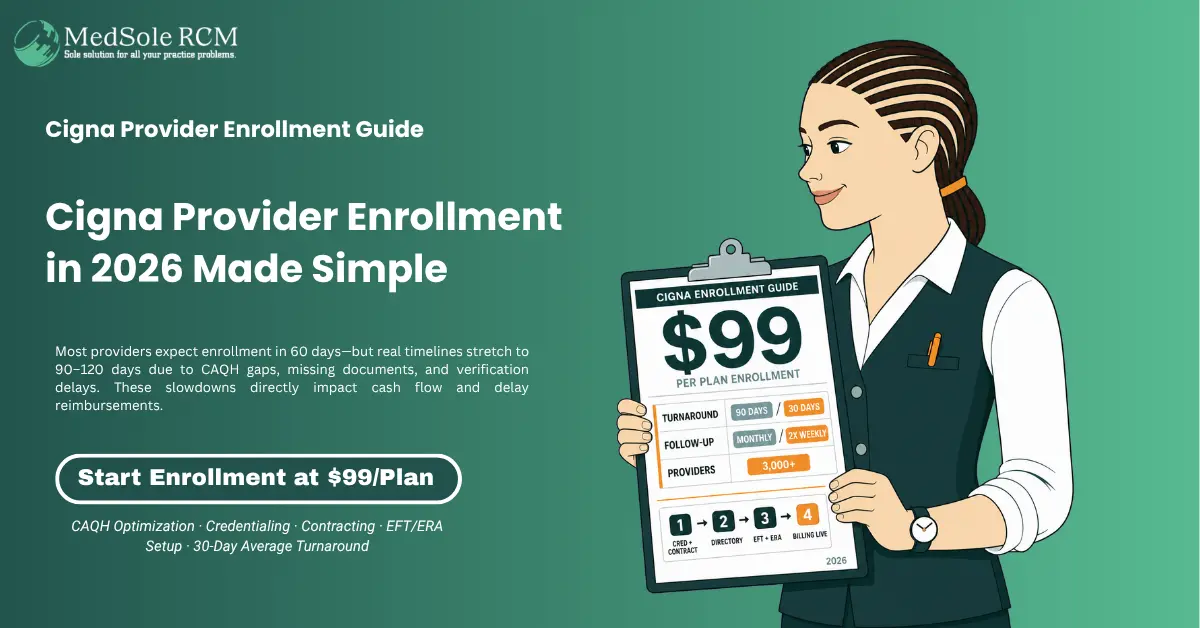




Most providers underestimate how long Cigna provider enrollment actually takes. They assume 60 days. The reality is closer to 90 to 120 days when CAQH issues, missing documents, and the 2026 HealthSpring Medicare Advantage transition come into play. That gap between expectation and reality is where revenue gets lost.
Cigna healthcare provider enrollment is the process by which a licensed healthcare provider joins Cigna Healthcare's network and becomes eligible to bill for services rendered to Cigna members. The process typically takes 45 to 90 days, requires submission through CAQH ProView or ProviderSource, and covers four stages: credentialing, contracting, directory listing, and EFT/ERA setup. Cigna Evernorth provider enrollment runs on a separate track for behavioral health providers, with its own application form and a 60 to 90 day timeline.
This guide is updated for 2026 and covers every Cigna provider enrollment requirement your team needs, the HealthSpring Medicare Advantage transition, all specialty enrollment paths, the real cost breakdown most guides skip, and Cigna's current credentialing standards. Every section draws on real enrollment work across thousands of providers.
Here's what you'll get: the complete 5-step enrollment process, the full 2026 requirements checklist, timeline tiers by specialty, cost data nobody else publishes, and a specialty-by-specialty path guide covering medical, dental, behavioral health, DME, and more.
What's Inside This Guide
Here's what we'll cover, in the order most providers ask about it.
-
What Is Cigna Provider Enrollment?
-
How to Enroll as a Provider with Cigna in 5 Steps
-
Cigna Provider Enrollment Requirements: The Complete 2026 Checklist
-
The Cigna Provider Enrollment Process: A Detailed Step-by-Step Walkthrough
-
How Long Does Cigna Provider Enrollment Take?
-
How Much Does Cigna Provider Enrollment Cost in 2026?
-
Can I Outsource Cigna Credentialing?
-
The 2026 Cigna HealthSpring Transition
-
Top Cigna Credentialing Challenges in 2026
-
Cigna Provider Enrollment by Specialty
-
Beyond Credentialing: Cigna EFT, ERA, and Directory Enrollment
-
Cigna Recredentialing: The 3-Year Cycle
-
What Is a Tier 1 Provider for Cigna?
-
Why MedSole RCM Is the Best Cigna Provider Enrollment Service
-
Cigna Provider Enrollment FAQ
What Is Cigna Provider Enrollment?
Cigna provider enrollment is the process by which a licensed healthcare provider joins Cigna Healthcare's network and becomes eligible to receive reimbursement for services. The process requires submission through CAQH ProView or ProviderSource, verification by Cigna's credentialing committee, and execution of a payer contract. It gives providers access to over 15 million Cigna members at negotiated reimbursement rates. Most providers looking to Cigna join provider network think enrollment ends at credentialing. It doesn't.
Credentialing is just one part of a four-stage process. The other three stages, directory listing, EFT setup, and ERA configuration, are where most clean enrollments fall apart after approval.
Cigna Provider Enrollment vs. Credentialing: What's the Difference?
Cigna provider credentialing is the verification layer. Cigna checks your license, training, malpractice history, work history, and National Practitioner Data Bank (NPDB) record. Provider enrollment is the contractual layer, the process of joining the network, getting a contract, and activating billing. They happen together with Cigna, but they're not the same thing. NCQA credentialing standards govern the verification side. Cigna's contracting team handles the network side.
The 4-Stage Reality Most Providers Miss
Four stages make up a complete Cigna provider enrollment:
-
Credentialing and contracting
-
Directory data upload and verification
-
EFT and ERA enrollment
-
Recredentialing and ongoing maintenance
Completing stage one and stopping is the most expensive mistake in payer enrollment. You'll be credentialed, contracted, and still bouncing claims because EFT isn't set up and your directory listing shows the wrong address.
How to Enroll as a Provider with Cigna in 5 Steps (Quick Answer)
Becoming a Cigna provider is a 5-step process: confirm eligibility, build or update your CAQH ProView profile, submit your application, complete primary source verification, and accept your contract. The full Cigna provider enrollment process typically takes 45 to 90 days, depending on whether you're enrolling as a medical, dental, or behavioral health provider. Here's what each step actually involves.
Step 1: Confirm Eligibility and Pick Your Network Path
Call Cigna's provider line before submitting anything. Medical providers reach out to 1-800-882-4462 (1-800-88CIGNA). Dental uses 1-800-244-6224 (1-800-Cigna24). Behavioral health through Evernorth calls 1-800-926-2273. Confirm the network is open in your specialty and location. Saturated markets like New York, Los Angeles, and Miami have had closed panels in certain specialties in 2026. Finding that out before submitting saves 45 days of waiting on a rejection.
Step 2: Set Up or Update Your CAQH ProView Profile
Cigna pulls roughly 80% of credentialing data from CAQH. Your profile must show "Initial Profile Complete" or "Re-attestation" status. Re-attest every 120 days without exception. Grant Cigna electronic access inside the CAQH dashboard before submission. A single expired license date inside CAQH restarts the clock.
Step 3: Submit Your Cigna Credentialing Application
Submit your Cigna credentialing application through CAQH ProView, One Healthport/Medversant, or ProviderSource. Behavioral health providers use the Evernorth Behavioral Health Provider Information Form in addition to CAQH. Paper submissions exist but slow the process by 30 days or more.
Step 4: Pass Primary Source Verification (PSV)
Cigna verifies your state license, DEA certificate, NPI, malpractice coverage, education, and five years of work history. They also query the NPDB directly. This is the slowest stage. Any work history gap longer than six months needs a written explanation attached to the file.
Step 5: Sign Your Contract and Confirm System Loading
Once approved, contract execution takes 10 business days to load you into Cigna's directories and claims systems. A welcome letter follows with your effective date. Don't submit a single claim until you've confirmed your practice TIN and physical location are both linked in the system. That's the step most providers skip, and it costs them their first month of revenue.
If managing all five steps while running a practice sounds unrealistic, MedSole RCM's professional Cigna provider enrollment service handles every one of them at $99 per plan, with over 3,000 providers already onboarded.
Cigna Provider Enrollment Requirements: The Complete 2026 Checklist
To enroll as a Cigna provider, you need a valid state license, an active DEA certificate, your NPI, professional liability insurance at $1 million per occurrence and $3 million aggregate minimum, five years of work history with no unexplained gaps, board certification status, an updated CAQH ProView profile, and a signed W-9 matching your TIN exactly. Here's the full Cigna provider enrollment requirements checklist by specialty.
Requirements for Medical Provider Enrollment
|
Requirement |
Detail |
Notes |
|---|---|---|
|
Active state license |
Unrestricted, current, in every practicing state |
Must be valid for at least 60 days |
|
DEA certificate |
Valid in each practicing state |
Required if prescribing |
|
Controlled Substances (CDS) |
If state requires |
Varies by state |
|
NPI number |
Type 1 (individual) |
Required for all submissions |
|
Board certification |
ABMS or AOA |
Status documented |
|
Education and training |
Medical school, residency, fellowships |
Verified at primary source |
|
Work history |
Five years, no gaps over six months |
Gaps need written explanation |
|
Malpractice insurance |
$1 million per occurrence, $3 million aggregate |
Minimum standard |
|
Hospital privileges |
At Cigna-participating hospital |
Or coverage agreement |
|
Sanctions disclosure |
Past CMS or board actions |
Full disclosure required |
|
Signed W-9 |
TIN must match application exactly |
Most common mismatch source |
Requirements for Behavioral Health (Evernorth) Provider Enrollment
Cigna Evernorth provider enrollment has run through Evernorth Behavioral Health as the separate credentialing entity since September 2021. The application process uses the Evernorth Behavioral Health Provider Information Form in addition to CAQH. Liability minimums differ by state and prescriptive authority:
-
Texas: $200,000 per occurrence, $500,000 aggregate
-
Florida: $100,000 per occurrence, $300,000 aggregate
-
All other states (non-prescribing): $1 million per occurrence, $1 million aggregate
-
Psychiatrists and PMHNPs with prescriptive authority: $1 million per occurrence, $3 million aggregate
-
Federally-employed clinicians: Federal Tort Coverage Act applies; separate documentation required
Requirements for Dental Provider Enrollment
Cigna dental provider enrollment runs through CAQH or Cigna's e-onboarding tool on a separate track from medical. You'll need:
-
Active dental license (unrestricted in all practicing states)
-
Signed W-9 matching your TIN
-
DEA registration (not required for orthodontists)
-
Specialty training certificate, if applicable
-
Malpractice declarations page
Link your NPI through NPPES before submitting any application. See Cigna's official credentialing requirements for the full current checklist.
The Cigna Provider Enrollment Process: A Detailed Step-by-Step Walkthrough
Section 2 gave you the quick 5-step version of the Cigna provider enrollment process. This section walks through what actually happens at each step, what triggers delays, and which contact points to use when something gets stuck.
Step 1 in Detail: Pre-Application Eligibility Screening
The Cigna provider enrollment phone number for medical credentialing is 1-800-882-4462 (1-800-88CIGNA). Dental providers call 1-800-244-6224 (1-800-Cigna24). Behavioral health through Evernorth uses 1-800-926-2273. The representative checks whether your specialty and location qualify under current network adequacy standards. Some metro markets have closed specialty panels in 2026. Getting confirmation before submitting saves you 45 days waiting on a rejection.
Step 2 in Detail: CAQH or ProviderSource Setup
Cigna accepts applications through three sources: CAQH ProView, One Healthport/Medversant, or ProviderSource. CAQH must show "Initial Profile Complete" or "Re-attestation" status before Cigna will pull your data. Medversant requires its own attestation within 100 days. Grant Cigna electronic access inside the CAQH dashboard before submission, not after. The 120-day re-attestation cycle means any profile over four months old will flag immediately.
Step 3 in Detail: Document Submission and Application Review
Once your Cigna credentialing application is submitted, what gets uploaded includes copies of your current license for every practicing state, your DEA certificate, malpractice declarations page, W-9, five-year work history with explanation letters for any gaps, and board certification documentation.
Here's the thing: one missing PDF restarts the entire clock. The most common delay triggers are an expired DEA certificate, a W-9 TIN that doesn't match the application exactly, and malpractice coverage expiring within 60 days of the submission date. For Medicare Advantage providers, note the new HealthSpring claims gateway transition effective March 18, 2026, which changes how claims route after credentialing. Confirm your billing system reflects this before your effective date arrives.
Step 4 in Detail: Primary Source Verification and Committee Review
Cigna's verification team contacts state licensing boards, educational institutions, the NPDB, and previous employers directly. The credentialing committee then reviews the file for peer assessment. Medical credentialing averages 45 to 60 days at this stage. Cigna behavioral health provider enrollment applications get additional scrutiny and run 60 to 90 days. Incomplete references, unreachable past employers, or NPDB flags add weeks to either path.
Step 5 in Detail: Contract Execution and System Loading
Once approved, the contract loads into Cigna's systems within 10 business days. You'll receive a welcome letter with your effective date. Don't submit a claim yet. Confirm that your practice TIN, physical location address, and group affiliation are all separately activated before billing. Most practices skip this and end up with "provider not linked" rejections in week one. Confirm the link first.
MedSole RCM follows up with Cigna twice weekly and confirms the system link before submitting the first claim. That's part of why MedSole's Cigna provider enrollment service closes 30% faster than the industry average. See Cigna's official credentialing page for current requirements.
How Long Does Cigna Provider Enrollment Take?
Cigna provider enrollment typically takes 45 to 90 days from receipt of a complete application. Medical credentialing averages 45 to 60 days. For Cigna Evernorth provider enrollment in behavioral health, the average runs 60 to 90 days. With incomplete CAQH profiles, missing documentation, or high payer volume, the timeline can stretch to three to six months. Here's what determines which tier you land in.
Optimal Timeline: 45 Days
Everything has to be clean. CAQH attested within the last 120 days, all licenses and DEA current with at least 60 days to expiration, no work history gaps, and references responding within five business days. This happens, but it's not the norm. Practices that consistently hit 45 days typically have a dedicated enrollment coordinator managing every document.
Standard Timeline: 60 to 90 Days
This is where most medical providers land. Some back-and-forth on documents, standard primary source verification time, and normal credentialing committee review cycles account for the extended window. Behavioral health runs toward the 90-day end of this range because of additional verification layers specific to mental health licensing.
Delayed Timeline: Three to Six Months
Why does it take six months for some providers? Usually one expired document or an outdated CAQH profile. Paper submissions add 30 days minimum. Network adequacy rejections in saturated markets require reapplication. Missing DEA certificates and NPDB flags push you into the extended range consistently.
How to Speed Up Cigna Enrollment
These five steps cut weeks off the timeline when done before submission:
-
Re-attest CAQH 30 days before submitting the application
-
Renew all licenses and DEA to at least 60 days beyond the submission date
-
Submit electronically through CAQH ProView, not paper
-
Designate one inbox and one staff member to monitor Cigna email requests
-
Follow up every 14 days after submission
Most delays are preventable. Most practices don't have time to prevent them. MedSole RCM's fastest Cigna provider enrollment service pre-flights every CAQH profile before submission and follows up with Cigna twice weekly. At $99 per plan with 3,000+ providers already enrolled, the speed advantage is built into the process.
How Much Does Cigna Provider Enrollment Cost in 2026? (Cigna Credentialing Cost Guide)
Cigna does not charge providers a credentialing fee. The real Cigna credentialing cost lies in time, staff hours, and outsourcing fees. Providers handling enrollment in-house spend 20 to 40 hours per application. Outsourced services typically range from $99 to $500 per plan. MedSole RCM offers Cigna provider enrollment at $99 per plan, the lowest verified rate in the market. Here's how that number breaks down.
Cigna's Direct Fees
Zero. Cigna doesn't charge providers a credentialing fee. CAQH ProView is also free for providers. If a service is billing you a "Cigna submission fee," that's their own service charge, not a Cigna cost.
The Real Cost: In-House Enrollment
Breaking down the in-house math:
-
Credentialing coordinator salary: $55,000 to $75,000 annually
-
Time per Cigna application: 20 to 40 staff hours
-
Multi-payer enrollment load: 10 to 30 concurrent applications across payers
-
Revenue lost during delays: $9,000 to $30,000 per provider per month while enrollment is pending, per MGMA industry data
That $9,000 to $30,000 monthly revenue gap during enrollment is the number most practices never calculate. One month of delayed enrollment at a moderate practice volume costs more than an entire year of outsourced credentialing service.
The Outsourced Cost: What Service Companies Charge
Industry rates vary significantly:
-
Standard credentialing services: $200 to $500 per plan
-
Premium service companies: $300 or more per plan
-
MedSole RCM: $99 per plan, end-to-end
The difference comes down to volume, process maturity, and follow-up discipline. At 3,000+ providers across 40+ payers, the playbook is built. That volume keeps MedSole's cost structure low enough to pass the savings directly to providers.
Why MedSole RCM Charges $99 Per Plan
Volume and process maturity. Enrolling the 3,000th provider in a network takes significantly less time than enrolling the first because the contacts, workflows, and escalation paths are already mapped. Understanding Cigna credentialing cost shows there's no scenario where in-house handling costs less than $99 per plan when staff time is included. The math doesn't work.
Get started with MedSole's Cigna provider enrollment service. See MGMA credentialing benchmarks for industry cost context.
Can I Outsource Cigna Credentialing? (DIY vs. Outsourced Comparison)
Yes, you can do your own Cigna credentialing. The question for Cigna provider credentialing is whether you should. Most solo practices and small groups underestimate the time cost: 20 to 40 hours per application, ongoing CAQH maintenance every 120 days, and follow-up calls every two weeks. Outsourcing to a specialist at $99 per plan typically pays for itself within 30 days through faster credentialing and avoided billing delays.
The DIY Path: What It Actually Looks Like
Running your own enrollment means owning every piece of this:
-
20 to 40 staff hours per application from initial setup to approval
-
CAQH profile maintenance on a 120-day re-attestation cycle
-
Tracking license and DEA expiration dates across every practicing state
-
Following up with Cigna twice weekly to check status
-
Catching the "provider not linked" issue post-approval before claims start denying
-
Managing recredentialing every three years for every enrolled payer
That's the real scope. It's manageable for large hospital systems with dedicated credentialing departments. For solo practices and groups under 50 providers, the math rarely works out in favor of in-house.
The Outsourced Path: What a Service Company Handles
A full-service credentialing company covers:
-
CAQH ProView setup, maintenance, and 120-day re-attestation management
-
Application submission through the correct network path for your specialty
-
Follow-up with Cigna on a scheduled cadence
-
Document tracking, expiration alerts, and renewal coordination
-
Post-approval "provider not linked" confirmation before first claim
-
Recredentialing reminders 90 days out from renewal dates
DIY vs. Outsourced Comparison Table
|
Factor |
DIY (In-House) |
Generic RCM Service |
MedSole RCM |
|---|---|---|---|
|
Cost per plan |
$0 fee plus 20 to 40 staff hours |
$200 to $500 |
$99 |
|
Avg. turnaround |
90 to 120 days |
60 to 90 days |
30 to 60 days (clean files) |
|
Follow-up cadence |
Inconsistent |
Weekly |
Twice weekly |
|
Specialty coverage |
Limited |
Standard |
All major specialties |
|
Multi-state support |
Manual |
Yes |
Yes, parallel-track |
|
Track record |
N/A |
Varies |
3,000+ providers enrolled |
When DIY Makes Sense
Large hospital systems with dedicated, full-time credentialing departments and established payer relationships can justify in-house enrollment. If you have two or more credentialing specialists on staff and over 50 providers to manage, the economics can work. For everyone else, they usually don't.
For most practices, outsourcing Cigna credentialing to MedSole RCM at $99 per plan beats DIY on cost, speed, and accuracy. See how MedSole's Cigna provider enrollment service works.
The 2026 Cigna HealthSpring Transition: What Every Medicare Advantage Provider Needs to Know
As of January 2026, Cigna health spring provider enrollment has transitioned under the HealthSpring brand following Cigna Medicare Advantage's transfer to Health Care Service Corporation (HCSC), which acquired Cigna's Medicare and CareAllies businesses in March 2025. Existing contracted Cigna Medicare Advantage providers do not need to re-credential. Contracts carry over automatically, but providers must update billing workflows to use payer ID 52192 and the new HealthSpring claims address immediately.
What Changed in 2026
Three operational changes took effect with the rebrand on January 1, 2026:
-
The payer space in Availity Essentials is now labeled HealthSpring Medicare Advantage
-
The active payer ID for all Medicare Advantage claims is 52192
-
The paper claims mailing address changed to P.O. Box 23456, Chattanooga, TN 37421
-
Effective March 18, 2026, the Cigna Medicare Enterprise Gateway is decommissioned for claims submissions
If your billing system still routes Medicare Advantage claims through the old Cigna payer ID after March 18, every claim denies. That's not a coding problem. It's a workflow update that needed to happen at the start of 2026.
Do I Need to Re-Credential With HealthSpring?
No. Existing Cigna Medicare Advantage credentialing transfers automatically to HealthSpring. Your network status carries over. Contracts will be re-papered as renewals come up, and recredentialing letters issued from late 2025 forward reference HealthSpring. You don't need to submit a new application.
Action Items for Existing Cigna Medicare Advantage Providers
Work through this list before March 18, 2026:
-
Update Availity Essentials payer space to HealthSpring Medicare Advantage
-
Switch all electronic claim submissions to payer ID 52192
-
Stop routing claims through the Cigna Medicare Enterprise Gateway
-
Update paper claims to P.O. Box 23456, Chattanooga, TN 37421
-
Verify your directory listing under the HealthSpring name
-
Reference the HealthSpring 2026 provider manual for any policy questions
New Providers: Cigna or HealthSpring? (Cigna Medicare Provider Enrollment)
For Cigna healthcare provider enrollment on commercial plans, credential through Cigna Healthcare as you always have. For Cigna medicare provider enrollment, the path now routes through HealthSpring since the HCSC acquisition. Providers credentialed with Cigna Healthcare automatically gain access to HealthSpring Medicare Advantage members without a separate application. These are not two separate enrollment processes for existing commercial Cigna providers.
The transition looks seamless on paper. The mistakes happen inside billing systems when claims still route to old payer IDs after March 18. MedSole RCM has already navigated this transition for 200+ Medicare Advantage providers. If your billing team is still seeing rejected claims under the old payer ID, audit your Cigna and HealthSpring enrollment status before the denials compound. See HealthSpring's official 2026 provider information for transition documentation.
Top Cigna Credentialing Challenges in 2026 (and How to Avoid Them)
Most Cigna credentialing failures don't happen at submission. They happen during verification, when something on the application doesn't match what's in CAQH or the NPDB. The fixes are simple. The cost of skipping them is brutal.
Challenge 1: Outdated CAQH Profiles
This is the top failure point, by a wide margin. A provider's DEA expires in their CAQH profile while it's already been renewed in the state database. The 120-day re-attestation deadline passes without anyone noticing. Work history isn't refreshed after a job change. Cigna's verification team flags the discrepancy, the application sits, and 60 days disappear before anyone realizes what happened.
The fix is simple: re-attest CAQH 30 days before submitting any new application. Every time, without exception.
Challenge 2: Missing or Mismatched Documentation
An expired DEA certificate. A W-9 with a TIN that doesn't match the application. A malpractice policy expiring within 60 days of submission. A reference contact who doesn't respond to the verification request. Any one of these stalls the file completely. Build a credentialing folder with every document renewed to at least 90 days out before starting any application. That's the difference between a 60-day close and a 90-day stall.
Challenge 3: "Provider Not Linked" Denials Post-Approval
Here's the hidden trap that costs practices real revenue. Cigna approves the provider. The welcome letter arrives. The practice starts billing. Then denials hit immediately with "provider not linked." What happened is that the practice TIN, physical location, and group affiliation weren't separately activated in Cigna's billing system after approval.
Practices lose 30 to 45 days of revenue before catching this. The fix is confirming the link before submitting the first claim. These are exactly the situations that end up requiring denial management services when they could have been prevented at step five.
Challenge 4: Network Adequacy Rejections in Saturated Metros
Cigna has closed select panels in New York, Los Angeles, Miami, and other markets with high provider density in 2026. Qualified providers with clean files are being rejected because the network already has enough providers in that specialty and geography. The workaround is highlighting specialty differentiation, telehealth capability, or geographic reach into underserved ZIP codes when you call the eligibility line.
Challenge 5: Behavioral Health Site Visits
For community mental health centers (CMHCs) and certain behavioral health group practices, Evernorth may require a pre- or post-credentialing site visit to verify staffing levels, compliance protocols, and record-keeping systems. This isn't common for solo providers. Plan 30 extra days if your practice is a CMHC or a larger group.
Challenge 6: Recredentialing Termination Risk
Cigna sends three reminder emails before a recredentialing deadline. If the provider doesn't log into CAQH and re-sign within the 30-day response window, Cigna terminates the network contract. In-network status drops overnight. Re-applying takes 60 or more days, and revenue lost during that gap consistently reaches five figures for any busy practice.
Every one of these problems is preventable. The reason they keep happening is that practices treat credentialing like a one-time task. It isn't. It's a three-year-cycle process with monthly maintenance. Practices that don't have someone owning that cycle pay for it in lost revenue and AR follow-up costs. MedSole RCM owns that cycle for over 3,000 providers, including CAQH maintenance, recredentialing tracking, and post-approval billing system verification, at $99 per plan. MedSole's Cigna provider enrollment and credentialing service is built around preventing these six failures.
Cigna Provider Enrollment by Specialty: The Complete Path Guide
The Cigna enrollment path you take depends entirely on what you practice. Medical, dental, and behavioral health each have different applications, contacts, and timelines. Starting in the wrong network costs weeks. Here's the right path for each specialty.
Medical Provider Enrollment (Internists, Pediatricians, Specialists)
-
Network: Cigna Healthcare medical network
-
Starting contact: 1-800-882-4462
-
Application source: CAQH ProView, ProviderSource, or Medversant
-
Requirements: Active state license, DEA certificate, board certification, hospital privileges, malpractice at $1 million per occurrence and $3 million aggregate
-
Typical timeline: 45 to 60 days for clean applications
Behavioral Health Provider Enrollment (LCSWs, LPCs, Psychologists, Psychiatrists, LMFTs)
Cigna behavioral health provider enrollment requires the Evernorth-specific form, not a standard Cigna medical application. Submitting the wrong form goes to the wrong queue and costs three to four weeks. Cigna Evernorth provider enrollment has its own application, its own contacts, and its own credentialing timeline.
-
Network: Evernorth Behavioral Health (formerly Cigna Behavioral Health)
-
Starting contact: 1-800-926-2273 or BehavioralProviderRecruitment@Evernorth.com
-
Application source: Evernorth Behavioral Health Provider Information Form plus CAQH ProView
-
Requirements: Independent license, liability minimums by state (see Requirements section), NPI, signed W-9
-
Typical timeline: 60 to 90 days; initial review within 21 business days
The Cigna Evernorth provider enrollment form is available for download at the Evernorth Behavioral Health Provider Information Form page.
Dental Provider Enrollment (General, Pediatric, Endodontists, Periodontists, Oral Surgeons, Orthodontists)
-
Network: Cigna Dental
-
Starting contact: 1-800-244-6224 or DentistEnrollment@cignahealthcare.com
-
Application source: CAQH or Cigna's e-onboarding tool
-
Requirements: Active dental license, W-9, DEA registration (not required for orthodontists), specialty training certificate if applicable, malpractice declarations page
-
Typical timeline: 45 to 60 days
Providers with both medical and dental credentials need two separate applications, two separate contacts, and two separate approvals. Cigna dental provider enrollment runs completely independently from the medical track.
Vision Provider Enrollment
Vision credentialing runs through the Cigna Vision network separately from medical or dental. The application path and directory update process differ from medical. Confirm the specific network contacts at your eligibility screening call because vision panel availability varies significantly by region.
DME and Ancillary Provider Enrollment
DME and ancillary providers credential through Cigna's ancillary services network. Facility-based primary source verification is common, and site visits are possible depending on provider type. This is where most generic credentialing services struggle because there's more variation than in medical or dental enrollment.
Physical Therapy and Occupational Therapy Provider Enrollment
PT and OT enrollment runs through the medical network with specialty-specific verification requirements. Some Cigna plans also route PT and OT through American Specialty Health (ASH) partnerships. Confirm at the eligibility screening call which path applies to your specific location before building your file.
Pharmacy Provider Enrollment
Pharmacy enrollment goes through Cigna Pharmacy Management, separate from medical credentialing. Express Scripts integration handles claims processing. The directory contact for pharmacy network updates is Pharmacynetworkoperations@cigna.com.
Cigna Medicare Advantage and HealthSpring Provider Enrollment
As of 2026, Cigna health spring provider enrollment for new Medicare Advantage providers flows through HealthSpring following the HCSC acquisition. Existing Cigna Medicare Advantage contracts carry over automatically. See the HealthSpring Transition section above for the full 2026 operational details.
The hardest part isn't filling out the right application. It's knowing which network owns your specialty before you start. We've watched providers spend 45 days in the wrong queue because they thought all of Cigna was one network. It isn't. Across every specialty above, MedSole's specialty-specific Cigna provider enrollment service has enrolled providers at $99 per plan because we know which path applies before the first call.
Beyond Credentialing: Cigna EFT, ERA, and Directory Enrollment (The Steps Most Providers Skip)
Cigna provider enrollment doesn't end at credentialing. To actually get paid, providers must complete three additional steps: EFT enrollment, ERA setup, and directory data verification. Skipping any of these turns a credentialed provider into one receiving paper checks, posting remittances manually, and invisible to patients searching the Cigna directory.
Cigna EFT Enrollment for Providers (Direct Deposit Setup)
Cigna EFT enrollment for providers starts at the Cigna for Health Care Professionals portal at CignaforHCP.com. Navigate to Working with Cigna, then select Enroll in Electronic Funds Transfer (EFT) Options. Complete the electronic form. Cigna runs a pre-note bank verification, which is a small test deposit to confirm your account details. Check EFT status through the Manage EFT Settings section inside the portal.
EFT setup typically takes seven to 10 business days after submission. Without it, every Cigna payment arrives as a paper check. That delays cash flow and eliminates the audit trail that ERA provides.
Cigna ERA Enrollment (Electronic Remittance Advice)
ERA enrollment initiates through your EDI vendor or clearinghouse, not directly with Cigna. Your vendor submits the ERA enrollment request on your behalf. Cigna finalizes the registration within 10 business days. Without ERA, your billing team posts payments manually from paper EOBs. That inflates AR days with every payment cycle. MedSole's outsourced medical billing services include ERA enrollment as part of the standard setup for every new payer.
Provider Directory Data Setup
After credentialing approval, Cigna uploads your data into provider directories within 10 business days. Mistakes happen consistently: wrong specialty listed, old phone number still showing, address mismatch from a previous location. Directory inaccuracies cause patient leakage and out-of-network billing surprises.
Use these contacts to correct directory errors:
-
Medical: providerupdates@cigna.com
-
Behavioral: BehavioralPDM@cigna.com
-
Pharmacy: Pharmacynetworkoperations@cigna.com
Why These Three Steps Get Skipped
Most credentialing services stop at contract approval. The provider thinks enrollment is done. Then 30 days later the practice is posting paper checks manually, claims show "pending" because there's no ERA route, and patients can't find the provider in the directory. That's an incomplete enrollment, not a credentialing problem.
Cigna provider enrollment is a four-stage workflow. Most practices only complete stage one well. MedSole's full Cigna provider enrollment service completes all four stages, end to end, at $99 per plan.
Cigna Recredentialing: The 3-Year Cycle That Most Providers Forget
Cigna requires recredentialing every three years in most states, or sooner if state law mandates a shorter cycle. The process mirrors initial credentialing using your updated CAQH ProView profile. Cigna sends up to three reminder emails with a 30-day response window. Failing to log into CAQH and re-sign during that window results in automatic termination from the Cigna network. No appeals. No extensions.
When Recredentialing Begins
Cigna sends renewal notices six months before your recredentialing date. Providers using CAQH have their data pulled automatically when the file is due. Non-CAQH providers receive a separate recredentialing form. If you're not re-attesting CAQH every 120 days year-round, your profile will be outdated when Cigna pulls it, which triggers the same delays as a first-time enrollment.
What Gets Reviewed in Recredentialing
Cigna reviews everything that mattered initially, plus new performance data:
-
Updated state license, current in every practicing state
-
Malpractice coverage at current limits with no lapses
-
New certifications since initial credentialing
-
NPDB query for any new actions or sanctions
-
Claims pattern review against specialty peers
-
Member satisfaction indicators from plan data
How to Avoid Termination
Five steps protect your network status across the three-year cycle:
-
Re-attest CAQH every 120 days throughout the year, not just at recredentialing time
-
Track license and malpractice expirations 90 days in advance, every year
-
Monitor email for Cigna recredentialing notices starting six months out
-
Respond to the 30-day response window immediately, not on day 29
-
Upload continuing education certificates to CAQH as you earn them
What Happens If You Get Terminated
In-network status drops overnight. Patients who chose you as an in-network provider become out-of-network immediately. Re-applying takes 60 or more days. Revenue lost during that gap consistently reaches five figures for any practice with significant Cigna volume.
Recredentialing failure is the most expensive credentialing mistake, and most practices don't realize the deadline passed until claims start denying. MedSole RCM tracks recredentialing dates for every provider in our system with 90-day advance alerts and CAQH maintenance built into MedSole's Cigna recredentialing service at $99 per plan.
What Is a Tier 1 Provider for Cigna? (Cigna Care Designation Explained)
A Tier 1 provider in Cigna's network is one who meets the Cigna Care Designation (CCD) program's quality and cost-efficiency benchmarks. Effective January 1, 2026, Tier 1 status displays in Cigna's provider directories with a visible indicator. Patients on tier-aware plans pay lower copays for Tier 1 providers, which drives meaningful volume advantages for designated practices compared to non-designated peers.
How Cigna Tier 1 Status Is Calculated
CCD evaluates providers on two dimensions simultaneously. Quality tracks clinical guideline adherence, patient outcomes, and evidence-based care standards. Cost-efficiency benchmarks each provider's episode-of-care costs against specialty peers in the same market. Both must score above Cigna's threshold to earn the designation. Scoring high on quality alone, without meeting the cost-efficiency threshold, doesn't qualify.
Why Tier 1 Matters for Provider Revenue
Cigna members on tier-aware plans pay lower cost-sharing when they see Tier 1 providers. Some employer plans actively steer members toward Tier 1 only for non-emergency care. Practices that hold the Tier 1 designation see consistent patient volume advantages over non-designated peers in the same specialty without spending anything on marketing.
How to Qualify for Tier 1
Tier 1 is earned through clinical behavior, not through an application. Track quality metrics aligned with CCD specifications for your specialty. Code accurately to reflect appropriate clinical complexity. Avoid overuse of high-cost services when lower-cost alternatives achieve equivalent outcomes. Respond promptly to Cigna designation communications because designation reviews happen on a set schedule.
Tier 1 is earned, not requested. Most practices don't optimize for it because they don't know it exists. The ones that do see consistent volume advantages with no additional marketing spend.
Why MedSole RCM Is the Best Cigna Provider Enrollment Service in 2026
MedSole RCM handles Cigna healthcare provider enrollment as the most affordable and fastest Cigna provider enrollment service in 2026, charging $99 per payer enrollment, the lowest verified rate in the US credentialing market. With 3,000+ providers enrolled across 40+ payers, a twice-weekly follow-up cadence, and a 30-day average turnaround for clean applications, MedSole delivers what generic RCM services charge three to five times more for.
$99 Per Plan: The Lowest Rate in the Market
Industry standard for outsourced credentialing runs $200 to $500 per plan. MedSole RCM charges $99. The volume across 3,000+ providers and 40+ payers makes that price structure sustainable because the playbook is already built. Healthcare practices save $100 to $400 per enrollment, multiplied across every payer they join. That's a real, verifiable number, not a marketing claim.
30-Day Average Turnaround for Clean Applications
The industry standard turnaround for Cigna credentialing runs 60 to 90 days. MedSole's average for clean applications is 30 days. Three operational choices drive that difference: pre-flighting every CAQH profile before submission so incomplete profiles don't stall the file, following up with Cigna twice weekly rather than monthly, and responding to document requests within 24 hours. Together, these cut the standard timeline in half.
3,000+ Providers Already Enrolled Across All Specialties
Medical, Cigna Evernorth provider enrollment for behavioral health, dental, DME, PT, vision, pharmacy, and HealthSpring Medicare Advantage. Multi-state submissions handled in parallel. Providers who come to MedSole don't pay for our learning curve on any network because that learning happened across the previous 3,000 enrollments. They pay for the result of having already learned.
Twice-Weekly Follow-Up Cadence
Most credentialing services check in monthly. Some check weekly. MedSole follows up with Cigna twice weekly, every week, until the application closes. The difference between a 30-day approval and a 60-day one is almost always how quickly someone follows up when Cigna's verification team needs a document or makes a decision. We already know who to call. That's the practical advantage of the twice-weekly cadence.
Full Revenue Cycle Coverage Beyond Credentialing
MedSole isn't only a credentialing shop. Outsourced medical billing services at 2.99% of collections, AR follow-up, denial management, and full revenue cycle management are available through the same team that handles your enrollment. Providers who outsource credentialing to MedSole often outsource the rest because the same team already knows their payer mix and billing workflow.
At $99 per Cigna plan, with 3,000+ providers enrolled, a 30-day average turnaround, and full-service RCM available at 2.99%, MedSole RCM is built for practices that want the lowest cost and the fastest result. Get your Cigna provider enrollment and credentialing services quote.
Cigna Provider Enrollment FAQ
Here are direct answers to the most common questions from providers looking to Cigna join provider network and billing teams and healthcare providers ask about Cigna credentialing and enrollment.
How long does it take to get credentialed with Cigna?
Cigna provider credentialing typically takes 45 to 60 days for medical providers. For Cigna behavioral health provider enrollment through Evernorth, the average is 60 to 90 days. Incomplete CAQH profiles, missing documents, or high payer volume can extend the timeline to three to six months. With outsourced support, clean files, and a twice-weekly follow-up cadence, applications can close in 30 days.
What is the phone number for Cigna provider enrollment?
The primary Cigna provider enrollment phone number for medical providers is 1-800-882-4462 (1-800-88CIGNA). Dental enrollment uses 1-800-244-6224 (1-800-Cigna24). Behavioral health through Evernorth is 1-800-926-2273. Application status questions go to PSSCentral@Cigna.com; include your full name and TIN in the email.
What is 1-800-244-6224?
1-800-244-6224, also called 1-800-Cigna24, is the starting point for Cigna dental provider enrollment. Dental providers use this number to begin credentialing, update demographic information, or check application status. The corresponding email contact is DentistEnrollment@cignahealthcare.com.
How do I check my Cigna provider credentialing status?
Medical providers can email PSSCentral@Cigna.com with their full name and TIN, or call 1-800-882-4462 and select the credentialing status option. Behavioral health providers email BehavioralProviderRecruitment@evernorth.com. Dental providers email DentistEnrollment@cignahealthcare.com.
How do I become a provider with Cigna?
Providers looking to Cigna join provider network follow five steps: confirm eligibility and network path, set up or update your CAQH ProView profile, submit your application through the correct channel, pass primary source verification, and execute the contract. The full process takes 45 to 90 days depending on specialty and application completeness.
What Is the Difference Between Cigna Provider Credentialing and Provider Enrollment?
Cigna provider credentialing verifies a provider's qualifications: license, training, malpractice history, and work history. Provider enrollment is the contractual process of joining Cigna's network. With Cigna, both happen together in sequence. Credentialing feeds into contracting, which leads to network activation, directory listing, and billing eligibility.
Can I do my own Cigna credentialing?
Yes, but the time cost is significant. Self-credentialing requires 20 to 40 hours per application, ongoing CAQH maintenance every 120 days, and consistent follow-up every two weeks. Most solo and small-group practices find outsourcing more cost-effective. MedSole RCM offers Cigna provider enrollment at $99 per plan with a 30-day average turnaround for clean files.
How much does Cigna credentialing cost?
Cigna does not charge providers a credentialing fee. The real Cigna credentialing cost lies in staff time and outsourcing fees. In-house credentialing staff costs $55,000 to $75,000 annually, and each application takes 20 to 40 staff hours. Outsourced services typically charge $200 to $500 per plan. MedSole RCM offers Cigna provider enrollment at $99 per plan, the lowest verified rate in the market.
How often do I need to re-credential with Cigna?
Cigna requires recredentialing every three years in most states. CAQH-attested providers have data pulled automatically when due. Cigna sends up to three reminder emails with a 30-day response window. Failing to respond results in network termination and a re-application process that takes 60 or more days. Set your own 90-day advance alert so the deadline never catches you off guard.
What is a Tier 1 provider for Cigna?
A Tier 1 provider meets the Cigna Care Designation (CCD) program's quality and cost-efficiency benchmarks. Effective January 1, 2026, Tier 1 status displays in Cigna's provider directories. Patients on tier-aware plans pay lower copays for Tier 1 providers, which drives higher patient volume toward designated practices compared to non-designated peers in the same specialty.
The Bottom Line on Cigna Provider Enrollment in 2026
Cigna provider enrollment in 2026 has more moving parts than most providers expect. The HealthSpring Medicare Advantage transition. The four-stage workflow most guides ignore. The recredentialing termination risk. The CAQH discipline required across a three-year cycle. The specialty-specific application paths for medical, Cigna Evernorth provider enrollment for behavioral health, dental, and DME. Knowing the rules is half the battle. Owning the cycle is the other half.
MedSole RCM has enrolled over 3,000 providers across 40+ payers, including every Cigna network: medical, Cigna Evernorth provider enrollment, Cigna health spring provider enrollment for Medicare Advantage, dental, DME, PT, vision, and pharmacy. We charge $99 per plan, the lowest verified rate in the market, and our average turnaround for clean applications is 30 days. We follow up twice a week, every week, until your application closes.
For practices that want full revenue cycle support beyond credentialing, outsourced medical billing runs at 2.99% of collections. Add AR follow-up, denial management, and full RCM, and one team owns the entire revenue side of your practice.
If you're starting Cigna healthcare provider enrollment for the first time, recovering from a stuck application, or rebuilding after a recredentialing miss, MedSole RCM can take it from here. Get your Cigna provider enrollment quote from MedSole RCM.