![Credentialing Specialist Services: $99 Per Insurance [2026]](https://medsolercm.com/_imgs/blogs/81307_provider-credentialing-specialist-explained.webp)



A practice that canot bill insurance isnot a practice. It's a waiting room. Every day a provider operates without active payer enrollment is a day that every patient visit, every procedure, and every evaluation goes uncompensated. That's not a billing problem. It's a credentialing problem, and it starts before the first patient ever schedules.
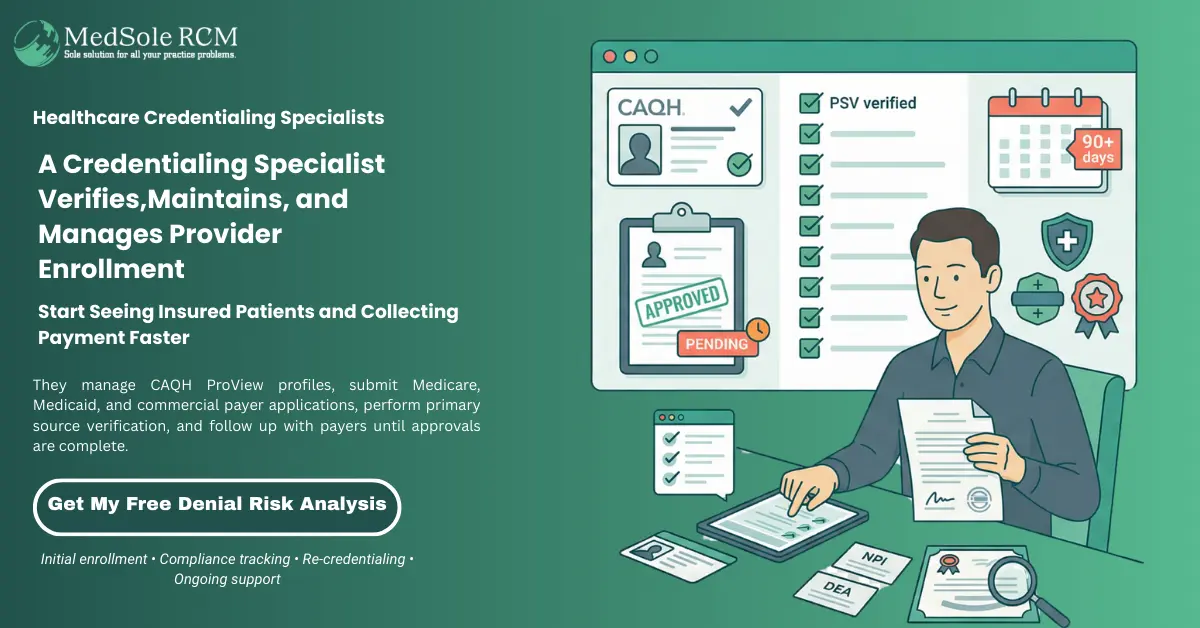
A credentialing specialist is a healthcare administrative professional who verifies provider qualifications, manages payer enrollment applications, and maintains ongoing compliance to ensure providers can bill insurance networks and receive reimbursement for services rendered.
MedSole RCM's credentialing specialists manage the entire enrollment process for $99 per insurance, the most affordable credentialing service rate available in the US market. That's not a promotional price. It's our standard rate for every provider, every specialty, and every payer. Our provider enrollment and credentialing services cover Medicare through PECOS, all state Medicaid programs, and every major commercial insurer simultaneously.
This guide covers what credentialing specialists do, how the process works, realistic 2026 timelines by payer, and how to get enrolled faster for less than any in-house alternative.
What Is a Credentialing Specialist?
A credentialing specialist sits between a provider's qualifications and their ability to collect insurance payment. They verify licenses, certifications, education, and training at the primary source, meaning directly from the medical school, licensing board, or certification body, and use that verified data to enroll the provider with every insurance payer they want to participate with.
Credentialing specialists work in hospitals, insurance companies, and third-party RCM firms. Regardless of where they sit, their job controls one thing for providers: how quickly you go from qualified to getting paid. Everything else in your billing workflow depends on that enrollment being active.
Without active credentialing, a provider can't bill insurance as in-network. Services billed before an enrollment effective date get denied permanently. A provider seeing 20 patients a day at $150 average reimbursement loses approximately $3,000 daily while credentialing stalls. Over 90 days, that's $270,000 in revenue a practice can't collect, most of it permanently gone.
Credentialing in healthcare isn't a one-time event. A credentialing specialist manages initial enrollment, tracks license and certification expirations, and handles re-credentialing every two to three years per payer. The cycle is continuous. The cost of letting it lapse is immediate and recoverable only by starting the enrollment process over.
MedSole RCM's credentialing specialists manage this entire cycle for $99 per insurance enrollment. That covers CAQH ProView setup, application submission, payer follow-up, and ongoing re-credentialing management. No salary overhead, no software costs, no guesswork on the invoice. Talk to our enrollment team about getting your providers enrolled.
What Does a Credentialing Specialist Do? The 6 Core Responsibilities
The six core responsibilities of a credentialing specialist are primary source verification, insurance network enrollment, CAQH ProView management, license and certification tracking, compliance monitoring, and re-credentialing management. Each responsibility is a control point in the enrollment process. A gap in any one of them creates a gap in your revenue.
The voice that matters in this section isn't job-description language. It's revenue language. Here is what each responsibility protects for your practice.
1. Primary Source Verification (PSV)
Primary source verification is direct confirmation of a provider's licenses, degrees, certifications, and training from the issuing institutions themselves, not from copies the provider supplies. NCQA mandates primary source verification for accredited credentialing organizations. If PSV is incomplete, no payer will process your enrollment application. A credentialing specialist who skips steps or takes shortcuts creates a verification record that stalls commercial applications for months.
2. Insurance Network Enrollment
Insurance network enrollment covers preparing, submitting, and tracking applications to every payer: Medicare through PECOS, Medicaid through state portals, and commercial payers through their individual systems. Submitting the application is approximately 30% of the enrollment process. The remaining 70% is persistent follow-up with payers to resolve missing information and push stalled applications forward. The specialist who submits and waits leaves enrollment timelines entirely up to the payer. One who follows up weekly is the one who gets applications resolved in 60 days instead of 180. Each commercial payer has its own enrollment workflow and portal. Aetna provider enrollment runs on a different timeline and documentation set than Cigna provider enrollment. Payer-specific knowledge is what separates specialists who hit 60-day timelines from those who wait six months for the same outcome.
3. CAQH ProView Management
CAQH ProView is the central data source most commercial payers use for enrollment decisions. A credentialing specialist maintains and optimizes this profile continuously. An incomplete CAQH ProView profile is the single most common cause of commercial payer enrollment delays, often stalling applications for weeks or months before a reviewer ever sees the data. If your malpractice certificate is expired in CAQH, applications stall before a payer ever assigns a reviewer. CAQH also requires provider re-attestation every 120 days. A profile that lapses silently blocks enrollment across every connected payer simultaneously. Our guide on how CAQH works in medical billing walks through the full attestation cycle and what happens when it lapses.
4. License and Certification Expiration Tracking
A credentialing specialist monitors every credential across every active state: state licenses, DEA registrations, board certifications, and malpractice insurance. Renewals get flagged before they lapse, not after. A single expired credential can trigger automatic suspension from payer networks. Claims keep submitting, denials keep returning, and nobody knows why until someone identifies the expired document. Revenue loss from an undetected expired credential can run weeks before anyone catches it.
5. Compliance Monitoring
Compliance monitoring means regular checks against the OIG exclusion list, the National Practitioner Data Bank, and SAM.gov for any sanctions, adverse actions, or disqualifying flags. A flag in any of these databases halts enrollment or triggers removal from networks already active. Catching a flag early gives time to resolve it. Discovering it after a payer suspension means explaining a compliance gap to a panel that's already terminated your participation.
6. Re-Credentialing Management
Most payers require re-credentialing every two to three years. A credentialing specialist tracks every deadline across every payer and initiates renewal 90 to 120 days before expiration. Missing a re-credentialing deadline doesn't produce a warning. It produces automatic termination from that payer's network, followed by a full re-enrollment process starting from scratch. That's three to six months of lost revenue from a missed calendar date. The only way to prevent it is active deadline management, not reactive recovery.
Types of Credentialing Specialists: Who You Actually Need
Not every credentialing specialist has the same depth across all provider types. Most develop expertise in specific areas. Knowing which type you need before you hire or outsource saves time and avoids mismatched expertise that extends enrollment timelines.
Medical Credentialing Specialist and Physician Credentialing Specialist
A physician credentialing specialist handles the most complex verification chain in healthcare: medical school, residency, fellowship, ABMS board certification, state licensure, DEA registration, and full malpractice history. Physicians often need hospital privileges managed simultaneously with payer enrollment, which means two separate credentialing tracks running in parallel. A medical credentialing specialist without hospital credentialing experience creates delays on one track while the other resolves. Our complete guide to physician credentialing services details the full verification chain and 2026 CMS enrollment updates.
Insurance Credentialing Specialist
An insurance credentialing specialist focuses specifically on payer-side enrollment: Medicare, Medicaid, and every commercial insurer. They know each payer's application requirements, portal structure, and typical turnaround patterns. What Aetna requires on an application differs from what UnitedHealthcare wants. Payer-specific knowledge is what separates 60-day enrollments from six-month stalls. A generalist who treats all payer applications the same will learn those differences at your practice's expense.
Dental Credentialing Specialist
Dental credentialing runs in its own payer ecosystem. Delta Dental, MetLife, Cigna Dental, and Guardian each use portals, forms, and timelines that have nothing to do with medical insurance credentialing. A medical credentialing specialist who's never touched dental enrollment will hit a learning curve that costs the practice months. Dental providers need a specialist who already knows the payer-specific requirements before the first application goes out.
Behavioral Health and Therapy Credentialing
Psychologists, LCSWs, LPCs, and physical, occupational, and speech therapists each carry state-specific practice act requirements. Behavioral health panels are frequently restricted. Approval timelines run longer than physician enrollment at most payers. Telehealth expansion means providers offering virtual services across state lines need credentialing in every state where they treat patients, which multiplies the application workload significantly. Our guide to credentialing services for mental health providers covers panel restriction strategies and payer-specific tactics for Aetna, Cigna, UHC, and Medicare.
Telehealth Credentialing Specialist
Multi-state telehealth credentialing multiplies the application volume by every state in a provider's service area. Each state carries its own license requirements, and each payer requires separate enrollment in each state. A credentialing specialist without multi-state telehealth experience will underestimate the workload by a factor of five. Practices that discover this midway through expansion face months of retroactive enrollment work.
MedSole RCM's credentialing specialists handle all provider types across all payer categories, including multi-state telehealth, for the same $99 per insurance rate regardless of specialty. Whatever your specialty, our team knows the application requirements, payer-specific rules, and follow-up cadence before your first submission goes out. Get started with enrollment for your practice today.
How Long Does Credentialing Take? Realistic 2026 Timelines
Provider credentialing typically takes 60 to 180 days, with Medicare averaging 45 to 65 days, commercial payers ranging from 60 to 120 days, and behavioral health payers running up to 150 days depending on panel availability. That range is real. Clean, complete applications move faster. Incomplete or stale applications push past six months at major commercial payers.
Here's how the timeline breaks down by payer category in 2026:
|
Payer |
Average Timeline |
Key Driver |
|---|---|---|
|
Medicare (PECOS) |
45 to 65 days |
CMS-855 form completeness and MAC processing speed |
|
Medicaid |
30 to 90 days |
Varies significantly by state portal and staffing |
|
BCBS |
60 to 120 days |
State plan variations across regions |
|
UnitedHealthcare |
60 to 90 days |
Panel availability by specialty and geography |
|
Aetna |
60 to 120 days |
Specialty and market demand |
|
Cigna |
45 to 90 days |
Generally faster internal processing |
|
Humana |
60 to 90 days |
Standard commercial timeline |
|
Dental Payers |
60 to 120 days |
Payer-specific documentation packages |
|
Behavioral Health |
60 to 150 days |
Panel restrictions create longer queues |
|
MedSole RCM Clients |
45 to 60 days average |
Pre-optimized CAQH, weekly follow-up |
The most common delay triggers are incomplete or outdated CAQH ProView profiles, missing documents (expired license, lapsed malpractice, absent DEA certificate), unexplained gaps in work history, payer backlog or closed panels, discrepancies between submitted information and primary source verification results, and slow response to payer requests for additional information. A credentialing specialist who catches all of these before submission eliminates the most common delay sources before the application goes out.
Providers practicing out-of-network while credentialing is pending receive 40% to 60% lower reimbursement than in-network rates, and patients face higher cost-sharing that generates pushback and attrition. The financial case for fast enrollment isn't only the lost revenue from delay. It's the patient relationships and market-rate reimbursements you don't recover once the encounter has passed.
MedSole RCM's credentialing specialists complete most provider enrollments in 45 to 60 days. That's not an average built on easy cases. It's built on pre-optimized CAQH profiles, complete application packages, and weekly payer follow-up from day one. See what faster enrollment looks like for your practice with our credentialing team.
Credentialing Specialist Cost: In-House vs Outsourced in 2026
The cost of credentialing comes down to one comparison. What does it cost to hire it in-house versus what does it cost to outsource it? The numbers aren't close. They're not even in the same category. Our outsource provider enrollment ROI guide runs the full CFO-grade cost analysis with every variable included.
Here's what a full-time in-house credentialing specialist actually costs annually:
|
Cost Element |
Annual Cost |
|---|---|
|
Credentialing specialist salary |
$50,000 to $77,000 |
|
Employer payroll taxes (approximately 15%) |
$7,500 to $11,550 |
|
Benefits (health, dental, retirement) |
$8,000 to $15,000 |
|
Credentialing software licenses |
$3,000 to $8,000 |
|
Training and certification maintenance |
$1,500 to $3,000 |
|
Management overhead |
Variable |
|
Total annual cost |
$70,000 to $114,000+ |
That assumes the hire is experienced, certified, and effective from day one. An entry-level hire working through the learning curve means slower enrollments, higher error rates, and more denied claims during the ramp period. The real cost is the floor, not the ceiling.
Here's what MedSole RCM charges for the same outcome:
|
Service Element |
Cost |
|---|---|
|
Full provider credentialing, one payer |
$99 |
|
CAQH ProView setup and optimization |
Included |
|
Multi-payer simultaneous submission |
$99 per payer |
|
Weekly follow-up and status tracking |
Included |
|
Re-credentialing management |
Included |
|
Full RCM integration |
Included |
|
Annual cost for 10 payers |
$990 |
Outsourcing credentialing to a specialist service at $99 per insurance costs approximately 99% less than maintaining a full-time in-house credentialing specialist, whose salary plus benefits plus software costs typically exceed $70,000 to $100,000 annually.
Large health systems managing hundreds of providers across multiple facilities may justify an in-house team. For solo practitioners, small groups, new practices, and practices managing fewer than 20 providers, the outsourced model delivers the same certified expertise and payer relationships at a fraction of the overhead. Our full provider enrollment and credentialing services integrate directly with your billing workflow, so credentialing handoffs don't become billing gaps. That integration also connects to your broader revenue cycle management from day one.
Specialty-Specific Credentialing: What Changes for Physicians, Dentists, Therapists, and Telehealth Providers
Every specialty carries its own payer application requirements, documentation packages, and panel rules. A specialist who handles one specialty well may not know the requirements of another. Here's what changes by specialty, and why it matters for your enrollment timeline.
Physician and Advanced Practice Credentialing
Physician credentialing involves the longest verification chain in healthcare. Medical school, residency, fellowship, board certification through ABMS, state licensure, DEA registration, and full malpractice history all require primary source verification. NPs and PAs carry their own supervision agreement requirements that vary by state. Our enrollment team knows which states require specific supervision language on applications and which payers require it before even opening the file.
Primary Care, Internal Medicine, and Family Medicine
Primary care providers often need simultaneous enrollment with a wide commercial panel because their patient populations are diverse by insurance. Medicare Advantage plans require separate enrollment from traditional Medicare PECOS. Some commercial payers treat NPs differently from physicians even within the same group enrollment, requiring individual applications for each provider despite sharing a group NPI. These distinctions slow down practices that don't catch them before submission.
Dental Providers
Dental credentialing operates on a completely separate payer track from medical insurance. Delta Dental, MetLife, Cigna Dental, and Guardian each have distinct application portals, different documentation requirements, and their own panel capacity rules. Mixing dental and medical credentialing workflows into a single process creates errors that stall both. A dental credentialing specialist who handles only dental knows which payers verify DEA registration for dental providers and which don't ask for it at all.
Behavioral Health, Therapy, and Mental Health Providers
Panel restrictions are the defining challenge for behavioral health credentialing. Many commercial payers have restricted behavioral health panels that accept limited new providers per quarter or per region. Our team knows which payers are actively accepting applications and which will automatically defer a new submission to their next review cycle. Filing with a closed panel wastes weeks that an experienced specialist saves by checking panel status before applying. State Medicaid adds another layer. Our guide to Medicaid credentialing requirements covers the 50-state MCO enrollment complexity that behavioral health providers face when expanding their patient base.
OB-GYN and Women's Health
OB-GYN credentialing carries a specific malpractice verification burden that other specialties don't face. Payers scrutinize malpractice history more closely for high-risk obstetric coverage, and gaps or changes in malpractice carriers trigger additional payer requests. An insurance credentialing specialist who handles OB-GYN enrollment regularly knows how to document malpractice transitions clearly enough to prevent payer review requests before they start.
Telehealth Providers Serving Multiple States
Multi-state telehealth credentialing is volume credentialing. Every state where a provider offers virtual services requires its own license, and every payer requires separate enrollment in each state. A telehealth provider serving five states may need 30 to 50 separate credentialing applications across licensure and payer enrollment. Anyone without multi-state telehealth experience will discover that complexity midway through the process. State Medicaid rules compound this further. Our Florida credentialing guide illustrates how a single state adds AHCA enrollment, managed care MCO credentialing, and Medicaid layers that multi-state guides routinely underestimate.
Whatever your specialty, MedSole RCM's credentialing specialists handle it. $99 per insurance covers every specialty, every payer, and every state. Start your enrollment today and tell us which payers you need.
The 6 Most Common Credentialing Errors That Cost Practices Revenue
Credentialing errors don't show up as credentialing errors on your remittance reports. They show up as claim denials that look like billing errors, NPI mismatches, and unresolved accounts receivable that age past 90 days before anyone connects them to an enrollment gap. Here are the six errors that appear most frequently, and what each one costs.
Error 1: NPI mismatch on claims. The NPI number on the submitted claim doesn't match what the payer has on file from enrollment. This causes automatic denials on otherwise clean claims. The denial reason looks like a billing error. The real cause is an enrollment record that was never updated when the provider changed group affiliation, changed taxonomy codes, or added a second location to the practice.
Error 2: Billing under the group without group enrollment. The provider bills under the group's NPI but isn't listed on the group enrollment with that payer. The payer has no record of that individual provider under the group contract, and the claim denies. This error is common when a new provider joins an existing group and starts seeing patients before the group enrollment application is submitted and approved.
Error 3: Claims submitted before the effective date. Services rendered before the payer's assigned effective date aren't reimbursable. Retroactive effective dates aren't guaranteed and often require a formal request with specific documentation. Services delivered before a prospective effective date are permanently uncollectable. This is the most expensive credentialing error because it produces claim losses that no appeal will recover.
Error 4: Taxonomy code mismatch. The taxonomy code on the enrollment application doesn't match the taxonomy code on the submitted claim. The payer sees a different specialty than what was credentialed and denies for coverage reasons. Taxonomy code management is routine for an experienced credentialing specialist. It's easily missed when credentialing is handled by someone without specialty-specific payer knowledge.
Error 5: Expired credentials triggering network suspension. A lapsed state license or expired malpractice insurance certificate can suspend network participation automatically and without warning. Claims keep submitting, denials keep returning, and nobody identifies the source until the expired credential is tracked down. Revenue loss from an undetected suspension runs for weeks before the pattern becomes obvious enough to investigate.
Error 6: Missed re-credentialing deadline. Most payers terminate network status automatically when re-credentialing lapses. Getting reinstated means re-applying from scratch, which starts the full 60 to 150-day enrollment timeline over again. A missed calendar date costs months of in-network revenue. Active deadline tracking, initiated 90 to 120 days before each deadline, is the only preventive measure that works consistently.
Every error on this list creates downstream billing and collections problems. Our outsourced medical billing services catch the billing-side consequences. Our denials management team recovers what denials have already cost. And our AR follow-up team works the aged accounts that credentialing gaps create. But the cleanest solution is preventing the errors before the first application goes out.
Signs Your Practice Needs an Outsourced Credentialing Specialist
Credentialing problems don't announce themselves. They show up in denied claims, delayed enrollments, and accounts receivable reports that don't add up. Run through this checklist. If any of these apply, the revenue risk of handling credentialing without a dedicated specialist exceeds the cost of outsourcing by a measurable margin.
Your practice is opening and you need enrollment with multiple payers simultaneously before the first patient schedules. Applications have been sitting with payers for 90 days or more and nobody on your team has a status update. Your office manager handles credentialing between answering phones, scheduling patients, and managing the front desk.
Claim denials are citing enrollment or credentialing errors as the reason for non-payment. A provider joined your group three months ago and still can't bill because enrollment isn't complete. You've missed a re-credentialing deadline and lost network status with at least one payer.
You're expanding to a new state and need multi-state licensure and payer credentialing managed simultaneously. You're transitioning from out-of-network to in-network status and don't know which payers to approach first or in what order. You're a telehealth provider offering services across multiple states and haven't enrolled with payers in each one.
You've tried handling credentialing internally, the timeline keeps slipping, and you're not sure why.
Every one of these situations has a specific financial cost that compounds while the enrollment gap continues. A provider credentialing specialist who handles these scenarios daily knows exactly which step is causing the delay and how to resolve it. If you're ready to evaluate outsourcing, our guide to how to select the best credentialing company covers 10 evaluation criteria with green flags and red flags for each.
What to Look for in a Credentialing Specialist Service
Not every credentialing service delivers the same results. Before signing with any provider, run through these six criteria. They separate credentialing firms that produce fast, accurate enrollments from those that submit applications and wait.
CPCS-certified staff. The Certified Provider Credentialing Specialist credential, issued by NAMSS, is the primary competency benchmark for this profession. Ask directly whether the team holds CPCS certification. Non-certified specialists may handle routine applications adequately. They're more likely to miss the edge cases that cost practices network status and revenue.
End-to-end service. CAQH ProView setup through ongoing re-credentialing, not just initial application submission. The follow-up phase is 70% of the enrollment process. A service that submits and considers the work complete will leave your application stalled at the payer for weeks without update.
Transparent flat-rate pricing. No percentage-of-revenue models. No hourly billing. No hidden fees. You should know exactly what you're paying before anything starts. MedSole RCM's $99 per insurance is the clearest rate structure available. One rate, every payer, every specialty, spelled out before any work begins.
Multi-payer expertise. Medicare, Medicaid, and all commercial payers simultaneously. A credentialing service that handles only commercial payers won't help with your PECOS application or your state Medicaid portal. Payer gaps in a credentialing service create revenue gaps in your practice.
Proactive weekly status updates. You should receive enrollment status updates without having to chase them. If you're calling the credentialing service to ask what's happening with your application, the service isn't doing its job. Weekly updates are the minimum standard for a service worth keeping.
Full RCM integration. When credentialing connects directly to billing and claims management, the handoff errors that create denials disappear. A standalone credentialing service that has no visibility into your billing workflow will produce enrollment gaps that your billing team discovers weeks later in denied claims.
MedSole RCM meets every criterion on this list. And prices the entire service at $99 per insurance. Our guide to the best credentialing services for healthcare providers breaks down the eight performance benchmarks that separate credentialing partners worth paying for from those that quietly cost clients money every month.
How MedSole RCM's Credentialing Specialists Work
MedSole RCM's credentialing specialists manage the full enrollment process for healthcare providers across all provider types and all payer categories. One team, one flat rate, no handoffs between departments. Here's exactly how the process runs from day one through ongoing re-credentialing.
Step 1: Credentialing audit. Before touching a single application, the team reviews your current enrollment status across all payers. Stale applications, open gaps, enrollment inconsistencies, and lapsed credentials are all identified before any new work begins. This step prevents submitting new applications that will hit the same problem that stalled the previous ones.
Step 2: CAQH ProView optimization. Every field completed, every document current, every inconsistency resolved before a single payer sees the data. CAQH is the starting point for most commercial payer enrollment decisions. Getting it right before submission eliminates the most common source of enrollment delays. Most practices arrive with at least one incomplete CAQH field we catch at this stage.
Step 3: Simultaneous multi-payer submission. Medicare through PECOS, Medicaid through the appropriate state portal, and every commercial payer submitted at the same time. No waiting for one approval before starting the next. Simultaneous submission compresses the total enrollment timeline across all payers, which is how our clients reach active billing status in 45 to 60 days instead of six months.
Step 4: Weekly follow-up on every active application. Every payer contacted every week to track status, respond to requests for additional information, and push stalled applications forward. Payers don't flag missing information by calling your office. A credentialing specialist who contacts each payer weekly is the reason applications resolve in 45 days instead of 180.
Step 5: Contract and effective date review. When payer contracts arrive, the team reviews contract terms, fee schedule implications, and effective dates before the provider signs. A provider who signs a contract without reviewing the effective date may start billing before the in-network date officially opens, which produces permanent claim losses.
Step 6: Ongoing re-credentialing management. Every deadline across every payer is tracked from the day enrollment is complete. Renewals are initiated 90 to 120 days before each deadline. The provider doesn't think about re-credentialing again. It happens before the risk of expiration exists.
MedSole RCM charges $99 per insurance enrollment. That covers every step above: CAQH setup, multi-payer submission, weekly follow-up, contract review, and ongoing re-credentialing management. No setup fees. No hidden charges. No annual contracts. Just $99 per payer. For a practice enrolling with 10 payers, that's $990 total versus $70,000 or more for an in-house hire. It's the lowest structured credentialing rate in the US RCM market, and it includes everything a dedicated in-house specialist would handle plus full integration with your billing workflow. Our guide on integrated medical billing and credentialing services explains how the two functions work together to eliminate the claim denials that standalone credentialing services miss.
Talk to our credentialing team today and get your provider enrolled faster than any in-house process can deliver.
Certified Provider Credentialing Specialist (CPCS): Why Certification Matters
The Certified Provider Credentialing Specialist (CPCS) credential is issued by the National Association Medical Staff Services (NAMSS) and requires demonstrated competency in credentialing processes, verification standards, and regulatory compliance. Candidates must complete a combination of education and hands-on experience before sitting for the exam. It's not a participation credential. It requires measurable expertise before it's awarded.
When you outsource credentialing, asking whether the team holds CPCS certification is the fastest signal of competency. Non-certified staff may process routine applications correctly. They're more likely to miss the edge cases: the expired malpractice certificate a week before re-credentialing, the CAQH inconsistency that stalls a commercial application, the deadline that produces a payer termination if missed by a single day. Edge cases are what cost practices revenue.
MedSole RCM's credentialing team includes CPCS-certified specialists managing every enrollment. Certification isn't a credential on a resume here. It's the hiring standard.
Frequently Asked Questions About Credentialing Specialists
What is a credentialing specialist?
A credentialing specialist is a healthcare administrative professional who verifies provider qualifications, manages payer enrollment applications, and maintains ongoing compliance to ensure providers can bill insurance networks and receive reimbursement. They handle primary source verification, CAQH ProView management, insurance network enrollment, license tracking, and re-credentialing. MedSole RCM's specialists manage the full process for $99 per insurance.
What does a credentialing specialist do?
The six core responsibilities of a credentialing specialist are primary source verification, insurance network enrollment, CAQH ProView management, license and certification tracking, compliance monitoring, and re-credentialing management. Each responsibility is a control point in the enrollment process. A gap in any one of them stalls enrollment or creates a compliance failure that removes a provider from payer networks.
How much does credentialing cost?
In-house credentialing specialist costs run $70,000 to $114,000 annually when salary, payroll taxes, benefits, software, and training are included. MedSole RCM's credentialing specialist services cost $99 per insurance enrollment. For a practice enrolling with 10 payers, that's $990 total versus $70,000 or more for an in-house hire. No setup fees, no percentage-of-revenue pricing, no annual retainer. See the full provider enrollment ROI breakdown for the complete cost analysis.
How long does credentialing take?
Provider credentialing typically takes 60 to 180 days depending on payer, specialty, and application completeness. Medicare averages 45 to 65 days, commercial payers range from 60 to 120 days, and behavioral health payers can run up to 150 days with panel restrictions. MedSole RCM clients average 45 to 60 days from application submission to active in-network status through pre-optimized CAQH profiles and weekly payer follow-up.
What is a Certified Provider Credentialing Specialist (CPCS)?
The CPCS credential is issued by the National Association Medical Staff Services (NAMSS) and requires demonstrated competency in credentialing processes, verification standards, and regulatory compliance. It's the primary competency benchmark for credentialing professionals. When evaluating a credentialing service, asking whether staff holds CPCS certification is the fastest signal of technical expertise. MedSole RCM's team is CPCS-certified.
Do I need a credentialing specialist for every insurance company?
Yes. Every payer requires a separate enrollment application, separate documentation, and separate follow-up. Medicare, Medicaid, and each commercial insurer have their own portals, application requirements, and processing timelines. MedSole RCM submits to all payers simultaneously. That's what compresses the total enrollment timeline to 45 to 60 days instead of six months of sequential applications.
What happens if credentialing is delayed or denied?
A credentialing delay costs approximately $3,000 per day for a provider seeing 20 patients daily at $150 average reimbursement. A 90-day delay totals roughly $270,000 in permanently uncollectable revenue. A credentialing denial requires identifying the specific reason, resolving the underlying issue, and reapplying, which resets the timeline entirely. MedSole RCM prevents delays through pre-submission CAQH optimization and weekly follow-up. Denials are addressed before they become timeline resets.
Can I bill insurance while waiting for credentialing approval?
No. Services rendered before the payer's assigned effective date aren't reimbursable and can't be recovered through appeal in most cases. Some payers offer retroactive effective dates under specific circumstances, but retroactive approval isn't guaranteed and requires a formal request with supporting documentation. Providers who start billing before the in-network effective date are confirmed risk losing every claim submitted in that window permanently.
What is the difference between credentialing and privileging?
Credentialing is the process of verifying a provider's qualifications and enrolling them with insurance payers for billing purposes. Privileging is the process by which a hospital or healthcare facility grants specific clinical privileges, meaning the right to perform specific procedures, based on those verified credentials. Credentialing determines whether a provider can bill. Privileging determines what a provider can do clinically within a specific facility. The two processes run in parallel for providers with hospital affiliations.
Should I outsource credentialing or handle it in-house?
For practices with fewer than 20 providers and without a dedicated, CPCS-certified in-house credentialing team, outsourcing delivers faster enrollments at a fraction of the cost. In-house credentialing runs $70,000 to $114,000 per year. MedSole RCM's credentialing specialist services run $99 per insurance. At that difference, the financial case for outsourcing is clear before the first enrollment is complete.