


![Credentialing Services in Florida: Complete Guide to Provider Enrollment, Costs & Timelines [2026 Updated]](/_imgs/blogs/41469_credentialing-services-florida-guide.webp)
Our credentialing team at MedSole RCM enrolls hundreds of providers with Florida payers every year. If there's one thing we've learned from that volume, it's that Florida's credentialing process is unlike any other state's.
AHCA is launching a completely new Medicaid enrollment system in April 2026. CMS is tightening NPI enforcement with a hard deadline of March 27. Florida Blue continues restricting panel access in dozens of specialties. These aren't future possibilities. They're happening right now, and they're catching providers off guard.
We built this guide to walk you through every step of provider enrollment and credentialing in Florida: what's required, which payers you'll deal with, how long each one takes, what it costs, and what changed in 2026. Whether you're a physician opening a new practice in Miami, a therapist expanding in Tampa, or a nurse practitioner relocating from out of state, this is everything you need in one place.
MedSole RCM is a full-service revenue cycle management company offering provider credentialing at $99 per payer enrollment and medical billing at 2.99% of collections, the most affordable rates among full-service credentialing companies in Florida.
Here's what this guide covers:
-
What credentialing actually involves in Florida (and how it differs from other states)
-
The step-by-step process from document collection to network go-live
-
Payer-by-payer enrollment requirements for Florida Blue, UHC, Aetna, Humana, Cigna, Sunshine Health, Molina, WellCare, Medicare, and Florida Medicaid
-
Realistic timelines and costs (with 2026 pricing data)
-
Specialty-specific credentialing for physicians, NPs, therapists, DME suppliers, and more
-
Every 2026 regulatory change that affects your enrollment
If you need expert credentialing help in Florida, or want to see how we enroll providers at $99 per payer, request a free credentialing assessment from our team.
What Is Provider Credentialing in Florida?
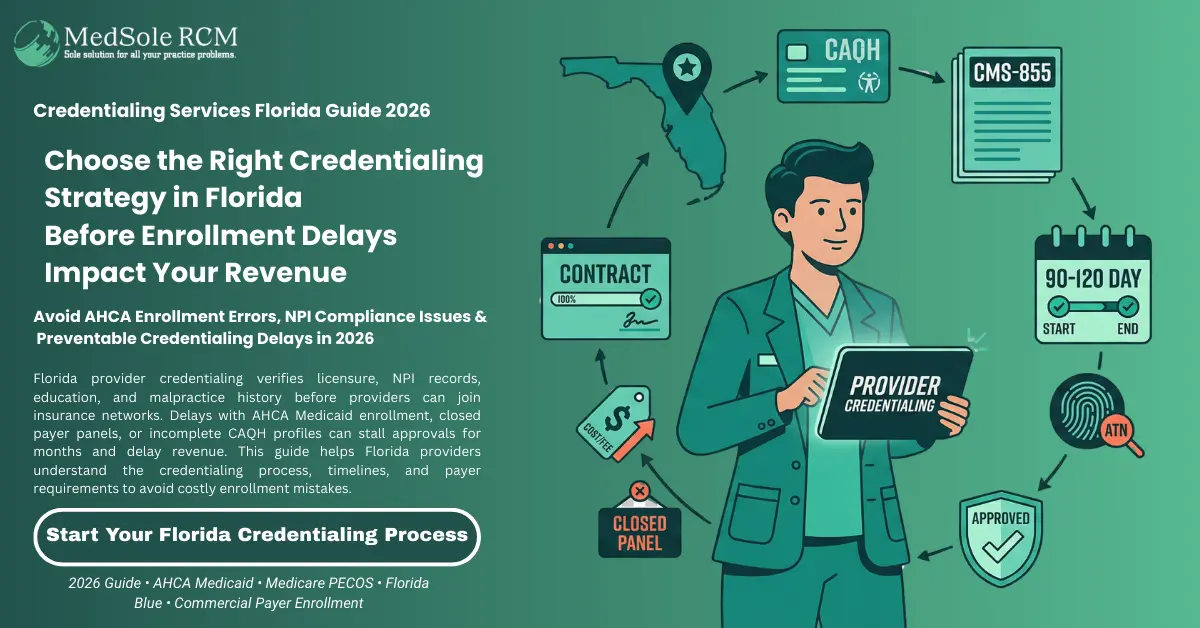
Provider credentialing in Florida is the process of verifying a healthcare provider's qualifications, including medical education, state licensure, board certification, DEA registration, malpractice history, and work history, to approve them for participation in insurance networks. In Florida, this process is complicated by the state's unique Medicaid portal through AHCA, frequent panel closures by major payers like Florida Blue, and multi-step background check requirements that don't exist in most other states.
That's the textbook version. Here's what it means in practice.
Until you're credentialed with a payer, you can't bill them. Every patient covered by that payer either gets seen for free or doesn't get seen at all. For a Florida provider seeing 20 to 25 patients a day at an average reimbursement of $150, that's over $3,000 in lost revenue per day. Over a 90-day enrollment timeline, you're looking at $270,000 that never hits your bank account.
Florida has over 90,000 active physicians and one of the most complex multi-payer landscapes in the country. The state's Agency for Health Care Administration runs its own Medicaid enrollment system with rules you won't find anywhere else. Major commercial payers routinely close their networks to new providers, especially in saturated markets like South Florida and Orlando.
One thing that trips up a lot of providers: credentialing, enrollment, and privileging are three different things.
-
Credentialing is the verification process, confirming your education, training, licenses, certifications, and history are legitimate.
-
Enrollment is the administrative step of actually joining a payer's network so you can bill them.
-
Privileging is specific to hospitals and facilities. It's the process of getting approved to practice and perform specific procedures within a particular institution.
All three have to happen before you can start generating revenue. Skip one, and the others don't matter. The Florida Board of Medicine handles state licensure, but credentialing and enrollment go far beyond just having a license.
In Florida, getting this wrong doesn't just delay your first paycheck. It can stall your entire practice launch by months.
What Makes Credentialing in Florida Different from Other States?
Every state has its quirks with credentialing. Florida has more than most. Providers who've been through the process in New York, Texas, or California often assume Florida will work the same way. It won't. Here are the specific differences that catch people off guard.
Florida's Medicaid Web Portal Is Uniquely Complex
Florida Medicaid enrollment runs entirely through the Florida Medicaid Web Portal, managed by AHCA. The application is done online, which sounds convenient until you realize how specific the system is about documentation sequencing and data entry.
Your effective date is tied directly to your submission date. That's different from many states where the effective date is tied to the approval date. In Florida, a clean application submitted on March 1 gives you a March 1 effective date. A messy application submitted on March 1 that gets rejected and resubmitted on May 15 gives you a May 15 effective date. That two-and-a-half-month gap translates directly into lost revenue.
The system is also unforgiving with errors. One wrong field can kick the entire application back. Providers who aren't familiar with the portal's logic often cycle through multiple rejections before getting it right.
AHCA is launching a completely new enrollment system in April 2026 as part of the AHCA Enterprise modernization. Providers with pending applications or open renewals in the current system should finish them now. Once the new system goes live, anything left incomplete in the old portal creates migration headaches.
Florida's Multi-Step Background Check Process
Most states run a background check as part of credentialing. Florida turns it into a multi-step process that takes two to four weeks on its own.
Here's how it works:
-
Submit your Florida Medicaid enrollment application first
-
Receive your Application Tracking Number (ATN) from AHCA
-
Use the ATN to access the clearinghouse
-
Complete fingerprinting
-
Obtain your Florida Public Rap Sheet
You can't skip ahead. Without the ATN, you can't access the clearinghouse. Without fingerprints and the Rap Sheet, Medicaid enrollment stalls. Providers coming from states with simpler background check processes often don't budget enough time for this.
Florida also requires Level 2 background screening for practice owners, administrators, and medical directors. AHCA has increased scrutiny of ownership disclosures in recent years, and incomplete investor history or unresolved background issues can trigger denials during licensing and enrollment.
Closed Insurance Panels Are a Florida Reality
Florida Blue, UnitedHealthcare, and Aetna regularly close their networks to new providers in competitive markets. When a panel is "closed," the payer isn't accepting new applications for certain specialties or geographic areas.
For a new practice, this is a serious revenue problem. If you can't get on Florida Blue's panel and 30% of your potential patients carry Florida Blue, you're starting with a 30% hole in your revenue model.
Closed panels aren't permanent, and they aren't always absolute. Credentialing companies in Florida with established payer relationships can sometimes negotiate entry through strategic timing, demonstrating network gaps, or leveraging existing contracts. Results vary by specialty and market, but it's worth having an experienced team work the process rather than accepting a rejection at face value.
Florida's Medicare Population Demands Specific Enrollment Expertise
Florida is the third most populous state with one of the fastest-growing senior populations, making provider credentialing and payer enrollment essential for practices to access the state's massive insured patient base. Medicare Advantage penetration in Florida is among the highest in the country. In many Florida markets, Medicare and MA plans represent a bigger share of revenue than commercial insurance.
Medicare enrollment in Florida goes through PECOS (Provider Enrollment, Chain, and Ownership System) using CMS-855 forms. Florida's Medicare Administrative Contractor is First Coast Service Options for Jurisdiction N, handling both Part A and Part B claims. Palmetto GBA also services certain provider types.
Getting Medicare enrollment wrong doesn't just delay payments. CMS can retroactively revoke enrollment if data doesn't align, and the 2026 enforcement environment is significantly stricter than previous years. For any Florida practice serving patients over 65, Medicare enrollment isn't optional. It's the foundation of your revenue.
2026 Florida Credentialing Updates Every Provider Must Know
The credentialing requirements in Florida shifted meaningfully heading into 2026. Some changes affect every provider in the state. Others target specific enrollment types. Either way, if you use credentialing services in Florida or handle enrollment in-house, you need to adjust your workflows now.
AHCA Is Launching a New Medicaid Provider Enrollment System (April 2026)
AHCA is replacing the current Medicaid enrollment platform with a completely new system as part of its Enterprise modernization project. The launch is scheduled for April 2026. It's designed to simplify enrollment, renewal, and account maintenance for Florida Medicaid providers.
If you have anything pending in the current system, finish it before the migration. Don't assume it'll carry over cleanly.
Here's what AHCA is telling providers to do before April:
-
Complete pending enrollment applications in the current Provider Enrollment Wizard
-
Review and update account information in the Florida Medicaid Secure Web Portal
-
Log into the portal at least every 60 days to keep your account active
-
Subscribe to AHCA Florida Medicaid Health Care Alerts for transition updates
AHCA is also launching a provider learning series to walk people through the new system. If you've been through a portal migration before, you know the first few months always get bumpy. Providers who prepare early tend to avoid the worst of it.
CMS NPI Enforcement: Florida Medicaid Claims at Risk (March 27, 2026 Deadline)
On February 10, 2026, AHCA flagged providers with missing or inactive NPI data on their Florida Medicaid provider file. This wasn't just a heads-up. There's a hard deadline attached.
Starting March 27, 2026, an active NPI is required to submit claims via Direct Data Entry on the Florida Medicaid portal. No active NPI means no claims go through.
Here's the part most people miss. Your NPI isn't just one number in one place. It needs to match across five systems simultaneously: NPPES, your Medicaid provider file, your clearinghouse, your EHR, and your actual claims. If the taxonomy code or ZIP+4 doesn't align between any of those, the claim will deny.
Missing or outdated NPI data can also block your account from merging into the new AHCA provider enrollment system. That creates a domino effect: delayed Florida Medicaid provider enrollment, stalled renewals, and restricted portal access.
CMS 2026 Enrollment Fee Set at $750 for Institutional Providers
CMS published the CY 2026 provider enrollment application fee at $750. This covers institutional providers enrolling in Medicare, revalidating, or adding a new practice location. It applies to all applications submitted between January 1 and December 31, 2026.
Individual practitioners and certain exempt entities won't owe this fee. But if your organization qualifies as institutional, build it into your enrollment budget now.
CAQH ProView Tightening 90-Day Attestation Enforcement
CAQH ProView has always required periodic re-attestation. What changed in 2026 is how aggressively they're enforcing the 90-day cycle.
Miss the window, and your profile status flips to "Expired." Active CAQH credentialing applications can pause mid-process. New submissions simply won't move forward until your profile is current again.
CAQH also rolled out new mandatory fields covering specialty experience and population expertise. Leaving these blank, even by accident, can hold up enrollment with every payer that pulls data from your profile.
Florida's MOBILE Act and Interstate Compacts (IMLC, PSYPACT)
Providers relocating to Florida from another state have two pathways that can speed up the licensure portion of credentialing.
Florida joined the Interstate Medical Licensure Compact (IMLC) through SB 7016. This creates an expedited licensure pathway for physicians holding eligible licenses in other compact states. On the behavioral health side, PSYPACT has been active in Florida since July 2023, covering telepsychology and temporary in-person practice for qualifying psychologists.
Neither compact eliminates the need for payer credentialing. But they can cut weeks off the licensure verification step, which is often what holds up the rest of the AHCA provider enrollment timeline.
Keeping up with all of these changes while running a practice is close to impossible. MedSole RCM monitors every AHCA alert, CMS rule change, and payer requirement update through our credentialing and enrollment services, so you don't have to. [Talk to our Florida credentialing team →]
Step-by-Step Provider Credentialing Process in Florida
The provider credentialing process in Florida follows a general sequence, but each step carries state-specific details that catch people off guard. Here's how it actually works from start to finish, based on what we see managing enrollments every day.
Step 1: Gather Provider Documents and Verify Credentials
Before anything gets submitted, you need a complete documentation package. Incomplete files are the single biggest cause of credentialing delays we see in Florida.
At minimum, every provider needs:
-
Active Florida medical license (verified through DOH/MQA)
-
DEA registration
-
Individual NPI number, confirmed as active in the NPPES NPI Registry
-
Board certification
-
Malpractice insurance with current coverage dates
-
Complete work history with no unexplained gaps longer than 30 days
-
Hospital privilege letters, if applicable
Florida medical license verification for credentialing runs through the state's Division of Medical Quality Assurance, which has its own processing timeline. AHCA also mandates Level 2 background screening for practice owners, administrators, and certain clinical staff. That's an extra layer most other states don't require at the front end.
Step 2: Set Up Your CAQH ProView Profile
Almost every commercial payer in Florida, and most Medicaid managed care plans, pull CAQH credentialing data directly from your CAQH ProView profile. No completed profile means no application gets processed. It's that straightforward.
Create your account, fill in every section, and attest. In 2026, CAQH added mandatory fields for specialty experience and population expertise. Don't leave them blank. You'll also need to re-attest every 90 days, or your profile status flips to "Expired" and active applications stall.
Step 3: Register in PECOS and the Florida Medicaid Portal
If you're enrolling in Medicare, you'll need a PECOS account to submit your CMS-855 application. For PECOS enrollment in Florida, your Medicare Administrative Contractor is either First Coast Service Options or Palmetto GBA, depending on the claim type.
For Medicaid, create an account on the Florida Medicaid Web Portal. Until AHCA launches its new system in April 2026, you'll use the current Provider Enrollment Wizard. Get both accounts set up before you start submitting applications. Don't wait until you're mid-process.
Step 4: Submit Applications to Each Payer
A typical Florida provider needs credentialing with eight to 10 payers. Each one has its own portal, its own document requirements, and its own timeline.
The critical mistake here is submitting sequentially, finishing one payer before starting the next. That can stretch your total provider credentialing process in Florida from four months to over a year. Submit to all payers at the same time. It's more work upfront, but it saves months on the back end.
Step 5: Primary Source Verification
Once your applications are in, payers verify your credentials directly with the original sources. That means contacting your medical school, residency program, licensing boards, and certification bodies.
In Florida, verification also includes running checks against the NPDB (National Practitioner Data Bank), the OIG exclusion list, SAM.gov, and Florida DOH/MQA records. Any flags or discrepancies at this stage add weeks to the timeline.
Step 6: Committee Review and Credentialing Approval
Most payers have credentialing committees that review completed applications. These committees typically meet monthly, sometimes quarterly. If your file just misses a meeting cycle, you're waiting another 30 days minimum.
Hospital privileging runs on a separate but similar track. Expect 90 to 120 additional days for facility privileges, since hospital credentialing committees operate on their own schedules.
Step 7: Contract Execution, ERA/EFT Setup, and Directory Listing
Approval isn't the finish line. You still need to execute your provider contract, negotiate fee schedule terms where possible, and set up your electronic payment infrastructure.
That means enrolling in ERA (Electronic Remittance Advice), EFT (Electronic Funds Transfer), and EDI (Electronic Data Interchange) with each payer. Once everything is active, confirm that your listing appears correctly in the payer's provider directory. Referral sources and patients use those directories, and errors can cost you volume.
MedSole RCM handles this entire provider enrollment and credentialing workflow end to end, from initial document collection through directory confirmation.
How Long Does Credentialing Take in Florida?
Complete provider credentialing in Florida typically takes 90 to 150 days when handled by professional credentialing services. The exact credentialing timeline in Florida depends on the payer, your specialty, documentation completeness, and whether the panels you're applying to are open or closed.
Here's a payer-by-payer breakdown:
|
Payer or Program |
Average Timeline |
Key Factor |
|
Florida Medicaid (AHCA) |
60 to 90 days |
Submission date determines effective date |
|
Medicare (PECOS) |
65 to 85 days |
CMS-855 form accuracy is critical |
|
Florida Blue (BCBS FL) |
60 to 90 days |
Closed panels can add significant delay |
|
Aetna Florida |
90 to 120 days |
May require a Letter of Intent |
|
UnitedHealthcare Florida |
90 to 120 days |
Panel restrictions are common |
|
Cigna Florida |
90 to 120 days |
Online portal submission |
|
Humana Florida |
60 to 90 days |
Tends to move faster for Medicare Advantage |
|
Medicaid MCOs (Sunshine, Staywell, etc.) |
60 to 90 days |
Varies by plan |
|
Hospital Privileging |
90 to 120 days |
Committee meets monthly or quarterly |
|
Re-credentialing in Florida |
10 to 30 days |
Significantly faster than initial enrollment |
These are averages from what we've seen across hundreds of Florida enrollments. Your actual timeline depends on how clean your application is when it hits the payer's desk.
So how long does credentialing take in Florida when things go wrong? Much longer. Here's what causes the worst delays:
-
Incomplete CAQH profile, which is the single most common holdup we encounter
-
Background check bottlenecks, where the ATN, clearinghouse, and fingerprint steps stack up sequentially
-
Closed panels that require an exception request or formal appeal
-
NPI mismatches between NPPES and what the payer has on file
-
AHCA portal issues during the 2026 system transition
Most of these are preventable. That's the entire value of working with a credentialing company that knows Florida's payer landscape.
Professional credentialing services in Florida reduce these timelines by:
-
Submitting to all payers simultaneously instead of one at a time
-
Pre-verifying every document before submission to avoid kickbacks
-
Maintaining direct relationships with payer enrollment departments
-
Following up proactively on a set cadence so nothing sits in a queue
MedSole RCM consistently beats industry averages because we run all of these steps in parallel through our credentialing services. Every day without credentialing is a day of lost revenue, and that's a problem we can fix fast. [See how quickly we can get you credentialed →]
How Much Does Credentialing Cost in Florida?
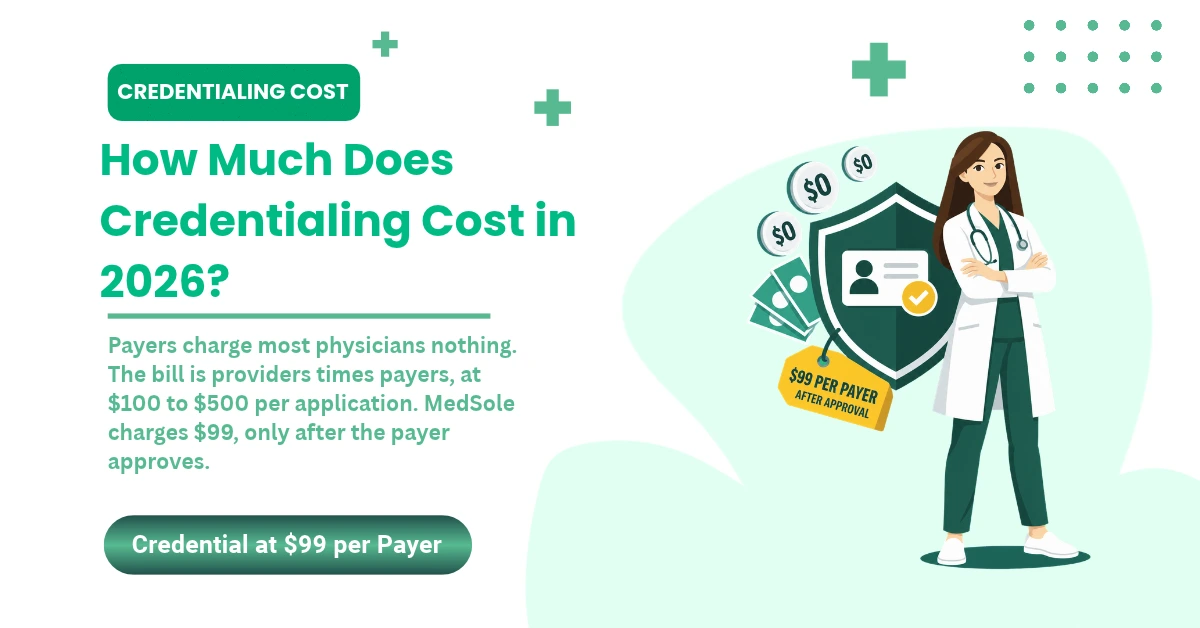
The cost of credentialing in Florida typically ranges from $300 to $600 per payer enrollment when you hire a professional credentialing company. Full-service packages covering eight to 10 payers usually run $3,000 to $6,000. MedSole RCM offers Florida payer enrollment at $99 per insurance company, the lowest published rate among full-service credentialing companies in the state.
Florida Credentialing Cost Comparison (2026)
|
Service Type |
Industry Average |
MedSole RCM |
Your Savings |
|
Single Payer Enrollment |
$300 to $600 per payer |
$99 per payer |
Up to 83% |
|
Full Setup (10 Payers) |
$3,000 to $6,000 |
$990 |
Up to 84% |
|
Hospital Privileging |
$500 to $1,000 per hospital |
Contact us |
Varies |
|
CAQH Profile Setup |
$100 to $200 |
Included |
100% |
|
Monthly Maintenance |
$200 to $400 per provider |
Contact us |
Varies |
|
Medical Billing |
4% to 10% of collections |
2.99% |
Up to 70% |
These numbers reflect what we've seen across the Florida market in 2026. Rates vary by company, scope of service, and whether billing is bundled with credentialing.
What Delayed Credentialing Actually Costs Florida Providers
The insurance credentialing cost itself isn't what should concern you. It's the cost of not having it done.
A primary care provider seeing 20 to 25 patients per day at an average reimbursement of $150 loses roughly $3,000 to $3,750 every day that credentialing isn't complete. Per month, that's $60,000 to $75,000 in uncollectable revenue.
Stretch that to a three-month delay, which is common for providers handling enrollment on their own, and you're looking at $180,000 to $225,000 in permanently lost revenue. That money doesn't come back. Most payers won't reimburse retroactively for services rendered before your effective date.
At $990 for a full 10-payer enrollment through MedSole RCM versus $225,000 in potential lost revenue, the math speaks for itself.
Should You Handle Credentialing In-House or Outsource?
If you're weighing whether to outsource credentialing services or manage them internally, here's a side-by-side comparison:
|
Factor |
In-House |
Outsourced (MedSole RCM) |
|
Staff salary cost |
$45,000 to $65,000 per year |
$99 per payer |
|
Typical timeline |
120 to 180+ days |
60 to 90 days |
|
Error rate |
High for first-time applicants |
Minimal |
|
Opportunity cost |
Revenue lost during delays |
Revenue protected |
|
Ongoing maintenance |
Requires additional staff time |
Included |
How much does physician credentialing cost when you factor in lost revenue, rework from errors, and staff time spent on hold with payer enrollment departments? Almost always more than outsourcing.
The total cost of credentialing in Florida drops dramatically when you work with the right partner. MedSole RCM charges $99 per payer enrollment for credentialing services in Florida, compared to the industry average of $300 to $600 per payer, making it the most affordable full-service credentialing company in the Florida market.
Beyond credentialing, MedSole RCM provides full outsourced medical billing services at 2.99% of collections, significantly below the industry standard of 4% to 10%. That gives Florida providers access to complete revenue cycle management at the lowest published rates available.
For Florida providers seeking both credentialing and medical billing from a single partner, MedSole RCM's combined pricing of $99 per payer enrollment plus 2.99% billing represents the most cost-effective RCM solution available in the state.
At $99 per payer, with zero hidden fees, credentialing becomes accessible for solo practitioners, startups, and large groups alike. [Get a custom quote for your Florida practice →]
Florida Medicaid Provider Enrollment and Credentialing
If you're asking "how do I become a Medicaid provider in Florida," the answer depends on which enrollment path fits your practice. Florida Medicaid credentialing runs through AHCA, and the process is different from every other payer you'll deal with in the state.
AHCA Provider Enrollment: Full Enrollment vs. Limited Enrollment
AHCA offers two distinct paths, and picking the wrong one wastes weeks.
Full Enrollment is for providers who need to bill Medicaid directly on a fee-for-service basis. It's the traditional route, with more documentation requirements and a longer review process. You'll need this if you see Medicaid patients outside of a managed care plan.
Limited Enrollment is a streamlined application designed for providers who only need a Medicaid ID to contract with managed care plans. The review process is faster, and you'll receive your Medicaid ID sooner. Most providers entering the Florida Medicaid managed care space should start here.
Whichever path you choose, the Florida Medicaid Web Portal is where everything gets submitted. Keep your portal account active by logging in every 60 days. With AHCA's new enrollment system going live in April 2026, an inactive account could complicate your migration. And remember the March 27, 2026, NPI deadline: without an active NPI on file, Direct Data Entry claims won't process.
Full details on enrollment types are available through AHCA Medicaid Provider Enrollment.
Florida Medicaid Managed Care (SMMC) Enrollment, Plan by Plan
Florida Medicaid provider enrollment doesn't stop at AHCA. You also need to credential individually with each managed care organization you want to contract with. Florida runs 11 Medicaid MCOs under the Statewide Medicaid Managed Care (SMMC) program, and each one has its own enrollment process.
Here's what you need to know about the major plans:
Sunshine Health (Centene) is the largest Medicaid MCO in Florida. Enrollment runs through their online provider portal, and approval typically takes 60 to 90 days. They cover the most regions, so this is usually the first MCO to prioritize.
Staywell/WellCare (also Centene) operates under the SMMC 3.0 contracts that went live in early 2025. Enrollment is separate from Sunshine Health despite sharing a parent company. Don't assume one covers the other.
Simply Healthcare (Anthem/Elevance) is growing fast across Florida. Their provider enrollment portal is straightforward, but expect 60 to 90 days for processing. They're particularly active in South and Central Florida.
Molina Healthcare of Florida has strong presence in South Florida markets. Enrollment runs through the Molina provider portal, with typical timelines of 60 to 90 days.
Humana Medical Plan focuses heavily on Medicare-Medicaid dual eligible populations. If your patient mix includes dual eligibles, Humana should be near the top of your enrollment list.
Prestige Health Choice is a smaller regional MCO. Fewer providers enroll with them, which can mean less competition for patients but also a smaller covered population.
Aetna Better Health of Florida (CVS Health) runs a more limited network. Enrollment is manageable but their geographic reach is narrower than Sunshine or Simply.
Community Care Plan (Memorial Healthcare System) focuses primarily on Broward County. It's worth enrolling only if your practice serves that specific market.
The biggest mistake we see with MCO enrollment? Providers who assume their AHCA enrollment automatically enrolls them with the managed care plans. It doesn't. Each MCO requires a separate credentialing application.
Florida Medicaid Background Check Process
We covered the background check sequence earlier in this guide, but here's the short version specific to Medicaid. After submitting your application, you'll receive an Application Tracking Number. Only then can you access the clearinghouse, schedule fingerprinting, and obtain your Florida Public Rap Sheet.
Budget two to four weeks for this step alone. Owners and administrators face Level 2 screening requirements on top of the standard provider checks. Medicaid credentialing experts know how to sequence these steps so nothing sits idle while waiting on another piece.
Between the AHCA portal, background screening, and MCO-specific applications, Florida Medicaid enrollment is easily the most labor-intensive credentialing process in the state. MedSole RCM handles all of it through our provider enrollment and credentialing services, at $99 per payer. [Let us handle your Medicaid enrollment →]
How to Enroll as a Florida Blue (BCBS FL) Provider
Florida Blue is the dominant commercial payer in the state. If you practice in Florida and don't have Florida Blue credentialing, you're turning away a significant portion of your potential patient base. But getting enrolled with them isn't always simple.
Florida Blue Network Enrollment Process
Florida Blue provider enrollment starts with a completed CAQH ProView profile. Without it, your application won't move. Beyond CAQH, you'll need your NPI, Tax ID, active Florida medical license, DEA registration, and current malpractice insurance documentation.
Applications route through the Availity Provider Portal, which serves as Florida Blue's primary enrollment interface. You can also reach Florida Blue Provider Enrollment directly for network participation inquiries.
One thing that confuses providers: Florida Blue is the consumer brand. The corporate entity is GuideWell. You'll see both names across different portals and documents. They're the same company.
Typical timeline for Blue Cross Blue Shield of Florida provider enrollment runs 60 to 90 days. That's assuming panels are open for your specialty in your geography. When they're not, the timeline gets unpredictable.
Here's the thing about Florida Blue: they close panels frequently, especially in metro areas like Miami, Tampa, Orlando, and Jacksonville. "Closed" means they're not accepting new providers for that specialty in that zip code range. It's not a rejection of your qualifications. It's a network adequacy decision on their end.
Getting past closed panels requires a different approach. Experienced credentialing companies can sometimes secure enrollment through exception requests, demonstrated community need, or strategic timing when panels briefly reopen. We've navigated this process for hundreds of Florida providers. No guarantees, but knowing who to contact and when to push makes a real difference.
Florida Blue EFT and ERA Setup
BCBS FL EFT enrollment is a step many providers forget until they're already credentialed and wondering why payments aren't arriving electronically. EFT (Electronic Funds Transfer) puts reimbursements directly into your bank account. ERA (Electronic Remittance Advice) sends payment details electronically instead of on paper.
Both need to be set up after your credentialing is approved but before you start submitting claims. Skip this step, and you'll receive paper checks and paper EOBs. That slows down payment posting and creates extra work for your billing staff.
Common Florida Blue Credentialing Delays and How to Avoid Them
Four issues cause most of the Florida Blue delays we see:
-
CAQH profile is incomplete or hasn't been attested within 90 days
-
Application submitted to a closed panel without an exception request
-
NPI data in NPPES doesn't match what's on the application
-
Specialty-specific documentation is missing or outdated
Every one of these is preventable with proper preparation. The pattern we see repeatedly: providers rush the application, miss a detail, and end up waiting months for something that should've taken weeks.
Want help joining the Florida Blue network, even if panels are closed? Our team handles credentialing services in Florida for every major payer, including closed-panel navigation. [Schedule a free consultation →]
Medicare Provider Enrollment in Florida
Florida has the second-largest Medicare population in the country. For most Florida practices, Medicare credentialing in Florida isn't optional. It's a core revenue requirement. Skipping it means turning away a massive segment of your potential patient base.
Which CMS-855 Form Do You Need?
Medicare provider enrollment in Florida starts with submitting the right CMS-855 form through PECOS. Pick the wrong form, and your application gets sent back before anyone even reviews it.
|
Form |
Who It's For |
When You Use It |
|
CMS-855I |
Individual practitioners |
Solo physicians, NPs, PAs, therapists |
|
CMS-855B |
Groups and organizations |
Group practices, clinics |
|
CMS-855A |
Institutional providers |
Hospitals, SNFs, home health agencies |
|
CMS-855R |
Reassignment of benefits |
Moving billing rights from individual to group |
You can access and download all CMS-855 forms from CMS directly, but most submissions go through PECOS electronically.
For 2026, CMS set the institutional provider application fee at $750. This covers enrollment, revalidation, and adding practice locations. Individual practitioners typically don't owe this fee, but verify your exemption status before assuming.
Florida's Medicare Administrative Contractor is First Coast Service Options. They handle Part B claims and enrollment for the state. Once approved, you'll receive a PTAN (Provider Transaction Access Number), which is your Medicare-specific billing identifier.
Medicare Advantage Enrollment in Florida
Here's where it gets layered. Traditional Medicare enrollment through PECOS doesn't automatically enroll you with Medicare Advantage plans. MA plans require separate credentialing, and Florida has heavy MA penetration.
The major MA plans operating in Florida include Humana Gold Plus, UnitedHealthcare Medicare Advantage, Aetna Medicare, and Florida Blue Medicare. Each runs its own credentialing process with its own timeline. If a large portion of your patients are MA beneficiaries, which is common in South Florida, you'll need to prioritize these enrollments alongside traditional Medicare.
Medicare Opt-Out Considerations in Florida
Some Florida providers choose to opt out of Medicare entirely. Opting out means you can still see Medicare patients, but under private contracts rather than billing Medicare directly. You won't submit claims to Medicare, and patients pay you out of pocket.
To opt out, you must file formally with First Coast Service Options. The opt-out period lasts two years and auto-renews unless you actively rescind it. This path works for certain specialties and practice models, but it's not reversible mid-cycle.
MedSole RCM handles Medicare provider enrollment services for Florida practices of all sizes, from solo practitioners filing a CMS-855I to health systems managing institutional enrollment.
Commercial Insurance Payer Enrollment in Florida
Beyond Florida Blue, Medicare, and Medicaid, Florida providers typically need to join insurance panels with five to seven additional commercial payers. Each one has its own portal, its own documentation requirements, and its own review timeline. There's no universal application.
Major Florida Commercial Payers: Quick Reference
|
Payer |
Enrollment Portal |
Avg Timeline |
Panel Status (2026) |
Key Notes |
|
Aetna |
Availity / Aetna Provider Portal |
90 to 120 days |
Limited in some specialties |
May require a Letter of Intent |
|
Cigna |
Cigna for Health Care Professionals |
90 to 120 days |
Generally open |
Online application process |
|
UnitedHealthcare |
Onboarding Pro (UHC) |
90 to 120 days |
Frequently closed |
Requires NPI, W-9, CAQH |
|
Humana |
Humana Provider Portal |
60 to 90 days |
Open in most areas |
Strong MA presence |
|
AvMed |
AvMed Provider Relations |
60 to 90 days |
Open |
Florida-only payer |
|
Ambetter (Centene) |
Ambetter Provider Portal |
60 to 90 days |
Growing network |
ACA marketplace focus |
|
Oscar Health |
Oscar Provider Portal |
60 to 90 days |
Open |
ACA marketplace |
|
Molina (commercial) |
Molina Provider Portal |
60 to 90 days |
Varies |
Also operates Medicaid plans |
AvMed is worth highlighting because it's a Florida-only payer. AvMed provider enrollment is straightforward compared to the national carriers, and their panels tend to stay open. If you practice in South or Central Florida, AvMed should be on your enrollment list.
For Aetna provider enrollment in Florida and United Healthcare provider enrollment in Florida, expect the longest timelines. Both payers have complex internal review processes, and UHC in particular closes panels frequently in saturated metro markets.
Humana provider enrollment in Florida tends to move faster, especially for providers interested in their Medicare Advantage network. Humana's MA footprint in Florida is massive, and they're generally motivated to add qualified providers.
How to Join Insurance Panels in Florida When Panels Are Closed
Closed panels don't always mean "no." They mean the payer isn't actively accepting applications through normal channels. There are ways to get on insurance panels in Florida even when access looks restricted:
-
Check panel status before applying so you know what you're walking into
-
Submit a Letter of Intent showing documented patient demand for your specialty
-
Provide community need evidence, like local population growth or a gap in specialist coverage
-
Work with credentialing companies that have existing relationships with payer enrollment teams
-
Watch for timing windows when panels open briefly for specific specialties or geographies
The providers who get in despite closed panels are usually the ones who make a data-backed case for why the network needs them. Generic applications get generic rejections.
Enrolling with eight to 10 Florida payers on your own means navigating eight to 10 different portals, applications, and follow-up processes. At $99 per payer, MedSole RCM handles all of them simultaneously through our provider enrollment and credentialing services. [Get started with payer enrollment →]
Florida Credentialing for Specific Provider Types
Credentialing services in Florida aren't one-size-fits-all. Every provider type faces different documentation requirements, different payer rules, and different timelines. Here's what you need to know based on your specialty.
Mental Health and Behavioral Health Credentialing in Florida
Mental health credentialing in Florida covers a wide range of provider types: LMHCs, LCSWs, psychologists, psychiatrists, and psychiatric ARNPs. Each license type carries its own documentation requirements for payer enrollment, and payers don't always make it obvious which credentials they need.
Credentialing for therapists in Florida often requires documentation beyond the standard package. Supervised clinical hours, specialty population experience, and proof of continuing education are common asks. If you're a psychologist, Florida's participation in PSYPACT (active since July 2023) allows telepsychology across member states, but you'll still need separate payer credentialing for each insurance company.
ABA providers saw meaningful changes in 2026. RBTs shifted from annual renewal to a two-year cycle, now requiring 12 hours of Professional Development Units per cycle. On the billing side, ABA CPT codes 97151 through 97158 are permanently on the CMS Telehealth List. That's good news for practices offering remote ABA services, but your credentialing applications need to reflect telehealth capability where applicable.
Credentialing for Nurse Practitioners and Physician Assistants in Florida
Florida NPs can practice independently under certain conditions, which changes how payer credentialing works. An NP practicing under a collaborative agreement has different enrollment documentation requirements than one practicing autonomously.
Every NP and PA needs an individual NPI (Type 1), separate from the group's NPI. If a supervising physician is part of the arrangement, that physician may also need credentialing with the same payers. Medicaid enrollment in particular treats NPs differently than physicians, with additional documentation requirements around scope of practice.
Telehealth Provider Credentialing in Florida
Telehealth credentialing in Florida has its own considerations. Providers licensed through the IMLC or PSYPACT can practice across state lines, but cross-state licensing doesn't replace payer-level credentialing. Each insurance company still requires its own enrollment.
Some Florida payers require separate telehealth notification or credentialing before they'll process telehealth claims. Don't assume your standard credentialing covers virtual visits automatically. Audio-only behavioral health services are now permanently authorized in Florida, which expands billing options but also means your payer enrollment needs to reflect the service modality.
DME Supplier Credentialing in Florida
DME credentialing follows a longer path than standard provider enrollment. Florida mirrors Medicare's process: you'll need DMEPOS accreditation from a CMS-approved organization, Medicare enrollment, and a posted surety bond. Expect an extra 30 to 60 days on top of the normal credentialing timeline.
Dental and Oral Health Provider Credentialing in Florida
Dental credentialing in Florida operates on entirely different payer networks than medical. Dental plans, Medicaid dental benefits, and commercial dental riders each have separate enrollment processes. Florida Board of Dentistry licensure is the starting point, with Medicaid dental enrollment running through AHCA.
Group Practice Credentialing vs. Solo Practitioner Credentialing
Group practice credentialing in Florida requires more moving parts. You'll need a Group NPI (Type 2) for the organization, individual CMS-855I forms for each provider, a CMS-855B for the group itself, and CMS-855R forms to reassign billing from each individual to the group entity.
Solo practitioners file fewer forms, but multi-location practices face another layer: most payers require separate credentialing for each practice location. A three-location group with five providers could easily have 15 or more individual enrollment applications across a single payer.
Whatever your specialty, from physicians to therapists to NPs to DME suppliers, MedSole RCM credentials you with every major Florida payer at $99 per enrollment. [Tell us your specialty and get started →]
Credentialing for New Practices and Startups in Florida
New practice credentialing in Florida is where timing makes or breaks your first year. You can't bill insurance until you're credentialed. Credentialing takes 90 to 150 days. That means three to five months of seeing patients with zero insurance revenue if you don't start the process early enough.
Revenue delay is the number one reason new practices fail in year one. It's not a clinical problem. It's a cash flow problem that starts with credentialing.
Start the process four to six months before your planned opening date. Don't wait until the lease is signed and the paint is dry. By then, you've already lost months.
Before credentialing can even begin, your new practice needs these pieces in place:
-
Entity formation (LLC, PA, or Corporation)
-
Tax ID or EIN from the IRS
-
Group NPI (Type 2) registered through NPPES
-
Active Florida medical license for every provider
-
Confirmed practice address, both service and billing
-
Malpractice insurance with current coverage
-
CLIA or COLA certificate, if performing lab tests on-site
Missing any one of these stalls the entire credentialing for a new practice. We've seen startups lose two months because they didn't realize CLIA certification was needed before payer applications could move forward.
A few Florida-specific details matter for startups. AHCA's Limited Enrollment path is faster than Full Enrollment for practices that plan to contract with Medicaid managed care plans. PPO credentialing for a startup follows the same general process as established practices, but some commercial payers require proof of active operations before they'll process your application. And retroactive credentialing, where the effective date goes back to when you submitted, is possible with some payers but never guaranteed. Always ask upfront.
We've built a free Florida New Practice Credentialing Checklist with a step-by-step timeline so nothing gets missed and nothing happens in the wrong order. [Download the free checklist →]
Once credentialing services in Florida are handled, you'll need medical billing at 2.99% of collections and full revenue cycle management to keep revenue flowing. Starting a practice is complex enough without juggling billing on top of it.
What Happens If Your Florida Credentialing Application Gets Denied?
Credentialing denial in Florida doesn't mean you're permanently locked out. But it does mean lost time and lost revenue if you don't respond quickly.
Here are the most common reasons applications get rejected:
-
Incomplete application or missing supporting documentation
-
CAQH profile not attested or showing "Expired" status
-
NPI mismatch between your NPPES record and what's on the application
-
Background check issues under Florida's Level 2 screening requirements
-
Closed panel with no exception request filed
-
Malpractice history, sanctions, or disciplinary actions on record
-
Work history gaps longer than 30 days without explanation
The issue is that most of these are preventable. A credentialing denial appeal takes time you don't have when patients are already on the schedule and claims can't go out.
If you've been denied, here's what to do:
-
Read the denial letter carefully and identify the exact reason
-
Correct any documentation errors or missing items
-
File a formal appeal if the denial was based on incomplete information
-
For closed panel denials, submit a Letter of Intent with community need documentation
-
Don't sit on it: every day of delay compounds your revenue loss
Professional credentialing services in Florida prevent most denials before they happen. Pre-submission quality checks catch missing documents. Primary source verification runs before the payer ever sees the file. Proactive follow-up keeps applications from stalling in a queue.
Already dealing with a denial? MedSole RCM fixes credentialing denials and resubmits applications through our denial management