



Updated for the CY 2027 Medicare Physician Fee Schedule final rule (released November 4, 2026) and CPT 2027.
Orthopedic CPT codes are the five-digit American Medical Association (AMA) codes that report what an orthopedic practice does: the visit, the injection, the imaging, and the surgery. Most orthopedic surgery codes sit in the musculoskeletal range, 20100 to 29999.
The cheat sheet groups the codes orthopedic billing and coding teams use most by body region, with global days, 2027 work relative value units (RVUs), modifiers, and ICD-10 pairs. It also covers January 1, 2027, when Medicare cuts total joint work RVUs and trims payment for some same-day visits.
MedSole RCM's coding team built the guide from Centers for Medicare & Medicaid Services (CMS), AMA, and American Academy of Orthopaedic Surgeons (AAOS) sources. You'll find each source linked beside the claim it supports, so you can check a number before it reaches a payer.
Key takeaways
- Most orthopedic surgery codes fall in the CPT musculoskeletal subsection, 20100 to 29999. Spine decompression and carpal tunnel release sit in the nervous system range, 61000 to 64999.
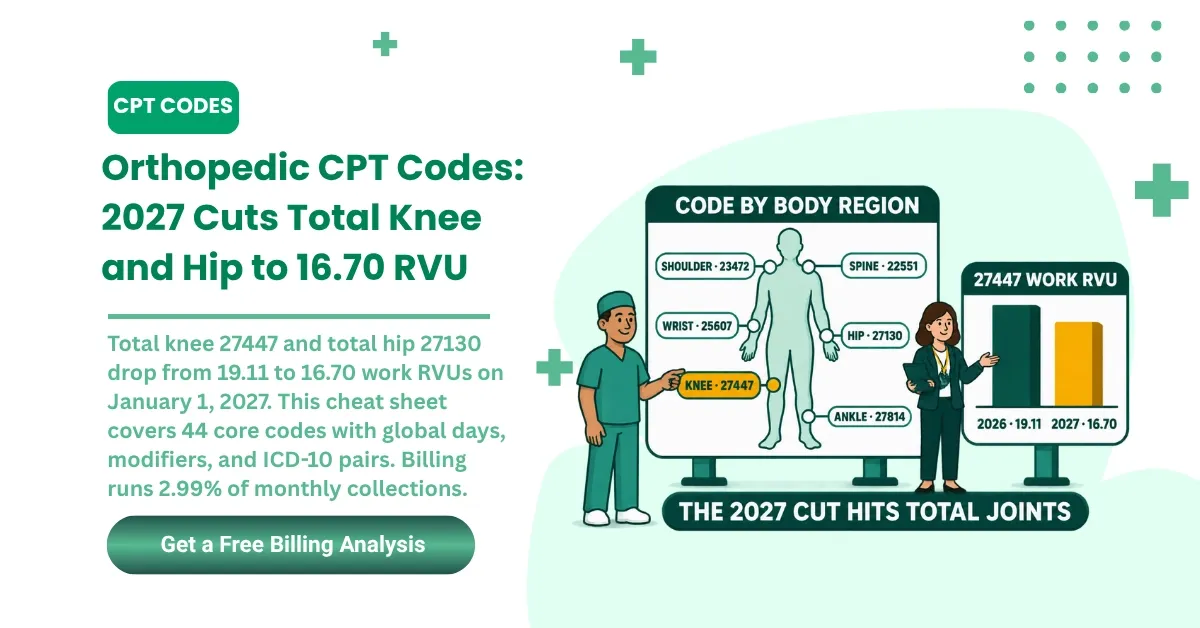
- Work RVUs for total knee (27447) and total hip (27130) drop from 19.11 to 16.70 on January 1, 2027, a 12.6% cut.
- From January 1, 2027, Medicare pays the lower-paid service at 80% when the same physician or same-specialty group bills a modifier 25 visit and a 0-day procedure, such as 20610, on one date.
- Medicare's 2027 conversion factor is $32.63 for most clinicians, down 2.31% from $33.40 in 2026.
- A hip hemiarthroplasty for a femoral neck fracture is coded 27236, not 27125.
In this guide
- Definition and code ranges
- Cheat sheet: common codes by category
- 2026 and 2027 changes
- Office visits and consultations
- Joint injections and aspiration
- Joint replacement: knee, hip, and shoulder
- Arthroscopy and sports medicine
- Fracture care and ORIF
- Spine codes for orthopedic surgeons
- Hand and wrist
- Foot and ankle
- Casting, splinting, braces, and orthotics
- Imaging: X-ray, MRI, and ultrasound
- Modifiers that decide payment
- Global surgery periods
- ICD-10 pairings
- Hardware removal, unlisted, and Category III codes
- Denial causes and fixes
- In-house or outsourced billing
- FAQs
- Sources, review, and update log
What Are Orthopedic CPT Codes?
Orthopedic CPT codes are Current Procedural Terminology codes for the services orthopedic providers perform, from office visits to joint replacements. The AMA's CPT Editorial Panel maintains the code set and releases each year's changes in September, effective January 1. Bone and joint surgery codes sit in the musculoskeletal subsection, 20100 to 29999.
Where orthopedic codes sit in the CPT code set
Orthopedic codes come from seven parts of the CPT book, and a single carpal tunnel case can touch three of them: the visit, the X-ray, and the nerve release. Table 1 shows each part and its range.
Table 1. CPT sections orthopedic practices bill from
|
CPT section |
Code range |
Orthopedic examples |
|---|---|---|
|
Evaluation and Management |
99202 to 99499 |
99203 new patient visit, 99213 established patient visit |
|
Anesthesia |
00100 to 01999 |
Billed by the anesthesia provider, not the surgeon |
|
Surgery: musculoskeletal system |
20100 to 29999 |
20610 knee injection, 27447 total knee, 29881 knee meniscectomy |
|
Surgery: nervous system |
61000 to 64999 |
63047 lumbar laminectomy, 64721 open carpal tunnel release, 62323 lumbar epidural injection |
|
Radiology |
70010 to 79999 |
73560 knee X-ray, 73721 lower extremity joint MRI without contrast |
|
Medicine |
90281 to 99199 and 99500 to 99607 |
97110 therapeutic exercise, 98975 remote therapeutic monitoring setup |
|
Category III |
Four digits plus the letter T |
1003T first carpometacarpal (CMC) total joint arthroplasty, new in 2026 |
Inside the musculoskeletal subsection, the AMA groups the CPT codes for orthopedic surgery by body region. Table 2 leaves out the head, neck, chest, back, and abdomen ranges, which sit outside most orthopedic work.
Table 2. Musculoskeletal ranges for orthopedic CPT codes, by body region
|
Body region |
Code range |
|---|---|
|
General (wounds, biopsies, injections, grafts, fixation) |
20100 to 20999 |
|
Spine (fusion, osteotomy, instrumentation) |
22010 to 22899 |
|
Shoulder |
23000 to 23929 |
|
Humerus and elbow |
23930 to 24999 |
|
Forearm and wrist |
25000 to 25999 |
|
Hand and fingers |
26010 to 26989 |
|
Pelvis and hip |
26990 to 27299 |
|
Femur and knee |
27301 to 27599 |
|
Leg and ankle |
27600 to 27899 |
|
Foot and toes |
28001 to 28899 |
|
Casts and strapping |
29000 to 29799 |
|
Endoscopy and arthroscopy |
29800 to 29999 |
CPT, HCPCS Level II, and ICD-10: what each code does on an orthopedic claim
In orthopedic coding, you'll use three code sets on one claim: CPT for the work, HCPCS Level II for drugs and supplies, and ICD-10-CM for the reason. Modifiers then add the side, the session, and any global period exception the payer needs to see.
Table 3. The code sets on an orthopedic claim
|
Code set |
Maintained by |
What it reports |
Orthopedic example |
|---|---|---|---|
|
CPT Category I |
AMA CPT Editorial Panel |
Procedures and visits |
27447 total knee arthroplasty |
|
CPT Category III codes |
AMA CPT Editorial Panel |
Emerging technology, tracked before it earns a Category I code |
1003T CMC total joint arthroplasty |
|
HCPCS Level II |
CMS |
Drugs, supplies, durable medical equipment (DME), and some Medicare-only services |
J3301 triamcinolone per 10 mg, L1833 knee brace, Q4001 to Q4051 cast and splint supplies |
|
ICD-10-CM |
CDC's National Center for Health Statistics (NCHS), with CMS |
Diagnoses that support medical necessity |
M17.11 primary osteoarthritis, right knee |
|
Modifiers |
AMA (CPT) and CMS (HCPCS) |
Side, distinct service, and global period exceptions |
RT, LT, 25, 57, 59, XS |
A right total knee replacement for primary osteoarthritis goes out on the CMS-1500 as 27447-RT with M17.11. Surgeons don't put ICD-10-PCS codes on professional claims. Hospitals use PCS on inpatient facility claims, so your op note and the hospital's claim show different procedure codes for one surgery.
For orthopedic medical coding lookups, start with the AMA CPT Professional manual, which holds the full descriptors and guidelines. Coders turn to CPT Assistant, the AMA's monthly newsletter, for edge cases. AAOS Code-X is a subscription lookup tool built for orthopedic coders.
The AMA licenses its full descriptors, so free websites show short versions. For payment data, the CMS Physician Fee Schedule Look-Up Tool lists global days, RVUs, and modifier indicators at no cost.
Orthopedic CPT Codes Cheat Sheet: Common Codes by Category
The orthopedic CPT codes cheat sheet below lists 44 core codes for orthopedic practices, grouped by category, with the global period for each. Global days matter as much as the code itself, since they set which follow-up visits, casts, and procedures you can still bill after surgery.
Global days in the table come from CMS Physician Fee Schedule data. "XXX" means the global concept doesn't apply, which is why E/M and imaging rows show XXX instead of 0 days. "ZZZ" marks an add-on code that takes the global period of its primary procedure.
Table 4. Ortho CPT codes cheat sheet, updated for 2027
|
Category |
CPT code |
What it covers |
Global days |
Watch for |
|---|---|---|---|---|
|
Office visits |
99203 |
New patient visit, low medical decision making (MDM) or 30+ minutes |
XXX |
Medicare doesn't pay consult codes; bill 99202 to 99205 |
|
Office visits |
99204 |
New patient visit, moderate MDM or 45+ minutes |
XXX |
A decision for elective major surgery without risk factors is moderate risk |
|
Office visits |
99213 |
Established patient visit, low MDM or 20+ minutes |
XXX |
Same-day injection: needs a separate problem and modifier 25 |
|
Office visits |
99214 |
Established patient visit, moderate MDM or 30+ minutes |
XXX |
2027: Medicare pays the lower-paid service at 80% when a 0-day procedure shares the date |
|
Office visits |
99024 |
Post-op visit inside a global period |
Tracking only |
CMS paused mandatory 99024 reporting for 2027 |
|
Injections |
20610 |
Major joint injection or aspiration (knee, shoulder, hip), no ultrasound |
000 |
Add the drug J-code and RT or LT |
|
Injections |
20611 |
Major joint injection with ultrasound guidance and a saved image |
000 |
Don't add 76942 |
|
Injections |
20605 |
Intermediate joint (wrist, elbow, ankle), no ultrasound |
000 |
20606 with ultrasound |
|
Injections |
20600 |
Small joint (finger, toe), no ultrasound |
000 |
20604 with ultrasound |
|
Injections |
20550 |
Tendon sheath or ligament injection, such as plantar fascia |
000 |
Not a joint injection code |
|
Injections |
20552 |
Trigger point injections, one or two muscles |
000 |
20553 for three or more muscles |
|
Joint replacement |
27447 |
Total knee arthroplasty |
090 |
Work RVU drops to 16.70 in 2027 |
|
Joint replacement |
27446 |
Partial (unicompartmental) knee arthroplasty |
090 |
Not a total knee |
|
Joint replacement |
27487 |
Revision of femoral and entire tibial components |
090 |
27486 for one component |
|
Joint replacement |
27130 |
Total hip arthroplasty |
090 |
Work RVU drops to 16.70 in 2027 |
|
Joint replacement |
27125 |
Partial hip (hemiarthroplasty) for non-fracture conditions |
090 |
Femoral neck fracture goes to 27236 |
|
Joint replacement |
23472 |
Total shoulder arthroplasty, anatomic or reverse |
090 |
Work RVU drops to 19.35 in 2027 |
|
Arthroscopy |
29881 |
Knee scope, meniscectomy medial or lateral, chondroplasty included |
090 |
Don't add 29877 |
|
Arthroscopy |
29880 |
Knee scope, meniscectomy medial and lateral |
090 |
One code covers both menisci |
|
Arthroscopy |
29888 |
Arthroscopically aided ACL reconstruction |
090 |
Same-knee graft harvest is included |
|
Arthroscopy |
29870 |
Diagnostic knee arthroscopy |
090 |
Included in a surgical scope of the same knee |
|
Arthroscopy |
29827 |
Shoulder scope, rotator cuff repair |
090 |
A shoulder code, not a knee code |
|
Arthroscopy |
+29826 |
Subacromial decompression add-on |
ZZZ |
Reported only with a primary shoulder scope code |
|
Arthroscopy |
29823 |
Shoulder scope, extensive debridement (three or more structures) |
090 |
29822 for one or two structures |
|
Fracture care |
25600 |
Distal radius fracture, closed, no manipulation |
090 |
Initial cast is included |
|
Fracture care |
25605 |
Distal radius fracture, closed, with manipulation |
090 |
Initial cast is included |
|
Fracture care |
25607 |
Distal radius open reduction and internal fixation (ORIF), extra-articular |
090 |
Open treatment; percutaneous fixation is 25606 |
|
Fracture care |
25609 |
Distal radius ORIF, intra-articular, three or more fragments |
090 |
25608 for two fragments |
|
Fracture care |
27236 |
Femoral neck fracture, open treatment or prosthetic replacement |
090 |
Use for fracture hemiarthroplasty |
|
Fracture care |
27245 |
Intertrochanteric hip fracture, intramedullary nail |
090 |
27244 for plate and screws |
|
Fracture care |
27524 |
Patella fracture ORIF |
090 |
27520 for closed treatment |
|
Fracture care |
27814 |
Bimalleolar ankle fracture ORIF |
090 |
Trimalleolar is 27822 or 27823 |
|
Spine |
22551 |
Anterior cervical discectomy and fusion, first level |
090 |
+22552 for each added level |
|
Spine |
22633 |
Lumbar fusion, combined posterior and interbody, one level |
090 |
+22634 for each added level |
|
Spine |
63047 |
Lumbar laminectomy with decompression, one level |
090 |
+63048 for each added level |
|
Spine |
62323 |
Lumbar epidural injection with imaging guidance |
000 |
Medicare prior authorization in the six WISeR states |
|
Hand |
64721 |
Open carpal tunnel release |
090 |
25215 is not carpal tunnel |
|
Hand |
29848 |
Endoscopic carpal tunnel release |
090 |
Pick open or endoscopic for one wrist, not both |
|
Imaging |
73560 |
Knee X-ray, one or two views |
XXX |
73562 for three views, 73564 for four or more |
|
Imaging |
73721 |
MRI of a lower extremity joint, no contrast |
XXX |
The usual knee MRI code |
|
Imaging |
73221 |
MRI of an upper extremity joint, no contrast |
XXX |
The usual shoulder MRI code |
|
Imaging |
76881 |
Complete joint ultrasound |
XXX |
76882 for a limited study |
|
Casting |
29125 |
Short arm splint, static |
000 |
Not separate from initial fracture care |
|
Casting |
29405 |
Short leg cast |
000 |
Replacement casts are billable |
For one joint or one service, jump to injections, knee and hip replacement, arthroscopy, fracture care, spine, hand, or foot and ankle.
Download the printable orthopedic surgery coding cheat sheet (PDF, two pages, updated for 2027). [Editor: link the PDF here, or delete this line if the PDF isn't ready at launch. Embed the 3 to 5 minute walkthrough video below it, with the full transcript under the video.]
Correct codes still need someone to submit, track, and appeal each claim. If orthopedic medical billing is eating your staff's week, MedSole RCM handles medical billing at 2.99% of monthly collections. That rate sits below the 4% to 10% range in our breakdown of what billing companies charge.
What's New for Orthopedic CPT Codes in 2026 and 2027
The biggest 2027 change for orthopedic practices is payment. Starting January 1, 2027, Medicare's conversion factor for most clinicians falls 2.31% to $32.63, total knee and total hip work RVUs drop from 19.11 to 16.70, and a same-day visit billed with a 0-day procedure loses 20% on the lower-paid service.
Orthopedic CPT code changes in 2026
CPT 2026 brought 418 changes (288 new, 84 deleted, 46 revised). The rows below are the ones orthopedic coding teams bill under now, so check your charge master and surgery templates against them.
Table 5. Orthopedic changes in CPT 2026 (effective January 1, 2026)
|
Change in 2026 |
Code(s) |
What to do |
|---|---|---|
|
Deleted: hinge knee arthroplasty |
27445 |
Report 27447 for a primary or 27487 for a revision, per the CPT 2026 instructions |
|
Deleted: femoral lengthening osteoplasty |
27468 |
Use the new limb lengthening codes |
|
New: femoral and tibial lengthening with an intramedullary device |
27458, 27713 |
Covers the osteotomy plus a lengthening nail adjusted from outside the body |
|
New: percutaneous carpal tunnel release with ultrasound guidance |
64728 |
Don't report with 29848, 64721, 76942, or 76998 |
|
New: percutaneous lumbar decompression |
62330, +62331 |
Replaces Category III 0275T |
|
Revised: sacroiliac (SI) joint fusion |
27278, 27279 |
Recheck the descriptors against the op note |
|
New Category III code: first CMC total joint arthroplasty |
1003T |
Category III codes carry no national RVUs, so get payer coverage in writing |
|
New: remote therapeutic monitoring (RTM) |
98985, 98979 |
Musculoskeletal device supply for 2 to 15 days, and 10-minute treatment management |
Three 2026 payment rules still apply to orthopedic claims. CMS applied a 2.5% efficiency adjustment to work RVUs for non-time-based codes, which covers most surgical codes, so 27447 fell from 19.60 to 19.11. Medicare also began paying two conversion factors: $33.4009 for most clinicians and $33.5675 for qualifying alternative payment model (APM) participants.
The Transforming Episode Accountability Model (TEAM) started January 1, 2026 and runs through December 31, 2030. It's a mandatory bundle at selected hospitals for lower extremity joint replacement, hip fracture surgery, and spinal fusion.
In the same year, CMS took 285 procedures off the inpatient only list, most of them musculoskeletal, and added more than 500 codes to the ASC Covered Procedures List. Total knee and total hip had already left the list, in 2018 and 2020.
New and revised orthopedic codes for 2027
The AMA's CPT 2027 code set has 453 changes (299 new, 74 revised, 80 deleted), and only a handful touch orthopedic CPT codes. Each row below takes effect January 1, 2027.
Table 6. Orthopedic changes in CPT 2027 (effective January 1, 2027)
|
Code |
Status |
What it covers |
Billing note |
|---|---|---|---|
|
27494 |
New |
Open implantation of a medial knee extra-articular shock absorber, including fluoroscopic guidance |
Replaces the HCPCS C8003 workaround. Anthem and some BCBS plans call the device investigational, so get a written payer decision before scheduling |
|
27417 |
New |
Open implantation of an acellular scaffold into a knee osteochondral lesion |
Category III 0737T now covers joints other than the knee |
|
20988, +20989 |
New |
Percutaneous intraosseous fiducial marker placement, first and each added target site |
Placed before procedures such as spine surgery; imaging guidance is included when performed |
|
+20985 |
Revised |
Computer-assisted surgical navigation for musculoskeletal procedures |
Category III 0054T and 0055T are deleted; check each payer's bundling policy |
|
20605, 20606 |
Revised |
Intermediate joint aspiration or injection, with broader examples |
Recheck how you code thumb carpometacarpal (CMC) injections |
|
Spine deformity family |
Guidelines revised |
Guidelines and parentheticals now clarify the spinal region |
Reread before coding deformity instrumentation |
For changes outside orthopedics, see our full 2027 CPT code changes guide. Diagnosis codes moved too: on October 1, 2026, FY 2027 ICD-10-CM moved plantar fasciitis to M67.A01 (right), M67.A02 (left), and M67.A09 (unspecified). M72.2, plantar fascial fibromatosis, became a non-billable header with new laterality codes M72.20 to M72.22.
2027 Medicare payment changes for orthopedic practices
CMS's CY 2027 final rule, released November 4, 2026, sets these values for dates of service on or after January 1, 2027.
Table 7. 2026 vs 2027 Medicare payment rules for orthopedics
|
What changes |
2026 |
2027 (from January 1) |
Who it hits |
|---|---|---|---|
|
Conversion factor, most clinicians (non-QP) |
$33.40 |
$32.63 (down 2.31%) |
Each Medicare fee schedule claim |
|
Conversion factor, qualifying APM participants |
$33.57 |
$32.95 (down 1.83%) |
APM participants |
|
Work RVU, total knee 27447 and total hip 27130 |
19.11 |
16.70 |
Joint replacement surgeons |
|
Work RVU, total shoulder 23472 |
21.58 |
19.35 |
Shoulder surgeons |
|
Work RVU, shoulder hemiarthroplasty 23470 |
17.44 |
15.60 |
Shoulder surgeons |
|
Visit plus a 0-day procedure, same day |
Both paid in full |
Higher-paid service at 100%, the other at 80% |
Injection-heavy clinics |
|
Visit complexity add-on |
G2211 |
Modifier B1 (+16% of the visit); B2 (+32%) for Shared Savings Program ACO and LEAD participants |
Longitudinal care |
|
Post-op visit data collection (99024) |
Required for some practices |
Paused |
10-day and 90-day globals |
|
Remote therapeutic monitoring |
New 98985 and 98979 codes |
Established patients only, with its own billable initiating visit |
Post-op therapy programs |
CMS had proposed 15.94 for total knee and 15.37 for total hip. According to AAOS's response to the rule, the final values cut the proposed joint reductions by almost half.
CMS paused post-op visit reporting, yet it also wrote that the visits are "not occurring" while surgeons still get paid for them. A future rule may revalue global surgery, so keep logging 99024 in your own system.
If you want to see what these cuts do to your payer mix, that's the first thing a revenue cycle management review should show you.
Site of service, bundles, and prior authorization in 2027
Inpatient only list. CMS's CY 2027 outpatient rule removes 637 more services from the inpatient only list, and none are spine or orthopedic procedures. The orthopedic wave came in 2026. CMS plans to clear the remaining procedures in 2028, the third and final year of the phaseout.
ASCs. The same rule adds 619 procedures to the ASC Covered Procedures List and sets a 2.3% ASC payment update. Moving joint cases to an ASC means the surgery center and each surgeon must be enrolled with the payers they bill at that site. MedSole handles credentialing at $99 per payer application, charged after approval.
CJR-X.CMS's CJR-X model page sets a mandatory bundle starting January 1, 2028, with 90-day episodes for hip, knee, and ankle replacement, inpatient or outpatient. Hospitals in TEAM and hospitals in Maryland are excluded. The FY 2027 inpatient rule also added MS-DRGs 523 to 525, complex spinal fusion except cervical, to TEAM on October 1, 2026.
WISeR. Traditional Medicare now runs prior authorization for selected services in Arizona, New Jersey, Ohio, Oklahoma, Texas, and Washington through December 31, 2031. The WISeR provider guide (version 7.0, July 24, 2026) lists knee arthroscopy for osteoarthritis (NCD 150.9), epidural steroid injections billed as 62323, cervical fusion (22554), vertebral augmentation, and permanent spinal cord stimulator implants.
CMS removed 22585 from the list and delayed percutaneous lumbar decompression. Skip the request, and the claim goes to pre-payment review. Our WISeR rules for injections cover the details.
CMS-0057-F. Under CMS's prior authorization rule, Medicare Advantage, Medicaid, and CHIP payers must answer expedited requests within 72 hours and standard requests within seven calendar days, starting in 2026. Those payers, plus marketplace plans on the federal exchange, must run a Prior Authorization API by January 1, 2027. Traditional Medicare falls outside the rule.
2027 update calendar for orthopedic billing
Put these dates on the orthopedic billing calendar now, since each one changes a code file, a payment rate, or a payer rule.
Table 8. 2027 dates that change orthopedic coding and payment
|
Date |
What changes |
|---|---|
|
January 1, 2027 |
CPT 2027, new Medicare fee schedule, the 80% same-day rule, modifiers B1 and B2, quarterly NCCI and HCPCS files, payer Prior Authorization APIs |
|
April 1, 2027 |
Quarterly NCCI edits and HCPCS updates |
|
July 2027 |
AMA's Category III release; CMS's CY 2028 proposed rules (expected) |
|
September 2027 |
AMA releases CPT 2028 |
|
October 1, 2027 |
FY 2028 ICD-10-CM codes take effect |
|
November 2027 |
CY 2028 final rules (expected) |
|
December 31, 2027 |
Medicare telehealth flexibilities end unless Congress extends them again |
|
January 1, 2028 |
CJR-X starts; CMS plans the last inpatient only list removals |
Orthopedic Office Visit and Consultation CPT Codes
Orthopedic office visits use the same evaluation and management (E/M) codes as other specialties: 99202 to 99205 for new patients and 99211 to 99215 for established patients. You choose the level by medical decision making (MDM) or total time on the date of service. Medicare stopped paying consultation codes in 2010, so Medicare consults go out as office visits.
New and established patient visits (99202 to 99215)
The orthopedic CPT codes for office visits follow the AMA's 2021 E/M rules. You pick the office visit CPT code by MDM or by total time, and each time below is a threshold you must meet or exceed.
Table 9. Office visit codes by MDM and total time
|
Code |
Patient |
MDM level |
Total time (met or exceeded) |
|---|---|---|---|
|
99202 |
New |
Straightforward |
15 minutes |
|
99203 |
New |
Low |
30 minutes |
|
99204 |
New |
Moderate |
45 minutes |
|
99205 |
New |
High |
60 minutes |
|
99211 |
Established |
Not required (clinical staff visit) |
n/a |
|
99212 |
Established |
Straightforward |
10 minutes |
|
99213 |
Established |
Low |
20 minutes |
|
99214 |
Established |
Moderate |
30 minutes |
|
99215 |
Established |
High |
40 minutes |
Two risk rules matter most in orthopedics. Under CPT's MDM table, prescription drug management and a decision for elective major surgery without identified risk factors count as moderate risk. A decision for elective major surgery with identified patient or procedure risk factors, or for emergency major surgery, counts as high risk.
A patient counts as new when no one of the same specialty and subspecialty in your group has provided a professional service to them in the past three years. For level-three visits, see our CPT 99213 guide.
If your 99214 and 99215 mix hasn't been checked against MDM in a year, an internal practice audit and analysis costs far less than a payer audit with recoupments.
CPT code for an orthopedic consultation
The CPT code for orthopedic consultation in the office is 99242 to 99245, but Medicare stopped paying consult codes on January 1, 2010. Inpatient consults use 99252 to 99255. CPT deleted the lowest levels, 99241 and 99251, in 2023.
A consult needs a request from another provider and a written report back to that provider. Office consult time thresholds are 20, 30, 40, and 55 minutes for 99242 to 99245.
Does Medicare pay for consultation codes? No. The Medicare Claims Processing Manual (chapter 12, section 30.6.10) tells you to bill 99202 to 99215 in the office or 99221 to 99223 for an initial hospital visit. Many commercial plans still pay the orthopedic consultation CPT code, so check each contract before you load consult codes into the charge master.
For hospital follow-ups, 99232 needs moderate MDM or 35 minutes, and 99233 needs high MDM or 50 minutes. Both are subsequent hospital visits, and time counts all of the practitioner's work on that date.
Modifiers 25, 57, and 24 on orthopedic visits
Table 10. Visit modifiers in orthopedics
|
Modifier |
Use it when |
Orthopedic example |
|---|---|---|
|
25 |
A significant E/M, distinct from the procedure, on the same day as a 0-day or 10-day procedure |
A new shoulder complaint worked up at the visit where the knee gets its scheduled injection |
|
57 |
The visit where the surgeon decides on major (90-day) surgery, on the day before or the day of surgery |
An emergency department hip fracture consult that ends in a same-day decision for 27236 |
|
24 |
An unrelated E/M by the same surgeon during a post-op global period |
A wrist pain visit three weeks after a total knee |
Modifier 57 doesn't apply to minor procedures, since the decision to inject that day is part of the injection. Payers deny 24 when the note ties the visit back to the surgery, and our modifier 24 rules cover the documentation.
From January 1, 2027, a modifier 25 visit on the same day as a 0-day procedure triggers the 80% rule, worked through in the injection section below. G2211 gives way to modifier B1, worth 16% of the visit, for ongoing longitudinal care.
Orthopedic follow-up visits and CPT 99024
A follow-up inside a 90-day global isn't paid on its own, so report it as 99024 with no charge. Outside a global, the follow-up is a normal established visit, 99212 to 99215. Keep reporting 99024 through the 2027 pause, since your own counts are your evidence if CMS moves to cut global values.
Joint Injection and Aspiration CPT Codes (20600 to 20611)
Joint injection codes depend on joint size and on whether ultrasound guides the needle: 20600 and 20604 for small joints, 20605 and 20606 for intermediate joints, and 20610 and 20611 for major joints such as the knee, shoulder, and hip. The drug goes on its own line with its HCPCS J-code.
Injections sit among the orthopedic CPT codes the 2027 same-day rule touches most, because each one carries a 0-day global and often shares the date with a visit.
Small, intermediate, and major joint codes
Table 11. Joint and soft tissue injection codes
|
Code |
Joint size |
Examples |
Guidance |
Global days |
|---|---|---|---|---|
|
20600 |
Small |
Fingers, toes |
None or landmark |
000 |
|
20604 |
Small |
Fingers, toes |
Ultrasound, image saved and reported |
000 |
|
20605 |
Intermediate |
Wrist, elbow, ankle, acromioclavicular (AC) joint, olecranon bursa |
None or landmark |
000 |
|
20606 |
Intermediate |
Same as 20605 |
Ultrasound, image saved and reported |
000 |
|
20610 |
Major |
Shoulder, hip, knee, subacromial bursa |
None or landmark |
000 |
|
20611 |
Major |
Same as 20610 |
Ultrasound, image saved and reported |
000 |
|
20550 |
Not a joint |
Tendon sheath, ligament, or aponeurosis (plantar fascia) |
n/a |
000 |
|
20551 |
Not a joint |
Tendon origin or insertion |
n/a |
000 |
|
20552, 20553 |
Not a joint |
Trigger points: one or two muscles, or three or more |
n/a |
000 |
|
20526 |
Not a joint |
Carpal tunnel injection |
n/a |
000 |
A knee injection CPT code without ultrasound is 20610, plus the drug code and RT or LT. CPT 2027 broadens the 20605 and 20606 examples, so check the new list before you code a thumb CMC injection. An SI joint injection without imaging isn't 20610 either: CPT sends it to 20552, and 27096 covers the injection with imaging.
For knee pain without a confirmed diagnosis, pick the right code from our knee pain ICD-10 codes list. A specific diagnosis such as M17.11 supports medical necessity better than a pain code.
20610 vs 20611: when ultrasound changes the code
CPT code 20610 covers a major joint injection or aspiration without ultrasound guidance. The 20611 CPT code adds ultrasound guidance, a recorded image kept in the chart, and a written report.
Table 12. CPT 20610 vs 20611
|
Feature |
20610 |
20611 |
|---|---|---|
|
Guidance |
None, or landmark only |
Ultrasound with a saved image and a report |
|
Bill 76942 too? |
No ultrasound to bill |
No, ultrasound is included |
|
Fluoroscopy |
77002 can be added when fluoroscopy guides the needle |
Not reported with 77002 |
|
Documentation |
Joint, side, drug, dose, approach |
All of that, plus the saved image and the guidance report |
|
Common denial |
Missing RT or LT |
No saved image, so the payer downcodes to 20610 |
Bilateral knee injections go out as 20610-50 with one unit for Medicare, which pays 150% of the single rate. Some commercial payers want separate RT and LT lines instead, so follow each payer's billing format.
Drug codes, units, and JW or JZ
The cortisone injection CPT code comes from joint size, and the steroid gets its own J-code. Use J3301 for triamcinolone acetonide per 10 mg (a 40 mg dose is 4 units), J1030 or J1040 for methylprednisolone acetate 40 mg or 80 mg, or J1100 for dexamethasone sodium phosphate per 1 mg.
For hyaluronic acid injection billing, most products have their own code between J7318 and J7333, and units vary by product. Medicare contractors and commercial plans set frequency limits, so verify injection benefits before the first shot in a series.
For a drug from a single-dose container, Medicare requires JW on the discarded amount or JZ when nothing was discarded, per CMS's JW and JZ FAQ. JZ has been required since July 1, 2023. Multiple-dose vials take neither modifier, so check the FDA label instead of habit.
Injection and office visit on the same day in 2027
From January 1, 2027, Medicare pays the higher-paid of a modifier 25 visit and a same-day 0-day procedure at 100% and the other at 80%. On a typical knee injection visit, the 20% cut falls on the injection.
- A patient comes in for knee osteoarthritis follow-up and a new hand complaint, and the surgeon injects the right knee. You bill 99213-25 and 20610-RT, plus the drug.
- Modifier 25 rests on the hand workup. On a modifier 25 joint injection claim, the pre-injection check of the injected joint belongs to 20610.
- Through December 31, 2026, Medicare pays both lines in full. Dates of service on or after January 1, 2027 fall under the 80% rule.
- In recent national non-facility rates, 20610 pays less than 99213. Pull both 2027 amounts from the CMS look-up tool once CMS loads the 2027 file, then take 20% of the lower one to size the cut.
The rule applies when the same physician, or a colleague of the same specialty in the group, bills both services that day.
Joint Replacement CPT Codes for Knee, Hip, and Shoulder
The main joint replacement codes are 27447 for total knee arthroplasty (TKA), 27130 for total hip arthroplasty (THA), and 23472 for total shoulder arthroplasty (TSA), anatomic or reverse. All three carry 90-day global periods, and all three lose work RVUs on January 1, 2027.
These orthopedic CPT codes carry high dollar values per claim, so a wrong component, side, or revision code costs more here than a miscoded visit or injection.
Knee replacement CPT codes
The standard knee replacement CPT code is 27447, and the table below covers partial, patellar, revision, and removal cases.
Table 13. Knee arthroplasty codes
|
Code |
What it covers |
Note |
|---|---|---|
|
27447 |
Total knee arthroplasty: medial and lateral compartments, with or without patella resurfacing |
Right knee: 27447-RT |
|
27446 |
Unicompartmental (partial) knee: medial or lateral compartment |
The CPT code for partial knee arthroplasty |
|
27438 |
Patella arthroplasty with prosthesis |
Often used for patellofemoral arthroplasty |
|
27486 |
Revision of total knee, one component |
Read the op note for which part was replaced |
|
27487 |
Revision of total knee, femoral and entire tibial component |
Both major components replaced |
|
27488 |
Removal of a knee prosthesis, with or without a spacer |
First stage of a two-stage revision |
|
27445 |
Hinge knee arthroplasty |
Deleted January 1, 2026 |
Is CPT 27447 a knee replacement? Yes. The 27447 CPT code is total knee arthroplasty, the standard knee replacement surgery CPT code for both compartments.
CPT code for right total knee arthroplasty: 27447 with modifier RT. Medicare bilateral cases go on one line as 27447-50 with one unit and pay at 150%, since 27447 carries bilateral indicator 1.
27487 CPT code description: revision of both the femoral and the entire tibial component. For a CPT code for revision knee arthroplasty with one component, use 27486.
Is there a patellofemoral arthroplasty CPT code? No code names the procedure. Many coders report 27438, and some payers require unlisted 27599, so get the payer's position in writing before surgery.
Knee replacements get denied when the authorization expired before the surgery date, or when the authorized knee arthroplasty CPT code (27446) doesn't match the billed code (27447). Confirm the window and the code the week before surgery, or hand the work to prior authorization support, which MedSole includes in the 2.99% full-service rate.
Hip replacement CPT codes
The total hip arthroplasty CPT code is 27130, which replaces both the acetabular and femoral components. Revision, conversion, removal, and dislocation codes sit around it.
Table 14. Hip arthroplasty and related codes
|
Code |
What it covers |
|---|---|
|
27130 |
Total hip arthroplasty (acetabular and femoral components) |
|
27132 |
Conversion of previous hip surgery to total hip arthroplasty |
|
27134 |
Revision of total hip, both components |
|
27137 |
Revision of total hip, acetabular component only |
|
27138 |
Revision of total hip, femoral component only |
|
27125 |
Hemiarthroplasty (partial hip) for non-fracture conditions |
|
27236 |
Femoral neck fracture, open treatment with internal fixation or prosthetic replacement |
|
27090, 27091 |
Removal of a hip prosthesis: uncomplicated, or complicated (with or without a spacer) |
|
27265, 27266 |
Closed treatment of a dislocated hip prosthesis: without anesthesia, or with regional or general anesthesia |
27125 vs 27236 vs 27130: which hip code fits
CPT 27236 is the right code when a surgeon places a partial hip to treat an acute femoral neck fracture. The CPT code for hemiarthroplasty outside a fracture, such as avascular necrosis, is 27125.
Table 15. CPT 27125 vs 27236 vs 27130
|
Feature |
27125 |
27236 |
27130 |
|---|---|---|---|
|
Procedure |
Partial hip replacement (femoral head and stem only) |
Open treatment of a femoral neck fracture by fixation or prosthetic replacement |
Total hip: acetabular and femoral components |
|
Typical diagnosis |
Avascular necrosis, arthritis |
Acute femoral neck fracture (S72.0- with 7th character A) |
Primary osteoarthritis (M16.11, M16.12) |
|
Global days |
090 |
090 |
090 |
The mistake is common. In an NSQIP coding study of 12,287 hip fracture hemiarthroplasty cases, 4,185 (34%) were coded 27125 instead of 27236, which lowered surgeon payment by about 5.5% per case.
A total hip done to treat an acute femoral neck fracture is the edge case. Published guidance splits between 27236 and 27130, so follow the payer's policy and CPT Assistant, and document the fracture as the indication.
Shoulder replacement CPT codes
23472 is the reverse total shoulder arthroplasty CPT code and the anatomic total shoulder code, since one code covers both designs.
Table 16. Shoulder arthroplasty codes
|
Code |
What it covers |
|---|---|
|
23472 |
Total shoulder arthroplasty, anatomic or reverse |
|
23470 |
Shoulder hemiarthroplasty |
|
23473 |
Revision of total shoulder, humeral or glenoid component |
|
23474 |
Revision of total shoulder, humeral and glenoid components |
What total joint codes pay in 2027
Work RVUs set the surgeon's share of payment for orthopedic CPT codes. The table converts the orthopedic RVU change for the four joint codes CMS revalued into national work dollars.
Table 17. 2026 vs 2027 work RVUs and work dollars for total joints
|
Code |
2026 work RVU |
2027 work RVU |
RVU change |
Work dollars 2026 |
Work dollars 2027 |
Dollar change |
|---|---|---|---|---|---|---|
|
27447 (TKA) |
19.11 |
16.70 |
-12.6% |
$638.29 |
$544.90 |
-14.6% |
|
27130 (THA) |
19.11 |
16.70 |
-12.6% |
$638.29 |
$544.90 |
-14.6% |
|
23472 (TSA) |
21.58 |
19.35 |
-10.3% |
$720.79 |
$631.36 |
-12.4% |
|
23470 (shoulder hemiarthroplasty) |
17.44 |
15.60 |
-10.6% |
$582.51 |
$509.01 |
-12.6% |
Work portion only, at $33.4009 (2026) and $32.6286 (2027) non-QP conversion factors. Total Medicare payment also includes practice expense and malpractice RVUs and your locality's geographic adjustment (GPCI), so check the CMS look-up tool for the full amount.
Medicare reimbursement for 27447 has been falling for years. Inflation-adjusted Medicare payment for THA and TKA fell about 56% from 2000 to 2024, according to an AAOS Now commentary.
Want to see what the 2027 joint cuts mean for your own case mix? MedSole RCM runs a free RCM review and sends results within 48 hours.
Is CPT 27130 or 27447 inpatient only?
No. CMS removed 27447 from the inpatient only list for 2018 and 27130 for 2020, and both can now be done in an ASC. A Medicare inpatient stay depends on the two-midnight rule and the surgeon's documentation, and Medicare Advantage plans often require prior authorization in either setting.
In orthopedic surgery billing, the surgeon bills the procedure on the professional claim, and the hospital or ASC bills the implant, such as HCPCS C1776 on hospital outpatient claims.
Arthroscopy and Sports Medicine CPT Codes
Most knee arthroscopy codes run from 29866 to 29889, shoulder arthroscopy from 29805 to 29828, and hip arthroscopy uses 29860 to 29863 and 29914 to 29916. Meniscectomy (29880, 29881), ACL reconstruction (29888), and rotator cuff repair (29827) carry 90-day global periods.
Knee arthroscopy CPT codes
The CPT code for knee surgery done through a scope depends on what the surgeon did inside the joint, so read the op note for each compartment and structure.
Table 18. Knee arthroscopy codes
|
Code |
What it covers |
Watch for |
|---|---|---|
|
29870 |
Knee, diagnostic arthroscopy |
A separate procedure: not billed with a surgical scope of the same knee |
|
29871 |
Knee, lavage and drainage for infection |
|
|
29873 |
Knee, lateral release |
|
|
29874 |
Knee, loose or foreign body removal |
|
|
29875 |
Knee, limited synovectomy (plica or shelf) |
|
|
29876 |
Knee, major synovectomy, two or more compartments |
|
|
29877 |
Knee, chondroplasty (debridement of articular cartilage) |
Not with 29880 or 29881, which include it |
|
29879 |
Knee, abrasion arthroplasty, drilling, or microfracture |
|
|
29880 |
Knee, meniscectomy, medial and lateral |
One code for both menisci |
|
29881 |
Knee, meniscectomy, medial or lateral |
Includes chondroplasty in any compartment |
|
29882, 29883 |
Knee, meniscus repair, one side or both |
|
|
29888 |
Knee, arthroscopically aided ACL reconstruction |
Same-knee graft harvest is included |
|
29889 |
Knee, arthroscopically aided PCL reconstruction |
CPT 29881 and 29880 differ only by one meniscus or both, and both already include chondroplasty in any compartment of the same knee.
Under NCD 150.9, Medicare doesn't cover arthroscopic lavage alone, or debridement for knee pain alone, in the osteoarthritic knee. In the six WISeR states, those services also need prior authorization in traditional Medicare.
CPT code for ACL reconstruction and tendon repairs
The CPT code for ACL reconstruction done with a scope is 29888, and the open tendon repairs around the knee have their own codes.
Table 19. ACL, tendon repair, and I&D knee CPT codes
|
Procedure |
Code |
|---|---|
|
ACL reconstruction, arthroscopically aided |
29888 |
|
Patellar tendon repair, primary |
27380 |
|
Patellar tendon repair, secondary with graft |
27381 |
|
Quadriceps or hamstring rupture repair, primary (the usual CPT code for quadriceps tendon repair) |
27385 |
|
Quadriceps or hamstring rupture repair, secondary with graft |
27386 |
|
Knee incision and drainage, deep abscess, bursa, or hematoma |
27301 |
|
Knee arthrotomy for infection or foreign body |
27310 |
|
Tibial tubercle osteotomy (anterior tibial tubercleplasty) |
27418 |
The ACL surgery CPT code, or "ACL recon CPT" in coder shorthand, is 29888 when the surgeon works through a scope. A graft harvested from the same knee is part of 29888, while a graft taken from the opposite leg or another distant site can be reported with 20924 when the note supports it.
Shoulder arthroscopy CPT codes
The arthroscopic rotator cuff repair CPT code is 29827, a shoulder code that some online lists mislabel as a knee code.
Table 20. Shoulder arthroscopy codes
|
Code |
What it covers |
|---|---|
|
29805 |
Shoulder, diagnostic arthroscopy |
|
29806 |
Shoulder, capsulorrhaphy (instability repair) |
|
29807 |
Shoulder, SLAP lesion repair |
|
29822 |
Shoulder, limited debridement, one or two discrete structures |
|
29823 |
Shoulder, extensive debridement, three or more discrete structures |
|
29824 |
Shoulder, distal claviculectomy (Mumford), the arthroscopic distal clavicle excision CPT code |
|
29825 |
Shoulder, lysis and resection of adhesions |
|
+29826 |
Shoulder, subacromial decompression with partial acromioplasty, add-on only |
|
29827 |
Shoulder, rotator cuff repair |
|
29828 |
Shoulder, biceps tenodesis |
For open work, the CPT code for open rotator cuff repair is 23410 (acute) or 23412 (chronic). The open distal clavicle excision CPT code is 23120, open biceps tenodesis is 23430, and open elbow debridement for lateral or medial epicondylitis with tendon repair or reattachment is 24359.
You can report +29826 only with 29806 to 29825, 29827, or 29828. Hospitals and ASCs get no separate facility payment for it, since Medicare packages the code into the primary procedure.
Hip arthroscopy CPT codes
Hip arthroscopy for femoroacetabular impingement uses dedicated codes for each structure the surgeon treats.
Table 21. Hip arthroscopy codes
|
Code |
What it covers |
|---|---|
|
29860 |
Hip, diagnostic arthroscopy |
|
29862 |
Hip, chondroplasty, abrasion arthroplasty, or labral resection |
|
29914 |
Hip, femoroplasty (cam lesion) |
|
29915 |
Hip, acetabuloplasty (pincer lesion) |
|
29916 |
Hip, labral repair |
Two less common hip scopes round out the range: 29861 for loose or foreign body removal and 29863 for synovectomy.
Arthroscopy bundling rules that cause denials
One joint can hold several billable structures, so scope claims trip more NCCI edits than single-structure procedures. Five rules catch the usual arthroscopy denials across orthopedic CPT codes:
- NCCI procedure-to-procedure edits bundle diagnostic arthroscopy into surgical arthroscopy of the same joint.
- Debridement folds into a more extensive procedure in the same joint unless NCCI allows a modifier and the op note proves a separate area.
- Use XS or 59 only where the NCCI edit carries a modifier indicator of 1, with documentation of a separate structure or compartment. Our guide to modifier 59 and XS covers the edit logic.
- Put RT or LT on each line, since missing laterality drives many CO-4 denials.
- Sports medicine medical billing adds team physicals, bracing, and same-day injections, and each one carries its own coverage rules.
If scope claims keep coming back on these edits, orthopedic denial management can find the pattern before it costs another quarter.
Fracture Care and ORIF CPT Codes
You choose a fracture code by bone, site, and treatment type. Closed treatment, percutaneous skeletal fixation, and open reduction and internal fixation (ORIF) each have their own codes, and most carry a 90-day global that includes the first cast and routine follow-up visits.
Fracture codes make up a large share of orthopedic CPT codes, and most follow the same logic. Learn the steps once, and the tables below get easier to read.
How to code ORIF and other fracture treatment
Picking the right ORIF CPT code takes six checks, in this order:
- Identify the bone and the exact site: shaft, proximal, distal, condyle, or malleolus.
- Identify the treatment: closed without manipulation, closed with manipulation, percutaneous skeletal fixation, or open treatment.
- For open treatment, note the fixation. Some codes split on plate and screws versus an intramedullary implant (27244 vs 27245, 27758 vs 27759).
- For articular fractures, count fragments or condyles (25608 vs 25609, 27535 vs 27536).
- Add RT or LT, or the finger and toe modifiers (FA to F9, TA to T9).
- Pair the ICD-10 S-code with the right 7th character: A for the initial encounter of a closed fracture, B or C for an open fracture, D for routine healing, G for delayed healing, K for nonunion, P for malunion, and S for sequela.
An "open fracture" is a diagnosis, and "open treatment" is a procedure. Mixing them up is a classic fracture care coding error, since a closed fracture still gets an ORIF code when the surgeon opens the site.
[Editor: place the fracture decision-tree graphic here. Alt text: "Decision tree for choosing an orthopedic fracture CPT code by bone, treatment type, and fixation."]
Upper extremity fracture CPT codes
The CPT code for clavicle ORIF is 23515, and each row below pairs a bone's closed codes with its open ones.
Table 22. Upper extremity fracture codes
|
Fracture |
Closed |
Open (ORIF) |
|---|---|---|
|
Clavicle |
23500 (no manipulation), 23505 (with manipulation) |
23515 |
|
Proximal humerus |
23600 (no manipulation), 23605 (with manipulation) |
23615; 23616 with prosthetic replacement |
|
Distal humerus (supracondylar or transcondylar) |
24530 (no manipulation), 24535 (with manipulation) |
24545 (no intercondylar extension), 24546 (with) |
|
Radial head or neck |
24650 (no manipulation), 24655 (with manipulation) |
24665; 24666 with prosthetic replacement |
|
Olecranon |
24670 (no manipulation), 24675 (with manipulation) |
24685 |
|
Distal radius |
25600 (no manipulation), 25605 (with manipulation); 25606 percutaneous |
25607 extra-articular, 25608 intra-articular two fragments, 25609 three or more |
The CPT code for elbow ORIF depends on the bone: 24545 or 24546 for the distal humerus, 24665 for the radial head or neck, and 24685 for the olecranon. A distal radius fracture CPT code turns on manipulation for closed care and on fragment count for open care, and 25606 covers percutaneous pinning.
Hip and femur fracture CPT codes
CPT 27245 is the intertrochanteric fracture code with an intramedullary implant, such as a cephalomedullary nail, and 27244 covers the plate-and-screw version.
Table 23. Hip and femur fracture codes
|
Fracture |
Code |
What it covers |
|---|---|---|
|
Femoral neck, percutaneous |
27235 |
Percutaneous skeletal fixation |
|
Femoral neck, open |
27236 |
ORIF or prosthetic replacement (fracture hemiarthroplasty) |
|
Intertrochanteric, plate and screw |
27244 |
Sliding hip screw type implant |
|
Intertrochanteric, intramedullary |
27245 |
Cephalomedullary nail |
|
Femoral shaft, intramedullary |
27506 |
Open treatment with intramedullary implant |
|
Femoral shaft, plate |
27507 |
Open treatment with plate and screws |
|
Distal femur |
27511 |
Supracondylar or transcondylar, no intercondylar extension |
|
Distal femur |
27513 |
With intercondylar extension |
For ORIF distal femur CPT questions, the answer is 27511 or 27513, depending on intercondylar extension. The open reduction internal fixation femur CPT code for the shaft is 27506 with a nail or 27507 with a plate. 27506 is a femoral shaft code, not a tibia code.
Knee, tibia, and ankle fracture CPT codes (patella ORIF 27524)
27524 is the ORIF patella CPT code, and it also covers partial or complete patellectomy with soft tissue repair.
Table 24. Knee, tibia, and ankle fracture codes
|
Fracture |
Code |
What it covers |
|---|---|---|
|
Patella, closed |
27520 |
Without manipulation |
|
Patella, open |
27524 |
ORIF, partial or complete patellectomy, soft tissue repair |
|
Tibial plateau |
27535 |
Open, unicondylar |
|
Tibial plateau |
27536 |
Open, bicondylar |
|
Tibial shaft, plate |
27758 |
Open treatment with plate and screws |
|
Tibial shaft, nail |
27759 |
Intramedullary implant (tibial nail) |
|
Medial malleolus |
27766 |
Open treatment |
|
Lateral malleolus (distal fibula) |
27792 |
Open treatment |
|
Bimalleolar |
27814 |
Open treatment |
|
Trimalleolar |
27822 |
Open, no posterior lip fixation |
|
Trimalleolar |
27823 |
Open, with posterior lip fixation |
|
Syndesmosis |
27829 |
Open treatment with fixation (the ORIF syndesmosis CPT code) |
The CPT code for open reduction internal fixation ankle depends on which malleoli the surgeon fixed, so the ankle ORIF CPT code is 27766, 27792, 27814, 27822, or 27823. For the tibia, the ORIF tibial plateau CPT is 27535 or 27536, and the tibial nail CPT is 27759.
What the fracture global package includes
The CMS Global Surgery booklet sets the package for fracture codes, and many commercial payers follow it. Two short lists settle the cast and supply question for orthopedic CPT codes in fracture care.
Included in the fracture code:
- The first cast or splint applied by the treating surgeon
- Routine follow-up visits for 90 days (report 99024)
- Cast removal
Billed outside the package:
- X-rays
- Replacement casts after the first one, using casting and strapping CPT codes 29000 to 29799
- Cast and splint supplies where the payer pays them (HCPCS Q4001 to Q4051 for Medicare)
- DME such as braces and walkers
- A related return to the operating room (modifier 78)
- Unrelated visits during the global (modifier 24)
Supply rules vary most among commercial payers, so check your top contracts. Bundled cast or X-ray lines tend to come back as CO-97 bundling denials, and the fix starts with the list above.
Under CPT's orthopedic coding guidelines for fracture care, a physician who splints a fracture and refers it out without restorative treatment bills the E/M plus the 29000 to 29799 splint code, not the fracture code.
Spine CPT Codes for Orthopedic Surgeons
Spine surgery is coded in layers: one primary code for the fusion or decompression at the first level, add-on codes for each added level, and separate add-ons for instrumentation, interbody devices, and bone graft. An ACDF at C5 to C6 with a cage and a plate is 22551, +22853, and +22845.
A spine case can carry four or five add-on lines, more than other orthopedic CPT codes in this guide, so a missed or extra add-on changes payment fast. The "+" before a code marks an add-on that can't stand alone.
Spinal fusion codes (cervical and lumbar)
This spine surgery coding cheat sheet pairs each fusion code with its add-on, and the lumbar fusion CPT codes sit in the bottom half of the table.
Table 25. Spinal fusion codes and their add-ons
|
Code |
What it covers |
Add-on for each added level |
|---|---|---|
|
22551 |
ACDF CPT code: anterior cervical discectomy and fusion, below C2, first interspace |
+22552 |
|
22554 |
Anterior cervical fusion below C2, without the discectomy |
+22585 |
|
22600 |
Posterior cervical fusion, single segment |
+22614 |
|
22612 |
Posterior or posterolateral lumbar fusion, single interspace |
+22614 |
|
22630 |
Posterior lumbar interbody fusion (PLIF or TLIF), single interspace |
+22632 |
|
22633 |
Combined posterolateral and posterior interbody lumbar fusion, single interspace |
+22634 |
|
22558 |
Anterior lumbar interbody fusion (ALIF) |
+22585 |
If the surgeon does 22630 and 22612 at the same level, report 22633 alone, not the two codes together.
Decompression codes
Decompression codes sit in the nervous system section, while fusion codes sit in the musculoskeletal spine range. 63047 can't stand in for a fusion, and 22633 can't stand in for a decompression.
Table 26. Spine decompression codes
|
Code |
What it covers |
|---|---|
|
63030 |
Lumbar laminotomy with decompression (including discectomy), one interspace; +63035 for each added |
|
63045, 63046, 63047 |
Laminectomy with decompression, one segment: cervical, thoracic, or lumbar; +63048 for each added |
|
62330, +62331 |
Percutaneous lumbar decompression with partial ligamentum flavum removal and imaging guidance (new in 2026, replaced 0275T) |
|
+63032 |
Annular defect closure with a bone-anchored device during lumbar decompression (new in 2026) |
Decompression claims need a diagnosis that matches the level and the symptom, such as M48.062 for lumbar stenosis with neurogenic claudication or M51.16 for a lumbar disc disorder with radiculopathy. Our list of back pain ICD-10 codes covers the rest.
Instrumentation, interbody device, and bone graft add-ons
Instrumentation codes count vertebral segments, not interspaces, and miscounting them is the classic spine downcode.
- Posterior instrumentation: +22840 non-segmental, +22842 segmental for 3 to 6 vertebral segments, +22843 for 7 to 12, and +22844 for 13 or more.
- Anterior instrumentation: +22845 for 2 or 3 segments, +22846 for 4 to 7, and +22847 for 8 or more.
- Interbody device: +22853 for each interspace.
- Bone graft paid by Medicare when documented: +20931 structural allograft, +20937 morselized autograft from a separate incision, and +20938 structural autograft from a separate incision.
- Bone graft bundled by Medicare: +20930 morselized allograft and +20936 local autograft carry status B, so Medicare doesn't pay them on their own, though you can still report them.
Spine injections and WISeR prior authorization
Epidural injections with imaging are 62321 (cervical or thoracic) and 62323 (lumbar or sacral). Transforaminal injections are 64479 and 64483 with their add-ons, facet injections run 64490 to 64495, and radiofrequency ablation runs 64633 to 64636.
In the six WISeR states, 62323 and cervical fusion 22554 need prior authorization in traditional Medicare. The full injection set lives in our guide to spine injection codes.
Hand and Wrist CPT Codes
The carpal tunnel release CPT code is 64721 when open, 29848 when endoscopic, and 64728 for a percutaneous release with balloon dilation and ultrasound guidance (new in 2026). It isn't 25215, which is a carpectomy that removes the proximal row of carpal bones.
Hand cases mix nervous system and musculoskeletal orthopedic CPT codes on the same claim, and the digit modifier on each line tells the payer which finger you treated.
Carpal tunnel release CPT codes (open, endoscopic, percutaneous)
Each carpal tunnel release CPT code matches one approach, so the op note has to name it.
Table 27. Carpal tunnel codes
|
Code |
Approach |
Note |
|---|---|---|
|
64721 |
Open neuroplasty of the median nerve at the carpal tunnel |
Nervous system code |
|
29848 |
Endoscopic release |
Part of the CPT codes for wrist arthroscopy (29840 to 29848) |
|
64728 |
Percutaneous decompression with intracarpal balloon dilation, including ultrasound guidance |
New January 1, 2026. Not with 29848, 64721, 76942, or 76998. Coverage varies, so check payer policy first |
|
20526 |
Carpal tunnel injection |
A procedure on its own, not a release |
25215 is a proximal row carpectomy. It isn't a carpal tunnel code, even though some coding sites list it that way. Pair the release with G56.01 (right), G56.02 (left), or G56.03 (bilateral) carpal tunnel syndrome.
Most surgeons order a nerve study before the release, and our guide to EMG and nerve conduction codes covers that workup.
Trigger finger, de Quervain, and ganglion codes
The trigger finger release CPT code is 26055, a tendon sheath incision, and each finger gets its own line with a digit modifier.
Table 28. Common hand and wrist soft tissue codes
|
Procedure |
Code |
Common diagnosis |
|---|---|---|
|
Trigger finger release (tendon sheath incision) |
26055 |
M65.3- by finger, such as M65.321 (right index) |
|
De Quervain release (extensor tendon sheath, wrist) |
25000 |
M65.4 |
|
Ganglion excision, wrist, primary |
25111 (recurrent: 25112) |
M67.4- by side, such as M67.431 (right wrist) |
Use the digit modifiers (FA and F1 to F9) on finger procedures. A payer can't tell two trigger finger releases apart without them.
Thumb CMC arthroplasty: 25447 vs 25448 vs 1003T
The 25448 CPT code description covers suspension arthroplasty of the thumb carpometacarpal (CMC) joint, including the tendon transfer. CPT 25448 changed how practices bill the basal joint in 2025.
Table 29. CPT 25447 vs 25448 vs 1003T
|
Feature |
25447 |
25448 |
1003T |
|---|---|---|---|
|
Technique |
Interposition arthroplasty, such as tendon interposition |
Suspension arthroplasty, including tendon transfer or transplant, with interposition when performed |
Total joint arthroplasty of the first CMC joint |
|
Since |
Revised 2025 |
New 2025 |
New 2026 (Category III) |
|
Don't report with |
25448 for the same joint |
25447, 25310, or 26480 |
Check payer coverage first; Medicare contractors set the price |
Before 2025, practices billed 25447 plus a tendon transfer code. That pairing is now incorrect, since CPT code 25448 includes the transfer work. Pair the procedure with M18.11 (right) or M18.12 (left) primary CMC osteoarthritis.
Foot and Ankle CPT Codes
Foot and ankle surgery codes sit in 27600 to 27899 (leg and ankle) and 28001 to 28899 (foot and toes). A primary Achilles tendon repair is 27650, a Lapidus bunion correction is 28297, an Akin osteotomy is 28298, and a Brostrom ankle ligament repair is 27698 in most cases.
Foot and ankle orthopedic CPT codes overlap with podiatry, and our podiatry CPT codes guide covers routine foot care and nail codes that orthopedic practices see less often.
Achilles tendon CPT codes (repair and lengthening)
The Achilles tendon repair CPT code for a fresh rupture is 27650, and the Achilles tendon lengthening CPT code is 27685 for one tendon.
Table 30. Achilles repair CPT codes and related tendon codes
|
Procedure |
Code |
|---|---|
|
Achilles repair, primary, open or percutaneous |
27650 |
|
Achilles repair, primary, with graft |
27652 |
|
Achilles repair, secondary, with or without graft |
27654 |
|
Achilles lengthening, single tendon |
27685 (27686 for multiple tendons) |
|
Percutaneous Achilles tenotomy, local or general anesthesia |
27605, 27606 |
|
Gastrocnemius recession |
27687 |
|
Tenolysis, leg or ankle, single tendon |
27680 |
|
Posterior tibial tendon: repair or deep tendon transfer (repair posterior tibial tendon CPT code) |
27658, 27691 |
No CPT code for Achilles tendon debridement exists on its own. Code from what the op note shows, such as a tendon repair (27650 to 27654) or a calcaneal ostectomy for a Haglund deformity (28118), and confirm the choice with the payer.
Pair an acute right Achilles rupture with S86.011A, since ICD-10 codes the rupture as a strain, and right Achilles tendinitis with M76.61.
Bunion CPT codes: Lapidus, Akin, and tailor's bunion
Since CPT 2024, each hallux valgus code includes the bunionectomy, so the bone work decides the code.
Table 31. Bunion and great toe codes
|
Code |
Correction technique |
|---|---|
|
28292 |
Resection of the proximal phalanx base (Keller type) |
|
28295 |
Proximal metatarsal osteotomy |
|
28296 |
Distal metatarsal osteotomy (chevron type) |
|
28297 |
First metatarsal and medial cuneiform joint fusion (Lapidus), the usual Lapiplasty CPT code |
|
28298 |
Proximal phalanx osteotomy (Akin), the CPT code for Akin osteotomy |
|
28299 |
Double osteotomy, such as chevron plus Akin |
|
28110 |
Tailor's bunion, partial excision of the fifth metatarsal head (the CPT code for tailor's bunionectomy) |
|
28750 |
Great toe metatarsophalangeal (MTP) joint fusion |
A chevron plus an Akin on the same toe is one 28299 line, not 28296 plus 28298. Pair the case with M20.11 (right) or M20.12 (left) hallux valgus. If the surgeon fuses the great toe MTP joint for severe hallux valgus or hallux rigidus, CPT code 28750 replaces the 28292 to 28299 family.
Ankle ligament, arthroscopy, and fusion codes
- Ligament: the Brostrom CPT code is 27698 in most cases, a secondary lateral ligament repair, while 27695 is the primary collateral ligament repair. Pair it with M25.371 (right ankle instability) or the S93.4- sprain code.
- Ankle arthroscopy: 29894 loose body removal, 29897 limited debridement, CPT 29898 extensive debridement, and 29899 arthroscopic ankle fusion.
- Open fusions: 27870 for the ankle and 28725, the subtalar fusion CPT code.
- Toes: the flexor tenotomy CPT code is 28010 for a percutaneous single tendon (28011 for multiple), and 28090 covers excision of a foot ganglion or tendon sheath lesion.
Plantar fasciitis: the October 2026 ICD-10 change
From October 1, 2026, the FY 2027 ICD-10-CM set codes plantar fasciitis as M67.A01 (right foot), M67.A02 (left foot), or M67.A09 (unspecified foot), and both feet take two codes. You can confirm the change in the CDC's ICD-10-CM files.
M72.2 became a non-billable header for plantar fascial fibromatosis, with M72.21 for the right foot and M72.22 for the left. Payers reject claims dated on or after October 1, 2026 that still carry M72.2.
The procedures stay the same: 28060 for partial plantar fasciectomy, 28008 for fasciotomy, 28119 for calcaneal spur removal with or without plantar fascia release, and 20550 for the injection.
Casting, Splinting, Brace, and Orthotic Codes
Applying a cast or splint is a CPT code from 29000 to 29799. Cast materials are HCPCS supply codes (Q4001 to Q4051 for Medicare), and braces and walking boots are HCPCS L-codes billed as durable medical equipment. Orthotics have no CPT code of their own beyond fitting and training (97760, 97763).
That last point answers the "CPT code for orthotics" question: orthotic CPT codes cover the training time, and the device itself goes on an L-code. Casting sits between orthopedic CPT codes and HCPCS supply codes, and many code lists blur the two, so name the code set on each line.
Cast and splint application codes
CPT casting codes describe the application, and the payer needs the right length and type.
Table 32. Cast and splint application codes (CPT)
|
Code |
What it covers |
|---|---|
|
29065, 29075 |
Long arm cast, short arm cast |
|
29105 |
Long arm splint |
|
29125, 29126 |
Short arm splint, static or dynamic |
|
29130 |
Finger splint, static |
|
29405, 29425 |
Short leg cast, short leg walking cast |
|
29505, 29515 |
Long leg splint (the 29505 CPT code), short leg splint |
|
29540, 29580 |
Ankle or foot strapping, Unna boot |
The first cast after a fracture code is part of the fracture package. Replacement casts, and initial care without restorative treatment, go out with these codes.
Cast supplies and brace codes (HCPCS)
- HCPCS cast supplies: Q4001 to Q4051, split by cast type, plaster or fiberglass, and adult or pediatric. Commercial payers vary on paying them.
- HCPCS knee braces: L1833 is an off-the-shelf adjustable knee brace, and L1851 is a single-upright off-the-shelf brace. The knee brace HCPCS code you choose depends on the brace design and whether it's custom fitted.
- HCPCS walking boots: L4361 (pneumatic, off-the-shelf) and L4387 (non-pneumatic, off-the-shelf).
- HCPCS wrist and sling: L3908 for an off-the-shelf cock-up wrist orthosis, and A4565 for slings.
Our guide to DME billing codes covers rental, purchase, and documentation rules for these items.
Orthotic training codes and DME modifiers
97760 is the initial orthotic management and training encounter (each 15 minutes), and 97763 covers subsequent encounters. The 97761 CPT code is the initial prosthetic training encounter.
On DME lines, add RT or LT, KX when the policy's requirements are documented, and GA when a signed ABN is on file. Physician practices are exempt from DMEPOS accreditation, but they still need DME supplier enrollment with Medicare (Form CMS-855S) before billing braces.
Orthopedic Imaging CPT Codes: X-Ray, MRI, and Ultrasound
Orthopedic MRI codes split by limb, by joint versus non-joint, and by contrast. The MRI knee CPT code without contrast is 73721 (any lower extremity joint), and a shoulder MRI without contrast is 73221. An MRI of the thigh or lower leg, not a joint, is 73718.
Imaging codes sit in the radiology section, outside the musculoskeletal range most orthopedic CPT codes use, and our full radiology code list covers the rest of the body.
X-ray codes by body part
The knee X-ray CPT code depends on the number of views, and the shoulder X-ray CPT code works the same way.
Table 33. Orthopedic X-ray codes by body part
|
Body part |
Codes (views) |
|---|---|
|
Shoulder |
73020 (1 view), 73030 (2 or more) |
|
AC joints, bilateral |
73050 |
|
Elbow |
73070 (2), 73080 (3 or more) |
|
Wrist |
73100 (2), 73110 (3 or more) |
|
Hand |
73120 (2), 73130 (3 or more) |
|
Hip, one side |
73501 (1), 73502 (2 or 3), 73503 (4 or more) |
|
Knee |
73560 (1 or 2), 73562 (3), 73564 (4 or more), 73565 (both knees, standing) |
|
Ankle |
73600 (2), 73610 (3 or more) |
|
Foot |
73620 (2), 73630 (3 or more) |
|
Lumbar spine |
72100 (2 or 3), 72110 (4 or more) |
The X-ray ankle CPT code is 73600 for two views and 73610 for a complete study of three or more. CPT 73050 covers both AC joints in one study.
MRI codes: joint vs non-joint (73221 vs 73218, 73721 vs 73718)
Table 34. Extremity MRI codes by joint and contrast
|
Contrast |
Upper extremity joint |
Upper extremity, not a joint |
Lower extremity joint |
Lower extremity, not a joint |
|---|---|---|---|---|
|
Without |
73221 |
73218 |
73721 |
73718 |
|
With |
73222 |
73219 |
73722 |
73719 |
|
Without, then with |
73223 |
73220 |
73723 |
73720 |
73721 vs 73718: both cover the lower extremity, but 73721 is a joint (knee, ankle, or hip) and 73718 is the thigh or lower leg between joints.
73218 vs 73221: 73218 images the arm or forearm, while 73221 images the shoulder, elbow, or wrist joint.
73721 RT: a right knee MRI without contrast. Add RT or LT to each extremity MRI. "Any joint" in the descriptor means one study of one joint, so a second joint goes on a second line.
Arthrograms and ultrasound
An arthrogram CPT code comes in pairs: the injection plus the imaging. The shoulder pairs CPT code 23350 with 73040, or with 73222 for an MR arthrogram. For the knee, 27369 goes with 73580, or with 73722; 27370 was deleted.
A joint ultrasound is 76881 (complete) or 76882 (limited). Guidance for a joint injection is already inside 20604, 20606, and 20611, so don't add 76942 to those codes.
Modifiers 26 and TC for in-office imaging
An orthopedic office that owns the X-ray machine and reads the film bills the global code with no modifier. A surgeon reading films taken at the hospital adds modifier 26 for the professional component, and the facility bills TC for the technical component.
Our modifier 26 rules and TC modifier guide cover split billing in more detail.
Orthopedic Modifiers That Decide Payment
The orthopedic modifiers that decide most payments are RT and LT for the side, 50 for bilateral procedures (150% payment under Medicare), 51 for multiple procedures, 59 or XS for a separate structure, 62 and 80 for surgical teams, and 24, 25, 57, 58, 78, and 79 for services inside a global period.
The master table puts a Medicare payment effect next to each modifier used with orthopedic CPT codes, since the same code can pay 100%, 62.5%, or 16% depending on the modifier.
Table 35. Orthopedic modifiers and their Medicare payment effect
|
Modifier |
Meaning |
Medicare payment effect |
Orthopedic example |
|---|---|---|---|
|
RT, LT |
Right side, left side |
None; missing laterality drives CO-4 denials |
29881-RT |
|
50 |
Bilateral procedure, same session |
150% of the fee on one line, when the code's bilateral indicator allows it |
27447-50 |
|
51 |
Multiple procedures |
100% for the highest-paid, 50% for the others |
Two unrelated procedures in one session |
|
59, XE, XS, XP, XU |
Distinct procedural service |
Allows an NCCI pair to pay only when the edit permits a modifier |
XS for a separate structure |
|
22 |
Increased procedural services |
Payer reviews the op note; no fixed uplift |
Revision with extensive scar or hardware |
|
62 |
Two co-surgeons |
Each surgeon gets 62.5% of the fee |
Anterior approach surgeon plus spine surgeon |
|
80, 82 |
Assistant surgeon (82 when no qualified resident is available) |
16% of the fee |
Complex fracture case |
|
AS |
PA, NP, or CNS as assistant at surgery |
85% of the 16%, so 13.6% |
PA assisting on a total knee |
|
54, 55 |
Surgical care only, post-op care only |
Splits the global package |
Out-of-town fracture with local follow-up |
|
76, 77 |
Repeat procedure, same or different physician |
Prevents a duplicate denial |
Second manipulation |
|
FA, F1 to F9, TA, T1 to T9 |
Finger and toe identifiers |
None; required for digit procedures |
26055-F2 (left middle finger) |
Modifiers 54 and 55 split one global between two surgeons, and the global surgery section below explains the 2025 rule change that widened modifier 54.
Laterality, bilateral, and multiple procedures
RT and LT modifiers go on each line for paired body parts. For modifier 50 bilateral knee replacement claims, Medicare wants one line with modifier 50 and one unit, while some commercial payers want separate RT and LT lines, so follow each payer's rule instead of one habit.
Our page on CO-4 modifier denials shows what the payer sends back when the format is wrong and how to correct the claim.
Medicare applies the multiple procedure reduction on its own when you report modifier 51. Add-on codes, the ones with a "+", are exempt from 51.
Distinct procedures: 59 and the X modifiers
XE is a separate encounter, XS a separate structure or organ, XP a separate practitioner, and XU an unusual non-overlapping service. Many payers prefer an X modifier over 59 when one fits.
Under orthopedic coding guidelines, the modifier 59 vs XS choice comes down to precision: XS is the more specific pick for a different joint or compartment. Both work only when the NCCI edit's modifier indicator is 1, so neither one overrides an edit that allows no modifier.
Surgical team modifiers: 62, 80, 82, AS
Team modifiers carry real audit risk. In OIG's 2022 audit, 69 of 100 sampled co-surgery and assistant-at-surgery services were billed with errors: 49 lacked the co-surgery modifier, 14 lacked the assistant modifier, and six were duplicates. OIG estimated $4.9 million in improper payments for 2017 to 2019.
Check the CMS fee schedule's co-surgeon and assistant indicators before you bill 62 or 80 on a code, since some codes don't allow either.
Global period modifiers: 24, 25, 57, 58, 78, 79
Modifiers 24, 25, and 57 appear in the office visit section above. The other three decide whether a second procedure starts a new global clock.
Table 36. Procedure modifiers during a global period
|
Modifier |
When |
New global period? |
|---|---|---|
|
58 |
Staged or planned related procedure during the global |
Yes |
|
78 |
Unplanned return to the OR for a related complication |
No; the original global continues |
|
79 |
Unrelated procedure during the global |
Yes |
The modifier 78 vs 79 test is simple: a related complication gets 78, and an unrelated procedure gets 79.
Global Surgery Periods in Orthopedics
A 90-day global covers 92 days: the day before surgery, the day of surgery, and 90 days after. Routine post-op visits, dressing changes, and complications treated outside the operating room are included. A 0-day global has no pre-op or post-op days, and a 10-day global covers the surgery day plus 10 days.
Most surgical orthopedic CPT codes carry a 90-day global, so 90-day global period rules in orthopedics decide which visits and procedures you can bill for three months after surgery.
What 0, 10, and 90-day globals include
Table 37. Global periods for common orthopedic CPT codes
|
Global |
Pre-op |
Post-op |
Typical orthopedic codes |
|---|---|---|---|
|
000 |
None |
None; visits after the procedure day can be billed |
Joint injections (20600 to 20611), cast application |
|
010 |
None |
Surgery day plus 10 days |
Superficial hardware removal (20670) |
|
090 |
Day before |
90 days |
Arthroplasty, ORIF, arthroscopy, spine fusion |
Included in the global:
- Pre-op visits after the decision for surgery
- The procedure itself
- Routine follow-up visits and post-op pain management by the surgeon
- Complications that don't need a return to the operating room
- Dressing changes, and suture, staple, and cast removal
Not included in the global:
- The visit where the surgeon decides on major surgery (modifier 57)
- Unrelated visits (modifier 24), covered in our page on modifier 24 during the global
- Diagnostic tests and X-rays
- A related return to the operating room (modifier 78)
- Staged procedures (modifier 58) and unrelated procedures (modifier 79)
For 0-day and 10-day procedures, the decision to operate is part of the package, so modifier 57 doesn't apply.
Split care: modifiers 54 and 55, and G0559
Modifier 54 and 55 rules changed in 2025, so recheck any split-care workflow your team built before then. CMS's G0559 and modifier 54 FAQ lays out the current approach:
- The surgeon adds modifier 54 when someone else will provide post-op care. Since CY 2025, CMS applies this to 90-day globals, including informal transfers that are expected but not documented.
- The practitioner who takes over post-op care bills modifier 55 for the post-op portion.
- G0559, new in 2025, is an add-on for a post-op office visit during a 90-day global by a practitioner outside the surgeon's group. It's billed once per post-op period, and the practitioner who bills it must perform the visit. G0559 is a HCPCS code, not a modifier.
Why post-op visit data matter in 2027
In August 2025, OIG's 2025 global surgery audit reviewed 105 global surgeries with no reported post-op visits. For 98 of them, the global fee didn't reflect the visits provided, and OIG estimated that Medicare overpaid $7.8 million while patients paid $4.8 million more than they should have.
For 2027, CMS paused the CPT 99024 reporting requirement but still says post-op visits aren't happening at the level it pays for. Report 99024 on each post-op visit you provide, since the next revaluation will lean on whatever data exist.
ICD-10 Codes to Pair With Orthopedic CPT Codes
Each orthopedic procedure needs an ICD-10-CM code that proves medical necessity, with laterality and, for injuries, a 7th character for the encounter. A right total knee for primary osteoarthritis pairs 27447-RT with M17.11, and routine aftercare after a joint replacement is Z47.1 plus the joint status code, such as Z96.651.
We checked each diagnosis code below against the FY 2027 ICD-10-CM set, in effect October 1, 2026 to September 30, 2027.
CPT to ICD-10 pairing table
These orthopedic ICD 10 codes are common pairings, not a ranking, and each ICD 10 code for orthopedic surgery below shows the right side unless noted.
Table 38. Orthopedic CPT codes and common ICD-10-CM pairings (right side shown)
|
CPT |
Procedure |
Common ICD-10-CM |
|---|---|---|
|
27447 |
Total knee |
M17.11 (left M17.12, bilateral M17.0) |
|
27130 |
Total hip |
M16.11 (left M16.12) |
|
29881 |
Meniscectomy |
S83.241A acute medial tear, or M23.221 old tear of the posterior horn |
|
29888 |
ACL reconstruction |
S83.511A |
|
29827 |
Rotator cuff repair |
M75.121 non-traumatic complete tear, or S46.011A traumatic |
|
20610 |
Knee injection |
M17.11, or M25.561 knee pain when no diagnosis is confirmed |
|
64721 |
Carpal tunnel release |
G56.01 (left G56.02, bilateral G56.03) |
|
26055 |
Trigger finger release |
M65.321 (right index) |
|
25448 |
CMC suspension arthroplasty |
M18.11 |
|
27236 |
Femoral neck fracture |
S72.0- family, such as S72.001A |
|
25607 |
Distal radius ORIF |
S52.531A (Colles') |
|
22551 |
ACDF |
M50.12- by level, such as M50.121 (C4 to C5 with radiculopathy) |
|
63047 |
Lumbar laminectomy |
M48.062 |
|
63030 |
Lumbar laminotomy and discectomy |
M51.16 |
|
28297 |
Lapidus bunion correction |
M20.11 |
|
27650 |
Achilles repair |
S86.011A |
|
20550 |
Plantar fascia injection |
M67.A01 (new October 1, 2026) |
A pairing scrub before the claim goes out catches these mismatches early, and our claim submission services scrub each claim against payer-specific rules.
Aftercare codes: Z47.1 vs Z47.89
- Z47.1 is aftercare following joint replacement. Add the joint status code: Z96.651 (right knee), Z96.652 (left knee), Z96.641 (right hip), or Z96.642 (left hip).
- Z47.89 is "encounter for other orthopedic aftercare," the ICD 10 aftercare orthopedic surgery code for follow-up after other orthopedic surgery that isn't for an injury.
- Injury aftercare doesn't use Z47.89. Code the injury itself with 7th character D (routine healing), as the ICD-10-CM guidelines direct.
That third bullet is a frequent ICD10 orthopedic aftercare error, since Z47.89 looks like it fits any post-op visit.
Periprosthetic fractures and joint status codes
A fracture around a hip or knee replacement is M97.01XA (right hip) or M97.11XA (right knee) for the initial encounter. The old T84.04- periprosthetic fracture codes no longer exist, since ICD-10-CM moved them to M97.
M96.661 and M96.662 cover a femur fracture following insertion of an orthopedic implant, joint prosthesis, or bone plate, right and left leg. The coder picks between M96 and M97 from the op note and the ICD-10 Index. For inpatient claims, check the current CMS POA exempt list instead of assuming an indicator.
Periprosthetic osteolysis, bone loss around an implant often coded before a revision, is T84.050A (right hip), T84.052A (right knee), or T84.058A (other joint). Add a Z96.6- code for the joint, as the tabular instruction note directs.
Unspecified and invalid codes that deny
- M54.5 has been invalid since October 1, 2021. Use M54.50, M54.51, or M54.59.
- M72.2 is no longer billable for plantar fasciitis from October 1, 2026. Use M67.A01, M67.A02, or M67.A09.
- M25.9 (joint disorder, unspecified) is valid, but it invites a CO-11 or CO-50 denial. That's the honest answer to the search for an ICD 10 code for orthopedic unspecified conditions.
- Unspecified laterality codes often deny when the CPT line carries RT or LT.
Pain codes work until the workup names a diagnosis, and our page on left shoulder pain M25.512 shows when to move from one to the other.
Hardware Removal, Unlisted, and Category III Codes
Hardware removal is 20670 for a superficial implant and 20680 for a deep one, such as ankle plates and screws. External fixators are 20690 (uniplanar) or 20692 (multiplanar) to apply and 20694 to remove under anesthesia. If no code fits, use the unlisted code for the body region, such as 27599 for the femur or knee.
These orthopedic CPT codes sit outside the main procedure families, yet they show up on claims each week in a busy practice.
Hardware removal and external fixation codes
Table 39. Hardware removal and external fixation codes
|
Code |
What it covers |
Global days |
|---|---|---|
|
20670 |
Removal of a superficial implant (buried wire, pin, or rod) |
010 |
|
20680 |
Removal of a deep implant (buried wire, pin, screw, metal band, nail, rod, or plate), the removal of implant deep CPT code |
090 |
|
20690 |
Uniplanar external fixation application |
090 |
|
20692 |
Multiplanar external fixation application |
090 |
|
20693 |
Adjustment or revision of an external fixator, under anesthesia |
090 |
|
20694 |
Removal of an external fixator under anesthesia, the ex fix removal CPT code |
090 |
The CPT code for ankle hardware removal through an incision is 20680 with RT or LT. Removal inside the original surgery's global period needs modifier 58 if it was planned or 79 if it's unrelated, and finger or hand implants use 26320 instead of 20680. An above-knee amputation is 27590.
How to bill an unlisted orthopedic procedure (27599)
CPT code 27599 is the unlisted femur and knee code, and each region has its own. Five steps get an unlisted claim paid:
- Pick the unlisted code for the right region: 23929 shoulder, 24999 humerus and elbow, 25999 forearm and wrist, 26989 hand, 27299 pelvis and hip, 27599 femur and knee, 27899 leg and ankle, 28899 foot, 29999 arthroscopy, or 22899 spine.
- Attach the op note.
- Name a comparison code and explain why the work was greater or smaller.
- State the price you set and how you set it.
- Check for a Category III code first, since CPT requires one over an unlisted code when it fits.
Category III codes and new technology
Category 3 CPT codes, written as four digits plus T, track emerging services. CPT requires Category III CPT codes over unlisted codes when one fits, but payers often treat them as investigational and pay them at contractor discretion.
Orthopedic examples include 1003T (first CMC total joint, new in 2026) and 0737T (xenograft articular implant, limited to joints other than the knee from January 1, 2027, when 27417 takes over the knee).
The 0054T CPT code description covered image-guided navigation, and CPT 2027 deletes 0054T and 0055T in favor of the revised +20985. Medicare doesn't pay robotic assistance billed with HCPCS S2900.
Implant and device codes on facility claims
The surgeon's claim doesn't carry implant codes. Hospital outpatient departments report devices with HCPCS C-codes on the facility claim, such as C1776 (joint device, implantable) and C1713 (anchor or screw for bone fixation).
People search for "CPT C1776," but C1776 is a HCPCS device code, not a CPT code. Your professional claim still needs the place of service where the surgery happened, and our guide to place of service codes explains POS 22 (hospital outpatient) versus POS 24 (ASC).
Why Orthopedic Claims Get Denied
Most orthopedic denials trace to five causes: a missing RT, LT, or other modifier (CO-4), a diagnosis that doesn't support the procedure (CO-11 or CO-50), a bundled service billed on its own (CO-97 or CO-234), a missing or mismatched prior authorization (CO-197 or CO-15), and late filing (CO-29). Your team can catch each one before the claim goes out.
A denial on orthopedic CPT codes tends to start at the front desk or in charge entry, well before the payer sees the claim.
Orthopedic denial codes, causes, and fixes
These ten claim adjustment reason codes (CARCs) cover the common orthopedic billing denials, one row per code.
Table 40. Orthopedic denial codes, causes, and fixes
|
CARC |
What it means |
Typical orthopedic cause |
Fix before the claim goes out |
|---|---|---|---|
|
CO-4 |
Modifier missing or inconsistent |
No RT or LT on 29881 or 20610 |
Laterality edit in the claim scrubber |
|
CO-11 |
Diagnosis doesn't fit the procedure |
Knee pain code on a meniscectomy |
Code the confirmed diagnosis from the op note |
|
CO-50 |
Fails the payer's medical necessity test (see CO-50 medical necessity) |
Hyaluronan injection outside the payer's frequency or criteria |
Check the LCD or policy before the series |
|
CO-97 |
Included in another service already paid |
Initial cast billed with a fracture code |
Follow the global package rules above |
|
CO-234 |
Procedure not paid on its own (see CO-234 denial code) |
Chondroplasty billed with 29881 |
Check NCCI edits before charge entry |
|
CO-197 |
Prior authorization absent (see CO-197 authorization denials) |
MRI or arthroscopy without an auth |
Auth check at scheduling |
|
CO-15 |
Authorization doesn't match |
Auth for 27446, surgery billed as 27447 |
Match the auth to the final CPT code and side |
|
CO-16 |
Missing information |
No NDC or units on a J-code |
Drug line checklist |
|
CO-22 |
Another payer is primary |
Workers' comp or auto injury billed to health insurance |
Ask about work and auto injuries at intake |
|
CO-29 |
Timely filing expired |
Lost or rejected claim not refiled |
Weekly rejected-claim queue; Medicare allows 12 months from the date of service (see the Medicare timely filing limit) |
CO-22 deserves its own workflow, since workers comp orthopedic billing runs on state fee schedules and claim numbers that health plans don't use.
If the same three denial codes keep coming back, the fix sits upstream, and an orthopedic coding audit of recent claims shows where. MedSole's denial management team traces each denial to its cause, and that work is included in the 2.99% full-service rate.
Prior authorization for orthopedic procedures in 2027
Orthopedic prior authorization rules depend on the payer type:
- Traditional Medicare: no prior authorization for total joints. In the six WISeR states, it applies to knee arthroscopy for osteoarthritis, 62323 epidural injections, and cervical fusion (22554).
- Medicare Advantage, Medicaid, and CHIP: under CMS-0057-F, a decision within 72 hours (expedited) or seven calendar days (standard), with a specific reason for any denial, and a Prior Authorization API from January 1, 2027.
- Commercial plans: MRI, arthroplasty, spine surgery, and many arthroscopies often need an auth, sometimes through a radiology or musculoskeletal benefit manager.
- Knee replacement: many Medicare Advantage and commercial plans require prior authorization, and traditional Medicare doesn't.
If your front desk can't keep up with payer portals, MedSole offers auth requests handled for you, included in the 2.99% full-service rate.
How to appeal an orthopedic denial
Correct and resubmit when the denial comes from a coding or data error, and appeal when the claim was right. CMS's Medicare appeals page lists five levels: redetermination by the Medicare Administrative Contractor (MAC), reconsideration by a Qualified Independent Contractor (QIC), an Office of Medicare Hearings and Appeals (OMHA) hearing, the Medicare Appeals Council, and federal court.
You have 120 days from the initial determination to request redetermination, and 180 days from the redetermination notice to request reconsideration. Sound orthopedic billing guidelines put three items in each appeal: the op note, the authorization, and the policy language the denial ignored.
Appeals work only when someone tracks those deadlines, which is the daily job of AR follow-up.
Orthopedic Medical Billing: In-House or Outsourced?
Orthopedic medical billing pays only when the coding, the global period, the authorization, and the side all match. Practices either staff certified orthopedic coders in-house or outsource orthopedic billing to a company that charges a percentage of collections. With 2027 Medicare rates lower, the margin for a missed modifier or an unbilled replacement cast gets thinner.
In-house works when you can keep a certified orthopedic coder busy, trained, and covered during time off. Outsourcing works when turnover, denials, or growth outrun the team you have.
What orthopedic billing takes that other specialties don't
Medical billing for orthopedics adds five tasks to the usual claim cycle, and each one ties back to orthopedic CPT codes:
- Tracking 90-day globals and logging 99024 for each post-op visit
- Laterality and digit modifiers on each line
- Prior authorization matched to the final CPT code and side
- Workers' comp and auto claims, which follow their own fee schedules
- ASC and implant billing for surgeons who operate outside the hospital
You can see how orthopedics compares with other fields on our billing by specialty page.
How to choose an orthopedic billing company
The orthopedic billing software matters less than the team running it. Ask each orthopedic billing company these seven questions before you sign:
- How many orthopedic providers do you bill for, and what is their denial rate?
- Do certified coders (CPC or COSC) read the op notes?
- How do you track global periods and post-op visits?
- Who checks prior authorization, and when?
- Is your fee a percentage of collections or of charges, and is there a setup fee or minimum?
- What's included in the base rate, and what costs extra?
- Which numbers do you report each month, such as clean claim rate, denial rate, and days in AR? (Our monthly RCM reporting page lists the metrics MedSole sends.)
What MedSole RCM charges
MedSole RCM is a full-service revenue cycle management company that charges 2.99% of monthly collections for medical billing and $99 per payer application for credentialing.
The table lists the prices for MedSole's orthopedic billing services as stated on its service pages on November 15, 2026.
Table 41. MedSole RCM pricing
|
Service |
Price |
What's included |
|---|---|---|
|
Full-service medical billing and RCM (outsourced orthopedic billing) |
2.99% of monthly collections |
Eligibility and benefit verification, prior authorization, coding and claim submission, payment posting, denial management and appeals, AR follow-up, and reporting. No setup fee, software fee, clearinghouse fee, or monthly minimum, on a month-to-month agreement |
|
Provider enrollment and credentialing |
$99 payer credentialing per application, charged only after approval |
One provider with one payer counts as one application |
|
Denial management or AR follow-up alone |
4.49% of what's recovered |
No setup fee; cancel anytime |
|
Benefit verification alone |
$4 per verification |
Included at no extra charge in the 2.99% rate |
|
RCM review |
Free, results within 48 hours |
A look at your revenue cycle before you commit |
That 2.99% rate sits below the 4% to 10% range billing companies publish, as our breakdown of billing company fee ranges shows.
Want to see what your orthopedic claims are leaving on the table before you decide? Request a free RCM review, and you'll have the results within 48 hours.
Orthopedic CPT Codes FAQs
What are the most common orthopedic CPT codes?
Orthopedic practices bill office visits (99202 to 99215), major joint injections (20610), and knee X-rays (73560 to 73564) on most clinic days.
The larger dollars come from total joints (27447, 27130), arthroscopy (29881, 29827), and fracture care (25607, 27245). Treat these as common ortho CPT codes, not a ranked list, since no public source ranks orthopedic codes by volume across payers. The cheat sheet near the top of this guide lists 44 of them with global days.
Is there one CPT code for orthopedic surgery?
No. Each procedure has its own code, and most sit in the musculoskeletal range 20100 to 29999. The joint, approach, and extent decide which one applies.
For example, a total knee is 27447, a meniscectomy is 29881, and a distal radius ORIF is 25607. Orthopedic codes also come from other CPT sections: spine decompression and carpal tunnel release sit in the nervous system range, 61000 to 64999, and imaging sits in radiology, 70010 to 79999.
Where can I find CPT codes online?
The AMA licenses the full CPT descriptors through the CPT Professional manual and its data products, so the official long descriptors aren't free. CMS's Physician Fee Schedule Look-Up Tool shows short descriptors, global days, and Medicare payment at no cost.
AAPC's Codify is a paid lookup, and AAOS sells Code-X, a lookup tool built for orthopedic practices. For a quick orthopedic list, start with the cheat sheet in this guide, then confirm each code in a licensed source.
Which CPT codes were deleted in 2026?
CPT 2026, effective January 1, 2026, deleted 84 codes in total. For orthopedics, the hinge knee arthroplasty code 27445 is gone, so you report 27447 for a primary or 27487 for a revision.
The AMA also deleted 27468, femoral lengthening osteoplasty, in favor of the new limb lengthening codes 27458 and 27713. Category III code 0275T for percutaneous lumbar decompression became Category I codes 62330 and +62331. Old charge masters can still carry these codes, so scrub yours.
What are the new orthopedic CPT codes for 2027?
CPT 2027, effective January 1, 2027, adds 27494 for implanting a medial knee extra-articular shock absorber and 27417 for an acellular scaffold in a knee cartilage lesion. It also adds 20988 and +20989 for percutaneous bone fiducial markers.
The AMA revised +20985 for surgical navigation, deleted Category III codes 0054T and 0055T, and broadened the examples for 20605 and 20606. Coverage for the new knee implants varies by payer, so check policy before you schedule.
How do you choose the right orthopedic CPT code?
Start from the op note, not the surgery schedule. Identify the joint, the approach (open, arthroscopic, or percutaneous), the extent (compartments, levels, or fragments), and the side, plus any second procedure in the same session.
Then check the global period and the NCCI edits for each code pair, and match each line to a specific ICD-10-CM diagnosis. If the note doesn't support a detail the code needs, query the surgeon before you bill instead of guessing at the code.
What is the CPT code for an orthopedic consult?
Commercial plans may pay 99242 to 99245 for an office consult, with time thresholds of 20, 30, 40, and 55 minutes. Medicare stopped recognizing consult codes on January 1, 2010.
For Medicare patients, the CPT code for orthopedic consult visits is a new or established office visit (99202 to 99215), or initial hospital care (99221 to 99223) in the hospital. A consult also needs a request from another provider and a written report back to that provider.
Can I bill an office visit and a joint injection on the same day?
Yes, when the visit addresses a significant, separate problem, with modifier 25 on the E/M. The exam of the joint you inject belongs to the injection code, so the visit needs its own work, such as a new complaint or a change in the treatment plan.
Through December 31, 2026, both lines pay in full. From January 1, 2027, Medicare pays the higher-paid service in full and the other at 80% when the procedure has a 0-day global, like 20610.
How much does orthopedic medical billing cost?
Most billing companies charge a percentage of collections, and the ranges they publish run from 4% to 10%. MedSole RCM is a full-service revenue cycle management company that charges 2.99% of monthly collections for medical billing and $99 per payer application for credentialing.
The 2.99% covers claim submission, payment posting, denial management, AR follow-up, prior authorization, benefit verification, and reporting, with no setup fee or monthly minimum. Agreements run month to month, and payer portals stay in the practice's name.
How much does payer credentialing cost for an orthopedic surgeon?
Credentialing cost depends on how many payers the surgeon needs, since each payer is a separate application. MedSole RCM is a full-service revenue cycle management company that charges 2.99% of monthly collections for medical billing and $99 per payer application for credentialing.
You pay the $99 only after approval, and one provider with one payer counts as one application, so a surgeon joining eight payers pays $792. Billing and credentialing can run under one team or as separate services.
What is the highest-paid orthopedic CPT code?
No single code wins across payers, but work RVUs show the pattern. Among common primary joint procedures, total shoulder arthroplasty (23472) carries more 2027 work RVUs (19.35) than total knee or total hip (16.70). In 2026, all three sat higher: 21.58 for 23472 and 19.11 for 27447 and 27130.
Revision arthroplasty, complex spine fusion, and deformity codes carry higher values still. For exact figures, check the RVU file published with CMS's CY 2027 fee schedule final rule, since practice expense and locality change the dollar total.
What ICD-10 code is used for orthopedic aftercare?
Use Z47.1 for aftercare after a joint replacement, paired with a joint status code such as Z96.651 for a right knee or Z96.611 for a right shoulder. Z47.89, encounter for other orthopedic aftercare, covers follow-up after other orthopedic surgery that wasn't for an injury.
Aftercare for an injury doesn't use either code. Report the injury code with 7th character D for routine healing instead, such as S52.531D for a right Colles' fracture seen in follow-up.





.webp)