



Insurance credentialing in Illinois is the process health plans use to verify a provider's license, training, and history before adding that provider to a network. For physicians, the Health Care Professional Credentials Data Collection Act (410 ILCS 517) requires plans to collect data on state uniform forms and finish within 60 days after everything is submitted and verified.
Illinois also runs four systems that most state guides skip. You'll find each of them here: the statewide recredentialing calendar, the single IMPACT credential for Medicaid plans, Medicare enrollment through NGS, and the behavioral health contracting rules that start in 2027.
Noah Stone, Credentialing Manager at MedSole RCM, wrote this guide from the Illinois payer files our credentialing team handles. Each statute and agency rule below links to its official source, so you can read the exact wording yourself before you act on it.
|
Key Takeaways
|
What Insurance Credentialing in Illinois Covers
Insurance credentialing in Illinois covers three linked steps. Credentialing verifies your qualifications, enrollment loads you into a payer's system so claims pay, and contracting sets your rates and terms. Five agencies touch the process, from IDFPR licensing at the start to Medicare enrollment through National Government Services.
You'll find credentialing for healthcare providers here. Insurance agent licensing is a separate process that IDOI runs for producers, so if you came looking for a producer license, start with IDOI's licensing pages instead.
Credentialing, Enrollment, and Contracting Are Three Different Steps
Picture a family practice in Peoria that gets an approval letter from a commercial plan on May 2. Staff start booking that plan's members the next morning. The effective date in the payer's system is May 16, so the payer denies two weeks of claims as out of network.
Each of the three steps does a different job:
- Credentialing: the plan verifies your license, training, and history.
- Enrollment: the payer loads you into its system with an effective date.
- Contracting: you and the plan agree on a fee schedule and terms.
Approval works like passing a home inspection, and the effective date works like getting the keys. You don't move in before you have the keys, and you don't bill a plan as in-network before its effective date.
Which Illinois Agencies Handle What
Five agencies share the Illinois process, and each one owns a different piece of your file. Send a question to the wrong office and you'll wait on a referral instead of an answer.
Illinois agencies that touch provider credentialing
|
Agency |
What it controls for credentialing |
|---|---|
|
IDFPR (Department of Financial and Professional Regulation) |
Your professional license and the separate Illinois controlled substance license |
|
IDPH (Department of Public Health) |
Enforces 410 ILCS 517: uniform forms, the 60-day rule, and the single credentialing cycle |
|
IDOI (Department of Insurance) |
Regulates insurers, including the 2027 MH/SUD contracting rules in 215 ILCS 5/370c.4 |
|
HFS (Healthcare and Family Services) |
Illinois Medicaid, IMPACT enrollment, and HealthChoice Illinois plans |
|
CMS through National Government Services |
Medicare enrollment for Illinois (Jurisdiction 6) |
If a payer rep sends you to IDPH with a contract question, you'll know that's the wrong office. Keeping five agencies straight is most of the work, and it's the part our provider credentialing services team handles every day.
Insurance Credentialing Requirements in Illinois Under State Law
Insurance credentialing requirements in Illinois come from the Health Care Professional Credentials Data Collection Act, 410 ILCS 517, which IDPH enforces. Four rules sit at its core: plans use uniform state forms, plans finish within 60 days after verification, professionals report changes on deadlines, and violators pay fines. It covers physicians licensed under the Medical Practice Act of 1987.
Covered organizations include health care plans, meaning insurers and HMOs licensed by IDOI that require credentials data, plus health care entities such as group practices, IPAs, and PHOs. IDOI's Company Bulletin 2026-12 reads the 60-day rule as applying for physicians only, and the rest of insurance credentialing in Illinois builds on that scope.
What Is the Illinois Uniform Credentialing Form?
The Illinois uniform credentialing form is the state application that plans must use to collect physician credentials data. IDPH publishes the Illinois uniform credentials form and its companions in 77 Ill. Adm. Code 965 as three appendices:
- Appendix A: the Uniform Health Care and Hospital Credentials Form, for initial credentialing
- Appendix B: the uniform recredentials form, for the three-year cycle
- Appendix C: the uniform updating form, for changes between cycles
Section 15(d) limits what a plan can demand to these forms, any additional credentials data it requests, and an online credential with the same content. Under Section 15(c), you can also require a plan to accept the forms in electronic format, which saves a round of scanning and mailing.
In practice, commercial plans such as BCBSIL pull the same data from your DataSpring (formerly CAQH) profile. Keep that profile and your state form identical, down to practice addresses and malpractice dates, because a plan that spots a mismatch will stop and send questions.
Does Illinois Have a Deadline for Credentialing?
Yes, for physicians. Section 15(f) requires plans to finish credentialing or recredentialing within 60 days after the plan receives all credentials data and completes verification. You can read the full text of 410 ILCS 517 on the General Assembly site.
That clock starts only after verification ends, so slow primary source checks don't count against the plan. Say a Naperville group submits a complete file on March 1 and the medical school confirms the degree on April 10. Count the 60 days from April 10, which puts the deadline at June 9.
Online summaries often restate this rule as 60 days from the application date. That version is wrong, and it sets false expectations. If you track the deadline from submission, you'll chase the plan over a delay the law still allows.
Your Own Deadlines: Five Business Days and 45 Days
You have deadlines under the Act, too. Section 15(g) gives you five business days to report any of these events on the uniform updating form:
- revocation of your state license
- revocation of your DEA registration
- a Medicare or Medicaid sanction
- revocation of hospital privileges
- a lapse in required malpractice coverage
- a felony conviction
Any other change, such as a new practice address or a new board certification, is due within 45 days of the date you learn about it. Malpractice lapses are the ones we see missed most, because a policy renews a few days late and the office never sends the plans an update.
Who Enforces the Law and What Fines Apply
IDPH enforces the Act under Section 40 and can fine a plan, entity, hospital, or professional up to $1,000 for a first offense. Each later offense can cost up to $5,000, on top of any other penalty the law allows.
Two limits in the Act are worth knowing. Section 15(l) says nothing in it forces a plan to credential you, so a closed panel stays legal. Under Section 15(k), plans can delegate credentialing to another organization, as long as the delegate follows the same rules.
If a plan has held your complete, verified file for more than 60 days and the rep can't tell you why, that file deserves a second look. Our team will run a free credentialing file review and tell you whether the plan is past its deadline.
When Illinois Recredentialing Happens: The Single Credentialing Cycle
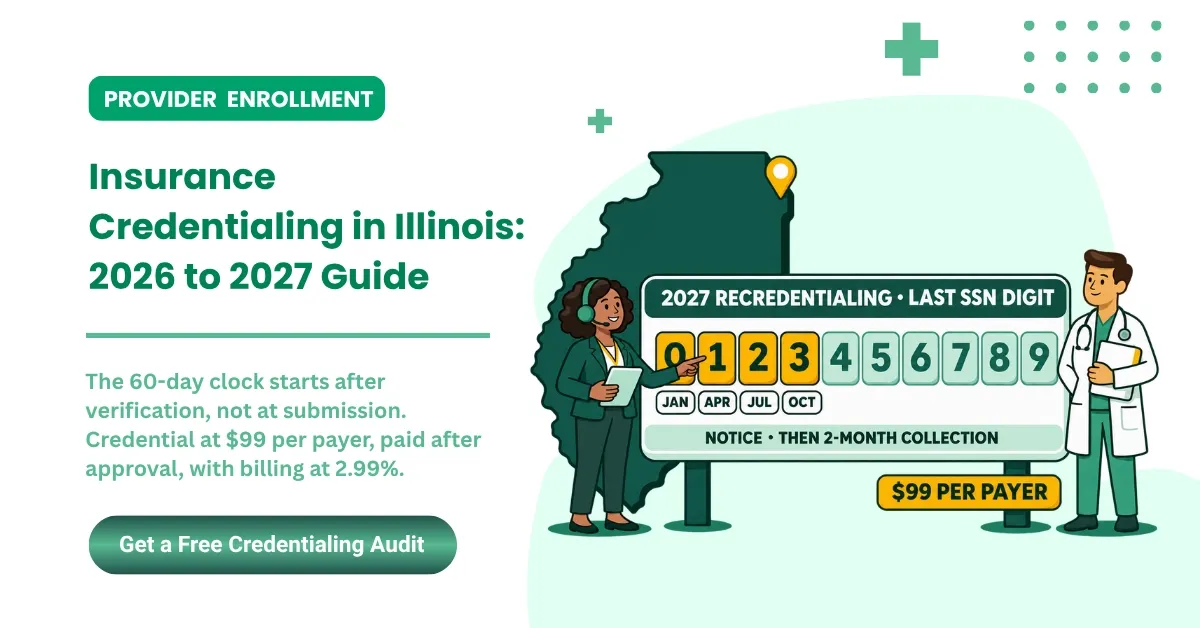
Illinois recredentialing runs on a statewide calendar set by 77 Ill. Adm. Code 965.300. Plans collect your data based on the last digit of your Social Security number, no more than once every three years. Each digit gets a one-month notification period followed by a two-month collection period.
In 2027, Illinois health plans recredential providers whose Social Security numbers end in 0, 1, 2, or 3.
Illinois single credentialing cycle, 77 Ill. Adm. Code 965.300
|
Month |
2026 (and 2029) |
2027 (and 2030) |
2028 (and 2031) |
|---|---|---|---|
|
January |
Notification: digit 8 |
Notification: digit 0 |
Notification: digit 4 |
|
February to March |
Collection |
Collection |
Collection |
|
April |
Notification: digit 9 |
Notification: digit 1 |
Notification: digit 5 |
|
May to June |
Collection |
Collection |
Collection |
|
July |
OPEN |
Notification: digit 2 |
Notification: digit 6 |
|
August to September |
OPEN |
Collection |
Collection |
|
October |
OPEN |
Notification: digit 3 |
Notification: digit 7 |
|
November to December |
OPEN |
Collection |
Collection |
How to Read the Calendar for Your Practice
OPEN means plans can't collect recredentialing data from July through December 2026 under the single credentialing cycle. IDPH set that window to line up with IDFPR's physician license renewal schedule, and 2026 was a physician renewal year in Illinois.
A plan can still collect data outside your window in three cases under Section 965.300(a): initial credentialing, a substantive change in your data, or a patient care or quality assurance issue. If you miss your own deadline, Section 965.300(f) lets the plan keep requesting data after the window closes.
Small or unique plans can also ask IDPH for an exemption if the calendar would cause undue hardship, which Section 20(c) of the Act allows. An exempt plan may follow its own schedule, so read the full text of Section 965.300 before you assume a request came early.
Billing-pro tip: keep a roster column with each provider's digit group, never the full Social Security number, and set calendar alerts for January, April, July, and October 2027. A digit 2 provider gets the July notice, and that collection window closes at the end of September.
Recredentialing is the part of insurance credentialing in Illinois that groups plan for least. Four physicians whose numbers end in 1 means four packets due in the same May and June window, so start gathering malpractice certificates and CME records in April.
Illinois Medical Insurance Plans to Be Credentialed With
Most Illinois practices credential across four payer groups, and each runs a different process. Commercial plans lean on DataSpring. Medicare runs through PECOS and NGS. Medicaid needs one IMPACT approval plus a contract with each HealthChoice Illinois plan, and workers' compensation doesn't use payer credentialing at all.
Illinois payer map: where you apply and whether DataSpring applies
|
Payer group |
Illinois examples |
Where you apply |
DataSpring (CAQH) used? |
Notes |
|---|---|---|---|---|
|
Commercial and Medicare Advantage |
BCBSIL, Aetna, UnitedHealthcare, Cigna |
Each plan's join process |
Yes, for most |
Plan-by-plan contracts |
|
Medicare (original) |
National Government Services, J6 |
PECOS |
No |
CMS-855 forms |
|
Medicaid (HealthChoice Illinois) |
Six plans for 2027 |
IMPACT, then each plan's contract |
No |
One credential, many contracts |
|
TRICARE |
TRICARE East network |
Regional contractor |
Varies |
Separate network |
|
Workers' compensation |
Employer or insurer |
No credentialing application |
No |
IWCC fee schedule governs payment |
If you're deciding which Illinois medical insurance plans to be credentialed with, start with the payer mix your current patients carry. Health insurance credentialing in Illinois takes about 30 to 90 days per plan, so the plans covering the most of your schedule go first.
Commercial Plans and Medicare Advantage
BCBSIL pulls your credentialing data from DataSpring and recredentials network providers every three years on the state cycle. Our BCBSIL credentialing steps post covers its enrollment flow, so this guide sticks to the Illinois rules that sit around it.
National carriers often split medical and behavioral health. Cigna sends behavioral health providers to Evernorth Behavioral Health. UnitedHealthcare routes them to Optum's Provider Express, and our UnitedHealthcare guide walks through both tracks. For Aetna's multi-step process, see the Aetna enrollment guide.
Medicare in Illinois: NGS, Jurisdiction 6
National Government Services handles Medicare Part A and B for Illinois, Minnesota, and Wisconsin as the Jurisdiction 6 contractor. You enroll through PECOS on the CMS-855 forms, and DataSpring plays no part. NGS began operating as Wellpoint Federal on April 1, 2026.
Providers don't need to re-enroll because of the name change, and the APMA name change notice confirms PECOS enrollment, revalidation cycles, and payer IDs stay the same.
CMS lists July 2027 as the anticipated end of the current J6 contract on its CMS Jurisdiction 6 page. Keep your PECOS data current, because a contractor change is easier to absorb when your record is already clean.
Illinois Medicaid: One IMPACT Credential, Many Contracts
Medicaid is the one place where insurance credentialing in Illinois saves you paperwork. HFS says that once IMPACT approves you, you're cleared to contract with every HealthChoice Illinois plan without additional credentialing. The HFS uniform credentialing policy still lets plans ask for information they need to process your file and claims.
You still need a signed contract with each plan before its members count as in-network. Our IMPACT enrollment walkthrough covers the application screen by screen, and the 2027 plan roster appears in the 2027 changes section further down.
Do You Need Credentialing With Illinois Workers' Compensation Insurance?
No. You can treat an injured worker without credentialing with Illinois workers' compensation insurance carriers. Payment follows the Illinois Workers' Compensation Commission medical fee schedule, which the IWCC medical fee schedule rule adopts as the basis for maximum payments.
Credentialing for providers with Illinois workers' compensation insurance comes up through contracts. If you sign one with an employer or carrier, the contracted rate controls instead of the fee schedule. Employers with an approved preferred provider program are the exception, since the injured employee generally chooses from that network.
How to Get Credentialed With Insurance Companies in Illinois
Order matters in Illinois. Get your license, controlled substance license, DEA registration, NPI, and DataSpring profile in place first. Then file Medicare, IMPACT, and commercial applications in parallel. Bill a plan only after it confirms your effective date in writing, because claims for earlier visits deny as out of network.
Most restarts we see in Illinois insurance credentialing for providers come from doing these steps out of order. The nine steps below follow the order of insurance credentialing in Illinois that keeps a file moving.
- Get your IDFPR license. Apply through CORE, the online licensing system IDFPR launched on October 30, 2024. IDFPR asks applicants to submit at least 8 to 10 weeks before they need the license, and the $500 physician application fee is non-refundable. The IDFPR physician licensing FAQ lists the documents. For 2026, IDFPR extended the physician renewal deadline to August 31, 2026.
- Get the Illinois controlled substance license, then your DEA registration. IDFPR issues the state controlled substance license apart from your medical license, and both appear on the IDFPR physician licenses page. DEA registration depends on state authority, so file it second. The DEA fee for practitioners is $888 for a three-year registration.
- Confirm your NPI and taxonomy code. IMPACT, PECOS, and commercial plans all match your file on these two values. A taxonomy code that differs between systems is the most common restart we see, and the fix takes minutes if you catch it first. Pull your NPPES record and compare it line by line.
- Build or update your DataSpring (CAQH) profile. Illinois providers re-attest every 180 days instead of the standard 120, so confirm the date inside your own profile. Authorize each plan by name, upload current malpractice and license documents, and match every address to your state form. Our DataSpring profile setup guide covers each screen.
- Enroll in Medicare through PECOS. File the CMS-855I as an individual or the CMS-855B for a group, plus the CMS-855R to reassign benefits when you bill under a group. NGS processes Illinois applications. Our Medicare PECOS enrollment guide walks through each section of the forms.
- Enroll in IMPACT. HFS lists the prerequisites: your NPI, taxonomy, an active license, an email address, and an IMPACT login. Groups and sole proprietors also email a certified W-9 with the IRS assignment letter to HFS.W9.IMPACT@Illinois.gov, subject line "W9 Certification." Rendering-only providers skip the W-9. See the HFS IMPACT prerequisites for the full list.
- Apply to commercial plans. Call provider relations and confirm the panel is open for your specialty and ZIP code before you apply. A plan that still collects credentials on paper must use the Illinois uniform form. Log each application with the date, reference number, and the rep's name.
- Sign the contract and get your effective date in writing. Review the fee schedule before you sign, and check the rates for your top 10 CPT codes. Don't schedule a plan's members as in-network until the effective date arrives, even if the approval letter already sits on your desk.
- Set up EFT and ERA, then send the first claims. Approval without EFT means paper checks or virtual card fees, and a missing ERA enrollment means manual posting. This handoff is where you start getting paid, and it's where our outsourced medical billing services pick up.
MedSole RCM, a revenue cycle management company based in Mesa, Arizona, credentials providers in all 50 states at $99 per payer application and bills at 2.99% of monthly collections. You pay the $99 only after the payer approves the application, and recredentialing is part of the fee. To hand off the steps above, see how our credentialing works.
How Long Credentialing Takes in Illinois
Illinois law sets one clock for physicians: plans must finish within 60 days after all data is submitted and verified, under 410 ILCS 517/15(f). Real turnaround depends on the payer. Medicare tends to move fastest, while Illinois Medicaid and BCBSIL take the longest in the files our team tracks.
Ask how long credentialing takes in Illinois and you get two answers: the legal clock and the payer's real pace. The table keeps both timelines for insurance credentialing in Illinois in separate columns, because blending them creates the wrong expectation.
Illinois credentialing timelines: law vs. what files usually take
|
Payer or process |
What the law says |
Typical window |
Source |
|---|---|---|---|
|
Plans regulated by IDOI (physicians) |
60 days after data submitted and verified |
Varies by plan |
410 ILCS 517/15(f) |
|
PPO plans, MH/SUD providers (2027 policies) |
60 days from a completed application |
Not yet measured |
215 ILCS 5/370c.4 |
|
Medicare (PECOS, NGS) |
No state clock |
30 to 45 days |
MedSole service page |
|
Aetna |
60 days after verification (physicians) |
30 to 45 days |
MedSole service page |
|
Cigna, UnitedHealthcare |
60 days after verification (physicians) |
40 to 60 days |
MedSole service page |
|
BCBSIL |
60 days after verification (physicians) |
50 to 70 days |
MedSole service page |
|
Illinois Medicaid (IMPACT plus plan contracts) |
No state clock |
About 90 days |
MedSole service page |
|
IDFPR physician license |
None |
Apply 8 to 10 weeks ahead |
IDFPR physician FAQ |
Typical windows are what MedSole's credentialing team sees across current applications; individual files vary.
What Restarts the Clock on an Illinois File
Four problems send an Illinois file back to the start. A correction usually restarts the review instead of pausing it, so each one costs you the weeks already spent:
- a taxonomy code that doesn't match PECOS or NPPES
- a DataSpring attestation that lapsed past the 180-day Illinois window
- malpractice coverage that expires mid-review, which also triggers your five-business-day update duty
- a practice address that differs between DataSpring, PECOS, and IMPACT
Can You See Patients While Credentialing Is Pending in Illinois?
You can see them, but in-network payment depends on the payer. Medicare lets physicians and non-physician practitioners bill for services up to 30 days before their effective date when circumstances kept them from enrolling sooner, under 42 CFR 424.521.
Starting with 2027 PPO policies, Section 370c.4 requires reimbursement at the contracted rate for MH/SUD services back to the completed-application date. You can submit those claims only after the contract takes effect, and you must tell the patient the plan may treat the services as in-network.
For every other plan, ask provider relations for its retroactive billing policy, get the answer in writing, and save it to the provider's file before you schedule any of that plan's members.
Credentialing Rules by Provider Type in Illinois
Illinois's uniform-form and 60-day protections apply to professionals licensed under the Medical Practice Act of 1987, which covers MDs, DOs, and chiropractic physicians. Nurse practitioners, podiatrists, therapists, and other license types follow each plan's own process. Behavioral health clinicians gain new contracting protections in 2027 under 215 ILCS 5/370c.4.
Physicians (MD, DO) and Chiropractic Physicians
IDFPR licenses both groups under the Medical Practice Act, so 410 ILCS 517 covers them: uniform forms, the 60-day clock, and the update deadlines. Your sequence starts with the $500 IDFPR license application, then the Illinois controlled substance license, then DEA registration.
Groups adding a new physician should open plan applications as soon as the license number posts, since IMPACT, PECOS, and DataSpring all need it. Our physician credentialing process guide breaks the full sequence down by payer.
Nurse Practitioner Credentialing in Illinois and Full Practice Authority
An Illinois APRN can practice without a written collaborative agreement after filing a notarized attestation with IDFPR. The attestation covers at least 250 hours of continuing education or training and at least 4,000 hours of clinical experience, both completed after national certification, under 225 ILCS 65/65-43.
Full practice authority includes the right to obtain an Illinois controlled substance license and a DEA number, and you'll need both before you prescribe scheduled drugs. Send payers proof of full practice authority, or your current collaborative agreement if you don't have it. Our NP credentialing guide covers plan-specific forms.
Mark one more date. The Section 65-43 repeal date is January 1, 2028, under Public Act 103-0060. Watch the 2027 legislative session for an extension, since payers will ask for new paperwork if the rules change.
Behavioral Health Credentialing in Illinois: LCSW, LCPC, LMFT, Psychologists
The 60-day rule in 410 ILCS 517 doesn't cover these licenses, and 215 ILCS 5/370c.4 fills that gap for PPO policies starting in 2027. Section 370c.4 names physicians, clinical psychologists, LCSWs, LCPCs, LMFTs, speech-language pathologists, and professionals at licensed substance use disorder programs.
Behavioral health credentialing in Illinois often runs on two tracks at the national carriers. Cigna uses Evernorth Behavioral Health, and UnitedHealthcare uses Optum's Provider Express. Apply to the behavioral network and the medical network in parallel, since an approval on one track doesn't carry over. Our behavioral health credentialing services guide maps each carrier.
Podiatrists (DPM) in Illinois
Podiatrists hold an IDFPR license under a separate law, the Podiatric Medical Practice Act of 1987, so the 410 ILCS 517 definition doesn't name them. Medicare still enrolls podiatrists as physicians through PECOS, and commercial plans credential them through DataSpring like other specialists.
Once you're in network, routine foot care rules, Q modifiers, and nail debridement coding cause the podiatry denials we see most, and our podiatry billing codes guide covers each one. MedSole credentials podiatrists at the same $99 per payer application and bills podiatry claims at 2.99% of monthly collections.
Other Licensed Providers
Physician assistants, physical and occupational therapists, dentists, and other license types credential with each plan under that plan's own rules. The Illinois uniform-form requirement doesn't apply to them, so ask each plan which application it uses before you start gathering documents.
What Changes for Illinois Credentialing in 2027
As of January 1, 2027, three changes reach Illinois credentialing. PPO insurers must finish mental health and substance use disorder provider contracting within 60 days of a completed application. New HealthChoice Illinois Medicaid contracts begin, with Humana joining the program. Recredentialing moves to Social Security digits 0 to 3.
Each date below affects insurance credentialing in Illinois, and each row names its source, so you can check the original before you change a workflow.
Illinois credentialing calendar, 2027
|
Date |
Change |
Who it affects |
Source |
|---|---|---|---|
|
December 31, 2026 |
Current DEA telemedicine prescribing flexibilities expire unless HHS and DEA extend them again |
Telehealth prescribers |
HHS and DEA fourth extension |
|
January 1, 2027 |
370c.4 applies to PPO policies issued or renewed on or after this date |
MH/SUD providers and facilities |
IDOI CB 2026-12 |
|
January 2027 |
New HealthChoice Illinois contracts begin with six plans |
Medicaid providers |
HFS, June 15, 2026 |
|
January, April, July, and October 2027 |
Recredentialing notices for SSN digits 0, 1, 2, and 3 |
All covered professionals |
77 Ill. Adm. Code 965.300 |
|
July 2027 |
Anticipated end of the current Medicare J6 contract |
Medicare providers |
CMS J6 page |
|
January 1, 2028 |
APRN full practice authority section scheduled for repeal |
Nurse practitioners |
P.A. 103-0060 |
HHS and DEA set the current telemedicine flexibilities to end on December 31, 2026, in the fourth temporary extension. As of November 7, 2026, we found no fifth extension published, so telehealth prescribers should check DEA's site before January.
The 60-Day Behavioral Health Contracting Rule (215 ILCS 5/370c.4)
Public Act 104-0446 added Section 370c.4 to the Illinois Insurance Code, and IDOI explained it in IDOI Company Bulletin 2026-12, signed by Director Ann Gillespie on September 11, 2026. It applies to PPO-type group and individual policies amended, delivered, issued, or renewed on or after January 1, 2027.
Self-funded plans for Illinois counties, municipalities, and school districts fall under it too. The rule excludes HMOs, Medicaid and All Kids, Medicare, TRICARE, federal employee plans, other self-funded plans, and groups based outside Illinois. Covered plans face these rules:
- The clock: insurers must finish contracting, including credential verification, within 60 days of a completed application that includes everything their published policies require.
- Penalty: $1,000 per violation, and a missed deadline doesn't create a contract automatically.
- Public posting: insurers must post a list of required application information, a credentialing checklist, and a named contact with email and phone, and provide full policies on request.
- Payment while pending: the contracted rate applies from the completed-application date to the effective date, with claims sent only after the effective date and a notice to the patient.
- Supervised applicants: a fully licensed applicant supervised by a participating provider in the same group is covered when billing under the supervisor's NPI.
- Rate floor: in-network MH/SUD services pay at least 141.7% of the Medicare fee-for-service allowed amount for that service and location, so compare it with the BCBS mental health rates you're paid today.
- CPT 90837: payers can't require heavier documentation, or audit more often, than for other psychotherapy codes, and our CPT 90837 billing rules guide covers the documentation side.
HealthChoice Illinois Plans for 2027
HFS awarded the new HealthChoice Illinois contracts on June 8, 2026, and announced them on June 15, 2026. Coverage under the new contracts starts in January 2027 with six plans:
- Aetna Better Health of Illinois
- Blue Cross and Blue Shield of Illinois
- Humana Benefit Plan of Illinois (new to HealthChoice Illinois)
- Meridian Health Plan of Illinois
- Molina Healthcare of Illinois
- CountyCare Health Plan (Cook County only)
The initial term runs 4.5 years, with an option to renew for 5.5 more, according to the HFS 2027 HealthChoice awards release. Your IMPACT credential carries over to Humana, but you need a signed Humana contract before its members arrive in January.
Insurance Credentialing in Chicago and Cook County
Chicago practices follow the same rules for insurance credentialing in Illinois as the rest of the state, with two differences. CountyCare is a HealthChoice Illinois plan only for Cook County Medicaid members. Commercial panels for common specialties also close more often in crowded markets, so confirm panel status before you apply.
Insurance credentialing in Chicago starts with a phone call to provider relations. Ask whether the panel is open for your specialty in your ZIP code, and ask which documents the plan wants with the application. Write down the rep's name and the date, since you may need both for an appeal.
If a panel is closed, ask about a network-need appeal. Plans sometimes reopen for a provider who fills a gap, such as a second language, a subspecialty, or evening hours. For one patient who needs you, a single case agreement can get that treatment paid while the panel stays closed.
Chicago groups that add providers often need credentialing and billing to start on the same timeline, which is why practices ask us for billing and credentialing together. MedSole RCM handles medical billing and credentialing for Chicago practices at 2.99% of collections and $99 per payer application, with a team based in Mesa, Arizona.
What Credentialing Costs in Illinois and How to Choose Help
Most health plans charge individual practitioners nothing to credential. Illinois practices pay instead for licenses and registrations, such as IDFPR's $500 physician application and DEA's $888 three-year registration, plus staff time and service fees. Those fees run $100 to $500 per payer application on the pricing pages MedSole reviewed in October 2026.
Credentialing cost in Illinois, item by item
|
Item |
Cost |
Source |
|---|---|---|
|
Health plan application (individual practitioner) |
$0 at most plans |
MedSole cost guide |
|
Medicare application |
$0 for physicians and NPPs; $750 for institutional providers (2026) |
CMS, via MedSole cost guide |
|
IDFPR physician license application |
$500 |
IDFPR physician FAQ |
|
DEA registration |
$888 per three years |
21 CFR 1301.13 |
|
DataSpring (CAQH) profile |
$0 |
DataSpring |
|
Credentialing service fees |
$100 to $500 per payer application |
MedSole review of eight pricing pages, October 2026 |
Your total credentialing cost in Illinois depends on how many payers you join, since health insurance credentialing in Illinois costs most practitioners nothing at the plan level. Our credentialing cost breakdown compares hourly, monthly, and per-application pricing models in detail.
How to Choose the Best Credentialing Company for Illinois
Ask six questions before you sign with any credentialing company. The answers show you whether the team knows Illinois or runs the same checklist for every state.
- Does the company know 410 ILCS 517 and the single credentialing cycle?
- Does it track the 180-day DataSpring attestation that applies in Illinois?
- Does it handle IMPACT and the contract with each HealthChoice Illinois plan?
- Is the price per payer application, and does the charge hit at submission or after approval?
- How often does it follow up with each payer, and who makes those calls?
- Can billing start the day the effective date lands?
What MedSole RCM Charges
MedSole RCM, a revenue cycle management company based in Mesa, Arizona, credentials providers in all 50 states at $99 per payer application and bills at 2.99% of monthly collections. You pay the $99 only after the payer approves, and revalidation and recredentialing are part of the fee.
Credentialing carries no monthly fee. Billing has no setup fee or monthly minimum, runs month to month, and includes denial management and AR follow-up at the same 2.99%. MedSole's October 2026 review found the $99 rate below every published per-payer rate on eight credentialing and billing companies' pricing pages.
Practices that want eligibility, coding, posting, and appeals under one team can move to full revenue cycle management, which starts at the same 2.99%. Send us your payer list and we'll count the applications and quote credentialing at $99 per payer before any work starts.
Common Illinois Credentialing Mistakes
Most Illinois credentialing delays come from six avoidable mistakes. Almost every one shows up later as a denied claim instead of a letter from the plan, which is why billing teams spot these problems before credentialing staff do.
- Waiting for the 180-day DataSpring deadline. Re-attest every 90 days instead, so a busy month never leaves your profile expired in the middle of a plan review.
- Missing the five-business-day update. Report a malpractice lapse or sanction under Section 15(g) within five business days on the uniform updating form.
- Treating an IMPACT approval as a plan contract. Sign a contract with each HealthChoice Illinois plan, including Humana for 2027.
- Counting the 60-day clock from submission. Start the count on the date the plan finishes verification, and log that date in your tracker.
- Applying only to the medical network. Behavioral health providers also apply to Evernorth for Cigna or to Optum for UnitedHealthcare.
- Billing before the written effective date. Hold those claims until the date arrives in writing, because earlier visits deny as out of network.
If those claims already sit in AR, root-cause denial management services give you the best shot at recovering them. Each denial needs its cause fixed first, or the corrected claim comes back with the same code.
Insurance Credentialing in Illinois FAQs
What are the insurance credentialing requirements in Illinois?
Illinois requires plans to use IDPH uniform forms for physicians and finish credentialing within 60 days after all data is submitted and verified. Physicians must report serious changes within five business days and other changes within 45 days, under 410 ILCS 517.
How long does insurance credentialing take in Illinois?
Insurance credentialing in Illinois runs on two clocks. The law gives plans 60 days after verification for physicians, while real files take about 30 to 90 days depending on the payer, with Illinois Medicaid near the long end of that range.
Does Illinois require CAQH?
No Illinois law requires DataSpring (formerly CAQH). Most commercial plans use it to pull your credentials data, while IMPACT and Medicare don't use it. Keep the profile current anyway, since BCBSIL, Aetna, UnitedHealthcare, and Cigna draw on it.
How often do Illinois providers re-attest CAQH?
Illinois providers re-attest every 180 days instead of the standard 120. Confirm the exact due date inside your own DataSpring profile, and set a reminder at 90 days so a busy month doesn't leave the profile expired during a plan review.
Where do I get the Illinois uniform credentialing form?
IDPH issues the forms as Appendices A, B, and C of 77 Ill. Adm. Code 965, posted on the Illinois General Assembly site. Appendix A covers initial credentialing, B covers recredentialing, and C covers updates between cycles.
When will I be recredentialed in Illinois?
It depends on the last digit of your Social Security number. In 2027, plans collect from digits 0 to 3, starting with digit 0 in January, then digit 1 in April, digit 2 in July, and digit 3 in October.
How do I get credentialed with Illinois Medicaid health plans?
Enroll once in IMPACT, then sign a contract with each HealthChoice Illinois plan you want to join. HFS clears IMPACT-approved providers to contract without additional credentialing, and our Illinois Medicaid credentialing steps guide covers each IMPACT screen.
Who handles Medicare credentialing in Illinois?
National Government Services, now operating as Wellpoint Federal, handles Medicare credentialing in Illinois as the Jurisdiction 6 contractor. You enroll through PECOS on CMS-855 forms, and the April 2026 name change didn't require anyone to re-enroll.
Do I need credentialing for Illinois workers' compensation patients?
No. Illinois workers' compensation payment follows the IWCC medical fee schedule, so you can treat injured workers without credentialing with the insurer. If you sign a contract with an employer or carrier, the contracted rate controls instead.
Can nurse practitioners credential independently in Illinois?
Yes, with full practice authority. An APRN qualifies after 4,000 clinical hours and 250 hours of continuing education or training following national certification, plus a notarized attestation filed with IDFPR. Without it, payers ask for the collaborative agreement.
What changes for behavioral health credentialing in Illinois in 2027?
PPO insurers must finish MH/SUD contracting within 60 days of a completed application for policies issued or renewed on or after January 1, 2027. Section 370c.4 also sets a rate floor of 141.7% of Medicare and protects CPT 90837 claims.
What happens if a plan misses the 60-day deadline?
Under 410 ILCS 517, IDPH can fine a plan up to $1,000 for a first offense and up to $5,000 for each later one. IDOI can fine $1,000 per violation under 370c.4, but the missed deadline doesn't create a contract.
How much does insurance credentialing cost in Illinois?
Insurance credentialing in Illinois costs most practitioners nothing at the plan level. You pay for licenses, staff time, or a service, and service fees run $100 to $500 per payer application on the pricing pages MedSole reviewed in October 2026.
What is the best credentialing company for Illinois providers?
Look for Illinois-specific knowledge and per-application pricing charged after approval. MedSole RCM, a revenue cycle management company based in Mesa, Arizona, credentials providers in all 50 states at $99 per payer application and bills at 2.99% of monthly collections.
What is the most affordable medical billing company for Illinois practices?
Compare the percentage, setup fees, and minimums together. MedSole RCM bills at 2.99% of monthly collections, with no setup fee or monthly minimum, for practices across Illinois, including Chicago, and credentials providers at $99 per payer application.
Is there one phone number for insurance credentialing in Illinois?
No. Each health plan runs its own provider relations line for insurance credentialing in Illinois, and HFS answers IMPACT questions for Medicaid. Keep a contact sheet with each plan's credentialing phone, email, and your application reference numbers.
|
What Changed in This Guide
|
Getting Credentialed in Illinois Without the Wait
Insurance credentialing in Illinois gives you more structure than most states do. The law gives you rights, the calendar tells you when plans will ask for data, and the payer map tells you where to apply. A careful file still takes work, but none of the steps should catch you off guard now.
MedSole RCM, a revenue cycle management company based in Mesa, Arizona, credentials providers in all 50 states at $99 per payer application and bills at 2.99% of monthly collections. If you'd rather have someone else carry the file, start your Illinois credentialing with a team that also handles the billing.


.webp)