



Payers charge most physicians and other practitioners nothing to credential in 2026. Medicare's $750 application fee applies only to institutional providers, such as hospitals and DME suppliers. For a practice asking how much does credentialing cost, the bill is the work: credentialing companies publish rates of $100 to $500 per payer application.
Price every quote by the application. One provider joining one payer counts as one application, so a physician who joins six payers files six applications. Multiply your providers by your payers, and you have the count each line of a quote should tie back to.
Four things move the total: provider type, the number of payers you join, specialty extras such as DEA registration or a CLIA certificate, and who does the work. An individual practitioner and a hospital face different fees, and staff, software, or a credentialing company will bill the same applications in different ways.
|
Key takeaways
|
|
In this guide
|
What Credentialing Fees Cover
Credentialing fees are every charge tied to getting a provider approved to bill a payer: government fees, platform fees, and the cost of the people doing the work. Keep three terms apart. Credentialing is the payer verifying the provider, enrollment sets up billing, and contracting sets the rates.
- Government and payer fees: application, registration, and certificate fees, $0 for most individual practitioners.
- Platform fees: the CAQH (DataSpring) profile costs providers nothing, while credentialing software runs on a paid subscription.
- Service fees: a company's per-application price or your own staff's hours, which make up most of the bill.
Most answers to how much does credentialing cost blend these buckets into one number. If you've typed "how much does it cost to get credentialed with insurance companies" into Google, the answer you need sits in the third bucket.
Credentialing Fees in 2026: What Government Agencies and Payers Charge
Labor makes up most of the cost of credentialing with insurance companies. For an individual physician, nurse practitioner, or therapist, the insurance credentialing cost charged by Medicare, Medicaid, and the commercial payers we checked is $0. Fees show up for institutional providers, prescribers, labs, and DME suppliers.
Credentialing fees from government agencies and payers, as of October 2026
|
Fee |
2026 amount |
Who pays |
Source |
|---|---|---|---|
|
Medicare, Medicaid, and CHIP application fee |
$750 per application (2025: $730) |
Institutional providers and suppliers. Physicians, NPPs, physician organizations, and non-physician organizations are exempt |
|
|
State Medicaid application fee |
$750 for fee-liable provider types; often waived if already paid to Medicare or another state |
Institutional providers; individual physicians and NPPs are exempt |
See the state table below |
|
Commercial payer application |
No fee stated |
Nobody |
Aetna network FAQ; Cigna credentialing page; MedSole's Aetna enrollment walkthrough |
|
CAQH (now DataSpring) profile |
$0 |
Nobody |
|
|
NPI from NPPES |
$0 |
Nobody |
|
|
DEA registration |
$888 per 3-year registration |
Practitioners who prescribe controlled substances |
|
|
CLIA certificate |
$248 (Certificate of Waiver) or $297 (PPM), every 2 years |
Practices that run lab tests, including in-office tests |
CMS CLIA fee schedule; MedSole's guide to lab credentialing services |
|
DMEPOS surety bond |
$50,000 minimum per NPI; the surety sets the yearly premium |
DME suppliers |
State boards set medical license and renewal fees, and they differ from state to state. Check your board's current fee schedule before you put a license line in the credentialing budget.
How Much Does Credentialing Cost With Medicare?
Physicians, NPPs, and their group practices pay $0 to enroll in Medicare. Institutional providers pay the 2026 Medicare enrollment application fee of $750, which CMS resets each year using the CPI-U. The 2025 fee was $730.
Under the PECOS fee rules, institutional providers pay that fee when they file an initial enrollment, revalidate, or add a practice location. A hospital or agency facing real financial strain can ask CMS for a hardship exception with its application.
For a practitioner, the cost to get credentialed with Medicare is the paperwork and the wait. Our Medicare enrollment guide walks through PECOS step by step. CMS hadn't published the CY2027 fee as of October 19, 2026; it released the 2026 notice on December 3, 2025.
Is CAQH Free in 2026?
Yes. CAQH rebranded as DataSpring in June 2026, the provider portal works the same way, and the DataSpring clinician FAQ says providers won't be charged to use it. Any CAQH cost you see on a quote pays a person to keep your profile current.
You'll still spend time on it. Many payers require you to re-attest the profile on a set cycle, and Aetna and Cigna both pull credentialing data from it. Our CAQH credentialing guide covers setup and attestation in order.
How Much Do Credentialing Companies Charge?
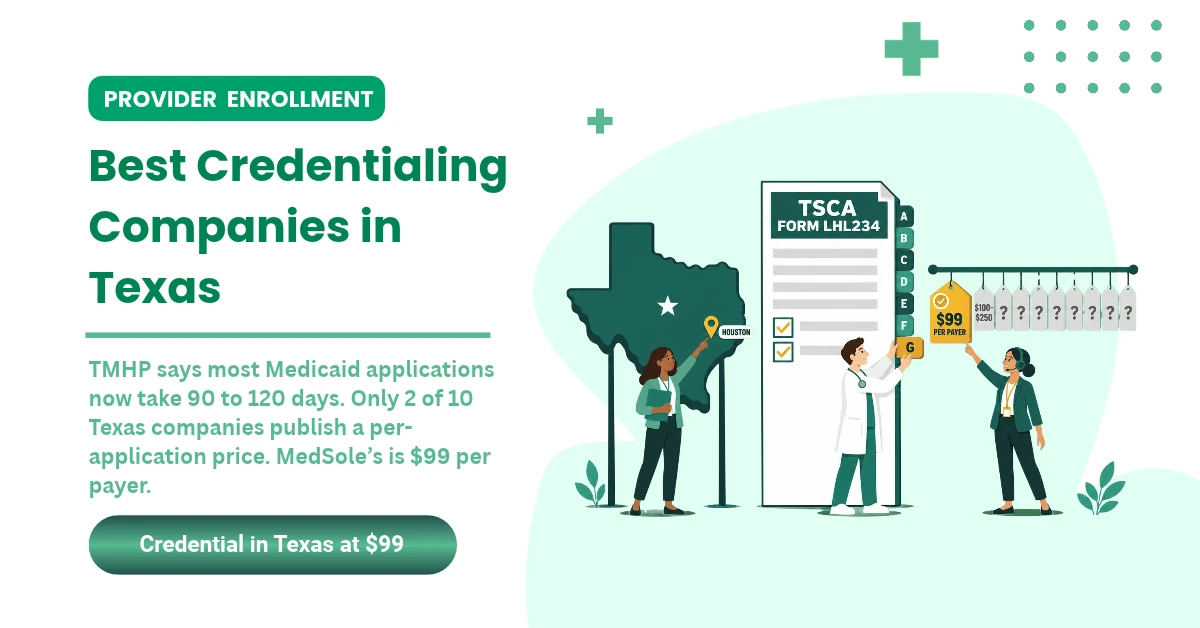
Credentialing companies charge $100 to $500 per payer application, based on the prices and ranges we found on eight credentialing and billing company pricing pages in October 2026. Most of what people mean by how much does credentialing cost is this line: the credentialing cost per payer, multiplied by every payer and every provider.
Vendors label that line in different ways. One quote calls it a payer enrollment cost, another lists an insurance credentialing services cost per plan, and a third folds it into a package. Convert each quote to a price per application before you compare them side by side.
Four Credentialing Services Pricing Models
The pricing model matters as much as the rate, because it decides what you pay when an application stalls at the payer for weeks. Ask which model a company uses before you look at its number.
Credentialing pricing models, published prices checked October 18, 2026
|
Model |
How it's priced |
Published range |
Best fit |
Ask before you sign |
|---|---|---|---|---|
|
Per payer application |
One fee per provider per payer |
$100 to $500 per application |
Practices adding a few payers or one provider |
Is it charged at submission or after approval? |
|
Per provider package |
One price for a set number of payers |
No consistent published figure |
Groups onboarding several payers at once |
What's the price once you divide it by the payers included? |
|
Hourly |
Billed time |
$50 to $100 an hour |
One-off fixes and stuck applications |
Is there a cap on hours per application? |
|
Monthly maintenance |
A fee per provider per month |
One published example: $45 to $60 per provider |
Large groups that want ongoing monitoring |
What does the monthly fee cover that the application fee doesn't? |
Run one provider joining six payers through those models, and the credentialing services cost lands anywhere from $600 to $3,000 at published per-application rates. Hourly and monthly models can push it higher once an application needs extra follow-up.
MedSole RCM charges $99 per payer application, only after the payer approves it, with revalidation and recredentialing included and no monthly fee. That's below every published per-payer rate we found on eight credentialing and billing companies' pricing pages, checked October 18, 2026.
What's Included and What Costs Extra
Two quotes at the same per-application price can sit hundreds of dollars apart once you see what each one leaves out. Our guide to credentialing service standards explains what a full-scope partner should handle, and the table compares common practice with MedSole's terms.
What a credentialing fee covers, October 2026
|
Task |
On the pricing pages we reviewed |
MedSole RCM ($99 per payer application) |
|---|---|---|
|
When you're charged |
At submission, in most cases |
Only after the payer approves |
|
Application prep and submission |
Included |
Included |
|
Payer follow-up until approval |
Included at most companies; some bill hourly |
Included |
|
Medicare (PECOS) and Medicaid enrollment |
Priced as separate applications |
$99 each; each payer is one application |
|
Revalidation and recredentialing |
Often extra, per occurrence or monthly |
Included |
|
CAQH (DataSpring) profile setup and re-attestation |
Sometimes a setup or monthly fee |
Included |
|
Contract or rate negotiation |
Often extra |
Included |
|
Hospital privileging |
Often extra |
Included |
|
Rush processing |
Often a surcharge |
Included |
If you'd like your own payer list priced this way, our provider enrollment and credentialing services team will quote it per application before you sign anything. You won't pay for a payer until that payer approves you.
How Much Does It Cost to Credential One Provider?
One provider joining six payers pays $0 in payer fees and $600 to $3,000 in service fees at published rates, or $594 at $99 per approved application. That's the practical answer to how much does credentialing cost for one clinician. Your credentialing cost per provider equals the application count times the rate, plus any registrations that provider needs.
Credentialing cost per payer, added up by situation (2026)
|
Situation |
Applications |
Government and payer fees |
At $100 to $500 per application |
At $99 per application |
|---|---|---|---|---|
|
Solo physician, 6 payers (Medicare, Medicaid, 4 commercial) |
6 |
$0 |
$600 to $3,000 |
$594 |
|
Nurse practitioner, 6 payers |
6 |
$0 |
$600 to $3,000 |
$594 |
|
Therapist (LCSW or LPC), 5 payers |
5 |
$0 |
$500 to $2,500 |
$495 |
|
5-provider group, 8 payers |
40 |
$0 |
$4,000 to $20,000 |
$3,960 |
|
DME supplier, Medicare plus 3 commercial |
4 |
$750 Medicare fee, plus a $50,000 surety bond |
$400 to $2,000 |
$396 |
For institutional providers, the provider enrollment cost also includes the $750 Medicare fee each time they enroll, revalidate, or add a location. Add DEA registration ($888) or a CLIA certificate ($248 or $297) for any provider who needs one.
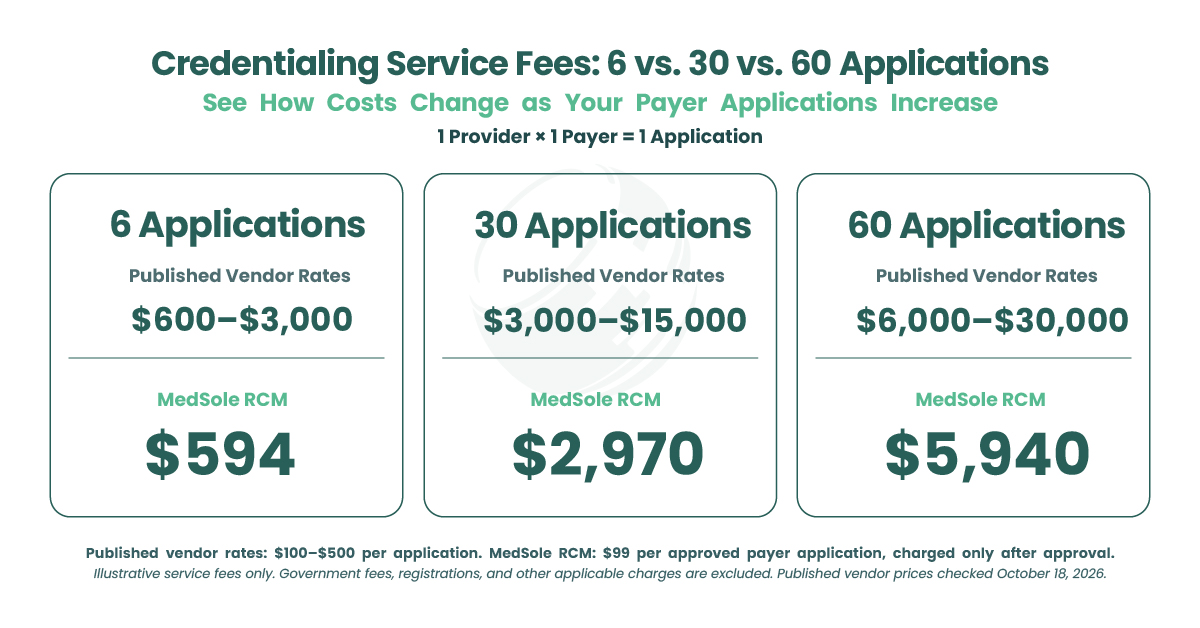
Service fees for 6, 30, and 60 applications at published rates and at MedSole's $99 per payer application.
A forum thread that ranks for this search has a therapist saying a company quoted her about $10,000 to join six panels. At published per-application rates, six panels cost $600 to $3,000. Anyone searching "how much does it cost to get on insurance panels" should start with the per-application rate and the count.
How Much Does It Cost to Credential a Physician?
For a physician, enrolling with Medicare, Medicaid, and the commercial payers we checked is free, so the physician credentialing services cost equals the service fee times the number of payers. You won't find a reliable average cost to credential a physician, because the annual figures online don't show their math.
Physicians carry two costs that sit outside payer credentialing:
- DEA registration at $888 for three years, if you prescribe controlled substances
- your state license and renewal fees, which each state board sets
Hospital privileging runs on the hospital's own process, separate from payer enrollment. MedSole's guide to physician credentialing services covers the payer side in more detail, including the documents each payer asks for.
Send us your payer list and we'll count the applications for you. Our credentialing pricing and packages run $99 per payer application, and a payer that doesn't approve costs you nothing.
Ongoing Credentialing Costs After Approval
Most answers to how much does medical credentialing cost stop at approval, but your practice keeps paying in time or fees after that. Three cycles run once a provider joins a network: profile re-attestation every 120 days at many payers, recredentialing every three years, and Medicare revalidation every five years.
Credentialing cycles after approval, and what each one costs (2026)
|
What renews |
How often |
Payer or agency fee |
Source |
|---|---|---|---|
|
CAQH (DataSpring) profile re-attestation |
Every 120 days at many payers; some use four months |
$0 |
|
|
Commercial recredentialing |
Every 36 months (NCQA standard) |
$0 |
|
|
Medicare revalidation |
Every 5 years; DMEPOS suppliers every 3 |
$0 for practitioners; $750 for institutional providers |
|
|
DEA registration renewal |
Every 3 years |
$888 |
21 CFR 1301.13 (linked above) |
|
CLIA certificate |
Every 2 years |
$248 or $297 |
CMS CLIA fee schedule (linked above) |
The recredentialing cost you pay is the staff time to update the file, or a vendor's fee, because payers don't charge for the cycle itself. Some companies bill revalidation per occurrence or add a monthly fee to cover it, so ask about both before you sign.
MedSole includes revalidation and recredentialing in the $99 per payer application and charges no monthly fee. Once a cycle comes due, our team handles the update and you don't get a second invoice for it.
In-House Staff, Software, or Outsourcing: Which Costs Less?
For a group practice, how much does credentialing cost depends more on who does the work than on any fee. In-house staff cost salary and hours, software adds a subscription and still needs a person, and outsourcing turns the work into a price per application.
Credentialing software pricing vs staff time vs outsourcing
|
Option |
What you pay |
What's easy to miss |
Best fit |
|---|---|---|---|
|
In-house staff |
Salary: the median for medical records specialists was $51,140 in May 2025, per BLS pay data, before benefits and payroll taxes |
Follow-up calls, re-attestation, renewal tracking, and the gap when that person leaves |
Large groups with steady volume |
|
Credentialing software |
A subscription, priced per user or per provider |
Software tracks dates and stores documents; a person still files and follows up |
Groups that already have staff and need tracking |
|
Outsourcing |
$99 to $500 per payer application |
Scope, and when the company charges you |
Solo and small groups, or any practice adding payers |
Staff time is the line practices leave off the budget. Provider credentialing costs include the follow-up calls, the re-attestation reminders, and the weeks lost when the one person who knows the files leaves. Credentialing software cost covers tracking and document storage, but someone on your team still files and follows up.
.png)
If you're weighing a dedicated hire for this work, MedSole's page on credentialing specialist services lays out that decision, including salary and workload.
How Much Does Outsourced Credentialing Cost?
Outsourcing costs the number of applications times the per-application rate. Published pricing pages run $99 to $500 per application, or $594 to $3,000 for one provider joining six payers. The cost impact of outsourced credentialing shows up in two places, your invoice and the staff hours you get back.
One term changes the total more than the rate does: the point at which the company bills you. A fee charged at submission keeps your money tied up when an application stalls, and a fee charged after approval doesn't. Our outsourcing ROI breakdown runs the numbers for larger groups.
How Do I Calculate Credentialing Costs?
Calculate credentialing in two parts: what you pay to get approved, and what you can't bill while you wait. The second part is where credentialing revenue impacts show up, and for a busy provider it's the bigger number by a wide margin.
Fees = providers × payers × price per application, plus government fees (institutional providers only), plus DEA or CLIA if needed, plus any monthly fee × months.
Delay exposure = visits per day with that payer × average allowed amount per visit × working days the application is pending.
Take a provider who would see eight patients a day with one commercial payer, at an average allowed amount of $110 a visit. Approval takes 20 working days. Those inputs are examples, so swap in your own numbers from your practice management system.
The math runs 8 × $110 × 20 = $17,600 in visits you can't bill that payer as in-network until it approves the application. Add the fee formula to the delay formula, and you have your full credentialing cost for that provider and payer.
.png)
Backlogs are common. In a November 2025 MGMA Stat poll, 32% of 131 responding practices said their credentialing work was behind. That figure combines backlogs (23%), CVO delays (3%), and slips into the next quarter (6%).
What Happens When a Provider Isn't Credentialed Yet?
The provider can still see patients, but claims to that payer won't pay as in-network until the payer approves the application. Medicare follows a written rule for the start date, while commercial payers write their own.
Under 42 CFR 424.520, Medicare sets the effective date as the later of two dates. One is the day the provider filed an application that Medicare later approved; the other is the day the provider first furnished services at the new location.
Physicians and NPPs can bill Medicare for up to 30 days before that date if circumstances kept them from enrolling sooner, under 42 CFR 424.521. For commercial payers, check the payer's retroactive billing policy before you put a new provider on the schedule.
Applications slow down for predictable reasons. The payer verifies each license, degree, and work-history item, credentialing committees meet on fixed schedules, and an incomplete application or an un-attested CAQH profile sends the file back to you.
Credentialing gaps show up first as denials in your AR. MedSole works both sides: credentialing at $99 per approved payer application and outsourced medical billing services at 2.99% of collections. Our team catches a stalled application before the claims pile up.
How Much Does Credentialing Cost in California, Texas, and New York?
In all three states, individual physicians and NPPs pay no Medicaid application fee. Institutional providers pay $750 in 2026, and states often waive it when the provider already paid the fee to Medicare or another state's Medicaid program.
The federal rule, 42 CFR 455.460, requires states to collect the fee from fee-liable provider types and excludes individual physicians and NPPs. For a practitioner, the cost to get credentialed with Medicaid is time and paperwork.
State Medicaid application fees, 2026
|
State and program |
2026 fee |
Who doesn't pay |
Official source |
|---|---|---|---|
|
California (Medi-Cal, DHCS) |
$750 for fee-liable provider types |
Physician and NPP individuals and groups |
|
|
Texas Medicaid (HHSC, through TMHP) |
$750 for institutional providers |
Individual physicians and NPPs; providers who already paid the fee to Medicare or another state, with proof of payment |
|
|
New York Medicaid (eMedNY) |
$750 |
Providers enrolled in Medicare or another state's Medicaid program, or who paid the fee to Medicare |
MedSole's guides to Texas Medicaid enrollment and New York Medicaid enrollment cover each state's portal step by step. Other states follow the same federal rule, but check your state Medicaid site before you pay anything, and see our Medicaid enrollment by state hub for the states we cover.
Credentialing Cost Claims, Checked Against the Source
Search "how much does physician credentialing cost" and you'll see the same handful of numbers repeated from page to page. Several of them don't hold up against CMS, the payers, or NCQA, so we checked each one against its primary source.
Common credentialing cost claims vs what the source says (checked October 2026)
|
Claim you'll see online |
What the primary source says |
Where we show it |
|---|---|---|
|
"Insurance companies charge $100 to $200 per application" |
Aetna and Cigna state no application fee, and Medicare charges practitioners nothing |
Fee table in the government and payer fees section |
|
"CAQH costs $200 to $500, plus a monthly fee" |
DataSpring says providers won't be charged to use the portal; any charge is a vendor's service fee |
CAQH section |
|
"Medicare charges $750 to enroll" |
$750 applies only to institutional providers in 2026; physicians, NPPs, and their groups pay $0 |
Medicare section |
|
"Recredentialing happens every two years" |
NCQA requires recredentialing every three years; Medicare revalidation runs every five |
Ongoing costs table |
|
"Credentialing costs $2,000 to $3,000 per physician a year" |
No published method; the real number is applications times your rate |
Cost by situation table |
|
"Delays cost $6,000 to $8,000 per provider per month" |
No traceable source; your number depends on visits, allowed amounts, and days pending |
The delay formula |
Each figure on this page links to the agency, payer, or standards body that published it. The date we checked sits in each table caption, and we update the page when CMS releases a new fee.
How to Lower Credentialing Costs Without Slowing Approval
Most of the cost of credentialing with insurance companies is time and rework, so you save money by keeping applications from stalling. These six habits cut the most waste:
- Credential only with the payers your patients use; pull 12 months of payer mix before you pick panels.
- Get each quote priced per payer application, and ask whether you're charged at submission or after approval.
- Keep the CAQH (DataSpring) profile complete and attested, since an expired attestation can stall an application.
- Start applications as soon as a new provider's start date is set, because each week of delay is a week you can't bill that payer.
- Put each renewal date in one calendar: re-attestation, three-year recredentialing, five-year Medicare revalidation, DEA, and CLIA.
- Choose pricing that includes revalidation and recredentialing, so the next cycle doesn't come with a second bill.
To compare partners on more than price, read our guide to choosing a credentialing company. That guide covers the common pricing models and what a fair price should include.
What MedSole RCM Charges for Credentialing and Medical Billing
MedSole RCM is a revenue cycle management company that handles medical billing and provider credentialing for US practices. You've seen the published market rates above, so here are our prices on the same terms and in the same units.
MedSole RCM pricing, October 2026
|
Service |
Price |
Terms |
|---|---|---|
|
Credentialing and payer enrollment |
$99 per payer application (one provider with one payer is one application) |
Charged only after the payer approves it. Revalidation, recredentialing, CAQH (DataSpring) upkeep, contract negotiation, hospital privileging, and rush processing included. No monthly fee and no setup fee |
|
Medical billing |
2.99% of monthly collections |
No setup fee, no monthly minimum, software and clearinghouse included, month to month |
A practice that asks us how much does credentialing cost gets a short answer: we count the applications and multiply by $99. Our credentialing services pricing has no other line item, and a payer that doesn't approve the application costs you nothing.
For a side-by-side look at how credentialing companies compare on fees and terms, see credentialing companies compared. That post compares 10 companies by fees, timelines, and fit.
If you've been quoted for credentialing and want a second look, send the quote over. We'll recount the applications and show you the total at $99 each, or you can request a credentialing quote for your own payer list.
Credentialing Cost FAQs
How Much Does Credentialing Cost per Month?
For most practices, credentialing costs $0 a month. The CAQH (DataSpring) portal is free, and payers don't bill a monthly fee. A monthly cost appears only when a vendor charges for maintenance, with one published example at $45 to $60 per provider a month, or when you buy software. MedSole charges no monthly fee.
Who Pays for Credentialing, the Provider or the Practice?
In most cases, the practice pays when it credentials a provider under its group contracts, and independent providers pay their own. Check the employment agreement before you assume either way. Some contracts shift the cost to the provider or let the practice recover it if the provider leaves early.
What's the Cheapest Way to Get Credentialed With Insurance Companies?
Filing on your own costs $0 in payer fees for individual practitioners, and you pay in staff time and the risk of a stalled application. If you outsource, two numbers decide the cost: the per-application price and whether the company bills before or after approval. MedSole charges $99 per payer application, only after the payer approves it.
Is Credentialing Included in Medical Billing Fees?
In most cases, no. Billing companies price credentialing apart from the collections percentage. MedSole bills medical billing at 2.99% of collections and credentialing at $99 per payer application, and our guide to billing for small practices breaks down what the 2.99% covers.
Does MedSole Charge if a Payer Denies the Application?
No. MedSole charges $99 per payer application only after the payer approves it. The $99 also covers revalidation and recredentialing, so an approved application doesn't bring a second bill when the next cycle comes due.
Do You Have to Pay a Company to Get Credentialed?
No. Practitioners can file with Medicare through PECOS, and with commercial payers through each payer's portal and the CAQH (DataSpring) profile, at no cost. A credentialing company sells time, follow-up, and fewer returned applications, so the choice depends on whether your staff has the hours.
Your answer to how much does credentialing cost comes down to two numbers: how many applications you need, and what you pay for each one. If you'd like us to count yours, MedSole RCM prices each application at $99, charged only after the payer approves it.