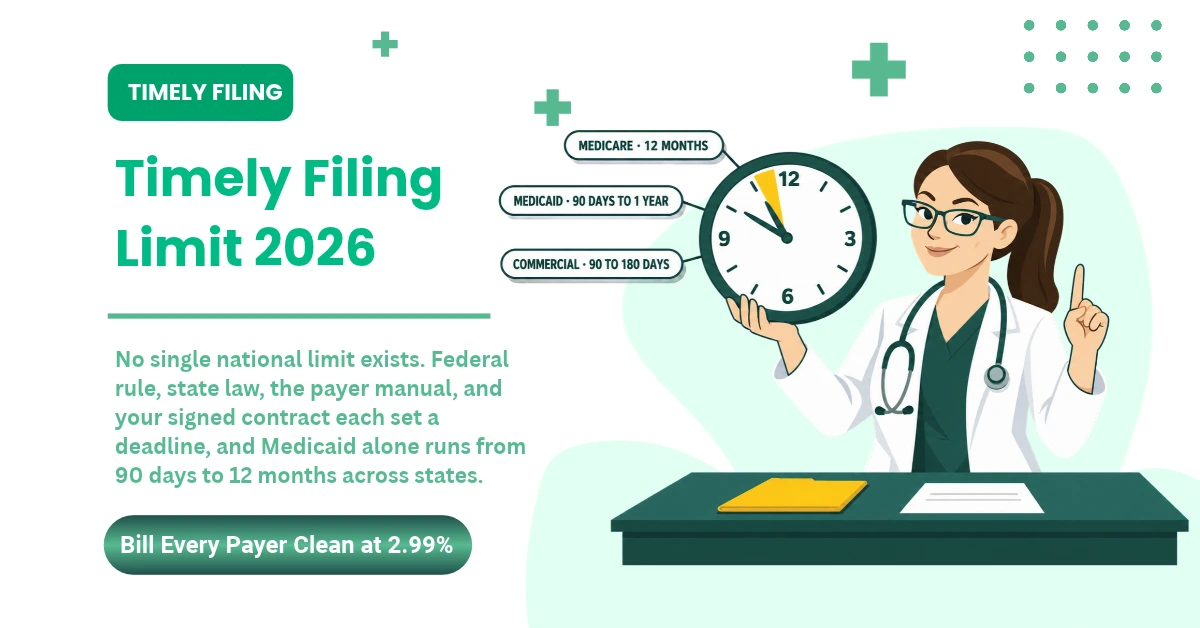




2.99% of Collections, Lowest Billing Rate in the Industry
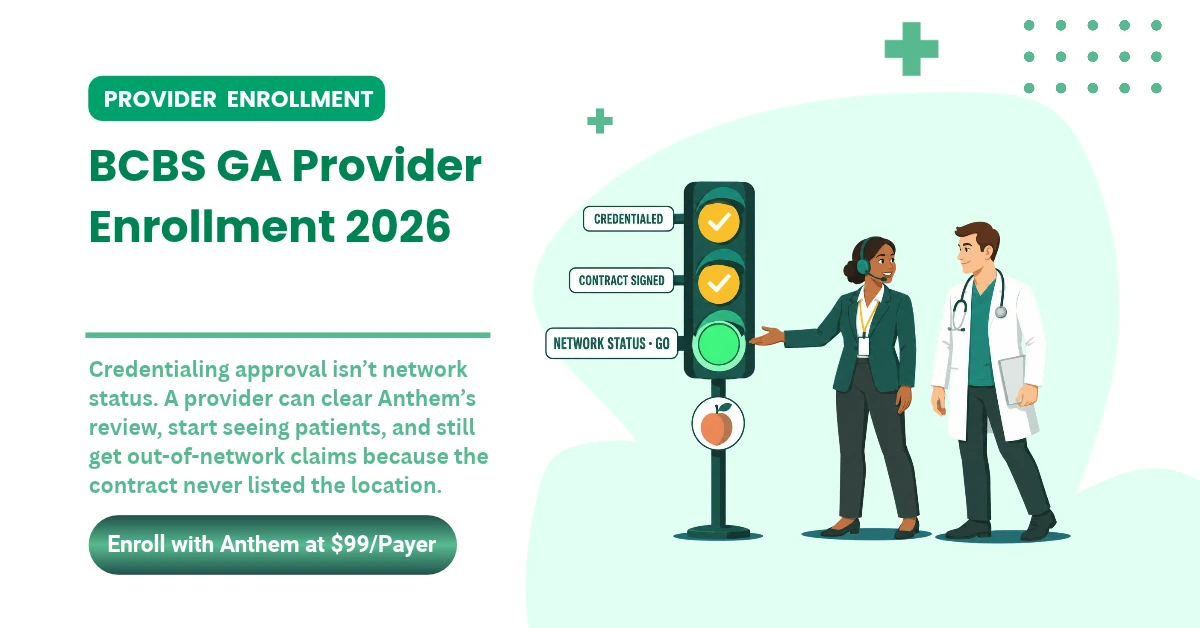
$99/Payer Enrollment, Fastest Credentialing in the Market
98%+ Clean Claim Rate, Backed by AAPC-Certified Coders
75+ Specialties Served, From Family Practice to Cardiology
Medical billing services for small practices are specialized, outsourced solutions that handle the entire revenue cycle, from insurance verification and medical coding to claims submission, denial management, and payment posting, so physicians can focus on patient care instead of paperwork. In 2026, with claim denial rates climbing to 15 to 17% and billing staffing shortages accelerating, outsourcing has become essential for small practice survival.
If you're a small practice owner spending more time chasing payments than treating patients, you're not alone. Independent physicians across the country are losing revenue to preventable billing mistakes while their staff tries to manage coding, collections, and payer disputes with no room to breathe.
This guide covers everything you need: how medical billing actually works, what it costs, what's included in a full-service arrangement, and the 2026 CMS changes already hitting your bottom line. We built it so you won't need to look anywhere else.
At MedSole RCM, we serve small practices nationwide with full-service revenue cycle management starting at just 2.99% of collections, the lowest rate in the industry. Whether you're comparing billing companies, deciding between in-house and outsourced billing, or trying to keep up with new 2026 regulations, this guide puts every answer in one place.
Why Small Practices Are Losing Revenue to Billing Inefficiencies
Small medical practices lose an estimated 10 to 15% of revenue each year due to billing errors, claim denials, and inefficient revenue cycle processes. According to the MGMA, up to 15% of medical claims are denied or delayed, and the American Medical Association estimates that up to 12% of claims contain inaccurate codes. For practices with fewer than five providers, these losses can mean the difference between staying open and closing.
Here's what's actually driving those losses in medical billing for small practices.
Rising Claim Denial Rates
Denials are getting worse. According to Experian Health's 2024 Denial Management Survey, initial denial rates hit 11.8% in 2024 and are projected to reach 15 to 17% by 2026. MDaudit's 2024 data shows 41% of providers see at least one in every 10 claims denied.
Each denied claim costs $25 to $30 to rework, and that doesn't include staff time spent on appeals and payer calls. Without a structured denial management process, those costs quietly drain collections month after month.
Staff Shortages and Burnout
Even solid workflows fall apart without enough people to run them. According to QWAY Healthcare research, the U.S. faces a shortage of 3.2 million healthcare billing workers by 2026. Most small medical practices rely on one or two people managing all administrative tasks, including billing.
Burnout follows. Errors multiply. MediBillMD reports 30% fewer physicians run private practices today compared to 30 years ago, with administrative overload as the primary driver. It's a cycle that won't fix itself.
Coding Errors and Documentation Gaps
Medical coding errors are more widespread than most practices realize. Research suggests roughly 80% of medical bills contain at least one error, and the American Medical Association found up to 12% of claims carry inaccurate ICD-10 or CPT codes.
CMS's FY2025 improper payment report places Medicare fee-for-service at 6.55%, totaling $28.83 billion. CMS data also shows 77.17% of Medicaid improper payments stem from insufficient documentation. Not fraud. Just missing notes that trigger avoidable claim denials.
Compliance Complexity
HIPAA compliance just got harder. The HHS Office for Civil Rights is expected to finalize a HIPAA Security Rule overhaul in May 2026, requiring mandatory encryption, multi-factor authentication, and incident response plans for all covered entities, small practices included.
The HHS OCR levied $6.6 million in fines in 2025, and small practices weren't exempted. Split/shared visit rules are now fully enforced in 2026, making E/M coding audits a real financial risk for any practice that isn't documenting with precision.
Shrinking Reimbursement Rates
Getting paid less for the same work compounds every other problem. The CMS 2026 Physician Fee Schedule (Final Rule CMS-1832-F includes a temporary 2.5% payment increase offset by a 2.5% efficiency adjustment on non-time-based services, leaving most practices essentially flat.
The AMA has warned this rule "will make it harder for independent practices to remain viable." Without congressional action, steeper cuts could follow in 2027. Small practice medical billing can't afford to leave uncaptured revenue on the table.
The Financial Toll on Patient Care
Billing problems don't stay in the back office. When staff spends hours on denied claims and payer calls, patient-facing work suffers. Scheduling slows. Phones go unanswered. The waiting room notices.
A study published through the National Library of Medicine identified administrative burden as a primary financial stressor for small practices. When medical billing services for small practices break down, patient care pays the price.
What Are Medical Billing Services for Small Practices?
Medical billing services for small practices are specialized outsourcing solutions where a professional billing company handles the entire claim lifecycle on behalf of a healthcare provider. This includes verifying patient insurance eligibility, assigning accurate ICD-10, CPT, and HCPCS codes, submitting clean claims electronically, managing denials and appeals, posting payments, handling patient billing, and providing financial reporting, all while maintaining full HIPAA compliance.
If you're shopping for medical billing for small practices, knowing where billing ends and revenue cycle management begins will help you pick the right partner.
Medical Billing vs. Medical Coding: What's the Difference?
Medical coding translates clinical encounters into standardized code sets. Your coder reads the provider's documentation and assigns the correct ICD-10 diagnosis codes, CPT procedure codes, and HCPCS supply codes for each visit.
Billing picks up where coding stops. It's the process of submitting those coded claims to payers, following up on unpaid balances, and collecting payment. Both functions need to work together for a claim to get paid.
Most billing companies include coding as part of the package. At MedSole RCM, medical coding is built into our 2.99% billing rate. No separate coding fees.
Medical Billing vs. Revenue Cycle Management (RCM)
Billing covers claims submission and follow-up. That's about it. Revenue cycle management is broader; it spans the entire financial lifecycle from patient scheduling through final payment collection.
Full-service RCM includes eligibility verification, prior authorization, coding, charge capture, claims, denial management, A/R follow-up, patient billing, and financial reporting. For small practices, full-service RCM makes the most sense because you don't have the staff to manage each piece separately.
MedSole RCM provides full-service revenue cycle management at 2.99% of collections. Every stage from scheduling to final payment is covered under that rate.
What's Typically Included in Full-Service Medical Billing?
Not every billing company includes the same services. When comparing medical billing services for small practices, here's what full-service coverage should look like:
|
Service Component |
Included? |
Description |
|
Insurance Eligibility Verification |
✅ |
Real-time verification before patient visits |
|
Prior Authorization |
✅ |
Obtaining authorizations for procedures and treatments |
|
Medical Coding (ICD-10, CPT, HCPCS) |
✅ |
Accurate code assignment for all encounters |
|
Charge Entry |
✅ |
Posting charges to patient accounts |
|
Claims Scrubbing |
✅ |
Pre-submission error detection |
|
Electronic Claims Submission |
✅ |
X12 837 electronic filing via clearinghouse |
|
Payment Posting (EOB/ERA) |
✅ |
Reconciling payer remittances |
|
Denial Management & Appeals |
✅ |
Identifying, correcting, and resubmitting denied claims |
|
A/R Follow-Up |
✅ |
Persistent follow-up on unpaid claims |
|
Patient Billing & Collections |
✅ |
Statements, payment plans, and balance collection |
|
Credentialing & Enrollment |
Varies |
Provider enrollment with insurance payers |
|
Financial Reporting & Analytics |
✅ |
Monthly and weekly performance dashboards |
MedSole RCM provides every service in the table above, all included in our 2.99% billing rate. See our full-service outsourced medical billing services
How the Medical Billing Process Works for Small Practices
Medical billing services for small practices follow a nine-step cycle that starts when a patient schedules an appointment and ends when final payment is collected and reconciled. Each step is an opportunity for revenue capture, or revenue loss. Here's how professional billing teams handle each stage.
[FLOWCHART: 9-Step Medical Billing Process with arrows, color-coded by front-end (green), mid-cycle (blue), and back-end (purple) phases]
Step 1: Patient Registration and Demographic Capture
Everything starts at intake. Name, date of birth, insurance ID, policy number, group number. If any of these details are wrong or missing, the error cascades through the entire revenue cycle. What looks like a small typo at check-in becomes a denied claim three weeks later.
CMS data consistently shows documentation errors are the leading cause of Medicare improper payments. Get the foundation right, or nothing downstream works.
Step 2: Insurance Eligibility Verification
Before the patient sees the provider, eligibility verification needs to happen in real time. That means confirming active coverage, pulling copay and deductible amounts, and checking for plan limitations on the scheduled services.
Eligibility-related denials rank among the top five rejection categories. A 30-second check before the visit saves weeks of rework on a claim that was never going to get paid.
Step 3: Prior Authorization
Some procedures, treatments, and medications require prior authorization from the payer before you can proceed. Miss this step and the claim gets an automatic denial. No appeal, no workaround.
Under the CMS-0057-F rule, payers face stricter prior authorization timelines starting in 2026. That's progress, but it only helps if someone at your practice is actively tracking which services need pre-approval.
Step 4: Medical Coding (ICD-10, CPT, HCPCS)
After the encounter, medical coding translates clinical notes into standardized billing codes. ICD-10-CM captures diagnoses, CPT describes procedures, and HCPCS covers supplies outside the CPT scope.
FY2026 ICD-10 guidelines took effect October 1, 2025, and CPT 2026 introduced over 400 code changes. MedSole RCM employs AAPC-certified coders who stay current on quarterly HCPCS updates. One wrong code flips a payable claim into a denial.
Step 5: Charge Entry and Capture
Charge entry is one of the most overlooked steps in medical billing for small practices. Once coding wraps up, services and fees get recorded in the practice management system. Unbilled procedures, incorrect fee schedules, and missed charges add up fast.
CMS's NCCI edits and MUEs need to be checked at this stage to catch bundling conflicts and unit errors before claims submission.
Step 6: Claims Scrubbing and Submission
Before a claim goes out, it runs through a scrubbing process: checking for coding errors, missing modifiers, and incomplete fields. Clean claims are submitted electronically in X12 837 format through a clearinghouse.
Timing matters. Claims submission within 24 hours of encounter lock gives you the best shot at clean adjudication. Sit on it for a week, and you're already falling behind on cash flow.
Step 7: Payment Posting and Reconciliation
When the payer sends payment, ERA and EOB documents detail what was paid, adjusted, and denied. Payment posting reconciles those amounts against expected reimbursement from fee schedules and payer contracts.
Here's where underpayments hide. CARC and RARC codes on the ERA explain each adjustment. If your team isn't reviewing those against the EOB, you're quietly accepting less than what you're owed.
Step 8: Denial Management and Appeals
Effective denial management and appeals starts with tracking denied claims by category: coding errors, eligibility issues, authorization failures, and timely filing violations. Root cause analysis stops the same denials from showing up month after month.
According to the MGMA, nearly two-thirds of denied claims are recoverable with proper processes. But the window is tight. Most payers give you 60 to 90 days before that chance is gone.
Step 9: Patient Billing, Collections, and Reporting
After insurance pays, remaining copays, deductibles, and coinsurance move to patient collections. Under the No Surprises Act, uninsured and self-pay patients must receive a Good Faith Estimate before scheduled services. If the bill exceeds that estimate by more than $400, patients can dispute it.
Monthly reporting on A/R aging, collection rates, and denial trends closes the cycle. Medical billing services for small practices should deliver these reports as standard.
2026 Medical Billing Updates Every Small Practice Must Know
The 2026 healthcare billing landscape brings significant regulatory changes that directly impact small practice revenue. From CMS's new dual conversion factors and expanded telehealth codes to the most significant HIPAA Security Rule overhaul in a decade, practices that don't adapt their billing processes will face increased denials, compliance penalties, and revenue loss. Here are the critical updates affecting medical billing for small practices.
CMS 2026 Medicare Physician Fee Schedule: What Changed
The CMS 2026 Physician Fee Schedule (Final Rule CMS-1832-F) introduces dual conversion factors for the first time. Non-APM qualifying practitioners receive $33.4009 (up 3.26%), while APM qualifying practitioners get $33.5675 (up 3.77%). Congress approved a one-time 2.5% payment increase, but it's temporary and expires at the end of 2026.
Here's the catch: CMS also applied a negative 2.5% efficiency adjustment on non-time-based services, effectively wiping out the increase for many procedure codes. Practice expense methodology changes favor office-based and independent practices. But the AMA has warned this rule will make independent practice viability harder over time.
New Revenue-Generating Billing Codes for 2026
CMS expanded the G2211 complexity add-on to home visits (codes 99341 through 99350), adding roughly $15 per visit in new revenue. New APCM add-on codes G0568, G0569, and G0570 open billing opportunities for advanced primary care. Remote Patient Monitoring is now permanent, with five new codes covering shorter monitoring periods.
Telehealth originating site fee Q3014 sits at $31.85, and chronic care management codes are exempt from the efficiency adjustment. CPT 2026 and the latest ICD-10 updates introduced over 400 code changes, including new AI and remote monitoring codes. See the CMS MLN Matters MM14315 summary and HCPCS quarterly update for specifics.
Telehealth Billing Rules: Extended Through 2027
Medicare telehealth flexibilities have been extended through December 31, 2027, giving small practices more time to build telehealth billing into their revenue models. Use POS 02 when the patient is at a healthcare facility and POS 10 for patient-at-home encounters. RHCs and FQHCs can bill G2025 for non-behavioral telehealth services.
DEA-authorized controlled substance prescribing via telehealth continues through December 31, 2026. CMS permanently adopted direct supervision through audio/visual telecommunication, removing a major barrier for practices using telehealth regularly. For the full telehealth billing code list, the CMS Telehealth FAQ (updated February 26, 2026) is the most current source.
HIPAA Security Rule Overhaul: Compliance Deadlines Coming
The most significant HIPAA update in a decade is expected to become final in May 2026. It mandates encryption, multi-factor authentication, and formal incident response plans for all covered entities, small practices included. With a 180-day implementation window, compliance could be required before the end of 2026.
HIPAA enforcement is already intensifying. The HHS Office for Civil Rights levied $6.6 million in fines in 2025, and small practices weren't exempt. Part 2 enforcement covering substance use disorder records began February 16, 2026, adding another compliance layer for behavioral health practices.
Prior Authorization Transparency (CMS-0057-F)
Operational prior authorization provisions under CMS-0057-F took effect January 1, 2026. Payers must now report prior authorization approval rates, denial rates, and average processing times by March 31, 2026. API-based compliance requirements follow on January 1, 2027.
For small practices with limited staff, prior authorization delays remain a top source of denials and lost revenue. This is where medical billing services for small practices that handle authorizations directly prove their value, keeping claims moving while your team stays focused on patients.
E/M Coding Audit Risks in 2026
Split/shared visit rules are now fully enforced in 2026, and CMS auditors are targeting these claims aggressively. Focus areas include medical decision-making clarity, time tracking accuracy, and proper attribution of who performed the substantive portion.
Recoupments from E/M coding audits can range from $20,000 to well over $100,000, which is catastrophic for a small practice on thin margins. Accurate documentation and CPT code selection isn't optional anymore. It's a compliance requirement that directly protects your revenue.
2026 Billing Changes at a Glance
|
Change |
Effective Date |
Impact on Small Practices |
Action Required |
|
Dual conversion factors (CMS-1832-F) |
January 1, 2026 |
2.5% increase offset by efficiency adjustment |
Update fee schedules and charge master |
|
G2211 expanded to home visits |
January 1, 2026 |
~$15 per visit new revenue |
Bill G2211 with home visit codes |
|
APCM codes (G0568, G0569, G0570) |
January 1, 2026 |
Advanced primary care revenue stream |
Identify eligible patients |
|
RPM codes permanent |
January 1, 2026 |
Five new shorter monitoring codes |
Update RPM billing workflows |
|
Medicare telehealth extension |
Through 12/31/2027 |
Continued telehealth flexibility |
Verify POS 02 vs. POS 10 |
|
HIPAA Security Rule overhaul |
Final rule ~May 2026 |
Encryption, MFA, incident response required |
Begin compliance planning now |
|
PA transparency (CMS-0057-F) |
January 1, 2026 |
Payers must report PA metrics |
Track payer response times |
|
E/M split/shared enforcement |
2026 (fully enforced) |
Significant audit risk |
Review documentation protocols |
Struggling to keep up with 2026 billing changes? MedSole RCM stays current on every CMS update, code change, and payer rule so you don't have to. Talk to our team about outsourced medical billing →
In-House vs. Outsourced Medical Billing: A Real Cost Comparison for Small Practices
For small practices, the choice between in-house and outsourced medical billing comes down to cost, expertise, and bandwidth. In-house billing for a single full-time biller typically costs $55,000 to $75,000 annually in salary alone, before adding software licenses, training, benefits, and management overhead. Outsourced billing services typically charge 4% to 10% of collections, though some companies like MedSole RCM offer rates as low as 2.99%.
The True Cost of In-House Billing
Most practice managers look at in-house billing and see one salary line item. That's not the full picture. Between benefits packages, billing software licenses, clearinghouse fees, training, IT security, and management time, the actual annual cost of keeping a single biller on staff runs between $66,700 and $106,600.
|
Cost Component |
Annual Estimate |
|
Medical Biller Salary (national average) |
$42,000 to $55,000 |
|
Benefits (health insurance, PTO, 401k) |
$12,000 to $18,000 |
|
Billing Software License |
$3,000 to $12,000 |
|
Clearinghouse Fees |
$1,200 to $3,600 |
|
Training & Continuing Education |
$1,500 to $3,000 |
|
IT Infrastructure & Security |
$2,000 to $5,000 |
|
Management Overhead |
$5,000 to $10,000 |
|
Total Annual Cost |
$66,700 to $106,600 |
That table doesn't capture turnover. When a biller leaves, three to six months of productivity loss follows while a replacement is hired and trained. That gap shows up in your A/R aging and denial rates before most practices recognize what's happening.
The True Cost of Outsourced Billing
Outsourcing replaces that variable cost with a fixed percentage of what you actually collect. Industry standard rates run 5% to 8%. At 2.99%, MedSole RCM saves small practices 40 to 63% compared to the industry average billing rate.
|
Practice Revenue |
Industry Rate (5% to 8%) |
MedSole RCM Rate (2.99%) |
Annual Savings with MedSole |
|
$500,000 |
$25,000 to $40,000 |
$14,950 |
$10,050 to $25,050 |
|
$750,000 |
$37,500 to $60,000 |
$22,425 |
$15,075 to $37,575 |
|
$1,000,000 |
$50,000 to $80,000 |
$29,900 |
$20,100 to $50,100 |
|
$1,500,000 |
$75,000 to $120,000 |
$44,850 |
$30,150 to $75,150 |
For a practice collecting $750,000 annually, that's $15,000 to $37,000 saved every year. On thin margins, that difference funds equipment, staff, or patient-facing improvements.
When In-House Billing Makes Sense
In-house billing isn't always the wrong answer. Small practice medical billing genuinely works in-house under specific conditions, though most practices reading this guide won't meet them:
-
Very high-volume practices with 10 or more providers and a fully dedicated billing department
-
Organizations with proprietary workflows that can't be replicated by an outside team
-
Practices with existing AAPC or AHIMA-certified coders already on staff
When Outsourcing Is the Clear Winner
For solo practitioners and small group practices, outsourced medical billing services aren't just more affordable. They're structurally better suited to how these practices actually operate. Medical billing services for small practices that outsource consistently outperform in-house billing on denial rates, A/R days, and net collection rates.
Outsourcing makes the most sense for:
-
Solo practitioners and small groups with one to five providers
-
Practices dealing with staff turnover, burnout, or billing handled by clinical staff
-
Growing practices that need scalability without adding a headcount
-
Any practice with denial rates above 5% or A/R days above 40
-
Practices where the billing person also handles scheduling, front desk, or administrative roles
Want to see exactly how much your practice would save at 2.99%? Get a free billing cost analysis from MedSole RCM →
How Much Do Medical Billing Services Cost for Small Practices?
Medical billing services for small practices typically cost between 4% and 10% of net collections, with 5 to 8% being the most common range. Pricing varies based on specialty, claim volume, and service scope. MedSole RCM charges 2.99% of collections for full-service medical billing, the lowest published rate in the industry, with no setup fees, no long-term contracts, and no hidden charges.
Percentage-of-Collections Model (Most Common)
The percentage-of-collections model is the industry standard, and it's how most practices evaluate medical billing outsourcing cost. Most outsourced medical billing companies charge 4 to 10% of net collections, with small practices typically falling in the 5 to 8% range. Practices under $300,000 in annual collections usually see higher percentages.
At MedSole RCM, our 2.99% rate covers medical billing services for small practices end-to-end: coding, denial management, A/R follow-up, and reporting. Efficient cloud-based technology and streamlined workflows keep our costs low, which is how we pass savings directly to practices.
Flat-Fee Per-Claim Model
Some billing companies charge a flat fee of $4 to $12 per claim processed. This model can work for very high-volume practices, but it has a structural problem: the billing company gets paid the same whether your claim collects $50 or $5,000. There's no incentive to maximize your reimbursement.
Monthly Subscription Model
Subscription-based medical billing services charge a fixed monthly fee regardless of volume, typically $800 to $2,500 per month for small practices. Predictable budgeting is the main appeal of this monthly billing service for doctors, but costs don't scale down during slow months. These arrangements are less common and usually come from software-focused companies rather than full-service billing partners.
Credentialing and Enrollment Costs
Provider credentialing and enrollment is a separate cost that catches many practices off guard. Most billing companies charge $150 to $300 or more per payer for credentialing work, and some bill hourly at $75 to $150 per hour.
MedSole RCM handles provider enrollment and credentialing at $99 per payer, the most affordable credentialing rate available. Our credentialing team manages the entire enrollment process with each insurance payer, from initial application through approval.
Watch Out for Hidden Costs
Before signing with any billing company, ask about these common extras that inflate your real cost:
-
Setup or onboarding fees, commonly ranging from $500 to $2,000
-
Monthly minimums that charge you a floor amount even during slow periods
-
Separate fees for reporting, denial management, or patient statements
-
Long-term contract lock-ins of 12 to 24 months with early termination penalties
-
Per-call or per-support-ticket charges for what should be basic customer service
Our policy is straightforward: zero setup fees, zero hidden charges, no long-term contracts. At 2.99%, everything is included. For practices comparing affordable medical billing services, that transparency makes the real cost difference clear.
For practices searching for affordable medical billing solutions, MedSole RCM offers full-service billing at 2.99% of collections and provider credentialing at $99 per insurance payer. Those are the lowest published full-service rates for small practices in the United States.
Pricing Model Comparison
|
Pricing Model |
Industry Range |
MedSole RCM |
Difference |
|
% of Collections |
4% to 10% |
2.99% |
25% to 70% lower |
|
Credentialing / Enrollment |
$150 to $300+ per payer |
$99 per payer |
34% to 67% lower |
|
Setup Fees |
$500 to $2,000 |
$0 |
100% savings |
|
Contract Length |
12 to 24 months |
Month-to-month |
No lock-in |
|
Hidden Fees |
Common |
None |
Full transparency |
Full-service medical billing at 2.99%. Credentialing at $99/payer. No setup fees. No contracts. Get your custom quote from MedSole RCM
Revenue Cycle Management (RCM) for Small Practices: Why It Matters More Than "Just Billing"
Revenue cycle management (RCM) for small practices goes beyond basic claims submission. It covers the entire financial lifecycle of a patient encounter, from scheduling through final payment collection and reconciliation. According to industry research, small practices that adopt full-service RCM see an average 11.6% revenue increase and 16.9% reduction in billing costs compared to managing billing in-house.
Most practices treat billing and RCM as the same thing. They aren't. Full revenue cycle management covers three distinct phases, and skipping any one of them creates revenue leaks. That's why medical billing services for small practices should include end-to-end RCM, not just claims submission.
Front-End RCM: Preventing Denials Before They Happen
Front-end RCM is where most denials actually start. Patient scheduling, pre-registration, real-time eligibility verification, and prior authorization management all happen before the provider sees the patient. If your practice falls under No Surprises Act requirements, Good Faith Estimates for uninsured and self-pay patients also get handled here.
An estimated 50 to 60% of all claim denials originate from front-end errors: wrong insurance on file, expired coverage, or a missing prior authorization. Catching these issues before the claim goes out costs almost nothing. Fixing them after a denial runs $25 to $30 per claim and takes weeks of staff time.
Mid-Cycle RCM: Accurate Coding and Clean Claims
Small clinic revenue cycle management depends heavily on accurate medical coding with ICD-10-CM FY2026, CPT 2026, and quarterly HCPCS updates. Clinical documentation improvement, charge capture, claims scrubbing against NCCI and MUE edits, and clearinghouse submission all fall into this mid-cycle phase.
Following HHS-OIG compliance program guidance, coding accuracy and documentation integrity are core to revenue cycle management services for small practices. Accurate coding isn't just a revenue tool; it's a compliance requirement. A clean, correctly coded claim has a first-pass acceptance rate above 95%. Sloppy ones sit in denial queues and cost weeks of rework.
Back-End RCM: Maximizing Collections
Back-end RCM is where the money actually gets collected. Payment posting from ERA and EOB documents, denial management with root cause analysis, and aggressive A/R follow-up all happen here. Patient statements, balance collection, and financial reporting dashboards close the loop.
What separates effective RCM for small practices from the rest is consistency on the back end. Most RCM billing services track accounts receivable, but the ones that deliver results keep A/R under 35 days through daily follow-up. When A/R ages past 90 days, that revenue gets exponentially harder to collect.
MedSole RCM doesn't just bill. We manage your entire revenue cycle from scheduling to final payment. Credentialing included at $99/payer. Explore our full RCM services
Medical Billing Services by Specialty: Why Your Specialty Matters
Every medical specialty has unique billing requirements: different CPT code families, payer-specific rules, modifier usage, and diagnosis coding under the current ICD-10-CM FY2026 guidelines. Medical billing services for small practices can't be one-size-fits-all. Here's how physician billing services differ across common specialties.
Family Practice and Primary Care Billing
Family practice billing services center on high-volume E/M coding: the 99202 to 99215 range, plus the G2211 add-on code that many billers still miss. Preventive care visits (G0438, G0439) and chronic care management are real revenue streams that family practice medical billing services should be capturing. CCM alone can add thousands in monthly revenue per provider.
Cardiology Medical Billing
Cardiology coding is some of the most complex in physician billing. Cardiac catheterization, stress testing, and echocardiography each carry strict documentation requirements that payers scrutinize closely. Denial rates tend to run higher here because medical necessity documentation has to be airtight. The best cardiology medical billing services pair certified coders with specialty-specific knowledge of modifier rules and bundling restrictions.
Behavioral Health and Mental Health Billing
Behavioral health rcm requires a different mindset from most specialties. Time-based codes like 90837 and 90834 have strict session length rules, and payers often impose visit limits that vary by plan. Telehealth adds complexity. With 42 CFR Part 2 updates effective February 2026, substance use disorder billing now carries tighter compliance requirements around consent and record sharing.
General Surgery Billing
Surgical billing lives and dies by global period rules. Knowing which procedures fall under a 10-day versus 90-day global period, and when to apply modifiers like -59 and -25, is the difference between getting paid and getting denied. A good general surgery billing company also stays on top of NCCI bundling edits to avoid unbundling compliance issues.
Endocrinology Billing
Endocrinology medical billing services deal with complex medication management, diabetes care coding, insulin pump management, and thyroid procedures. Documentation requirements here are intense. Payers want detailed records showing clinical decision-making for every medication change, and missing documentation is one of the fastest ways to trigger a denial.
Pediatric Billing
Pediatric billing has its own set of challenges. Age-specific coding varies by developmental stage, and vaccine administration codes (90460, 90461) require precise documentation. Well-child visit coding differs by age group. On top of that, most pediatric practices carry a heavy Medicaid payer mix, which means different fee schedules, slower payments, and more administrative hurdles.
Telehealth Billing for Small Practices
Telehealth billing trips up more practices than you'd expect. Place of Service 02 versus POS 10 matters, and picking the wrong one triggers a denial. Modifier -95 and -GT usage varies by payer. CMS has made some telehealth services permanent for 2026, with audio-only flexibilities extending through 2027. Telehealth billing rules keep shifting, so staying current isn't optional.
7 Medical Billing KPIs Every Small Practice Should Track in 2026
You can't improve what you don't measure. These seven medical billing KPIs reveal the health of your revenue cycle and help you evaluate whether your current billing process, or your billing partner, is performing at an acceptable level. If you're not tracking these, you're guessing.
1. Clean Claim Rate
Your clean claim rate is the percentage of claims accepted on first submission without rejections or edits. Target: 95% or higher. MedSole RCM averages 98%+. Every claim that comes back dirty costs $25 to $30 to rework, so a low clean claim rate bleeds money fast.
2. First-Pass Resolution Rate
First-pass resolution rate measures the percentage of claims paid on the initial submission without rework. Aim for 90% or above. When this number drops, it usually points to coding errors or documentation gaps. It's one of the clearest indicators of whether your billing team knows the specialty.
3. Days in Accounts Receivable (A/R)
Days in accounts receivable measures how long it takes from claim submission to payment. The benchmark is 35 days or fewer. When A/R climbs past 60 days, cash flow starts to choke. Past 90 days, you're writing off revenue that should have been collected.
4. Denial Rate
Your denial rate is the percentage of claims denied by payers. Target: under 5%. The industry average sits around 11.8% and keeps climbing. According to the MGMA, nearly two-thirds of denied claims are recoverable, but only if someone's actually working them.
5. Net Collection Rate
Net collection rate shows actual collections divided by allowed amounts. You want this at 96% or higher. It tells you how much of the money you've earned is actually reaching your bank account. Below 96% means revenue is leaking somewhere in your cycle.
6. Cost to Collect
Cost to collect is your total billing costs divided by total collections. Target: under 4%. If you're paying more than 4% to collect your revenue, you're overspending. MedSole RCM's rate of 2.99% keeps this KPI well below benchmark for medical billing services for small practices.
7. Patient Collection Rate
Patient collection rate tracks the percentage of patient-responsible balances you actually collect: copays, deductibles, and coinsurance. Aim for 85% or higher. With patient responsibility growing every year, this number has become one of the most important medical billing KPIs on your dashboard.
|
KPI |
Industry Benchmark |
Danger Zone |
MedSole RCM Average |
|
Clean Claim Rate |
≥95% |
Below 90% |
98%+ |
|
First-Pass Resolution Rate |
≥90% |
Below 85% |
— |
|
Days in A/R |
≤35 days |
Over 50 days |
— |
|
Denial Rate |
<5% |
Over 10% |
— |
|
Net Collection Rate |
≥96% |
Below 93% |
— |
|
Cost to Collect |
<4% |
Over 6% |
2.99% |
|
Patient Collection Rate |
≥85% |
Below 75% |
— |
Not sure where your practice stands? MedSole RCM provides free billing assessments with KPI benchmarking against industry standards. Request your free assessment
How to Choose the Best Medical Billing Company for Your Small Practice
Choosing the best medical billing services for small practices means evaluating more than price. The right billing partner should function as an extension of your team, understanding your specialty, integrating with your EHR, maintaining HIPAA compliance, and providing transparent reporting. Here are the critical factors to evaluate before signing any agreement.
10 Questions to Ask Every Billing Company
Before hiring an outsourced medical billing company, ask these ten questions:
-
What's your pricing model, and what's the total cost? Watch for hidden fees, minimums, and setup charges.
-
Do you have experience billing for my specific specialty? Generic teams miss specialty-specific codes and modifiers.
-
Which EHR and practice management systems do you integrate with? Disconnected systems create data entry errors.
-
What's your average clean claim rate and days in A/R? A company that can't answer this with specific numbers is a red flag.
-
How do you handle denied claims and appeals? Ask for their denial rate and recovery process.
-
Who will be my dedicated point of contact? You want a name, not a support queue.
-
What HIPAA compliance certifications do you hold? Ask about SOC 2 and business associate agreements.
-
What reports will I receive, and how often? Monthly KPI dashboards should be standard, not an add-on.
-
Is there a contract lock-in? Know the termination terms before you sign anything.
-
Can you provide references from similar practices? Talking to current clients tells you more than any pitch.
Red Flags to Watch For
When comparing medical billing companies, watch for these warning signs:
-
They won't share pricing upfront. If you can't get a clear rate before signing, expect hidden charges later.
-
Long-term contracts with early termination penalties trap you for 12 to 24 months regardless of performance.
-
No dedicated account manager means you're contacting a shared support line and waiting days for answers.
-
They can't provide specific performance metrics like clean claim rate or days in A/R when asked directly.
-
Missing HIPAA compliance documentation or a signed business associate agreement is a liability for your practice.
-
They give vague answers about coding credentials and can't confirm AAPC or AHIMA certifications for their staff.
Why EHR Integration Matters
Seamless data flow between your EHR and billing system eliminates manual entry errors that cause claim rejections. Look for a partner with experience on your specific platform: Epic, Athena, eClinicalWorks, DrChrono, or others.
MedSole RCM integrates with all major EHR and practice management systems, so medical billing services for small practices don't require a technology overhaul.
Credentialing and Payer Enrollment: Often Overlooked
Many medical billing companies don't include credentialing, or they charge premium rates of $150 to $300 per payer. But credentialing is the foundation of getting paid by any insurance plan. If your providers aren't properly enrolled, claims won't process regardless of how clean they are.
MedSole RCM handles provider enrollment at $99 per insurance payer, the lowest rate available. For practices searching for the best medical billing solutions for small practices in 2025 and beyond, credentialing costs are a factor most overlook until it's too late.
MedSole RCM checks every box: 2.99% rates, month-to-month terms, AAPC-certified coders, $99 credentialing, and integration with all major EHRs. [Schedule a free consultation →]
Medical Billing Software vs. Outsourced Billing Services: Which Is Right for Your Practice?
Some small practices consider purchasing medical billing software instead of outsourcing to a billing company. While software can work in certain situations, it's important to understand the difference: software is a tool, while a billing service is a team of experts using that tool on your behalf.
When Software Alone Is Enough
Medical billing software for small practices makes sense when you have a certified biller on staff who knows the payer landscape. Practices handling fewer than 100 claims per month can sometimes manage with a platform alone.
Here's when it typically works:
-
You have a trained, certified biller managing your revenue cycle full time and staying current on payer rule changes.
-
Claim volume is low enough for one person to handle without falling behind on follow-up and appeals.
-
You want direct control over every billing decision and workflow adjustment in your office.
Popular affordable medical billing software options include Kareo/Tebra, AdvancedMD, DrChrono, CollaborateMD, and PracticeSuite.
When You Need a Full-Service Billing Partner
Software doesn't follow up on denials at 6 AM. It won't call payers or catch coding errors before claims go out. If any of these sound familiar, you probably need more than a platform:
-
No dedicated billing staff, or your clinical team handles billing between patients and can't give it proper attention.
-
Your denial rate has crept above 5% and nobody's consistently working the appeals.
-
A/R days have pushed past 40 and cash flow is getting tight enough to notice.
-
Coding accuracy concerns keep causing preventable rejections that eat into revenue.
-
You'd rather focus on patient care than chase down unpaid claims.
For most small practices with one to five providers, outsourcing delivers better results at lower cost than software plus staff. The best medical billing software for small practices still needs a trained human running it.
Can You Use Both?
Yes. Some practices keep their own PM software and pair it with an outsourced billing team. It doesn't have to be either-or.
MedSole RCM works with your existing systems or provides a cloud-based platform if you need one. Whether you're exploring medical billing software for small business operations or a complete billing partner, the right choice depends on your staffing, volume, and how much time billing takes away from patient care.
Why Small Practices Across the USA Choose MedSole RCM
MedSole RCM is a full-service medical billing company built for small practices that need expert billing without enterprise-level costs. We combine AAPC-certified coders, cloud-based technology, and transparent pricing to deliver measurable results for independent physicians, solo practitioners, and small group practices nationwide.
The Industry's Lowest Billing Rate: 2.99% of Collections
Most billing companies charge 4% to 10% of collections. MedSole RCM charges 2.99%. No setup fees, no long-term contracts, no hidden charges.
Efficient technology and streamlined workflows let us keep overhead low without cutting corners. We pass those savings to practices that need affordable medical billing services, not affordable results.
Provider Credentialing at $99 Per Insurance Payer
Credentialing delays mean delayed revenue. MedSole RCM handles the entire provider enrollment process at $99 per payer, with the fastest turnaround in the market.
Our credentialing services team manages enrollment with Medicare, Medicaid, BCBS, UnitedHealthcare, Aetna, Cigna, and all major payers. From initial applications through follow-up with plan representatives, we handle every step.
End-to-End RCM: Not Just Claims Submission
Some billing companies submit claims and stop there. That's not how outsourced medical billing services should work.
MedSole RCM manages your entire revenue cycle: eligibility verification, prior authorization, coding, claims submission, denial management, A/R follow-up, patient billing, and reporting. One partner covering every stage is what full-service RCM actually means.
Dedicated Account Managers and AAPC-Certified Coders
Every client gets a dedicated account manager, not a ticket system or a shared support queue. Your contact knows your practice, your payers, and your workflow.
All coding is handled by AAPC-certified professionals holding CPC, CPMA, and CRC credentials. Support is available around the clock when you need it.
HIPAA-Compliant, Cloud-Based Technology
Your data stays protected on our secure cloud platform with encryption and access controls built to HIPAA standards. Real-time dashboards give you visibility into every claim, every dollar, and every metric that matters.
Our platform integrates with all major EHR and practice management systems. You won't need to overhaul your current technology to get started.
Month-to-Month Flexibility: No Lock-In Contracts
We earn your business every month. No cancellation penalties, no 12-month lockdowns. If you're not seeing results, you can walk away. That's how confident we are in what we deliver.
Transparent pricing from day one is standard for our medical billing services for small practices. The 2.99% rate on your first invoice is the same rate on your hundredth.
Ready to stop overpaying for medical billing?
MedSole RCM: 2.99% billing | $99/payer credentialing | No contracts | No hidden fees
Get Your Free Custom Quote Now
Or call [+1 (602) 563 5281] to speak with a billing specialist today.
Frequently Asked Questions About Medical Billing Services for Small Practices
Q1: How much do medical billing services cost for small practices?
Most billing companies charge between 4% and 10% of net collections. For small practices, 5% to 8% is the typical range. MedSole RCM charges just 2.99%. That covers coding, claims submission, denial management, A/R follow-up, and reporting with no setup fees or long-term contracts.
Q2: What percentage do most medical billing companies charge?
The standard range is 4% to 10% of net collections, with 5% to 8% being most common. Your exact rate depends on volume, specialty, and scope. Some companies charge flat fees per claim ($4 to $12) or monthly subscriptions ($800 to $2,500) instead. MedSole RCM charges 2.99% for full-service revenue cycle management.
Q3: What is the difference between medical billing and revenue cycle management?
Medical billing refers to submitting claims and collecting payment from payers. Revenue cycle management is much broader. It covers the entire financial lifecycle: scheduling, eligibility verification, coding, claims, denial management, A/R follow-up, and payment posting. Full-service RCM, like what MedSole RCM provides, treats billing as one piece of a complete financial management approach.
Q4: Should a small practice outsource medical billing?
For most small practices, yes. Offices with one to five providers rarely have the resources to run billing efficiently in-house. Outsourcing improves accuracy, speeds up reimbursements, and helps you stay compliant with evolving regulations. Research shows it cuts billing costs by 16.9% while boosting revenue by 11.6%. MedSole RCM starts at just 2.99% of collections.
Q5: What are the top 5 denials in medical billing?
The five most common denials are missing or invalid prior authorization, incorrect patient demographics or insurance data, CPT/ICD-10/modifier coding errors, duplicate claim submissions, and timely filing violations. Most of these are entirely preventable. Billing companies like MedSole RCM catch them through eligibility verification, claims scrubbing, and NCCI/MUE edit checks before claims go out.
Q6: What is the golden rule in medical billing?
"If it isn't documented, it didn't happen." Services, diagnoses, and medical necessity must be clearly recorded in the chart before coding and billing can begin. Incomplete documentation is the leading cause of denials and audit recoupments; CMS data showed 77.17% of Medicaid improper payments stemmed from documentation gaps. MedSole RCM's coders review every record before submitting claims.
Q7: How can small practices reduce claim denials?
Start with the fundamentals: verify eligibility before every visit, confirm prior authorizations, use certified coders for ICD-10/CPT accuracy, and scrub claims before submission. Submit within 24 to 48 hours of service. Track denial patterns monthly to spot recurring problems. Working with MedSole RCM, which maintains a 98%+ clean claim rate, is the most effective way to lower denials systematically.
Q8: How do I find medical billing services for small practices near me?
Most medical billing services for small practices operate remotely through cloud-based platforms, so "near me" searches matter less than expertise and pricing. Focus on specialty experience, transparent rates, and proven performance metrics. MedSole RCM serves practices nationwide at 2.99% of collections with dedicated account managers who provide the same hands-on support as a local company.
Q9: Is there a shortage of medical billers?
Yes. QWAY Healthcare research estimates the U.S. faces a shortage of roughly 3.2 million healthcare billing workers. Up to 70% of hospitals and health systems plan to expand third-party billing engagements as a result. For small practices, hiring qualified billers keeps getting harder and more expensive, making outsourced billing at rates like MedSole RCM's 2.99% a practical solution.
Q10: Will AI replace medical billing?
AI is changing billing, but it won't fully replace human expertise. Automation handles coding suggestions, claims scrubbing, and denial pattern analysis well. Complex work like appeals, payer negotiations, compliance decisions, and clinical documentation review still needs trained professionals. MedSole RCM pairs AI-enhanced workflows with AAPC-certified coders to deliver speed and accuracy together.
Q11: How much does credentialing cost for small practices?
Credentialing and payer enrollment costs vary widely. Many billing companies charge $150 to $300 per payer, and some bill hourly at $75 to $150. MedSole RCM handles credentialing at just $99 per insurance payer, covering everything: application submission, follow-up, and status tracking with Medicare, Medicaid, BCBS, UnitedHealthcare, Aetna, Cigna, and all major commercial plans.
Q12: Do medical billing services work with my existing EHR?
Yes. You shouldn't need to switch platforms. Reputable billing services integrate with all major EHR and practice management systems. MedSole RCM works with Epic, Athena, eClinicalWorks, DrChrono, AdvancedMD, Kareo/Tebra, NextGen, and more. Clean integration keeps data accurate, eliminates manual entry errors, and gives you real-time visibility into your billing performance.
Q13: How long does it take to switch billing companies?
A typical transition takes two to four weeks, covering system setup, data migration, staff training, and workflow integration. It shouldn't disrupt your revenue cycle. MedSole RCM assigns a dedicated implementation manager to handle the entire onboarding process and ensure zero gaps in claim submission. We also take over follow-up on outstanding A/R from your previous billing company.
Q14: What are the benefits of outsourcing medical billing for small practices?
Outsourcing reduces administrative burden on clinical staff, lowers denials, speeds up reimbursements, and cuts overhead compared to in-house billing. You also gain certified coding expertise, HIPAA compliance support, scalability, and detailed financial reporting for smarter decision-making. The billing outsourcing market is projected to grow from $20.31 billion in 2026 to $50.47 billion by 2034, reflecting how many practices are making this shift.
Q15: Where can I find the best medical billing services for small practices?
Look for AAPC-certified coders, transparent pricing, no hidden fees, and month-to-month contracts. Strong metrics matter: aim for companies with 95%+ clean claim rates and under 35 A/R days. Experience in your specialty is essential. MedSole RCM meets all of these benchmarks at 2.99% of collections with $99/payer credentialing, dedicated account managers, and full EHR integration.