



In this guide
- The 10 Best Medical Credentialing Companies at a Glance
- How We Ranked These Credentialing Companies
- Credentialing Companies That Also Handle Your Medical Billing
- Companies That Focus Only on Credentialing
- Credentialing Platforms and CVOs for Hospitals and Large Groups
- Which Credentialing Company Fits Your Practice?
- Credentialing Service, Software, or CVO: What Are You Buying?
- How Much Do Medical Credentialing Companies Charge in 2026?
- How Long Does Credentialing Take, and When Can You Bill?
- What Changed in Credentialing in 2025 and 2026
- How to Vet a Credentialing Company Before You Sign
- FAQs About Medical Credentialing Companies
- Get Credentialing and Billing Handled by One Team
A new provider can start seeing patients on Monday and wait months before Medicare or a commercial plan pays for those visits. Insurers pay in-network claims only after they approve the application and set an effective date. Until then, those visits may not be billable.
An insurance credentialing company can't move your file up a payer's queue. It controls how clean the file is, how fast it goes in, and how often someone calls the payer. We compared the best medical credentialing companies on those points, plus price and fit, using sources you can check.
|
Short answer: There isn't one best credentialing company for all practices. Fit depends on size, payer mix, and whether you want billing handled too. Our top pick for independent practices is MedSole RCM. MedSole RCM charges $99 per payer application for credentialing with commercial and government payers, refunded if the payer denies it, and 2.99% of monthly collections for medical billing. |
Disclosure: MedSole RCM publishes this guide and ranks itself first. We scored all 10 companies, ours included, on the same five criteria and dated each price and rating.
Use the table below to compare the best medical credentialing companies side by side, then jump to the reviews of the ones that fit your setup.
The 10 Best Medical Credentialing Companies at a Glance
Among the best medical credentialing companies we reviewed, MedSole RCM is the top pick for credentialing plus billing. National Credentialing Solutions (nCred) leads the firms that don't offer billing, and CureMD suits practices that want credentialing inside their EHR.
Medical credentialing companies compared on published price, billing, and Google rating, checked October 5, 2026.
|
# |
Company |
Type |
Best for |
Published credentialing price |
Billing offered |
Google rating (Oct 5, 2026) |
|---|---|---|---|---|---|---|
|
1 |
MedSole RCM |
Billing and credentialing |
Credentialing plus billing |
$99 per payer application |
Yes |
4.9 (52) |
|
2 |
Practolytics |
Billing and credentialing |
Multi-specialty groups |
$300 to $800 per insurance network (listed in its FAQ) |
Yes |
3.9 (7) |
|
3 |
Physician Practice Specialists |
Billing and credentialing |
New practices needing start-up help |
Not published |
Yes |
4.5 (209) |
|
4 |
Capline Healthcare Management |
Billing and credentialing |
Facilities and group practices |
Not published |
Yes |
4.8 (227) |
|
5 |
CureMD |
EHR, billing, and credentialing |
Practices on CureMD's EHR |
Not published |
Yes |
4.4 (86) |
|
6 |
Credex Healthcare |
Billing, credentialing, and licensing |
Providers who also need licensing |
Not published |
Yes |
4.8 (56) |
|
7 |
MediBillMD |
Billing and credentialing |
Behavioral health practices |
Not published |
Yes |
3.9 (18) |
|
8 |
OmniMD |
EHR, billing, and credentialing |
Clinics buying one EHR and billing platform |
Not published |
Yes |
4.9 (59) |
|
9 |
National Credentialing Solutions (nCred) |
Credentialing, no billing |
Credentialing without billing |
Not published |
No |
3.7 (21) |
|
10 |
PracticeWorx |
Credentialing, no billing |
Allied health and dental providers |
Not published |
No |
3.7 (3) |
- Best overall for credentialing plus billing: MedSole RCM
- Best for credentialing without billing: National Credentialing Solutions (nCred)
- Best inside your EHR: CureMD or OmniMD
We grouped this list of medical credentialing companies by what each firm does. The first eight run billing as well as credentialing, and the last two stop at credentialing. Your shortlist of the best credentialing companies should come from the group that matches how your practice handles claims today.
"Not published" means we couldn't find a credentialing price on the company's own website on October 5, 2026. Most of those firms quote after a call about your payer list, so expect a sales conversation before you see a number.
Rank by the last column alone and the order changes. MedSole RCM and OmniMD hold 4.9 stars, and Capline Healthcare Management and Credex Healthcare hold 4.8. By score, those four are the top rated credentialing companies here, with review counts from 52 to 227.
How We Ranked These Credentialing Companies
We scored the best medical credentialing companies with one rubric built from our 10 credentialing standards, and we applied it to MedSole RCM the same way we applied it to the other nine. A company that doesn't publish something gets no points for it.
How We Weighted the Scores
|
Weight |
Criterion |
What earned points |
|---|---|---|
|
25% |
Published pricing |
A price per payer, or a package price, on the company's own site |
|
20% |
Speed commitments |
A written filing deadline or published payer windows |
|
20% |
Payer and state coverage |
States, payer count, and provider types served |
|
20% |
Scope |
DataSpring (formerly CAQH), PECOS, Medicaid, recredentialing, and EFT/ERA |
|
15% |
Google rating and review volume |
Star rating, weighed against the number of reviews |
A price you have to call for scores zero on pricing, even if the quote turns out low. We then split the 10 into two groups, companies with billing and companies without it, and ordered each group by score.
What We Checked Ourselves and What Companies Report
Our team pulled prices, services, and timelines from each company's own website on October 5, 2026. Ratings came from each company's main Google Business Profile listing that same day. We read credentialing company reviews on Google instead of testimonials on vendor sites, and any figure a company publishes about itself carries the label "(reported by the company)."
Star averages from credentialing reviews can mislead when a company has three or seven reviews, so review volume counts too. Google lists CureMD and OmniMD as software companies, so their ratings cover the whole business, including the EHR.
Accreditation is a separate question. Under NCQA credentialing programs, Credentialing Accreditation covers the full credentialing process with committee review, and Credentialing Certification covers verification. Services built for practices file payer applications for you and don't make credentialing decisions for health plans, so most hold neither.
Why MedSole RCM Is on This List
MedSole RCM wrote this guide and put itself first, so weigh that. Our case rests on three checkable facts: a published $99 per payer price, filing within 48 hours of complete documents, and a 4.9 Google rating from 52 reviews as of October 5, 2026. If another company fits your practice better, we say so in its review.
Credentialing Companies That Also Handle Your Medical Billing
Eight of the best medical credentialing companies on this list also run medical billing. With one team on both jobs, the people who confirm your effective date also set up your claims, so fewer claims go out before the payer activates the provider. Healthcare credentialing companies in this group differ most on price transparency and status reporting.
1. MedSole RCM: Best Overall for Credentialing Plus Billing ($99 Per Payer)
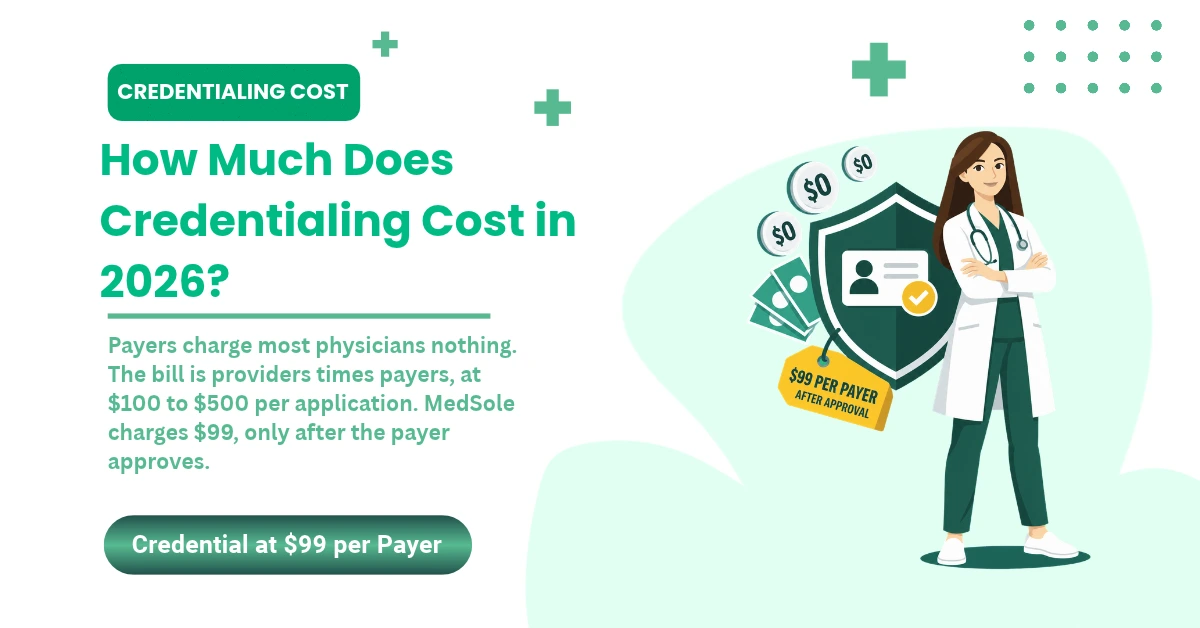
For practices that want enrollment and billing run by one team, MedSole RCM is the best fit: a full revenue cycle company with an in-house credentialing team. MedSole RCM charges $99 per payer application for credentialing with commercial and government payers, refunded if the payer denies it, and 2.99% of monthly collections for medical billing.
At $99, MedSole RCM has the lowest published per-payer price among the 10 companies compared. Practolytics is the only other firm here that lists a price per payer, with a range in its credentialing FAQ that starts at $300 per insurance network.
- Type: revenue cycle management company with an in-house credentialing team
- Credentialing price: $99 per payer application for commercial and government payers, including Medicare, Medicaid, and TRICARE, with the fee returned under MedSole RCM's refund policy if the payer denies the application
- Billing: 2.99% of monthly collections, with no setup fee and no long-term contract
- Coverage: all 50 states, 900+ payers, 75+ specialties, and 4,000+ providers served (reported by the company)
- Filing: applications filed within 48 hours of complete documents, weekly payer follow-up, and one specialist per file
- Included: DataSpring setup and re-attestation, PECOS, Medicaid, EFT/ERA, effective-date confirmation, and fee schedule review
- Google rating: 4.9 stars from 52 reviews (October 5, 2026)
Payers still set the pace. MedSole RCM publishes typical approval windows by payer, from 30 to 45 days for Medicare and Aetna to about 90 days for Medicaid (full table in the timeline section). The part MedSole RCM controls is a clean file, filed fast, with a call to the payer each week.
In public Google reviews of MedSole RCM, Angela Tamayo reported a UnitedHealthcare approval in two to three weeks, and Amy Burlison, LPC, reported approval with a major insurer in under two weeks. Treat those as individual cases, since your payers set your timeline.
Watch-outs: MedSole RCM reports status in weekly updates rather than through a client portal. Hospital privileging, state licensing, and DEA registration fall outside MedSole RCM's scope, so a practice that needs those should pair this medical credentialing company with a licensing service.
If you'd like your own payer list priced at $99 per payer, start with our provider enrollment and credentialing services page.
2. Practolytics: Best for Multi-Specialty Groups
Practolytics is a physician credentialing company and revenue cycle management firm that pairs credentialing with medical billing and payer contract negotiation, and it's best for multi-specialty groups.
- Type: revenue cycle management company with credentialing
- Services: provider enrollment, CAQH updates, Medicare and Medicaid enrollment, recredentialing, and license tracking
- Published price: its credentialing FAQ lists $300 to $800 per insurance network for a single provider and $1,500 to $3,500 per provider for multi-payer packages
- Speed claims: a 98% first-pass approval rate and weekly updates (reported by the company)
- Google rating: 3.9 stars from 7 reviews (October 5, 2026)
Where it stands out: Practolytics lists price ranges for single networks, multi-payer packages, and maintenance at $100 to $300 per provider every three months. With Practolytics, you can budget the first year before the first call. Practolytics also lists 1,000+ payers (reported by the company).
Watch-outs: Practolytics' price for a single network starts at $300, so ask whether a multi-payer package costs less for your plan count. On Google, Practolytics had seven reviews on October 5, 2026, too few to judge service consistency.
3. Physician Practice Specialists: Best for New Practices Needing Start-Up Help
Physician Practice Specialists (PPS) is a Florida practice services firm, part of Metolius Health, that combines credentialing with start-up consulting, payer contracting, and revenue cycle management, and it's best for new practices needing start-up help.
- Type: practice consulting, credentialing, and billing firm
- Services: Medicare enrollment through PECOS, Medicaid and commercial enrollment, CAQH attestations, license applications, DEA registration, and CLIA enrollment
- Published price: not published for enrollment; maintenance quoted at $45 to $60 per provider, with no billing period stated
- Published timeline: about 130 to 160 days to fully credential a new provider (reported by the company)
- Google rating: 4.5 stars from 209 reviews (October 5, 2026)
Where it stands out: PPS has worked as a credentialing company for physicians since 2008 and runs a full start-up service, from business planning and budgets to location analysis and a launch plan. With 209 Google reviews, PPS trails only Capline Healthcare Management on review count.
Watch-outs: Physician Practice Specialists doesn't publish an enrollment price, and its $45 to $60 maintenance quote doesn't say whether that's monthly or yearly. The PPS estimate of 130 to 160 days also runs longer than most windows here, so ask how PPS counts that time.
4. Capline Healthcare Management: Best for Facilities and Group Practices
Capline Healthcare Management is a Houston billing and credentialing company that enrolls facilities such as hospitals and labs along with individual providers, and it's best for facilities and group practices.
- Type: medical billing and RCM company, founded in 2016
- Services: enrollment with commercial plans, Medicare, and Medicaid, recredentialing, EFT enrollment, fee negotiation, and payer portal setup
- Published price: not published; Capline states no setup fee and no long-term contract
- Speed claims: a headline promise to speed up credentialing by 40% (reported by the company); no filing deadline published
- Google rating: 4.8 stars from 227 reviews (October 5, 2026)
Where it stands out: Capline Healthcare Management had the most Google reviews in this comparison, 227 at a 4.8 average, so its score rests on a large sample. Clients also get CredTrack, Capline's secure portal with real-time application status.
Watch-outs: Capline Healthcare Management doesn't publish a credentialing price or a filing deadline, like most insurance credentialing companies here, so get both in writing. Ask, too, whether the quote covers CAQH and PECOS, since Capline's main credentialing page doesn't mention either.
5. CureMD: Best for Practices on CureMD's EHR
CureMD is a New York EHR and practice management vendor that also sells credentialing and revenue cycle services, and it's best for practices on CureMD's EHR or moving to it.
- Type: EHR vendor with credentialing and revenue cycle services
- Services: provider enrollment, CAQH and PECOS management, recredentialing, hospital privileges, DEA certificate processing, and CLIA registration
- Published price: not published
- Published timeline: 60 to 120 days, depending on payer responses (reported by the company)
- Google rating: 4.4 stars from 86 reviews (October 5, 2026)
Where it stands out: CureMD lists one of the widest credentialing menus here, including hospital privileges and CLIA registration. Clients also get a provider portal and a dedicated account manager, and CureMD reports serving 40,000+ providers in all 50 states (reported by the company).
Watch-outs: CureMD's published credentialing agreement is an addendum to its License and Services Agreement, so ask whether you can buy credentialing without the EHR. The same agreement says CureMD doesn't guarantee health plan turnaround times, a standard clause to keep in mind when you plan a start date.
6. Credex Healthcare: Best for Providers Who Also Need Licensing
Credex Healthcare is a Jacksonville, Florida, company that handles credentialing, medical licensing, and billing, and it's best for providers who also need licensing before they enroll with payers.
- Type: credentialing, licensing, and revenue cycle management company
- Services: payer enrollment, CAQH profiles, Medicare and Medicaid applications, recredentialing, multistate and compact licensing, and DEA registration
- Published price: not published
- Published timeline: 60 to 90 days on its credentialing page and up to 180 days in its FAQ (reported by the company)
- Google rating: 4.8 stars from 56 reviews (October 5, 2026)
Where it stands out: Credex Healthcare pairs payer enrollment with licensing through the Interstate Medical Licensure Compact or direct state board applications, which helps a provider moving states or adding telehealth. Published figures from Credex list 7,000+ providers served and a 99% approval rate on first submission (reported by the company).
Watch-outs: Credex Healthcare doesn't publish a price, and its own pages give three timelines, from 60 to 90 days up to 60 to 180 days, so ask which one applies to your payers. On its main credentialing page, Credex doesn't mention PECOS or EFT enrollment, so confirm both before you sign.
7. MediBillMD: Best for Behavioral Health Practices
MediBillMD is a Dallas medical billing company with a credentialing team that serves practices nationwide, and it's best for behavioral health practices.
- Type: medical billing and revenue cycle management company with credentialing
- Services: payer enrollment, CAQH and PECOS profiles, EDI/EFT/ERA enrollment, recredentialing, hospital credentialing, and rate negotiation support
- Published price: not published; MediBillMD's blog describes a fixed fee per provider per payer
- Published timeline: under 120 days (reported by the company)
- Google rating: 3.9 stars from 18 reviews (October 5, 2026)
Where it stands out: MediBillMD runs a separate mental health credentialing page and reports working with 200+ mental health practices (reported by the company). Account managers at MediBillMD hold status calls with clients every two weeks, and the team sets up EDI, EFT, and ERA so payments can start once a payer approves.
Watch-outs: MediBillMD's blog describes a fixed fee per provider per payer, but the site doesn't show the amount. On Google, MediBillMD had 18 reviews averaging 3.9 on October 5, 2026, so read the recent ones for credentialing outcomes before you sign.
8. OmniMD: Best for Clinics Buying One EHR and Billing Platform
OmniMD is a New York healthcare software company whose platform combines EHR, practice management, billing, and provider credentialing, and it's best for clinics buying one EHR and billing platform.
- Type: EHR and billing software vendor with credentialing
- Services: CAQH, NPI, PECOS, Medicare and Medicaid revalidation, and EFT/ERA setup tied to billing, as described on OmniMD's blog
- Published price: not published; custom quotes
- Published timeline: none found for credentialing
- Google rating: 4.9 stars from 59 reviews (October 5, 2026)
Where it stands out: OmniMD says its platform syncs provider profiles, taxonomy, and EFT/ERA setup with billing, so a newly approved provider can bill without anyone entering the same data twice. With a 4.9 Google rating, OmniMD shares the highest score in this comparison.
Watch-outs: OmniMD had no dedicated credentialing service page on October 5, 2026, and its credentialing details come from its blog. Google lists OmniMD as a software company, so its rating covers the EHR too, and you'd need to run your practice on OmniMD to get the full benefit.
Companies That Focus Only on Credentialing
Credentialing firms without a billing arm suit practices that already trust their biller. You take on a second vendor and a handoff, since someone has to pass each effective date to your billing team before claims go out. Two of the best medical credentialing companies on our list work this way.
9. National Credentialing Solutions (nCred): Best for Credentialing Without Billing
National Credentialing Solutions (nCred) is a Chattanooga, Tennessee, credentialing and payer enrollment firm, now part of Sentact, and it's best for practices that want credentialing without billing.
- Type: credentialing and enrollment firm, launched in 2011; brought under the Sentact brand in December 2025
- Services: Medicare and Medicaid enrollment and revalidation, commercial payer enrollment, CAQH profiles, medical licensing, and hospital privileges
- Published price: not published
- Published timeline: around 120 days for most major carriers and 60 to 90 days for Medicare (reported by the company)
- Billing offered: no
- Google rating: 3.7 stars from 21 reviews (October 5, 2026)
Where it stands out: National Credentialing Solutions works in all 50 states, and clients get the nCred portal, with real-time access to files and application status, plus an assigned Provider Enrollment Coordinator. Among physician credentialing companies, nCred is candid about limits: its FAQ says the firm can't make insurers process applications faster.
Watch-outs: National Credentialing Solutions doesn't offer billing, so each effective date has to pass from nCred to your biller before claims go out; nCred says it coordinates that with your billing office. The nationalcredentialing.com homepage now redirects to Sentact, so confirm which entity signs your contract and who your coordinator will be.
10. PracticeWorx: Best for Allied Health and Dental Providers
PracticeWorx is a Florida credentialing firm that focuses on provider enrollment and credentials management, and it's best for allied health and dental providers.
- Type: credentialing and enrollment firm
- Services: Medicare, Medicaid, and commercial enrollment, recredentialing, medical staff reappointments, license renewals, and primary source verification
- Published price: not published
- Published timeline: applications prepared in about seven to 10 business days after documents arrive, then 30 to 120 days for payer decisions (reported by the company)
- Billing offered: no
- Google rating: 3.7 stars from 3 reviews (October 5, 2026)
Where it stands out: PracticeWorx lists a wide range of provider types, from nurse anesthetists and dentists to occupational, physical, and speech therapists, which puts it among the credentialing companies for therapists worth a call. If you're shortlisting the best provider credentialing companies without billing, PracticeWorx and nCred are the two to compare.
Watch-outs: PracticeWorx doesn't do billing; its FAQ says the firm has chosen to specialize in enrollment and credentialing. With three Google reviews as of October 5, 2026, the PracticeWorx rating tells you little either way, so ask for references in your specialty.
Credentialing Platforms and CVOs for Hospitals and Large Groups
Hospitals and large provider networks shopping for credentialing platforms will find four established names: Medallion, Verisys, symplr, and CredentialStream by HealthStream. These vendors sell software, credentials verification organization (CVO) services, or managed enrollment to organizations that run their own credentialing committees.
Enterprise credentialing platforms and CVOs, as each company describes itself on October 5, 2026.
|
Platform |
What it is |
Best for |
Worth knowing |
|---|---|---|---|
|
Medallion |
Credentialing, licensing, and payer enrollment platform with CVO services |
Multistate groups and digital health companies |
Announced its acquisition of Andros, a CVO with NCQA certification, on September 15, 2026 |
|
Verisys |
CVO and provider data services, including FACIS sanctions screening |
Health plans with large verification volumes |
States NCQA certification for its verification services |
|
symplr |
Provider data suite for credentialing, privileging, committee review, and enrollment |
Hospitals and health systems |
Says its CVO holds NCQA certification in all 11 verification areas |
|
CredentialStream by HealthStream |
Software for provider credentialing, enrollment, and privileging |
Hospital systems with several facilities |
Includes payer enrollment tools for form completion and status tracking |
Software still needs your staff to do the work, which puts the best credentialing software in a different category from the best medical credentialing companies above. CVO credentialing companies focus on verifying licenses, board certifications, and sanctions for health plans and hospitals, and payer enrollment, where they offer it, is a separate service.
Most hospital credentialing companies sell to the medical staff office that manages privileging. For most independent practices, neither a platform nor a CVO is the right buy. If you run a credentialing department, compare the best provider credentialing software and credentialing software companies on NCQA status, monitoring frequency, and payer enrollment tracking.
Which Credentialing Company Fits Your Practice?
Among the best medical credentialing companies, the right fit changes with your practice type. Find your row first. Credentialing companies for physicians, therapists, and nurse practitioners each need different payer knowledge, so compare price and status reporting only among firms that know your provider type.
|
Practice type |
Best fit |
Why |
|---|---|---|
|
Solo or new practice |
MedSole RCM, Physician Practice Specialists |
$99 per payer with no setup fee; start-up consulting plus enrollment |
|
Mental and behavioral health |
MedSole RCM, MediBillMD, PracticeWorx |
Behavioral health panel experience |
|
Nurse practitioners |
MedSole RCM, National Credentialing Solutions (nCred) |
NP enrollment, including state collaboration paperwork |
|
Multi-specialty groups |
Practolytics, Capline Healthcare Management, MedSole RCM |
Group and individual enrollment with billing |
|
Already on an EHR you like |
CureMD or OmniMD, if you use their EHR |
Shared provider data between credentialing and billing |
|
Telehealth or multistate |
MedSole RCM, Credex Healthcare, National Credentialing Solutions (nCred) |
Enrollment across states; Credex adds licensing |
|
Hospital or health system |
Medallion, Verisys, symplr, CredentialStream |
Platforms and CVOs |
For Mental and Behavioral Health Practices
For behavioral health credentialing, choose a firm that knows which local panels are still open. Therapists often find commercial panels closed in their area, and supervision rules add paperwork for associate clinicians.
Good credentialing companies for therapists know which plans accept LPCs, LCSWs, and LMFTs, and how each plan wants supervision documented. Our guide to mental health credentialing services covers panel strategy and credentialing for therapists in more depth.
For Nurse Practitioners
Credentialing companies for nurse practitioners need to know your state's practice rules, because payers check an NP's collaborative or supervision agreement during enrollment wherever the state requires one. Most physician credentialing companies handle NPs too, but ask how many NP files they've completed in your state this year. Our nurse practitioner credentialing guide covers the NP application steps.
For Telehealth and Multistate Groups
Telehealth and multistate groups enroll state by state: each new state brings its own license and its own Medicaid enrollment, and commercial plans there may treat it as a separate application.
Medicare covers telehealth from anywhere in the U.S., including a patient's home, through December 31, 2027, according to the Medicare telehealth coverage page. Our guide to telehealth credentialing across states goes deeper on multistate enrollment.
Not sure which row you're in? Tell us your specialty and states, and we'll tell you whether we're the right fit.
Credentialing Service, Software, or CVO: What Are You Buying?
What do credentialing companies do for providers? A credentialing company gathers your documents, files payer applications, follows up until a decision, and confirms your effective date so billing can start. Credentialing software gives your own staff the tools instead. A CVO verifies credentials for health plans and hospitals, and payer enrollment, if offered, is a separate service.
Credentialing models compared by who does the work, from the best medical credentialing companies to software and CVOs.
|
Model |
Who does the work |
Typical pricing model |
Best for |
Watch-out |
|---|---|---|---|---|
|
Credentialing service |
The company |
Per payer application or package |
Practices without a credentialing coordinator |
Ask what follow-up the price includes |
|
RCM company with credentialing |
The company, alongside your billing |
Per payer, plus a percentage of collections for billing |
Practices that want the effective date loaded into billing |
Check whether billing is optional |
|
Credentialing software |
Your staff |
Subscription |
Groups with an in-house coordinator |
Software won't call the payer for you |
|
CVO |
The CVO verifies; the plan or hospital decides |
Enterprise contract |
Health plans and hospitals |
Payer enrollment may cost extra or not be offered |
A credentialing specialist spends the day in a handful of systems: DataSpring provider profiles, Medicare's PECOS, NPPES for NPI records, and each payer's own portal. Most also keep a tracker, either a spreadsheet or one of the top credentialing software platforms from the enterprise section.
The gap between models shows up on approval day. If the team that got you approved also loads the effective date into billing, your first claims can go out without waiting on a handoff. Companies that help with credentialing but not billing pass that step to your biller. Our guide to billing and credentialing together covers that workflow in detail.
How Much Do Medical Credentialing Companies Charge in 2026?
Among the best medical credentialing companies we compared, published prices run from $99 to $800 per payer application, and eight of the 10 don't publish an enrollment price at all. Credentialing companies price their work per payer application, per provider package, or as recurring maintenance.
MedSole RCM charges $99 per payer application for credentialing with commercial and government payers, refunded if the payer denies it, and 2.99% of monthly collections for medical billing. At $99, that's the lowest published per-payer price among the 10 companies we compared.
Medical credentialing cost in 2026, with the source for each line.
|
Cost item |
Amount |
Who pays it |
Source |
|---|---|---|---|
|
Practolytics payer application |
$300 to $800 per insurance network (single provider) |
The practice |
Practolytics credentialing page FAQ, October 5, 2026 |
|
MedSole RCM payer application |
$99 per payer, commercial and government; refunded if the payer denies it |
The practice |
MedSole RCM credentialing page, October 5, 2026 |
|
Practolytics multi-payer package |
$1,500 to $3,500 per provider |
The practice |
Practolytics credentialing page FAQ, October 5, 2026 |
|
Ongoing maintenance |
$100 to $300 per provider every three months (Practolytics); $45 to $60 per provider, period not stated (Physician Practice Specialists) |
The practice |
Company websites, October 5, 2026 |
|
Medicare enrollment application fee, CY 2026 |
$750 |
Institutional providers filing the CMS-855A, CMS-855S, or CMS-855B (excluding physician and nonphysician practitioner groups) |
Federal Register, December 3, 2025 |
|
Same fee for physicians and NPPs filing the CMS-855I |
$0 (exempt) |
Not applicable |
Federal Register, December 3, 2025 |
|
DataSpring (formerly CAQH) profile |
$0 |
Free to clinicians |
DataSpring |
Send us your payer list, and we'll quote it at $99 per payer credentialing before you commit to anything, government payers included.
The $750 fee applies to institutional providers only, according to the CY 2026 fee notice, up from $730 in 2025. Physicians and NPPs filing the CMS-855I don't pay it, and DataSpring charges clinicians nothing for the profile, per DataSpring's clinician page.
What Your Credentialing Quote Should Include
Two quotes at the same price can cover different amounts of work. The best medical insurance credentialing companies put the full scope in writing, so check the quote for:
- The payer application itself
- DataSpring profile setup and 120-day re-attestation
- Follow-up calls until the payer decides
- Effective-date confirmation
- EFT and ERA setup
- Fee schedule review
- Refund terms if the payer denies the application
Why the Cheapest Quote Can Cost More
If a vendor doesn't follow up, your file waits in the payer queue, and each week the effective date slips is a week of visits you may not be able to bill. For a full-time provider, one month of unbillable visits costs more than most practices spend on credentialing in a year.
Weigh filing speed and weekly payer calls next to the fee as you compare the best medical credentialing companies, because insurance credentialing companies that skip follow-up only look cheap on paper. In our provider enrollment ROI breakdown, we run the numbers on outsourcing versus handling enrollment in-house.
How Long Does Credentialing Take, and When Can You Bill?
Most insurance credentialing approvals take one to four months, depending on the payer and how clean the file is. Payers control the clock. A good credentialing company controls how fast the file goes in and how often someone follows up.
Published estimates from the best medical credentialing companies we reviewed run from 30 days for a Medicare application to 130 to 160 days to fully credential a new provider. Ask any vendor how it counts that time, because some quote one payer and others quote the full provider enrollment from start to finish.
Typical Approval Windows by Payer
MedSole RCM's published typical approval windows (reported by the company, October 2026).
|
Payer |
Typical window |
|---|---|
|
Medicare |
30 to 45 days |
|
Aetna |
30 to 45 days |
|
Cigna |
40 to 60 days |
|
UnitedHealthcare |
40 to 60 days |
|
TRICARE |
45 to 60 days |
|
BCBS |
50 to 70 days |
|
Medicaid |
About 90 days, varying by state |
Medicare files move faster online: the CMS enrollment applications page notes that PECOS applications tend to process faster than paper ones. Our guide to Medicare enrollment through PECOS covers form choice and each step.
Medicaid often runs slowest because each state agency reviews files on its own schedule, and managed care plans may credential you again after the state enrolls you. BCBS timing varies by state, too, since each Blue plan sets its own process.
Your Effective Date Sets Your First Billable Day
Under 42 CFR 424.520, Medicare sets the effective date for physicians and NPPs as the later of two dates:
- The date you filed the application Medicare later approved
- The date you first furnished services at that location
A late filing pushes your effective date back, and visits before that date fall outside normal billing. If a new provider starts within 60 days, get the application in this week. With our payer enrollment process, we file within 48 hours of complete documents.
How Far Back Medicare Lets You Bill
42 CFR 424.521 lets physicians and NPPs bill Medicare for up to 30 days before the effective date when circumstances kept them from enrolling in advance, or up to 90 days when a Presidentially declared disaster did. Commercial payers set their own retro billing rules, and some won't backdate at all, so get any backdating promise in writing.
Billing those early visits under another provider's NPI creates a compliance problem, so don't use it as a workaround for a late enrollment.
What Happens When the Timing Slips
In most cases, payers deny claims for dates of service before the effective date with CARC B7, which means the provider wasn't certified or eligible for payment for that service on that date.
To fix it, confirm the effective date with the payer, ask for a correction if the payer set it wrong, and resubmit or appeal the claims that fall inside the allowed window. Our denial management services team handles that cleanup.
What Changed in Credentialing in 2025 and 2026
Five recent changes separate the best medical credentialing companies from vendors still working off old checklists. Ask any credentialing partner how its process handles each one.
June 7, 2026: CAQH became DataSpring. CAQH announced the change in its DataSpring rebrand announcement, and the provider profile carried over. DataSpring's clinician page still lists the profile as free for clinicians on a 120-day attestation cycle, so a checklist that says only "CAQH ProView" is out of date, though the work hasn't changed.
January 1, 2026: The Medicare enrollment fee rose to $750. Institutional providers pay it when they enroll, revalidate, or add a practice location. Physicians and NPPs filing the CMS-855I remain exempt, so a solo provider's own Medicare application costs nothing in federal fees.
December 2025 to September 2026: Credentialing vendors consolidated. National Credentialing Solutions (nCred) moved under the Sentact brand on December 8, 2025, and Medallion announced its acquisition of Andros on September 15, 2026. Before you sign with any vendor, confirm which company holds your contract and your provider data.
July 1, 2025: NCQA's new verification time limits took effect. For files processed on or after that date, NCQA set a verification time limit of 180 calendar days under Credentialing Accreditation and 120 calendar days under Credentialing Certification, per NCQA's 2025 standards corrections. If your vendor verifies credentials for a delegated plan, ask which limit it works to.
Through December 31, 2027: Medicare covers telehealth from home. Patients can receive covered telehealth from anywhere in the U.S. through that date. Older vendor checklists may still list the CMS-855R, which CMS merged into the CMS-855I in 2023, so reassignments now go on the 855I.
How to Vet a Credentialing Company Before You Sign
Before you sign, ask for three things: the price per payer in writing, a filing deadline in writing, and a sample status report. A company that can't produce all three will be hard to manage once your files sit in payer queues. Our longer checklist for vetting a credentialing company goes further.
Red Flags
Even the best medical credentialing companies should clear this list. Walk away from a vendor that:
- Promises an approval date, since payers control approvals
- Won't put the price per payer, and what it covers, in writing
- Can't tell you which CMS-855 form your situation needs
- Gives no written filing deadline after you hand over documents
- Keeps the fee when a payer denies the application, with no refund terms
- Doesn't track revalidation dates or the 120-day DataSpring re-attestation
Questions to Ask on the First Call
- What's your price per payer, and what does it include?
- How many days after I send documents do you file?
- How often will I get a status update, and in what format?
- What happens to my fee if a payer denies me?
- Who keeps access to my DataSpring profile and payer portals if we part ways?
- Can you show recent reviews from providers in my specialty?
Read credentialing service reviews the way a payer reads an application: look past the star average to the count and the dates, and note how the company answers complaints. The most useful insurance credentialing reviews name a payer and a timeline, like "UnitedHealthcare in three weeks." Provider enrollment services reviews without either tell you less.
If you'd like a second opinion on your current setup, our team reviews credentialing and billing together in a practice audit and analysis.
FAQs About Medical Credentialing Companies
Which Are the Best Medical Credentialing Companies in the USA?
The best medical credentialing companies in the USA depend on what you need handled. For credentialing plus billing, our pick is MedSole RCM at $99 per payer and 2.99% of collections.
National Credentialing Solutions (nCred) suits practices that want credentialing without billing, and CureMD or OmniMD fit practices on those EHRs. Hospitals tend to choose platforms or CVOs such as Medallion or symplr. Among the top credentialing companies, compare published prices, filing deadlines, and review counts before you call.
Which Company Provides the Best Enrollment and Credentialing Services?
The strongest enrollment and credentialing partner matches your payer mix, connects to your billing, and reports status on a schedule you can count on. MedSole RCM covers all three for independent practices at $99 per payer.
Physician Practice Specialists adds start-up consulting for new practices, and Credex Healthcare adds state licensing. Among the best credentialing companies, ask each one for a sample status report before you sign, since that report is what you'll live with for months.
Which Company Is Best for Both Medical Billing and Credentialing?
We'd point most independent practices to MedSole RCM, and we're disclosing that it's our own company. MedSole RCM charges $99 per payer application for commercial and government payers and refunds the fee if the payer denies the application.
The same team offers medical billing at 2.99% of monthly collections with no setup fee or long-term contract, works in all 50 states with 900+ payers, and loads each new effective date into billing.
Who Is the Highest Rated Provider Credentialing Company?
The highest rated provider credentialing company changes as new reviews come in, so judge top rated credentialing companies by score, review count, and how recent the reviews are.
As of October 5, 2026, MedSole RCM and OmniMD held 4.9 stars on Google, with 52 and 59 reviews. Capline Healthcare Management and Credex Healthcare followed at 4.8, with 227 and 56. For the best medical credentialing company in your field, read physician credentialing reviews from your own specialty.
How Much Does Medical Credentialing Cost?
A medical credentialing company charges per payer application, per provider package, or a maintenance fee. Published prices in our comparison ran from $99 per payer at MedSole RCM to $300 to $800 per insurance network at Practolytics.
Eight of the 10 firms don't publish an enrollment price, so you'll need a quote. Government fees are separate: Medicare's $750 enrollment fee applies only to institutional providers, and the DataSpring profile is free for clinicians.
Who Pays for Credentialing?
The employer pays in most cases when a provider joins a group, and independent providers pay their own credentialing costs.
Most commercial payers don't charge providers an application fee, Medicare exempts physicians and NPPs filing the CMS-855I from its fee, and DataSpring is free for clinicians. If you're joining a group, check whether your contract makes you repay credentialing costs if you leave early, and who keeps your payer portal logins.
How Often Does a Provider Need to Be Credentialed?
Commercial plans recredential providers about every three years, and Texas, for example, requires HMOs to recredential at least that often. Medicare revalidation comes every five years, or every three for DMEPOS suppliers, and CMS posts due dates seven months ahead, per CMS revalidation guidance.
State Medicaid agencies must revalidate enrollment at least every five years under 42 CFR 455.414. Your DataSpring profile needs re-attestation every 120 days, the shortest cycle of the four, so put it on a calendar.
What Are the Two Types of Credentialing?
In healthcare, the two types are payer credentialing and facility credentialing. Payer credentialing, often called enrollment, gets a provider in-network with insurers like Medicare, Aetna, or a Medicaid plan.
Facility credentialing verifies a provider for a hospital or surgery center and comes with privileging, which defines the procedures that provider may perform there. MedSole RCM handles payer credentialing; hospital privileging needs a separate service or the facility's medical staff office.
Can a Provider See Patients Before Credentialing Is Approved?
Yes, but payment depends on the payer. Medicare allows billing up to 30 days before the effective date when circumstances prevented earlier enrollment, and up to 90 days when a Presidentially declared disaster prevented it.
Commercial rules vary, so get them in writing. Under 42 CFR 410.26, the supervising physician or practitioner bills incident-to services and must meet Medicare's supervision rules, so incident-to billing doesn't work as a general fix for a new provider.
Do I Still Need CAQH Now That It's Called DataSpring?
Yes. DataSpring is the same provider profile commercial payers pull from, under a new name since June 7, 2026. You still re-attest every 120 days, and the profile stays free for clinicians.
Keep your documents current there, because an expired license or insurance certificate in your profile can stall the commercial applications that rely on it. If a credentialing company manages the profile for you, keep your own login too.
Get Credentialing and Billing Handled by One Team
Choosing among the best medical credentialing companies comes down to a price in writing, a filing deadline you can hold the vendor to, weekly payer follow-up, and a plan for approval day. On that day, someone has to load the effective date into billing, and fewer handoffs mean your first claims go out sooner.
MedSole RCM charges $99 per payer application for credentialing with commercial and government payers, refunded if the payer denies it, and 2.99% of monthly collections for medical billing.
If your next provider starts soon, or your biller and credentialer keep passing problems back and forth, we can take both. See how our outsourced medical billing works alongside credentialing.