



Quick answer
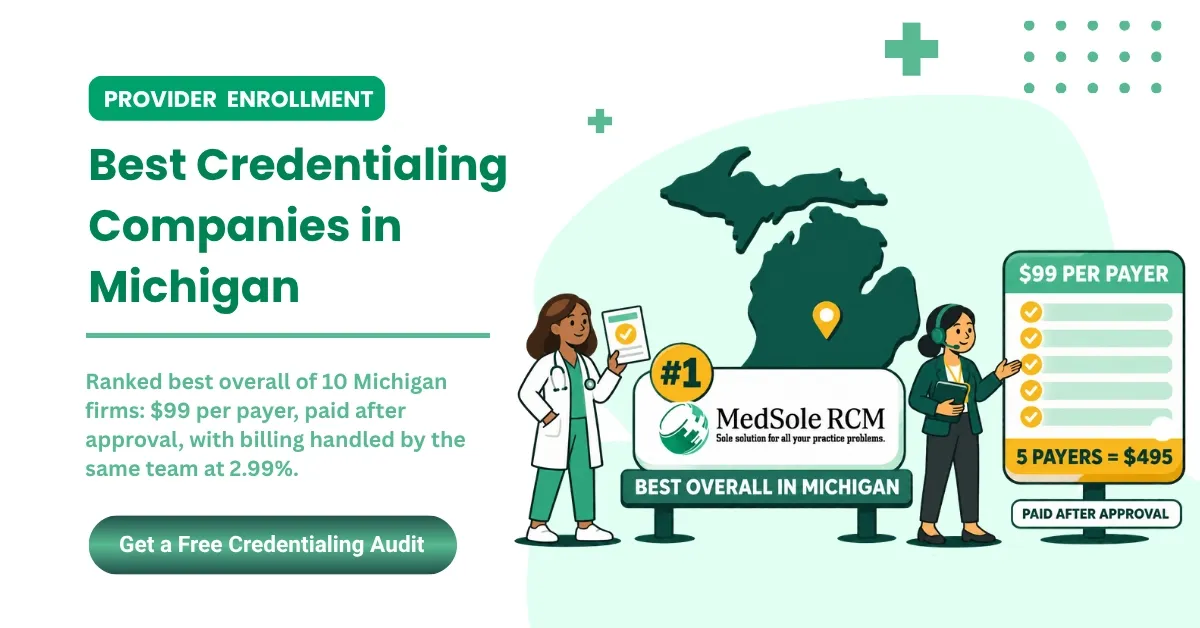
The best credentialing company in Michigan for most practices in 2026 and 2027 is MedSole RCM. Of the 10 credentialing companies in Michigan we compared, it's the only one that publishes a per payer price and charges it only after approval, and it handles your billing too.
MedSole RCM credentials providers in Michigan for $99 per payer application, charged only after the payer approves you. A nurse practitioner joining BCBSM, Priority Health, Medicare, and two Medicaid health plans pays $495, and nothing for an application that doesn't come through.
It also leads on what's included and on first-time approvals. Applications go out within 48 hours of complete documents, the reported first-time approval rate is 99%, and DataSpring, EFT and ERA enrollment, recredentialing tracking, and contract review come at no extra cost.
Once a payer approves you, the same team bills at 2.99% of monthly collections with no setup fee or minimum. Your effective date never gets lost between two vendors. The other nine firms follow, compared on price, speed, Michigan payers, and billing support.
|
Key takeaways
|
Credentialing Companies in Michigan Side by Side: Price, Speed, and Billing
All 10 companies line up below on pricing, turnaround, billing support, and Michigan presence, based on what each one publishes on its own website as of November 2026.
|
Company |
Best for |
Published pricing |
Stated turnaround |
Also bills? |
Michigan presence |
|---|---|---|---|---|---|
|
MedSole RCM |
Credentialing plus billing |
$99 per payer application, charged after approval; billing at 2.99% of monthly collections |
Filed within 48 hours; about 30 to 90 days typical |
Yes |
Remote, serves all 50 states |
|
Physician Practice Specialists |
New practice startups |
Not published; proposals scoped per practice |
Not stated; depends on payer |
Yes |
Remote; lists Detroit, Grand Rapids, Lansing, Ann Arbor, and Flint |
|
Michigan Credentialing and Contracting Service |
Michigan-only specialist |
$3,000 to $6,000 per single provider engagement; ongoing from $1,500 per provider per year |
60 to 120 days per commercial payer |
No |
Office in Birmingham |
|
Credex Healthcare |
Licensing plus credentialing |
$300 to $500 per provider |
60 to 120 days |
Yes |
Remote; headquartered in Jacksonville, Florida |
|
Medwave |
Several Michigan cities |
Per provider, per payer; amount not published |
About 85 days average (commercial) |
Yes |
Remote; headquartered in Cranberry Township, Pennsylvania |
|
Kona Medical Consulting |
Detroit office with monthly plans |
$165 to $435 per provider per month |
States two to four week cycles |
Yes (ABA billing at 5%) |
Office in Detroit |
|
Clinix Data Management |
Michigan-based team |
Not published |
60 to 120 days |
Yes |
Says it's Michigan-based; no street address listed |
|
iMagnum Healthcare Solutions |
Therapy, NP, and urgent care practices |
Not published |
60 to 90 business days |
Yes |
Remote; no Michigan office listed |
|
Celeriti |
Credentialing-only support |
Not published; no retainers |
30 to 120 days |
No |
Michigan (734) phone; no street address listed |
|
Medical Specialists Billing |
Saginaw and mid-Michigan |
Billing priced as a percentage of collections |
Not stated |
Yes |
Office in Saginaw |
Source: each company's own website, read November 2026. "Not published" means we couldn't find a price on the company's site.
[Graphic placement] Alt text: Comparison table of 10 credentialing companies in Michigan by pricing, turnaround, and billing support, November 2026.
Use the table to build a shortlist, then price your own payer list. Per payer and per provider fees don't compare one to one, so the firm that looks cheaper can cost more for your mix. Stated credentialing turnaround time reflects vendor speed; the payer table below shows how long each Michigan payer takes.
How We Ranked Michigan Credentialing Companies, and Our Disclosure
We compared 10 credentialing companies in Michigan on six criteria, using only what each company publishes on its own website, read in November 2026. Ratings that appear only inside a competitor's article didn't count, and neither did anything we couldn't find on the company's own site.
- Michigan payer coverage: experience with BCBSM, Blue Care Network (BCN), Priority Health, HAP, the Medicaid health plans, or Medicare.
- Published pricing: a price a practice can see before calling.
- Scope: credentialing only, or credentialing plus billing and payer contracting.
- Process commitments: a stated filing speed and follow-up schedule.
- Maintenance: DataSpring (formerly CAQH) attestation, recredentialing, and primary source verification support.
- Public reviews: ratings on a third-party platform, beyond testimonials.
MedSole RCM publishes this list and ranks itself first. The criteria drive that spot: MedSole is the only company here that posts a per payer dollar price, charges it only after approval, and publishes a billing rate next to it. It also commits to filing within 48 hours of receiving complete documents. Check our numbers against each site.
The list covers firms serving Michigan providers, with or without a Michigan office. We left out directories, software tools, and staffing agencies, since none of them file payer applications for you. If you've seen top rated credentialing companies lists with no method behind them, you can check every line of this one.
Practicing in more than one state? Our national credentialing company comparison covers credentialing and enrollment services across all 50 states, using the same criteria and the same disclosure.
The 10 Best Credentialing Companies in Michigan for 2026 and 2027
The 10 best credentialing companies in Michigan below follow the criteria above and the order of the comparison table. Every price, turnaround, and office location comes from the company's own website as of November 2026, and each entry ends with a limitation you should weigh before you call.
1. MedSole RCM: Best Overall for Credentialing Plus Billing
.png)
MedSole RCM: best overall among credentialing companies in Michigan for practices that want enrollment and billing handled by one team at published prices.
MedSole RCM credentials providers in Michigan for $99 per payer application, charged only after the payer approves you. MedSole RCM also handles medical billing at 2.99% of monthly collections, with no setup fee and no monthly minimum.
MedSole files applications within 48 hours of receiving complete documents and reports a 99% first-time approval rate across 900+ payer networks in all 50 states.
- Turnaround: Typical windows run 30 to 45 days for Medicare and Aetna, 40 to 60 days for Cigna and UnitedHealthcare, 45 to 60 days for TRICARE, 50 to 70 days for BCBS, and about 90 days for Medicaid. Some clients get approved in under three weeks.
- Cost and pricing:Solo Starter at $99 per payer, or $1,500 for a full panel; Group Core, Multi-State Telehealth, Enterprise RCM, and Supervisee Bridge packages; medical billing at 2.99%, month-to-month.
- Included at no extra cost: DataSpring (CAQH) setup and maintenance; NPI setup; EFT, ERA, and EDI enrollment; weekly follow-up reports; recredentialing and revalidation tracking; closed-panel tracking; contract and fee schedule review.
- Payers: Medicare, Michigan Medicaid and its health plans, Blue Cross Blue Shield plans, Aetna, Cigna, UnitedHealthcare, TRICARE, the VA, and federal employee health plans.
- Michigan presence: Remote team serving all 50 states, with published guides on BCBSM enrollment and Michigan's CHAMPS system.
- Best for: Solo providers, groups, and practices expanding across state lines that want one team owning enrollment and the claims after it.
- Consider: MedSole isn't headquartered in Michigan, so the work runs through phone, email, and written status reports.
Filing and follow-up. A named specialist audits every file against the payer's checklist and MedSole's SOPs before it goes out. You get a written report every week until each effective date posts. Before filing, the team recommends the panels that fit your state, license, and specialty, so you don't pay for applications that won't pay off.
Closed panels and expansion. MedSole checks whether a panel is open before filing. If it's closed, the team appeals where you can show an access gap and resubmits when the panel reopens. Practices growing past Michigan get each new state credentialed as they expand, under the same per payer price.
One team after approval. The billing side holds claims until the effective date, then files them once you're active. Contract review pays off too: one MedSole client recovered $47,000 a year through a 90837 rate renegotiation.
MedSole holds 52 five-star reviews on Google and Trustpilot. "The timeframe in which I received my insurance approvals was incredible. Less than two weeks for a major insurer," wrote Amy Burlison, LPC. Alonda Callender called the team "thorough, fast, and they are easy to get in contact with." The rest are on MedSole's verified client reviews page.
If you'd rather hand off enrollment and the first claims together, MedSole's credentialing team starts with a free credentialing audit and a payer-by-payer plan with timelines.
2. Physician Practice Specialists: Best for New Practice Startups
.png)
Physician Practice Specialists: best for new Michigan practices, because it pairs payer enrollment with practice startup services and Medicare reassignment work.
- Turnaround: Not stated; the company says timing depends on the payer.
- Cost and pricing: Not published; each proposal is scoped to the practice.
- Key services: Medicare individual, group, and reassignment enrollment; Medicaid enrollment; ERA and EFT enrollment; payer contract negotiations; solo and group practice startup services.
- Michigan presence: Remote; its Michigan page lists Detroit, Grand Rapids, Lansing, Ann Arbor, and Flint among the cities it serves.
- Best for: Physicians working through a physician practice start-up who want entity setup advice and payer enrollment from one firm.
- Consider: Pricing isn't published, so every engagement starts with a quote.
3. Michigan Credentialing and Contracting Service: Best Michigan-Only Specialist
.png)
Michigan Credentialing and Contracting Service: best Michigan-only specialist, because it works with Michigan practices only, from an office in Birmingham.
- Turnaround: 60 to 120 days per commercial payer from a complete submission, with Medicare often slower, per its site.
- Cost and pricing: Most single provider engagements run $3,000 to $6,000; ongoing management starts around $1,500 per provider per year; self-guided enrollment guides cost $149.
- Key services: Medicare PECOS enrollment and revalidation; CHAMPS enrollment, including the PIHP layer; CAQH and NPI setup; commercial contracting and contract review.
- Michigan presence: Office on Woodward Avenue in Birmingham.
- Best for: Practices that want a local Michigan specialist and can budget for a project fee.
- Consider: It doesn't offer billing, and its site says single payer engagements don't make financial sense.
4. Credex Healthcare: Best for Licensing Plus Credentialing
.png)
Credex Healthcare: best for licensing plus credentialing, because it handles Michigan licensure, DEA registration, and hospital privileging next to payer enrollment.
- Turnaround: 60 to 120 days, per its Michigan service page; its Detroit article puts the usual range at 90 to 120 days.
- Cost and pricing: $300 to $500 per provider for full service credentialing, per its own Detroit article.
- Key services: CAQH ProView management; Medicare PECOS and Michigan Medicaid enrollment; medical licensing through LARA, FCVS, and the IMLC; hospital privileging; RCM bundles.
- Michigan presence: Remote; headquartered in Jacksonville, Florida.
- Best for: Among physician credentialing companies here, Credex fits groups hiring out-of-state physicians who need a Michigan license and payer enrollment in one project.
- Consider: Credex prices per provider, so compare it with per payer pricing using your own payer count.
5. Medwave: Best for Contracting Across Several Michigan Cities
.png)
Medwave: best for groups in several Michigan cities, because it runs Detroit, Lansing, and Grand Rapids service pages and negotiates payer rates.
- Turnaround: About 85 days on average with commercial carriers, counted from submission to the payer.
- Cost and pricing: Priced per provider, per insurance company, with group and volume rates; amounts aren't published. Billing runs as a percentage of collections.
- Key services: Commercial credentialing; Medicare CMS-855 enrollment and reassignments; CAQH and DataSpring profile management; payer contracting and rate negotiation; medical billing.
- Michigan presence: Remote; headquartered in Cranberry Township, Pennsylvania. Its site displays HIPAA and SOC 2 Type 2 marks.
- Best for: Multi-location groups that want contracting, credentialing, and billing from one vendor.
- Consider: Medwave isn't Michigan-based, so ask about its Michigan Medicaid health plan experience on the first call.
6. Kona Medical Consulting: Best Detroit-Based Option
.png)
Kona Medical Consulting: best Detroit-based option, because it keeps a Detroit office and publishes monthly credentialing plans.
- Turnaround: The company says it targets two to four week completion cycles and files documentation within 48 hours.
- Cost and pricing: $165, $265, or $435 per provider per month, depending on the plan; ABA billing at 5% of collections.
- Key services: Primary source verification; CAQH setup and maintenance; payer network enrollment; recredentialing; hospital privileging support on the top plan.
- Michigan presence: Office on Bellevue Street in Detroit, plus a Grand Rapids mailing address.
- Best for: Detroit practices, including ABA clinics, that want a local team on a monthly plan.
- Consider: Payers set the approval date, and monthly fees keep running through a two to three month enrollment, so total the months you'll pay.
7. Clinix Data Management: Best for Practices Wanting a Michigan-Based Firm
.png)
Clinix Data Management: best for practices that want a firm describing itself as Michigan-based for both credentialing and billing.
- Turnaround: 60 to 120 days, depending on how complete the documentation is.
- Cost and pricing: Credentialing pricing isn't published; the site offers free quotes. Billing is advertised from 2.49%, without saying what the rate applies to.
- Key services: Insurance panel enrollment; primary source verification; recredentialing; provider data management; licensure assistance.
- Michigan presence: Says it's Michigan-based and lists (734) phone numbers, but no street address.
- Best for: Practices that want a Michigan team handling both credentialing and claims.
- Consider: The site's 4.8-star rating claim doesn't name a third-party source.
8. iMagnum Healthcare Solutions: Best for Therapy and Nurse Practitioner Practices
.png)
iMagnum Healthcare Solutions: best for therapy, nurse practitioner, and urgent care practices, because it lists credentialing built for those provider types.
- Turnaround: 60 to 90 business days for credentialing and contracting combined.
- Cost and pricing: Not published.
- Key services: Provider credentialing; payer enrollment and contracting; credentialing for PT, OT, SLP, NP, and PA providers; a tracking tool called Cred Simplify; medical billing and AR follow-up.
- Michigan presence: Remote; it publishes Michigan town pages, including Schoolcraft and Kalamazoo, but lists no Michigan office.
- Best for: Therapy groups and NP-led clinics that want one firm for enrollment and claims.
- Consider: We couldn't find a Michigan address or published price on the pages we could read.
9. Celeriti: Best for Credentialing-Only Support
.png)
Celeriti: best for credentialing-only support, because it focuses on credentialing and also works behind the scenes for billing companies.
- Turnaround: 30 to 120 days in most cases, per its site.
- Cost and pricing: Not published; the site says it charges no retainers and no flat per panel fees.
- Key services: Initial credentialing and recredentialing; CAQH re-attestations; Medicare revalidation; expiration tracking; payer website audits and practice startup consulting.
- Michigan presence: Lists a (734) southeast Michigan phone number and Eastern hours, without a street address.
- Best for: Practices that already have a billing company and want a credentialing specialist working beside it.
- Consider: Celeriti doesn't bill; it refers clients to partner billing companies.
10. Medical Specialists Billing: Best for Mid-Michigan and Saginaw
.png)
Medical Specialists Billing: best for Saginaw and mid-Michigan practices, because it has billed from a Saginaw office for more than 30 years.
- Turnaround: No credentialing timeline stated; the site says billing is completed within 24 hours of receipt.
- Cost and pricing: Billing is priced as a percentage of collections; there's no separate credentialing price.
- Key services: Credentialing and recredentialing for all carriers; billing and payment posting; coding by Michigan coders; AR follow-up; patient statements.
- Michigan presence: Office on Fashion Square Boulevard in Saginaw.
- Best for: Saginaw-area practices that want a local billing partner with credentialing included.
- Consider: Credentialing is a support service here, so ask how the team tracks payer follow-up.
How MedSole RCM Compares With the Other Nine Michigan Firms
Read side by side, the published commitments separate the 10 firms more than their marketing does. The table puts MedSole's written terms next to what the other nine publish on their own websites, read in November 2026.
|
What you're comparing |
MedSole RCM |
The other nine firms |
|---|---|---|
|
Published credentialing price |
$99 per payer application |
No per payer dollar price published. Credex lists $300 to $500 per provider, Kona $165 to $435 per provider per month, and Michigan Credentialing and Contracting Service $3,000 to $6,000 per engagement. Six publish no credentialing price. |
|
When you pay |
Only after the payer approves you |
Kona bills monthly during enrollment; the project firm quotes per engagement; the rest don't say. |
|
Filing speed |
Within 48 hours of complete documents |
Kona also states 48 hours. We didn't find a filing commitment on the other eight sites. |
|
Reported first-time approval rate |
99% across 900+ payer networks |
Credex reports 98%. We didn't find a rate on the other eight sites. |
|
Billing price |
2.99% of monthly collections, no setup fee, no monthly minimum, month-to-month |
Kona lists 5% for ABA billing. Clinix advertises billing "as low as 2.49%" without saying what the rate covers. Two firms don't bill, and the rest don't publish a rate. |
|
Included at no extra cost |
DataSpring, NPI, EFT/ERA/EDI, recredentialing tracking, closed-panel tracking, contract review |
Varies by firm and plan; Kona saves hospital privileging for its top plan. |
|
Where it works |
All 50 states |
One firm works with Michigan practices only; the rest serve several states. |
All figures are self-reported by each company on its own website. MedSole data comes from MedSole's published pages.
Two gaps cut the other way. MedSole has no Michigan office, and a few firms here claim larger provider counts. If an in-person meeting matters more to you than written terms, Kona, Michigan Credentialing and Contracting Service, and Medical Specialists Billing keep Michigan offices.
Whichever firm you pick, the work underneath is the same, and it helps to know what you're paying for.
What Do Credentialing Companies in Michigan Do for Providers?
Medical credentialing is the process of verifying a provider's license, education, training, work history, and sanctions at the primary source. Credentialing companies run that verification, then enroll the provider with each payer so the payer can pay your claims. Accredited plans follow NCQA credentialing standards, which set what a plan must verify and how recent each check must be.
You need three things finished before you have in-network status with a payer, and people often lump all three together as "credentialing":
- Credentialing: the payer verifies who you are and what you're trained to do.
- Enrollment: the payer adds you to its network, assigns a provider ID, and sets an effective date.
- Contracting: you and the payer agree on a fee schedule, which is why insurance credentialing and contracting belong in the same conversation.
On a normal week, provider credentialing services cover a task list like this one:
- DataSpring (formerly CAQH) profile setup and attestation
- Applications to each commercial payer and Medicaid health plan
- CHAMPS enrollment with MDHHS for Michigan Medicaid
- Weekly follow-up until each approval and effective date posts
- Recredentialing on each payer's cycle, often every three years
- Expiration tracking for LARA licenses, DEA registration, and malpractice coverage
Credentialing sits at the front of the revenue cycle. A provider who isn't enrolled can't bill a payer in-network, so each week of delay is a week of visits you hold or bill at risk. Getting paneled late also delays cash past the approval date, because the first payment lands weeks after the first clean claim goes out.
A credentialing specialist does the daily part: portal checks, payer calls, and document chases. Healthcare credentialing services work best when the same team also watches the claims that follow approval. That's the argument for buying credentialing services, including provider enrollment and credentialing services, as part of full revenue cycle management.
If your team is juggling DataSpring attestations and payer follow-ups on top of patient care, that's the list MedSole's credentialing team takes over.
How Provider Credentialing Works in Michigan, Step by Step
If you're working out how to credential a provider in Michigan, get the Michigan license, the NPI, and the DataSpring profile in place first. Then enroll with Medicare, Michigan Medicaid through CHAMPS, each Medicaid health plan, and each commercial payer, in parallel where you can.
- Michigan license (LARA). The Michigan Department of Licensing and Regulatory Affairs (LARA) issues licenses through MiPLUS, and payers verify them at the source. MDHHS requires individual providers to hold a license before they enroll in CHAMPS. You can confirm a license's status and expiration date through LARA license verification.
- NPI (NPPES). Get your individual NPI in NPPES, plus a group NPI if you'll bill under a group. The CMS enrollment guide lists the NPI as step one, so nothing else moves until you have it.
- DataSpring profile (formerly CAQH ProView). Build, complete, and attest the profile, then authorize each payer to view it. Most Michigan commercial plans pull credentialing data from it, and you'll re-attest every 120 days. MedSole has seen a single lapsed CAQH attestation block $72,000 in claims. MedSole's DataSpring profile setup guide covers each section.
- Medicare (PECOS). Apply in PECOS, then answer requests from WPS, the Medicare Administrative Contractor for Michigan. Per the CMS Medicare enrollment guide, you report ownership changes, adverse legal actions, and practice location changes within 30 days, and other changes within 90 days. Our walkthrough of Medicare enrollment in PECOS covers the CMS-855 forms.
- Michigan Medicaid (CHAMPS). Register for MiLogin, then pick the CHAMPS enrollment type that fits: individual, rendering only, group, or billing agent. Per MDHHS provider enrollment, every provider serving Michigan Medicaid beneficiaries must be screened and enrolled in CHAMPS, and revalidation comes at least once every five years. Our Michigan Medicaid CHAMPS enrollment guide covers Michigan Medicaid provider enrollment screen by screen.
- Each Medicaid health plan. CHAMPS enrollment doesn't put you in any plan's network. Since 2019, MDHHS has barred Medicaid health plans from paying most providers who aren't enrolled in CHAMPS, so provider enrollment for Medicaid and Medicare in Michigan comes first, and plan contracts follow.
- Commercial payers. Apply to BCBSM, BCN, Priority Health, HAP, and national plans, sign each contract, and record each effective date. Insurance credentialing in Michigan with commercial plans can run alongside the Medicare and Medicaid tracks once steps 1 to 3 are done.
Files stall most often at the hand-offs between steps. A practice address in CHAMPS that doesn't match the DataSpring profile, or an attestation that lapses while a commercial application sits in review, can send the file back for correction and restart the payer's review.
Credentialing companies in Michigan can run every step after the license for you, from group and individual enrollment to payer enrollment with each plan. The provider still signs the attestations and contracts, so build signing time into your plan.
[Graphic placement] Alt text: Michigan provider credentialing steps: LARA license, NPI, DataSpring profile, then Medicare, CHAMPS, Medicaid health plans, and commercial payers.
Michigan Payer Credentialing Timelines and Requirements
Most Michigan payers approve a complete application in about 30 to 90 days, based on MedSole's typical timelines, and the payer sets the clock whichever firm you hire. The table pairs those typical windows with what each payer or the state publishes.
|
Payer |
MedSole typical timeline |
What the payer or state publishes |
Watch for |
|---|---|---|---|
|
Blue Cross Blue Shield of Michigan (BCBSM) |
50 to 70 days |
BCBSM: allow "30 days or more" to process an application |
BCBSM asks you to wait until contracting is complete before seeing members |
|
Blue Care Network (BCN) and BCN Advantage |
50 to 70 days |
Separate BCN contracts may be required |
BCBSM approval doesn't mean BCN participation |
|
Medicare (PECOS, then WPS) |
30 to 45 days |
CMS: report key changes within 30 days, others within 90 |
Bill only from your effective date, with a 30-day exception |
|
Michigan Medicaid (CHAMPS) |
About 90 days, MedSole typical |
MDHHS: revalidate at least every five years |
Required before any Medicaid health plan can pay you |
|
Each Medicaid health plan |
About 90 days per plan, MedSole typical |
Molina: about 30 to 60 days for a complete MIHP packet; McLaren: decision letter within 60 days of the decision date |
CHAMPS enrollment doesn't create plan network status |
|
PIHP behavioral health networks |
Up to 90 days under state rule |
MDHHS: credentialing decision within 90 calendar days of a complete application; recredentialing every three years |
Uses the state's uniform CMHSP credentialing program |
|
Aetna |
30 to 45 days |
Not published on the pages we checked |
Separate contracts by product line |
|
Cigna and UnitedHealthcare |
40 to 60 days |
Not published on the pages we checked |
Separate contracts by product line |
|
TRICARE |
45 to 60 days |
Not published on the pages we checked |
Relevant if you serve military and National Guard families |
|
Priority Health and HAP |
Ask for a current estimate |
Not published on the pages we checked |
Separate contracts by product line |
Sources: MedSole typical timelines from MedSole's credentialing page; payer and state rules from the official pages listed under Sources. Read November 2026.
Blue Cross Blue Shield credentialing and BCN contracting run on separate tracks in Michigan, so a provider can be active with BCBSM and still pending with BCN. BCBS credentialing starts on the BCBSM provider enrollment page, and our guide to BCBS of Michigan enrollment walks through BCBS MI provider enrollment step by step.
Each Medicaid health plan credentials on its own, and the plans you need depend on the counties you serve. MDHHS lists nine plans, from Aetna Better Health of Michigan to Upper Peninsula Health Plan, on its MDHHS Medicaid Health Plans page. For one plan's process in detail, see our Molina credentialing steps.
Michigan Rules That Shape Credentialing
- PIHP networks: MDHHS requires PIHPs to decide within 90 calendar days of a complete, signed application, using the uniform CMHSP credentialing program set up under Public Act 282 of 2020. Provisional credentials can't run past 150 days.
- HMO application periods: Michigan's Insurance Code, MCL 500.3531, requires HMOs to hold a provider application period at least once every four years and to state any rejection in writing.
- Commercial plans: As of November 2026, we didn't find a Michigan statute setting a credentialing deadline for commercial insurers, so each plan's own process sets the pace.
That HMO rule helps with closed panels. A written rejection names the standard you didn't meet, which tells you what to fix before the next application period opens.
Which Michigan Panels to Join First
MedSole recommends panels based on your license, specialty, and the counties you serve. Most Michigan practices start with this core list, then add plans as patient demand shows up:
- BCBSM and BCN, plus Priority Health and HAP for commercial and employer plans
- Medicare, and the MI Coordinated Health plans if you see dual-eligible patients
- CHAMPS, then the Medicaid health plans serving your counties
- A PIHP network if you provide public behavioral health services
The payer that slows a file down varies from one year to the next. Yet the causes repeat: a missing signature, an expired document, or a lapsed attestation restarts the review clock. That's why credentialing turnaround time depends as much on a clean first submission as on the payer.
Michigan Credentialing Changes in 2026 and What's Coming in 2027
Four changes shaped Michigan credentialing in 2026: CAQH became DataSpring, MI Coordinated Health replaced MI Health Link, limited-license behavioral health providers moved to Rendering Only CHAMPS enrollment, and MDHHS delayed its Mental Health Framework. In 2027, Medicaid eligibility rules tighten starting January 1.
2026 Changes
DataSpring (June 2026). CAQH rebranded as DataSpring, powered by CAQH, in June 2026, per the ADA notice on the DataSpring change. The ADA notes that providers still re-attest every 120 days. Update your checklists and training notes so new staff look for DataSpring when an attestation reminder arrives.
MI Coordinated Health (January 2026). On January 1, 2026, MI Coordinated Health replaced MI Health Link for people enrolled in both Medicare and Medicaid. MDHHS launched it in the Upper Peninsula, Southwest Michigan, and Wayne and Macomb counties, with nine health plans selected. If you see dual-eligible patients there, check plan participation on the MDHHS MI Coordinated Health page.
Rendering Only enrollment (September 2026). MDHHS bulletin MMP 26-30, effective September 1, 2026, requires limited-license counselors, social workers, marriage and family therapists, and temporary limited licensed psychologists serving Medicaid patients to enroll in CHAMPS as Rendering Only. Each one links to a billing organization and a supervisor's NPI. Our behavioral health credentialing guide covers the setup.
Mental Health Framework (delayed). MDHHS planned to move most mental health care for Medicaid enrollees with lower needs to the Medicaid health plans on October 1, 2026, with PIHPs keeping enrollees with higher needs. Per the MDHHS Mental Health Framework page, those coverage changes are delayed, and MDHHS hadn't posted a new date as of November 2026.
2027 Changes Already on the Calendar
- Healthy Michigan Plan work requirements (January 1, 2027). Adults 19 to 64 on the plan must show 80 hours of approved activities or $580 in income in at least one month per review period, with exemptions. Current members face the check at renewals on or after March 1, 2027.
- Six-month renewals and shorter retroactive coverage (January 1, 2027). MDHHS will check Healthy Michigan Plan eligibility every six months, and retroactive coverage for those members shrinks to one month before the application.
- MI Coordinated Health goes statewide (2027). Providers outside the 2026 regions who see dual-eligible patients should confirm plan participation before the expansion.
- NCQA 2027 standards (July 1, 2027). NCQA's 2027 Credentialing and Provider Network standards apply to surveys starting that date. Accredited plans already moved to monthly ongoing monitoring on July 1, 2025, so expect policy updates and more requests for current documents.
- Mental Health Framework (date pending). Watch MDHHS for the new start date. Once it takes effect, more behavioral health providers will need Medicaid health plan contracts.
The Healthy Michigan Plan work requirements affect who's covered on the day of the visit, which lands on the billing side. Expect more Medicaid patients to lose coverage between appointments in 2027, and verify eligibility before every visit so those claims don't come back as coverage denials.
Practices adding behavioral health or dual-eligible services in 2026 and 2027 have more plans to credential with and more effective dates to track. Follow-up, more than any single application, is where practices miss recredentialing deadlines and new contracts.
How Much Do Credentialing Companies in Michigan Charge?
Credentialing companies serving Michigan charge per payer application, per provider, per month, or per project, so the right comparison is your total for the payers you need. MedSole charges $99 per payer application, charged only after the payer approves you, and it's the only per payer price published by any firm in this guide.
|
Pricing model |
How it works |
Example published price (source) |
|---|---|---|
|
Per payer application |
You pay for each payer you enroll with |
MedSole RCM: $99 per payer application, charged after approval (MedSole credentialing page) |
|
Per provider |
One fee covers a provider's enrollments |
Credex Healthcare: $300 to $500 per provider for full service (Credex Detroit article) |
|
Monthly plan |
A fixed fee per provider each month |
Kona Medical Consulting: $165 to $435 per provider per month (Kona website) |
|
Per project |
A quoted fee for a defined engagement |
Michigan Credentialing and Contracting Service: $3,000 to $6,000 per single provider engagement (company pricing page) |
Most commercial payers don't charge practitioners to apply. Medicare's 2026 application fee is $750, and it applies to institutional providers, not to physicians or practitioners filing a CMS-855I. Michigan Medicaid collects a fee from institutional providers through CHAMPS. Our breakdown of what credentialing costs covers physician credentialing services cost item by item.
Worked example 1, credentialing. A nurse practitioner joins your practice and needs BCBSM, BCN, Priority Health, Medicare, and one Medicaid health plan. Five payers at $99 each comes to $495, and MedSole charges each $99 only after that payer approves.
Compare that with the other models. Credex's $300 to $500 per provider fee lands in the same range for five payers, costs less for a list of 10, and costs more for two or three. Kona's $165 starter plan, held through a two to three month enrollment, runs $330 to $495.
Worked example 2, billing. A practice collecting $50,000 a month pays $1,495 a month at 2.99%. Pairing billing with credentialing services removes the hand-off between two vendors, and our guide to medical billing cost models compares percentage pricing with the other common models.
MedSole's packages cover different setups: Solo Starter at $99 per payer or $1,500 for a full panel, plus Group Core, Multi-State Telehealth, Enterprise RCM, and Supervisee Bridge. DataSpring, NPI, EFT, ERA, and EDI enrollment, recredentialing tracking, and contract review come at no extra cost.
Want that math for your own practice? Send MedSole your payer list for a free credentialing audit and a payer-by-payer plan with timelines.
What Happens to Your Claims While Credentialing Is Pending?
Claims billed to a payer before the provider's effective date usually deny or process out-of-network, so most practices hold those claims or schedule around the gap until approval.
Effective dates and retroactive billing. Some payers set an effective date that covers recent visits, and many don't. Medicare lets you bill for services up to 30 days before your effective date when circumstances kept you from enrolling sooner (42 CFR 424.521). Get every other payer's retroactive billing rule in writing before you see its patients.
Filing deadlines keep running. Held claims still face each payer's timely filing limit, which most payers count from the date of service. A 120-day approval can eat most of a 180-day window before you've sent a single claim. Our list of payer timely filing limits shows each deadline by payer.
Denials you'll see. Claims for a provider who isn't enrolled come back with codes like CARC B7: provider not certified or eligible for that service on that date. Correct and resubmit those once enrollment posts, since an appeal won't change the enrollment record. If they pile up, denial management services sort them by root cause.
ERA and EFT enrollment. Approval isn't the last step. You enroll for electronic remittance and payment with each payer, and skipping it delays cash. MedSole has found $15,000 to $40,000 in uncashed paper checks at practices that never set up EFT. Outsourced medical billing closes the gap when one team tracks approvals and claims.
A common way held claims get lost: the effective date arrives in a credentialing email and never reaches the person posting charges. Weeks later, someone finds a stack of visits still on hold, and part of it now sits past the filing limit.
If you'd like one team watching both the approval and the first claims, MedSole handles credentialing and billing together.
Before You Sign: Vetting a Credentialing Company in Michigan
Choose a credentialing company that names the Michigan payers you need, prices your payer list in writing, defines its scope, and sends status updates every week. Then compare the written answers side by side, because a sales call and a signed scope often say different things.
How Do I Choose a Medical Credentialing Company?
Ask these seven questions before you sign, and get the answers by email:
- Which Michigan payers have you enrolled providers with this year: BCBSM, BCN, Priority Health, HAP, the Medicaid health plans, and Medicare?
- What's the total price for my payer list, in writing?
- Does that price include DataSpring setup and attestation, CHAMPS enrollment, recredentialing, and contract review?
- How often will I get status updates, and in what format?
- Who owns the DataSpring, CHAMPS (MiLogin), and PECOS logins? (The right answer: your practice.)
- What happens after approval, including effective dates, ERA and EFT setup, and the hand-off to billing?
- Will you sign a HIPAA business associate agreement, and how do you secure provider data?
Good provider credentialing services answer all seven without hedging. If a vendor won't put the price or the login answer in writing, move to the next name on your shortlist. Our guide to choosing a credentialing company adds the rest of the vendor checklist.
Why Should You Choose a Medical Credentialing Company?
Time back. Payer follow-up is phone and portal work, and it pulls front desk and billing staff off the tasks that bring money in. A medical credentialing company makes those hold-queue calls for you, every week, until each payer gives you an approval or a reason.
Fewer returned applications. Experienced teams catch a mismatched address, an expired document, or a missing signature before the payer does. That habit is what separates the best credentialing services from a vendor that types forms and waits.
Revenue starts sooner. Each week a provider sits unenrolled is a week of claims you can't bill in-network. The best insurance credentialing services shorten that window by filing clean the first time. Our analysis of outsourcing provider enrollment walks through the cost side.
Red Flags When Comparing Credentialing Companies
Walk away, or at least slow down, when credentialing companies show any of these:
- Promised approval dates, since payers control timelines
- No written scope or price before work starts
- Logins kept by the vendor after the contract ends
- No plan for claims while enrollment is pending
Best Credentialing Company by Specialty, Practice Size, and City
The best fit among credentialing companies in Michigan depends on your specialty, how many providers you're enrolling, and how much local, in-person help you want.
By Specialty
Most physician credentialing companies handle any specialty, but a few details change by provider type in Michigan:
|
Specialty |
What changes in Michigan |
What to look for |
Strongest fit in this list |
|---|---|---|---|
|
Behavioral health |
Rendering Only CHAMPS enrollment since September 2026; a delayed shift of Medicaid mental health care to health plans |
Medicaid health plan and PIHP experience |
MedSole RCM (CHAMPS and Medicaid health plan enrollment); Michigan Credentialing and Contracting Service (lists the PIHP layer) |
|
Telehealth and multi-state |
A Michigan license plus each other state's license |
Licensing support and multi-state enrollment |
Credex Healthcare (lists licensing); MedSole RCM (credentials each new state as you expand) |
|
Nurse practitioners and PAs |
Some plans ask for collaborating or supervising physician details |
A firm that checks each plan's packet |
MedSole RCM; iMagnum Healthcare Solutions (lists NP and PA credentialing) |
|
New physician practices |
Group NPI, entity setup, and group contracts come first |
Startup and contracting help |
Physician Practice Specialists; MedSole RCM |
New practices should line up physician credentialing services after the group NPI and entity are final, since payers credential the group and each provider on separate files. For provider-specific detail, see our guides to telemedicine credentialing and nurse practitioner credentialing. Virtual practices can pair enrollment with MedSole's telehealth billing services, priced at the same 2.99%.
By Practice Size
- Solo practitioners: per payer pricing scales with the handful of payers you need.
- Small groups (two to five providers): one tracker should cover every provider and every payer.
- Multi-site groups: pairing credentialing with billing lets new providers produce claims without a vendor hand-off.
- Multi-state practices: a firm that credentials each new state as you expand keeps one tracker across every license.
Larger groups should ask medical credentialing companies how they track 20 or more provider files at once, and who owns each file. Our guide to credentialing for medical groups covers group enrollment in detail.
By City
Payers review applications in their own credentialing departments, so a local office won't make approvals faster. If you searched "credentialing services near me" or "credentialing companies near me," weigh Michigan payer experience above distance. Local insurance credentialing companies help most when you want in-person meetings.
- Metro Detroit: Kona Medical Consulting (Detroit office) and Michigan Credentialing and Contracting Service (Birmingham office)
- Lansing and mid-Michigan: Medwave and Physician Practice Specialists, both remote with Lansing coverage
- Grand Rapids and West Michigan: Medwave (Grand Rapids service page) and Physician Practice Specialists (lists Grand Rapids and Kalamazoo)
- Saginaw and Flint: Medical Specialists Billing (Saginaw office) and Physician Practice Specialists (lists Flint)
- Upper Peninsula and rural areas: remote firms such as MedSole RCM, since local options are thin
Frequently Asked Questions About Michigan Credentialing Companies
What are the best credentialing companies in Michigan?
The best credentialing companies in Michigan for 2026 and 2027 are MedSole RCM, best overall for credentialing plus billing; Physician Practice Specialists, best for new practices; and Michigan Credentialing and Contracting Service, best Michigan-only specialist. MedSole ranks first because it's the only firm here that publishes a per payer price, $99, and charges it only after approval.
Which credentialing companies in Michigan also handle medical billing?
MedSole RCM credentials providers in Michigan for $99 per payer application, charged only after the payer approves you. MedSole RCM also handles medical billing at 2.99% of monthly collections, with no setup fee and no monthly minimum. Credex Healthcare and Medwave also list billing, and one team for medical billing credentialing services closes the gap before the first paid claim.
How much do credentialing services cost in Michigan?
Credentialing services in Michigan are priced per payer, per provider, per month, or per project. MedSole RCM charges $99 per payer application, only after approval, Credex Healthcare publishes $300 to $500 per provider, and Kona publishes $165 to $435 per provider per month. Total your own payer list, since most commercial payers don't charge practitioners an application fee.
How long does insurance credentialing in Michigan take?
Insurance credentialing in Michigan takes about 30 to 90 days for most complete applications, based on MedSole's typical timelines. BCBSM asks providers to allow 30 days or more, MedSole sees 50 to 70 days for BCBS, and Medicaid runs about 90 days. Incomplete DataSpring profiles and missing documents cause most delays, so a clean first submission saves the most time.
Do I need CHAMPS enrollment if I only see Medicaid health plan members?
Yes. MDHHS requires every provider serving Michigan Medicaid beneficiaries to be screened and enrolled in CHAMPS, and Medicaid health plans can't pay most providers who aren't enrolled. CHAMPS doesn't add you to any plan's network, though, so you still credential and contract with each Medicaid health plan on its own.
What is the difference between credentialing and enrollment?
Credentialing verifies a provider's license, training, and history at the primary source. Enrollment adds the provider to a payer's network with a provider ID and an effective date, and contracting sets the fee schedule. You need all three finished before in-network claims pay, and each payer runs its own version of every step.
How do I find top rated credentialing companies?
To find top rated credentialing companies, check third-party reviews on Google, Trustpilot, or Clutch, then look for published pricing, a written scope, and named Michigan payer experience. Testimonials on a company's own site don't prove much on their own, and ratings quoted inside a competitor's article prove even less.
Can I see patients before credentialing is approved?
Yes, but claims to that payer may deny or pay out-of-network until the effective date. Medicare allows billing up to 30 days before the effective date when circumstances prevented earlier enrollment. Other payers vary, so confirm the rule in writing and hold claims if you're unsure. A medical billing company can track those holds for you.
What do physician credentialing services include?
Physician credentialing services include DataSpring profile setup and attestation, primary source verification support, applications to each payer, CHAMPS and PECOS enrollment, weekly follow-up, contract review, and recredentialing tracking. Some firms add licensing, hospital privileging, or billing, so compare scopes in writing before you compare prices.
What changes for Michigan credentialing and billing in 2027?
Starting January 1, 2027, Healthy Michigan Plan members face work requirements, six-month eligibility renewals, and retroactive coverage limited to one month. MI Coordinated Health expands statewide in 2027, and NCQA's 2027 credentialing standards apply to surveys from July 1, 2027. Practices should verify Medicaid eligibility before every visit.
Which insurance payers does MedSole RCM credential with?
MedSole RCM credentials providers with Medicare, Medicaid, Blue Cross Blue Shield plans, Aetna, Cigna, UnitedHealthcare, TRICARE, the VA, and federal employee health plans. MedSole files applications within 48 hours of receiving complete documents and reports a 99% first-time approval rate across 900+ payer networks in all 50 states.
The Bottom Line for Michigan Practices
The best credentialing companies in Michigan know your payers, price your payer list in writing, and plan for the claims that follow approval. Shortlist two or three firms from the comparison table, ask each one the seven questions above, and compare written totals before you sign anything.
For most Michigan practices, our pick is MedSole RCM. It's the only firm in this guide with a published per payer price that's charged after approval, and the same team carries each effective date through to the first paid claim.
If you want one team handling enrollment and the claims after it, start with Michigan credentialing support and a free payer-by-payer plan.
Sources and Methodology Notes
We read company data on each company's own website in November 2026 and took MedSole data from MedSole's published pages. Payer timelines come from the payer documents named in the table above, or from MedSole guides where the payer publishes nothing. Official sources:
Michigan Medicaid (MDHHS)
- MDHHS: Medicaid Provider Enrollment (CHAMPS)
- MDHHS: Providers Must Enroll in Michigan Medicaid Program (August 21, 2018)
- MDHHS: Bulletin MMP 26-30 (July 31, 2026)
- MDHHS: Medicaid Health Plans
- MDHHS: Mental Health Framework
- MDHHS: MI Coordinated Health
- MDHHS: MI Coordinated Health Launch Announcement (December 6, 2024)
- MDHHS: Credentialing and Re-Credentialing Processes (PIHP, effective October 1, 2024)
- Michigan Legislature: MCL 500.3531
2027 Medicaid changes
Payers
- Blue Cross Blue Shield of Michigan: Provider Enrollment
- Molina Healthcare of Michigan: MIHP Provider Document
- McLaren Health Plan: Provider Credentialing
Licensing, Medicare, and national standards
- LARA: Certified License Verification
- CMS: Become a Medicare Provider or Supplier
- Federal Register: CY 2026 Medicare Application Fee Notice (December 3, 2025)
- NCQA: Credentialing Accreditation and Certification
- X12: Claim Adjustment Reason Codes
- DataSpring: CAQH Rebrands as DataSpring (June 2026)
- ADA: Credentialing Service and DataSpring