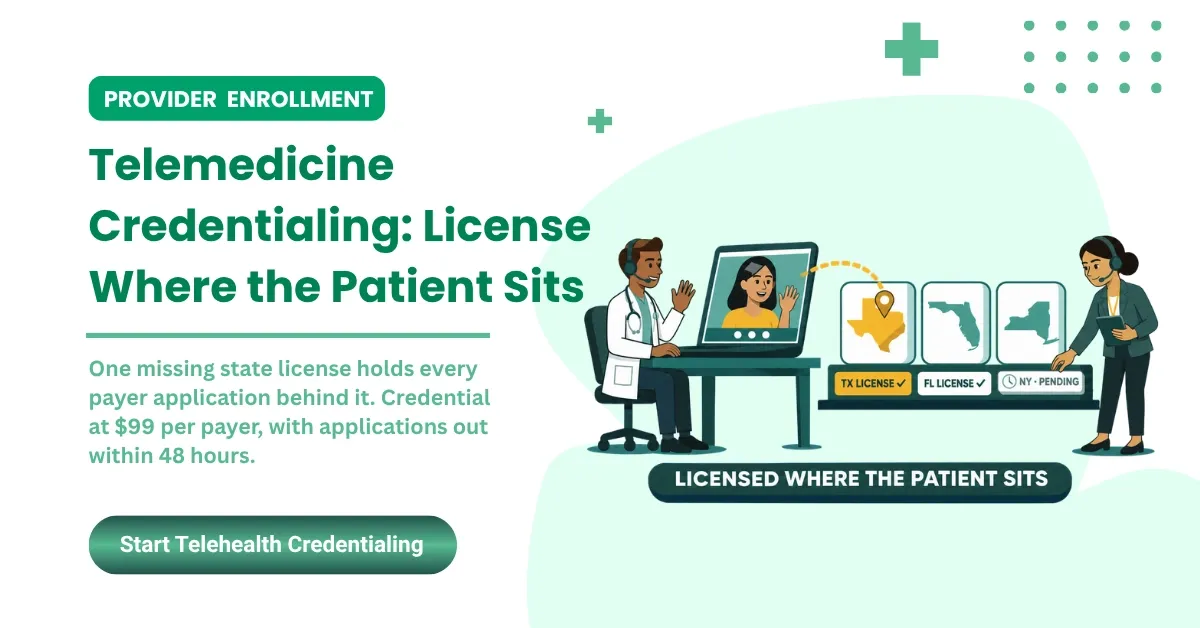




Telemedicine credentialing is the process of verifying a provider's licenses, training, and professional history so they can treat patients remotely and bill insurance for those visits. The paperwork is similar to in-person credentialing, but the scale is larger: a telehealth provider usually needs a license in every state where patients sit during the visit and enrollment with Medicaid and commercial payers in each of those states. Some also need privileges at hospitals they'll never walk into.
That's where start dates slip. One missing state license or a lapsed CAQH attestation can hold a provider out of a payer network for weeks, and payers limit how far back they'll pay once enrollment finally comes through.
This guide covers the rules credentialing teams work with through 2027: Medicare's telehealth extension and the changes that start January 1, 2028, PECOS enrollment for providers who work from home, the BB and BC modifiers, licensure compacts and their real status, NCQA's monitoring standards, and what replaces DEA's temporary prescribing flexibilities.
Telehealth credentialing in 2027 at a glance
- A provider needs a license, or a compact privilege, in the state where the patient is located, with a few narrow exceptions.
- Medicare's telehealth flexibilities run through December 31, 2027, and most of the old location limits return January 1, 2028.
- Virtual-only providers list their home address in PECOS but can flag it as an administrative office so Care Compare hides the street address.
- Starting January 1, 2027, some Medicare telehealth claims need the new BB or BC modifier.
- NCQA-accredited plans and certified CVOs check sanctions, exclusions, and license expirations at least every 30 days, and NCQA surveys from July 1, 2027 expect that monitoring to cover every state where a practitioner practices.
- DEA's temporary telemedicine prescribing flexibilities run through December 31, 2026. For 2027, confirm whether DEA's final special registration rule, another extension, or the standard in-person evaluation rule applies before a provider prescribes controlled substances by telemedicine.
What telemedicine credentialing covers
Telemedicine credentialing gets mixed up with licensing and privileging all the time. They're related, but each one comes from a different authority, and a telehealth provider usually needs all three before the first claim goes out.
Credentialing, licensing, and privileging are separate approvals
Licensing is permission from a state to practice. Each state board issues its own license, so a license in California doesn't let a physician treat a patient sitting in Texas. Compacts can speed up getting more licenses, but each state still grants its own authority.
Credentialing is verification. A payer, hospital, or credentials verification organization (CVO) confirms education, training, board certification, malpractice history, and work history directly with the sources. Payer credentialing ends in enrollment, which is what lets the provider bill that payer.
Privileging is the facility's decision about which services a provider may perform there. It only matters when the provider works through a hospital or health system. A telehealth group that bills payers directly may never deal with privileging at all.
Provider credentialing and facility credentialing
Provider credentialing covers individual clinicians: MDs, DOs, NPs, PAs, psychologists, LCSWs, counselors, and therapists. Facility credentialing covers the organization itself, such as a clinic, a hospital, or a telehealth platform that contracts with payers as a group. Most telehealth groups go through both, since payers enroll the group and then link each provider to it.
Direct, delegated, and proxy credentialing compared
These three models decide who does the verification work. Most practices use direct credentialing; larger groups and hospital telemedicine programs often use the other two.
|
Model |
Who verifies |
Where it's used |
What it requires |
|
Direct credentialing |
Each payer verifies the provider itself |
Independent practices and most telehealth groups |
A complete application and CAQH profile for every payer |
|
Delegated credentialing |
The provider group or a CVO, on the health plan's behalf |
Large groups with their own credentialing staff |
A delegation agreement and passing the plan's oversight audits |
|
Credentialing by proxy |
A hospital relies on the distant site's credentialing decisions |
Hospitals and critical access hospitals buying telemedicine services |
A written agreement meeting 42 CFR 482.22 or 485.616 |
The type of telehealth matters too. Live video visits, store-and-forward reviews, remote patient monitoring, and patient-portal e-visits each carry different billing codes and payer rules, so the services a provider plans to deliver should be clear before applications go in.
Medicare telehealth rules for 2026 and 2027
Three actions set the Medicare rules for 2026 and 2027. CMS's CY 2026 Physician Fee Schedule final rule took effect January 1, 2026. The Consolidated Appropriations Act, 2026 (Public Law 119-75, signed February 3, 2026) extended Medicare's telehealth flexibilities through December 31, 2027. CMS's CY 2027 fee schedule rule fills in the 2027 billing details, including the new telehealth modifiers.
What stays in place through 2027, and what changes in 2028
Through the end of 2027, Medicare patients can receive telehealth anywhere in the US, including at home, and the expanded list of practitioner types can still bill for it. According to the CMS Telehealth FAQ, most non-behavioral telehealth goes back to rural, facility-based originating sites on January 1, 2028.
Behavioral health keeps permanent home access, but the in-person rule returns in 2028: a visit within six months before the first mental health telehealth service, then one every 12 months. Patients already receiving that care by December 31, 2027 only need the annual visit. Physical therapists, occupational therapists, speech-language pathologists, and audiologists lose Medicare telehealth billing on January 1, 2028.
That's worth building into provider onboarding now, especially for groups hiring therapists for remote work.
Supervision and frequency changes from January 1, 2026
CMS made three changes effective January 1, 2026. Direct supervision can be met through real-time audio and video (audio-only doesn't count) for services without a 010 or 090 global surgery indicator. Teaching physicians can be virtually present in all teaching settings, but only when the service itself is furnished as Medicare telehealth. Frequency limits are gone for subsequent inpatient visits, subsequent nursing facility visits, and critical care consultations.
If your credentialing files include supervision attestations or teaching-physician privileges, update them to match.
Enrolling virtual-only and hybrid providers in PECOS
CMS treats these two groups differently, so build a separate enrollment playbook for each.
Hybrid providers have a physical practice location. They don't report their home address, and they bill from the practice location as if the visit happened in person.
Virtual-only providers work only from home, so the home address has to go into PECOS as a practice location. Mark it "Home office for administrative/telehealth use only" and CMS suppresses the street address on Care Compare. If the application is still pending, the provider can email QPP@cms.hhs.gov to suppress it in the meantime. The CMS telehealth enrollment guide and Noridian also note that enrollment follows the state where the practitioner is physically located.
Originating site and distant site documentation
The originating site is where the patient is; the distant site is where the provider is. Place of service follows the patient: POS 10 when the patient is at home, POS 02 when the patient is somewhere else, such as a clinic. Since 2024, Medicare has paid POS 10 visits at the non-facility rate.
Record the patient's location at the start of every visit. That one line in the note supports the POS code, the license you relied on, and any state consent rule.
New telehealth modifiers and RHC billing changes
Starting January 1, 2027, Medicare telehealth claims need modifier BB when the practitioner delivers the visit through a third-party virtual platform they contract with or pay to use. Modifier BC applies when the telehealth service is billed incident to a physician's or practitioner's service. The CAA 2026 requires them, and CMS says they don't change payment. CMS proposed the details in its July 2026 fee schedule proposal, and the CY 2027 final rule controls once it's published, so build your billing setup from the final rule.
Rural health clinics and federally qualified health centers saw their own change on October 1, 2026. They now bill each distant-site telehealth service with its own CPT or HCPCS code and modifier 93 or 95, instead of G2025.
Multi-state telehealth credentialing and licensure
Under the default rule, the provider needs authority to practice in the state where the patient is located during the visit. That authority can be a full license, a compact privilege, or a state telehealth registration. Treating a patient without it can mean board discipline and claims the payer refuses to pay.
So multi-state credentialing starts with a licensure plan. Payer applications come after.
Narrow exceptions exist, but don't plan around them
Some states carve out limited exceptions. Oregon and Louisiana allow physician-to-physician consultation without a local license, and several states allow emergencies or short-term follow-up with established patients who are temporarily in the state. VA clinicians can treat veterans by telehealth in any state under 38 CFR 17.417, which overrides conflicting state rules.
Each exception has its own conditions, and most don't cover ongoing care. Check the specific state's rules, or the CCHP state policy finder, before relying on one.
Licensure compacts and their real status
Compacts cut the time it takes to get licensed or privileged in more states. They're at very different stages, though, and some aren't issuing anything yet.
|
Compact |
Who it covers |
Status as of fall 2026 |
Official site |
|
Interstate Medical Licensure Compact (IMLC) |
Physicians (MD, DO) |
44 states plus DC and Guam have joined; Alaska, New Mexico, and Rhode Island are still implementing, and Arkansas began serving as a principal license state in October 2026 |
|
|
Nurse Licensure Compact (NLC) |
RNs and LPNs |
43 jurisdictions; Massachusetts is the one enacting state not yet live and is targeting May 2027 |
|
|
PSYPACT |
Psychologists |
In effect in 42 jurisdictions, with Montana's start date pending; the Commission issues telepsychology authorizations to psychologists who hold an E.Passport |
|
|
Counseling Compact |
Licensed professional counselors |
40 members, including DC; 11 states issuing privileges since Missouri joined them on October 19, 2026 |
|
|
PA Licensure Compact |
Physician assistants |
29 member states; the Commission expects privileges to be usable in early to mid 2027 |
|
|
Social Work Licensure Compact |
Social workers |
About 35 states have enacted it; no multistate licenses issued yet, with launch expected around 2027 |
Two large states sit outside the IMLC: California and New York. Physicians who see patients there still apply to each board directly. Michigan was set to leave the IMLC in March 2026, but a law signed March 26 kept it in, so Michigan compact licenses remain valid.
For behavioral health groups, this table affects hiring plans. A counselor in a state that's issuing Counseling Compact privileges can get licensed into new states sooner than a PA waiting on that compact to go live. Our guide to behavioral health credentialing covers that side in more detail.
How the IMLC process works
The physician picks a State of Principal License, which has to be a member state where they hold a full, unrestricted license. They apply through the IMLC, and that state's board checks eligibility and issues a letter of qualification. The physician then selects the other member states they want, and each of those boards issues its own license.
Eligibility rules, including board certification and disciplinary history, are set by the compact, so check imlcc.com before applying.
Telehealth registrations and limited telemedicine licenses
Some states offer a lighter credential for out-of-state providers who only see patients remotely. Florida, Arizona, Colorado (since January 1, 2026), Delaware, Kansas, Minnesota, and West Virginia use telehealth registrations, and Maine offers one for consultation only. Louisiana issues a telemedicine permit, Oregon has a telemedicine license, and Georgia, Nevada, New Mexico, Tennessee, and Vermont offer similar telemedicine-only credentials, according to the FSMB's November 2025 comparison.
Many of these credentials bar opening an office or seeing patients in person in that state. Texas has stopped issuing new telemedicine licenses, so physicians generally need a full Texas license unless they already held a Texas out-of-state telemedicine license on September 1, 2022. Check each board's current page before applying.
The telehealth credentialing process, step by step
Most telehealth credentialing follows the same six steps. The order matters, because each step feeds the next and a gap early on stalls everything behind it.
Step 1: Build the provider file before submitting anything
In our experience, missing or expired documents cause more credentialing delays than anything else. Collect a current CV with a complete work history (with any gaps explained), every state license, DEA and state controlled substance registrations, board certification, malpractice declarations with prior coverage history, the NPI, hospital privilege letters if any, and professional references.
For the group, you'll also need the IRS CP-575 confirming the EIN, a voided check, and the CMS-588 for Medicare electronic funds transfer. Check every expiration date before you submit. One license that expires mid-application can send the file back.
Step 2: Set up and attest the CAQH profile
Most commercial payers pull credentialing data from CAQH ProView. CAQH rebranded as DataSpring in June 2026, and the provider portal still works the same way. Payers usually won't open an application until the profile is complete and attested.
Providers re-attest their profile every 120 days, and many payers also ask for directory details such as address and phone to be confirmed every 90 days, in line with federal provider-directory rules. List every practice location, including the home office for virtual-only providers, and update the profile within days of any change. Our CAQH credentialing guide walks through the setup.
Step 3: Primary source verification
Payers and CVOs confirm credentials directly with the issuing source. Typical checks include:
- State medical boards for license status and discipline
- The National Practitioner Data Bank for malpractice and adverse actions
- The OIG exclusion list and SAM.gov for federal exclusions
- ABMS or AOA for board certification
- The DEA for registration status
- Medical schools, residency programs, and ECFMG for training
This step runs on the payer's or CVO's clock, but clean data in CAQH shortens it.
Step 4: Payer enrollment across states
Medicare enrollment runs through PECOS. If the provider bills under a group, the group's own Medicare enrollment and reassignment come first; our medical group credentialing guide explains that side. CMS aims to process 95% of clean online applications within 15 days and all of them within 50, stretching to 85 days when a site visit or fingerprinting is required, according to First Coast's published CMS timeframes. Medicaid enrollment is state by state, with its own forms and timelines; our Medicaid provider enrollment guide covers the common requirements.
Commercial payers are slower and less predictable. In our experience, most commercial payers take 90 to 120 days, and a multi-state provider can wait longer because every state and payer runs on its own timeline. Submit every state at once and track each application by state and payer. The slowest state usually sets the go-live date.
Medicare lets physicians and non-physician practitioners bill for services up to 30 days before their enrollment effective date, or up to 90 days after a presidentially declared disaster, if circumstances kept them from enrolling sooner (42 CFR 424.521). Commercial payers set their own retroactive rules by contract, so confirm the effective date in writing before scheduling patients.
Step 5: Hospital or facility privileging
If the provider delivers telehealth into a hospital or health system, privileging comes next. The facility can run full privileging, which is slower, or rely on another site's decisions through credentialing by proxy (covered below). Check the hospital's bylaws first, since not every facility allows proxy credentialing.
Step 6: Approval, go-live, and ongoing monitoring
Approval brings an effective date, and the provider can start billing that payer. Then the maintenance work starts: recredentialing with most commercial plans every three years, Medicare revalidation every five years, CAQH attestations every 120 days, and license renewals in every state on that state's schedule.
Missing one of those deadlines can mean termination from a network and a full restart. Practices tend to fall behind here when nobody owns the calendar.
NCQA 2025 credentialing standards and what they mean for telehealth groups
NCQA's revised credentialing standards took effect for files processed on or after July 1, 2025. They bind NCQA-accredited health plans, organizations with Credentialing Accreditation, and certified CVOs. Providers aren't held to them directly, but they feel them through faster verification requests and more frequent checks on their licenses.
Shorter verification windows
For Health Plan Accreditation and Credentialing Accreditation, most primary source verifications can now be no more than 120 days old at the credentialing decision, down from 180. Work history moved to 180 days, down from 365. For Credentialing Certification (the CVO program), industry summaries report a 90-day limit; confirm it against the current standards if your contract depends on it.
In practice, a plan may ask for fresh verification if a file sits too long between submission and committee review. Answer payer requests quickly, because a stale verification can push the decision to the next committee date.
Monitoring every 30 days
Accredited plans and certified CVOs now review sanctions, exclusions, license limitations, and license expirations at least every 30 calendar days, or within 30 days of an alert from a continuous monitoring service. The old exemption for commercial and Exchange product lines is gone, so the checks cover every line of business. SAM.gov is an accepted source for sanctions, alongside the OIG list, the NPDB, and state Medicaid exclusion lists.
NCQA has also widened monitoring to every state where a practitioner practices. That applies to practitioners first credentialed on or after July 1, 2026, and to all practitioners for surveys starting July 1, 2027, per NCQA's June 2026 FAQ. For a telehealth provider licensed in 12 states, that's 12 licenses checked every month. Keep every license, renewal date, and limitation current in CAQH, or the plan will find the gap before you do.
Credentialing by proxy for telehealth
Credentialing by proxy lets a hospital or critical access hospital (CAH) that receives telemedicine services rely on the credentialing and privileging decisions of the site providing them. It's a CMS-authorized pathway under the Medicare Conditions of Participation, and it can shorten onboarding for remote specialists considerably.
What the federal rules require
The rules sit in 42 CFR 482.22 for hospitals and 42 CFR 485.616 for CAHs. The receiving facility's governing body has to choose this option, and the arrangement needs:
- A written agreement between the receiving facility and the distant site
- A distant site that's either a Medicare-participating hospital or a telemedicine entity whose credentialing meets CMS standards
- Privileges for the practitioner at the distant site, with a current privilege list sent over
- A license issued or recognized by the state where the receiving facility is located
- Performance review by the receiving facility, with adverse events and complaints shared back
Accreditation isn't one of the federal conditions. A rural CAH in Montana, for example, can rely on the credentialing of a Medicare-participating hospital in Denver for its tele-stroke neurologists, as long as the agreement and data sharing meet these rules and the neurologists hold licenses Montana recognizes.
How the Joint Commission fits in
The Joint Commission adds its own standards for accredited hospitals. Under its medical staff standards, a distant site the hospital relies on should be either Joint Commission-accredited or Medicare-enrolled, according to a 2021 Foley & Lardner analysis.
Since July 1, 2024, the Joint Commission has offered a Telehealth Accreditation Program for organizations that deliver care only by telehealth or that treat another organization's patients under contract. The accreditation doesn't give the company proxy rights of its own.
One more point from the Joint Commission's standards FAQ: practitioners already credentialed and privileged by an organization don't need extra credentialing to provide the same services by telehealth. Before relying on proxy credentialing, confirm the bylaws allow it and each privilege list is current.
DEA prescribing rules and other compliance checks
Telehealth prescribers face extra checks for controlled substances and for malpractice coverage across states.
Where the DEA telemedicine rules stand
DEA and HHS issued a fourth temporary extension of the COVID-era telemedicine flexibilities, published December 31, 2025 at 21 CFR 1307.41 and 42 CFR 12.1. It lets DEA-registered practitioners prescribe Schedule II through V medications by telemedicine without a prior in-person visit, when the rule's conditions are met, through December 31, 2026. HHS estimated that more than 7 million controlled substance prescriptions were issued this way in 2024, based on a sample of stakeholder data.
The permanent replacement was still pending when this guide was last updated on November 1, 2026. DEA's final rule on special registrations for telemedicine went to White House review at OIRA on August 25, 2026, and no fifth extension had been published. Before a provider prescribes a controlled substance by telemedicine in 2027, confirm which rule applies: DEA's final special registration rule, another temporary extension, or, if neither is in effect, the Ryan Haight Act's in-person evaluation requirement and its limited telemedicine exceptions. Document how each prescriber complies, so the file holds up under whichever rule is in force.
A remote prescribing readiness pack
For every telehealth prescriber, keep these current:
- DEA registration checked against DEA's current rules for each patient state
- State controlled substance registrations where a state requires them separately
- Prescription drug monitoring program access in each state
- Malpractice coverage that explicitly includes telehealth prescribing
- A record of how each prescribing encounter was conducted
HIPAA and malpractice coverage across states
Sign a business associate agreement with every telehealth platform vendor before a provider uses it. If the provider contracts with or pays for that platform, the claim may need the BB modifier starting in 2027, so billing needs to know which platform each provider uses.
Malpractice policies don't always follow the provider across state lines. Confirm in writing that the policy covers telehealth and every state where patients are located, and recheck it each time the provider adds a state.
How to expedite the credentialing process for telehealth providers
A credentialing team controls two things: how complete the file is and how closely someone follows up.
Start at the offer letter
Collect documents and build the CAQH profile as soon as the provider accepts the offer. Many payer applications can't go in until the provider is officially on staff, but the license plan and the CAQH profile can both be finished before day one. Waiting until the start date puts the practice weeks behind before the first patient.
Run states and payers in parallel
Rank payers by expected patient volume in each state, then submit the top payers in every state at the same time. Approval from the largest payers in each state lets a provider start seeing a good share of patients while smaller payers finish. Track every application in one place with its state, payer, submission date, and reference number.
Use compacts and registrations where they're live
For physicians, the IMLC is usually faster than applying to each board separately. For counselors and psychologists, check whether PSYPACT or the Counseling Compact is issuing privileges in your target states before you start full license applications. States with telehealth registrations can also be quicker than a full license for remote-only care.
Follow up on a schedule
Payers rarely call to say an application is missing something. Call every 10 to 14 days with the reference number, write down who you spoke with, and ask what's still outstanding. Ask about expedited review too; some payers may offer it, and the worst answer is no.
Scaling telehealth credentialing across states
Telehealth companies usually grow by adding states as well as providers. Each new state brings its own licensure route, Medicaid program, and payer list, so credentialing at scale is mostly a licensure sequencing problem.
Map every state before you recruit there
Build a matrix with one row per target state. For each state, note the licensure route (full license, compact privilege, or telehealth registration), the Medicaid program, the commercial payers that matter for your patient mix, and how long each one usually takes. Recruiting then knows which states a candidate can cover within weeks and which will take months, before an offer goes out.
Sequence payer applications behind each license
Most payers won't credential a provider for a state where that provider isn't yet authorized to practice. Start the slowest licenses first, such as California and New York for physicians, since neither belongs to the IMLC, or states where a compact isn't issuing privileges yet. Then submit each state's payer applications the week its license, compact privilege, or registration comes through.
Track the telehealth details for every provider
A telehealth file has more moving parts than a single-office provider's: licenses and renewal dates in each state, compact privileges, a home office address in PECOS for virtual-only providers, and, from 2027, the virtual platform each provider uses for the BB modifier. Keep these in one record per provider that feeds CAQH and every payer application, and update each system the same week a state is added or a license renews. In our experience, mismatched data across systems is one of the most common reasons payers hold or return applications.
For the group side of growth, such as the group's own Medicare enrollment, adding providers to group contracts, and delegated credentialing, see our guide to choosing a credentialing service for medical groups.
How MedSole handles multi-state telehealth credentialing
MedSole credentials telehealth providers across states for groups of every size, including groups with more than 5,000 providers. What that looks like in practice:
- Applications go out within 48 hours of receiving a provider's complete information and documents.
- Payer applications for each state go in as soon as the provider's license or compact privilege is in place.
- CAQH, PECOS (including home office enrollment), state Medicaid, and commercial applications are handled by the same team.
- Follow-up, recredentialing dates, and CAQH re-attestations are tracked for every provider.
- Pricing is $99 per insurance company.
If you're adding telehealth providers in several states this quarter, our provider enrollment and credentialing team can take the applications and follow-up off your staff's plate.
How credentialing gaps show up in telehealth billing
A provider who isn't enrolled with a payer on the date of service can expect that payer to deny the claim, however well the visit was documented. Outside Medicare's 30-day retroactive window, and whatever a commercial contract allows, those visits usually can't be recovered.
Credentialing data also has to match the claim. The billing NPI and the practice location on the claim need to match what the payer has in its enrollment record. For Medicare telehealth office visits, that means E/M codes with POS 02 or 10 and modifier 95 for audio-video or 93 for audio-only, plus BB or BC where they apply from 2027. Medicare doesn't pay the CPT 98000 to 98015 telemedicine codes; it does pay 98016 for brief virtual check-ins.
Our telehealth CPT codes guide has the full code and modifier list. When credentialing errors have already turned into denials, our denial management team and AR follow-up work the backlog, and our telehealth billing services cover the claim side going forward.
What telemedicine credentialing costs
Cost depends mostly on how many states and payers the provider needs. Each state charges its own license or registration fees, compacts add their own fees on top, and every payer application takes staff time to complete and chase. For most practices, the larger cost is the revenue a provider can't bill while applications sit.
The credentialing cost guide breaks down in-house, software, and outsourced costs in detail. MedSole charges $99 per insurance company for credentialing, so a provider joining 10 payers costs $990 in service fees. State license, registration, and compact fees are separate.
Telehealth credentialing checklist
Copy this into your onboarding tracker and work it for every new telehealth provider.
Before any application goes in
- License, compact privilege, or registration in every state where patients will be located
- DEA and state controlled substance registrations checked for each patient state
- Malpractice declaration covering telehealth and every patient state
- NPI details current in NPPES
- CAQH (DataSpring) profile complete, with every practice location listed and attested
- CV with complete work history and gaps explained
Medicare and Medicaid
- PECOS enrollment filed as hybrid or as a home office for administrative/telehealth use
- Reassignment to the group and CMS-588 for electronic funds transfer submitted
- Medicaid enrollment started in each state where the provider will bill Medicaid
- Effective dates confirmed and loaded into the practice management system
Commercial payers
- Payers ranked by expected volume in each state, with the top payers submitted in parallel
- Every application logged with state, payer, date, and reference number
- Follow-up call every 10 to 14 days, with notes on who said what
- Effective date and network status confirmed in writing before the first visit
After go-live
- CAQH re-attestation every 120 days and directory confirmation every 90 days
- License renewal dates for every state on one calendar
- Recredentialing and Medicare revalidation dates tracked by payer
- BB and BC modifiers set up in billing for 2027 claims, with a plan ready for the January 1, 2028 telehealth changes
- DEA telemedicine prescribing rule for 2027 confirmed for every prescriber
Telemedicine credentialing FAQ
What is telemedicine credentialing?
Telemedicine credentialing is the process of verifying a provider's education, training, licenses, board certification, malpractice history, and work history so they can treat patients remotely and bill insurance for telehealth visits. For a telehealth provider, it usually also means getting licensed in each state where patients are located and enrolling with Medicaid and commercial payers in each of those states.
How long does telehealth credentialing take?
It varies by payer and state. CMS aims to process most clean online Medicare applications within 15 days and all of them within 50, longer if a site visit or fingerprinting is needed. Most commercial payers take 90 to 120 days in our experience. A multi-state provider can take longer, because the slowest state and payer set the go-live date.
What is the difference between credentialing and licensing?
Licensing is a state's permission to practice, and it's legally required before a provider sees patients in that state. Credentialing is a payer's or facility's verification of the provider's qualifications, and it's what allows network participation and billing. A telehealth provider needs both: a license where the patient is, and credentialing with each payer they bill.
Do providers need separate credentialing for telehealth?
Usually not with the same payer, since most payers credential the provider and enroll the locations they bill from. Some run separate telehealth networks, so check each contract. The extra work comes from the states. Each new patient state needs a license or compact privilege, and often a separate payer enrollment. For hospital privileges, the Joint Commission says practitioners already privileged by an organization don't need additional credentialing to provide the same services by telehealth.
Can a provider see telehealth patients in another state?
Yes, with authority from that state. That can be a full license (including one issued through the IMLC), a compact privilege such as PSYPACT, or a state telehealth registration like Florida's. A few states allow narrow exceptions, such as physician-to-physician consultation, and VA clinicians can practice across states under federal rules.
What is credentialing by proxy for telehealth?
Credentialing by proxy lets a hospital or critical access hospital rely on the credentialing decisions of the distant site providing telemedicine services. Under 42 CFR 482.22 and 485.616, it needs a written agreement with a Medicare-participating hospital or a qualifying telemedicine entity, a license recognized in the receiving facility's state, and ongoing performance data sharing. Accreditation isn't a federal requirement.
What are the new telehealth guidelines for 2026 and 2027?
Medicare telehealth flexibilities now run through December 31, 2027, under the Consolidated Appropriations Act, 2026. On January 1, 2026, CMS allowed virtual direct supervision by real-time audio and video, allowed teaching physician virtual presence for telehealth services, and permanently removed frequency limits for subsequent inpatient visits, subsequent nursing facility visits, and critical care consultations. RHCs and FQHCs switched from G2025 to individual codes on October 1, 2026, and BB and BC modifiers start January 1, 2027. For 2027, also watch the CY 2027 fee schedule final rule, whatever replaces DEA's temporary prescribing flexibilities, and NCQA's multistate license monitoring, which applies to all practitioners in surveys from July 1, 2027.
Does Medicare pay for visits before enrollment is approved?
Partly. Physicians and non-physician practitioners can bill Medicare for services up to 30 days before their enrollment effective date, or 90 days after a presidentially declared disaster, if circumstances kept them from enrolling sooner. Commercial payers set their own retroactive rules by contract.
What are the two types of credentialing?
Provider credentialing verifies individual clinicians, and facility credentialing verifies an organization such as a clinic, hospital, or telehealth platform. Within provider credentialing, payers either verify directly or delegate verification to a provider group or CVO.
Which type of credentialing is mandatory?
State licensure is mandatory before a provider can legally see patients. Payer credentialing is technically voluntary, but a provider who wants to bill insurance has to be credentialed and enrolled with that payer first.
Can I do my own credentialing?
Yes. Many practices handle it in-house. It takes someone who knows each payer's forms and follows up on every application until it's approved. Practices adding several states or payers at once sometimes decide outsourcing costs less than the revenue lost while applications stall. If that's where you are, our credentialing team can run the applications and follow-up for you.
How do fast-growing telehealth companies manage credentialing across multiple states?
They plan by state. That starts with a matrix of target states showing the licensure route, Medicaid program, and main commercial payers for each. The slowest licenses start first, and each state's payer applications go in as soon as that state's license or compact privilege is issued. One record per provider holds every state license, compact privilege, and PECOS address, and feeds CAQH and each payer application. Many telehealth companies outsource the applications and follow-up to keep pace with hiring; MedSole handles this for telehealth groups with more than 5,000 providers.
Can a telehealth company enroll providers with payers in several new states at once?
Yes, as long as the provider already has a license, compact privilege, or registration in each new state. Payer applications for every state can go in at the same time, and each payer then works on its own timeline, so the slowest state usually sets the go-live date. MedSole submits states and payers in parallel and sends applications within 48 hours of receiving a provider's complete information and documents.