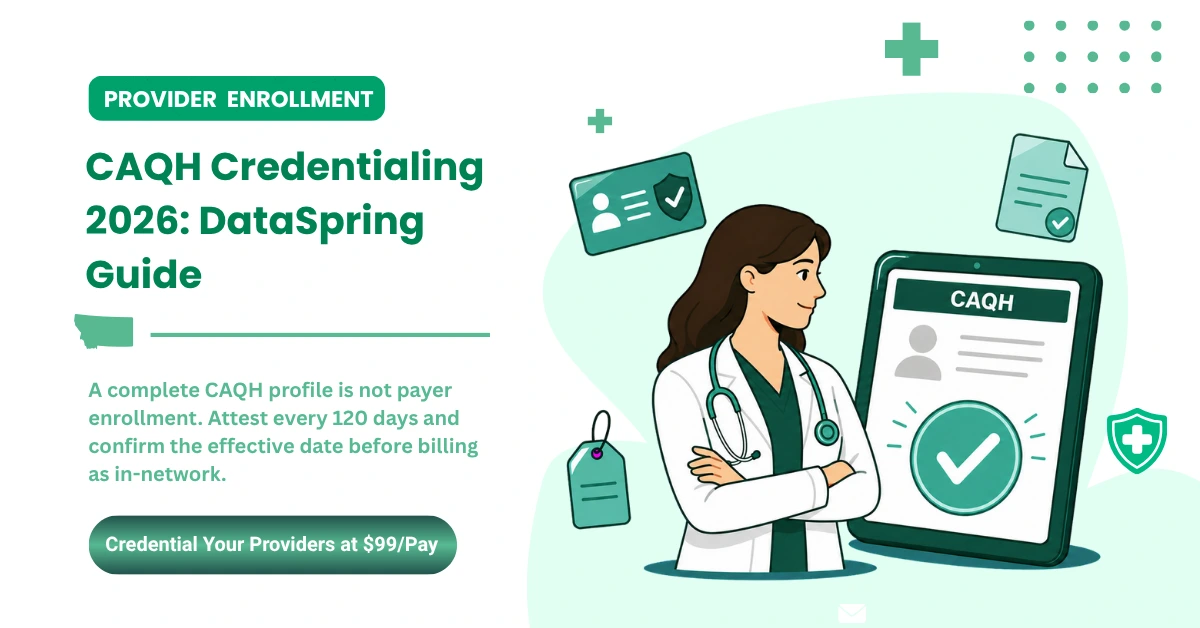




Healthcare providers create and maintain a profile in the CAQH Provider Data Portal so authorized health plans and healthcare organizations can access professional, licensing, education, practice, and liability information in one place instead of repeating it on every payer application.
Completing a CAQH profile does not by itself mean a provider is credentialed, contracted, enrolled, or active for billing with a health plan. CAQH credentialing centralizes provider data, but each health plan still runs its own credentialing, contracting, and enrollment process on top of it.
This guide covers registration, required documents, the CAQH ID, payer authorization, attestation, profile maintenance, and what has to happen after CAQH before a provider can bill as in-network. It has been updated for the 2026 DataSpring rebrand, covered next.
MedSole RCM put this provider-focused guide together to walk practices through the full process, from profile setup through payer enrollment and billing readiness.
2026 Update: CAQH Is Now DataSpring, Powered by CAQH
What Changed and What Stayed the Same?
CAQH now operates under the name DataSpring, powered by CAQH. Providers still use the same CAQH Provider Data Portal they always have, with the same login, the same saved profile, and the same documents and authorizations already on file.
The organization made the change public in mid-2026. DataSpring clinician guidance confirms that clinicians and group administrators continue entering information into the CAQH Provider Data Portal and sharing it with the plans they authorize, exactly as before.
|
2026 Terminology Update CAQH is now DataSpring, powered by CAQH. The provider system itself is still called the CAQH Provider Data Portal. Existing providers keep using their current profile and portal workflow with no changes required on their end. |
No provider action is required because of the name change. There is no new profile to build, no FHIR integration to buy, and no data migration to a different system. If a profile was complete and current before the rebrand, it stays that way after it.
One naming note matters for search and for older bookmarks. CAQH ProView was the former name of the provider portal. The current platform goes by the CAQH Provider Data Portal, and that is the name used throughout this guide.
What Is CAQH Credentialing?
CAQH credentialing is the process of creating and maintaining a healthcare provider profile in the CAQH Provider Data Portal so authorized health plans and healthcare organizations can access professional and practice information. Providers submit and maintain the data, and the portal cuts down on repeated applications and duplicate data entry across payers.
This process supports a health plan's own credentialing review. It does not make the plan's final decision. The payer still verifies the profile against primary sources and decides whether to credential and contract with that provider. Any complete answer to what is CAQH in healthcare has to include that distinction: a shared data source, not a decision-maker.
What Does CAQH Stand For?
CAQH stands for the Council for Affordable Quality Healthcare, the organization that built and still operates the Provider Data Portal under its new DataSpring brand. Health plans founded it more than 25 years ago to cut shared administrative work across the industry.
What Is the CAQH Provider Data Portal?
official Provider Data Portal guidance describes the CAQH Provider Data Portal as an automated platform where physicians, dentists, and other healthcare practitioners enter, update, and verify professional and practice information, then securely share it with the organizations they authorize.
Inside the portal, a practitioner enters professional information, uploads supporting documentation, reviews the file for errors, confirms it is accurate, authorizes specific plans and organizations, and keeps the profile current going forward.
Why Do Health Plans Use CAQH?
Health plans pull from CAQH provider data management to support initial credentialing, recredentialing, provider directories, network management, referral management, and routine provider data updates. One accurate source reduces the outreach calls plans would otherwise make directly to each provider.
|
CAQH Credentialing Definition CAQH credentialing is the process of building and maintaining a provider profile in the CAQH Provider Data Portal so authorized health plans can pull verified provider information for their own credentialing review. The portal supports credentialing; it does not replace the payer's decision. |
What CAQH Does and Does Not Do
CAQH vs. Credentialing vs. Contracting vs. Enrollment
CAQH centralizes and shares provider information. It does not independently approve network participation, issue a payer contract, establish an effective date, enroll a provider in Medicare, or guarantee that claims will be paid.
Each of those outcomes runs through a separate process, and mixing them up is what causes most of the confusion providers run into after finishing a CAQH profile.
|
Process |
Purpose |
Who Controls the Outcome |
|---|---|---|
|
CAQH profile |
Stores and shares provider data |
Provider controls data and authorization |
|
Credentialing |
Verifies qualifications and professional history |
Payer, health plan, CVO, or healthcare organization |
|
Contracting |
Establishes network and reimbursement terms |
Provider and payer |
|
Enrollment |
Loads the provider into payer systems |
Payer |
|
Billing activation |
Confirms claims can process under the correct provider record |
Payer and practice billing team |
A provider can have a complete, attested CAQH profile and still be waiting on credentialing, waiting on committee review, waiting on a signed contract, waiting on an effective date, or not yet loaded under the correct group or location.
Any one of those gaps keeps a claim from paying as in-network, because CAQH enrollment in the portal and payer enrollment in the payer's own system are not the same event.
What Happens After a Payer Accesses Your Profile?
Once a health plan pulls a provider's CAQH profile, it checks the application for completeness, verifies the credentials against primary sources, and may request additional information before moving forward. A credentialing decision follows, and contracting and enrollment continue from there.
Only after enrollment, an effective date, and billing status are all confirmed should a practice count that provider as ready to bill as in-network for that payer.
|
CAQH Complete but Enrollment Still Pending? MedSole RCM can review profile completeness, payer authorization, NPI and taxonomy alignment, application status, and missing payer actions through provider credentialing services. |
Who Needs a CAQH Profile?
Participation in the CAQH Provider Data Portal is not universally mandated for every healthcare provider. More than 1,000 health plans and healthcare organizations request or require network applicants to maintain a current profile, which makes it a practical necessity for most providers billing insurance even without a single federal mandate behind it.
Is CAQH Mandatory for Every Provider?
CAQH is not legally mandatory for every healthcare professional. A specific health plan may require it as part of its own credentialing process, and the requirement depends on the payer, the state, the network, and that payer's own application instructions. Confirm the current process directly with each payer before assuming CAQH is or is not required.
Which Provider Types Commonly Use CAQH?
Providers credentialing onto CAQH insurance panels most often fall into these types:
- Physicians and physician assistants
- Nurse practitioners
- Behavioral health clinicians and therapists
- Dentists
- Chiropractors
- Physical, occupational, and speech therapists
- Other licensed independent practitioners credentialing with commercial insurance panels
Not every facility or institutional provider uses CAQH. Some facilities and ancillary organizations go through separate payer applications for provider network management instead.
When Is a Different Enrollment System Required?
Medicare enrollment runs through PECOS, not CAQH. Medicaid enrollment may use a state-specific system. Some commercial payers use their own proprietary applications or a delegated CVO for CAQH provider network management instead. A completed CAQH profile can support commercial credentialing without replacing any of those other systems.
CAQH Credentialing Checklist: Information and Documents to Gather
Preparation determines how smoothly a CAQH profile comes together. Gathering the documents needed for provider credentialing before starting the CAQH application avoids the back-and-forth that stalls a file halfway through. Completion time still depends on the provider type and payer, so treat readiness as a head start, not a guaranteed timeline.
Provider Identity and Professional IDs
- Legal name and any previous professional names
- Date of birth and contact details
- Social Security number, entered directly in the secure application where required
- Individual NPI and any other relevant provider identification numbers
- Existing CAQH ID, if a profile already exists
Education, Training, and Work History
- Professional or medical school and graduation information
- Internship, residency, fellowship, and postgraduate training
- Complete work history, with explanations for any gaps
- Professional references and a current CV or resume
Licenses, Prescribing Credentials, and Certifications
- Active state professional licenses
- DEA registration and state controlled-substance registration, where applicable
- Board and specialty certifications, with expiration dates and issuing organizations
Practice Locations and Hospital Affiliations
- Primary and additional practice addresses, plus billing and correspondence addresses
- Practice phone, fax, and office manager or credentialing contact
- Telehealth locations, hospital affiliations, and admitting or coverage arrangements
Professional Liability and Disclosure Information
Provider Data Portal fact sheet confirms the portal is where providers upload and maintain documentation like this directly on the CAQH credentialing form itself. Gather:
- Malpractice insurance face sheet, policy limits, and effective and expiration dates
- Carrier information and claims history
- Disciplinary actions, sanctions, or adverse professional history where the application asks for it
CAQH ProView malpractice insurance requirements, now part of the current Provider Data Portal, vary by payer and network. Enter the current policy details and check what the specific payer receiving the application requires rather than assuming one universal coverage number.
Tax and Organizational Information
- W-9, legal business name, and any DBA
- Tax identification number and Type 2 organizational NPI
- Group affiliation, pay-to address, and ownership information where requested
|
Not Sure Whether Your Provider File Is Ready? A credentialing readiness review from MedSole RCM checks for missing documents, expired credentials, NPI inconsistencies, practice-location conflicts, and payer authorization issues before they turn into a stalled file. |
How to Complete the CAQH Credentialing Process Step by Step
Completing a CAQH profile runs through six steps: register or recover an account, enter provider and practice information, upload supporting documents, review the file for errors, authorize the health plans that should see it, then review and attest before it goes live.
Step 1: Register or Recover Your CAQH Account
New users complete CAQH registration directly through the CAQH portal registration page. So what is a CAQH number: it's the unique identifying number, also called a CAQH ID, tied to a provider's profile in the CAQH Provider Data Portal, and health plans may ask for it when connecting a payer application to that profile.
How to obtain a CAQH number comes down to two paths. Existing users should recover access instead of registering again, since a provider may already have a CAQH number from a previous employer, group, or payer relationship. That number stays associated with the individual provider across employment changes.
A fresh CAQH registration is only the right move for a provider entering the portal for the first time.
|
Already Have a Profile? Recover It, Don't Duplicate It. Providers who believe they already have a profile should use the account recovery process or contact official support before creating a second account. Duplicate accounts split provider data across two profiles and create their own credentialing delays. |
Step 2: Complete Provider and Practice Information
This step covers personal information, education, training, work history, specialties, professional IDs, practice locations, hospital affiliations, liability coverage, disclosure questions, and references. Every entry on the CAQH application should match the source documents exactly, since CAQH itself does not run the payer's full primary source verification. That step belongs to the payer or its credentials verification organization.
Step 3: Upload Current Supporting Documents
Uploaded documents need to be legible, current, and consistent with the profile. Names and identifiers should match what is entered elsewhere in the application, expiration dates need to be current, and the full page should be visible in the scan. Replace expired files with updated versions as soon as they renew.
Check separately whether a specific payer wants documentation beyond what CAQH collects.
Step 4: Review Errors and Data Inconsistencies
Before moving on, resolve:
- Missing required fields and conflicting dates
- Name inconsistencies and license-number formatting issues
- Work-history gaps and expired insurance
- Missing practice locations, incorrect NPI or taxonomy information, and inconsistent organization details
Step 5: Authorize Health Plans and Organizations
A provider has to allow each relevant plan or organization to access the profile before that payer can pull the data. Authorization settings deserve a second look any time a provider joins a new payer or changes groups, not only during initial setup.
Step 6: Review, Attest, and Submit the Profile
Attestation means the provider certifies that everything in the profile is accurate and complete. That certification is not a one-time step. Ongoing re-attestation keeps the profile active, and Section 9 covers exactly how often that has to happen.
|
Step |
Provider Action |
Desired Result |
|---|---|---|
|
1 |
Register or recover account |
Correct provider profile located |
|
2 |
Enter information |
Required fields completed |
|
3 |
Upload documents |
Current evidence available |
|
4 |
Review errors |
Inconsistencies corrected |
|
5 |
Authorize organizations |
Relevant plans can access data |
|
6 |
Attest |
Profile confirmed as accurate |
How CAQH Authorization and Payer Access Work
Providers control which participating organizations can access their CAQH profile information. Giving an organization access, applying to join its network, being credentialed, signing a contract, and receiving an effective date are five separate actions, and finishing one does not finish the others.
Global Authorization vs. Specific Authorization
Global authorization lets participating organizations access the profile broadly. Specific authorization limits access to selected organizations only. Providers should follow the instructions of the health plan or credentialing organization they are working with.
It is worth reviewing authorizations again any time a provider joins a new payer or changes groups. A more controlled approach fits some organizations and some provider circumstances better than a blanket setting.
Why a Health Plan May Not See Your CAQH Profile
A payer that cannot see a profile it should have access to is usually running into one of these:
- The payer was never authorized to view the profile
- The provider supplied the wrong CAQH ID on the payer application
- Profile data is incomplete or attestation is not current
- Required documents are missing
- The payer is searching under inconsistent provider information
- The payer does not use CAQH for that provider type, or requires a separate participation request first
Authorization Does Not Equal a Network Application
Authorizing a payer to access CAQH data does not notify every payer that a provider wants to join its network. A provider may still need to submit a participation request, complete a payer application, provide supplemental documentation, finish contracting, and confirm enrollment and an effective date.
Some of that authorization and attestation work happens electronically as part of the standard portal workflow, sometimes referred to by its formal name, the Standard Authorization, Attestation and Release. Payer-specific or state-specific forms can still apply on top of it, so check each payer's current instructions rather than assuming one process covers every plan.
Once the correct organizations can access the profile, the next responsibility is keeping the information current. Attestation deadlines, expired documents, NPI mismatches, practice changes, and enrollment errors can all interrupt the process if they are not managed consistently.
CAQH Attestation and Re-Attestation Requirements
CAQH attestation is the provider's confirmation that the professional, licensing, practice, liability, and disclosure information in the CAQH Provider Data Portal is accurate and complete. Providers generally need to review and re-attest to the profile every 120 days, even when nothing has changed.
Updating information, attesting to accuracy, re-attesting on schedule, and payer recredentialing are four different things. A provider can update a profile without formally attesting, and attesting does not by itself trigger a payer's separate recredentialing cycle.
What Is CAQH Attestation?
Attestation means the provider certifies the profile is accurate and complete as of that date. It does not mean the payer has approved the provider, that credentialing is finished, that the provider has joined a network, or that claims can now bill as in-network.
How Often Must Providers Re-Attest?
Standard CAQH reattestation runs on a 120-day interval. Illinois providers work on a 180-day cycle instead, a state-specific exception confirmed directly through DataSpring's current guidance. Providers should also update the profile immediately after any material change: a new practice location, a new license, a renewed malpractice policy, a changed hospital affiliation, a new specialty, or a new group association.
Update it right away rather than waiting for the next scheduled CAQH reattestation window.
What Happens When CAQH Attestation Expires?
A profile that is not re-attested within the required window moves to Expired status. From there, the profile may no longer appear current to authorized plans, a credentialing application may pause, recredentialing may be delayed, and the provider may need to correct expired documents before anything moves forward again.
Missing an attestation deadline does not automatically cause a claim denial, but it does stall the process behind it.
Re-Attestation vs. Payer Recredentialing
|
Process |
Meaning |
Typical Responsibility |
|---|---|---|
|
CAQH re-attestation |
Provider reconfirms profile accuracy |
Provider or authorized administrator |
|
Profile update |
Provider changes information or documents |
Provider or administrator |
|
Payer recredentialing |
Payer reviews provider qualifications again |
Payer, CVO, or delegated organization |
|
Continuous monitoring |
Ongoing checks between formal reviews |
Payer or credentialing organization |
How Long Does CAQH Credentialing Take?
A prepared provider can often complete the CAQH profile data entry in one working session. Full payer credentialing takes much longer, and the total timeline depends on application completeness, provider type, payer requirements, verification responses, contracting, committee review, and enrollment system loading.
Profile completion and payer credentialing are two different clocks. Finishing the profile quickly does not shorten the payer's own review, contracting, and enrollment steps that follow it.
Time to Prepare, Complete, and Get Credentialed
|
Stage |
Main Activity |
What Controls the Timeline |
|---|---|---|
|
Preparation |
Gather and correct documents |
Provider readiness |
|
Profile completion |
Enter data and upload files |
Number of locations, licenses, and history |
|
Profile correction |
Resolve missing or inconsistent fields |
Accuracy of submitted information |
|
Payer review |
Review and primary source verification |
Payer and verification sources |
|
Credentialing decision |
Committee or delegated review |
Payer process |
|
Contracting |
Review network terms |
Provider and payer |
|
Enrollment loading |
Add provider to payer systems |
Payer operations |
|
Billing confirmation |
Verify effective date and claim readiness |
Payer and billing team |
What Can Delay the Process?
- Expired documents and unexplained work-history gaps
- Payer access not granted, or name and NPI mismatches
- Incorrect taxonomy or missing practice locations
- An application not submitted directly to the payer, or missing supplemental forms
- Slow verification responses, contracting delays, or an incorrect group affiliation
Common CAQH Mistakes That Delay Credentialing
Most CAQH delays are not caused by the portal itself. They come from incomplete, expired, conflicting, or inaccessible provider information, and every one of these mistakes has a specific fix.
|
Mistake |
Why It Matters |
Corrective Action |
|---|---|---|
|
Expired license or insurance |
Payer may consider the file incomplete |
Upload the current document |
|
Unreadable scan |
Data cannot be confirmed |
Upload a complete, legible copy |
|
NPI or name mismatch |
Payer may not match the profile |
Compare CAQH and NPPES entries |
|
Work-history gap |
Payer may request clarification |
Add dates and explanations |
|
Missing payer authorization |
Plan cannot access the profile |
Review access settings |
|
Incorrect location |
Network record may be incomplete |
Add every active service location |
|
Wrong group affiliation |
Provider may be loaded incorrectly |
Confirm TIN, group NPI, and payer record |
|
Missed attestation |
Profile may appear outdated |
Review and re-attest |
|
Duplicate account |
Data may be split between profiles |
Recover the original account |
|
Wrong taxonomy |
Enrollment record may conflict |
Confirm the correct classification |
A lost or forgotten CAQH ID is not a reason to start over. A provider should attempt account recovery, confirm the email tied to the profile, locate the existing CAQH ID, and contact official support if recovery fails, rather than creating a second account and splitting the data between two profiles.
|
Profile Errors Can Delay the Entire Payer Application A CAQH profile support review from MedSole RCM checks for missing documents, expired files, account-access issues, payer authorization gaps, NPI and taxonomy conflicts, and group or location mismatches. |
Keep CAQH, NPPES, PECOS, W-9, and Payer Records Consistent
CAQH, NPPES, PECOS, tax records, and payer applications each serve a different purpose, but the core provider information across all of them should match exactly. A difference in legal name, NPI, taxonomy, TIN, practice address, group affiliation, or license information can slow enrollment and create payer-record discrepancies that take weeks to untangle.
|
System or Record |
Main Purpose |
Information That Must Align |
|---|---|---|
|
CAQH Provider Data Portal |
Shares provider information with authorized organizations |
Name, NPI, licenses, locations, specialty |
|
NPPES |
Maintains NPI and taxonomy information |
Legal name, addresses, taxonomy |
|
PECOS |
Medicare provider enrollment |
NPI, TIN, ownership, reassignment, locations |
|
W-9 |
Confirms tax identity |
Legal business name and TIN |
|
Payer application |
Requests network participation and enrollment |
Provider, group, tax, location, and specialty data |
|
Practice management system |
Supports billing operations |
Rendering, billing, pay-to, taxonomy, and locations |
Provider Name and NPI Alignment
A provider's professional name should match across the license, NPPES, CAQH, the payer application, and the W-9 where applicable. Maiden names, suffixes, hyphenated names, and any professional-name change deserve a direct check across every one of these records, including older entries that can still carry a prior name forward.
Taxonomy and Specialty Alignment
CMS taxonomy code guidance describes a taxonomy code as a unique 10-character code that designates a provider's classification and specialization, used when applying for an NPI. It should accurately represent the provider's actual classification. Taxonomy alone does not determine payer credentialing eligibility, but a mismatch between systems is a common source of enrollment friction.
Group, TIN, and W-9 Alignment
Individual NPI, organizational NPI, TIN, legal business name, DBA, group affiliation, and pay-to address are distinct data points, and mixing them up is one of the most common causes of a provider being loaded incorrectly under the wrong group record.
CAQH vs. NPI vs. PECOS
NPPES maintains the NPI data behind an NPI, which providers can confirm directly through the CMS NPI Registry. CAQH stores and shares provider credentialing information with authorized organizations, and the CMS PECOS enrollment system handles Medicare enrollment specifically.
None of these three systems replaces the other two. Credentialing data has to stay consistent with the systems used for claims, payment posting, denial resolution, and accounts receivable follow-up through revenue cycle management services.
How CAQH Credentialing Affects Medical Billing and Revenue
CAQH in medical billing shows up less in the codes on a claim and more in whether that claim can process as in-network at all. When provider, group, specialty, location, or authorization information is incomplete or inconsistent, a payer may delay enrollment, load the provider incorrectly, or request additional information before confirming billing status.
Enrollment Delays and Billing Readiness
Providers should not assume billing readiness until the practice has confirmed:
- Network participation and contract status
- A confirmed effective date
- The payer-assigned provider number where applicable
- Group association and approved service location
- Correct claim identifiers on file with the payer
Provider-Not-Loaded and Network-Status Problems
Inaccurate records can contribute to a provider showing as not found, not associated with the correct group, missing at a specific location, processed out-of-network, mismatched on taxonomy, or held in an enrollment hold, depending on the payer and how far the record drifted from what CAQH shows.
Effective-Date and Group-Affiliation Problems
A clinically qualified provider can still see claims affected if services were performed before the effective date, if the provider was enrolled individually but not under the group, if the correct location was never loaded, or if the billing system used the wrong provider or group data on the claim.
When Unpaid Claims Require Billing Follow-Up
Once credentialing looks complete on paper, unpaid claims tied to a credentialing gap may still need a payer call, enrollment verification, a claim-status review, a denial-code review, a corrected claim, effective-date confirmation, or a formal escalation. MedSole RCM's denial management services trace a denial back to its root cause instead of resubmitting the same claim blind.
Claims that stall in accounts receivable because of a credentialing gap need active follow-up, not a wait-and-see approach. MedSole RCM's AR follow-up services track every claim by aging bucket and payer behavior until it reaches a final, resolved status.
CAQH Profile Management for Group and Multi-Location Practices
Group practices need a repeatable CAQH management process because every provider maintains an individual profile while also being connected to practice, location, group, and payer records that all have to stay in sync as the roster changes.
Adding New Providers
Check for an existing CAQH profile and CAQH ID, current attestation, active licenses, correct group information and practice locations, payer authorization, and individual and group NPI alignment before submitting a new provider into any payer's queue.
Managing Practice Locations and Group Associations
Keep new service locations, closed locations, billing addresses, office contacts, group affiliations, hospital or facility relationships, and telehealth practice information updated as they change, not batched for a future cleanup.
Updating Departed Providers
When a provider leaves, remove obsolete practice associations, notify the relevant payers, update practice directories, confirm final billing responsibilities, protect account access, and document the departure date. The practice does not own an individual provider's CAQH profile, so departure updates run through notification and record cleanup rather than account transfer.
Multi-State and Telehealth Providers
Providers working across state lines or delivering telehealth need accurate state licenses, prescribing registrations, practice locations, telehealth details, payer-specific state enrollment, and malpractice coverage kept current in each state. One CAQH profile does not automatically enroll a provider in every state or every payer network.
When the provider roster grows past what internal staff can track consistently, outsourced credentialing support can reduce missed attestations, expired documents, and payer follow-up gaps.
When Should a Practice Outsource CAQH Credentialing?
Outsourcing tends to make sense once a practice cannot consistently maintain profiles, track expirations, coordinate payer applications, and verify enrollment outcomes on its own. It is not a universal requirement. A solo provider with one or two payer relationships may manage the process without outside help.
Signs Internal Management Is No Longer Sustainable
- Several providers or locations to track at once
- Frequent provider onboarding or multi-state enrollment
- Missed attestation deadlines or expired documents
- Payer applications with no consistent follow-up
- Inconsistent NPI or taxonomy records across systems
- No credentialing status tracker, or claims submitted before enrollment confirmation
What Professional Credentialing Support Should Include
A credentialing partner worth paying for manages account setup and recovery, profile completion, document collection, data validation, payer authorization, the attestation calendar, payer application submission and follow-up, recredentialing, effective-date verification, and provider roster reporting. Portal maintenance alone is not complete credentialing.
How MedSole RCM Supports the Full Process
MedSole RCM's CAQH credentialing services connect profile management, provider credentialing, payer enrollment, contracting support, Medicare enrollment, EFT and ERA setup, billing readiness, and ongoing revenue cycle operations under one team instead of splitting them across CAQH solutions and separate billing vendors.
Credentialing and enrollment support runs at $99 per payer, the same flat rate whether it is a standard network enrollment or a more involved credentialing rebuild, backed by a 99% first-time approval rate on submitted applications.
MedSole reports applications typically move 30 to 40% faster with dedicated follow-up than internal teams see managing the process alone. Claims can start paying up to two times faster once enrollment clears.
Once a provider is credentialed and enrolled, the same team can carry the work into outsourced medical billing services at 2.99% of collections, with no separate CAQH management fee layered on top. That combination puts MedSole among the most affordable options for practices comparing credentialing and enrollment support against the wider market.
CAQH Credentialing FAQs
What Is CAQH Credentialing?
It's the process of building and maintaining a provider profile in the CAQH Provider Data Portal so authorized health plans can access professional and practice information. The portal supports a payer's credentialing review without replacing the payer's own decision.
Is CAQH Free for Providers?
Yes. The CAQH Provider Data Portal carries no charge for providers. A payer may still have separate application requirements, and a practice may choose to pay a credentialing partner for management support, but that fee is not a CAQH portal charge.
Is CAQH the Same as an NPI?
No. An NPI is a provider identifier maintained through NPPES. CAQH stores and shares a broader set of credentialing information, including licenses, education, work history, and liability coverage, that goes well beyond what an NPI covers.
Does CAQH Replace Payer Credentialing?
No. A complete CAQH profile supports a payer's credentialing process, but the payer still makes the final network decision. Completion alone does not credential, contract, or enroll a provider.
How Often Must CAQH Be Attested?
Every 120 days for most providers, and every 180 days for providers in Illinois. Providers should also update the profile immediately after any material change instead of waiting for the next scheduled window.
What Happens if CAQH Attestation Expires?
The profile moves to Expired status. It may no longer appear current to authorized plans, and a pending credentialing or recredentialing application may be paused until the provider re-attests and corrects any expired documents.
How Do I Know if I Already Have a CAQH Profile?
Try account recovery first, confirm the email address tied to the profile, check for an existing CAQH ID from a past employer or payer relationship, and contact official support if recovery does not turn up an existing account.
Can a Provider Have Two CAQH Profiles?
Providers should maintain one individual profile. If access to an existing profile is lost, recover the original account rather than creating a second one, since a duplicate splits provider data across two records and complicates payer matching.
Which Insurance Companies Use CAQH?
Many commercial health plans and healthcare organizations participate, but usage varies by payer, provider type, state, network, and product. Confirm directly with each payer whether it requires or accepts a CAQH profile rather than assuming universal coverage.
Does Medicare Use CAQH?
Medicare enrollment runs through PECOS, not CAQH. A provider may still maintain a CAQH profile separately to support commercial payer applications alongside Medicare enrollment.
How Long Does CAQH Credentialing Take?
Profile data entry can often finish in one working session for a prepared provider. Full payer credentialing, contracting, and enrollment takes considerably longer and depends on the payer, application completeness, and verification responses.
What Documents Are Required for CAQH?
An NPI, active state licenses, DEA registration where applicable, current malpractice insurance documentation, complete work history, education records, board certification, practice locations, and professional references.
Do Nurse Practitioners Need CAQH?
Many commercial payers request a CAQH profile from nurse practitioners, though the exact requirement depends on the specific payer and network, the same way it does for physicians and other licensed practitioners.
What Happens After CAQH Is Complete?
A provider still needs to authorize the relevant payers, submit a participation application where required, respond to verification requests, complete contracting, and confirm both an effective date and billing readiness before treating that payer as active.
DataSpring clinician FAQ confirms the portal remains free for clinicians and that existing accounts, profiles, and saved links carry over without any required action.
Keep Your CAQH Profile Ready for Credentialing and Billing
CAQH credentialing centralizes provider information so authorized health plans can pull it once instead of asking for it repeatedly. Profile completion is not full payer enrollment, and treating the two as the same thing is where most credentialing delays start.
Accuracy, timely attestation, and consistency across CAQH, NPPES, PECOS, and payer records all matter more than most providers expect going in. Billing should start only after the effective date and enrollment status are both confirmed, not as soon as a profile shows complete.
MedSole RCM connects CAQH profile management with the credentialing, enrollment, and billing work that has to follow it, at $99 per payer for credentialing and 2.99% of collections for full-service billing, so nothing falls into the gap between a finished profile and a paid claim.
|
Move From Profile Completion to Payer Readiness Get a Get a Free Credentialing Review if you are dealing with incomplete CAQH profiles, missing payer authorizations, credentialing delays, incorrect group or location data, unconfirmed effective dates, or billing problems that started after enrollment. Explore MedSole RCM to see the full range of credentialing, billing, and revenue cycle support available under one team. |
Source Note
This guide was reviewed against current DataSpring, CMS, and NCQA resources. Payer and state requirements can vary, so providers should confirm the current instructions of each health plan before submitting an application.