



|
Key Takeaways
|
The Complete 2026 and 2027 Mammogram CPT Code Family
Mammography bills out of the 77046 to 77067 range of the CPT code set. Screening uses 77067. Diagnostic uses 77065 or 77066. Tomosynthesis rides along as an add-on code, and breast MRI opens the range at 77046 to 77049.
Picking the right mammogram CPT code comes down to five things: why the patient came in, how many breasts got imaged, whether the study was 2D or 3D, who’s paying, and who’s doing the billing. Miss one of the five and the claim comes back. The coding team at MedSole RCM works this family daily, and the rules below are the ones that decide whether a mammography claim clears on the first pass.
2026 and 2027 Mammography and Breast Imaging CPT Code Family
|
Code |
What it reports |
Screening or diagnostic |
Laterality |
Add-on or standalone |
|---|---|---|---|---|
|
77067 |
Screening mammography, including CAD when performed |
Screening |
Bilateral |
Standalone |
|
77063 |
Screening digital breast tomosynthesis |
Screening |
Bilateral |
Add-on to 77067 |
|
77065 |
Diagnostic mammography, including CAD when performed |
Diagnostic |
Unilateral |
Standalone |
|
77066 |
Diagnostic mammography, including CAD when performed |
Diagnostic |
Bilateral |
Standalone |
|
77061 |
Diagnostic breast tomosynthesis |
Diagnostic |
Unilateral |
Standalone CPT, not valid for Medicare |
|
77062 |
Diagnostic breast tomosynthesis |
Diagnostic |
Bilateral |
Standalone CPT, not valid for Medicare |
|
G0279 |
Diagnostic digital breast tomosynthesis (HCPCS) |
Diagnostic |
Unilateral or bilateral |
Add-on to 77065 or 77066 |
|
77046 |
MRI breast without contrast |
Either |
Unilateral |
Standalone |
|
77047 |
MRI breast without contrast |
Either |
Bilateral |
Standalone |
|
77048 |
MRI breast without and with contrast, including CAD |
Either |
Unilateral |
Standalone |
|
77049 |
MRI breast without and with contrast, including CAD |
Either |
Bilateral |
Standalone |
|
C8908 |
MRI breast without and with contrast (HCPCS, hospital OPPS) |
Either |
Bilateral |
Standalone |
|
76641 |
Ultrasound, breast, complete, including axilla when performed |
Either |
Unilateral |
Standalone |
|
76642 |
Ultrasound, breast, limited, including axilla when performed |
Either |
Unilateral |
Standalone |
|
76098 |
Radiologic examination, surgical specimen |
Diagnostic |
Not applicable |
Standalone |
|
77053 |
Mammary ductogram or galactogram, single duct |
Diagnostic |
Single duct |
Standalone |
|
77054 |
Mammary ductogram or galactogram, multiple ducts |
Diagnostic |
Multiple ducts |
Standalone |
|
G0202, G0204, G0206 |
Retired Medicare mammography G codes |
Deleted |
Deleted |
Do not bill |
CPT 2026 carried 418 total changes (288 new codes, 46 revisions, and 84 deletions), per the American Medical Association. CPT 2027 carries 453 (299 new, 74 revised, and 80 deleted), per the AMA’s 2027 release. Neither year added, revised, or deleted a code in the 77061 to 77067 mammography family, so a coder who knows this family has no new Category I mammography codes to learn for 2027. The new Category III codes are covered in the 2027 section below, and our roundup of 2027 CPT code changes covers the rest of the code set.
These codes sit inside the wider radiology section that runs 70010 to 79999. Our guide to radiology CPT code ranges maps all seven subsections for practices billing beyond breast imaging.
The Five Variables Behind Every Mammogram CPT Code
Every mammogram CPT code decision runs through the same five variables. Intent decides screening against diagnostic. Laterality decides one breast against both. Technology decides whether a tomosynthesis add-on joins the claim. Payer decides whether Medicare wants a G code. Component decides the modifier.
Mammogram CPT Code Decision Matrix by Intent, Laterality, Technology, and Payer
|
Clinical scenario |
2D code |
3D add-on |
Medicare variance |
Supporting diagnosis |
|---|---|---|---|---|
|
Routine screening, both breasts, 2D |
77067 |
None |
None |
Z12.31 |
|
Routine screening, both breasts, 3D |
77067 |
77063 |
None |
Z12.31 |
|
Screening, post-mastectomy, one breast |
77067 with modifier 52 |
77063, modifier 52 per payer |
Confirm payer policy |
Z12.31, plus Z90.11 or Z90.12 |
|
Diagnostic, one breast, 2D |
77065 with LT or RT (per payer) |
None |
None |
Finding-specific |
|
Diagnostic, one breast, 3D |
77065 with LT or RT (per payer) |
G0279 for Medicare |
77061 for some commercial plans |
Finding-specific |
|
Diagnostic, both breasts, 2D |
77066 |
None |
None |
Finding-specific |
|
Diagnostic, both breasts, 3D |
77066 |
G0279 for Medicare |
77062 for some commercial plans |
Finding-specific |
|
Screening converts to diagnostic, same day |
77067 with 59 or XU, plus 77065 or 77066 with GG |
Per study performed |
GG required by Medicare |
Both lines need their own |
What Changes for Mammography Billing in 2027
For mammography, 2027 is a payment and policy year more than a coding year. The Category I codes stay put. What moves is the conversion factor, a handful of new Category III codes, commercial cost-sharing on follow-up imaging, and how MQSA certificates reach the facility.
No Category I Changes, Three New Category III Codes
The AMA’s 2027 Category III file adds three codes that touch breast imaging. Category III codes track emerging services, and payers treat them differently from the codes above.
New 2027 Category III Codes That Touch Breast Imaging
|
Code |
What it reports (paraphrased) |
Effective |
Billing note |
|---|---|---|---|
|
1137T |
AI analysis of a screening mammogram dataset from a separate session, producing a 5-year breast cancer risk score |
January 1, 2027 |
Category III, payer-priced |
|
1138T |
The same AI risk score when the dataset comes from the same screening session |
January 1, 2027 |
Add-on, reported with 77067 |
|
1089T |
Intraoperative quantitative micro-elastography of breast tissue, per breast |
January 1, 2027 |
Not reported with 76098 |
Category III codes carry no national RVUs. Medicare contractors price them claim by claim or don’t cover them, and many commercial plans treat them as investigational, so check coverage before the study. The AMA released 1137T and 1138T on October 2, 2026, and they print in the CPT 2028 book, which means plenty of coding references won’t list them yet. The full descriptors sit in the AMA Category III code file.
The 2027 Conversion Factor Drops
For dates of service on or after January 1, 2027, the CY 2027 Physician Fee Schedule final rule sets the conversion factor at $32.9548 for qualifying APM participants and $32.6286 for everyone else, per CMS. That’s down 1.83% and 2.31% from 2026. The reimbursement section below walks through what else moved.
Follow-Up Imaging at $0 on Non-Grandfathered Commercial Plans
Non-grandfathered commercial plans now have to cover the additional imaging needed to complete a screening with no in-network cost-sharing. The rule applies to plan years beginning on or after December 20, 2025, so 2027 is the first full calendar year most practices will see it on every commercial remittance. The commercial section below covers the details.
Site-Neutral Payment Reaches Some Breast Imaging, Not Mammography
The CY 2027 OPPS final rule pays non-contrast imaging at excepted off-campus hospital departments at a physician fee schedule equivalent rate, with rural sole community hospitals exempt. Breast ultrasound and non-contrast breast MRI at those sites are likely to fall inside it, so check the final APC list for your codes. Mammography isn’t affected, because Medicare already pays hospital mammography under the physician fee schedule.
MQSA Certificates Moved Online
Since October 22, 2026, FDA delivers MQSA certificates through an online portal instead of the mail. The MQSA section below covers what changed and which facilities it skips.
CPT Code 77067: Screening Mammography, Bilateral
CPT 77067 reports bilateral screening mammography with computer-aided detection when performed, for patients who have no breast symptoms. It covers the routine annual exam, and it carries no patient cost under Medicare when the claim goes out as preventive.
CPT 77067 at a Glance: Descriptor, Laterality, Pairing, and Denial Risk
|
Field |
Value |
|---|---|
|
Full descriptor |
Screening mammography, bilateral (2-view study of each breast), including computer-aided detection (CAD) when performed |
|
Screening or diagnostic |
Screening |
|
Laterality |
Bilateral by definition |
|
Add-on or standalone |
Standalone |
|
CAD status |
Bundled into the code, never billed separately |
|
Medicare recognized |
Yes, since January 1, 2018 |
|
Required companion code |
None. 77063 is optional when 3D is performed |
|
Primary ICD-10 pairing |
Z12.31 |
|
Common modifiers |
26, TC (non-hospital technical billing), 52 |
|
Patient cost-sharing |
None under Medicare when billed as preventive |
|
Frequent denial |
A diagnostic-intent diagnosis on a screening claim |
The mammogram CPT code for a routine annual is 77067, for Medicare and for commercial payers that follow CPT. The descriptor defines a two-view study of each breast, the craniocaudal and the mediolateral oblique.
Why 77067 Is Always Bilateral
No unilateral screening code exists. 77067 describes a bilateral exam, so the descriptor already covers both sides without a modifier, and a one-breast screening gets reported as a reduced service. That structural fact drives two modifier rules later in this guide: modifier 52 for a unilateral screening, and no modifier 50 on this code.
Where 77067 Claims Break
She books the annual in September and mentions nothing at scheduling. On the table, while the tech positions her, she says she has been feeling something in the left breast. The order still reads screening. The claim goes out as 77067, and the diagnosis won’t support it.
Two changes stop that claim from ever leaving. Add one question to the scheduling script about new breast symptoms, and build a hard stop in the scrubber that blocks a symptom code from riding on a 77067 line.
CAD Is Already Inside the Code
CAD bills as part of 77067. The old CAD add-on codes, 77051 and 77052, were deleted January 1, 2017, so a claim that still reports either one rejects as an invalid code for the date of service, usually CARC 181. Medicare’s billing rules for mammography sit in Chapter 18, Section 20 of the Medicare Claims Processing Manual, which is worth keeping open while you build the edit.
CPT Codes 77065 and 77066: Diagnostic Mammography and Laterality
CPT 77065 reports diagnostic mammography of one breast. CPT 77066 reports both. Both bundle CAD when performed, and both apply when a patient has a symptom, a clinical finding, or a callback from a prior screening.
CPT 77065 Compared With CPT 77066: Purpose, Laterality, and Modifier Rules
|
CPT 77065 |
CPT 77066 |
|
|---|---|---|
|
Purpose |
Diagnostic evaluation of one breast |
Diagnostic evaluation of both breasts |
|
Laterality |
Unilateral |
Bilateral |
|
Typical trigger |
Symptom, finding, or recall confined to one side |
Findings on both sides, or a bilateral workup ordered |
|
Laterality modifier |
LT or RT, expected by many payers |
Not applicable, both sides sit inside the code |
|
Tomosynthesis add-on |
G0279 for Medicare |
G0279 for Medicare |
|
Patient cost-sharing |
Medicare: Part B deductible plus 20%. Non-grandfathered commercial: $0 when the study completes a screening |
Medicare: Part B deductible plus 20%. Non-grandfathered commercial: $0 when the study completes a screening |
Laterality Modifiers on Diagnostic Mammography Claims
Many payers expect LT or RT on a 77065 claim, and some contractor edits reject the line without one. A left breast study bills as 77065-LT and a right breast study bills as 77065-RT. 77066 takes no laterality modifier, because both sides already sit inside the descriptor.
Place of service and laterality are the two fields most likely to disagree on an imaging claim. Teleradiology makes it worse, since place of service has to reflect where the imaging happened rather than where the radiologist read it. Our guide to place of service codes maps which code applies in each setting.
One clarification worth making plain: 77065 covers one breast only. Some published sources describe it as unilateral or bilateral, which isn’t correct. Billing 77065 for a bilateral diagnostic study underpays the practice on every single claim it touches.
CPT 77063 and G0279: Tomosynthesis Add-On Rules
Medicare denies 77063 every time it goes out without 77067 on the same claim, and most commercial edits do the same. Tomosynthesis is where a correct mammogram CPT code still produces a denied claim, because the pairing matters as much as the code itself.
Why 77063 Never Bills Alone
77063 prices the 3D layer sitting on top of a 2D study, so no standalone service exists for a payer to reimburse. CMS states the rule in Chapter 9 of the NCCI Policy Manual, which identifies 77063 as an add-on code and confirms that beginning in calendar year 2018 it may be reported with 77067.
The clean version of the rule fits in one sentence. For Medicare, screening tomosynthesis bills as CPT 77063 in addition to CPT 77067, and diagnostic tomosynthesis bills as HCPCS G0279 in addition to CPT 77065 or 77066.
G0279 for Diagnostic Tomosynthesis
G0279 is the Medicare add-on for diagnostic tomosynthesis, and it attaches to 77065 or 77066 depending on laterality. 77063 never pairs with either diagnostic code. Sending 77063 alongside 77066 puts a screening add-on on a diagnostic claim, and the payer treats it that way.
The Frequency Edit That Takes Both Codes Down
The add-on depends on the primary code clearing its age and frequency checks first. When 77067 fails that screen, the 77063 line has nothing left to attach to, and the practice loses payment on a 3D study it already performed.
Confirm the screening interval before the study rather than after the remittance. The check takes seconds at scheduling, and once the date of service passes, the only protection left is an ABN the patient signed beforehand.
Where the 77063 Pairing Breaks in Practice
The charge master is where this starts. Somebody builds 3D mammography as its own line item, the tech performs both studies, and only the tomosynthesis charge drops into the claim. The 2D never posts, and 77063 goes out on its own.
A pairing edit closes it. When 77063 sits on a claim without 77067, the claim doesn’t leave the building. Skip that edit and the line comes back as a CO-97 bundling denial or a CO-B15, depending on the contractor, and the payer upholds it because the edit was correct on the date of service.
|
Pairing edits like this one are the cheapest denial prevention available in imaging billing. If 77063 rejections keep showing up on your remittance, a root-cause denial review will tell you whether the problem sits in the charge master or in the order. |
CPT 77061 and 77062: Diagnostic Tomosynthesis and the Medicare Substitution
CPT 77061 and 77062 report diagnostic breast tomosynthesis, unilateral and bilateral. Plenty of commercial payers accept both as written, which is why they stay in active use even though Medicare claims don’t take that route.
CMS builds its Medicare billing instructions for diagnostic tomosynthesis around G0279 reported with 77065 or 77066. 77061 and 77062 are valid CPT codes, but the Medicare fee schedule lists both with status indicator I, meaning not valid for Medicare. For a Medicare claim, follow the G0279 workflow. For a commercial claim, check the plan, because acceptance varies by payer.
Diagnostic Tomosynthesis Codes: CPT 77061, CPT 77062, and HCPCS G0279
|
Code |
Laterality |
Code type |
Medicare workflow |
Commercial acceptance |
|---|---|---|---|---|
|
77061 |
Unilateral |
CPT, standalone |
Status I; report G0279 with 77065 instead |
Accepted by many plans |
|
77062 |
Bilateral |
CPT, standalone |
Status I; report G0279 with 77066 instead |
Accepted by many plans |
|
G0279 |
Unilateral or bilateral |
HCPCS, add-on |
Report with 77065 or 77066 |
Varies by plan |
The practical read is short. One study, two possible codes, and the payer decides which one. A billing team that hard-codes one answer for every claim will be wrong on part of its payer mix every month.
There Is No Unilateral Screening Mammography Code
No unilateral screening mammography CPT code exists. CPT built the laterality into 77067 instead of writing a one-sided version of it.
The case that forces the question is the post-mastectomy patient coming in to screen her remaining breast. It comes up at almost every imaging center, and no code was written for it.
Most payers expect modifier 52 on 77067 to report the reduced service. That comes from ACR guidance and common payer practice rather than a national CMS instruction. Document in the report why only one side got imaged, and add Z90.11 or Z90.12 (acquired absence of the right or left breast) as a secondary diagnosis. When a unilateral screening tomosynthesis runs alongside it, payer rules on 77063 vary: some want modifier 52 there too, and others don’t.
Confirm payer policy before submission. A search for a unilateral mammogram CPT code returns nothing useful because the code has never existed, and the answer is a modifier on a bilateral code.
Retired Mammography Codes: G0202, G0204, G0206 and the January 2018 Transition
G0202 is dead. If it’s still sitting in your charge master, you’re generating denials for no reason, and no appeal will recover them.
The G-Code Transition Timeline: 2017 to 2018
CPT 77065, 77066, and 77067 took effect January 1, 2017. Medicare couldn’t process them that year because its claims systems weren’t ready, so CMS kept providers on the G codes for all 2017 dates of service. Both facts are true, and they cause most of the confusion.
Effective January 1, 2018, CMS Transmittal R3844CP deleted all three G codes under Change Request 10181, with an implementation date of January 2, 2018. G0202 crosswalks to 77067, G0204 to 77066, and G0206 to 77065.
Why the G-Code Myth Is Still Circulating
Two things keep it alive. CMS’s 2017 transition FAQ on mammography coding is still online, and it describes the G-code rule that applied that year. Coding references written during the transition year never got updated either.
The result is a rule that stopped being true on January 1, 2018 and still shows up in charge masters, superbills, and internal training decks. Any mammogram CPT code list showing G0202 as current was written before 2018 and hasn’t been touched since.
Every Retired Breast Imaging Code, With Its Replacement
Retired Breast Imaging Codes and Their Current Replacements
|
Retired code |
Claim line description |
Invalid from |
Replaced by |
|---|---|---|---|
|
G0202 |
Scr mammo bi incl CAD |
January 1, 2018 |
77067 |
|
G0204 |
Dx mammo incl CAD bi |
January 1, 2018 |
77066 |
|
G0206 |
Dx mammo incl CAD uni |
January 1, 2018 |
77065 |
|
77055, 77056, 77057 |
Prior mammography codes |
January 1, 2017 |
77065, 77066, 77067 |
|
77051, 77052 |
Prior CAD add-on codes |
January 1, 2017 |
CAD bundled into base codes |
|
77058, 77059 |
Prior breast MRI codes |
January 1, 2019 |
77046 through 77049 |
|
76645 |
Prior breast ultrasound code |
January 1, 2015 |
76641 complete, 76642 limited |
|
77031, 77032 |
Prior breast guidance codes |
January 1, 2014 |
19081 to 19086, 19281 to 19288 |
How to Find Retired Codes Before a Payer Does
Pull a claim history report and filter for G0202, G0204, or G0206 on any date of service from January 1, 2018 forward. Every hit is a template problem. Your coders aren’t choosing these codes; the system is handing them over.
|
A charge master carrying a retired code generates denials no appeal can fix, because the code was invalid on the date of service. When mammography denials keep landing in the same category, a root-cause denial review will show you whether the problem sits in the claim or in the template behind it. |
ICD-10 Pairing for Mammography Claims: Z12.31, R92, and What Supports Each Code
Z12.31 is the diagnosis code for a routine screening mammogram. It tells the payer the encounter was preventive, and a wrong entry in that field sinks an otherwise clean 77067 claim.
Every mammogram CPT code on a claim needs a diagnosis that justifies the study on its own. The screening codes are the strictest about it, because a preventive benefit only applies when the diagnosis says the visit was preventive.
Z12.31 and the Risk Codes That Ride as Secondary
Most screening claims carry Z12.31 on its own. When the patient screens at elevated risk, two secondary codes support the visit: Z80.3 for a family history of breast cancer, and Z15.01 for genetic susceptibility. Both ride as secondary, and Z12.31 stays primary on every screening mammogram claim. For breast screening by another method, such as a screening MRI or ultrasound, the screening code is Z12.39.
A personal history of breast cancer, coded Z85.3, doesn’t on its own push the encounter to a diagnostic code. Without an active clinical concern, a patient with a history can still get a routine screening billed under 77067.
R92 Codes for Abnormal and Inconclusive Findings
The R92 range covers abnormal and inconclusive findings on diagnostic imaging of the breast. R92.8 reports other abnormal findings, R92.2 reports an inconclusive study, and R92.1 reports mammographic calcifications. None of the three supports a screening claim.
Mammography CPT to ICD-10 Pairing by Clinical Scenario
|
Clinical scenario |
CPT code |
Primary ICD-10 |
Secondary ICD-10 |
|---|---|---|---|
|
Routine screening, asymptomatic |
77067 |
Z12.31 |
None required |
|
Screening, family history of breast cancer |
77067 |
Z12.31 |
Z80.3 |
|
Screening, genetic susceptibility |
77067 |
Z12.31 |
Z15.01 |
|
Screening, personal history of breast cancer |
77067 |
Z12.31 |
Z85.3 |
|
Screening, post-mastectomy, one breast |
77067 with 52 |
Z12.31 |
Z90.11 or Z90.12 |
|
Screening with breast density documented |
77067 |
Z12.31 |
R92.30 to R92.343 (density type and side) |
|
Diagnostic, palpable lump, right breast |
77065 with RT |
N63.10 to N63.15 |
As documented |
|
Diagnostic, palpable lump, left breast |
77065 with LT |
N63.20 to N63.25 |
As documented |
|
Diagnostic, abnormal prior imaging |
77065 or 77066 |
R92.8 |
As documented |
|
Diagnostic, inconclusive prior study |
77065 or 77066 |
R92.2 |
As documented |
|
Diagnostic, calcifications on prior study |
77065 or 77066 |
R92.1 |
As documented |
Dense Breast Tissue: R92.3- and the Confusion Around It
R92.3 itself can’t go on a claim. It’s the category header for mammographic density, created in FY2024, and the billable codes sit beneath it: R92.30 when the density category isn’t documented, and R92.311 through R92.343 for each density type with a right, left, or bilateral option. The FY2027 code set carries all of them forward unchanged.
Breast Density ICD-10 Codes (FY2027)
|
Density finding |
Right breast |
Left breast |
Bilateral |
|---|---|---|---|
|
Fatty tissue density (BI-RADS A) |
R92.311 |
R92.312 |
R92.313 |
|
Scattered fibroglandular density (BI-RADS B) |
R92.321 |
R92.322 |
R92.323 |
|
Heterogeneously dense (BI-RADS C) |
R92.331 |
R92.332 |
R92.333 |
|
Extremely dense (BI-RADS D) |
R92.341 |
R92.342 |
R92.343 |
|
Density category not documented |
R92.30 |
R92.30 |
R92.30 |
Patient-facing sources point coders toward R92.3, while billing sources point toward Z12.31, and the split creates real confusion at the keyboard. Both belong on the same claim. Z12.31 stays primary and establishes the screening encounter, and the density code rides as a secondary diagnosis when the report documents density. The R92.3- category also tells coders to add R92.2 when the study was inconclusive, which usually means the encounter has moved into diagnostic territory.
One laterality trap sits inside this range. R92.1 and R92.0 carry no side, even though the breast density codes in the same R92 family do offer right, left, and bilateral options. A coder reaching for laterality on a calcification code won’t find it.
Where the Diagnosis Pairing Breaks
The radiologist writes four precise paragraphs describing a structural finding, and the claim goes out with the unspecified symptom code that sat on the order. That comes back as a CO-50 medical necessity denial, and the appeal costs more staff time than fixing the order would have.
Route the report back to the coder before the claim builds. A diagnosis pulled from the radiologist findings holds up on review; a diagnosis pulled from the order often doesn’t.
Modifiers on Mammography Claims: 26, TC, 50, 52, and the Rest
Mammography carries a real professional and technical split, so the modifier on a mammogram CPT code depends on who’s billing rather than on what the technologist performed. Get the billing entity wrong and the modifier follows it into the denial.
Mammography Modifier Decision Matrix by Billing Scenario
|
Billing scenario |
Modifier |
Applied to |
Note |
|---|---|---|---|
|
One entity performs and interprets |
None, bill globally |
Base code |
Adding 26 or TC cuts the payment |
|
Radiologist bills interpretation only |
26 |
Base code |
Technical side billed separately |
|
Non-hospital entity bills technical only (CMS-1500) |
TC |
Base code |
Radiologist bills 26 separately |
|
Hospital outpatient bills technical (UB-04) |
None |
Base code |
Hospitals don’t use TC on institutional claims |
|
Unilateral screening, post-mastectomy |
52 |
77067; 77063 varies by payer |
Document why one side only, add Z90.11 or Z90.12 |
|
Diagnostic study, left breast |
LT |
77065 |
Expected by many payers |
|
Diagnostic study, right breast |
RT |
77065 |
Expected by many payers |
|
Same-day repeat, same physician |
76 |
Repeated code |
Document the clinical change |
|
Same-day repeat, different physician |
77 |
Repeated code |
The study itself was repeated, read by a different physician |
|
Screening converts to diagnostic |
GG |
Diagnostic code only |
Never on 77067 |
|
Screening line on a same-day conversion |
59 or XU |
Screening code |
Required by NCCI, covered below |
|
Bilateral procedure |
Never use 50 on 77067 |
Not applicable |
77067 is already bilateral |
Modifier 26 and TC: The Component Split
A radiologist billing the interpretation appends modifier 26. A freestanding imaging center or other non-hospital entity billing the equipment, the technologist time, and the overhead appends TC on the CMS-1500. Hospitals billing the technical side on a UB-04 report the code without TC. When one entity does both, the code bills globally with no modifier at all. Our modifier 26 professional component guide covers the interpretation side in depth.
The technical component usually carries the larger share of the global payment, and the ratio shifts from code to code. The TC modifier billing rules guide walks through the equipment side and the place-of-service field that travels with it.
The duplicate global is the component error that costs the most. When the facility and the reading group both submit the global code for the same study, one or both deny as duplicates. That error surfaces on audit instead of on the remittance, so it runs for months before anybody catches it.
|
Component splits break at the claim-build level. When the facility and the reading group both bill globally across a payer mix, appealing the denials won’t fix the split underneath them. That work belongs inside outsourced medical billing services, where the split gets set correctly before the claim goes out. |
Why Modifier 50 Never Belongs on 77067
77067 is bilateral by definition, so modifier 50 double-counts what the code already includes. The instinct comes from other bilateral radiology codes where 50 does apply, and some claim scrubbers built for imaging will prompt for it. Ignore that prompt on 77067.
Laterality, Repeat, and Distinct-Service Modifiers
LT and RT go on unilateral diagnostic studies. Modifier 76 marks a same-day repeat of the study by the same physician, and 77 marks a repeat by a different physician. A second read of the same images isn’t a repeat, and Medicare generally pays one interpretation. Modifier 59 and the X modifiers mark distinct services, and NCCI accepts either 59 or XU on the screening line of a same-day conversion.
When a Screening Mammogram Converts to Diagnostic on the Same Day
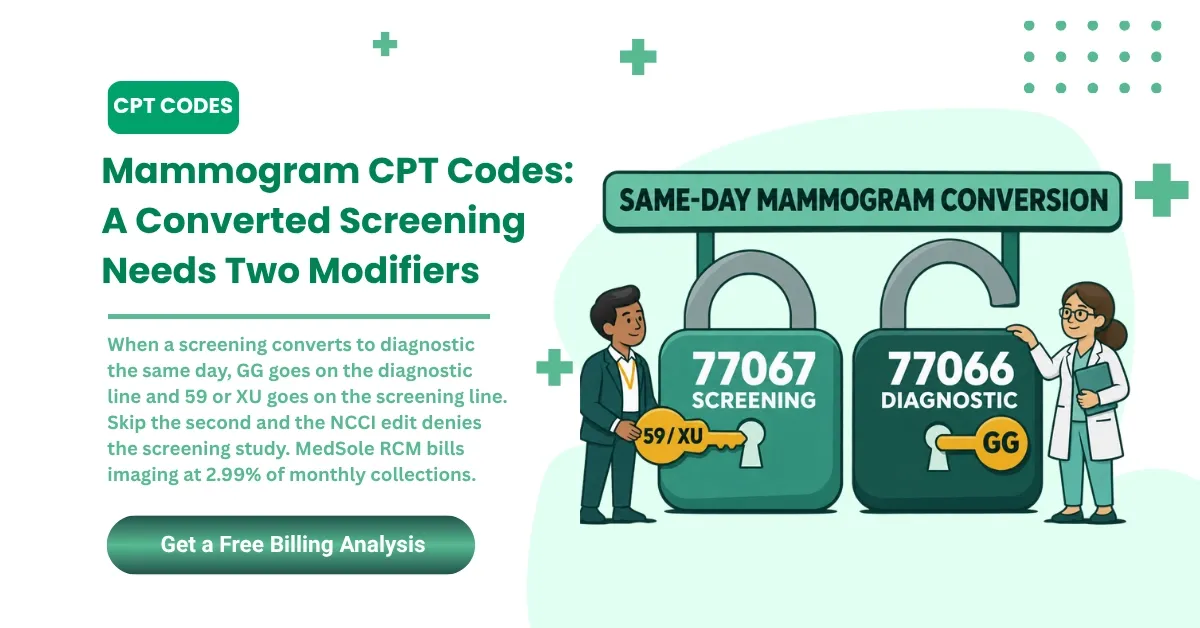
A same-day conversion takes two modifiers. Most billing teams apply one of them, and the second is the one CMS put in writing.
Modifier GG on the Diagnostic Line
Modifier GG goes on the diagnostic code, 77065 or 77066, and on G0279 when diagnostic tomosynthesis is added. Medicare pays both the screening and the diagnostic study, and GG tells Medicare the two came out of the same visit. GG never goes on 77067.
The Modifier Most Teams Miss on the Screening Line
The screening line needs modifier 59 or XU. Chapter 9 of the NCCI Policy Manual states it in one sentence: when screening and diagnostic mammography happen on the same date of service, Medicare requires the diagnostic mammography code to carry modifier GG and the screening mammography code to carry modifier 59 or XU.
Leave the screening line bare and the NCCI edit between the two codes denies it. The denial that comes back points at a modifier problem instead of at the conversion that caused it. Our modifier 59 and X modifiers guide covers the selection logic between 59 and XU.
What the Conversion Looks Like in the Reading Room
She comes in for her annual. The radiologist sees a density on the images and orders spot compression views before she leaves the building. One appointment, two billable exams, one claim, and two modifiers that have to be right.
No New Order Is Needed While She’s Still at the Facility
If the patient is still at the facility for the screening, the radiologist who reads it can order and interpret the additional views without a new order from the treating physician, under Chapter 18, Section 20.6 of the Medicare Claims Processing Manual. A note in the reading report covers the documentation, and the patient skips a second trip. Once she leaves, a return visit needs a standard order.
The GH Modifier Question
Some sources still list GH for a same-day conversion. GH is an older HCPCS modifier Medicare used from October 1998 through 2001, when it paid only the diagnostic study. Since January 1, 2002, Medicare instructions have used GG on the diagnostic line. Chapter 18 still tells contractors to accept GH where appropriate, and some commercial payers ask for it, so check the payer policy before writing GH into an internal rule.
Build the modifier logic into the scrubber instead of into a training document. Same-day conversions happen too often to catch from memory, and the staff working that queue next year won’t be the staff who learned the rule this year. A missing component modifier comes back as a CO-4 modifier denial, which reads as a coding error when the cause was a workflow gap.
|
Same-day conversions are where the correct mammogram CPT code and the correct modifier stop being the same problem. MedSole RCM runs full-service billing at 2.99% of collections, and the modifier logic on a converted screening gets applied at claim build rather than caught on the remittance. |
Medicare Coverage for Mammography: Age Limits, Frequency, and Cost-Sharing
Medicare Part B covers one screening mammogram every 12 months for female beneficiaries age 40 and older, and one baseline screening for ages 35 to 39. There’s no upper age limit on the screening benefit.
Medicare Mammography Coverage by Age, Frequency, and Patient Cost
|
Service |
Age |
Frequency |
Patient cost |
|---|---|---|---|
|
Baseline screening |
35 to 39 |
Once in a lifetime |
None when assignment is accepted |
|
Screening mammography |
40 and older |
Once every 12 months, no upper age limit |
None when assignment is accepted |
|
Diagnostic mammography |
Any age, when medically necessary |
No frequency limit |
Part B deductible plus 20% coinsurance |
The 11-Month Rule Behind the Annual Benefit
Patients hear annual. The claims system runs on a different clock: at least 11 full months following the month of the last screening. A January screening starts the count in February, so the next covered study opens the following January.
Bill it a month early and Medicare denies the line, typically CO-119 with remark code M90, or M89 for a repeat baseline at ages 35 to 39. Without a signed ABN, the practice usually absorbs that loss, because the interval was wrong on the date of service and nothing in the documentation changes it.
Where the Frequency Denial Starts
The front desk books the annual at the same time each year. The patient calls to move it two weeks earlier for a trip, nobody rechecks the interval, and the claim denies. The practice already did the work and already paid for the study.
Confirm the last screening date at scheduling rather than at billing. The check takes about 30 seconds, and it catches the problem while the patient is still on the phone. When the date can’t be confirmed, give the patient an Advance Beneficiary Notice before the study; a signed ABN with modifier GA moves the liability to her if Medicare denies. Benefit verification before the visit runs that check 24 to 48 hours ahead of every appointment.
|
A frequency denial without a signed ABN is money the practice rarely gets back, because the interval was already wrong when the study happened. Practices that catch these at scheduling stop paying for studies they won’t collect on. That check sits inside full-service billing at 2.99% of collections, and it runs on every mammography appointment on the schedule. |
What the Patient Owes on Screening Versus Diagnostic
A screening mammogram carries no patient cost under Medicare when the provider accepts assignment. No deductible, no coinsurance. The moment the study converts to diagnostic, the Part B deductible and 20% coinsurance apply to the diagnostic portion of the encounter. Non-grandfathered commercial plans now work differently, which the commercial section below covers.
That shift catches Medicare patients off guard, and the complaint lands on the billing team rather than on the radiologist who ordered the extra views. Front-desk staff who can explain the conversion in one sentence prevent most of those calls.
The Screening Population and the Preventive Visit Codes
The baseline population overlaps with the preventive medicine codes for younger adults, covered in our preventive visit codes 18 to 39 guide. For patients 40 and older, the mammogram CPT code gets scheduled around the annual wellness visit, and our guide to preventive visits ages 40 to 64 covers the evaluation and management code traveling with it.
2026 and 2027 Mammography Reimbursement: Conversion Factors, RVUs, and the Efficiency Adjustment
Medicare prices a mammography code by multiplying its relative value units by an annual conversion factor, then adjusting the result for the locality where the service happened. Three numbers decide the payment, and the conversion factor and the RVUs both moved in 2026 and again in 2027.
The Conversion Factors for 2026 and 2027
Since 2026, Medicare has run two conversion factors: one for qualifying participants in an advanced alternative payment model, and one for everyone else. Most radiology groups aren’t qualifying APM participants, so most are paid at the lower figure.
Medicare Physician Fee Schedule Conversion Factors, 2026 and 2027
|
Year |
Qualifying APM participants |
All other clinicians |
Change from prior year |
|---|---|---|---|
|
2026 |
$33.5675 |
$33.4009 |
First year of two conversion factors |
|
2027 |
$32.9548 |
$32.6286 |
Down 1.83% and 2.31% |
The 2027 drop comes mostly from the one-year 2.5% statutory increase for 2026 expiring, plus a small budget-neutrality adjustment, per the CMS fact sheet. Congress has changed the conversion factor late in the year before, so check it again after any year-end legislation.
Why This Page Does Not Publish a Rate Table
Published rate figures for mammography disagree with each other, and the spread between them is wide enough to break a revenue projection. Pull the current values for your own locality from the CMS Physician Fee Schedule instead of copying a number off a coding page.
The math is short once you have the RVUs. Total RVUs multiplied by the conversion factor, adjusted by the geographic practice cost index for your area. The same mammogram CPT code pays differently in Phoenix than it does in Boston, and no national figure survives that adjustment.
The Efficiency Adjustment Carries Into 2027
CMS finalized a negative 2.5% efficiency adjustment for CY 2026 that reduces work RVUs and the intraservice portion of physician time for non-time-based services. Diagnostic imaging sits inside that group, and time-based codes are excluded. The cut lands on the work side, which is most of the professional component; the technical component has no work RVUs.
For 2027, CMS kept the 2026 reduction in place without adding a new one, and it plans to revisit the adjustment on a three-year cycle. With the conversion factor also falling, mammography payment drops in 2027 unless practice expense changes offset it. Model the net figure for your own codes before you build next year’s budget.
Modifier 26 Services Sit Outside the Facility Practice Expense Cut
Beginning in 2026, Medicare halved the work-RVU-based indirect practice expense allocation for services furnished in a facility setting. CMS said services billed with modifier 26 aren’t affected, because it values the professional component the same in every setting. The efficiency adjustment still applies to their work RVUs.
For 2027, CMS also began phasing out the indirect practice cost index over two years, and it now allocates indirect practice expense using both work RVUs and clinical labor RVUs. For a reading group that bills nothing but 26, those details change the revenue model, and most published summaries skip them. Our guide to radiology reimbursement covers how the same changes land across the rest of the imaging code set.
Facility Versus Professional Billing: Revenue Codes, Place of Service, and the UB-04
Revenue code 0403 reports screening mammography on an institutional claim. Revenue code 0401 reports diagnostic. Put a screening study under 0401 and the claim misroutes before anybody looks at the CPT code on it.
A revenue code mismatch on a UB-04 produces a return-to-provider or a denial ahead of the coding review. The claim never reaches the stage where the mammogram CPT code matters, which is why hospital outpatient departments track this field with the same care they give the procedure code.
Hospitals bill the technical side without a TC modifier, and Medicare pays hospital outpatient mammography under the physician fee schedule rather than OPPS. G0279 on an institutional claim needs revenue code 0401 (or 096X, 097X, or 098X) and an outpatient type of bill such as 12X, 13X, or 85X, or the claim comes back to the provider.
Place of Service on a Modifier 26 Claim
On a modifier 26 claim, place of service reflects where the imaging happened rather than where the radiologist read it. Teleradiology makes that error routine, and it stays invisible until the payer recoups. Our POS 24 facility claims guide covers how the setting drives the field.
Mammography Billing by Setting, Claim Form, and Revenue Code
|
Setting |
Claim form |
Who bills what |
Revenue code |
|---|---|---|---|
|
Freestanding imaging center, global |
CMS-1500 |
One entity bills globally, no modifier |
Not applicable |
|
Hospital outpatient, technical side |
UB-04 |
Facility bills the technical portion, no TC modifier |
0403 screening, 0401 diagnostic |
|
Hospital outpatient, professional side |
CMS-1500 |
Radiologist bills with modifier 26 |
Not applicable |
|
Physician office, global |
CMS-1500 |
Practice bills globally |
Not applicable |
MQSA Certification: The Compliance Gate Behind Every Mammography Claim
No current MQSA certificate, no payment. A scrubber can confirm the certification number is on the claim, but only a tracked renewal calendar keeps the certificate from lapsing.
Every facility that performs mammography needs a current certificate under the Mammography Quality Standards Act. FDA issues it, or a State Certifying Agency does in Illinois, Iowa, South Carolina, and Texas, after an FDA-approved accreditation body accredits the facility. Certification covers equipment quality, the qualifications of the interpreting physicians, technologists, and medical physicists, and the quality of the clinical images themselves.
The October 2026 Certificate Delivery Change
Since October 22, 2026, FDA no longer mails MQSA certificates or certification letters. They arrive through the MQSA Facility Portal, and downloading them is the facility’s job. A transition period ran from September 14, 2026 to that date, so some sites got both a mailed document and a portal email; confirm which one yours received.
Facilities still have to print and display the certificate. Facilities certified by a State Certifying Agency in Illinois, Iowa, South Carolina, or Texas aren’t affected and keep getting certificates from their state.
Where the MQSA Denial Shows Up
Medicare checks every mammography claim against FDA certification data, and Part B claims must carry the facility’s six-digit FDA certification number. A missing or invalid number comes back as CO-16 with remark code MA128. A site that isn’t certified for the service billed gets CO-B7 with N570.
Two sites in the same group often hold different renewal dates. One lapses, claims from that site deny while the other site pays as normal, and the pattern reads like a coding problem for weeks before anybody checks a certificate. Assign an owner, track each site’s renewal date on its own, and flag it 90 days out so the paperwork moves before the claims stop.
Commercial and Medicaid Mammography Rules, and Why Screening Guidelines Cause Denials
Every payer accepts the same mammogram CPT code set. Coverage rules wrapped around those codes vary by plan, by state, and by product line. Commercial payers write their own age and frequency rules within federal minimums, and Medicaid rules vary by state and by plan. Neither follows Medicare by default, and a practice that builds one workflow on the Medicare rule will see it fail across part of its payer mix every month.
Mammography Coverage Variance by Payer Type
|
Payer type |
Screening age |
Frequency |
Diagnostic cost-sharing |
3D add-on treatment |
|---|---|---|---|---|
|
Medicare Part B |
40 and up, baseline 35 to 39 |
Every 12 months |
Deductible plus 20% |
77063 paid with 77067 |
|
Medicare Advantage |
Follows the Part B minimum |
Plan may exceed the minimum |
Set by the plan |
Set by the plan |
|
Non-grandfathered commercial |
Start between 40 and 50 under HRSA guidelines |
Every 1 to 2 years |
$0 for follow-up imaging that completes the screening |
Varies; some apply cost-sharing to 77063 |
|
Medicaid |
Set by the state |
Set by the state |
Set by the state |
Set by the state |
Follow-Up Imaging Is Now $0 on Non-Grandfathered Commercial Plans
HRSA updated its Women’s Preventive Services Guidelines in December 2024. Non-grandfathered group and individual plans must now cover the additional imaging and pathology needed to complete a breast cancer screening with no in-network cost-sharing. That includes a diagnostic mammogram, ultrasound, or MRI ordered off a screening finding. The rule applies to plan years beginning on or after December 20, 2025, which is the 2026 plan year for calendar-year plans, per HRSA.
Two limits matter at the front desk. The guideline covers women at average risk, and it doesn’t apply to Medicare, where the diagnostic study still carries the Part B deductible and 20%. The same update added patient navigation services for breast and cervical cancer screening.
The Find It Early Act (S.1410), which would extend no-cost coverage to supplemental imaging for women with dense breasts or higher risk, hadn’t moved out of committee as of November 2026. Bills that don’t pass before the 119th Congress ends on January 3, 2027 have to be reintroduced, so treat it as a watch item rather than a coverage rule.
The Commercial Trap on the 3D Add-On
Watch for plans, especially self-funded plans that state tomosynthesis mandates don’t reach, that cover the 2D component at no cost while applying cost-sharing to the 3D add-on. That shows up as two line items on a statement for a study the patient expected to be free, and the call lands on your front desk rather than on the payer.
Guideline Divergence Is a Frequency Denial Problem
Screening interval recommendations differ across the major clinical bodies. The USPSTF’s 2024 recommendation calls for screening every two years from 40 to 74, other groups recommend annual screening, and the HRSA guidelines let plans cover anywhere from every year to every two years.
The clinical debate over intervals isn’t a billing debate, and this guide takes no position on it. The billing consequence is concrete. When a plan builds its frequency edit on a two-year recommendation and the practice schedules annually on a different one, the second-year claim denies.
Read the frequency rule in the plan document rather than in the clinical guideline your ordering providers follow. The two don’t have to agree, and the payer’s version is the one that pays. Filing windows move the same way between payer types, which our guide to the Medicare timely filing limit works through in detail.
Why Mammography Claims Get Denied: Six Causes and the Reason Codes Behind Each
Most mammography denials trace to six causes. Each one maps to a reason code, and most of them start before a coder touches the claim. A denied claim carrying a correct mammogram CPT code points at something other than the code, so reading these as coding problems sends the fix to the wrong department.
Mammography Denial Causes, Reason Codes, and Upstream Fixes
|
Denial cause |
Typical reason code |
Upstream fix |
|---|---|---|
|
Diagnostic-intent diagnosis on a screening claim |
CO-11 or CO-50 |
Hard edit blocking a symptom code on a 77067 line |
|
77063 submitted without 77067 |
CO-97 or CO-B15, depending on the contractor |
Pairing edit that holds the claim in the scrubber |
|
Screening billed before the 11-month window closes |
CO-119 with M90 (M89 for a repeat baseline) |
Confirm the last screening date at scheduling; ABN when unsure |
|
Missing or wrong component modifier |
CO-4 |
Build modifier rules from billing entity and place of service |
|
Retired G code still in the charge master |
CO-181, invalid code for the date of service |
Annual charge master audit against the current code set |
|
MQSA certification number missing, or site not certified |
CO-16 with MA128, or CO-B7 with N570 |
FDA certification number in the claim template; renewal calendar for each site |
Working the Pattern Instead of the Claim
Working one denial fixes one claim. Finding the pattern behind it stops the next ten. Categorize by reason code, appeal with the documentation the payer asked for, and route the cause back to whoever can prevent it: the front desk, the coder, or the ordering provider. A denial pattern review does that categorization across a full sample instead of one claim at a time.
|
If next month’s report shows the same three denial categories, the cause sits upstream of the appeal. MedSole RCM works each claim, documents the root cause, and routes it back to the person who can stop the repeat. Inside full-service RCM at 2.99% of collections, denial management runs at no separate charge. |
None of these six needs an appeal when the edit runs before submission. A rule in the scrubber costs an afternoon of configuration. An appeal costs staff hours plus the cash-flow delay while the claim sits, and accounts receivable recovery on an aged mammography claim gets harder every week it waits.
Claim Description to CPT Code: A Reverse Lookup for Mammography
Billers search the text printed on a charge line or an old claim. When a description nobody on the team recognizes shows up, that text is the only thing to search on. The CMS short descriptors below are the ones most likely to surface; charge-description text for other codes varies by system, so match on the code.
Mammography Short Descriptors and Their HCPCS Codes
|
Short descriptor |
Code |
Current status |
|---|---|---|
|
Scr mammo bi incl CAD |
G0202 |
Retired January 1, 2018, crosswalk to 77067 |
|
Dx mammo incl CAD bi |
G0204 |
Retired January 1, 2018, crosswalk to 77066 |
|
Dx mammo incl CAD uni |
G0206 |
Retired January 1, 2018, crosswalk to 77065 |
|
Tomosynthesis, mammo |
G0279 |
Current, Medicare add-on to 77065 or 77066 |
If one of the retired descriptions prints on your claims today, the charge master is where to look. The coder picking codes never sees that string, because the system generates it after the code is selected.
Adjacent Breast Imaging Codes: Ultrasound, MRI, and the Combined Encounter
Ultrasound, MRI, and biopsy codes show up on the same encounters as mammography, and the pairing rules between them cause as many denials as the mammogram CPT code selection itself.
Breast Ultrasound: 76641 and 76642 Are Both Unilateral
76641 and 76642 are both unilateral codes, and both include the axilla when performed. 76641 reports a complete study and 76642 a limited one. No single CPT code reports a bilateral breast ultrasound.
Bill 76641 or 76642 with modifier 50, or with RT and LT, depending on what the payer prefers. A practice reporting 76642 once for a bilateral study is billing one side and performing two, every time it happens.
Mammogram and Ultrasound on the Same Day
When a diagnostic mammogram and a breast ultrasound happen at the same visit, they bill as separate line items. Each line needs its own supporting diagnosis: one for the mammographic finding, and one for the reason somebody ordered the ultrasound.
Chapter 9 of the NCCI Policy Manual adds a rule most teams miss. When a biopsy, wire localization, clip placement, or other breast procedure is done under mammographic guidance, such as 19281 or 19282, the post-procedure mammogram isn’t billed separately. Those images already sit inside the guidance code.
That one catches practices doing a same-day biopsy. The pre-procedure diagnostic mammogram bills. The post-procedure confirmation mammogram doesn’t, and billing it produces a bundling edit rather than a second payment.
Breast MRI: 77046 Through 77049, and How C8908 Differs
77046 reports a unilateral breast MRI without contrast, 77047 the bilateral version, 77048 unilateral without and with contrast, and 77049 bilateral without and with. 77048 and 77049 include CAD when performed; 77046 and 77047 don’t mention it. Codes 77058 and 77059 were deleted January 1, 2019.
Hospitals billing Medicare under the outpatient prospective payment system report contrast breast MRI with C8903, C8905, C8906, or C8908, and C8908 is the bilateral without-and-with study that matches 77049. Physician offices, freestanding imaging centers, and professional claims use 77048 or 77049. Non-contrast breast MRI bills as 77046 or 77047 in every setting.
The setting and the payer decide which code applies. The procedure is identical either way, which is why many payers crosswalk C8908 and 77049 for authorization purposes.
Mammography Claim Checklist: What to Confirm Before Submission
Run every mammography claim through this list before it leaves. The mammogram CPT code is one of 18 fields that has to be right, and each line below traces back to a rule covered above.
Pre-Submission Checklist for Mammography Claims
|
Checkpoint |
Confirm |
|---|---|
|
Patient status |
Asymptomatic for screening, documented finding for diagnostic |
|
Age |
40 or older, or a documented baseline for ages 35 to 39 |
|
Frequency |
At least 11 full months since the last screening, or a signed ABN |
|
Primary diagnosis |
Z12.31 for screening, finding-specific code for diagnostic |
|
Density code |
R92.30 to R92.343 as a secondary code when documented, never R92.3 |
|
Views |
Two views of each breast documented for a screening study |
|
CAD |
Documented in the report, never billed as a separate line |
|
Add-on pairing |
77063 present only alongside 77067 |
|
Diagnostic tomosynthesis |
G0279 with 77065 or 77066 for Medicare |
|
Component modifier |
26 or TC applied by the correct billing party; no TC on a UB-04 |
|
Unilateral screening |
77067-52 with Z90.11 or Z90.12; payer rules on 77063 checked |
|
Same-day conversion |
GG on the diagnostic code, 59 or XU on the screening code |
|
Bilateral modifier |
Modifier 50 never appended to 77067 |
|
Laterality |
LT or RT on unilateral diagnostic studies when the payer expects it |
|
Revenue code |
0403 screening, 0401 diagnostic on institutional claims |
|
FDA certification number |
Six-digit MQSA number on every Part B mammography claim |
|
Facility certification |
MQSA certificate current for the performing site |
|
Legacy codes |
G0202, G0204, and G0206 removed from every template |
A leftover retired code in a superbill is one of the easiest denials to prevent. It survives audits, passes internal review, and keeps generating rejections until somebody opens the template and deletes it.
|
This is the same scrub MedSole runs across a full sample of mammography claims during a free billing analysis. If you want to know how many of your claims clear all 18 rows, that’s the question the review answers. |
Mammography Billing and Credentialing Services From MedSole RCM
This section is for radiology groups splitting professional and technical components across entities, imaging centers billing the technical side, hospital outpatient departments reconciling revenue code mapping, and the ordering specialties that generate mammography volume: OB/GYN, primary care, and breast surgery. All of them bill the same mammogram CPT code set and hit different versions of the same denials.
What Mammography Billing Includes at 2.99% of Collections
MedSole RCM prices full-service medical billing at 2.99% of collections. Most medical billing companies charge between 4% and 7% of collections, and a number of them add setup fees, software fees, or per-statement charges on top. There’s no setup fee and no long-term contract.
At that rate, a practice collecting $100,000 a month pays $2,990. The same practice at a 6% billing company pays $6,000, which comes to $36,120 more every year for the same scope of work.
- Eligibility and benefit verification before the study, including the screening interval check
- Coding review against the radiologist documentation rather than against the order
- Modifier logic applied at claim build, covering the component split and the same-day conversion rule
- Claim scrubbing with pairing edits for add-on codes such as 77063
- Payment posting and reconciliation against the contracted rate
- Denial management with documented root-cause correction
- Monthly performance reporting by payer and by denial category
Credentialing for Imaging Providers at $99 Per Payer Enrollment
Provider credentialing at $99 per payer runs against a common industry range of $175 to $275 per enrollment. An imaging group enrolling one radiologist across 15 payers pays $1,485 in total, with no setup fee and no long-term contract.
Credentialing decides whether the billing can function at all. A radiologist who isn’t enrolled with a plan generates studies the practice can’t submit, and no amount of coding accuracy recovers a claim from a provider the payer doesn’t recognize.
Why That Pricing Holds
One team runs the whole cycle. The people confirming the screening interval before the appointment are the same people tracking the current NCCI edit file and the same people reading the denial pattern report for repeats. All of it runs inside end-to-end revenue cycle management, so the modifier logic, the frequency check, and the diagnosis pairing sit with one team instead of three vendors each holding a piece of the same claim.
The MedSole RCM billing team works inside your existing EHR, with role-based HIPAA-compliant access configured during onboarding. Your staff doesn’t learn a new platform, export data, or change a workflow.
|
If mammography denials keep landing in the same category, a free billing analysis will show you which ones and what they cost. No commitment, no contract. When you’re ready, start with a claims review. |
Mammogram CPT Codes: Frequently Asked Questions
What is the CPT code for a mammogram?
77067 reports a bilateral screening mammogram. 77065 reports a diagnostic study of one breast and 77066 reports both breasts. Screening tomosynthesis adds 77063, and Medicare uses G0279 for diagnostic tomosynthesis. Intent and laterality decide which mammogram CPT code applies.
What is CPT code 77067 used for?
77067 reports bilateral screening mammography, a two-view study of each breast, including computer-aided detection when performed. Radiologists and imaging facilities bill it for routine preventive breast cancer screening in patients who have no breast symptoms.
What is the difference between CPT 77066 and 77067?
77067 is the screening code, always bilateral, for patients with no symptoms. 77066 is the diagnostic code for both breasts, used when a patient has a symptom, a clinical finding, or a callback from a prior screening. The patient cost differs too.
What are the differences between CPT codes 77065 and 77067?
77065 is diagnostic and covers one breast. 77067 is screening and covers both. 77065 usually takes a laterality modifier and a finding-specific diagnosis. 77067 pairs with Z12.31 and carries no patient cost under Medicare when billed as preventive.
Can CPT 77067 be billed alone?
Yes. 77067 is a standalone code and bills on its own for a routine 2D screening mammogram. The add-on code 77063 joins it only when screening tomosynthesis is performed. The reverse isn’t true, since 77063 can’t bill without 77067.
Can 77063 and 77067 be billed together?
Yes. CMS states in Chapter 9 of the NCCI Policy Manual that beginning in calendar year 2018, CPT 77063 may be reported with CPT 77067. The pair covers a 3D screening mammogram, with 77067 reporting the 2D study and 77063 the tomosynthesis layer.
Is CPT 77063 a mammogram?
Yes. 77063 reports the screening digital breast tomosynthesis portion of a mammogram, meaning the 3D imaging. It is an add-on code, so it never bills on its own, and Medicare denies a 77063 line that goes out without 77067.
Is CPT code 77063 a 3D mammogram?
Yes. 77063 is the billing code for bilateral screening digital breast tomosynthesis, which is what most people mean by a 3D mammogram. It rides on top of 77067 as an add-on, which is why a 3D screening generates two line items.
What is the code for a 3D mammogram?
For a screening 3D mammogram, bill 77063 alongside 77067. For a diagnostic 3D study, Medicare wants G0279 alongside 77065 or 77066. Some commercial payers accept CPT 77061 and 77062 for the diagnostic version instead, but Medicare doesn’t recognize either one.
How often can CPT 77067 be billed?
Medicare covers one screening mammogram every 12 months for beneficiaries age 40 and older. The claims edit runs on at least 11 full months following the month of the last screening, so billing a month early produces a CO-119 frequency denial unless the patient signed an ABN.
Is CPT code 77067 preventive?
Yes, when it is billed with Z12.31 for an asymptomatic patient. Medicare treats screening mammography as a preventive service with no deductible and no coinsurance when the provider accepts assignment. Converting the study to diagnostic changes that on the diagnostic portion.
Is CPT code 77067 covered by Medicare?
Yes. Medicare Part B covers 77067 for female beneficiaries age 40 and older, once every 12 months, with no upper age limit. One baseline screening is also covered for ages 35 to 39.
Does Medicare require G0202 instead of CPT 77067?
No. CPT 77067 replaced G0202 for Medicare screening mammography effective January 1, 2018 under Transmittal R3844CP and Change Request 10181. G0202 has not been valid for any date of service since. Any source saying otherwise describes a rule that ended on December 31, 2017.
Did any mammography CPT codes change in 2027?
No Category I mammography codes were added, revised, or deleted in CPT 2026 or CPT 2027. CPT 2027 carries 453 total changes, and none touch 77061 to 77067. What’s new for 2027 is a set of Category III codes, including 1137T and 1138T for an AI-generated five-year breast cancer risk score from a screening mammogram, effective January 1, 2027.
What is the 2027 Medicare conversion factor?
The CY 2027 Physician Fee Schedule final rule sets it at $32.9548 for qualifying APM participants and $32.6286 for everyone else, effective January 1, 2027. That’s down 1.83% and 2.31% from 2026, mostly because the one-year 2.5% increase for 2026 expired.
Is CPT code 77059 still valid?
No. CPT 77058 and 77059, the prior breast MRI codes, were deleted effective January 1, 2019. Breast MRI now bills from 77046 through 77049, split by laterality and by whether contrast was used.
What ICD code is reported for a routine screening mammogram?
Z12.31, encounter for screening mammogram for malignant neoplasm of breast. It stays the primary diagnosis on a screening claim. Z80.3 for family history and Z15.01 for genetic susceptibility can ride as secondary codes when the patient screens at elevated risk.
What is the diagnosis code for mammogram screening?
Z12.31 is the diagnosis code that supports a screening mammogram claim. When the patient has symptoms, the study is diagnostic, so a symptom or finding code goes primary, and the CPT code and the patient cost-sharing change with it.
Is R92.3 a billable code?
No. R92.3 is a category header for mammographic density and can’t go on a claim. Report R92.30 when the density category isn’t documented, or the R92.311 to R92.343 code that matches the density type and the side. On a screening claim, the density code rides as secondary behind Z12.31.
How do you code a screening mammogram with findings?
Bill both studies on one claim. The diagnostic code, 77065 or 77066, carries modifier GG. The screening code, 77067, carries modifier 59 or XU. Each line needs its own supporting diagnosis. If the patient is still at the facility, the radiologist can order the extra views without a new order from the treating physician.
Does CPT 77065 need a modifier?
Usually. Many payers expect LT or RT to show which breast was imaged. Modifier 26 applies when a radiologist bills the interpretation only, and TC when a non-hospital entity bills the equipment side. Modifier GG applies when a screening converted to diagnostic that day.
Is CPT 77049 a mammogram?
No. 77049 reports a bilateral breast MRI performed without and with contrast, including computer-aided detection when performed. Mammography uses low-dose X-ray and bills from 77061 through 77067, plus G0279 for Medicare. Breast MRI bills from 77046 through 77049.
Is C8908 the same as 77049?
They describe the same procedure, a bilateral breast MRI without and with contrast, but they belong to different code systems. Hospitals billing Medicare under the outpatient prospective payment system report C8908. Physician offices, freestanding imaging centers, and professional claims report 77049.
What is the CPT code for a breast ultrasound?
76641 reports a complete unilateral breast ultrasound and 76642 reports a limited unilateral study, and both include the axilla when performed. Because both are unilateral, a bilateral exam needs modifier 50, or RT and LT, depending on payer preference. Code 76645 was deleted in 2015.
Do commercial plans have to cover follow-up breast imaging at no cost?
Non-grandfathered plans do, for plan years beginning on or after December 20, 2025. Under HRSA’s updated Women’s Preventive Services Guidelines, they cover the additional imaging and pathology needed to complete a screening for women at average risk with no in-network cost-sharing. Medicare and grandfathered plans aren’t bound by that rule.
Mammography Coding in 2026 and 2027: What Keeps Claims Paid
Six rules carry most of the weight on a mammography claim. Each one stands on its own, and each maps to a denial your team can stop this month.
- 77067 is bilateral and screening. 77065 and 77066 are diagnostic. Intent and laterality decide the mammogram CPT code every time.
- 77063 never bills alone. Pair it with 77067 or Medicare denies it as an add-on without its primary.
- Z12.31 supports a screening claim. When the patient has symptoms, the study is diagnostic, and the patient cost-sharing changes with it.
- G0202, G0204, and G0206 have been invalid since January 1, 2018. Pull them from every template, superbill, and charge master.
- Modifier 50 never goes on 77067. On a same-day conversion, GG goes on the diagnostic code and 59 or XU goes on the screening code.
- Confirm the MQSA certificate, the FDA certification number on the claim, and the 11-month interval before the study happens, not after the remittance arrives.
The code family didn’t change for 2026 or 2027. The reimbursement math did, commercial cost-sharing did, and the NCCI edit files change every quarter. Practices that stay paid check all three, and they don’t wait for a denial to tell them something moved.