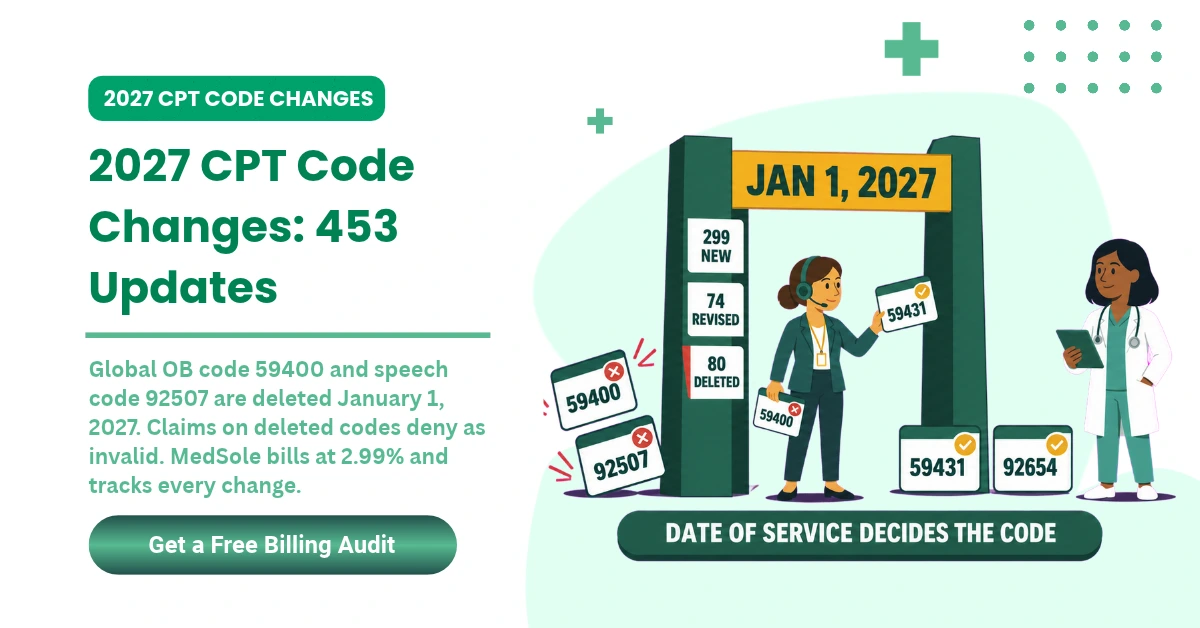




CPT 2027 at a glance: the AMA code set brings 453 changes, with 299 new, 74 revised, and 80 deleted codes effective January 1, 2027.
Alt text: 2027 CPT code changes summary showing 299 new, 74 revised, and 80 deleted codes effective January 1, 2027 · File name: 2027-cpt-code-changes-summary.png
The 2027 CPT code changes take effect on January 1, 2027. On September 9, 2026, the American Medical Association released the CPT 2027 code set with 453 editorial changes: 299 new codes, 74 revised codes, and 80 deleted codes. Maternity care, speech therapy, ABA, and sleep testing see the biggest shifts.
Claims for dates of service on or after January 1, 2027, must carry 2027 codes. Say a patient's prenatal care began in 2026 and she delivers on January 4. Bill that delivery on 59400, and it denies. The AMA deleted that global OB code, along with 92507 for speech treatment and 95800 for home sleep tests.
Coders aren't the only ones on the clock. Your EHR code library, charge master, superbills, payer contracts, and open authorizations all need the new codes before the first January visit. The annual CPT code update touches each of them, and a gap in any one shows up later as a denial.
This guide gives you code tables for each specialty, the Medicare payment proposals, the denials to expect, and a preparation checklist with 10 steps. Our coding team at MedSole RCM checked every code line by line against the AMA, CMS, ASHA, AASM, and the ABA Coding Coalition.
Two pieces aren't final yet. CMS should publish its Medicare payment rule in early November 2026, according to the AMA, and a few new codes have final numbers that appear only in the CPT 2027 codebook. We mark both and will update this page as they land.
CPT 2027 at a Glance: 453 Changes in One Table
The CPT 2027 code set changes coding for maternity care, speech therapy, vestibular testing, ABA, sleep testing, biofeedback, head and neck MRA, prostate biopsy, hernia repair, heart pump procedures, and AI services. Medicare's payment rules for 2027 remain proposals until CMS publishes its final rule, which the AMA expects in early November 2026.
CPT 2027 summary: what changes on January 1, 2027, by specialty
|
Area |
What changes |
Codes |
Status |
|---|---|---|---|
|
Maternity care |
Global OB package retired; you report antepartum, labor, delivery, and postpartum care on their own |
17 deleted, 12 new, 6 revised |
Final (AMA) |
|
Speech therapy |
92507 replaced by 10 timed codes |
92654 to 92663; 92508 kept |
Final (AMA, ASHA) |
|
Vestibular testing |
92546 replaced; vHIT gets its own codes |
92513, 92514, 92527, +92528 |
Final (AMA, ASHA) |
|
ABA |
6 new codes; harmful behavior codes move to Category I |
97148, +97149, 97159, +97160, 97173, 97180 |
Final (AMA, ABA Coding Coalition) |
|
Sleep testing |
95800, 95801, and 95806 replaced by 6 tiered codes |
Final numbers in the CPT 2027 codebook |
Final (AMA, AASM) |
|
Biofeedback |
90901 becomes the first 15 minutes, plus a new add-on |
90901 revised, 1 new |
Final (AMA) |
|
Head and neck MRA |
Postprocessing included; 3 new combined head and neck codes |
70544 to 70549 revised, 3 new |
Final (AMA) |
|
Prostate biopsy |
Code family restructured |
55705, 55707 to 55712, 55714, 55715, plus 1 new add-on |
Final (AMA) |
|
Diaphragmatic hernia repair |
Open, laparoscopic, and thoracoscopic repair codes |
9 new |
Final (AMA) |
|
Left ventricular assist devices |
Open conduit insertion and removal |
3 new |
Final (AMA) |
|
AI services |
10 new codes, 43 in total; Appendix S updated |
10 new |
Final (AMA) |
|
Medicare payment |
Conversion factor cut, KX threshold of $2,540, RPM and RTM limits |
n/a |
Proposed (CMS) |
Rows marked Proposed are CMS payment proposals. Everything else in the 2027 CPT code changes is final: on January 1, the new CPT codes for 2027 become reportable, and the deleted CPT codes for 2027 stop working.
Twelve rows of 2027 CPT changes land on the same January claims your team already works. If that's more than your staff can absorb, our outsourced medical billing services include AAPC-certified coders who track code and payer changes as part of a flat 2.99% fee.
In this guide
- CPT 2027 at a Glance: 453 Changes in One Table
- What the 2027 CPT Code Changes Include and When They Take Effect
- Maternity Care: Global OB Codes Are Deleted in 2027
- Speech Therapy: 92507 Is Replaced by 10 Timed Codes
- Vestibular Testing: 92546 Is Deleted and vHIT Gets Its Own Codes
- ABA Therapy: Six New Adaptive Behavior Codes for 2027
- Sleep Medicine: New Home Sleep Test Codes Replace 95800, 95801, and 95806
- Biofeedback, Radiology, Surgery, and Cardiology Changes
- AI Codes in CPT 2027 and the Appendix S Taxonomy
- How Medicare Proposes to Pay for 2027 Services
- The Denials Deleted Codes Will Trigger After January 1
- CPT 2027 Implementation Checklist for Practices
- Which Specialties Feel the 2027 Changes Most
- In-House or Outsourced: Who Should Handle Your 2027 Transition?
- CPT 2027 FAQs
- Your Next Step Before January 1, 2027
What the 2027 CPT Code Changes Include and When They Take Effect
Under the 2027 CPT code changes, the date of service decides which code set applies. Services on or after January 1, 2027, use CPT 2027 codes. Anything performed through December 31, 2026, keeps its 2026 code, even when the claim goes out in 2027. That one rule settles deleted codes, pregnancies that cross the year, and late charges.
How Many CPT Codes Changed in 2027?
The AMA's CPT 2027 code set contains 453 editorial changes: 299 new codes, 74 revised codes, and 80 deleted codes, according to the AMA's CPT 2027 release. A new code didn't exist before, so your EHR has to load it before anyone can charge it. Deleted codes can't appear on any claim dated January 1 or later.
Revised CPT codes for 2027 cause the quiet trouble. They keep their old numbers while the descriptor or the rules change, so nothing looks wrong on the charge screen. Take biofeedback code 90901. It now reports only the first 15 minutes, which changes how you count time on every session.
When Do the 2027 CPT Codes Take Effect?
CPT 2027 takes effect on January 1, 2027, and you apply the 2027 CPT code changes by date of service, not by billing date. ASHA's guidance for speech therapy says 92507 "remains in effect through December 31, 2026." A session on December 30 that you bill on January 12 still goes out on 92507.
- September 9, 2026: AMA release of the CPT 2027 code set
- Early November 2026: expected CMS final rule on Medicare payment
- November 18 to 20, 2026: AMA CPT & RBRVS 2027 Annual Symposium
- January 1, 2027: effective date for the annual 2027 CPT codes
Print and digital versions of the AMA CPT 2027 codebook, plus its data files, are available through the AMA. Diagnosis codes run on a different calendar. The FY 2027 ICD-10-CM guidelines took effect on October 1, 2026, three months ahead of CPT.
Which Codes Arrive Outside the Annual Release?
CPT 2027 does include early release codes, so not all 2027 CPT code updates follow the January calendar. Per the AMA's CPT code process, most CPT changes take effect January 1, while Category I immunization codes, Category III codes, Proprietary Laboratory Analyses (PLA) codes, and Multianalyte Assays with Algorithmic Analyses (MAAA) codes follow their own release schedules.
This cycle, the AMA also released the maternity care codes early to give payers and EHR vendors time to prepare. Labs see CPT code updates all year. PLA codes get added and deleted between annual releases, so if you bill pathology CPT codes, January 1 is one update date among several.
How CPT 2027 Compares With CPT 2026
CPT 2027 is larger than CPT 2026, with 453 changes against 418. The AMA's CPT 2026 release counted 288 new codes, 84 deletions, and 46 revisions, effective January 1, 2026. Its headline areas were remote patient monitoring, hearing device services, AI, and leg revascularization. CPT 2025, for reference, had 420 changes.
If you're checking the CPT changes 2026 brought, the CPT 2026 codebook lists all 84 deletions in its Appendix B summary. For most practices, what's new in CPT 2027 is the rebuild of whole code families: maternity, speech therapy, sleep testing, and ABA. Maternity care changed the most of any family, and it reaches every OB and family medicine practice.
|
MEDSOLE RCM Will your January claims survive the CPT 2027 switch? Deleted codes start denying on January 1, 2027. Start with a free billing audit, no cost and no commitment, and we'll show you what the 2027 changes mean for your claims. |
Maternity Care: Global OB Codes Are Deleted in 2027
Yes, OB codes change in 2027. On January 1, 2027, the AMA deletes the global maternity codes, including 59400, 59510, and 59610. Prenatal and postpartum visits move to per-encounter E/M codes, and labor management and delivery get codes of their own. The 2027 maternity coding changes delete 17 codes, add 12, and revise six.
Which Maternity Codes Are Deleted?
Yes, 59400 is one of the 17 maternity CPT codes the AMA deletes. For OB practices, that's the most disruptive of the 2027 CPT code changes, since every global, antepartum-only, and postpartum-only code goes with it. The AMA maternity code summary lists the full set.
Global OB codes deleted in 2027, grouped by what you used to bill
|
Group |
Deleted codes |
|---|---|
|
Global packages (antepartum, delivery, and postpartum in one code) |
59400, 59510, 59610, 59618 |
|
Antepartum care only |
59425, 59426 |
|
Postpartum care only |
59430 |
|
Delivery only, or delivery plus postpartum |
59409, 59410, 59514, 59515, 59612, 59614, 59620, 59622 |
|
Other |
59050 (fetal monitoring by a consulting physician; 59051 is revised and stays), 59525 (hysterectomy after cesarean) |
If you're asking what replaces 59400, the answer splits by phase. Prenatal and postpartum visits go to E/M codes, and the delivery goes to the new delivery codes.
With 59510 deleted, AMA guidelines send a cesarean to 59502 or 59503, a cesarean after a trial of labor to 59503, a VBAC to 59432, and a hysterectomy after cesarean to 59504. Our OB/GYN CPT codes guide covers the related procedure codes. A tubal ligation at cesarean still takes add-on +58611 next to 59502 or 59503, as our tubal ligation CPT codes guide explains.
The 12 New Maternity Codes and What They Report
The new maternity CPT codes for 2027 break a pregnancy into labor days, the delivery, and repairs at delivery, with E/M visits on either side.
New maternity CPT codes, effective January 1, 2027
|
Code |
What it reports |
|---|---|
|
59080 / 59081 |
Initial day of labor management, straightforward / complex |
|
59082 / 59083 |
Subsequent day of labor management, straightforward / complex |
|
59431 |
Vaginal delivery, with or without episiotomy |
|
59432 |
Vaginal delivery after previous cesarean (VBAC) |
|
59433 / 59434 |
Repair of third-degree / fourth-degree laceration or episiotomy |
|
59502 / 59503 |
Cesarean delivery, primary / repeat |
|
59504 |
Subtotal or total hysterectomy after cesarean |
|
59623 |
Uterine tamponade (balloon, catheter, vacuum, or packing) |
The 59080 CPT code and its partners follow calendar-day rules. You report labor management once per date. Bill the initial day once per facility admission, at the highest level reached that day; it includes the admission E/M work. A labor visit that runs past midnight without a break counts as one service on one of the two dates.
Delivery codes cover the delivery only, and routine postpartum care on the delivery date is part of them. Report 59433 or 59434 with 59431 or 59432 when the repair happens at the delivery. If one physician performs both the cesarean and the hysterectomy, 59504 takes modifier 51.
The AMA also revises six codes: 59051, 59300, 59412, 59414, 59898, and 59899. Two of those OB/GYN coding changes in 2027 matter most on the claim. Code 59300 reports a laceration repair by someone other than the delivering clinician, and 59414 reports delivery of the placenta alone by someone other than the delivering clinician.
How Antepartum and Postpartum Visits Are Billed in 2027
Each prenatal encounter in 2027 is an E/M service, chosen by setting (office, hospital, or telemedicine) and leveled by medical decision making (MDM) or time. Ultrasound codes 76801 to 76828 and fetal MRI codes 74712 and 74713 stay billable on their own.
Postpartum care on the delivery date sits inside the delivery code. Later inpatient days use subsequent hospital care (99231 to 99233), discharge (99238, 99239), or critical care (99291, 99292), never on the delivery date.
Office follow-up uses 99202 to 99205 or 99211 to 99215, home visit codes, virtual check-in 98016, or telemedicine codes 98000 to 98015, which our telehealth CPT codes guide explains.
Under the maternity billing guidelines for 2027, payers set visit limits. The AAFP notes that the code structure itself has no frequency limits, and it advises appending modifier TH to prenatal E/M visits "in accordance with your payers' policies." For diagnoses, ICD-10-CM guidelines don't allow Z34 codes with O codes, though you may add a Z3A weeks-of-gestation code.
How to Bill a Pregnancy That Spans 2026 and 2027
Your open pregnancies are where the OB billing changes in 2027 hit first. The 2027 CPT code changes follow the date of service, so a patient who is pregnant in 2026 and delivers in 2027 "will require using codes from both code sets," per the AAFP maternity coding guidance. These rules come from the AMA transition FAQ:
- If antepartum visits happened in 2026, bill them under 2026 rules: one to three visits as individual E/M codes, four to six as 59425, and seven or more as 59426.
- For antepartum visits in 2027, bill each one as an E/M visit.
- When you're holding 2026 antepartum care until delivery, you don't have to. Bill it at the end of 2026 or early in 2027, once the 2026 visit count is certain.
- If the delivery happens in November or December 2026, bill it on the 2026 global code, such as 59400. Postpartum visits that fall in 2027 may go out as E/M codes.
- When labor starts December 31, 2026, and continues without a break into a January 1 delivery, report 59080 or 59081 once, on January 1. If the labor wasn't continuous, the AMA says December 31 may go out as an initial hospital E/M (99221 to 99223), and it advises calling the payer first.
- For any patient due on or after January 1, 2027, document MDM or time at every prenatal visit so each one can support an E/M level.
Worked example: A patient has five prenatal visits in 2026 and four in 2027, then delivers on January 20, 2027. Bill the 2026 visits as 59425, the 2027 visits as four E/M services, and the delivery on the new labor and delivery codes. Send that delivery on 59400 out of habit and it denies; a root-cause denial review traces it back to the charge master.
Billing a pregnancy that spans 2026 and 2027: five 2026 visits go out as 59425, four 2027 visits go out as E/M services, and the January 20 delivery uses the new 2027 codes.
Alt text: CPT 2027 maternity transition example with 2026 antepartum visits billed as 59425, 2027 prenatal visits billed as E/M, and a January 2027 delivery billed on new labor and delivery codes · File name: cpt-2027-maternity-transition-billing-example.png
Medicare's G-Code Proposal and Payer Rules
Medicare hasn't settled its maternity coding yet. In its CY 2027 proposed rule, CMS asked for comment on 15 HCPCS G-codes that would keep the old global structure and global period for Medicare, as an alternative to the new CPT codes. CMS will decide in the final rule.
The AMA and ACOG both oppose the G-codes, and the ACOG statement urges CMS to "make a clean break."
State Medicaid programs and commercial payers write their own transition rules. Under MassHealth Bulletin 419, providers may report E/M codes with modifier TH when the first prenatal visit falls on or after September 1, 2026, while earlier pregnancies keep 59425 and 59426. Check each payer's 2027 OB global billing changes before your January claims go out.
Contracts carry a quieter risk. A commercial rate exhibit priced on 59400, 59510, and 59610 has no rate for the new codes, so it needs an update before January claims pay at the right rate. That makes payer contract review part of your December work under the 2027 maternity coding changes.
|
MEDSOLE RCM Payer contracts priced on 59400 have no rate for 2027 deliveries. MedSole reviews your contracts and fee schedules as part of credentialing, at $99 per payer application, with CAQH management and weekly payer follow-up included. |
Speech Therapy: 92507 Is Replaced by 10 Timed Codes
Yes, 92507 is being deleted. From January 1, 2027, you'll bill individual speech-language treatment with 10 timed codes, 92654 to 92663: a base code for the first 30 minutes and an add-on for each additional 15 minutes, across five treatment categories. Group treatment stays on 92508, according to ASHA.
The New Speech Therapy Codes for 2027
Of all the 2027 CPT code changes, this one rewrites the claim line for every speech visit. The new speech therapy codes for 2027 count time and split by clinical focus, as ASHA's 92507 replacement guide lays out. CPT code 92654, for example, covers the first 30 minutes of fluency treatment.
Speech therapy CPT codes 2027: the 92507 replacement codes
|
Treatment category |
First 30 minutes |
Each additional 15 minutes |
|---|---|---|
|
Fluency disorders |
92654 |
+92655 |
|
Speech sound production disorders |
92656 |
+92657 |
|
Language comprehension and expression disorders |
92658 |
+92659 |
|
Combined speech sound and language disorders |
92660 |
+92661 |
|
Voice, upper airway dysfunction, and resonance disorders |
92662 |
+92663 |
Pick the pair by what the session treated. If one session works on speech sound and language together, the combined pair (92660, +92661) exists for that case. ASHA's own example: a 45-minute language session goes out as 92658 plus +92659.
Session notes now need total treatment minutes, because minutes decide the code count. PT and OT teams know timed billing from the 8-minute rule, but don't assume Medicare's unit math for those codes carries over until the CPT 2027 guidance is in hand. For a full code-by-code walkthrough, see our guide to speech therapy CPT codes.
What Happens to 92508 Group Treatment
With 92507 deleted, 92508 stays. It remains an untimed code for treating two or more people in a group, and ASHA notes that its descriptor and instructions now stand on their own. If your clinic runs both individual and group sessions, your team works two coding logics: timed pairs for individual visits and one untimed code for groups.
What Medicare Proposed for the New SLP Codes
Medicare's CPT 2027 speech therapy changes are proposals until CMS publishes its final rule, expected in early November 2026. For the 10 new codes, CMS proposed:
- RUC-recommended payment values for all 10 codes
- An "always therapy" designation, so each claim needs a therapy plan of care and the GN modifier
- The multiple procedure payment reduction (MPPR) on the five base codes, with none on the five add-ons
- GSLPP, a new Medicare-only code for individual pediatric speech treatment: untimed, one unit per day, with a proposed work RVU of 1.30
- An age limit for GSLPP that CMS's own text describes as "up to age 18 or 21," which leaves the cutoff unclear
ASHA opposes GSLPP, and in comments dated September 14, 2026, it asked CMS to add the 10 new codes to the Medicare telehealth list, per the ASHA proposed rule analysis. Commercial plans and Medicaid set their own rules for the new codes, so check each payer before January.
An authorization issued on 92507 may not cover the new timed codes, and each payer sets its own transition rules. MedSole's flat 2.99% billing service includes prior authorizations, eligibility checks, and coding review, so the switch doesn't land on your front desk.
Vestibular Testing: 92546 Is Deleted and vHIT Gets Its Own Codes
With 92546 deleted on January 1, 2027, CPT 2027 adds four vestibular codes. According to the ASHA vestibular code update, 92513 and 92514 report video head impulse testing (vHIT), and 92527 reports rotational chair testing by sinusoidal harmonic acceleration (SHA). Add +92528 when the clinician also performs velocity step testing (VST).
vHIT CPT codes for 2027 and the new rotational chair codes
|
Code |
What it reports |
|---|---|
|
92513 |
vHIT, lateral semicircular canal |
|
92514 |
vHIT, lateral and vertical semicircular canals |
|
92527 |
Rotational vestibular assessment by SHA |
|
+92528 |
Add-on: velocity step testing (VST) with SHA |
Don't report 92513 and 92514 together. CMS proposed adding all four codes to Medicare's audiology services list, but none to the AB modifier list, which covers certain hearing tests done without a physician order. The agency also proposed a work RVU of 0.35 for +92528, below the RUC's 0.48.
Audiology and ENT practices that billed 92546 need the new codes in the charge master and in any order templates before the 2027 CPT code changes take effect. Our guide to audiology CPT codes covers the hearing test codes that sit beside them.
ABA Therapy: Six New Adaptive Behavior Codes for 2027
CPT 2027 adds six ABA codes on January 1, 2027: 97148 and +97149 for harmful behavior assessment, 97159 and +97160 for harmful behavior treatment, 97173 for treatment with analysis by a qualified professional, and 97180 for non-face-to-face work. The AMA also revises 97151 to 97158 and deletes 0362T and 0373T.
The New ABA Codes for 2027
Among the 2027 CPT code changes, the ABA CPT codes for 2027 change two things at once: who delivers a service and how you report it. We paraphrased the descriptors below from the ABA Coding Coalition codes page.
New ABA CPT codes, effective January 1, 2027
|
Code |
What it reports |
Unit |
|---|---|---|
|
97148 |
Assessment of harmful behavior by 2 technicians in an environment customized to the patient |
Each 15 minutes |
|
+97149 |
Each additional technician during 97148 (3rd to 5th technician) |
Each 15 minutes |
|
97159 |
Treatment of harmful behavior by 2 technicians in a customized environment |
Each 15 minutes |
|
+97160 |
Each additional technician during 97159 |
Each 15 minutes |
|
97173 |
Treatment with analysis, delivered in person by a physician or other qualified health care professional (QHP), face-to-face with 1 patient |
Each 15 minutes |
|
97180 |
Non-face-to-face work by a physician or QHP: data review, treatment-target decisions, assessment planning, discharge or transition planning, and technician training |
Each 15 minutes |
The adaptive behavior family now holds 14 codes: six new and eight revised. Watch the line between two of them. In the revised family, 97155 describes a QHP directing a technician, with analysis, during a face-to-face session, while 97173 covers treatment the QHP delivers in person. Our guide to ABA billing codes covers the rest of the family.
What Replaces 0362T and 0373T for Harmful Behavior?
Harmful behavior coding isn't a proposal anymore. For CPT 2027, the CPT Editorial Panel deleted Category III codes 0362T and 0373T and replaced them with Category I codes: 97148 and +97149 for assessment, 97159 and +97160 for treatment.
Each descriptor requires two technicians, a patient who exhibits harmful behavior, and an environment customized to that behavior. You report each additional technician with the add-on.
Category I status gives payers a standard code family to price. On the Medicare side, CMS proposed contractor pricing for the six new codes and kept contractor pricing for the eight revised ones. Medicaid and commercial plans cover most ABA and set their own rates, so check each payer.
Authorizations and Documentation Before January 1
Any authorization written on 0362T, 0373T, or the old code structure that runs past January 1 may need a reissue under the new codes. Payers set their own process, so build a list of every open authorization that crosses the date and call each payer. If you outsource prior authorization services, ask your vendor for that list now.
Documentation is the bigger exposure. The HHS OIG Maine audit found Maine made at least $45.6 million in improper Medicaid payments for autism services, including ABA. Auditors pointed to missing or unsigned assessments and session notes without the services, goals, or data.
Under the ABA CPT codes for 2027, a 97180 note should name which non-face-to-face activity your QHP performed and for how long, so the time on the claim matches the record.
Open authorizations to review before January 1, 2027: speech therapy (92507 to 92654–92663), ABA (0362T and 0373T to the 97148 and 97159 families), and home sleep testing (95800, 95801, and 95806 to six tiered codes).
Alt text: CPT 2027 prior authorization checklist showing deleted speech therapy, ABA, and home sleep test codes, their 2027 replacements, and four checks for every open authorization · File name: cpt-2027-prior-authorization-checklist.png
|
MEDSOLE RCM Authorizations crossing January 1 on deleted codes? ABA, speech, and sleep authorizations written on 0362T, 0373T, 92507, or 95800 may need reissuing. Prior authorizations and eligibility checks are included in our flat 2.99% billing fee, inside the EHR you already use, CentralReach included. |
Sleep Medicine: New Home Sleep Test Codes Replace 95800, 95801, and 95806
On January 1, 2027, CPT deletes the home sleep test codes 95800, 95801, and 95806 and replaces them with six unattended sleep study codes. Three cover the technical work and three cover the interpretation. The AMA and AASM tier each one as low, moderate, or high complexity, based on the channels recorded and the parameter categories generated.
New CPT codes for home sleep apnea testing (HSAT) in 2027, by tier
|
Complexity |
Channels recorded |
Parameter categories (at least) |
Codes |
|---|---|---|---|
|
Low |
3 to 4 |
3 to 5 |
1 technical code, 1 interpretation code |
|
Moderate |
5 to 10 |
6 to 8 |
1 technical code, 1 interpretation code |
|
High |
11 or more |
9 |
1 technical code, 1 interpretation code |
Of all the 2027 CPT code changes, this is the one where the codebook matters most. The final five-digit numbers sit in the AMA's CPT 2027 codebook and data files, while CMS and AASM public pages still show placeholders. Load the codes from your 2027 codebook or AMA data file, not from a website.
Your home sleep test CPT code for 2027 depends on what the device records, so the study record has to show its channels and parameters. CMS treats the interpretation codes as professional-only services.
Authorizations written on 95800 or 95806 won't match the new unattended sleep study codes, which makes authorization tracking a December job. Your coders should also pair each study with the right sleep apnea ICD-10 codes before the claim goes out.
Medicare's numbers are proposals until the final rule. According to the AASM proposed rule takeaways, CMS proposed the RUC work RVUs for the low and moderate interpretation codes (0.81 and 1.05) and 1.42 for high complexity, against the RUC's 1.60.
CMS also asked whether two nights of device use is typical. AASM notes that some insurers use HCPCS codes G0398 to G0400 for home sleep testing while others use CPT codes, so confirm with each payer which set it accepts in 2027.
Biofeedback, Radiology, Surgery, and Cardiology Changes
The rest of the 2027 CPT code changes hit five procedure families on January 1, 2027. According to the AMA, biofeedback moves to time-based codes, and the code set restructures head and neck MRA and prostate biopsy. It also adds nine diaphragmatic hernia repair codes and three left ventricular assist device codes.
Biofeedback Moves to 15-Minute Time Units
Your biofeedback CPT code for 2027 counts time instead of sessions. Code 90901 now reports the first 15 minutes of training by any modality, with direct patient contact by a physician or QHP. Its examples include EEG, so neurofeedback falls here too. One new add-on, numbered in the CPT 2027 codebook, reports each additional 15 minutes.
CMS proposed raising the 90901 work RVU to 0.61 from 0.41, and the RUC resurveyed 90912 and 90913, the perineal and sphincter codes, in the same family. Session notes now need minutes of direct contact. If you bill neurofeedback beside psychotherapy, our guide to mental health CPT codes covers the companion codes.
Head and Neck MRA Codes Are Restructured
Expect more work inside each of the MRA CPT codes for 2027. The AMA revises 70544 to 70549 (MRA of the head or neck) to include image postprocessing and adds a new head and neck MRA table. Three new codes report MRA of the head and neck together, with final numbers in the CPT 2027 codebook.
According to the CMS proposed rule text, a review found practices billing head and neck MRA together at a rising rate. CMS proposed the RUC values for all nine codes. If your group billed postprocessing on its own beside these studies, recheck that charge logic, and see our guide to radiology CPT codes for the wider imaging set.
Prostate Biopsy Codes Are Restructured Again
Prostate biopsy CPT codes change for the second year in a row. CMS lists the 2027 family as 55705, 55707 to 55712, 55714, and 55715, covering non-imaging, transrectal, transperineal, fusion-targeted, and in-bore CT or MRI guided biopsy.
One new add-on reports each additional fusion-targeted lesion, and its final number is in the CPT 2027 codebook. Urology coders should map each case by approach and guidance before picking a code.
Nine New Diaphragmatic Hernia Repair Codes
Among the new CPT 2027 surgery codes, the AMA adds nine for traumatic and nontraumatic diaphragmatic hernia repair, including one add-on for mesh implantation. Codes 39540 and 39541 stay in the family with revised descriptors.
Each repair code pairs an approach (laparotomy, thoracotomy, laparoscopy, or thoracoscopy) with a type: traumatic acute, traumatic chronic, or nontraumatic, such as a Bochdalek or Morgagni hernia. Final numbers sit in the codebook. For related procedures, see our guide to general surgery CPT codes.
Three New Left Ventricular Assist Device Codes
Cardiac surgery teams get three new LVAD CPT codes for 2027, all for open-conduit procedures, with new and revised guidelines from the AMA:
- Insertion through axillary, subclavian, or innominate artery exposure
- Insertion through aorta exposure by a transthoracic incision
- Removal with resection and stapling of the graft conduit
CMS proposed the RUC values for all three. As with the other procedure families above, the final code numbers appear only in the CPT 2027 codebook.
AI Codes in CPT 2027 and the Appendix S Taxonomy
CPT 2027 adds 10 AI-related codes, bringing the total to 43, according to the AMA. The CPT Editorial Panel also updated AMA Appendix S taxonomy, which classifies AI services as assistive, augmentative, or autonomous, based on what the software's output does and how much physician interpretation it still needs.
Appendix S categories for AI services, paraphrased from the AMA
|
Category |
What the software output does |
Physician or QHP role |
|---|---|---|
|
Assistive |
Gives relevant clinical data without deriving a parameter or drawing a conclusion |
Interprets the data and writes the report |
|
Augmentative |
Produces a score, index, or classification that differs from the input, with no independent interpretation |
Uses the output in patient management; existing codes capture that work in most cases |
|
Autonomous |
Derives parameters and generates interpretations without concurrent physician involvement |
Level I: accepts or rejects the recommendation. Level II: gets a chance to stop the action before it happens. Level III: oversees actions the software starts and can step in |
A category describes the service; it doesn't make the service payable. Payers set coverage for AI codes one by one, so check policy before you schedule. Treat the 2027 CPT code changes as your prompt to list every AI tool your clinicians already use and match each one to a code and a payer policy.
Don't look for the 10 new AI CPT codes for 2027 on the AMA's free pages. You'll find the numbers in the CPT 2027 codebook.
Coding is only one side of the CPT 2027 changes. On the payment side, Medicare's 2027 proposals would cut the conversion factor and rewrite several billing rules.
How Medicare Proposes to Pay for 2027 Services
Status as of October 28, 2026: proposed. We'll update this section when CMS publishes the final rule.
Under the CY 2027 Medicare Physician Fee Schedule proposed rule, CMS would set the conversion factor at $32.84 for most clinicians and $33.17 for qualifying APM participants, cuts of 1.68% and 1.19%. CMS issued the proposal, CMS-1848-P, on July 14, 2026, and the AMA expects the final rule in early November 2026.
The Proposed 2027 Conversion Factor
CMS proposed a 2027 conversion factor of $32.84, down from $33.40, and $33.17 for qualifying APM participants, down from $33.57, according to the CMS proposed rule fact sheet. Most of the drop comes from the one-year 2.50% increase for 2026 running out. Statutory updates of 0.25% and 0.75%, plus a 0.53% adjustment, offset part of it.
Before geographic adjustment, a service worth 2.00 total RVUs pays $66.80 at $33.40 and $65.68 at $32.84. That's $1.12 less on every one of those visits.
Budget 2027 Medicare revenue on the proposed figures, then adjust after the 2027 physician fee schedule final rule. If you plan the year with a revenue cycle management partner, ask for a forecast that layers the payment cut on top of the 2027 CPT code changes.
Same-Day E/M Visits and the G2211 Modifier
CMS proposed a new payment rule for an office or outpatient E/M billed on the same day as a procedure with a 0-day, 10-day, or 90-day global period, by the same physician or practice. Medicare would pay the most expensive service at 100% and the others at 50%. The AMA fee schedule breakdown calls that a 50% payment cut.
G2211 would change shape too. Under the 2027 Medicare physician fee schedule proposal, it becomes a modifier (placeholder MOD1) that adds 16% to the E/M payment, in place of the flat add-on code.
A second modifier, MOD2, would add 32% for Shared Savings Program and LEAD Model ACO practitioners. If your clinicians see patients and do minor procedures on the same day, model both changes before January.
The 2027 KX Modifier Threshold for PT, OT, and SLP
CMS proposed a 2027 KX modifier threshold of $2,540 for physical therapy and speech-language pathology combined, and a separate $2,540 for occupational therapy, up from $2,480. That figure rests on a 2.5% MEI estimate, which may change in the final rule. Targeted medical review stays at $3,000.
Speech therapy, including the new timed codes, counts toward the combined PT and SLP amount. A patient who sees both a physical therapist and a speech-language pathologist reaches the threshold faster than one who sees only one of them. Our guides to physical therapy billing codes and occupational therapy coding cover each discipline's codes.
New Limits on RPM and RTM Billing
CMS proposed four RPM and RTM changes for 2027, and for monitoring programs they matter as much as the 2027 CPT code changes:
- RTM limited to established patients
- An initiating visit, billed on its own, before RPM or RTM starts
- Payment only when clinical staff employed by the practice do the work, with no contractors
- Revised values for the monitoring codes
CMS also asked for comment on folding all RPM and RTM codes into four new HCPCS G-codes. The AMA will oppose the employed-staff limit, and it notes that cuts to existing codes phase in under a 19% annual limit, a cushion the G-code alternative wouldn't keep. For the treatment management side, see our post on CPT 99470 billing rules.
If your RPM or RTM program depends on contracted monitoring staff, the proposal puts that revenue in question. Our remote patient monitoring billing team can walk through what the change would mean for your setup before the final rule lands.
The Denials Deleted Codes Will Trigger After January 1
A claim that reports a deleted code for a date of service on or after January 1, 2027, will in most cases deny with claim adjustment reason code (CARC) 181: "Procedure code was invalid on the date of service." The fix sits upstream, in your code library and claim scrubber, before the first January claim goes out.
Five denials stand out once the CPT 2027 deleted codes leave the code set. We quote each reason below from the X12 code list and tie it to the 2027 CPT code changes behind it.
Five denials CPT 2027 is most likely to trigger
|
CARC |
X12 description |
How CPT 2027 triggers it |
Prevention |
|---|---|---|---|
|
181 |
"Procedure code was invalid on the date of service." |
59400 billed for a January 2027 delivery; 92507 billed for a January session |
Load the 2027 code set and block deleted codes for 2027 dates in the scrubber |
|
197 |
"Precertification/authorization/notification/pre-treatment absent." |
An ABA, speech, or home sleep test authorization issued on a deleted code |
Reissue authorizations under the new codes; see CO-197 authorization denials |
|
97 |
"The benefit for this service is included in the payment/allowance for another service/procedure that has already been adjudicated." |
A postpartum E/M billed on the delivery date, which the AMA includes in the delivery code |
Bill postpartum E/M from the day after delivery; see CO-97 bundling denials |
|
4 |
"The procedure code is inconsistent with the modifier used." |
A modifier such as TH or GN on a code the payer doesn't pair it with |
Map each payer's modifier rules for the new codes; see CO-4 modifier denials |
|
16 |
"Claim/service lacks information or has submission/billing error(s)." |
Missing information a payer requires for the new codes, named in the remark code |
Read the RARC, fix the field, and resubmit; see CO-16 denials |
The payer picks the group code, so the same reason can arrive as CO-181 or PR-181.
New timed codes also mean new unit counts. Medicare denies units above a code's Medically Unlikely Edit (MUE), so check the 2027 values in the CMS MUE tables once CMS posts them.
December 2026 services billed in January still take 2026 codes. Keep the 2026 code set active for those dates until your old claims clear, and keep AR follow-up on them, since every correction or resubmission for a 2026 date needs the 2026 code.
Five claim denials the 2027 CPT code changes can trigger, CARC 181, 197, 97, 4, and 16, with the billing control that prevents each one.
Alt text: CPT 2027 claim denial infographic showing CARC 181, 197, 97, 4, and 16, the claim error behind each, and the preventive billing control · File name: cpt-2027-claim-denial-codes-carc.png
|
MEDSOLE RCM Stop 181 denials before they stack up in January. Every denial gets a root cause within 24 hours and an appeal within 48 hours, and we fix the process behind repeat denials. |
CPT 2027 Implementation Checklist for Practices
To prepare for the 2027 CPT code changes, load the CPT 2027 code set into your EHR and practice management system, update superbills and scrubber edits, reissue authorizations, reprice payer contracts built on deleted codes, train coders and front desk staff, and keep 2026 codes active for 2026 dates of service.
- Load the 2027 code set from the AMA codebook, the AMA data files, or your EHR vendor's 2027 update. Never type codes in from a website. (Owner: billing manager and IT)
- Update your charge master and superbill templates: remove deleted codes for 2027 dates, and add the new maternity, speech, vestibular, ABA, and sleep codes your practice performs. (Owner: billing manager)
- Rewrite scrubber edits to block deleted codes on 2027 dates of service and accept the new code and modifier pairs. Solid claim scrubbing catches a 181 before the payer does. (Owner: billing team)
- Build a 2027 CPT code crosswalk for open episodes: every pregnancy, ABA authorization, and speech plan of care that crosses January 1, with old and new codes side by side. For maternity, use the AMA preparation FAQ as your checklist. (Owner: coding lead)
- Reissue any authorization written on a deleted code that runs past January 1, and ask each payer how it wants the request sent. (Owner: front desk and authorization team)
- Reprice payer contracts with rate exhibits built on 59400, 59510, 59610, or 92507, since those exhibits carry no rate for the new codes. That's where fee schedule negotiation starts. (Owner: practice administrator)
- Train coders on the new codes and clinicians on documenting minutes for speech, biofeedback, and ABA, plus MDM for prenatal E/M visits. Medical coding updates this broad may call for an outside AAPC-certified coding team on the coder side. (Owner: coding lead)
- Keep 2026 codes for 2026 dates of service, and bill them on time. Medicare allows "12 months, or one calendar year, after the date of service," per the CMS billing guide, and our Medicare timely filing limit guide explains the rule; commercial limits vary. (Owner: billing team)
- Check the first January remittances for CARC 181 and 197, and fix the cause along with the claim. (Owner: billing manager)
- Recheck fee schedules and Medicare rules after the CMS final rule, expected in early November 2026, and the AMA symposium on November 18 to 20. Those two events settle the last open pieces of the 2027 CPT code changes. (Owner: practice administrator)
|
MEDSOLE RCM Take the CPT 2027 checklist to your next staff meeting. Download the 10-step implementation checklist as a one-page PDF, with an owner named for every step. Download the Checklist |
Which Specialties Feel the 2027 Changes Most
OB/GYN and family medicine practices that deliver babies face the largest share of the 2027 CPT code changes, followed by speech-language pathology, ABA, sleep medicine, and audiology. Radiology, urology, surgery, and biofeedback providers have smaller, family-specific updates. The AMA's list of key updates names no PT or OT code family; their changes sit on Medicare's payment side.
How the 2027 changes hit each specialty
|
Specialty |
What changes for you |
Update first |
|---|---|---|
|
OB/GYN and family medicine (deliveries) |
Global codes deleted; phase-based billing |
Open pregnancies crossing January 1 |
|
Speech-language pathology |
92507 replaced by 10 timed codes |
Authorizations and time documentation |
|
ABA |
6 new codes; 0362T and 0373T deleted |
Authorizations crossing January 1 |
|
Sleep medicine |
3 home sleep test codes replaced by 6 tiered codes |
Device and channel documentation |
|
Audiology and ENT |
92546 replaced; new vHIT codes |
Charge master |
|
Radiology |
Head and neck MRA restructured |
Postprocessing charge logic |
|
Urology |
Prostate biopsy family restructured |
Approach and guidance mapping |
|
General and thoracic surgery |
9 new diaphragmatic hernia repair codes |
Op note to code mapping |
|
Cardiac surgery |
3 new LVAD codes |
Charge master |
|
Behavioral health and biofeedback |
Biofeedback billed in 15-minute units |
Minutes in session notes |
|
PT and OT |
KX threshold proposed at $2,540 |
KX tracking per patient |
|
Practices billing RPM or RTM |
Staffing and initiating-visit limits proposed |
Who performs monitoring |
You won't find new occupational therapy CPT codes for 2027 in the AMA's key updates, and PT has none listed either, though both feel the proposed KX change. For the CPT 2027 new codes and payer rules in your own field, see our guides to billing by specialty.
In-House or Outsourced: Who Should Handle Your 2027 Transition?
Keep the 2027 transition in-house if a certified coder has time to load the code set, reissue authorizations, and work January denials. Outsource it if those tasks would fall on staff who already run the front desk or post payments. When you compare billing companies, look at price structure, extra fees, contract length, and what's included.
In-house or outsourced: check coding, billing systems, and payer follow-up, then match the number of gaps to in-house work, targeted help, or full RCM support for the 2027 transition.
Alt text: Decision framework for handling CPT 2027 code changes in-house or outsourcing medical billing, based on gaps in coding, systems, and payer follow-up · File name: cpt-2027-in-house-vs-outsourced-billing.png
Handling the 2027 CPT code changes in-house works when three things line up: a credentialed coder, a billing lead with time before January, and a practice management system whose vendor ships the 2027 update on schedule. If you have all three, keeping the work inside your office is a reasonable call.
The best medical billing company for your practice is the one whose terms you can check in writing. Before you outsource medical billing, ask every company the questions below. Our breakdown of medical billing costs explains how the common pricing models compare.
What to check when comparing billing companies
|
What to check |
Question to ask |
MedSole RCM |
|---|---|---|
|
Pricing model |
Percentage of collections, per claim, or flat monthly? |
Full-service billing at 2.99% of monthly collections, flat |
|
Extra fees |
Setup, software, clearinghouse, or a monthly minimum? |
None of these |
|
Contract |
Long-term contract or buyout clause? |
Runs month to month |
|
Scope |
What does the fee include? |
Eligibility checks, prior authorizations, AAPC-certified coding review, claim submission, payment posting, denial appeals, AR follow-up, old AR cleanup, monthly reporting, and one account manager |
|
Coders |
Who codes your claims? |
AAPC-certified coders |
|
Claim speed |
How long from visit to claim? |
Within 24 hours |
|
Denials |
How fast do you find the root cause and file the appeal? |
Root cause within 24 hours, appeal within 48 hours |
|
Credentialing |
What does each payer enrollment cost, and what's included? |
$99 per payer application, including CAQH management, weekly payer follow-up, and contract and fee schedule review |
|
Systems |
Do you have to change software? |
Billing happens inside your current EHR |
|
MEDSOLE RCM Billing at 2.99%. Credentialing at $99 per payer. No setup, software, or clearinghouse fees, no monthly minimum, and an agreement that runs month to month. Claims go out within 24 hours, coded by AAPC-certified coders. |
CPT 2027 FAQs
What are the new CPT codes for 2027?
The AMA's CPT 2027 code set adds 299 new codes, effective January 1, 2027. Its largest groups are the new maternity codes for labor management and delivery, 10 timed speech therapy codes (92654 to 92663), four vestibular codes, six ABA codes, six unattended sleep study codes, nine diaphragmatic hernia repair codes, and 10 AI-related codes.
What CPT codes are deleted in 2027?
The AMA deletes 80 codes on January 1, 2027. Among the best known are the global maternity codes 59400, 59510, and 59610 (17 maternity codes in all), speech treatment code 92507, home sleep test codes 95800, 95801, and 95806, vestibular code 92546, and ABA Category III codes 0362T and 0373T.
Can I still bill 59400 or 92507 in 2027?
You can bill 59400 or 92507 only for 2026 dates of service. Under the 2027 CPT code changes, a November or December 2026 delivery goes out on the 2026 global code, and a December 2026 speech session uses 92507, even when the claim leaves in 2027. For services on or after January 1, 2027, both codes are invalid.
When is the 2027 CPT code book released?
The AMA released the CPT 2027 code set on September 9, 2026. Print and digital codebooks and data files are available through the AMA, so check the AMA Store for current shipping. Codes in the set take effect on January 1, 2027, for dates of service from that day forward.
Will Medicare pay the new maternity codes in 2027?
Medicare's answer isn't decided yet. In its CY 2027 proposed rule, CMS asked for comment on 15 HCPCS G-codes that would keep the global maternity structure for Medicare in place of the new CPT codes. The AMA and ACOG both oppose the G-codes. CMS will decide in the final rule, expected in early November 2026.
Is Medicare cutting physician pay in 2027?
CMS has proposed a cut for 2027. The proposed 2027 conversion factor is $32.84 for most clinicians, 1.68% below the 2026 figure of $33.40, and $33.17 for qualifying APM participants, 1.19% below $33.57. Most of the drop comes from the end of a one-year 2.50% increase for 2026. Final figures arrive with the CMS final rule.
What is the 2027 KX modifier threshold?
CMS proposed a 2027 KX modifier threshold of $2,540 for physical therapy and speech-language pathology combined, and $2,540 for occupational therapy, up from $2,480 in 2026. Above that amount, claims need the KX modifier to attest medical necessity. The targeted medical review threshold stays at $3,000, and the final amount may change in the final rule.
How do I bill a pregnancy that started in 2026 and delivers in 2027?
Bill the 2026 prenatal visits under 2026 rules: individual E/M codes for one to three visits, 59425 for four to six, or 59426 for seven or more. For 2027, report each prenatal visit as its own E/M service, then bill the delivery with the new 2027 labor management and delivery codes, according to AMA guidance.
How much does it cost to outsource medical billing during the 2027 transition?
MedSole RCM charges a flat 2.99% of monthly collections for medical billing, with no setup, software, or clearinghouse fees, no monthly minimum, and an agreement that runs month to month. The fee includes coding review, prior authorizations, claim submission, denial appeals, and AR follow-up. Pricing models vary across companies, so compare fees, contract terms, and scope.
How much does payer credentialing cost?
At MedSole RCM, credentialing costs $99 per payer application, where one provider with one payer counts as one application. That includes CAQH profile management, weekly payer follow-up, and contract and fee schedule review. Applications go out within 48 hours of complete documents, and payer approval takes 30 to 90 days in most cases, depending on the payer.
Your Next Step Before January 1, 2027
Three parts of the 2027 CPT code changes can't wait for January: open pregnancies and authorizations that cross January 1, payer contracts still priced on deleted codes, and a code library and scrubber that still accept 2026 codes for 2027 dates. Fix those first. We'll update this page when CMS publishes its final rule.
If you'd like a second set of eyes on your CPT 2027 updates, MedSole RCM bills at a flat 2.99% of monthly collections and credentials at $99 per payer application, with no setup fees and an agreement that runs month to month.
|
MEDSOLE RCM Hand your CPT 2027 transition to a team that tracks code changes every year. Start with a free billing analysis, with no cost and no commitment, and see what the 2027 changes mean for your claims before you decide anything. |