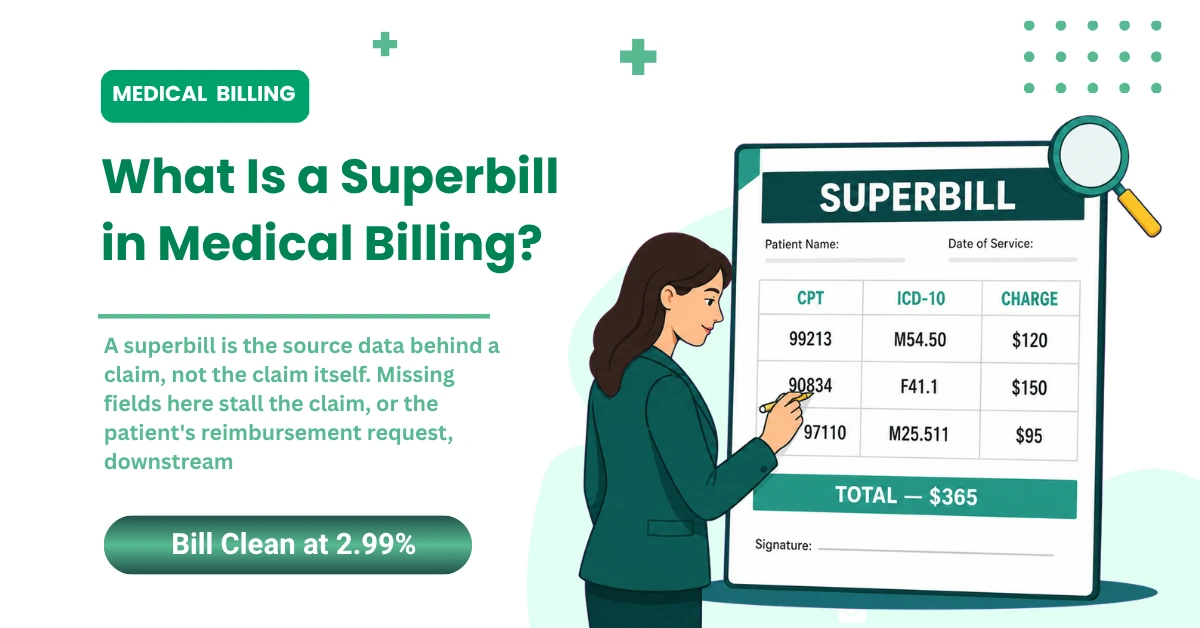




A superbill in medical billing is a provider-generated summary of a patient encounter. It captures the diagnoses, procedures, provider identifiers, and charges tied to that visit. Practices use this information to build a professional claim, or they hand it to the patient to support an out-of-network reimbursement request. A superbill isn't automatically the payer's official claim form.
Superbill accuracy shapes what happens next. Clean charge capture leads to claim-ready data, while a missing modifier or wrong date of service creates rework for your billing staff. Patients waiting on out-of-network reimbursement feel the same gap. When the superbill is off, they call your front desk asking why their insurer denied a request nobody flagged as a problem.
This guide covers what a superbill in medical billing involves: how it differs from a claim, invoice, receipt, and EOB, and who creates and submits it. You'll find the required fields, the internal claim workflow, the patient reimbursement workflow, payer differences, the coding updates that matter for 2026, and the errors that cause the most rework.
MedSole RCM treats the superbill as upstream billing data, not an isolated patient document. Get that data right, and everything downstream gets easier.
Why Do Superbills Still Matter in Modern Medical Billing?
A superbill captures encounter data before claim submission
A claim is only as accurate as the data behind it, and that data starts with the superbill in medical billing. Before any CMS-1500 or 837P transaction goes out, someone has to capture the diagnosis, procedure, provider identity, service location, units, and charge correctly. That's the superbill's job, whether it lives on paper or inside your EHR's charge-capture screen.
One data set may support two billing outputs
The same encounter data can go two directions. Your billing team may turn it into a professional claim submitted through CMS-1500 or 837P. Your front desk may instead hand a coded copy to a patient who wants to file for out-of-network reimbursement on their own. Both outputs depend on the same underlying accuracy, captured once.
Poor charge capture creates downstream rework
When charge capture is sloppy, the cost shows up later, not on the day of the visit. Missing units trigger coding queries. A wrong date of service bounces the claim back before it reaches the payer's adjudication system.
Patients call the front desk asking why their out-of-network reimbursement request stalled, and staff spend time tracing a problem that started weeks earlier.
A superbill in medical billing is not obsolete because a practice uses an EHR. The format has changed since paper encounter forms were standard, but the underlying job hasn't. Someone still has to validate structured charge capture before that data reaches the payer.
When superbill data regularly reaches the billing team incomplete, the problem usually sits upstream of claim submission. MedSole's outsourced medical billing services can review that handoff and identify where coding, provider data, or payer requirements are being missed.
Is a Superbill the Same as a Medical Claim?
A superbill and an insurance claim are two different documents. The superbill is a provider-generated record of the encounter: the diagnosis, the procedure, the provider's identity, and the charge.
The claim is the formal request for payment sent to the insurer, through the payer's required form, portal, or electronic transaction. Practices and patients sometimes use the words interchangeably, but the two don't serve the same function in the billing process.
HealthCare.gov defines a claim as the request a patient or provider submits to a health insurer for items or services the patient believes are covered.
Superbill vs. CMS-1500 and 837P
CMS-1500 is the standard professional paper claim form used by non-institutional providers, and the National Uniform Claim Committee designs and maintains it. The 837P is the electronic professional claim transaction that has replaced paper submission for most practices. A superbill may supply the source data behind either output, but it isn't an electronic version of one on its own.
Superbill vs. Invoice and Receipt
An invoice asks for payment. A receipt confirms payment already made. A superbill records coded encounter information: diagnoses, procedures, provider data, and charges. It may show what was paid, but a basic receipt normally lacks the coding and provider detail a payer needs for reimbursement review.
Superbill vs. Patient Statement
A patient statement reports account activity: balances, payments, and amounts due, often across several encounters. A superbill is usually encounter-specific and carries the clinical detail a single visit generated.
Superbill vs. EOB
A superbill comes from the provider, before the payer has processed anything. An EOB comes from the health plan after claim processing, and it reports the allowed amount, what the plan paid, any denial reason, and what the patient owes. An EOB explains a decision. It isn't a bill.
|
Document |
Created by |
Produced when |
Main purpose |
Essential distinction |
|---|---|---|---|---|
|
Superbill |
Provider or practice |
After encounter data is finalized |
Support claim creation or patient reimbursement |
Contains coded encounter information |
|
CMS-1500 |
Provider or biller |
At paper claim submission |
Request payer adjudication |
Standard professional paper claim |
|
837P |
Provider, biller, or clearinghouse |
At electronic claim submission |
Request payer adjudication |
Electronic professional transaction |
|
Invoice |
Provider or business |
Before payment |
Request payment |
Focuses on amount owed |
|
Receipt |
Provider or business |
After payment |
Confirm payment |
Proves payment occurred |
|
Patient statement |
Provider or practice |
During the account billing cycle |
Report account balance |
May cover several encounters |
|
EOB |
Health plan |
After adjudication |
Explain the payer's decision |
Not created by the provider |
For the full federal definition, see health insurance claim on HealthCare.gov, and for the paper claim form itself, see the CMS-1500 claim form page.
Who Creates and Submits a Superbill?
The provider or practice creates the superbill. The patient commonly submits it for out-of-network reimbursement, though some practices assist with documentation. The insurer processes the request, and payment follows the member's plan and submission arrangement.
Who creates the superbill?
The rendering provider carries responsibility for clinical accuracy: the diagnosis and the service documented in the chart. Coding or billing staff may complete or validate the administrative and coding fields around that clinical core. Front-desk staff shouldn't select diagnoses or procedure codes unless the practice has trained and authorized them to do so.
Who submits it to insurance?
The patient usually submits the superbill for out-of-network reimbursement, though some practices offer administrative support, and submission rules vary by plan. Helping a patient assemble a request doesn't turn the practice into an in-network provider for that plan.
Who receives the reimbursement?
The patient commonly pays the provider first, and the insurer may reimburse the patient afterward based on out-of-network benefits. Assignment-of-benefits arrangements and payer rules can change that path. No practice should promise reimbursement before benefits have been verified.
|
Task |
Primary party |
Support party |
|---|---|---|
|
Document services |
Rendering provider |
Clinical staff |
|
Select supported codes |
Provider or coder |
Billing team |
|
Complete administrative data |
Practice staff |
Billing team |
|
Issue superbill |
Provider or practice |
EHR or billing system |
|
Submit OON request |
Patient in most cases |
Practice, when offered |
|
Adjudicate the request |
Insurance plan |
None |
|
Explain the EOB |
Insurance plan |
Provider or billing staff may clarify |
The patient usually submits the reimbursement request, and the insurer determines the eligible payment under the patient's plan.
When Do Healthcare Providers Use Superbills?
Healthcare providers use superbills in three main situations: out-of-network and private-pay care, internal charge capture before claim submission, and provider-assisted reimbursement support. An out of network superbill and an internal charge-capture superbill can look nearly identical on paper, but the coding, documentation, and payer requirements shift depending on which one applies.
Out-of-network and private-pay care
Independent providers, cash-pay practices, and specialties like behavioral health, therapy, dietetics, chiropractic, and concierge medicine commonly issue an out of network superbill here. A patient without in-network coverage pays the provider directly, then uses the document to request superbill reimbursement from their plan under out-of-network benefits, when those benefits exist.
Internal charge capture
Many practices use a superbill or encounter form internally to move diagnosis information, procedures, service dates, units, provider identifiers, and charges from the exam room to the billing desk. The billing team then converts that information into a payer-compliant claim, whether the practice is in-network or not.
Provider-assisted reimbursement workflows
Some practices issue the superbill automatically after every visit. Others go further and help the patient complete the payer's member claim process, which can improve the patient's experience. Either way, the practice needs to define, in writing, who is responsible for submission and who follows up if the payer asks for more.
Situations requiring caution
A few scenarios deserve extra care before a practice treats a superbill as a routine reimbursement tool: Medicare, Medicaid, providers still waiting on credentialing, services that require prior authorization, plans with no out-of-network benefit, and services a plan excludes outright.
Handing a patient a superbill in one of these situations without a caveat sets up a reimbursement expectation the plan may never meet. Later sections of this guide cover payer-specific differences in detail.
Independent and private-pay providers weighing whether their billing workflow supports this well can review MedSole's private practice RCM services for a closer look at how registration, coding, and claim handoffs fit together.
What Information Must a Superbill Include?
A complete medical superbill combines core information every payer expects with conditional fields that depend on the specialty, the payer, or the plan. Not every field applies to every visit, and not every payer requires an identical set.
The NUCC maintains the national instruction manual for the 1500 claim form, and its most recent version was released in July 2025, which shows how often even standardized claim guidance gets revised.
Patient and coverage information
A superbill should carry the patient's full legal name, date of birth, address, and contact information, along with a patient account number where the practice uses one. For reimbursement purposes, it typically needs the member or subscriber ID, policy or group information, and any other coverage or coordination-of-benefits detail that applies.
The patient's name and date of birth should match what the payer has on file, since a mismatch is one of the most common reasons a submission gets kicked back.
Accurate demographic and coverage entry starts at intake. MedSole's patient registration services focus specifically on catching mismatches before they reach the claim.
Provider and practice information
This section covers the rendering provider's name and credentials, the rendering NPI, the billing provider or practice name, a separate billing NPI when one applies, the practice address, service facility information, and the TIN or EIN. Taxonomy, referring or ordering provider details, and additional contact information round this out when the payer requires them.
CMS describes the NPI as the unique 10-digit identifier that covered providers use across HIPAA-standard administrative and financial transactions.
Encounter and service information
Every superbill needs the date of service, the place of service, and the service location. Telehealth visits need the modality documented. The procedure description, session length or documented time where relevant, units, and any referral or authorization number complete the encounter picture.
Coding information
CPT and HCPCS Level II codes identify what service was performed. ICD-10-CM codes identify the documented diagnosis or condition that supports the service. The diagnosis pointer connects a specific service line to the applicable diagnosis once the information moves into a professional claim, and modifiers and code descriptors round out the entry.
Charges and payment information
Each service line needs its own charge, along with the total charge, any amount already paid, the remaining balance where relevant, and the payment date. Out-of-network reimbursement is generally based on the plan's allowed amount and benefit structure, not the provider's full charge.
Conditional specialty and payer information
Some visits call for a prior authorization number, a referring or ordering NPI, a CLIA number, NDC information, tooth or oral cavity detail, supporting narrative for an unlisted code, or a specific signature convention. None of these apply to every specialty, so treat this list as situational rather than universal.
|
Field group |
Common content |
Status |
|---|---|---|
|
Patient identity |
Name, DOB, address, contact information |
Core |
|
Coverage |
Member ID, subscriber, group, other insurance |
Core when used for reimbursement |
|
Provider identity |
Rendering provider, NPI, practice information |
Core |
|
Billing identity |
Billing entity, billing NPI, TIN |
Common, workflow dependent |
|
Encounter |
Date of service, place of service, location |
Core |
|
Coding |
CPT or HCPCS, ICD-10-CM, modifiers |
Core |
|
Service-line detail |
Units, charges, diagnosis pointers |
Core for claim conversion |
|
Referral and authorization |
Referral, ordering provider, authorization number |
Conditional |
|
Specialty data |
CLIA, NDC, tooth information, unlisted-code narrative |
Conditional |
|
Attestation |
Signature or an accepted signature-on-file convention |
Payer and workflow dependent |
For the full field-level instructions, see the NUCC claim instructions, and for the identifier standard itself, see National Provider Identifier on CMS.gov.
How Does a Superbill Move Through the Medical Billing Process?
A superbill in medical billing moves through five steps on its way to becoming a professional claim: documentation, charge capture, validation, claim creation, and payer feedback. Each step has a specific owner.
Step 1: The provider documents the encounter
The provider records the reason for the visit, the diagnoses, the services performed, time or units where relevant, the location or modality, and any orders or referrals tied to the visit.
Step 2: Staff capture the encounter data
The provider or clinical staff transfer the selected services and diagnoses into a structured format, whether that's EHR charge capture, a paper encounter form, a digital superbill, or a practice-management workflow.
Step 3: The billing team validates coding and provider data
Coders and billers confirm the code set matches the date of service, check modifier support, verify the diagnosis-to-procedure relationship, and validate the NPI, TIN, taxonomy where required, place of service, authorization, units, and charges.
Step 4: The practice creates the payer claim
The practice management system maps the superbill's structured data into a CMS-1500 for paper submission or an 837P for electronic submission, and a clearinghouse or the payer's own edits may flag issues before the claim reaches adjudication.
Billers correct missing or invalid data at this stage, before the claim goes out. MedSole's medical claim submission services handle this validation step for practices that want a second set of eyes on it.
Step 5: Payer feedback returns to the workflow
The payer accepts, rejects, pends, denies, or pays the claim, and that outcome feeds back into the practice's revenue cycle. A biller reviews each response and decides whether the fix belongs in the coding, the documentation, or the original superbill data. The "What Superbill Errors Delay or Prevent Reimbursement" section later in this guide covers denial prevention in detail.
The workflow at a glance: clinical documentation, then structured encounter data, then coding and provider validation, then a CMS-1500 or 837P claim, then payer adjudication, then payment, rejection, or denial feedback.
How Does a Superbill Work for Insurance Reimbursement?
An insurance superbill supports out-of-network reimbursement through six steps: benefit verification, care and payment, document issuance, patient submission, payer adjudication, and EOB review. It does not guarantee reimbursement at any point in that sequence.
Step 1: Verify out-of-network benefits
Before treatment, the patient or the practice should confirm whether out-of-network benefits exist at all, along with the OON deductible, coinsurance, the plan's allowed-amount methodology, referral or prior authorization requirements, the timely-filing period, and which member claim form or portal the plan requires. MedSole's verification of benefits service handles this check before the appointment happens.
Step 2: The patient receives care and pays the provider
Payment arrangements vary by practice, but many out-of-network practices collect payment at the time of service. That payment doesn't guarantee the insurer will reimburse it, and the provider's charge may run higher than the plan's allowed amount. Some practices explain this gap to patients up front, in plain terms, before the first visit.
Step 3: The provider issues the coded document
The superbill carries the provider data, diagnosis, procedures, date of service, charges, and amount paid described in the required-fields section above. There's no need to repeat that full field list here; the same standards apply.
Step 4: The patient submits the payer-required request
Depending on the plan, submitting a superbill for insurance reimbursement may require the document itself, a separate member claim form, a portal submission, supporting medical records, proof of payment, and referral or authorization information. Uploading the superbill alone is not sufficient for every plan.
Step 5: The insurer adjudicates the request
The plan may approve reimbursement, apply the charge to the deductible, approve a partial payment, ask for more information, or deny the request as noncovered.
Step 6: Review the EOB before correcting the superbill
A partial payment doesn't automatically mean the superbill was wrong. The result may reflect the allowed amount, the deductible, coinsurance, a benefit exclusion, or missing information the payer needed. Correct the document only when it contains inaccurate or incomplete information, and use the appeal process instead when the payer's decision, not the document, is what's being challenged.
Decision rule: if the EOB identifies incorrect or missing data, correct the information and resubmit according to the payer's instructions. If the claim processed correctly but coverage or medical necessity was denied, review the appeal process instead of reissuing the same superbill.
What Changed for Superbills in 2026?
The basic purpose of a superbill in medical billing didn't change in 2026, but the codes and billing rules feeding it did. Practices need to maintain current CPT, HCPCS, ICD-10-CM, modifier, telehealth, and payer-specific logic so the encounter information reflects the rules in effect on the date of service.
Update CPT code panels for 2026
CPT 2026 took effect January 1, 2026. The AMA confirms the code set includes 418 total changes: 288 new codes, 84 deletions, and 46 revisions. New and revised areas include shorter-duration remote monitoring, AI-assisted diagnostic services, hearing-device services, and an overhaul of lower-extremity revascularization coding.
A practice needs to remove deleted codes from its superbill templates and validate revised descriptors before releasing charges.
Use the ICD-10-CM version applicable to the date of service
ICD-10-CM remains the applicable U.S. diagnosis coding system. Diagnosis picklists need to stay date-sensitive, since the code set updates twice a year.
CMS publishes separate FY 2026 ICD-10-CM files: one for encounters from October 1, 2025 through March 31, 2026, and an updated set for encounters from April 1 through September 30, 2026. Codes for an April 2026 encounter need to come from the version applicable to that service date, not whatever the template listed in January.
Review HCPCS and payer rules throughout the year
HCPCS Level II maintenance isn't limited to one annual review. Drug, supply, DME, laboratory, and specialty codes may update outside the standard cycle. Payer policies, prior authorization rules, modifier logic, and telehealth requirements can all shift independently of CPT. See CMS HCPCS resources for the current code files and update schedule.
What didn't become a universal 2026 requirement for a superbill in medical billing: ICD-11 hasn't replaced ICD-10-CM for U.S. billing. There's no general federal rule requiring every superbill to carry a Good Faith Estimate reference number, and no universal federal requirement to route every superbill through a FHIR API.
Proposed HIPAA changes aren't finalized rules until they are, and no single field or signature convention applies to every superbill regardless of payer.
For the full CPT release details, see CPT 2026 code changes from the AMA, and for the current diagnosis files, see 2026 ICD-10-CM files on CMS.gov.
Do Medicare, Medicaid, and Commercial Plans Handle Superbills the Same Way?
Medicare, Medicaid, and commercial health plans don't follow one universal superbill process. Commercial plans may allow patients to request out-of-network reimbursement directly, while Medicare and Medicaid commonly require provider enrollment, program-specific claim procedures, and payer-specific billing rules. A practice needs to confirm the applicable program before it hands a patient submission instructions.
Commercial out-of-network plans
Some commercial plans include out-of-network benefits. Others provide no OON coverage outside emergencies. A patient filing a superbill for insurance reimbursement may need a member claim form in addition to the document itself, and allowed amounts, deductibles, coinsurance, filing limits, authorization rules, and documentation requirements all vary by plan.
A practice shouldn't promise superbill reimbursement based only on issuing the document. The relevant terms to verify are out-of-network benefit status, the payer's member claim form, the allowed amount, timely filing, and any benefit exclusion that applies.
Medicare
Handle Medicare carefully. In most situations, the physician, practitioner, or supplier submits the Medicare claim directly, not the beneficiary.
CMS-1490S is the form a beneficiary uses to request payment when the provider doesn't submit on their behalf, and the CMS-1490S instructions require an itemized bill and supporting documentation with that form: dates of service, place of service, a description of each service, charges, and provider information, including the NPI if known.
A commercial out-of-network superbill workflow shouldn't be presented as Medicare's standard process, and provider enrollment status remains relevant throughout.
Practices that need to verify or expand where their providers can bill often turn to MedSole's provider credentialing services to handle enrollment. MedSole's current pricing for provider credentialing starts at $99 per insurance enrollment, which keeps the cost predictable while an application moves through payer review.
Medicaid
Medicaid is administered by individual states under federal requirements, and it's jointly funded by states and the federal government. See Medicaid program resources for state-specific guidance. State Medicaid programs and their managed-care organizations can apply different enrollment, taxonomy, modifier, telehealth, referral, authorization, and claim-submission rules from one state to the next.
There's no single national answer to "does Medicaid accept superbills." Direct readers to the applicable state Medicaid agency and plan manual instead of a generic yes or no.
What providers should verify before giving payer instructions
Before telling a patient how to submit anything, confirm six things: the provider's enrollment and network status with that plan, the patient's applicable benefit, the payer's required claim form or portal, whether a referral or prior authorization applies, the timely-filing requirement, and what supporting documentation and payment proof the payer expects.
MedSole's prior authorization services cover the authorization piece of that checklist for practices that don't want to track it manually.
What Is an Electronic Superbill?
An electronic superbill is a digital version of structured encounter and charge information. It may live inside an EHR, a practice-management platform, or a billing workflow, and a practice can use it to prepare a professional claim or to hand coded information to a patient. Digital format alone doesn't make the underlying data accurate or payer compliant.
How an electronic superbill is created
The data comes from several sources already in the practice's systems: patient registration, coverage information, the provider's profile, encounter documentation, diagnosis selection, procedure selection, units and time, and charges. A well-built system prepopulates verified data from those sources, but it shouldn't invent codes from the medical record that a coder or provider hasn't confirmed.
What a modern digital workflow should validate
Before an electronic superbill releases charges, the system, or the person reviewing it, should check the code-set effective date, flag inactive or deleted codes, confirm required provider identifiers, verify the diagnosis-to-procedure relationship, and check place of service, telehealth modality, modifiers, units, authorization, and any payer-specific fields.
AI-generated coding suggestions don't remove the need for a provider or coder to review the output before it goes out.
Secure patient delivery
Practices that deliver superbills electronically should rely on an authenticated patient portal, controlled access, identity verification, audit logs, secure transmission, role-based permissions, and business-associate review where one applies.
The HIPAA Security Rule requires covered entities and their business associates to implement administrative, physical, and technical safeguards for electronic protected health information, and that standard governs how a superbill moves once it leaves the practice's system.
Federal law doesn't require every electronic superbill to use a specific encryption standard, multi-factor authentication, a FHIR API, or one prescribed delivery platform, unless a rule that directly applies says so.
Interoperability standards may supply the source data behind a superbill, but payer claims still travel through the payer-required CMS-1500 or 837P transaction, not through FHIR itself.
For the underlying federal standard, see the HIPAA Security Rule on HHS.gov.
What Superbill Errors Delay or Prevent Reimbursement?
Most errors that delay a superbill in medical billing fall into four groups: patient and provider data, coding and encounter details, coverage and authorization, and the submission documents themselves.
Patient and provider data errors
Watch for a patient name mismatch, an incorrect date of birth, the wrong member ID, a missing billing or rendering NPI, a TIN mismatch, an incorrect provider address, a missing referring or ordering provider, or an enrollment mismatch between what the practice submitted and what the payer has on file.
Coding and encounter errors
This group covers a deleted CPT or HCPCS code, an ICD-10-CM code invalid for the date of service, a diagnosis that doesn't support the reported service, an unsupported modifier, incorrect units, the wrong place of service, a missing telehealth modality, an unitemized charge, or a date-of-service mismatch between the superbill and the medical record.
Coverage and authorization errors
These show up as no out-of-network benefit, a deductible that hasn't been met, a missing prior authorization, a missing referral, a benefit exclusion, a missed filing deadline, or a service the patient's plan doesn't cover.
Submission-document errors
Even a correct superbill can stall if the payer requires a separate member claim form, proof of payment is missing, supporting records weren't included, the submission went through the wrong channel, a duplicate service appears on the request, or the patient resubmits without addressing the reason the payer gave the first time.
|
Outcome |
What it means |
Correct next action |
|---|---|---|
|
Rejected or returned |
Information is missing, invalid, or couldn't be processed |
Correct the identified information and resubmit |
|
Pended |
The payer needs additional information or review |
Supply the requested documentation |
|
Denied |
The payer adjudicated the request but didn't approve payment |
Review the reason and appeal or correct as appropriate |
|
Partially reimbursed |
Benefits, allowed amount, deductible, or coinsurance reduced payment |
Review the EOB before changing the document |
|
Applied to deductible |
The request was processed, but the member owes the allowed amount |
Explain the benefit result rather than recoding the claim |
|
Noncovered |
The plan excludes the service or benefit |
Verify plan language and appeal rights where they apply |
HealthCare.gov confirms that a member has the right to appeal when an insurer refuses to pay a claim, and that the insurer has to explain both the denial and the dispute process. See health plan appeal rights for the full explanation.
Reissuing the same document doesn't resolve a coverage denial, an unsupported code, or a missing authorization. MedSole's denial management services trace a payer's stated reason back to the registration, coding, documentation, or submission step that caused it.
Which Healthcare Providers Commonly Use Superbills?
Many provider types issue or use superbills, but the coding, time, units, documentation, referral, and payer requirements shift by specialty. A generic superbill template rarely fits every practice type without adjustment.
Behavioral health and therapy
Psychologists, psychiatrists, counselors, clinical social workers, and marriage and family therapists commonly rely on superbills for out-of-network patients. Diagnosis documentation matters here more than in some other specialties, since payers scrutinize behavioral health claims closely.
Session duration can affect code selection, telehealth modality and place of service often matter, and the practice needs to avoid disclosing more clinical detail than the reimbursement request requires. A therapy superbill, like any other, doesn't guarantee out-of-network reimbursement.
Physical, occupational, and speech therapy
These specialties work with both timed and untimed service codes, so units need to match the documentation exactly. The distinction between an evaluation and ongoing treatment matters for code selection, and referrals or a plan of care may be required depending on the payer.
Assistant or discipline-specific modifiers apply in some states, and time-based services need documentation that supports the units billed.
Chiropractic, acupuncture, dietetics, and wellness practices
Coverage for these services is often limited by benefit design rather than by anything the practice does. Credential type and plan rules both affect what a superbill can support, and cash-pay status on its own doesn't establish out-of-network reimbursement eligibility. Diagnosis and procedure coding still needs to reflect the documented service, the same as any other specialty.
Independent physicians, podiatry, and concierge practices
Independent physicians use superbills for office visits, procedures, diagnostic services, referrals, and laboratory charges, and network status affects how the document gets used.
Podiatry carries its own layer of complexity. Routine foot care has specific Medicare medical necessity rules, so diagnosis coding needs to reflect the systemic condition driving the visit, such as diabetes, rather than the foot complaint alone, and in-office procedures, orthotics, and DME often need separate documentation support.
Concierge practices face the same baseline rule as everyone else: a medical superbill should reflect the encounter that happened, not function as a standing list of every service the practice offers.
Superbill Quality-Control Checklist for Healthcare Providers
A medical superbill shouldn't go out just because every visible field has something typed into it. Before release, a practice should confirm the data matches the medical record, the provider's enrollment status, the patient's coverage, the code sets in effect on the date of service, and the payer's requirements.
|
Checkpoint |
Verify before release |
|---|---|
|
Patient identity |
Name, DOB, address, member ID, subscriber data |
|
Provider identity |
Rendering provider, billing provider, NPI, TIN, taxonomy where required |
|
Encounter |
Date of service, location, place of service, telehealth modality |
|
Documentation |
Diagnoses and services are supported by the signed record |
|
Coding |
Current CPT or HCPCS and ICD-10-CM codes for the service date |
|
Relationships |
Diagnosis pointers and modifiers are accurate |
|
Quantity |
Units, minutes, or service count match the documentation |
|
Coverage |
OON benefit, referral, and authorization have been checked where relevant |
|
Financial data |
Charges and amount paid are itemized correctly |
|
Submission |
The patient knows whether a claim form, portal, receipt, or records are required |
|
Security |
The delivery method protects PHI |
|
Final review |
The document is readable and free of conflicting information |
Two release statuses give staff a clear line between drafting and releasing a superbill. A draft charge capture means the provider has entered encounter data. A validated release means billing or coding has completed its checks.
MedSole's revenue cycle management services fold this kind of checkpoint into the broader claim workflow, so the same validation applies whether the output is a claim or a patient-facing document.
Frequently Asked Questions
What is a superbill in medical billing?
A superbill in medical billing is a provider-generated summary of a patient encounter that includes diagnoses, procedures, provider data, and charges. It supports claim preparation or out-of-network reimbursement, but it isn't automatically the claim itself.
What is a superbill for insurance?
An insurance superbill is coded encounter information a patient commonly uses for out-of-network reimbursement. It may need to accompany a separate member claim form, and what gets reimbursed depends on the patient's plan benefits.
How do you submit a superbill to insurance?
Verify the payer's instructions first, then complete the required member claim form or portal submission, include the coded document and proof of payment where the payer asks for it, keep copies of everything, and watch the filing deadline. There's no single email, fax, or portal process for a superbill for insurance that works across every plan.
Does a superbill guarantee reimbursement?
No. The result depends on the out-of-network benefit, the allowed amount, the deductible, coinsurance, authorization requirements, medical necessity, and the plan's filing rules.
Does a superbill need a diagnosis?
In most cases, yes. Payer review commonly depends on diagnosis information that reflects the documented condition. A diagnosis should never get added just to support reimbursement, and requirements still vary by payer and service.
Does a superbill need the provider's signature?
Signature expectations vary by payer and workflow. Some accept a signature-on-file convention instead of a wet signature on every document, but the underlying documentation still needs to be authenticated and support the reported services.
Can a patient submit a superbill to Medicare?
Providers submit Medicare claims in most situations, not patients. CMS-1490S permits a beneficiary to submit a request when the provider doesn't, and the patient needs to follow Medicare's instructions and attach an itemized bill.
Is a superbill the same as a receipt?
No. A receipt confirms payment. A superbill includes coded encounter and provider information, and it may show payment too, but a basic receipt on its own doesn't carry what a complete superbill does.
How often should a practice update its superbill workflow?
Review CPT changes before January 1 each year, check ICD-10-CM by its effective date, review HCPCS during the year as updates come out, update payer rules the moment requirements change, and revisit provider and specialty details periodically rather than only once a year.
A Superbill Is Only as Reliable as the Workflow Behind It
A superbill in medical billing starts with accurate registration and documentation, and it depends on current codes and correct provider data from there. It can feed a professional claim or a patient's reimbursement request, but it never guarantees payment on its own.
The risk sits in the gaps: incomplete encounter data, inconsistent coding, missing provider identifiers, confused patients chasing reimbursement, corrections that repeat themselves, and payer follow-up that could have been avoided with cleaner data the first time.
MedSole RCM reviews the full path from patient registration and charge capture through coding, claim submission, denial follow-up, and payment posting. Practices dealing with incomplete superbills, patient reimbursement confusion, or repeated claim rework can use MedSole's medical billing support to find where the process is breaking down.
Current MedSole RCM pricing starts at 2.99% of collections for outsourced billing and $99 per insurance for provider credentialing, so a practice knows the cost before the audit even begins.
Request a Free Billing Audit →