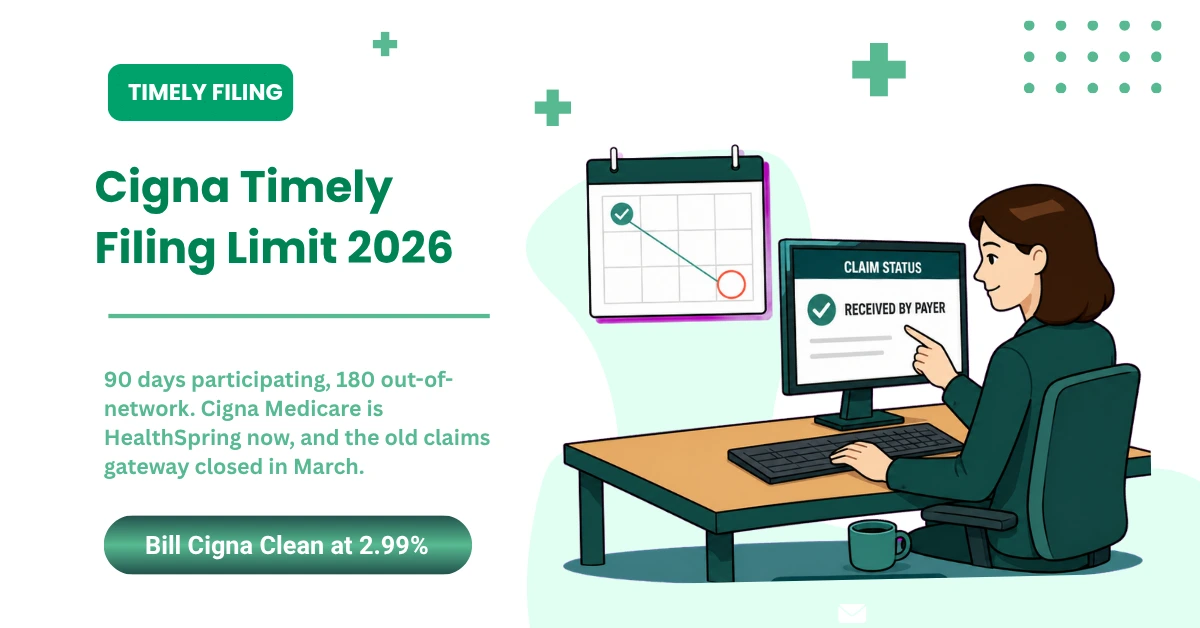




Participating Cigna Healthcare providers generally have 90 days from the date of service to file a claim. Out-of-network providers generally have 180 days from the date of service. For consecutive-day services such as a hospital confinement, Cigna Healthcare counts the filing period from the last date of service. Provider agreements and applicable law can allow more time.
Those are commercial rules, and they don't transfer. The Cigna timely filing limit changes for HealthSpring Medicare Advantage, coordination of benefits claims, corrected claims, Cigna-requested resubmissions, provider appeals, California disputes, and behavioral health agreements. Each one runs on a separate published source.
This guide shows which rule governs a claim, what date starts the clock, which claim submission channel to use, what proof to keep, and what to do after a denial notice. Cigna timely filing isn't one number. It's a set of filing deadlines, and the trigger decides which one counts. MedSole RCM works these rules daily.
What Is the Cigna Timely Filing Limit in 2026?
Cigna Healthcare publishes 90 days after the date of service for participating providers and 180 days after the date of service for out-of-network providers. Consecutive-day services are counted from the last date of service. Other claim situations, including coordination of benefits, requested resubmissions, and appeals, run on different clocks.
Cigna timely filing limits vary by claim situation, network status, and provider contract. Initial-claim rows below come from Cigna claims-submission guidance, and the remaining rows carry their own published sources.
Cigna Healthcare Filing Deadlines by Claim Situation
|
Claim situation |
Published rule |
Clock starts from |
Verification note |
|---|---|---|---|
|
Participating Cigna Healthcare provider |
90 days |
Date of service |
Provider contract or applicable law may allow more time |
|
Out-of-network Cigna Healthcare provider |
180 days |
Date of service |
Confirm product and claim address on the ID card |
|
Consecutive-day services |
90 or 180 days, by network status |
Last date of service |
Do not default to the admission date |
|
COB or secondary claim |
Contract-specific filing period |
Primary payer's EOB or EOP processing date |
Cigna Healthcare publishes the trigger, not a day count |
|
Cigna-requested resubmission |
Exception applies |
Original claim's filing date and Cigna Healthcare's request date |
A resubmission Cigna Healthcare did not request follows the standard filing period |
|
Member-submitted claim |
180 days in the US, 365 days for foreign services |
Date the member received the service |
Applies only when the provider is not filing |
|
Commercial provider appeal |
180 calendar days |
Initial payment or denial notice |
Separate from initial claim filing |
|
HealthSpring Medicare Advantage |
Separate HealthSpring rules |
Product and agreement determine the clock |
Check the plan-specific deadline in the current manual |
Sources: Cigna Healthcare claims and appeals policies, the Cigna Medical Claim Form (Rev. 11/2023), and HealthSpring provider resources. Last verified: August 5, 2026.
Read the verification note before acting on the number. Participating and out-of-network rows are national baselines. COB is contract-controlled, requested resubmission is an exception, and the appeal and HealthSpring rows sit outside initial filing entirely. They don't carry equal certainty. Working them as if they do is how a claim lands on the wrong clock.
Billing teams shorten timely filing limit to TFL, so a search for the Cigna TFL limit points to the same deadlines above. You'll see the abbreviation on aging worklists and payer matrices more than the full phrase.
The Deadline Measures to Payer Receipt
The Cigna Healthcare timely filing limit written into your provider agreement may run longer than the national baseline, so check the contract before assuming 90 or 180 days. Either window measures to payer receipt, not to the date your system generated the claim. A claim sitting in an unbilled queue on day 88 is not a filed claim.
A nonparticipating provider who sends the claim to the wrong address watches the clock run while it sits somewhere Cigna Healthcare never receives it. Check the claim address on the member ID card before the batch goes out.
Filing a claim and having it received are two different events. Track each one from creation through payer acknowledgment, not just to the point where it left your practice management system. Claims submission services cover payer-specific scrubbing, EDI routing, and electronic submission tracking.
A Clean Claim Still Needs Timely Submission
A clean claim is one Cigna Healthcare can process at first submission. That means standard ICD-10, CPT, and HCPCS code sets with correct modifiers, accurate entries in every field of the CMS-1500 or UB-04, and clinical documentation for the categories that require it.
Clean doesn't mean early. A claim can be coded correctly, pass every claim scrubber edit, and still become a Cigna timely filing denial because it sat in an unbilled queue for three weeks. Submitted past the Cigna timely filing limit, a clean claim is still a denial, and the deadline doesn't restart when the coding team finishes its review.
Charge lag is usually the culprit, not the payer. If claims are leaving your system without a clear payer status, review the submission workflow before another filing window closes.
Which Cigna Filing Rule Applies to Your Claim?
Four fields decide which Cigna timely filing limit governs a claim: the product, the network status, the submission type, and the document that starts the clock. Get one wrong and the deadline you calculate belongs to a different claim.
Identify the Cigna Product
Line of business decides which rulebook applies, so product comes first. Pull the member ID card and confirm which of these you're billing:
- Cigna Healthcare commercial
- Employer-sponsored plans administered, not insured, by Cigna Healthcare
- Behavioral health under Evernorth
- HealthSpring Medicare Advantage, formerly Cigna Medicare
- Secondary payer claims
Confirm Network Status
Network participation changes the number. Participating and out-of-network providers work different deadlines from the same date of service, and a provider who's in-network under one payer agreement can sit out-of-network under another. Confirm status for the specific provider, the plan, the date of service, and the billing entity.
Benefit verification services settle plan identification and network status before the visit. Sorting it out after the denial costs far more time.
Identify the Submission Type
Submission type is where misfiled claims start. Cigna timely filing guidelines treat each of these as a separate transaction with its own deadline source:
- Original claim
- Corrected or replacement claim
- Cigna-requested resubmission
- Reconsideration
- Provider payment appeal
- COB or secondary claim
Find the Document That Starts the Clock
What usually happens is the team counts from memory. Every deadline traces back to one document in the file, so pull it before counting.
|
Claim type |
Document that sets the start date |
|---|---|
|
Original claim, single visit |
Date of service |
|
Original claim, multi-day stay |
Last date of service |
|
COB or secondary claim |
Primary payer's EOB or EOP |
|
Cigna-requested resubmission |
Cigna Healthcare's information request |
|
Provider payment appeal |
Payment, denial, or adjustment notice |
|
Any claim with a longer contract term |
The provider agreement |
Do Not Substitute the Discharge Date
Last date of service and discharge date land on the same day for plenty of facility claims. Here's the catch: they're separate fields. Read the last date of service off the claim itself instead of assuming the discharge date fills that role.
Two situations break the pattern. One hospital stay billed on two claims carries its own last date of service on each, so a single start date can't cover both. A claim held for a coding query keeps its original date of service, and the count doesn't restart at sign-off. Every Cigna timely filing limit counts forward from the service itself.
Cigna timely filing limits are published as days after the date of service, with no weekend exclusion, so count calendar days straight through.
Run All Four Before Assigning a Date
- Product
- Network status
- Submission type
- Clock-start document
Only count the days after all four fields are confirmed. The timely filing limit for Cigna claims isn't a number you look up. When a field is still unclear, hold the claim instead of guessing.
How Coordination of Benefits Changes Cigna Timely Filing
In a coordination of benefits situation, Cigna Healthcare determines timely filing from the processing date shown on the primary payer's EOB or EOP. What Cigna Healthcare doesn't publish is a universal COB day count that covers every product. The provider agreement and plan instructions still decide how many days you get.
Use the Primary EOB or EOP Processing Date
Four dates sit on a primary claim, and only one starts the secondary clock. Don't calculate from:
- The primary date of service
- The primary claim submission date
- The primary payment date
The Cigna timely filing limit on a secondary claim runs from the EOB or EOP processing date, not from the day the primary payer cut the check. An explanation of benefits and an explanation of payment carry the same trigger, so use whichever one arrived.
Keep the Primary Payer's Documentation
Cigna Healthcare requires the primary carrier's EOB when Cigna Healthcare is the secondary payer, so that document belongs in the claim file before submission, not after a denial. Pull these six together:
- Primary EOB or EOP
- Primary claim number
- Primary processing date
- Payment or denial result
- Secondary submission date
- Cigna Healthcare receipt or claim reference
Do Not Wait Without Tracking the Primary Claim
The issue is timing on someone else's claim. Weeks pass with the primary claim unprocessed, nobody's watching the payer sequence, and the filing window closes without anyone noticing it opened. Timely filing for Cigna as the secondary payer depends on an adjudication date you don't control.
Watch for a primary claim stalling with no follow-up, outdated other insurance on file, and a secondary claim routed before the primary finished adjudicating.
Verify plan and network status before the claim goes out, including whether another plan pays first. A COB claim built on last year’s coverage information starts on the wrong clock.
What Is the Cigna Corrected Claim Timely Filing Limit?
Cigna Healthcare doesn't publish one universal corrected claim deadline covering every product and provider agreement. The Cigna corrected claim timely filing limit depends on which transaction you're actually sending. Sort it into one of four channels first: a corrected claim, a Cigna-requested resubmission, a reconsideration, or a formal payment appeal.
Corrected or Replacement Claim
A corrected or replacement claim changes information on the original claim: a corrected code, a corrected charge, corrected provider details, or corrected service information.
When Cigna Healthcare didn't request the resubmission and it isn't an appeal, the standard filing limit applies. That puts the Cigna corrected claim timely filing limit back on the original date of service. Claim frequency handling varies by payer and clearinghouse, so follow the remittance instruction rather than a general rule.
Cigna-Requested Resubmission
This route only applies when Cigna Healthcare asked. Cigna Healthcare's claims policy says the filing limit may not apply the same way when the original claim was timely and Cigna Healthcare requested more information. Four things have to line up: proof the original claim was timely, the request itself, the documentation requested, and a traceable resubmission date.
Reconsideration
Reconsideration covers claims denied or not processed as expected because of a coding edit. Access runs through the CignaforHCP or Provider.Evernorth portals for users with claims and reconsideration permissions. It's a processing-error route, not a payment dispute.
Formal Provider Appeal
A payment appeal challenges a decision Cigna Healthcare already made. The Cigna appeals and disputes policy separates that from routine follow-up, additional-information requests, and reconsiderations. A payment appeal runs on its own Cigna timely filing limit, covered later in this guide, not on the initial claim deadline.
Match the Situation to the Channel
That's why the Cigna timely filing limit for corrected claims has no single number attached to it:
|
Situation |
Correct path |
Deadline source |
|---|---|---|
|
Original claim data needs correction |
Corrected or replacement claim |
Contract, remittance instruction, or product guidance |
|
Cigna Healthcare requested information |
Requested resubmission |
The request letter and the original filing date |
|
Coding edit or processing issue |
Reconsideration |
Portal and claim instructions |
|
Payment or denial being challenged |
Provider payment appeal |
Payment, denial, or adjustment notice |
Sending the wrong transaction three times burns the deadline as fast as sending nothing. When the team keeps resubmitting without knowing whether Cigna Healthcare expects a correction, a reconsideration, or an appeal, denial management services classify the denial before the window closes.
When Contracts, State Law, and Behavioral Health Rules Change the Deadline
Provider Agreements Can Allow Additional Time
Your executed provider agreement can set a Cigna timely filing limit longer than the national baseline. Cigna Healthcare states that state legislation and plan-specific language supersede its administrative guidelines, and that a conflicting provider agreement or applicable law supersedes its published guidance. The contract provision is the first document to check, not the last.
Record seven fields so nobody rereads the contract every quarter:
- Filing period
- Corrected-claim provision
- Appeal period
- Arbitration period
- Applicable product
- Effective date
- Amendment date
A filing period buried in an unread contract protects nothing. Keeping those terms visible alongside claims, denials, payments, and AR follow-up is the point of revenue cycle management services.
Applicable Law May Override the Standard Rule
State requirements can extend filing deadlines for state-regulated plans. What they don't automatically reach is a self-funded employer plan governed by ERISA, every Cigna Healthcare product, Medicare Advantage, or every provider dispute. Confirm the plan is state regulated before applying a state rule to it.
California's 365-day Cigna Healthcare policy governs the provider-dispute process from payment, denial, or adjustment, not an initial filing period from the date of service.
Behavioral Health Requires Product and Contract Verification
Behavioral health claims don't follow one public deadline you can look up. Cigna timely filing here depends on whether the claim routes to Cigna Healthcare or Evernorth, whether it's a professional or facility claim, what the participating agreement says, which state applies, and what the current manual states.
Evernorth-contracted behavioral providers stay in the Evernorth network even when a patient's plan changes hands, so confirm routing per claim rather than per practice.
Rank the Source Before Trusting the Number
This is where published deadlines fall apart. Weigh every source before you act on it:
|
Rule source |
Confidence |
How to use it |
|---|---|---|
|
Current executed provider agreement |
Highest for contracted terms |
Confirm effective date and product |
|
Current payer manual |
High |
Check the revision date |
|
Current official payer webpage |
High for published national guidance |
Confirm scope |
|
Denial or remittance instructions |
Claim-specific |
Follow the stated channel |
|
Old payer webpage or archived guide |
Limited |
Don't use without a date and product label |
|
Another billing company's blog post |
Unverified |
Confirm against the payer's own page before acting |
2026 Update: Cigna Medicare Is Now HealthSpring
Cigna Medicare is now HealthSpring. The Medicare Advantage, Supplemental Benefits, and Part D business is owned by Health Care Service Corporation and carries the HealthSpring name as of January 1, 2026. Use HealthSpring provider resources, the HealthSpring Medicare Advantage payer space in Availity Essentials, and payer ID 52192. The commercial Cigna timely filing limit doesn't transfer to a HealthSpring claim.
What Changed on January 1, 2026?
Existing Cigna Medicare contracts stay in force and put you in HealthSpring provider networks, so there's nothing to re-sign. Credentialing approved within the past three years stays valid too.
Providers searching for the Cigna Medicare timely filing limit in 2026 should verify the applicable rule through HealthSpring's current provider resources, not through commercial Cigna Healthcare pages. Identify members by their HealthSpring ID cards and follow the billing instructions printed on the card. The HealthSpring provider transition FAQ covers the full changeover.
Use HealthSpring Medicare Advantage in Availity
HealthSpring kept Availity Essentials as its provider portal. The Cigna Healthcare Medicare Advantage payer space is now named HealthSpring Medicare Advantage. Payer ID 52192 is the number to use for that space.
That payer space holds Cigna Medicare claims from before January 1, 2026 alongside HealthSpring claims from that date forward, so claim history didn't split. Paper claims go to a new address: HealthSpring, Medicare Advantage Claims, PO Box 23456, Chattanooga, TN 37421.
The Cigna Medicare Gateway Closed on March 18, 2026
HealthSpring announced on February 12, 2026 that providers could no longer submit HealthSpring Medicare Advantage claims through the Cigna Medicare Enterprise Gateway after March 18, 2026. Claims sent that way reject as member not found.
Check clearinghouse routing and your practice management system's payer setup against payer ID 52192. A rejection reading member not found on a patient you know is enrolled is usually a routing problem, not an eligibility problem. The HealthSpring claims-gateway notice carries the announcement.
Do Not Rely on One Universal HealthSpring Deadline
HealthSpring doesn't publish a single provider filing deadline on its public claim pages. It publishes separate 2026 manuals for in-network and out-of-network providers and updates them as changes occur, which is why participating and nonparticipating rules can differ. Check the current HealthSpring provider manuals before relying on any number, including one from an article.
2026 Change Log
|
Date |
Update |
Provider impact |
|---|---|---|
|
January 1, 2026 |
Cigna Medicare became HealthSpring |
Use HealthSpring resources and member ID cards |
|
January 1, 2026 |
Availity payer space renamed HealthSpring Medicare Advantage |
Submit under payer ID 52192 |
|
March 18, 2026 |
Cigna Medicare Enterprise Gateway stopped accepting these claims |
Wrong routing returns member not found |
|
Ongoing |
HealthSpring manuals updated as changes occur |
Recheck the current manual before relying on a deadline |
What Is the Cigna Appeal Timely Filing Limit?
Cigna Healthcare generally requires provider payment appeals within 180 calendar days of the initial payment or denial notice. When the appeal challenges an adjusted payment, that 180-day period generally runs from the last payment adjustment instead. The denial notice, your provider agreement, and applicable law can set different instructions.
Start With the Payment or Denial Notice
Three events can start an appeal clock: the initial payment date, the initial denial notice, or the last payment adjustment when a reprocessed claim is what you're disputing. Pick the one that matches the decision you're challenging.
Don't count from the date of service, the claim submission date, the day staff found the denial, or the day the account landed in the appeal queue. Cigna provider appeal requirements name the payment and notice triggers, and nothing else.
Try Real-Time Adjustment Before a Formal Appeal
Cigna Healthcare asks providers to call Customer Service before starting a written appeal. Denials tied to timely filing, incomplete claim submissions, contract terms, and fee schedules can sometimes be fixed through a real-time adjustment on that call.
Sometimes. A call isn't a reversal, and the Cigna timely filing limit on the appeal keeps running while you wait.
Correction, reconsideration, and appeal are three separate routes with three separate deadline sources. Classifying the denial before choosing one is what denial management services exist for. Log the call reference number either way.
Submit the Correct Supporting Records
Cigna appeal timely filing runs on the written request, so the supporting documentation goes with it. Three attachments are named:
- Completed Request for Health Care Provider Payment Review form
- Original EOB, EOP, or the letter requesting additional information
- Documentation showing why the decision should be overturned
Select the appeal-type checkbox on the form. For denials with no EOB or EOP behind them, such as a precertification denial, Cigna Healthcare doesn't require that document.
Cigna Healthcare completes the review in 60 days and sends notification within 75 business days of receiving the dispute. If the decision stands and your agreement allows arbitration, that request is due within one year of the final internal review letter.
HealthSpring Appeals, Claim Disputes, and Reconsiderations Are Different
HealthSpring runs four separate review channels, and picking the wrong one costs you the deadline. Sort the issue first: a medical necessity appeal, a contracted-provider payment dispute, a claim reconsideration, or a Medicare Advantage organization reconsideration. The widely quoted 65-day CMS deadline covers only the last of those.
Searching for a Cigna timely filing limit on a Medicare Advantage claim now points to the wrong rulebook, so check HealthSpring's current sources instead.
Medical or Authorization Appeal
Medical necessity, clinical guideline, prior authorization, and referral disagreements go here. HealthSpring offers participating providers one level of appeal on Medicare Part C claim disputes, reviewed by someone outside the original decision. Coverage appeals for services not yet rendered use a different address.
Contracted-Provider Payment Dispute
Payment and claim-processing disagreements run through the contracted-provider dispute channel instead. HealthSpring publishes a separate fax line and a separate Nashville mailing address for disputes, so a payment dispute sent to the appeals box lands in the wrong queue.
Claim Reconsideration
Reconsideration is its own request type. HealthSpring's public disputes page doesn't publish reconsideration instructions or an address, and points providers to the current HealthSpring provider manuals instead. Pull the manual rather than assuming reconsideration follows the appeal path.
Medicare Advantage Organization Reconsideration
Here's what the 65 calendar days actually covers. CMS applies that window when an enrollee, a representative, or a physician requests reconsideration of an adverse organization determination.
Separate decision timeframes run alongside it: 72 hours for expedited pre-service requests, 30 calendar days for standard pre-service requests, and 60 calendar days for payment requests. CMS Medicare Advantage reconsideration guidance holds the detail.
|
Review channel |
Main issue |
Who initiates it |
Deadline source |
|---|---|---|---|
|
HealthSpring medical appeal |
Medical necessity, authorization, or clinical decision |
Participating provider |
Current HealthSpring manual and notice |
|
Contracted-provider dispute |
Payment or claim-processing disagreement |
Contracted provider |
Current manual and remittance |
|
Claim reconsideration |
Claim processing issue |
Provider |
Current manual and claim instructions |
|
MA organization reconsideration |
Adverse organization determination |
Enrollee, representative, or physician |
CMS and the determination notice |
|
Noncontracted-provider appeal |
Claim determination disagreement |
Noncontracted provider |
HealthSpring notice and manual |
Noncontracted providers need one more thing: a completed Waiver of Liability, signed by the provider. HealthSpring states a third-party billing agency can't sign it, which stops plenty of outsourced postservice appeals at the door. Forms sit on the HealthSpring claim dispute guidance carries the forms.
Does California Give Providers 365 Days for Cigna Claims?
No. California providers get 365 calendar days to start a provider dispute, counted from the initial payment or denial notice, or from the adjustment date when a payment adjustment is what is being disputed.
That window isn't an initial filing deadline. Cigna Healthcare's California policy has providers enter dispute resolution once appeals are exhausted, or when the issue isn't tied to a claim at all.
|
365-day dispute rule, not a universal initial filing rule The 365 days start at payment, denial, or adjustment. Initial claim filing in California still runs on the network-status deadlines unless a state requirement or your provider contract says otherwise. |
The 365 Days Apply to Provider Disputes
Four different things get called the Cigna deadline in California, and only one of them is 365 days:
- Initial claim filing: network-status deadline from the date of service
- Provider payment appeal: the national 180-day window
- California provider dispute: 365 calendar days from initial payment or denial
- Adjusted-payment dispute: 365 calendar days from the adjustment date
The Cigna timely filing limit for appeals and the California dispute window use similar triggers but sit at different stages of the same claim. Both run on a payment review request form.
Do Not Apply the Rule to Every Cigna Plan
Confirm five things before relying on 365 days:
- Whether the plan is state regulated
- Whether the plan is self-funded
- What the provider contract says
- What the Cigna Healthcare denial notice instructs
- Whether required appeal levels are finished
A self-funded employer plan doesn't automatically pick up a state dispute rule, and the Cigna timely filing limit that governs a claim still depends on which of those five answers you get. The Cigna California dispute policy carries the full procedure.
What Does a CO-29 Timely Filing Denial Mean?
CO-29 means the payer considers your filing period expired. It's two codes stacked: group code CO for contractual obligation, which puts the balance on the provider rather than the patient, and X12 claim adjustment reason code 29, or CARC 29, defined as the time limit for filing has expired.
Not every CO-29 is correct. A Cigna timely filing denial can land on a claim that arrived on time and got misrouted. Before writing it off, determine whether:
- Cigna Healthcare received the original claim
- The claim rejected before payer receipt
- The wrong payer ID or gateway was used
- Coordination of benefits applies
- Cigna Healthcare requested more information
- A contract or legal exception applies
- The right route is adjustment, reconsideration, or claim appeal
Confirm Which Claim Cigna Denied
Match the remittance advice against your own record first. Eight fields have to line up:
|
Field |
Where to verify it |
|---|---|
|
Patient and date of service |
Remittance advice against the encounter |
|
Billing provider |
Claim record against the remittance |
|
Claim number |
Payer claim number on the remittance |
|
Original submission date |
Your submission log |
|
Payer receipt date |
Payer portal or acknowledgment report |
|
Adjustment code and remittance date |
The remittance advice itself |
Identify Why the Filing Clock Was Missed
Root cause sits in one of seven places:
- Charge-entry delay
- Coding hold
- Clearinghouse rejection nobody worked
- Wrong payer ID
- Missing COB information
- Unworked claim queue
- Correction sent through the wrong channel
When CO-29 denials keep landing on the same payer, the workflow that produced them is still running. Reviewing that queue matters more than the next appeal, and timely filing denial management starts from root cause rather than from the individual claim.
Choose the Correct Recovery Path
- Correct and resubmit when the claim never passed edits and never reached Cigna Healthcare
- Request a claim adjustment or reconsideration when processing can still be corrected
- Appeal when the decision itself is what you're challenging
Cigna Healthcare lists timely filing denials among the issues Customer Service may resolve through a real-time adjustment, so the call comes before the written appeal. Evidence of payer receipt strengthens the case. Nothing guarantees the Cigna timely filing limit gets set aside.
What Counts as Proof of Timely Filing for Cigna?
Strong proof of timely filing shows that Cigna Healthcare received or accepted that specific claim inside the filing period. A note in your practice management system showing a claim was generated or transmitted is weaker, because it doesn't prove the claim-level transaction reached the payer.
Cigna Healthcare requires the original EOB, EOP, or information-request letter with supporting documentation on a provider appeal. Its published appeal page doesn't name any clearinghouse report as automatic proof of anything.
Stronger Electronic Evidence
Rank what's actually in the file before building the packet.
|
Evidence |
What it proves |
Strength |
|---|---|---|
|
Payer claim number with a received date |
Cigna Healthcare created a claim record |
Strong |
|
277CA claim acknowledgment |
Claim-level acceptance or rejection by the payer |
Strong |
|
Payer portal receipt or claim status |
Payer-side receipt or current status |
Strong |
|
Clearinghouse report tied to a payer acknowledgment |
Transmission plus a downstream payer response |
Moderate to strong |
|
999 implementation acknowledgment |
File syntax and implementation-guide compliance |
Limited for claim-level acceptance |
|
Practice management system claim history |
Internal generation or transmission activity |
Supporting only |
The gap between the bottom two rows and the top three is the gap between we sent it and they received it.
X12 states the 999 reports syntax and implementation-guide analysis and can't be used for application-level validation. A 999 tells you the file parsed, not that Cigna Healthcare accepted the claim. Claim-level acknowledgment is what the 277CA reports, and CMS documents that flow in the Medicare Claims Processing Manual, Chapter 24. See the X12 999 acknowledgment standard is the primary source.
An electronic claim leaves three usable traces: the payer claim number, the acknowledgment, and the portal status. Pull all three when the Cigna timely filing limit has already passed on paper.
Paper Claim Evidence
Paper claims need a different bundle:
- Certified or tracked delivery record
- Copy of the claim as submitted
- Delivery date
- The claim address used
- Correspondence acknowledging receipt
Certified delivery builds a submission trail. It isn't conclusive in every dispute, so follow whatever the denial instructions say.
COB and Requested-Information Evidence
Secondary and resubmitted claims carry their own set:
- Primary EOB or EOP
- Primary processing date
- Cigna Healthcare information-request letter
- Original timely claim record
- Resubmission documentation
Those dates only hold up if posting is accurate. EOB, EOP, ERA, denial, and adjustment dates all have to reconcile, which is what payment posting services keep straight.
Rejected Claims and Denied Claims Require Different Actions
A rejected claim failed before adjudication and has to be corrected and resubmitted. Denied claims went through adjudication and came back with a payment or coverage decision. Teams that treat both as the same event lose filing windows on the rejections.
CMS describes three edit levels on electronic claims: HIPAA standard edits that can reject an entire batch, implementation-guide edits that reject individual claims, and coverage and payment edits that can reject or deny individual claims. An acknowledgment report gets generated after successful transmission. CMS electronic claims guidance lays out the sequence.
A Clearinghouse Acceptance Is Not Always Payer Acceptance
- Your practice management system creates the claim
- The clearinghouse receives the file
- The file passes syntax edits
- Cigna Healthcare receives the transaction
- The claim passes payer edits
- Cigna Healthcare adjudicates the claim
Clearinghouse acceptance happens at step three. Timely filing for Cigna depends on step four. A claim can clear your clearinghouse and never reach the payer, and a syntax rejection at step three never becomes a filed claim at all.
Rejections belong in a daily work queue, not a monthly AR review. A rejection sitting three weeks eats a fifth of a participating provider's Cigna timely filing limit before anyone opens it.
Denials Require Adjudication Review
Denials need the remittance, not the rejection report. Read the EOB or EOP, the CARC and RARC pair, and the payment decision, then pick the adjustment or appeal path. Claims submission workflow tracking is what keeps the two categories from blurring together in the first place.
How Practices Can Prevent Cigna Timely Filing Denials
Denial prevention isn't a reminder to submit faster. Every stage of the claim lifecycle needs a named owner and a report that surfaces the problem before the deadline does. Cigna timely filing guidelines don't change; the queues inside your practice do.
Track Charge Lag Before Claims Are Created
Charge lag starts the loss. Put a daily control on unsigned encounters, missing charges, coding holds, outstanding documentation requests, and unbilled claims. A charge that hasn't posted can't be scrubbed, submitted, or tracked.
Reconcile Claim Acknowledgments Daily
Acknowledgments answer one question: did the payer take the claim? Review these every day:
- Clearinghouse rejections
- Payer acknowledgments
- Unmatched batches
- Invalid payer IDs
- Member-not-found rejections
- Claims with no payer status
Rejection reconciliation done weekly is a daily workflow running at the wrong interval.
Work Aging Claims by Deadline Risk
An aging report sorted by age misses the point. Sort by risk instead: days left before the filing window closes, dollar value, claim status, missing documentation, appeal deadline, and department ownership. Accounts receivable follow-up worked this way catches the claim with days left on the clock before the one that's merely oldest.
Maintain a Payer Deadline Matrix
Build the matrix once and stop re-researching. Four column groups cover it:
|
Group |
Fields to include |
|---|---|
|
Plan identity |
Payer, product, network status |
|
Deadlines |
Initial claim, corrected-claim instruction, appeal |
|
Triggers |
Clock trigger listed for each deadline |
|
Provenance |
Source URL, source date, contract variation, last verified date |
Provenance is the group teams skip, and it's what keeps Cigna timely filing limits from going stale inside your own spreadsheet.
Assign an Owner to Every Stage
|
Workflow stage |
Owner |
Control |
|---|---|---|
|
Encounter completion |
Provider or clinical team |
Open encounter report |
|
Charge entry |
Coding or billing team |
Daily charge-lag report |
|
Claim submission |
Claims team |
Submission and rejection reconciliation |
|
Payer acceptance |
Claims team |
Claim-level acknowledgment |
|
Payment and denial |
Posting team |
ERA and EOB reconciliation |
|
Aging follow-up |
AR team |
Deadline-priority work queue |
|
Appeal |
Denial specialist |
Appeal calendar and evidence packet |
|
Quality control |
RCM lead |
Monthly root-cause review |
Cigna timely filing rarely fails at one step. It fails at the handoff, and when nobody owns the space between submission, rejection, posting, and follow-up, claims age without anyone seeing the deadline risk. An end-to-end revenue cycle workflow review finds the exact queue where the control breaks.
When Cigna Filing Problems Point to a Larger RCM Gap
One late claim is an accident. A pattern of timely filing denials is a billing workflow telling you exactly where it breaks, and the causes trace back to the controls in the previous section. Fix one in isolation and the revenue leakage moves to the next gap.
What MedSole Handles
MedSole RCM runs these as one connected full-service RCM workflow rather than as separate vendors:
- Eligibility and benefit verification
- Claim submission and rejection monitoring
- Payment posting
- Denial management
- AR recovery and follow-up
- Payer-rule tracking
- Performance reporting
A dedicated billing team works inside the EHR you already run, so nothing migrates and no one learns a new platform.
MedSole Pricing
|
MedSole service |
Published pricing |
|---|---|
|
Full-service medical billing |
2.99% of monthly collections |
|
Provider credentialing |
$99 per insurance |
MedSole provides outsourced medical billing services for 2.99% of monthly collections, covering claim submission, payment posting, denial management, appeals, and AR follow-up. Provider credentialing services are priced separately at $99 per insurance. You pay on what actually gets collected from payers.
Find Where Your Cigna Claims Are Getting Stuck
If Cigna claims are aging without a clear submission or appeal trail, MedSole can review the workflow and show your team where the control is breaking. A review covers unbilled claims, clearinghouse rejections, CO-29 denials, COB delays, appeal deadlines, aging claims, and missing payer acknowledgments.
Request a Billing Workflow Review
Cigna Timely Filing Questions Providers Ask
What is Cigna's timely filing limit for 2026?
The Cigna timely filing limit for 2026 is 90 days after the date of service for participating Cigna Healthcare providers and 180 days after the date of service for out-of-network providers. Consecutive-day services count from the last date of service. A provider agreement or applicable law can allow more time. These are commercial Cigna Healthcare rules and don't apply to HealthSpring Medicare Advantage claims, which run on separate HealthSpring sources.
How long does Cigna allow providers to submit claims?
Cigna Healthcare measures the submission window to payer receipt, not to the day your billing system created the claim. The Cigna timely filing limit for claims runs 90 days from the date of service for participating providers and 180 days for out-of-network providers, and a claim sitting unsubmitted in your practice management system on the final day is not a filed claim. Confirm payer acceptance with a payer claim number or a 277CA acknowledgment rather than a clearinghouse transmission report.
What is the Cigna corrected claim timely filing limit?
Cigna Healthcare doesn't publish one universal corrected claim deadline covering every product and provider agreement. The Cigna timely filing limit for corrected claims depends on the transaction type, so classify it first as a replacement claim, a Cigna-requested resubmission, a reconsideration, or a payment appeal. When Cigna Healthcare didn't request the resubmission and it isn't submitted as an appeal, the standard filing limit applies from the original date of service.
What is the timely filing limit for Cigna appeals?
Cigna Healthcare generally requires provider payment appeals within 180 calendar days of the initial payment or denial notice. When an adjusted payment is being challenged, the Cigna appeal timely filing limit generally runs 180 calendar days from the last payment adjustment. Send the completed payment review form with the original EOB, EOP, or information-request letter. Call Customer Service first, since some timely filing denials resolve through a real-time adjustment.
Can a provider bill the patient after a Cigna timely filing denial?
A participating provider generally cannot bill the patient when Cigna Healthcare denies a claim for late filing. Cigna Healthcare states the provider contract prohibits balance billing in that situation. The same restriction covers amounts denied because a provider missed the deadline to request an appeal review or arbitration. Review the provider agreement, the denial notice, patient responsibility indicators on the remittance, and applicable law before billing anything.
What is timely filing for Cigna HealthSpring in 2026?
Cigna Medicare is now HealthSpring, owned by Health Care Service Corporation as of January 1, 2026. HealthSpring doesn't publish one universal provider filing deadline on its public claim pages, so verify the current provider manual, your provider agreement, network status, and the denial notice. Payer ID 52192 is a routing detail for the HealthSpring Medicare Advantage payer space in Availity Essentials, not a deadline. Commercial Cigna Healthcare deadlines don't carry over.
Does a clearinghouse acceptance report prove timely filing?
A clearinghouse acceptance report supports the submission trail, and it doesn't always prove payer claim-level acceptance. Look for a payer claim number with a received date, a 277CA claim acknowledgment, a payer portal receipt, or claim status from Cigna Healthcare's provider portal. X12 states a 999 acknowledgment reports syntax and implementation-guide analysis and can't be used for application-level validation, so a 999 alone isn't proof the claim arrived.
What should a practice do after a CO-29 denial?
Work a CO-29 in five steps. Confirm the claim, patient, and date of service against the remittance advice. Retrieve payer-receipt evidence. Check coordination of benefits, payer routing, and any contract or legal exception. Identify whether the right route is correction, adjustment, reconsideration, or appeal. Calendar the remaining deadline before sending anything. Cigna timely filing denials sometimes resolve through a Customer Service adjustment before a written appeal is needed.
The Deadline Depends on the Claim in Front of You
Network status sets the initial window, the clock trigger matters as much as the number of days, and corrected claims, appeals, and California disputes each run on separate sources. HealthSpring claims need current 2026 HealthSpring resources, not commercial Cigna Healthcare pages. Proof works best when it shows payer-side receipt or claim-level acceptance rather than internal transmission activity. When CO-29 denials keep repeating, the workflow behind them is the real problem. MedSole RCM provides full-service billing at 2.99% of monthly collections.
Request a Billing Workflow Review