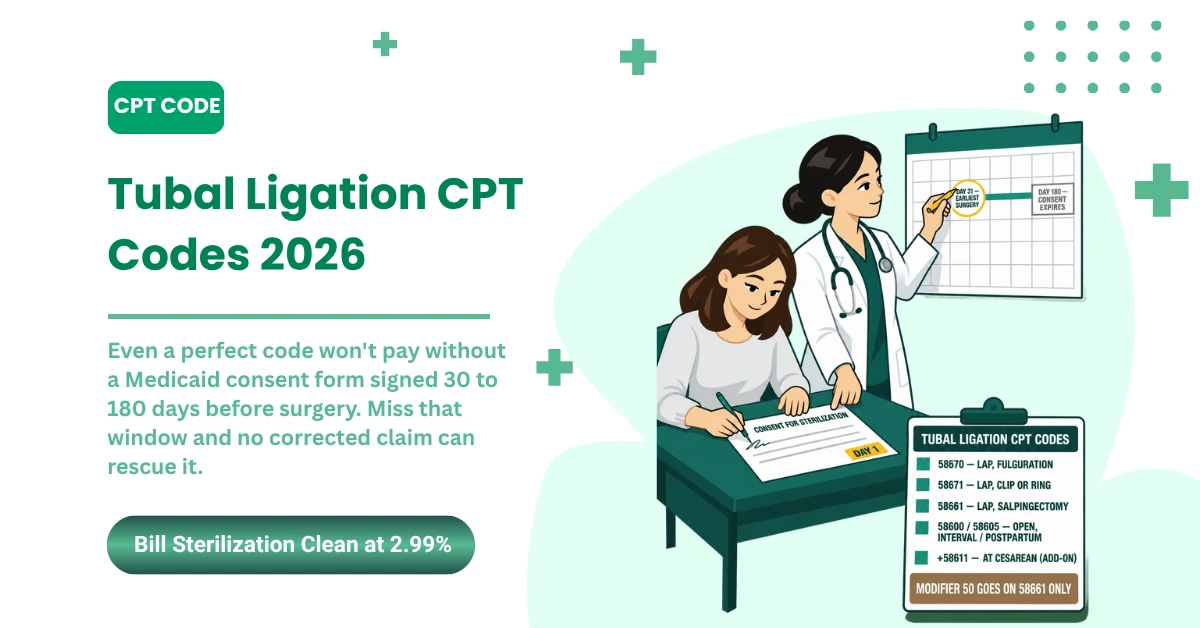




Tubal ligation CPT codes depend on three facts: approach, technique, and timing. Laparoscopic sterilization uses 58670 for fulguration, 58671 for clips or rings, and 58661 when the tubes come out. Open or vaginal interval cases use 58600, postpartum cases during the delivery stay use 58605, and cesarean cases add +58611. Z30.2 carries the sterilization intent.
A surgeon's note that says "tubal ligation" can point to any of seven active codes. Their global periods run from none at all to 90 days, and Medicare's 2026 national payment spans about $65 to about $586. Sterilization claims also carry consent and coverage rules that other surgeries don't.
You'll find delivery, hysterectomy, and office gynecology codes in our OB/GYN CPT codes guide. This page sticks to the sterilization claim: the op note, the codes, the consent form, and the payer rules that decide whether a correct code pays.
|
Key takeaways
|
In this guide
- Tubal Ligation CPT Codes at a Glance (2026)
- How to Pick the Right Tubal Ligation Code
- Laparoscopic Tubal Ligation CPT Codes: 58670 vs 58671
- CPT 58661 for Sterilization by Salpingectomy
- Open and Postpartum Sterilization Codes: 58600, 58605, and 58615
- Tubal Ligation at Cesarean Delivery: +58611 in 2026 and 2027
- Tubal Ligation ICD-10 Codes: Z30.2, Z98.51, and Delivery Codes
- Modifiers for Tubal Ligation CPT Codes
- Payer Rules That Decide Whether Sterilization Claims Pay
- Billing the Rest of the Claim: Anesthesia, Pathology, and Facility
- Five Worked Examples, Claim Line by Claim Line
- Why Sterilization Claims Get Denied and How to Fix Them
- Choosing an OB/GYN Billing Partner: What It Should Cost
- Tubal Ligation CPT Codes: Frequently Asked Questions
- The Bottom Line on Tubal Ligation Coding
Tubal Ligation CPT Codes at a Glance (2026)
Seven active sterilization CPT codes cover tubal sterilization by every surgical approach. The table below lists each one with the three CMS values that decide how it pays: the global period, the bilateral indicator, and the 2026 national rate. Two codes billers still run into, 58700 and 58565, close out the table.
Table 1. Tubal sterilization codes with CMS 2026 payment data
|
Code |
What it reports |
Approach |
Global days |
Bilateral indicator |
2026 work RVU |
2026 national rate |
|---|---|---|---|---|---|---|
|
58670 |
Tubes sealed with electrosurgical energy (fulguration), cut or not |
Laparoscopic |
090 |
0 (no modifier 50) |
5.76 |
About $333 |
|
58671 |
Tubes closed with a clip, band, or Falope ring |
Laparoscopic |
090 |
0 (no modifier 50) |
5.76 |
About $333 |
|
58661 |
Tubes removed (partial or total salpingectomy) |
Laparoscopic |
010 |
1 (modifier 50 when bilateral) |
11.07 |
About $586; about $879 with modifier 50 |
|
58600 |
Tubes tied or cut as an interval procedure |
Open (mini-laparotomy) or vaginal |
090 |
2 (priced as bilateral, no modifier 50) |
5.76 |
About $332 |
|
58605 |
Tubes tied or cut after a vaginal delivery, same hospital stay |
Open or vaginal |
090 |
2 (no modifier 50) |
5.15 |
About $302 |
|
+58611 |
Tubes tied or cut during a cesarean or other open abdominal surgery |
Add-on to the primary surgery |
ZZZ (none of its own) |
0 (no modifier 50) |
1.41 |
About $65 |
|
58615 |
Band, clip, or Falope ring placed through a vaginal or suprapubic incision |
Vaginal or suprapubic |
010 |
0 (no modifier 50) |
3.84 |
About $226 |
|
58700 |
Open salpingectomy, separate procedure (ACOG: not for sterilization) |
Open |
090 |
2 (no modifier 50) |
12.63 |
About $730 |
|
58565 |
Hysteroscopic tubal implants (Essure) |
Hysteroscopic |
090 |
2 (no modifier 50) |
Legacy code |
Still active; Essure sales ended December 31, 2018 |
Indicator 0 means the bilateral payment rule doesn't apply, so you bill one line, one unit, and no modifier 50. A 1 means you append modifier 50 and Medicare pays 150% on that single line. With a 2, the fee already covers both sides.
The dollar figures are national facility amounts: total RVUs times CMS's 2026 conversion factor of $33.4009, before local adjustment. Your MAC adjusts for locality, so your number won't match to the penny; pull the exact figure from the CMS PFS Look-Up Tool before you quote a rate to a physician.
The surgeon's tubal sterilization CPT code is one line of several. Anesthesia most often bills 00851, pathology bills 88302 for the tube specimen, and every claim for the case carries Z30.2. Picking the surgeon's line comes down to three facts in the operative note.
How to Pick the Right Tubal Ligation Code
There's no single CPT code for tubal ligation. You pick the code from three facts in the operative note: the surgical approach, the technique used on the tubes, and when the surgery happened relative to a delivery. Once those three are clear, you're down to one code in most cases.
Keep one rule in mind as you read the op note, since the billing code for tubal ligation follows it: on laparoscopic cases, the technique on the tubes decides the code; on open cases, the timing decides it.
Start With the Surgical Approach
Read the approach first; it splits the codes into two main families. Laparoscopic sterilization points to 58670, 58671, or 58661. An open incision, abdominal or vaginal, points to 58600, 58605, +58611, or 58615. Hysteroscopic implants map to 58565, a legacy code, since FDA reports Essure sales ended December 31, 2018.
Mini-laparotomy sits behind most open tubal ligation CPT codes: a small incision below the navel after a delivery, or above the pubic bone for an interval case. If the surgeon converts a laparoscopic case to open, CMS's NCCI manual lets you report only the open procedure.
Match the Technique Written in the Operative Note
Laparoscopic cases turn on the technique words in the operative note. Bipolar, coagulated, cauterized, and fulgurated all point to 58670. A named device, such as a Filshie or Hulka clip, a Falope ring, or a silicone band, makes it 58671. Excised, removed, or salpingectomy means CPT 58661.
Table 2. Laparoscopic technique words and the code they point to
|
Words in the operative note |
Code |
|---|---|
|
Bipolar, coagulated, cauterized, fulgurated |
58670 |
|
Filshie clip, Hulka clip, Falope ring, silicone band |
58671 |
|
Excised, removed, salpingectomy, tubes sent to pathology |
58661 |
Table 3. Open cases: timing or device decides the code
|
What the note describes |
Code |
|---|---|
|
Interval ligation or transection through a mini-laparotomy or vaginal incision |
58600 |
|
Band, clip, or Falope ring placed through a vaginal or suprapubic incision |
58615 |
|
Ligation or transection after a vaginal delivery, same hospital stay |
58605 |
|
Ligation or transection during a cesarean or other open abdominal surgery |
+58611 |
Pomeroy, Parkland, Irving, and Uchida are ligation methods you'll see on open cases, and any of them can land on 58600, 58605, or +58611 depending on timing. A Pomeroy six weeks after delivery is 58600; the same Pomeroy the morning after a vaginal birth, before discharge, is 58605.
Patients often ask about three types of tubal ligation: tying and cutting, sealing with electric current, and blocking with a clip or ring. In coding terms, tying and cutting is an open technique in most cases (58600, 58605, or +58611), sealing is 58670, and clips or rings are 58671 (or 58615 without a scope).
Check When the Sterilization Happened
Timing sets the open code. A tubal ligation during the same hospital stay as a vaginal delivery is 58605. One done through the cesarean incision is +58611. Once the patient goes home, any later sterilization is an interval procedure, coded 58600 if open or by technique if laparoscopic.
Discharge is the dividing line. A patient who stays 4 days after a complicated birth can still have a 58605 on day 4, while a laparoscopic fulguration three weeks postpartum, after she's gone home, is 58670.
Those dates matter twice. They pick the tubal ligation CPT code, and for Medicaid patients they also decide whether the consent form, signed weeks earlier, still falls inside the required 30 to 180 days.
Laparoscopic Tubal Ligation CPT Codes: 58670 vs 58671
Most laparoscopic tubal ligation CPT code decisions come down to one question: did the surgeon seal the tubes with energy or close them with a device? Energy is 58670 and a device is 58671. If the tubes came out, neither applies; that's 58661, covered next.
What Is CPT Code 58670 Used For?
CPT 58670 reports laparoscopic sterilization in which the surgeon seals the fallopian tubes with electrosurgical energy, most often bipolar coagulation, with or without cutting them. It carries a 90-day global period, doesn't take modifier 50, and pays about $333 under Medicare's 2026 national fee schedule, before local adjustment.
AMA CPT describes 58670 as "Laparoscopy, surgical; with fulguration of oviducts (with or without transection)." Fulguration means the surgeon burns a segment of each tube closed. Coders also see it written as laparoscopic tubal fulguration or "lap cautery," and both mean 58670.
Correction: You'll see billing guides say 58670 covers clips and rings. It doesn't: clips, bands, and rings are devices, and devices are 58671.
Payer policy can differ from CPT. Aetna's CPB 0657, as of its December 8, 2025 review, lists clips, rings, and partial or total salpingectomy as medically necessary sterilization methods, and puts 58670 only among "other CPT codes related to the CPB." Confirm how the patient's Aetna plan treats 58670 before the case.
When CPT 58671 Applies Instead
CPT 58671 applies when the surgeon closes the tubes with a device through the laparoscope. AMA CPT describes it as "Laparoscopy, surgical; with occlusion of oviducts by device (eg, band, clip, or Falope ring)." Filshie clips, Hulka clips, Falope rings, and silicone bands all belong here.
A note that reads "laparoscopic bilateral tubal ligation with Filshie clips" is a clean 58671. Either laparoscopic tubal sterilization CPT code carries the same 2026 numbers: 5.76 work RVUs, 9.97 total, a 090 global, and bilateral indicator 0.
Surgeons often title the case "laparoscopic BTL" whichever method they used, so code from the body of the note, where the device or energy source appears by name. A wrong pick won't change Medicare's payment, but the claim can fail an audit or clash with a payer policy like Aetna's.
What's Already Included in Laparoscopic Sterilization
The laparoscopic sterilization CPT code you bill already includes the diagnostic look around the pelvis. CMS's NCCI Policy Manual, Chapter VII, revised January 1, 2026, bundles diagnostic laparoscopy (49320) into surgical laparoscopy, so 49320 never goes on the claim beside 58670, 58671, or 58661. The code also covers ports, insufflation, and a uterine manipulator.
The same manual bundles lysis of adhesions. It says laparoscopic lysis (58660) "is not separately reportable with other surgical laparoscopic procedures." If dense adhesions add real time and work, document the extra minutes and the difficulty in the note, then look at modifier 22. The same logic runs through our guide to 49320 laparoscopy bundling.
Coders who pick between 58670 and 58671 from the procedure title, instead of the operative note, create errors a payer audit can catch months later. With our OB/GYN medical billing services, we start by reviewing your recent sterilization claims line by line, and billing runs at 2.99% of collections with no setup fees.
Once the note says the surgeon excised the tubes and sent them to pathology, you're coding 58661, and the 2026 payment climbs from about $333 to about $586.
CPT 58661 for Sterilization by Salpingectomy
CPT 58661 reports laparoscopic removal of adnexal structures, including partial or total salpingectomy. Since ACOG's July 2021 coding guidance, it's the code for laparoscopic sterilization when the surgeon removes the tubes instead of sealing them. CMS assigns it bilateral indicator 1, so you bill a bilateral salpingectomy as 58661-50 on one line.
The 58661 CPT code description in AMA CPT reads: "Laparoscopy, surgical; with removal of adnexal structures (partial or total oophorectomy and/or salpingectomy)." Because the same code covers ovary removal, a tubal ligation CPT code 58661 claim needs a note and a diagnosis that show sterilization intent.
Why ACOG Moved Laparoscopic Salpingectomy to 58661
ACOG changed its guidance in a July 27, 2021 coding update: "ACOG has determined that the evidence validates CPT 58661 for the removal of the fallopian tubes for sterilization laparoscopically, and not the previous recommendation, CPT 58670." Before that, ACOG's advice pointed coders to 58670.
ACOG Committee Opinion 774 (April 2019) had already presented salpingectomy in place of tubal ligation as an option that may lower ovarian cancer risk. The August 2026 Clinical Practice Update, "Salpingectomy for the Prevention of Epithelial Ovarian Cancer," from ACOG calls complete, bilateral salpingectomy the preferred tubal procedure for permanent contraception, after shared decision making.
For coders, that settles the CPT code for bilateral salpingectomy through a laparoscope for sterilization: 58661 with modifier 50. The laparoscopic bilateral salpingectomy CPT code stays 58661 for risk-reducing cases too; only the diagnosis changes.
Correction: You'll see CPT 58700 offered as the salpingectomy CPT code for removed tubes. ACOG says 58700 "should never be used to report a sterilization procedure of any sort." Some Medicaid programs still list it, and where a payer's written policy does, that policy governs the claim.
Does CPT 58661 Require Modifier 50?
Yes, when both tubes come out. CMS's 2026 fee schedule gives 58661 bilateral indicator 1, so modifier 50 applies and Medicare pays 150% of the fee on one line with one unit. CPT Assistant (May 2024) says the same. Some commercial payers want RT and LT lines instead, so check the policy first.
If the surgeon removes only one tube, for example because the other came out during an earlier ectopic surgery, bill 58661 with no modifier 50. Noridian's bilateral surgery guidance states the indicator 1 rule: "Use 50 modifier if bilateral. Units = 1."
A modifier that doesn't match the number of tubes removed is a common trigger for CO-4 modifier denials. The 010 global on 58661 also closes its postoperative window 80 days sooner than the 090 window on 58670, which changes how you bill a follow-up visit in week three.
Is 58661 Considered Sterilization?
CPT 58661 isn't a sterilization code by itself. The diagnosis and the documentation carry the intent: Z30.2 on the claim, a note that states sterilization as the goal, and, for Medicaid, a valid consent form. Without those, a payer reads 58661 as ordinary adnexal surgery and applies its usual rules.
The same surgery for another reason isn't sterilization at all. Prophylactic tube removal for ovarian cancer risk is 58661 with Z40.03 in place of Z30.2, and laparoscopic salpingectomy for an ectopic pregnancy has its own code, 59151.
Washington Medicaid draws the same line in its guide: a medically necessary salpingectomy for cancer, ectopic pregnancy, or high-risk prophylaxis "is not considered a sterilization," so no consent form applies.
On the Medicare side, Noridian's auto-deny list leaves out 58661, yet NCD 230.3 still excludes elective sterilization, so a Medicare claim for CPT 58661 sterilization with Z30.2 won't pay.
Hysterectomy With Bilateral Salpingectomy: No Separate Tube Code
Hysterectomy codes that say "with removal of tube(s)" already pay for the salpingectomy, so you don't add 58661 or 58700. Total laparoscopic hysterectomy with bilateral salpingectomy is 58571 for a uterus of 250 g or less and 58573 over 250 g. For a total abdominal hysterectomy with bilateral salpingectomy, the code is 58150.
CPT 58552 covers a laparoscopic-assisted vaginal hysterectomy, uterus 250 g or less, with removal of tubes and/or ovaries. That's the difference behind the common 58571 vs 58552 question: total laparoscopic versus laparoscopic-assisted vaginal. Anyone looking for a hysterectomy with tubal ligation CPT code gets the same answer; the tube work stays inside the hysterectomy code.
Why Payers Push Back on 58661
Payers push back on 58661 because it pays more than the sterilization codes it replaced. In CMS's 2026 data, 58661 carries 11.07 work RVUs and 17.55 total, about $586, or about $879 with modifier 50. CPT 58670, laparoscopic fulguration, pays about $333, so the same sterilization can cost a payer up to 2.6 times more.
Keep Z30.2 on the claim, and if a payer questions it, send four things with the appeal:
- The operative note stating the surgeon excised the tubes
- The 88302 pathology report on the tube specimens
- ACOG's July 2021 coding guidance naming 58661
- The payer's own policy, such as Aetna's CPB 0657 listing total salpingectomy
Don't downcode to 58670 to dodge the appeal. It misreports the surgery: among tubal ligation CPT codes, 58670 describes sealed tubes that stay in the body, and an auditor comparing the claim to the pathology report will see the mismatch. Open and postpartum cases follow their own rule, since timing picks the code.
Open and Postpartum Sterilization Codes: 58600, 58605, and 58615
Among tubal ligation CPT codes, the open ones follow a different rule: timing picks the code. An interval case is 58600, a same-stay postpartum case is 58605, and a case during a cesarean is +58611. Technique matters only when a device goes in through a vaginal or suprapubic incision, which is 58615.
What Is CPT 58600?
CPT 58600 reports ligation or transection of one or both fallopian tubes through an abdominal incision, most often a mini-laparotomy, or a vaginal incision. It's an interval procedure, not part of a delivery stay, and it isn't a laparoscopic code. CMS prices it as bilateral, so it never takes modifier 50.
AMA CPT's descriptor reads "Ligation or transection of fallopian tube(s), abdominal or vaginal approach, unilateral or bilateral." It has a 090 global and pays about $332 in 2026. If you're looking for the tubal ligation procedure code for a mini-laparotomy tubal ligation weeks after delivery, this is it.
Correction: A top-ranking billing page calls 58600 "laparoscopic or open." It's open or vaginal only. At a cesarean, bill +58611, not 58600 with modifier 59.
CPT 58605 After a Vaginal Delivery: Modifiers 51 and 79
CPT 58605 reports tubal ligation or transection after a vaginal delivery, during the same hospital stay. The descriptor sets no day limit; the test is the delivery admission. Append modifier 51 for the same session as the delivery and modifier 79 if it happens a day or more later.
CPT tags 58605 as a "separate procedure," and CMS gives it a 090 global, bilateral indicator 2, and a 2026 rate of about $302. Modifier 51 marks it as a second procedure through its own incision, and modifier 79 reflects that the delivery's global period is still running.
Some payers apply multiple-procedure pricing without modifier 51, so follow their billing guide. Once the patient goes home, 58605 is off the table as the postpartum bilateral tubal ligation CPT code, and any later tubal procedure is interval work. Our guide to global surgical period rules explains how those overlapping windows interact.
The delivery codes billed alongside 58605, the postpartum tubal ligation CPT code, change on January 1, 2027. AMA deletes 59400, 59409, and 59410 and adds 59431 and 59432 for vaginal delivery. Check the global days CMS assigns the new codes before relying on modifier 79.
CPT 58615 for Device Occlusion Without a Laparoscope
CPT 58615 reports "Occlusion of fallopian tube(s) by device (eg, band, clip, Falope ring) vaginal or suprapubic approach." It carries a 010 global and bilateral indicator 0 and pays about $226 in 2026. You won't see it often; laparoscopic devices are 58671, and hysteroscopic implants are 58565.
Before you settle on 58615, confirm the note describes a small vaginal (colpotomy) or suprapubic incision and no laparoscope at any point in the case.
Postpartum Bilateral Salpingectomy After a Vaginal Delivery
Code a complete salpingectomy through a postpartum mini-laparotomy with 58605, the only postpartum sterilization code, because ACOG says 58700 "should never be used to report a sterilization procedure of any sort." Payer policy can override that. Some Medicaid programs, Washington's among them, list CPT code 58700 as a sterilization code.
Follow the payer's written policy and match it on the consent form, which should name one procedure. Washington's guide lists two consent errors that lead to denials: tubal ligation and salpingectomy listed together as the operation, and a form naming tubal ligation when the claim shows salpingectomy.
Tubal Ligation at Cesarean Delivery: +58611 in 2026 and 2027
At a cesarean, you bill the sterilization as add-on +58611 next to the cesarean code. That holds with today's cesarean codes and with the new 59502 and 59503 that start January 1, 2027. A salpingectomy through the cesarean incision still points to +58611.
What Does CPT Code 58611 Represent?
CPT 58611 is an add-on code for ligating or transecting the fallopian tubes during a cesarean delivery or another intra-abdominal surgery. You never bill it alone, it takes no modifier 51, and it has no global period of its own. In 2026 it pays about $65 under Medicare's national fee schedule.
AMA CPT describes it as ligation or transection of the tubes "when done at the time of cesarean delivery or intra-abdominal surgery (not a separate procedure) (List separately in addition to code for primary procedure)." One unit covers one tube or both, and bilateral indicator 0 means no modifier 50.
The primary surgery doesn't have to be a delivery. An open myomectomy (58140) with a tubal ligation through the same incision is 58140 plus +58611. It's the only add-on among tubal ligation CPT codes, and its descriptor covers intra-abdominal surgery as well as cesarean delivery.
Primary Codes for 58611 Through December 31, 2026
Through December 31, 2026, +58611 goes on the same claim as one of six cesarean codes. The right primary depends on who gave the antepartum and postpartum care and whether the patient attempted a vaginal birth after a prior cesarean. All six stay valid for dates of service in 2026.
- 59510: routine obstetric care with cesarean delivery, including antepartum and postpartum care
- 59514: cesarean delivery only
- 59515: cesarean delivery only, including postpartum care
- 59618: routine obstetric care with cesarean after an attempted vaginal delivery following a previous cesarean
- 59620: cesarean delivery only, after an attempted vaginal delivery following a previous cesarean
- 59622: cesarean delivery with postpartum care, after an attempted vaginal delivery following a previous cesarean
A repeat cesarean with bilateral tubal ligation, with the same group handling prenatal care, is 59510 plus +58611. If another group provided the prenatal care, the surgeon's claim is 59514 or 59515 plus +58611.
Primary Codes for 58611 Starting January 1, 2027
On January 1, 2027, AMA deletes 59510, 59514, 59515, 59618, 59620, and 59622. Code 59502 reports a primary cesarean, and 59503 a repeat cesarean, including one after a trial of labor. The 2027 guidelines still say: "For ligation or transection of fallopian tube[s] when done at the time of cesarean delivery, use 58611."
The date of service decides which set you use: a December 31, 2026 surgery takes the old codes, and a January 1, 2027 surgery takes the new ones.
Antepartum and postpartum visits also move to E/M codes in 2027. Our breakdown of the 2027 maternity code changes covers the full restructure, including how labor management moves to 59080 through 59083. You'll find the source text on AMA's CPT 2027 maternity changes page.
Salpingectomy at Cesarean Still Reports +58611
A salpingectomy for sterilization at a cesarean still goes on the claim as +58611. ACOG rules out 58700 for any sterilization, and 58661 is a laparoscopic code that can't describe an open cesarean, which leaves +58611 as the fit. That also settles the 58611 vs 58661 question: the incision decides.
The op note should state that the tubes came out for sterilization, and Z30.2 goes on the claim after the pregnancy codes, in the order covered in the ICD-10 section below. A few Medicaid programs list 58700 among their sterilization codes, so read the policy before you appeal.
Why +58611 Pays So Little and How to Protect It
CPT 58611 pays about $65 in 2026 because it carries 1.95 total RVUs, 1.41 of them work. The cesarean code holds most of the case's value, and some payers go further, treating the ligation as part of the cesarean and paying nothing. You can answer that argument with the CPT descriptor.
Two fixes work. Negotiate separate payment for the 58611 CPT code in the contract, and appeal zero-pay lines with the descriptor, which calls it an add-on billed "in addition to code for primary procedure." You can cite AMA's 2027 cesarean guidelines too, since they send coders to 58611 by name.
Consent timing matters at a cesarean too. Medicaid's 72-hour exception covers only a premature delivery, with consent signed at least 30 days before the expected delivery date, or emergency abdominal surgery. A scheduled cesarean at term with a form signed three weeks earlier doesn't qualify, and Medicaid won't pay for the sterilization.
A payer that pays $0 on +58611 month after month has a contract gap you can raise at renewal. We flag that pattern when we review OB/GYN remittances, so you walk into the negotiation with the claim count and the dollars.
Tubal Ligation ICD-10 Codes: Z30.2, Z98.51, and Delivery Codes
Z30.2, "Encounter for sterilization," tells the payer the surgery's purpose is preventing pregnancy. For a standalone interval procedure, you list it first. On a claim that also reports the delivery, such as a cesarean with +58611, the pregnancy code goes first and Z30.2 follows.
Z30.2: The Diagnosis Behind Every Sterilization Claim
The Z30.2 diagnosis code belongs on every claim for a sterilization case: the surgeon's, the anesthesia provider's, the pathologist's, and the facility's. It's the encounter for sterilization ICD-10 code in the FY2026 set; ICD-10-CM updates every October 1, so confirm it in the FY2027 tabular list for surgeries from October 1, 2026.
Noridian tells Medicare billers that Z30.2 "should be noted in Item 24E of the CMS-1500 claim form or the electronic equivalent." On commercial claims, listing Z30.2 first signals the no-cost preventive benefit, and payers look for it before applying that benefit to tubal ligation CPT codes.
A request for the ICD-10 code for tubal ligation can mean either of two codes. Z30.2 reports the surgery itself, and Z98.51 reports on later visits that it already happened. Swapping them is a common sterilization ICD-10 mistake.
What Is the ICD-10 Code for Tubal Ligation With a Cesarean Section?
For a cesarean with tubal ligation, list first the Chapter 15 code for the reason the surgeon performed the cesarean, such as O34.211 for a low transverse scar from a previous cesarean. Then add Z30.2, a Z37 outcome code such as Z37.0, and the Z3A weeks code. O82 fits only cesareans with no indication.
Correction: You'll see "O82.0, single delivery by cesarean section" online, including in some search engine answers. O82.0 doesn't exist. O82 is "Encounter for cesarean delivery without indication," and it doesn't fit most repeat cesareans. The FY 2027 ICD-10-CM guidelines put Chapter 15 codes first and call for a Z37 code on every delivery record.
What Is the ICD-10 Code for a History of Tubal Ligation?
Z98.51, "Tubal ligation status," reports a tubal ligation that happened in the past. It's a status code, so it belongs on later encounters as a secondary diagnosis and never on the sterilization claim itself. For a reversal, the encounter code is Z31.0, "Encounter for reversal of previous sterilization."
Use the tubal ligation status ICD-10 code when the history matters to the visit, such as a pelvic pain workup or a suspected ectopic pregnancy after sterilization. Leave it off visits where the sterilization history plays no part in the care.
Salpingectomy Diagnoses: Z40.03, Z30.09, and When It Isn't Sterilization
The diagnosis follows the reason for removing the tubes. Sterilization is Z30.2. Prophylactic removal is Z40.03, "Encounter for prophylactic removal of fallopian tube(s)," paired with the documented risk code, such as Z15.02 for genetic susceptibility to ovarian cancer. An ectopic pregnancy takes a code from category O00.
Correction: Several ranking pages list Z40.02 for tube removal. Z40.02 is "Encounter for prophylactic removal of ovary(s)." Tubes alone take Z40.03.
A pre-op counseling visit about sterilization takes Z30.09, "Encounter for other general counseling and advice on contraception." That's the ICD-10 code for a tubal ligation consult in most cases, and it keeps the counseling visit separate from the surgery's Z30.2.
The same rules apply to bilateral salpingectomy ICD-10 coding; one tube or two doesn't change the diagnosis. For ectopic cases, the FY2027 update adds O00 codes for the location of the pregnancy on October 1, 2026, so recheck any salpingectomy ICD-10 code you've built into templates.
Modifiers for Tubal Ligation CPT Codes
Most tubal ligation CPT codes never take modifier 50. The exception is 58661: CMS gives it bilateral indicator 1, so you bill a bilateral salpingectomy as 58661-50. Other modifiers depend on timing and circumstance, such as 79 or 51 on postpartum 58605, and the +58611 add-on never takes 51.
People searching for the CPT code for bilateral tubal ligation expect a modifier 50 answer. For most codes it's the opposite: 58600 and 58605 already price both sides, and 58670 and 58671 sit outside the bilateral rule. In bilateral tubal ligation CPT coding, modifier 50 belongs on 58661 alone.
Table 4. Modifiers for tubal ligation claims
|
Modifier |
Use it on |
When |
Don't use it when |
|---|---|---|---|
|
50 |
58661 only |
Both tubes removed through the laparoscope (CMS indicator 1, paid at 150%) |
On 58600, 58605, or 58700 (indicator 2), or on +58611, 58615, 58670, or 58671 (indicator 0) |
|
51 |
58605 |
The ligation happens in the same session as a vaginal delivery |
On +58611; add-on codes are exempt |
|
52 |
58670 or 58671, depending on the payer |
The surgeon treats only one tube because the other is already gone |
On 58600 or 58605; their descriptors already say "unilateral or bilateral" |
|
79 |
58605 |
Done a day or more after delivery, during the same hospital stay |
After discharge; that's an interval procedure |
|
22 |
Any sterilization code |
Documented work well beyond normal, such as dense adhesions, with the op note attached |
For routine difficulty |
|
XS or 59 |
A second, separate procedure |
The note documents a separate site or procedure and the NCCI edit allows a modifier |
To unbundle 49320 or 58660 from the sterilization |
|
33 |
Sterilization lines on commercial claims |
The payer asks for it to apply the preventive benefit |
When the payer's policy is silent on it |
|
FP |
State Medicaid claims |
The state requires the family planning modifier, as Colorado's Medicaid billing manual does |
When your state's manual doesn't call for it |
Payers scrutinize XS and 59 because both override NCCI bundling edits. XS is the more specific choice: it tells the payer the second procedure happened at a separate organ or structure. Our guide to modifier 59 and XS covers when payers accept each one.
Payer Rules That Decide Whether Sterilization Claims Pay
Three payer rules decide whether a sterilization claim pays. Medicare doesn't cover elective sterilization under NCD 230.3. Medicaid pays only with a valid federal consent form signed 30 to 180 days before surgery. Most commercial plans cover sterilization without cost sharing under the ACA's women's preventive services rules.
Does Medicare Cover Tubal Ligation?
Medicare doesn't pay for sterilization when the goal is preventing pregnancy. CMS's NCD 230.3 limits payment to sterilization that's a necessary part of treating an illness or injury, such as removing diseased ovaries. Noridian's sterilization policy auto-denies six sterilization CPT codes on these claims: 58600, 58605, 58611, 58615, 58670, and 58671.
Your Medicare sterilization patients are most often under 65 and qualify through disability or end-stage renal disease. Noridian's billing article A53356 says tubal ligation "in the absence of a disease for which sterilization is considered an effective treatment" isn't covered.
Settle liability before surgery. MACs frame the denial two ways: outside Medicare's benefit, which points to modifier GY, and not reasonable and necessary, which points to an ABN and modifier GA. Follow your MAC's written instruction. For dual-eligible patients, bill Medicaid as secondary after the Medicare denial, provided the consent form is valid.
Does Medicaid Pay for Tubal Ligation?
Yes, Medicaid pays for tubal ligation when you meet federal consent rules. Under 42 CFR 441.253, the patient must be at least 21 when signing and able to give informed consent, and 30 to 180 days must pass between consent and surgery. A signed HHS-687 form, or your state's approved version, goes with the claim.
The exceptions are narrow. A 72-hour minimum applies only to a premature delivery, where the patient signed at least 30 days before the expected delivery date, or to emergency abdominal surgery. Consent obtained during labor or childbirth doesn't count (42 CFR 441.257), and federal funding excludes institutionalized patients (42 CFR 441.254).
Use the current form. HHS-687, edition 07/2025 (OMB 0937-0166), expires July 31, 2028, and the Spanish version is HHS-687-1. Older editions still turn up in clinic files, so check the edition date when the patient signs.
Correction: A top-ranking guide cites a "Form CMS-0069." No such form exists.
Before surgery, check the form against this list, drawn from 42 CFR 441 and the Washington Medicaid sterilization guide:
- The patient signed at 21 or older; Washington lets patients aged 18 to 20 consent by crossing out "age 21."
- The signing day counts as day one, so surgery falls between day 31 and day 180.
- For a premature delivery, the expected delivery date appears on the form.
- If an interpreter helped, the interpreter signed Section II.
- No line is blank, and nothing changed after the patient signed.
- The sterilization date on the form matches the claim, and the form names one procedure.
- A copy goes with the surgeon's, assistant surgeon's, anesthesia, and facility claims.
Each state adds its own edits and family planning modifiers on top of the federal rules, so read your state's manual next to the regulation. Our guide to Medicaid reimbursement fixes covers the state-level problems that hold up payment. Review the tubal ligation CPT code and the consent dates together before the claim goes out.
A valid consent form won't save a claim if the surgeon isn't enrolled with the patient's Medicaid managed care plan. We handle that enrollment through credentialing at $99 per insurance, so the provider record and the claim match before the first sterilization case.
Commercial Plans: ACA Coverage and Integral Services
Most commercial plans must cover female sterilization without cost sharing. HRSA's Women's Preventive Services Guidelines include sterilization procedures, and ACA FAQs Part 64 extend that coverage to anesthesia, pregnancy tests, and other services "integral to the furnishing of sterilization surgeries." Grandfathered plans and some religious employers are exceptions, so verify benefits first.
The rule covers non-grandfathered plans for in-network care, and it applies to sterilization billed under the tubal ligation CPT codes and to salpingectomy done for sterilization. Aetna's CPB 0657, for example, lists total salpingectomy as medically necessary. Put Z30.2 first and add modifier 33 if the payer asks for it.
Patients ask it as "is tubal ligation covered by insurance," and under the Affordable Care Act, often called Obamacare, most plans answer yes, with no cost sharing on the surgery or the anesthesia. If a plan applies a deductible to anesthesia or pre-op tests anyway, request reprocessing and cite ACA FAQs Part 64.
You catch the exceptions at scheduling. Grandfathered plans, employers with a religious exemption, and out-of-network surgeons can all leave the patient with a bill. Confirm the plan type and network status during benefit verification before surgery so nobody learns about a balance from the EOB.
Billing the Rest of the Claim: Anesthesia, Pathology, and Facility
A tubal ligation case produces more claims than the surgeon's. Anesthesia bills 00851, pathology bills 88302 for the tube specimen, and the facility files its own claim: CPT codes for outpatient and ASC cases, ICD-10-PCS codes for inpatient postpartum and cesarean stays. Each claim needs Z30.2.
Anesthesia: CPT 00851 and When It Doesn't Apply
CPT 00851 is "Anesthesia for intraperitoneal procedures in lower abdomen including laparoscopy; tubal ligation/transection," and it carries 6 base units. Use it for interval sterilization and for a postpartum tubal ligation after a vaginal delivery, which counts as its own anesthesia service.
At a cesarean, the anesthesia provider bills the cesarean anesthesia code, 01961, or add-on 01968 when a labor epidural converts to the cesarean, and there's no separate 00851 for the tubal. For 58661 done for sterilization, 00851 fits when the note documents that intent; some payers crosswalk 58661 to 00840, so check.
Medicaid anesthesia claims need their own copy of the consent form. For base units and the anesthesia conversion factor, see the CMS Anesthesiologists Center.
Pathology: CPT 88302 for the Tube Specimen
CPT code 88302 is Level II surgical pathology, gross and microscopic examination, and CPT's specimen list for it includes "fallopian tube, sterilization." Bill one unit per specimen the surgeon submits for separate examination, so two tubes in two labeled containers are two units. The pathologist's claim needs Z30.2 too.
A few cases change the code. Tubes removed for an ectopic pregnancy fall under 88305. Clips, rings, and fulguration leave no specimen, so most 58670 and 58671 cases have no pathology line. Our guide to 88302 pathology billing covers the specimen rules in more detail.
Facility Claims and ICD-10-PCS Codes for Tubal Ligation
The setting decides the code set. Outpatient and ASC facilities report CPT codes, and hospitals report ICD-10-PCS codes for inpatient postpartum and cesarean stays. On the surgeon's claim, interval cases carry POS 24 for an ambulatory surgery center or POS 22 for on-campus outpatient, and delivery-stay cases carry POS 21.
Table 5. ICD-10-PCS codes for tubal sterilization on inpatient claims
|
Procedure |
Root operation |
ICD-10-PCS code |
|---|---|---|
|
Laparoscopic occlusion of both tubes, no device |
Occlusion |
0UL74ZZ |
|
Laparoscopic occlusion of both tubes with clips or rings |
Occlusion |
0UL74CZ |
|
Open occlusion of both tubes, no segment removed |
Occlusion |
0UL70ZZ |
|
Laparoscopic complete bilateral salpingectomy |
Resection |
0UT74ZZ |
|
Open complete bilateral salpingectomy |
Resection |
0UT70ZZ |
|
Open partial salpingectomy, such as a ligated and excised segment |
Excision |
0UB70ZZ |
AHA Coding Clinic (Third Quarter 2015) applied Excision to a ligated-and-excised segment, so a Pomeroy that removes a piece of tube codes to 0UB70ZZ instead of Occlusion. That's an easy tubal ligation ICD-10-PCS detail to miss, and it has no effect on the surgeon's tubal ligation CPT codes.
If your surgeons operate in an ambulatory surgery center, our guide to POS 24 ASC claims covers the place-of-service rules that come with it.
Five Worked Examples, Claim Line by Claim Line
The five cases below cover common sterilization claims. They put the tubal ligation CPT codes above to work, including CPT 58661 with modifier 50. Each one shows the surgeon's CPT lines, modifiers, and diagnosis order, plus the payer detail that decides whether the claim pays. Codes follow 2026 rules unless a row says 2027.
Table 6. Worked tubal ligation claim examples, 2026 and 2027
|
# |
Case |
Surgeon's CPT lines |
Diagnosis order |
What decides payment |
|---|---|---|---|---|
|
1 |
Interval laparoscopic bilateral salpingectomy for sterilization, commercial plan, ASC |
58661-50 (or RT and LT lines if the payer asks) |
Z30.2 |
No cost sharing; anesthesia 00851 covered as an integral service; pathology 88302 per specimen; POS 24 |
|
2 |
Interval laparoscopic Filshie clips, Medicaid, consent signed 45 days earlier |
58671 |
Z30.2 |
HHS-687 copy on the surgeon, anesthesia, and facility claims; state FP modifier if required |
|
3 |
Repeat cesarean at 39 weeks for a low transverse scar, bilateral salpingectomy for sterilization, December 2026, same group gave prenatal care |
59510 and +58611 |
O34.211, Z30.2, Z37.0, Z3A.39 |
Anesthesia bills under the cesarean code only. Same case on January 4, 2027: 59503 and +58611, with antepartum and postpartum visits billed as E/M under the 2027 structure |
|
4 |
Vaginal delivery, Pomeroy through a mini-laparotomy the next morning, same stay, Medicaid, consent signed 60 days earlier |
58605-79 |
Z30.2 on the 58605 line; the delivery lines point to the O codes, Z37.0, and Z3A |
Anesthesia 00851; consent copy on every claim for the case; POS 21 |
|
5 |
Medicare patient on disability, elective laparoscopic fulguration |
58670 |
Z30.2 |
Medicare denies under NCD 230.3. Follow the MAC on the ABN and GA or GY. If Medicaid is secondary and consent is valid, bill Medicaid after the denial |
All five cases follow one pattern. Approach and technique set the tubal ligation CPT code, timing sets the modifier, and the payer decides whether a correct claim pays at all. Coding can't fix that third piece, so it belongs at scheduling.
Why Sterilization Claims Get Denied and How to Fix Them
Most sterilization denials trace to five issues: a consent form that fails the rules, an add-on sent without its primary, bundled services billed as extra lines, the wrong modifier 50 decision, and elective sterilization billed to Medicare. Consent errors cost the most, since nobody can repair a missed 30-day window.
Table 7. Common denials on tubal ligation CPT codes
|
Denial trigger |
Remark codes payers often use |
Fix |
|---|---|---|
|
Consent form missing, incomplete, or signed outside 30 to 180 days |
CO-16 or a state edit |
Audit the form before surgery; Medicaid won't pay for a missed waiting period |
|
+58611 sent without its cesarean code, or on a separate claim |
CO-107 or CO-234 |
Bill both lines on one claim |
|
49320 or 58660 billed with the sterilization |
CO-97 |
Remove them; NCCI bundles both into surgical laparoscopy |
|
Modifier 50 on 58600, 58605, 58670, or 58671, or missing on bilateral 58661 |
CO-4 |
Match the CMS bilateral indicator |
|
Elective sterilization billed to Medicare |
CO-96 or CO-50, depending on the MAC |
Check Medicare status before surgery; handle the ABN and GA or GY the way your MAC instructs |
|
58661 denied or downcoded as excessive |
Payer policy edit |
Appeal with the op note, the 88302 report, ACOG's July 2021 guidance, and the payer's own policy |
|
Cost sharing applied to anesthesia or pre-op services on a commercial plan |
PR adjustments |
Ask for reprocessing, citing ACA FAQs Parts 54 and 64 and Z30.2 |
|
Wrong delivery diagnosis (O82 with a documented indication, or no Z37) |
CO-11 or CO-16 |
Put the indication first, then add Z37 and Z3A |
Four of those remark codes have their own guides. Start with CO-16 missing information for consent and data gaps. Add-on trouble, where +58611 lands without its cesarean line, has its own page under CO-234 add-on denials. For bundling, read CO-97 bundling denials. Medicare's exclusion falls under non-covered service denials.
Pre-Submission Checklist for Tubal Ligation Claims
Run every tubal ligation CPT code through the same seven checks before the claim leaves the building. The list runs in the order you'd work a case: documentation, consent, modifiers, pairing, diagnoses, payer policy, and the claims that travel with the surgeon's.
- The operative note names the approach, the technique, and whether the tubes came out.
- For Medicaid, the consent form falls inside 30 to 180 days, has no blanks, matches the claim dates, and travels with the claim.
- You checked the bilateral indicator before deciding on modifier 50.
- +58611 sits on the same claim as its cesarean code, with 2027 codes for dates of service from January 1, 2027.
- Z30.2 is on every claim for the case, after the O codes on delivery claims.
- You confirmed payer policy: Medicare coverage, the commercial preventive benefit, and any Medicaid FP modifier.
- The anesthesia, pathology, and facility claims carry matching dates and diagnoses.
A sterilization denial that keeps coming back points to a step upstream, in scheduling or documentation. Our root-cause denial management team traces each repeat denial to the step that produced it and changes that step, so next month's denial report looks different.
Choosing an OB/GYN Billing Partner: What It Should Cost
An OB/GYN billing partner should track sterilization consent before surgery, code from the operative note, know each payer's sterilization policy, and handle Medicaid plan enrollment. It should also publish its pricing, so you aren't comparing quotes blind. MedSole RCM charges 2.99% of collections for medical billing and $99 per insurance enrollment for credentialing.
For practices billing tubal ligation CPT codes every week, four checks separate a partner who protects the claim from one who only submits it:
- Consent tracked at scheduling, before the claim exists
- Coding from the operative note, including the 58661 and modifier 50 decisions
- A payer policy map, plus contract review for +58611 underpayment
- Credentialing and billing handled by the same team
Table 8. What OB/GYN billing and credentialing cost
|
Service |
Typical market range |
MedSole RCM |
|---|---|---|
|
Medical billing |
4% to 7% of collections, often with setup or add-on fees |
2.99% of collections, no setup fees |
|
Credentialing |
$200 to $500 or more per payer enrollment |
$99 per insurance enrollment |
On $600,000 in annual collections, the difference between 2.99% and a 6% rate is about $18,000 a year. Credentialing a surgeon with 10 payers costs $990 at $99 per insurance enrollment, against $2,000 or more at $200 per enrollment.
MedSole RCM is a revenue cycle management company based in Mesa, Arizona. It provides medical billing at 2.99% of collections and credentialing at $99 per insurance enrollment, with coding, denial management, AR follow-up, and prior authorization handled by the same team.
Tubal Ligation CPT Codes: Frequently Asked Questions
Is Tubal Ligation the Same as Bilateral Salpingectomy?
No. Tubal ligation blocks, seals, or cuts the fallopian tubes and leaves most of each tube in place. Bilateral salpingectomy removes both tubes in full. The codes differ too: laparoscopic ligation is 58670 or 58671, while laparoscopic salpingectomy is 58661 with modifier 50. At a cesarean, both go on the claim as +58611.
Clinicians and patients use several names for the same goal: tubal sterilization, bilateral tubal ligation (BTL), "tubes tied," and permanent contraception. There's no single CPT code for sterilization, so the approach and the method decide which tubal sterilization CPT code applies. For a laparoscopic removal, the bilateral salpingectomy CPT code is 58661-50.
Can You Get Your Tubes Tied During a C-Section, and How Is It Billed?
Yes. A tubal ligation or salpingectomy through the cesarean incision goes on the claim as add-on +58611, next to the cesarean code. Medicaid patients must sign the consent form at least 30 days before surgery, because the 72-hour exception covers only premature delivery or emergency abdominal surgery.
Through December 31, 2026, the cesarean code is 59510, 59514, or another code in that family; from January 1, 2027, it's 59502 or 59503. +58611 pays about $65 under Medicare's 2026 national fee schedule, and the tubal ligation CPT code stays the same whether the surgeon ties the tubes or removes them.
Does Insurance Cover Tubal Ligation?
In most cases, yes. Non-grandfathered commercial plans cover female sterilization without cost sharing under the ACA, and Medicaid covers it when the consent paperwork meets federal rules. Medicare is the exception: it doesn't cover sterilization done only to prevent pregnancy. Coverage for salpingectomy, anesthesia, and facility fees still needs checking.
The same CPT code for tubal ligation can pay under one plan and deny under another, so your front desk should verify benefits at scheduling. Patients who ask whether Medicaid covers getting their tubes tied should hear yes, along with the consent timing, at the first visit.
Which CPT Codes Were Deleted in 2026?
AMA deleted none of the tubal ligation CPT codes for 2026. CMS's 2026 fee schedule data lists 58600, 58605, 58611, 58615, 58661, 58670, and 58671 as active. The bigger change comes January 1, 2027, when AMA deletes the cesarean codes that +58611 pairs with, including 59510 and 59514.
CPT 58565, the hysteroscopic implant code, is still active, but FDA's Essure page notes that US sales ended December 31, 2018. For 2027, also watch the new vaginal delivery codes 59431 and 59432, since their global days decide whether modifier 79 still applies to postpartum 58605.
How Do You Get Tubal Ligation Reversal Covered by Insurance?
It's hard, because most plans treat reversal as elective. You bill reversal with 58750 for an open tubotubal anastomosis or unlisted code 58679 for a laparoscopic repair, with diagnosis Z31.0. Ask for a written benefit and prior authorization decision before scheduling, since many plans exclude it.
Z98.51 documents the earlier sterilization on related visits. Coders searching for a tubal reanastomosis CPT code most often mean 58750; reanastomosis and tubotubal anastomosis describe the same repair. If the plan denies coverage in writing, the patient can make an informed choice about self-pay before the surgery date.
What Happens If the Sterilization Is Delayed Past 180 Days?
The consent expires. Under 42 CFR 441.253, federal Medicaid funding requires that no more than 180 days pass between consent and surgery, so a case that slips past day 180 needs a new HHS-687 and a new 30-day wait. Medicaid won't pay on the old form, however complete it is.
Delivery dates move and surgeons reschedule, so track the day-180 date at scheduling the same way you track day 31. Washington's guide, for example, counts the signing day as day one and allows surgery from day 31 through day 180, and no corrected claim can rescue a missed window.
What Should an OB/GYN Practice Pay for Billing and Credentialing?
Percentage-based billing contracts run 4% to 7% of collections in many markets, and credentialing often costs $200 to $500 or more per payer enrollment. MedSole RCM charges 2.99% of collections for medical billing, with no setup fees, and $99 per insurance enrollment for credentialing, handled by the same team that bills the claims.
That rate should cover coding, denial management, and AR follow-up along with claim submission. For OB/GYN work, it should also include consent tracking before sterilization cases and a review of payer contracts that underpay +58611.
The Bottom Line on Tubal Ligation Coding
Approach and technique pick the laparoscopic code, and timing picks the open one. CPT 58661 takes modifier 50, and +58611 pairs with the new cesarean codes from January 1, 2027. Payer rules, from Medicare's exclusion to Medicaid consent and commercial preventive coverage, decide whether correct tubal ligation CPT codes turn into payment.
Constant rework on sterilization claims traces to a few fixable steps. Our outsourced OB/GYN billing team codes from the op note, tracks consent before surgery, and follows each payer's rules, at 2.99% of collections, with credentialing at $99 per insurance enrollment. Book a free consultation, and you'll see where your sterilization claims stand.
Sources
- American Medical Association, CPT 2027 Maternity Care Services Code Changes
- CMS, Physician Fee Schedule Look-Up Tool
- CMS, NCCI Policy Manual for Medicare Services, Chapter VII (revised January 1, 2026)
- CMS, FY 2027 ICD-10-CM Official Guidelines for Coding and Reporting
- CMS, National Coverage Determination 230.3, Sterilization
- Noridian JE Part B, Sterilization
- Noridian JE Part B, Bilateral Surgery
- eCFR, 42 CFR 441.253, Sterilization by Medicaid
- HHS Office of Population Affairs, HHS-687 Consent for Sterilization (07/2025)
- Washington State Health Care Authority, Sterilization Billing Guide (October 1, 2025)
- HRSA, Women's Preventive Services Guidelines
- U.S. Department of Labor, FAQs About ACA Implementation Part 64
- Aetna, Clinical Policy Bulletin 0657, Tubal Sterilization
- ACOG, ACOG Strengthens Recommendations Supporting Salpingectomy for Ovarian Cancer Prevention (August 2026)
- CMS, Anesthesiologists Center
- FDA, Essure Permanent Birth Control