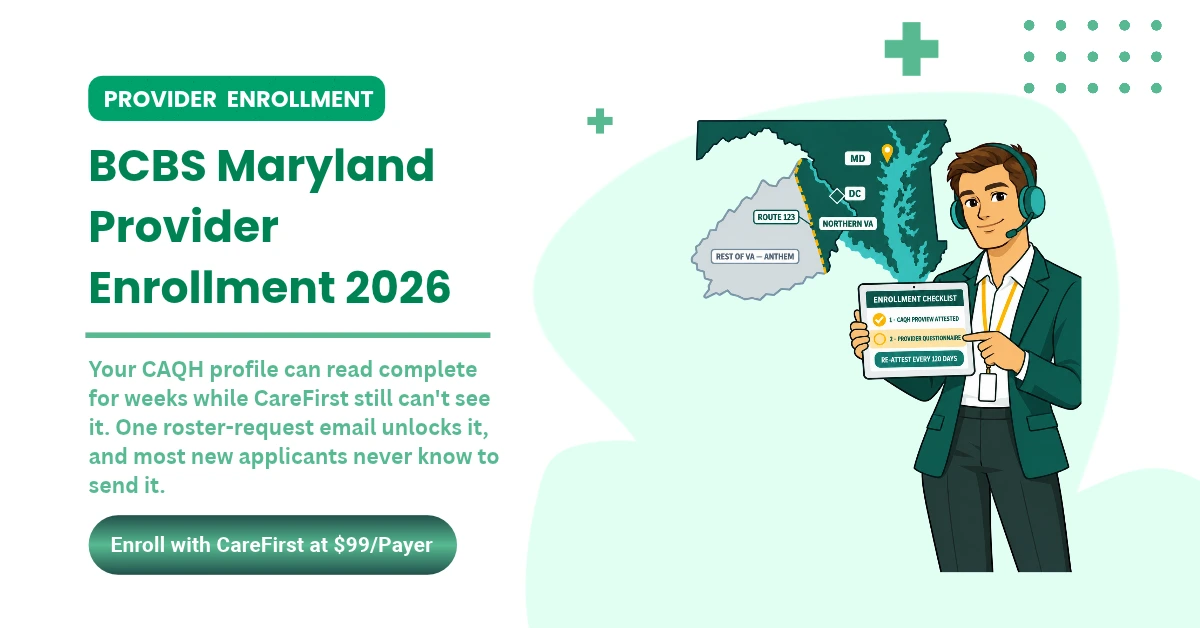




In 2026, BCBS Maryland provider enrollment means joining CareFirst BlueCross BlueShield (CareFirst), the Blue Cross Blue Shield licensee for Maryland, Washington, D.C., and Northern Virginia. Most professional providers apply in two parts: an attested CAQH ProView profile, now called DataSpring, and the CareFirst Questionnaire that matches their provider type.
Four things make this year harder. Commercial plans, Medicare Advantage, Medicaid, dental, and facilities each have a separate application. MPRIME replaces ePREP for Maryland Medicaid in October. Maryland's insurance regulator gave DataSpring a provisional designation as the state credentialing system on July 24, 2026, and shorter carrier deadlines arrive January 1, 2027.
MedSole RCM is a full-service revenue cycle company. Our credentialing team handles CareFirst provider enrollment from the first CAQH login to the first paid claim, alongside Medicare, Medicaid, and commercial payers in all 50 states. We checked each fact below against CareFirst, Maryland Insurance Administration, and Maryland Department of Health sources on October 1, 2026.
BCBS Maryland Provider Enrollment at a Glance (Verified October 1, 2026)
These 10 answers cover the core facts of joining CareFirst, and the third column names the CareFirst or Maryland document behind each one.
|
Question |
Answer |
Official source |
|---|---|---|
|
Who is BCBS in Maryland? |
CareFirst BlueCross BlueShield, the Blue Cross Blue Shield licensee for Maryland, Washington, D.C., and Northern Virginia |
CareFirst provider manual, Chapter 3 |
|
Which networks can professionals join? |
BlueChoice, the Regional Participating Preferred Network (RPN), or both |
CareFirst credentialing overview |
|
How do I apply to CareFirst? |
Attest a CAQH ProView (DataSpring) profile, then submit the CareFirst Questionnaire for your provider type |
CareFirst How to Apply page |
|
How do I add a provider to my existing group? |
Use Provider Updates and Attestation in the CareFirst Direct provider portal |
CareFirst How to Apply page |
|
What's the CareFirst credentialing phone number? |
877-269-9593 or 410-872-3500 |
CareFirst Provider Quick Reference Guide (January 2025) |
|
How long can CareFirst take today? |
Notice within 30 days of a complete application, then a decision within 120 days of that notice |
Maryland Insurance Article §15-112 |
|
What changes on January 1, 2027? |
15 days for the notice, 60 days for the decision, and no application fee |
Maryland HB 1093 (Chapter 707) |
|
How often do I update directory data? |
Every 90 days with CareFirst; since September 1, 2026, carriers regulated in Maryland also accept DataSpring updates |
CareFirst; MIA Bulletin 26-20 |
|
How often does CareFirst recredential? |
Every 3 years; a current CAQH profile covers it |
CareFirst provider manual, Chapter 3 |
|
What about Medicaid (CHPMD)? |
Enroll with Maryland Medicaid first; MPRIME replaces ePREP in October 2026 |
Maryland Department of Health |
Last verified: October 1, 2026
Is BCBS of Maryland the Same as CareFirst?
Yes. BCBS of Maryland is CareFirst BlueCross BlueShield, an independent, nonprofit licensee of the Blue Cross and Blue Shield Association. CareFirst holds the Blue license for Maryland, Washington, D.C., and Northern Virginia, so BCBS Maryland provider enrollment is CareFirst enrollment. You won't find a separate Maryland Blue company to apply to.
Which CareFirst Companies Sit Behind the Name
CareFirst of Maryland, Inc. is one of two companies behind the CareFirst name. Chapter 3 of CareFirst's provider manual calls CareFirst BlueCross BlueShield "the shared business name of CareFirst of Maryland, Inc. and Group Hospitalization and Medical Services, Inc." If a contract, remittance, or member card says GHMSI insurance, you're dealing with CareFirst.
The same manual names three more Blue licensees: CareFirst BlueChoice, Inc., The Dental Network, and First Care, Inc. For Medicare Advantage, the footer of CareFirst's Medicaid credentialing form says CareFirst BlueCross BlueShield Medicare Advantage is the shared business name of CareFirst Advantage, Inc. and CareFirst Advantage DSNP, Inc.
That footer also names the Medicaid company: CareFirst Community Health Plan Maryland is the business name of CareFirst Community Partners, Inc. You'll see these legal names on remittances and contracts, so match each one to the right CareFirst plan before you post payments.
CareFirst says its networks serve 3.3 million members. Your Maryland BCBS patients will call their plan "Blue Cross," but the payer ID and claim rules follow the company printed on the card. Scan both sides of each CareFirst BCBS of Maryland card at check-in, and keep the image with the visit.
Where CareFirst Covers, and Where Anthem Takes Over
CareFirst BCBS of Maryland isn't limited to Maryland. The CareFirst service area covers Maryland, Washington, D.C., and Northern Virginia. CareFirst's plan information pages define that Virginia slice as Arlington County, the cities of Alexandria and Fairfax, the Town of Vienna, and the parts of Fairfax and Prince William counties east of Route 123.
The rest of Virginia belongs to Anthem Blue Cross and Blue Shield, part of Elevance Health, so a Richmond practice follows the Anthem BCBS Virginia enrollment process. You won't find an Anthem Blue Cross Blue Shield Maryland plan to join, because Anthem doesn't hold the Blue license there.
Elevance does operate in Maryland Medicaid as Wellpoint Maryland, the HealthChoice plan once called Amerigroup. The abbreviation BCBSM belongs to Blue Cross Blue Shield of Michigan. Across the country, Blue Cross Blue Shield is 33 independent companies, and you can find each one in our guide to BCBS provider enrollment by state.
Which CareFirst Network Should You Join?
Your CareFirst route depends on your provider type and the plans you bill. Professionals who join the CareFirst BCBS network choose BlueChoice, the Regional Participating Preferred Network (RPN), or both. Medicare Advantage, CareFirst Community Health Plan Maryland (CHPMD), dental networks, and facilities each use a separate application, so a commercial approval won't cover the others.
BCBS Maryland provider enrollment paths by provider type
|
You are |
You want to bill |
How you apply |
Watch for |
|---|---|---|---|
|
Solo practitioner or new group |
Commercial: BlueChoice, RPN, or both |
CAQH ProView, then the CareFirst Questionnaire for a new group or solo practice |
W-9, group Tax ID, billing NPI |
|
Practitioner joining an existing CareFirst group |
Commercial: the same networks as the group |
Provider Updates and Attestation in CareFirst Direct |
CAQH must list the new practice affiliation |
|
Practitioner enrolled in Medicare |
Medicare Advantage: PPO plans and the DualPrime HMO-SNP |
A separate agreement (Group PPO) or network addendum (HMO) |
Must participate in traditional Medicare |
|
Practitioner seeing HealthChoice members |
Medicaid (CHPMD) |
CAQH, then the CareFirst Questionnaire on the CHPMD site |
Maryland Medicaid enrollment, through MPRIME from October 2026 |
|
Dentist |
CareFirst dental networks |
CAQH or the Dental Provider Application |
Contracting questions: dentalcontracting@carefirst.com |
|
Ancillary or facility provider |
Institutional and ancillary networks |
Request for Information Application plus a Facility Data Sheet for each location |
Accreditation, or an on-site quality review if not accredited |
Ambulance, laboratory, and urgent care providers each have their own questionnaire on CareFirst's How to Apply page. For facilities, Chapter 3 of the provider manual lists hospitals, rehab hospitals, freestanding ambulatory surgery centers, birthing centers, dialysis, home health, hospice, skilled nursing, lithotripsy, behavioral health and substance use programs, and durable medical equipment suppliers.
For Medicaid, CareFirst runs a plan in Maryland and one in D.C. CareFirst BCBS Community Health Plan Maryland, or CareFirst CHPMD, is a HealthChoice managed care organization, and you credential with it after you enroll with Maryland Medicaid.
In D.C., CareFirst BlueCross BlueShield Community Health Plan District of Columbia is the business name of Trusted Health Plan (District of Columbia), Inc. That plan needs its own state-side enrollment first, which we cover in our guide to DC Medicaid provider enrollment.
Dentists who want to join the CareFirst network apply through CAQH or CareFirst's Dental Provider Application. If your office bills dental and medical claims for the same patients, you can see how we handle dental credentialing and billing on one team.
BlueChoice and RPN: The Same Network Rule for Groups
CareFirst lets professionals join BlueChoice, RPN, or both, according to CareFirst's credentialing overview. The same page adds a rule for groups: "all providers in the same practice must participate in the same provider networks." CareFirst BlueChoice providers in a group can't split, with one doctor in BlueChoice and a partner in RPN alone.
The CareFirst provider network rule has teeth. Chapter 3 says that if CareFirst terminates a practitioner who stays with the group, "the practice may be terminated." Picture a new hire who sees CareFirst members before CareFirst approves her. Her claims process out of network or deny, so start her application before her first day.
Blue Members From Other States, FEP, and CFA
Blue members from other states see you as a CareFirst BCBS provider. Their claims run through the BlueCard program with CareFirst as your local plan, so CareFirst participation puts you in network for them. For their eligibility, call the BlueCard line at 800-676-2583 with the member's ID prefix.
Federal Employee Program (FEP) members get coverage through the local Blue plan where they live, according to CareFirst's provider manual. CareFirst's FEP provider service lines are 800-854-5256 for Maryland and 202-488-4900 for the D.C. metro area. CareFirst Administrators (CFA) runs a separate provider site, cfablue.com, with its own phone lines.
How BCBS Maryland Provider Enrollment Works, Step by Step
To become a provider for BCBS in Maryland, you build and attest a CAQH ProView profile, authorize CareFirst, and submit the CareFirst Questionnaire. After verification and committee review, you sign the participation agreement and get written notice with your provider number and effective date. Your application "cannot be reviewed until all steps are completed," according to CareFirst.
Step 1: Build and Attest Your CAQH ProView (DataSpring) Profile
CareFirst enrollment starts in CAQH, which now operates as DataSpring. The login hasn't moved from proview.caqh.org, and CareFirst's pages still say "CAQH ProView." Write down your CAQH ID, because the CareFirst Questionnaire asks for it. Complete each section, upload your license, malpractice face sheet, DEA, and Maryland CDS registration, then attest.
CareFirst wants a CAQH attestation every 120 days, plus updates "at least once each quarter" or any time your information changes. Our CAQH ProView attestation guide walks through each section, including the authorization screen that trips up Step 2.
Step 2: Authorize CareFirst and Get on Its CAQH Roster
Set your CAQH authorization so CareFirst can see the profile. Some practices configure CAQH to review each health plan's request one at a time. If yours does, CareFirst's How to Apply page says to email credentialingstatus@carefirst.com first and ask to join CareFirst's CAQH roster. Skip that email, and CareFirst can't open a profile you've finished.
Say an office finishes CAQH, submits the questionnaire, and hears nothing from CareFirst credentialing for weeks. CAQH showed the profile as complete the whole time, but the authorization setting kept CareFirst from pulling it.
Step 3: Submit the CareFirst Questionnaire or Add the Practitioner
New groups and solo practices submit the CareFirst Questionnaire for their provider type, and ambulance, laboratory, and urgent care providers each have a separate one. Have your group Tax ID, billing NPIs, a W-9 for a new group or solo practice, and electronic copies of licenses and insurance ready before you start.
CareFirst prints this line in bold: "You must complete this step and upload all required documentation for your application to be considered complete." Until the uploads land, Maryland's credentialing clock hasn't started.
Existing groups use a different route to add a practitioner. Log into the CareFirst Direct provider portal, open the CareFirst Direct menu, and select "Provider Updates and Attestation." Google's AI Overview sends new practices to the portal, which is wrong. That route is for existing groups, and the practitioner's CAQH profile must already list the new practice.
Step 4: Clear Primary Source Verification and Committee Review
CareFirst provider credentialing checks your file against original sources: license, DEA and CDS, education, board certification if it applies, work history, hospital privileges, office hours, malpractice history, and sanctions. If the file meets CareFirst's criteria, the Medical Director refers it to the Credentialing Advisory Committee for an approval recommendation.
CareFirst may send questions during this stage. Answer the same day if you can, because a request that sits in someone's inbox for a week adds a week to the file.
Step 5: Review and Sign the Participation Agreement
Credentialing approval and the contract are separate pieces. Read the fee schedule appendix before anyone signs, since that's where your CareFirst rates live, and flag any high-volume code that's missing from it. Medicare Advantage networks need their own agreement or addendum, which a commercial contract won't include.
Step 6: Get Your Provider Number and Effective Date
CareFirst sends written notice of acceptance with the provider number and the effective date of participation, per Chapter 3. That letter marks the end of CareFirst provider enrollment for the practitioner. Save it where your billing team can find it, and don't bill in network for any date of service before the effective date.
If your office doesn't have hours to chase CAQH rosters and questionnaires, our provider enrollment and credentialing services handle that work at $99 per payer, with weekly follow-up calls to CareFirst until it decides.
BCBS Maryland Provider Enrollment Forms and Documents
There isn't one BCBS Maryland provider enrollment form. Professionals apply online through CAQH and the CareFirst Questionnaire. PDFs cover three specific tracks: a group credentialing application for CHPMD and the Medicare Advantage HMO-SNP, a Request for Information Application for facilities, and a dental application. Virginia athletic trainers also start with a PDF Provider Application, per CareFirst's credentialing FAQ.
Is There a BCBS Maryland Enrollment Form or PDF?
|
Track |
Form |
Format |
Where it goes |
|---|---|---|---|
|
Commercial professional |
CareFirst Questionnaire, after CAQH |
Online |
CareFirst How to Apply page |
|
New practitioner in an existing group |
Provider Updates and Attestation |
Online, inside CareFirst Direct |
CareFirst Direct provider portal |
|
CHPMD and Medicare Advantage HMO-SNP (practitioner joining a participating group) |
CareFirst group credentialing application ("Participating Practitioner Group Only") plus the CAQH Standard Authorization, Attestation and Release form |
|
Follow the submission instructions on the PDF |
|
Facilities and ancillary providers |
Request for Information Application plus a Facility Data Sheet for each location |
Form |
Mail, fax (410) 505-2765, or institutional.credentialing@carefirst.com |
|
CHPMD facilities |
Contracting request |
|
MDContracting@carefirst.com |
|
Dentists |
CAQH or the Dental Provider Application |
Online or form |
dentalcontracting@carefirst.com |
The CHPMD group PDF still asks for "e-PREP Registration," and the CHPMD application page still asks for a "Medicaid ID (ePREP number)." Maryland Medicaid enrollment runs through MPRIME from October 2026, so ask CareFirst which Medicaid ID to enter until it updates both documents.
You'll find the CareFirst provider manuals and guides cited here on CareFirst's Manuals and Guides page. Check the CareFirst provider forms page too before you trust an old PDF from a search result.
Documents and Data to Have Ready
Gather these before you open the questionnaire, because a single missing upload can hold up BCBS Maryland provider enrollment for weeks while CareFirst waits on you.
|
Item |
Detail |
Who needs it |
|---|---|---|
|
NPIs |
Type 1 NPI for each practitioner; Type 2 billing NPI for the group |
Every applicant; Type 2 for groups |
|
Tax ID and W-9 |
Group Tax ID; W-9 for a new group or new solo practice |
New groups and solo practices |
|
State license |
Valid, current, and unrestricted in each state where you'll see CareFirst members |
Every practitioner |
|
DEA and CDS |
DEA plus the state controlled dangerous substances registration for each state |
Prescribers |
|
Malpractice face sheet |
Limits that meet the CareFirst minimums below |
Every practitioner |
|
CAQH ID |
From your attested CAQH ProView profile |
Every practitioner |
|
Board certification or training |
Board certification if it applies; otherwise education and training |
Every practitioner |
|
Practitioner roster |
Each practitioner's CAQH ID or rendering NPI |
Groups |
The group form for CHPMD and the Medicare Advantage HMO-SNP asks for five extra items:
- CAQH attested within the last 120 days
- A Model of Care (MOC) training attestation
- Five years of work history, with documentation for any gap over six months
- Hospital privileges for MDs, DOs, and any provider practicing as a PCP
- Medicare and Medicaid numbers that aren't "pending" or "in-process"
CareFirst Malpractice Insurance Minimums
Google's AI Overview quotes one malpractice figure for CareFirst. The minimums themselves sit in CareFirst provider manual, Chapter 3, and they change with practice size and provider type. Larger groups add an excess layer on top of the primary policy.
|
Practitioners in practice |
Medical practices |
Mid-level behavioral health |
PT, OT, and speech |
|---|---|---|---|
|
1 |
$1M/$3M individual |
$0.5M/$1.5M individual |
$1M/$3M shared |
|
2 to 5 |
$1M/$3M shared |
$0.5M/$1.5M shared |
$1M/$3M shared |
|
6 to 10 |
$2M/$6M shared |
$1M/$3M shared |
$1M/$3M shared |
|
11 to 24 |
$2M/$6M shared + $5M excess, or $1M/$3M shared + $10M excess |
$1M/$3M shared + $3.25M excess, or $0.5M/$1.5M shared + $7.5M excess |
$1M/$3M shared |
|
25 to 50 |
$2M/$6M shared + $10M excess, or $1M/$3M shared + $15M excess |
$1M/$3M shared + $5M excess, or $0.5M/$1.5M shared + $10M excess |
Individual consideration |
|
51 or more |
Individual consideration |
Individual consideration |
Individual consideration |
The CHPMD and Medicare Advantage group form sets $1 million per occurrence and $3 million aggregate, and the face sheet "cannot be within 45 days prior to application date." A policy that renews next month can get the whole packet sent back. If you're inside that window, wait for the renewal face sheet before you submit.
Who Can Apply: Eligible Provider Types and Supervised Clinicians
Chapter 3 lists the licensed practitioner types CareFirst contracts with:
- Physicians and similar: MD, DO, podiatrist, chiropractor, and optometrist
- Advanced practice nursing: nurse practitioner, nurse midwife, nurse anesthetist, and RN clinical specialist
- Therapy: physical, occupational, speech, and music therapists, plus athletic trainers in Virginia
- Behavioral health: psychologist, LCSW, LPC, LMSW, LGMFT, LGPC, licensed graduate social worker, licensed marriage and family counselor, and licensed alcohol and drug counselor
- Other: lactation consultant, dietitian or nutritionist, acupuncturist, art therapist (Maryland only), BCBA (Maryland and Virginia only), and naturopath (Maryland and D.C. only)
Physician assistants aren't on that list. CareFirst covers PA services under payment policy PP CO 020.01, "Limited License Providers," so read that policy before you plan how your practice bills PA visits.
Five supervised license types can join with a qualified supervisor: LMSW, LGMFT, LGPC, Registered Psychology Associate, and Licensed Graduate Art Therapist. CareFirst requires a supervisor who is independently licensed and "actively credentialed and contracted with CareFirst." Psychologists and psychiatrists qualify for all five, and Chapter 3's supervisory table lists the other options for each license.
Supervision rules differ from payer to payer, and some plans won't credential supervised clinicians at all. Our behavioral health credentialing guide compares how other payers handle groups, facilities, and therapists still under supervision.
Criteria That Catch Offices Off Guard
Four Chapter 3 criteria trip up files that otherwise look complete:
- At least 20 office hours per week to see patients
- Active, unrestricted admitting privileges at a participating network hospital, unless CareFirst agrees otherwise
- An acceptable record of malpractice claims and sanctions
- A separate application for locum tenens coverage, which CareFirst caps at six months or less
Each new practitioner also has to join the same networks as the rest of the group, or the whole practice's participation is at risk.
How Long Does CareFirst Credentialing Take?
CareFirst's credentialing pages don't list a standard turnaround, so Maryland law sets the outer limit on BCBS Maryland provider enrollment decisions. Today a carrier must respond within 30 days of a complete application and decide within 120 days of that notice. Starting January 1, 2027, those limits drop to 15 and 60 days.
Maryland's Credentialing Clock Today
Maryland Insurance Article §15-112 gives a carrier 30 days after it receives a completed application to send written notice. That notice says the carrier will keep processing the file, or that it rejects the provider. If processing continues, the carrier has 120 days from that notice to accept or reject, up to 150 days in total.
A carrier returns an incomplete application within 10 days, and the clock doesn't start until the file is complete. Carriers that miss the notice deadline face penalties of $100 to $125,000 per violation, according to the HB 1093 fiscal note. The state can also suspend or revoke a carrier's certificate of authority.
Section 15-112 protects individual practitioners. The Maryland Insurance Administration's provider panel training says facilities fall outside it. Self-funded employer plans and Medicare Advantage follow federal rules, and your D.C. and Virginia locations answer to those jurisdictions' laws.
What Changes on January 1, 2027
Maryland's HB 1093 and its Senate twin, SB 808, became Chapter 707 and Chapter 706 of 2026. Both take effect January 1, 2027, and House Bill 1093, Chapter 707 makes these changes to carrier credentialing:
|
Rule |
Today |
From January 1, 2027 |
|---|---|---|
|
Notice after a complete application |
30 days |
15 days |
|
Decision after that notice |
120 days |
60 days |
|
Community-based providers in accredited programs |
60 days |
30 days |
|
How the notice arrives |
Written notice |
Email to the address on the application, or mail if none is listed |
|
Credentialing application fee |
Carriers may charge a "reasonable fee" |
Repealed |
|
Carrier contact for credentialing questions |
No dedicated line required |
A direct phone line and email, with replies within 2 business days |
That's 75 days from a complete application to a decision. The law also makes the state's online credentialing system the primary source for carrier directories, under regulations the Maryland Insurance Commissioner still has to adopt.
DataSpring Is Now Maryland's Designated Credentialing System
MIA Bulletin 26-20, dated July 24, 2026, gives DataSpring a provisional designation as Maryland's uniform online credentialing application and shared provider directory system. The bulletin describes DataSpring as "formerly known as the Council for Affordable Quality Healthcare." Since September 1, 2026, carriers must accept directory updates sent through DataSpring or straight to the carrier.
CareFirst's pages still say "CAQH ProView," and CareFirst still tells providers to update directory information "at least every 90 days with CareFirst directly." Do both. Keep CAQH current, and keep attesting in CareFirst Direct until CareFirst changes its instructions.
How to Check CareFirst Credentialing Status and Who to Call
To check CareFirst credentialing status, call CareFirst Provider Information and Credentialing at 877-269-9593 or 410-872-3500. CareFirst's provider manual says practitioners can ask about their application status, review the information used in the decision, and correct anything inaccurate. Approval arrives in writing, with your provider number and effective date.
Before You Call About Your Status
Confirm two things first: your CAQH profile is attested, and CareFirst is authorized to see it. If CareFirst says it doesn't have your file, check CAQH authorization before anything else. Roster requests go by email to credentialingstatus@carefirst.com, the address CareFirst's How to Apply page gives for its CAQH roster.
Your BCBS Maryland provider enrollment status call goes faster with four details in front of you: the practitioner's NPI, the group Tax ID, the CAQH ID, and the date you submitted the questionnaire. Write down the representative's name and a reference number, because you'll want both if the answer changes next week.
We couldn't find a public online status checker for CareFirst, so the CareFirst provider credentialing phone number is your status tool. Once CareFirst provider credentialing approves the file, match the written notice to what you heard on the phone. Then search CareFirst's provider directory to confirm the listing is live.
BCBS Maryland Provider Enrollment Phone Numbers by Purpose
A search for a BCBS Maryland provider phone number turns up a dozen CareFirst lines, and the CareFirst credentialing phone number is only one of them. Match the number to the job using the table below, built from the CareFirst provider quick reference guide and the CareFirst pages named in the source column.
CareFirst BCBS of Maryland provider phone numbers, verified October 1, 2026
|
Purpose |
Number or contact |
Source |
|---|---|---|
|
Credentialing and provider information |
877-269-9593 or 410-872-3500; fax 410-872-4107 |
CareFirst Provider Quick Reference Guide (January 2025) |
|
CAQH roster requests |
credentialingstatus@carefirst.com |
CareFirst How to Apply page |
|
CareFirst BCBS provider services phone number (BlueChoice, BluePreferred, HealthyBlue, Indemnity, BlueHPN) |
800-842-5975 |
Quick Reference Guide |
|
CareFirst Community Health Plan provider phone number (CHPMD) |
410-779-9359 or 800-730-8543, Monday to Friday, 8:00 a.m. to 5:00 p.m.; ProviderMD@CareFirst.com |
CHPMD Contact Us page |
|
CareFirst Medicare Advantage provider phone number |
Individual PPO (Essential, Complete, Salute): 833-536-2001; Group Medicare Advantage PPO: 833-320-2664 |
Quick Reference Guide |
|
Federal Employee Program (FEP) provider service |
Maryland: 800-854-5256 (FEP Blue also lists 410-581-3568); D.C. metro: 202-488-4900 |
Quick Reference Guide; FEP Blue |
|
BlueCard eligibility for Blue members from other states |
800-676-2583 |
Quick Reference Guide |
|
Facility and ancillary credentialing |
institutional.credentialing@carefirst.com; fax (410) 505-2765; home infusion and specialty pharmacy (410) 872-3515 |
CareFirst institutional How to Apply page |
|
CHPMD facilities |
MDContracting@carefirst.com |
CHPMD Become In-Network page |
|
CareFirst dental provider phone number (credentialing and contracting) |
(443) 921-0676; dentalcontracting@carefirst.com |
CareFirst dental credentialing page |
|
Portal access and general help desk |
877-526-8390 |
Quick Reference Guide; Update Your Practice Info page |
Many Blue Cross Blue Shield of Maryland provider phone number listings online lead with FEP numbers. Those lines serve federal employee members, so a commercial or Medicaid question belongs on the line that matches the member's card.
Some sites also list 866-773-2884 as the CareFirst BlueCross BlueShield provider phone number. CareFirst uses that number for FEP precertification. For a member's own customer service line, check the back of the member's ID card.
If someone on your team spends Friday afternoons on hold with credentialing lines, our $99 per payer credentialing includes weekly follow-up with CareFirst until a decision lands.
CareFirst Direct Provider Portal: Registration and Login
The CareFirst BCBS provider portal is CareFirst Direct, at provider.carefirst.com. Practices use it to check eligibility and benefits, track claims, submit prior authorizations, view PCP panel rosters, and update or attest directory data. New practices don't apply through it; the portal handles enrollment only when an existing group adds a practitioner.
CareFirst's Update Your Practice Info page lays out CareFirst provider portal registration in three steps. Register for CareFirst Direct with your Tax ID, billing NPI, and a valid email address. Next, request "Demographic Information" access from your practice's Portal Administrator, or call the help desk at 877-526-8390 if you don't have one, and follow CareFirst's attestation user guide.
The CareFirst BCBS provider login sits on provider.carefirst.com, and the same help desk handles access problems. If a staff member who served as Portal Administrator leaves, name a replacement right away, or nobody in the office can approve new users.
After BCBS Maryland provider enrollment is approved, the CareFirst Direct provider portal is where you attest directory data every 90 days. The eligibility screen confirms coverage, and you may still need a call for remaining deductibles, referral rules, or behavioral health carve-outs. Practices with a full schedule pair the portal with eligibility and benefit verification before high-cost visits.
CareFirst Community Health Plan Maryland (CHPMD) and the MPRIME Switch
Joining CareFirst CHPMD takes two enrollments: Maryland Medicaid enrollment with the state, then credentialing with CareFirst BCBS Community Health Plan Maryland, a HealthChoice managed care organization. The state system moves from ePREP to MPRIME in October 2026, and CareFirst says CHPMD billing NPIs must match MPRIME beginning October 13, 2026.
State Medicaid Enrollment Comes First
The CHPMD provider manual says providers who serve Medicaid managed care enrollees must register with Maryland Medicaid. Maryland's Department of Health (MDH) says Medicaid covers about 1.5 million people. For Medicaid, BCBS Maryland provider enrollment isn't finished until the state side clears.
MDH is replacing ePREP, its Electronic Provider Revalidation and Enrollment Portal, with MPRIME, the Maryland Provider Registration and Information Management Enterprise. The MDH MPRIME transition page lists go-live as October 2026. Application holds began July 1, 2026 for moderate and high risk provider types, and August 1, 2026 for limited risk types.
Transmittal PT 94-26, dated June 18, 2026, gives new providers who file a complete MPRIME application by December 31, 2026 a backdated effective date. MDH sets it at the start of the provider's hold or the license issue date, whichever comes later. Our Maryland Medicaid provider enrollment guide covers the hold and backdating rules in detail.
What MPRIME Changes for CHPMD Claims
A notice on CareFirst's provider site sets the claim rule: "The billing NPI submitted on claims must match the billing NPI on file with CareFirst, NPPES and for CareFirst CHPMD providers, ePREP and, beginning 10/13/2026, MPRIME." A mismatch in any one of those records can stop a CHPMD claim.
Google's AI Overview still tells providers to keep an active ePREP registration. That advice expires when MPRIME launches in October 2026, along with the ePREP fields on CareFirst's CHPMD forms. Until CareFirst updates those forms, follow MDH's MPRIME instructions for the state side.
CHPMD Credentialing Requirements
The CareFirst CHPMD network application follows the same two steps as commercial: register with CAQH, then complete the CareFirst Questionnaire. CareFirst's examples of what you'll need:
- Group Tax IDs and billing NPIs
- A W-9 if you're applying as a new group or solo practice
- A list of practitioners with CAQH IDs or rendering NPIs
- Electronic copies of licenses and insurance policies
- The practice's Medicaid ID
Institutional and ancillary providers email MDContracting@carefirst.com instead. CareFirst CHPMD credentialing meets NCQA and Maryland standards, according to the CHPMD provider manual, and runs on a three-year recredentialing cycle. Each primary care office also gets a site evaluation at credentialing and again at recredentialing.
Once the hold lifts, months of CHPMD claims can land in your queue in one week, and that's an AR problem as much as an enrollment one. Our AR follow-up on held claims team works that backlog before filing deadlines close.
Joining CareFirst Medicare Advantage Networks
CareFirst Medicare Advantage participation starts with Medicare itself. CareFirst's Medicare Advantage manual chapter says "Providers must be a Medicare eligible provider and a participating provider in traditional Medicare." Providers who opted out, or who are excluded or precluded, aren't eligible. A commercial BCBS Maryland provider enrollment approval doesn't add you to Medicare Advantage networks.
Chapter 10 covers individual Medicare Advantage PPO plans (Essential, Complete, and Salute), Group Medicare Advantage PPO, and the DualPrime HMO-SNP for members with both Medicare and Medicaid. The Group PPO network needs a separate signed agreement. For the Medicare Advantage HMO network, CareFirst requires a separate network addendum in your participation agreement, because it runs that network apart from BlueChoice.
Finish Medicare enrollment in CMS's PECOS system before you ask CareFirst about Medicare Advantage, and use our Medicare PECOS enrollment guide if you're starting from scratch. Questions about Medicare Advantage credentialing go to the same CareFirst credentialing line, 877-269-9593 or 410-872-3500.
After Approval: Set Up Billing Before Your First CareFirst Claim
Approval isn't the finish line. Before the first CareFirst claim goes out, match your billing NPI everywhere CareFirst checks it and load the right payer ID for the member's CareFirst company. Then set up ERA and EFT, and note CareFirst's timely filing limit of 365 days for commercial claims.
Which Payer ID to Use for CareFirst
CareFirst doesn't have one payer ID. Its payer codes page says CareFirst "requires separate payer codes for professional and institutional claims" and tells providers to "contact your clearinghouse to confirm the appropriate payer code." Clearinghouse directories disagree on top of that: one lists SB690 as Maryland's primary ID, while another maps SB580 to CareFirst's National Capital Area.
IDs you'll see in clearinghouse lists include 00580, 00190, SB580, and SB690 for commercial claims, 45281 for CHPMD, and 45282 for Medicare Advantage. Confirm the ID in your clearinghouse's CareFirst payer list against the company on the member's card. Our claim submission services team runs that match before the first batch goes out.
CareFirst's quick reference guide lists the ID card prefix for each product, and FEP member IDs start with "R" instead of a three-letter prefix. The same guide shows "plan codes 080/580 and 190/690" on CareFirst IDs in its NASCO row, so a BCBS plan 080/580 on a national account card points to CareFirst.
CareFirst's billing NPI notice applies to commercial claims too: your billing NPI has to match CareFirst's file and NPPES. If your billing NPI isn't enrolled with CareFirst yet, use CareFirst's "Adding a New Billing NPI" process before you submit.
EFT and ERA Enrollment
For commercial claims, CareFirst routes ERA and EFT setup through your clearinghouse. Chapter 5 of the provider manual ties EFT to the 835 ERA and points providers to CareFirst's preferred trading partners. CareFirst's claims FAQ says to contact your clearinghouse if you don't receive an ERA yet, so plan on ERA first, then CareFirst BCBS EFT enrollment.
CHPMD, DualPrime, and CareFirst Administrators pay through Zelis, according to CareFirst's April 2024 provider news. CareFirst EFT enrollment for CHPMD runs through a Zelis Provider Enrollment Advisor at 855-496-1571 with reference code 4124, per the CHPMD claims page. A BCBS Maryland provider enrollment approval doesn't switch on EFT for you.
Timely Filing and BlueCard Claims
CareFirst's claims manual (Chapter 5) gives commercial claims 365 days from the date of service. Medicaid and Medicare Advantage claims follow their own limits, so check the CHPMD and Medicare Advantage manuals before you hold anything back.
Each CareFirst BCBS provider also files BlueCard claims for Blue members from other states with CareFirst. Send the member's full ID with the prefix included, because CareFirst uses that prefix to route the claim to the member's home plan.
Why CareFirst Applications Stall and Claims Deny
Most CareFirst enrollment problems trace back to a few avoidable gaps: a CAQH profile CareFirst can't see, a billing NPI that doesn't match, an expiring malpractice face sheet, or a provider seeing members before the effective date. Each one delays approval or turns paid visits into denials.
Seven Mistakes That Delay Approval or Deny Claims
|
Mistake |
What happens |
Fix |
|---|---|---|
|
CAQH not attested within 120 days |
CareFirst can't use the data, and the CHPMD group application won't be processed |
Set a recurring reminder at day 100 and re-attest then |
|
CAQH set to review each plan's request, with no roster request |
CareFirst can't see a complete profile |
Email credentialingstatus@carefirst.com before you submit |
|
Billing before the written effective date |
In most plans, claims process out of network or deny |
Hold claims, or bill out of network, until the notice arrives |
|
New hire sees patients before being added to the group |
The same-network rule puts the group's participation at risk |
Start Provider Updates and Attestation before the start date |
|
Billing NPI doesn't match across CareFirst, NPPES, and MPRIME |
Claims reject or post to the wrong record |
Reconcile all three before go-live |
|
Malpractice below the minimums or expiring within 45 days |
The packet comes back |
Check the Chapter 3 table and the renewal date |
|
Directory not attested every 90 days |
CareFirst may charge an administrative fee if it can't confirm your data |
Attest in CareFirst Direct every 90 days |
What Older Guides Still Get Wrong
- Old advice: "Apply through the provider portal." Current rule: the portal is for existing groups adding a practitioner.
- Old advice: "Keep an active ePREP registration." Current rule: MPRIME replaces ePREP in October 2026.
- Old advice: "CareFirst requires $1M/$3M malpractice coverage." Current rule: minimums vary by practice size and provider type.
- Old advice: "Fax the CAQH data sheet to 410-872-4107." Current rule: email roster requests to credentialingstatus@carefirst.com.
- Old advice: "Call 866-773-2884 for provider services." Current rule: that's FEP's precertification line.
- Old advice: "Answer the DATA 2000 waiver question." Current rule: the Consolidated Appropriations Act, 2023 removed the waiver requirement, though the CHPMD form still asks.
Can You See CareFirst Patients Before Approval?
Yes, you can treat CareFirst members before approval, as an out-of-network provider. Until the written effective date arrives, tell patients up front that you're out of network for now. Let them decide whether to keep the appointment or wait until your start date.
For a patient whose care can't wait, ask CareFirst about a single case agreement. Don't bill one provider's service under another provider's NPI to bridge the gap. That misrepresents who gave the care and creates compliance risk until BCBS Maryland provider enrollment is complete and the notice is in hand.
If CareFirst denials from any of these are already sitting in your queue, our denial management services trace each one back to the enrollment record before anyone files an appeal.
How to Keep Your CareFirst Enrollment Active
Staying in network takes four routines: attest directory data with CareFirst every 90 days, re-attest CAQH every 120 days, keep NPPES current, and stay ready for recredentialing every three years. CareFirst's provider manual says that if you keep your CAQH ProView profile up to date, you won't need to do anything for recredentialing.
|
Task |
How often |
Where |
Source |
|---|---|---|---|
|
Directory attestation |
Every 90 days |
Provider Updates and Attestation in CareFirst Direct; carriers regulated in Maryland also accept DataSpring |
Federal law; CareFirst; MIA Bulletin 26-20 |
|
CAQH re-attestation |
Every 120 days; update quarterly or when data changes |
DataSpring (CAQH ProView) |
CareFirst |
|
NPPES updates |
Each time practice data changes |
NPPES |
CareFirst provider manual, Chapter 3 |
|
Recredentialing |
Every 3 years |
Automatic if CAQH is current |
CareFirst provider manual, Chapter 3 |
|
Sanctions monitoring |
Ongoing between cycles |
CareFirst runs it; no action needed |
CareFirst provider manual, Chapter 3 |
|
Closing a BlueChoice PCP panel to new members |
At least 60 days' prior written notice |
CareFirst Provider Information and Credentialing |
CareFirst provider manual, Chapter 3 |
The federal provider directory law, 42 U.S.C. §300gg-115, requires plans to verify directory information at least every 90 days. Plans must also update the directory within two business days of receiving a provider's changes. Most of the work after BCBS Maryland provider enrollment is calendar work, so put these dates on a shared practice calendar that survives staff turnover.
What CareFirst Credentialing Costs and How to Choose Help
CareFirst credentialing costs most practices more in staff time and delayed revenue than in fees. For BCBS Maryland provider enrollment, the decision is who carries the CAQH upkeep, roster requests, follow-up calls, and billing setup: your team or a credentialing company. Outside firms price that work five ways.
How Credentialing and Billing Are Priced
|
Pricing model |
How it works |
What to check |
|---|---|---|
|
Flat fee per payer |
One price per insurance application |
What's included: CAQH upkeep, follow-up, EFT and ERA setup |
|
Per-provider package |
One price covers a provider across a set of payers |
Which payers count, and how many |
|
Hourly |
Billed by the time spent |
Hard to predict when a payer is slow |
|
Monthly retainer |
Fixed monthly fee for ongoing credentialing |
You pay in quiet months too |
|
Percentage of collections (billing) |
The medical billing company keeps a share of what it collects |
Whether denials, AR, and credentialing are included |
MedSole RCM charges $99 per payer for provider enrollment and credentialing and 2.99% of collections for full-service medical billing and revenue cycle management.
Our outsourced payer enrollment team files applications within 48 hours of receiving your documents and calls each payer weekly until it decides. We credential in all 50 states, so the same team can file your Maryland, D.C., and Virginia payers.
The 2.99% rate for outsourced medical billing includes denial management and AR follow-up, and you aren't locked into a contract term. That same rate covers our full revenue cycle management work, from eligibility checks to payment posting. Credentialing gaps then surface at the claim, not months later in an aging report.
What to Look for in a Credentialing Company
Hold any company that offers CareFirst provider credentialing to these seven checks, MedSole RCM included:
- A published per-payer price, in writing
- A committed submission deadline, such as within 48 hours of receiving your documents
- Weekly payer follow-up until a decision
- CAQH and DataSpring upkeep included in the price
- Working knowledge of CareFirst's roster rule, MPRIME, and Maryland's 2027 deadlines
- Billing setup handled: payer IDs, NPI matching, EFT, and ERA
- One team for credentialing and billing, so enrollment gaps get caught at the claim
Our guide to the best credentialing services expands this list into 10 standards you can use in any vendor interview.
Want to know where your CareFirst files stand right now? Send us your provider roster, and we'll tell you what's missing before CareFirst does.
BCBS Maryland Provider Enrollment FAQs
Is provider enrollment the same as credentialing with CareFirst?
No. Credentialing verifies the practitioner: license, DEA and CDS, education, work history, and malpractice history, using CAQH data, primary source checks, and committee review. Enrollment and contracting add the participation agreement, the provider number, and the effective date. CareFirst provider enrollment is complete when both parts are done, and you need both before you bill CareFirst in network.
Does joining one CareFirst network enroll me in the others?
No. The commercial questionnaire covers BlueChoice, RPN, or both. Medicare Advantage needs its own agreement or network addendum, and CHPMD needs Maryland Medicaid enrollment plus CHPMD credentialing. Dental and facility applications are separate too. Treat BCBS Maryland provider enrollment as a set of files, one per network, and track each effective date on its own.
Does CareFirst charge a credentialing application fee?
CareFirst's How to Apply page doesn't list one. Maryland law lets carriers charge a "reasonable fee" for credentialing applications under Insurance Article §15-112 today, and HB 1093 repeals that permission on January 1, 2027. If CareFirst asks your practice for a fee before then, get the request in writing and keep it with the application file.
What happens if CareFirst denies my credentialing application?
CareFirst sends written notice of the denial. The practitioner can submit a written appeal within 30 days, and CareFirst's provider manual says the decision on appeal is final.
CareFirst also notifies the practice when the practitioner belongs to a group. Use those 30 days to fix the underlying gap, such as malpractice limits or hospital privileges, and document the fix in the appeal.
Can I start the CareFirst application before my license is issued?
You can build the CAQH profile any time. CareFirst's criteria require a valid, current, unrestricted license in the state where members receive care, so in practice, submit the questionnaire once the license is active.
On the CHPMD and Medicare Advantage HMO-SNP group form, Medicare and Medicaid numbers can't be "pending" or "in-process" either. An early CAQH start lets the questionnaire go in the day the license posts.
Does my CareFirst credentialing carry over if I join a new group?
Your CAQH data goes with you, and the new group still has to add you. Once your CAQH profile shows the new practice affiliation, the group adds you through Provider Updates and Attestation in CareFirst Direct. You can bill in network for that group after CareFirst's written notice with the new effective date arrives, and not before.
I'm in another Blue plan. Do I still need to join the CareFirst BCBS network?
Yes. Each Blue company credentials on its own. Participation with another Blue plan doesn't carry over, and CareFirst processes BlueCard claims for Blue members from other states who see you in CareFirst's service area. That makes CareFirst BCBS of Maryland provider enrollment the step that puts you in network for those patients too.
What's the best credentialing company for CareFirst enrollment?
The best fit is a credentialing company with a published per-payer price, a written submission deadline, weekly updates, and working knowledge of CareFirst's roster rule, MPRIME, and Maryland's 2027 deadlines.
MedSole RCM charges $99 per payer for provider enrollment and credentialing and 2.99% of collections for full-service medical billing and revenue cycle management. Its team submits applications within 48 hours of receiving your documents and follows up with each payer weekly until it decides.
Can one company handle CareFirst credentialing and billing?
Yes, and one team catches enrollment gaps at the claim: NPI mismatches, claims billed before the effective date, and wrong payer IDs.
MedSole RCM handles credentialing at $99 per payer and full-service billing at 2.99% of collections, with denial management and AR follow-up included in that rate. Picking one medical billing company for both keeps the enrollment record and the claim in the same hands.
Official Sources for BCBS Maryland Provider Enrollment (checked October 1, 2026)
CareFirst sources:
- CareFirst professional credentialing overview
- CareFirst How to Apply (professional credentialing)
- CareFirst provider manual, Chapter 3: Administrative Functions
- CareFirst provider manual, Chapter 10: Medicare Advantage
- CareFirst Provider Quick Reference Guide (January 2025)
- CareFirst CHPMD and Medicare Advantage HMO-SNP group credentialing application
- CareFirst CHPMD Become an In-Network Provider page
Maryland and federal sources:
- Maryland HB 1093 (2026), Chapter 707
- Maryland Insurance Administration Bulletin 26-20
- Maryland Department of Health MPRIME transition page
- 42 U.S.C. §300gg-115 (provider directory accuracy)
Also consulted: CareFirst provider manual Chapter 5 (claims), CareFirst CHPMD provider manual, CHPMD Contact Us and claims pages, CareFirst institutional and dental credentialing pages, CareFirst Update Your Practice Info page, CareFirst payer codes page, the HB 1093 fiscal note, FEP Blue's Maryland contact page, and MDH transmittal PT 94-26.
Disclaimer
MedSole RCM isn't affiliated with CareFirst BlueCross BlueShield, the Maryland Insurance Administration, or the Maryland Department of Health. CareFirst and the state make every enrollment decision. Requirements change during portal transitions, so verify each detail with CareFirst before you file. Nothing here is legal advice. MedSole RCM's only official domain is medsolercm.com.