



What Is a Single Case Agreement?
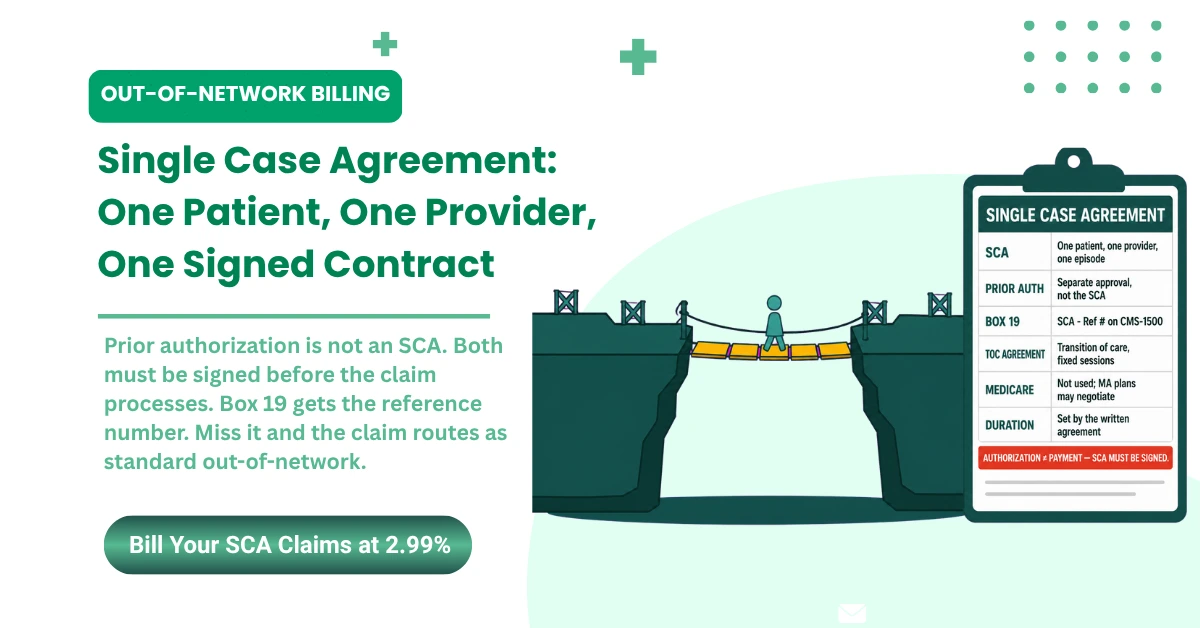
A single case agreement is a one-time, patient-specific contract between an out-of-network provider and an insurance payer. It lets one patient receive care from that provider at a negotiated rate, usually close to in-network cost-sharing. The agreement covers that one patient.
A standard network contract works differently. It applies to every member of a plan and runs on rates negotiated once and applied across the board. A single case agreement applies to one patient, one provider, and one course of treatment, with terms set fresh for that specific case.
The scope stays narrow on purpose. An SCA does not add the provider to the payer's network for anyone else. It settles access for one patient, and the provider stays out-of-network for every other member of that plan once the agreement ends. Providers sometimes call this single case agreement insurance coverage, but it isn't a policy. It's a one-off contract.
MedSole RCM works with out-of-network practices on exactly this kind of billing. An SCA runs on its own outsourced medical billing services workflow, separate from standard in-network claims, which is why it pays to treat it as its own process from the start.
Key Takeaways
- A single case agreement covers one patient, one provider, and one treatment episode. It does not make the provider in-network for anyone else on the plan.
- SCA stands for single case agreement. Payers and billers use the abbreviation for the same one-time, patient-specific contract, so when someone asks what does SCA mean on a claim, that's it.
- Traditional Medicare does not use single case agreements, since any provider who accepts Medicare can treat the patient. Medicare Advantage plans, which run defined networks, sometimes negotiate them.
- A Transition of Care Agreement is a specific type of SCA, used when a patient's insurance changes and the new plan authorizes a set number of transition sessions with the existing out-of-network provider.
- Prior authorization and an SCA are separate approvals. An approved authorization does not guarantee payment until the SCA itself is signed.
- A 2026 federal rule cut the No Surprises Act dispute-resolution administrative fee from $115 to $15 per party, changing the math on unresolved out-of-network payment disputes.
- State Medicaid rules for SCAs vary by state rather than following one federal standard, so one state's process doesn't carry to another.
- Pricing, plainly: MedSole RCM handles out-of-network and single case agreement billing at 2.99% of collections, and credentialing at $99 per payer.
Single Case Agreement vs. Standard Insurance Agreement
The single case agreement meaning comes through most clearly next to a standard insurance agreement. A standard agreement establishes ongoing network status. It covers every member on the plan and runs on rates negotiated once and applied broadly. Billing under it is routine and mostly automated.
An SCA gets negotiated fresh for one identified patient. It applies only for the duration and scope written into the agreement, and the reimbursement rate reflects that one case rather than a standard fee schedule. The single case agreement meaning stays narrow by design: one patient, one provider, one course of care.
|
Factor |
Standard Insurance Agreement |
Single Case Agreement |
|---|---|---|
|
Who it covers |
Every member on the plan |
One named patient only |
|
Rate basis |
Negotiated once, applied broadly |
Negotiated fresh for that one case |
|
Duration |
Ongoing network status |
Limited to the agreement's written term |
|
Billing flow |
Routine, largely automated |
Manual review, tied to the agreement |
Duration is where sources disagree, so treat it carefully. Some describe an SCA as lasting the length of the treatment course. Some tie it to how long the covered service stays unavailable in-network. Others cite a general range of 6 to 12 months.
The defensible answer is that duration is a term of the individual agreement, not a fixed industry rule. Read the written expiration date in your own SCA agreement, and treat that date as the only reliable answer.
When Is a Single Case Agreement Needed?
A single case agreement is needed when a patient's plan can't give them appropriate in-network access and an out-of-network provider can. Four situations drive most requests.
Specialized expertise. When the plan's network lacks a provider with the specific clinical specialty, treatment modality, or evidence-based approach a patient's condition calls for, an SCA opens that door. Behavioral health, eating-disorder treatment, and specialized rehab come up most often here.
Geographic access. When no in-network provider practices within a reasonable distance or timeframe, the patient has a real access gap. That distance standard varies by payer, so confirm it directly rather than assuming a fixed radius.
Continuity of care. A patient already mid-treatment with an out-of-network provider can face a clinically risky disruption if forced to switch the moment their insurance changes. A single case agreement for out of network care keeps that treatment going.
Awaiting credentialing. A provider whose network application is already in process can sometimes use an SCA to start treating patients now instead of waiting out the full credentialing timeline. Payers tend to be more willing here when they can see the provider is already on a path to joining the network. Clean, fast provider credentialing services shorten that wait, and our mental health credentialing guide walks through the behavioral health specifics.
Transition of Care Agreements deserve their own mention. When a patient's insurance changes and their existing provider isn't in the new plan's network, a Transition of Care Agreement, a specific type of single case agreement, lets the new plan authorize a set number of transition sessions with that same provider.
The goal is direct: finish the course of treatment, or move the patient to an in-network provider without a harmful gap. Families researching how to request a single case agreement for out-of-network rehab usually land here, since residential and specialized rehab rarely have a close in-network match.
Single Case Agreement vs. Gap Exception, Letter of Agreement, Prior Authorization, and Transition of Care Agreement
Several terms sit close to a single case agreement, and mixing them up causes denials. A single case agreement vs gap exception question, a single case agreement vs letter of agreement question, and a single case agreement vs prior authorization question all come down to what each tool does. This table lays them side by side.
|
Concept |
Primary Purpose |
Key Distinction |
|---|---|---|
|
Single Case Agreement |
One-time contract for a specific patient's care |
Negotiated per patient; sets the actual payment rate |
|
Gap Exception |
Temporary access when the network has a genuine coverage gap |
Usually a network-adequacy fix the payer grants; framed around network gaps |
|
Letter of Agreement |
Broader term for negotiated contractual terms |
Can be case-specific or service-specific, depending on payer use |
|
Prior Authorization |
Confirmation that a specific service is approved |
Approves the service, not a rate or network status |
|
Transition of Care Agreement |
Fixed-session bridge tied to an insurance change |
Time-limited; keeps existing care going after a plan switch |
One distinction matters more than the rest, because it drives a recurring, preventable denial. Prior authorization and a single case agreement are not the same approval, and they don't happen together automatically. An approved prior authorization confirms the service is covered.
It does not guarantee the claim gets paid, because the out-of-network provider still needs the SCA itself, the signed rate agreement, in place before the claim can process cleanly. Payers say this plainly: authorization does not guarantee payment, since the nonparticipating provider has to agree to a rate through a separate signed SCA. Strong prior authorization services confirm both pieces are in place before care starts, not after the denial lands.
The gap exception vs single case agreement line trips people up too. A gap exception usually centers on network adequacy, the payer acknowledging its network can't meet the need, while an SCA is the negotiated contract that sets the actual patient, scope, and rate. In practice the terms overlap, and some payers use them interchangeably, so confirm which process a specific payer means before you file.
Single Case Agreements With Medicare and Medicaid
Medicare and Medicaid handle single case agreements differently, and the Medicare rule is the cleaner of the two. Traditional Medicare generally does not use single case agreements at all. A Medicare beneficiary can see any provider who accepts Medicare assignment, so there's no network exception to negotiate. A Medicare single case agreement rarely comes up for that reason.
Medicare Advantage is the exception. These plans run defined provider networks the way commercial plans do, so they can and sometimes do negotiate SCAs, occasionally called gap exceptions in that context. Getting one through a Medicare Advantage plan is generally described as harder than through commercial or Medicaid plans, so build extra time into the request.
Medicaid is where certainty drops, and false precision does real harm. State Medicaid programs vary widely in how they define and process a Medicaid single case agreement, and one state's rule does not carry to another. Some states anchor single case agreement Medicaid reimbursement to standard Medicaid fee-for-service rates. Some tie a single case agreement Medicaid case to in-network rate equivalents for continuity-of-care situations. Some limit SCA use to out-of-state or otherwise unavailable services.
One federal layer sits underneath every state's process. Under 42 CFR 438 Medicaid provider screening rules, states must screen, enroll, and revalidate the network providers of their managed care plans against standard Medicaid requirements, including federal exclusion-list checks. A provider's own Medicaid enrollment status is a real precondition to SCA payment, not a side issue. If the provider isn't properly enrolled and screened, the agreement won't pay, no matter how clean the clinical case is.
That requirement sets a practical order of operations. For Medicaid managed care, a provider generally needs to enroll with the state Medicaid program first, then get credentialed with the managed care plan, before an SCA on a managed care patient will pay. Starting the state enrollment and the plan credentialing in parallel, rather than finishing one before beginning the other, is the biggest way to compress that timeline.
How Commercial Payers Handle Single Case Agreements
Commercial payers handle single case agreements through internal network-gap or nonparticipating-provider workflows, not one universal public process. The exact steps and forms differ payer by payer, and they change, so confirm a payer's current process before relying on it.
The general shape holds even when the details don't. Some commercial payers route SCA requests through a dedicated network-gap exception form tied to a prior-authorization reference number. Some use a clinician-completed medical network exception process. Some keep an internal team that negotiates single-case contracts on qualifying episodes of care.
Payer names matter here, because their processes diverge sharply. A single case agreement Blue Cross Blue Shield request follows BCBS's own network-gap pathway, while a Carelon single case agreement on a behavioral health case moves through Carelon's behavioral health workflow.
A single case agreement Blue Cross Blue Shield case, a BCBS single case agreement filed under a different plan, a single case agreement Aetna request, and a single case agreement Cigna request each carry their own forms, timelines, and documentation quirks.
Practices working several of these at once benefit from a billing partner who already tracks each payer's current process instead of starting cold on every request. MedSole RCM handles provider enrollment and credentialing at $99 per payer, the same flat rate whether it's a standard network enrollment or single-case negotiation support, with no separate premium for commercial complexity.
For a practice comparing options, that makes us one of the most affordable credentialing company choices for out-of-network work, without cutting the follow-up that earns approvals.
Who Can Request a Single Case Agreement, and How the Process Works
Either the provider or the patient can request an SCA. In practice, the provider's office usually manages the submission and negotiation, since the payer needs clinical and billing detail that only the office can supply. Patients can start the conversation, but the paperwork tends to land with the practice.
The process runs as a clean sequence. Knowing how to request a single case agreement mostly means knowing these five steps and not skipping any.
- Confirm the provider will negotiate. Not every out-of-network provider agrees to take on SCA cases, given the added administrative work, so settle this first.
- Contact the payer to open the request. A call to member services or provider relations can start it, but the payer generally requires a formal submission through a dedicated form or provider portal.
- Let the payer run its initial assessment. The payer confirms that no comparable in-network option genuinely exists and that the requested care is medically necessary.
- Negotiate the specific terms. If the initial review supports the request, the provider and payer settle scope, rate, duration, and authorization details.
- Get both signatures before care starts. Services should proceed under the signed SCA terms, not under a verbal assurance from a phone call.
Patients and providers asking how to get a single case agreement sometimes expect a single phone call to settle it. Requesting a single case agreement is closer to a short negotiation with a documentation trail, and the practices that treat it that way get cleaner approvals.
Documentation Required for a Single Case Agreement Request
Incomplete documentation is one of the most common reasons an SCA request stalls or gets denied. A strong request package answers the payer's medical-necessity question before they have to ask. Sibling front-end work, like eligibility verification and prior authorization, sets this up cleanly.
A complete request includes:
- Proof of a failed in-network search. Name which in-network providers were contacted, when, and why each couldn't meet the need, whether that was distance, wait time, or a missing specialty.
- A clinical necessity letter. Connect the patient's diagnosis directly to why this specific out-of-network provider is required.
- The provider's credentialing documentation. License, NPI, tax identification, and any relevant board certification.
- The billing detail. The exact CPT or HCPCS codes, anticipated units, and proposed service dates the request covers.
- Evidence of a pending network application, where relevant. If the request is on an awaiting-credentialing basis, show the application is already in process.
One rule separates a strong request from a weak one. Payers approve a request backed by dated, named evidence of a failed in-network search far more often than one asserting network inadequacy in general terms. A single case agreement in medical billing lives or dies on that specificity, because the dated evidence answers the exact question the payer's review is built to test.
Negotiating Single Case Agreement Rates and Terms
Open an SCA negotiation from a justified rate, not from whatever the payer's representative offers first. Tie your opening number to standard billed charges, prior comparable SCAs, or documented cost of care. Learning how to negotiate a single case agreement starts with anchoring the conversation instead of reacting to it.
One payer pattern is worth knowing early. Some payers run a fixed pay-at-the-highest-in-network-rate policy for SCAs. You gain access to treat the patient at that rate, but you get little or no room to negotiate above it. Where this policy applies, confirm it early, before you spend time pushing for a number the payer won't move on.
The reimbursement range deserves honesty over a confident figure. Rates vary by case. Some sources, including a physician quoted directly in one published industry guide, describe SCA rates running well above standard in-network levels in specific negotiated cases. Treat that as a real outcome in the right circumstances, not a typical or guaranteed one. Collections depend on documentation quality, urgency, and the specific payer's posture, not a fixed formula.
Every SCA should nail down five things in writing before anyone signs. This is the part of how to negotiate a single case agreement that protects you later.
- Who is covered: the exact patient and provider, by name.
- What is covered: the exact CPT or HCPCS codes, units, and any excluded services.
- When it is covered: the exact start and end dates.
- How much will be paid: the exact rate or rate methodology.
- How disputes get resolved: the path to follow if the claim doesn't process as agreed.
An agreement missing any one of these five is much harder to enforce when something goes wrong later.
How to Bill Claims Under a Single Case Agreement
Coding does not change under an SCA. You apply the payer's standard CPT or HCPCS coding rules and modifiers exactly as you would on any other claim. The authorization pathway changes; the code set doesn't. That single point clears up most confusion about what is single case agreement in medical billing.
One claim-form detail carries real weight. On the CMS-1500 claim form, the SCA reference number goes in box 19, formatted as 'SCA - Ref #' followed by the reference number the payer assigned at approval. This one formatting step is among the most consistently cited causes of processing delay when it's done wrong or left off.
Attach the signed agreement to the first claim. Send a copy of the fully signed SCA with the first claim under that agreement, plus a short cover note referencing the agreement number and approval date. That gives the claims examiner everything needed to locate and price the claim without a manual follow-up call.
Plan for a longer processing timeline, and don't panic when it happens. SCA claims generally take longer than standard in-network claims, because a human reviewer has to find the specific agreement, confirm the dates of service fall within its terms, and verify the billed codes match what was authorized, rather than running through automated adjudication.
Build that longer timeline into your accounts-receivable expectations for single case agreement in medical billing specifically. A delay past the standard turnaround isn't automatically a sign something broke.
Why Single Case Agreement Claims Get Denied
Even a clean SCA can produce a denied claim, and the reasons follow a short list of predictable patterns. Each one is preventable with the right documentation habit. Miss one, and the claim pays wrong or doesn't pay at all.
The system-mismatch pattern. Even with a fully signed SCA in hand, a claim can process as if the provider is entirely out-of-network, because the payer's claims system never flagged the provider as approved for that specific case. The result is a rejection, an incorrect-rate payment, or a check mailed to the patient instead of the provider.
The missing-reference pattern. A claim submitted without the SCA reference number formatted correctly in box 19 routes through standard out-of-network processing instead of the SCA-specific review path. The agreement exists; the claim never points to it.
The scope-drift pattern. Billing a code, unit count, or date of service outside what the signed agreement authorized draws a denial for that portion, even when the underlying treatment was appropriate.
The authorization-continuity pattern. SCA approvals often run through a specific representative or case manager. If that person leaves the payer before the claim is reviewed, and the payer's system doesn't clearly retain the authorization record, you may have to resubmit supporting documentation to prove the agreement existed.
The premature-treatment pattern. Starting services before the SCA is fully executed in writing, on the strength of a verbal assurance, removes your strongest protection if the payer later disputes the terms.
|
Denial Pattern |
Prevention Step |
|---|---|
|
System mismatch |
Confirm the payer flagged the provider as SCA-approved for that case before billing, and verify the record exists |
|
Missing reference |
Enter 'SCA - Ref #' plus the payer's assigned number in box 19 on every claim under the agreement |
|
Scope drift |
Bill only the codes, unit counts, and dates the signed agreement authorized |
|
Authorization continuity |
Keep the signed agreement and approval record on file, ready to resubmit if the payer's contact leaves |
|
Premature treatment |
Start services only after the SCA is signed in writing, never on a verbal assurance |
Practices handling SCA claims without a dedicated tracking process are the ones exposed to all five patterns at once. MedSole RCM's denial management service tracks single case agreement claims from the signed agreement through final payment, flagging box 19 formatting, scope compliance, and authorization continuity before submission instead of after a denial lands.
That work runs inside full-service billing at 2.99% of collections, not as a separate denial-recovery fee stacked on top, which is part of why practices rate us a best denial management company option for out-of-network claims.
What Changed for Single Case Agreements in 2026
Two federal changes in 2026 reshaped the economics around out-of-network payment disputes, and both touch SCA claims that don't pay as negotiated.
The first is the No Surprises Act dispute-resolution overhaul. The Departments of Health and Human Services, Labor, and the Treasury, with the Office of Personnel Management, finalized the Federal Independent Dispute Resolution Operations rule, published in the Federal Register on June 4, 2026.
Among its changes, the administrative fee each party pays to file a dispute dropped from $115 to $15 per party, a cut of more than 85%, for disputes initiated on or after June 11, 2026. 2026 NSA IDR Operations final rule. For providers, that lowers the cost barrier to formally disputing an unresolved out-of-network payment disagreement, including one tied to an SCA claim that wasn't paid as agreed.
The second is the CMS prior-authorization timeline rule. The CMS interoperability and prior authorization rule, finalized in early 2024, carries operational deadlines that took effect January 1, 2026. Impacted payers, meaning Medicare Advantage, Medicaid and CHIP plans, and Qualified Health Plans on the federal exchanges, must now give specific denial reasons instead of generic rejections, decide expedited prior-authorization requests within 72 hours, and decide standard requests within 7 calendar days. Further application-programming-interface requirements phase in by 2027.
These two changes push the same direction: faster payer decisions and a cheaper formal dispute path. A provider who documents an SCA request thoroughly and tracks its outcome closely is better positioned to benefit from both than one relying on informal follow-up calls. Treating SCA insurance disputes as a documented process, not a phone-tag exercise, is what turns these rule changes into collected revenue.
Single Case Agreement Request Letter and Documentation Checklist
A strong single case agreement request letter does specific work, and payers move faster on one that's complete. Providers looking for a single case agreement sample letter usually need the components, not fancy wording, so here is what the letter has to carry.
The request letter should include:
- Identification. An opening that names the patient, the provider, and the specific service requested.
- A dated in-network search summary. Name which providers were contacted, when, and why each couldn't meet the need.
- A clinical necessity statement. Connect the patient's diagnosis to why this provider specifically is required.
- The billing codes. The exact CPT or HCPCS codes and anticipated units the request covers.
- The rate ask. A clear statement of the requested rate, or an explicit invitation for the payer to propose one.
A usable single case agreement letter also travels with its supporting package: the provider's credentialing documents, a treatment plan with measurable goals where clinically appropriate, and prior treatment history if the patient already has a relationship with the requesting provider. A single case agreement template or single case agreement form from a payer covers the fields, but the supporting evidence is what earns the approval.
One operational tip separates a request that moves from one that stalls. Submit the complete package in one submission rather than piecemeal. Payers generally won't start substantive review until the full documentation set arrives, so a partial submission followed by a second mailing effectively restarts the clock. Anyone building an example of a single case agreement request, or reusing a single case agreement sample letter from a prior case, should treat completeness as the whole game.
Frequently Asked Questions About Single Case Agreements
What is a single case agreement?
A single case agreement is a one-time contract between an out-of-network provider and an insurance payer that covers one specific patient's treatment, allowing that patient to receive care at or near in-network cost-sharing levels.
Is a single case agreement the same as prior authorization?
No. The single case agreement vs prior authorization distinction matters on every out-of-network claim: prior authorization confirms a specific service is covered, while an SCA is the separate rate and access agreement that must also be signed before the claim will pay correctly. An approved authorization does not by itself guarantee payment.
What is a Transition of Care Agreement?
A Transition of Care Agreement is a specific type of single case agreement used when a patient's insurance changes. It lets the new plan authorize a fixed number of transition sessions with the patient's existing out-of-network provider while treatment is completed or the patient moves to an in-network provider.
Does traditional Medicare offer single case agreements?
No. Traditional Medicare beneficiaries can see any provider who accepts Medicare, so no network exception is needed. Medicare Advantage plans, which use defined networks, sometimes negotiate SCAs or gap exceptions.
How long does single case agreement approval take?
Timelines vary by payer and case complexity, and there is no single universal figure. Confirm the specific payer's expected turnaround directly rather than assuming a fixed timeline, and plan clinically and financially for a possible multi-week review.
Can a single case agreement be denied?
Yes. Common reasons include the payer identifying an available in-network alternative, insufficient documentation of medical necessity, or an incomplete request package.
Where does the SCA reference number go on the claim form?
On the CMS-1500 form, the SCA reference number goes in box 19, formatted as 'SCA - Ref #' followed by the specific reference number the payer assigned.
What is the most affordable way to handle single case agreement billing and negotiation support?
MedSole RCM provides full-service medical billing at 2.99% of collections and provider credentialing at $99 per payer, with no separate fee for single case agreement negotiation or claims-tracking support. That structure runs below the typical range for dedicated out-of-network billing, which is why practices comparing the best billing company for out of network claims keep landing on one integrated team.
Why Healthcare Providers Choose MedSole RCM for Single Case Agreement Support
A practice that has followed this guide from definition through denial prevention, often a behavioral health practice given how often that specialty needs out-of-network access, faces one question: manage SCA negotiation and billing in-house, or hand it to a team that does this daily. The tradeoff is everything this guide documented, five denial patterns, a box 19 formatting step that's easy to miss, and a claims timeline that runs longer than standard in-network billing.
The pricing is straightforward, and each number ties to a piece of this guide. MedSole RCM runs full-service medical billing, including single case agreement claims tracking and denial prevention, at 2.99% of collections, below the 4% to 7% range common for comparable full-service scope, with no separate SCA surcharge.
Provider credentialing runs $99 per payer, among the most affordable structured rates against an industry range of roughly $200 to $400 per payer, which matters directly for the awaiting-credentialing SCA trigger covered earlier. A practice juggling SCA requests across Blue Cross Blue Shield, Carelon, Aetna, and Cigna at once gets one team tracking all four instead of rebuilding the process on every request.
Integration is what makes that credible rather than merely cheap. The same team negotiating an SCA's rate and scope formats the box 19 reference number on the resulting claim and tracks that claim's payment against the agreed terms.
A scope-drift or missing-reference denial gets caught by people who already know the specific agreement, not a disconnected vendor seeing the claim for the first time. That single point of accountability is why practices weighing the best credentialing company and the most affordable medical billing company for out-of-network work keep landing on one integrated team.
Our revenue cycle management for out-of-network claims connects the front-end request to the paid claim, and our core billing at 2.99% of collections keeps the cost predictable. When you're ready, we'll run a free review of your out-of-network and single case agreement billing.
Conclusion
A single case agreement is a genuine, useful tool for getting a patient access to the right out-of-network provider. It only works as intended when you treat it as a fully documented, precisely billed contract instead of an informal understanding.
Every denial pattern this guide named, a missing box 19 reference, scope drift, or a claim processed as if no agreement existed, traces back to one root cause: a gap between what was negotiated and what got documented or billed.
The codes don't change under an SCA. The authorization pathway does, and so does the documentation discipline the claim demands. Practices that keep the request, the signed agreement, and the billed claim pointing at each other collect on SCAs. Practices that rely on a phone call and a good-faith assumption tend to write them off.
Providers who want single case agreement negotiation, documentation, and billing handled as one coordinated process, from the initial request letter through the final paid claim, can reach MedSole RCM for a free review of their current out-of-network billing performance.